Data Warehousing and
Data Mart
• A data warehouse is a database designed to
enable business intelligence activities: it exists to
help users understand and enhance their
organization's performance. It is designed for
query and analysis rather than for transaction
processing, and usually contains historical data
derived from transaction data, but can include
data from other sources. Data warehouses
separate analysis workload from transaction
workload and enable an organization to
consolidate data from several sources. This helps
in:
• Maintaining historical records
• Analyzing the data to gain a better understanding
of the business and to improve the business
• In addition to a relational database, a data
warehouse environment can include an
extraction, transportation, transformation, and
loading (ETL) solution, statistical analysis,
reporting, data mining capabilities, client analysis
tools, and other applications that manage the
process of gathering data, transforming it into
useful, actionable information, and delivering it
to business users.
• A data warehouse usually stores many months or
years of data to support historical analysis. The
data in a data warehouse is typically loaded
through an extraction, transformation, and
loading (ETL) process from multiple data sources.
• A data mart serves the same role as a data warehouse, but it is
intentionally limited in scope. It may serve one particular
department or line of business.
• The advantage of a data mart versus a data warehouse is that it
can be created much faster due to its limited coverage. However,
data marts also create problems with inconsistency.
• It takes tight discipline to keep data and calculation definitions
consistent across data marts. This problem has been widely
recognized, so data marts exist in two styles.
• Independent data marts are those which are fed directly from
source data. They can turn into islands of inconsistent
information.
• Dependent data marts are fed from an existing data warehouse.
• Dependent data marts can avoid the problems of inconsistency,
but they require that an enterprise-level data warehouse already
exist.
• A common way of introducing data
warehousing is to refer to the characteristics
of a data warehouse as set forth by William
Inmon:
Subject Oriented
Integrated
Nonvolatile
Time Varient
Key Characteristics of a Data Warehouse: The key
characteristics of a data warehouse are as follows:
• Data is structured for simplicity of access and high-
speed query performance.
• End users are time-sensitive and desire speed-of-
thought response times.
• Large amounts of historical data are used.
• Queries often retrieve large amounts of data, perhaps
many thousands of rows.
• Both predefined and ad hoc queries are common.
• The data load involves multiple sources and
transformations.
• In general, fast query performance with high data
throughput is the key to a successful data warehouse.
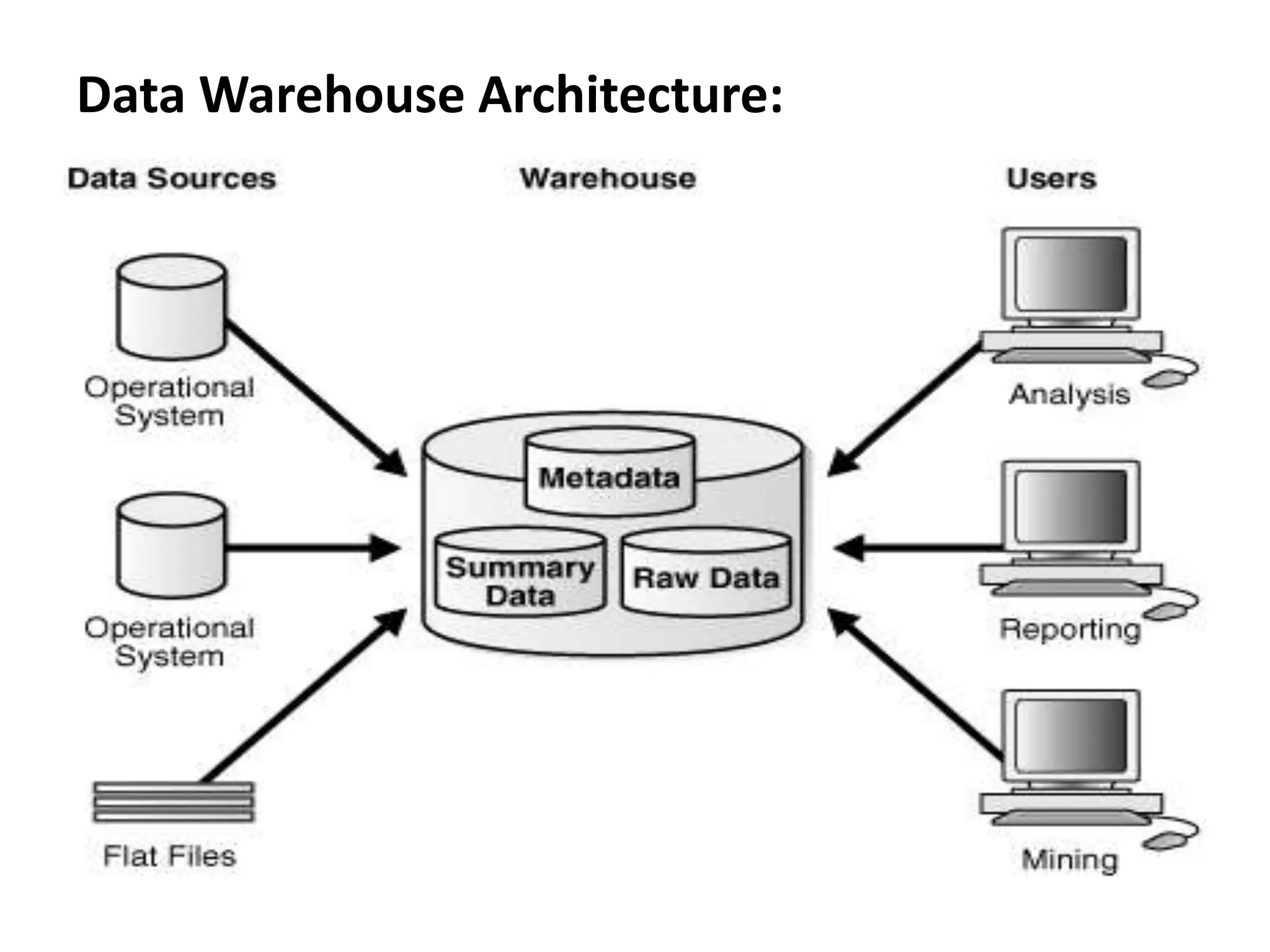
Data Warehouse Architecture:
Fig: Architecture of a Data Warehouse with a Staging Area and Data Marts

Data warehousing and data mart

  • 1.
  • 2.
    • A datawarehouse is a database designed to enable business intelligence activities: it exists to help users understand and enhance their organization's performance. It is designed for query and analysis rather than for transaction processing, and usually contains historical data derived from transaction data, but can include data from other sources. Data warehouses separate analysis workload from transaction workload and enable an organization to consolidate data from several sources. This helps in: • Maintaining historical records • Analyzing the data to gain a better understanding of the business and to improve the business
  • 3.
    • In additionto a relational database, a data warehouse environment can include an extraction, transportation, transformation, and loading (ETL) solution, statistical analysis, reporting, data mining capabilities, client analysis tools, and other applications that manage the process of gathering data, transforming it into useful, actionable information, and delivering it to business users. • A data warehouse usually stores many months or years of data to support historical analysis. The data in a data warehouse is typically loaded through an extraction, transformation, and loading (ETL) process from multiple data sources.
  • 4.
    • A datamart serves the same role as a data warehouse, but it is intentionally limited in scope. It may serve one particular department or line of business. • The advantage of a data mart versus a data warehouse is that it can be created much faster due to its limited coverage. However, data marts also create problems with inconsistency. • It takes tight discipline to keep data and calculation definitions consistent across data marts. This problem has been widely recognized, so data marts exist in two styles. • Independent data marts are those which are fed directly from source data. They can turn into islands of inconsistent information. • Dependent data marts are fed from an existing data warehouse. • Dependent data marts can avoid the problems of inconsistency, but they require that an enterprise-level data warehouse already exist.
  • 5.
    • A commonway of introducing data warehousing is to refer to the characteristics of a data warehouse as set forth by William Inmon: Subject Oriented Integrated Nonvolatile Time Varient
  • 6.
    Key Characteristics ofa Data Warehouse: The key characteristics of a data warehouse are as follows: • Data is structured for simplicity of access and high- speed query performance. • End users are time-sensitive and desire speed-of- thought response times. • Large amounts of historical data are used. • Queries often retrieve large amounts of data, perhaps many thousands of rows. • Both predefined and ad hoc queries are common. • The data load involves multiple sources and transformations. • In general, fast query performance with high data throughput is the key to a successful data warehouse.
  • 7.
  • 8.
    Fig: Architecture ofa Data Warehouse with a Staging Area and Data Marts