Data Warehouse Design
& Dimensional Modeling
Aaron Lowe
Principal Consultant
@Vendoran
@SQLFriends
Who am I
» Aaron Lowe
  » Husband
  » Father of 5
  » Principal Consultant at Magenic
  » Working with SQL Server since 1998, version 6.5
  » MCITP 2005 and 2008
  » Co-organizer of SQLSaturday Chicago
  » Masters in Information Systems Management
  » www.aaronlowe.net / @Vendoran
  » sqlfriends.org / @SQLFriends
Data, Data everywhere, but not a drop of
Information


             http://www.flickr.com/photos/walkingsf/5993167874/
The Data Person


             http://www.flickr.com/photos/tantek/1360323838/
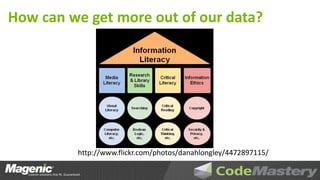
How can we get more out of our data?


         http://www.flickr.com/photos/danahlongley/4472897115/
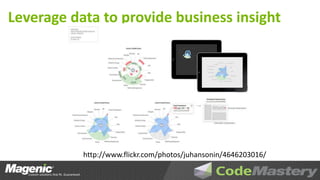
Leverage data to provide business insight


           http://www.flickr.com/photos/juhansonin/4646203016/
Create a new Data Model in a Data Warehouse
Why a new Data Model?
What do we need?
Information – not just data
» Collecting data
  » Log Files
  » Clicks
  » How long?
  » How much?
» Prediction?
  » How Target Figured out Teen was pregnant -
    http://www.forbes.com/sites/kashmirhill/2012/02/16/how-target-figured-
    out-a-teen-girl-was-pregnant-before-her-father-did/
  » The Numerati - http://www.amazon.com/The-Numerati-Stephen-
    Baker/dp/B003TO6G20/ - published 2009!
Relate data from multiple systems
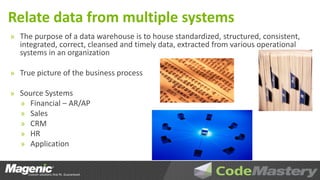
» The purpose of a data warehouse is to house standardized, structured, consistent,
  integrated, correct, cleansed and timely data, extracted from various operational
  systems in an organization

» True picture of the business process

» Source Systems
  » Financial – AR/AP
  » Sales
  » CRM
  » HR
  » Application
Fast
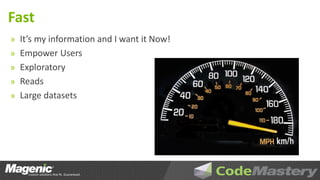
» It’s my information and I want it Now!
» Empower Users
» Exploratory
» Reads
» Large datasets
Why won’t existing models work?
What are they designed for?
» Operational
   » Preservation of data integrity
   » Speed of recording of business transactions
   » Often Many tables


» To free the collection of relations from undesirable insertion, update and deletion dependencies;
» To reduce the need for restructuring the collection of relations, as new types of data are introduced,
  and thus increase the life span of application programs;
» To make the relational model more informative to users;
» To make the collection of relations neutral to the query statistics, where these statistics are liable to
  change as time goes by.
» —E.F. Codd, "Further Normalization of the Data Base Relational Model"
Consistent
» Partial data across
  » Have the sale in the sales system
  » Represented in the inventory system
  » Don’t have the $ in the financial system yet

» Deleted on sources
  » Removed transactions
  » Archive
  » Legally destroy records can remove work product

» Incomplete data on source
  » Changes over time
Silo’d
» How do we get the entire picture?


» Example:
  » Cost of Sales?
     » Sales system – Sale Price
     » Marketing System – $$ spent on Marketing
     » Inventory System – $$ spent on inventory
     » HR System – $$ spent on Employee
     » IT Systems – $$ spent on Infrastructure
What will work?


         http://www.flickr.com/photos/d-y-f/2870942257/
Designed for Users
» De-normalized
  » Fast Reads
  » Fast Reports
  » Limited JOINs

» Information
  » Scheduled
  » On Demand
  » Exploratory

» Information
  » Cross Functional
  » The more the better!
Inter-related data
» Specifications for my Current Data Warehouse


            http://www.flickr.com/photos/ross_goodman/3276964270/
Independent from Operational
» Operational systems change
  » Data will outlive Application
  » Crashes
  » Upgrades
  » Breaking changes


» Single Source of truth
Logical Data Model


           http://www.flickr.com/photos/doctorlizardo/6812846803/
Terminology


       http://www.flickr.com/photos/doctorlizardo/6809564765/
Metadata Management
» Business metadata
  » What’s out there?
  » Identify/Define
      » Overloaded terms
      » What is a customer?
» Process metadata
  » DW process operations
  » Asses system status
  » Investigate problems
» Technical metadata
  » Tables
  » Fields
  » Datatypes
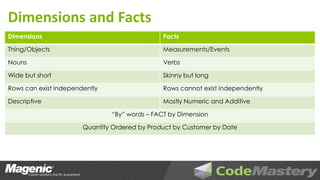
Dimensions and Facts
Dimensions                                     Facts

Thing/Objects                                  Measurements/Events

Nouns                                          Verbs

Wide but short                                 Skinny but long

Rows can exist independently                   Rows cannot exist independently

Descriptive                                    Mostly Numeric and Additive

                               “By” words – FACT by Dimension

                       Quantity Ordered by Product by Customer by Date
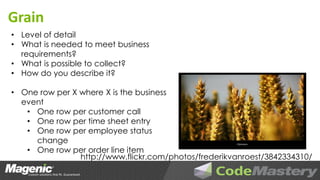
Grain
• Level of detail
• What is needed to meet business
  requirements?
• What is possible to collect?
• How do you describe it?

• One row per X where X is the business
  event
   • One row per customer call
   • One row per time sheet entry
   • One row per employee status
     change
   • One row per order line item
                http://www.flickr.com/photos/frederikvanroest/3842334310/
Methodology


       http://www.flickr.com/photos/doctorlizardo/6812847973/
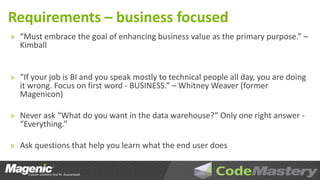
Requirements – business focused
» “Must embrace the goal of enhancing business value as the primary purpose.” –
  Kimball


» “If your job is BI and you speak mostly to technical people all day, you are doing
  it wrong. Focus on first word - BUSINESS.” – Whitney Weaver (former
  Magenicon)

» Never ask “What do you want in the data warehouse?” Only one right answer -
  “Everything.”

» Ask questions that help you learn what the end user does
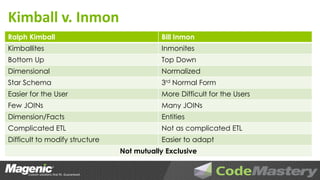
Kimball v. Inmon
Ralph Kimball                              Bill Inmon
Kimballites                                Inmonites
Bottom Up                                  Top Down
Dimensional                                Normalized
Star Schema                                3rd Normal Form
Easier for the User                        More Difficult for the Users
Few JOINs                                  Many JOINs
Dimension/Facts                            Entities
Complicated ETL                            Not as complicated ETL
Difficult to modify structure              Easier to adapt
                                Not mutually Exclusive
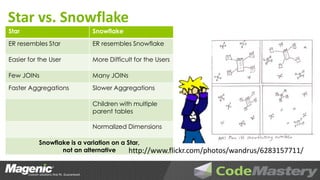
Star vs. Snowflake
Star                      Snowflake
ER resembles Star         ER resembles Snowflake

Easier for the User       More Difficult for the Users

Few JOINs                 Many JOINs
Faster Aggregations       Slower Aggregations

                          Children with multiple
                          parent tables

                          Normalized Dimensions

           Snowflake is a variation on a Star,
                  not an alternative      http://www.flickr.com/photos/wandrus/6283157711/
History (ology?)


           http://www.flickr.com/photos/doctorlizardo/6809564335/
Dimension Types
» 0 – Inserts only, no updates or delete
» 1 – Insert and updated to reflect current state
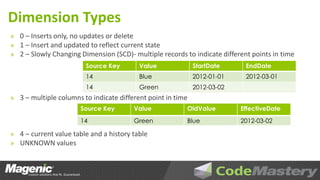
» 2 – Slowly Changing Dimension (SCD)- multiple records to indicate different points in time
                        Source Key        Value              StartDate      EndDate
                        14                Blue               2012-01-01     2012-03-01
                        14                Green              2012-03-02
» 3 – multiple columns to indicate different point in time
                       Source Key       Value            OldValue         EffectiveDate
                       14               Green            Blue             2012-03-02

» 4 – current value table and a history table
» UNKNOWN values
Date and Time
» Date
  » Fundamental dimensions across all organizations and industries
  » Allows for trending across dates or periods
  » 1 row for every date in the years = 365 or 366 row/year
  » Use your words
      »   WeekDay
      »   EndofMonth
      »   Quarter
      »   FiscalYear?
» Time
  » Not often needed, but becoming more popular
  » Allows for time based analysis for things like Status
  » 1 row for every time slice in a day – minutes? Seconds?
Surrogate Keys
» New set of keys in the DW


» Protects against
  » Source systems changes
  » Single key for multiple source systems
  » New rows that only exist in DW (UNKNOWN)
  » Tracking over time (SCD)
Physical Data Model


           http://www.flickr.com/photos/flying_cloud/2667218708/
Approach


           http://www.flickr.com/photos/7506006@N07/7021456259/
Null – yay or nay
» Same discussion as OLTP with a twist
  » Purpose of DW is for reporting
  » Building on top of with :
     » SSIS
     » SSAS
  » Purpose of the Dimension UNKNOWN values


» Best practice is to avoid if you can, otherwise document
  » Some have separate values for UNKNOWN and NOT POPULATED
  » Default value instead
Aggregates
» Minimize number of aggregates while maximize effectiveness

» Store or

» Can aggregate Facts

» Roll-up Dimension hierarchies?

» Can still be relational to other tables when necessary
Hierarchies
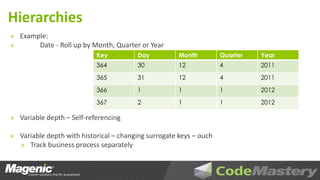
» Example:
»      Date - Roll up by Month, Quarter or Year
                           Key          Day           Month         Quarter   Year
                           364          30            12            4         2011
                           365          31            12            4         2011
                           366          1             1             1         2012
                           367          2             1             1         2012

» Variable depth – Self-referencing

» Variable depth with historical – changing surrogate keys – ouch
  » Track business process separately
Size Matters


      http://starwars.wikia.com/wiki/Rancor?image=Rancor-jpg
Data amount and size
» Data Types?
  » BLOB data?
  » Identity columns (do you need bigint?)

» Data Profiling
  » Collect source system sizes for data bringing over
  » Add sizes of new row

» Don’t forget index size!!!
Partitioning
» Usually lends naturally to partitioning large Fact tables by Date


» Larger Dimension tables can be partitioned as well


» Sometimes Old (SQL 2000) Partitioning is still better than SQL 2005+
  partitioning

» Take ETL process into consideration
Archiving
» Question: When is big too big?


» Answer: When performance impact outweighs need for data availability


» Many options:
  » Backup to tape offline
  » keep “Archived” DW available
» Records Retention – this could be your work product
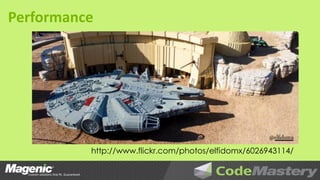
Performance


          http://www.flickr.com/photos/elfidomx/6026943114/
Hardware
» Remember when the user said “It’s my data and I want it now”?
» Buy
  » Reference Architecture (Fast Track)
  » Appliances
      » HP
        »    Enterprise Data Warehouse
        »    Business Decision
        »    Business Data Warehouse
        »    Enterprise Database Consolidation
      » Dell
        » PDW
» Build
  » Reference Architecture (Fast Track)
  » SQLIO
  » Benchmark
Throughput
»   Amounts of data
    » Not all of it will be in memory
    » Between ETL and reports, SP Cache might not be efficient
    » Need to tune those disks

»   Reference Architecture(Fast Track)
    » Accepts that Procedure cache will stink due to data sizes
    » Instead small amount of RAM
    » Requires bandwidth of 400 GB/s per LUN

»   Materialize data that makes reporting faster!!
    » More Denormalization
    » More Aggregations

»   ReadOnly while not processing ETLs? (switch)
Parallelism
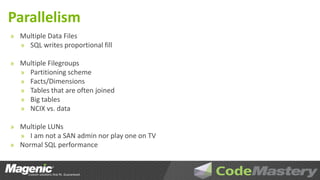
» Multiple Data Files
  » SQL writes proportional fill

» Multiple Filegroups
  » Partitioning scheme
  » Facts/Dimensions
  » Tables that are often joined
  » Big tables
  » NCIX vs. data

» Multiple LUNs
  » I am not a SAN admin nor play one on TV
» Normal SQL performance
Questions and Discussion time!

Data Warehouse Design & Dimensional Modeling

  • 1.
    Data Warehouse Design &Dimensional Modeling Aaron Lowe Principal Consultant @Vendoran @SQLFriends
  • 2.
    Who am I »Aaron Lowe » Husband » Father of 5 » Principal Consultant at Magenic » Working with SQL Server since 1998, version 6.5 » MCITP 2005 and 2008 » Co-organizer of SQLSaturday Chicago » Masters in Information Systems Management » www.aaronlowe.net / @Vendoran » sqlfriends.org / @SQLFriends
  • 3.
    Data, Data everywhere,but not a drop of Information http://www.flickr.com/photos/walkingsf/5993167874/
  • 4.
    The Data Person http://www.flickr.com/photos/tantek/1360323838/
  • 5.
    How can weget more out of our data? http://www.flickr.com/photos/danahlongley/4472897115/
  • 6.
    Leverage data toprovide business insight http://www.flickr.com/photos/juhansonin/4646203016/
  • 7.
    Create a newData Model in a Data Warehouse
  • 8.
    Why a newData Model?
  • 9.
  • 10.
    Information – notjust data » Collecting data » Log Files » Clicks » How long? » How much? » Prediction? » How Target Figured out Teen was pregnant - http://www.forbes.com/sites/kashmirhill/2012/02/16/how-target-figured- out-a-teen-girl-was-pregnant-before-her-father-did/ » The Numerati - http://www.amazon.com/The-Numerati-Stephen- Baker/dp/B003TO6G20/ - published 2009!
  • 11.
    Relate data frommultiple systems » The purpose of a data warehouse is to house standardized, structured, consistent, integrated, correct, cleansed and timely data, extracted from various operational systems in an organization » True picture of the business process » Source Systems » Financial – AR/AP » Sales » CRM » HR » Application
  • 12.
    Fast » It’s myinformation and I want it Now! » Empower Users » Exploratory » Reads » Large datasets
  • 13.
  • 14.
    What are theydesigned for? » Operational » Preservation of data integrity » Speed of recording of business transactions » Often Many tables » To free the collection of relations from undesirable insertion, update and deletion dependencies; » To reduce the need for restructuring the collection of relations, as new types of data are introduced, and thus increase the life span of application programs; » To make the relational model more informative to users; » To make the collection of relations neutral to the query statistics, where these statistics are liable to change as time goes by. » —E.F. Codd, "Further Normalization of the Data Base Relational Model"
  • 15.
    Consistent » Partial dataacross » Have the sale in the sales system » Represented in the inventory system » Don’t have the $ in the financial system yet » Deleted on sources » Removed transactions » Archive » Legally destroy records can remove work product » Incomplete data on source » Changes over time
  • 16.
    Silo’d » How dowe get the entire picture? » Example: » Cost of Sales? » Sales system – Sale Price » Marketing System – $$ spent on Marketing » Inventory System – $$ spent on inventory » HR System – $$ spent on Employee » IT Systems – $$ spent on Infrastructure
  • 17.
    What will work? http://www.flickr.com/photos/d-y-f/2870942257/
  • 18.
    Designed for Users »De-normalized » Fast Reads » Fast Reports » Limited JOINs » Information » Scheduled » On Demand » Exploratory » Information » Cross Functional » The more the better!
  • 19.
    Inter-related data » Specificationsfor my Current Data Warehouse http://www.flickr.com/photos/ross_goodman/3276964270/
  • 20.
    Independent from Operational »Operational systems change » Data will outlive Application » Crashes » Upgrades » Breaking changes » Single Source of truth
  • 21.
    Logical Data Model http://www.flickr.com/photos/doctorlizardo/6812846803/
  • 22.
    Terminology http://www.flickr.com/photos/doctorlizardo/6809564765/
  • 23.
    Metadata Management » Businessmetadata » What’s out there? » Identify/Define » Overloaded terms » What is a customer? » Process metadata » DW process operations » Asses system status » Investigate problems » Technical metadata » Tables » Fields » Datatypes
  • 24.
    Dimensions and Facts Dimensions Facts Thing/Objects Measurements/Events Nouns Verbs Wide but short Skinny but long Rows can exist independently Rows cannot exist independently Descriptive Mostly Numeric and Additive “By” words – FACT by Dimension Quantity Ordered by Product by Customer by Date
  • 25.
    Grain • Level ofdetail • What is needed to meet business requirements? • What is possible to collect? • How do you describe it? • One row per X where X is the business event • One row per customer call • One row per time sheet entry • One row per employee status change • One row per order line item http://www.flickr.com/photos/frederikvanroest/3842334310/
  • 26.
    Methodology http://www.flickr.com/photos/doctorlizardo/6812847973/
  • 27.
    Requirements – businessfocused » “Must embrace the goal of enhancing business value as the primary purpose.” – Kimball » “If your job is BI and you speak mostly to technical people all day, you are doing it wrong. Focus on first word - BUSINESS.” – Whitney Weaver (former Magenicon) » Never ask “What do you want in the data warehouse?” Only one right answer - “Everything.” » Ask questions that help you learn what the end user does
  • 28.
    Kimball v. Inmon RalphKimball Bill Inmon Kimballites Inmonites Bottom Up Top Down Dimensional Normalized Star Schema 3rd Normal Form Easier for the User More Difficult for the Users Few JOINs Many JOINs Dimension/Facts Entities Complicated ETL Not as complicated ETL Difficult to modify structure Easier to adapt Not mutually Exclusive
  • 29.
    Star vs. Snowflake Star Snowflake ER resembles Star ER resembles Snowflake Easier for the User More Difficult for the Users Few JOINs Many JOINs Faster Aggregations Slower Aggregations Children with multiple parent tables Normalized Dimensions Snowflake is a variation on a Star, not an alternative http://www.flickr.com/photos/wandrus/6283157711/
  • 30.
    History (ology?) http://www.flickr.com/photos/doctorlizardo/6809564335/
  • 31.
    Dimension Types » 0– Inserts only, no updates or delete » 1 – Insert and updated to reflect current state » 2 – Slowly Changing Dimension (SCD)- multiple records to indicate different points in time Source Key Value StartDate EndDate 14 Blue 2012-01-01 2012-03-01 14 Green 2012-03-02 » 3 – multiple columns to indicate different point in time Source Key Value OldValue EffectiveDate 14 Green Blue 2012-03-02 » 4 – current value table and a history table » UNKNOWN values
  • 32.
    Date and Time »Date » Fundamental dimensions across all organizations and industries » Allows for trending across dates or periods » 1 row for every date in the years = 365 or 366 row/year » Use your words » WeekDay » EndofMonth » Quarter » FiscalYear? » Time » Not often needed, but becoming more popular » Allows for time based analysis for things like Status » 1 row for every time slice in a day – minutes? Seconds?
  • 33.
    Surrogate Keys » Newset of keys in the DW » Protects against » Source systems changes » Single key for multiple source systems » New rows that only exist in DW (UNKNOWN) » Tracking over time (SCD)
  • 34.
    Physical Data Model http://www.flickr.com/photos/flying_cloud/2667218708/
  • 35.
    Approach http://www.flickr.com/photos/7506006@N07/7021456259/
  • 36.
    Null – yayor nay » Same discussion as OLTP with a twist » Purpose of DW is for reporting » Building on top of with : » SSIS » SSAS » Purpose of the Dimension UNKNOWN values » Best practice is to avoid if you can, otherwise document » Some have separate values for UNKNOWN and NOT POPULATED » Default value instead
  • 37.
    Aggregates » Minimize numberof aggregates while maximize effectiveness » Store or » Can aggregate Facts » Roll-up Dimension hierarchies? » Can still be relational to other tables when necessary
  • 38.
    Hierarchies » Example: » Date - Roll up by Month, Quarter or Year Key Day Month Quarter Year 364 30 12 4 2011 365 31 12 4 2011 366 1 1 1 2012 367 2 1 1 2012 » Variable depth – Self-referencing » Variable depth with historical – changing surrogate keys – ouch » Track business process separately
  • 39.
    Size Matters http://starwars.wikia.com/wiki/Rancor?image=Rancor-jpg
  • 40.
    Data amount andsize » Data Types? » BLOB data? » Identity columns (do you need bigint?) » Data Profiling » Collect source system sizes for data bringing over » Add sizes of new row » Don’t forget index size!!!
  • 41.
    Partitioning » Usually lendsnaturally to partitioning large Fact tables by Date » Larger Dimension tables can be partitioned as well » Sometimes Old (SQL 2000) Partitioning is still better than SQL 2005+ partitioning » Take ETL process into consideration
  • 42.
    Archiving » Question: Whenis big too big? » Answer: When performance impact outweighs need for data availability » Many options: » Backup to tape offline » keep “Archived” DW available » Records Retention – this could be your work product
  • 43.
    Performance http://www.flickr.com/photos/elfidomx/6026943114/
  • 44.
    Hardware » Remember whenthe user said “It’s my data and I want it now”? » Buy » Reference Architecture (Fast Track) » Appliances » HP » Enterprise Data Warehouse » Business Decision » Business Data Warehouse » Enterprise Database Consolidation » Dell » PDW » Build » Reference Architecture (Fast Track) » SQLIO » Benchmark
  • 45.
    Throughput » Amounts of data » Not all of it will be in memory » Between ETL and reports, SP Cache might not be efficient » Need to tune those disks » Reference Architecture(Fast Track) » Accepts that Procedure cache will stink due to data sizes » Instead small amount of RAM » Requires bandwidth of 400 GB/s per LUN » Materialize data that makes reporting faster!! » More Denormalization » More Aggregations » ReadOnly while not processing ETLs? (switch)
  • 46.
    Parallelism » Multiple DataFiles » SQL writes proportional fill » Multiple Filegroups » Partitioning scheme » Facts/Dimensions » Tables that are often joined » Big tables » NCIX vs. data » Multiple LUNs » I am not a SAN admin nor play one on TV » Normal SQL performance
  • 47.