Download to read offline
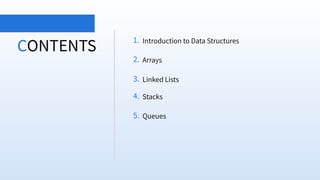
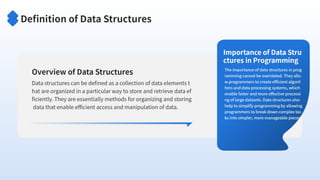
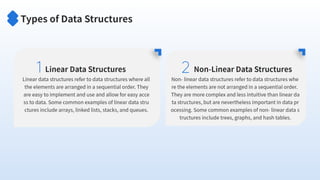

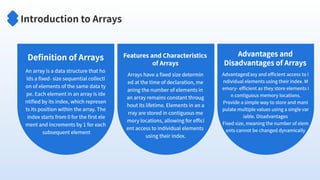
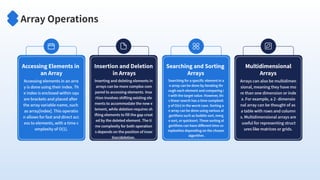
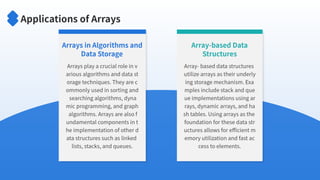

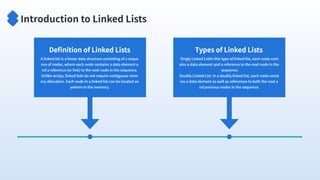

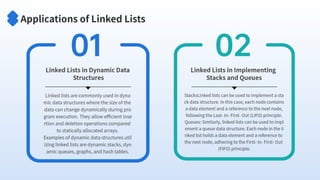

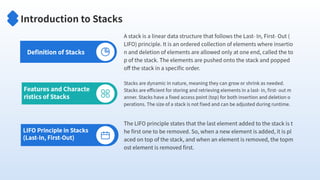
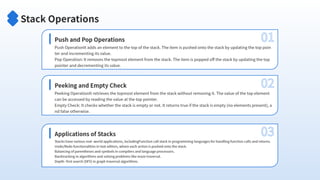

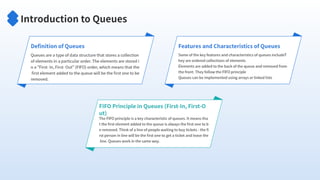
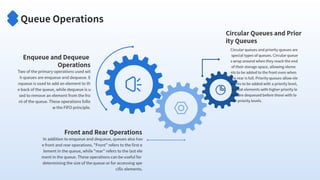
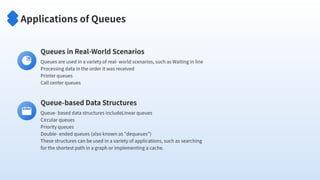

Data Structures: Arrays, Linked Lists, Stacks, and Queues – An Overview This PowerPoint presentation provides an introduction to the basic data structures in computer science: Arrays, Linked Lists, Stacks, and Queues. It covers the essential concepts, features, and applications of these structures, offering a solid foundation for beginners. Introduction to Data Structures: Data structures are fundamental to organizing and managing data efficiently, playing a key role in optimizing the performance of software applications and algorithms. Understanding how to utilize the right data structure for different problems is crucial for developing efficient and scalable solutions. Arrays: Arrays are one of the simplest and most widely used data structures. An array is a collection of elements, all of the same type, stored in contiguous memory locations. The elements can be accessed randomly using an index, making arrays ideal for scenarios requiring fast access to elements. This presentation covers different types of arrays, including one-dimensional and multi-dimensional arrays, along with operations like insertion, deletion, and searching. Linked Lists: Linked Lists are more flexible than arrays, consisting of a series of nodes where each node contains data and a reference to the next node. Linked lists allow for efficient insertions and deletions, particularly when the size of the collection is dynamic. The presentation explains the basic concept of linked lists and discusses different types, such as singly linked lists, doubly linked lists, and circular linked lists, emphasizing their advantages over arrays in specific use cases. Stacks: Stacks follow the Last In, First Out (LIFO) principle, where the most recently added element is the first to be removed. This structure is useful for managing tasks that require reverse order processing, such as function calls in programming or undo operations in software. The key operations on stacks, such as pushing (adding) and popping (removing) elements, are explained, along with their applications in various computational scenarios. Queues: Queues operate on the First In, First Out (FIFO) principle, ensuring that the first element added is the first to be removed. This makes queues ideal for managing tasks that need to be processed in a sequential order. Common operations like enqueue (adding an element) and dequeue (removing an element) are discussed. The presentation also covers different types of queues, such as circular queues and priority queues, and their use in scenarios like task scheduling and data buffering. This presentation is designed to provide a beginner-friendly overview of these data structures, their characteristics, and their real-world applications. By understanding these fundamental concepts, you can begin to select the most appropriate data structure for solving various computational problems.


