1Database Systems, 8th
Edition
Database Systems:
Design, Implementation, and
Management
Eighth Edition
Chapter 2
Data Models
2Database Systems, 8th
Edition
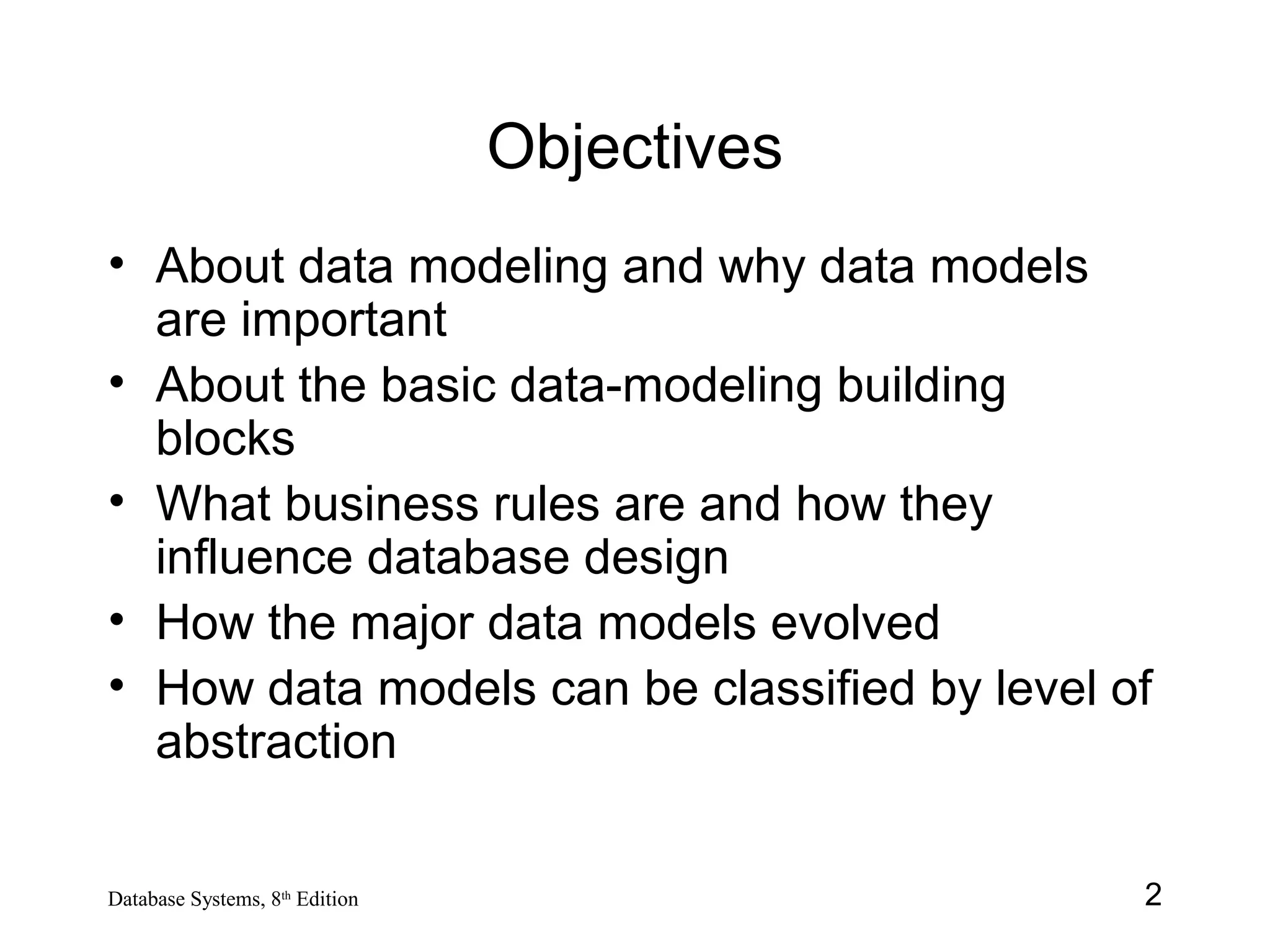
Objectives
• About data modeling and why data models
are important
• About the basic data-modeling building
blocks
• What business rules are and how they
influence database design
• How the major data models evolved
• How data models can be classified by level of
abstraction
3Database Systems, 8th
Edition
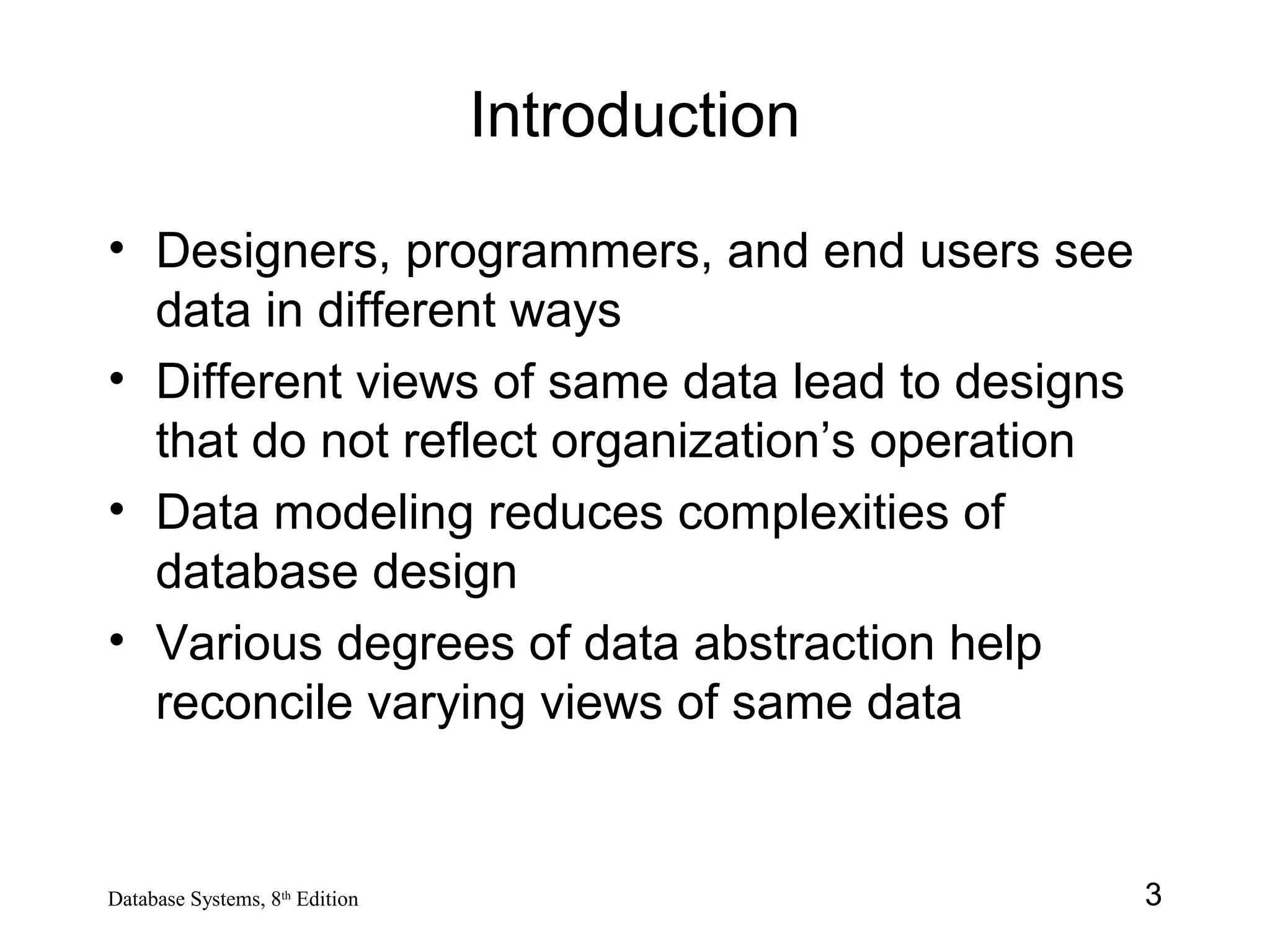
Introduction
• Designers, programmers, and end users see
data in different ways
• Different views of same data lead to designs
that do not reflect organization’s operation
• Data modeling reduces complexities of
database design
• Various degrees of data abstraction help
reconcile varying views of same data
4Database Systems, 8th
Edition
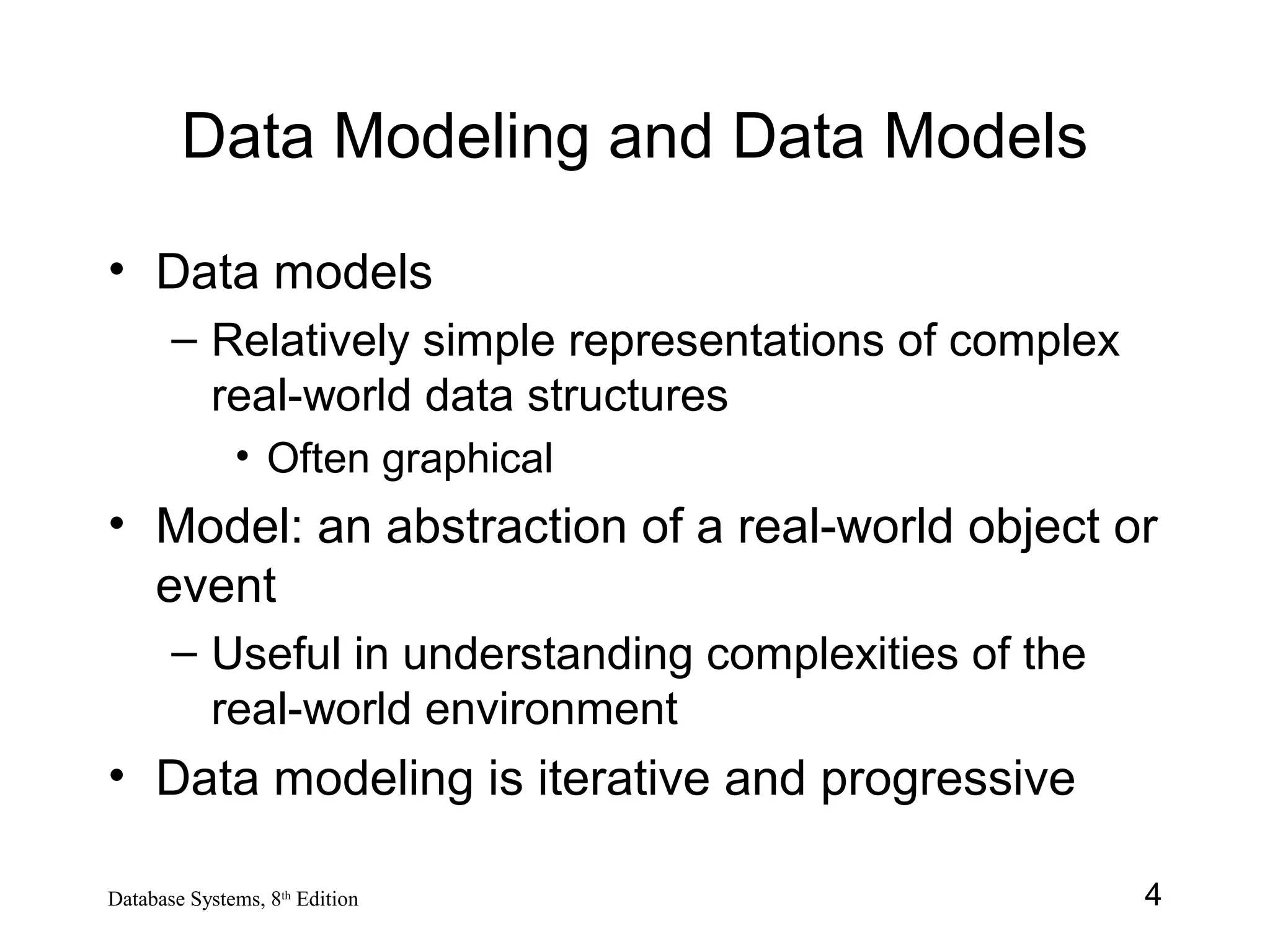
Data Modeling and Data Models
• Data models
– Relatively simple representations of complex
real-world data structures
• Often graphical
• Model: an abstraction of a real-world object or
event
– Useful in understanding complexities of the
real-world environment
• Data modeling is iterative and progressive
5Database Systems, 8th
Edition
The Importance of Data Models
• Facilitate interaction among the designer, the
applications programmer, and the end user
• End users have different views and needs for
data
• Data model organizes data for various users
• Data model is an abstraction
– Cannot draw required data out of the data
model
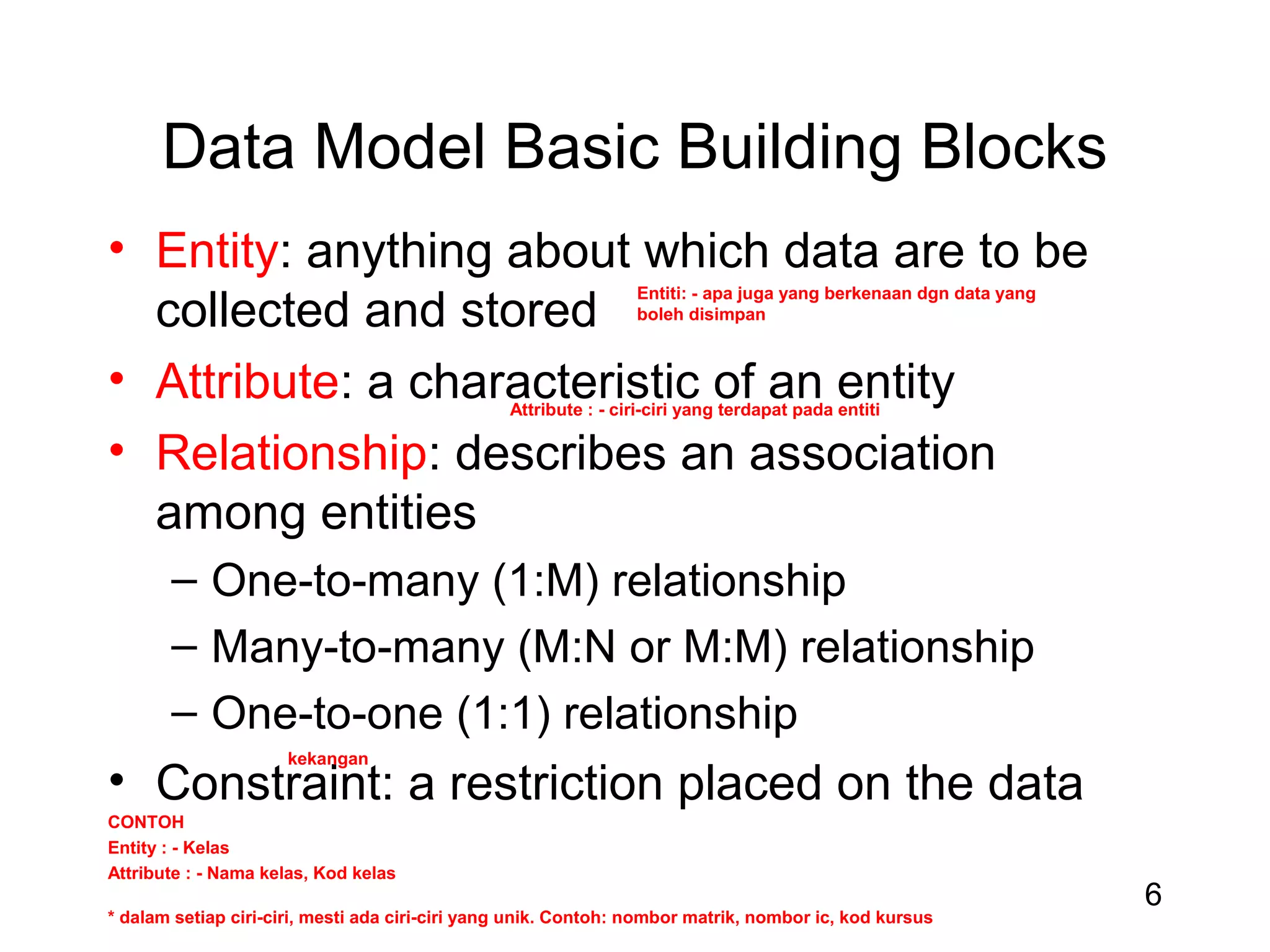
6
Data Model Basic Building Blocks
• Entity: anything about which data are to be
collected and stored
• Attribute: a characteristic of an entity
• Relationship: describes an association
among entities
– One-to-many (1:M) relationship
– Many-to-many (M:N or M:M) relationship
– One-to-one (1:1) relationship
• Constraint: a restriction placed on the data
Attribute : - ciri-ciri yang terdapat pada entiti
Entiti: - apa juga yang berkenaan dgn data yang
boleh disimpan
CONTOH
Entity : - Kelas
Attribute : - Nama kelas, Kod kelas
* dalam setiap ciri-ciri, mesti ada ciri-ciri yang unik. Contoh: nombor matrik, nombor ic, kod kursus
kekangan
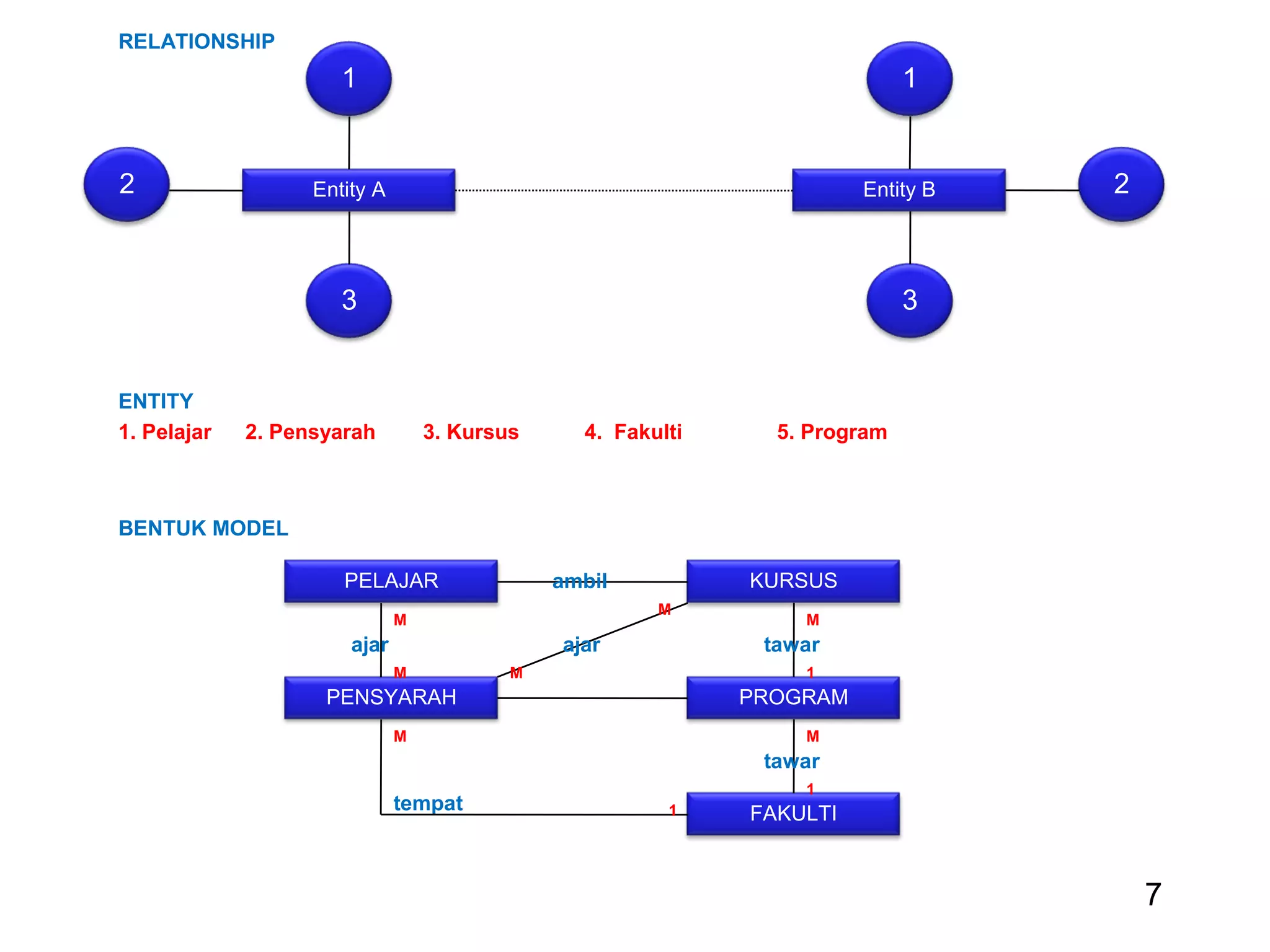
7
Entity A Entity B
1
2
3
1
2
3
RELATIONSHIP
ENTITY
1. Pelajar 2. Pensyarah 3. Kursus 4. Fakulti 5. Program
BENTUK MODEL
PELAJAR KURSUS
PENSYARAH PROGRAM
FAKULTI
ambil
ajar tawar
tempat
tawar
ajar
M
M
M
1
M
1
M
1
M
M
8Database Systems, 8th
Edition
Business Rules
• Descriptions of policies, procedures, or
principles within a specific organization
– Apply to any organization that stores and uses
data to generate information
• Description of operations to create/enforce
actions within an organization’s environment
• Must be in writing and kept up to date
• Must be easy to understand and widely
disseminated
• Describe characteristics of data as viewed by
the company
9Database Systems, 8th
Edition
Discovering Business Rules
• Sources of business rules:
– Company managers
– Policy makers
– Department managers
– Written documentation
• Procedures
• Standards
• Operations manuals
– Direct interviews with end users
10Database Systems, 8th
Edition
Discovering Business Rules
(continued)
• Standardize company’s view of data
• Communications tool between users and
designers
• Allow designer to understand the nature, role,
and scope of data
• Allow designer to understand business
processes
• Allow designer to develop appropriate
relationship participation rules and constraints
11Database Systems, 8th
Edition
Translating Business Rules into
Data Model Components
• Generally, nouns translate into entities
• Verbs translate into relationships among
entities
• Relationships are bidirectional
• Two questions to identify the relationship
type:
– How many instances of B are related to one
instance of A?
– How many instances of A are related to one
instance of B?
Perhubungan dilihat secara dua arah
12Database Systems, 8th
Edition
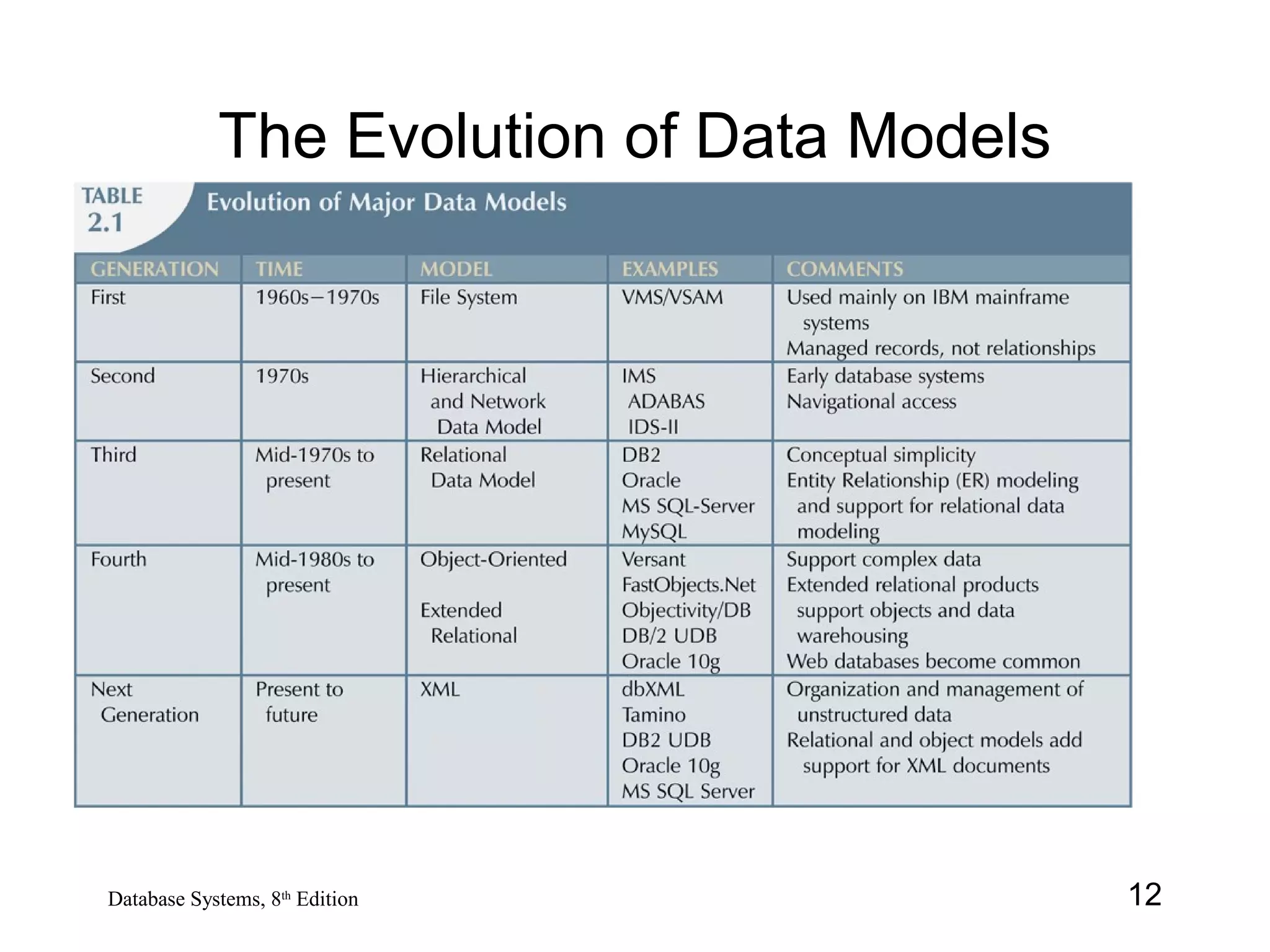
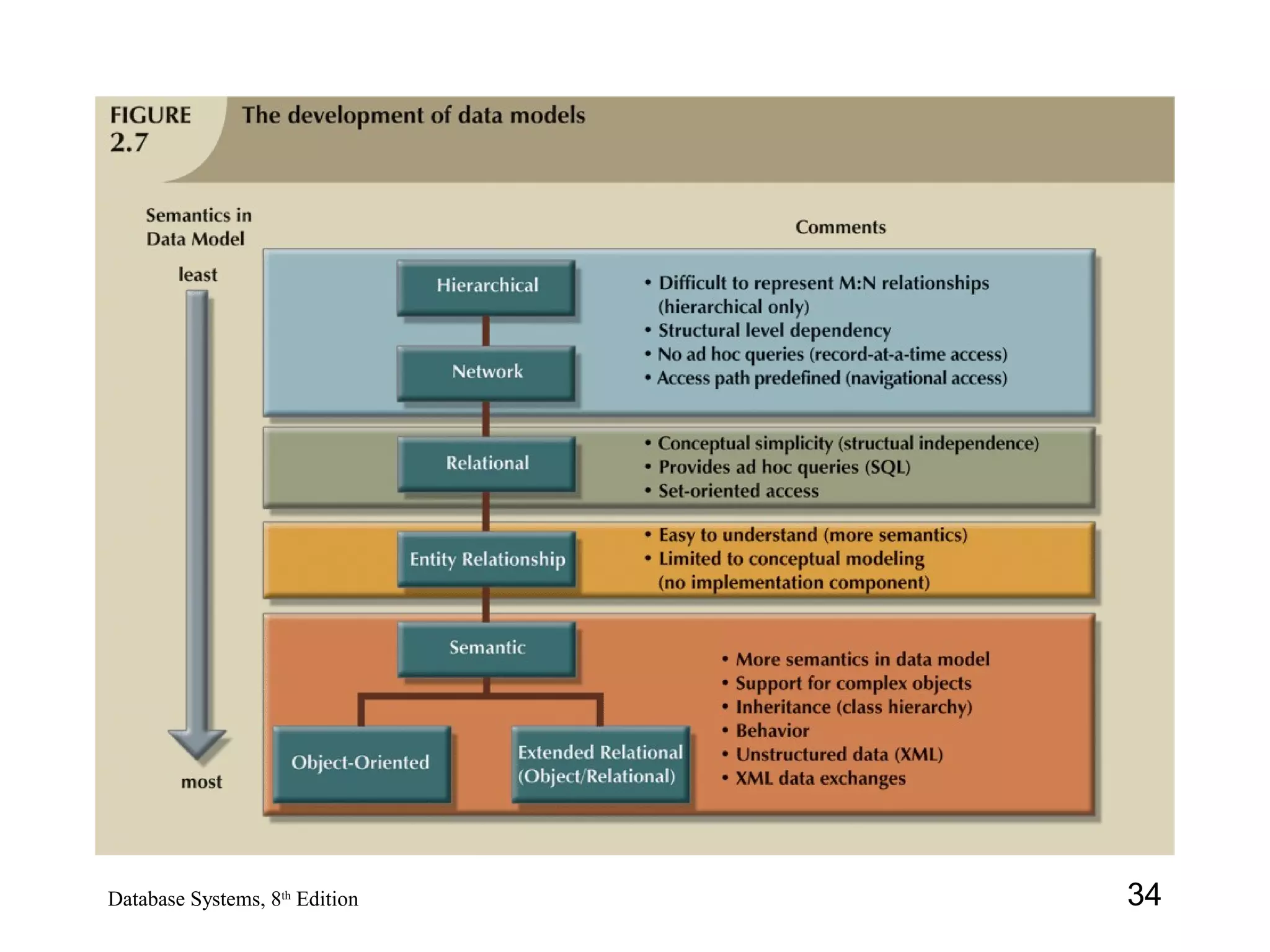
The Evolution of Data Models
13Database Systems, 8th
Edition
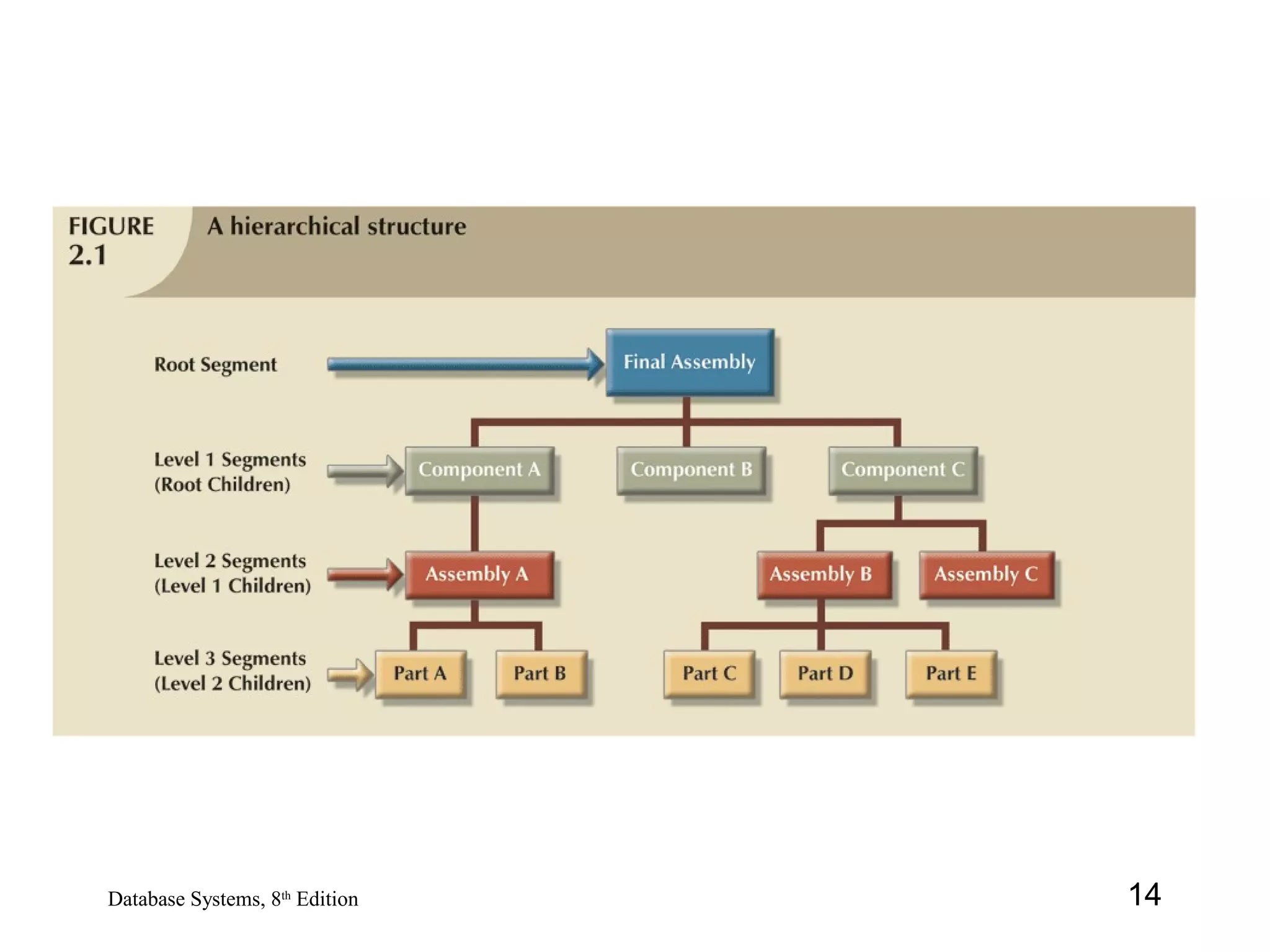
The Hierarchical Model
• Developed in the 1960s to manage large
amounts of data for manufacturing projects
• Basic logical structure is represented by an
upside-down “tree”
• Hierarchical structure contains levels or
segments
– Segment analogous to a record type
– Set of one-to-many relationships between
segments
14Database Systems, 8th
Edition
15Database Systems, 8th
Edition
The Hierarchical Model (continued)
• Foundation for current data models
• Disadvantages of the hierarchical model:
– Complex to implement
– Difficult to manage
– Lacks structural independence
– Relationships do not conform to 1:M form
– No standards for how to implement
16Database Systems, 8th
Edition
The Network Model
• Created to represent complex data
relationships more effectively
– Improves database performance
– Imposes a database standard
• Conference on Data Systems Languages
(CODASYL) created the DBTG
• Database Task Group (DBTG): defined
environment to facilitate database creation
Network model lebih baik daripada Hierarchy model
17Database Systems, 8th
Edition
The Network Model (continued)
• Schema
– Conceptual organization of entire database as
viewed by the database administrator
• Subschema
– Database portion “seen” by the application
programs
• Data management language (DML)
– Defines the environment in which data can be
managed
18Database Systems, 8th
Edition
The Network Model (continued)
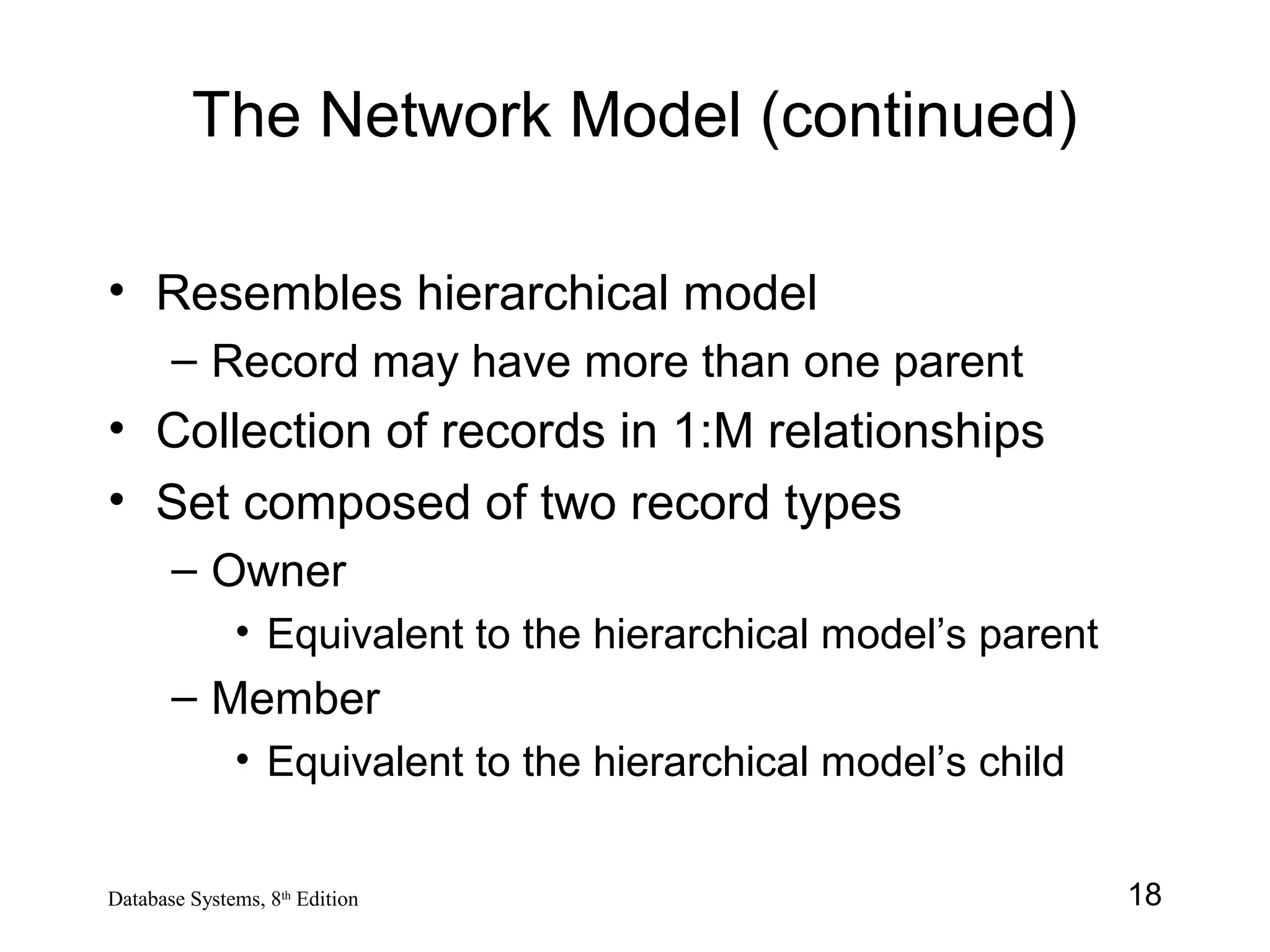
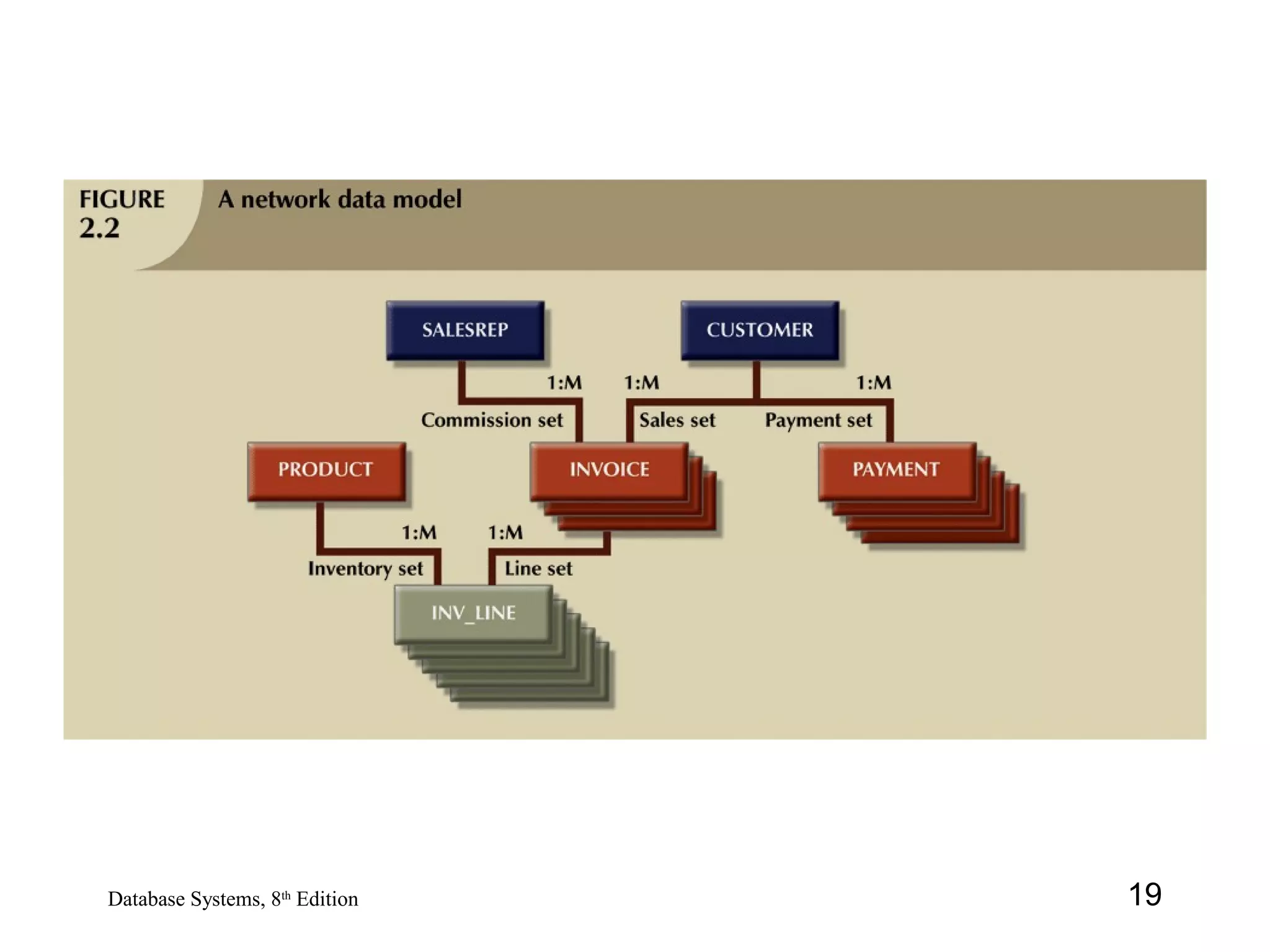
• Resembles hierarchical model
– Record may have more than one parent
• Collection of records in 1:M relationships
• Set composed of two record types
– Owner
• Equivalent to the hierarchical model’s parent
– Member
• Equivalent to the hierarchical model’s child
19Database Systems, 8th
Edition
20Database Systems, 8th
Edition
The Network Model (continued)
• Disadvantages of the network model
– Cumbersome
– Lack of ad hoc query capability placed burden
on programmers to generate code for reports
– Structural change in the database could
produce havoc in all application programs
21Database Systems, 8th
Edition
The Relational Model
• Developed by E. F. Codd (IBM) in 1970
• Table (relations)
– Matrix consisting of row/column intersections
– Each row in a relation called a tuple
• Relational models considered impractical in
1970
• Model conceptually simple at expense of
computer overhead
22Database Systems, 8th
Edition
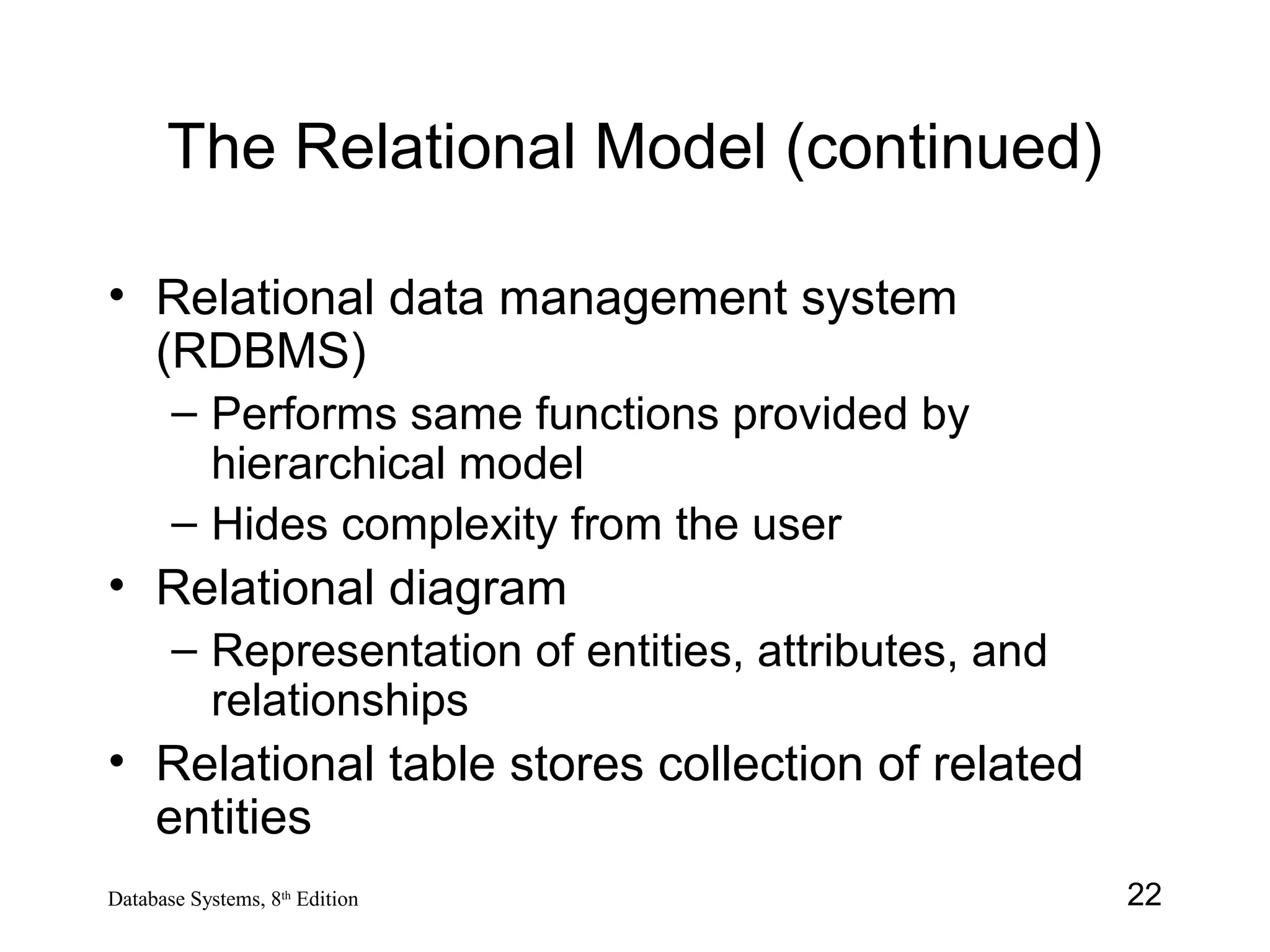
The Relational Model (continued)
• Relational data management system
(RDBMS)
– Performs same functions provided by
hierarchical model
– Hides complexity from the user
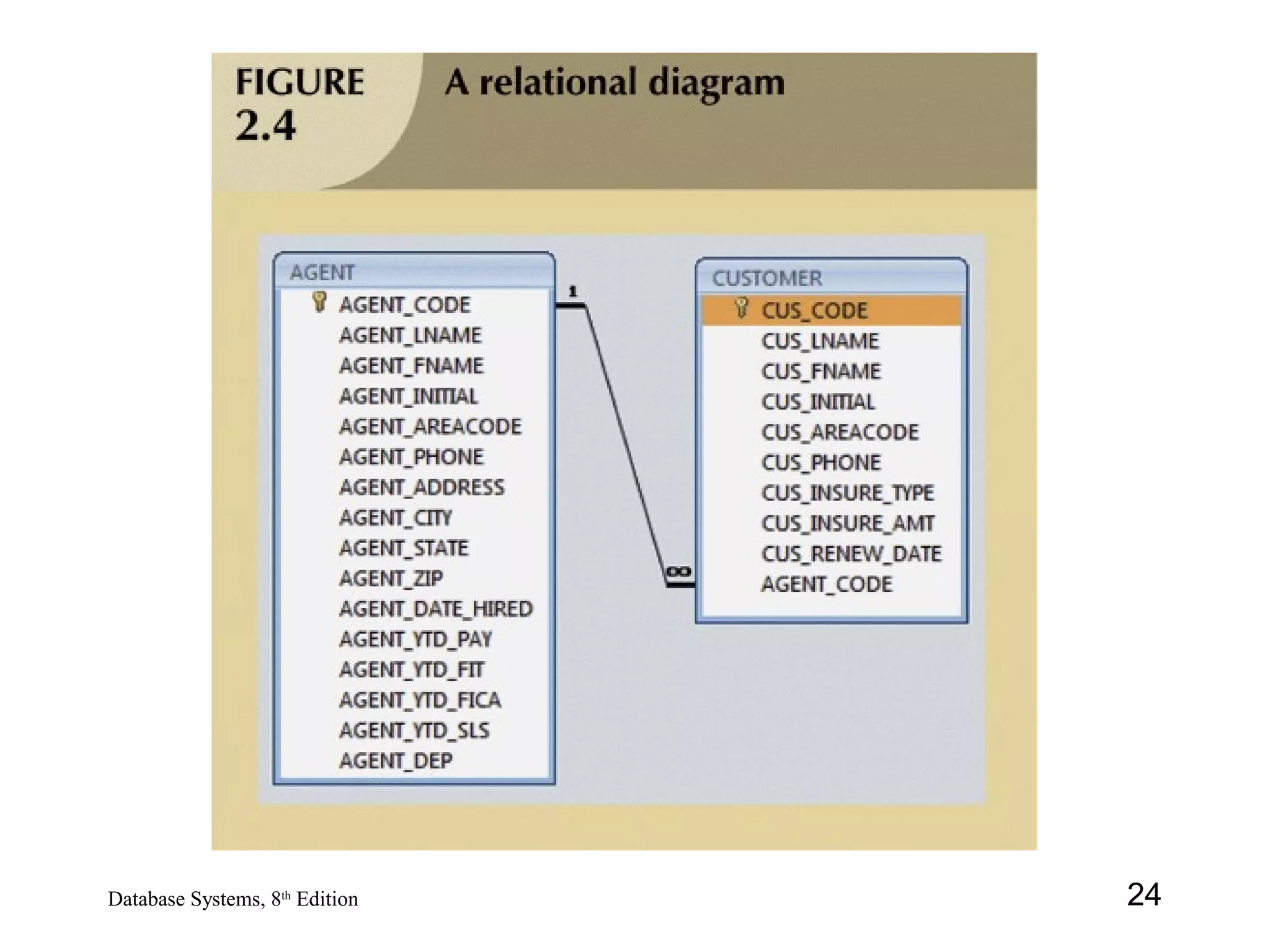
• Relational diagram
– Representation of entities, attributes, and
relationships
• Relational table stores collection of related
entities
23
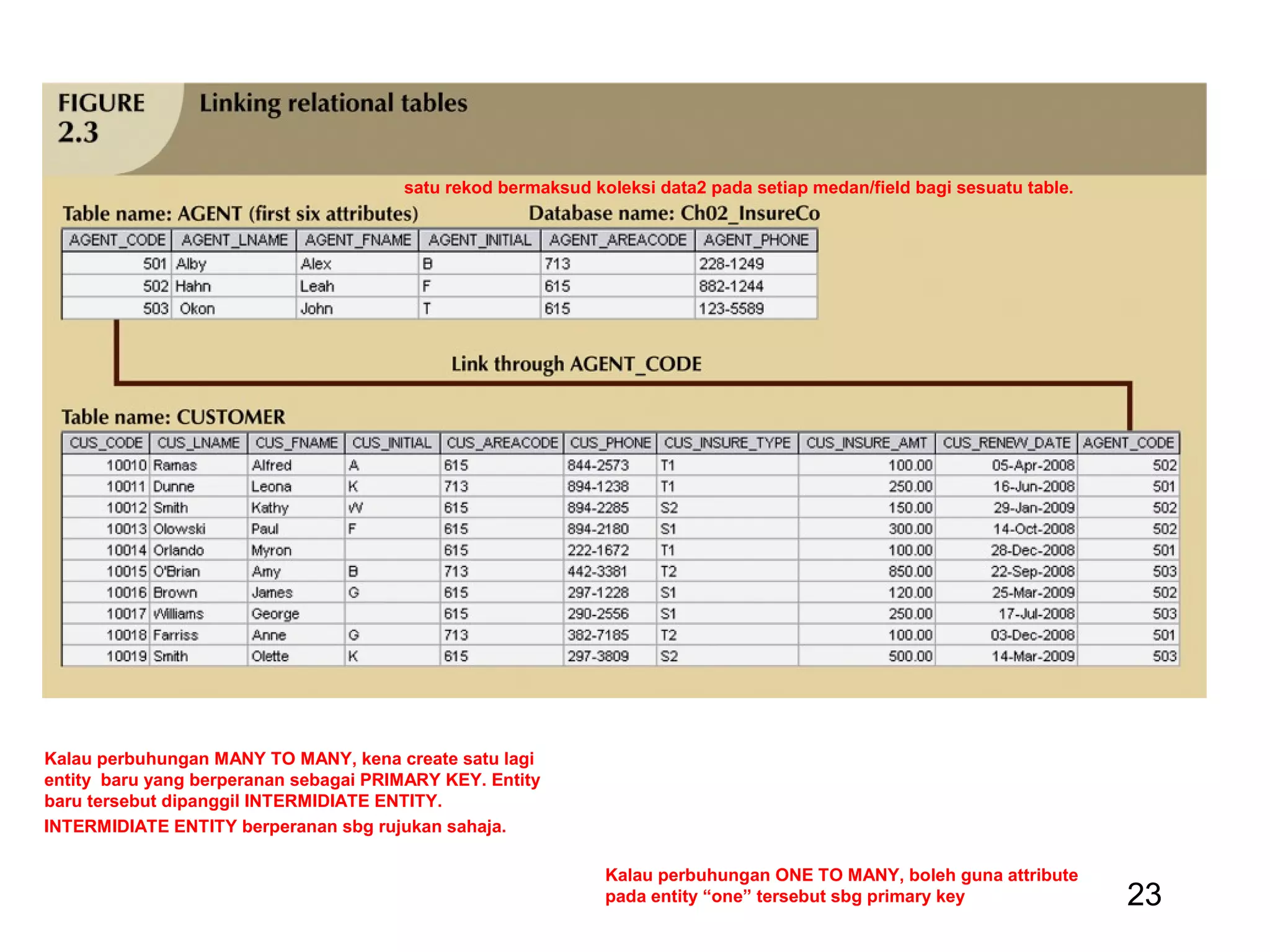
Kalau perbuhungan MANY TO MANY, kena create satu lagi
entity baru yang berperanan sebagai PRIMARY KEY. Entity
baru tersebut dipanggil INTERMIDIATE ENTITY.
INTERMIDIATE ENTITY berperanan sbg rujukan sahaja.
Kalau perbuhungan ONE TO MANY, boleh guna attribute
pada entity “one” tersebut sbg primary key
satu rekod bermaksud koleksi data2 pada setiap medan/field bagi sesuatu table.
24Database Systems, 8th
Edition
25Database Systems, 8th
Edition
The Relational Model (continued)
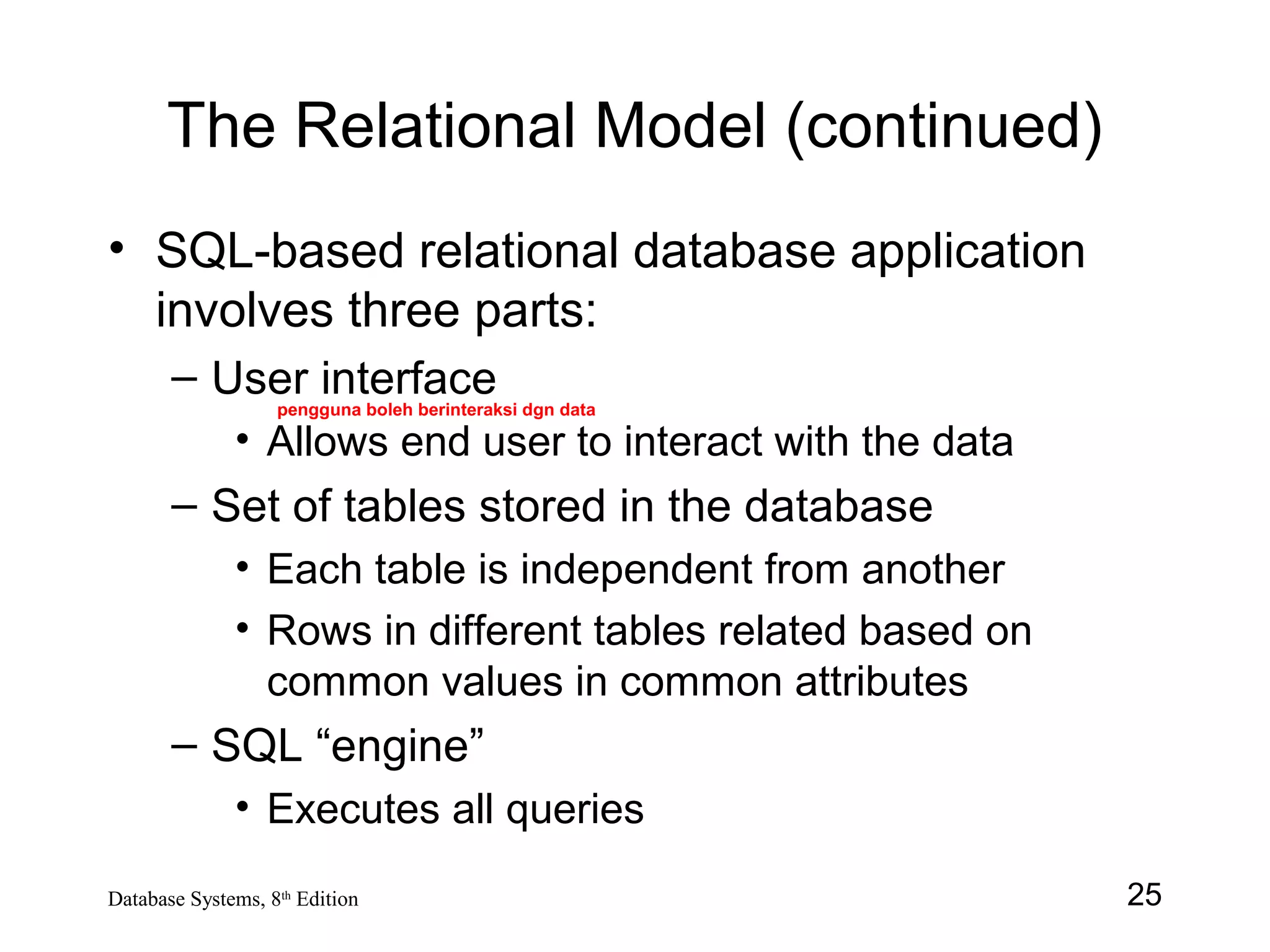
• SQL-based relational database application
involves three parts:
– User interface
• Allows end user to interact with the data
– Set of tables stored in the database
• Each table is independent from another
• Rows in different tables related based on
common values in common attributes
– SQL “engine”
• Executes all queries
pengguna boleh berinteraksi dgn data
26Database Systems, 8th
Edition
The Entity Relationship Model
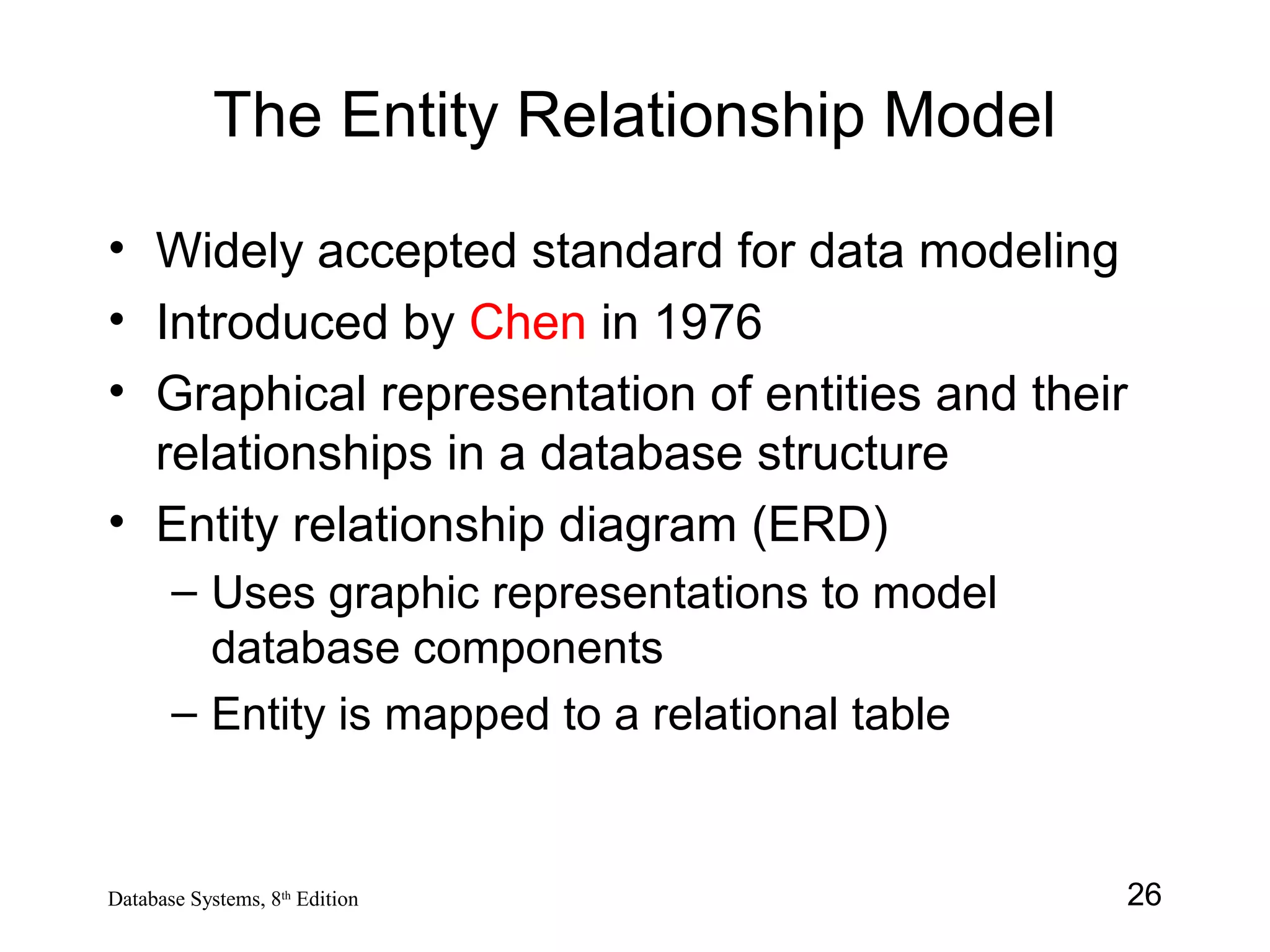
• Widely accepted standard for data modeling
• Introduced by Chen in 1976
• Graphical representation of entities and their
relationships in a database structure
• Entity relationship diagram (ERD)
– Uses graphic representations to model
database components
– Entity is mapped to a relational table
27Database Systems, 8th
Edition
The Entity Relationship Model
(continued)
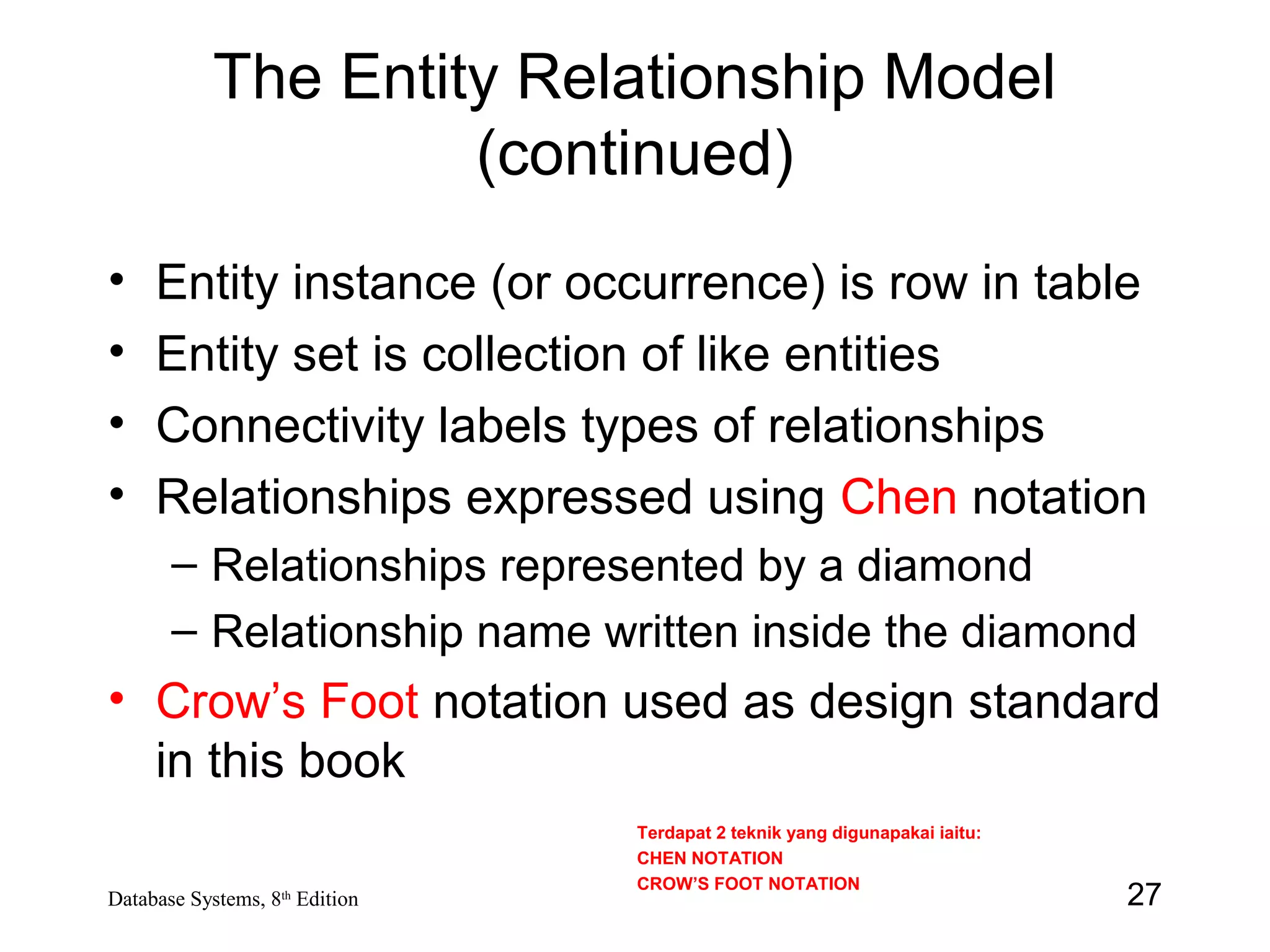
• Entity instance (or occurrence) is row in table
• Entity set is collection of like entities
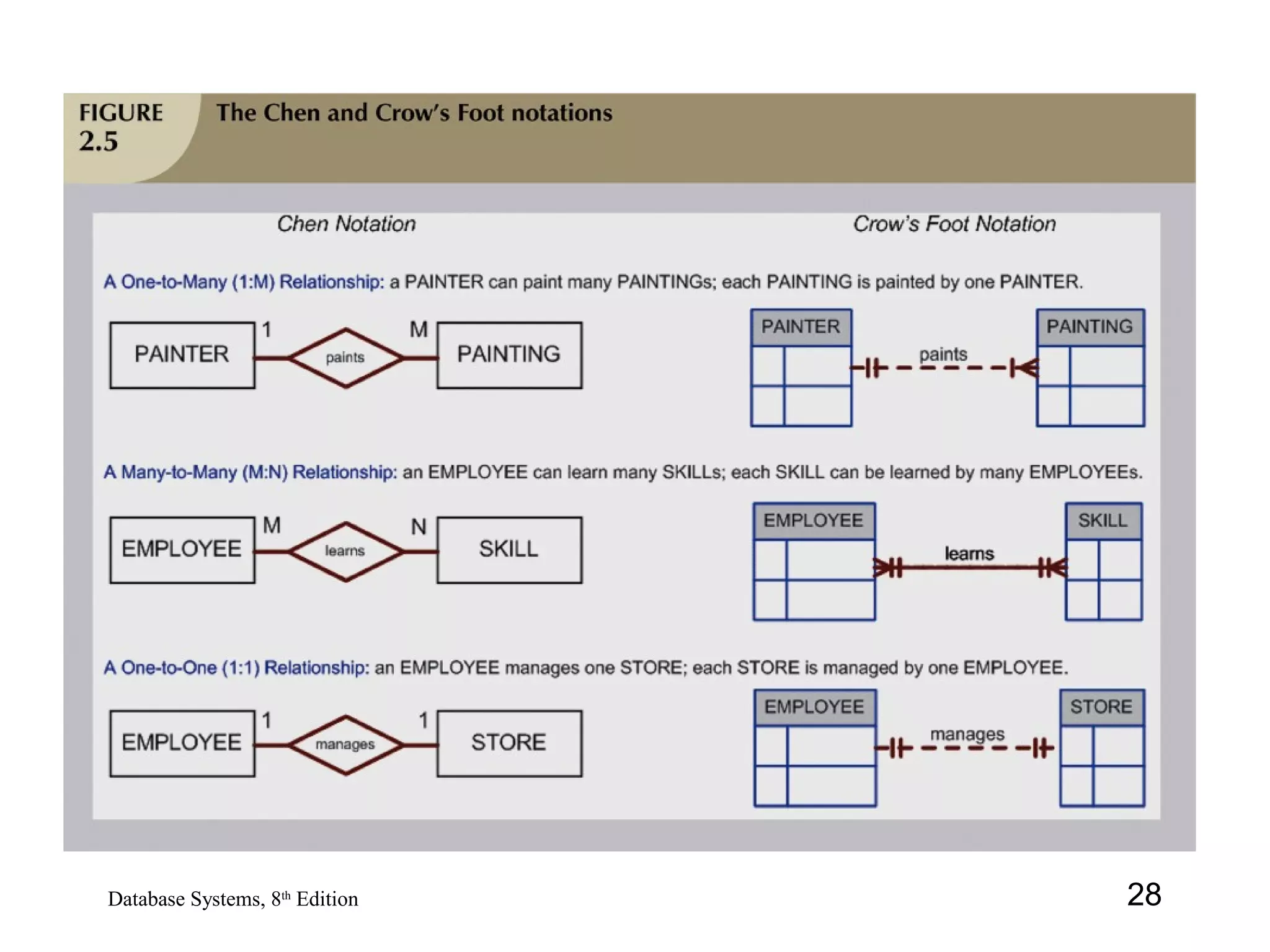
• Connectivity labels types of relationships
• Relationships expressed using Chen notation
– Relationships represented by a diamond
– Relationship name written inside the diamond
• Crow’s Foot notation used as design standard
in this book
Terdapat 2 teknik yang digunapakai iaitu:
CHEN NOTATION
CROW’S FOOT NOTATION
28Database Systems, 8th
Edition
29Database Systems, 8th
Edition
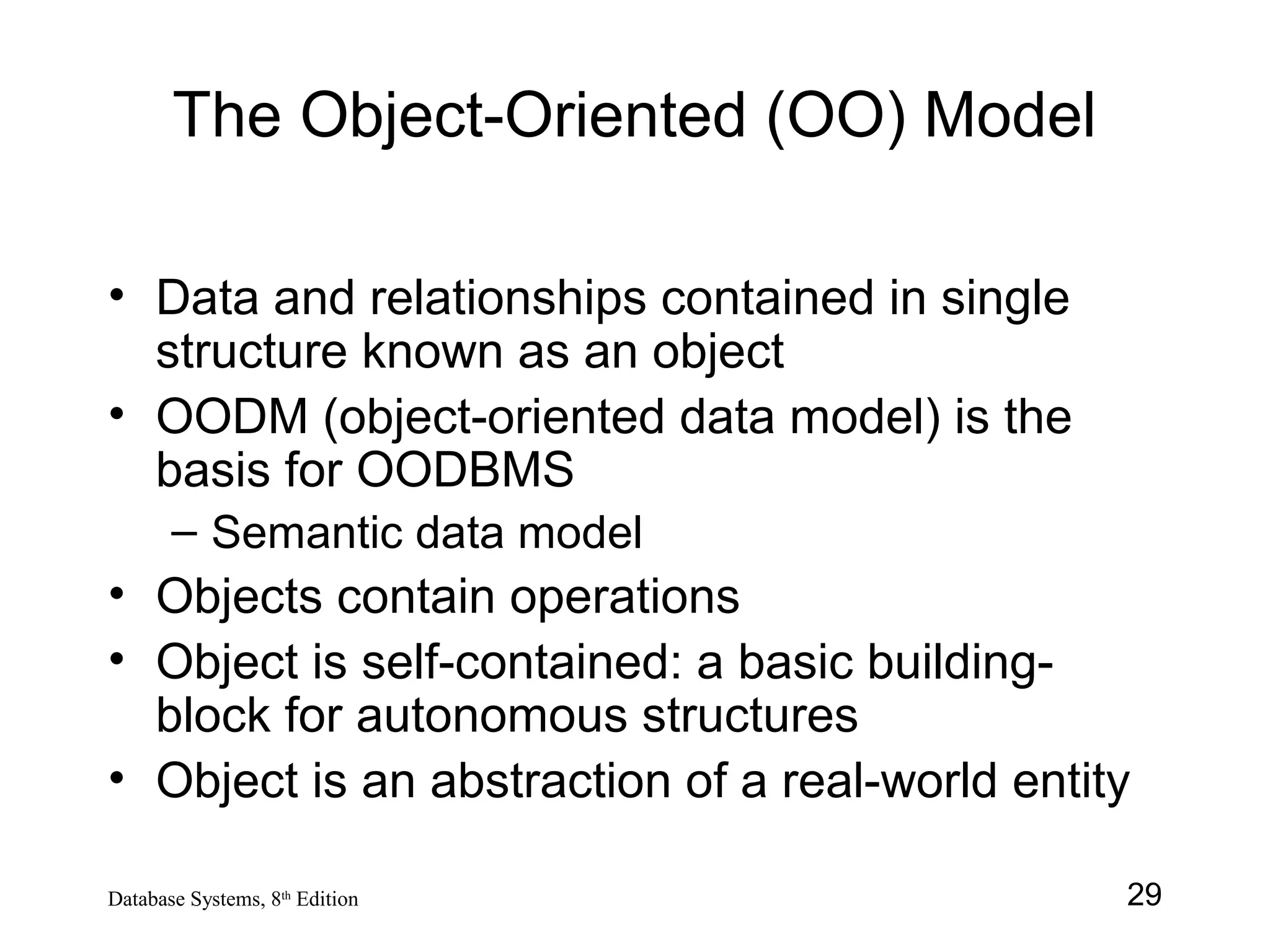
The Object-Oriented (OO) Model
• Data and relationships contained in single
structure known as an object
• OODM (object-oriented data model) is the
basis for OODBMS
– Semantic data model
• Objects contain operations
• Object is self-contained: a basic building-
block for autonomous structures
• Object is an abstraction of a real-world entity
30Database Systems, 8th
Edition
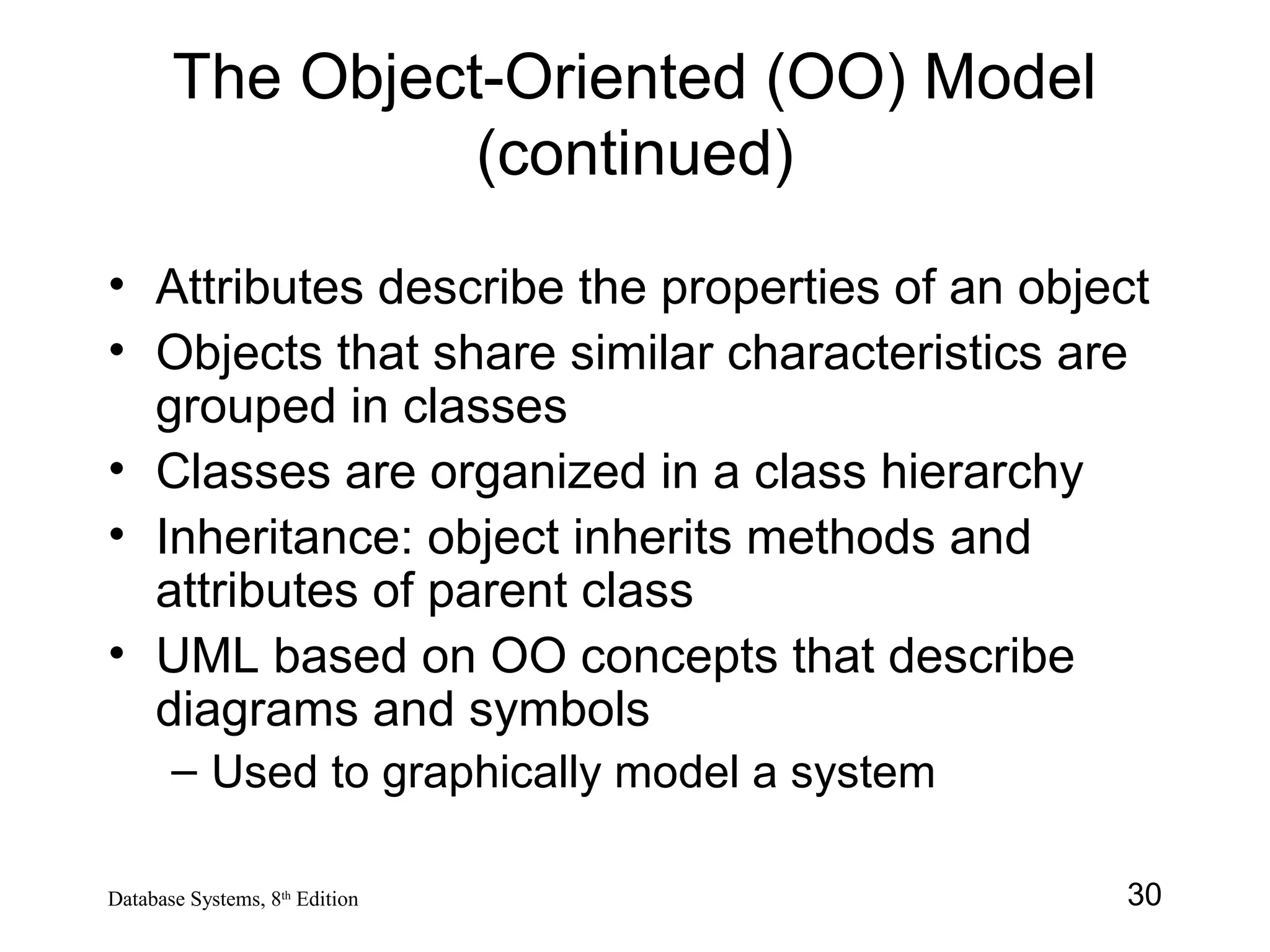
The Object-Oriented (OO) Model
(continued)
• Attributes describe the properties of an object
• Objects that share similar characteristics are
grouped in classes
• Classes are organized in a class hierarchy
• Inheritance: object inherits methods and
attributes of parent class
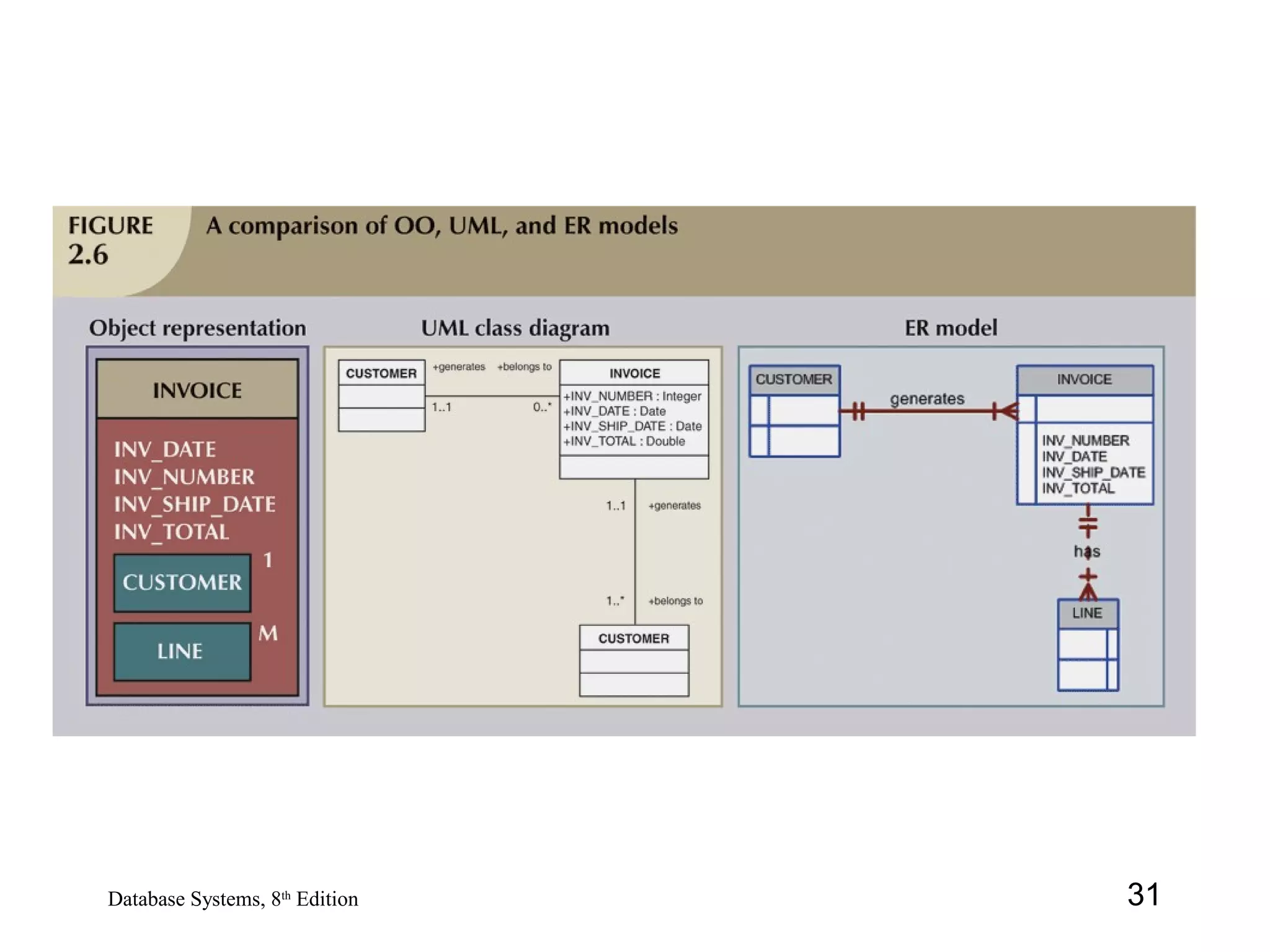
• UML based on OO concepts that describe
diagrams and symbols
– Used to graphically model a system
31Database Systems, 8th
Edition
32Database Systems, 8th
Edition
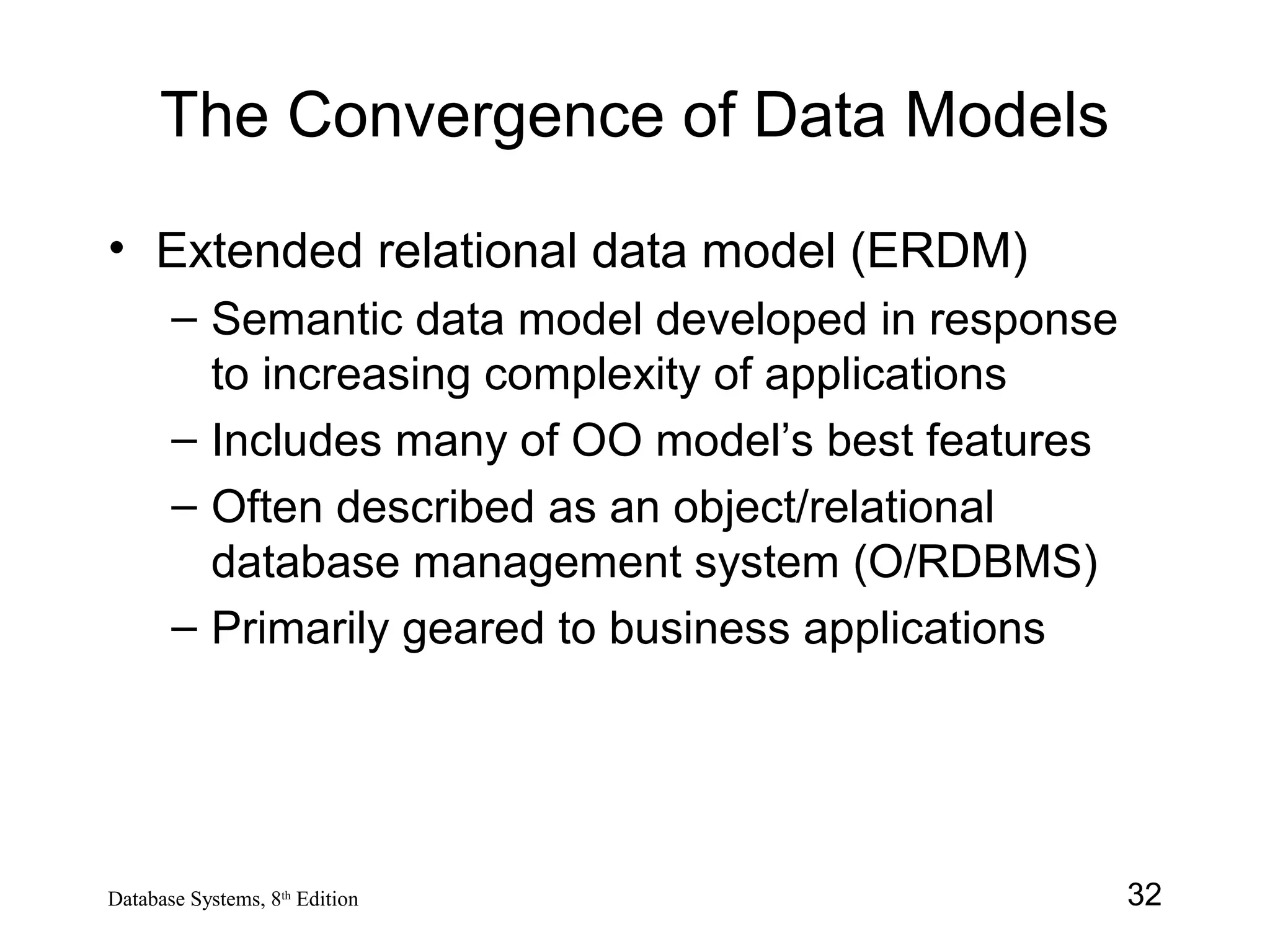
The Convergence of Data Models
• Extended relational data model (ERDM)
– Semantic data model developed in response
to increasing complexity of applications
– Includes many of OO model’s best features
– Often described as an object/relational
database management system (O/RDBMS)
– Primarily geared to business applications
33Database Systems, 8th
Edition
Database Models and the Internet
• Internet drastically changed role and scope of
database market
• Focus on Internet makes underlying data
model less important
• Dominance of Web has resulted in growing
need to manage unstructured information
• Current databases support XML
– XML: the standard protocol for data exchange
among systems and Internet services
34Database Systems, 8th
Edition
35Database Systems, 8th
Edition
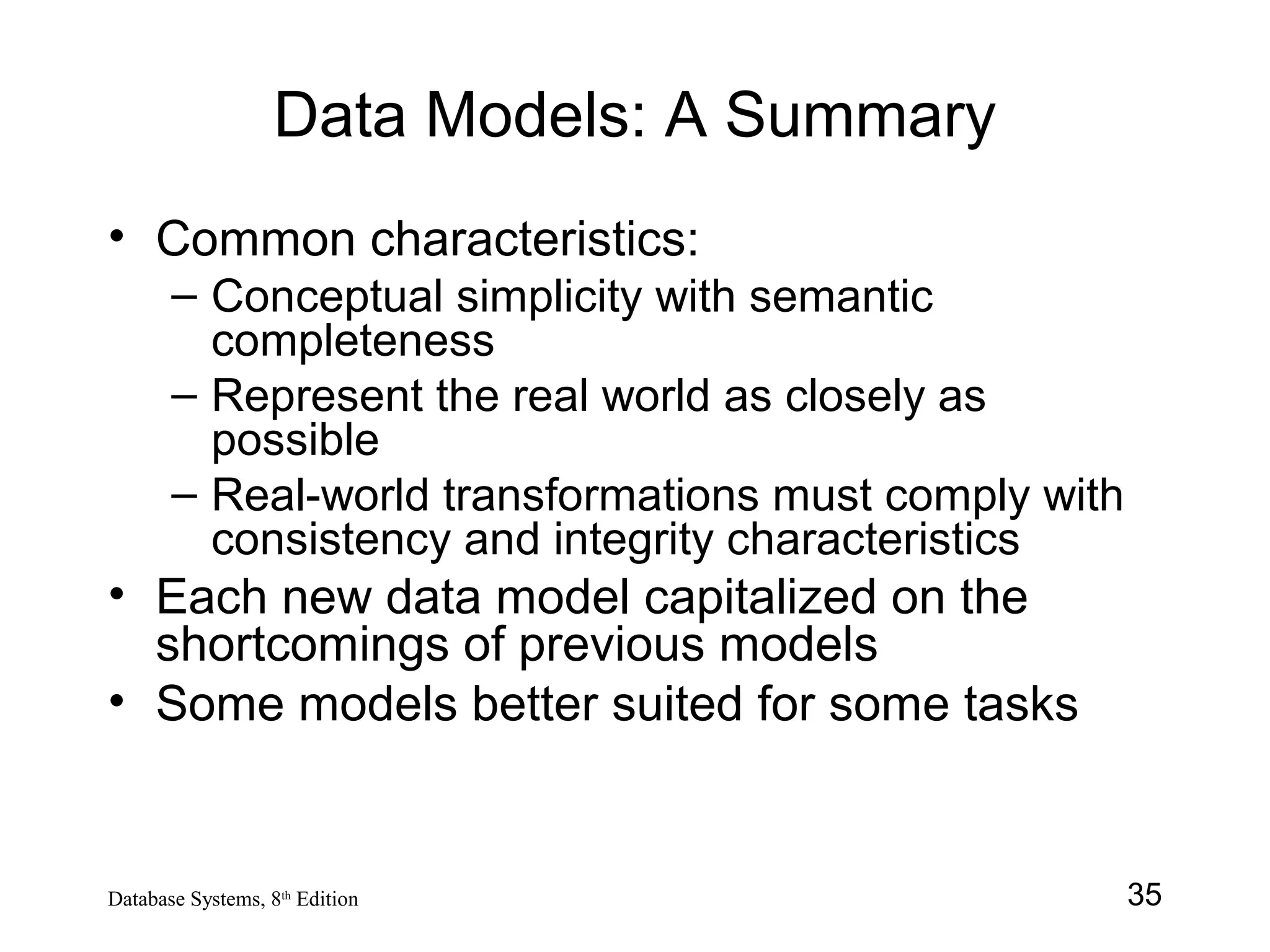
Data Models: A Summary
• Common characteristics:
– Conceptual simplicity with semantic
completeness
– Represent the real world as closely as
possible
– Real-world transformations must comply with
consistency and integrity characteristics
• Each new data model capitalized on the
shortcomings of previous models
• Some models better suited for some tasks
36Database Systems, 8th
Edition
37Database Systems, 8th
Edition
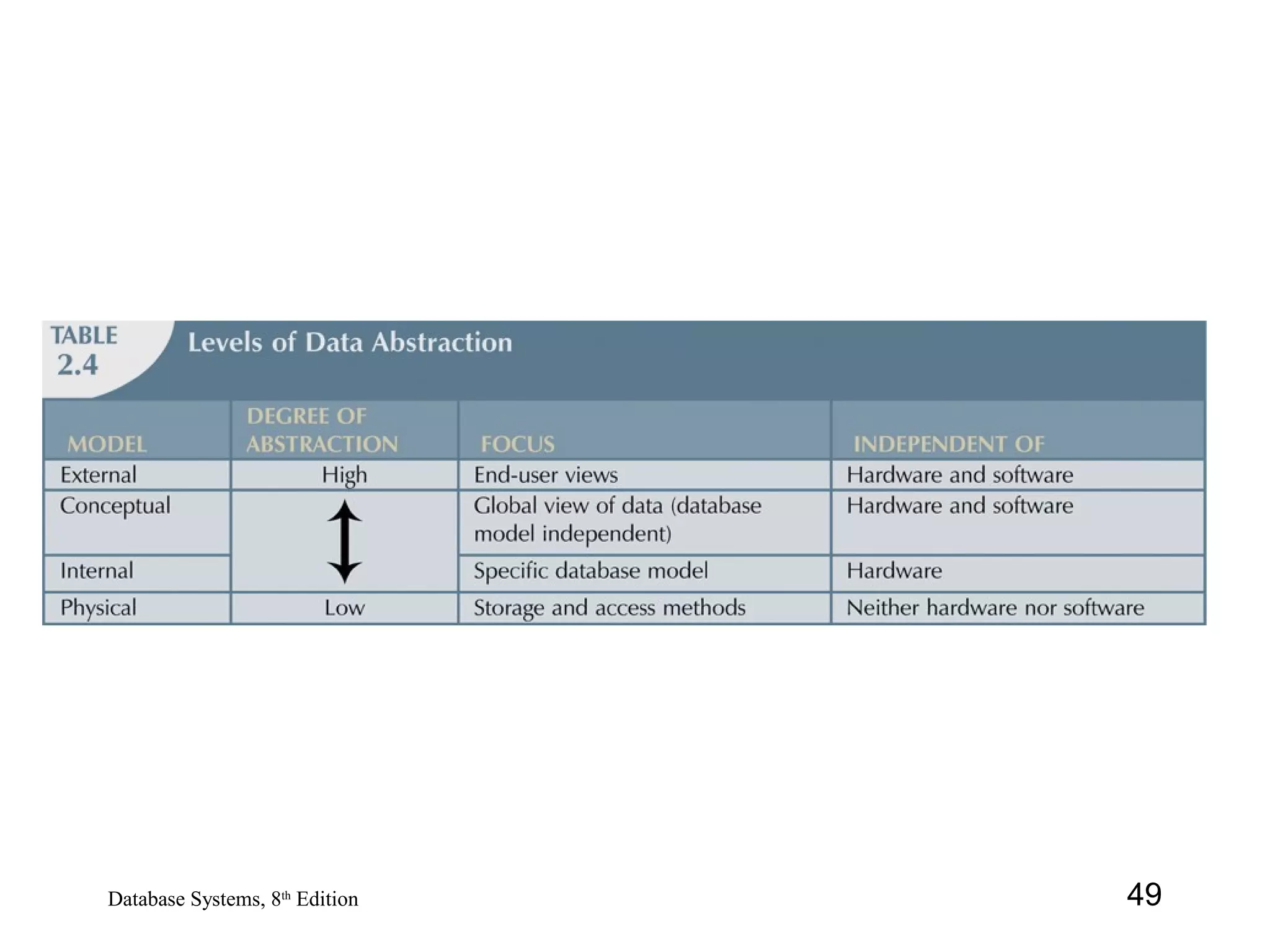
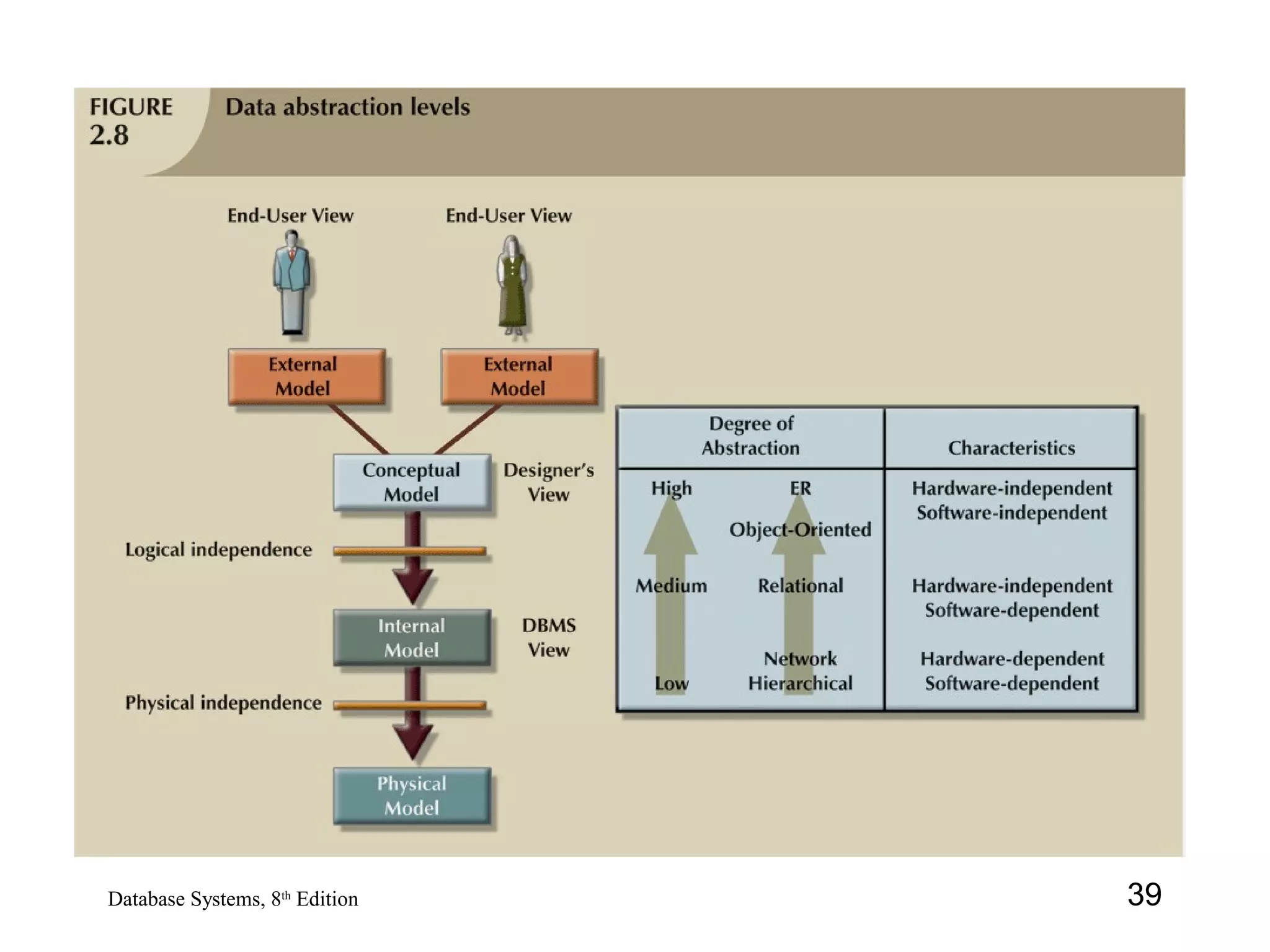
Degrees of Data Abstraction
• Database designer starts with abstracted
view, then adds details
• ANSI Standards Planning and Requirements
Committee (SPARC)
– Defined a framework for data modeling based
on degrees of data abstraction (1970s):
• External
• Conceptual
• Internal
38Database Systems, 8th
Edition
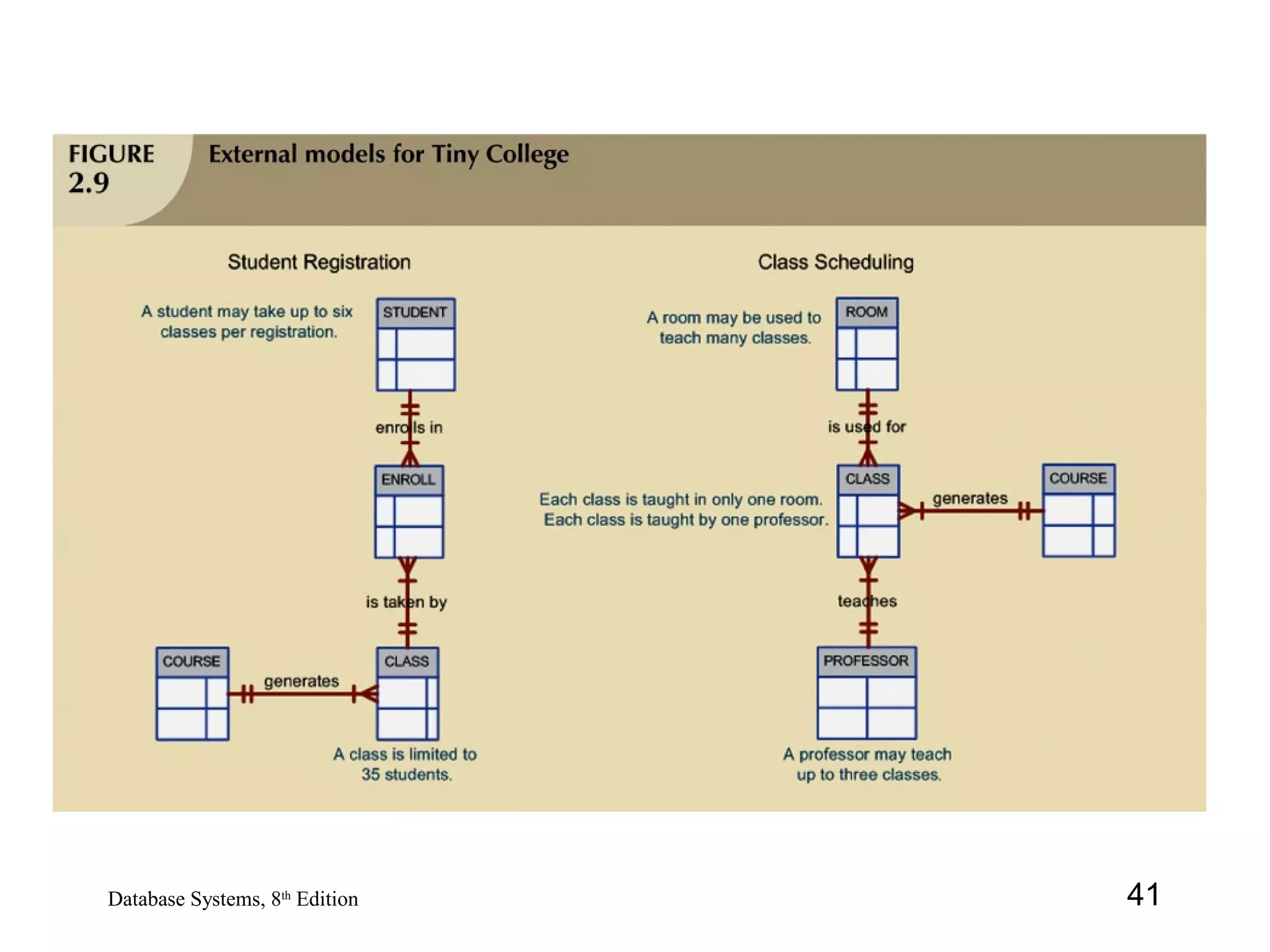
The External Model
• End users’ view of the data environment
• ER diagrams represent external views
• External schema: specific representation of
an external view
– Entities
– Relationships
– Processes
– Constraints
39Database Systems, 8th
Edition
40Database Systems, 8th
Edition
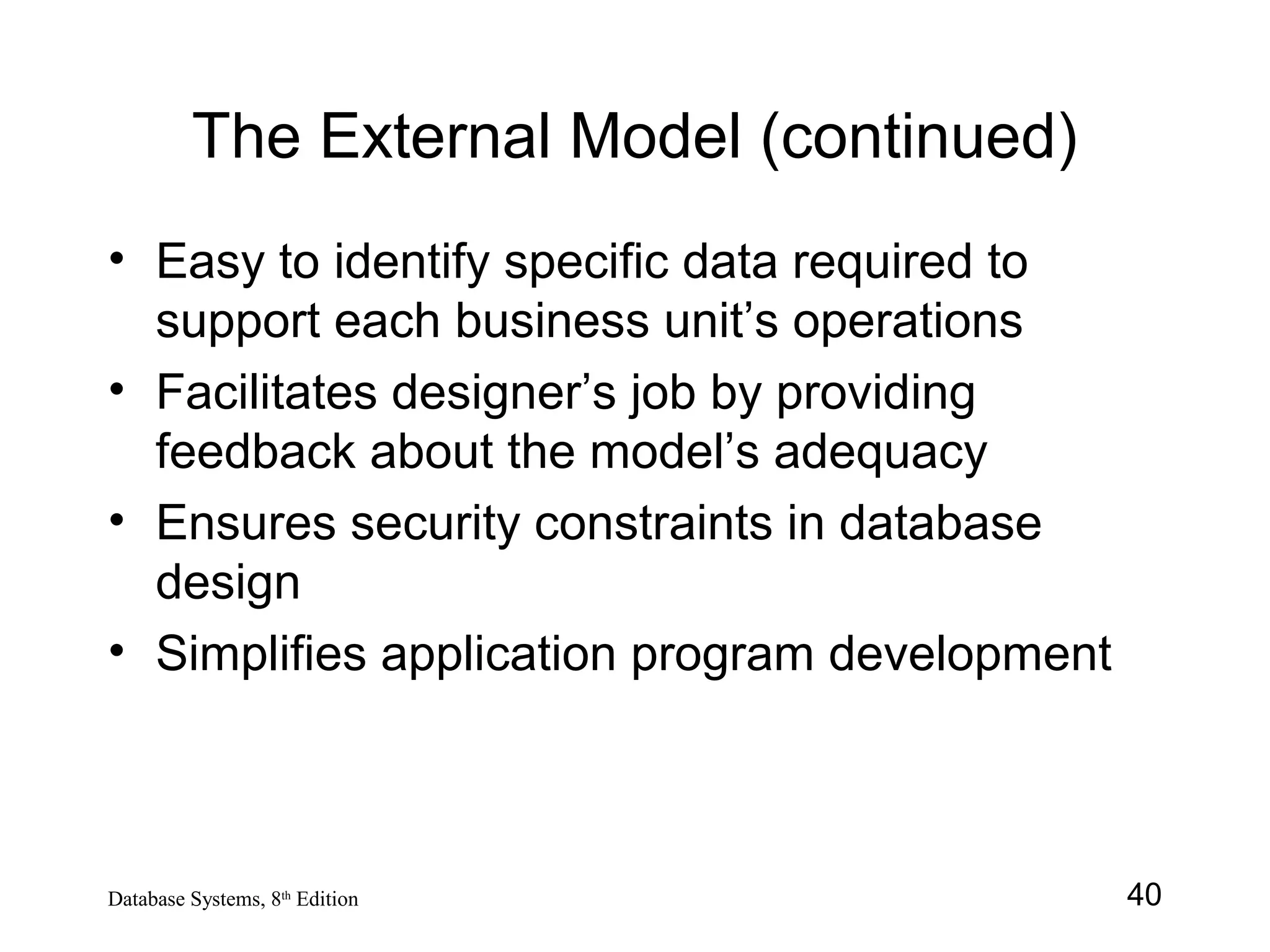
The External Model (continued)
• Easy to identify specific data required to
support each business unit’s operations
• Facilitates designer’s job by providing
feedback about the model’s adequacy
• Ensures security constraints in database
design
• Simplifies application program development
41Database Systems, 8th
Edition
42Database Systems, 8th
Edition
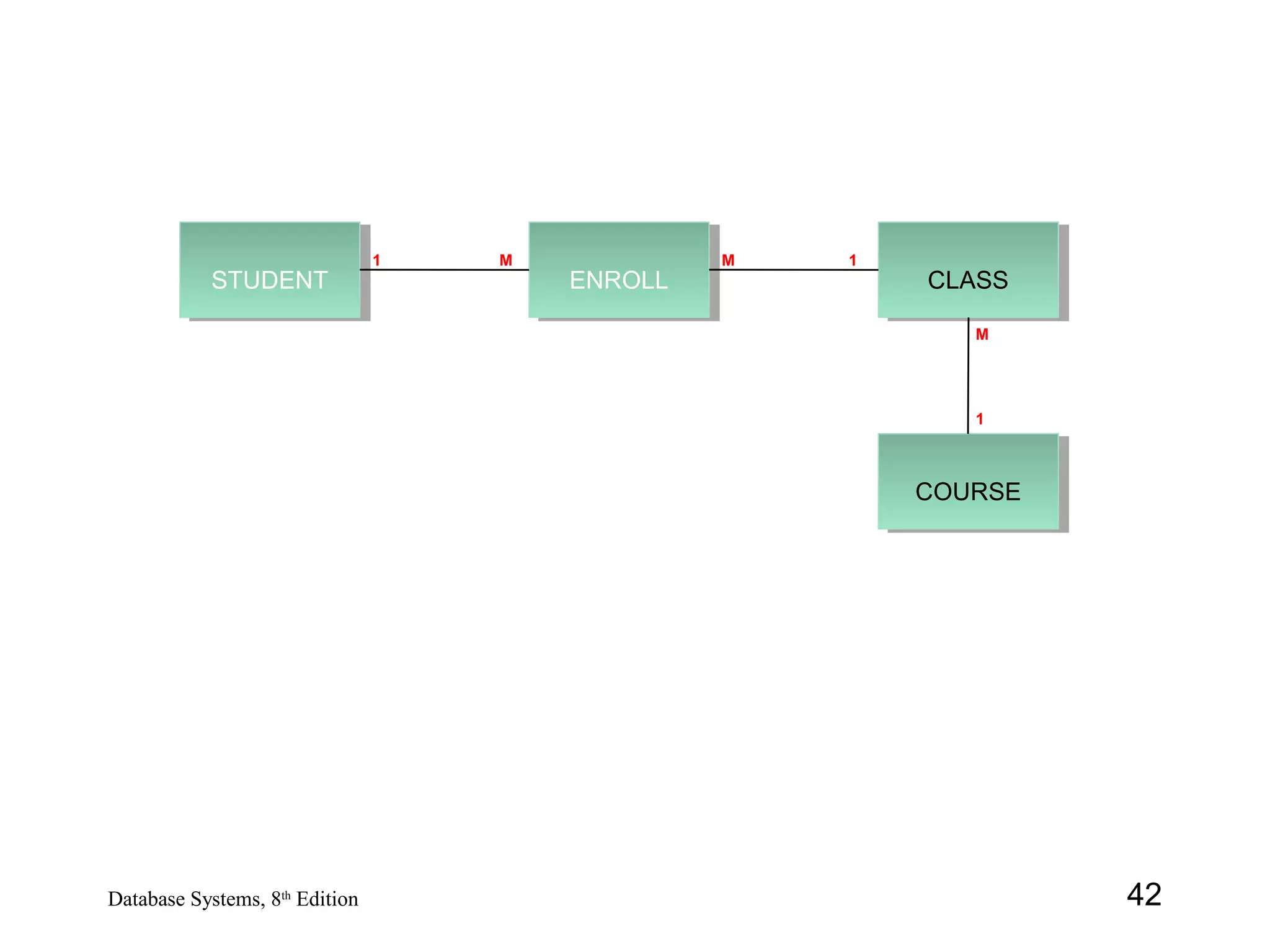
STUDENTSTUDENT CLASSCLASSENROLLENROLL
M M
COURSECOURSE
1 1
1
M
43Database Systems, 8th
Edition
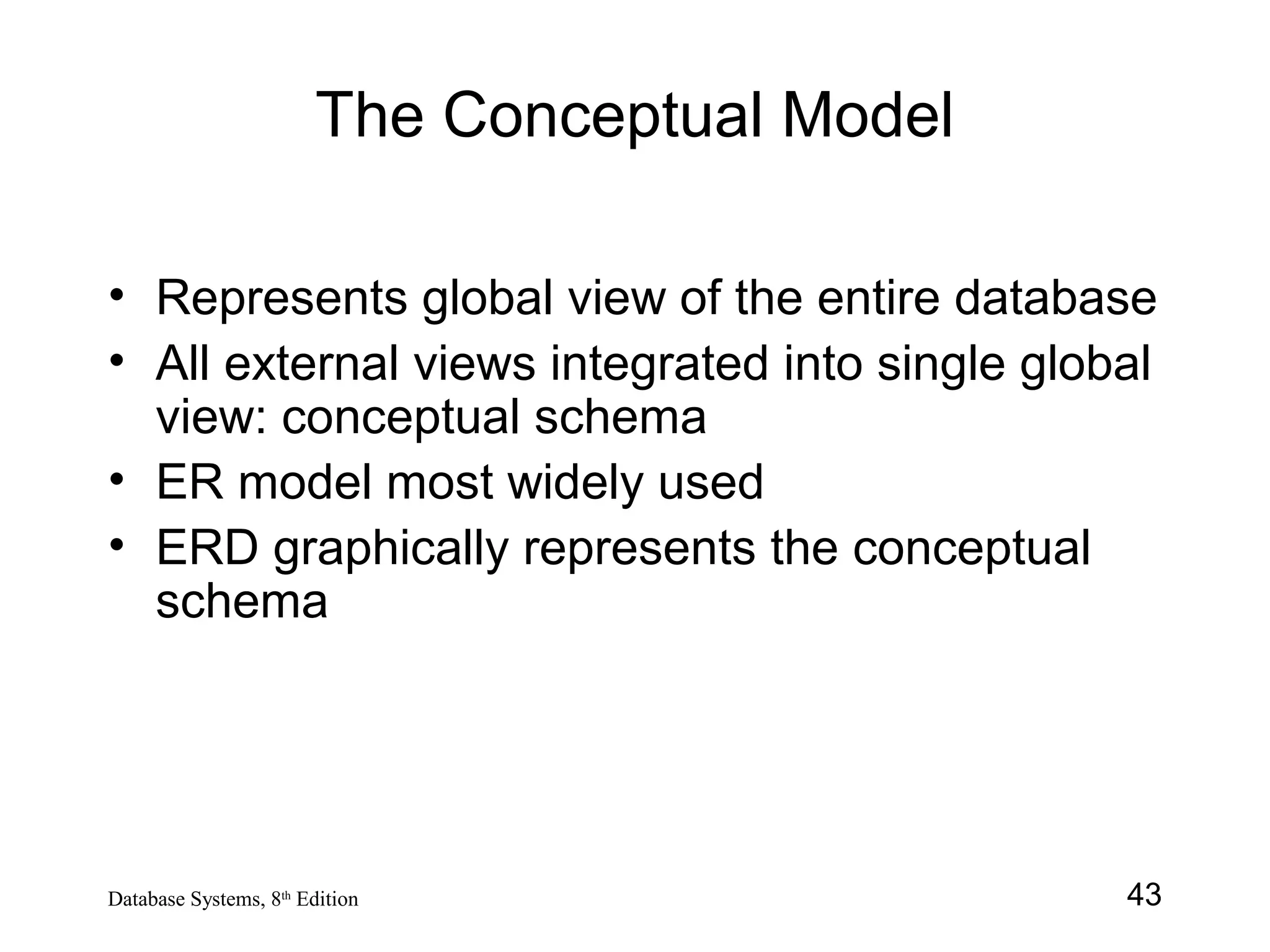
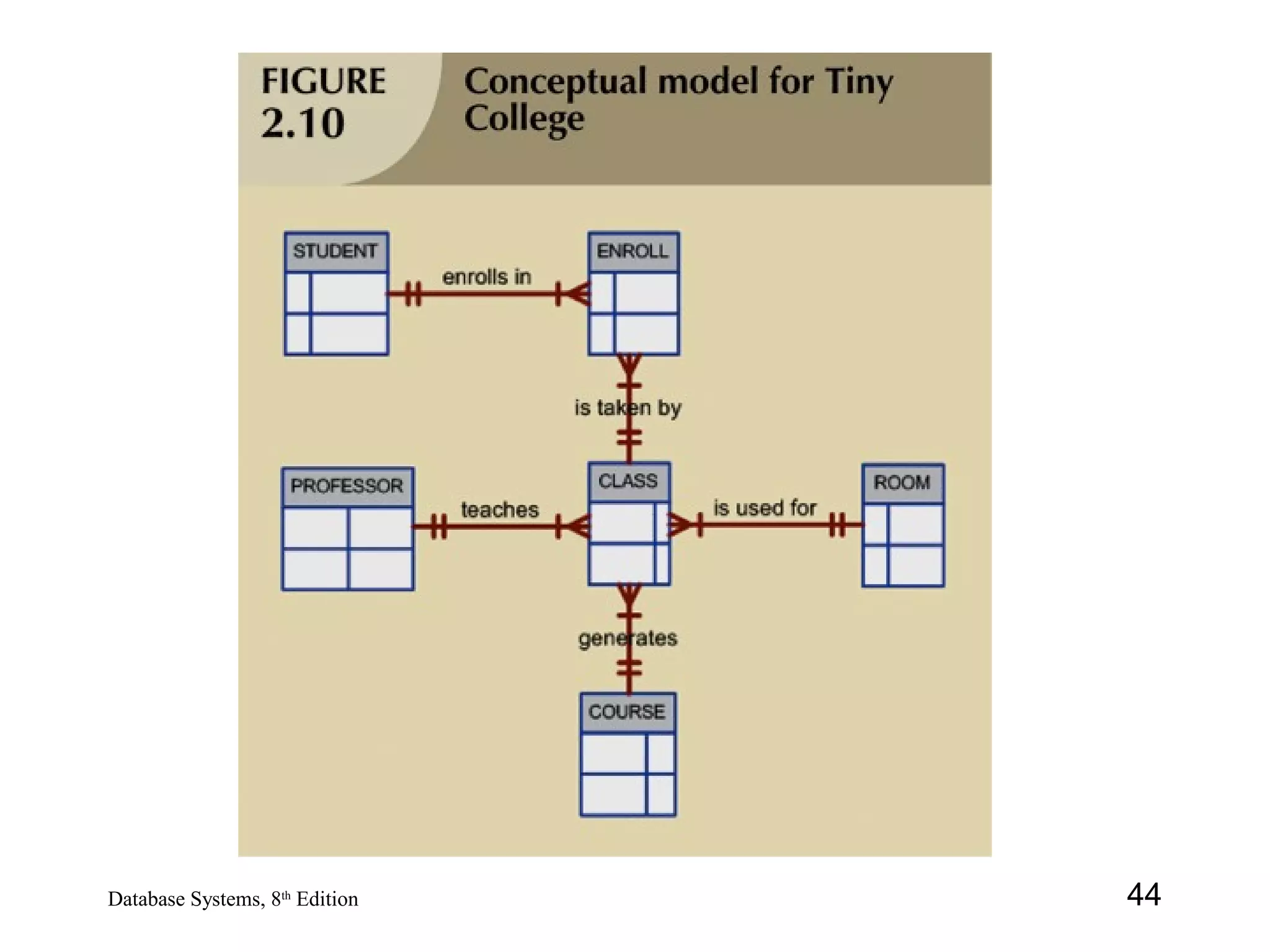
The Conceptual Model
• Represents global view of the entire database
• All external views integrated into single global
view: conceptual schema
• ER model most widely used
• ERD graphically represents the conceptual
schema
44Database Systems, 8th
Edition
45Database Systems, 8th
Edition
The Conceptual Model (continued)
• Provides a relatively easily understood macro
level view of data environment
• Independent of both software and hardware
– Does not depend on the DBMS software used
to implement the model
– Does not depend on the hardware used in the
implementation of the model
– Changes in hardware or software do not affect
database design at the conceptual level
46Database Systems, 8th
Edition
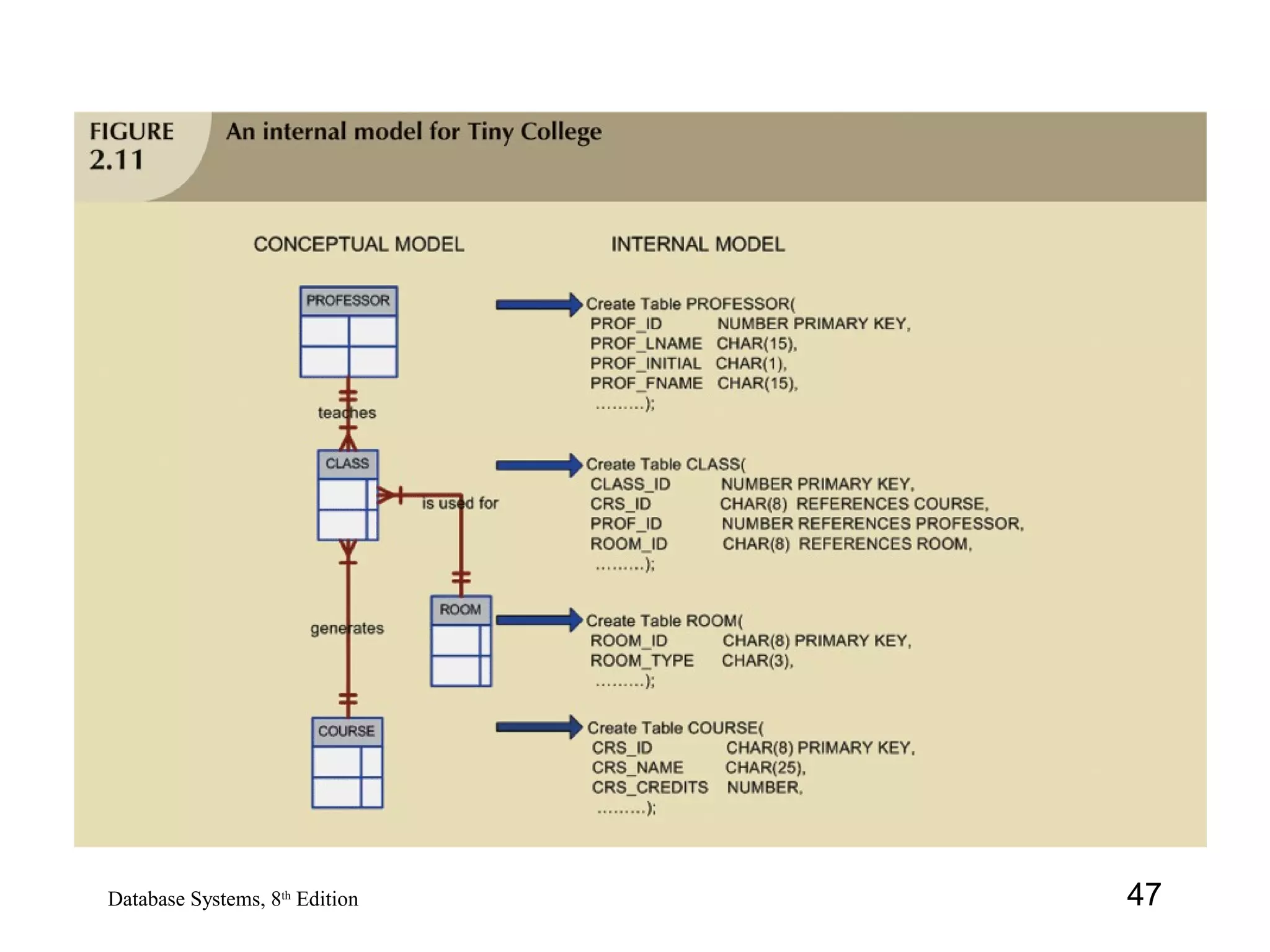
The Internal Model
• Representation of the database as “seen” by
the DBMS
– Maps the conceptual model to the DBMS
• Internal schema depicts a specific
representation of an internal model
• Depends on specific database software
– Change in DBMS software requires internal
model be changed
• Logical independence: change internal model
without affecting conceptual model
47Database Systems, 8th
Edition
48Database Systems, 8th
Edition
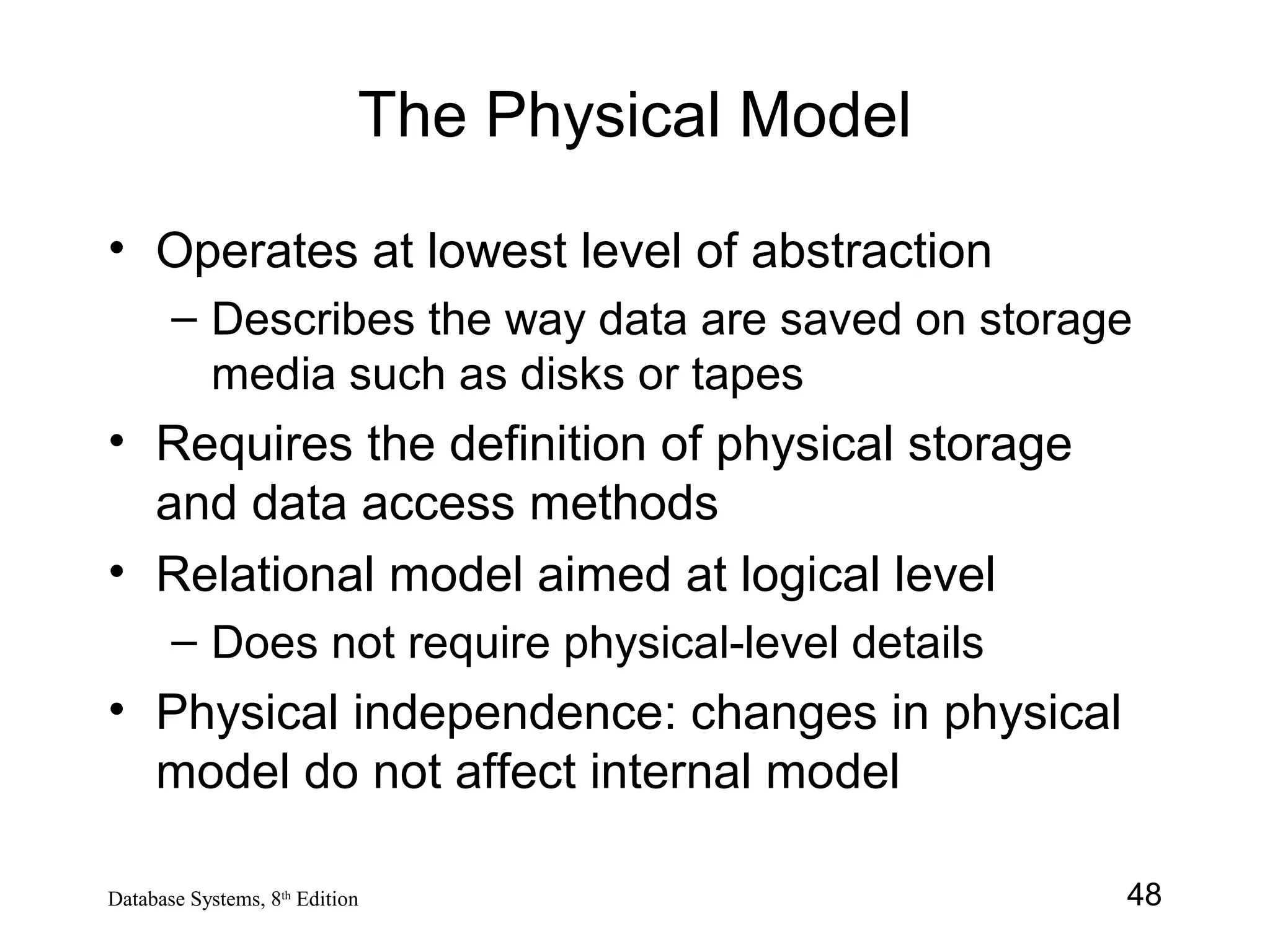
The Physical Model
• Operates at lowest level of abstraction
– Describes the way data are saved on storage
media such as disks or tapes
• Requires the definition of physical storage
and data access methods
• Relational model aimed at logical level
– Does not require physical-level details
• Physical independence: changes in physical
model do not affect internal model
49Database Systems, 8th
Edition
50Database Systems, 8th
Edition
Summary
• A data model is an abstraction of a complex
real-world data environment
• Basic data modeling components:
– Entities
– Attributes
– Relationships
– Constraints
• Business rules identify and define basic
modeling components
51Database Systems, 8th
Edition
Summary (continued)
• Hierarchical model
– Set of one-to-many (1:M) relationships
between a parent and its children segments
• Network data model
– Uses sets to represent 1:M relationships
between record types
• Relational model
– Current database implementation standard
– ER model is a tool for data modeling
• Complements relational model
52Database Systems, 8th
Edition
Summary (continued)
• Object-oriented data model: object is basic
modeling structure
• Relational model adopted object-oriented
extensions: extended relational data model
(ERDM)
• OO data models depicted using UML
• Data modeling requirements are a function of
different data views and abstraction levels
– Three abstraction levels: external, conceptual,
internal

Data models

  • 1.
    1Database Systems, 8th Edition DatabaseSystems: Design, Implementation, and Management Eighth Edition Chapter 2 Data Models
  • 2.
    2Database Systems, 8th Edition Objectives •About data modeling and why data models are important • About the basic data-modeling building blocks • What business rules are and how they influence database design • How the major data models evolved • How data models can be classified by level of abstraction
  • 3.
    3Database Systems, 8th Edition Introduction •Designers, programmers, and end users see data in different ways • Different views of same data lead to designs that do not reflect organization’s operation • Data modeling reduces complexities of database design • Various degrees of data abstraction help reconcile varying views of same data
  • 4.
    4Database Systems, 8th Edition DataModeling and Data Models • Data models – Relatively simple representations of complex real-world data structures • Often graphical • Model: an abstraction of a real-world object or event – Useful in understanding complexities of the real-world environment • Data modeling is iterative and progressive
  • 5.
    5Database Systems, 8th Edition TheImportance of Data Models • Facilitate interaction among the designer, the applications programmer, and the end user • End users have different views and needs for data • Data model organizes data for various users • Data model is an abstraction – Cannot draw required data out of the data model
  • 6.
    6 Data Model BasicBuilding Blocks • Entity: anything about which data are to be collected and stored • Attribute: a characteristic of an entity • Relationship: describes an association among entities – One-to-many (1:M) relationship – Many-to-many (M:N or M:M) relationship – One-to-one (1:1) relationship • Constraint: a restriction placed on the data Attribute : - ciri-ciri yang terdapat pada entiti Entiti: - apa juga yang berkenaan dgn data yang boleh disimpan CONTOH Entity : - Kelas Attribute : - Nama kelas, Kod kelas * dalam setiap ciri-ciri, mesti ada ciri-ciri yang unik. Contoh: nombor matrik, nombor ic, kod kursus kekangan
  • 7.
    7 Entity A EntityB 1 2 3 1 2 3 RELATIONSHIP ENTITY 1. Pelajar 2. Pensyarah 3. Kursus 4. Fakulti 5. Program BENTUK MODEL PELAJAR KURSUS PENSYARAH PROGRAM FAKULTI ambil ajar tawar tempat tawar ajar M M M 1 M 1 M 1 M M
  • 8.
    8Database Systems, 8th Edition BusinessRules • Descriptions of policies, procedures, or principles within a specific organization – Apply to any organization that stores and uses data to generate information • Description of operations to create/enforce actions within an organization’s environment • Must be in writing and kept up to date • Must be easy to understand and widely disseminated • Describe characteristics of data as viewed by the company
  • 9.
    9Database Systems, 8th Edition DiscoveringBusiness Rules • Sources of business rules: – Company managers – Policy makers – Department managers – Written documentation • Procedures • Standards • Operations manuals – Direct interviews with end users
  • 10.
    10Database Systems, 8th Edition DiscoveringBusiness Rules (continued) • Standardize company’s view of data • Communications tool between users and designers • Allow designer to understand the nature, role, and scope of data • Allow designer to understand business processes • Allow designer to develop appropriate relationship participation rules and constraints
  • 11.
    11Database Systems, 8th Edition TranslatingBusiness Rules into Data Model Components • Generally, nouns translate into entities • Verbs translate into relationships among entities • Relationships are bidirectional • Two questions to identify the relationship type: – How many instances of B are related to one instance of A? – How many instances of A are related to one instance of B? Perhubungan dilihat secara dua arah
  • 12.
    12Database Systems, 8th Edition TheEvolution of Data Models
  • 13.
    13Database Systems, 8th Edition TheHierarchical Model • Developed in the 1960s to manage large amounts of data for manufacturing projects • Basic logical structure is represented by an upside-down “tree” • Hierarchical structure contains levels or segments – Segment analogous to a record type – Set of one-to-many relationships between segments
  • 14.
  • 15.
    15Database Systems, 8th Edition TheHierarchical Model (continued) • Foundation for current data models • Disadvantages of the hierarchical model: – Complex to implement – Difficult to manage – Lacks structural independence – Relationships do not conform to 1:M form – No standards for how to implement
  • 16.
    16Database Systems, 8th Edition TheNetwork Model • Created to represent complex data relationships more effectively – Improves database performance – Imposes a database standard • Conference on Data Systems Languages (CODASYL) created the DBTG • Database Task Group (DBTG): defined environment to facilitate database creation Network model lebih baik daripada Hierarchy model
  • 17.
    17Database Systems, 8th Edition TheNetwork Model (continued) • Schema – Conceptual organization of entire database as viewed by the database administrator • Subschema – Database portion “seen” by the application programs • Data management language (DML) – Defines the environment in which data can be managed
  • 18.
    18Database Systems, 8th Edition TheNetwork Model (continued) • Resembles hierarchical model – Record may have more than one parent • Collection of records in 1:M relationships • Set composed of two record types – Owner • Equivalent to the hierarchical model’s parent – Member • Equivalent to the hierarchical model’s child
  • 19.
  • 20.
    20Database Systems, 8th Edition TheNetwork Model (continued) • Disadvantages of the network model – Cumbersome – Lack of ad hoc query capability placed burden on programmers to generate code for reports – Structural change in the database could produce havoc in all application programs
  • 21.
    21Database Systems, 8th Edition TheRelational Model • Developed by E. F. Codd (IBM) in 1970 • Table (relations) – Matrix consisting of row/column intersections – Each row in a relation called a tuple • Relational models considered impractical in 1970 • Model conceptually simple at expense of computer overhead
  • 22.
    22Database Systems, 8th Edition TheRelational Model (continued) • Relational data management system (RDBMS) – Performs same functions provided by hierarchical model – Hides complexity from the user • Relational diagram – Representation of entities, attributes, and relationships • Relational table stores collection of related entities
  • 23.
    23 Kalau perbuhungan MANYTO MANY, kena create satu lagi entity baru yang berperanan sebagai PRIMARY KEY. Entity baru tersebut dipanggil INTERMIDIATE ENTITY. INTERMIDIATE ENTITY berperanan sbg rujukan sahaja. Kalau perbuhungan ONE TO MANY, boleh guna attribute pada entity “one” tersebut sbg primary key satu rekod bermaksud koleksi data2 pada setiap medan/field bagi sesuatu table.
  • 24.
  • 25.
    25Database Systems, 8th Edition TheRelational Model (continued) • SQL-based relational database application involves three parts: – User interface • Allows end user to interact with the data – Set of tables stored in the database • Each table is independent from another • Rows in different tables related based on common values in common attributes – SQL “engine” • Executes all queries pengguna boleh berinteraksi dgn data
  • 26.
    26Database Systems, 8th Edition TheEntity Relationship Model • Widely accepted standard for data modeling • Introduced by Chen in 1976 • Graphical representation of entities and their relationships in a database structure • Entity relationship diagram (ERD) – Uses graphic representations to model database components – Entity is mapped to a relational table
  • 27.
    27Database Systems, 8th Edition TheEntity Relationship Model (continued) • Entity instance (or occurrence) is row in table • Entity set is collection of like entities • Connectivity labels types of relationships • Relationships expressed using Chen notation – Relationships represented by a diamond – Relationship name written inside the diamond • Crow’s Foot notation used as design standard in this book Terdapat 2 teknik yang digunapakai iaitu: CHEN NOTATION CROW’S FOOT NOTATION
  • 28.
  • 29.
    29Database Systems, 8th Edition TheObject-Oriented (OO) Model • Data and relationships contained in single structure known as an object • OODM (object-oriented data model) is the basis for OODBMS – Semantic data model • Objects contain operations • Object is self-contained: a basic building- block for autonomous structures • Object is an abstraction of a real-world entity
  • 30.
    30Database Systems, 8th Edition TheObject-Oriented (OO) Model (continued) • Attributes describe the properties of an object • Objects that share similar characteristics are grouped in classes • Classes are organized in a class hierarchy • Inheritance: object inherits methods and attributes of parent class • UML based on OO concepts that describe diagrams and symbols – Used to graphically model a system
  • 31.
  • 32.
    32Database Systems, 8th Edition TheConvergence of Data Models • Extended relational data model (ERDM) – Semantic data model developed in response to increasing complexity of applications – Includes many of OO model’s best features – Often described as an object/relational database management system (O/RDBMS) – Primarily geared to business applications
  • 33.
    33Database Systems, 8th Edition DatabaseModels and the Internet • Internet drastically changed role and scope of database market • Focus on Internet makes underlying data model less important • Dominance of Web has resulted in growing need to manage unstructured information • Current databases support XML – XML: the standard protocol for data exchange among systems and Internet services
  • 34.
  • 35.
    35Database Systems, 8th Edition DataModels: A Summary • Common characteristics: – Conceptual simplicity with semantic completeness – Represent the real world as closely as possible – Real-world transformations must comply with consistency and integrity characteristics • Each new data model capitalized on the shortcomings of previous models • Some models better suited for some tasks
  • 36.
  • 37.
    37Database Systems, 8th Edition Degreesof Data Abstraction • Database designer starts with abstracted view, then adds details • ANSI Standards Planning and Requirements Committee (SPARC) – Defined a framework for data modeling based on degrees of data abstraction (1970s): • External • Conceptual • Internal
  • 38.
    38Database Systems, 8th Edition TheExternal Model • End users’ view of the data environment • ER diagrams represent external views • External schema: specific representation of an external view – Entities – Relationships – Processes – Constraints
  • 39.
  • 40.
    40Database Systems, 8th Edition TheExternal Model (continued) • Easy to identify specific data required to support each business unit’s operations • Facilitates designer’s job by providing feedback about the model’s adequacy • Ensures security constraints in database design • Simplifies application program development
  • 41.
  • 42.
    42Database Systems, 8th Edition STUDENTSTUDENTCLASSCLASSENROLLENROLL M M COURSECOURSE 1 1 1 M
  • 43.
    43Database Systems, 8th Edition TheConceptual Model • Represents global view of the entire database • All external views integrated into single global view: conceptual schema • ER model most widely used • ERD graphically represents the conceptual schema
  • 44.
  • 45.
    45Database Systems, 8th Edition TheConceptual Model (continued) • Provides a relatively easily understood macro level view of data environment • Independent of both software and hardware – Does not depend on the DBMS software used to implement the model – Does not depend on the hardware used in the implementation of the model – Changes in hardware or software do not affect database design at the conceptual level
  • 46.
    46Database Systems, 8th Edition TheInternal Model • Representation of the database as “seen” by the DBMS – Maps the conceptual model to the DBMS • Internal schema depicts a specific representation of an internal model • Depends on specific database software – Change in DBMS software requires internal model be changed • Logical independence: change internal model without affecting conceptual model
  • 47.
  • 48.
    48Database Systems, 8th Edition ThePhysical Model • Operates at lowest level of abstraction – Describes the way data are saved on storage media such as disks or tapes • Requires the definition of physical storage and data access methods • Relational model aimed at logical level – Does not require physical-level details • Physical independence: changes in physical model do not affect internal model
  • 49.
  • 50.
    50Database Systems, 8th Edition Summary •A data model is an abstraction of a complex real-world data environment • Basic data modeling components: – Entities – Attributes – Relationships – Constraints • Business rules identify and define basic modeling components
  • 51.
    51Database Systems, 8th Edition Summary(continued) • Hierarchical model – Set of one-to-many (1:M) relationships between a parent and its children segments • Network data model – Uses sets to represent 1:M relationships between record types • Relational model – Current database implementation standard – ER model is a tool for data modeling • Complements relational model
  • 52.
    52Database Systems, 8th Edition Summary(continued) • Object-oriented data model: object is basic modeling structure • Relational model adopted object-oriented extensions: extended relational data model (ERDM) • OO data models depicted using UML • Data modeling requirements are a function of different data views and abstraction levels – Three abstraction levels: external, conceptual, internal