Data Governance That
Drives the Bottom Line
Focusing data governance to improve
financial results
Housekeeping
Webinar Audio
• Today’s webcast audio is streamed through your
computer speakers
• If you need technical assistance with the web interface
or audio, please reach out to us using the Q&A box
Questions Welcome
• Submit your questions at any time during the
presentation using the Q&A box. If we don't get to your
question, we will follow-up via email
Recording and slides
• This webinar is being recorded. You will receive an email
following the webinar with a link to the recording and
slides
“We need to
govern our data!”
3
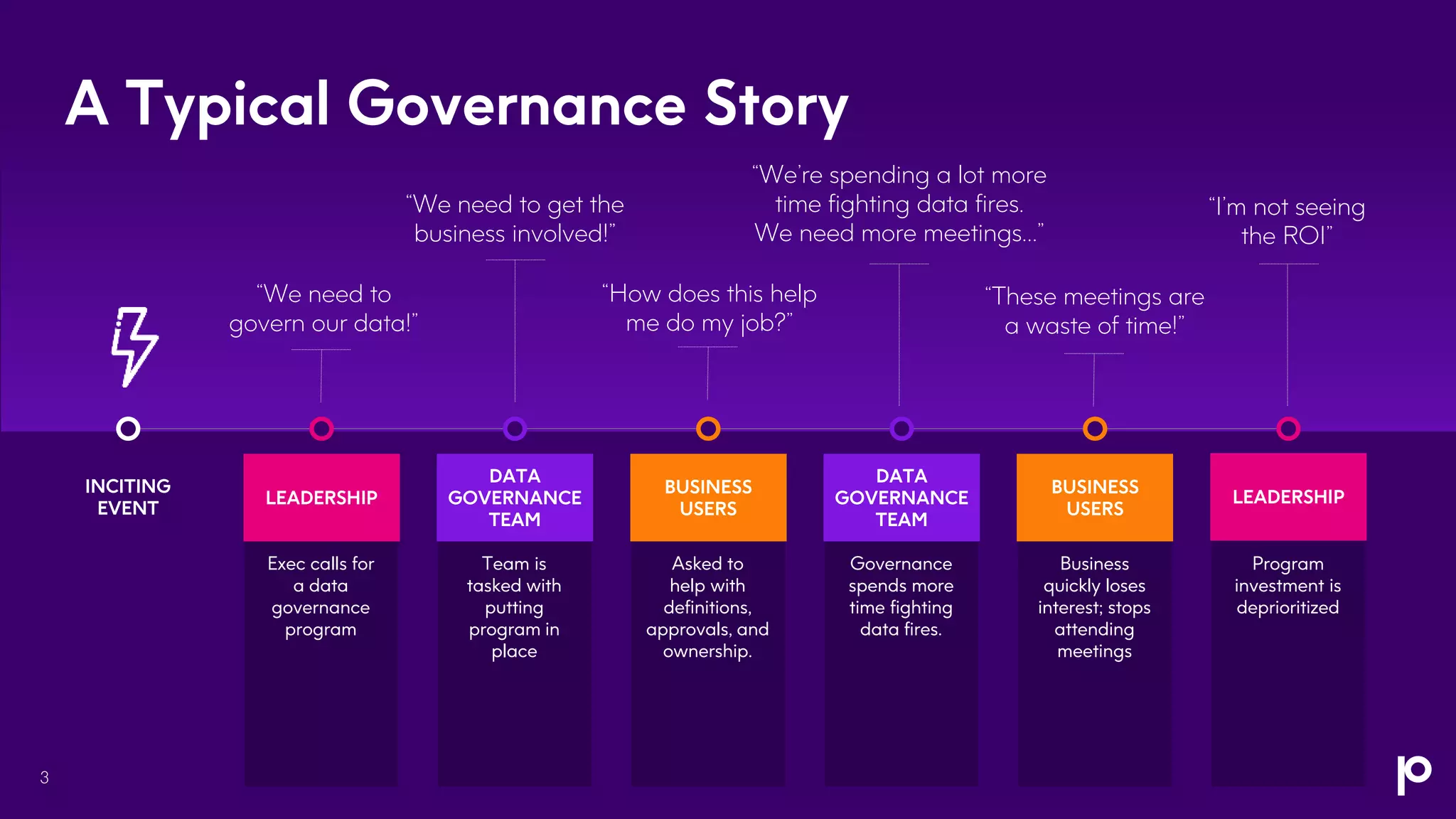
A Typical Governance Story
LEADERSHIP
DATA
GOVERNANCE
TEAM
BUSINESS
USERS
DATA
GOVERNANCE
TEAM
BUSINESS
USERS
LEADERSHIP
INCITING
EVENT
Governance
spends more
time fighting
data fires.
Business
quickly loses
interest; stops
attending
meetings
Program
investment is
deprioritized
Asked to
help with
definitions,
approvals, and
ownership.
Team is
tasked with
putting
program in
place
Exec calls for
a data
governance
program
“We need to get the
business involved!”
“How does this help
me do my job?”
“We’re spending a lot more
time fighting data fires.
We need more meetings…”
“These meetings are
a waste of time!”
“I’m not seeing
the ROI”
Data Governance drives value creation
• Gartner “Data governance is the specification of decision rights and an accountability
framework to ensure the appropriate behavior in the valuation, creation, consumption and
control of data and analytics.”
• DAMA International “Data governance is the exercise of authority and control (planning,
monitoring, and enforcement) over the management of data assets.”
• Data governance Institute “Data governance is a system of decision rights and
accountabilities for information-related processes, executed according to agreed-upon
models which describe who can take what actions with what information, and when, under
what circumstances, using what methods.”
• Data governance 2.0 , just enough data governance, data governance framework, etc.
4
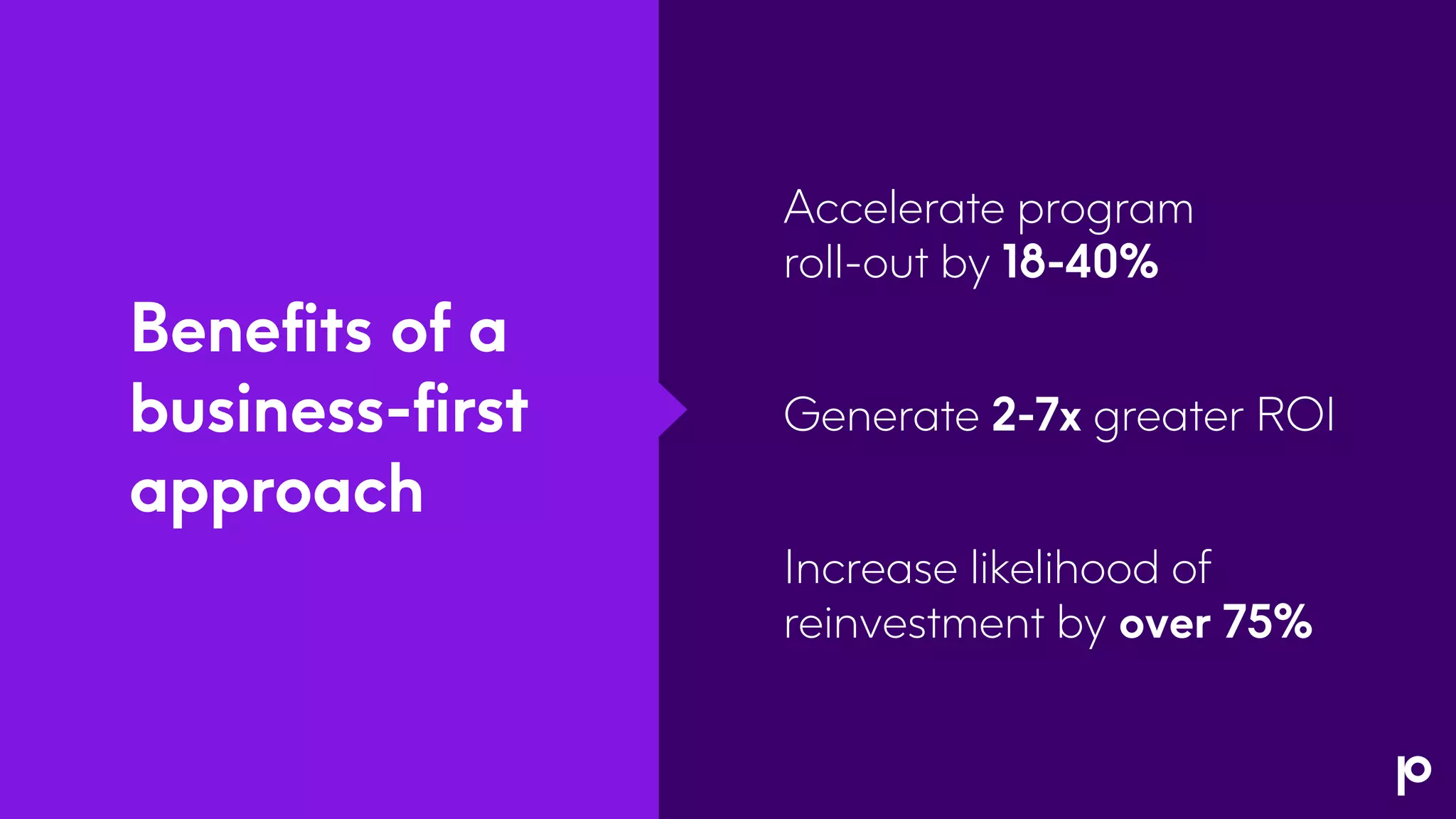
Benefits of a
business-first
approach
Accelerate program
roll-out by 18-40%
Increase likelihood of
reinvestment by over 75%
Generate 2-7x greater ROI
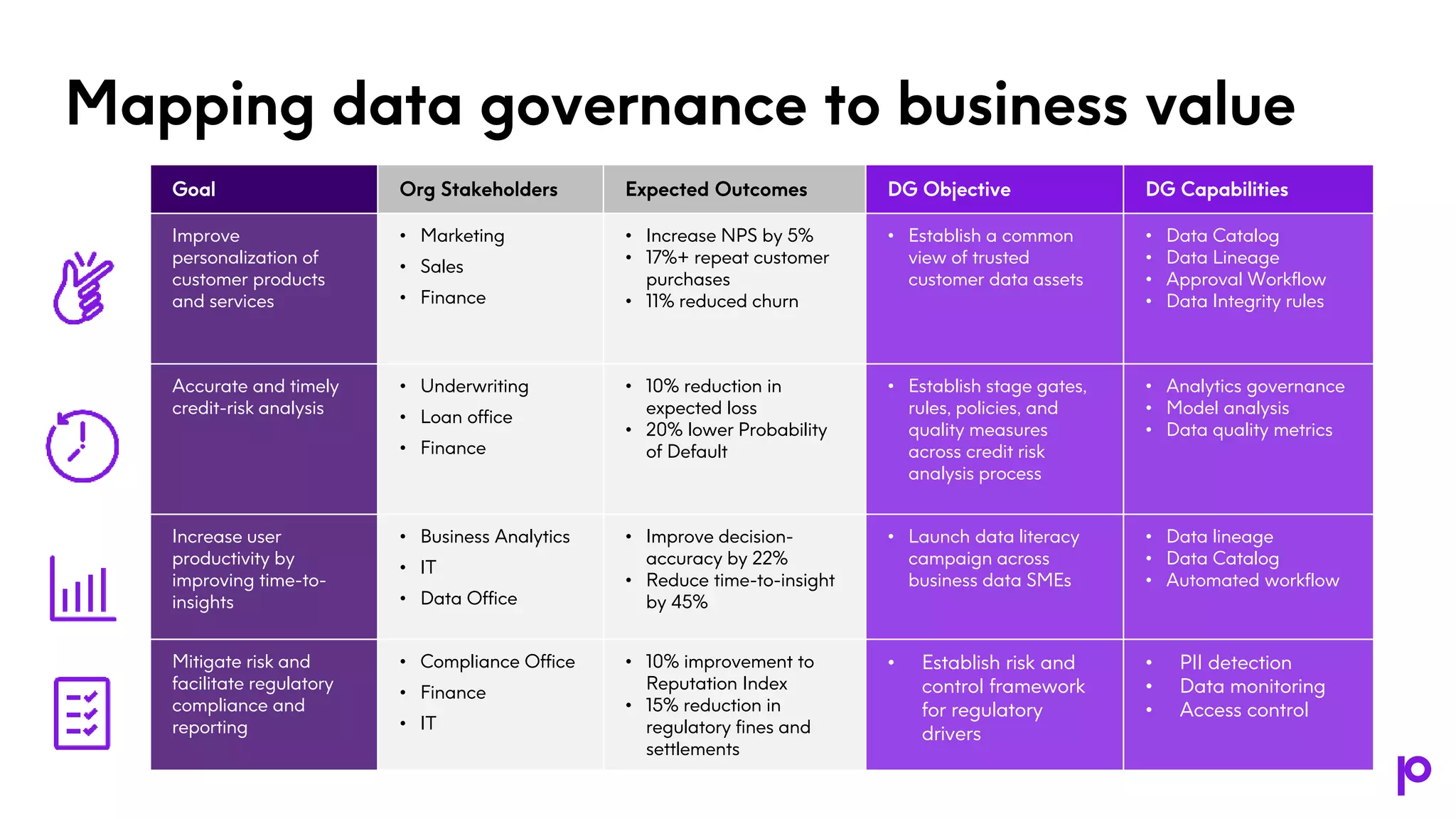
Mapping data governance to business value
Goal Org Stakeholders Expected Outcomes DG Objective DG Capabilities
Improve
personalization of
customer products
and services
• Marketing
• Sales
• Finance
• Increase NPS by 5%
• 17%+ repeat customer
purchases
• 11% reduced churn
• Establish a common
view of trusted
customer data assets
• Data Catalog
• Data Lineage
• Approval Workflow
• Data Integrity rules
Accurate and timely
credit-risk analysis
• Underwriting
• Loan office
• Finance
• 10% reduction in
expected loss
• 20% lower Probability
of Default
• Establish stage gates,
rules, policies, and
quality measures
across credit risk
analysis process
• Analytics governance
• Model analysis
• Data quality metrics
Increase user
productivity by
improving time-to-
insights
• Business Analytics
• IT
• Data Office
• Improve decision-
accuracy by 22%
• Reduce time-to-insight
by 45%
• Launch data literacy
campaign across
business data SMEs
• Data lineage
• Data Catalog
• Automated workflow
Mitigate risk and
facilitate regulatory
compliance and
reporting
• Compliance Office
• Finance
• IT
• 10% improvement to
Reputation Index
• 15% reduction in
regulatory fines and
settlements
• Establish risk and
control framework
for regulatory
drivers
• PII detection
• Data monitoring
• Access control
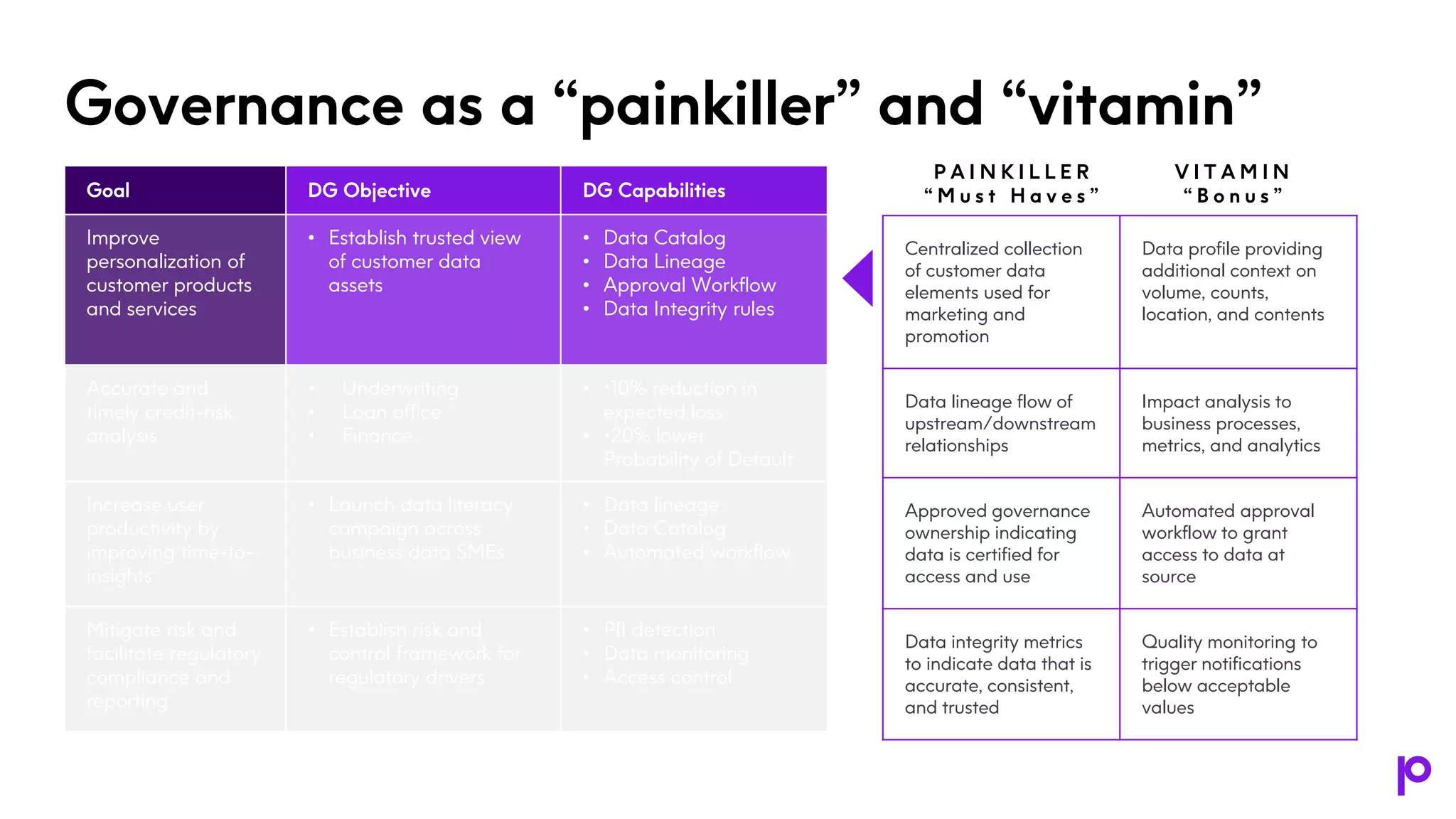
Governance as a “painkiller” and “vitamin”
Goal DG Objective DG Capabilities
Improve
personalization of
customer products
and services
• Establish trusted view
of customer data
assets
• Data Catalog
• Data Lineage
• Approval Workflow
• Data Integrity rules
Accurate and
timely credit-risk
analysis
• Underwriting
• Loan office
• Finance
• •10% reduction in
expected loss
• •20% lower
Probability of Default
Increase user
productivity by
improving time-to-
insights
• Launch data literacy
campaign across
business data SMEs
• Data lineage
• Data Catalog
• Automated workflow
Mitigate risk and
facilitate regulatory
compliance and
reporting
• Establish risk and
control framework for
regulatory drivers
• PII detection
• Data monitoring
• Access control
Centralized collection
of customer data
elements used for
marketing and
promotion
Data profile providing
additional context on
volume, counts,
location, and contents
Data lineage flow of
upstream/downstream
relationships
Impact analysis to
business processes,
metrics, and analytics
Approved governance
ownership indicating
data is certified for
access and use
Automated approval
workflow to grant
access to data at
source
Data integrity metrics
to indicate data that is
accurate, consistent,
and trusted
Quality monitoring to
trigger notifications
below acceptable
values
P A I N K I L L E R
“ M u s t H a v e s ”
V I T A M I N
“ B o n u s ”
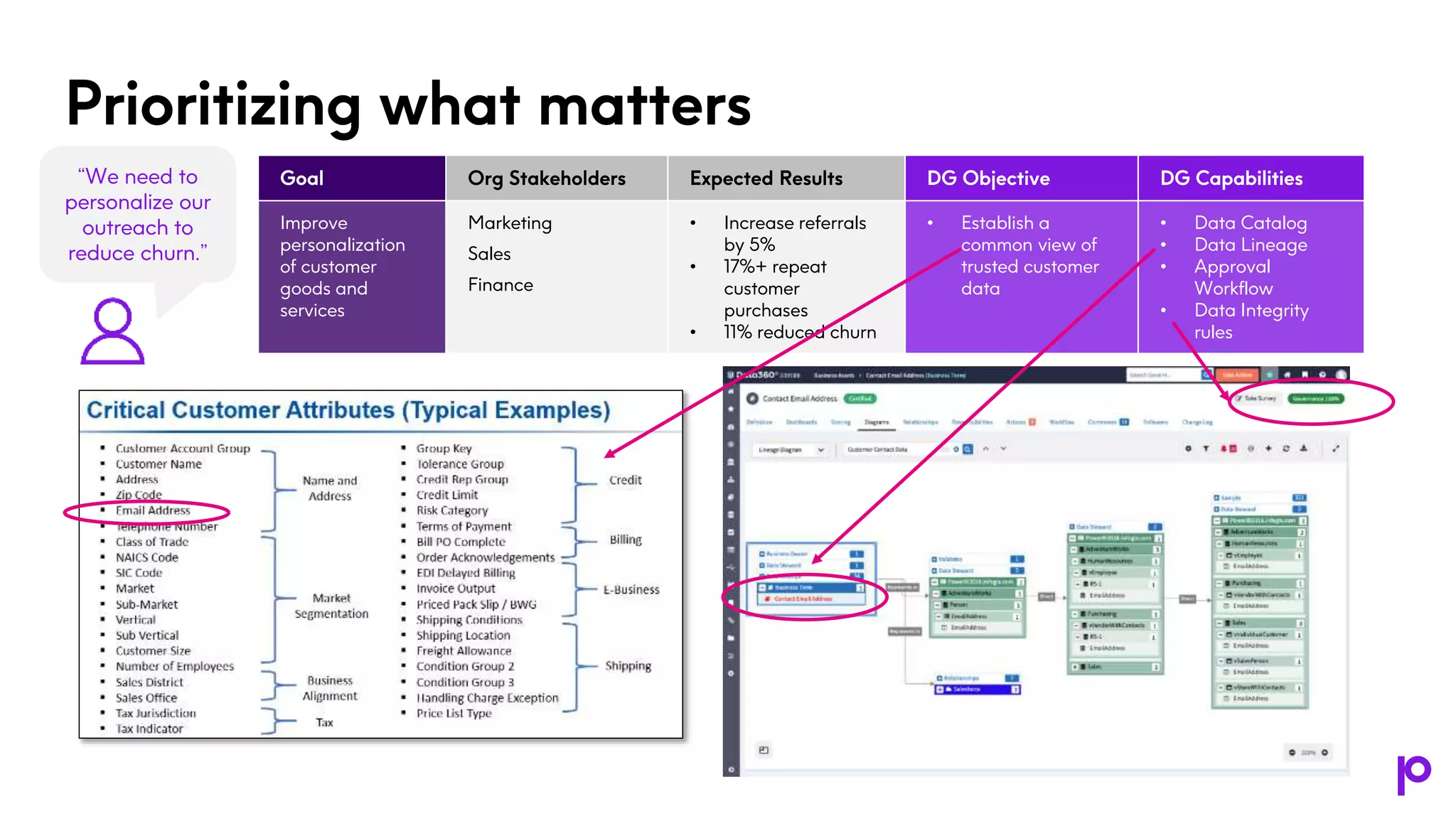
Prioritizing what matters
Goal Org Stakeholders Expected Results DG Objective DG Capabilities
Improve
personalization
of customer
goods and
services
Marketing
Sales
Finance
• Increase referrals
by 5%
• 17%+ repeat
customer
purchases
• 11% reduced churn
• Establish a
common view of
trusted customer
data
• Data Catalog
• Data Lineage
• Approval
Workflow
• Data Integrity
rules
“We need to
personalize our
outreach to
reduce churn.”
Operational
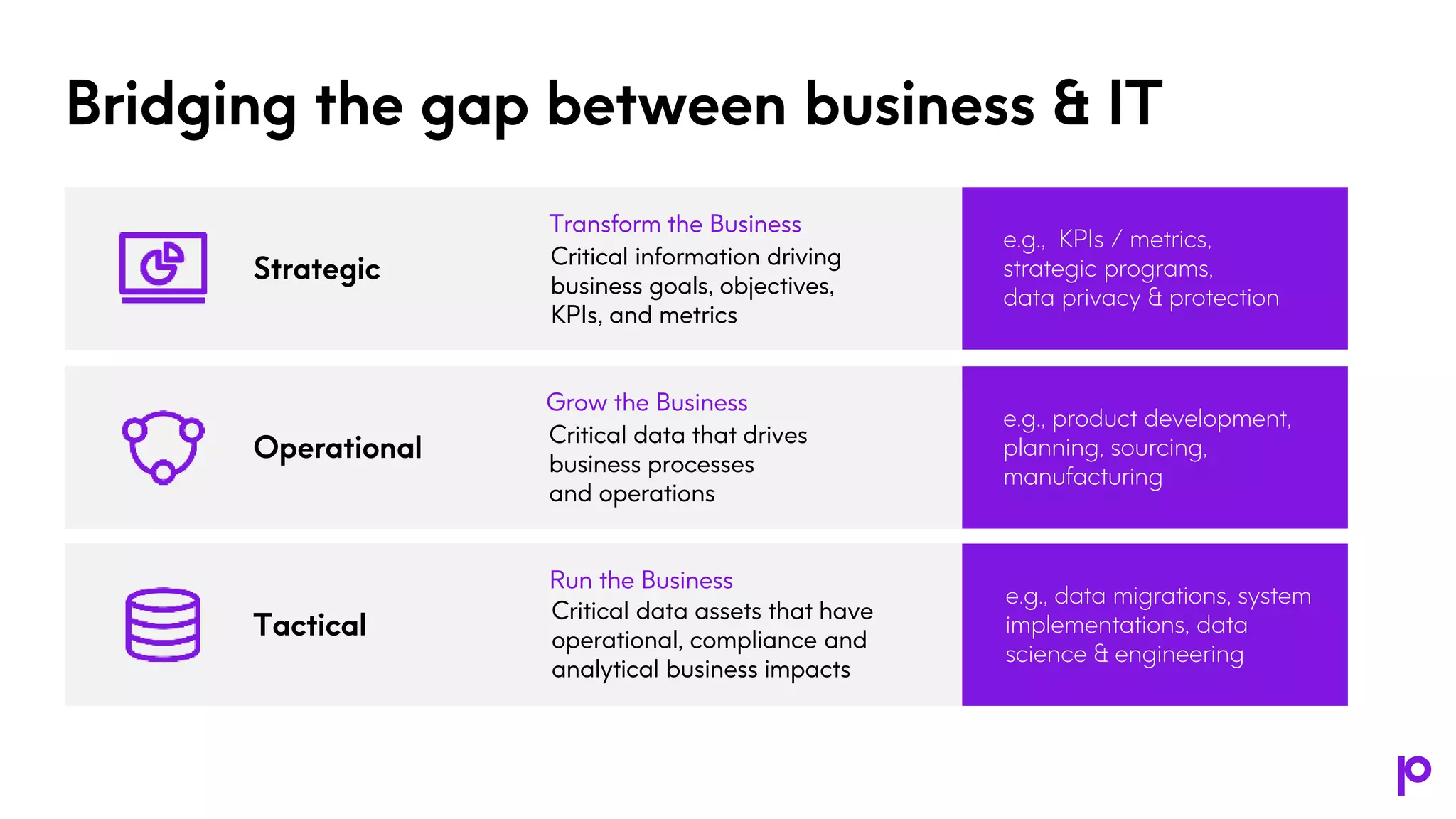
Bridging the gap between business & IT
Strategic
Tactical
e.g., KPIs / metrics,
strategic programs,
data privacy & protection
e.g., product development,
planning, sourcing,
manufacturing
e.g., data migrations, system
implementations, data
science & engineering
Critical data that drives
business processes
and operations
Grow the Business
Critical data assets that have
operational, compliance and
analytical business impacts
Run the Business
Critical information driving
business goals, objectives,
KPIs, and metrics
Transform the Business
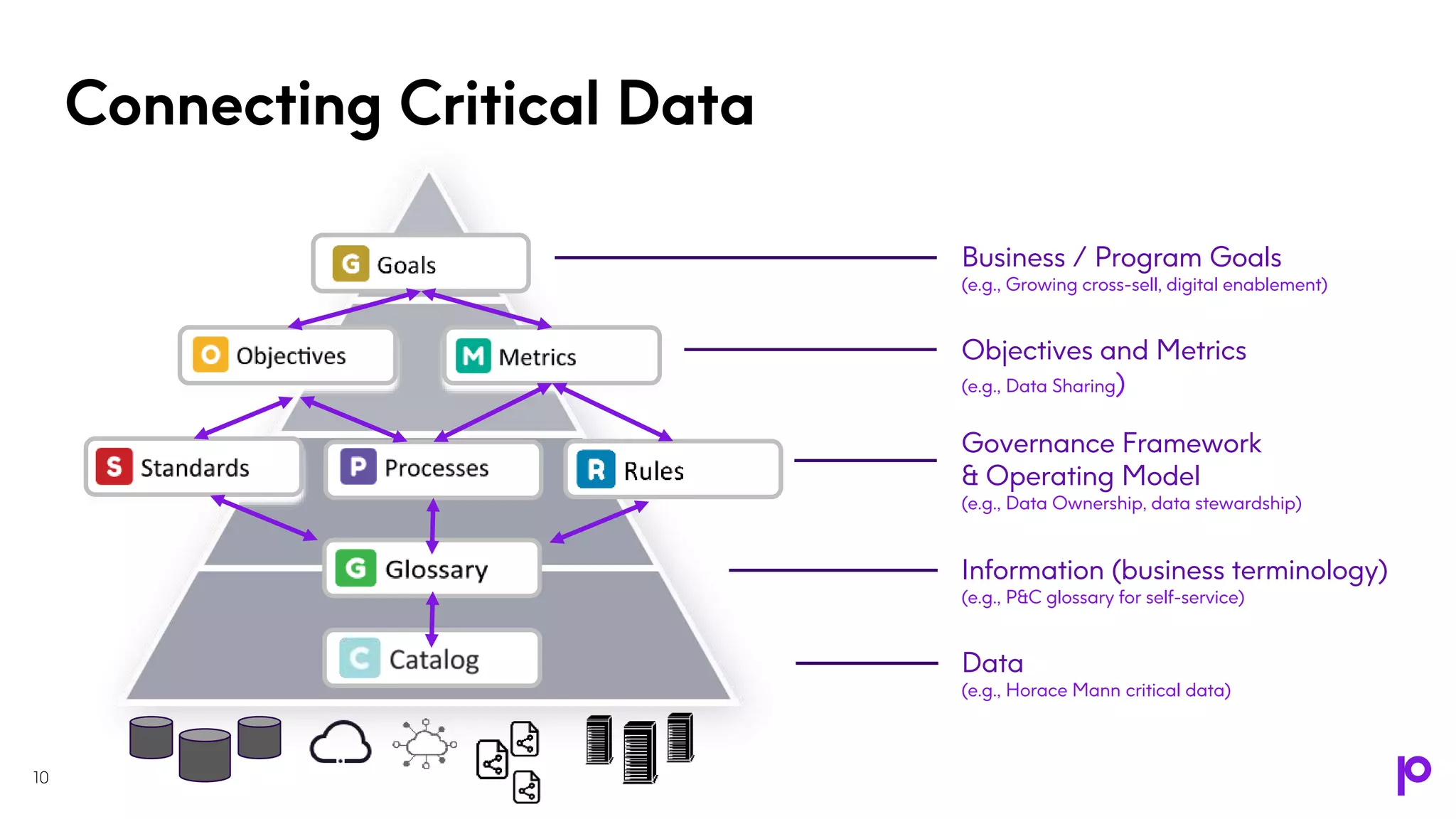
Connecting Critical Data
10
Business / Program Goals
(e.g., Growing cross-sell, digital enablement)
Objectives and Metrics
(e.g., Data Sharing)
Governance Framework
& Operating Model
(e.g., Data Ownership, data stewardship)
Information (business terminology)
(e.g., P&C glossary for self-service)
Data
(e.g., Horace Mann critical data)
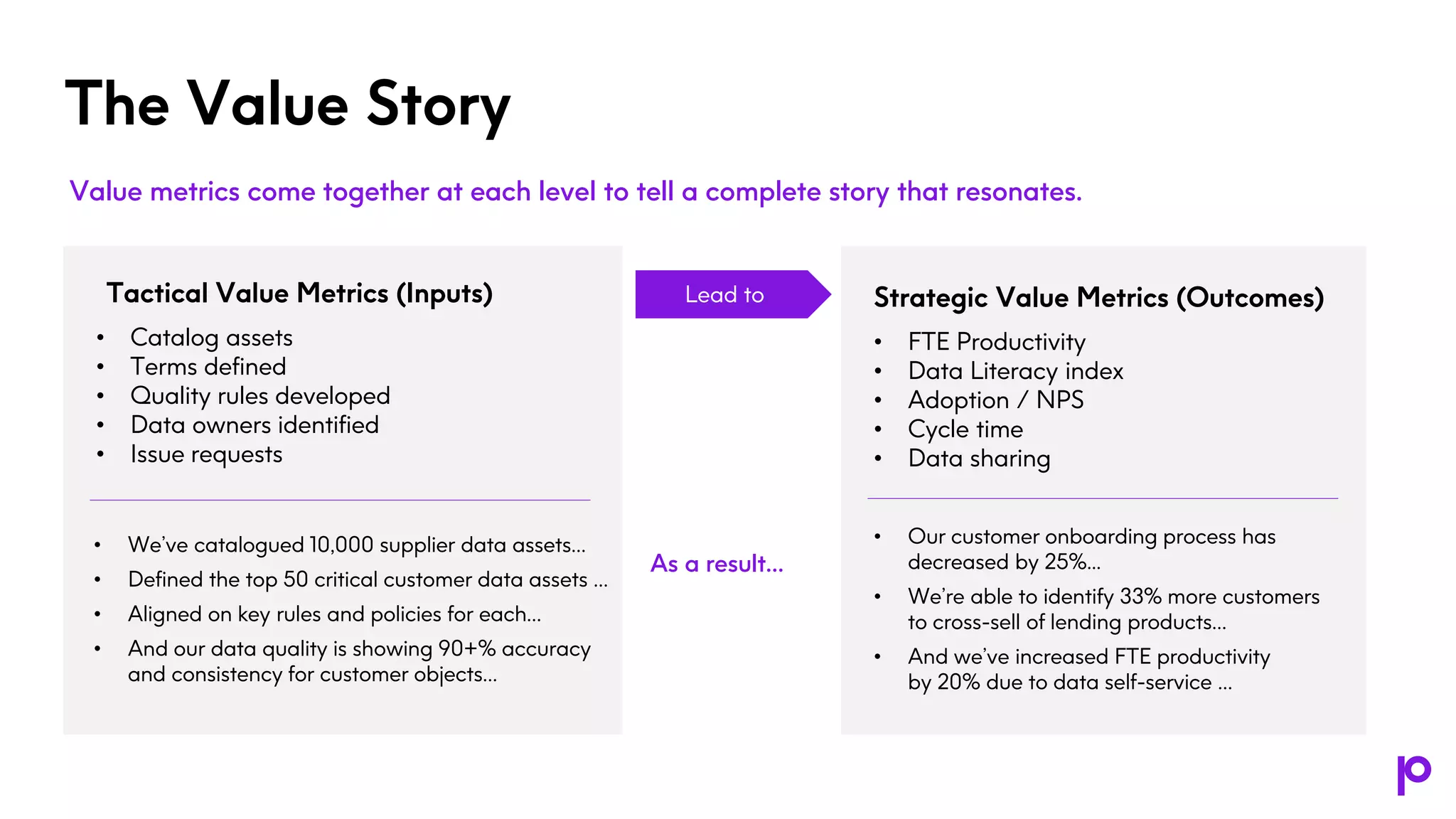
The Value Story
• Catalog assets
• Terms defined
• Quality rules developed
• Data owners identified
• Issue requests
Tactical Value Metrics (Inputs)
• FTE Productivity
• Data Literacy index
• Adoption / NPS
• Cycle time
• Data sharing
Strategic Value Metrics (Outcomes)
• Our customer onboarding process has
decreased by 25%...
• We’re able to identify 33% more customers
to cross-sell of lending products…
• And we’ve increased FTE productivity
by 20% due to data self-service …
• We’ve catalogued 10,000 supplier data assets…
• Defined the top 50 critical customer data assets …
• Aligned on key rules and policies for each…
• And our data quality is showing 90+% accuracy
and consistency for customer objects…
Value metrics come together at each level to tell a complete story that resonates.
As a result…
Lead to
How Precisely Data360 can help
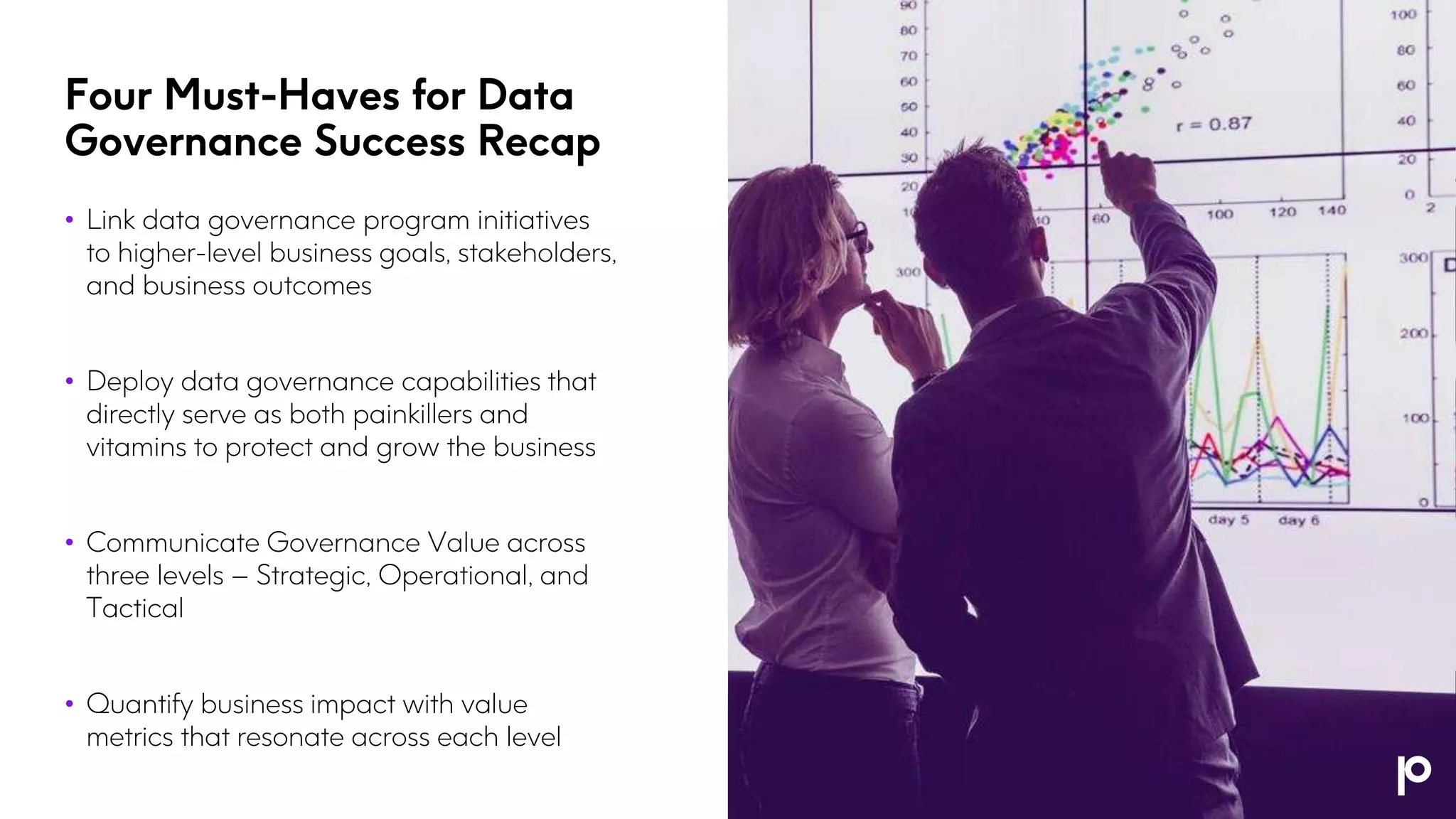
Four Must-Haves for Data
Governance Success Recap
• Link data governance program initiatives
to higher-level business goals, stakeholders,
and business outcomes
• Deploy data governance capabilities that
directly serve as both painkillers and
vitamins to protect and grow the business
• Communicate Governance Value across
three levels – Strategic, Operational, and
Tactical
• Quantify business impact with value
metrics that resonate across each level
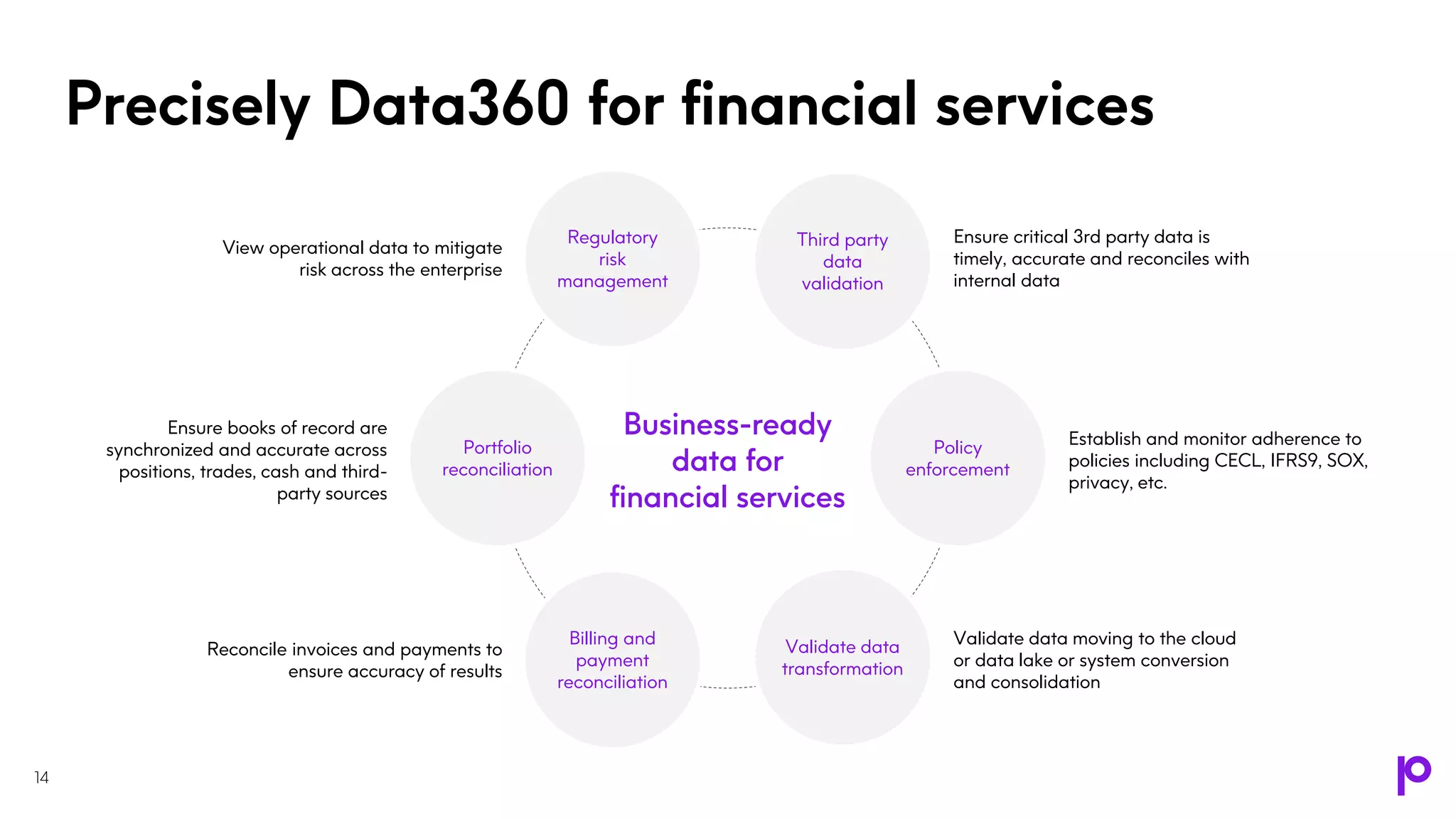
Precisely Data360 for financial services
14
Third party
data
validation
Policy
enforcement
Billing and
payment
reconciliation
Portfolio
reconciliation
Regulatory
risk
management
Validate data
transformation
Business-ready
data for
financial services
View operational data to mitigate
risk across the enterprise
Ensure books of record are
synchronized and accurate across
positions, trades, cash and third-
party sources
Reconcile invoices and payments to
ensure accuracy of results
Ensure critical 3rd party data is
timely, accurate and reconciles with
internal data
Establish and monitor adherence to
policies including CECL, IFRS9, SOX,
privacy, etc.
Validate data moving to the cloud
or data lake or system conversion
and consolidation
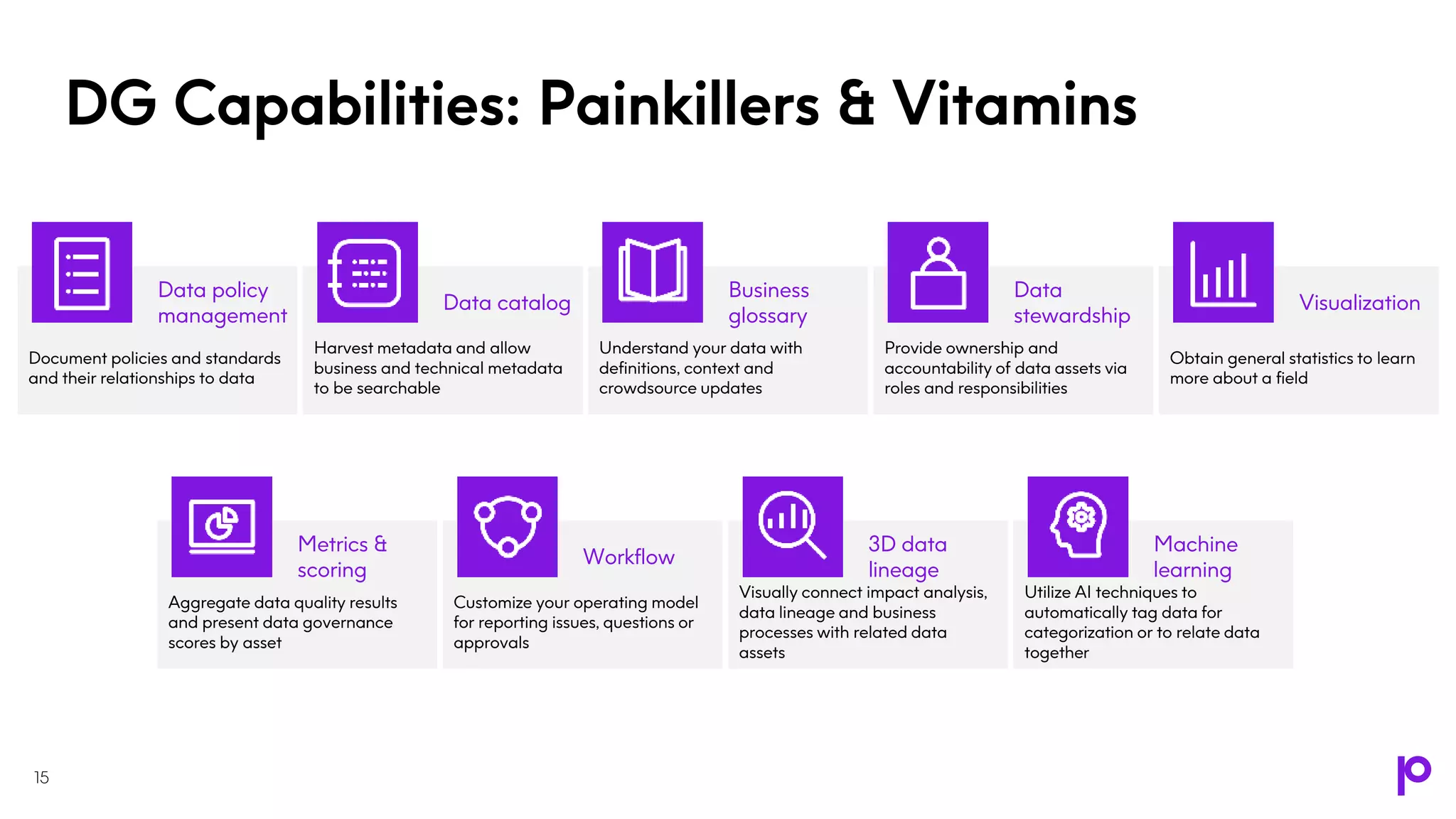
DG Capabilities: Painkillers & Vitamins
15
Provide ownership and
accountability of data assets via
roles and responsibilities
Data
stewardship
Obtain general statistics to learn
more about a field
Visualization
Visually connect impact analysis,
data lineage and business
processes with related data
assets
3D data
lineage
Utilize AI techniques to
automatically tag data for
categorization or to relate data
together
Machine
learning
Aggregate data quality results
and present data governance
scores by asset
Metrics &
scoring
Understand your data with
definitions, context and
crowdsource updates
Business
glossary
Customize your operating model
for reporting issues, questions or
approvals
Workflow
Harvest metadata and allow
business and technical metadata
to be searchable
Data catalog
Document policies and standards
and their relationships to data
Data policy
management
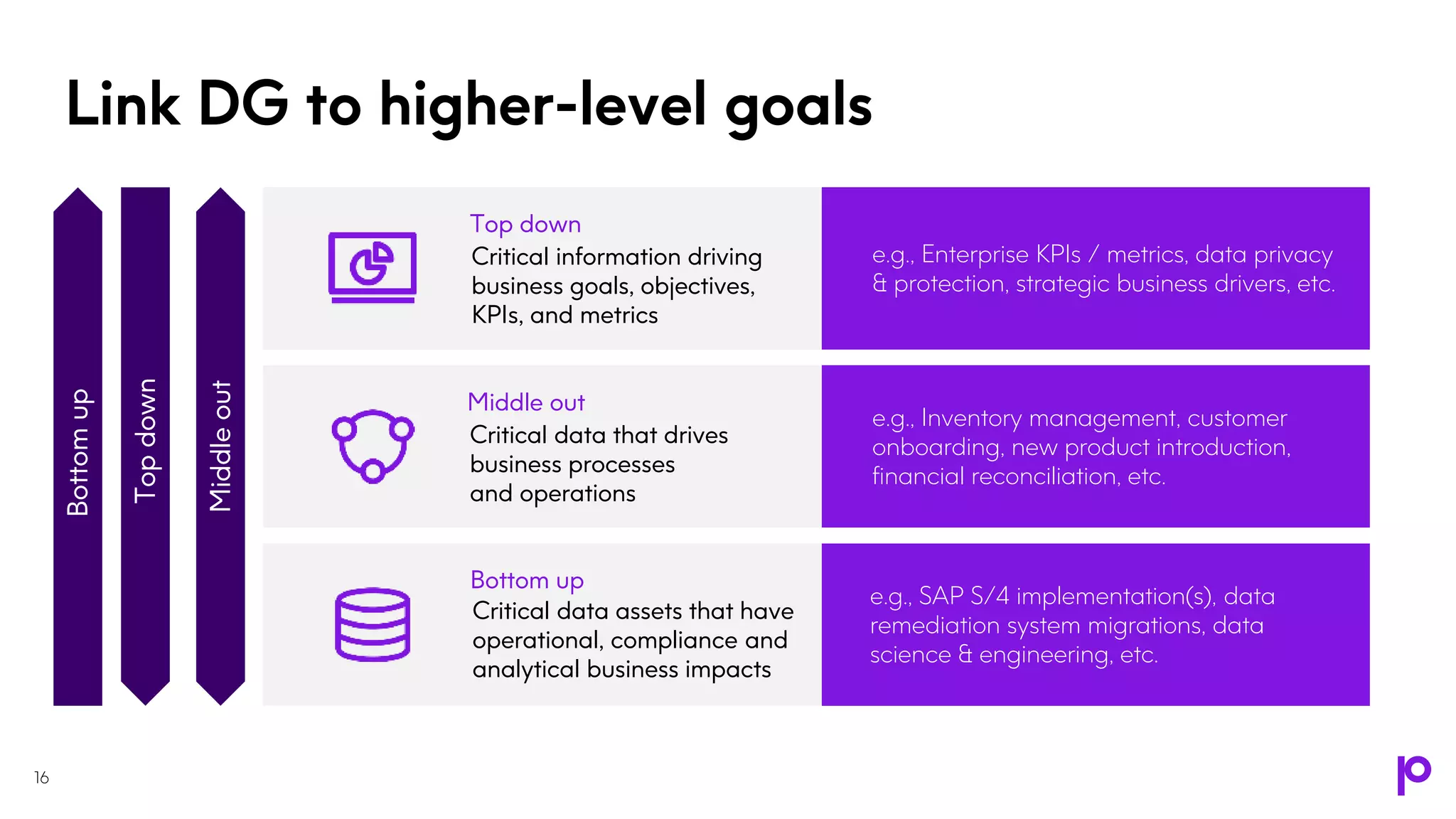
Link DG to higher-level goals
16
e.g., Inventory management, customer
onboarding, new product introduction,
financial reconciliation, etc.
e.g., SAP S/4 implementation(s), data
remediation system migrations, data
science & engineering, etc.
e.g., Enterprise KPIs / metrics, data privacy
& protection, strategic business drivers, etc.
Bottom
up
Middle
out
Top
down
Critical data that drives
business processes
and operations
Middle out
Critical data assets that have
operational, compliance and
analytical business impacts
Bottom up
Critical information driving
business goals, objectives,
KPIs, and metrics
Top down
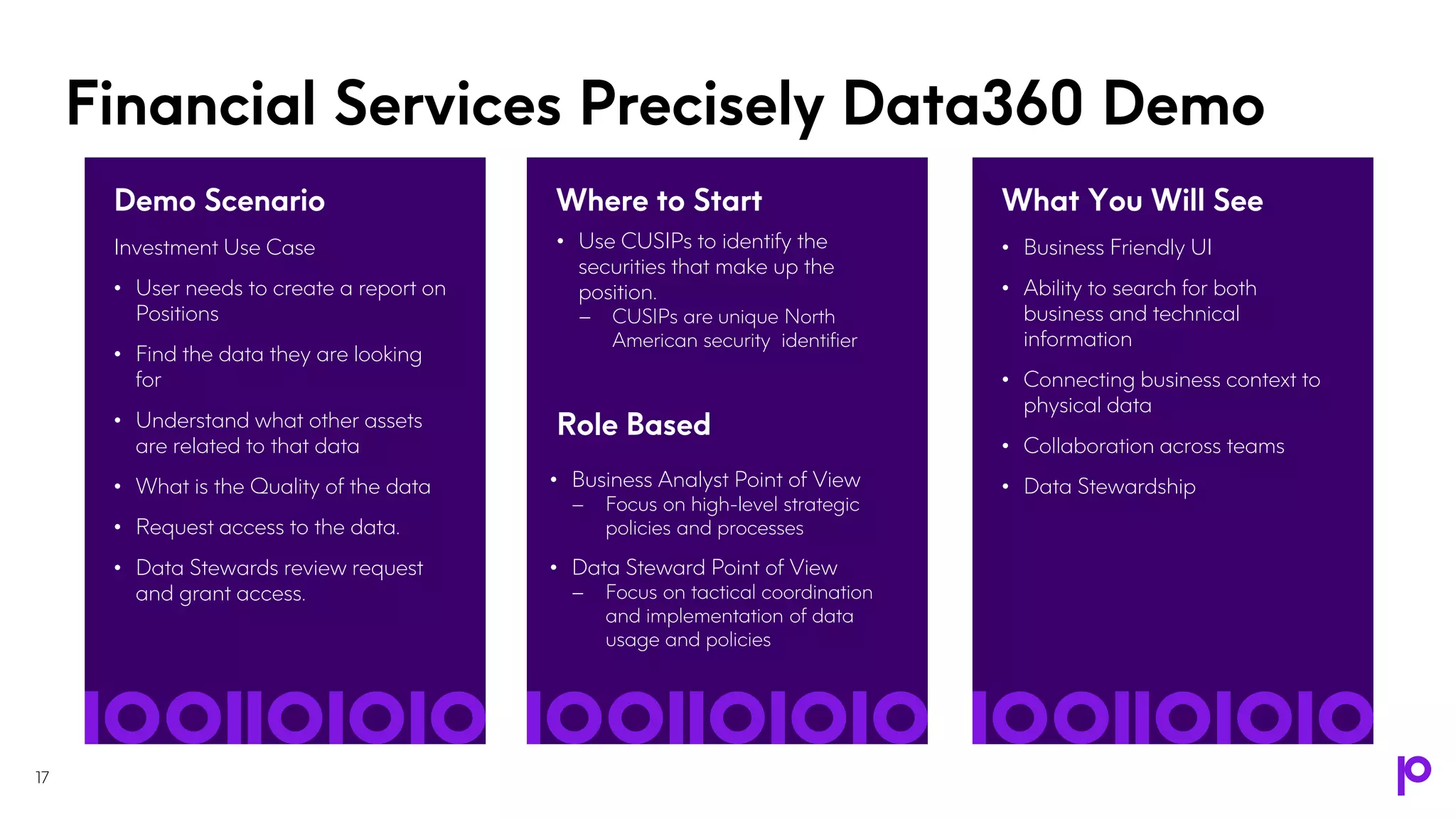
Financial Services Precisely Data360 Demo
17
Demo Scenario
Investment Use Case
• User needs to create a report on
Positions
• Find the data they are looking
for
• Understand what other assets
are related to that data
• What is the Quality of the data
• Request access to the data.
• Data Stewards review request
and grant access.
Where to Start What You Will See
• Business Friendly UI
• Ability to search for both
business and technical
information
• Connecting business context to
physical data
• Collaboration across teams
• Data Stewardship
• Use CUSIPs to identify the
securities that make up the
position.
– CUSIPs are unique North
American security identifier
Role Based
• Business Analyst Point of View
– Focus on high-level strategic
policies and processes
• Data Steward Point of View
– Focus on tactical coordination
and implementation of data
usage and policies
Precisely Data360 demo
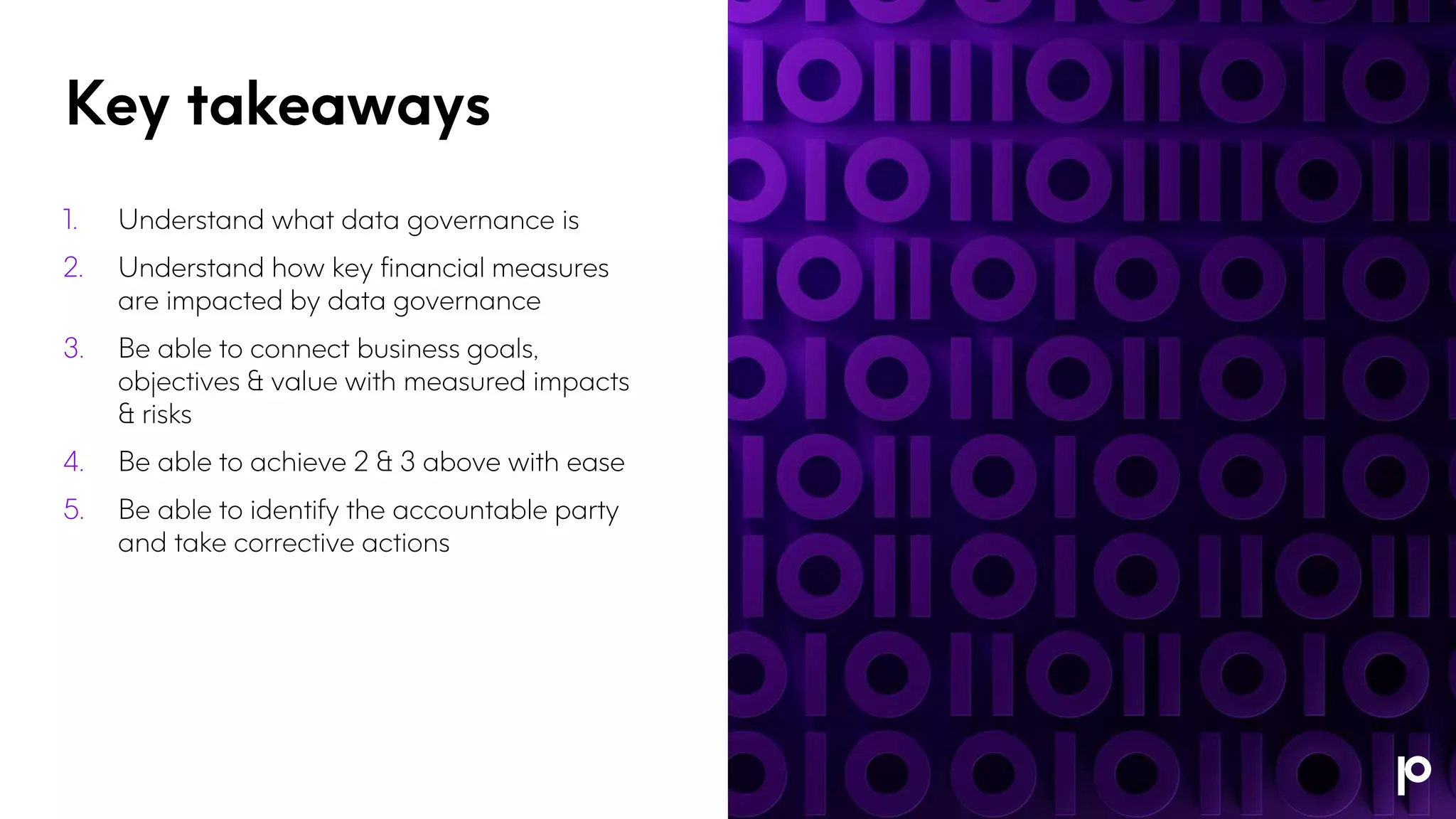
Key takeaways
1. Understand what data governance is
2. Understand how key financial measures
are impacted by data governance
3. Be able to connect business goals,
objectives & value with measured impacts
& risks
4. Be able to achieve 2 & 3 above with ease
5. Be able to identify the accountable party
and take corrective actions
Q&A

Data Governance That Drives the Bottom Line

  • 1.
    Data Governance That Drivesthe Bottom Line Focusing data governance to improve financial results
  • 2.
    Housekeeping Webinar Audio • Today’swebcast audio is streamed through your computer speakers • If you need technical assistance with the web interface or audio, please reach out to us using the Q&A box Questions Welcome • Submit your questions at any time during the presentation using the Q&A box. If we don't get to your question, we will follow-up via email Recording and slides • This webinar is being recorded. You will receive an email following the webinar with a link to the recording and slides
  • 3.
    “We need to governour data!” 3 A Typical Governance Story LEADERSHIP DATA GOVERNANCE TEAM BUSINESS USERS DATA GOVERNANCE TEAM BUSINESS USERS LEADERSHIP INCITING EVENT Governance spends more time fighting data fires. Business quickly loses interest; stops attending meetings Program investment is deprioritized Asked to help with definitions, approvals, and ownership. Team is tasked with putting program in place Exec calls for a data governance program “We need to get the business involved!” “How does this help me do my job?” “We’re spending a lot more time fighting data fires. We need more meetings…” “These meetings are a waste of time!” “I’m not seeing the ROI”
  • 4.
    Data Governance drivesvalue creation • Gartner “Data governance is the specification of decision rights and an accountability framework to ensure the appropriate behavior in the valuation, creation, consumption and control of data and analytics.” • DAMA International “Data governance is the exercise of authority and control (planning, monitoring, and enforcement) over the management of data assets.” • Data governance Institute “Data governance is a system of decision rights and accountabilities for information-related processes, executed according to agreed-upon models which describe who can take what actions with what information, and when, under what circumstances, using what methods.” • Data governance 2.0 , just enough data governance, data governance framework, etc. 4
  • 5.
    Benefits of a business-first approach Accelerateprogram roll-out by 18-40% Increase likelihood of reinvestment by over 75% Generate 2-7x greater ROI
  • 6.
    Mapping data governanceto business value Goal Org Stakeholders Expected Outcomes DG Objective DG Capabilities Improve personalization of customer products and services • Marketing • Sales • Finance • Increase NPS by 5% • 17%+ repeat customer purchases • 11% reduced churn • Establish a common view of trusted customer data assets • Data Catalog • Data Lineage • Approval Workflow • Data Integrity rules Accurate and timely credit-risk analysis • Underwriting • Loan office • Finance • 10% reduction in expected loss • 20% lower Probability of Default • Establish stage gates, rules, policies, and quality measures across credit risk analysis process • Analytics governance • Model analysis • Data quality metrics Increase user productivity by improving time-to- insights • Business Analytics • IT • Data Office • Improve decision- accuracy by 22% • Reduce time-to-insight by 45% • Launch data literacy campaign across business data SMEs • Data lineage • Data Catalog • Automated workflow Mitigate risk and facilitate regulatory compliance and reporting • Compliance Office • Finance • IT • 10% improvement to Reputation Index • 15% reduction in regulatory fines and settlements • Establish risk and control framework for regulatory drivers • PII detection • Data monitoring • Access control
  • 7.
    Governance as a“painkiller” and “vitamin” Goal DG Objective DG Capabilities Improve personalization of customer products and services • Establish trusted view of customer data assets • Data Catalog • Data Lineage • Approval Workflow • Data Integrity rules Accurate and timely credit-risk analysis • Underwriting • Loan office • Finance • •10% reduction in expected loss • •20% lower Probability of Default Increase user productivity by improving time-to- insights • Launch data literacy campaign across business data SMEs • Data lineage • Data Catalog • Automated workflow Mitigate risk and facilitate regulatory compliance and reporting • Establish risk and control framework for regulatory drivers • PII detection • Data monitoring • Access control Centralized collection of customer data elements used for marketing and promotion Data profile providing additional context on volume, counts, location, and contents Data lineage flow of upstream/downstream relationships Impact analysis to business processes, metrics, and analytics Approved governance ownership indicating data is certified for access and use Automated approval workflow to grant access to data at source Data integrity metrics to indicate data that is accurate, consistent, and trusted Quality monitoring to trigger notifications below acceptable values P A I N K I L L E R “ M u s t H a v e s ” V I T A M I N “ B o n u s ”
  • 8.
    Prioritizing what matters GoalOrg Stakeholders Expected Results DG Objective DG Capabilities Improve personalization of customer goods and services Marketing Sales Finance • Increase referrals by 5% • 17%+ repeat customer purchases • 11% reduced churn • Establish a common view of trusted customer data • Data Catalog • Data Lineage • Approval Workflow • Data Integrity rules “We need to personalize our outreach to reduce churn.”
  • 9.
    Operational Bridging the gapbetween business & IT Strategic Tactical e.g., KPIs / metrics, strategic programs, data privacy & protection e.g., product development, planning, sourcing, manufacturing e.g., data migrations, system implementations, data science & engineering Critical data that drives business processes and operations Grow the Business Critical data assets that have operational, compliance and analytical business impacts Run the Business Critical information driving business goals, objectives, KPIs, and metrics Transform the Business
  • 10.
    Connecting Critical Data 10 Business/ Program Goals (e.g., Growing cross-sell, digital enablement) Objectives and Metrics (e.g., Data Sharing) Governance Framework & Operating Model (e.g., Data Ownership, data stewardship) Information (business terminology) (e.g., P&C glossary for self-service) Data (e.g., Horace Mann critical data)
  • 11.
    The Value Story •Catalog assets • Terms defined • Quality rules developed • Data owners identified • Issue requests Tactical Value Metrics (Inputs) • FTE Productivity • Data Literacy index • Adoption / NPS • Cycle time • Data sharing Strategic Value Metrics (Outcomes) • Our customer onboarding process has decreased by 25%... • We’re able to identify 33% more customers to cross-sell of lending products… • And we’ve increased FTE productivity by 20% due to data self-service … • We’ve catalogued 10,000 supplier data assets… • Defined the top 50 critical customer data assets … • Aligned on key rules and policies for each… • And our data quality is showing 90+% accuracy and consistency for customer objects… Value metrics come together at each level to tell a complete story that resonates. As a result… Lead to
  • 12.
  • 13.
    Four Must-Haves forData Governance Success Recap • Link data governance program initiatives to higher-level business goals, stakeholders, and business outcomes • Deploy data governance capabilities that directly serve as both painkillers and vitamins to protect and grow the business • Communicate Governance Value across three levels – Strategic, Operational, and Tactical • Quantify business impact with value metrics that resonate across each level
  • 14.
    Precisely Data360 forfinancial services 14 Third party data validation Policy enforcement Billing and payment reconciliation Portfolio reconciliation Regulatory risk management Validate data transformation Business-ready data for financial services View operational data to mitigate risk across the enterprise Ensure books of record are synchronized and accurate across positions, trades, cash and third- party sources Reconcile invoices and payments to ensure accuracy of results Ensure critical 3rd party data is timely, accurate and reconciles with internal data Establish and monitor adherence to policies including CECL, IFRS9, SOX, privacy, etc. Validate data moving to the cloud or data lake or system conversion and consolidation
  • 15.
    DG Capabilities: Painkillers& Vitamins 15 Provide ownership and accountability of data assets via roles and responsibilities Data stewardship Obtain general statistics to learn more about a field Visualization Visually connect impact analysis, data lineage and business processes with related data assets 3D data lineage Utilize AI techniques to automatically tag data for categorization or to relate data together Machine learning Aggregate data quality results and present data governance scores by asset Metrics & scoring Understand your data with definitions, context and crowdsource updates Business glossary Customize your operating model for reporting issues, questions or approvals Workflow Harvest metadata and allow business and technical metadata to be searchable Data catalog Document policies and standards and their relationships to data Data policy management
  • 16.
    Link DG tohigher-level goals 16 e.g., Inventory management, customer onboarding, new product introduction, financial reconciliation, etc. e.g., SAP S/4 implementation(s), data remediation system migrations, data science & engineering, etc. e.g., Enterprise KPIs / metrics, data privacy & protection, strategic business drivers, etc. Bottom up Middle out Top down Critical data that drives business processes and operations Middle out Critical data assets that have operational, compliance and analytical business impacts Bottom up Critical information driving business goals, objectives, KPIs, and metrics Top down
  • 17.
    Financial Services PreciselyData360 Demo 17 Demo Scenario Investment Use Case • User needs to create a report on Positions • Find the data they are looking for • Understand what other assets are related to that data • What is the Quality of the data • Request access to the data. • Data Stewards review request and grant access. Where to Start What You Will See • Business Friendly UI • Ability to search for both business and technical information • Connecting business context to physical data • Collaboration across teams • Data Stewardship • Use CUSIPs to identify the securities that make up the position. – CUSIPs are unique North American security identifier Role Based • Business Analyst Point of View – Focus on high-level strategic policies and processes • Data Steward Point of View – Focus on tactical coordination and implementation of data usage and policies
  • 18.
  • 19.
    Key takeaways 1. Understandwhat data governance is 2. Understand how key financial measures are impacted by data governance 3. Be able to connect business goals, objectives & value with measured impacts & risks 4. Be able to achieve 2 & 3 above with ease 5. Be able to identify the accountable party and take corrective actions
  • 20.

Editor's Notes

  • #11 These are some notes I want on the connecting Critical Data Slide
  • #14 TALK TRACK Review details of previous Webinar Title & topic Review take aways at a high level – Next 4 slides flesh these out
  • #15 TALK TRACK: DESCRIBE SAMPLE FS USES CASES
  • #16 TALK TRACK: HIGHLIGHT CAPABILITIES AND THE BENEFITS THEY DELIVER AND HOW THEY CONTRIBUTE TO DG SUCCESS
  • #17 TALK TRACK: TALK ABOUT HOW TRACKING HIGHER LEVEL GOALS CONTTRIBUTES TO DG SUCCESS We think of our approach as “top down, bottom up, middle out.” This refers to connecting business objectives (at the top), to the data that supports them (at the bottom), and the processes that run the business (in the middle). This is based on proven practical experience with hundreds of customers across all industries. We do see that customers requires all of these capabilities to deliver meaningful results as quickly as possible. Top Down: This is where traditional data governance tools live driven by business goals, KPIs, regulatory and compliance Bottom Up: This is the domain of data catalogs and technical metadata management tools and addresses the technical users Middle Out: This is where data quality and data management tools excel. This part is often overlooked by governance and catalog tools. ---------------------------------------------------------------------------------------------------- We think of our approach as “top down, bottom up, middle out.” This refers to connecting business objectives (at the top), to the data that supports them (at the bottom), and the processes that run the business (in the middle). It’s based on proven practitioner expertise with hundreds of companies across all industries. Data Leadership requires all of these capabilities, along with the ability to start from where you are and deliver meaningful results as quickly as possible. Top Down: Critical information driving business goals, objectives, KPIs, regulatory and compliance This is key to getting business stakeholder adoption, or communicating data value to executive sponsors This is where traditional data governance tools live and are effective cause there is an urgent need or issue that has C-level visibility Middle out: Critical data driving business processes, operations, strategic sourcing, and R&D innovation This is where data quality and data management tools excel. This is often overlooked by governance and catalog tools. Bottoms up: Critical data assets that have analytical business impacts (data science, data engineering, analytics). This is the domain of data catalogs and technical metadata management tools and meets the needs to technical users
  • #18  In this scenario, I might have the CUSIP numbers for the securities transacted CUSIPs are codes that uniquely identify securities in the US and Canada CUSIP numbers are essential for the seamless trade of financial securities. Without a unique identification code for each security, the financial markets may not be able to function efficiently. Using the CUSIP will provide a lot more detail about the security in our system: Where its pricing came from? What accounts to which it might be associated? What is its ISIN? Are the associated details accurate? Etc.