Dark Field Microscopy
By:-
Abhishek Rajesh Indurkar
17PBT202
1
Contents
What is dark field microscopy?
Principle and working
Applications
Advantages
Disadvantages
References
2
What is dark field
microscopy?
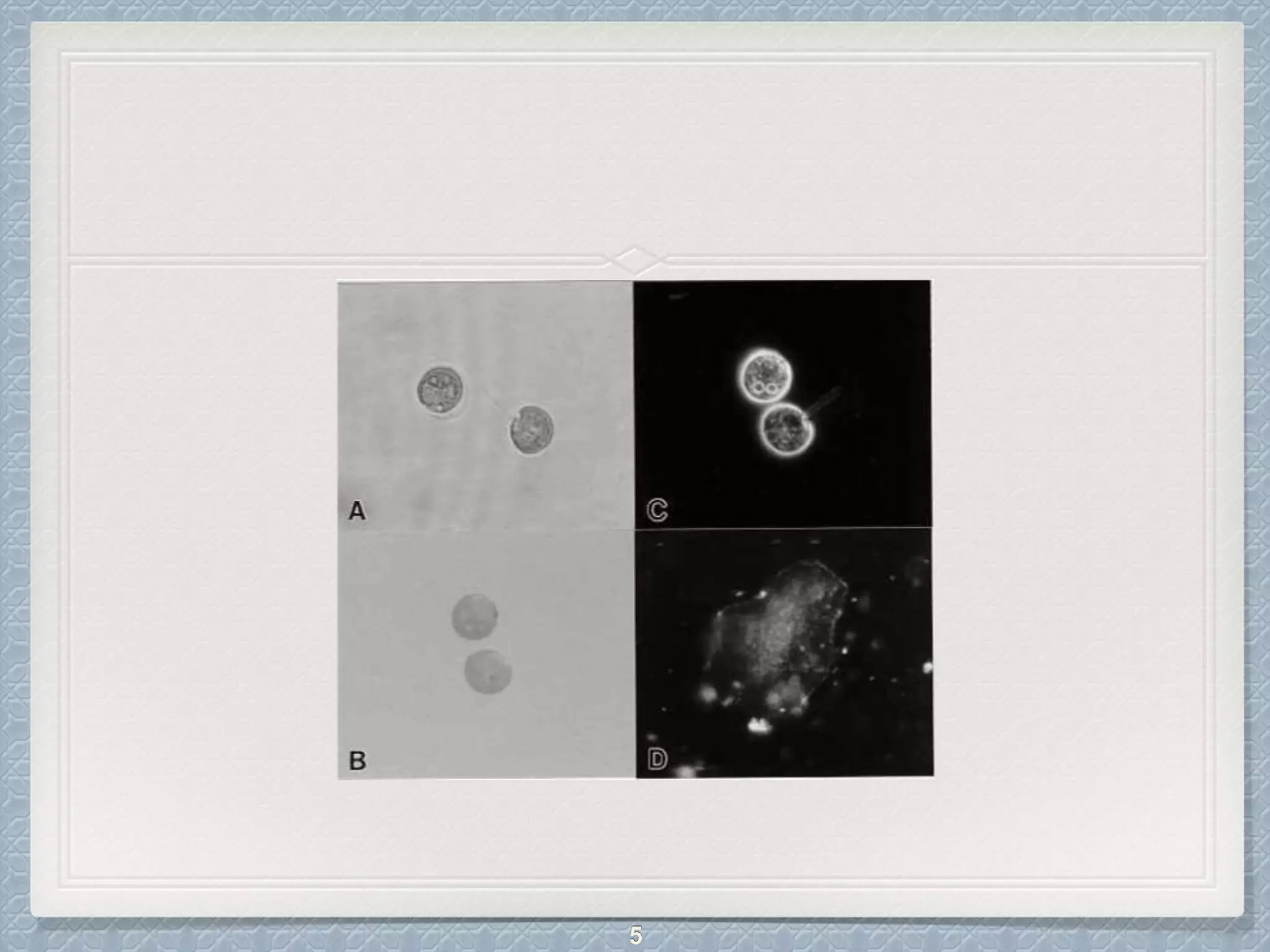
A dark field microscopy is used to examine live micro-
organisms that either invisible in the ordinary light
microscope, cannot be stained by standard methods, or are
so distorted by staining that their characteristics then cannot
be identified.
Instead of the normal condenser, a dark field microscope
uses a dark field condenser that contain a opaque disc. The
disc blocks light that would enter the lens directly, only the
light is reflected off the specimen enters the objective lens.
Because there is no background light, the specimen appears
light against black background- the dark field.
3
Principle
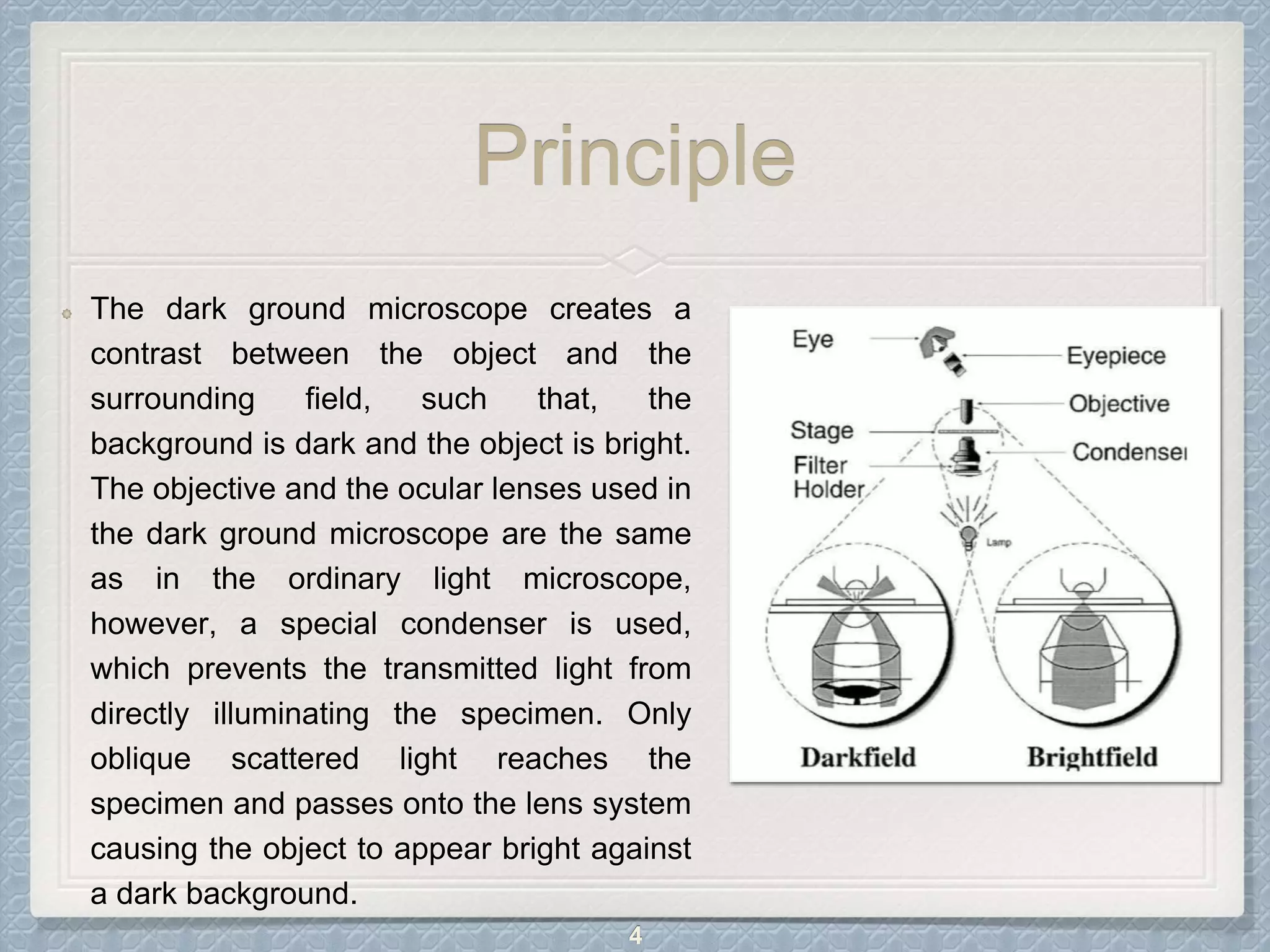
The dark ground microscope creates a
contrast between the object and the
surrounding field, such that, the
background is dark and the object is bright.
The objective and the ocular lenses used in
the dark ground microscope are the same
as in the ordinary light microscope,
however, a special condenser is used,
which prevents the transmitted light from
directly illuminating the specimen. Only
oblique scattered light reaches the
specimen and passes onto the lens system
causing the object to appear bright against
a dark background.
4
5
Working
Applications
• Used for diagnostic of Syphilis
(Treponema pallidum).
• Viewing blood cells.
• Viewing bacteria.
• Viewing different types of algae.
• Viewing hairline metal fracture.
• Viewing diamonds and other precious
stones.
• Viewing shrimp or other invertebrates.
7
Advantages
• A dark field microscope is ideal for viewing objects that are unstained, transparent and absorb little or
no light.
• These specimens often have similar refractive indices as their surroundings, making them hard to
distinguish with other illumination techniques.
• You can use dark field to study marine organisms such as algae and plankton, diatoms, insects, fibers,
hairs, yeast and protozoa as well as some minerals and crystals, thin polymers and some ceramics.
• You can also use dark field in the research of live bacterium, as well as mounted cells and tissues.
• It is more useful in examining external details, such as outlines, edges, grain boundaries and surface
defects than internal structure.
• Dark field microscopy is often dismissed for more modern observation techniques such as phase
contrast and DIC, which provide more accurate, higher contrasted images and can be used to observe a8
Disadvantages
First, dark field images are prone to degradation, distortion and inaccuracies.
• A specimen that is not thin enough or its density differs across the slide, may appear to have
artefacts throughout the image.
• The preparation and quality of the slides can grossly affect the contrast and accuracy of a
dark field image.
• You need to take special care that the slide, stage, nose and light source are free from small
particles such as dust, as these will appear as part of the image.
• Similarly, if you need to use oil or water on the condenser and/or slide, it is almost
impossible to avoid all air bubbles.
• These liquid bubbles will cause images degradation, flare and distortion and even decrease9
Reference
http://medind.nic.in/ibo/t08/i2/ibot08i2p105.pdf
http://www.battlesnake.co.uk/_uni/articles/holo/4-
darkfield.pdf
http://nptel.ac.in/courses/102103044/pdf/mod3.pdf
https://toutestquantique.fr/en/dark-field-and-phase-
contrast/
https://www.cdc.gov/std/syphilis/manual-
1998/chapt5.pdf
10
Thank you…
11

Dark field microscopy

  • 1.
    Dark Field Microscopy By:- AbhishekRajesh Indurkar 17PBT202 1
  • 2.
    Contents What is darkfield microscopy? Principle and working Applications Advantages Disadvantages References 2
  • 3.
    What is darkfield microscopy? A dark field microscopy is used to examine live micro- organisms that either invisible in the ordinary light microscope, cannot be stained by standard methods, or are so distorted by staining that their characteristics then cannot be identified. Instead of the normal condenser, a dark field microscope uses a dark field condenser that contain a opaque disc. The disc blocks light that would enter the lens directly, only the light is reflected off the specimen enters the objective lens. Because there is no background light, the specimen appears light against black background- the dark field. 3
  • 4.
    Principle The dark groundmicroscope creates a contrast between the object and the surrounding field, such that, the background is dark and the object is bright. The objective and the ocular lenses used in the dark ground microscope are the same as in the ordinary light microscope, however, a special condenser is used, which prevents the transmitted light from directly illuminating the specimen. Only oblique scattered light reaches the specimen and passes onto the lens system causing the object to appear bright against a dark background. 4
  • 5.
  • 6.
  • 7.
    Applications • Used fordiagnostic of Syphilis (Treponema pallidum). • Viewing blood cells. • Viewing bacteria. • Viewing different types of algae. • Viewing hairline metal fracture. • Viewing diamonds and other precious stones. • Viewing shrimp or other invertebrates. 7
  • 8.
    Advantages • A darkfield microscope is ideal for viewing objects that are unstained, transparent and absorb little or no light. • These specimens often have similar refractive indices as their surroundings, making them hard to distinguish with other illumination techniques. • You can use dark field to study marine organisms such as algae and plankton, diatoms, insects, fibers, hairs, yeast and protozoa as well as some minerals and crystals, thin polymers and some ceramics. • You can also use dark field in the research of live bacterium, as well as mounted cells and tissues. • It is more useful in examining external details, such as outlines, edges, grain boundaries and surface defects than internal structure. • Dark field microscopy is often dismissed for more modern observation techniques such as phase contrast and DIC, which provide more accurate, higher contrasted images and can be used to observe a8
  • 9.
    Disadvantages First, dark fieldimages are prone to degradation, distortion and inaccuracies. • A specimen that is not thin enough or its density differs across the slide, may appear to have artefacts throughout the image. • The preparation and quality of the slides can grossly affect the contrast and accuracy of a dark field image. • You need to take special care that the slide, stage, nose and light source are free from small particles such as dust, as these will appear as part of the image. • Similarly, if you need to use oil or water on the condenser and/or slide, it is almost impossible to avoid all air bubbles. • These liquid bubbles will cause images degradation, flare and distortion and even decrease9
  • 10.
  • 11.