Republic of the Philippines
Department of Education
Region III
DIVISION OF NUEVA ECIJA
GENERAL TINIO NATIONAL HIGH SCHOOL
General Tinio, Nueva Ecija
LESSON PLAN IN GRADE 12
INTRODUCTION TO THE PHILOSOPHY OF THE HUMAN PERSON
I. LEARNING OBJECTIVES
At the end of the lesson, the students will be able to
a. Explain that they are human persons possessing a body and spirit;
b. Identify the traits that distinguish them as human persons;
c. Explain how embodiment defines them as persons.
II. SUBJECT MATTER
A. Topic: Human Person as an Embodied Spirit
B. References: Introduction to the Philosophy of the Human Person (Pages 43-51)
C. Materials: Powerpoint Presentation
III. PROCEDURE
ELICIT
1. Reviewing the previous lesson.
Let the students define man, human, human being and human nature.
ENGAGE
1. Establishing purpose of the new lesson.
Have the students identify the traits that differentiate human beings from objects and animals.
Have them ponder the questions on page 44.
2. Presenting instances of the new lesson.
 Is your pet truly aware of what is happening around it?
 Can your pet truly feel emotions in the same way that you do?
 Can your pet reflect on its actions and behavior? Do you think it can feel guilt or
satisfaction in the same way you do?
 Is your pet capable of reflection? Can it question its nature or identity as a dog?
EXPLORE
1. Discussing new concepts and practicing new skills.
 Self-awareness refers to the person having a clear perception of oneself, including his or
her thoughts, emotions, identity, and actions. Human awareness goes beyond
perception and reaction to the environment. The human person is defined by a deeper
awareness which is driven by rationality or human thought. This awareness of the self
also enables us persons to experience an inner world that is defined by our personal
thoughts and ideas. The sense of self enables a person to look within himself or herself
and experience interiority.
 Self-determination refers to the capability of persons to make choices and decisions
based on their own preference, monitor and regulate their actions, and be goal-oriented
and self-directed. We are persons because we act and we are aware of our actions. Our
free will enables us to do actions whenever we want to and make various alternatives.
The existence of free will enables a person to act willfully, control his or her actions, and
recognize himself or herself as the source of action. Consequence is the result or effect
of an action or condition. This brings us to another element of human action, which is
morality or the goodness and badness of an act.
 Externality or the capability to reach out and interact with others and the world.
 Dignity or the innate right to be valued and respected.
EXPLAIN
1. Developing Mastery.
 Personhood – refers to the state of being a person.
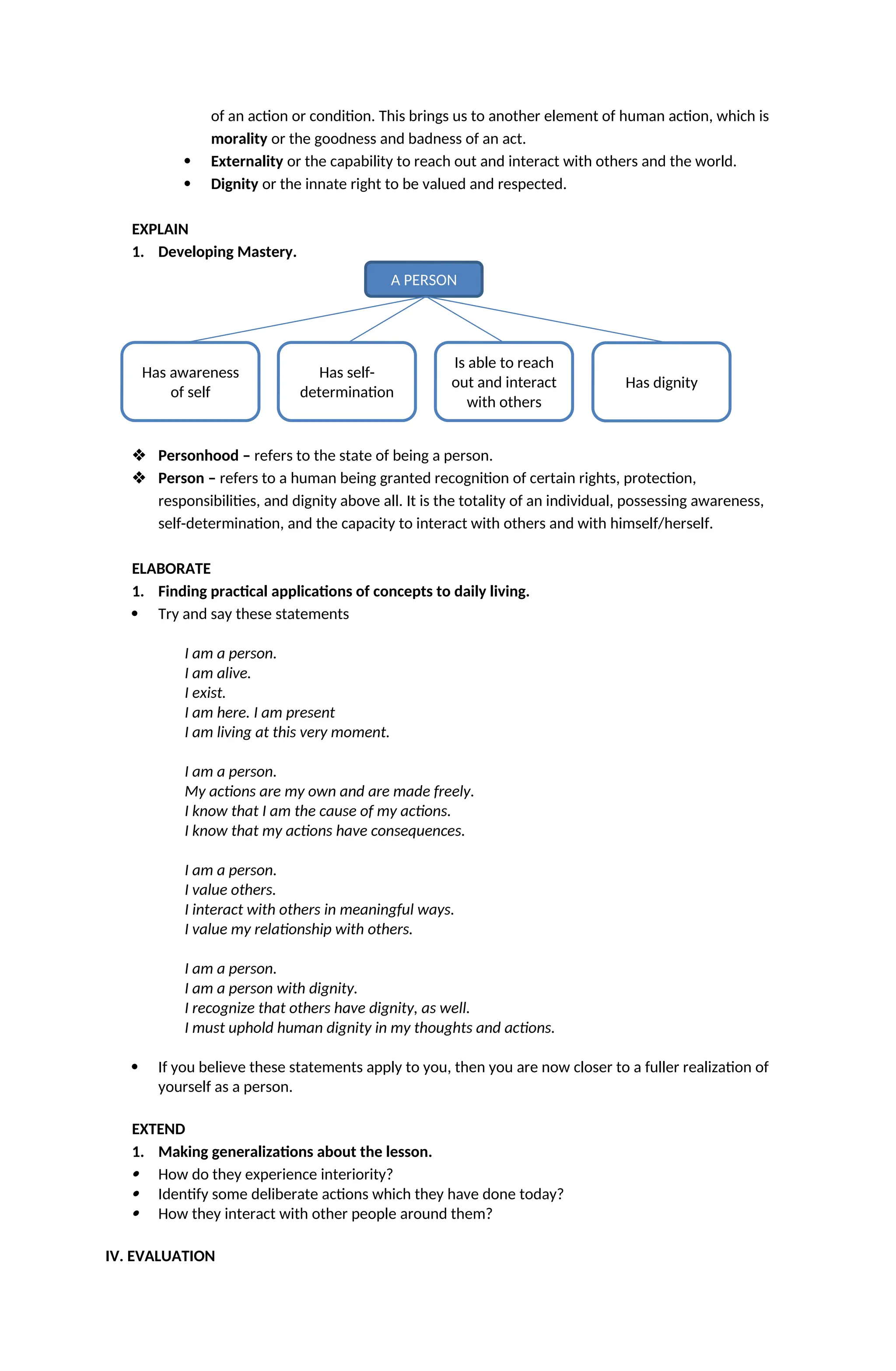
 Person – refers to a human being granted recognition of certain rights, protection,
responsibilities, and dignity above all. It is the totality of an individual, possessing awareness,
self-determination, and the capacity to interact with others and with himself/herself.
ELABORATE
1. Finding practical applications of concepts to daily living.
 Try and say these statements
I am a person.
I am alive.
I exist.
I am here. I am present
I am living at this very moment.
I am a person.
My actions are my own and are made freely.
I know that I am the cause of my actions.
I know that my actions have consequences.
I am a person.
I value others.
I interact with others in meaningful ways.
I value my relationship with others.
I am a person.
I am a person with dignity.
I recognize that others have dignity, as well.
I must uphold human dignity in my thoughts and actions.
 If you believe these statements apply to you, then you are now closer to a fuller realization of
yourself as a person.
EXTEND
1. Making generalizations about the lesson.
 How do they experience interiority?
 Identify some deliberate actions which they have done today?
 How they interact with other people around them?
IV. EVALUATION
A PERSON
Has awareness
of self
Has self-
determination
Is able to reach
out and interact
with others
Has dignity
Evaluating Learning.
How will you uphold the dignity of the human person in the following situations?
1. Your classmates are teasing your cross-eyed classmate because they find her funny-looking.
2. Your friend confided in you that his girlfriend told him that she was pregnant. He is asking your
advice on what to do.
3. You discover that your 4-year-old sister likes to draw and daydream. She shows you a drawing of
a green flying elephant which she tells you is her imaginary friend.
4. Your teacher invites you to join him in an outreach program where you will be spending the
whole summer break helping impoverished communities.
V. AGREEMENT
 What makes you special? Write the answer in your reflection journal.
REFLECTION
A. Number of learners who earned 80% in the evaluation.
B. Number of learners who require additional activities for remediation
who scored below 80%.
C. Did the remedial lesson work? Number of learners who have caught up
the lesson.
D. Number of learners who continue to require remediation.
E. Which of my teaching strategies worked well? Why did this work?
F. What difficulties did I encounter which my principal or supervisor can
help?
G. What innovation or localized materials did I use/discover which I wish to
share with other teachers?
Prepared by: Checked:
CAROLINE M. SOLOMON EVANGELINE M. DELA CRUZ
Teacher II OIC-SHS, Head Teacher IV-AP
Noted:
ADORA B. DELA CRUZ
School Principal IV

Daily Lesson Plan on Philosophy-COT1.docx

  • 1.
    Republic of thePhilippines Department of Education Region III DIVISION OF NUEVA ECIJA GENERAL TINIO NATIONAL HIGH SCHOOL General Tinio, Nueva Ecija LESSON PLAN IN GRADE 12 INTRODUCTION TO THE PHILOSOPHY OF THE HUMAN PERSON I. LEARNING OBJECTIVES At the end of the lesson, the students will be able to a. Explain that they are human persons possessing a body and spirit; b. Identify the traits that distinguish them as human persons; c. Explain how embodiment defines them as persons. II. SUBJECT MATTER A. Topic: Human Person as an Embodied Spirit B. References: Introduction to the Philosophy of the Human Person (Pages 43-51) C. Materials: Powerpoint Presentation III. PROCEDURE ELICIT 1. Reviewing the previous lesson. Let the students define man, human, human being and human nature. ENGAGE 1. Establishing purpose of the new lesson. Have the students identify the traits that differentiate human beings from objects and animals. Have them ponder the questions on page 44. 2. Presenting instances of the new lesson.  Is your pet truly aware of what is happening around it?  Can your pet truly feel emotions in the same way that you do?  Can your pet reflect on its actions and behavior? Do you think it can feel guilt or satisfaction in the same way you do?  Is your pet capable of reflection? Can it question its nature or identity as a dog? EXPLORE 1. Discussing new concepts and practicing new skills.  Self-awareness refers to the person having a clear perception of oneself, including his or her thoughts, emotions, identity, and actions. Human awareness goes beyond perception and reaction to the environment. The human person is defined by a deeper awareness which is driven by rationality or human thought. This awareness of the self also enables us persons to experience an inner world that is defined by our personal thoughts and ideas. The sense of self enables a person to look within himself or herself and experience interiority.  Self-determination refers to the capability of persons to make choices and decisions based on their own preference, monitor and regulate their actions, and be goal-oriented and self-directed. We are persons because we act and we are aware of our actions. Our free will enables us to do actions whenever we want to and make various alternatives. The existence of free will enables a person to act willfully, control his or her actions, and recognize himself or herself as the source of action. Consequence is the result or effect
  • 2.
    of an actionor condition. This brings us to another element of human action, which is morality or the goodness and badness of an act.  Externality or the capability to reach out and interact with others and the world.  Dignity or the innate right to be valued and respected. EXPLAIN 1. Developing Mastery.  Personhood – refers to the state of being a person.  Person – refers to a human being granted recognition of certain rights, protection, responsibilities, and dignity above all. It is the totality of an individual, possessing awareness, self-determination, and the capacity to interact with others and with himself/herself. ELABORATE 1. Finding practical applications of concepts to daily living.  Try and say these statements I am a person. I am alive. I exist. I am here. I am present I am living at this very moment. I am a person. My actions are my own and are made freely. I know that I am the cause of my actions. I know that my actions have consequences. I am a person. I value others. I interact with others in meaningful ways. I value my relationship with others. I am a person. I am a person with dignity. I recognize that others have dignity, as well. I must uphold human dignity in my thoughts and actions.  If you believe these statements apply to you, then you are now closer to a fuller realization of yourself as a person. EXTEND 1. Making generalizations about the lesson.  How do they experience interiority?  Identify some deliberate actions which they have done today?  How they interact with other people around them? IV. EVALUATION A PERSON Has awareness of self Has self- determination Is able to reach out and interact with others Has dignity
  • 3.
    Evaluating Learning. How willyou uphold the dignity of the human person in the following situations? 1. Your classmates are teasing your cross-eyed classmate because they find her funny-looking. 2. Your friend confided in you that his girlfriend told him that she was pregnant. He is asking your advice on what to do. 3. You discover that your 4-year-old sister likes to draw and daydream. She shows you a drawing of a green flying elephant which she tells you is her imaginary friend. 4. Your teacher invites you to join him in an outreach program where you will be spending the whole summer break helping impoverished communities. V. AGREEMENT  What makes you special? Write the answer in your reflection journal. REFLECTION A. Number of learners who earned 80% in the evaluation. B. Number of learners who require additional activities for remediation who scored below 80%. C. Did the remedial lesson work? Number of learners who have caught up the lesson. D. Number of learners who continue to require remediation. E. Which of my teaching strategies worked well? Why did this work? F. What difficulties did I encounter which my principal or supervisor can help? G. What innovation or localized materials did I use/discover which I wish to share with other teachers? Prepared by: Checked: CAROLINE M. SOLOMON EVANGELINE M. DELA CRUZ Teacher II OIC-SHS, Head Teacher IV-AP Noted: ADORA B. DELA CRUZ School Principal IV