CYBER BULLYING

 Presented by Phyl Stubbs
 PR Social Media Services
What is Cyberbullying?


2   © PR Social Media Services
3   © PR Social Media Services
Modes of Cyberbullying


4   © PR Social Media Services
5   © PR Social Media Services
The Cyberbullying Virus
     CyberbullyingVirus


6   © PR Social Media Services
Signs of Cyberbullying
    A child may be the victim of cyberbullying if he or she
     Suddenly stops using the computer
     Appears nervous or jumpy when they receive a Text or email
     Seems uneasy about going to school or outside in general
     Appears to be angry, depressed, or frustrated after using the
      computer
     Avoids discussions about what they are doing on the computer
     Becomes abnormally withdrawn from their friends and family


7   © PR Social Media Services
Sites used by Cyberbullies


8   © PR Social Media Services
Social Media Sites


9   © PR Social Media Services
   Young people can become anonymous online


   The difference between writing nasty messages on the back of a school book and posting it on the internet is that the messages
    can potentially be seen by a very wide audience almost instantly. The message can remain available on the internet even if it is
    later removed from the site


   Young people posting messages on the internet tend not to feel as responsible for their online actions as they do in ‘real life’


   This type of behaviour is often outside of the reach of schools as it often happens outside of school on home computers or via
    mobile phones


   Young people are often fearful of telling others about being bullied because they fear that the bullying may actually become worse
    if they tell.


   They are often also afraid to report incidents, as they fear that adults will take away their mobile phone, computer and/or
    internet access


   In most cases, cyberbullies know their targets, but their victims don’t always know the person bullying them. This can prove very
    isolating for the victim in group, club or school settings


   Because communications technologies have become so popular cyberbullying can happen any time and any place and, for many
    children, home is no longer a safe haven from bullying
Advice on handling Cyberbullying


11   © PR Social Media Services
12   © PR Social Media Services
RESPECT
There are four parts to the Respect message:-
 I respect myself
 I respect others
 I expect others to respect me and each other
 I will not tolerate disrespect to anyone
Reporting Abuse on Social Network Sites
Facebook
 www.facebook.com/help
Internet Chat
Windows messenger Live
You can report any illegal or inappropriate behaviour, such as harassment or threats, on MSN Messenger by
    notifying Microsoft using the form on this webpage:
 https://support.live.com/eform.aspx?productKey=wlmessengerabuse&ct=eformts
Skype
http://support.skype.com
Yahoo Messenger
 http://help.yahoo.com/l/us/yahoo/abuse/
Report content on YouTube:
 http://help.youtube.com/support/youtube/bin/request.py


    If you are experiencing difficulties with other Social Networking Sites not listed
   above, you should the site administrators directly for advice and assistance.
Useful Websites
You can get further information on general internet safety issues, including cyberbullying
   from the following websites:
 www.internetsafety.ie
  Website of the Office for Internet Safety
 www.webwise.ie
  Provides parents, teachers and children with educational resources,advice and
   information about potential dangers on-line
 www.watchyourspace.ie
  Advice on managing children’s profiles on social-networking sites
 www.childline.ie
  Child Safety Issues
 www.hotline.ie
  Irish hotline for public to report child pornography and other illegal content on the
   internet.
 www.barnardos.ie
  Charity for the protection of children

Cyber Bullying Presentation for Schools

  • 1.
    CYBER BULLYING Presentedby Phyl Stubbs PR Social Media Services
  • 2.
    What is Cyberbullying? 2 © PR Social Media Services
  • 3.
    3 © PR Social Media Services
  • 4.
    Modes of Cyberbullying 4 © PR Social Media Services
  • 5.
    5 © PR Social Media Services
  • 6.
    The Cyberbullying Virus  CyberbullyingVirus 6 © PR Social Media Services
  • 7.
    Signs of Cyberbullying A child may be the victim of cyberbullying if he or she  Suddenly stops using the computer  Appears nervous or jumpy when they receive a Text or email  Seems uneasy about going to school or outside in general  Appears to be angry, depressed, or frustrated after using the computer  Avoids discussions about what they are doing on the computer  Becomes abnormally withdrawn from their friends and family 7 © PR Social Media Services
  • 8.
    Sites used byCyberbullies 8 © PR Social Media Services
  • 9.
    Social Media Sites 9 © PR Social Media Services
  • 10.
    Young people can become anonymous online  The difference between writing nasty messages on the back of a school book and posting it on the internet is that the messages can potentially be seen by a very wide audience almost instantly. The message can remain available on the internet even if it is later removed from the site  Young people posting messages on the internet tend not to feel as responsible for their online actions as they do in ‘real life’  This type of behaviour is often outside of the reach of schools as it often happens outside of school on home computers or via mobile phones  Young people are often fearful of telling others about being bullied because they fear that the bullying may actually become worse if they tell.  They are often also afraid to report incidents, as they fear that adults will take away their mobile phone, computer and/or internet access  In most cases, cyberbullies know their targets, but their victims don’t always know the person bullying them. This can prove very isolating for the victim in group, club or school settings  Because communications technologies have become so popular cyberbullying can happen any time and any place and, for many children, home is no longer a safe haven from bullying
  • 11.
    Advice on handlingCyberbullying 11 © PR Social Media Services
  • 12.
    12 © PR Social Media Services
  • 14.
    RESPECT There are fourparts to the Respect message:-  I respect myself  I respect others  I expect others to respect me and each other  I will not tolerate disrespect to anyone
  • 15.
    Reporting Abuse onSocial Network Sites Facebook  www.facebook.com/help Internet Chat Windows messenger Live You can report any illegal or inappropriate behaviour, such as harassment or threats, on MSN Messenger by notifying Microsoft using the form on this webpage:  https://support.live.com/eform.aspx?productKey=wlmessengerabuse&ct=eformts Skype http://support.skype.com Yahoo Messenger  http://help.yahoo.com/l/us/yahoo/abuse/ Report content on YouTube:  http://help.youtube.com/support/youtube/bin/request.py If you are experiencing difficulties with other Social Networking Sites not listed above, you should the site administrators directly for advice and assistance.
  • 16.
    Useful Websites You canget further information on general internet safety issues, including cyberbullying from the following websites:  www.internetsafety.ie Website of the Office for Internet Safety  www.webwise.ie Provides parents, teachers and children with educational resources,advice and information about potential dangers on-line  www.watchyourspace.ie Advice on managing children’s profiles on social-networking sites  www.childline.ie Child Safety Issues  www.hotline.ie Irish hotline for public to report child pornography and other illegal content on the internet.  www.barnardos.ie Charity for the protection of children

Editor's Notes

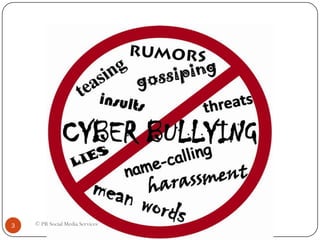
  • #3 Cyberbullying is when a child, preteen or teen is tormented, threatened, harassed, humiliated, embarrassed or otherwise targeted by another child, preteen or teen using the Internet, interactive and digital technologies or mobile phones. It has to have a minor on both sides, or at least have been instigated by a minor against another minor. Once adults become involved, it is plain and simple cyber-harassment or cyberstalking. Adult cyber-harassment or cyberstalking is NEVER called cyberbullying.
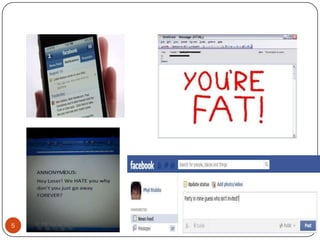
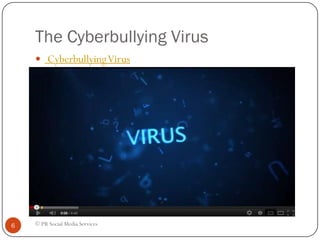
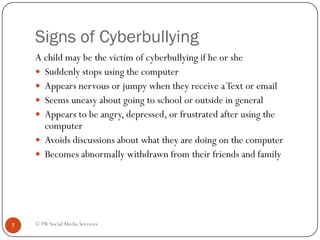
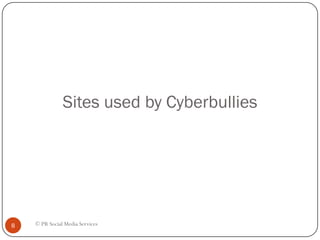
  • #4 This is when instant messages, emails, text messages or webpages are used to spread rumours, make threats or harass. It can include written messages, photographs, videos or voice messages.
  • #5 Can anyone of guess which modes of digital technologies are used in cyberbullying?
  • #6 Modes of cyberbullying are Mobile phones, email and social media sites.
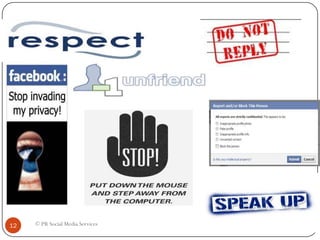
  • #13 Encourage respect for othersDon’t reply to messagesUnfriend the bully.  Block & Report the bully.  Change your Privacy Settings on FacebookStep away from the computer. Tell someone you trustReport - Facebook's abuse policy allows your child to report cyberbullying, impersonation, threats, or hate pages. Teach him how to report cyberbullying by hitting “block/report” and selecting the appropriate details on the offending person's Wall.