









iANNUAL REPORT 2007
®
Caribbean Examinations Council
Annual Report 2007
ii CARIBBEAN EXAMINATIONS COUNCIL
Copyright© 2007
Caribbean Examinations Council
All rights reserved
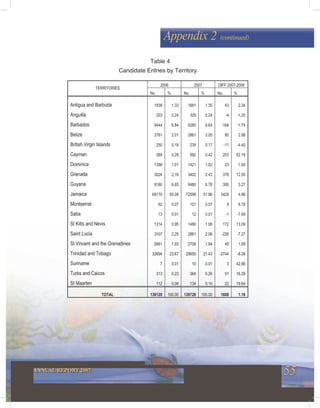
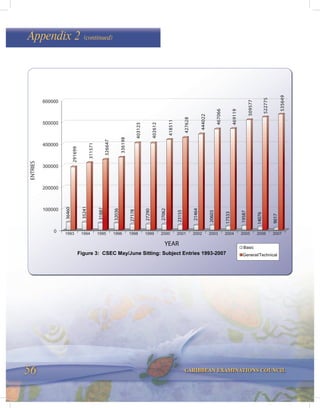
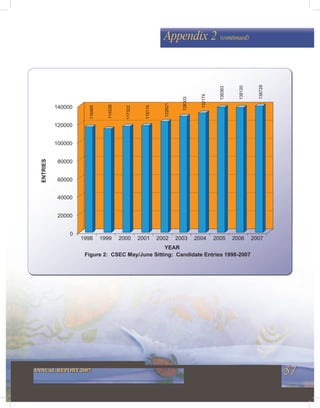
Annual Report 2007
Published by the Caribbean Examinations Council
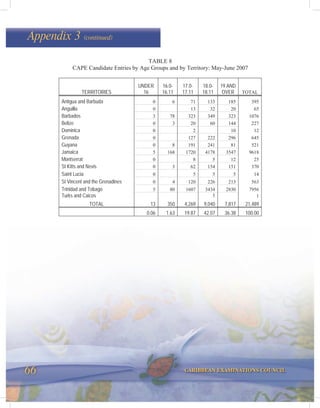
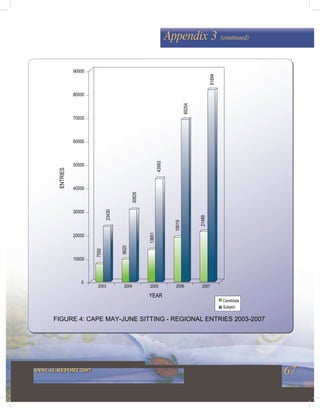
Headquarters Western Zone Office
Dr Lucy Steward Mr Glenroy Cumberbatch
Registrar Pro-Registrar
The Garrison Caenwood Centre
St. Michael BB11158 37 Arnold Road
Barbados Kingston 5, Jamaica
E-Mail: cxcezo@cxc.org cxcwzo@cxc.org
Website: www.cxc.org
Phone No. 1 (246) 436-6261 1 (876) 922-6463
Fax No. 1 (246) 429-5421 1 (876) 967-4972
ISSN: 1562-0476
Printed November 2007
Designed and Printed by Cole’s Printery Ltd.
Cover Photograph
Sea Life
By Rashida Collymore
Deighton Griffith Secondary School
Barbados
CSEC Visual Arts Examination 2007
iiiANNUAL REPORT 2007
Table of Contents
Statement from Chairman.........................................................................................................................................iv
Statement from Registrar..........................................................................................................................................iv
Introduction............................................................................................................................................................... 1
Strategic Goals........................................................................................................................................................... 2
New Pro-Registrar and Farewell Ms Licorish and Mr Barrett................................................................................... 7
Caribbean Secondary Education Certificate (CSEC)................................................................................................. 8
January Sitting.......................................................................................................................................... 8
May/June Sitting..................................................................................................................................... 10
Performance of Candidates.................................................................................................................... 10
Outstanding Performance ...................................................................................................................... 15
Outstanding Performers......................................................................................................................... 16
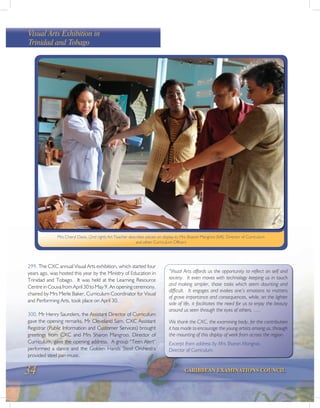
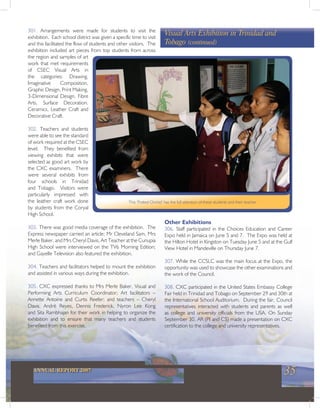
Visual Arts Examination Pieces................................................................................................................ 17
Caribbean Advanced Proficiency Examination (CAPE)........................................................................................... 19
CAPE Associate Degree......................................................................................................................... 19
Performance of Candidates.................................................................................................................... 19
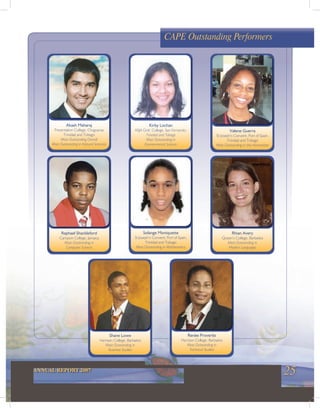
Outstanding Performance ...................................................................................................................... 24
Outstanding Performers......................................................................................................................... 25
Syllabus Development Activities.............................................................................................................................. 26
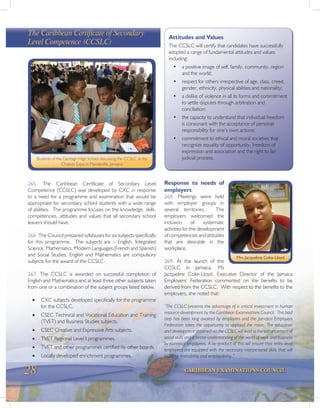
CCSLC ................................................................................................................................................. 26
CSEC.................................................................................................................................................... 26
CAPE .................................................................................................................................................... 27
Teacher Training Workshops................................................................................................................. 27
Caribbean Certificate of Secondary Level Competence (CCSLC) ......................................................................... 28
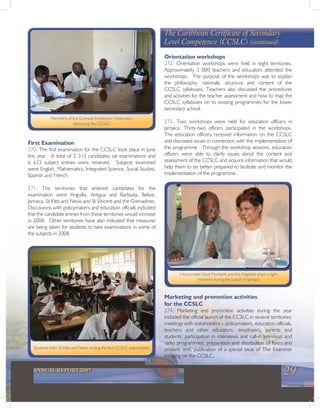
First Examination ................................................................................................................................... 29
Launch in Participating Territories........................................................................................................... 30
Caribbean Vocational Qualification ......................................................................................................................... 32
Visual Arts Exhibition............................................................................................................................................... 34
Electronic School Based Assessment....................................................................................................................... 36
Committees of the Council..................................................................................................................................... 37
AFC ...................................................................................................................................................... 38
SUBSEC................................................................................................................................................ 39
Marketing and Public Relations Activities................................................................................................................ 40
Regional and International Meetings........................................................................................................................ 44
Staff.......................................................................................................................................................................... 47
Appendices.............................................................................................................................................................. 37
Appendix 1 CSEC January Entry and Performance Data ....................................................................... 49
Appendix 2 CSEC May/June Entry and Performance Data .................................................................... 54
Appendix 3 CAPE Entry and Performance Data.................................................................................... 65
Appendix 4 General Description of Council ......................................................................................... 90
Appendix 5 Membership of FAC.......................................................................................................... 91
Appendix 6 Membership of the Council............................................................................................... 92
Appendix 7 Membership of SEC .......................................................................................................... 96
Appendix 8 Local Registrars ................................................................................................................. 99
Appendix 9 Membership of CSEC Subject Panels............................................................................... 100
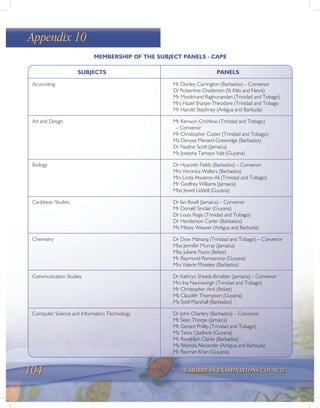
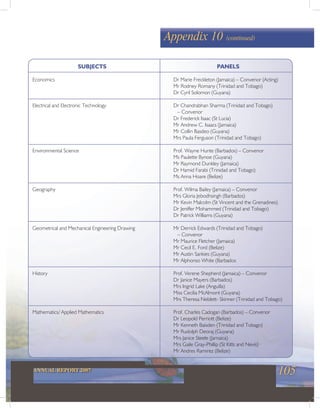
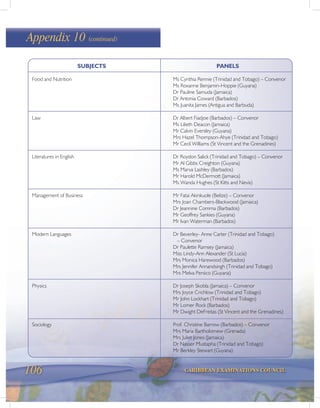
Appendix 10 Membership of CAPE Subject Panels ............................................................................... 104
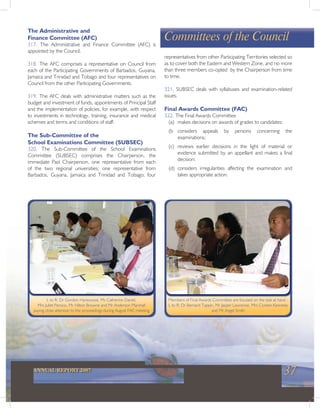
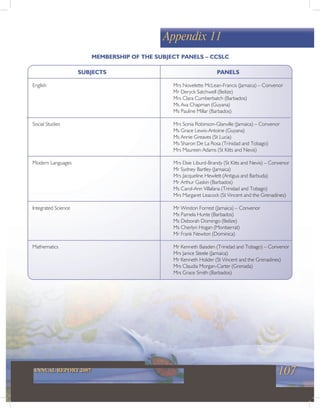
Appendix 11 Membership of CCSLC Subject Panels ............................................................................ 107
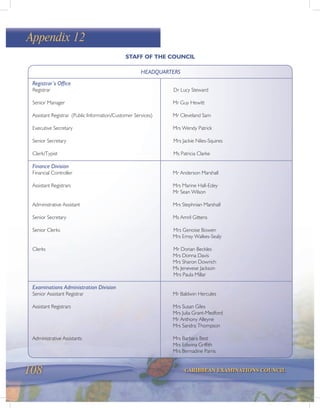
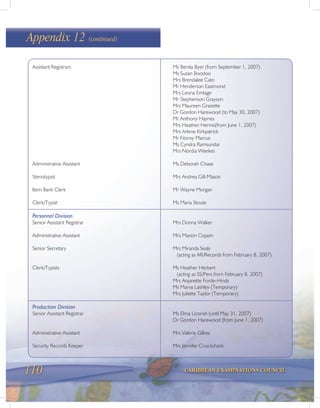
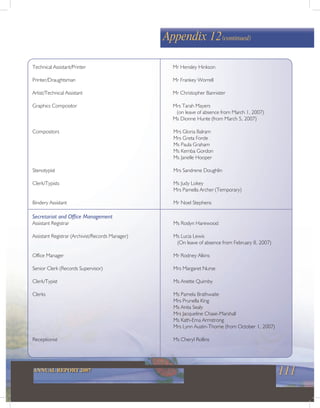
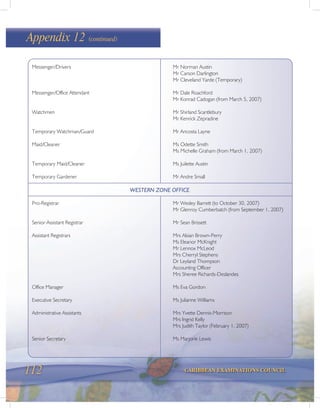
Appendix 12 Staff of the Council .......................................................................................................... 108
iv CARIBBEAN EXAMINATIONS COUNCIL
I am pleased to present the
2007 Annual Report which
provides information on the
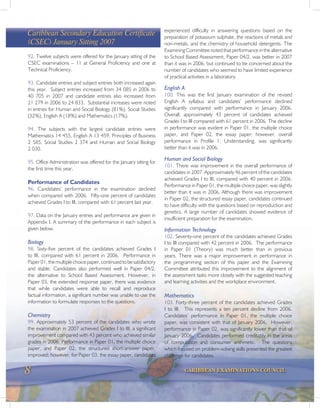
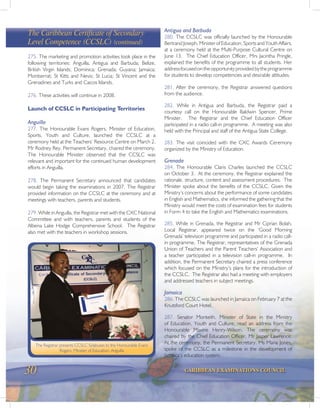
activities undertaken during
the year.
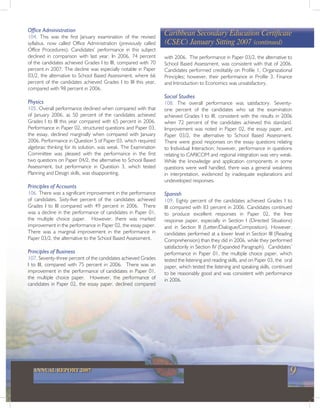
The Council’s operations
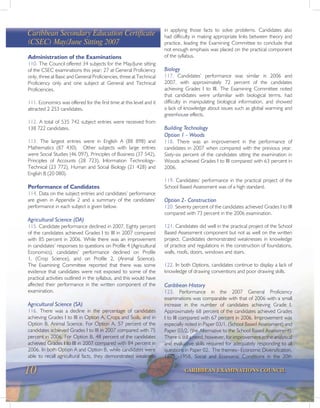
continued to grow. There
was a relatively small increase
in candidate and subject
entries for the Caribbean
Secondary Education
Certificate(CSEC).However,
there were significant
increases in candidate
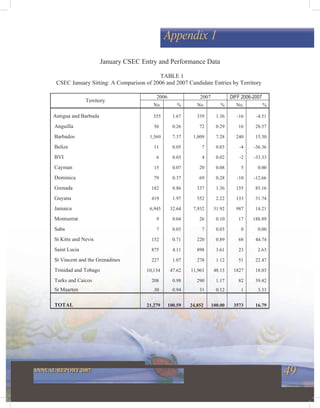
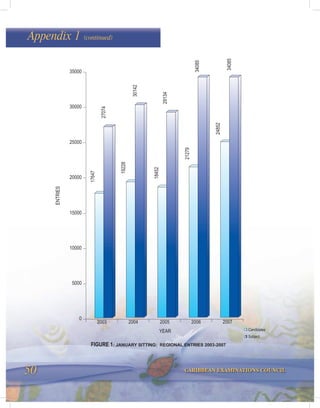
and Unit entries for the Caribbean Advanced Proficiency
Examination (CAPE). Examinations for the Caribbean Certificate
of Secondary Level Competence (CCSLC) were administered
for the first time in June. A great deal of effort went into
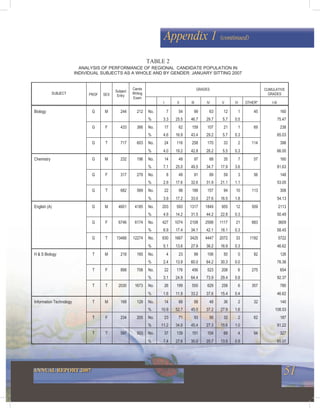
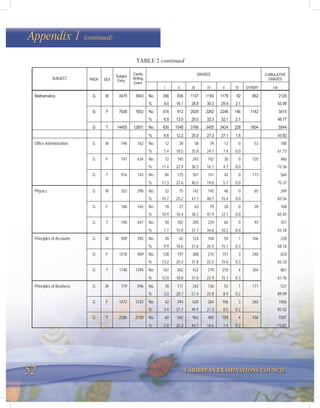
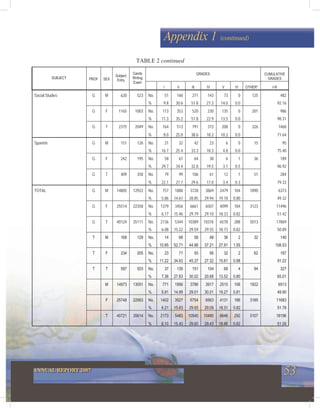
the marketing and promotion of the CCSLC. Orientation
workshops were held for approximately 3 000 teachers and
education officials across the region.
The Council also initiated work in response to a regional
mandate to award the Caribbean Vocational Qualification.
Work started in two territories and the first awards will be
made in 2008.
In order to carry out its work effectively, the Council continued
to make significant investments in appropriate technologies.
This year, e-Registration was implemented fully and a module
for electronic submission of School Based Assessment (e-SBA)
was made available to territories. Work also continued on
enhancements of the Examination Processing System and as a
result of this we were able to release results early.
The successful implementation of activities is due to the
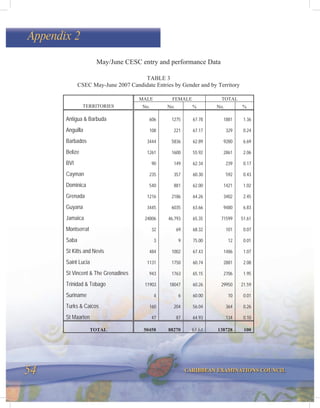
dedication and commitment of staff and the tremendous
support that we receive from all Participating Territories.
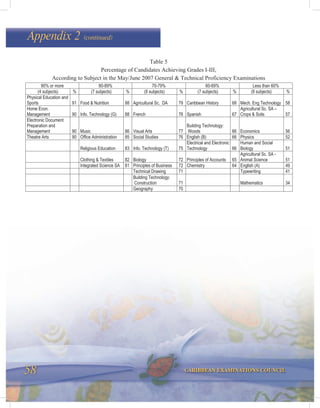
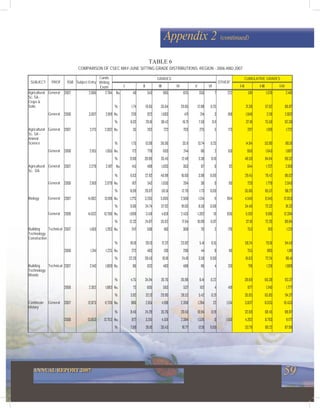
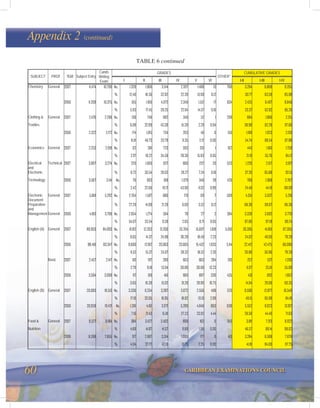
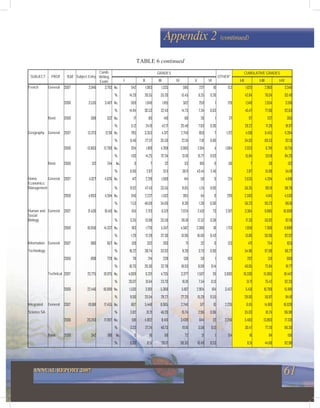
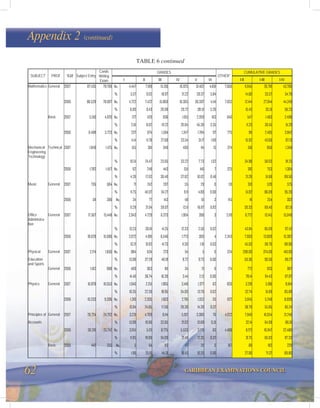
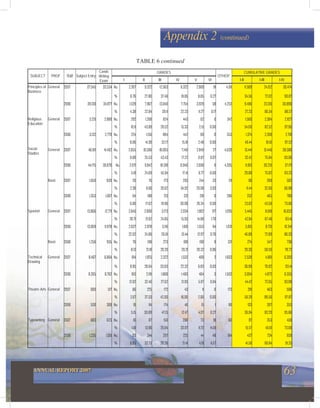
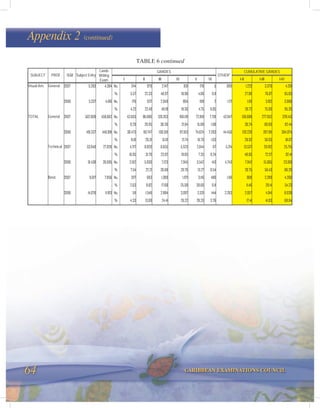
I wish to thank everyone for their support during my tenure
and to wish the staff and the CXC family across the region the
very best for the holiday season and for the new year.
Statement from RegistrarStatement from Chairman
The information provided in
this annual report illustrates
the wide ranging activities
of the Council in its efforts
to contribute to education
development in the region.
The role of CXC in developing
syllabuses, harmonizing
curricula, setting standards
and providing certification has
become even more critical
as the region develops and
implements procedures for
the movement of people
within the CSME. Last year the Council introduced the Caribbean
Certificate of Secondary Level Competence (CCSLC) and the
feedback from policy makers, teachers and other educators and
employers is encouraging.
In addition, discussions with personnel involved in Technical
and Vocational Education resulted in the decision taken by
the CARICOM Council for Human and Social Development
(COHSOD) for CXC to award the Caribbean Vocational
Qualification (CVQ) to candidates in institutions. I am pleased to
report that contracts were signed with the Ministry responsible
for education in St Kitts and Nevis and in Trinidad and Tobago for
the award of the CVQ.
In this programme for the CVQ, the Council provides quality
assurance to ensure that occupational standards are met and
that there is common understanding of the certification provided
to people who pursue Technical and Vocational Education and
Training (TVET). The award of the CVQ is also important for the
movement of skilled persons in the context of the CSME.
During the year, we said farewell to Mr. Wesley Barnett and
welcomed Mr. Glenroy Cumberbatch as the new Pro-Registrar.
This is also my second year as Chairman and I am grateful to
the members and staff of Council for their support and to the
policy makers, educators, Local Registrars and resource persons
who enable the effective implementation of the Council’s
pogrammes.
I wish to thank you very much for your continued assistance and
to all of you season’s greetings and a happy new year.
Professor E Nigel Harris
Chairman
Dr Lucy Steward
Registrar
1ANNUAL REPORT 2007
1. This report summarizes the major activities and
accomplishments of the Caribbean Examinations Council
(CXC) in 2007. The report gives information on the
achievements under the Strategic Goals and the performance
of candidates in the examinations for the Caribbean Secondary
Education Certificate (CSEC) and the Caribbean Advanced
Proficiency Examination (CAPE); and on activities undertaken
to market and promote the work of the Council.
2. Some of the major activities of the Council are listed
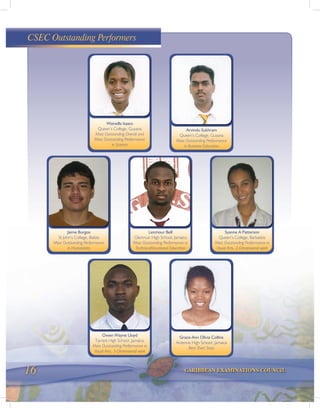
below.
(i) Caribbean Certificate of Secondary Level
Competence (CCSLC)
• The first examinations for the CCSLC took place
in June. Six subjects – English, French, Integrated
Science, Mathematics, Social Studies and Spanish
were examined. Six territories submitted entries.
A total of 2 312 candidates entered.
• Orientation workshops were held for teachers.
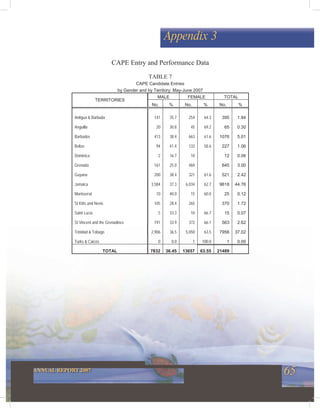
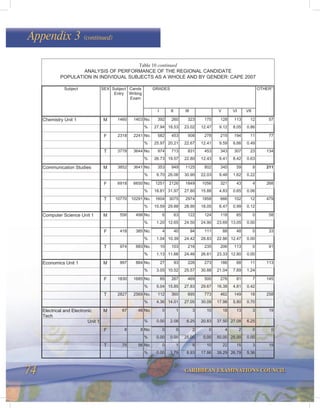
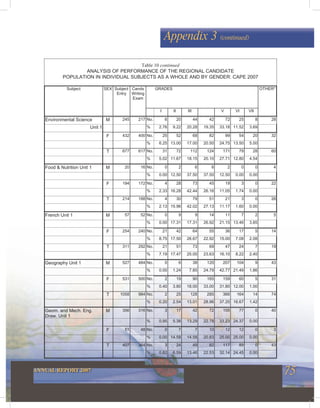
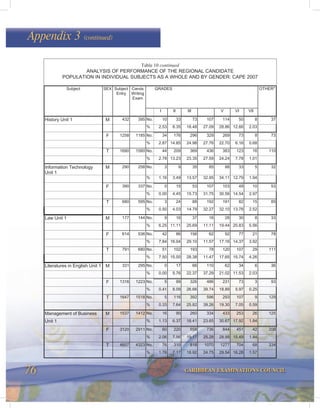
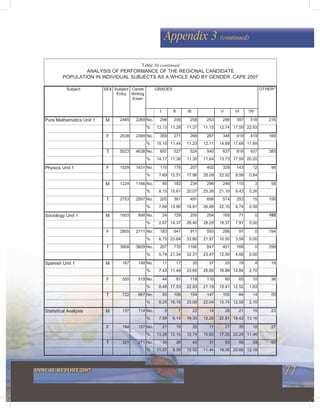
Aproximately 3 000 teachers and other
educators attended.
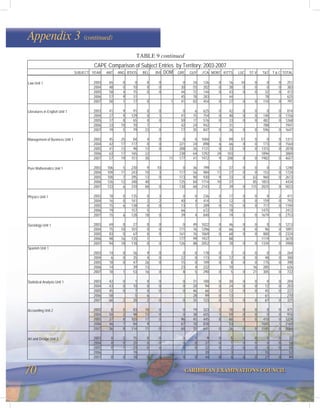
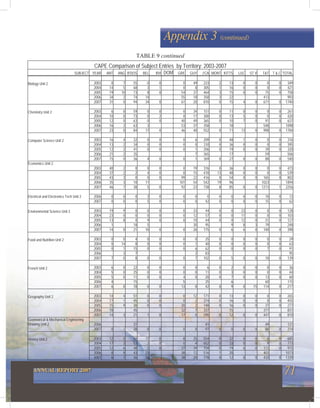
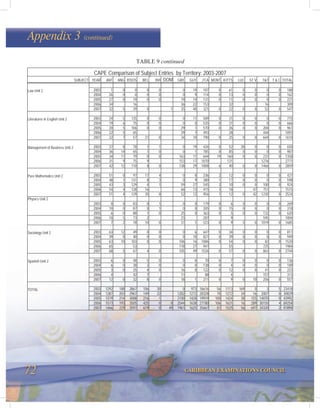
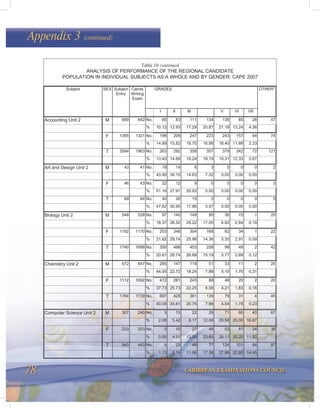
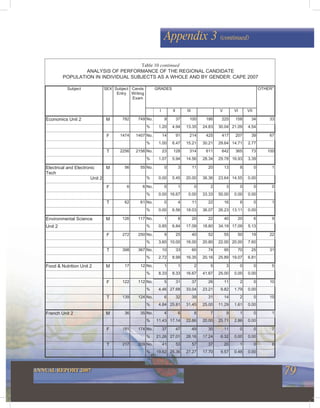
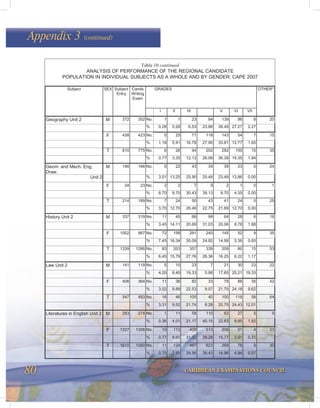
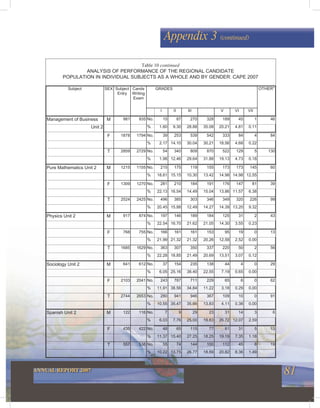
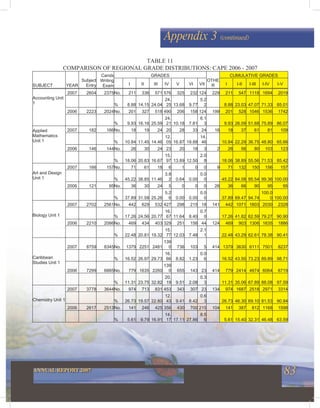
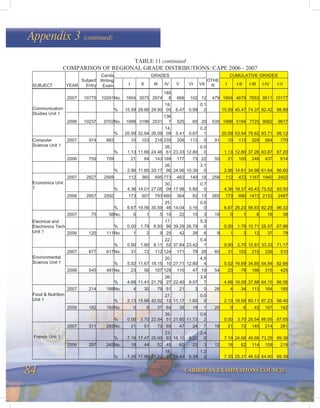
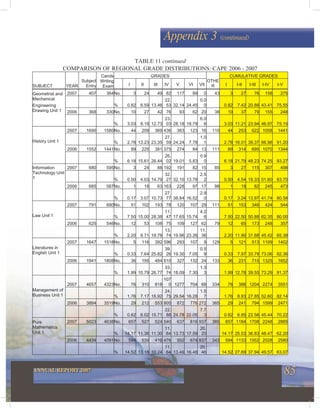
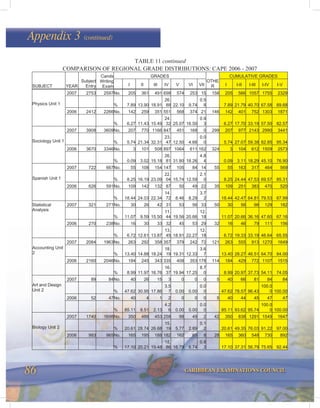
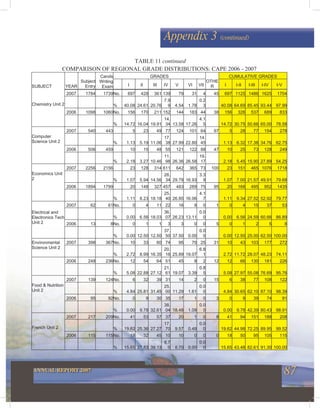
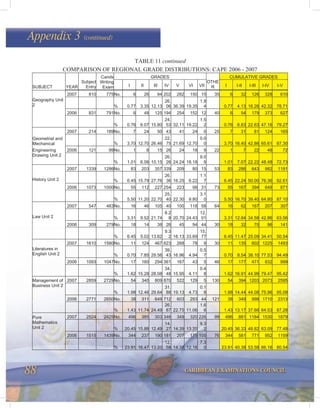
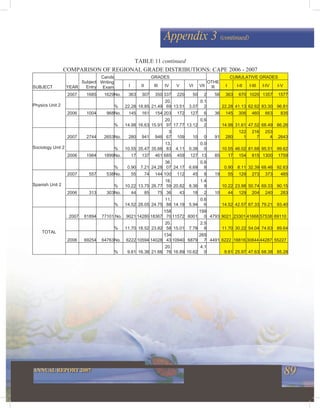
• Meetings were held with policy makers,
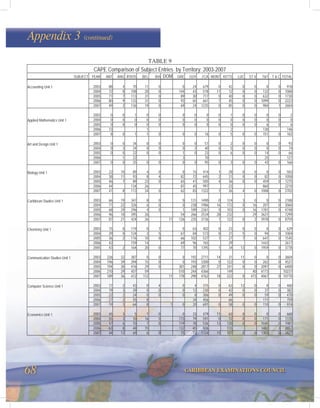
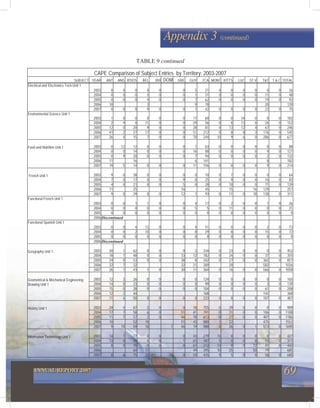
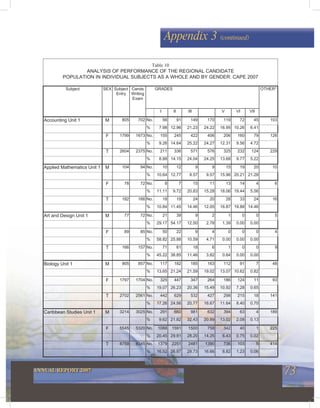
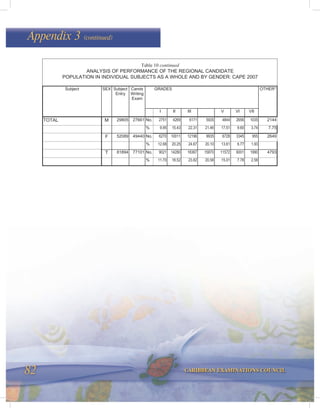
employers, educators, parents and students to
inform them about the CCSLC.
• Promotion and marketing activities took place in
eight territories.
(i) Caribbean Secondary Education Certificate (CSEC)
• An examination in Economics was offered for the
first time.
• Syllabuses for two subjects – Visual Arts and
Social Studies – were reviewed.
• Candidate and subject entries increased.
Introduction
• Self-study guides for Principles of Accounts
and Office Administration were printed and
distributed.
• A Visual Arts exhibition was held in Trinidad and
Tobago.
(ii) Caribbean Advanced Proficiency Examination
(CAPE)
• Syllabuses for five subjects - Applied
Mathematics, Biology, Physics, Pure
Mathematics, and Statistical Analysis - were
revised, printed and distributed.
• Both candidate and Unit entries increased.
• Resource materials were developed for Pure
Mathematics and Economics.
• Regional top awards for outstanding performance
in nine areas were made for the second time.
• Two thousand, three hundred and sixty-eight
candidates qualified for Associate Degrees.
(iii) Caribbean Vocational Qualification (CVQ)
• Contracts between CXC and two territories
were signed for the award of the CVQ by CXC.
• Candidates entered for a variety of areas in
Technical and Vocational Education and Training
(TVET).
• Candidates registered in 2007 were given
transcripts showing modules completed for the
CVQ.
• Six hundred and thirty-seven candidates
registered for the CVQ this year.
2 CARIBBEAN EXAMINATIONS COUNCIL
3. The Council’s Strategic Plan for 2005-2007 lists 13 Strategic
Goals. These goals and the major outcomes pertaining to
them are summarized below.
Strategic Goal 1
4. Develop and administer relevant, high quality curriculum and
assessment products and services to an increased percentage of
persons in and out of institutions in a timely and cost-effective
manner.
Outcomes
CCSLC
5. The first examinations for the CCSLC took place in June.
A total of 2 312 candidates entered for six subjects and 6 633
subject entries were received.
6. The subjects examined were English, French, Integrated
Science, Mathematics, Social Studies and Spanish.
7. Six territories – Anguilla, Antigua and Barbuda, Belize,
Jamaica, St Kitts and Nevis and St Vincent and the Grenadines
entered candidates.
CSEC
8. The candidate entries for the May/June examinations
increased from 138 120 last year to 138 722 this year and
subject entries increased from 522 492 last year to 535 742
this year.
9. An examination in Economics was offered for the first time
and 2 253 candidates sat this examination. English A and
Mathematics had the largest entries with 88 898 and 87 430
candidates respectively. Other subjects with relatively high
entries were Social Studies, Principles of Business, Principles
of Accounts, Information Technology, Technical Drawing,
Human and Social Biology and English B.
CAPE
10. Candidate entries increased from 19 019 last year to
21 489 this year. Unit entries also increased from 69 018 last
year to 81 852 this year.
11. Caribbean Studies had the largest entry with 10 768
candidates. Other subjects with relatively large entries
were Communication Studies, Pure Mathematics Unit 1,
Management of Business Unit 1 and Sociology Unit 1.
Strategic Goals
12. Fourteen territories entered candidates for CAPE. These
territories were Anguilla, Antigua and Barbuda, Barbados,
Belize, Dominica, Grenada, Guyana, Jamaica, Montserrat,
St Kitts and Nevis, St Lucia, St Vincent and the Grenadines,
Trinidad and Tobago and Turks and Caicos Islands.
CVQ
13. Six hundred and thirty-seven candidates from Trinidad and
Tobago registered for TVET options.
14. The CVQ will be awarded for the first time in 2008.
Strategic Goal 2
15. Develop and maintain syllabuses and examinations which
reflecttheculturalandsocialidentityoftheregionandtakeaccount
of curriculum reform initiatives of Participating Territories.
Outcomes
CCSLC
16. The CCSLC syllabuses were developed by subject panels.
A culture officer from one territory also participated in the
exercise. The feedback from teachers and other stakeholders
indicates that the syllabuses reflect culture and social identity in
the content and teaching and assessment activities.
17.Indevelopingthesyllabuses,thecurriculumdocumentsfrom
several Participating Territories were used. Also, in orientation
workshops, teachers and education officers were assisted in
mapping the CCSLC syllabuses on to existing secondary level
programmes.
18. Item-writing workshops were held for the six subjects
developed specifically for the CCSLC. Teachers participating
in these workshops provided examples that reflect culture and
practices at national level.
CSEC
19. Review meetings were held for Social Studies and Visual Arts
in March. For Visual Arts, changes were made in categorizing
the Expressive forms from ‘Production Options’ to ‘Expressive
Forms’.
20. The Social Studies syllabus was restructured to provide
more support to teachers for effective delivery of the subject.
CAPE
21. Revised syllabuses for Applied Mathematics, Biology,
Physics, Pure Mathematics and Statistical Analysis were issued to
schools for teaching in September 2007 and first examinations
in May/June 2008.
3ANNUAL REPORT 2007
Strategic Goal 3
22. Develop learning resources for Caribbean Secondary Education
Certificate and Caribbean Advanced Proficiency Examination to
complement syllabuses and enhance the learning process.
Outcomes
CSEC
23. Self-study materials were prepared for Principles of
Accounts and Office Administration.
CAPE
24. A handbook for Pure Mathematics and a self-study guide
for Economics were prepared.
Strategic Goal 4
25. Develop effective relationships with stakeholders in order to
provide relevant products and services.
Outcomes
CCSLC
26. Several meetings took place with policy makers, education
officials, principals, teachers, employers and students to share
information on the philosophy, rationale, structure and content
of the programme for the CCSLC.
27. Orientation workshops were held in seven territories.
Approximately3000teachersandeducationofficialsparticipated
in these workshops.
28. Meetings with employers took place in six territories.
Feedback from employers was positive as they recognized
that the syllabuses incorporated the development of desirable
attitudes and behaviours for the workplace.
29. The CCSLC was officially launced in five territories.
CSEC
30. Staff facilitated several workshops for education officials,
principals and teachers for electronic registration and electronic
submission of data for School Based Assessment.
31. The marking exercise provided opportunity for discussion
with teachers about the Council’s offerings. Teachers were
also able to obtain syllabuses and resource materials at the
marking centres.
CAPE
32. Discussions continued with colleges and universities on the
articulation of CAPE and the Associate Degree with tertiary
level programmes.
33. The Registrar participated in a meeting of the Consortium
forBelizeEducationalCooperation(COBEC). TheConsortium
includes several universities in the United States of America. At
the meeting, the Registrar explained the structure of CAPE and
facilitated the discussion on articulation arrangements.
34. Other activities included the distribution of materials for
sale in bookstores. The Book Centre in Belize City is the latest
addition to the bookstores that now sell CXC materials in
seven territories.
35. In addition to providing information through workshops
and meetings, flyers relating to changes in SBA requirements,
centre moderation, random sampling, internal assessment for
CAPE and Visual Arts were prepared and distributed.
36. CXC products, including revised CAPE Biology and Physics
syllabuses and school reports, were made available on the
CXC website.
Strategic Goal 5
37. Develop and implement a creative, dynamic and highly
effective Public Relations and Customer Services programme that
maintains and builds strong internal and external support for the
work of the Caribbean Examinations Council.
Outcomes
CCSLC
38. Promotion materials were developed for CCSLC and
distributed widely. A special issue of The Examiner was
prepared focusing on the CCSLC.
39. The Registrar and members of staff along with education
officials gave several television and radio interviews to provide
information on the CCSLC. For example, in Jamaica, the
Registrar and the Chief Education Officer appeared twice
on morning television programmes. Also in Grenada, the
Registrar was interviewed twice on “Good Morning Grenada’,
participated in television and radio call-in programmes and a
press conference chaired by the Permanent Secretary.
40. The CCSLC was officially launched in five territories –
Anguilla, Antigua and Barbuda, Grenada, Jamaica and St Vincent
and the Grenadines.
41. Meetings took place with policy makers, education officials,
employers, principals, teachers, parents and students on the
Strategic Goals (continued)
4 CARIBBEAN EXAMINATIONS COUNCIL
programmes of the Council, in general, and on the CCSLC,
in particular.
42. The annual Visual Arts Exhibition took place in Trinidad and
Tobago from April 30 to May 9. The exhibition featured CSEC
Visual Arts pieces from Trinidad and Tobago and other CXC
Participating Territories.
43. Queries and requests for information were given prompt
responses. More use was made of the website to provide
forms, syllabuses for CCSLC and school reports.
44. A proposal for restructuring the website was prepared and
work started on the new website in October.
45. Staff participated in the Choices Exhibition and Career
Expo held in Jamaica on June 5 and 7, and in the United States
Embassy College Fair in Trinidad and Tobago from September
29 to 30.
46. Four issues of Team CXC, the Council’s internal
newsletter, were prepared and distributed.
47. Press releases were issued on results of examinations, top
awards and the appointment of the Pro-Registrar.
Strategic Goal 6
48. Exercise fiscal responsibility and prudent management in the
conduct of the Council’s business.
Outcomes
49. The sale of self-study materials contributed to an increase
in revenue.
50. Increased expenditure occurred in the marking
exercise mainly because of increases in air fares and hotel
accommodation.
51. Quarterly reports were prepared and discussed with
Heads of Division. Activities were implemented using the most
cost-effective methods.
Strategic Goal 7
52. Identify and develop new business opportunities
Outcomes
53. The Council signed agreements with the ministries of
education in St Kitts and Nevis and Trinidad and Tobago for
Strategic Goals (continued)
the award of the Caribbean Vocational Qualification (CVQ).
Discussions are on-going with other territories for the signing
of similar agreements.
54. The Council continued its efforts to expand the publication
of resource materials and the marketing and distribution
arrangements with bookstores in the region. The Book Centre,
a major bookstore in Belize City, entered into an agreement
with CXC this year.
55. A handbook was developed for Pure Mathematics and
self-study guides were published for CAPE Economics and
CSEC Office Administration and Principles of Accounts.
Strategic Goal 8
56. Evaluate manual and computerised processes to inform and
ensure the optimal use of technological enhancements.
Outcomes
57. The Records Unit embarked on a project to preserve and
secure the Council’s vital records in electronic format. Phase I
was the scanning of all vital paper records kept in the central
Registry and converting them to PDF. This activity will continue
in 2008 with paper-based records held by other divisions.
58. The EPS was enhanced during 2007 to address user
requirements and included improvements to moderation,
multiple-choice data processing and the candidate registration
process. The modifications to moderation incorporated all
current moderation business rules, including stratified random
sampling. These modifications also provided a more efficient
user interface and error reporting capability for un-moderated
candidatesandothererrorsthatoccurinmoderation. Additional
details were provided on the candidate maintenance screen
for more effective user interaction and to process all defined
registration options.
59. The implementation and the continuous enhancement of
the registration process have yielded great benefits. Through
the e-Registration and e-SBA applications the manual processes
required to complete these activities have been significantly
reduced and the processing is much more efficient.
60. Based on the outcomes of the pilot, the e-SBA module was
revised. This year, 50 schools from seven territories (Barbados,
Belize, Guyana, Jamaica, St Kitts and Nevis, St Vincent and
the Grenadines and Trinidad and Tobago) used the revised
module.
61. Four training workshops were held in Barbados, Guyana,
Jamaica and Trinidad and Tobago to update teachers and
5ANNUAL REPORT 2007
ministry of education officials on the enhancements of the
e-Registration and e-SBA.
Strategic Goal 9
62. Improve efficiency by reviewing, modifying, developing and
implementing procedures and best practices for managing
organisational change.
Outcomes
63. A Records and Information Management (RIM) Policy
document was prepared. The RIM Policy is intended to guide
theapplicationofrecordsmanagementstandardsandtechniques
at Headquarters (HQ) and the Western Zone Office (WZO)
and ensure that international laws on information management
are adhered to and best practices adopted by the Council.
64. A policy on the use of removable storage devices was
completed to control and monitor the use of removable
devices across the organization. The policy informs users
of the dangers in the indiscriminate use of such devices and
procedures to secure data.
Strategic Goal 10
65. Establish research and development mechanisms to
facilitate the work of the Council.
Outcomes
66. A Research Committee which was established last year
met twice this year. A summary of some of the research related
to CXC syllabuses and programme was prepared. A proposal
for conducting and documenting case studies of best practices
in SBA was prepared and is being piloted in some schools in
Barbados. The consequential validity of CAPE is being studied
through a collaborative arrangement with the University of the
West Indies (UWI), St. Augustine. The research focuses on the
adequacy of the CAPE Physics and Mathematics programmes
for preparing candidates for degree programmes at UWI, St.
Augustine.
67. In subsequent phases, the study will be replicated with
other subjects and institutions.
Strategic Goal 11
68. Develop and maintain sound human resource management
programmes.
Outcomes
69. On-going meetings were held between management and
staff representatives to discuss matters of relevance and address
issues of concern to staff.
70. The Revised Staff Rules came into effect from January 1,
2007.
71. Activities were planned at both HQ and WZO to
commemorate Office Professionals’ Day. At Headquarters,
staff participated in a seminar on ‘Team Building’ as part of
Office Professionals’ Day. The seminar was facilitated by the
Barbados Productivity Council. Fun days were also held for
staff at both offices.
72. The Council also facilitated staff participation in
professional development conferences. Assistant Registrars,
Dr Gordon Harewood (MED), Mr Anthony Haynes (MED)
and Mrs Sandra Thompson (EAD) attended the AERA/NCME
Conference from April 9-13, in Chicago. Mr Baldwin Hercules,
Senior Assistant Registrar, Examinations Administration
Division (EAD) and the Registrar attended the International
Association for Educational Assessment (IAEA) Conference
in Azerbaijan from September 16 to 20. AR (PI and CS) Mr
Cleveland Sam attended the International Conference of
the Public Relations Society of America in Philadelphia from
October 20 to 23.
73. Mr Anderson Marshall, Fianncial Controller, attended the
ACCPAC User Conference in Chicago, USA from November
3 to 6.
74. The Council also facilitated several staff members’
participation in academic courses during the year, granted
study leave, allowed flexible working hours and sponsored
some programmes for staff development.
Strategic Goal 12
75. Develop and institute measures for a safe and healthy working
environment.
Outcomes
76. The Health and Safety Committee continued to hold its
quarterly meetings and to monitor and address matters related
to the working environment. With the assistance of the
Occupational Health and Safety Department of the Ministry of
Labour, a Health and Safety Manual was drafted. More staff
members obtained Health and Safety Certification to remain
current with good practices and obtain better understanding
of the new Safety and Health legislation recently passed in
Barbados. In addition, training in First Aid was provided for
Strategic Goals (continued)
6 CARIBBEAN EXAMINATIONS COUNCIL
some staff members while those previously trained were re-
certified.
77. Members of the Disaster Management Team and Fire
Marshals from each division participated in a seminar on bomb
threats. The half-day seminar was facilitated by members of
the Explosive Ordnance Devices Squad of the Royal Barbados
Police Force.
Strategic Goal 13
78. Obtain and furnish buildings for CXC operations.
Outcomes
79. Adequate accommodation is urgently needed at
HeadquartersandattheWZO. Thecurrentinadequatefacilities
Strategic Goals (continued)
have impacted on staff morale, internal communications, the
constant moving of materials between buildings, and health and
safety concerns. Additionally, significant sums were spent on
building maintenance, refurbishment and relocation.
80. It should be noted that the Government of Barbados, in
its attempts to provide additional accommodation, has made
new space available in two buildings – Alexandra Court and
the Nemwil House in the environs of the Garrison - to replace
the Bandstan Manor, the Ernst and Young building and the
Harbour Road building.
81. The Council was informed by the Ministry of Education,
YouthAffairsandSports,Barbados,thatprogresshasbeenmade
with regard to the construction of a permanent headquarters
building. The Ministry of Education, Jamaica, has also advised
that plans are being made for alternate accommodation for the
WZO. The need to acquire suitable accommodation remains
a priority for the Council.
7ANNUAL REPORT 2007
New Pro-Registrar
82. Mr Glenroy
Cumberbatch, a Barbados
national, was appointed
Pro-Registrar effective from
September 1, 2007. Mr
Cumberbatch comes to
CXC with a wide range of
experience in education.
He started his professional
career as a teacher in 1975
and moved to the Ministry
of Education in 1991 as
Education Officer with
responsibilityforMathematics.
Inthispost,heassistedwiththe
development of mathematics curricula, a remedial mathematics
programme and the implementation of workshops for teachers.
After four years in this post he was appointed Senior Education
Mr Glenroy Cumberbatch
Pro-Registrar
84. Mr Wesley Barrett served as Pro-Registrar from November 2005 to October 2007.
Mr Barrett was thanked for his contribution to the work of the Council as Pro-Registrar
at a function hosted at the Courtleigh Hotel, Jamaica. He served previously on the Sub-
Committee of the School Examinations Committee (SUBSEC) and the Final Awards
Committee (FAC).
Mr Wesley Barrett
Farewell Ms Elma Licorish
85. Ms Elma Licorish, the first
employee of CXC, retired from
the Council on June 8th, 2007.
86. Ms Licorish started work
as a Clerk in 1974. She was
promoted to Senior Clerk in the
Secretariat Division on January
1, 1975.Two years later, on
December 1, 1977, Ms Licorish
became a Junior Assistant
Registrar. On January 1, 1979,
she was promoted to Senior Administrative Assistant in EAD.
Ms Licorish spent 19 years in EAD until 1998 when she was
promoted to Assistant Registrar. In October that same year,
she was made Officer in Charge of the Production Division.
87. Ms Licorish completed a Bachelor of Arts degree in History
at the University of the West Indies, Cave Hill Campus in 2003.
Ms Elma Licorish
Officer (Planning, Research and Development). He served in
this post for three years. He was then promoted to the post of
Deputy Chief Education Officer.
83. In his various positions in the Ministry of Education,
Mr Cumberbatch has contributed to the development and
implementation of education policies and programmes in
Barbados. His responsibilities included budget preparation,
coordination of activities in Planning, Research and
Development, Testing and Measurement and Management
of Information Systems. He was also directly involved in the
supervision and management of schools, student services and
teacher evaluation. He served for a period as the CXC Local
Registrar in Barbados.
In July 2003, she was appointed Senior Assistant Registrar-
Production Division.
88. Ms Licorish played a vital role in the early days of the Council
in helping to set up the examination systems. She was part of
a CXC delegation which visited Scotland and Manchester in
the UK to observe the operations of examination boards
there.
89. Ms Licorish was also integrally involved in the first CSEC
examinations in 1979. She had the task of going to the
Educational Testing Service (ETS) in New Jersey, USA to bring
back the first results which were processed by ETS.
90. Ms Licorish is justly proud of the strides the Council has
made. “The fact is that we managed to start an organization
from scratch with one staff member, and we now have an
examination that is recognized worldwide with a logo that most
people in the Caribbean recognize.”
91. Ms Licorish was thanked for her years of dedicated service
to the Council.
8 CARIBBEAN EXAMINATIONS COUNCIL
Caribbean Secondary Education Certificate
(CSEC) January Sitting 2007
92. Twelve subjects were offered for the January sitting of the
CSEC examinations – 11 at General Proficiency and one at
Technical Proficiency.
93. Candidate entries and subject entries both increased again
this year. Subject entries increased from 34 085 in 2006 to
40 705 in 2007 and candidate entries also increased from
21 279 in 2006 to 24 833. Substantial increases were noted
in entries for Human and Social Biology (81%), Social Studies
(32%), English A (18%) and Mathematics (17%).
94. The subjects with the largest candidate entries were
Mathematics 14 455, English A 13 459, Principles of Business
2 585, Social Studies 2 374 and Human and Social Biology
2 030.
95. Office Administration was offered for the January sitting for
the first time this year.
Performance of Candidates
96. Candidates’ performance in the examination declined
when compared with 2006. Fifty-one percent of candidates
achieved Grades I to III, compared with 61 percent last year.
97. Data on the January entries and performance are given in
Appendix I. A summary of the performance in each subject is
given below.
Biology
98. Sixty-five percent of the candidates achieved Grades I
to III, compared with 61 percent in 2006. Performance in
Paper 01, the multiple choice paper, continued to be satisfactory
and stable. Candidates also performed well in Paper 04/2,
the alternative to School Based Assessment. However, in
Paper 03, the extended response paper, there was evidence
that while candidates were able to recall and reproduce
factual information, a significant number was unable to use the
information to formulate responses to the questions.
Chemistry
99. Approximately 53 percent of the candidates who wrote
the examination in 2007 achieved Grades I to III, a significant
improvement compared with 43 percent who achieved similar
grades in 2006. Performance in Paper 01, the multiple choice
paper, and Paper 02, the structured short-answer paper,
improved; however, for Paper 03, the essay paper, candidates
experienced difficulty in answering questions based on the
preparation of potassium sulphate, the reactions of metals and
non-metals, and the chemistry of household detergents. The
Examining Committee noted that performance in the alternative
to School Based Assessment, Paper 04/2, was better in 2007
than it was in 2006, but continued to be concerned about the
number of candidates who seemed to have limited experience
of practical activities in a laboratory.
English A
100. This was the first January examination of the revised
English A syllabus and candidates’ performance declined
significantly compared with performance in January 2006.
Overall, approximately 43 percent of candidates achieved
Grades I to III compared with 61 percent in 2006. The decline
in performance was evident in Paper 01, the multiple choice
paper, and Paper 02, the essay paper; however, overall
performance in Profile 1, Understanding, was significantly
better than it was in 2006.
Human and Social Biology
101. There was improvement in the overall performance of
candidates in 2007. Approximately 46 percent of the candidates
achieved Grades I to III, compared with 40 percent in 2006.
Performance in Paper 01, the multiple choice paper, was slightly
better than it was in 2006. Although there was improvement
in Paper 02, the structured essay paper, candidates continued
to have difficulty with the questions based on reproduction and
genetics. A large number of candidates showed evidence of
insufficient preparation for the examination.
Information Technology
102. Seventy-one percent of the candidates achieved Grades
I to III compared with 42 percent in 2006. The performance
in Paper 01 (Theory) was much better than in previous
years. There was a major improvement in performance in
the programming section of this paper and the Examining
Committee attributed this improvement to the alignment of
the assessment tasks more closely with the suggested teaching
and learning activities and the workplace environment.
Mathematics
103. Forty-three percent of the candidates achieved Grades
I to III. This represents a ten percent decline from 2006.
Candidates’ performance in Paper 01, the multiple choice
paper, was consistent with that of January 2006. However,
performance in Paper 02, was significantly lower than that of
January 2006. Candidates performed creditably in the areas
of computation and consumer arithmetic. The questions
which focused on problem-solving skills presented the greatest
challenge for candidates.
9ANNUAL REPORT 2007
Office Administration
104. This was the first January examination of the revised
syllabus, now called Office Administration (previously called
Office Procedures). Candidates’ performance in this subject
declined in comparison with last year. In 2006, 74 percent
of the candidates achieved Grades I to III, compared with 70
percent in 2007. The decline was especially notable in Paper
03/2, the alternative to School Based Assessment, where 66
percent of the candidates achieved Grades I to III this year,
compared with 98 percent in 2006.
Physics
105. Overall performance declined when compared with that
of January 2006, as 50 percent of the candidates achieved
Grades I to III this year compared with 65 percent in 2006.
Performance in Paper 02, structured questions and Paper 03,
the essay, declined marginally when compared with January
2006. Performance in Question 5 of Paper 03, which required
algebraic thinking for its solution, was weak. The Examination
Committee was pleased with the performance in the first
two questions on Paper 04/2, the alternative to School Based
Assessment, but performance in Question 3, which tested
Planning and Design skills, was disappointing.
Principles of Accounts
106. There was a significant improvement in the performance
of candidates. Sixty-five percent of the candidates achieved
Grades I to III compared with 49 percent in 2006. There
was a decline in the performance of candidates in Paper 01,
the multiple choice paper. However, there was marked
improvement in the performance in Paper 02, the essay paper.
There was a marginal improvement in the performance in
Paper 03/2, the alternative to the School Based Assessment.
Principles of Business
107. Seventy-three percent of the candidates achieved Grades
I to III, compared with 75 percent in 2006. There was an
improvement in the performance of candidates in Paper 01,
the multiple choice paper. However, the performance of
candidates in Paper 02, the essay paper, declined compared
with 2006. The performance in Paper 03/2, the alternative to
School Based Assessment, was consistent with that of 2006.
Candidates performed creditably on Profile 1, Organizational
Principles; however, their performance in Profile 3, Finance
and Introduction to Economics was unsatisfactory.
Social Studies
108. The overall performance was satisfactory. Seventy-
one percent of the candidates who sat the examination
achieved Grades I to III, consistent with the results in 2006
when 72 percent of the candidates achieved this standard.
Improvement was noted in Paper 02, the essay paper, and
Paper 03/2, the alternative to School Based Assessment.
There were good responses on the essay questions relating
to Individual Interaction; however, performance in questions
relating to CARICOM and regional integration was very weak.
While the knowledge and application components in some
questions were well handled, there was a general weakness
in interpretation, evidenced by inadequate explanations and
undeveloped responses.
Spanish
109. Eighty percent of the candidates achieved Grades I to
III compared with 83 percent in 2006. Candidates continued
to produce excellent responses in Paper 02, the free
response paper, especially in Section I (Directed Situations)
and in Section II (Letter/Dialogue/Composition). However,
candidates performed at a lower level in Section III (Reading
Comprehension) than they did in 2006, while they performed
satisfactorily in Section IV (Expanded Paragraph). Candidates’
performance in Paper 01, the multiple choice paper, which
tested the listening and reading skills, and on Paper 03, the oral
paper, which tested the listening and speaking skills, continued
to be reasonably good and was consistent with performance
in 2006.
Caribbean Secondary Education Certificate
(CSEC) January Sitting 2007 (continued)
10 CARIBBEAN EXAMINATIONS COUNCIL
Caribbean Secondary Education Certificate
(CSEC) May/June Sitting 2007
Administration of the Examinations
110. The Council offered 34 subjects for the May/June sitting
of the CSEC examinations this year; 27 at General Proficiency
only, three at Basic and General Proficiencies, three at Technical
Proficiency only and one subject at General and Technical
Proficiencies.
111. Economics was offered for the first time at this level and it
attracted 2 253 candidates.
112. A total of 535 742 subject entries were received from
138 722 candidates.
113. The largest entries were in English A (88 898) and
Mathematics (87 430). Other subjects with large entries
were Social Studies (46 097), Principles of Business (37 542),
Principles of Accounts (28 723), Information Technology-
Technical (23 772), Human and Social Biology (21 428) and
English B (20 080).
Performance of Candidates
114. Data on the subject entries and candidates’ performance
are given in Appendix 2 and a summary of the candidates’
performance in each subject is given below.
Agricultural Science (DA)
115. Candidate performance declined in 2007. Eighty percent
of the candidates achieved Grades I to III in 2007 compared
with 85 percent in 2006. While there was an improvement
in candidates’ responses to questions on Profile 4 (Agricultural
Economics), candidates’ performance declined on Profile
1, (Crop Science), and on Profile 2, (Animal Science).
The Examining Committee reported that there was some
evidence that candidates were not exposed to some of the
practical activities outlined in the syllabus, and this would have
affected their performance in the written component of the
examination.
Agricultural Science (SA)
116. There was a decline in the percentage of candidates
achieving Grades I to III in Option A, Crops and Soils, and in
Option B, Animal Science. For Option A, 57 percent of the
candidates achieved Grades I to III in 2007 compared with 75
percent in 2006. For Option B, 48 percent of the candidates
achieved Grades I to III in 2007 compared with 84 percent in
2006. In both Option A and Option B, while candidates were
able to recall agricultural facts, they demonstrated weakness
in applying those facts to solve problems. Candidates also
had difficulty in making appropriate links between theory and
practice, leading the Examining Committee to conclude that
not enough emphasis was placed on the practical component
of the syllabus.
Biology
117. Candidates’ performance was similar in 2006 and
2007, with approximately 72 percent of the candidates
achieving Grades I to III. The Examining Committee noted
that candidates were unfamiliar with biological terms, had
difficulty in manipulating biological information, and showed
a lack of knowledge about issues such as global warming and
greenhouse effects.
Building Technology
Option 1 - Woods
118. There was an improvement in the performance of
candidates in 2007 when compared with the previous year.
Sixty-six percent of the candidates sitting the examination in
Woods achieved Grades I to III compared with 63 percent in
2006.
119. Candidates’ performance in the practical project of the
School Based Assessment was of a high standard.
Option 2- Construction
120. Seventy percent of the candidates achieved Grades I to III
compared with 73 percent in the 2006 examination.
121. Candidates did well in the practical project of the School
Based Assessment component but not as well on the written
project. Candidates demonstrated weaknesses in knowledge
of practice and regulations in the construction of foundations,
walls, roofs, doors, windows and stairs.
122. In both Options, candidates continue to display a lack of
knowledge of drawing conventions and poor drawing skills.
Caribbean History
123. Performance in the 2007 General Proficiency
examinations was comparable with that of 2006 with a small
increase in the number of candidates achieving Grade I.
Approximately 68 percent of the candidates achieved Grades
I to III compared with 67 percent in 2006. Improvement was
especially noted in Paper 03/1, (School Based Assessment) and
Paper 03/2, (the Alternative to the School Based Assessment).
There is still a need, however, for improvement in the analytical
and evaluative skills required for adequately responding to all
questions in Paper 02. The themes– Economic Diversification,
1875 -1958, Social and Economic Conditions in the 20th
11ANNUAL REPORT 2007
Century, and The United States in the Caribbean 1776 -1985
in Sections C; and Movements Towards Independence and
Regional Integration up to 1985 and Social Life 1838 -1962
in Section D - continue to present challenges to candidates.
Although candidates possessed some general knowledge of
the questions, they needed, in most cases, to provide more
specific and detailed responses and to pay greater attention to
chronology.
Chemistry
124. The overall performance of candidates improved in
2007. Sixty-four percent of the candidates achieved Grades I
to III in 2007, compared with 62 percent in 2006. Candidates’
performance improved on Profile 2, Use of Knowledge, and
on the Planning and Design skill. However, writing the formula
of common compounds presented difficulties for candidates,
which impacted on their ability to write balanced equations.
Clothing and Textiles
125. Candidates’ performance declined in 2007 with 83
percent of the candidates achieving Grades I to III compared
with 89 percent in 2006.
126. Common areas of weakness related to limited knowledge
of fundamental concepts such as seams and fabric construction.
Additionally, many responses were limited in the concepts and
details required.
127. The garments constructed for the School Based
Assessment component of the examination showed excellent
workmanship, generally.
Economics
128. This was the first year in which the Economics syllabus
was examined and 56 percent of candidates achieved Grades
I to III. Performance was generally satisfactory though some
areas of weakness were evident. Many candidates failed
to demonstrate a good understanding of critical economic
concepts such as national income, terms of trade, monetary
policies and factors of production.
129. Performance in the School Based Assessment component
was fair though some of the research projects showed
inadequate research skills.
Electrical and Electronic Technology
130. Candidates’ performance improved in 2007 with 66
percent of candidates achieving Grades I to III compared with
40 percent in 2006. Candidates’ performance improved in all
three papers.
Electronic Document Preparation and Management
131. Ninety-five percent of the candidates achieved Grades I
to III. This is consistent with the performance in 2006 when 97
percent of the candidates achieved Grades I to III. Candidates’
performance in this examination was excellent, particularly in
Paper 02, the Production Test.
132. The work of candidates for the School Based Assessment
andPaper03/2,theAlternativetotheSchoolBasedAssessment,
was of a high standard.
English A
133. There was a small decline in the number of candidates
achieving Grades I to III in 2007 compared with 2006.
Approximately, 49 percent of the candidates achieved Grades
I to III compared with 51 percent in 2006. In 2007, the
performance in Paper 01 showed a small decline from 2006.
In Paper 02, performance in the Summary skills, Section I,
was comparable with performance in 2006. There was an
improvement in Comprehension Skills, Section II, compared
with 2006. Candidates’ performance in the Short Story writing,
Section III, showed a decline from 2006.
134. The 2007 Basic examination in English A was the
penultimate examination for this subject. The overall
performance in 2007 declined slightly. Approximately 25
percent of the candidates achieved Grades I to III.
English B
135. This year was the second examination of the revised
English B syllabus. Previously, two profiles, Knowledge and
Insight and Organization of Response were assessed. From
2006 three profiles: Drama (Profile 1), Poetry (Profile 2) and
Prose (Profile 3) were assessed in Paper 01, the Short Answers,
and Paper 02, the Essay Paper. Overall, 66 percent of the
candidates achieved Grades I to III, compared with 44 percent
in 2006. Candidates performed best in the Drama component
and better in the Prose than in the Poetry. Performance in
Papers 01 and 02 improved this year.
Food and Nutrition
136. There was an improvement in the performance of
candidates in 2007 when compared with performance in 2006.
Approximately 88 percent of the candidates achieved Grades I
to III, compared with 84 percent in 2006.
Caribbean Secondary Education Certificate
(CSEC) May/June Sitting 2007 (continued)
12 CARIBBEAN EXAMINATIONS COUNCIL
137. Many candidates continued to find the scientific principles
of nutrition challenging. In general, responses tended to be
general statements related to nutritional concepts rather than
focus on the specifics of the questions asked.
138. In the School Based Assessment component of the
examination, candidates, generally, demonstrated proficiency
in the food preparation and service skills.
French
139. Seventy-eight percent of the candidates at the General
Proficiency, the same as last year, achieved Grades I to III.
140. This was the first examination of the revised syllabus. As
was noted in previous years, there is room for improvement on
all Papers - Paper 01, which assesses the listening and reading
skills; Paper 02, the Free Response paper which assesses the
reading and writing skills; and Paper 03, which assesses listening
and speaking skills.
Geography
141. The revised syllabus was examined for the first time
in 2007. A significant improvement in the performance of
candidates was noted. Seventy percent of the candidates
earned acceptable grades, Grades I to III, an increase of 17
percent compared with 2006. Six percent achieved Grade I
compared with two percent in 2006.
142. Some improvements were noted in performance in
questions relating to Human Systems and Human Environment
Systems. However, many candidates faltered in applying map-
reading skills and in topics relating to natural systems. Some
fundamental concepts and definitions, basic to the discipline,
continue to be challenging for many candidates. There is need
for improvement in the application of field-work skills and in the
quality of the School Based Assessment.
Home Economics Management
143. Candidates’ performance in 2007 was the same as in 2006
with approximately 90 percent of the candidates achieving
Grades I to III.
144. Candidates generally demonstrated a sound knowledge
of concepts related to food preparation and management.
However, performance was weak in the Modules based on
disaster preparedness; entertainment; and, the relationship
between family and the community.
145. Several candidates encountered difficulties in responding
to command words, and critical phrases in questions were
often ignored.
146. Candidates performed well in the School Based
Assessment component of the examination.
Human and Social Biology
147. Candidate entry showed significant growth for this third
sitting of the June examination. Candidates’ performance was
similar in 2006 and 2007, with approximately 51 percent of the
candidates achieving Grades I to III. Candidates demonstrated
inadequate understanding of topics such as, organs and systems
of the human body, genetics, HIV and AIDS, and the relationship
between floods and diseases. They experienced particular
difficulty with questions which integrated social aspects with
human biology.
Information Technology
148. At the General Proficiency, 88 percent of the candidates
achieved Grades I to III compared with 73 percent in 2006.
At the Technical Proficiency, the percentage of candidates
achieving Grades I to III in 2007 increased to 80 percent from
57 percent in 2006. There was a general improvement in
performance in all three papers; however, the programming
component of Paper 01 continues to challenge students.
Integrated Science
149. Eighty-one percent of the candidates writing the 2007
examination earned Grades I to III, compared with 77 percent
in 2006.
150. Approximately four percent of the candidates achieved
Grade I compared with three percent in 2006.
151. Generally, candidates performed better in questions with
biology content than on questions with chemistry and physics
content. There was noticeable decline in the quality of the
reports submitted for the School Based Assessment compared
with the quality in 2006. Some weaknesses were exhibited in
activities requiring analysis and interpretation, and planning and
design.
Mathematics
152. Thirty-four percent of the candidates who sat the General
Proficiency examination achieved Grades I to III, compared
with 36 percent in 2006. There was significant improvement
in the performance in Paper 01, the multiple choice paper, but
there was a decline in performance in Paper 02, the extended
response paper. The performance of candidates in the
Caribbean Secondary Education Certificate
(CSEC) May/June Sitting 2007 (continued)
13ANNUAL REPORT 2007
questions testing Measurement, Geometry and Trigonometry
was unsatisfactory.
153. At the Basic Proficiency, 30 percent of the candidates
achieved Grades I to III, compared with 44 percent in 2006.
The performance in Paper 01, the multiple choice paper was
consistent with that of 2006. However, there was a decline in
performance in Paper 02. Candidates experienced difficulty in
answering questions related to Algebra and Geometry.
Mechanical Engineering Technology
154. Eighty-one percent of the candidates who sat this
examination achieved Grades I to III, compared with 52
percent in 2006.
155. Candidates generally performed well in the practical
project for the SBA, but displayed weakness in the written
project. Candidates continue to experience difficulties with
engineering design.
Music
156. Eighty-two percent of the candidates achieved Grades I
to III, compared with 70 percent in 2006. There was notable
improvement in the performing and composing skills. The
top performing candidates showed an aptitude for creative
expression. Most responses showed evidence of effective
instruction. The candidates performed well in the listening
and appraising components of the examination; candidates,
who excelled in these skills, also demonstrated mastery of the
performing skills as well as musical literacy. The performance
in Paper 03, the School Based Assessment was good and was
comparable to the performance last year.
Office Administration
157. This was the second year of examination of the new
syllabus. Candidates’ overall performance in the 2007
examination was comparable to the performance in 2006.
Eighty-five percent of the candidates achieved Grades I to III
compared with 84 percent in 2006. Candidates’ performance
in 2007 in Paper 01 was consistent with that of 2006.
Performance in Paper 02 (the essay) showed a decline from
that of 2006. Candidates’ performance in the Paper 03/2, the
alternative to School Based Assessment, showed a significant
improvement compared with 2006.
Physics
158. Overall performance declined, with 51 percent of the
candidates achieving Grades I to III compared with 56 percent
in 2006. Candidates found the Paper 03, the essay paper,
challenging. Similar performances in Paper 01, the multiple-
choice paper and Paper 02 the structured paper were recorded
when compared with 2006. Performance in Paper 04, the
School Based Assessment component, was satisfactory.
Physical Education and Sport
159. Ninety-seven percent of the candidates earned Grades I
to III, compared with 94 percent in 2006. Approximately 48
percent of the candidates achieved Grade I compared with 41
percent in 2006.
160. The overall performance was good. The ‘historical’
questions presented some challenges to candidates. Generally
there was some improvement in the quality of the portfolios
submitted for the School Based Assessment compared with the
quality in 2006.
Principles of Accounts
161. The performance of candidates in 2007 was consistent
with that of 2006. Sixty-five percent of the candidates achieved
Grades I to III compared with 67 percent in 2006. There
was a decline in the performance of candidates in Paper 01,
the multiple choice paper. However, there was improvement
in the performance of candidates in Paper 02, the problem-
solving paper and Paper 03/1, the School Based Assessment.
Candidates performed better on Profile 2, (Application of
Information), than on Profile 1, (Knowledge) and Profile 3,
(Interpretation).
Principles of Business
162. There was improvement in the overall performance of
candidates on this year’s examination over 2006. Seventy-one
percent of the candidates achieved Grades I to III compared
with 66 percent in 2006. There were improvements in the
performance of candidates in Paper 01, the multiple choice
paper, and Paper 02, the essay paper. The performance of
candidates in Paper 03/1, the School Based Assessment was
good. Profile 3, (Finance and Introduction to Economics),
continues to be challenging for candidates.
Religious Education
163. This was the first examination based on the new syllabus
and performance overall was good. Approximately 80 percent
of candidates achieved Grades I to III in this year’s examination
compared with 82 percent in 2006. There was a small decline
in performance in Paper 01. Some candidates were unfamiliar
with the questions set on Caribbean Indigenous Religions.
The performance of many candidates in Paper 02 continues
to fall below the expected standard. These candidates often
Caribbean Secondary Education Certificate
(CSEC) May/June Sitting 2007 (continued)
14 CARIBBEAN EXAMINATIONS COUNCIL
interpreted questions incorrectly and lacked adequate analytical
and expressive skills. There was also some deficiency in their
knowledge of scriptural texts.
Social Studies
164. Overall performance at General Proficiency level was
good. Approximately 76 percent of the candidates achieved
Grades I to III compared with 69 percent in 2006. Improvement
was recorded in Papers 01, 02 and 03/2 at the General
Proficiency level. Performance at the Basic Proficiency level
declined from that of 2006 with approximately 31 percent of
candidates achieving Grades I to III compared with 44 percent
in 2006. Generally, while performance on the knowledge
components of questions was very satisfactory at both levels,
the questions measuring Profile 2 (Interpretation), were
challenging. The School Based Assessment projects were
generally well researched and presented.
Spanish
165. Sixty-eight percent of the candidates at General Proficiency
achieved Grades I to III compared with 74 percent in 2006.
There was a decline in performances on Profile 2 (Reading)
and Profile 4 (Writing). Performance declined in all Papers.
Technical Drawing
166. There was an improvement in the performance of
candidates in the 2007 examinations. Seventy-one percent
of the candidates achieved Grades I to III compared with 67
percent in 2006.
167. There was a marginal increase in performance in
Papers 01 and 02. Performance in the School Based Assessment
component was consistent with performance in 2006 and
Caribbean Secondary Education Certificate
(CSEC) May/June Sitting 2007 (continued)
previous years. Although performance in the SBA continues
to be good, the decline in use of standard drawing practice has
been noted.
168. The number of candidates using the CAD option continues
to increase. While this is a positive development, there is need
for greater attention to mastery of drawing standards.
Theatre Arts
169. Overall, candidates’ performance in this examination
improved significantly. In 2007, 89 percent of the candidates
achieved Grades I to III compared with 83 percent in 2006.
This improved performance was reflected in the performance
in the Paper 01. Additionally, improved performance was noted
in all three profiles; Analyzing and Appreciating, Performing and
Creating.
Typewriting
170. The number of candidates registered for this examination
continues to decline, with 683 entries this year. Forty percent
of the candidates achieved Grades I to III, compared with 70
percent in 2006.
171. The Examining Committee reported that weaknesses
were demonstrated in the candidates’ ability to follow the
instructions given and to identify spelling and grammatical errors
in completed tasks.
Visual Arts
172. Overall performance in this subject decreased slightly
when compared with 2006. Seventy-four percent of the
candidates achieved Grades I to III compared with 76 percent
in 2006. Drawing, Imaginative Composition, Graphic Design,
Surface Decoration and Decorative Craft were the most
popular options. Reasonable performances were recorded
across the options. Significant improvement in the performance
in Leather Craft was recorded when compared with 2006.
15ANNUAL REPORT 2007
Outstanding Performance in the
May/June 2007 CSEC Examinations
2007 Awardees
173. The award for Most Outstanding Candidate Overall in
the CSEC examinations went to Miss Wainella Isaacs of Queen’s
College, Guyana. Wainella also received the award for Most
Outstanding Performance in Science. She achieved Grade I
in Agricultural Science (Double Award), Biology, Caribbean
History, Chemistry, Electronic Document Preparation and
Management, English A, English B, French, Geography,
Human and Social Biology, Information Technology (General),
Mathematics and Spanish. In addition, Wainella achieved Grade
II in Physics.
174. Also from Queen’s College, Guyana, Mr Arvindu Sukhram
received the award for Most Outstanding Performance in
Business Education. Arvindu achieved Grade I in Economics,
Electronic Document Preparation and Management,
English A, English B, Geography, Information Technology
(Technical), Integrated Science, Mathematics, Office
Administration, Principles of Accounts and Principles of Business
as well as Grade III in Spanish.
175. Mr Jaime Burgos of St John’s College, Belize, received the
award for Most Outstanding Performance in Humanities. He
achieved Grade I in Biology, Caribbean History, Chemistry,
English A, English B, Human and Social Biology, Information
Technology (Technical), Integrated Science, Mathematics,
Physics, Religious Education, Social Studies and Spanish.
176. The award for Most Outstanding Performance in Technical
and Vocational Subjects went to Mr Lenmour Bell, of Glenmuir
High School, Jamaica. Mr Bell achieved Grade I in Building
Technology (Construction), Chemistry, English A, Geography,
Information Technology (Technical), Mathematics, Physics and
Technical Drawing. He also achieved Grade II in Caribbean
History.
177. Miss Grace-Ann Collins of Ardenne High School, Jamaica,
was awarded the prize for the Best Short Story. Her story was
based on the stimulus: The phone rang once and stopped. This
was it now.
178. The award for the Best Visual Arts (Two-dimensional)
piece was won by Miss Syanne Patterson, of Queen’s College,
Barbados. She produced a three-fold brochure that highlighted
the dangers of deforestation.
179. Mr Owen Lloyd from Tarrant High School, Jamaica,
received the award for the Best Visual Arts (Three-dimensional)
piece for his relief entitled ‘The Crossing’.
180. For the second year in succession, Queen’s College,
Guyana, received the School of the Year Award.
16 CARIBBEAN EXAMINATIONS COUNCIL
CSEC Outstanding Performers
Wainella Isaacs
Queen’s College, Guyana
Most Outstanding Overall and
Most Outstanding Performance
in Science
Jaime Burgos
St John’s College, Belize
Most Outstanding Performance
in Humanities
Owen Wayne Lloyd
Tarrant High School, Jamaica,
Most Outstanding Performance in
Visual Arts, 3-Dimensional work
Lenmour Bell
Glenmuir High School, Jamaica
Most Outstanding Performance in
Technical/Vocational Education
Grace-Ann Olivia Collins
Ardenne High School, Jamaica
Best Short Story
Arvindu Sukhram
Queen’s College, Guyana
Most Outstanding Performance
in Business Education
Syanne A Patterson
Queen’s College, Barbados
Most Outstanding Performance in
Visual Arts, 2-Dimensional work
17ANNUAL REPORT 2007
Visual Arts Examination: Outstanding
Pieces in May/June 2007
Deforestation
By Syanne Patterson
Queen’s College
Barbados
CSEC Regional Top Award
2-Dimensional Work
The Crossing
By Owen Wayne Lloyd
Tarrant High School
Jamaica
CSEC Regional Top Award
3-Dimensional Work
Ancestry
By Malaka Matthew
All Saints Secondary School
Antigua and Barbuda
Upside Down
By Dexton Barnes
Mannings School
Jamaica
Ancestry
By Charez Weste
Antigua Girls’ High School
Antigua and Barbuda
18 CARIBBEAN EXAMINATIONS COUNCIL
Shoes
By J Christal Oliver
Antigua Girls’ High School
Antigua and Barbuda
Upside Down
By Luka Sheppard
Harrison College
Barbados
Island Beauty
By Titiane Knights
St Joseph’s Convent-Kingstown
St Vincent and the Grenadines
Mango Tree Bar
By Cherisse McDonald
NorthGate College
Trinidad and Tobago
My Garden
By Rasheda Clarke
Grantley Adams Secondary School
Barbados
Visual Arts Examination: Outstanding
Pieces in May/June 2007 (continued)
19ANNUAL REPORT 2007
Administration of the Examination
181. The Council examined 47 Units in 25 subjects for the
Caribbean Advanced Proficiency Examination (CAPE).
182. Both candidate entries and Unit entries increased again
this year. Unit entries increased from 69 018 in 2006 to
81 852 entries this year, while candidate entries increased
from 19 019 in 2006 to 21 489. Caribbean Studies continues
to be the Unit with the largest entries - 10 768, followed by
Communication Studies (8 759), Pure Mathematics Unit 1
(5 022), Management of Business Unit 1 (4 657) and Sociology
Unit 1 (3 906).
CAPE Associate Degree
183. This is the third year for the award of the Associate
Degree. The Associate Degree is awarded on successful
completion (Grades I to V) of Caribbean Studies and
Communication Studies (compulsory Units for all CXC
Associate Degrees) and five other Units specified for each
Associate Degree. This year 2 368 candidates were eligible
for the award of Associate Degrees.
Performance of Candidates
184. In 19 of the 47 Units examined, over 90 percent of
the Unit entries achieved Grades I to V, which are acceptable
grades at CAPE.
185. Data on the Unit entries and candidates’ performance
are given in Appendix 3 and a summary of the candidates’
performance in each Unit is given below.
Accounting Units 1and 2
186. Eighty-seven percent of the candidates achieved Grades
I to V in Unit 1, compared with 86 percent in 2006. In Unit 2,
84 percent of the candidates achieved Grades I to V, compared
with 74 percent in 2006.
187. Candidates’ performance in Unit 1 was weakest in
Module 1, Accounting Theory, Recording and Control Systems,
whereas in Unit 2, performance was weakest in Module 3,
Planning and Decision Making.
188. A common weakness in Unit 1 was the failure to use an
accepted format in the preparation of the balance sheets. In
Unit 2, many candidates encountered challenges with variable
and absorption costing.
189. Performance in the Internal Assessment component of
both Units was generally satisfactory though performance was
weak in the alternative paper to the Internal Assessment.
Caribbean Advanced Proficiency
Examination (CAPE) May/June Sitting
Applied Mathematics
190. This was the third year of the revised Applied Mathematics
syllabus. One hundred and fifty-seven candidates wrote the
examination this year compared with 143 in 2006. This subject
allows candidates to choose from three options, and Option
C – Discrete Mathematics; Probability and Distributions; and
Particle Mechanics - was for the second consecutive year, the
most popular.
191. Sixty-seven percent of the candidates achieved Grades I
to V, compared with 85 percent in 2006. Candidates
demonstrated a high level of competence in Discrete
Mathematics (Module 1) and Probability and Distributions
(Module 2) but failed to demonstrate mastery of Particle
Mechanics (Module 3).
192. Performance in the Internal Assessment was satisfactory.
Art and Design Units 1and 2
193. In Unit 1, 100 percent of the candidates achieved Grades
I to V. Eighty-four percent of the candidate achieved Grades I
to II compared with 70 percent in 2006.
194. Candidates who are able to apply their general knowledge
tend to perform much better in Paper 01, Cultural Studies.
Knowledge of contemporary artists throughout the Caribbean
was lacking among candidates.
195. In Unit 2, 100 percent of the candidates achieved Grades I
to V in 2007. Eighty percent of the candidates achieved Grades
I to II compared with 94 percent in 2006.
196. The quality of the art work suggests that many candidates
are attempting the subject without any previous knowledge of
art. Some maturity has been demonstrated, however, in the
handling of the themes and the materials.
Biology Units 1and 2
197. Ninety-one percent of the candidates who sat the Unit 1
examination achieved Grades I to V, compared with 90 percent
in 2006. In Unit 2, 97 percent of the candidates achieved
Grades I to V, compared with 92 percent in 2006.
198. Paper 01, the multiple choice paper, was introduced
for the first time for both Units and performance in these
papers was creditable. Performance in Unit 2 improved. The
candidate population almost doubled for this Unit. The quality
20 CARIBBEAN EXAMINATIONS COUNCIL
of the Internal Assessment improved over that of 2006. There
was evidence of good coverage of the syllabus and emphasis
placed on drawing. Some attention needs to be paid to the
development of Planning and Designing activities. Many of the
activities selected did not follow the prescribed format and in
many cases the topics chosen were inappropriate.
Caribbean Studies
199. The candidate entry increased in 2007 by over 3 000
candidates. Consistent performance was maintained with
approximately 98 percent of candidates achieving Grades I – V,
a performance similar to that of 2006. The numbers achieving
Grade I increased significantly from 11 percent in 2006 to 16
percent. The topics for Paper 02 were well handled, with the
topic Integration and Culture being the most popular. Topics
chosen for the Internal Assessment projects were more diverse
this year, but there is still a need for greater attention to be paid
to the specific syllabus requirements for components such as
limitations, recommendations and conclusions.
Chemistry Units 1and 2
200. Ninety-one percent of the candidates achieved Grades I
to V in 2007 compared with 63 percent in 2006. This
examination was based on a revised syllabus for Unit 1, and a
revisedformatforthetwoexternalpapers.Paper01consistedof
multiple choice items, and Paper 02 consisted of six compulsory
structured essay questions. While candidates’ performance
showed overall improvement, candidates demonstrated
weakness in the areas of mathematical calculations, and
graphical representations of experimental data. Performance in
the Internal Assessment was satisfactory.
201. Ninety-eight percent of the candidates achieved Grades
I to V compared with 78 percent in 2006. While candidate
performance in the three modules was satisfactory, candidates
continue to demonstrate weakness in writing balanced
equations.
Communication Studies
202. Candidates’ performance in 2007 was comparable
with that of 2006 with 98 percent of candidates achieving
Grades 1 to V compared with 99 percent in 2006. The
performance of candidates in Paper 02, the essay paper, and
Paper 03, the Internal Assessment, was comparable with 2006.
Performance in Paper 01, short answers, and Paper 03/2,
the alternate paper for private candidates, declined. There
was, however, significant improvement in Paper 01B, the
Caribbean Advanced Proficiency Examination
(CAPE) May/June Sitting (continued)
listening comprehension. Overall, performance in Module 1,
Gathering and Processing Information and Module 3, Speaking
and Writing, was consistent. However, there was a decline in
performance in Module 2, Language and Community. This
decline in performance was especially observed in Paper 01A.
Comprehension - both aural and written - continues to present
a challenge to candidates. The areas of concern identified
were lack of critical analysis of the passages in Paper 02, the
indiscriminate use of jargon and the lack of knowledge of the
Caribbean Creoles.
Computer Science Units 1and 2
203. The overall performance of candidates in Unit 1 declined
when compared with performance in 2006. Seventy-eight
percent of the candidates achieved Grades I to V in 2007
compared with 87 percent in 2006. The weakest performance
was evident in Module 2 (Applications of Computers) and
Module 3 (Computer-Based Problem Solving).
204. In Unit 2, candidates achieving Grades I to V increased
from 58 percent in 2006 to 63 percent in 2007. Performance
in Paper 02, the essay paper, declined, but there was
improvement in Paper 01, the structured paper.
Economics Units 1and 2
205. Candidate performance in Unit 1 was not as good
in comparison with that of 2006. Ninety-three percent of the
candidates achieved Grades I to V compared with 97 percent
in 2006. Although performance in Paper 01, now multiple-
choice format, improved over last year’s, candidates did not
perform as well in the Paper 02, the essay paper. The area of
greatest decline in Paper 02 was Module 3 (Distribution Theory
and Applications of Recent Theoretical Developments) which
required candidates to analyze and evaluate issues related
to size and functional distribution of income, measurement
of inequality and factors that contribute to social welfare and
poverty.
206. The overall performance of the candidates in Unit 2
was similar to that of 2006. Eighty per cent of candidates
achieved Grades I to V. While candidates exhibited a much
improved performance in the Paper 01, which is now a
multiple choice paper, their performance in Paper 02, the
essay paper, was not comparable with performance in this
paper in 2006. Weakest performances occurred in Module 3
(Growth, Development and International Economic Relations).
Candidates experienced difficulty in responding to questions on
regional integration and globalization as well as protectionism
and issues relating to exchange rate systems.
207. For both Units, performance in the Internal Assessment
was satisfactory.
21ANNUAL REPORT 2007
Electrical and Electronic Technology Units 1and 2
208. The revised syllabus was examined for the second time
this year. In Unit 1, 68 percent of the candidates achieved
Grades I to V compared with 71 percent in 2006. In Unit 2,
87 percent of the candidates achieved Grades I to V compared
with 73 percent in 2006.
209. Performance in each Unit was generally disappointing,
as candidates demonstrated weaknesses in their ability to
explain concepts and to solve problems involving computation.
Compared with performance in 2006, performance in the
Internal Assessment component declined in Unit 2 but was
consistent in Unit 1. Generally, reports were good; however,
some candidates failed to discuss the outcomes of their
projects.
Environmental Science Units I and 2
210. For Unit 1, 83 percent of the candidates earned
acceptable grades, Grades I to V, compared with 87 percent
in 2006. In both years, five percent of the candidates achieved
Grade I. Seventy-four percent of the candidates writing Unit
2 in 2007 earned Grades I to V compared with 96 percent in
2006. Three percent of the candidates earned Grade I in 2007
compared with five percent in 2006.
211. For both Units in 2007, candidates exhibited weaknesses
in recalling definitions and in understanding basic concepts
and principles. Tasks requiring application of knowledge and
interpretation of data were challenging for most candidates.
212. The overall performance in the Internal Assessment
components was commendable.
Food and Nutrition Units 1 and 2
213. There was a significant improvement in performance in
both Units 1 and 2 when compared with 2006.
214. In Unit 1, 98 percent of candidates achieved Grades I to
V compared with 88 percent in 2006. In Unit 2, 98 percent
of the candidates achieved Grades I to V compared with 80
percent in 2006.
215. Though some candidates demonstrated a sound
knowledge of critical nutrition content, many responses
provided very general information related to nutrition concepts
and failed to address the specific issues raised. Some candidates
lacked a thorough understanding of the scientific principles
governing Nutrition and Food Preparation.
216. In Unit 1, performance was weakest in Module 3, Food
Preparation and Service: Principles and Methods, and in Unit 2,
performance was weakest in Module 2, Food Science and
Technology.
217. In both Units candidates, generally, performed well on
the Internal Assessment component of the examination. Many
of the portfolios were well researched and well presented.
French Units 1and 2
218. Candidates’ overall performance in Unit 1 for 2007 was
comparable to that of 2006 with 89 percent of candidates
achieving Grades I to V, just as in 2006. Performance in
Module 1 and Module 3 compared favorably with the same
Modules in 2006 while Module 2 showed an improvement.
There was a slight improvement in performance in Paper 01,
which tested the aural skills, and Paper 03, which tested the
literary component of the examination. Paper 02, which tested
the reading and writing skills, showed a decline. Performance
in Paper 04/1 (Internal Assessment) was comparable to that of
2006.
219. Candidates continued to experience problems with
grammar and basic vocabulary and many presentations that
were good in content suffered because of poor expression.
220. In Unit 2, overall performance was comparable to 2006
with 99 percent of the candidates achieving Grades I to V
compared with 100 percent in 2006. However, 20 percent of
candidates achieved Grade I in 2007 compared with 16 percent
in 2006. Candidates did not perform as well on Module 2 as
they did in 2006, but performance compared favourably on the
two other Modules. Despite overall good performance, there
were still many careless errors in grammatical structures.
Geography Units I and 2
221. Approximately 82 percent of candidates writing Unit 1
in 2007 earned acceptable grades, Grades I to V, compared
with 80 per cent in 2006. Seventy-nine percent of the
candidates writing Unit 2 in 2007 earned acceptable grades,
the same as in 2006. In both years and in both Units, less than
one percent of the candidates achieved Grade I.
222. Some improvement was noted in the performance in
questions requiring map-reading and other practical skills.
However, basic concepts, definitions, as well as topics in
physical geography continue to present challenges to the
majority of candidates. The overall performance in the Internal
Assessment components in both Units was satisfactory.
Caribbean Advanced Proficiency Examination
(CAPE) May/June Sitting (continued)
22 CARIBBEAN EXAMINATIONS COUNCIL
Caribbean Advanced Proficiency Examination
(CAPE) May/June Sitting (continued)
Geometrical and Mechanical Engineering
Drawing Units 1 and 2
223. The overall performance of candidates in both Units
improved. In Unit 1, 76 percent of the candidates achieved
Grades I to V compared with 75 percent in 2006. In Unit 2,
87 percent of the candidates achieved Grades I to V compared
with 73 percent in 2006.
224. Candidates continue to display a lack of knowledge of
drawing conventions and a poor level of drawing skills. It
is necessary for candidates to improve their line work and
lettering – fundamental skills that are lacking at this advanced
level of drawing.
225. Candidates’ preparation for this examination should also
include increased exposure to terms and practices used in the
mechanical engineering field. There is also a need for candidates
to follow the six-stage design process and to pay attention to
functionality of the design.
History Units 1 and 2
226. Performance in Units 1 and 2 was satisfactory. There
was slight decline in performance in Unit 1, whereas in Unit 2,
performance was significantly improved over 2006.
227. In the Unit 1 examination, 91 per cent of the candidates
achieved Grades I to V, compared with 93 per cent in 2006. In
Unit 2, 93 per cent of the candidates achieved Grades I to V,
compared with 87 per cent in 2006.
228. Though candidates generally demonstrated a satisfactory
understanding of several historical issues, some candidates
demonstrated poor analytical and essay writing skills. In several
instances, information related to concepts was provided without
the in-depth analysis of the relevant issues that is required at
this level.
229. Candidates continued to show improvement in their
research skills and there were many well-researched and well-
written papers submitted for the Internal Assessment of both
Units.
Information Technology
230. There was a 14 percent increase in the number of
candidates entered for the 2007 examination, when compared
with 2006. There was a marginal improvement in overall
performance with 84 percent of the candidates achieving
Grades I to V compared with 80 percent in 2006. Candidates
continued to perform best in Module 1 (Information Systems).
The overall performance was affected by candidates’ inability to
master higher-order skills involving processes such as evaluation
and making judgments.
231. Candidates generally performed well in the Internal
Assessment component.
Law Units 1and 2
232. Eighty percent of the candidates who wrote Unit 1
in2007earnedacceptablegrades,GradesItoV. Approximately
eight percent of the candidates achieved Grade 1. Sixty-four
percent of the candidates who wrote Unit 2 earned acceptable
grades with three percent achieving Grade 1.
233. In Unit 1, candidates performed best in the Module
dealing with Caribbean Legal Systems. In Unit 2, candidates
demonstrated strengths in the Module dealing with Tort but
exhibited weaknesses in topics related to Real Property. In
both Units, some fundamental concepts and definitions basic to
the discipline continue to be challenging for many candidates.
Generally, the performance in the Internal Assessment
components of both Units was satisfactory.
Literatures in English Units 1 and 2
234. Ninety-two percent of the candidates achieved Grades
I to V in Unit 1, the same percent as last year. However, in
2007 there were fewer candidates achieving the higher grades.
Candidates performed satisfactorily on all Modules. Although
there was a slight improvement in both Module 2 (Poetry)
and Module 3 (Prose Fiction) over performance of 2006, in
Module 1 (Drama) there was a decline in performance.
235. In Unit 2, 94 percent of the candidates achieved Grades I
to V, compared with 96 percent in 2006. However, a smaller
percentage of candidates (39%) achieved Grades I to III in
2007 than in 2006 (45%). While performance on Modules
was generally satisfactory, weakest performances by candidates
occurred in Module 2 (Poetry).
Management of Business Units 1and 2
236. There was an improvement in the performance of
candidates in both Units.
237. In Unit 1, 83 percent of the candidates achieved
Grades I to V compared with 72 percent in 2006. There
were improvements in the performance of candidates in
Paper 01, the multiple choice paper, and Paper 03/1, the
Internal Assessment. The performance of candidates in
Paper 02, the essay paper, was consistent with that in 2006.
23ANNUAL REPORT 2007
There was improved performance in the three Modules of the
Unit, particularly in Module 2, the Management of People.
238. In Unit 2, the percentage of candidates achieving Grades
I to V increased from 89 percent in 2006 to 95 percent in
2007. The performance of candidates in Paper 01, the
multiple choice paper, declined from that of 2006. There
was a slight improvement in the performance of candidates in
Paper 02, the essay paper. Performance in Paper 03/1, the
Internal Assessment, continues to be satisfactory. There was a
decline in the overall performance of candidates in Module 1,
Production and Operations Management. There was marked
improvement in the performance in Module 2, Fundamentals
of Marketing and Module 3, Small Business Management.
Physics Units 1 and 2
239. Eighty-nine percent of the candidates who sat the
Unit 1 examination achieved Grades I to V compared with 86
percent in 2006. For Unit 2, 96 percent of the candidates
achieved Grades I to V compared with 86 percent in 2006.
The multiple choice paper (Paper 01) was introduced for the
first time this year. The general performance in this paper was
commendable. For both Units, there was an improvement in
performance in Module 3 when compared with previous years.
Candidates found the questions assessing Thermometers in
Unit 1 and Kirchhoff’s laws in Unit 2 challenging.
Pure Mathematics Units 1and 2
240. Sixty-two percent of the candidates writing Unit 1 in
2007 earned Grades I to V, compared with 63 percent in 2006.
Fourteen percent of them achieved Grade I compared with
15 percent in 2006. Seventy-eight percent of the candidates
writing Unit 2 in 2007 earned Grades I to V, compared
with 81 percent in 2006. Twenty percent of them achieved
Grade I compared with 24 percent in 2006.
241. Candidates demonstrated a satisfactory level of
competence in routine algorithmic processes especially in
operations involving matrices, differentiation and integration.
However, improvement is needed in trigonometry, algebraic
manipulation, and in demonstrating analytic or deductive
competencies. The performance in the Internal Assessment
components in both Units was good.
Sociology Units 1and 2
242. There was a significant improvement in performance
in 2007 over 2006. In Unit 1, approximately 95 percent of
candidates achieved grades I to V, compared with 77 percent
in 2007. In Unit 2, approximately 99 percent achieved this
standard compared with 93 percent in 2006. The percentage
achieving Grade I rose from less than one to five percent
in Unit 1 and from one percent to eight percent in Unit 2.
Candidates’ responses suggested a greater familiarity with
syllabus requirements and greater breadth and understanding
of sociological knowledge. While the skills of interpretation,
analysis and evaluation showed some improvement, there is
still a need for greater development in these areas.
Spanish Units 1 and 2
243. In Unit 1, 85 percent of the candidates achieved
Grades I to V compared with 87 percent in 2006. There
was an improved performance by candidates in Paper 01, in
which the aural component of the examination is assessed.
The performance in Paper 02, where the reading and writing
skills are assessed was reasonably good, although weaker than
that of 2006. The performance of candidates in Paper 03 has
shown a declining trend over the past two years. This paper
assessed the literary knowledge and written skills. Greater
attention must be paid to the development of literary skills, and
greater understanding of literature and language is required.
244. In Unit 2, 90 percent of the candidates achieved
Grades I to V compared with 93 percent in 2006. There was
an improved performance in Paper 01, the aural component
of the examination. The performance in Paper 02, reading
and writing skills, was reasonably good but showed a decline
from 2006. The performance of candidates in Paper 03 was
also of an acceptable standard and comparable to 2006. This
paper assessed literary knowledge and written skills. Paper 04,
the Internal Assessment, assessed the candidates’ oral ability.
Candidates’ performed well and comparable to former years
in the Internal Assesment in both Units.
Statistical Analysis
245. The overall performance in Statistical Analysis in 2007
was similar to the performance in 2006. Sixty-seven percent
of the candidates achieved Grades I to V, compared with
66 percent in 2006. Candidate performance in Module 1
(Collecting and Describing Data) was satisfactory. However,
candidates experienced difficulties with many of the concepts
tested in Module 2 (Managing Uncertainty).
246. The performance in the Internal Assessment component
was of a high standard.
Caribbean Advanced Proficiency Examination
(CAPE) May/June Sitting (continued)
24 CARIBBEAN EXAMINATIONS COUNCIL
Outstanding Performance in the May/June
2007 CAPE
247. This is the second year for awards for most outstanding
performance in CAPE.
248. Mr Akash Maharaj of Presentation College, Chaguanas,
won the award for most outstanding performance overall
and for Natural Sciences. He also received the Dennis Irvine
plaque. Akash achieved Grade I in nine Units – Caribbean
Studies, Communication Studies, Chemistry (Units 1 and 2),
Physics (Units 1 and 2), Pure Mathematics (Units 1 and 2) and
Applied Mathematics.
249. Three other students from Trinidad and Tobago received
awards. Kirby Lochan of ASJA Girls’ College, San Fernando,
received the award for Environmental Science. She achieved
Grade I in eight Units - Caribbean Studies, Communication
Studies, Environmental Science (Units 1 and 2), Biology (Units
1 and 2) and Chemistry (Units 1 and 2).
250. Two students from St Joseph’s Convent, Port of Spain,
received awards. Valene Guerra received the award for the
Humanities. She achieved Grade I in eight Units - Caribbean
Studies, Communication Studies, History (Units 1 and 2),
Literatures in English (Units 1 and 2) and Sociology (Units 1
and 2).
251. Solange Moniquette received the award for
Mathematics. She achieved Grade I in eight Units - Caribbean
Studies, Communication Studies, Applied Mathematics, Physics
(Units 1and 2) Pure Mathematics (Units 1 and 2), and Statistical
Analysis.
252. Three students from Barbados received awards. Shane
Lowe, of Harrison College received the Business Studies
award. He achieved Grade I in seven Units and Grade II in
one Unit. His Grade I subjects were Accounting (Units 1 and
2), Caribbean Studies, Communication Studies, Management
of Business (Units 1 and 2) and Economics Unit 1. He achieved
the Grade II in Economics Unit 2.
253. Also from Harrison College, Renée Proverbs received the
award for Technical Studies. She achieved Grade I in Caribbean
Studies, Communication Studies, Geometrical and Mechanical
Engineering Drawing Unit 2, Physics Unit 2, Pure Mathematics
(Units 1 and 2); and Grade II in Geometrical and Mechanical
Engineering Drawing Unit 1 and Physics Unit 1.
254. Rhian Avery of Queen’s College, Barbados, received
the award for Modern Languages. She achieved Grade I in
eight Units - Caribbean Studies, Communication Studies,
French (Units 1 and 2), History (Units 1 and 2) and Spanish
(Units 1 and 2).
255. Jamaican student, Raphael Shackleford, of Campion
College, received the award for Computer Science. He
achieved Grade 1 in Caribbean Studies, Communication
Studies, Computer Science (Units 1 and 2), Physics
(Units 1 and 2) and Pure Mathematics (Units 1 and 2).
25ANNUAL REPORT 2007
Raphael Shackleford
Campion College, Jamaica
Most Outstanding in
Computer Science
Shane Lowe
Harrison College, Barbados
Most Outstanding in
Business Studies
Solange Moniquette
St Joseph’s Convent, Port of Spain,
Trinidad and Tobago
Most Outstanding in Mathematics
Kirby Lochan
ASJA Girls’ College, San Fernando,
Trinidad and Tobago
Most Outstanding in
Environmental Science
Renée Proverbs
Harrison College, Barbados
Most Outstanding in
Technical Studies
Valene Guerra
St Joseph’s Convent, Port of Spain,
Trinidad and Tobago
Most Outstanding in the Humanities
Rhian Avery
Queen’s College, Barbados
Most Outstanding in
Modern Languages
Akash Maharaj
Presentation College, Chaguanas
Trinidad and Tobago
Most Outstanding Overall
Most Outstanding in Natural Sciences
CAPE Outstanding Performers
26 CARIBBEAN EXAMINATIONS COUNCIL
Syllabus Development Activities
Caribbean Certificate of Secondary Level
Competence (CCSLC)
256. During the year staff participated in marketing and
promotion activities which took place together with orientation
workshops for teachers. Workshops were held in Anguilla,
Antigua and Barbuda, Dominica, Grenada, Jamaica, St Kitts and
Nevis, St Lucia and St Vincent and the Grenadines.
257. In addition, two workshops for education officials were
held in Jamaica. Approximately 3 000 teachers and other
educators participated in workshops to obtain information
about the CCSLC, discuss issues and concerns and share
information on strategies for effective implementation of the
programme.
258. Item-writing workshops were also held across the region
and these would continue in 2008.
Caribbean Secondary Education Certificate (CSEC)
Visual Arts
259. A Review Committee meeting held in March
recommended the categorization of the Expressive Forms,
previously referred to as Production Options, into Two-
Dimensional and Three-Dimensional Forms. The Two-
Dimensional Forms will comprise Drawing; Painting and Mixed-
Media; Graphic Design; Printmaking; and Surface Decoration.
The Three-Dimensional Forms will consist of Sculpture and
Ceramics; Leather Craft; Fibre Arts and Decorative Craft. The
Committee’s recommendation would reduce the Expressive
Forms currently offered from ten to eight and also reduce
the number of samples to be submitted for SBA moderation.
A draft syllabus incorporating the proposals of the Review
Committee was circulated to teachers, subject specialists and
other stakeholders and a Panel meeting will be held to finalize
the syllabus in January 2008. The finalized syllabus will be
submitted for SUBSEC’s approval in March/April 2008, and if
approved, will be distributed to schools in May 2008, for first
examinations in May/June 2010.
Social Studies
260. A Review Committee meeting for this subject also held in
March, recommended a reduction of the number of questions
in Paper 02 Section C from six to three (one per option),
to bring it in line with other subjects in the same cognate
group. The Committee also recommended that the syllabus
document be presented in landscape format to show more
clearly the links among Specific Objectives, Content, Suggested
Teaching and Learning Activities and Unifying Concepts. A draft
syllabus incorporating the proposals of the Review Committee
was circulated among teachers, subject specialists and other
stakeholders and a Panel meeting will be held to finalize the
syllabus in January 2008. The finalized syllabus will be submitted
for SUBSEC’s approval in March/April 2008, and if approved,
will be distributed to schools in May 2008, for first examinations
in May/June 2010.
Teachers involved in group discussion during a syllabus orientation workshop
27ANNUAL REPORT 2007
Caribbean Advanced Proficiency Examination (CAPE)
Pure Mathematics, Applied Mathematics
and Statistical Analysis
261. Revised syllabuses for Pure Mathematics, Applied
MathematicsandStatisticalAnalysiswereissuedtoschoolsinJune
2007 for teaching from September 2007 and first examination
in May/June 2008. The major change was a merger between
the Applied Mathematics and Statistical Analysis syllabuses to
form a 2-Unit syllabus, Applied Mathematics.
Biology
262. A revised Biology syllabus was issued to schools in June
2007 for teaching from September 2007 and first examination
in May/June 2008. The structure of Section B, Paper 02 was
changed to allow candidates to respond to three compulsory
essay-type questions, instead of the current choice of three
essay-type questions out of six. Further, Modules 2 and 3 of
Unit 1 and all Modules in Unit 2 were restructured to provide
a more logical sequence of topics.
Physics
263. A revised Physics syllabus was issued to schools in June
2007 for teaching from September 2007 and first examination
in May/June 2008. Similar to the revised Biology syllabus, the
Section B, Paper 02 was restructured to allow candidates to
respond to three compulsory essay-type questions, instead of
Mrs Alsian Brown-Perry, Syllabus Officer, conducting orientation
workshop with teachers
Ms Janice Steel, a member of the CCSLC Mathematics Panel
conducting a workshop in Jamaica
the current choice of three essay-type questions out of six. The
revised syllabus also provides suggested practical activities in all
Modules of the two Units to address concerns about the choice
of practical activities used by teachers to assess experimental
skills.
Teacher Training Workshops
264. Regional orientation workshops were held in September
andOctober2006,andJanuaryandFebruary2007,forteachers
of the revised syllabuses for Agricultural Science, Human and
Social Biology, Principles of Accounts, Principles of Business and
CAPE Chemistry. The workshops were held in five territories
for teachers across the region. The Ministries of Education
in the territories with the largest candidate populations were
invited to co-host the workshops by providing a suitable venue
and meals for local participants. A total of 1 242 participants
from 16 Participating Territories, attended the workshops in
the five territories. Ministry of Education officials who attended
the workshops gave the assurance that follow-up workshops
would be conducted on an on-going basis using persons who
were trained at these workshops.
Syllabus Development Activities (continued)
28 CARIBBEAN EXAMINATIONS COUNCIL
265. The Caribbean Certificate of Secondary Level
Competence (CCSLC) was developed by CXC in response
to a need for a programme and examination that would be
appropriate for secondary school students with a wide range
of abilities. The programme focuses on the knowledge, skills,
competencies, attitudes and values that all secondary school
leavers should have.
266. The Council prepared syllabuses for six subjects specifically
for this programme. The subjects are – English, Integrated
Science, Mathematics, Modern Languages (French and Spanish)
and Social Studies. English and Mathematics are compulsory
subjects for the award of the CCSLC.
267. The CCSLC is awarded on successful completion of
English and Mathematics and at least three other subjects taken
from one or a combination of the subject groups listed below.
· CXC subjects developed specifically for the programme
for the CCSLC.
· CSEC Technical and Vocational Education and Training
(TVET) and Business Studies subjects.
· CSEC Creative and Expressive Arts subjects.
· TVET Regional Level I programmes.
· TVET and other programmes certified by other boards.
· Locally developed enrichment programmes.
The Caribbean Certificate of Secondary
Level Competence (CCSLC)
Students of the Denbigh High School discussing the CCSLC at the
Choices Expo in Mandeville, Jamaica
Attitudes and Values
The CCSLC will certify that candidates have successfully
adopted a range of fundamental attitudes and values
including:
• a positive image of self, family, community, region
and the world;
• respect for others irrespective of age, class, creed,
gender, ethnicity, physical abilities and nationality;
• a dislike of violence in all its forms and commitment
to settle disputes through arbitration and
conciliation;
• the capacity to understand that individual freedom
is consonant with the acceptance of personal
responsibility for one’s own actions;
• commitment to ethical and moral societies that
recognize equality of opportunity, freedom of
expression and association and the right to fair
judicial process.
Response to needs of
employers
268. Meetings were held
with employer groups in
several territories. The
employers welcomed the
inclusion of systematic
activities for the development
of competencies and attitudes
that are desirable in the
workplace.
269. At the launch of the
CCSLC in Jamaica, Ms
Jacqueline Coke-Lloyd, Executive Director of the Jamaica
Employers’ Federation commented on the benefits to be
derived from the CCSLC. With respect to the benefits to the
employers, she noted that:
“The CCSLC presents the advantage of a critical investment in human
resource development by the Caribbean Examinations Council. This bold
step has been long awaited by employers and the Jamaica Employers
Federation takes the opportunity to applaud the move. The education
and development obtained via the CCSLC will lead to the enhancement of
social skills and a better understanding of the world of work and business
by potential employees. A by-product of this will ensure that entry-level
employees are equipped with the necessary interpersonal skills that will
increase trainability and employability.”
Mrs Jacqueline Coke-Lloyd
29ANNUAL REPORT 2007
First Examination
270. The first examination for the CCSLC took place in June
this year. A total of 2 312 candidates sat examinations and
6 633 subject entries were received. Subjects examined
were English, Mathematics, Integrated Science, Social Studies,
Spanish and French.
271. The territories that entered candidates for the
examination were Anguilla, Antigua and Barbuda, Belize,
Jamaica, St Kitts and Nevis and St Vincent and the Grenadines.
Discussions with policymakers and education officials indicated
that the candidate entries from these territories would increase
in 2008. Other territories have also indicated that measures
are being taken for students to take examinations in some of
the subjects in 2008.
Orientation workshops
272. Orientation workshops were held in eight territories.
Approximately 3 000 teachers and educators attended the
workshops. The purpose of the workshops was to explain
the philosophy, rationale, structure and content of the
CCSLC syllabuses. Teachers also discussed the procedures
and activities for the teacher assessment and how to map the
CCSLC syllabuses on to existing programmes for the lower
secondary school.
273. Two workshops were held for education officers in
Jamaica. Thirty-two officers participated in the workshops.
The education officers received information on the CCSLC
and discussed issues in connection with the implementation of
the programme. Through the workshop sessions, education
officers were able to clarify issues about the content and
assessment of the CCSLC and acquire information that would
help them to be better prepared to facilitate and monitor the
implementation of the programme.
Members of the Grenada Employers’ Federation
discussing the CCSLC
Students from St Kitts and Nevis writing the first CCSLC examination
Honourable Noel Monteith and the Registrar share a light
moment during the launch in Jamaica
The Caribbean Certificate of Secondary
Level Competence (CCSLC) (continued)
Marketing and promotion activities
for the CCSLC
274. Marketing and promotion activities during the year
included the official launch of the CCSLC in several territories;
meetings with stakeholders – policymakers, education officials,
teachers and other educators, employers, parents and
students; participation in interviews and call-in television and
radio programmes; preparation and distribution of flyers and
posters; and, publication of a special issue of The Examiner
focusing on the CCSLC.
30 CARIBBEAN EXAMINATIONS COUNCIL
275. The marketing and promotion activities took place in the
following territories: Anguilla; Antigua and Barbuda; Belize,
British Virgin Islands; Dominica; Grenada; Guyana; Jamaica;
Montserrat; St Kitts and Nevis; St Lucia; St Vincent and the
Grenadines and Turks and Caicos Islands.
276. These activities will continue in 2008.
Launch of CCSLC in Participating Territories
Anguilla
277. The Honourable Evans Rogers, Minister of Education,
Sports, Youth and Culture, launched the CCSLC at a
ceremony held at the Teachers’ Resource Centre on March 2.
Mr Rodney Rey, Permanent Secretary, chaired the ceremony.
The Honourable Minister observed that the CCSLC was
relevant and important for the continued human development
efforts in Anguilla.
278. The Permanent Secretary announced that candidates
would begin taking the examinations in 2007. The Registrar
provided information on the CCSLC at the ceremony and at
meetings with teachers, parents and students.
279. While in Anguilla, the Registrar met with the CXC National
Committee and with teachers, parents and students of the
Albena Lake Hodge Comprehensive School. The Registrar
also met with the teachers in workshop sessions.
Antigua and Barbuda
280. The CCSLC was officially launched by the Honourable
BertrandJoseph,MinisterofEducation,SportsandYouthAffairs,
at a ceremony held at the Multi-Purpose Cultural Centre on
June 13. The Chief Education Officer, Mrs Jacintha Pringle,
explained the benefits of the programme to all students. Her
addressfocusedontheopportunityprovidedbytheprogramme
for students to develop competencies and desirable attitudes.
281. After the ceremony, the Registrar answered questions
from the audience.
282. While in Antigua and Barbuda, the Registrar paid a
courtesy call on the Honourable Baldwin Spencer, Prime
Minister. The Registrar and the Chief Education Officer
participated in a radio call-in programme. A meeting was also
held with the Principal and staff of the Antigua State College.
283. The visit coincided with the CXC Awards Ceremony
organized by the Ministry of Education.
Grenada
284. The Honourable Claris Charles launched the CCSLC
on October 3. At the ceremony, the Registrar explained the
rationale, structure, content and assessment procedures. The
Minister spoke about the benefits of the CCSLC. Given the
Ministry’s concerns about the performance of some candidates
in English and Mathematics, she informed the gathering that the
Ministry would meet the costs of examination fees for students
in Form 4 to take the English and Mathematics examinations.
285. While in Grenada, the Registrar and Mr Ciprian Bolah,
Local Registrar, appeared twice on the ‘Good Morning
Grenada’ television programme and participated in a radio call-
in programme. The Registrar, representatives of the Grenada
Union of Teachers and the Parent Teachers’ Association and
a teacher participated in a television call-in programme. In
addition, the Permanent Secretary chaired a press conference
which focused on the Ministry’s plans for the introduction of
the CCSLC. The Registrar also had a meeting with employers
and addressed teachers in subject meetings.
Jamaica
286. The CCSLC was launched in Jamaica on February 7 at the
Knutsford Court Hotel.
287. Senator Monteith, Minister of State in the Ministry
of Education, Youth and Culture, read an address from the
Honourable Maxine Henry-Wilson. The ceremony was
chaired by the Chief Education Officer, Mr Jasper Lawrence.
At the ceremony, the Permanent Secretary, Ms Maria Jones,
spoke of the CCSLC as a milestone in the development of
Jamaica’s education system.
The Caribbean Certificate of Secondary
Level Competence (CCSLC) (continued)
The Registrar presents CCSLC Sylabuses to the Honourable Evans
Rogers, Minister of Education, Anguilla
31ANNUAL REPORT 2007
The CARICOM Ministers of
Education have accepted the
CCSLC as a fitting solution to
the problems that gave rise
to their charge to CXC. As a
member of CARICOM, and
because we are confident that
this examination is the correct
response to the changing
demands of secondary
education, Jamaica’s Ministry
of Education and Youth is fully
supporting the CCSLC. Furthermore, and most importantly,
CCSLC will help to advance and entrench Government’s
commitment to universal secondary education.
Mrs Maria Jones, Permanent Secretary
The Caribbean Certificate of Secondary
Level Competence (CCSLC) (continued)
The examination for the CCSLC
which will commence in June
of this year is designed to
certify the knowledge, generic
competencies and attitudes
and values all secondary school
leavers should have attained.
Its aim is to merge both the
general and technical and
vocational subjects as well as
develop certain competencies
to give school leavers the best
opportunity to move to the next stage of their development.
In this way, the CCSLC provides an alternative path to ensure
that all school leavers at this level are certified.
Honourable Maxine Henry-Wilson, Minister of
Education, Youth and Culture
Mrs Maria Jones
Permanent Secretary
288. Mr Hopeton Henry, President of the Jamaica Teachers’
Association and Ms Jacqueline Coke-Lloyd, Executive Director
of the Jamaica Employers’ Federation brought greetings from
their respective organizations and endorsed the programme
for the CCSLC.
The Jamaica Teachers’
Association is very happy
to be associated with the
launch of this new Caribbean
Examination. Thousands of
our young people will now be
given the opportunity to access
training or will be given the
base that is necessary to build
on for further education and for
lifelong learning to take place.
This will be important for the
region as we embark upon the
CARICOM Single Market and Economy where there will be
free movement of skilled labour.
The Jamaica Teachers’ Association fully and unconditionally
endorses this new examination and pledges the full support of
our members. We look forward to working with CXC for the
success of this competency based examination.
Mr Hopeton Henry, President of the Jamaica Teachers’
Association
289. While in Jamaica, the Registrar, Cleveland Sam, Assistant
Registrar (PI and CS) and Mr Jasper Lawrence, the Chief
Education Officer provided information to the public on the
CCSLC on television and radio programmes.
St Vincent and the Grenadines
290. The Honourable Girlyn Miguel, Minister of Education,
launched the CCSLC at a press conference in St Vincent and the
Grenadines on June 14. Dr Yolande Wright, Senior Assistant
Registrar, Measurement and Evaluation Division (MED) and
Mrs Maureen Grazette, Assistant Registrar (MED) participated
in the press conference.
Mr Hopeton Henry
President of the Jamaica
Teachers’ Association
Honourable
Maxine Henry-Wilson
Minister of Education, Youth
and Culture
32 CARIBBEAN EXAMINATIONS COUNCIL
291. Over the past five years, discussions took place with
providers of Technical and Vocational Education and Training
(TVET), the Caribbean Association of National Training
Agencies (CANTA) and the CARICOM Secretariat on the
award of the CVQ.
292. The TVET providers have done considerable work in
developing curricula and assessment for various areas of TVET.
In collaboration with personnel from industry, occupational
standards were developed for several areas. These standards
were approved by the Council for Human and Social
Development (COHSOD).
293. At its meeting in Guyana in October 2006, COHSOD
agreed that CXC would work with ministries of education and
National Training Agencies to award the CVQ to students in
institutions. The CVQ will be based on the regional standards
approved by the COHSOD.
294. Essentially the arrangement is for the ministries of
education and the NTAs to take responsibility for development
Caribbean Vocational Qualification (CVQ)
Students among the audience at the CVQ launch in
Trinidad and Tobago
The Registrar (centre) signs the first CVQ agreement with the Honourable Hazel Manning (L), Minister of Education, Trinidad and Tobago
and Mrs Angella Jack (R) Permanent Secretary
33ANNUAL REPORT 2007
work with the National Training Agencies in developing a
system for quality assurance for the award of the CVQ. He
noted that the award “was timely and came at a time when St
KittsandNevisisvigorouslystrivingtomeetthedemandforan
expanded, skilled workforce by the introduction of Technical
and Vocational Education and Training and certification for
both the in-school and out-of-school population.”
of curricula; training of teachers, assessors and external
verifiers; providing equipment and other resources; and,
conducting assessment. The role of CXC would be for quality
assurance through processes that include review of documents,
sampling work of students, site visits,
developing and maintaining a data base
of student achievement and providing
reports on performance, transcripts
and certificates.
295. The introduction of the CVQ
was welcomed by all Participating
Territories. Two territories – St Kitts
and Nevis and Trinidad and Tobago –
signed contracts with CXC for work
to begin in 2007 for the award of the
CVQ in 2008. Discussions have also
taken place for similar arrangements
to be made with other territories in
2008.
296. The signing ceremony in Trinidad
and Tobago took place on May 18,
2007. At the ceremony, the Principal of Mucurapo Senior
Comprehensive School spoke of the enthusiasm of students
for the certification of TVET programmes by CXC. She noted
that “any programme that emphasizes and encourages flexible,
innovative and creative methodologies and is geared towards
the attainment and demonstration of specified competencies in
our students must be a good thing and should be supported.”
297. The Honourable Minister of Education, Senator Hazel
Manning gave the feature address.
Caribbean Vocational Qualification (CVQ)
(continued)
CVQ Talks: The CANTA working group discusses the Caribbean Vocational Qualification
The Honourable Sam Condor
Deputy Prime Minister and Minister of Education, Youth, Social and
Community Development and Gender Affairs
The signing of this Agreement with CXC embodies a bold
collaborative link with community and industry. It is a
significant step towards tackling student achievement in the
long term because it links community and industry to the new
system of Caribbean Vocational Qualifications which:
• expands curriculum opportunities;
• widens certification opportunities; and
• brings the schools, the community and the world of work
closer together.
Senator Hazel Manning, Minister of Education,
Trinidad and Tobago
298. The signing ceremony in St Kitts and Nevis took place on
May 25, 2007. The Honourable Sam Condor, Deputy Prime
Minister and Minister of Education commended CXC for its
34 CARIBBEAN EXAMINATIONS COUNCIL
299. The CXC annual Visual Arts exhibition, which started four
years ago, was hosted this year by the Ministry of Education in
Trinidad and Tobago. It was held at the Learning Resource
Centre in Couva from April 30 to May 9. An opening ceremony,
chaired by Mrs Merle Baker, Curriculum Coordinator for Visual
and Performing Arts, took place on April 30.
300. Mr Henry Saunders, the Assistant Director of Curriculum
gave the opening remarks, Mr Cleveland Sam, CXC Assistant
Registrar (Public Information and Customer Services) brought
greetings from CXC and Mrs Sharon Mangroo, Director of
Curriculum, gave the opening address. A group “Teen Alert”
performed a dance and the Golden Hands Steel Orchestra
provided steel pan music.
“Visual Arts affords us the opportunity to reflect on self and
society. It even moves with technology keeping us in touch
and making simpler, those tasks which seem daunting and
difficult. It engages and evokes one’s emotions to matters
of grave importance and consequences, while, on the lighter
side of life, it facilitates the need for us to enjoy the beauty
around us seen through the eyes of others. ….
We thank the CXC, the examining body, for the contribution
it has made to encourage the young artists among us, through
the mounting of this display of work from across the region.
Excerpt from address by Mrs Sharon Mangroo,
Director of Curriculum.
Visual Arts Exhibition in
Trinidad and Tobago
Mrs Cheryl Davis, (2nd right) Art Teacher describes pieces on display to Mrs Sharon Mangroo (left), Director of Curriculum
and other Curriculum Officers
35ANNUAL REPORT 2007
301. Arrangements were made for students to visit the
exhibition. Each school district was given a specific time to visit
and this facilitated the flow of students and other visitors. The
exhibition included art pieces from top students from across
the region and samples of art
work that met requirements
of CSEC Visual Arts in
the categories: Drawing,
Imaginative Composition,
Graphic Design, Print Making,
3-Dimensional Design, Fibre
Arts, Surface Decoration,
Ceramics, Leather Craft and
Decorative Craft.
302. Teachers and students
were able to see the standard
of work required at the CSEC
level. They benefited from
viewing exhibits that were
selected as good art work by
the CXC examiners. There
were several exhibits from
four schools in Trinidad
and Tobago. Visitors were
particularly impressed with
the leather craft work done
by students from the Coryal
High School.
303. There was good media coverage of the exhibition. The
Express newspaper carried an article; Mr Cleveland Sam, Mrs
Merle Baker, and Mrs Cheryl Davis, Art Teacher at the Cunupia
High School were interviewed on the TV6 Morning Edition;
and Gayelle Television also featured the exhibition.
304. Teachers and facilitators helped to mount the exhibition
and assisted in various ways during the exhibition.
305. CXC expressed thanks to Mrs Merle Baker, Visual and
Performing Arts Curriculum Coordinator; Art facilitators –
Annette Antoine and Curtis Reefer; and teachers – Cheryl
Davis, Andrè Reyes, Dennis Frederick, Nyron Lee Kong
and Sita Rambhajan for their work in helping to organize the
exhibition and to ensure that many teachers and students
benefited from this exercise.
Visual Arts Exhibition in Trinidad and
Tobago (continued)
This ‘Potted Orchid’ has the full attention of these students and their teacher
Other Exhibitions
306. Staff participated in the Choices Education and Career
Expo held in Jamaica on June 5 and 7. The Expo was held at
the Hilton Hotel in Kingston on Tuesday June 5 and at the Gulf
View Hotel in Mandeville on Thursday June 7.
307. While the CCSLC was the main focus at the Expo, the
opportunity was used to showcase the other examinations and
the work of the Council.
308. CXC participated in the United States Embassy College
Fair held in Trinidad and Tobago on September 29 and 30th at
the International School Auditorium. During the fair, Council
representatives interacted with students and parents as well
as college and university officials from the USA. On Sunday
September 30, AR (PI and CS) made a presentation on CXC
certification to the college and university representatives.
36 CARIBBEAN EXAMINATIONS COUNCIL
• reduction in data input from teachers since only profile
scores for each candidate (and not detailed scores for an
entire group) are required;
• automation in the selection, based on specified criteria,
of candidates whose SBA scores will be used for
moderation;
• linksbetweene-SBAande-Registrationwhichwillensure
that candidates are registered correctly for the options
selected – this will reduce examination processing
time since much time is lost when errors are made in
registration;
• automation of calculation of total scores;
• reduction in processing time and costs since the
processes in capturing data after these are sent to CXC
will be eliminated.
316. The full implementation of the e-SBA module will be
done early in 2008. This schedule would allow time for any
correction in registration data obtained in December 2007.
309. In 2007, the Council continued
to make significant investments
in technology enhancements for
effective examination administration
and data processing.
310. Electronic Registration
(e-Registration) which was
introduced two years ago was
developed fully. CXC staff met
with education officials, principals
and teachers in some territories to
provide information and assistance
to enable them to follow correct
registration procedures. In addition,
flyers detailing the rules relating
to selection of options for School
Based Assessment were prepared
and distributed widely.
311. After the successful
introduction of the e-Registration
of candidates, a module for
electronic submission of School
Based Assessment (e-SBA) was
developed.
312. A pilot programme for e-SBA has been introduced in
some schools in 2004. Based on the outcomes of the pilot,
the e-SBA module had to be revised.
313. In 2007, 50 schools from seven territories (Barbados,
Belize, Guyana, Jamaica, St Kitts and Nevis, St Vincent and
the Grenadines and Trinidad and Tobago) used the revised
module. In order to assist education officials and teachers
in using the module, workshops were held in three of the
territories. The territories also received CDs containing the
application and a training video.
314. Users of the module have indicated that it was easy to
use and much more efficient than the procedure of completing
forms to be submitted to CXC. In 2008, the module will be
fully implemented in all Participating Territories.
315. Some of the benefits to be derived from the use of the
e-SBA module are:
• reduction in the volume of paper records sent to CXC;
Implementation of Electronic School Based
Assessment Module
Mr Andre Blair, AR-Programmer and Mrs Megan Vitoria,
Business Analyst working on the e-SBA module software
37ANNUAL REPORT 2007
Committees of the Council
The Administrative and
Finance Committee (AFC)
317. The Administrative and Finance Committee (AFC) is
appointed by the Council.
318. The AFC comprises a representative on Council from
each of the Participating Governments of Barbados, Guyana,
Jamaica and Trinidad and Tobago and four representatives on
Council from the other Participating Governments.
319. The AFC deals with administrative matters such as the
budget and investment of funds, appointments of Principal Staff
and the implementation of policies, for example, with respect
to investments in technology, training, insurance and medical
schemes and terms and conditions of staff.
The Sub-Committee of the
School Examinations Committee (SUBSEC)
320. The Sub-Committee of the School Examinations
Committee (SUBSEC) comprises the Chairperson, the
immediate Past Chairperson, one representative from each
of the two regional universities; one representative from
Barbados, Guyana, Jamaica and Trinidad and Tobago; four
representatives from other Participating Territories selected so
as to cover both the Eastern and Western Zone, and no more
than three members co-opted by the Chairperson from time
to time.
321. SUBSEC deals with syllabuses and examination-related
issues.
Final Awards Committee (FAC)
322. The Final Awards Committee
(a) makes decisions on awards of grades to candidates;
(b considers appeals by persons concerning the
examinations;
(c) reviews earlier decisions in the light of material or
evidence submitted by an appellant and makes a final
decision;
(d) considers irregularities affecting the examination and
takes appropriate action.
L to R: Dr Gordon Harewood, Ms Catherine Daniel,
Mrs Juliet Persico, Mr Hilton Browne and Mr Anderson Marshall
paying close attention to the proceedings during August FAC meeting
Members of Final Awards Committee are focused on the task at hand -
L to R: Dr Bernard Tappin, Mr Jasper Lawrence, Mrs Coreen Kennedy
and Mr Angel Smith
38 CARIBBEAN EXAMINATIONS COUNCIL
Current Chairman Professor E Nigel Harris (centre) with past Chairmen
Sir Roy Augier (left) and Sir Keith Hunte (right)
Mr Osmond Petty
Deputy Chairman
Permanent Secretary
Ministry of Education, Youth,
Social and Community
Development
and Gender Affairs
St Kitts and Nevis
Mrs Jacintha Pringle
Chief Education Officer
Ministry of Education,
Sports and Youth Affairs
Antigua and Barbuda
*Missing – Dr Rufina Frederick: Permanent Secretary, Ministry of Education and Culture, St Lucia
Mr Pulandar Kandhi
Permanent Secretary
Ministry of Education
Guyana
Mrs Atheline Haynes
Permanent Secretary
Ministry of Education,
Youth Affairs and Sports
Barbados
Mrs Angella Jack
Permanent Secretary
Ministry of Education
Trinidad and Tobago
Ms Marian McNab
Chief Executive Officer
Ministry of Education
and Labour
Belize
Mrs Maria Jones
Permanent Secretary
Ministry of Education,
Youth and Culture
Jamaica
Members of the Administrative and Finance
Committee (AFC)
39ANNUAL REPORT 2007
Professor E Nigel Harris
Chairman
Vice Chancellor
University of the
West Indies
Mr Osmond Petty
Deputy Chairman
Permanent Secretary
Ministry of Education Youth,
Social and Community
Development and
Gender Affairs
St Kitts and Nevis
Sir Keith Hunte
Past Chairman
Dr Marlene Cox
Director of Resources,
Mobilisation and Planning
University of Guyana
Ms Idamay Denny
Deputy Chief
Education Officer
Ministry of Education,
Youth Affairs and Sports
Barbados
Ms Colleen Horsford
Local Registrar
Ministry of Education,
Health and Social
Development
Anguilla
Mrs Delores Thompson
Deputy Principal
John Gray High School
Cayman Islands
Mrs Juliet Persico
Superintendent of
Examinations
Ministry of Education
Guyana
Mr Peter O’Neil
Chief Education Officer
Ministry of Education,
Trinidad and Tobago
Mr Jasper Lawrence
Chief Education Officer
Ministry of Education,
Youth and Culture
Jamaica
Mrs Beatrice Fulford
Director of Education
Ministry of Education,
Youth, Sports, Culture, Arts
and Gender Affairs
Turks and Caicos Islands
Sir Roy Augier
Past Chairman
Mrs Claudia
Morgan-Carter
Testing and
Measurement Officer
Ministry of Education
and Labour
Grenada
Professor Hazel
Simmons-McDonald
Pro Vice Chancellor
University of the
West Indies
Cave Hill Campus
Members of the Sub-Committee of the
School Examinations Committee (SUBSEC)
40 CARIBBEAN EXAMINATIONS COUNCIL
323. During the year, the Registrar, Pro-Registrar, Assistant
Registrar, Public Information and Customer Services, and staff
visited several Participating Territories and met with policy
makers, teachers and other educators and various interest
groups to market and promote the Council’s programmes.
This year the focus was on the programme for the CCSLC and
the introduction of the CVQ.
324. Activities which took place included those listed below.
Anguilla
325. March 1 – 2: The Registrar and staff met with the CXC
National Committee and with parents and teachers of Albena
Lake Hodge Comprehensive School. The official launch of the
CCSLC took place on March 2. Orientation workshops were
held for teachers of subjects for the CCSLC.
Antigua and Barbuda
326. June 11 – 14: The official launch of the CCSLC took
place on June 13. The Registrar, Mr McLeod and Ms Stephens
(Assistant Registrars – Syllabus Unit) participated in the CXC
Awards Ceremony.
327. Orientation workshops were conducted for teachers.
328. The Registrar and Ms Jacintha Pringle, Chief Education
Officer, participated in a radio call-in programme which lasted
for 90 minutes.
Barbados
329. Meetings were held during the year with the Honourable
Anthony Wood, Minister of Education, Youth Affairs and Sports,
Ms Atheline Haynes, Permanent Secretary, Ms Wendy Griffith-
Watson, Chief Education Officer and Ms Idamay Denny,
Deputy Chief Education Officer, on the CCSLC, arrangements
for the award of the CVQ, the Barbados Secondary Schools
Entrance Examination (BSSEE), accommodation for CXC and
other administrative matters.
330. CXC staff also visited schools on request, for example, on
Teachers’ Professional Day.
Belize
331. May 8 – 9: Meetings were held with the Honourable
Francis Fonseca, Attorney General and Minister of Education,
Ms Marian McNab, Chief Executive Officer, Ms Maud Hyde,
Chief Education Officer and Mr Alan Genitty, Deputy Chief
Education Officer. Meetings were also held with the Belize
Association of Principals of Secondary Schools.
332. The Registrar, Local Registrar, Chairman of the CXC
National Committee and a teacher were guests on a talk show
– Love FM. The Registrar was also interviewed by Mr Norris
Hall of the Government Information Service. A meeting was
also held with teachers at the St. Katherine Academy.
Marketing and Public Relations Activities
Mr Lennox McLeod, Syllabus Officer explains the CXC offerings to
students visiting the booth at the Choices Expo
Mr Alan Genitty, Deputy Chief Education Officer, Belize and the
Registrar speaking to principals and teachers during a meeting in May
British Virgin Islands
333. October 29-30: The Registrar paid a courtesy call on
the Honourable Andrew Fahie, Minister of Education and
Culture. She also met with Ms Julia Christopher, Permanent
Secretary, Ms Arlene Smith, Deputy Permanent Secretary, and
41ANNUAL REPORT 2007
Ms Prudence Mathavious, Chief Education Officer, to discuss
the CVQ, the CCSLC and other CXC matters.
334. A press conference was held to provide information on
the CCSLC. The Registrar visited some secondary schools and
the Bregado Flax Educational Centre in Virgin Gorda and met
with personnel from the community college.
Cayman Islands
335. March 7-9: Two education officers, Miss
Lisa Prendergast and Mr Fred Spiers, visited
CXC Headquarters to obtain information on
the Council’s operations, in general, and the
examination administration and data processing,
in particular.
Dominica
336. January 25-27: The Registrar attended the
meeting of the OECS Education Ministers and
made a presentation on the CCSLC.
337. Orientation workshops were held for
teachers.
Grenada
338. October 3-4: The CCSLC was officially
launched on October 3. During her visit for the
launch, the Registrar and Mr Ciprian Bolah (CXC
Local Registrar) were guests on two mornings on
the ‘Good Morning Grenada’ programme. They were also
interviewed on a radio call-in programme.
339. The Registrar, a representative of the Teachers’ Union,
a representative of the Parent Teachers’ Association and a
teacher participated in a television call-in programme. Mr Martin
Baptise, Permanent Secretary, convened a press conference
and the Registrar provided information on the CCSLC.
340. The Registrar and the Local Registrar met with employers
and shared information on how the CCSLC programme
addresses concerns of employers. The Registrar also
explained the articulation of CAPE with other post-secondary
programmes.
Guyana
341. The Registrar met with the Honourable Shaikh Baksh,
Minister of Education, and the Honourable Dr Desery Fox, Mr.
Pulandar Kandhi, Permanent Secretary Ms. Genevieve Whyte-
Nedd, Chief Education Officer, Ms Juliette Persico, CXC Local
Registrar and other education officals. The meetings focused
on the CCSLC and CVQ. The need for continued vigilance in
security arrangements for CXC’s examination papers was also
discussed.
342. Staff conducted workshops for e-Registration and e-SBA.
Marketing and Public Relations Activities
(continued)
Cleveland Sam AR-(PI and CS) explaining the CCSLC to students at the
Choices Education and Career Expo in Mandeville, Jamaica
Jamaica
343. January: The Pro-Registrar was interviewed by the Jamaica
Information Service (JIS) about the CCSLC.
344. Mr Jasper Lawrence, Chief Education Officer and the AR
(PI and CS) were interviewed on Power 106 Independent Talk
morning programme on January 29.
345. February: On February 6, the Registrar and the AR
(PI and CS) appeared on a morning television programme,
Smile Jamaica. On the same day, the Registrar and the CEO
were interviewed by the JIS for a television programme,
Questions and Answers. Later that day, the CCSLC was officially
launched at the Knutsford Court Hotel.
346. On February 8, the Registrar was a guest on the CVM
programme Jamaica at Sunrise.
347.OnFebruary9,theRegistrar,theCEOandaPrincipalwere
interviewed on a radio programme ‘Beyond the Headlines’; and
Ms. Cherryl Stephens (Assistant Registrar – Syllabus Unit) was a
guest on Independent Talk on Power 106 FM.
42 CARIBBEAN EXAMINATIONS COUNCIL
348. May: On May 1, the Registrar and CEO were guests on
Independent Talk on Power 106 FM. On May 2, the Registrar
and CEO appeared on the programme, Smile Jamaica.
349. Throughout the year, the Pro-Registrar and Staff of the
Syllabus Unit conducted several workshops for teachers,
visited schools, met with principals and education officers to
provide information about the CCSLC and to facilitate the
implementation of the programme.
of Education, Youth, Social and Community Development and
Gender Affairs, Mr Osmond Petty, Permanent Secretary and
Mr Patrick Welcome, Chief Education Officer, attended a press
conference.
352. On the same day, the Registrar was guest speaker at a
lunch hosted by the St Kitts Rotary Club; and, later that evening,
the Registrar and the Permanent Secretary participated in a
radio, call-in programme Prime Talk.
353. On February 16, the Registrar participated in a press
conference held in Nevis and along with the syllabus officers
and education officials met with representatives of employers
and other private sector interest groups.
354. Orientation workshops were held
for teachers.
355. May 25: The Registrar signed a
contract on behalf of the Council with
the Ministry of Education, Youth, Social
and Community Develoment and
Gender Affairs, for the award of the
CVQ.
St. Lucia
356. March 6-7: Twostaffmembers,
Dr Gordon Harewood and Mrs Arlene
Kirkpatrick, of the Measurement
and Evaluation Division conducted
workshops for teachers to prepare them
for the introduction of the CCSLC.
St Vincent and Grenadines
357. June 14-15: The CCSLC was
launched by the Honourable Girlyn
Miguel at a press conference in which Dr
Yolande Wright (Head of Measurement
and Evaluation) and Mrs Maureen Grazette (Assistant Registrar)
participated. Workshops were also held for teachers of the
CCSLC programme.
Trinidad and Tobago
358. September 29-30: A Visual Arts Exhibition was held at
the Learning Resource Centre.
359. The AR (PI and CS), Mrs Merle Baker, Curriculum Officer
and Mrs Cheryl Davis, Visual Arts Teacher were guests on the
Morning Edition television programme. The AR (PI and CS),
and Mrs Davis were also interviewed for a programme by the
Gayelle television.
Cleveland Sam, AR (PI and CS) speaking with students about the
CXC Associate Degree Programme
Montserrat
350. On June 15, the Registrar met with the Honourable
John Osborne, Minister of Education and Labour, Ms Kathleen
Greenaway, Director of Education, Ms Yasmin White, Local
Registrar, and the Principal and senior staff at the Montserrat
Secondary School and the Montserrat Community College.
The Registrar and Ms Kathleen Greenaway spoke at a press
conference on the CCSLC.
St. Kitts and Nevis
351. February 15-16: On February 15, the Registrar,
Honourable Sam Condor, Deputy Prime Minister and Minister
Marketing and Public Relations Activities
(continued)
43ANNUAL REPORT 2007
The Registrar and Ms Kathleen Greenaway, Director of Education in Montserrat
speaking at a press conference
360. May 18: The CVQ was launched at a ceremony at the
Hilton Hotel.
361. Ms Leona Emtage, Assistant Registrar, Measurement and
Evaluation Division met with principals to deal with matters
related to CAPE.
Turks and Caicos Islands
362. November 1-2: Meetings held with the Honourable
Carlton Mills, Minister of Education, Youth, Sports and Culture,
Mrs Sonia Williams, Permanent Secretary (Ag) and other
education officials. Meetings were held with Principals and
staff of secondary schools in Grand Turk and North and South
Caicos.
363. The media attended the meeting with teachers in
Providenciales.
Other Public Relations activities
364. Press releases were issued during the year as follows:
• March – on the results of the CSEC examination in
January
• April – on the Visual Arts exhibition held in Trinidad and
Tobago.
• August – on the May/June CSEC examinations and CAPE.
• October – on the CSEC and CAPE top awards.
• November – on the 2007 Council meeting.
365. Four issues of Team CXC, the Council’s internal
newsletter were prepared and distributed. A special edition of
the Caribbean Examiner was prepared and distributed widely.
366. Discussions continued with colleges and universities on
the articulation of the Council’s programmes, in general, and
the Associate Degree, in particular, with programmes offered
regionally and internationally.
367. The video documentary on CXC which was distributed
in 2006 continues to be shown on television stations in
Participating Territories.
Marketing and Public Relations Activities
(continued)
44 CARIBBEAN EXAMINATIONS COUNCIL
The Registrar speaking with the Honourable Baldwin Spencer, Prime Minister of Antigua and Barbuda during a courtesy call
368. During the year under review, the Registrar attended
various meetings and met with policy makers and stakeholders
to advance the work of the Council.
• January 23: Attended the OECS Ministers of
Education meeting in Dominica and
presented a paper on CXC activities.
• January 28: Attended the Executive Committee
meeting of the International Association
for Educational Assessment (IAEA) in
Paris.
• February 7: Addressed the launch of the CCSLC in
Jamaica.
• February 14: Addressed the Rotary Club of St Kitts at
a lunch its weekly meeting in St Kitts and
Nevis.
• March 2: Spoke at the launch of the CCSLC in
Anguilla.
• May 9: Along with Cleveland Sam, Assistant
Registrar (PI and CS) paid a courtesy call
on the Honourable Said Musa, Prime
Minister of Belize, and the Honourable
Francis Fonseca, Attorney General and
Minister of Education.
• May 18: Along with Fitzroy Marcus, MED Officer,
visited Trinidad and Tobago to sign a
contract with the Ministry of Education
for the award of the CVQ.
• May 25: Visited St Kitts and Nevis to sign a contract
with the Ministry of Education, Youth,
Social and Community Development
and Gender Affairs for the award of the
CVQ.
Regional and International Meetings
45ANNUAL REPORT 2007
The Registrar presents the Honourable Dr John Osbourne, Minister of
Education, Health, Community Services and Labour in Montserrat
with CCSLC Syllabuses
The Honourable Claris Charles, Minister of Education and Labour,
Grenada and the Registrar
• June 11: Along with Lennox McLeod and Cherryl
Stephens, Syllabus Officers, visited
Antigua and Barbuda for the launch of the
CCSLC and orientation workshops for
teachers. While in Antigua and Barbuda,
the Registrar paid a courtesy call on the
Honourable Baldwin Spencer, Prime
Minister.
• June 14: Met with Dr John Osbourne, Minister of
Education, Health, Community Services
and Labour, Education Officials, Principal
of the Secondary School and teachers
and Principal and staff of the Community
College to discuss the CCSLC, CVQ and
other CXC programmes.
• June 21: Visited Trinidad and Tobago to attend
meetings with Ministry of Education
officials.
• June 26-29: Visited Jamaica to attend meetings with
Ministry of Education officials.
• July 25-27: Attended the Consortium for Belize
Educational Cooperation, (COBEC),
Summer Conference at the University of
North Florida, Jacksonville, Florida, USA.
• August 22: Along with Mr Baldwin Hercules and
Dr Yolande Wright, Senior Assistant
Registrars attended a meeting to review
the 2007 administration of the Secondary
Entrance Assessment (SEA) in Trinidad
and Tobago. The Registrar also met with
the Minister of Education and the Chief
Education Officer to discuss CAPE and
CVQ.
• August 23: Met the Honourable Claris Charles,
Minister of Education and Labour; Mr
Martin Baptiste, Permanent Secretary
(Ag) and education officers in the Ministry
of Education in Grenada.
• August 29: Met with the Honourable Anthony
Wood, Minister of Education,
Youth Affairs and Sports in
Barbados; Mrs Atheline Haynes,
Regional and International Meetings
(continued)
46 CARIBBEAN EXAMINATIONS COUNCIL
The Registrar with the Honourable Said Mussa (L) Prime Minister and
the Honourable Francis Fonseca, Attorney General
and Minister of Education, Belize
Permanent Secretary and Mrs Wendy
Griffith-Watson, Chief Education
Officer, to discuss the introduction
of the CCSLC and the CVQ.
• September 16-21: Along with Mr Baldwin Hercules, Senior
Assistant Registrar, attended the 33rd
Annual Conference of the International
Association for Educational Assessment
(IAEA) in Baku, Azerbaijan.
• October 3: Attended the launch of the CCSLC
in Grenada along with Dr Leyland
Thompson and Mr Lennox McLeod,
Syllabus Officers. While in Grenada they
also held meetings with employers and
orientation workshops for teachers.
• October 10: Along with Senior Manager, Mr Guy
Hewitt, attended a meeting of COHSOD
held in Guyana.
While in Guyana, the Registrar met with
the Honourable Shaikh Baksh, Minister
of Education and senior officers from the
Ministry of Education.
• October 26: Attended a meeting of Heads of
Community Institutions under the
Revised Treaty of Chaguaramas and
other regional institutions, convened
by the Secretary-General, Caribbean
Community (CARICOM).
• October 29-30: Paid a courtesy call on the Honourable
Andrew Fahie, the Minister of Education
andCultureintheBritishVirginIslandsand
met with the Permanent Secretary and
education officals and visited schools.
• November 2: Paid a courtesy call on the Honourable
Dr Carlton Manley Mills, Minister of
Education, Youth, Sports and Culture,
Turks and Caicos Islands, and met
with education officals, principals and
teachers.
• November 8-9: Paid a courtesy call on the Honourable
Andrew Holness, the Minister of
Education, Youth and Culture in Jamaica
andmetwithMrsMariaJones,Permanent
Secretary, the Director of the UWI Board
of Undergraduate Studies and the Mona
Campus Principal.
Regional and International Meetings
(continued)
47ANNUAL REPORT 2007
Staff
369. The following persons left the employ of the Council in the year 2007:
Headquarters
• Mrs Dennis O’Neale, Clerk (S/OM), with effect from April 30, 2007
• Ms Elma Licorish, SAR (Production), with effect from June 30, 2007
Western Zone Office
• Ms Tanneka Newell, Stenographer (Exams), with effect from January 1, 2007
• Mr Wesley Barrett, Pro-Registrar, with effect from October 30, 2007
New Appointments
Headquarters
Name Post Effective Date
Ms Michelle Graham Maid/Cleaner (Secretariat and Office Management) March 1, 2007
Mr Konrad Cadogan Messenger/Office Attendant
(Secretariat and Office Management) March 5, 2007
Mrs Heather Hennis Assistant Registrar – (Measurement and Evaluation) June 1, 2007
Ms Benita Byer Assistant Registrar - (Measurement and Evaluation ) September 1, 2007
Western Zone Office
Mrs Judith Taylor Administrative Assistant (Human Resources) February 1, 2007
Mr Glenroy Cumberbatch Pro-Registrar September 1, 2007
Ms Arana Thompson Receptionist September 17, 2007
48 CARIBBEAN EXAMINATIONS COUNCIL
Staff (continued)
Employee Awards
370. The Council will honour the following long service staff members in
2007 for their dedication and commitment.
Headquarters
25 years’ service
• Mrs Wendy Patrick, Executive Secretary ( Registrar’s Office)
20 years’ service
• Mr Shirland Scantlebury, Watchman, (S/OM)
• Ms Judy Lokey, Clerk/Typist, (Production)
• Mrs Andrea Gill-Mason, Stenotypist, (MED)
15 years’ service
• Mrs Esther Leacock, Senior Clerk, (EAD)
10 years’ service
• Mrs Avonda Foster, Clerk, (EAD)
• Ms Carla Hendy, Clerk/Typist, (EAD)
• Mr Anthony Haynes, Assistant Registrar, (MED)
5 years’ service
• Mr Anderson Marshall, Financial Controller, (Finance)
• Mr Cleveland Sam, Assistant Registrar, (Registrar’s Office)
• Ms Roslyn Harewood, Assistant Registrar, (S/OM)
• Mr Sean Wilson, Assistant Registrar, (Finance)
• Ms Paula Nicholls, Clerk/Typist, (EAD)
• Ms Kemba Gordon, Compositor, (Production)
Western Zone Office
10 years’ service
• Mr Lennox McLeod, Assistant Registrar, (Syllabus)
• Dr Leyland Thompson, Assistant Registrar, (Syllabus)
• Ms Eleanor McKnight, Assistant Registrar, (Examinations)
5 year’s service
• Mr Sean Brissett, Senior Assistant Registrar, (Administration)
• Mrs Alsian Brown-Perry, Assistant Registrar, (Syllabus)
• Mrs Sheree Richards-Deslandes, Accounting Officer, (Finance)
• Ms Ava Henry, Accounts Clerk, (Finance)
• Mrs Sheryl Shirley-McGregor, Stenographer/Clerk (Syllabus )
Mr Glenroy Cumberbatch, new Pro Registrar has the attention
of Mrs Leona Emtage and Mrs Nordia Weeks (backing) during
his meeting with HQ staff
49ANNUAL REPORT 2007
Appendix 1
2006 2007 DIFF 2006-2007
Territory
No. % No. % No. %
Antigua and Barbuda 355 1.67 339 1.36 -16 -4.51
Anguilla 56 0.26 72 0.29 16 28.57
Barbados 1,569 7.37 1,809 7.28 240 15.30
Belize 11 0.05 7 0.03 -4 -36.36
BVI 6 0.03 4 0.02 -2 -33.33
Cayman 15 0.07 20 0.08 5 0.00
Dominica 79 0.37 69 0.28 -10 -12.66
Grenada 182 0.86 337 1.36 155 85.16
Guyana 419 1.97 552 2.22 133 31.74
Jamaica 6,945 32.64 7,932 31.92 987 14.21
Montserrat 9 0.04 26 0.10 17 188.89
Saba 7 0.03 7 0.03 0 0.00
St Kitts and Nevis 152 0.71 220 0.89 68 44.74
Saint Lucia 875 4.11 898 3.61 23 2.63
St Vincent and the Grenadines 227 1.07 278 1.12 51 22.47
Trinidad and Tobago 10,134 47.62 11,961 48.13 1827 18.03
Turks and Caicos 208 0.98 290 1.17 82 39.42
St Maarten 30 0.94 31 0.12 1 3.33
TOTAL 21,279 100.59 24,852 100.00 3573 16.79
TABLE 1
CSEC January Sitting: A Comparison of 2006 and 2007 Candidate Entries by Territory
January CSEC Entry and Performance Data
50 CARIBBEAN EXAMINATIONS COUNCIL
Appendix 1 (continued)
51ANNUAL REPORT 2007
Appendix 1 (continued)
PROF SEX
GRADES CUMULATIVE
GRADESSUBJECT
Subject
Entry
Cands
Writing
Exam
I II III IV V VI OTHER* I-III
Biology G M 244 212 No. 7 54 99 63 12 1 45 160
% 3.3 25.5 46.7 29.7 5.7 0.5 75.47
G F 433 366 No. 17 62 159 107 21 1 69 238
% 4.6 16.9 43.4 29.2 5.7 0.3 65.03
G T 717 603 No. 24 116 258 170 33 2 114 398
% 4.0 19.2 42.8 28.2 5.5 0.3 66.00
Chemistry G M 232 196 No. 14 49 97 68 35 7 57 160
% 7.1 25.0 49.5 34.7 17.9 3.6 81.63
G F 317 279 No. 8 49 91 89 59 3 56 148
% 2.9 17.6 32.6 31.9 21.1 1.1 53.05
G T 682 569 No. 22 98 188 157 94 10 113 308
% 3.9 17.2 33.0 27.6 16.5 1.8 54.13
English (A) G M 4601 4185 No. 203 593 1317 1849 955 12 509 2113
% 4.9 14.2 31.5 44.2 22.8 0.3 50.49
G F 6746 6174 No. 427 1074 2108 2598 1117 21 683 3609
% 6.9 17.4 34.1 42.1 18.1 0.3 58.45
G T 13466 12274 No. 630 1667 3425 4447 2072 33 1192 5722
% 5.1 13.6 27.9 36.2 16.9 0.3 46.62
H & S Biology T M 218 165 No. 4 23 99 106 50 0 82 126
% 2.4 13.9 60.0 64.2 30.3 0.0 76.36
T F 898 708 No. 22 176 456 523 208 6 275 654
% 3.1 24.9 64.4 73.9 29.4 0.8 92.37
T T 2030 1673 No. 26 199 555 629 258 6 357 780
% 1.6 11.9 33.2 37.6 15.4 0.4 46.62
Information Technology T M 168 129 No. 14 68 58 48 36 2 32 140
% 10.9 52.7 45.0 37.2 27.9 1.6 108.53
T F 234 205 No. 23 71 93 56 32 2 62 187
% 11.2 34.6 45.4 27.3 15.6 1.0 91.22
T T 597 503 No. 37 139 151 104 68 4 94 327
% 7.4 27.6 30.0 20.7 13.5 0.8 65.01
TABLE 2
ANALYSIS OF PERFORMANCE OF REGIONAL CANDIDATE POPULATION IN
INDIVIDUAL SUBJECTS AS A WHOLE AND BY GENDER: JANUARY SITTING 2007
52 CARIBBEAN EXAMINATIONS COUNCIL
Appendix 1 (continued)
PROF SEX
GRADES CUMULATIVE
GRADESSUBJECT
Subject
Entry
Cands
Writing
Exam
I II III IV V VI OTHER* I-III
Mathematics G M 4479 3943 No. 356 636 1137 1193 1178 82 662 2129
% 9.0 16.1 28.8 30.3 29.9 2.1 53.99
G F 7938 7002 No. 474 912 2029 2262 2246 146 1142 3415
% 6.8 13.0 29.0 32.3 32.1 2.1 48.77
G T 14455 12651 No. 830 1548 3166 3455 3424 228 1804 5544
% 6.6 12.2 25.0 27.3 27.1 1.8 43.82
Office Administration G M 196 162 No. 12 30 58 39 12 0 53 100
% 7.4 18.5 35.8 24.1 7.4 0.0 61.73
G F 747 634 No. 72 145 243 102 30 0 120 460
% 11.4 22.9 38.3 16.1 4.7 0.0 72.56
G T 916 743 No. 84 175 301 141 42 0 173 560
% 11.3 23.6 40.5 19.0 5.7 0.0 75.37
Physics G M 352 298 No. 32 75 142 145 46 0 65 249
% 10.7 25.2 47.7 48.7 15.4 0.0 83.56
G F 186 165 No. 18 27 63 79 20 0 28 108
% 10.9 16.4 38.2 47.9 12.1 0.0 65.45
G T 740 647 No. 50 102 205 224 66 0 93 357
% 7.7 15.8 31.7 34.6 10.2 0.0 55.18
Principles of Accounts G M 509 392 No. 39 65 124 104 59 1 106 228
% 9.9 16.6 31.6 26.5 15.1 0.3 58.16
G F 1218 969 No. 128 197 308 215 151 3 248 633
% 13.2 20.3 31.8 22.2 15.6 0.3 65.33
G T 1748 1394 No. 167 262 432 319 210 4 354 861
% 12.0 18.8 31.0 22.9 15.1 0.3 61.76
Principles of Business G M 719 596 No. 18 171 342 136 53 1 171 531
% 3.0 28.7 57.4 22.8 8.9 0.2 89.09
G F 1472 1242 No. 42 394 620 264 106 3 265 1056
% 3.4 31.7 49.9 21.3 8.5 0.2 85.02
G T 2586 2150 No. 60 565 962 400 159 4 436 1587
% 2.8 26.3 44.7 18.6 7.4 0.2 73.81
TABLE 2 continued
53ANNUAL REPORT 2007
Appendix 1 (continued)
PROF SEX
GRADES CUMULATIVE
GRADESSUBJECT
Subject
Entry
Cands
Writing
Exam
I II III IV V VI OTHER* I-III
Social Studies G M 620 523 No. 51 160 271 143 73 0 125 482
% 9.8 30.6 51.8 27.3 14.0 0.0 92.16
G F 1165 1003 No. 113 353 520 230 135 0 201 986
% 11.3 35.2 51.8 22.9 13.5 0.0 98.31
G T 2375 2049 No. 164 513 791 373 208 0 326 1468
% 8.0 25.0 38.6 18.2 10.2 0.0 71.64
Spanish G M 151 126 No. 21 32 42 23 6 0 15 95
% 16.7 25.4 33.3 18.3 4.8 0.0 75.40
G F 242 195 No. 58 67 64 38 6 1 36 189
% 29.7 34.4 32.8 19.5 3.1 0.5 96.92
G T 409 358 No. 79 99 106 61 12 1 51 284
% 22.1 27.7 29.6 17.0 3.4 0.3 79.33
TOTAL G M 14805 12922 No. 757 1888 3728 3869 2479 104 1890 6373
% 5.86 14.61 28.85 29.94 19.18 0.80 49.32
G F 25514 22358 No. 1379 3456 6661 6507 4099 184 3123 11496
% 6.17 15.46 29.79 29.10 18.33 0.82 51.42
G T 40124 35111 No. 2136 5344 10389 10376 6578 288 5013 17869
% 6.08 15.22 29.59 29.55 18.73 0.82 50.89
T M 168 129 No. 14 68 58 48 36 2 32 140
% 10.85 52.71 44.96 37.21 27.91 1.55 108.53
T F 234 205 No. 23 71 93 56 32 2 62 187
% 11.22 34.63 45.37 27.32 15.61 0.98 91.22
T T 597 503 No. 37 139 151 104 68 4 94 327
% 7.36 27.63 30.02 20.68 13.52 0.80 65.01
M 14973 13051 No. 771 1956 3786 3917 2515 106 1922 6513
% 5.91 14.99 29.01 30.01 19.27 0.81 49.90
F 25748 22563 No. 1402 3527 6754 6563 4131 186 3185 11683
% 6.21 15.63 29.93 29.09 18.31 0.82 51.78
T 40721 35614 No. 2173 5483 10540 10480 6646 292 5107 18196
% 6.10 15.40 29.60 29.43 18.66 0.82 51.09
TABLE 2 continued
54 CARIBBEAN EXAMINATIONS COUNCIL
May/June CESC entry and performance Data
TABLE 3
CSEC May-June 2007 Candidate Entries by Gender and by Territory
MALE FEMALE TOTAL
TERRITORIES No. No. % No. %
Antigua & Barbuda 606 1275 67.78 1881 1.36
Anguilla 108 221 67.17 329 0.24
Barbados 3444 5836 62.89 9280 6.69
Belize 1261 1600 55.92 2861 2.06
BVI 90 149 62.34 239 0.17
Cayman 235 357 60.30 592 0.43
Dominica 540 881 62.00 1421 1.02
Grenada 1216 2186 64.26 3402 2.45
Guyana 3445 6035 63.66 9480 6.83
Jamaica 24806 46,793 65.35 71599 51.61
Montserrat 32 69 68.32 101 0.07
Saba 3 9 75.00 12 0.01
St Kitts and Nevis 484 1002 67.43 1486 1.07
Saint Lucia 1131 1750 60.74 2881 2.08
St Vincent & The Grenadines 943 1763 65.15 2706 1.95
Trinidad & Tobago 11903 18047 60.26 29950 21.59
Suriname 4 6 60.00 10 0.01
Turks & Caicos 160 204 56.04 364 0.26
St Maarten 47 87 64.93 134 0.10
TOTAL 50458 88270 63.63 138728 100
Appendix 2
55ANNUAL REPORT 2007
Appendix 2 (continued)
Candidate Entries by Territory
2006 2007 DIFF 2007-2006
TERRITORIES
No. % No. % No. %
Antigua and Barbuda 1838 1.33 1881 1.35 43 2.34
Anguilla 333 0.24 329 0.24 -4 -1.20
Barbados 9444 6.84 9280 6.64 -164 -1.74
Belize 2781 2.01 2861 2.05 80 2.88
British Virgin Islands 250 0.18 239 0.17 -11 -4.40
Cayman 389 0.28 592 0.42 203 52.19
Dominica 1398 1.01 1421 1.02 23 1.65
Grenada 3024 2.19 3402 2.43 378 12.50
Guyana 9180 6.65 9480 6.78 300 3.27
Jamaica 69170 50.08 72599 51.96 3429 4.96
Montserrat 92 0.07 101 0.07 9 9.78
Saba 13 0.01 12 0.01 -1 -7.69
St Kitts and Nevis 1314 0.95 1486 1.06 172 13.09
Saint Lucia 3107 2.25 2881 2.06 -226 -7.27
St Vincent and the Grenadines 2661 1.93 2706 1.94 45 1.69
Trinidad and Tobago 32694 23.67 29950 21.43 -2744 -8.39
Suriname 7 0.01 10 0.01 3 42.86
Turks and Caicos 313 0.23 364 0.26 51 16.29
St Maarten 112 0.08 134 0.10 22 19.64
TOTAL 138120 100.00 139728 100.00 1608 1.16
Table 4
56 CARIBBEAN EXAMINATIONS COUNCIL
Appendix 2 (continued)
57ANNUAL REPORT 2007
Appendix 2 (continued)
58 CARIBBEAN EXAMINATIONS COUNCIL
Appendix 2 (continued)
Table 5
Percentage of Candidates Achieving Grades I-III,
According to Subject in the May/June 2007 General & Technical Proficiency Examinations
90% or more 80-89% 70-79% 60-69% Less than 60%
(4 subjects) % (7 subjects) % (8 subjects) % (7 subjects) % (8 subjects) %
Physical Education and
Sports 91 Food & Nutrition 88 Agricultural Sc. DA 79 Caribbean History 68 Mech. Eng Technology 58
Home Econ.
Management 90 Info. Technology (G) 88 French 78 Spanish 67
Agricultural Sc. SA !
Crops & Soils 57
Electronic Document
Preparation and
Management 90 Music 86 Visual Arts 77
Building Technology:
Woods 66 Economics 56
Theatre Arts 90 Office Administration 85 Social Studies 76 English (B) 66 Physics 52
Religious Education 83 Info. Technology (T) 75
Electrical and Electronic
Technology 66
Human and Social
Biology 51
Clothing & Textiles 82 Biology 72 Principles of Accounts 65
Agricultural Sc. SA -
Animal Science 51
Integrated Science SA 81 Principles of Business 72 Chemistry 64 English (A) 49
Technical Drawing 71 Typewriting 41
Building Technology:
Construction 71 Mathematics 34
Geography 70
59ANNUAL REPORT 2007
Appendix 2 (continued)
GRADES CUMULATIVE GRADES
SUBJECT PROF YEAR Subject Entry
Cands
Writing
Exam I II III IV V VI
OTHER*
I-II I-III I-IV
Agricultural
Sc. SA -
Crops &
General 2007 2,986 2,764 No. 48 543 985 825 356 7 222 591 1,576 2,401
Soils % 1.74 19.65 35.64 29.85 12.88 0.25 21.38 57.02 86.87
General 2006 3,007 2,819 No. 226 822 1,083 471 214 3 188 1,048 2,131 2,602
% 8.02 29.16 38.42 16.71 7.59 0.11 37.18 75.59 92.30
Agricultural
Sc. SA -
Animal
General 2007 2,175 2,002 No. 35 262 722 703 275 5 173 297 1,019 1,722
Science % 1.75 13.09 36.06 35.11 13.74 0.25 14.84 50.90 86.01
General 2006 2,105 1,955 No. 172 778 693 244 66 2 150 950 1,643 1,887
% 8.80 39.80 35.45 12.48 3.38 0.10 48.59 84.04 96.52
Agricultural
Sc. DA
General 2007 2,279 2,187 No. 145 499 1,093 363 87 0 92 644 1,737 2,100
% 6.63 22.82 49.98 16.60 3.98 0.00 29.45 79.42 96.02
General 2006 2,169 2,079 No. 187 542 1,050 264 36 0 90 729 1,779 2,043
% 8.99 26.07 50.51 12.70 1.73 0.00 35.06 85.57 98.27
Biology General 2007 14,062 13,198 No. 1,275 3,265 5,005 2,508 1,134 11 864 4,540 9,545 12,053
% 9.66 24.74 37.92 19.00 8.59 0.08 34.40 72.32 91.32
General 2006 14,632 13,796 No. 1,699 3,431 4,831 2,433 1,392 10 836 5,130 9,961 12,394
% 12.32 24.87 35.02 17.64 10.09 0.07 37.18 72.20 89.84
Building
Technology:
Construction
Technical 2007 1,469 1,293 No. 247 506 160 308 70 2 176 753 913 1,221
% 19.10 39.13 12.37 23.82 5.41 0.15 58.24 70.61 94.43
2006 1,341 1,225 No. 272 483 130 296 44 0 116 755 885 1,181
% 22.20 39.43 10.61 24.16 3.59 0.00 61.63 72.24 96.41
Building
Technology:
Woods
Technical 2007 2,140 1,809 No. 86 632 483 488 116 4 331 718 1,201 1,689
% 4.75 34.94 26.70 26.98 6.41 0.22 39.69 66.39 93.37
2006 2,302 1,883 No. 72 605 563 537 102 4 419 677 1,240 1,777
% 3.82 32.13 29.90 28.52 5.42 0.21 35.95 65.85 94.37
Caribbean
History
General 2007 12,873 11,739 No. 986 2,851 4,198 2,398 1,284 22 1,134 3,837 8,035 10,433
% 8.40 24.29 35.76 20.43 10.94 0.19 32.69 68.45 88.87
2006 13,853 12,703 No. 977 3,315 4,501 2,384 1,526 0 1,150 4,292 8,793 11,177
% 7.69 26.10 35.43 18.77 12.01 0.00 33.79 69.22 87.99
TABLE 6
COMPARISON OF CSEC MAY-JUNE SITTING GRADE DISTRIBUTIONS: REGION - 2006 AND 2007
60 CARIBBEAN EXAMINATIONS COUNCIL
GRADES CUMULATIVE GRADES
SUBJECT PROF YEAR Subject Entry
Cands
Writing
Exam I II III IV V VI
OTHER*
I-II I-III I-IV
Chemistry General 2007 11,474 10,706 No. 1,328 1,966 3,514 2,397 1,488 13 768 3,294 6,808 9,205
% 12.40 18.36 32.82 22.39 13.90 0.12 30.77 63.59 85.98
2006 11,209 10,375 No. 615 1,810 4,072 2,349 1,512 17 834 2,425 6,497 8,846
% 5.93 17.45 39.25 22.64 14.57 0.16 23.37 62.62 85.26
Clothing & General 2007 2,476 2,268 No. 138 746 982 349 52 1 208 884 1,866 2,215
Textiles % 6.08 32.89 43.30 15.39 2.29 0.04 38.98 82.28 97.66
2006 2,322 2,172 No. 174 1,015 734 203 46 0 150 1,189 1,923 2,126
% 8.01 46.73 33.79 9.35 2.12 0.00 54.74 88.54 97.88
Economics General 2007 2,253 2,091 No. 62 381 723 593 331 1 162 443 1,166 1,759
% 2.97 18.22 34.58 28.36 15.83 0.05 21.19 55.76 84.12
Electrical
and
Technical 2007 3,807 3,274 No. 220 1,000 937 860 237 20 533 1,220 2,157 3,017
Electronic % 6.72 30.54 28.62 26.27 7.24 0.61 37.26 65.88 92.15
Technology 2006 3,567 3,141 No. 76 693 619 1,379 346 28 426 769 1,388 2,767
% 2.42 22.06 19.71 43.90 11.02 0.89 24.48 44.19 88.09
Electronic
Document
General 2007 5,801 5,292 No. 2,764 1,587 686 179 69 7 509 4,351 5,037 5,216
Preparation
and
% 27.29 41.08 21.29 6.69 3.52 0.12 68.38 89.67 96.36
Management General 2006 4,183 3,799 No. 2,054 1,274 364 78 27 2 384 3,328 3,692 3,770
% 54.07 33.54 9.58 2.05 0.71 0.05 87.60 97.18 99.24
English (A) General 2007 89,903 84,893 No. 8,192 12,203 21,206 25,704 15,697 1,891 5,010 20,395 41,601 67,305
% 9.65 14.37 24.98 30.28 18.49 2.23 24.02 49.00 79.28
2006 88,461 83,347 No. 9,600 12,812 20,063 23,605 15,432 1,835 5,114 22,412 42,475 66,080
% 11.52 15.37 24.07 28.32 18.52 2.20 26.89 50.96 79.28
Basic 2007 2,457 2,147 No. 60 197 280 663 663 284 310 257 537 1,200
% 2.79 9.18 13.04 30.88 30.88 13.23 11.97 25.01 55.89
2006 3,504 3,069 No. 112 319 461 960 887 330 435 431 892 1,852
% 3.65 10.39 15.02 31.28 28.90 10.75 14.04 29.06 60.35
English (B) General 2007 20,083 19,513 No. 3,336 6,254 3,287 3,672 2,556 408 570 9,590 12,877 16,549
% 17.10 32.05 16.85 18.82 13.10 2.09 49.15 65.99 84.81
2006 20,059 19,421 No. 1,391 4,161 3,071 5,289 4,646 863 638 5,552 8,623 13,912
% 7.16 21.43 15.81 27.23 23.92 4.44 28.59 44.40 71.63
Food & General 2007 8,527 8,184 No. 384 3,427 3,402 809 162 0 343 3,811 7,213 8,022
Nutrition % 4.69 41.87 41.57 9.89 1.98 0.00 46.57 88.14 98.02
2006 8,268 7,855 No. 317 2,967 3,314 1,080 177 0 413 3,284 6,598 7,678
% 4.04 37.77 42.19 13.75 2.25 0.00 41.81 84.00 97.75
Appendix 2 (continued)
TABLE 6 continued
61ANNUAL REPORT 2007
Appendix 2 (continued)
French General 2007 3,946 3,793 No. 542 1,083 1,335 586 237 10 153 1,625 2,960 3,546
% 14.29 28.55 35.20 15.45 6.25 0.26 42.84 78.04 93.49
2006 3,535 3,407 No. 509 1,040 1,105 502 250 1 128 1,549 2,654 3,156
% 14.94 30.53 32.43 14.73 7.34 0.03 45.47 77.90 92.63
Basic 2006 369 332 No. 17 80 140 68 26 1 37 97 237 305
% 5.12 24.10 42.17 20.48 7.83 0.30 29.22 71.39 91.87
GRADES CUMULATIVE GRADES
SUBJECT PROF YEAR Subject Entry
Cands
Writing
Exam I II III IV V VI
OTHER*
I-II I-III I-IV
Geography General 2007 13,373 12,161 No. 785 3,353 4,317 2,749 950 7 1,212 4,138 8,455 11,204
% 6.46 27.57 35.50 22.61 7.81 0.06 34.03 69.53 92.13
2006 13,863 12,769 No. 204 1,819 4,768 3,960 2,014 4 1,094 2,023 6,791 10,751
% 1.60 14.25 37.34 31.01 15.77 0.03 15.84 53.18 84.20
Basic 2006 312 244 No. 0 7 32 93 106 6 68 7 39 132
% 0.00 2.87 13.11 38.11 43.44 2.46 2.87 15.98 54.10
Home
Economics:
General 2007 4,927 4,676 No. 417 2,218 1,569 414 58 0 251 2,635 4,204 4,618
Management % 8.92 47.43 33.55 8.85 1.24 0.00 56.35 89.91 98.76
2006 4,893 4,594 No. 346 2,237 1,562 385 64 0 299 2,583 4,145 4,530
% 7.53 48.69 34.00 8.38 1.39 0.00 56.23 90.23 98.61
Human and
Social
General 2007 21,430 19,413 No. 651 2,713 6,521 7,024 2,431 73 2,017 3,364 9,885 16,909
Biology % 3.35 13.98 33.59 36.18 12.52 0.38 17.33 50.92 87.10
2006 16,050 14,337 No. 183 1,776 5,347 4,582 2,388 61 1,713 1,959 7,306 11,888
% 1.28 12.39 37.30 31.96 16.66 0.43 13.66 50.96 82.92
Information General 2007 980 857 No. 139 332 283 71 32 0 123 471 754 825
Technology % 16.22 38.74 33.02 8.28 3.73 0.00 54.96 87.98 96.27
2006 898 729 No. 78 214 239 138 59 1 169 292 531 669
% 10.70 29.36 32.78 18.93 8.09 0.14 40.05 72.84 91.77
Technical 2007 23,775 19,975 No. 4,009 6,321 4,735 3,377 1,507 26 3,800 10,330 15,065 18,442
% 20.07 31.64 23.70 16.91 7.54 0.13 51.71 75.42 92.33
2006 22,446 18,989 No. 1,530 3,901 5,368 5,182 2,904 104 3,457 5,431 10,799 15,981
% 8.06 20.54 28.27 27.29 15.29 0.55 28.60 56.87 84.16
Integrated General 2007 19,681 17,455 No. 667 5,448 8,065 2,748 517 10 2,226 6,115 14,180 16,928
Science SA % 3.82 31.21 46.20 15.74 2.96 0.06 35.03 81.24 96.98
2006 20,243 17,997 No. 581 4,902 8,410 3,438 644 22 2,246 5,483 13,893 17,331
% 3.23 27.24 46.73 19.10 3.58 0.12 30.47 77.20 96.30
Basic 2006 342 188 No. 0 16 68 72 31 1 154 16 84 156
% 0.00 8.51 36.17 38.30 16.49 0.53 8.51 44.68 82.98
TABLE 6 continued
62 CARIBBEAN EXAMINATIONS COUNCIL
Appendix 2 (continued)
Mathematics General 2007 87,435 79,769 No. 4,447 7,198 15,136 16,925 31,402 4,661 7,666 11,645 26,781 43,706
% 5.57 9.02 18.97 21.22 39.37 5.84 14.60 33.57 54.79
2006 86,529 78,697 No. 4,722 7,422 15,800 16,305 30,307 4,141 7,832 12,144 27,944 44,249
% 6.00 9.43 20.08 20.72 38.51 5.26 15.43 35.51 56.23
Basic 2007 5,510 4,870 No. 127 420 936 1,015 2,209 163 640 547 1,483 2,498
% 2.61 8.62 19.22 20.84 45.36 3.35 11.23 30.45 51.29
2006 6,498 5,723 No. 237 674 1,584 1,347 1,784 97 775 911 2,495 3,842
% 4.14 11.78 27.68 23.54 31.17 1.69 15.92 43.60 67.13
GRADES CUMULATIVE GRADES
SUBJECT PROF YEAR Subject Entry
Cands
Writing
Exam I II III IV V VI
OTHER*
I-II I-III I-IV
Mechanical
Engineering
Technology
Technical 2007 1,849 1,475 No. 155 361 340 490 114 15 374 516 856 1,346
% 10.51 24.47 23.05 33.22 7.73 1.02 34.98 58.03 91.25
2006 1,782 1,457 No. 62 248 443 551 146 7 325 310 753 1,304
% 4.26 17.02 30.40 37.82 10.02 0.48 21.28 51.68 89.50
Music General 2007 735 604 No. 71 242 207 55 29 0 131 313 520 575
% 11.75 40.07 34.27 9.11 4.80 0.00 51.82 86.09 95.20
2006 511 366 No. 34 77 143 48 61 3 145 111 254 302
% 9.29 21.04 39.07 13.11 16.67 0.82 30.33 69.40 82.51
Office
Administra-
tion
General 2007 17,567 15,448 No. 2,043 4,729 6,373 1,904 396 3 2,119 6,772 13,145 15,049
% 13.23 30.61 41.25 12.33 2.56 0.02 43.84 85.09 97.42
2006 18,029 15,686 No. 2,072 4,991 6,546 1,773 300 4 2,343 7,063 13,609 15,382
% 13.21 31.82 41.73 11.30 1.91 0.03 45.03 86.76 98.06
Physical General 2007 2,174 1,850 No. 884 634 273 54 5 0 324 208.00 374.00 410.00
Education
and Sports
% 13.08 37.29 40.19 8.72 0.73 0.00 50.36 90.56 99.27
General 2006 1,162 988 No. 409 363 161 34 21 0 174 772 933 967
% 41.40 36.74 16.30 3.44 2.13 0.00 78.14 94.43 97.87
Physics General 2007 10,879 10,053 No. 1,040 2,251 1,905 3,418 1,377 62 826 3,291 5,196 8,614
% 10.35 22.39 18.95 34.00 13.70 0.62 32.74 51.69 85.69
2006 10,333 9,396 No. 1,310 2,335 1,603 2,761 1,352 35 937 3,645 5,248 8,009
% 13.94 24.85 17.06 29.38 14.39 0.37 38.79 55.85 85.24
Principles of General 2007 28,724 24,702 No. 3,231 4,709 8,114 5,192 3,380 76 4,022 7,940 16,054 21,246
Accounts % 13.08 19.06 32.85 21.02 13.68 0.31 32.14 64.99 86.01
2006 30,210 25,742 No. 3,051 5,121 8,775 5,533 3,179 83 4,468 8,172 16,947 22,480
% 11.85 19.89 34.09 21.49 12.35 0.32 31.75 65.83 87.33
Basic 2006 442 255 No. 5 64 113 47 26 0 187 69 182 229
% 1.96 25.10 44.31 18.43 10.20 0.00 27.06 71.37 89.80
TABLE 6 continued
63ANNUAL REPORT 2007
Appendix 2 (continued)
GRADES CUMULATIVE GRADES
SUBJECT PROF YEAR Subject Entry
Cands
Writing
Exam I II III IV V VI
OTHER*
I-II I-III I-IV
Principles of
Business
General 2007 37,545 33,534 No. 2,267 9,322 12,563 6,322 2,969 91 4,011 11,589 24,152 30,474
% 6.76 27.80 37.46 18.85 8.85 0.27 34.56 72.02 90.87
2006 39,130 34,877 No. 1,529 7,967 13,640 7,754 3,929 58 4,253 9,496 23,136 30,890
% 4.38 22.84 39.11 22.23 11.27 0.17 27.23 66.34 88.57
General 2007 3,231 2,889 No. 292 1,268 824 443 62 0 342 1,560 2,384 2,827Religious
Education
% 10.11 43.89 28.52 15.33 2.15 0.00 54.00 82.52 97.85
2006 3,132 2,779 No. 224 1,150 894 442 69 0 353 1,374 2,268 2,710
% 8.06 41.38 32.17 15.91 2.48 0.00 49.44 81.61 97.52
General 2007 46,101 41,462 No. 2,855 10,586 18,005 7,140 2,849 27 4,639 13,441 31,446 38,586Social
Studies
% 6.89 25.53 43.43 17.22 6.87 0.07 32.42 75.84 93.06
2006 44,175 39,870 No. 2,071 9,842 18,318 6,940 2,699 0 4,305 11,913 30,231 37,171
% 5.19 24.69 45.94 17.41 6.77 0.00 29.88 75.82 93.23
Basic 2007 1,050 839 No. 20 76 173 293 244 33 211 96 269 562
% 2.38 9.06 20.62 34.92 29.08 3.93 11.44 32.06 66.98
2006 1,353 1,067 No. 64 188 213 321 281 0 286 252 465 786
% 6.00 17.62 19.96 30.08 26.34 0.00 23.62 43.58 73.66
Spanish General 2007 13,866 12,771 No. 2,645 2,800 3,173 2,034 1,902 217 1,095 5,445 8,618 10,652
% 20.71 21.92 24.85 15.93 14.89 1.70 42.64 67.48 83.41
2006 13,009 11,978 No. 2,637 2,978 3,116 1,610 1,553 84 1,031 5,615 8,731 10,341
% 22.02 24.86 26.01 13.44 12.97 0.70 46.88 72.89 86.33
Basic 2006 1,256 935 No. 76 198 273 189 190 9 321 274 547 736
% 8.13 21.18 29.20 20.21 20.32 0.96 29.30 58.50 78.72
Technical
Drawing
General 2007 8,467 6,864 No. 614 1,925 2,322 1,532 469 2 1,603 2,539 4,861 6,393
% 8.95 28.04 33.83 22.32 6.83 0.03 36.99 70.82 93.14
2006 8,265 6,762 No. 813 2,191 1,868 1,483 404 3 1,503 3,004 4,872 6,355
% 12.02 32.40 27.62 21.93 5.97 0.04 44.42 72.05 93.98
Theatre Arts General 2007 690 517 No. 66 225 172 43 11 0 173 291 463 506
% 2.67 37.33 42.00 16.00 2.00 0.00 56.29 89.56 97.87
2006 530 369 No. 19 114 174 46 15 1 161 133 307 353
% 5.15 30.89 47.15 12.47 4.07 0.27 36.04 83.20 95.66
Typewriting General 2007 683 623 No. 10 87 156 206 73 91 60 97 253 459
% 1.61 13.96 25.04 33.07 11.72 14.61 15.57 40.61 73.68
2006 1,235 1,051 No. 93 344 297 225 44 48 184 437 734 959
% 8.85 32.73 28.26 21.41 4.19 4.57 41.58 69.84 91.25
TABLE 6 continued
64 CARIBBEAN EXAMINATIONS COUNCIL
Appendix 2 (continued)
GRADES CUMULATIVE GRADES
SUBJECT PROF YEAR Subject Entry
Cands
Writing
Exam I II III IV V VI
OTHER*
I-II I-III I-IV
Visual Arts General 2007 5,283 4,384 No. 244 979 2,147 831 178 5 899 1,223 3,370 4,201
% 5.57 22.33 48.97 18.96 4.06 0.11 27.90 76.87 95.83
2006 5,337 4,166 No. 176 937 2,049 804 198 2 1,171 1,113 3,162 3,966
% 4.22 22.49 49.18 19.30 4.75 0.05 26.72 75.90 95.20
TOTAL General 2007 502,609 458,662 No. 42,603 96,086 139,263 100,191 72,818 7,701 43,947 138,689 277,952 378,143
% 9.29 20.95 30.36 21.84 15.88 1.68 30.24 60.60 82.44
2006 491,337 446,881 No. 38,473 90,747 138,591 97,163 74,624 7,283 44,456 129,220 267,811 364,974
% 8.61 20.31 31.01 21.74 16.70 1.63 28.92 59.93 81.67
Technical 2007 33,040 27,826 No. 4,717 8,820 6,655 5,523 2,044 67 5,214 13,537 20,192 25,715
% 16.95 31.70 23.92 19.85 7.35 0.24 48.65 72.57 92.41
2006 31,438 26,695 No. 2,012 5,930 7,123 7,945 3,542 143 4,743 7,942 15,065 23,010
% 7.54 22.21 26.68 29.76 13.27 0.54 29.75 56.43 86.20
Basic 2007 9,017 7,856 No. 207 693 1,389 1,971 3,116 480 1,161 900 2,289 4,260
% 2.63 8.82 17.68 25.09 39.66 6.11 11.46 29.14 54.23
2006 14,076 11,813 No. 511 1,546 2,884 3,097 3,331 444 2,263 2,057 4,941 8,038
% 4.33 13.09 24.41 26.22 28.20 3.76 17.41 41.83 68.04
TABLE 6 continued
65ANNUAL REPORT 2007
Appendix 3
CAPE Entry and Performance Data
TABLE 7
CAPE Candidate Entries
by Gender and by Territory: May-June 2007
MALE FEMALE TOTAL
TERRITORIES
No. % No. % No. %
Antigua & Barbuda 141 35.7 254 64.3 395 1.84
Anguilla 20 30.8 45 69.2 65 0.30
Barbados 413 38.4 663 61.6 1076 5.01
Belize 94 41.4 133 58.6 227 1.06
Dominica 2 16.7 10 12 0.06
Grenada 161 25.0 484 645 3.00
Guyana 200 38.4 321 61.6 521 2.42
Jamaica 3,584 37.3 6,034 62.7 9618 44.76
Montserrat 10 40.0 15 60.0 25 0.12
St Kitts and Nevis 105 28.4 265 370 1.72
Saint Lucia 5 33.3 10 66.7 15 0.07
St Vincent and the Grenadines 191 33.9 372 66.1 563 2.62
Trinidad & Tobago 2,906 36.5 5,050 63.5 7956 37.02
Turks & Caicos 0 0.0 1 100.0 1 0.00
TOTAL 7832 36.45 13657 63.55 21489
66 CARIBBEAN EXAMINATIONS COUNCIL
Appendix 3 (continued)
TABLE 8
CAPE Candidate Entries by Age Groups and by Territory: May-June 2007
TERRITORIES
UNDER
16
16.0-
16.11
17.0-
17.11
18.0-
18.11
19 AND
OVER TOTAL
Antigua and Barbuda 0 6 71 133 185 395
Anguilla 0 13 32 20 65
Barbados 3 78 323 349 323 1076
Belize 0 3 20 60 144 227
Dominica 0 2 10 12
Grenada 0 127 222 296 645
Guyana 0 8 191 241 81 521
Jamaica 5 168 1720 4178 3547 9618
Montserrat 0 8 5 12 25
St Kitts and Nevis 0 3 62 154 151 370
Saint Lucia 0 5 5 5 14
St Vincent and the Grenadines 0 4 120 226 213 563
Trinidad and Tobago 5 80 1607 3434 2830 7956
Turks and Caicos 1 1
TOTAL 13 350 4,269 9,040 7,817 21,489
0.06 1.63 19.87 42.07 36.38 100.00
67ANNUAL REPORT 2007
Appendix 3 (continued)
68 CARIBBEAN EXAMINATIONS COUNCIL
Appendix 3 (continued)
TABLE 9
CAPE Comparison of Subject Entries by Territory: 2003-2007
SUBJECT YEAR ANT ANG B'DOS BEL BVI DOM GRE GUY J'CA MONT KITTS LUC ST V T&T T & C TOTAL
2003 88 4 70 11 0 0 24 679 0 42 0 0 0 0 918
2004 72 8 108 20 0 144 43 518 11 12 0 0 132 0 1068
2005 71 7 113 31 0 89 30 717 0 40 0 0 632 0 1730
2006 80 9 133 31 0 93 65 661 7 45 0 0 1099 0 2223
Accounting Unit 1
2007 49 2 136 19 0 69 24 1235 0 85 0 0 984 1 2604
2003 0 0 1 0 0 0 0 0 0 1 0 0 0 0 2
2004 0 0 0 0 0 0 0 0 0 0 0 0 0 0 0
2005 0 0 0 0 0 0 0 0 0 0 0 0 6 0 6
2006 13 1 2 130 146
Applied Mathematics Unit 1
2007 8 0 1 1 0 0 0 16 0 5 0 0 151 0 182
2003 0 0 34 0 0 0 0 57 0 2 0 0 0 0 93
2004 0 3 24 0 0 0 2 40 0 5 0 0 0 0 74
2005 0 0 22 0 0 1 0 23 0 6 0 0 14 0 66
2006 1 22 3 70 25 121
Art and Design Unit 1
2007 0 0 25 0 0 0 0 95 0 3 0 0 43 0 166
2003 22 10 89 4 0 0 15 414 1 28 0 0 0 0 583
2004 38 11 93 8 4 82 72 645 2 21 0 0 82 0 1058
2005 46 7 89 23 0 65 41 505 4 36 0 0 459 0 1275
2006 44 134 26 81 45 997 23 860 2210
Biology Unit 1
2007 41 8 113 34 0 62 83 1322 1 26 4 0 1008 0 2702
2003 66 19 347 8 0 0 131 1490 0 124 3 0 0 0 2188
2004 71 22 326 6 0 0 238 1986 16 172 0 16 207 0 3060
2005 68 29 296 4 0 1 189 2261 0 103 0 16 1781 0 4748
2006 96 18 395 26 54 266 2534 28 232 29 3621 7299
Caribbean Studies Unit 1
2007 87 21 424 26 11 126 225 3736 1 122 0 2 3978 0 8759
2003 15 0 119 0 7 0 63 402 0 23 0 0 0 0 629
2004 29 0 124 2 5 67 84 573 0 21 5 0 94 0 1004
2005 36 2 116 10 0 66 102 537 1 27 7 0 641 0 1545
2006 42 159 14 69 96 765 29 1443 2617
Chemistry Unit 1
2005 43 2 164 20 0 77 70 1395 1 34 13 0 1959 0 3778
2003 226 32 387 0 0 0 192 2711 14 31 11 0 0 0 3604
2004 196 39 394 15 0 0 193 3300 0 122 0 0 262 0 4521
2005 194 30 416 29 0 301 248 2817 27 241 0 0 2097 0 6400
2006 210 29 457 59 510 244 4366 149 40 4173 10237
Communication Studies Unit 1
2007 189 36 412 112 11 178 290 4762 18 222 0 473 4067 0 10770
2003 17 2 43 0 4 0 4 315 0 63 12 0 0 0 460
2004 19 3 39 0 0 0 12 230 0 42 0 0 37 0 382
2005 22 2 24 0 0 0 8 306 0 49 0 0 59 0 470
2006 27 2 55 8 34 456 66 111 759
Computer Science Unit 1
2007 19 3 64 8 1 0 20 691 0 58 0 0 110 0 974
2003 65 3 5 1 0 0 33 479 11 63 0 0 0 0 660
2004 55 3 10 16 0 173 79 591 0 72 0 0 171 0 1170
2005 47 6 10 7 0 119 78 536 13 120 0 0 1045 0 1981
2006 63 8 48 15 132 65 926 115 1482 3 2857
Economics Unit 1
2007 44 12 69 6 0 75 72 1124 15 107 0 0 1303 0 2827
69ANNUAL REPORT 2007
Appendix 3 (continued)
2003 0 0 0 0 0 0 5 21 0 0 0 0 0 0 26
2004 0 0 0 5 0 0 1 31 0 0 0 0 11 0 48
2005 0 0 0 4 0 0 7 62 0 0 0 0 19 0 92
2006 10 3 9 78 20 120
Electrical and Electronics Tech Unit 1
2007 0 0 0 9 0 0 1 42 0 0 0 0 23 0 75
CAPE Comparison of Subject Entries by Territory: 2003-2007
SUBJECT YEAR ANT ANG B'DOS BEL BVI DOM GRE GUY J'CA MONT KITTS LUC ST V T&T T & C TOTAL
2003 1 0 0 0 0 0 17 60 0 0 24 0 0 0 102
2004 2 9 0 11 0 0 29 56 0 8 13 0 24 0 152
2005 12 0 20 9 0 0 28 81 0 13 12 4 67 0 246
2006 41 2 27 17 0 0 51 212 0 8 8 3 176 0 545
Environmental Science Unit 1
2007 26 4 15 7 0 0 70 244 10 9 6 0 286 0 677
2003 0 12 12 0 0 0 1 63 0 0 0 0 0 0 88
2004 0 0 14 0 0 0 16 88 0 0 0 0 9 0 127
2005 0 9 20 0 0 0 7 94 0 0 0 0 2 0 132
2006 11 16 6 141 8 182
Food and Nutrition Unit 1
2007 19 5 14 0 0 0 11 156 0 0 0 0 9 0 214
2003 9 0 38 0 0 0 0 10 0 7 0 0 0 0 64
2004 7 0 17 0 0 9 0 25 0 9 0 0 16 0 83
2005 4 0 21 0 0 5 0 28 0 10 0 0 71 0 139
2006 11 25 16 45 15 16 129 257
French Unit 1
2007 9 0 29 0 0 12 1 93 0 11 0 18 138 0 311
2003 0 0 1 1 0 0 4 17 0 2 0 0 1 0 26
2004 0 0 0 0 0 0 5 5 0 11 0 0 0 0 21
2005 0 0 0 0 0 0 0 0 0 0 0 0 0 0 0
Functional French Unit 1
2006 Discontinued
2003 0 0 4 12 0 0 4 51 0 0 0 0 2 0 73
2004 0 0 2 10 0 0 8 29 0 8 0 0 15 0 72
2005 0 0 0 0 0 0 0 0 0 0 0 0 0 0 0
Functional Spanish Unit 1
2006 Discontinued
2003 30 1 62 0 0 0 2 334 0 23 0 0 0 0 452
2004 18 1 48 0 0 33 12 182 0 24 0 0 37 0 355
2005 24 0 53 0 0 38 8 342 0 27 0 0 365 0 857
2006 32 7 32 32 21 300 20 582 1026
Geography Unit 1
2007 26 1 43 1 0 30 11 364 0 16 0 0 566 0 1058
2003 12 3 26 0 0 0 0 124 0 0 0 0 0 0 165
2004 14 0 23 0 0 0 0 99 0 0 0 0 3 0 139
2005 15 0 28 0 0 0 0 104 0 0 0 0 61 0 208
2006 12 2 44 168 142 368
Geometrical & Mechanical Engineering
Drawing Unit 1
2007 11 6 50 0 0 0 0 233 0 0 0 0 107 0 407
2003 24 4 67 2 0 0 18 755 0 39 0 0 0 0 909
2004 17 7 58 6 0 51 41 791 0 31 0 0 106 0 1108
2005 11 7 57 2 0 44 18 613 0 27 0 0 407 0 1186
2006 10 52 18 51 43 880 1 22 475 1552
History Unit 1
2007 9 10 59 18 1 46 19 988 0 26 0 1 513 0 1690
2003 14 1 77 0 0 0 43 279 13 0 0 0 0 0 427
2004 13 0 39 0 0 1 61 187 5 0 0 0 11 0 317
2005 8 0 35 0 0 0 61 212 13 0 0 72 41 0 442
2006 60 17 49 395 10 25 50 79 685
Information Technology Unit 1
2007 0 6 75 22 11 0 59 435 9 5 0 0 58 0 680
TABLE 9 continued
70 CARIBBEAN EXAMINATIONS COUNCIL
2003 65 0 0 0 0 0 34 126 0 16 10 0 0 0 251
2004 48 0 10 0 0 30 55 202 0 38 0 0 0 0 383
2005 58 4 15 0 0 44 72 144 0 43 0 0 32 0 412
2006 57 9 31 45 78 283 44 78 625
Law Unit 1
2007 58 1 17 0 1 41 82 454 0 27 0 0 110 0 791
2003 41 9 91 0 0 0 6 625 0 42 0 0 0 0 814
2004 27 9 129 0 1 41 15 754 0 40 0 0 140 0 1156
2005 37 8 65 0 0 50 17 576 0 33 0 0 482 0 1268
2006 33 10 70 1 42 24 942 31 788 1941
Literatures in English Unit 1
2007 19 5 79 23 0 17 35 847 0 26 0 0 596 0 1647
CAPE Comparison of Subject Entries by Territory: 2003-2007
SUBJECT YEAR ANT ANG B'DOS BEL BVI DOM GRE GUY J'CA MONT KITTS LUC ST V T&T T & C TOTAL
2003 45 25 84 4 0 0 0 1004 3 89 57 0 0 0 1311
2004 42 17 117 0 0 221 24 898 6 66 0 0 173 0 1564
2005 41 13 98 13 0 208 26 1131 0 33 0 0 1315 0 2878
2006 63 17 165 22 238 64 1292 24 103 1896 3884
Management of Business Unit 1
2007 57 19 151 30 11 177 41 1972 9 208 0 0 1982 0 4657
2003 106 5 230 9 10 0 36 799 5 37 0 0 0 3 1240
2004 109 11 243 10 3 117 56 984 11 27 0 0 153 0 1724
2005 100 7 295 13 0 113 90 930 9 33 0 63 960 0 2613
2006 126 12 348 40 125 84 1714 10 37 85 1853 4434
Pure Mathematics Unit 1
2007 133 6 310 60 0 130 60 2143 2 39 0 115 2025 0 5023
2003 18 0 135 0 3 0 0 236 0 17 0 0 0 2 411
2004 16 0 141 2 2 40 4 414 3 12 0 0 159 0 793
2005 15 6 138 0 0 13 1 289 0 15 0 0 717 0 1194
2006 19 157 5 66 672 18 1475 2412
Physics Unit 1
2007 15 6 128 18 0 39 4 840 0 19 5 0 1679 0 2753
2003 69 0 27 0 0 0 49 1022 0 46 0 0 0 0 1213
2004 75 10 101 0 0 171 76 1296 0 66 0 0 96 0 1891
2005 83 0 67 0 0 161 76 1069 0 68 0 0 800 0 2324
2006 98 16 135 1 177 99 1937 88 1119 3670
Sociology Unit 1
2007 94 18 118 0 0 126 88 2052 0 78 0 0 1334 0 3908
2003 14 0 56 9 0 0 0 178 0 7 0 0 0 0 264
2004 6 0 35 4 0 22 0 173 0 12 0 0 48 0 300
2005 18 0 47 26 0 15 0 109 0 8 0 0 175 0 398
2006 14 39 13 23 4 222 10 16 285 626
Spanish Unit 1
2007 18 1 53 16 0 8 5 290 0 5 0 21 305 0 722
2003 42 0 1 0 0 0 31 100 0 30 0 0 0 0 204
2004 43 0 10 0 0 0 20 94 0 24 0 0 12 0 203
2005 45 0 7 0 0 0 46 66 0 12 0 0 45 0 221
2006 58 5 6 28 99 0 13 61 270
Statistical Analysis Unit 1
2007 60 2 20 2 0 0 35 123 0 12 0 0 67 0 321
2003 8 5 83 10 0 0 19 323 5 18 0 0 0 0 471
2004 50 2 98 13 0 0 38 655 1 59 0 0 0 0 916
2005 37 8 103 17 0 96 45 445 8 60 0 0 410 0 1229
2006 46 7 84 9 67 10 838 53 1045 1 2160
Accounting Unit 2
2007 36 8 114 11 0 68 35 641 0 26 0 0 1145 0 2084
2003 0 2 15 0 0 0 1 9 0 5 0 0 0 0 32
2004 0 0 20 0 0 0 0 37 0 1 0 0 0 0 58
2005 0 1 23 0 0 0 0 32 0 2 0 0 0 0 58
2006 19 20 3 10 52
Art and Design Unit 2
2007 0 0 18 0 0 0 0 44 0 0 0 0 27 0 89
Appendix 3 (continued)
TABLE 9 continued
71ANNUAL REPORT 2007
2003 0 7 55 0 0 0 49 223 2 13 0 0 0 0 349
2004 14 5 68 3 1 0 8 305 1 16 0 0 0 0 421
2005 19 10 73 8 0 54 37 464 3 15 0 0 75 0 758
2006 34 2 74 14 55 18 358 3 22 413 993
Biology Unit 2
2007 31 0 94 34 0 61 20 810 0 15 4 0 671 0 1740
2003 6 0 59 0 0 0 34 151 0 11 0 0 0 0 261
2004 10 0 73 0 2 0 17 300 0 13 5 0 0 0 420
2005 12 0 63 0 0 40 49 365 0 10 7 0 91 0 637
2006 16 2 63 3 53 37 358 18 548 1098
Chemistry Unit 2
2007 23 0 84 17 0 46 40 552 0 11 13 0 998 0 1784
2003 16 4 32 0 0 0 6 209 0 48 1 0 0 0 316
2004 13 2 34 0 0 0 0 310 0 36 0 0 0 0 395
2005 12 2 41 0 0 0 1 206 0 19 0 0 39 0 320
2006 21 2 35 7 365 17 59 506
Computer Science Unit 2
2007 15 0 36 4 0 0 1 369 0 27 0 0 88 0 540
Economics Unit 2
2003 40 2 0 0 0 0 19 376 0 36 0 0 0 0 473
CAPE Comparison of Subject Entries by Territory: 2003-2007
SUBJECT YEAR ANT ANG B'DOS BEL BVI DOM GRE GUY J'CA MONT KITTS LUC ST V T&T T & C TOTAL
2004 37 2 2 4 0 0 15 418 13 48 0 0 0 0 539
2005 43 3 0 0 0 99 22 416 0 54 0 0 165 0 802
2006 35 3 10 11 101 54 542 19 96 1023 1894
2007 46 7 38 5 0 92 23 738 8 85 0 0 1213 1 2256
2006 0 0 0 3 0 0 0 0 0 0 0 0 10 0 13Electrical and Electronics Tech Unit 2
2007 0 0 0 5 0 0 0 42 0 0 0 0 15 0 62
2003 19 9 0 0 0 0 33 44 0 0 23 0 0 0 128
2004 23 0 0 0 0 0 12 57 0 0 11 0 0 0 103
2005 13 8 0 9 0 0 10 44 0 0 12 0 31 0 127
2006 1 18 5 30 95 9 8 3 79 248
Environmental Science Unit 2
2007 14 0 21 10 0 0 26 175 0 6 6 0 140 0 398
2003 0 0 4 0 0 0 0 25 0 0 0 0 0 0 29
2004 0 14 8 0 0 0 1 40 0 0 0 0 0 0 63
2005 0 1 15 0 0 0 6 62 0 0 0 0 7 0 91
2006 3 7 2 83 95
Food and Nutrition Unit 2
2007 7 0 8 0 0 0 7 102 0 5 0 0 10 0 139
2003 6 0 22 0 0 0 0 6 0 2 0 0 0 0 36
2004 5 0 25 0 0 0 0 11 0 3 0 0 0 0 44
2005 5 0 11 0 0 4 0 20 0 7 0 0 13 0 60
2006 4 15 5 25 6 60 115
French Unit 2
2007 6 0 18 0 0 13 0 42 0 9 0 15 114 0 217
2003 14 4 51 0 0 0 12 171 0 13 0 0 0 0 265
2004 17 1 45 0 0 0 2 374 0 16 0 0 0 0 455
2005 15 9 30 0 0 20 2 148 0 16 0 0 37 0 277
2006 18 45 32 7 337 15 377 831
Geography Unit 2
2007 14 3 21 1 0 17 5 290 0 12 0 0 447 0 810
2006 31 41 49 121
Geometrical & Mechanical Engineering
Drawing Unit 2
2007 0 1 28 0 0 0 0 97 0 0 0 0 88 0 214
2003 12 0 50 12 0 0 25 554 0 32 0 0 0 0 685
2004 17 3 53 2 0 0 4 652 0 33 0 0 9 0 773
2005 12 6 48 2 0 37 34 704 0 19 0 0 113 0 975
2006 8 9 43 23 38 12 516 1 20 403 1073
History Unit 2
2007 6 1 36 14 1 38 20 778 0 12 0 0 433 0 1339
Appendix 3 (continued)
TABLE 9 continued
72 CARIBBEAN EXAMINATIONS COUNCIL
Appendix 3 (continued)
CAPE Comparison of Subject Entries by Territory: 2003-2007
SUBJECT YEAR ANT ANG B'DOS BEL BVI DOM GRE GUY J'CA MONT KITTS LUC ST V T&T T & C TOTAL
2003 1 0 0 0 0 0 19 107 0 61 0 0 0 0 188
2004 26 0 0 0 0 0 9 114 0 13 0 0 0 0 162
2005 27 0 19 0 0 19 14 131 0 11 0 0 0 0 221
2006 34 16 36 22 153 32 16 309
Law Unit 2
2007 32 5 39 0 1 35 40 321 0 22 0 0 52 0 547
2003 24 5 135 0 0 0 11 509 0 31 0 0 0 0 715
2004 19 6 75 0 0 0 0 535 0 31 0 0 0 0 666
2005 20 5 106 0 0 29 1 570 0 26 0 0 204 0 961
2006 22 5 65 29 7 493 28 444 1093
Literatures in English Unit 2
2007 22 7 57 21 0 34 10 790 0 25 0 0 644 0 1610
2003 37 8 78 1 1 0 19 426 0 52 28 0 0 0 650
2004 36 14 65 1 0 0 1 785 0 85 0 0 0 0 987
2005 34 11 79 0 0 163 11 644 19 160 0 0 237 0 1358
2006 31 9 75 9 153 17 1070 131 1276 2771
Management of Business Unit 2
2007 42 12 110 8 0 138 29 1008 6 40 0 0 1466 0 2859
2003 51 0 97 17 4 0 8 236 2 12 0 0 0 0 427
2004 48 1 131 8 3 0 9 380 1 17 0 0 0 0 598
2005 43 3 129 4 1 59 27 545 3 10 0 0 100 0 924
2006 54 4 128 16 66 13 415 3 18 47 751 1515
Pure Mathematics Unit 2
2007 51 4 129 35 0 52 12 956 1 12 0 42 1230 0 2524
2003 0 0 83 0 1 0 0 179 0 6 0 0 0 0 269
2004 10 0 87 0 1 0 0 205 0 15 0 0 0 0 318
Physics Unit 2
2005 6 0 88 1 0 25 0 363 0 5 0 0 132 0 620
2006 10 5 73 2 23 287 9 595 1004
2007 7 2 78 10 0 31 1 523 0 9 5 0 1019 0 1685
2003 63 12 49 0 0 0 6 647 0 34 0 0 0 0 811
2004 39 0 40 0 0 0 10 821 0 39 0 0 0 0 949
2005 63 10 103 0 0 106 16 1086 0 54 0 0 82 0 1520
2006 65 53 118 27 941 55 725 1984
Sociology Unit 2
2007 68 5 67 4 0 105 49 1526 0 57 0 0 863 0 2744
2003 6 0 48 5 0 0 0 70 0 7 0 0 0 0 136
2004 6 0 38 3 0 0 0 138 0 4 0 0 0 0 189
2005 3 0 25 4 0 16 0 122 0 12 0 0 41 0 223
2006 4 42 7 11 88 4 157 313
Spanish Unit 2
2007 12 0 32 8 0 18 1 211 0 9 0 10 256 0 557
2003 1292 188 2867 106 30 0 973 16616 56 1113 169 0 3 5 23418
2004 1287 203 2967 149 22 1202 1272 20328 70 1272 34 16 2007 0 30829
2005 1319 214 3008 216 1 2100 1428 19919 100 1424 38 155 14070 0 43992
2006 1573 193 3505 425 0 0 2544 1638 27180 106 1631 16 289 30150 4 69254
TOTAL
2007 1466 229 3597 619 0 49 1961 1625 35667 81 1525 56 697 34320 2 81894
TABLE 9 continued
73ANNUAL REPORT 2007
Appendix 3 (continued)
Subject SEX Subject
Entry
Cands
Writing
Exam
GRADES OTHER*
I II III V VI VII
Accounting Unit 1 M 805 702 No. 56 91 149 170 119 72 45 103
% 7.98 12.96 21.23 24.22 16.95 10.26 6.41
F 1799 1673 No. 155 245 422 406 206 160 79 126
% 9.26 14.64 25.22 24.27 12.31 9.56 4.72
T 2604 2375 No. 211 336 571 576 325 232 124 229
% 8.88 14.15 24.04 24.25 13.68 9.77 5.22
Applied Mathematics Unit 1 M 104 94 No. 10 12 9 9 15 19 20 10
% 10.64 12.77 9.57 9.57 15.96 20.21 21.28
F 78 72 No. 8 7 15 11 13 14 4 6
% 11.11 9.72 20.83 15.28 18.06 19.44 5.56
T 182 166 No. 18 19 24 20 28 33 24 16
% 10.84 11.45 14.46 12.05 16.87 19.88 14.46
Art and Design Unit 1 M 77 72 No. 21 39 9 2 1 0 0 5
% 29.17 54.17 12.50 2.78 1.39 0.00 0.00
F 89 85 No. 50 22 9 4 0 0 0 4
% 58.82 25.88 10.59 4.71 0.00 0.00 0.00
T 166 157 No. 71 61 18 6 1 0 0 9
% 45.22 38.85 11.46 3.82 0.64 0.00 0.00
Biology Unit 1 M 905 857 No. 117 182 185 163 112 91 7 48
% 13.65 21.24 21.59 19.02 13.07 10.62 0.82
F 1797 1704 No. 325 447 347 264 186 124 11 93
% 19.07 26.23 20.36 15.49 10.92 7.28 0.65
T 2702 2561 No. 442 629 532 427 298 215 18 141
% 17.26 24.56 20.77 16.67 11.64 8.40 0.70
Caribbean Studies Unit 1 M 3214 3025 No. 291 660 981 632 394 63 4 189
% 9.62 21.82 32.43 20.89 13.02 2.08 0.13
F 5545 5320 No. 1088 1591 1500 758 342 40 1 225
% 20.45 29.91 28.20 14.25 6.43 0.75 0.02
T 8759 8345 No. 1379 2251 2481 1390 736 103 5 414
% 16.52 26.97 29.73 16.66 8.82 1.23 0.06
Table 10
ANALYSIS OF PERFORMANCE OF THE REGIONAL CANDIDATE
POPULATION IN INDIVIDUAL SUBJECTS AS A WHOLE AND BY GENDER: CAPE 2007
74 CARIBBEAN EXAMINATIONS COUNCIL
Appendix 3 (continued)
Subject SEX Subject
Entry
Cands
Writing
Exam
GRADES OTHER*
I II III V VI VII
Chemistry Unit 1 M 1460 1403 No. 392 260 323 175 128 113 12 57
% 27.94 18.53 23.02 12.47 9.12 8.05 0.86
F 2318 2241 No. 582 453 508 278 215 194 11 77
% 25.97 20.21 22.67 12.41 9.59 8.66 0.49
T 3778 3644 No. 974 713 831 453 343 307 23 134
% 26.73 19.57 22.80 12.43 9.41 8.42 0.63
Communication Studies M 3852 3641 No. 353 949 1125 802 345 59 8 211
% 9.70 26.06 30.90 22.03 9.48 1.62 0.22
F 6918 6650 No. 1251 2126 1849 1056 321 43 4 268
% 18.81 31.97 27.80 15.88 4.83 0.65 0.06
T 10770 10291 No. 1604 3075 2974 1858 666 102 12 479
% 15.59 29.88 28.90 18.05 6.47 0.99 0.12
Computer Science Unit 1 M 556 498 No. 6 63 122 124 118 65 0 58
% 1.20 12.65 24.50 24.90 23.69 13.05 0.00
F 418 385 No. 4 40 94 111 88 48 0 33
% 1.04 10.39 24.42 28.83 22.86 12.47 0.00
T 974 883 No. 10 103 216 235 206 113 0 91
% 1.13 11.66 24.46 26.61 23.33 12.80 0.00
Economics Unit 1 M 997 884 No. 27 93 226 273 186 68 11 113
% 3.05 10.52 25.57 30.88 21.04 7.69 1.24
F 1830 1685 No. 85 267 469 500 276 81 7 145
% 5.04 15.85 27.83 29.67 16.38 4.81 0.42
T 2827 2569 No. 112 360 695 773 462 149 18 258
% 4.36 14.01 27.05 30.09 17.98 5.80 0.70
Electrical and Electronic
Tech
M 67 48 No. 0 1 3 10 18 13 3 19
Unit 1 % 0.00 2.08 6.25 20.83 37.50 27.08 6.25
F 8 8 No. 0 0 2 0 4 2 0 0
% 0.00 0.00 25.00 0.00 50.00 25.00 0.00
T 75 56 No. 0 1 5 10 22 15 3 19
% 0.00 1.79 8.93 17.86 39.29 26.79 5.36
Table 10 continued
ANALYSIS OF PERFORMANCE OF THE REGIONAL CANDIDATE
POPULATION IN INDIVIDUAL SUBJECTS AS A WHOLE AND BY GENDER: CAPE 2007
75ANNUAL REPORT 2007
Appendix 3 (continued)
Subject SEX Subject
Entry
Cands
Writing
Exam
GRADES OTHER*
I II III V VI VII
Environmental Science M 245 217 No. 6 20 44 42 72 25 8 28
Unit 1 % 2.76 9.22 20.28 19.35 33.18 11.52 3.69
F 432 400 No. 25 52 68 82 99 54 20 32
% 6.25 13.00 17.00 20.50 24.75 13.50 5.00
T 677 617 No. 31 72 112 124 171 79 28 60
% 5.02 11.67 18.15 20.10 27.71 12.80 4.54
Food & Nutrition Unit 1 M 20 16 No. 0 2 6 6 2 0 0 4
% 0.00 12.50 37.50 37.50 12.50 0.00 0.00
F 194 172 No. 4 28 73 45 19 3 0 22
% 2.33 16.28 42.44 26.16 11.05 1.74 0.00
T 214 188 No. 4 30 79 51 21 3 0 26
% 2.13 15.96 42.02 27.13 11.17 1.60 0.00
French Unit 1 M 57 52 No. 0 9 9 14 11 7 2 5
% 0.00 17.31 17.31 26.92 21.15 13.46 3.85
F 254 240 No. 21 42 64 55 36 17 5 14
% 8.75 17.50 26.67 22.92 15.00 7.08 2.08
T 311 292 No. 21 51 73 69 47 24 7 19
% 7.19 17.47 25.00 23.63 16.10 8.22 2.40
Geography Unit 1 M 527 484 No. 0 6 38 120 207 104 9 43
% 0.00 1.24 7.85 24.79 42.77 21.49 1.86
F 531 500 No. 2 19 90 165 159 60 5 31
% 0.40 3.80 18.00 33.00 31.80 12.00 1.00
T 1058 984 No. 2 25 128 285 366 164 14 74
% 0.20 2.54 13.01 28.96 37.20 16.67 1.42
Geom. and Mech. Eng.
Draw. Unit 1
M 356 316 No. 3 17 42 72 105 77 0 40
% 0.95 5.38 13.29 22.78 33.23 24.37 0.00
F 51 48 No. 0 7 7 10 12 12 0 3
% 0.00 14.58 14.58 20.83 25.00 25.00 0.00
T 407 364 No. 3 24 49 82 117 89 0 43
% 0.82 6.59 13.46 22.53 32.14 24.45 0.00
Table 10 continued
ANALYSIS OF PERFORMANCE OF THE REGIONAL CANDIDATE
POPULATION IN INDIVIDUAL SUBJECTS AS A WHOLE AND BY GENDER: CAPE 2007
76 CARIBBEAN EXAMINATIONS COUNCIL
Appendix 3 (continued)
Subject SEX Subject
Entry
Cands
Writing
Exam
GRADES OTHER*
I II III V VI VII
History Unit 1 M 432 395 No. 10 33 73 107 114 50 8 37
% 2.53 8.35 18.48 27.09 28.86 12.66 2.03
F 1258 1185 No. 34 176 296 329 269 73 8 73
% 2.87 14.85 24.98 27.76 22.70 6.16 0.68
T 1690 1580 No. 44 209 369 436 383 123 16 110
% 2.78 13.23 23.35 27.59 24.24 7.78 1.01
Information Technology
Unit 1
M 290 258 No. 3 9 35 85 88 33 5 32
% 1.16 3.49 13.57 32.95 34.11 12.79 1.94
F 390 337 No. 0 15 53 107 103 49 10 53
% 0.00 4.45 15.73 31.75 30.56 14.54 2.97
T 680 595 No. 3 24 88 192 191 82 15 85
% 0.50 4.03 14.79 32.27 32.10 13.78 2.52
Law Unit 1 M 177 144 No. 9 16 37 16 28 30 8 33
% 6.25 11.11 25.69 11.11 19.44 20.83 5.56
F 614 536 No. 42 86 156 62 92 77 21 78
% 7.84 16.04 29.10 11.57 17.16 14.37 3.92
T 791 680 No. 51 102 193 78 120 107 29 111
% 7.50 15.00 28.38 11.47 17.65 15.74 4.26
Literatures in English Unit 1 M 331 295 No. 0 17 66 110 62 34 6 36
% 0.00 5.76 22.37 37.29 21.02 11.53 2.03
F 1316 1223 No. 5 99 326 486 231 73 3 93
% 0.41 8.09 26.66 39.74 18.89 5.97 0.25
T 1647 1518 No. 5 116 392 596 293 107 9 129
% 0.33 7.64 25.82 39.26 19.30 7.05 0.59
Management of Business M 1537 1412 No. 16 90 260 334 433 253 26 125
Unit 1 % 1.13 6.37 18.41 23.65 30.67 17.92 1.84
F 3120 2911 No. 60 220 558 736 844 451 42 209
% 2.06 7.56 19.17 25.28 28.99 15.49 1.44
T 4657 4323 No. 76 310 818 1070 1277 704 68 334
% 1.76 7.17 18.92 24.75 29.54 16.28 1.57
Table 10 continued
ANALYSIS OF PERFORMANCE OF THE REGIONAL CANDIDATE
POPULATION IN INDIVIDUAL SUBJECTS AS A WHOLE AND BY GENDER: CAPE 2007
77ANNUAL REPORT 2007
Appendix 3 (continued)
Subject SEX Subject
Entry
Cands
Writing
Exam
GRADES OTHER*
I II III V VI VII
Pure Mathematics Unit 1 M 2485 2269 No. 298 256 258 253 289 397 518 216
% 13.13 11.28 11.37 11.15 12.74 17.50 22.83
F 2538 2369 No. 359 271 266 287 348 419 419 169
% 15.15 11.44 11.23 12.11 14.69 17.69 17.69
T 5023 4638 No. 657 527 524 540 637 816 937 385
% 14.17 11.36 11.30 11.64 13.73 17.59 20.20
Physics Unit 1 F 1529 1431 No. 110 179 257 402 328 143 12 98
% 7.69 12.51 17.96 28.09 22.92 9.99 0.84
M 1224 1166 No. 95 182 234 296 246 110 3 58
% 8.15 15.61 20.07 25.39 21.10 9.43 0.26
T 2753 2597 No. 205 361 491 698 574 253 15 156
% 7.89 13.90 18.91 26.88 22.10 9.74 0.58
Sociology Unit 1 M 1003 898 No. 24 129 255 254 165 71 0 105
% 2.67 14.37 28.40 28.29 18.37 7.91 0.00
F 2905 2711 No. 183 641 911 593 286 97 0 194
% 6.75 23.64 33.60 21.87 10.55 3.58 0.00
T 3908 3609 No. 207 770 1166 847 451 168 0 299
% 5.74 21.34 32.31 23.47 12.50 4.66 0.00
Spanish Unit 1 M 167 148 No. 11 17 35 37 25 19 4 19
% 7.43 11.49 23.65 25.00 16.89 12.84 2.70
F 555 519 No. 44 91 119 110 80 65 10 36
% 8.48 17.53 22.93 21.19 15.41 12.52 1.93
T 722 667 No. 55 108 154 147 105 84 14 55
% 8.25 16.19 23.09 22.04 15.74 12.59 2.10
Statistical Analysis M 137 114 No. 9 7 22 14 26 21 15 23
% 7.89 6.14 19.30 12.28 22.81 18.42 13.16
F 184 157 No. 21 19 20 17 27 35 18 27
% 13.38 12.10 12.74 10.83 17.20 22.29 11.46
T 321 271 No. 30 26 42 31 53 56 33 50
% 11.07 9.59 15.50 11.44 19.56 20.66 12.18
Table 10 continued
ANALYSIS OF PERFORMANCE OF THE REGIONAL CANDIDATE
POPULATION IN INDIVIDUAL SUBJECTS AS A WHOLE AND BY GENDER: CAPE 2007
78 CARIBBEAN EXAMINATIONS COUNCIL
Appendix 3 (continued)
Subject SEX Subject
Entry
Cands
Writing
Exam
GRADES OTHER*
I II III V VI VII
Accounting Unit 2 M 689 642 No. 65 83 111 134 136 85 28 47
% 10.12 12.93 17.29 20.87 21.18 13.24 4.36
F 1395 1321 No. 198 209 247 223 243 157 44 74
% 14.99 15.82 18.70 16.88 18.40 11.88 3.33
T 2084 1963 No. 263 292 358 357 379 242 72 121
% 13.40 14.88 18.24 18.19 19.31 12.33 3.67
Art and Design Unit 2 M 43 41 No. 18 14 6 3 0 0 0 2
% 43.90 34.15 14.63 7.32 0.00 0.00 0.00
F 46 43 No. 22 12 9 0 0 0 0 3
% 51.16 27.91 20.93 0.00 0.00 0.00 0.00
T 89 84 No. 40 26 15 3 0 0 0 5
% 47.62 30.95 17.86 3.57 0.00 0.00 0.00
Biology Unit 2 M 548 528 No. 97 140 149 90 36 15 1 20
% 18.37 26.52 28.22 17.05 6.82 2.84 0.19
F 1192 1170 No. 253 348 304 168 62 34 1 22
% 21.62 29.74 25.98 14.36 5.30 2.91 0.09
T 1740 1698 No. 350 488 453 258 98 49 2 42
% 20.61 28.74 26.68 15.19 5.77 2.89 0.12
Chemistry Unit 2 M 672 647 No. 285 147 118 51 33 11 2 25
% 44.05 22.72 18.24 7.88 5.10 1.70 0.31
F 1112 1092 No. 412 281 243 88 46 20 2 20
% 37.73 25.73 22.25 8.06 4.21 1.83 0.18
T 1784 1739 No. 697 428 361 139 79 31 4 45
% 40.08 24.61 20.76 7.99 4.54 1.78 0.23
Computer Science Unit 2 M 307 240 No. 5 13 22 29 71 60 40 67
% 2.08 5.42 9.17 12.08 29.58 25.00 16.67
F 233 203 No. 0 10 27 48 53 41 24 30
% 0.00 4.93 13.30 23.65 26.11 20.20 11.82
T 540 443 No. 5 23 49 77 124 101 64 97
% 1.13 5.19 11.06 17.38 27.99 22.80 14.45
Table 10 continued
ANALYSIS OF PERFORMANCE OF THE REGIONAL CANDIDATE
POPULATION IN INDIVIDUAL SUBJECTS AS A WHOLE AND BY GENDER: CAPE 2007
79ANNUAL REPORT 2007
Appendix 3 (continued)
Subject SEX Subject
Entry
Cands
Writing
Exam
GRADES OTHER*
I II III V VI VII
Economics Unit 2 M 782 749 No. 9 37 100 186 225 158 34 33
% 1.20 4.94 13.35 24.83 30.04 21.09 4.54
F 1474 1407 No. 14 91 214 425 417 207 39 67
% 1.00 6.47 15.21 30.21 29.64 14.71 2.77
T 2256 2156 No. 23 128 314 611 642 365 73 100
% 1.07 5.94 14.56 28.34 29.78 16.93 3.39
Electrical and Electronic
Tech
M 56 55 No. 0 3 11 20 13 8 0 1
Unit 2 % 0.00 5.45 20.00 36.36 23.64 14.55 0.00
F 6 6 No. 0 1 0 2 3 0 0 0
% 0.00 16.67 0.00 33.33 50.00 0.00 0.00
T 62 61 No. 0 4 11 22 16 8 0 1
% 0.00 6.56 18.03 36.07 26.23 13.11 0.00
Environmental Science M 126 117 No. 1 8 20 22 40 20 6 9
Unit 2 % 0.85 6.84 17.09 18.80 34.19 17.09 5.13
F 272 250 No. 9 25 40 52 55 50 19 22
% 3.60 10.00 16.00 20.80 22.00 20.00 7.60
T 398 367 No. 10 33 60 74 95 70 25 31
% 2.72 8.99 16.35 20.16 25.89 19.07 6.81
Food & Nutrition Unit 2 M 17 12 No. 1 1 2 5 3 0 0 5
% 8.33 8.33 16.67 41.67 25.00 0.00 0.00
F 122 112 No. 5 31 37 26 11 2 0 10
% 4.46 27.68 33.04 23.21 9.82 1.79 0.00
T 139 124 No. 6 32 39 31 14 2 0 15
% 4.84 25.81 31.45 25.00 11.29 1.61 0.00
French Unit 2 M 36 35 No. 4 6 8 7 9 1 0 1
% 11.43 17.14 22.86 20.00 25.71 2.86 0.00
F 181 174 No. 37 47 49 30 11 0 0 7
% 21.26 27.01 28.16 17.24 6.32 0.00 0.00
T 217 209 No. 41 53 57 37 20 1 0 8
% 19.62 25.36 27.27 17.70 9.57 0.48 0.00
Table 10 continued
ANALYSIS OF PERFORMANCE OF THE REGIONAL CANDIDATE
POPULATION IN INDIVIDUAL SUBJECTS AS A WHOLE AND BY GENDER: CAPE 2007
80 CARIBBEAN EXAMINATIONS COUNCIL
Appendix 3 (continued)
Subject SEX Subject
Entry
Cands
Writing
Exam
GRADES OTHER*
I II III V VI VII
Geography Unit 2 M 372 352 No. 1 1 23 84 139 96 8 20
% 0.28 0.28 6.53 23.86 39.49 27.27 2.27
F 438 423 No. 5 25 71 118 143 54 7 15
% 1.18 5.91 16.78 27.90 33.81 12.77 1.65
T 810 775 No. 6 26 94 202 282 150 15 35
% 0.77 3.35 12.13 26.06 36.39 19.35 1.94
Geom. and Mech. Eng.
Draw.
M 190 166 No. 5 22 43 34 39 23 0 24
Unit 2 % 3.01 13.25 25.90 20.48 23.49 13.86 0.00
F 24 23 No. 2 2 7 9 2 1 0 1
% 8.70 8.70 30.43 39.13 8.70 4.35 0.00
T 214 189 No. 7 24 50 43 41 24 0 25
% 3.70 12.70 26.46 22.75 21.69 12.70 0.00
History Unit 2 M 337 319 No. 11 45 66 99 64 28 6 18
% 3.45 14.11 20.69 31.03 20.06 8.78 1.88
F 1002 967 No. 72 158 291 240 145 52 9 35
% 7.45 16.34 30.09 24.82 14.99 5.38 0.93
T 1339 1286 No. 83 203 357 339 209 80 15 53
% 6.45 15.79 27.76 26.36 16.25 6.22 1.17
Law Unit 2 M 141 119 No. 5 10 23 7 21 30 23 22
% 4.20 8.40 19.33 5.88 17.65 25.21 19.33
F 406 364 No. 11 36 82 33 79 88 35 42
% 3.02 9.89 22.53 9.07 21.70 24.18 9.62
T 547 483 No. 16 46 105 40 100 118 58 64
% 3.31 9.52 21.74 8.28 20.70 24.43 12.01
Literatures in English Unit 2 M 283 274 No. 1 11 58 110 62 27 5 9
% 0.36 4.01 21.17 40.15 22.63 9.85 1.82
F 1327 1306 No. 10 113 409 513 206 51 4 21
% 0.77 8.65 31.32 39.28 15.77 3.91 0.31
T 1610 1580 No. 11 124 467 623 268 78 9 30
% 0.70 7.85 29.56 39.43 16.96 4.94 0.57
Table 10 continued
ANALYSIS OF PERFORMANCE OF THE REGIONAL CANDIDATE
POPULATION IN INDIVIDUAL SUBJECTS AS A WHOLE AND BY GENDER: CAPE 2007
81ANNUAL REPORT 2007
Appendix 3 (continued)
Subject SEX Subject
Entry
Cands
Writing
Exam
GRADES OTHER*
I II III V VI VII
Management of Business M 981 935 No. 15 87 270 328 189 45 1 46
Unit 2 % 1.60 9.30 28.88 35.08 20.21 4.81 0.11
F 1878 1794 No. 39 253 539 542 333 84 4 84
% 2.17 14.10 30.04 30.21 18.56 4.68 0.22
T 2859 2729 No. 54 340 809 870 522 129 5 130
% 1.98 12.46 29.64 31.88 19.13 4.73 0.18
Pure Mathematics Unit 2 M 1215 1155 No. 215 175 119 155 173 173 145 60
% 18.61 15.15 10.30 13.42 14.98 14.98 12.55
F 1309 1270 No. 281 210 184 191 176 147 81 39
% 22.13 16.54 14.49 15.04 13.86 11.57 6.38
T 2524 2425 No. 496 385 303 346 349 320 226 99
% 20.45 15.88 12.49 14.27 14.39 13.20 9.32
Physics Unit 2 M 917 874 No. 197 146 189 184 125 31 2 43
% 22.54 16.70 21.62 21.05 14.30 3.55 0.23
F 768 755 No. 166 161 161 153 95 19 0 13
% 21.99 21.32 21.32 20.26 12.58 2.52 0.00
T 1685 1629 No. 363 307 350 337 220 50 2 56
% 22.28 18.85 21.49 20.69 13.51 3.07 0.12
Sociology Unit 2 M 641 612 No. 37 154 235 138 44 4 0 29
% 6.05 25.16 38.40 22.55 7.19 0.65 0.00
F 2103 2041 No. 243 787 711 229 65 6 0 62
% 11.91 38.56 34.84 11.22 3.18 0.29 0.00
T 2744 2653 No. 280 941 946 367 109 10 0 91
% 10.55 35.47 35.66 13.83 4.11 0.38 0.00
Spanish Unit 2 M 122 116 No. 7 9 29 23 31 14 3 6
% 6.03 7.76 25.00 19.83 26.72 12.07 2.59
F 435 422 No. 48 65 115 77 81 31 5 13
% 11.37 15.40 27.25 18.25 19.19 7.35 1.18
T 557 538 No. 55 74 144 100 112 45 8 19
% 10.22 13.75 26.77 18.59 20.82 8.36 1.49
Table 10 continued
ANALYSIS OF PERFORMANCE OF THE REGIONAL CANDIDATE
POPULATION IN INDIVIDUAL SUBJECTS AS A WHOLE AND BY GENDER: CAPE 2007
82 CARIBBEAN EXAMINATIONS COUNCIL
Appendix 3 (continued)
Subject SEX Subject
Entry
Cands
Writing
Exam
GRADES OTHER*
I II III V VI VII
TOTAL M 29805 27661 No. 2751 4269 6171 5935 4844 2656 1035 2144
% 9.95 15.43 22.31 21.46 17.51 9.60 3.74 7.75
F 52089 49440 No. 6270 10011 12196 9935 6728 3345 955 2649
% 12.68 20.25 24.67 20.10 13.61 6.77 1.93
T 81894 77101 No. 9021 14280 18367 15870 11572 6001 1990 4793
% 11.70 18.52 23.82 20.58 15.01 7.78 2.58
Table 10 continued
ANALYSIS OF PERFORMANCE OF THE REGIONAL CANDIDATE
POPULATION IN INDIVIDUAL SUBJECTS AS A WHOLE AND BY GENDER: CAPE 2007
83ANNUAL REPORT 2007
Appendix 3 (continued)
COMPARISON OF REGIONAL GRADE DISTRIBUTIONS: CAPE 2006 - 2007
GRADES CUMULATIVE GRADES
SUBJECT YEAR
Subject
Entry
Cands
Writing
Exam I II III IV V VI VII
OTHE
R I I-II I-III I-IV I-V
2007 2604 2375No. 211 336 571 576 325 232 124 229 211 547 1118 1694 2019
% 8.88 14.15 24.04
24.
25 13.68 9.77
5.2
2 8.88 23.03 47.07 71.33 85.01
2006 2223 2024No. 201 327 518 490 206 158 124 199 201 528 1046 1536 1742
Accounting Unit
1
% 9.93 16.16 25.59
24.
21 10.18 7.81
6.1
3 9.93 26.09 51.68 75.89 86.07
2007 182 166No. 18 19 24 20 28 33 24 16 18 37 61 81 109
% 10.84 11.45 14.46
12.
05 16.87 19.88
14.
46 10.84 22.29 36.75 48.80 65.66
2006 146 144No. 26 30 24 23 20 18 3 2 26 56 80 103 123
Applied
Mathematics
Unit 1
% 18.06 20.83 16.67
15.
97 13.89 12.50
2.0
8 18.06 38.89 55.56 71.53 85.42
2007 166 157No. 71 61 18 6 1 0 0 9 71 132 150 156 157
% 45.22 38.85 11.46
3.8
2 0.64 0.00
0.0
0 45.22 84.08 95.54 99.36 100.00
2006 121 95No. 36 30 24 5 0 0 0 26 36 66 90 95 95
Art and Design
Unit 1
% 37.89 31.58 25.26
5.2
6 0.00 0.00
0.0
0 37.89 69.47 94.74
100.0
0 100.00
2007 2702 2561No. 442 629 532 427 298 215 18 141 442 1071 1603 2030 2328
% 17.26 24.56 20.77
16.
67 11.64 8.40
0.7
0 17.26 41.82 62.59 79.27 90.90
2006 2210 2086No. 469 434 403 329 251 156 44 124 469 903 1306 1635 1886
Biology Unit 1
% 22.48 20.81 19.32
15.
77 12.03 7.48
2.1
1 22.48 43.29 62.61 78.38 90.41
2007 8759 8345No. 1379 2251 2481
139
0 736 103 5 414 1379 3630 6111 7501 8237
% 16.52 26.97 29.73
16.
66 8.82 1.23
0.0
6 16.52 43.50 73.23 89.89 98.71
2006 7299 6885No. 779 1635 2260
139
0 655 143 23 414 779 2414 4674 6064 6719
Caribbean
Studies Unit 1
% 11.31 23.75 32.82
20.
19 9.51 2.08
0.3
3 11.31 35.06 67.89 88.08 97.59
2007 3778 3644No. 974 713 831 453 343 307 23 134 974 1687 2518 2971 3314
% 26.73 19.57 22.80
12.
43 9.41 8.42
0.6
3 26.73 46.30 69.10 81.53 90.94
2006 2617 2513No. 141 246 425 356 430 700 215 104 141 387 812 1168 1598
Chemistry Unit 1
% 5.61 9.79 16.91
14.
17 17.11 27.86
8.5
6 5.61 15.40 32.31 46.48 63.59
TABLE 11
84 CARIBBEAN EXAMINATIONS COUNCIL
Appendix 3 (continued)
COMPARISON OF REGIONAL GRADE DISTRIBUTIONS: CAPE 2006 - 2007
GRADES CUMULATIVE GRADES
SUBJECT YEAR
Subject
Entry
Cands
Writing
Exam I II III IV V VI VII
OTHE
R I I-II I-III I-IV I-V
2007 10770 10291No. 1604 3075 2974
185
8 666 102 12 479 1604 4679 7653 9511 10177
% 15.59 29.88 28.90
18.
05 6.47 0.99
0.1
2 15.59 45.47 74.37 92.42 98.89
2006 10237 9702No. 1998 3196 2531
136
7 525 65 20 535 1998 5194 7725 9092 9617
Communication
Studies Unit 1
% 20.59 32.94 26.09
14.
09 5.41 0.67
0.2
1 20.59 53.54 79.62 93.71 99.12
2007 974 883 10 103 216 235 206 113 0 91 10 113 329 564 770
% 1.13 11.66 24.46
26.
61 23.33 12.80
0.0
0 1.13 12.80 37.26 63.87 87.20
Computer
Science Unit 1
2006 759 709 21 84 143 189 177 73 22 50 21 105 248 437 614
% 2.96 11.85 20.17
26.
66 24.96 10.30
3.1
0 2.96 14.81 34.98 61.64 86.60
2007 2827 2569 112 360 695 773 462 149 18 258 112 472 1167 1940 2402
% 4.36 14.01 27.05
30.
09 17.98 5.80
0.7
0 4.36 18.37 45.43 75.52 93.50
2006 2857 2592 173 507 793 660 364 82 13 265 173 680 1473 2133 2497
Economics Unit
1
% 6.67 19.56 30.59
25.
46 14.04 3.16
0.5
0 6.67 26.23 56.83 82.29 96.33
2007 75 56No. 0 1 5 10 22 15 3 19 0 1 6 16 38
% 0.00 1.79 8.93
17.
86 39.29 26.79
5.3
6 0.00 1.79 10.71 28.57 67.86
2006 120 111No. 1 2 9 25 42 26 6 9 1 3 12 37 79
Electrical and
Electronics Tech
Unit 1
% 0.90 1.80 8.11
22.
52 37.84 23.42
5.4
1 0.90 2.70 10.81 33.33 71.17
2007 677 617No. 31 72 112 124 171 79 28 60 31 103 215 339 510
% 5.02 11.67 18.15
20.
10 27.71 12.80
4.5
4 5.02 16.69 34.85 54.94 82.66
2006 545 491No. 23 56 107 129 110 47 19 54 23 79 186 315 425
Environmental
Science Unit 1
% 4.68 11.41 21.79
26.
27 22.40 9.57
3.8
7 4.68 16.09 37.88 64.15 86.56
2007 214 188No. 4 30 79 51 21 3 0 26 4 34 113 164 185
% 2.13 15.96 42.02
27.
13 11.17 1.60
0.0
0 2.13 18.09 60.11 87.23 98.40
2006 182 162No. 0 6 37 64 35 19 1 20 0 6 43 107 142
Food & Nutrition
Unit 1
% 0.00 3.70 22.84
39.
51 21.60 11.73
0.6
2 0.00 3.70 26.54 66.05 87.65
2007 311 292No. 21 51 73 69 47 24 7 19 21 72 145 214 261
% 7.19 17.47 25.00
23.
63 16.10 8.22
2.4
0 7.19 24.66 49.66 73.29 89.38
2006 257 245No. 18 44 52 45 60 23 3 12 18 62 114 159 219
French Unit 1
% 7.35 17.96 21.22
18.
37 24.49 9.39
1.2
2 7.35 25.31 46.53 64.90 89.39
TABLE 11 continued
85ANNUAL REPORT 2007
Appendix 3 (continued)
COMPARISON OF REGIONAL GRADE DISTRIBUTIONS: CAPE 2006 - 2007
GRADES CUMULATIVE GRADES
SUBJECT YEAR
Subject
Entry
Cands
Writing
Exam I II III IV V VI VII
OTHE
R I I-II I-III I-IV I-V
2007 407 364No. 3 24 49 82 117 89 0 43 3 27 76 158 275
% 0.82 6.59 13.46
22.
53 32.14 24.45
0.0
0 0.82 7.42 20.88 43.41 75.55
2006 368 330No. 10 27 42 76 93 62 20 38 10 37 79 155 248
Geometrial and
Mechanical
Engineering
Drawing Unit 1
% 3.03 8.18 12.73
23.
03 28.18 18.79
6.0
6 3.03 11.21 23.94 46.97 75.15
2007 1690 1580No. 44 209 369 436 383 123 16 110 44 253 622 1058 1441
% 2.78 13.23 23.35
27.
59 24.24 7.78
1.0
1 2.78 16.01 39.37 66.96 91.20
2006 1552 1441No. 89 225 381 375 274 84 13 111 89 314 695 1070 1344
History Unit 1
% 6.18 15.61 26.44
26.
02 19.01 5.83
0.9
0 6.18 21.79 48.23 74.25 93.27
2007 680 595No. 3 24 88 192 191 82 15 85 3 27 115 307 498
% 0.50 4.03 14.79
32.
27 32.10 13.78
2.5
2 0.50 4.54 19.33 51.60 83.70
2006 685 587No. 1 18 63 163 228 97 17 98 1 19 82 245 473
Information
Technology Unit
1
% 0.17 3.07 10.73
27.
77 38.84 16.52
2.9
0 0.17 3.24 13.97 41.74 80.58
2007 791 680No. 51 102 193 78 120 107 29 111 51 153 346 424 544
% 7.50 15.00 28.38
11.
47 17.65 15.74
4.2
6 7.50 22.50 50.88 62.35 80.00
2006 625 546No. 12 53 108 75 109 127 62 79 12 65 173 248 357
Law Unit 1
% 2.20 9.71 19.78
13.
74 19.96 23.26
11.
36 2.20 11.90 31.68 45.42 65.38
2007 1647 1518No. 5 116 392 596 293 107 9 129 5 121 513 1109 1402
% 0.33 7.64 25.82
39.
26 19.30 7.05
0.5
9 0.33 7.97 33.79 73.06 92.36
2006 1941 1808No. 36 195 484 610 327 132 24 133 36 231 715 1325 1652
Literatures in
English Unit 1
% 1.99 10.79 26.77
33.
74 18.09 7.30
1.3
3 1.99 12.78 39.55 73.29 91.37
2007 4657 4323No. 76 310 818
107
0 1277 704 68 334 76 386 1204 2274 3551
% 1.76 7.17 18.92
24.
75 29.54 16.28
1.5
7 1.76 8.93 27.85 52.60 82.14
2006 3884 3519No. 29 212 553 805 872 776 272 365 29 241 794 1599 2471
Management of
Business Unit 1
% 0.82 6.02 15.71
22.
88 24.78 22.05
7.7
3 0.82 6.85 22.56 45.44 70.22
2007 5023 4638No. 657 527 524 540 637 816 937 385 657 1184 1708 2248 2885
% 14.17 11.36 11.30
11.
64 13.73 17.59
20.
20 14.17 25.53 36.83 48.47 62.20
2006 4434 4091No. 594 539 419 476 552 674 837 343 594 1133 1552 2028 2580
Pure
Mathematics
Unit 1
% 14.52 13.18 10.24
11.
64 13.49 16.48
20.
46 14.52 27.69 37.94 49.57 63.07
TABLE 11 continued
86 CARIBBEAN EXAMINATIONS COUNCIL
Appendix 3 (continued)
COMPARISON OF REGIONAL GRADE DISTRIBUTIONS: CAPE 2006 - 2007
GRADES CUMULATIVE GRADES
SUBJECT YEAR
Subject
Entry
Cands
Writing
Exam I II III IV V VI VII
OTHE
R I I-II I-III I-IV I-V
2007 2753 2597No. 205 361 491 698 574 253 15 156 205 566 1057 1755 2329
% 7.89 13.90 18.91
26.
88 22.10 9.74
0.5
8 7.89 21.79 40.70 67.58 89.68
2006 2412 2266No. 142 259 351 551 568 374 21 146 142 401 752 1303 1871
Physics Unit 1
% 6.27 11.43 15.49
24.
32 25.07 16.50
0.9
3 6.27 17.70 33.19 57.50 82.57
2007 3908 3609No. 207 770 1166 847 451 168 0 299 207 977 2143 2990 3441
% 5.74 21.34 32.31
23.
47 12.50 4.66
0.0
0 5.74 27.07 59.38 82.85 95.34
2006 3670 3346No. 3 101 508 897 1064 611 162 324 3 104 612 1509 2573
Sociology Unit 1
% 0.09 3.02 15.18
26.
81 31.80 18.26
4.8
4 0.09 3.11 18.29 45.10 76.90
2007 722 667No. 55 108 154 147 105 84 14 55 55 163 317 464 569
% 8.25 16.19 23.09
22.
04 15.74 12.59
2.1
0 8.25 24.44 47.53 69.57 85.31
2006 626 591No. 109 142 132 87 50 49 22 35 109 251 383 470 520
Spanish Unit 1
% 18.44 24.03 22.34
14.
72 8.46 8.29
3.7
2 18.44 42.47 64.81 79.53 87.99
Statistical 2007 321 271No. 30 26 42 31 53 56 33 50 30 56 98 129 182
% 11.07 9.59 15.50
11.
44 19.56 20.66
12.
18 11.07 20.66 36.16 47.60 67.16
2006 270 238No. 16 30 33 32 45 53 29 32 16 46 79 111 156
Analysis
% 6.72 12.61 13.87
13.
45 18.91 22.27
12.
18 6.72 19.33 33.19 46.64 65.55
2007 2084 1963No. 263 292 358 357 379 242 72 121 263 555 913 1270 1649
% 13.40 14.88 18.24
18.
19 19.31 12.33
3.6
7 13.40 28.27 46.51 64.70 84.00
2006 2160 2046No. 184 245 343 335 408 353 178 114 184 429 772 1107 1515
Accounting Unit
2
% 8.99 11.97 16.76
16.
37 19.94 17.25
8.7
0 8.99 20.97 37.73 54.11 74.05
2007 89 84No. 40 26 15 3 0 0 0 5 40 66 81 84 84
% 47.62 30.95 17.86
3.5
7 0.00 0.00
0.0
0 47.62 78.57 96.43
100.0
0 100.00
2006 52 47No. 40 4 1 2 0 0 0 5 40 44 45 47 47
Art and Design
Unit 2
% 85.11 8.51 2.13
4.2
6 0.00 0.00
0.0
0 85.11 93.62 95.74
100.0
0 100.00
2007 1740 1698No. 350 488 453 258 98 49 2 42 350 838 1291 1549 1647
% 20.61 28.74 26.68
15.
19 5.77 2.89
0.1
2 20.61 49.35 76.03 91.22 97.00
2006 993 965No. 165 195 188 182 162 65 8 28 165 360 548 730 892
Biology Unit 2
% 17.10 20.21 19.48
18.
86 16.79 6.74
0.8
3 17.10 37.31 56.79 75.65 92.44
TABLE 11 continued
87ANNUAL REPORT 2007
Appendix 3 (continued)
COMPARISON OF REGIONAL GRADE DISTRIBUTIONS: CAPE 2006 - 2007
GRADES CUMULATIVE GRADES
SUBJECT YEAR
Subject
Entry
Cands
Writing
Exam I II III IV V VI VII
OTHE
R I I-II I-III I-IV I-V
2007 1784 1739No. 697 428 361 139 79 31 4 45 697 1125 1486 1625 1704
% 40.08 24.61 20.76
7.9
9 4.54 1.78
0.2
3 40.08 64.69 85.45 93.44 97.99
2006 1098 1060No. 156 170 211 152 144 183 44 38 156 326 537 689 833
Chemistry Unit 2
% 14.72 16.04 19.91
14.
34 13.58 17.26
4.1
5 14.72 30.75 50.66 65.00 78.58
2007 540 443 5 23 49 77 124 101 64 97 5 28 77 154 278
% 1.13 5.19 11.06
17.
38 27.99 22.80
14.
45 1.13 6.32 17.38 34.76 62.75
2006 506 459 10 15 48 55 121 122 88 47 10 25 73 128 249
Computer
Science Unit 2
% 2.18 3.27 10.46
11.
98 26.36 26.58
19.
17 2.18 5.45 15.90 27.89 54.25
2007 2256 2156 23 128 314 611 642 365 73 100 23 151 465 1076 1718
% 1.07 5.94 14.56
28.
34 29.78 16.93
3.3
9 1.07 7.00 21.57 49.91 79.68
2006 1894 1799 20 148 327 457 483 289 75 95 20 168 495 952 1435
Economics Unit
2
% 1.11 8.23 18.18
25.
40 26.85 16.06
4.1
7 1.11 9.34 27.52 52.92 79.77
2007 62 61No. 0 4 11 22 16 8 0 1 0 4 15 37 53
% 0.00 6.56 18.03
36.
07 26.23 13.11
0.0
0 0.00 6.56 24.59 60.66 86.89
2006 13 8No. 0 1 1 3 3 0 0 5 0 1 2 5 8
Electrical and
Electronics Tech
Unit 2
% 0.00 12.50 12.50
37.
50 37.50 0.00
0.0
0 0.00 12.50 25.00 62.50 100.00
2007 398 367No. 10 33 60 74 95 70 25 31 10 43 103 177 272Environmental
Science Unit 2
% 2.72 8.99 16.35
20.
16 25.89 19.07
6.8
1 2.72 11.72 28.07 48.23 74.11
2006 248 236No. 12 54 64 51 45 8 2 12 12 66 130 181 226
% 5.08 22.88 27.12
21.
61 19.07 3.39
0.8
5 5.08 27.97 55.08 76.69 95.76
2007 139 124No. 6 32 39 31 14 2 0 15 6 38 77 108 122
% 4.84 25.81 31.45
25.
00 11.29 1.61
0.0
0 4.84 30.65 62.10 87.10 98.39
2006 95 92No. 0 9 30 35 17 1 0 3 0 9 39 74 91
Food & Nutrition
Unit 2
% 0.00 9.78 32.61
38.
04 18.48 1.09
0.0
0 0.00 9.78 42.39 80.43 98.91
2007 217 209No. 41 53 57 37 20 1 0 8 41 94 151 188 208
% 19.62 25.36 27.27
17.
70 9.57 0.48
0.0
0 19.62 44.98 72.25 89.95 99.52
2006 115 115No. 18 32 45 10 10 0 0 0 18 50 95 105 115
French Unit 2
% 15.65 27.83 39.13
8.7
0 8.70 0.00
0.0
0 15.65 43.48 82.61 91.30 100.00
TABLE 11 continued
88 CARIBBEAN EXAMINATIONS COUNCIL
Appendix 3 (continued)
2007 810 775No. 6 26 94 202 282 150 15 35 6 32 126 328 610
% 0.77 3.35 12.13
26.
06 36.39 19.35
1.9
4 0.77 4.13 16.26 42.32 78.71
2006 831 791No. 6 48 125 194 254 152 12 40 6 54 179 373 627
Geography Unit
2
% 0.76 6.07 15.80
24.
53 32.11 19.22
1.5
2 0.76 6.83 22.63 47.16 79.27
2007 214 189No. 7 24 50 43 41 24 0 25 7 31 81 124 165
% 3.70 12.70 26.46
22.
75 21.69 12.70
0.0
0 3.70 16.40 42.86 65.61 87.30
2006 121 99No. 1 6 15 26 24 18 9 22 1 7 22 48 72
Geometrial and
Mechanical
Engineering
Drawing Unit 2
% 1.01 6.06 15.15
26.
26 24.24 18.18
9.0
9 1.01 7.07 22.22 48.48 72.73
2007 1339 1286No. 83 203 357 339 209 80 15 53 83 286 643 982 1191
% 6.45 15.79 27.76
26.
36 16.25 6.22
1.1
7 6.45 22.24 50.00 76.36 92.61
2006 1073 1000No. 55 112 227 254 223 98 31 73 55 167 394 648 871
History Unit 2
% 5.50 11.20 22.70
25.
40 22.30 9.80
3.1
0 5.50 16.70 39.40 64.80 87.10
2007 547 483No. 16 46 105 40 100 118 58 64 16 62 167 207 307
% 3.31 9.52 21.74
8.2
8 20.70 24.43
12.
01 3.31 12.84 34.58 42.86 63.56
2006 309 279No. 18 14 38 26 45 94 44 30 18 32 70 96 141
Law Unit 2
% 6.45 5.02 13.62
9.3
2 16.13 33.69
15.
77 6.45 11.47 25.09 34.41 50.54
2007 1610 1580No. 11 124 467 623 268 78 9 30 11 135 602 1225 1493
% 0.70 7.85 29.56
39.
43 16.96 4.94
0.5
7 0.70 8.54 38.10 77.53 94.49
2006 1093 1047No. 17 160 294 361 167 43 5 46 17 177 471 832 999
Literatures in
English Unit 2
% 1.62 15.28 28.08
34.
48 15.95 4.11
0.4
8 1.62 16.91 44.99 79.47 95.42
2007 2859 2729No. 54 340 809 870 522 129 5 130 54 394 1203 2073 2595
% 1.98 12.46 29.64
31.
88 19.13 4.73
0.1
8 1.98 14.44 44.08 75.96 95.09
Management of
Business Unit 2
2006 2771 2650No. 38 311 649 712 603 293 44 121 38 349 998 1710 2313
COMPARISON OF REGIONAL GRADE DISTRIBUTIONS: CAPE 2006 - 2007
GRADES CUMULATIVE GRADES
SUBJECT YEAR
Subject
Entry
Cands
Writing
Exam I II III IV V VI VII
OTHE
R I I-II I-III I-IV I-V
% 1.43 11.74 24.49
26.
87 22.75 11.06
1.6
6 1.43 13.17 37.66 64.53 87.28
2007 2524 2425No. 496 385 303 346 349 320 226 99 496 881 1184 1530 1879
% 20.45 15.88 12.49
14.
27 14.39 13.20
9.3
2 20.45 36.33 48.82 63.09 77.48
2006 1515 1439No. 344 237 190 181 207 175 105 76 344 581 771 952 1159
Pure
Mathematics
Unit 2
% 23.91 16.47 13.20
12.
58 14.38 12.16
7.3
0 23.91 40.38 53.58 66.16 80.54
TABLE 11 continued
89ANNUAL REPORT 2007
Appendix 3 (continued)
COMPARISON OF REGIONAL GRADE DISTRIBUTIONS: CAPE 2006 - 2007
GRADES CUMULATIVE GRADES
SUBJECT YEAR
Subject
Entry
Cands
Writing
Exam I II III IV V VI VII
OTHE
R I I-II I-III I-IV I-V
2007 1685 1629No. 363 307 350 337 220 50 2 56 363 670 1020 1357 1577
% 22.28 18.85 21.49
20.
69 13.51 3.07
0.1
2 22.28 41.13 62.62 83.30 96.81
2006 1004 968No. 145 161 154 203 172 127 6 36 145 306 460 663 835
Physics Unit 2
% 14.98 16.63 15.91
20.
97 17.77 13.12
0.6
2 14.98 31.61 47.52 68.49 86.26
2007 2744 2653No. 280 941 946
3
67 109 10 0 91 280
122
1
216
7
253
4 2643
% 10.55 35.47 35.66
13.
83 4.11 0.38
0.0
0 10.55 46.02 81.68 95.51 99.62
2006 1984 1899No. 17 137 461 685 459 127 13 85 17 154 615 1300 1759
Sociology Unit 2
% 0.90 7.21 24.28
36.
07 24.17 6.69
0.6
8 0.90 8.11 32.39 68.46 92.63
2007 557 538No. 55 74 144 100 112 45 8 19 55 129 273 373 485
% 10.22 13.75 26.77
18.
59 20.82 8.36
1.4
9 10.22 23.98 50.74 69.33 90.15
2006 313 303No. 44 85 75 36 43 18 2 10 44 129 204 240 283
Spanish Unit 2
% 14.52 28.05 24.75
11.
88 14.19 5.94
0.6
6 14.52 42.57 67.33 79.21 93.40
2007 81894 77101 No. 9021 14280 18367
158
70 11572 6001
199
0 4793 9021 23301 41668 57538 69110
% 11.70 18.52 23.82
20.
58 15.01 7.78
2.5
8 11.70 30.22 54.04 74.63 89.64
2006 69254 64763No. 6222 10594 14028
134
43 10940 6879
265
7 4491 6222 16816 30844 44287 55227
TOTAL
% 9.61 16.36 21.66
20.
76 16.89 10.62
4.1
0 9.61 25.97 47.63 68.38 85.28
TABLE 11 continued
90 CARIBBEAN EXAMINATIONS COUNCIL
Appendix 4
General Description of the Council
371. The Council was established in 1972, under Agreement
by the Participating Governments in the English-speaking
Caribbean to conduct such examinations as it may think
appropriate and award certificates and diplomas on the
results of any such examinations so conducted. The Council is
empowered to regulate the conduct of any such examinations
and prescribe the qualification requirements of candidates and
the fees payable by them. The Council comprises the following
members:
(a) The Vice Chancellor of the University of the West
Indies;
(b) The Vice Chancellor of the University of Guyana;
(c) (i) Three representatives of the University of the West
Indies appointed by the Vice Chancellor of the
University of the West Indies, regard being given to
the geographic dispersion of the campuses;
(ii) One representative of the University of Guyana
appointed by the Vice Chancellor of the University
of Guyana;
(d) (i) Two representatives appointed by each of the
Participating Governments of Barbados, Guyana,
Jamaica and Trinidad and Tobago and one
representative appointed by each of the other
Participating Governments;
(ii) One representative of the teaching profession
appointed by each National Committee from among
its members.
372. The Participating Territories are: Anguilla, Antigua and
Barbuda, Barbados, Belize, British Virgin Islands, Cayman
Islands, Dominica, Grenada, Guyana, Jamaica, Montserrat,
St Kitts and Nevis, St Lucia, St Vincent and the Grenadines,
Trinidad and Tobago and Turks and Caicos Islands.
Committees of the Council
373. The Council and the School Examinations Committee
(SEC) meet annually. The Administrative and Finance
Committee (AFC) and the Sub-Committee of the School
Examinations Committee (SUBSEC) meet at least twice a
year.
374. Other details of the Committees of the Council were
given on page 37.
Subject Panels
375. Subject panels are appointed by the School
Examinations Committee to advise it on all matters concerning
CXC offerings. The panels are responsible for preparing
syllabuses and recommending methods of testing. The panels
also consider comments and suggestions on the syllabuses and
examinations and recommends to SUBSEC desirable syllabus
and examination modifications in the light of those comments.
Subject panels normally consist of six members of the education
profession drawn from Participating Territories but persons can
be co-opted for special meetings. At least three members of
the panel must be practising teachers of the subject.
376. Subject panels have continuing responsibility for reviewing
the syllabuses and ensuring that the Council is kept abreast of
the developments in curricula throughout the region. Panels
also nominate persons from among whom SUBSEC selects
members of the examining committees.
Examining Committees
377. The members of the Examining Committees are
responsible for the main work of examining, including setting
question papers, preparing mark schemes, supervising the
marking by Examiners and Assistant Examiners after the
examinations have been written.
378. An Examining Committee consists of a Chief Examiner
and Assistant Chief Examiners. Their main task is the setting of
question papers - a task requiring both care and expertise and
demanding rigorous security at all stages. Staff members of the
Measurement and Evaluation Division assist the committees.
National Committees
379. A National Committee is established by each Participating
Government in its territory and comprises representatives of a
Ministry or Department of Education, the teaching profession,
the Universities in the area and the general community.
380. The Chairperson of a National Committee is normally
appointed by the Participating Government from among the
members of that National Committee.
Administrative and Operational Centres
381. For operational purposes the region is divided into
two geographical areas - the Eastern Zone and the Western
Zone. Administrative and Operational Centres (AOCs), one
for each zone, have been established in Barbados and Jamaica
respectively.
91ANNUAL REPORT 2007
Appendix 4 (continued)
382. The Council’s Chief Executive Officer, the Registrar, is
located at the Council’s Headquarters.
383. The office in Jamaica has operational responsibility for
the Western Zone. The Pro-Registrar who is in charge of this
centre exercises functions delegated to the Western Zone
Office in matters relating to all National Committees, the School
Examinations Committee and its Sub-Committee (SUBSEC),
subject panels, and syllabus formulation and review.
Membership of the Final Awards Committee (FAC)
Appendix 5
Chairman Professor E Nigel Harris
Deputy Chairman Mr Osmond Petty
Barbados Mrs Coreen Kennedy
British Virgin Islands Mr Angel Smith
Dominica Ms Catherine Daniel
Guyana Mrs Juliet Persico
Jamaica Mr Jasper Lawrence
St Lucia Mr Rowan Seon
St Vincent and the Grenadines Mr Hilton Browne
Trinidad and Tobago Dr Bernard Tappin
Co-opted
Past Chairmen Sir Keith Hunte
Sir Roy Augier
92 CARIBBEAN EXAMINATIONS COUNCIL
Appendix 6
Membership of the Council
Members of the Council are appointed for a triennium. Membership for 2007 is as follows:
PARTICIPATING TERRITORIES REPRESENTATIVES
Regional Universities
A. University of the West Indies
(a) The Vice Chancellor Professor E Nigel Harris (Chairman)
(b) (i) “Three representatives ... appointed by the 1. Professor Hazel Simmons-McDonald
Vice Chancellor, regard being given to the Pro-Vice Chancellor
geographical dispersion of the campuses” Cave Hill
2. Professor Hilary Beckles
Principal
UWI, Cave Hill
3. Dr Bhoendradatt Tewarie
Principal
UWI, St Augustine
B. University of Guyana
(a) (i) The Vice Chancellor Mr Al Creighton
Deputy Vice Chancellor
(b) (ii) “one representative appointed Dr Marlene Cox
by the Vice Chancellor” Director, Office of Resource Mobilisation and Planning
ANGUILLA
Government Representative Mr Rodney Rey
Permanent Secretary
Member of Teaching Profession Ms Rhonda Connor
Chief Education Officer
ANTIGUA AND BARBUDA
Government Representative Mrs Jacintha Pringle
Chief Education Officer
Member of Teaching Profession Mr Clare Browne
Principal
93ANNUAL REPORT 2007
Appendix 6 (continued)
PARTICIPATING TERRITORIES REPRESENTATIVES
BARBADOS
Government Representatives Mrs Atheline Haynes
Permanent Secretary
Mrs Wendy Griffith-Watson
Chief Education Officer
Member of Teaching Profession Mrs Coreen Kennedy
BELIZE
Government Representative Ms Marian McNab
Chief Executive Officer
Member of Teaching Profession Mrs Salome Tillett
Principal
BRITISH VIRGIN ISLANDS
Government Representative Mrs Prudence Mathavious
Chief Education Officer (Ag)
Member of Teaching Profession Mrs Barbara Turnbull
Principal
CAYMAN ISLANDS
Government Representative Mr Vaughn Carter
Deputy Chief Education Officer
Member of Teaching Profession Mr Pedro Lazzari
Cayman Brac High School
DOMINICA
Government Representative Mr Stephenson Hyacinth
Chief Education Officer
Member of Teaching Profession Mrs Alicia Jean-Jacques
Principal
GRENADA
Government Representative Mr Martin Baptiste
Permanent Secretary (Ag)
Member of Teaching Profession Mrs Gemma De Allie
Principal
94 CARIBBEAN EXAMINATIONS COUNCIL
Appendix 6 (continued)
PARTICIPATING TERRITORIES REPRESENTATIVES
GUYANA
Government Representatives Mr Pulandar Kandhi
Permanent Secretary
Ms Cherrilene Baxter-Dennis (Until January 2007)
Assistant Chief Education Officer
(Secondary Education)
Ms Melcita Bovell (From September 2007)
Assistant Chief Education Officer
Member of Teaching Profession Mr Cleveland Thomas
Headmaster
JAMAICA
Government Representatives Mrs Maria Jones
Permanent Secretary
Mr Jasper Lawrence
Chief Education Officer
Member of Teaching Profession Mrs Ena Barclay
President
Jamaica Teachers’ Association
MONTSERRAT
Government Representative Mrs Claudette Weekes
Permanent Secretary
Member of the Teaching Profession Ms Kathleen Greenaway
Director of Education
ST KITTS AND NEVIS
Government Representative Mr Osmond Petty
Permanent Secretary
Member of Teaching Profession Ms Lorozine Williams
Principal
95ANNUAL REPORT 2007
Appendix 6 (continued)
PARTICIPATING TERRITORIES REPRESENTATIVES
ST LUCIA
Government Representative Ms Esther Brathwaite (Until May 2007)
Permanent Secretary
Dr Rufina Frederick (From August 2007)
Permanent Secretary
Member of Teaching Profession Mr Terrence Fenelon
Principal
ST VINCENT & THE GRENADINES
Government Representative Mrs Laura Browne
Permanent Secretary
Member of the Teaching Profession Mrs Andrea Bowman
Principal
TRINIDAD & TOBAGO
Government Representatives Mrs Angella Jack
Permanent Secretary
Mr Peter O’Neil
Chief Education Officer
Member of the Teaching Profession Ms Angela Iloo
Principal
TURKS & CAICOS ISLANDS
Government Representative Mrs Clara Gardiner
Permanent Secretary
Member of the Teaching Profession Mr David Bowen
Teacher
Co-opted
Sir Keith Hunte (Past Chairman)
Sir Roy Augier (Past Chairman)
96 CARIBBEAN EXAMINATIONS COUNCIL
Appendix 7
Membership of the School Examinations Committee (SEC)
Membership during 2007 is as follows:
PARTICIPATING TERRITORIES REPRESENTATIVES
University of the West Indies
The Chairman Prof. E Nigel Harris
Prof. Hazel Simmons-McDonald (Cave Hill)
Prof. Hilary Beckles (Cave Hill)
Dr. Bhoendradatt Tewarie (St Augustine)
University of Guyana Dr Marlene Cox
ANGUILLA
Government Representative Ms Colleen Horsford
Member of Teaching Profession Mr Leroy Hill
ANTIGUA AND BARBUDA
Government Representative Mrs Jacintha Pringle
Member of Teaching Profession Mr Clare Browne
BARBADOS
Government Representative Ms Idamay Denny
Member of Teaching Profession Mrs Coreen Kennedy
BELIZE
Government Representative Mr Alan Genitty
Member of Teaching Profession Mr Noel Carballo
BRITISH VIRGIN ISLANDS
Government Representative Mrs Prudence Mathavious
Member of Teaching Profession Mrs Erma Vanterpool
CAYMAN ISLANDS
Government Representative Mrs Shirley Wahler
Member of Teaching Profession Dr Chabienauth Samaroo
97ANNUAL REPORT 2007
Appendix 7 (continued)
PARTICIPATING TERRITORIES REPRESENTATIVES
DOMINICA
Government Representative Ms Catherine Daniel
Member of Teaching Profession Mrs Josephine Dublin
GRENADA
Government Representative Mrs Claudia Morgan-Carter
Member of Teaching Profession Mr Dominic Jeremiah
GUYANA
Government Representative Mrs Cherrilene Baxter-Dennis (Until January 2007)
Ms Melcita Bovell (From September 2007)
Member of Teaching Profession Mrs Elizabeth Isaacs-Walcott
JAMAICA
Government Representative Mr Jasper Lawrence
Member of Teaching Profession Mrs Ena Barclay
MONTSERRAT
Government Representative Ms Yasmin White
Member of Teaching Profession Mr Alrick Taylor
ST. KITTS AND NEVIS
Government Representative Mr Patrick Welcome
Member of Teaching Profession Mrs Jennifer Hodge
ST. LUCIA
Government Representative Mrs Augusta Ifill
Member of Teaching Profession Mr Rowan Seon
ST. VINCENT AND THE GRENADINES
Government Representative Mr Luis De Shong
Member of Teaching Profession Mr Frank Jones
98 CARIBBEAN EXAMINATIONS COUNCIL
PARTICIPATING TERRITORIES REPRESENTATIVES
TRINIDAD AND TOBAGO
Government Representative Mr Peter O’Neil
Member of Teaching Profession Fr Franklyn Davidson
TURKS AND CAICOS ISLANDS
Government Representative Mrs Beatrice Fulford
Member of Teaching Profession Mr David Bowen
Co-opted
Past Chairmen Sir Keith Hunte
Sir Roy Augier
Appendix 7 (continued)
99ANNUAL REPORT 2007
Appendix 8
Anguilla Ms Colleen Horsford
Antigua and Barbuda Mr Myrick Smith
Barbados Ms Idamay Denny
Belize Mrs Carolyn Hulse
British Virgin Islands Mrs Valentine Lewis
Cayman Islands Mr Fred Speirs
Dominica Ms Catherine Daniel
Grenada Mr Cyprian Bolah
Guyana Mrs Juliet Persico
Jamaica Mr Hector Stephenson
Montserrat Ms Yasmine White
St Kitts and Nevis Mrs Blondell Franks
St Lucia Ms Philomene Alexander
St Vincent and the Grenadines Mrs Mary Thompson
Trinidad and Tobago Ms Marlene Baksh
(Supervisor of Examinations)
Turks and Caicos Islands Mrs Emily Malcolm
External Territories
Saba Mr Franklyn Wilson
St Maarten Ms Marcella Hazel
Local Registrars
100 CARIBBEAN EXAMINATIONS COUNCIL
Appendix 9
MEMBERSHIP OF THE SUBJECT PANELS - CSEC
SUBJECTS PANELS
Agricultural Science Dr Majeed Mohammed (Trinidad and Tobago)
(Single Award and Double Award) – Convenor
Mrs Yvonne Blair-McIntosh (Guyana)
Mr Norman Yarru (Jamaica)
Mr Carson Bancroft (Barbados)
Mr Oswald Joseph (Antigua & Barbuda)
Mr Addison Warner (St Kitts and Nevis)
Biology Dr Grace Sirju-Charran (Trinidad and Tobago)
– Convenor
Mr Cherlyn Hogan (Montserrat)
Mr Karl Rawlins (Barbados)
Ms Annette Charles (Grenada)
Ms Carol Browne (Guyana)
Business Education Mrs Joylyn Breedy (Guyana) – Convenor
• Office Administration Ms Edlena Adams (St Vincent and the Grenadines)
• Principles of Accounts Ms Judith Carter (Antigua and Barbuda)
• Principles of Business Mrs Florence Harrigan (Anguilla)
• Typewriting/Electronic Document Mrs Joan Johnson (Jamaica)
Preparation and Management Mrs Christine Mathurin (St Lucia)
Mr Courtney Senhouse (Barbados)
Caribbean History Mrs Coreen Kennedy (Barbados) – Convenor
Mrs Brenda Armstrong (Belize)
Mrs Gloria Bean (Jamaica)
Mr Gordon French (Guyana)
Mrs Aurea Honoré (Trinidad and Tobago)
Dr Aleric Josephs (Jamaica)
Chemistry Ms Beverly Myers (Jamaica) – Convenor
Mr Gregory Blyden (Guyana)
Ms Valerie Moseley (Barbados)
Mr David Maharaj (Trinidad and Tobago)
Mr Rowan Seon (St Lucia)
Mr Lenrick Lake (St Kitts and Nevis)
Economics Mrs Paula Wright (Jamaica) – Convenor
Mrs Pamela Shaw (Antigua and Barbuda)
Ms Judy Reid (Barbados)
Mrs Odette O’Neil-Kerr (Trinidad and Tobago)
Mr Higinio Tzul (Belize)
Mr Frank Jordan (Guyana)
101ANNUAL REPORT 2007
Appendix 9 (continued)
SUBJECTS PANELS
English A and English B Dr Joyce Stewart (Barbados) - Convenor
Mrs Andrea Bowman (St Vincent and the Grenadines)
Mrs Lorna Down (Jamaica)
Mrs Ingrid Fung (Guyana)
Mr Leroy Pemberton (St Kitts and Nevis)
Ms Ena Subnaik (Trinidad and Tobago)
Expressive Arts
• Music Ms Joan Tucker (Jamaica) – Convenor
Ms Pearl Christian (Dominica)
Mrs Petronilla Deterville (St Lucia)
Ms Lyndel Bailey (Jamaica)
Mr Victor Prescod (Trinidad and Tobago)
• Theatre Arts Dr Nolma Coley-Agard (Jamaica) – Convenor
Mr Kendell Hippolyte (St Lucia)
Dr Danielle Lyndersay (Trinidad and Tobago)
Mrs Barbara Regua (Jamaica)
Mrs Jean Small (Jamaica)
Ms Yvonne Weekes (Barbados)
• Visual Arts Dr Doris Rogers (Guyana) – Convenor
Dr Victor Agard (Barbados)
Ms Velma Batson (Barbados)
Mr Norris Iton (Trinidad and Tobago)
Mr Bernard E. Richardson (Antigua and Barbuda)
Mrs Pearline Williams (Jamaica)
Geography Dr Michelle Mycoo (Trinidad and Tobago) - Convenor
Dr Mark Bynoe (Guyana)
Mrs Claudette Charles (Trinidad and Tobago)
Mrs Karen Radcliffe (Jamaica)
Ms Jeanette Ottley (Barbados)
Mr Sinclair Leitch (Antigua and Barbuda)
Home Economics Mrs Daphne Samuels (Jamaica) – Convenor
• Home Economics: Management Mrs Jennifer Athill (Antigua and Barbuda)
• Clothing and Textiles Mrs Penelope Harris (Guyana)
• Food and Nutrition Mrs Hedda Phillips-Bynoe (Barbados)
Mrs Norma Maynard (St Lucia)
Mrs Joycelyn Richardson (Anguilla)
102 CARIBBEAN EXAMINATIONS COUNCIL
Appendix 9 (continued)
SUBJECTS PANELS
Human and Social Biology Dr Dalip Ragoobirsingh (Jamaica) – Convenor
Miss Pamela Hunte (Barbados)
Mrs Barbara Williams (St Kitts and Nevis)
Miss Oneilia Alexis (Trinidad and Tobago)
Miss Doreen Dealy (Guyana)
Mrs Chrisilla Daniel (St Lucia)
Industrial Technology Dr George Callender (Barbados) – Convenor
• Building Technology Mr Raymond Guishard (Anguilla)
- Option I - Woods Mr Samuel Corbin (Guyana)
- Option II - Construction Mr Allister Bowen (Trinidad and Tobago)
• Mechanical Engineering Tech Mr Michael Roberts (Dominica)
• Electrical & Electronic Tech Mr Clive Thompson (Jamaica)
Mr Hardeo Gopie (Trinidad and Tobago)
Information Technology Ms Pauline Francis-Cobley (Barbados) – Convenor
Ms Jennifer Britton (Guyana)
Mr Wingrove Hunte (Cayman Islands)
Mr Keith Ramlakhan (Trinidad and Tobago)
Ms Loretta Simon (Grenada)
Mr Devon Simmonds (Jamaica)
Integrated Science (Single Award) Ms Denise Hernandez (Trinidad and Tobago)
– Convenor
Ms Annette Austrie (Dominica)
Mrs Magdalena Griffith (Barbados)
Mrs Sharon Patterson-Bourne (Guyana)
Mrs Yvette Stupart (Jamaica)
Mathematics Mr Gerald Rose (Barbados) – Convenor
Mr Marcus Caine (St Vincent and the Grenadines)
Ms Cheryl Ann Foreman (Jamaica)
Mr Mohandat Goolsaran (Guyana)
Ms Kathleen Greenway (Montserrat)
Mr Carlton Layne (Trinidad and Tobago)
Modern Languages Mr Sydney Bartley (Jamaica) – Convenor
Mrs Melva Persico (Guyana)
Ms Ariola Pasos (Belize)
Mr John d’Auvergne (St Lucia)
Mr Noel Gittens (Barbados)
Mrs Marcelle Sosa (Trinidad and Tobago)
103ANNUAL REPORT 2007
Appendix 9 (continued)
SUBJECTS PANELS
Physical Education and Sport Mr George Edwin Murray (Jamaica) – Convenor
Mr Michael N. Gaskin (Barbados)
Mr Lynden Dundas (Guyana)
Mr Anthony Lamontagne (St Lucia)
Ms Auldith Bravo (Trinidad and Tobago)
Mr Mark Mungal (Trinidad and Tobago)
Physics Mr Jan Groenendaal (Belize)
Ms Vinette Halliday (St Kitts and Nevis)
Mr Dwight De Freitas (St Vincent and the Grenadines)
Ms Yvette Mayers (Barbados)
Ms Joanne DeBourg (Trinidad and Tobago)
Religious Education Mr Kenneth Runcie (Jamaica) – Convenor
Mrs Pauline Raymond (Jamaica)
Sister Marilyn James (Grenada)
Mrs Aurea Honore (Trinidad and Tobago)
Mr Verden Blease (Belize)
Rev Paul A. Douglas-Walfall (Barbados)
Social Studies Mr Stephenson Brathwaite (Barbados) – Convenor
Ms Annie Greaves (St Lucia)
Mr Leroy Hill (Anguilla)
Ms Sharon De La Rosa (Trinidad and Tobago)
Ms Lenna Williams (Jamaica)
Mrs Selestine La Rose (Guyana)
Technical Drawing Mr Bejaimal Beepat (Jamaica)
Mr Glenroy Davis (Trinidad and Tobago)
Mr Valdez Francis (Barbados)
Mrs Estellita Rene (St Lucia)
Mr Errol Samuel (Antigua and Barbuda)
104 CARIBBEAN EXAMINATIONS COUNCIL
Appendix 10
SUBJECTS PANELS
Accounting Mr Donley Carrington (Barbados) – Convenor
Dr Robertine Chaderton (St Kitts and Nevis)
Mr Moolchand Raghunandan (Trinidad and Tobago)
Mrs Hazel Sharpe-Theodore (Trinidad and Tobago
Mr Harold Stephney (Antigua and Barbuda)
Art and Design Mr Kenwyn Crichlow (Trinidad and Tobago)
– Convenor
Mr Christopher Cozier (Trinidad and Tobago)
Ms Denyse Menard-Greenidge (Barbados)
Dr Nadine Scott (Jamaica)
Ms Josepha Tamayo Valz (Guyana)
Biology Dr Hyacinth Fields (Barbados) – Convenor
Mrs Veronica Walters (Barbados)
Mrs Linda Atwaroo-Ali (Trinidad and Tobago)
Mr Godfrey Williams (Jamaica)
Miss Jewel Liddell (Guyana)
Caribbean Studies Dr Ian Boxill (Jamaica) – Convenor
Mr Donald Sinclair (Guyana)
Dr Louis Regis (Trinidad and Tobago)
Dr Henderson Carter (Barbados)
Ms Mitsey Weaver (Antigua and Barbuda)
Chemistry Dr Dow Maharaj (Trinidad and Tobago) – Convenor
Miss Jennifer Murray (Jamaica)
Miss Juliane Pasos (Belize)
Mr Raymond Ramsaroop (Guyana)
Mrs Valerie Moseley (Barbados)
Communication Studies Dr Kathryn Shields-Brodber (Jamaica) – Convenor
Mrs Ina Narinesingh (Trinidad and Tobago)
Mr Christopher Aird (Belize)
Ms Claudith Thompson (Guyana)
Ms Sybil Marshall (Barbados)
Computer Science and Information Technology Dr John Charlery (Barbados) – Convenor
Mr Sean Thorpe (Jamaica)
Mr Gerard Phillip (Trinidad and Tobago)
Ms Tessa Oudkerk (Guyana)
Mr Randolph Clarke (Barbados)
Ms Rhonda Alexander (Antigua and Barbuda)
Mr Rayman Khan (Guyana)
MEMBERSHIP OF THE SUBJECT PANELS - CAPE
105ANNUAL REPORT 2007
Appendix 10 (continued)
SUBJECTS PANELS
Economics Dr Marie Freckleton (Jamaica) – Convenor (Acting)
Mr Rodney Romany (Trinidad and Tobago)
Dr Cyril Solomon (Guyana)
Electrical and Electronic Technology Dr Chandrabhan Sharma (Trinidad and Tobago)
– Convenor
Dr Frederick Isaac (St Lucia)
Mr Andrew C. Isaacs (Jamaica)
Mr Collin Basdeo (Guyana)
Mrs Paula Ferguson (Trinidad and Tobago)
Environmental Science Prof. Wayne Hunte (Barbados) – Convenor
Ms Paulette Bynoe (Guyana)
Mr Raymond Dunkley (Jamaica)
Dr Hamid Farabi (Trinidad and Tobago)
Ms Anna Hoare (Belize)
Geography Prof. Wilma Bailey (Jamaica) – Convenor
Mrs Gloria Jebodhsingh (Barbados)
Mr Kevin Malcolm (St Vincent and the Grenadines)
Dr Jeniffer Mohammed (Trinidad and Tobago)
Dr Patrick Williams (Guyana)
Geometrical and Mechanical Engineering Drawing Mr Derrick Edwards (Trinidad and Tobago)
– Convenor
Mr Maurice Fletcher (Jamaica)
Mr Cecil E. Ford (Belize)
Mr Austin Sankies (Guyana)
Mr Alphonso White (Barbados
History Prof. Verene Shepherd (Jamaica) – Convenor
Dr Janice Mayers (Barbados)
Mrs Ingrid Lake (Anguilla)
Miss Cecilia McAlmont (Guyana)
Mrs Theresa Neblett- Skinner (Trinidad and Tobago)
Mathematics/ Applied Mathematics Prof. Charles Cadogan (Barbados) – Convenor
Dr Leopold Perriott (Belize)
Mr Kenneth Baisden (Trinidad and Tobago)
Mr Rudolph Deoraj (Guyana)
Mrs Janice Steele (Jamaica)
Mrs Gaile Gray-Phillip (St Kitts and Nevis)
Mr Andres Ramirez (Belize)
106 CARIBBEAN EXAMINATIONS COUNCIL
Appendix 10 (continued)
SUBJECTS PANELS
Food and Nutrition Ms Cynthia Rennie (Trinidad and Tobago) – Convenor
Ms Roxanne Benjamin-Hoppie (Guyana)
Dr Pauline Samuda (Jamaica)
Dr Antonia Coward (Barbados)
Ms Juanita James (Antigua and Barbuda)
Law Dr Albert Fiadjoe (Barbados) – Convenor
Ms Lilieth Deacon (Jamaica)
Mr Calvin Eversley (Guyana)
Mrs Hazel Thompson-Ahye (Trinidad and Tobago)
Mr Cecil Williams (St Vincent and the Grenadines)
Literatures in English Dr Roydon Salick (Trinidad and Tobago) – Convenor
Mr Al Gibbs Creighton (Guyana)
Ms Marva Lashley (Barbados)
Mr Harold McDermott (Jamaica)
Ms Wanda Hughes (St Kitts and Nevis)
Management of Business Mr Fatai Akinkuole (Belize) – Convenor
Mrs Joan Chambers-Blackwood (Jamaica)
Dr Jeannine Comma (Barbados)
Mr Geoffrey Sankies (Guyana)
Mr Ivan Waterman (Barbados)
Modern Languages Dr Beverley- Anne Carter (Trinidad and Tobago)
– Convenor
Dr Paulette Ramsey (Jamaica)
Miss Lindy-Ann Alexander (St Lucia)
Mrs Monica Harewood (Barbados)
Mrs Jennifer Annandsingh (Trinidad and Tobago)
Mrs Melva Persico (Guyana)
Physics Dr Joseph Skobla (Jamaica) – Convenor
Mrs Joyce Crichlow (Trinidad and Tobago)
Mr John Lockhart (Trinidad and Tobago)
Mr Lomer Rock (Barbados)
Mr Dwight DeFreitas (St Vincent and the Grenadines)
Sociology Prof. Christine Barrow (Barbados) – Convenor
Mrs Maria Bartholomew (Grenada)
Mrs Juliet Jones (Jamaica)
Dr Nasser Mustapha (Trinidad and Tobago)
Mr Berkley Stewart (Guyana)
107ANNUAL REPORT 2007
Appendix 11
SUBJECTS PANELS
English Mrs Novelette McLean-Francis (Jamaica) – Convenor
Mr Deryck Satchwell (Belize)
Mrs Clara Cumberbatch (Barbados)
Ms Ava Chapman (Guyana)
Ms Pauline Millar (Barbados)
Social Studies Mrs Sonia Robinson-Glanville (Jamaica) – Convenor
Ms Grace Lewis-Antoine (Guyana)
Ms Annie Greaves (St Lucia)
Ms Sharon De La Rosa (Trinidad and Tobago)
Mrs Maureen Adams (St Kitts and Nevis)
Modern Languages Mrs Elsie Liburd-Brandy (St Kitts and Nevis) – Convenor
Mr Sydney Bartley (Jamaica)
Mrs Jacqueline Hewlett (Antigua and Barbuda)
Mr Arthur Gaskin (Barbados)
Ms Carol-Ann Villafana (Trinidad and Tobago)
Mrs Margaret Leacock (St Vincent and the Grenadines)
Integrated Science Mr Winston Forrest (Jamaica) – Convenor
Ms Pamela Hunte (Barbados)
Ms Deborah Domingo (Belize)
Ms Cherlyn Hogan (Montserrat)
Mr Frank Newton (Dominica)
Mathematics Mr Kenneth Baisden (Trinidad and Tobago) – Convenor
Mrs Janice Steele (Jamaica)
Mr Kenneth Holder (St Vincent and the Grenadines)
Mrs Claudia Morgan-Carter (Grenada)
Mrs Grace Smith (Barbados)
MEMBERSHIP OF THE SUBJECT PANELS – CCSLC
108 CARIBBEAN EXAMINATIONS COUNCIL
Appendix 12
HEADQUARTERS
Registrar’s Office
Registrar Dr Lucy Steward
Senior Manager Mr Guy Hewitt
Assistant Registrar (Public Information/Customer Services) Mr Cleveland Sam
Executive Secretary Mrs Wendy Patrick
Senior Secretary Mrs Jackie Niles-Squires
Clerk/Typist Ms Patricia Clarke
Finance Division
Financial Controller Mr Anderson Marshall
Assistant Registrars Mrs Marine Hall-Edey
Mr Sean Wilson
Administrative Assistant Mrs Stephnian Marshall
Senior Secretary Ms Amril Gittens
Senior Clerks Mrs Genoise Bowen
Mrs Emsy Walkes-Sealy
Clerks Mr Dorian Beckles
Mrs Donna Davis
Mrs Sharon Dowrich
Ms Jenevese Jackson
Mrs Paula Millar
Examinations Administration Division
Senior Assistant Registrar Mr Baldwin Hercules
Assistant Registrars Mrs Susan Giles
Mrs Julia Grant-Medford
Mr Anthony Alleyne
Mrs Sandra Thompson
Administrative Assistants Mrs Barbara Best
Mrs Edwina Griffith
Mrs Bernadine Parris
STAFF OF THE COUNCIL
109ANNUAL REPORT 2007
Appendix 12 (continued)
Senior Secretary Mrs Hazel Larrier
Senior Clerks Mrs Rose Brathwaite
Mrs Esther Leacock
Ms Andrea Callender
Clerks Mrs Avonda Foster
Ms Andrea Gooding
Ms Karene Graham
Mrs Ingrid Lovell
Mrs Mildred Daniel
Mrs Carol-Ann Gill
Clerk/Typists Ms Lisa Boyce
Ms Carla Hendy
Ms Paula Nicholls
Ms Christine Victor
Messenger/Driver Mr Adrian Gooding
Information Systems Division
Information Systems Manager Mr Earl Seale
Assistant Registrars (Network Administrator) Mr Rodney Payne
Assistant Registrar (Business Analyst) Mrs Megan Vitoria
Assistant Registrars Mr André Blair
Mr Mark Wilson
Mr Keone James (Temporary)
Administrative Assistant Mrs Michelle Harewood
User Support Coordinator Ms Sherry Brathwaite
Computer Operator Mrs Sheldine Robinson
Assistant Computer Operator Ms Deborah Haynes
Measurement and Evaluation Division
Senior Assistant Registrar Dr Yolande Wright
110 CARIBBEAN EXAMINATIONS COUNCIL
Assistant Registrars Ms Benita Byer (from September 1, 2007)
Ms Suzan Boodoo
Mrs Brendalee Cato
Mr Henderson Eastmond
Mrs Leona Emtage
Mr Stephenson Grayson
Mrs Maureen Grazette
Dr Gordon Harewood (to May 30, 2007)
Mr Anthony Haynes
Mrs Heather Hennis(from June 1, 2007)
Mrs Arlene Kirkpatrick
Mr Fitzroy Marcus
Ms Cyndra Ramsundar
Mrs Nordia Weekes
Administrative Assistant Ms Deborah Chase
Stenotypist Mrs Andrea Gill-Mason
Item Bank Clerk Mr Wayne Morgan
Clerk/Typist Ms Maria Stoute
Personnel Division
Senior Assistant Registrar Mrs Donna Walker
Administrative Assistant Mrs Marion Coppin
Senior Secretary Mrs Miranda Sealy
(acting as AR/Records from February 8, 2007)
Clerk/Typists Ms Heather Herbert
(acting as SS/Pers from February 8, 2007)
Mrs Anjanette Forde-Hinds
Ms Marva Lashley (Temporary)
Mrs Juliette Taylor (Temporary)
Production Division
Senior Assistant Registrar Ms Elma Licorish (until May 31, 2007)
Dr Gordon Harewood (from June 1, 2007)
Administrative Assistant Mrs Valerie Gilkes
Security Records Keeper Mrs Jennifer Cruickshank
Appendix 12 (continued)
111ANNUAL REPORT 2007
Technical Assistant/Printer Mr Hensley Hinkson
Printer/Draughtsman Mr Frankey Worrell
Artist/Technical Assistant Mr Christopher Bannister
Graphics Compositor Mrs Tarah Mayers
(on leave of absence from March 1, 2007)
Ms Dionne Hunte (from March 5, 2007)
Compositors Mrs Gloria Balram
Mrs Greta Forde
Ms Paula Graham
Ms Kemba Gordon
Ms Janelle Hooper
Stenotypist Mrs Sandrene Doughlin
Clerk/Typists Ms Judy Lokey
Mrs Pamella Archer (Temporary)
Bindery Assistant Mr Noel Stephens
Secretariat and Office Management
Assistant Registrar Ms Roslyn Harewood
Assistant Registrar (Archivist/Records Manager) Ms Lucia Lewis
(On leave of absence from February 8, 2007)
Office Manager Mr Rodney Alkins
Senior Clerk (Records Supervisor) Mrs Margaret Nurse
Clerk/Typist Ms Anette Quimby
Clerks Ms Pamela Brathwaite
Mrs Prunella King
Ms Anita Sealy
Mrs Jacqueline Chase-Marshall
Ms Kath-Ema Armstrong
Mrs Lynn Austin-Thorne (from October 1, 2007)
Receptionist Ms Cheryl Rollins
Appendix 12(continued)
112 CARIBBEAN EXAMINATIONS COUNCIL
Messenger/Drivers Mr Norman Austin
Mr Carson Darlington
Mr Cleveland Yarde (Temporary)
Messenger/Office Attendant Mr Dale Roachford
Mr Konrad Cadogan (from March 5, 2007)
Watchmen Mr Shirland Scantlebury
Mr Kenrick Zepradine
Temporary Watchman/Guard Mr Aricosta Layne
Maid/Cleaner Ms Odette Smith
Ms Michelle Graham (from March 1, 2007)
Temporary Maid/Cleaner Ms Juilette Austin
Temporary Gardener Mr Andre Small
WESTERN ZONE OFFICE
Pro-Registrar Mr Wesley Barrett (to October 30, 2007)
Mr Glenroy Cumberbatch (from September 1, 2007)
Senior Assistant Registrar Mr Sean Brissett
Assistant Registrars Mrs Alsian Brown-Perry
Ms Eleanor McKnight
Mr Lennox McLeod
Mrs Cherryl Stephens
Dr Leyland Thompson
Accounting Officer
Mrs Sheree Richards-Deslandes
Office Manager Ms Eva Gordon
Executive Secretary Ms Julianne Williams
Administrative Assistants Mrs Yvette Dennis-Morrison
Mrs Ingrid Kelly
Mrs Judith Taylor (February 1, 2007)
Senior Secretary Ms Marjorie Lewis
Appendix 12 (continued)
113ANNUAL REPORT 2007
Senior Clerks Mrs Sharon Cameron-Brown
Stenographer/Clerks Ms Tegra Bruce
Mrs Sheryl Shirley-McGregor
Ms Natawyah Smith
Accounts Clerks Mrs Cecile Wedderburn
Ms Ava Henry (from May 7, 2007)
Clerk Ms Karen Hamilton
Receptionist Ms Arana Thompson (from September 17, 2007)
Office Attendant Mrs Violet Dwyer
Messenger/Drivers Mr Michael Grant
Mr Richard Clarke
Maid/Cleaner Ms Beverlyn Henry
Appendix 12(continued)
114 CARIBBEAN EXAMINATIONS COUNCIL
Notes

CXC Annual Report 2007

  • 1.
    iANNUAL REPORT 2007 ® CaribbeanExaminations Council Annual Report 2007
  • 2.
    ii CARIBBEAN EXAMINATIONSCOUNCIL Copyright© 2007 Caribbean Examinations Council All rights reserved Annual Report 2007 Published by the Caribbean Examinations Council Headquarters Western Zone Office Dr Lucy Steward Mr Glenroy Cumberbatch Registrar Pro-Registrar The Garrison Caenwood Centre St. Michael BB11158 37 Arnold Road Barbados Kingston 5, Jamaica E-Mail: cxcezo@cxc.org cxcwzo@cxc.org Website: www.cxc.org Phone No. 1 (246) 436-6261 1 (876) 922-6463 Fax No. 1 (246) 429-5421 1 (876) 967-4972 ISSN: 1562-0476 Printed November 2007 Designed and Printed by Cole’s Printery Ltd. Cover Photograph Sea Life By Rashida Collymore Deighton Griffith Secondary School Barbados CSEC Visual Arts Examination 2007
  • 3.
    iiiANNUAL REPORT 2007 Tableof Contents Statement from Chairman.........................................................................................................................................iv Statement from Registrar..........................................................................................................................................iv Introduction............................................................................................................................................................... 1 Strategic Goals........................................................................................................................................................... 2 New Pro-Registrar and Farewell Ms Licorish and Mr Barrett................................................................................... 7 Caribbean Secondary Education Certificate (CSEC)................................................................................................. 8 January Sitting.......................................................................................................................................... 8 May/June Sitting..................................................................................................................................... 10 Performance of Candidates.................................................................................................................... 10 Outstanding Performance ...................................................................................................................... 15 Outstanding Performers......................................................................................................................... 16 Visual Arts Examination Pieces................................................................................................................ 17 Caribbean Advanced Proficiency Examination (CAPE)........................................................................................... 19 CAPE Associate Degree......................................................................................................................... 19 Performance of Candidates.................................................................................................................... 19 Outstanding Performance ...................................................................................................................... 24 Outstanding Performers......................................................................................................................... 25 Syllabus Development Activities.............................................................................................................................. 26 CCSLC ................................................................................................................................................. 26 CSEC.................................................................................................................................................... 26 CAPE .................................................................................................................................................... 27 Teacher Training Workshops................................................................................................................. 27 Caribbean Certificate of Secondary Level Competence (CCSLC) ......................................................................... 28 First Examination ................................................................................................................................... 29 Launch in Participating Territories........................................................................................................... 30 Caribbean Vocational Qualification ......................................................................................................................... 32 Visual Arts Exhibition............................................................................................................................................... 34 Electronic School Based Assessment....................................................................................................................... 36 Committees of the Council..................................................................................................................................... 37 AFC ...................................................................................................................................................... 38 SUBSEC................................................................................................................................................ 39 Marketing and Public Relations Activities................................................................................................................ 40 Regional and International Meetings........................................................................................................................ 44 Staff.......................................................................................................................................................................... 47 Appendices.............................................................................................................................................................. 37 Appendix 1 CSEC January Entry and Performance Data ....................................................................... 49 Appendix 2 CSEC May/June Entry and Performance Data .................................................................... 54 Appendix 3 CAPE Entry and Performance Data.................................................................................... 65 Appendix 4 General Description of Council ......................................................................................... 90 Appendix 5 Membership of FAC.......................................................................................................... 91 Appendix 6 Membership of the Council............................................................................................... 92 Appendix 7 Membership of SEC .......................................................................................................... 96 Appendix 8 Local Registrars ................................................................................................................. 99 Appendix 9 Membership of CSEC Subject Panels............................................................................... 100 Appendix 10 Membership of CAPE Subject Panels ............................................................................... 104 Appendix 11 Membership of CCSLC Subject Panels ............................................................................ 107 Appendix 12 Staff of the Council .......................................................................................................... 108
  • 4.
    iv CARIBBEAN EXAMINATIONSCOUNCIL I am pleased to present the 2007 Annual Report which provides information on the activities undertaken during the year. The Council’s operations continued to grow. There was a relatively small increase in candidate and subject entries for the Caribbean Secondary Education Certificate(CSEC).However, there were significant increases in candidate and Unit entries for the Caribbean Advanced Proficiency Examination (CAPE). Examinations for the Caribbean Certificate of Secondary Level Competence (CCSLC) were administered for the first time in June. A great deal of effort went into the marketing and promotion of the CCSLC. Orientation workshops were held for approximately 3 000 teachers and education officials across the region. The Council also initiated work in response to a regional mandate to award the Caribbean Vocational Qualification. Work started in two territories and the first awards will be made in 2008. In order to carry out its work effectively, the Council continued to make significant investments in appropriate technologies. This year, e-Registration was implemented fully and a module for electronic submission of School Based Assessment (e-SBA) was made available to territories. Work also continued on enhancements of the Examination Processing System and as a result of this we were able to release results early. The successful implementation of activities is due to the dedication and commitment of staff and the tremendous support that we receive from all Participating Territories. I wish to thank everyone for their support during my tenure and to wish the staff and the CXC family across the region the very best for the holiday season and for the new year. Statement from RegistrarStatement from Chairman The information provided in this annual report illustrates the wide ranging activities of the Council in its efforts to contribute to education development in the region. The role of CXC in developing syllabuses, harmonizing curricula, setting standards and providing certification has become even more critical as the region develops and implements procedures for the movement of people within the CSME. Last year the Council introduced the Caribbean Certificate of Secondary Level Competence (CCSLC) and the feedback from policy makers, teachers and other educators and employers is encouraging. In addition, discussions with personnel involved in Technical and Vocational Education resulted in the decision taken by the CARICOM Council for Human and Social Development (COHSOD) for CXC to award the Caribbean Vocational Qualification (CVQ) to candidates in institutions. I am pleased to report that contracts were signed with the Ministry responsible for education in St Kitts and Nevis and in Trinidad and Tobago for the award of the CVQ. In this programme for the CVQ, the Council provides quality assurance to ensure that occupational standards are met and that there is common understanding of the certification provided to people who pursue Technical and Vocational Education and Training (TVET). The award of the CVQ is also important for the movement of skilled persons in the context of the CSME. During the year, we said farewell to Mr. Wesley Barnett and welcomed Mr. Glenroy Cumberbatch as the new Pro-Registrar. This is also my second year as Chairman and I am grateful to the members and staff of Council for their support and to the policy makers, educators, Local Registrars and resource persons who enable the effective implementation of the Council’s pogrammes. I wish to thank you very much for your continued assistance and to all of you season’s greetings and a happy new year. Professor E Nigel Harris Chairman Dr Lucy Steward Registrar
  • 5.
    1ANNUAL REPORT 2007 1.This report summarizes the major activities and accomplishments of the Caribbean Examinations Council (CXC) in 2007. The report gives information on the achievements under the Strategic Goals and the performance of candidates in the examinations for the Caribbean Secondary Education Certificate (CSEC) and the Caribbean Advanced Proficiency Examination (CAPE); and on activities undertaken to market and promote the work of the Council. 2. Some of the major activities of the Council are listed below. (i) Caribbean Certificate of Secondary Level Competence (CCSLC) • The first examinations for the CCSLC took place in June. Six subjects – English, French, Integrated Science, Mathematics, Social Studies and Spanish were examined. Six territories submitted entries. A total of 2 312 candidates entered. • Orientation workshops were held for teachers. Aproximately 3 000 teachers and other educators attended. • Meetings were held with policy makers, employers, educators, parents and students to inform them about the CCSLC. • Promotion and marketing activities took place in eight territories. (i) Caribbean Secondary Education Certificate (CSEC) • An examination in Economics was offered for the first time. • Syllabuses for two subjects – Visual Arts and Social Studies – were reviewed. • Candidate and subject entries increased. Introduction • Self-study guides for Principles of Accounts and Office Administration were printed and distributed. • A Visual Arts exhibition was held in Trinidad and Tobago. (ii) Caribbean Advanced Proficiency Examination (CAPE) • Syllabuses for five subjects - Applied Mathematics, Biology, Physics, Pure Mathematics, and Statistical Analysis - were revised, printed and distributed. • Both candidate and Unit entries increased. • Resource materials were developed for Pure Mathematics and Economics. • Regional top awards for outstanding performance in nine areas were made for the second time. • Two thousand, three hundred and sixty-eight candidates qualified for Associate Degrees. (iii) Caribbean Vocational Qualification (CVQ) • Contracts between CXC and two territories were signed for the award of the CVQ by CXC. • Candidates entered for a variety of areas in Technical and Vocational Education and Training (TVET). • Candidates registered in 2007 were given transcripts showing modules completed for the CVQ. • Six hundred and thirty-seven candidates registered for the CVQ this year.
  • 6.
    2 CARIBBEAN EXAMINATIONSCOUNCIL 3. The Council’s Strategic Plan for 2005-2007 lists 13 Strategic Goals. These goals and the major outcomes pertaining to them are summarized below. Strategic Goal 1 4. Develop and administer relevant, high quality curriculum and assessment products and services to an increased percentage of persons in and out of institutions in a timely and cost-effective manner. Outcomes CCSLC 5. The first examinations for the CCSLC took place in June. A total of 2 312 candidates entered for six subjects and 6 633 subject entries were received. 6. The subjects examined were English, French, Integrated Science, Mathematics, Social Studies and Spanish. 7. Six territories – Anguilla, Antigua and Barbuda, Belize, Jamaica, St Kitts and Nevis and St Vincent and the Grenadines entered candidates. CSEC 8. The candidate entries for the May/June examinations increased from 138 120 last year to 138 722 this year and subject entries increased from 522 492 last year to 535 742 this year. 9. An examination in Economics was offered for the first time and 2 253 candidates sat this examination. English A and Mathematics had the largest entries with 88 898 and 87 430 candidates respectively. Other subjects with relatively high entries were Social Studies, Principles of Business, Principles of Accounts, Information Technology, Technical Drawing, Human and Social Biology and English B. CAPE 10. Candidate entries increased from 19 019 last year to 21 489 this year. Unit entries also increased from 69 018 last year to 81 852 this year. 11. Caribbean Studies had the largest entry with 10 768 candidates. Other subjects with relatively large entries were Communication Studies, Pure Mathematics Unit 1, Management of Business Unit 1 and Sociology Unit 1. Strategic Goals 12. Fourteen territories entered candidates for CAPE. These territories were Anguilla, Antigua and Barbuda, Barbados, Belize, Dominica, Grenada, Guyana, Jamaica, Montserrat, St Kitts and Nevis, St Lucia, St Vincent and the Grenadines, Trinidad and Tobago and Turks and Caicos Islands. CVQ 13. Six hundred and thirty-seven candidates from Trinidad and Tobago registered for TVET options. 14. The CVQ will be awarded for the first time in 2008. Strategic Goal 2 15. Develop and maintain syllabuses and examinations which reflecttheculturalandsocialidentityoftheregionandtakeaccount of curriculum reform initiatives of Participating Territories. Outcomes CCSLC 16. The CCSLC syllabuses were developed by subject panels. A culture officer from one territory also participated in the exercise. The feedback from teachers and other stakeholders indicates that the syllabuses reflect culture and social identity in the content and teaching and assessment activities. 17.Indevelopingthesyllabuses,thecurriculumdocumentsfrom several Participating Territories were used. Also, in orientation workshops, teachers and education officers were assisted in mapping the CCSLC syllabuses on to existing secondary level programmes. 18. Item-writing workshops were held for the six subjects developed specifically for the CCSLC. Teachers participating in these workshops provided examples that reflect culture and practices at national level. CSEC 19. Review meetings were held for Social Studies and Visual Arts in March. For Visual Arts, changes were made in categorizing the Expressive forms from ‘Production Options’ to ‘Expressive Forms’. 20. The Social Studies syllabus was restructured to provide more support to teachers for effective delivery of the subject. CAPE 21. Revised syllabuses for Applied Mathematics, Biology, Physics, Pure Mathematics and Statistical Analysis were issued to schools for teaching in September 2007 and first examinations in May/June 2008.
  • 7.
    3ANNUAL REPORT 2007 StrategicGoal 3 22. Develop learning resources for Caribbean Secondary Education Certificate and Caribbean Advanced Proficiency Examination to complement syllabuses and enhance the learning process. Outcomes CSEC 23. Self-study materials were prepared for Principles of Accounts and Office Administration. CAPE 24. A handbook for Pure Mathematics and a self-study guide for Economics were prepared. Strategic Goal 4 25. Develop effective relationships with stakeholders in order to provide relevant products and services. Outcomes CCSLC 26. Several meetings took place with policy makers, education officials, principals, teachers, employers and students to share information on the philosophy, rationale, structure and content of the programme for the CCSLC. 27. Orientation workshops were held in seven territories. Approximately3000teachersandeducationofficialsparticipated in these workshops. 28. Meetings with employers took place in six territories. Feedback from employers was positive as they recognized that the syllabuses incorporated the development of desirable attitudes and behaviours for the workplace. 29. The CCSLC was officially launced in five territories. CSEC 30. Staff facilitated several workshops for education officials, principals and teachers for electronic registration and electronic submission of data for School Based Assessment. 31. The marking exercise provided opportunity for discussion with teachers about the Council’s offerings. Teachers were also able to obtain syllabuses and resource materials at the marking centres. CAPE 32. Discussions continued with colleges and universities on the articulation of CAPE and the Associate Degree with tertiary level programmes. 33. The Registrar participated in a meeting of the Consortium forBelizeEducationalCooperation(COBEC). TheConsortium includes several universities in the United States of America. At the meeting, the Registrar explained the structure of CAPE and facilitated the discussion on articulation arrangements. 34. Other activities included the distribution of materials for sale in bookstores. The Book Centre in Belize City is the latest addition to the bookstores that now sell CXC materials in seven territories. 35. In addition to providing information through workshops and meetings, flyers relating to changes in SBA requirements, centre moderation, random sampling, internal assessment for CAPE and Visual Arts were prepared and distributed. 36. CXC products, including revised CAPE Biology and Physics syllabuses and school reports, were made available on the CXC website. Strategic Goal 5 37. Develop and implement a creative, dynamic and highly effective Public Relations and Customer Services programme that maintains and builds strong internal and external support for the work of the Caribbean Examinations Council. Outcomes CCSLC 38. Promotion materials were developed for CCSLC and distributed widely. A special issue of The Examiner was prepared focusing on the CCSLC. 39. The Registrar and members of staff along with education officials gave several television and radio interviews to provide information on the CCSLC. For example, in Jamaica, the Registrar and the Chief Education Officer appeared twice on morning television programmes. Also in Grenada, the Registrar was interviewed twice on “Good Morning Grenada’, participated in television and radio call-in programmes and a press conference chaired by the Permanent Secretary. 40. The CCSLC was officially launched in five territories – Anguilla, Antigua and Barbuda, Grenada, Jamaica and St Vincent and the Grenadines. 41. Meetings took place with policy makers, education officials, employers, principals, teachers, parents and students on the Strategic Goals (continued)
  • 8.
    4 CARIBBEAN EXAMINATIONSCOUNCIL programmes of the Council, in general, and on the CCSLC, in particular. 42. The annual Visual Arts Exhibition took place in Trinidad and Tobago from April 30 to May 9. The exhibition featured CSEC Visual Arts pieces from Trinidad and Tobago and other CXC Participating Territories. 43. Queries and requests for information were given prompt responses. More use was made of the website to provide forms, syllabuses for CCSLC and school reports. 44. A proposal for restructuring the website was prepared and work started on the new website in October. 45. Staff participated in the Choices Exhibition and Career Expo held in Jamaica on June 5 and 7, and in the United States Embassy College Fair in Trinidad and Tobago from September 29 to 30. 46. Four issues of Team CXC, the Council’s internal newsletter, were prepared and distributed. 47. Press releases were issued on results of examinations, top awards and the appointment of the Pro-Registrar. Strategic Goal 6 48. Exercise fiscal responsibility and prudent management in the conduct of the Council’s business. Outcomes 49. The sale of self-study materials contributed to an increase in revenue. 50. Increased expenditure occurred in the marking exercise mainly because of increases in air fares and hotel accommodation. 51. Quarterly reports were prepared and discussed with Heads of Division. Activities were implemented using the most cost-effective methods. Strategic Goal 7 52. Identify and develop new business opportunities Outcomes 53. The Council signed agreements with the ministries of education in St Kitts and Nevis and Trinidad and Tobago for Strategic Goals (continued) the award of the Caribbean Vocational Qualification (CVQ). Discussions are on-going with other territories for the signing of similar agreements. 54. The Council continued its efforts to expand the publication of resource materials and the marketing and distribution arrangements with bookstores in the region. The Book Centre, a major bookstore in Belize City, entered into an agreement with CXC this year. 55. A handbook was developed for Pure Mathematics and self-study guides were published for CAPE Economics and CSEC Office Administration and Principles of Accounts. Strategic Goal 8 56. Evaluate manual and computerised processes to inform and ensure the optimal use of technological enhancements. Outcomes 57. The Records Unit embarked on a project to preserve and secure the Council’s vital records in electronic format. Phase I was the scanning of all vital paper records kept in the central Registry and converting them to PDF. This activity will continue in 2008 with paper-based records held by other divisions. 58. The EPS was enhanced during 2007 to address user requirements and included improvements to moderation, multiple-choice data processing and the candidate registration process. The modifications to moderation incorporated all current moderation business rules, including stratified random sampling. These modifications also provided a more efficient user interface and error reporting capability for un-moderated candidatesandothererrorsthatoccurinmoderation. Additional details were provided on the candidate maintenance screen for more effective user interaction and to process all defined registration options. 59. The implementation and the continuous enhancement of the registration process have yielded great benefits. Through the e-Registration and e-SBA applications the manual processes required to complete these activities have been significantly reduced and the processing is much more efficient. 60. Based on the outcomes of the pilot, the e-SBA module was revised. This year, 50 schools from seven territories (Barbados, Belize, Guyana, Jamaica, St Kitts and Nevis, St Vincent and the Grenadines and Trinidad and Tobago) used the revised module. 61. Four training workshops were held in Barbados, Guyana, Jamaica and Trinidad and Tobago to update teachers and
  • 9.
    5ANNUAL REPORT 2007 ministryof education officials on the enhancements of the e-Registration and e-SBA. Strategic Goal 9 62. Improve efficiency by reviewing, modifying, developing and implementing procedures and best practices for managing organisational change. Outcomes 63. A Records and Information Management (RIM) Policy document was prepared. The RIM Policy is intended to guide theapplicationofrecordsmanagementstandardsandtechniques at Headquarters (HQ) and the Western Zone Office (WZO) and ensure that international laws on information management are adhered to and best practices adopted by the Council. 64. A policy on the use of removable storage devices was completed to control and monitor the use of removable devices across the organization. The policy informs users of the dangers in the indiscriminate use of such devices and procedures to secure data. Strategic Goal 10 65. Establish research and development mechanisms to facilitate the work of the Council. Outcomes 66. A Research Committee which was established last year met twice this year. A summary of some of the research related to CXC syllabuses and programme was prepared. A proposal for conducting and documenting case studies of best practices in SBA was prepared and is being piloted in some schools in Barbados. The consequential validity of CAPE is being studied through a collaborative arrangement with the University of the West Indies (UWI), St. Augustine. The research focuses on the adequacy of the CAPE Physics and Mathematics programmes for preparing candidates for degree programmes at UWI, St. Augustine. 67. In subsequent phases, the study will be replicated with other subjects and institutions. Strategic Goal 11 68. Develop and maintain sound human resource management programmes. Outcomes 69. On-going meetings were held between management and staff representatives to discuss matters of relevance and address issues of concern to staff. 70. The Revised Staff Rules came into effect from January 1, 2007. 71. Activities were planned at both HQ and WZO to commemorate Office Professionals’ Day. At Headquarters, staff participated in a seminar on ‘Team Building’ as part of Office Professionals’ Day. The seminar was facilitated by the Barbados Productivity Council. Fun days were also held for staff at both offices. 72. The Council also facilitated staff participation in professional development conferences. Assistant Registrars, Dr Gordon Harewood (MED), Mr Anthony Haynes (MED) and Mrs Sandra Thompson (EAD) attended the AERA/NCME Conference from April 9-13, in Chicago. Mr Baldwin Hercules, Senior Assistant Registrar, Examinations Administration Division (EAD) and the Registrar attended the International Association for Educational Assessment (IAEA) Conference in Azerbaijan from September 16 to 20. AR (PI and CS) Mr Cleveland Sam attended the International Conference of the Public Relations Society of America in Philadelphia from October 20 to 23. 73. Mr Anderson Marshall, Fianncial Controller, attended the ACCPAC User Conference in Chicago, USA from November 3 to 6. 74. The Council also facilitated several staff members’ participation in academic courses during the year, granted study leave, allowed flexible working hours and sponsored some programmes for staff development. Strategic Goal 12 75. Develop and institute measures for a safe and healthy working environment. Outcomes 76. The Health and Safety Committee continued to hold its quarterly meetings and to monitor and address matters related to the working environment. With the assistance of the Occupational Health and Safety Department of the Ministry of Labour, a Health and Safety Manual was drafted. More staff members obtained Health and Safety Certification to remain current with good practices and obtain better understanding of the new Safety and Health legislation recently passed in Barbados. In addition, training in First Aid was provided for Strategic Goals (continued)
  • 10.
    6 CARIBBEAN EXAMINATIONSCOUNCIL some staff members while those previously trained were re- certified. 77. Members of the Disaster Management Team and Fire Marshals from each division participated in a seminar on bomb threats. The half-day seminar was facilitated by members of the Explosive Ordnance Devices Squad of the Royal Barbados Police Force. Strategic Goal 13 78. Obtain and furnish buildings for CXC operations. Outcomes 79. Adequate accommodation is urgently needed at HeadquartersandattheWZO. Thecurrentinadequatefacilities Strategic Goals (continued) have impacted on staff morale, internal communications, the constant moving of materials between buildings, and health and safety concerns. Additionally, significant sums were spent on building maintenance, refurbishment and relocation. 80. It should be noted that the Government of Barbados, in its attempts to provide additional accommodation, has made new space available in two buildings – Alexandra Court and the Nemwil House in the environs of the Garrison - to replace the Bandstan Manor, the Ernst and Young building and the Harbour Road building. 81. The Council was informed by the Ministry of Education, YouthAffairsandSports,Barbados,thatprogresshasbeenmade with regard to the construction of a permanent headquarters building. The Ministry of Education, Jamaica, has also advised that plans are being made for alternate accommodation for the WZO. The need to acquire suitable accommodation remains a priority for the Council.
  • 11.
    7ANNUAL REPORT 2007 NewPro-Registrar 82. Mr Glenroy Cumberbatch, a Barbados national, was appointed Pro-Registrar effective from September 1, 2007. Mr Cumberbatch comes to CXC with a wide range of experience in education. He started his professional career as a teacher in 1975 and moved to the Ministry of Education in 1991 as Education Officer with responsibilityforMathematics. Inthispost,heassistedwiththe development of mathematics curricula, a remedial mathematics programme and the implementation of workshops for teachers. After four years in this post he was appointed Senior Education Mr Glenroy Cumberbatch Pro-Registrar 84. Mr Wesley Barrett served as Pro-Registrar from November 2005 to October 2007. Mr Barrett was thanked for his contribution to the work of the Council as Pro-Registrar at a function hosted at the Courtleigh Hotel, Jamaica. He served previously on the Sub- Committee of the School Examinations Committee (SUBSEC) and the Final Awards Committee (FAC). Mr Wesley Barrett Farewell Ms Elma Licorish 85. Ms Elma Licorish, the first employee of CXC, retired from the Council on June 8th, 2007. 86. Ms Licorish started work as a Clerk in 1974. She was promoted to Senior Clerk in the Secretariat Division on January 1, 1975.Two years later, on December 1, 1977, Ms Licorish became a Junior Assistant Registrar. On January 1, 1979, she was promoted to Senior Administrative Assistant in EAD. Ms Licorish spent 19 years in EAD until 1998 when she was promoted to Assistant Registrar. In October that same year, she was made Officer in Charge of the Production Division. 87. Ms Licorish completed a Bachelor of Arts degree in History at the University of the West Indies, Cave Hill Campus in 2003. Ms Elma Licorish Officer (Planning, Research and Development). He served in this post for three years. He was then promoted to the post of Deputy Chief Education Officer. 83. In his various positions in the Ministry of Education, Mr Cumberbatch has contributed to the development and implementation of education policies and programmes in Barbados. His responsibilities included budget preparation, coordination of activities in Planning, Research and Development, Testing and Measurement and Management of Information Systems. He was also directly involved in the supervision and management of schools, student services and teacher evaluation. He served for a period as the CXC Local Registrar in Barbados. In July 2003, she was appointed Senior Assistant Registrar- Production Division. 88. Ms Licorish played a vital role in the early days of the Council in helping to set up the examination systems. She was part of a CXC delegation which visited Scotland and Manchester in the UK to observe the operations of examination boards there. 89. Ms Licorish was also integrally involved in the first CSEC examinations in 1979. She had the task of going to the Educational Testing Service (ETS) in New Jersey, USA to bring back the first results which were processed by ETS. 90. Ms Licorish is justly proud of the strides the Council has made. “The fact is that we managed to start an organization from scratch with one staff member, and we now have an examination that is recognized worldwide with a logo that most people in the Caribbean recognize.” 91. Ms Licorish was thanked for her years of dedicated service to the Council.
  • 12.
    8 CARIBBEAN EXAMINATIONSCOUNCIL Caribbean Secondary Education Certificate (CSEC) January Sitting 2007 92. Twelve subjects were offered for the January sitting of the CSEC examinations – 11 at General Proficiency and one at Technical Proficiency. 93. Candidate entries and subject entries both increased again this year. Subject entries increased from 34 085 in 2006 to 40 705 in 2007 and candidate entries also increased from 21 279 in 2006 to 24 833. Substantial increases were noted in entries for Human and Social Biology (81%), Social Studies (32%), English A (18%) and Mathematics (17%). 94. The subjects with the largest candidate entries were Mathematics 14 455, English A 13 459, Principles of Business 2 585, Social Studies 2 374 and Human and Social Biology 2 030. 95. Office Administration was offered for the January sitting for the first time this year. Performance of Candidates 96. Candidates’ performance in the examination declined when compared with 2006. Fifty-one percent of candidates achieved Grades I to III, compared with 61 percent last year. 97. Data on the January entries and performance are given in Appendix I. A summary of the performance in each subject is given below. Biology 98. Sixty-five percent of the candidates achieved Grades I to III, compared with 61 percent in 2006. Performance in Paper 01, the multiple choice paper, continued to be satisfactory and stable. Candidates also performed well in Paper 04/2, the alternative to School Based Assessment. However, in Paper 03, the extended response paper, there was evidence that while candidates were able to recall and reproduce factual information, a significant number was unable to use the information to formulate responses to the questions. Chemistry 99. Approximately 53 percent of the candidates who wrote the examination in 2007 achieved Grades I to III, a significant improvement compared with 43 percent who achieved similar grades in 2006. Performance in Paper 01, the multiple choice paper, and Paper 02, the structured short-answer paper, improved; however, for Paper 03, the essay paper, candidates experienced difficulty in answering questions based on the preparation of potassium sulphate, the reactions of metals and non-metals, and the chemistry of household detergents. The Examining Committee noted that performance in the alternative to School Based Assessment, Paper 04/2, was better in 2007 than it was in 2006, but continued to be concerned about the number of candidates who seemed to have limited experience of practical activities in a laboratory. English A 100. This was the first January examination of the revised English A syllabus and candidates’ performance declined significantly compared with performance in January 2006. Overall, approximately 43 percent of candidates achieved Grades I to III compared with 61 percent in 2006. The decline in performance was evident in Paper 01, the multiple choice paper, and Paper 02, the essay paper; however, overall performance in Profile 1, Understanding, was significantly better than it was in 2006. Human and Social Biology 101. There was improvement in the overall performance of candidates in 2007. Approximately 46 percent of the candidates achieved Grades I to III, compared with 40 percent in 2006. Performance in Paper 01, the multiple choice paper, was slightly better than it was in 2006. Although there was improvement in Paper 02, the structured essay paper, candidates continued to have difficulty with the questions based on reproduction and genetics. A large number of candidates showed evidence of insufficient preparation for the examination. Information Technology 102. Seventy-one percent of the candidates achieved Grades I to III compared with 42 percent in 2006. The performance in Paper 01 (Theory) was much better than in previous years. There was a major improvement in performance in the programming section of this paper and the Examining Committee attributed this improvement to the alignment of the assessment tasks more closely with the suggested teaching and learning activities and the workplace environment. Mathematics 103. Forty-three percent of the candidates achieved Grades I to III. This represents a ten percent decline from 2006. Candidates’ performance in Paper 01, the multiple choice paper, was consistent with that of January 2006. However, performance in Paper 02, was significantly lower than that of January 2006. Candidates performed creditably in the areas of computation and consumer arithmetic. The questions which focused on problem-solving skills presented the greatest challenge for candidates.
  • 13.
    9ANNUAL REPORT 2007 OfficeAdministration 104. This was the first January examination of the revised syllabus, now called Office Administration (previously called Office Procedures). Candidates’ performance in this subject declined in comparison with last year. In 2006, 74 percent of the candidates achieved Grades I to III, compared with 70 percent in 2007. The decline was especially notable in Paper 03/2, the alternative to School Based Assessment, where 66 percent of the candidates achieved Grades I to III this year, compared with 98 percent in 2006. Physics 105. Overall performance declined when compared with that of January 2006, as 50 percent of the candidates achieved Grades I to III this year compared with 65 percent in 2006. Performance in Paper 02, structured questions and Paper 03, the essay, declined marginally when compared with January 2006. Performance in Question 5 of Paper 03, which required algebraic thinking for its solution, was weak. The Examination Committee was pleased with the performance in the first two questions on Paper 04/2, the alternative to School Based Assessment, but performance in Question 3, which tested Planning and Design skills, was disappointing. Principles of Accounts 106. There was a significant improvement in the performance of candidates. Sixty-five percent of the candidates achieved Grades I to III compared with 49 percent in 2006. There was a decline in the performance of candidates in Paper 01, the multiple choice paper. However, there was marked improvement in the performance in Paper 02, the essay paper. There was a marginal improvement in the performance in Paper 03/2, the alternative to the School Based Assessment. Principles of Business 107. Seventy-three percent of the candidates achieved Grades I to III, compared with 75 percent in 2006. There was an improvement in the performance of candidates in Paper 01, the multiple choice paper. However, the performance of candidates in Paper 02, the essay paper, declined compared with 2006. The performance in Paper 03/2, the alternative to School Based Assessment, was consistent with that of 2006. Candidates performed creditably on Profile 1, Organizational Principles; however, their performance in Profile 3, Finance and Introduction to Economics was unsatisfactory. Social Studies 108. The overall performance was satisfactory. Seventy- one percent of the candidates who sat the examination achieved Grades I to III, consistent with the results in 2006 when 72 percent of the candidates achieved this standard. Improvement was noted in Paper 02, the essay paper, and Paper 03/2, the alternative to School Based Assessment. There were good responses on the essay questions relating to Individual Interaction; however, performance in questions relating to CARICOM and regional integration was very weak. While the knowledge and application components in some questions were well handled, there was a general weakness in interpretation, evidenced by inadequate explanations and undeveloped responses. Spanish 109. Eighty percent of the candidates achieved Grades I to III compared with 83 percent in 2006. Candidates continued to produce excellent responses in Paper 02, the free response paper, especially in Section I (Directed Situations) and in Section II (Letter/Dialogue/Composition). However, candidates performed at a lower level in Section III (Reading Comprehension) than they did in 2006, while they performed satisfactorily in Section IV (Expanded Paragraph). Candidates’ performance in Paper 01, the multiple choice paper, which tested the listening and reading skills, and on Paper 03, the oral paper, which tested the listening and speaking skills, continued to be reasonably good and was consistent with performance in 2006. Caribbean Secondary Education Certificate (CSEC) January Sitting 2007 (continued)
  • 14.
    10 CARIBBEAN EXAMINATIONSCOUNCIL Caribbean Secondary Education Certificate (CSEC) May/June Sitting 2007 Administration of the Examinations 110. The Council offered 34 subjects for the May/June sitting of the CSEC examinations this year; 27 at General Proficiency only, three at Basic and General Proficiencies, three at Technical Proficiency only and one subject at General and Technical Proficiencies. 111. Economics was offered for the first time at this level and it attracted 2 253 candidates. 112. A total of 535 742 subject entries were received from 138 722 candidates. 113. The largest entries were in English A (88 898) and Mathematics (87 430). Other subjects with large entries were Social Studies (46 097), Principles of Business (37 542), Principles of Accounts (28 723), Information Technology- Technical (23 772), Human and Social Biology (21 428) and English B (20 080). Performance of Candidates 114. Data on the subject entries and candidates’ performance are given in Appendix 2 and a summary of the candidates’ performance in each subject is given below. Agricultural Science (DA) 115. Candidate performance declined in 2007. Eighty percent of the candidates achieved Grades I to III in 2007 compared with 85 percent in 2006. While there was an improvement in candidates’ responses to questions on Profile 4 (Agricultural Economics), candidates’ performance declined on Profile 1, (Crop Science), and on Profile 2, (Animal Science). The Examining Committee reported that there was some evidence that candidates were not exposed to some of the practical activities outlined in the syllabus, and this would have affected their performance in the written component of the examination. Agricultural Science (SA) 116. There was a decline in the percentage of candidates achieving Grades I to III in Option A, Crops and Soils, and in Option B, Animal Science. For Option A, 57 percent of the candidates achieved Grades I to III in 2007 compared with 75 percent in 2006. For Option B, 48 percent of the candidates achieved Grades I to III in 2007 compared with 84 percent in 2006. In both Option A and Option B, while candidates were able to recall agricultural facts, they demonstrated weakness in applying those facts to solve problems. Candidates also had difficulty in making appropriate links between theory and practice, leading the Examining Committee to conclude that not enough emphasis was placed on the practical component of the syllabus. Biology 117. Candidates’ performance was similar in 2006 and 2007, with approximately 72 percent of the candidates achieving Grades I to III. The Examining Committee noted that candidates were unfamiliar with biological terms, had difficulty in manipulating biological information, and showed a lack of knowledge about issues such as global warming and greenhouse effects. Building Technology Option 1 - Woods 118. There was an improvement in the performance of candidates in 2007 when compared with the previous year. Sixty-six percent of the candidates sitting the examination in Woods achieved Grades I to III compared with 63 percent in 2006. 119. Candidates’ performance in the practical project of the School Based Assessment was of a high standard. Option 2- Construction 120. Seventy percent of the candidates achieved Grades I to III compared with 73 percent in the 2006 examination. 121. Candidates did well in the practical project of the School Based Assessment component but not as well on the written project. Candidates demonstrated weaknesses in knowledge of practice and regulations in the construction of foundations, walls, roofs, doors, windows and stairs. 122. In both Options, candidates continue to display a lack of knowledge of drawing conventions and poor drawing skills. Caribbean History 123. Performance in the 2007 General Proficiency examinations was comparable with that of 2006 with a small increase in the number of candidates achieving Grade I. Approximately 68 percent of the candidates achieved Grades I to III compared with 67 percent in 2006. Improvement was especially noted in Paper 03/1, (School Based Assessment) and Paper 03/2, (the Alternative to the School Based Assessment). There is still a need, however, for improvement in the analytical and evaluative skills required for adequately responding to all questions in Paper 02. The themes– Economic Diversification, 1875 -1958, Social and Economic Conditions in the 20th
  • 15.
    11ANNUAL REPORT 2007 Century,and The United States in the Caribbean 1776 -1985 in Sections C; and Movements Towards Independence and Regional Integration up to 1985 and Social Life 1838 -1962 in Section D - continue to present challenges to candidates. Although candidates possessed some general knowledge of the questions, they needed, in most cases, to provide more specific and detailed responses and to pay greater attention to chronology. Chemistry 124. The overall performance of candidates improved in 2007. Sixty-four percent of the candidates achieved Grades I to III in 2007, compared with 62 percent in 2006. Candidates’ performance improved on Profile 2, Use of Knowledge, and on the Planning and Design skill. However, writing the formula of common compounds presented difficulties for candidates, which impacted on their ability to write balanced equations. Clothing and Textiles 125. Candidates’ performance declined in 2007 with 83 percent of the candidates achieving Grades I to III compared with 89 percent in 2006. 126. Common areas of weakness related to limited knowledge of fundamental concepts such as seams and fabric construction. Additionally, many responses were limited in the concepts and details required. 127. The garments constructed for the School Based Assessment component of the examination showed excellent workmanship, generally. Economics 128. This was the first year in which the Economics syllabus was examined and 56 percent of candidates achieved Grades I to III. Performance was generally satisfactory though some areas of weakness were evident. Many candidates failed to demonstrate a good understanding of critical economic concepts such as national income, terms of trade, monetary policies and factors of production. 129. Performance in the School Based Assessment component was fair though some of the research projects showed inadequate research skills. Electrical and Electronic Technology 130. Candidates’ performance improved in 2007 with 66 percent of candidates achieving Grades I to III compared with 40 percent in 2006. Candidates’ performance improved in all three papers. Electronic Document Preparation and Management 131. Ninety-five percent of the candidates achieved Grades I to III. This is consistent with the performance in 2006 when 97 percent of the candidates achieved Grades I to III. Candidates’ performance in this examination was excellent, particularly in Paper 02, the Production Test. 132. The work of candidates for the School Based Assessment andPaper03/2,theAlternativetotheSchoolBasedAssessment, was of a high standard. English A 133. There was a small decline in the number of candidates achieving Grades I to III in 2007 compared with 2006. Approximately, 49 percent of the candidates achieved Grades I to III compared with 51 percent in 2006. In 2007, the performance in Paper 01 showed a small decline from 2006. In Paper 02, performance in the Summary skills, Section I, was comparable with performance in 2006. There was an improvement in Comprehension Skills, Section II, compared with 2006. Candidates’ performance in the Short Story writing, Section III, showed a decline from 2006. 134. The 2007 Basic examination in English A was the penultimate examination for this subject. The overall performance in 2007 declined slightly. Approximately 25 percent of the candidates achieved Grades I to III. English B 135. This year was the second examination of the revised English B syllabus. Previously, two profiles, Knowledge and Insight and Organization of Response were assessed. From 2006 three profiles: Drama (Profile 1), Poetry (Profile 2) and Prose (Profile 3) were assessed in Paper 01, the Short Answers, and Paper 02, the Essay Paper. Overall, 66 percent of the candidates achieved Grades I to III, compared with 44 percent in 2006. Candidates performed best in the Drama component and better in the Prose than in the Poetry. Performance in Papers 01 and 02 improved this year. Food and Nutrition 136. There was an improvement in the performance of candidates in 2007 when compared with performance in 2006. Approximately 88 percent of the candidates achieved Grades I to III, compared with 84 percent in 2006. Caribbean Secondary Education Certificate (CSEC) May/June Sitting 2007 (continued)
  • 16.
    12 CARIBBEAN EXAMINATIONSCOUNCIL 137. Many candidates continued to find the scientific principles of nutrition challenging. In general, responses tended to be general statements related to nutritional concepts rather than focus on the specifics of the questions asked. 138. In the School Based Assessment component of the examination, candidates, generally, demonstrated proficiency in the food preparation and service skills. French 139. Seventy-eight percent of the candidates at the General Proficiency, the same as last year, achieved Grades I to III. 140. This was the first examination of the revised syllabus. As was noted in previous years, there is room for improvement on all Papers - Paper 01, which assesses the listening and reading skills; Paper 02, the Free Response paper which assesses the reading and writing skills; and Paper 03, which assesses listening and speaking skills. Geography 141. The revised syllabus was examined for the first time in 2007. A significant improvement in the performance of candidates was noted. Seventy percent of the candidates earned acceptable grades, Grades I to III, an increase of 17 percent compared with 2006. Six percent achieved Grade I compared with two percent in 2006. 142. Some improvements were noted in performance in questions relating to Human Systems and Human Environment Systems. However, many candidates faltered in applying map- reading skills and in topics relating to natural systems. Some fundamental concepts and definitions, basic to the discipline, continue to be challenging for many candidates. There is need for improvement in the application of field-work skills and in the quality of the School Based Assessment. Home Economics Management 143. Candidates’ performance in 2007 was the same as in 2006 with approximately 90 percent of the candidates achieving Grades I to III. 144. Candidates generally demonstrated a sound knowledge of concepts related to food preparation and management. However, performance was weak in the Modules based on disaster preparedness; entertainment; and, the relationship between family and the community. 145. Several candidates encountered difficulties in responding to command words, and critical phrases in questions were often ignored. 146. Candidates performed well in the School Based Assessment component of the examination. Human and Social Biology 147. Candidate entry showed significant growth for this third sitting of the June examination. Candidates’ performance was similar in 2006 and 2007, with approximately 51 percent of the candidates achieving Grades I to III. Candidates demonstrated inadequate understanding of topics such as, organs and systems of the human body, genetics, HIV and AIDS, and the relationship between floods and diseases. They experienced particular difficulty with questions which integrated social aspects with human biology. Information Technology 148. At the General Proficiency, 88 percent of the candidates achieved Grades I to III compared with 73 percent in 2006. At the Technical Proficiency, the percentage of candidates achieving Grades I to III in 2007 increased to 80 percent from 57 percent in 2006. There was a general improvement in performance in all three papers; however, the programming component of Paper 01 continues to challenge students. Integrated Science 149. Eighty-one percent of the candidates writing the 2007 examination earned Grades I to III, compared with 77 percent in 2006. 150. Approximately four percent of the candidates achieved Grade I compared with three percent in 2006. 151. Generally, candidates performed better in questions with biology content than on questions with chemistry and physics content. There was noticeable decline in the quality of the reports submitted for the School Based Assessment compared with the quality in 2006. Some weaknesses were exhibited in activities requiring analysis and interpretation, and planning and design. Mathematics 152. Thirty-four percent of the candidates who sat the General Proficiency examination achieved Grades I to III, compared with 36 percent in 2006. There was significant improvement in the performance in Paper 01, the multiple choice paper, but there was a decline in performance in Paper 02, the extended response paper. The performance of candidates in the Caribbean Secondary Education Certificate (CSEC) May/June Sitting 2007 (continued)
  • 17.
    13ANNUAL REPORT 2007 questionstesting Measurement, Geometry and Trigonometry was unsatisfactory. 153. At the Basic Proficiency, 30 percent of the candidates achieved Grades I to III, compared with 44 percent in 2006. The performance in Paper 01, the multiple choice paper was consistent with that of 2006. However, there was a decline in performance in Paper 02. Candidates experienced difficulty in answering questions related to Algebra and Geometry. Mechanical Engineering Technology 154. Eighty-one percent of the candidates who sat this examination achieved Grades I to III, compared with 52 percent in 2006. 155. Candidates generally performed well in the practical project for the SBA, but displayed weakness in the written project. Candidates continue to experience difficulties with engineering design. Music 156. Eighty-two percent of the candidates achieved Grades I to III, compared with 70 percent in 2006. There was notable improvement in the performing and composing skills. The top performing candidates showed an aptitude for creative expression. Most responses showed evidence of effective instruction. The candidates performed well in the listening and appraising components of the examination; candidates, who excelled in these skills, also demonstrated mastery of the performing skills as well as musical literacy. The performance in Paper 03, the School Based Assessment was good and was comparable to the performance last year. Office Administration 157. This was the second year of examination of the new syllabus. Candidates’ overall performance in the 2007 examination was comparable to the performance in 2006. Eighty-five percent of the candidates achieved Grades I to III compared with 84 percent in 2006. Candidates’ performance in 2007 in Paper 01 was consistent with that of 2006. Performance in Paper 02 (the essay) showed a decline from that of 2006. Candidates’ performance in the Paper 03/2, the alternative to School Based Assessment, showed a significant improvement compared with 2006. Physics 158. Overall performance declined, with 51 percent of the candidates achieving Grades I to III compared with 56 percent in 2006. Candidates found the Paper 03, the essay paper, challenging. Similar performances in Paper 01, the multiple- choice paper and Paper 02 the structured paper were recorded when compared with 2006. Performance in Paper 04, the School Based Assessment component, was satisfactory. Physical Education and Sport 159. Ninety-seven percent of the candidates earned Grades I to III, compared with 94 percent in 2006. Approximately 48 percent of the candidates achieved Grade I compared with 41 percent in 2006. 160. The overall performance was good. The ‘historical’ questions presented some challenges to candidates. Generally there was some improvement in the quality of the portfolios submitted for the School Based Assessment compared with the quality in 2006. Principles of Accounts 161. The performance of candidates in 2007 was consistent with that of 2006. Sixty-five percent of the candidates achieved Grades I to III compared with 67 percent in 2006. There was a decline in the performance of candidates in Paper 01, the multiple choice paper. However, there was improvement in the performance of candidates in Paper 02, the problem- solving paper and Paper 03/1, the School Based Assessment. Candidates performed better on Profile 2, (Application of Information), than on Profile 1, (Knowledge) and Profile 3, (Interpretation). Principles of Business 162. There was improvement in the overall performance of candidates on this year’s examination over 2006. Seventy-one percent of the candidates achieved Grades I to III compared with 66 percent in 2006. There were improvements in the performance of candidates in Paper 01, the multiple choice paper, and Paper 02, the essay paper. The performance of candidates in Paper 03/1, the School Based Assessment was good. Profile 3, (Finance and Introduction to Economics), continues to be challenging for candidates. Religious Education 163. This was the first examination based on the new syllabus and performance overall was good. Approximately 80 percent of candidates achieved Grades I to III in this year’s examination compared with 82 percent in 2006. There was a small decline in performance in Paper 01. Some candidates were unfamiliar with the questions set on Caribbean Indigenous Religions. The performance of many candidates in Paper 02 continues to fall below the expected standard. These candidates often Caribbean Secondary Education Certificate (CSEC) May/June Sitting 2007 (continued)
  • 18.
    14 CARIBBEAN EXAMINATIONSCOUNCIL interpreted questions incorrectly and lacked adequate analytical and expressive skills. There was also some deficiency in their knowledge of scriptural texts. Social Studies 164. Overall performance at General Proficiency level was good. Approximately 76 percent of the candidates achieved Grades I to III compared with 69 percent in 2006. Improvement was recorded in Papers 01, 02 and 03/2 at the General Proficiency level. Performance at the Basic Proficiency level declined from that of 2006 with approximately 31 percent of candidates achieving Grades I to III compared with 44 percent in 2006. Generally, while performance on the knowledge components of questions was very satisfactory at both levels, the questions measuring Profile 2 (Interpretation), were challenging. The School Based Assessment projects were generally well researched and presented. Spanish 165. Sixty-eight percent of the candidates at General Proficiency achieved Grades I to III compared with 74 percent in 2006. There was a decline in performances on Profile 2 (Reading) and Profile 4 (Writing). Performance declined in all Papers. Technical Drawing 166. There was an improvement in the performance of candidates in the 2007 examinations. Seventy-one percent of the candidates achieved Grades I to III compared with 67 percent in 2006. 167. There was a marginal increase in performance in Papers 01 and 02. Performance in the School Based Assessment component was consistent with performance in 2006 and Caribbean Secondary Education Certificate (CSEC) May/June Sitting 2007 (continued) previous years. Although performance in the SBA continues to be good, the decline in use of standard drawing practice has been noted. 168. The number of candidates using the CAD option continues to increase. While this is a positive development, there is need for greater attention to mastery of drawing standards. Theatre Arts 169. Overall, candidates’ performance in this examination improved significantly. In 2007, 89 percent of the candidates achieved Grades I to III compared with 83 percent in 2006. This improved performance was reflected in the performance in the Paper 01. Additionally, improved performance was noted in all three profiles; Analyzing and Appreciating, Performing and Creating. Typewriting 170. The number of candidates registered for this examination continues to decline, with 683 entries this year. Forty percent of the candidates achieved Grades I to III, compared with 70 percent in 2006. 171. The Examining Committee reported that weaknesses were demonstrated in the candidates’ ability to follow the instructions given and to identify spelling and grammatical errors in completed tasks. Visual Arts 172. Overall performance in this subject decreased slightly when compared with 2006. Seventy-four percent of the candidates achieved Grades I to III compared with 76 percent in 2006. Drawing, Imaginative Composition, Graphic Design, Surface Decoration and Decorative Craft were the most popular options. Reasonable performances were recorded across the options. Significant improvement in the performance in Leather Craft was recorded when compared with 2006.
  • 19.
    15ANNUAL REPORT 2007 OutstandingPerformance in the May/June 2007 CSEC Examinations 2007 Awardees 173. The award for Most Outstanding Candidate Overall in the CSEC examinations went to Miss Wainella Isaacs of Queen’s College, Guyana. Wainella also received the award for Most Outstanding Performance in Science. She achieved Grade I in Agricultural Science (Double Award), Biology, Caribbean History, Chemistry, Electronic Document Preparation and Management, English A, English B, French, Geography, Human and Social Biology, Information Technology (General), Mathematics and Spanish. In addition, Wainella achieved Grade II in Physics. 174. Also from Queen’s College, Guyana, Mr Arvindu Sukhram received the award for Most Outstanding Performance in Business Education. Arvindu achieved Grade I in Economics, Electronic Document Preparation and Management, English A, English B, Geography, Information Technology (Technical), Integrated Science, Mathematics, Office Administration, Principles of Accounts and Principles of Business as well as Grade III in Spanish. 175. Mr Jaime Burgos of St John’s College, Belize, received the award for Most Outstanding Performance in Humanities. He achieved Grade I in Biology, Caribbean History, Chemistry, English A, English B, Human and Social Biology, Information Technology (Technical), Integrated Science, Mathematics, Physics, Religious Education, Social Studies and Spanish. 176. The award for Most Outstanding Performance in Technical and Vocational Subjects went to Mr Lenmour Bell, of Glenmuir High School, Jamaica. Mr Bell achieved Grade I in Building Technology (Construction), Chemistry, English A, Geography, Information Technology (Technical), Mathematics, Physics and Technical Drawing. He also achieved Grade II in Caribbean History. 177. Miss Grace-Ann Collins of Ardenne High School, Jamaica, was awarded the prize for the Best Short Story. Her story was based on the stimulus: The phone rang once and stopped. This was it now. 178. The award for the Best Visual Arts (Two-dimensional) piece was won by Miss Syanne Patterson, of Queen’s College, Barbados. She produced a three-fold brochure that highlighted the dangers of deforestation. 179. Mr Owen Lloyd from Tarrant High School, Jamaica, received the award for the Best Visual Arts (Three-dimensional) piece for his relief entitled ‘The Crossing’. 180. For the second year in succession, Queen’s College, Guyana, received the School of the Year Award.
  • 20.
    16 CARIBBEAN EXAMINATIONSCOUNCIL CSEC Outstanding Performers Wainella Isaacs Queen’s College, Guyana Most Outstanding Overall and Most Outstanding Performance in Science Jaime Burgos St John’s College, Belize Most Outstanding Performance in Humanities Owen Wayne Lloyd Tarrant High School, Jamaica, Most Outstanding Performance in Visual Arts, 3-Dimensional work Lenmour Bell Glenmuir High School, Jamaica Most Outstanding Performance in Technical/Vocational Education Grace-Ann Olivia Collins Ardenne High School, Jamaica Best Short Story Arvindu Sukhram Queen’s College, Guyana Most Outstanding Performance in Business Education Syanne A Patterson Queen’s College, Barbados Most Outstanding Performance in Visual Arts, 2-Dimensional work
  • 21.
    17ANNUAL REPORT 2007 VisualArts Examination: Outstanding Pieces in May/June 2007 Deforestation By Syanne Patterson Queen’s College Barbados CSEC Regional Top Award 2-Dimensional Work The Crossing By Owen Wayne Lloyd Tarrant High School Jamaica CSEC Regional Top Award 3-Dimensional Work Ancestry By Malaka Matthew All Saints Secondary School Antigua and Barbuda Upside Down By Dexton Barnes Mannings School Jamaica Ancestry By Charez Weste Antigua Girls’ High School Antigua and Barbuda
  • 22.
    18 CARIBBEAN EXAMINATIONSCOUNCIL Shoes By J Christal Oliver Antigua Girls’ High School Antigua and Barbuda Upside Down By Luka Sheppard Harrison College Barbados Island Beauty By Titiane Knights St Joseph’s Convent-Kingstown St Vincent and the Grenadines Mango Tree Bar By Cherisse McDonald NorthGate College Trinidad and Tobago My Garden By Rasheda Clarke Grantley Adams Secondary School Barbados Visual Arts Examination: Outstanding Pieces in May/June 2007 (continued)
  • 23.
    19ANNUAL REPORT 2007 Administrationof the Examination 181. The Council examined 47 Units in 25 subjects for the Caribbean Advanced Proficiency Examination (CAPE). 182. Both candidate entries and Unit entries increased again this year. Unit entries increased from 69 018 in 2006 to 81 852 entries this year, while candidate entries increased from 19 019 in 2006 to 21 489. Caribbean Studies continues to be the Unit with the largest entries - 10 768, followed by Communication Studies (8 759), Pure Mathematics Unit 1 (5 022), Management of Business Unit 1 (4 657) and Sociology Unit 1 (3 906). CAPE Associate Degree 183. This is the third year for the award of the Associate Degree. The Associate Degree is awarded on successful completion (Grades I to V) of Caribbean Studies and Communication Studies (compulsory Units for all CXC Associate Degrees) and five other Units specified for each Associate Degree. This year 2 368 candidates were eligible for the award of Associate Degrees. Performance of Candidates 184. In 19 of the 47 Units examined, over 90 percent of the Unit entries achieved Grades I to V, which are acceptable grades at CAPE. 185. Data on the Unit entries and candidates’ performance are given in Appendix 3 and a summary of the candidates’ performance in each Unit is given below. Accounting Units 1and 2 186. Eighty-seven percent of the candidates achieved Grades I to V in Unit 1, compared with 86 percent in 2006. In Unit 2, 84 percent of the candidates achieved Grades I to V, compared with 74 percent in 2006. 187. Candidates’ performance in Unit 1 was weakest in Module 1, Accounting Theory, Recording and Control Systems, whereas in Unit 2, performance was weakest in Module 3, Planning and Decision Making. 188. A common weakness in Unit 1 was the failure to use an accepted format in the preparation of the balance sheets. In Unit 2, many candidates encountered challenges with variable and absorption costing. 189. Performance in the Internal Assessment component of both Units was generally satisfactory though performance was weak in the alternative paper to the Internal Assessment. Caribbean Advanced Proficiency Examination (CAPE) May/June Sitting Applied Mathematics 190. This was the third year of the revised Applied Mathematics syllabus. One hundred and fifty-seven candidates wrote the examination this year compared with 143 in 2006. This subject allows candidates to choose from three options, and Option C – Discrete Mathematics; Probability and Distributions; and Particle Mechanics - was for the second consecutive year, the most popular. 191. Sixty-seven percent of the candidates achieved Grades I to V, compared with 85 percent in 2006. Candidates demonstrated a high level of competence in Discrete Mathematics (Module 1) and Probability and Distributions (Module 2) but failed to demonstrate mastery of Particle Mechanics (Module 3). 192. Performance in the Internal Assessment was satisfactory. Art and Design Units 1and 2 193. In Unit 1, 100 percent of the candidates achieved Grades I to V. Eighty-four percent of the candidate achieved Grades I to II compared with 70 percent in 2006. 194. Candidates who are able to apply their general knowledge tend to perform much better in Paper 01, Cultural Studies. Knowledge of contemporary artists throughout the Caribbean was lacking among candidates. 195. In Unit 2, 100 percent of the candidates achieved Grades I to V in 2007. Eighty percent of the candidates achieved Grades I to II compared with 94 percent in 2006. 196. The quality of the art work suggests that many candidates are attempting the subject without any previous knowledge of art. Some maturity has been demonstrated, however, in the handling of the themes and the materials. Biology Units 1and 2 197. Ninety-one percent of the candidates who sat the Unit 1 examination achieved Grades I to V, compared with 90 percent in 2006. In Unit 2, 97 percent of the candidates achieved Grades I to V, compared with 92 percent in 2006. 198. Paper 01, the multiple choice paper, was introduced for the first time for both Units and performance in these papers was creditable. Performance in Unit 2 improved. The candidate population almost doubled for this Unit. The quality
  • 24.
    20 CARIBBEAN EXAMINATIONSCOUNCIL of the Internal Assessment improved over that of 2006. There was evidence of good coverage of the syllabus and emphasis placed on drawing. Some attention needs to be paid to the development of Planning and Designing activities. Many of the activities selected did not follow the prescribed format and in many cases the topics chosen were inappropriate. Caribbean Studies 199. The candidate entry increased in 2007 by over 3 000 candidates. Consistent performance was maintained with approximately 98 percent of candidates achieving Grades I – V, a performance similar to that of 2006. The numbers achieving Grade I increased significantly from 11 percent in 2006 to 16 percent. The topics for Paper 02 were well handled, with the topic Integration and Culture being the most popular. Topics chosen for the Internal Assessment projects were more diverse this year, but there is still a need for greater attention to be paid to the specific syllabus requirements for components such as limitations, recommendations and conclusions. Chemistry Units 1and 2 200. Ninety-one percent of the candidates achieved Grades I to V in 2007 compared with 63 percent in 2006. This examination was based on a revised syllabus for Unit 1, and a revisedformatforthetwoexternalpapers.Paper01consistedof multiple choice items, and Paper 02 consisted of six compulsory structured essay questions. While candidates’ performance showed overall improvement, candidates demonstrated weakness in the areas of mathematical calculations, and graphical representations of experimental data. Performance in the Internal Assessment was satisfactory. 201. Ninety-eight percent of the candidates achieved Grades I to V compared with 78 percent in 2006. While candidate performance in the three modules was satisfactory, candidates continue to demonstrate weakness in writing balanced equations. Communication Studies 202. Candidates’ performance in 2007 was comparable with that of 2006 with 98 percent of candidates achieving Grades 1 to V compared with 99 percent in 2006. The performance of candidates in Paper 02, the essay paper, and Paper 03, the Internal Assessment, was comparable with 2006. Performance in Paper 01, short answers, and Paper 03/2, the alternate paper for private candidates, declined. There was, however, significant improvement in Paper 01B, the Caribbean Advanced Proficiency Examination (CAPE) May/June Sitting (continued) listening comprehension. Overall, performance in Module 1, Gathering and Processing Information and Module 3, Speaking and Writing, was consistent. However, there was a decline in performance in Module 2, Language and Community. This decline in performance was especially observed in Paper 01A. Comprehension - both aural and written - continues to present a challenge to candidates. The areas of concern identified were lack of critical analysis of the passages in Paper 02, the indiscriminate use of jargon and the lack of knowledge of the Caribbean Creoles. Computer Science Units 1and 2 203. The overall performance of candidates in Unit 1 declined when compared with performance in 2006. Seventy-eight percent of the candidates achieved Grades I to V in 2007 compared with 87 percent in 2006. The weakest performance was evident in Module 2 (Applications of Computers) and Module 3 (Computer-Based Problem Solving). 204. In Unit 2, candidates achieving Grades I to V increased from 58 percent in 2006 to 63 percent in 2007. Performance in Paper 02, the essay paper, declined, but there was improvement in Paper 01, the structured paper. Economics Units 1and 2 205. Candidate performance in Unit 1 was not as good in comparison with that of 2006. Ninety-three percent of the candidates achieved Grades I to V compared with 97 percent in 2006. Although performance in Paper 01, now multiple- choice format, improved over last year’s, candidates did not perform as well in the Paper 02, the essay paper. The area of greatest decline in Paper 02 was Module 3 (Distribution Theory and Applications of Recent Theoretical Developments) which required candidates to analyze and evaluate issues related to size and functional distribution of income, measurement of inequality and factors that contribute to social welfare and poverty. 206. The overall performance of the candidates in Unit 2 was similar to that of 2006. Eighty per cent of candidates achieved Grades I to V. While candidates exhibited a much improved performance in the Paper 01, which is now a multiple choice paper, their performance in Paper 02, the essay paper, was not comparable with performance in this paper in 2006. Weakest performances occurred in Module 3 (Growth, Development and International Economic Relations). Candidates experienced difficulty in responding to questions on regional integration and globalization as well as protectionism and issues relating to exchange rate systems. 207. For both Units, performance in the Internal Assessment was satisfactory.
  • 25.
    21ANNUAL REPORT 2007 Electricaland Electronic Technology Units 1and 2 208. The revised syllabus was examined for the second time this year. In Unit 1, 68 percent of the candidates achieved Grades I to V compared with 71 percent in 2006. In Unit 2, 87 percent of the candidates achieved Grades I to V compared with 73 percent in 2006. 209. Performance in each Unit was generally disappointing, as candidates demonstrated weaknesses in their ability to explain concepts and to solve problems involving computation. Compared with performance in 2006, performance in the Internal Assessment component declined in Unit 2 but was consistent in Unit 1. Generally, reports were good; however, some candidates failed to discuss the outcomes of their projects. Environmental Science Units I and 2 210. For Unit 1, 83 percent of the candidates earned acceptable grades, Grades I to V, compared with 87 percent in 2006. In both years, five percent of the candidates achieved Grade I. Seventy-four percent of the candidates writing Unit 2 in 2007 earned Grades I to V compared with 96 percent in 2006. Three percent of the candidates earned Grade I in 2007 compared with five percent in 2006. 211. For both Units in 2007, candidates exhibited weaknesses in recalling definitions and in understanding basic concepts and principles. Tasks requiring application of knowledge and interpretation of data were challenging for most candidates. 212. The overall performance in the Internal Assessment components was commendable. Food and Nutrition Units 1 and 2 213. There was a significant improvement in performance in both Units 1 and 2 when compared with 2006. 214. In Unit 1, 98 percent of candidates achieved Grades I to V compared with 88 percent in 2006. In Unit 2, 98 percent of the candidates achieved Grades I to V compared with 80 percent in 2006. 215. Though some candidates demonstrated a sound knowledge of critical nutrition content, many responses provided very general information related to nutrition concepts and failed to address the specific issues raised. Some candidates lacked a thorough understanding of the scientific principles governing Nutrition and Food Preparation. 216. In Unit 1, performance was weakest in Module 3, Food Preparation and Service: Principles and Methods, and in Unit 2, performance was weakest in Module 2, Food Science and Technology. 217. In both Units candidates, generally, performed well on the Internal Assessment component of the examination. Many of the portfolios were well researched and well presented. French Units 1and 2 218. Candidates’ overall performance in Unit 1 for 2007 was comparable to that of 2006 with 89 percent of candidates achieving Grades I to V, just as in 2006. Performance in Module 1 and Module 3 compared favorably with the same Modules in 2006 while Module 2 showed an improvement. There was a slight improvement in performance in Paper 01, which tested the aural skills, and Paper 03, which tested the literary component of the examination. Paper 02, which tested the reading and writing skills, showed a decline. Performance in Paper 04/1 (Internal Assessment) was comparable to that of 2006. 219. Candidates continued to experience problems with grammar and basic vocabulary and many presentations that were good in content suffered because of poor expression. 220. In Unit 2, overall performance was comparable to 2006 with 99 percent of the candidates achieving Grades I to V compared with 100 percent in 2006. However, 20 percent of candidates achieved Grade I in 2007 compared with 16 percent in 2006. Candidates did not perform as well on Module 2 as they did in 2006, but performance compared favourably on the two other Modules. Despite overall good performance, there were still many careless errors in grammatical structures. Geography Units I and 2 221. Approximately 82 percent of candidates writing Unit 1 in 2007 earned acceptable grades, Grades I to V, compared with 80 per cent in 2006. Seventy-nine percent of the candidates writing Unit 2 in 2007 earned acceptable grades, the same as in 2006. In both years and in both Units, less than one percent of the candidates achieved Grade I. 222. Some improvement was noted in the performance in questions requiring map-reading and other practical skills. However, basic concepts, definitions, as well as topics in physical geography continue to present challenges to the majority of candidates. The overall performance in the Internal Assessment components in both Units was satisfactory. Caribbean Advanced Proficiency Examination (CAPE) May/June Sitting (continued)
  • 26.
    22 CARIBBEAN EXAMINATIONSCOUNCIL Caribbean Advanced Proficiency Examination (CAPE) May/June Sitting (continued) Geometrical and Mechanical Engineering Drawing Units 1 and 2 223. The overall performance of candidates in both Units improved. In Unit 1, 76 percent of the candidates achieved Grades I to V compared with 75 percent in 2006. In Unit 2, 87 percent of the candidates achieved Grades I to V compared with 73 percent in 2006. 224. Candidates continue to display a lack of knowledge of drawing conventions and a poor level of drawing skills. It is necessary for candidates to improve their line work and lettering – fundamental skills that are lacking at this advanced level of drawing. 225. Candidates’ preparation for this examination should also include increased exposure to terms and practices used in the mechanical engineering field. There is also a need for candidates to follow the six-stage design process and to pay attention to functionality of the design. History Units 1 and 2 226. Performance in Units 1 and 2 was satisfactory. There was slight decline in performance in Unit 1, whereas in Unit 2, performance was significantly improved over 2006. 227. In the Unit 1 examination, 91 per cent of the candidates achieved Grades I to V, compared with 93 per cent in 2006. In Unit 2, 93 per cent of the candidates achieved Grades I to V, compared with 87 per cent in 2006. 228. Though candidates generally demonstrated a satisfactory understanding of several historical issues, some candidates demonstrated poor analytical and essay writing skills. In several instances, information related to concepts was provided without the in-depth analysis of the relevant issues that is required at this level. 229. Candidates continued to show improvement in their research skills and there were many well-researched and well- written papers submitted for the Internal Assessment of both Units. Information Technology 230. There was a 14 percent increase in the number of candidates entered for the 2007 examination, when compared with 2006. There was a marginal improvement in overall performance with 84 percent of the candidates achieving Grades I to V compared with 80 percent in 2006. Candidates continued to perform best in Module 1 (Information Systems). The overall performance was affected by candidates’ inability to master higher-order skills involving processes such as evaluation and making judgments. 231. Candidates generally performed well in the Internal Assessment component. Law Units 1and 2 232. Eighty percent of the candidates who wrote Unit 1 in2007earnedacceptablegrades,GradesItoV. Approximately eight percent of the candidates achieved Grade 1. Sixty-four percent of the candidates who wrote Unit 2 earned acceptable grades with three percent achieving Grade 1. 233. In Unit 1, candidates performed best in the Module dealing with Caribbean Legal Systems. In Unit 2, candidates demonstrated strengths in the Module dealing with Tort but exhibited weaknesses in topics related to Real Property. In both Units, some fundamental concepts and definitions basic to the discipline continue to be challenging for many candidates. Generally, the performance in the Internal Assessment components of both Units was satisfactory. Literatures in English Units 1 and 2 234. Ninety-two percent of the candidates achieved Grades I to V in Unit 1, the same percent as last year. However, in 2007 there were fewer candidates achieving the higher grades. Candidates performed satisfactorily on all Modules. Although there was a slight improvement in both Module 2 (Poetry) and Module 3 (Prose Fiction) over performance of 2006, in Module 1 (Drama) there was a decline in performance. 235. In Unit 2, 94 percent of the candidates achieved Grades I to V, compared with 96 percent in 2006. However, a smaller percentage of candidates (39%) achieved Grades I to III in 2007 than in 2006 (45%). While performance on Modules was generally satisfactory, weakest performances by candidates occurred in Module 2 (Poetry). Management of Business Units 1and 2 236. There was an improvement in the performance of candidates in both Units. 237. In Unit 1, 83 percent of the candidates achieved Grades I to V compared with 72 percent in 2006. There were improvements in the performance of candidates in Paper 01, the multiple choice paper, and Paper 03/1, the Internal Assessment. The performance of candidates in Paper 02, the essay paper, was consistent with that in 2006.
  • 27.
    23ANNUAL REPORT 2007 Therewas improved performance in the three Modules of the Unit, particularly in Module 2, the Management of People. 238. In Unit 2, the percentage of candidates achieving Grades I to V increased from 89 percent in 2006 to 95 percent in 2007. The performance of candidates in Paper 01, the multiple choice paper, declined from that of 2006. There was a slight improvement in the performance of candidates in Paper 02, the essay paper. Performance in Paper 03/1, the Internal Assessment, continues to be satisfactory. There was a decline in the overall performance of candidates in Module 1, Production and Operations Management. There was marked improvement in the performance in Module 2, Fundamentals of Marketing and Module 3, Small Business Management. Physics Units 1 and 2 239. Eighty-nine percent of the candidates who sat the Unit 1 examination achieved Grades I to V compared with 86 percent in 2006. For Unit 2, 96 percent of the candidates achieved Grades I to V compared with 86 percent in 2006. The multiple choice paper (Paper 01) was introduced for the first time this year. The general performance in this paper was commendable. For both Units, there was an improvement in performance in Module 3 when compared with previous years. Candidates found the questions assessing Thermometers in Unit 1 and Kirchhoff’s laws in Unit 2 challenging. Pure Mathematics Units 1and 2 240. Sixty-two percent of the candidates writing Unit 1 in 2007 earned Grades I to V, compared with 63 percent in 2006. Fourteen percent of them achieved Grade I compared with 15 percent in 2006. Seventy-eight percent of the candidates writing Unit 2 in 2007 earned Grades I to V, compared with 81 percent in 2006. Twenty percent of them achieved Grade I compared with 24 percent in 2006. 241. Candidates demonstrated a satisfactory level of competence in routine algorithmic processes especially in operations involving matrices, differentiation and integration. However, improvement is needed in trigonometry, algebraic manipulation, and in demonstrating analytic or deductive competencies. The performance in the Internal Assessment components in both Units was good. Sociology Units 1and 2 242. There was a significant improvement in performance in 2007 over 2006. In Unit 1, approximately 95 percent of candidates achieved grades I to V, compared with 77 percent in 2007. In Unit 2, approximately 99 percent achieved this standard compared with 93 percent in 2006. The percentage achieving Grade I rose from less than one to five percent in Unit 1 and from one percent to eight percent in Unit 2. Candidates’ responses suggested a greater familiarity with syllabus requirements and greater breadth and understanding of sociological knowledge. While the skills of interpretation, analysis and evaluation showed some improvement, there is still a need for greater development in these areas. Spanish Units 1 and 2 243. In Unit 1, 85 percent of the candidates achieved Grades I to V compared with 87 percent in 2006. There was an improved performance by candidates in Paper 01, in which the aural component of the examination is assessed. The performance in Paper 02, where the reading and writing skills are assessed was reasonably good, although weaker than that of 2006. The performance of candidates in Paper 03 has shown a declining trend over the past two years. This paper assessed the literary knowledge and written skills. Greater attention must be paid to the development of literary skills, and greater understanding of literature and language is required. 244. In Unit 2, 90 percent of the candidates achieved Grades I to V compared with 93 percent in 2006. There was an improved performance in Paper 01, the aural component of the examination. The performance in Paper 02, reading and writing skills, was reasonably good but showed a decline from 2006. The performance of candidates in Paper 03 was also of an acceptable standard and comparable to 2006. This paper assessed literary knowledge and written skills. Paper 04, the Internal Assessment, assessed the candidates’ oral ability. Candidates’ performed well and comparable to former years in the Internal Assesment in both Units. Statistical Analysis 245. The overall performance in Statistical Analysis in 2007 was similar to the performance in 2006. Sixty-seven percent of the candidates achieved Grades I to V, compared with 66 percent in 2006. Candidate performance in Module 1 (Collecting and Describing Data) was satisfactory. However, candidates experienced difficulties with many of the concepts tested in Module 2 (Managing Uncertainty). 246. The performance in the Internal Assessment component was of a high standard. Caribbean Advanced Proficiency Examination (CAPE) May/June Sitting (continued)
  • 28.
    24 CARIBBEAN EXAMINATIONSCOUNCIL Outstanding Performance in the May/June 2007 CAPE 247. This is the second year for awards for most outstanding performance in CAPE. 248. Mr Akash Maharaj of Presentation College, Chaguanas, won the award for most outstanding performance overall and for Natural Sciences. He also received the Dennis Irvine plaque. Akash achieved Grade I in nine Units – Caribbean Studies, Communication Studies, Chemistry (Units 1 and 2), Physics (Units 1 and 2), Pure Mathematics (Units 1 and 2) and Applied Mathematics. 249. Three other students from Trinidad and Tobago received awards. Kirby Lochan of ASJA Girls’ College, San Fernando, received the award for Environmental Science. She achieved Grade I in eight Units - Caribbean Studies, Communication Studies, Environmental Science (Units 1 and 2), Biology (Units 1 and 2) and Chemistry (Units 1 and 2). 250. Two students from St Joseph’s Convent, Port of Spain, received awards. Valene Guerra received the award for the Humanities. She achieved Grade I in eight Units - Caribbean Studies, Communication Studies, History (Units 1 and 2), Literatures in English (Units 1 and 2) and Sociology (Units 1 and 2). 251. Solange Moniquette received the award for Mathematics. She achieved Grade I in eight Units - Caribbean Studies, Communication Studies, Applied Mathematics, Physics (Units 1and 2) Pure Mathematics (Units 1 and 2), and Statistical Analysis. 252. Three students from Barbados received awards. Shane Lowe, of Harrison College received the Business Studies award. He achieved Grade I in seven Units and Grade II in one Unit. His Grade I subjects were Accounting (Units 1 and 2), Caribbean Studies, Communication Studies, Management of Business (Units 1 and 2) and Economics Unit 1. He achieved the Grade II in Economics Unit 2. 253. Also from Harrison College, Renée Proverbs received the award for Technical Studies. She achieved Grade I in Caribbean Studies, Communication Studies, Geometrical and Mechanical Engineering Drawing Unit 2, Physics Unit 2, Pure Mathematics (Units 1 and 2); and Grade II in Geometrical and Mechanical Engineering Drawing Unit 1 and Physics Unit 1. 254. Rhian Avery of Queen’s College, Barbados, received the award for Modern Languages. She achieved Grade I in eight Units - Caribbean Studies, Communication Studies, French (Units 1 and 2), History (Units 1 and 2) and Spanish (Units 1 and 2). 255. Jamaican student, Raphael Shackleford, of Campion College, received the award for Computer Science. He achieved Grade 1 in Caribbean Studies, Communication Studies, Computer Science (Units 1 and 2), Physics (Units 1 and 2) and Pure Mathematics (Units 1 and 2).
  • 29.
    25ANNUAL REPORT 2007 RaphaelShackleford Campion College, Jamaica Most Outstanding in Computer Science Shane Lowe Harrison College, Barbados Most Outstanding in Business Studies Solange Moniquette St Joseph’s Convent, Port of Spain, Trinidad and Tobago Most Outstanding in Mathematics Kirby Lochan ASJA Girls’ College, San Fernando, Trinidad and Tobago Most Outstanding in Environmental Science Renée Proverbs Harrison College, Barbados Most Outstanding in Technical Studies Valene Guerra St Joseph’s Convent, Port of Spain, Trinidad and Tobago Most Outstanding in the Humanities Rhian Avery Queen’s College, Barbados Most Outstanding in Modern Languages Akash Maharaj Presentation College, Chaguanas Trinidad and Tobago Most Outstanding Overall Most Outstanding in Natural Sciences CAPE Outstanding Performers
  • 30.
    26 CARIBBEAN EXAMINATIONSCOUNCIL Syllabus Development Activities Caribbean Certificate of Secondary Level Competence (CCSLC) 256. During the year staff participated in marketing and promotion activities which took place together with orientation workshops for teachers. Workshops were held in Anguilla, Antigua and Barbuda, Dominica, Grenada, Jamaica, St Kitts and Nevis, St Lucia and St Vincent and the Grenadines. 257. In addition, two workshops for education officials were held in Jamaica. Approximately 3 000 teachers and other educators participated in workshops to obtain information about the CCSLC, discuss issues and concerns and share information on strategies for effective implementation of the programme. 258. Item-writing workshops were also held across the region and these would continue in 2008. Caribbean Secondary Education Certificate (CSEC) Visual Arts 259. A Review Committee meeting held in March recommended the categorization of the Expressive Forms, previously referred to as Production Options, into Two- Dimensional and Three-Dimensional Forms. The Two- Dimensional Forms will comprise Drawing; Painting and Mixed- Media; Graphic Design; Printmaking; and Surface Decoration. The Three-Dimensional Forms will consist of Sculpture and Ceramics; Leather Craft; Fibre Arts and Decorative Craft. The Committee’s recommendation would reduce the Expressive Forms currently offered from ten to eight and also reduce the number of samples to be submitted for SBA moderation. A draft syllabus incorporating the proposals of the Review Committee was circulated to teachers, subject specialists and other stakeholders and a Panel meeting will be held to finalize the syllabus in January 2008. The finalized syllabus will be submitted for SUBSEC’s approval in March/April 2008, and if approved, will be distributed to schools in May 2008, for first examinations in May/June 2010. Social Studies 260. A Review Committee meeting for this subject also held in March, recommended a reduction of the number of questions in Paper 02 Section C from six to three (one per option), to bring it in line with other subjects in the same cognate group. The Committee also recommended that the syllabus document be presented in landscape format to show more clearly the links among Specific Objectives, Content, Suggested Teaching and Learning Activities and Unifying Concepts. A draft syllabus incorporating the proposals of the Review Committee was circulated among teachers, subject specialists and other stakeholders and a Panel meeting will be held to finalize the syllabus in January 2008. The finalized syllabus will be submitted for SUBSEC’s approval in March/April 2008, and if approved, will be distributed to schools in May 2008, for first examinations in May/June 2010. Teachers involved in group discussion during a syllabus orientation workshop
  • 31.
    27ANNUAL REPORT 2007 CaribbeanAdvanced Proficiency Examination (CAPE) Pure Mathematics, Applied Mathematics and Statistical Analysis 261. Revised syllabuses for Pure Mathematics, Applied MathematicsandStatisticalAnalysiswereissuedtoschoolsinJune 2007 for teaching from September 2007 and first examination in May/June 2008. The major change was a merger between the Applied Mathematics and Statistical Analysis syllabuses to form a 2-Unit syllabus, Applied Mathematics. Biology 262. A revised Biology syllabus was issued to schools in June 2007 for teaching from September 2007 and first examination in May/June 2008. The structure of Section B, Paper 02 was changed to allow candidates to respond to three compulsory essay-type questions, instead of the current choice of three essay-type questions out of six. Further, Modules 2 and 3 of Unit 1 and all Modules in Unit 2 were restructured to provide a more logical sequence of topics. Physics 263. A revised Physics syllabus was issued to schools in June 2007 for teaching from September 2007 and first examination in May/June 2008. Similar to the revised Biology syllabus, the Section B, Paper 02 was restructured to allow candidates to respond to three compulsory essay-type questions, instead of Mrs Alsian Brown-Perry, Syllabus Officer, conducting orientation workshop with teachers Ms Janice Steel, a member of the CCSLC Mathematics Panel conducting a workshop in Jamaica the current choice of three essay-type questions out of six. The revised syllabus also provides suggested practical activities in all Modules of the two Units to address concerns about the choice of practical activities used by teachers to assess experimental skills. Teacher Training Workshops 264. Regional orientation workshops were held in September andOctober2006,andJanuaryandFebruary2007,forteachers of the revised syllabuses for Agricultural Science, Human and Social Biology, Principles of Accounts, Principles of Business and CAPE Chemistry. The workshops were held in five territories for teachers across the region. The Ministries of Education in the territories with the largest candidate populations were invited to co-host the workshops by providing a suitable venue and meals for local participants. A total of 1 242 participants from 16 Participating Territories, attended the workshops in the five territories. Ministry of Education officials who attended the workshops gave the assurance that follow-up workshops would be conducted on an on-going basis using persons who were trained at these workshops. Syllabus Development Activities (continued)
  • 32.
    28 CARIBBEAN EXAMINATIONSCOUNCIL 265. The Caribbean Certificate of Secondary Level Competence (CCSLC) was developed by CXC in response to a need for a programme and examination that would be appropriate for secondary school students with a wide range of abilities. The programme focuses on the knowledge, skills, competencies, attitudes and values that all secondary school leavers should have. 266. The Council prepared syllabuses for six subjects specifically for this programme. The subjects are – English, Integrated Science, Mathematics, Modern Languages (French and Spanish) and Social Studies. English and Mathematics are compulsory subjects for the award of the CCSLC. 267. The CCSLC is awarded on successful completion of English and Mathematics and at least three other subjects taken from one or a combination of the subject groups listed below. · CXC subjects developed specifically for the programme for the CCSLC. · CSEC Technical and Vocational Education and Training (TVET) and Business Studies subjects. · CSEC Creative and Expressive Arts subjects. · TVET Regional Level I programmes. · TVET and other programmes certified by other boards. · Locally developed enrichment programmes. The Caribbean Certificate of Secondary Level Competence (CCSLC) Students of the Denbigh High School discussing the CCSLC at the Choices Expo in Mandeville, Jamaica Attitudes and Values The CCSLC will certify that candidates have successfully adopted a range of fundamental attitudes and values including: • a positive image of self, family, community, region and the world; • respect for others irrespective of age, class, creed, gender, ethnicity, physical abilities and nationality; • a dislike of violence in all its forms and commitment to settle disputes through arbitration and conciliation; • the capacity to understand that individual freedom is consonant with the acceptance of personal responsibility for one’s own actions; • commitment to ethical and moral societies that recognize equality of opportunity, freedom of expression and association and the right to fair judicial process. Response to needs of employers 268. Meetings were held with employer groups in several territories. The employers welcomed the inclusion of systematic activities for the development of competencies and attitudes that are desirable in the workplace. 269. At the launch of the CCSLC in Jamaica, Ms Jacqueline Coke-Lloyd, Executive Director of the Jamaica Employers’ Federation commented on the benefits to be derived from the CCSLC. With respect to the benefits to the employers, she noted that: “The CCSLC presents the advantage of a critical investment in human resource development by the Caribbean Examinations Council. This bold step has been long awaited by employers and the Jamaica Employers Federation takes the opportunity to applaud the move. The education and development obtained via the CCSLC will lead to the enhancement of social skills and a better understanding of the world of work and business by potential employees. A by-product of this will ensure that entry-level employees are equipped with the necessary interpersonal skills that will increase trainability and employability.” Mrs Jacqueline Coke-Lloyd
  • 33.
    29ANNUAL REPORT 2007 FirstExamination 270. The first examination for the CCSLC took place in June this year. A total of 2 312 candidates sat examinations and 6 633 subject entries were received. Subjects examined were English, Mathematics, Integrated Science, Social Studies, Spanish and French. 271. The territories that entered candidates for the examination were Anguilla, Antigua and Barbuda, Belize, Jamaica, St Kitts and Nevis and St Vincent and the Grenadines. Discussions with policymakers and education officials indicated that the candidate entries from these territories would increase in 2008. Other territories have also indicated that measures are being taken for students to take examinations in some of the subjects in 2008. Orientation workshops 272. Orientation workshops were held in eight territories. Approximately 3 000 teachers and educators attended the workshops. The purpose of the workshops was to explain the philosophy, rationale, structure and content of the CCSLC syllabuses. Teachers also discussed the procedures and activities for the teacher assessment and how to map the CCSLC syllabuses on to existing programmes for the lower secondary school. 273. Two workshops were held for education officers in Jamaica. Thirty-two officers participated in the workshops. The education officers received information on the CCSLC and discussed issues in connection with the implementation of the programme. Through the workshop sessions, education officers were able to clarify issues about the content and assessment of the CCSLC and acquire information that would help them to be better prepared to facilitate and monitor the implementation of the programme. Members of the Grenada Employers’ Federation discussing the CCSLC Students from St Kitts and Nevis writing the first CCSLC examination Honourable Noel Monteith and the Registrar share a light moment during the launch in Jamaica The Caribbean Certificate of Secondary Level Competence (CCSLC) (continued) Marketing and promotion activities for the CCSLC 274. Marketing and promotion activities during the year included the official launch of the CCSLC in several territories; meetings with stakeholders – policymakers, education officials, teachers and other educators, employers, parents and students; participation in interviews and call-in television and radio programmes; preparation and distribution of flyers and posters; and, publication of a special issue of The Examiner focusing on the CCSLC.
  • 34.
    30 CARIBBEAN EXAMINATIONSCOUNCIL 275. The marketing and promotion activities took place in the following territories: Anguilla; Antigua and Barbuda; Belize, British Virgin Islands; Dominica; Grenada; Guyana; Jamaica; Montserrat; St Kitts and Nevis; St Lucia; St Vincent and the Grenadines and Turks and Caicos Islands. 276. These activities will continue in 2008. Launch of CCSLC in Participating Territories Anguilla 277. The Honourable Evans Rogers, Minister of Education, Sports, Youth and Culture, launched the CCSLC at a ceremony held at the Teachers’ Resource Centre on March 2. Mr Rodney Rey, Permanent Secretary, chaired the ceremony. The Honourable Minister observed that the CCSLC was relevant and important for the continued human development efforts in Anguilla. 278. The Permanent Secretary announced that candidates would begin taking the examinations in 2007. The Registrar provided information on the CCSLC at the ceremony and at meetings with teachers, parents and students. 279. While in Anguilla, the Registrar met with the CXC National Committee and with teachers, parents and students of the Albena Lake Hodge Comprehensive School. The Registrar also met with the teachers in workshop sessions. Antigua and Barbuda 280. The CCSLC was officially launched by the Honourable BertrandJoseph,MinisterofEducation,SportsandYouthAffairs, at a ceremony held at the Multi-Purpose Cultural Centre on June 13. The Chief Education Officer, Mrs Jacintha Pringle, explained the benefits of the programme to all students. Her addressfocusedontheopportunityprovidedbytheprogramme for students to develop competencies and desirable attitudes. 281. After the ceremony, the Registrar answered questions from the audience. 282. While in Antigua and Barbuda, the Registrar paid a courtesy call on the Honourable Baldwin Spencer, Prime Minister. The Registrar and the Chief Education Officer participated in a radio call-in programme. A meeting was also held with the Principal and staff of the Antigua State College. 283. The visit coincided with the CXC Awards Ceremony organized by the Ministry of Education. Grenada 284. The Honourable Claris Charles launched the CCSLC on October 3. At the ceremony, the Registrar explained the rationale, structure, content and assessment procedures. The Minister spoke about the benefits of the CCSLC. Given the Ministry’s concerns about the performance of some candidates in English and Mathematics, she informed the gathering that the Ministry would meet the costs of examination fees for students in Form 4 to take the English and Mathematics examinations. 285. While in Grenada, the Registrar and Mr Ciprian Bolah, Local Registrar, appeared twice on the ‘Good Morning Grenada’ television programme and participated in a radio call- in programme. The Registrar, representatives of the Grenada Union of Teachers and the Parent Teachers’ Association and a teacher participated in a television call-in programme. In addition, the Permanent Secretary chaired a press conference which focused on the Ministry’s plans for the introduction of the CCSLC. The Registrar also had a meeting with employers and addressed teachers in subject meetings. Jamaica 286. The CCSLC was launched in Jamaica on February 7 at the Knutsford Court Hotel. 287. Senator Monteith, Minister of State in the Ministry of Education, Youth and Culture, read an address from the Honourable Maxine Henry-Wilson. The ceremony was chaired by the Chief Education Officer, Mr Jasper Lawrence. At the ceremony, the Permanent Secretary, Ms Maria Jones, spoke of the CCSLC as a milestone in the development of Jamaica’s education system. The Caribbean Certificate of Secondary Level Competence (CCSLC) (continued) The Registrar presents CCSLC Sylabuses to the Honourable Evans Rogers, Minister of Education, Anguilla
  • 35.
    31ANNUAL REPORT 2007 TheCARICOM Ministers of Education have accepted the CCSLC as a fitting solution to the problems that gave rise to their charge to CXC. As a member of CARICOM, and because we are confident that this examination is the correct response to the changing demands of secondary education, Jamaica’s Ministry of Education and Youth is fully supporting the CCSLC. Furthermore, and most importantly, CCSLC will help to advance and entrench Government’s commitment to universal secondary education. Mrs Maria Jones, Permanent Secretary The Caribbean Certificate of Secondary Level Competence (CCSLC) (continued) The examination for the CCSLC which will commence in June of this year is designed to certify the knowledge, generic competencies and attitudes and values all secondary school leavers should have attained. Its aim is to merge both the general and technical and vocational subjects as well as develop certain competencies to give school leavers the best opportunity to move to the next stage of their development. In this way, the CCSLC provides an alternative path to ensure that all school leavers at this level are certified. Honourable Maxine Henry-Wilson, Minister of Education, Youth and Culture Mrs Maria Jones Permanent Secretary 288. Mr Hopeton Henry, President of the Jamaica Teachers’ Association and Ms Jacqueline Coke-Lloyd, Executive Director of the Jamaica Employers’ Federation brought greetings from their respective organizations and endorsed the programme for the CCSLC. The Jamaica Teachers’ Association is very happy to be associated with the launch of this new Caribbean Examination. Thousands of our young people will now be given the opportunity to access training or will be given the base that is necessary to build on for further education and for lifelong learning to take place. This will be important for the region as we embark upon the CARICOM Single Market and Economy where there will be free movement of skilled labour. The Jamaica Teachers’ Association fully and unconditionally endorses this new examination and pledges the full support of our members. We look forward to working with CXC for the success of this competency based examination. Mr Hopeton Henry, President of the Jamaica Teachers’ Association 289. While in Jamaica, the Registrar, Cleveland Sam, Assistant Registrar (PI and CS) and Mr Jasper Lawrence, the Chief Education Officer provided information to the public on the CCSLC on television and radio programmes. St Vincent and the Grenadines 290. The Honourable Girlyn Miguel, Minister of Education, launched the CCSLC at a press conference in St Vincent and the Grenadines on June 14. Dr Yolande Wright, Senior Assistant Registrar, Measurement and Evaluation Division (MED) and Mrs Maureen Grazette, Assistant Registrar (MED) participated in the press conference. Mr Hopeton Henry President of the Jamaica Teachers’ Association Honourable Maxine Henry-Wilson Minister of Education, Youth and Culture
  • 36.
    32 CARIBBEAN EXAMINATIONSCOUNCIL 291. Over the past five years, discussions took place with providers of Technical and Vocational Education and Training (TVET), the Caribbean Association of National Training Agencies (CANTA) and the CARICOM Secretariat on the award of the CVQ. 292. The TVET providers have done considerable work in developing curricula and assessment for various areas of TVET. In collaboration with personnel from industry, occupational standards were developed for several areas. These standards were approved by the Council for Human and Social Development (COHSOD). 293. At its meeting in Guyana in October 2006, COHSOD agreed that CXC would work with ministries of education and National Training Agencies to award the CVQ to students in institutions. The CVQ will be based on the regional standards approved by the COHSOD. 294. Essentially the arrangement is for the ministries of education and the NTAs to take responsibility for development Caribbean Vocational Qualification (CVQ) Students among the audience at the CVQ launch in Trinidad and Tobago The Registrar (centre) signs the first CVQ agreement with the Honourable Hazel Manning (L), Minister of Education, Trinidad and Tobago and Mrs Angella Jack (R) Permanent Secretary
  • 37.
    33ANNUAL REPORT 2007 workwith the National Training Agencies in developing a system for quality assurance for the award of the CVQ. He noted that the award “was timely and came at a time when St KittsandNevisisvigorouslystrivingtomeetthedemandforan expanded, skilled workforce by the introduction of Technical and Vocational Education and Training and certification for both the in-school and out-of-school population.” of curricula; training of teachers, assessors and external verifiers; providing equipment and other resources; and, conducting assessment. The role of CXC would be for quality assurance through processes that include review of documents, sampling work of students, site visits, developing and maintaining a data base of student achievement and providing reports on performance, transcripts and certificates. 295. The introduction of the CVQ was welcomed by all Participating Territories. Two territories – St Kitts and Nevis and Trinidad and Tobago – signed contracts with CXC for work to begin in 2007 for the award of the CVQ in 2008. Discussions have also taken place for similar arrangements to be made with other territories in 2008. 296. The signing ceremony in Trinidad and Tobago took place on May 18, 2007. At the ceremony, the Principal of Mucurapo Senior Comprehensive School spoke of the enthusiasm of students for the certification of TVET programmes by CXC. She noted that “any programme that emphasizes and encourages flexible, innovative and creative methodologies and is geared towards the attainment and demonstration of specified competencies in our students must be a good thing and should be supported.” 297. The Honourable Minister of Education, Senator Hazel Manning gave the feature address. Caribbean Vocational Qualification (CVQ) (continued) CVQ Talks: The CANTA working group discusses the Caribbean Vocational Qualification The Honourable Sam Condor Deputy Prime Minister and Minister of Education, Youth, Social and Community Development and Gender Affairs The signing of this Agreement with CXC embodies a bold collaborative link with community and industry. It is a significant step towards tackling student achievement in the long term because it links community and industry to the new system of Caribbean Vocational Qualifications which: • expands curriculum opportunities; • widens certification opportunities; and • brings the schools, the community and the world of work closer together. Senator Hazel Manning, Minister of Education, Trinidad and Tobago 298. The signing ceremony in St Kitts and Nevis took place on May 25, 2007. The Honourable Sam Condor, Deputy Prime Minister and Minister of Education commended CXC for its
  • 38.
    34 CARIBBEAN EXAMINATIONSCOUNCIL 299. The CXC annual Visual Arts exhibition, which started four years ago, was hosted this year by the Ministry of Education in Trinidad and Tobago. It was held at the Learning Resource Centre in Couva from April 30 to May 9. An opening ceremony, chaired by Mrs Merle Baker, Curriculum Coordinator for Visual and Performing Arts, took place on April 30. 300. Mr Henry Saunders, the Assistant Director of Curriculum gave the opening remarks, Mr Cleveland Sam, CXC Assistant Registrar (Public Information and Customer Services) brought greetings from CXC and Mrs Sharon Mangroo, Director of Curriculum, gave the opening address. A group “Teen Alert” performed a dance and the Golden Hands Steel Orchestra provided steel pan music. “Visual Arts affords us the opportunity to reflect on self and society. It even moves with technology keeping us in touch and making simpler, those tasks which seem daunting and difficult. It engages and evokes one’s emotions to matters of grave importance and consequences, while, on the lighter side of life, it facilitates the need for us to enjoy the beauty around us seen through the eyes of others. …. We thank the CXC, the examining body, for the contribution it has made to encourage the young artists among us, through the mounting of this display of work from across the region. Excerpt from address by Mrs Sharon Mangroo, Director of Curriculum. Visual Arts Exhibition in Trinidad and Tobago Mrs Cheryl Davis, (2nd right) Art Teacher describes pieces on display to Mrs Sharon Mangroo (left), Director of Curriculum and other Curriculum Officers
  • 39.
    35ANNUAL REPORT 2007 301.Arrangements were made for students to visit the exhibition. Each school district was given a specific time to visit and this facilitated the flow of students and other visitors. The exhibition included art pieces from top students from across the region and samples of art work that met requirements of CSEC Visual Arts in the categories: Drawing, Imaginative Composition, Graphic Design, Print Making, 3-Dimensional Design, Fibre Arts, Surface Decoration, Ceramics, Leather Craft and Decorative Craft. 302. Teachers and students were able to see the standard of work required at the CSEC level. They benefited from viewing exhibits that were selected as good art work by the CXC examiners. There were several exhibits from four schools in Trinidad and Tobago. Visitors were particularly impressed with the leather craft work done by students from the Coryal High School. 303. There was good media coverage of the exhibition. The Express newspaper carried an article; Mr Cleveland Sam, Mrs Merle Baker, and Mrs Cheryl Davis, Art Teacher at the Cunupia High School were interviewed on the TV6 Morning Edition; and Gayelle Television also featured the exhibition. 304. Teachers and facilitators helped to mount the exhibition and assisted in various ways during the exhibition. 305. CXC expressed thanks to Mrs Merle Baker, Visual and Performing Arts Curriculum Coordinator; Art facilitators – Annette Antoine and Curtis Reefer; and teachers – Cheryl Davis, Andrè Reyes, Dennis Frederick, Nyron Lee Kong and Sita Rambhajan for their work in helping to organize the exhibition and to ensure that many teachers and students benefited from this exercise. Visual Arts Exhibition in Trinidad and Tobago (continued) This ‘Potted Orchid’ has the full attention of these students and their teacher Other Exhibitions 306. Staff participated in the Choices Education and Career Expo held in Jamaica on June 5 and 7. The Expo was held at the Hilton Hotel in Kingston on Tuesday June 5 and at the Gulf View Hotel in Mandeville on Thursday June 7. 307. While the CCSLC was the main focus at the Expo, the opportunity was used to showcase the other examinations and the work of the Council. 308. CXC participated in the United States Embassy College Fair held in Trinidad and Tobago on September 29 and 30th at the International School Auditorium. During the fair, Council representatives interacted with students and parents as well as college and university officials from the USA. On Sunday September 30, AR (PI and CS) made a presentation on CXC certification to the college and university representatives.
  • 40.
    36 CARIBBEAN EXAMINATIONSCOUNCIL • reduction in data input from teachers since only profile scores for each candidate (and not detailed scores for an entire group) are required; • automation in the selection, based on specified criteria, of candidates whose SBA scores will be used for moderation; • linksbetweene-SBAande-Registrationwhichwillensure that candidates are registered correctly for the options selected – this will reduce examination processing time since much time is lost when errors are made in registration; • automation of calculation of total scores; • reduction in processing time and costs since the processes in capturing data after these are sent to CXC will be eliminated. 316. The full implementation of the e-SBA module will be done early in 2008. This schedule would allow time for any correction in registration data obtained in December 2007. 309. In 2007, the Council continued to make significant investments in technology enhancements for effective examination administration and data processing. 310. Electronic Registration (e-Registration) which was introduced two years ago was developed fully. CXC staff met with education officials, principals and teachers in some territories to provide information and assistance to enable them to follow correct registration procedures. In addition, flyers detailing the rules relating to selection of options for School Based Assessment were prepared and distributed widely. 311. After the successful introduction of the e-Registration of candidates, a module for electronic submission of School Based Assessment (e-SBA) was developed. 312. A pilot programme for e-SBA has been introduced in some schools in 2004. Based on the outcomes of the pilot, the e-SBA module had to be revised. 313. In 2007, 50 schools from seven territories (Barbados, Belize, Guyana, Jamaica, St Kitts and Nevis, St Vincent and the Grenadines and Trinidad and Tobago) used the revised module. In order to assist education officials and teachers in using the module, workshops were held in three of the territories. The territories also received CDs containing the application and a training video. 314. Users of the module have indicated that it was easy to use and much more efficient than the procedure of completing forms to be submitted to CXC. In 2008, the module will be fully implemented in all Participating Territories. 315. Some of the benefits to be derived from the use of the e-SBA module are: • reduction in the volume of paper records sent to CXC; Implementation of Electronic School Based Assessment Module Mr Andre Blair, AR-Programmer and Mrs Megan Vitoria, Business Analyst working on the e-SBA module software
  • 41.
    37ANNUAL REPORT 2007 Committeesof the Council The Administrative and Finance Committee (AFC) 317. The Administrative and Finance Committee (AFC) is appointed by the Council. 318. The AFC comprises a representative on Council from each of the Participating Governments of Barbados, Guyana, Jamaica and Trinidad and Tobago and four representatives on Council from the other Participating Governments. 319. The AFC deals with administrative matters such as the budget and investment of funds, appointments of Principal Staff and the implementation of policies, for example, with respect to investments in technology, training, insurance and medical schemes and terms and conditions of staff. The Sub-Committee of the School Examinations Committee (SUBSEC) 320. The Sub-Committee of the School Examinations Committee (SUBSEC) comprises the Chairperson, the immediate Past Chairperson, one representative from each of the two regional universities; one representative from Barbados, Guyana, Jamaica and Trinidad and Tobago; four representatives from other Participating Territories selected so as to cover both the Eastern and Western Zone, and no more than three members co-opted by the Chairperson from time to time. 321. SUBSEC deals with syllabuses and examination-related issues. Final Awards Committee (FAC) 322. The Final Awards Committee (a) makes decisions on awards of grades to candidates; (b considers appeals by persons concerning the examinations; (c) reviews earlier decisions in the light of material or evidence submitted by an appellant and makes a final decision; (d) considers irregularities affecting the examination and takes appropriate action. L to R: Dr Gordon Harewood, Ms Catherine Daniel, Mrs Juliet Persico, Mr Hilton Browne and Mr Anderson Marshall paying close attention to the proceedings during August FAC meeting Members of Final Awards Committee are focused on the task at hand - L to R: Dr Bernard Tappin, Mr Jasper Lawrence, Mrs Coreen Kennedy and Mr Angel Smith
  • 42.
    38 CARIBBEAN EXAMINATIONSCOUNCIL Current Chairman Professor E Nigel Harris (centre) with past Chairmen Sir Roy Augier (left) and Sir Keith Hunte (right) Mr Osmond Petty Deputy Chairman Permanent Secretary Ministry of Education, Youth, Social and Community Development and Gender Affairs St Kitts and Nevis Mrs Jacintha Pringle Chief Education Officer Ministry of Education, Sports and Youth Affairs Antigua and Barbuda *Missing – Dr Rufina Frederick: Permanent Secretary, Ministry of Education and Culture, St Lucia Mr Pulandar Kandhi Permanent Secretary Ministry of Education Guyana Mrs Atheline Haynes Permanent Secretary Ministry of Education, Youth Affairs and Sports Barbados Mrs Angella Jack Permanent Secretary Ministry of Education Trinidad and Tobago Ms Marian McNab Chief Executive Officer Ministry of Education and Labour Belize Mrs Maria Jones Permanent Secretary Ministry of Education, Youth and Culture Jamaica Members of the Administrative and Finance Committee (AFC)
  • 43.
    39ANNUAL REPORT 2007 ProfessorE Nigel Harris Chairman Vice Chancellor University of the West Indies Mr Osmond Petty Deputy Chairman Permanent Secretary Ministry of Education Youth, Social and Community Development and Gender Affairs St Kitts and Nevis Sir Keith Hunte Past Chairman Dr Marlene Cox Director of Resources, Mobilisation and Planning University of Guyana Ms Idamay Denny Deputy Chief Education Officer Ministry of Education, Youth Affairs and Sports Barbados Ms Colleen Horsford Local Registrar Ministry of Education, Health and Social Development Anguilla Mrs Delores Thompson Deputy Principal John Gray High School Cayman Islands Mrs Juliet Persico Superintendent of Examinations Ministry of Education Guyana Mr Peter O’Neil Chief Education Officer Ministry of Education, Trinidad and Tobago Mr Jasper Lawrence Chief Education Officer Ministry of Education, Youth and Culture Jamaica Mrs Beatrice Fulford Director of Education Ministry of Education, Youth, Sports, Culture, Arts and Gender Affairs Turks and Caicos Islands Sir Roy Augier Past Chairman Mrs Claudia Morgan-Carter Testing and Measurement Officer Ministry of Education and Labour Grenada Professor Hazel Simmons-McDonald Pro Vice Chancellor University of the West Indies Cave Hill Campus Members of the Sub-Committee of the School Examinations Committee (SUBSEC)
  • 44.
    40 CARIBBEAN EXAMINATIONSCOUNCIL 323. During the year, the Registrar, Pro-Registrar, Assistant Registrar, Public Information and Customer Services, and staff visited several Participating Territories and met with policy makers, teachers and other educators and various interest groups to market and promote the Council’s programmes. This year the focus was on the programme for the CCSLC and the introduction of the CVQ. 324. Activities which took place included those listed below. Anguilla 325. March 1 – 2: The Registrar and staff met with the CXC National Committee and with parents and teachers of Albena Lake Hodge Comprehensive School. The official launch of the CCSLC took place on March 2. Orientation workshops were held for teachers of subjects for the CCSLC. Antigua and Barbuda 326. June 11 – 14: The official launch of the CCSLC took place on June 13. The Registrar, Mr McLeod and Ms Stephens (Assistant Registrars – Syllabus Unit) participated in the CXC Awards Ceremony. 327. Orientation workshops were conducted for teachers. 328. The Registrar and Ms Jacintha Pringle, Chief Education Officer, participated in a radio call-in programme which lasted for 90 minutes. Barbados 329. Meetings were held during the year with the Honourable Anthony Wood, Minister of Education, Youth Affairs and Sports, Ms Atheline Haynes, Permanent Secretary, Ms Wendy Griffith- Watson, Chief Education Officer and Ms Idamay Denny, Deputy Chief Education Officer, on the CCSLC, arrangements for the award of the CVQ, the Barbados Secondary Schools Entrance Examination (BSSEE), accommodation for CXC and other administrative matters. 330. CXC staff also visited schools on request, for example, on Teachers’ Professional Day. Belize 331. May 8 – 9: Meetings were held with the Honourable Francis Fonseca, Attorney General and Minister of Education, Ms Marian McNab, Chief Executive Officer, Ms Maud Hyde, Chief Education Officer and Mr Alan Genitty, Deputy Chief Education Officer. Meetings were also held with the Belize Association of Principals of Secondary Schools. 332. The Registrar, Local Registrar, Chairman of the CXC National Committee and a teacher were guests on a talk show – Love FM. The Registrar was also interviewed by Mr Norris Hall of the Government Information Service. A meeting was also held with teachers at the St. Katherine Academy. Marketing and Public Relations Activities Mr Lennox McLeod, Syllabus Officer explains the CXC offerings to students visiting the booth at the Choices Expo Mr Alan Genitty, Deputy Chief Education Officer, Belize and the Registrar speaking to principals and teachers during a meeting in May British Virgin Islands 333. October 29-30: The Registrar paid a courtesy call on the Honourable Andrew Fahie, Minister of Education and Culture. She also met with Ms Julia Christopher, Permanent Secretary, Ms Arlene Smith, Deputy Permanent Secretary, and
  • 45.
    41ANNUAL REPORT 2007 MsPrudence Mathavious, Chief Education Officer, to discuss the CVQ, the CCSLC and other CXC matters. 334. A press conference was held to provide information on the CCSLC. The Registrar visited some secondary schools and the Bregado Flax Educational Centre in Virgin Gorda and met with personnel from the community college. Cayman Islands 335. March 7-9: Two education officers, Miss Lisa Prendergast and Mr Fred Spiers, visited CXC Headquarters to obtain information on the Council’s operations, in general, and the examination administration and data processing, in particular. Dominica 336. January 25-27: The Registrar attended the meeting of the OECS Education Ministers and made a presentation on the CCSLC. 337. Orientation workshops were held for teachers. Grenada 338. October 3-4: The CCSLC was officially launched on October 3. During her visit for the launch, the Registrar and Mr Ciprian Bolah (CXC Local Registrar) were guests on two mornings on the ‘Good Morning Grenada’ programme. They were also interviewed on a radio call-in programme. 339. The Registrar, a representative of the Teachers’ Union, a representative of the Parent Teachers’ Association and a teacher participated in a television call-in programme. Mr Martin Baptise, Permanent Secretary, convened a press conference and the Registrar provided information on the CCSLC. 340. The Registrar and the Local Registrar met with employers and shared information on how the CCSLC programme addresses concerns of employers. The Registrar also explained the articulation of CAPE with other post-secondary programmes. Guyana 341. The Registrar met with the Honourable Shaikh Baksh, Minister of Education, and the Honourable Dr Desery Fox, Mr. Pulandar Kandhi, Permanent Secretary Ms. Genevieve Whyte- Nedd, Chief Education Officer, Ms Juliette Persico, CXC Local Registrar and other education officals. The meetings focused on the CCSLC and CVQ. The need for continued vigilance in security arrangements for CXC’s examination papers was also discussed. 342. Staff conducted workshops for e-Registration and e-SBA. Marketing and Public Relations Activities (continued) Cleveland Sam AR-(PI and CS) explaining the CCSLC to students at the Choices Education and Career Expo in Mandeville, Jamaica Jamaica 343. January: The Pro-Registrar was interviewed by the Jamaica Information Service (JIS) about the CCSLC. 344. Mr Jasper Lawrence, Chief Education Officer and the AR (PI and CS) were interviewed on Power 106 Independent Talk morning programme on January 29. 345. February: On February 6, the Registrar and the AR (PI and CS) appeared on a morning television programme, Smile Jamaica. On the same day, the Registrar and the CEO were interviewed by the JIS for a television programme, Questions and Answers. Later that day, the CCSLC was officially launched at the Knutsford Court Hotel. 346. On February 8, the Registrar was a guest on the CVM programme Jamaica at Sunrise. 347.OnFebruary9,theRegistrar,theCEOandaPrincipalwere interviewed on a radio programme ‘Beyond the Headlines’; and Ms. Cherryl Stephens (Assistant Registrar – Syllabus Unit) was a guest on Independent Talk on Power 106 FM.
  • 46.
    42 CARIBBEAN EXAMINATIONSCOUNCIL 348. May: On May 1, the Registrar and CEO were guests on Independent Talk on Power 106 FM. On May 2, the Registrar and CEO appeared on the programme, Smile Jamaica. 349. Throughout the year, the Pro-Registrar and Staff of the Syllabus Unit conducted several workshops for teachers, visited schools, met with principals and education officers to provide information about the CCSLC and to facilitate the implementation of the programme. of Education, Youth, Social and Community Development and Gender Affairs, Mr Osmond Petty, Permanent Secretary and Mr Patrick Welcome, Chief Education Officer, attended a press conference. 352. On the same day, the Registrar was guest speaker at a lunch hosted by the St Kitts Rotary Club; and, later that evening, the Registrar and the Permanent Secretary participated in a radio, call-in programme Prime Talk. 353. On February 16, the Registrar participated in a press conference held in Nevis and along with the syllabus officers and education officials met with representatives of employers and other private sector interest groups. 354. Orientation workshops were held for teachers. 355. May 25: The Registrar signed a contract on behalf of the Council with the Ministry of Education, Youth, Social and Community Develoment and Gender Affairs, for the award of the CVQ. St. Lucia 356. March 6-7: Twostaffmembers, Dr Gordon Harewood and Mrs Arlene Kirkpatrick, of the Measurement and Evaluation Division conducted workshops for teachers to prepare them for the introduction of the CCSLC. St Vincent and Grenadines 357. June 14-15: The CCSLC was launched by the Honourable Girlyn Miguel at a press conference in which Dr Yolande Wright (Head of Measurement and Evaluation) and Mrs Maureen Grazette (Assistant Registrar) participated. Workshops were also held for teachers of the CCSLC programme. Trinidad and Tobago 358. September 29-30: A Visual Arts Exhibition was held at the Learning Resource Centre. 359. The AR (PI and CS), Mrs Merle Baker, Curriculum Officer and Mrs Cheryl Davis, Visual Arts Teacher were guests on the Morning Edition television programme. The AR (PI and CS), and Mrs Davis were also interviewed for a programme by the Gayelle television. Cleveland Sam, AR (PI and CS) speaking with students about the CXC Associate Degree Programme Montserrat 350. On June 15, the Registrar met with the Honourable John Osborne, Minister of Education and Labour, Ms Kathleen Greenaway, Director of Education, Ms Yasmin White, Local Registrar, and the Principal and senior staff at the Montserrat Secondary School and the Montserrat Community College. The Registrar and Ms Kathleen Greenaway spoke at a press conference on the CCSLC. St. Kitts and Nevis 351. February 15-16: On February 15, the Registrar, Honourable Sam Condor, Deputy Prime Minister and Minister Marketing and Public Relations Activities (continued)
  • 47.
    43ANNUAL REPORT 2007 TheRegistrar and Ms Kathleen Greenaway, Director of Education in Montserrat speaking at a press conference 360. May 18: The CVQ was launched at a ceremony at the Hilton Hotel. 361. Ms Leona Emtage, Assistant Registrar, Measurement and Evaluation Division met with principals to deal with matters related to CAPE. Turks and Caicos Islands 362. November 1-2: Meetings held with the Honourable Carlton Mills, Minister of Education, Youth, Sports and Culture, Mrs Sonia Williams, Permanent Secretary (Ag) and other education officials. Meetings were held with Principals and staff of secondary schools in Grand Turk and North and South Caicos. 363. The media attended the meeting with teachers in Providenciales. Other Public Relations activities 364. Press releases were issued during the year as follows: • March – on the results of the CSEC examination in January • April – on the Visual Arts exhibition held in Trinidad and Tobago. • August – on the May/June CSEC examinations and CAPE. • October – on the CSEC and CAPE top awards. • November – on the 2007 Council meeting. 365. Four issues of Team CXC, the Council’s internal newsletter were prepared and distributed. A special edition of the Caribbean Examiner was prepared and distributed widely. 366. Discussions continued with colleges and universities on the articulation of the Council’s programmes, in general, and the Associate Degree, in particular, with programmes offered regionally and internationally. 367. The video documentary on CXC which was distributed in 2006 continues to be shown on television stations in Participating Territories. Marketing and Public Relations Activities (continued)
  • 48.
    44 CARIBBEAN EXAMINATIONSCOUNCIL The Registrar speaking with the Honourable Baldwin Spencer, Prime Minister of Antigua and Barbuda during a courtesy call 368. During the year under review, the Registrar attended various meetings and met with policy makers and stakeholders to advance the work of the Council. • January 23: Attended the OECS Ministers of Education meeting in Dominica and presented a paper on CXC activities. • January 28: Attended the Executive Committee meeting of the International Association for Educational Assessment (IAEA) in Paris. • February 7: Addressed the launch of the CCSLC in Jamaica. • February 14: Addressed the Rotary Club of St Kitts at a lunch its weekly meeting in St Kitts and Nevis. • March 2: Spoke at the launch of the CCSLC in Anguilla. • May 9: Along with Cleveland Sam, Assistant Registrar (PI and CS) paid a courtesy call on the Honourable Said Musa, Prime Minister of Belize, and the Honourable Francis Fonseca, Attorney General and Minister of Education. • May 18: Along with Fitzroy Marcus, MED Officer, visited Trinidad and Tobago to sign a contract with the Ministry of Education for the award of the CVQ. • May 25: Visited St Kitts and Nevis to sign a contract with the Ministry of Education, Youth, Social and Community Development and Gender Affairs for the award of the CVQ. Regional and International Meetings
  • 49.
    45ANNUAL REPORT 2007 TheRegistrar presents the Honourable Dr John Osbourne, Minister of Education, Health, Community Services and Labour in Montserrat with CCSLC Syllabuses The Honourable Claris Charles, Minister of Education and Labour, Grenada and the Registrar • June 11: Along with Lennox McLeod and Cherryl Stephens, Syllabus Officers, visited Antigua and Barbuda for the launch of the CCSLC and orientation workshops for teachers. While in Antigua and Barbuda, the Registrar paid a courtesy call on the Honourable Baldwin Spencer, Prime Minister. • June 14: Met with Dr John Osbourne, Minister of Education, Health, Community Services and Labour, Education Officials, Principal of the Secondary School and teachers and Principal and staff of the Community College to discuss the CCSLC, CVQ and other CXC programmes. • June 21: Visited Trinidad and Tobago to attend meetings with Ministry of Education officials. • June 26-29: Visited Jamaica to attend meetings with Ministry of Education officials. • July 25-27: Attended the Consortium for Belize Educational Cooperation, (COBEC), Summer Conference at the University of North Florida, Jacksonville, Florida, USA. • August 22: Along with Mr Baldwin Hercules and Dr Yolande Wright, Senior Assistant Registrars attended a meeting to review the 2007 administration of the Secondary Entrance Assessment (SEA) in Trinidad and Tobago. The Registrar also met with the Minister of Education and the Chief Education Officer to discuss CAPE and CVQ. • August 23: Met the Honourable Claris Charles, Minister of Education and Labour; Mr Martin Baptiste, Permanent Secretary (Ag) and education officers in the Ministry of Education in Grenada. • August 29: Met with the Honourable Anthony Wood, Minister of Education, Youth Affairs and Sports in Barbados; Mrs Atheline Haynes, Regional and International Meetings (continued)
  • 50.
    46 CARIBBEAN EXAMINATIONSCOUNCIL The Registrar with the Honourable Said Mussa (L) Prime Minister and the Honourable Francis Fonseca, Attorney General and Minister of Education, Belize Permanent Secretary and Mrs Wendy Griffith-Watson, Chief Education Officer, to discuss the introduction of the CCSLC and the CVQ. • September 16-21: Along with Mr Baldwin Hercules, Senior Assistant Registrar, attended the 33rd Annual Conference of the International Association for Educational Assessment (IAEA) in Baku, Azerbaijan. • October 3: Attended the launch of the CCSLC in Grenada along with Dr Leyland Thompson and Mr Lennox McLeod, Syllabus Officers. While in Grenada they also held meetings with employers and orientation workshops for teachers. • October 10: Along with Senior Manager, Mr Guy Hewitt, attended a meeting of COHSOD held in Guyana. While in Guyana, the Registrar met with the Honourable Shaikh Baksh, Minister of Education and senior officers from the Ministry of Education. • October 26: Attended a meeting of Heads of Community Institutions under the Revised Treaty of Chaguaramas and other regional institutions, convened by the Secretary-General, Caribbean Community (CARICOM). • October 29-30: Paid a courtesy call on the Honourable Andrew Fahie, the Minister of Education andCultureintheBritishVirginIslandsand met with the Permanent Secretary and education officals and visited schools. • November 2: Paid a courtesy call on the Honourable Dr Carlton Manley Mills, Minister of Education, Youth, Sports and Culture, Turks and Caicos Islands, and met with education officals, principals and teachers. • November 8-9: Paid a courtesy call on the Honourable Andrew Holness, the Minister of Education, Youth and Culture in Jamaica andmetwithMrsMariaJones,Permanent Secretary, the Director of the UWI Board of Undergraduate Studies and the Mona Campus Principal. Regional and International Meetings (continued)
  • 51.
    47ANNUAL REPORT 2007 Staff 369.The following persons left the employ of the Council in the year 2007: Headquarters • Mrs Dennis O’Neale, Clerk (S/OM), with effect from April 30, 2007 • Ms Elma Licorish, SAR (Production), with effect from June 30, 2007 Western Zone Office • Ms Tanneka Newell, Stenographer (Exams), with effect from January 1, 2007 • Mr Wesley Barrett, Pro-Registrar, with effect from October 30, 2007 New Appointments Headquarters Name Post Effective Date Ms Michelle Graham Maid/Cleaner (Secretariat and Office Management) March 1, 2007 Mr Konrad Cadogan Messenger/Office Attendant (Secretariat and Office Management) March 5, 2007 Mrs Heather Hennis Assistant Registrar – (Measurement and Evaluation) June 1, 2007 Ms Benita Byer Assistant Registrar - (Measurement and Evaluation ) September 1, 2007 Western Zone Office Mrs Judith Taylor Administrative Assistant (Human Resources) February 1, 2007 Mr Glenroy Cumberbatch Pro-Registrar September 1, 2007 Ms Arana Thompson Receptionist September 17, 2007
  • 52.
    48 CARIBBEAN EXAMINATIONSCOUNCIL Staff (continued) Employee Awards 370. The Council will honour the following long service staff members in 2007 for their dedication and commitment. Headquarters 25 years’ service • Mrs Wendy Patrick, Executive Secretary ( Registrar’s Office) 20 years’ service • Mr Shirland Scantlebury, Watchman, (S/OM) • Ms Judy Lokey, Clerk/Typist, (Production) • Mrs Andrea Gill-Mason, Stenotypist, (MED) 15 years’ service • Mrs Esther Leacock, Senior Clerk, (EAD) 10 years’ service • Mrs Avonda Foster, Clerk, (EAD) • Ms Carla Hendy, Clerk/Typist, (EAD) • Mr Anthony Haynes, Assistant Registrar, (MED) 5 years’ service • Mr Anderson Marshall, Financial Controller, (Finance) • Mr Cleveland Sam, Assistant Registrar, (Registrar’s Office) • Ms Roslyn Harewood, Assistant Registrar, (S/OM) • Mr Sean Wilson, Assistant Registrar, (Finance) • Ms Paula Nicholls, Clerk/Typist, (EAD) • Ms Kemba Gordon, Compositor, (Production) Western Zone Office 10 years’ service • Mr Lennox McLeod, Assistant Registrar, (Syllabus) • Dr Leyland Thompson, Assistant Registrar, (Syllabus) • Ms Eleanor McKnight, Assistant Registrar, (Examinations) 5 year’s service • Mr Sean Brissett, Senior Assistant Registrar, (Administration) • Mrs Alsian Brown-Perry, Assistant Registrar, (Syllabus) • Mrs Sheree Richards-Deslandes, Accounting Officer, (Finance) • Ms Ava Henry, Accounts Clerk, (Finance) • Mrs Sheryl Shirley-McGregor, Stenographer/Clerk (Syllabus ) Mr Glenroy Cumberbatch, new Pro Registrar has the attention of Mrs Leona Emtage and Mrs Nordia Weeks (backing) during his meeting with HQ staff
  • 53.
    49ANNUAL REPORT 2007 Appendix1 2006 2007 DIFF 2006-2007 Territory No. % No. % No. % Antigua and Barbuda 355 1.67 339 1.36 -16 -4.51 Anguilla 56 0.26 72 0.29 16 28.57 Barbados 1,569 7.37 1,809 7.28 240 15.30 Belize 11 0.05 7 0.03 -4 -36.36 BVI 6 0.03 4 0.02 -2 -33.33 Cayman 15 0.07 20 0.08 5 0.00 Dominica 79 0.37 69 0.28 -10 -12.66 Grenada 182 0.86 337 1.36 155 85.16 Guyana 419 1.97 552 2.22 133 31.74 Jamaica 6,945 32.64 7,932 31.92 987 14.21 Montserrat 9 0.04 26 0.10 17 188.89 Saba 7 0.03 7 0.03 0 0.00 St Kitts and Nevis 152 0.71 220 0.89 68 44.74 Saint Lucia 875 4.11 898 3.61 23 2.63 St Vincent and the Grenadines 227 1.07 278 1.12 51 22.47 Trinidad and Tobago 10,134 47.62 11,961 48.13 1827 18.03 Turks and Caicos 208 0.98 290 1.17 82 39.42 St Maarten 30 0.94 31 0.12 1 3.33 TOTAL 21,279 100.59 24,852 100.00 3573 16.79 TABLE 1 CSEC January Sitting: A Comparison of 2006 and 2007 Candidate Entries by Territory January CSEC Entry and Performance Data
  • 54.
    50 CARIBBEAN EXAMINATIONSCOUNCIL Appendix 1 (continued)
  • 55.
    51ANNUAL REPORT 2007 Appendix1 (continued) PROF SEX GRADES CUMULATIVE GRADESSUBJECT Subject Entry Cands Writing Exam I II III IV V VI OTHER* I-III Biology G M 244 212 No. 7 54 99 63 12 1 45 160 % 3.3 25.5 46.7 29.7 5.7 0.5 75.47 G F 433 366 No. 17 62 159 107 21 1 69 238 % 4.6 16.9 43.4 29.2 5.7 0.3 65.03 G T 717 603 No. 24 116 258 170 33 2 114 398 % 4.0 19.2 42.8 28.2 5.5 0.3 66.00 Chemistry G M 232 196 No. 14 49 97 68 35 7 57 160 % 7.1 25.0 49.5 34.7 17.9 3.6 81.63 G F 317 279 No. 8 49 91 89 59 3 56 148 % 2.9 17.6 32.6 31.9 21.1 1.1 53.05 G T 682 569 No. 22 98 188 157 94 10 113 308 % 3.9 17.2 33.0 27.6 16.5 1.8 54.13 English (A) G M 4601 4185 No. 203 593 1317 1849 955 12 509 2113 % 4.9 14.2 31.5 44.2 22.8 0.3 50.49 G F 6746 6174 No. 427 1074 2108 2598 1117 21 683 3609 % 6.9 17.4 34.1 42.1 18.1 0.3 58.45 G T 13466 12274 No. 630 1667 3425 4447 2072 33 1192 5722 % 5.1 13.6 27.9 36.2 16.9 0.3 46.62 H & S Biology T M 218 165 No. 4 23 99 106 50 0 82 126 % 2.4 13.9 60.0 64.2 30.3 0.0 76.36 T F 898 708 No. 22 176 456 523 208 6 275 654 % 3.1 24.9 64.4 73.9 29.4 0.8 92.37 T T 2030 1673 No. 26 199 555 629 258 6 357 780 % 1.6 11.9 33.2 37.6 15.4 0.4 46.62 Information Technology T M 168 129 No. 14 68 58 48 36 2 32 140 % 10.9 52.7 45.0 37.2 27.9 1.6 108.53 T F 234 205 No. 23 71 93 56 32 2 62 187 % 11.2 34.6 45.4 27.3 15.6 1.0 91.22 T T 597 503 No. 37 139 151 104 68 4 94 327 % 7.4 27.6 30.0 20.7 13.5 0.8 65.01 TABLE 2 ANALYSIS OF PERFORMANCE OF REGIONAL CANDIDATE POPULATION IN INDIVIDUAL SUBJECTS AS A WHOLE AND BY GENDER: JANUARY SITTING 2007
  • 56.
    52 CARIBBEAN EXAMINATIONSCOUNCIL Appendix 1 (continued) PROF SEX GRADES CUMULATIVE GRADESSUBJECT Subject Entry Cands Writing Exam I II III IV V VI OTHER* I-III Mathematics G M 4479 3943 No. 356 636 1137 1193 1178 82 662 2129 % 9.0 16.1 28.8 30.3 29.9 2.1 53.99 G F 7938 7002 No. 474 912 2029 2262 2246 146 1142 3415 % 6.8 13.0 29.0 32.3 32.1 2.1 48.77 G T 14455 12651 No. 830 1548 3166 3455 3424 228 1804 5544 % 6.6 12.2 25.0 27.3 27.1 1.8 43.82 Office Administration G M 196 162 No. 12 30 58 39 12 0 53 100 % 7.4 18.5 35.8 24.1 7.4 0.0 61.73 G F 747 634 No. 72 145 243 102 30 0 120 460 % 11.4 22.9 38.3 16.1 4.7 0.0 72.56 G T 916 743 No. 84 175 301 141 42 0 173 560 % 11.3 23.6 40.5 19.0 5.7 0.0 75.37 Physics G M 352 298 No. 32 75 142 145 46 0 65 249 % 10.7 25.2 47.7 48.7 15.4 0.0 83.56 G F 186 165 No. 18 27 63 79 20 0 28 108 % 10.9 16.4 38.2 47.9 12.1 0.0 65.45 G T 740 647 No. 50 102 205 224 66 0 93 357 % 7.7 15.8 31.7 34.6 10.2 0.0 55.18 Principles of Accounts G M 509 392 No. 39 65 124 104 59 1 106 228 % 9.9 16.6 31.6 26.5 15.1 0.3 58.16 G F 1218 969 No. 128 197 308 215 151 3 248 633 % 13.2 20.3 31.8 22.2 15.6 0.3 65.33 G T 1748 1394 No. 167 262 432 319 210 4 354 861 % 12.0 18.8 31.0 22.9 15.1 0.3 61.76 Principles of Business G M 719 596 No. 18 171 342 136 53 1 171 531 % 3.0 28.7 57.4 22.8 8.9 0.2 89.09 G F 1472 1242 No. 42 394 620 264 106 3 265 1056 % 3.4 31.7 49.9 21.3 8.5 0.2 85.02 G T 2586 2150 No. 60 565 962 400 159 4 436 1587 % 2.8 26.3 44.7 18.6 7.4 0.2 73.81 TABLE 2 continued
  • 57.
    53ANNUAL REPORT 2007 Appendix1 (continued) PROF SEX GRADES CUMULATIVE GRADESSUBJECT Subject Entry Cands Writing Exam I II III IV V VI OTHER* I-III Social Studies G M 620 523 No. 51 160 271 143 73 0 125 482 % 9.8 30.6 51.8 27.3 14.0 0.0 92.16 G F 1165 1003 No. 113 353 520 230 135 0 201 986 % 11.3 35.2 51.8 22.9 13.5 0.0 98.31 G T 2375 2049 No. 164 513 791 373 208 0 326 1468 % 8.0 25.0 38.6 18.2 10.2 0.0 71.64 Spanish G M 151 126 No. 21 32 42 23 6 0 15 95 % 16.7 25.4 33.3 18.3 4.8 0.0 75.40 G F 242 195 No. 58 67 64 38 6 1 36 189 % 29.7 34.4 32.8 19.5 3.1 0.5 96.92 G T 409 358 No. 79 99 106 61 12 1 51 284 % 22.1 27.7 29.6 17.0 3.4 0.3 79.33 TOTAL G M 14805 12922 No. 757 1888 3728 3869 2479 104 1890 6373 % 5.86 14.61 28.85 29.94 19.18 0.80 49.32 G F 25514 22358 No. 1379 3456 6661 6507 4099 184 3123 11496 % 6.17 15.46 29.79 29.10 18.33 0.82 51.42 G T 40124 35111 No. 2136 5344 10389 10376 6578 288 5013 17869 % 6.08 15.22 29.59 29.55 18.73 0.82 50.89 T M 168 129 No. 14 68 58 48 36 2 32 140 % 10.85 52.71 44.96 37.21 27.91 1.55 108.53 T F 234 205 No. 23 71 93 56 32 2 62 187 % 11.22 34.63 45.37 27.32 15.61 0.98 91.22 T T 597 503 No. 37 139 151 104 68 4 94 327 % 7.36 27.63 30.02 20.68 13.52 0.80 65.01 M 14973 13051 No. 771 1956 3786 3917 2515 106 1922 6513 % 5.91 14.99 29.01 30.01 19.27 0.81 49.90 F 25748 22563 No. 1402 3527 6754 6563 4131 186 3185 11683 % 6.21 15.63 29.93 29.09 18.31 0.82 51.78 T 40721 35614 No. 2173 5483 10540 10480 6646 292 5107 18196 % 6.10 15.40 29.60 29.43 18.66 0.82 51.09 TABLE 2 continued
  • 58.
    54 CARIBBEAN EXAMINATIONSCOUNCIL May/June CESC entry and performance Data TABLE 3 CSEC May-June 2007 Candidate Entries by Gender and by Territory MALE FEMALE TOTAL TERRITORIES No. No. % No. % Antigua & Barbuda 606 1275 67.78 1881 1.36 Anguilla 108 221 67.17 329 0.24 Barbados 3444 5836 62.89 9280 6.69 Belize 1261 1600 55.92 2861 2.06 BVI 90 149 62.34 239 0.17 Cayman 235 357 60.30 592 0.43 Dominica 540 881 62.00 1421 1.02 Grenada 1216 2186 64.26 3402 2.45 Guyana 3445 6035 63.66 9480 6.83 Jamaica 24806 46,793 65.35 71599 51.61 Montserrat 32 69 68.32 101 0.07 Saba 3 9 75.00 12 0.01 St Kitts and Nevis 484 1002 67.43 1486 1.07 Saint Lucia 1131 1750 60.74 2881 2.08 St Vincent & The Grenadines 943 1763 65.15 2706 1.95 Trinidad & Tobago 11903 18047 60.26 29950 21.59 Suriname 4 6 60.00 10 0.01 Turks & Caicos 160 204 56.04 364 0.26 St Maarten 47 87 64.93 134 0.10 TOTAL 50458 88270 63.63 138728 100 Appendix 2
  • 59.
    55ANNUAL REPORT 2007 Appendix2 (continued) Candidate Entries by Territory 2006 2007 DIFF 2007-2006 TERRITORIES No. % No. % No. % Antigua and Barbuda 1838 1.33 1881 1.35 43 2.34 Anguilla 333 0.24 329 0.24 -4 -1.20 Barbados 9444 6.84 9280 6.64 -164 -1.74 Belize 2781 2.01 2861 2.05 80 2.88 British Virgin Islands 250 0.18 239 0.17 -11 -4.40 Cayman 389 0.28 592 0.42 203 52.19 Dominica 1398 1.01 1421 1.02 23 1.65 Grenada 3024 2.19 3402 2.43 378 12.50 Guyana 9180 6.65 9480 6.78 300 3.27 Jamaica 69170 50.08 72599 51.96 3429 4.96 Montserrat 92 0.07 101 0.07 9 9.78 Saba 13 0.01 12 0.01 -1 -7.69 St Kitts and Nevis 1314 0.95 1486 1.06 172 13.09 Saint Lucia 3107 2.25 2881 2.06 -226 -7.27 St Vincent and the Grenadines 2661 1.93 2706 1.94 45 1.69 Trinidad and Tobago 32694 23.67 29950 21.43 -2744 -8.39 Suriname 7 0.01 10 0.01 3 42.86 Turks and Caicos 313 0.23 364 0.26 51 16.29 St Maarten 112 0.08 134 0.10 22 19.64 TOTAL 138120 100.00 139728 100.00 1608 1.16 Table 4
  • 60.
    56 CARIBBEAN EXAMINATIONSCOUNCIL Appendix 2 (continued)
  • 61.
  • 62.
    58 CARIBBEAN EXAMINATIONSCOUNCIL Appendix 2 (continued) Table 5 Percentage of Candidates Achieving Grades I-III, According to Subject in the May/June 2007 General & Technical Proficiency Examinations 90% or more 80-89% 70-79% 60-69% Less than 60% (4 subjects) % (7 subjects) % (8 subjects) % (7 subjects) % (8 subjects) % Physical Education and Sports 91 Food & Nutrition 88 Agricultural Sc. DA 79 Caribbean History 68 Mech. Eng Technology 58 Home Econ. Management 90 Info. Technology (G) 88 French 78 Spanish 67 Agricultural Sc. SA ! Crops & Soils 57 Electronic Document Preparation and Management 90 Music 86 Visual Arts 77 Building Technology: Woods 66 Economics 56 Theatre Arts 90 Office Administration 85 Social Studies 76 English (B) 66 Physics 52 Religious Education 83 Info. Technology (T) 75 Electrical and Electronic Technology 66 Human and Social Biology 51 Clothing & Textiles 82 Biology 72 Principles of Accounts 65 Agricultural Sc. SA - Animal Science 51 Integrated Science SA 81 Principles of Business 72 Chemistry 64 English (A) 49 Technical Drawing 71 Typewriting 41 Building Technology: Construction 71 Mathematics 34 Geography 70
  • 63.
    59ANNUAL REPORT 2007 Appendix2 (continued) GRADES CUMULATIVE GRADES SUBJECT PROF YEAR Subject Entry Cands Writing Exam I II III IV V VI OTHER* I-II I-III I-IV Agricultural Sc. SA - Crops & General 2007 2,986 2,764 No. 48 543 985 825 356 7 222 591 1,576 2,401 Soils % 1.74 19.65 35.64 29.85 12.88 0.25 21.38 57.02 86.87 General 2006 3,007 2,819 No. 226 822 1,083 471 214 3 188 1,048 2,131 2,602 % 8.02 29.16 38.42 16.71 7.59 0.11 37.18 75.59 92.30 Agricultural Sc. SA - Animal General 2007 2,175 2,002 No. 35 262 722 703 275 5 173 297 1,019 1,722 Science % 1.75 13.09 36.06 35.11 13.74 0.25 14.84 50.90 86.01 General 2006 2,105 1,955 No. 172 778 693 244 66 2 150 950 1,643 1,887 % 8.80 39.80 35.45 12.48 3.38 0.10 48.59 84.04 96.52 Agricultural Sc. DA General 2007 2,279 2,187 No. 145 499 1,093 363 87 0 92 644 1,737 2,100 % 6.63 22.82 49.98 16.60 3.98 0.00 29.45 79.42 96.02 General 2006 2,169 2,079 No. 187 542 1,050 264 36 0 90 729 1,779 2,043 % 8.99 26.07 50.51 12.70 1.73 0.00 35.06 85.57 98.27 Biology General 2007 14,062 13,198 No. 1,275 3,265 5,005 2,508 1,134 11 864 4,540 9,545 12,053 % 9.66 24.74 37.92 19.00 8.59 0.08 34.40 72.32 91.32 General 2006 14,632 13,796 No. 1,699 3,431 4,831 2,433 1,392 10 836 5,130 9,961 12,394 % 12.32 24.87 35.02 17.64 10.09 0.07 37.18 72.20 89.84 Building Technology: Construction Technical 2007 1,469 1,293 No. 247 506 160 308 70 2 176 753 913 1,221 % 19.10 39.13 12.37 23.82 5.41 0.15 58.24 70.61 94.43 2006 1,341 1,225 No. 272 483 130 296 44 0 116 755 885 1,181 % 22.20 39.43 10.61 24.16 3.59 0.00 61.63 72.24 96.41 Building Technology: Woods Technical 2007 2,140 1,809 No. 86 632 483 488 116 4 331 718 1,201 1,689 % 4.75 34.94 26.70 26.98 6.41 0.22 39.69 66.39 93.37 2006 2,302 1,883 No. 72 605 563 537 102 4 419 677 1,240 1,777 % 3.82 32.13 29.90 28.52 5.42 0.21 35.95 65.85 94.37 Caribbean History General 2007 12,873 11,739 No. 986 2,851 4,198 2,398 1,284 22 1,134 3,837 8,035 10,433 % 8.40 24.29 35.76 20.43 10.94 0.19 32.69 68.45 88.87 2006 13,853 12,703 No. 977 3,315 4,501 2,384 1,526 0 1,150 4,292 8,793 11,177 % 7.69 26.10 35.43 18.77 12.01 0.00 33.79 69.22 87.99 TABLE 6 COMPARISON OF CSEC MAY-JUNE SITTING GRADE DISTRIBUTIONS: REGION - 2006 AND 2007
  • 64.
    60 CARIBBEAN EXAMINATIONSCOUNCIL GRADES CUMULATIVE GRADES SUBJECT PROF YEAR Subject Entry Cands Writing Exam I II III IV V VI OTHER* I-II I-III I-IV Chemistry General 2007 11,474 10,706 No. 1,328 1,966 3,514 2,397 1,488 13 768 3,294 6,808 9,205 % 12.40 18.36 32.82 22.39 13.90 0.12 30.77 63.59 85.98 2006 11,209 10,375 No. 615 1,810 4,072 2,349 1,512 17 834 2,425 6,497 8,846 % 5.93 17.45 39.25 22.64 14.57 0.16 23.37 62.62 85.26 Clothing & General 2007 2,476 2,268 No. 138 746 982 349 52 1 208 884 1,866 2,215 Textiles % 6.08 32.89 43.30 15.39 2.29 0.04 38.98 82.28 97.66 2006 2,322 2,172 No. 174 1,015 734 203 46 0 150 1,189 1,923 2,126 % 8.01 46.73 33.79 9.35 2.12 0.00 54.74 88.54 97.88 Economics General 2007 2,253 2,091 No. 62 381 723 593 331 1 162 443 1,166 1,759 % 2.97 18.22 34.58 28.36 15.83 0.05 21.19 55.76 84.12 Electrical and Technical 2007 3,807 3,274 No. 220 1,000 937 860 237 20 533 1,220 2,157 3,017 Electronic % 6.72 30.54 28.62 26.27 7.24 0.61 37.26 65.88 92.15 Technology 2006 3,567 3,141 No. 76 693 619 1,379 346 28 426 769 1,388 2,767 % 2.42 22.06 19.71 43.90 11.02 0.89 24.48 44.19 88.09 Electronic Document General 2007 5,801 5,292 No. 2,764 1,587 686 179 69 7 509 4,351 5,037 5,216 Preparation and % 27.29 41.08 21.29 6.69 3.52 0.12 68.38 89.67 96.36 Management General 2006 4,183 3,799 No. 2,054 1,274 364 78 27 2 384 3,328 3,692 3,770 % 54.07 33.54 9.58 2.05 0.71 0.05 87.60 97.18 99.24 English (A) General 2007 89,903 84,893 No. 8,192 12,203 21,206 25,704 15,697 1,891 5,010 20,395 41,601 67,305 % 9.65 14.37 24.98 30.28 18.49 2.23 24.02 49.00 79.28 2006 88,461 83,347 No. 9,600 12,812 20,063 23,605 15,432 1,835 5,114 22,412 42,475 66,080 % 11.52 15.37 24.07 28.32 18.52 2.20 26.89 50.96 79.28 Basic 2007 2,457 2,147 No. 60 197 280 663 663 284 310 257 537 1,200 % 2.79 9.18 13.04 30.88 30.88 13.23 11.97 25.01 55.89 2006 3,504 3,069 No. 112 319 461 960 887 330 435 431 892 1,852 % 3.65 10.39 15.02 31.28 28.90 10.75 14.04 29.06 60.35 English (B) General 2007 20,083 19,513 No. 3,336 6,254 3,287 3,672 2,556 408 570 9,590 12,877 16,549 % 17.10 32.05 16.85 18.82 13.10 2.09 49.15 65.99 84.81 2006 20,059 19,421 No. 1,391 4,161 3,071 5,289 4,646 863 638 5,552 8,623 13,912 % 7.16 21.43 15.81 27.23 23.92 4.44 28.59 44.40 71.63 Food & General 2007 8,527 8,184 No. 384 3,427 3,402 809 162 0 343 3,811 7,213 8,022 Nutrition % 4.69 41.87 41.57 9.89 1.98 0.00 46.57 88.14 98.02 2006 8,268 7,855 No. 317 2,967 3,314 1,080 177 0 413 3,284 6,598 7,678 % 4.04 37.77 42.19 13.75 2.25 0.00 41.81 84.00 97.75 Appendix 2 (continued) TABLE 6 continued
  • 65.
    61ANNUAL REPORT 2007 Appendix2 (continued) French General 2007 3,946 3,793 No. 542 1,083 1,335 586 237 10 153 1,625 2,960 3,546 % 14.29 28.55 35.20 15.45 6.25 0.26 42.84 78.04 93.49 2006 3,535 3,407 No. 509 1,040 1,105 502 250 1 128 1,549 2,654 3,156 % 14.94 30.53 32.43 14.73 7.34 0.03 45.47 77.90 92.63 Basic 2006 369 332 No. 17 80 140 68 26 1 37 97 237 305 % 5.12 24.10 42.17 20.48 7.83 0.30 29.22 71.39 91.87 GRADES CUMULATIVE GRADES SUBJECT PROF YEAR Subject Entry Cands Writing Exam I II III IV V VI OTHER* I-II I-III I-IV Geography General 2007 13,373 12,161 No. 785 3,353 4,317 2,749 950 7 1,212 4,138 8,455 11,204 % 6.46 27.57 35.50 22.61 7.81 0.06 34.03 69.53 92.13 2006 13,863 12,769 No. 204 1,819 4,768 3,960 2,014 4 1,094 2,023 6,791 10,751 % 1.60 14.25 37.34 31.01 15.77 0.03 15.84 53.18 84.20 Basic 2006 312 244 No. 0 7 32 93 106 6 68 7 39 132 % 0.00 2.87 13.11 38.11 43.44 2.46 2.87 15.98 54.10 Home Economics: General 2007 4,927 4,676 No. 417 2,218 1,569 414 58 0 251 2,635 4,204 4,618 Management % 8.92 47.43 33.55 8.85 1.24 0.00 56.35 89.91 98.76 2006 4,893 4,594 No. 346 2,237 1,562 385 64 0 299 2,583 4,145 4,530 % 7.53 48.69 34.00 8.38 1.39 0.00 56.23 90.23 98.61 Human and Social General 2007 21,430 19,413 No. 651 2,713 6,521 7,024 2,431 73 2,017 3,364 9,885 16,909 Biology % 3.35 13.98 33.59 36.18 12.52 0.38 17.33 50.92 87.10 2006 16,050 14,337 No. 183 1,776 5,347 4,582 2,388 61 1,713 1,959 7,306 11,888 % 1.28 12.39 37.30 31.96 16.66 0.43 13.66 50.96 82.92 Information General 2007 980 857 No. 139 332 283 71 32 0 123 471 754 825 Technology % 16.22 38.74 33.02 8.28 3.73 0.00 54.96 87.98 96.27 2006 898 729 No. 78 214 239 138 59 1 169 292 531 669 % 10.70 29.36 32.78 18.93 8.09 0.14 40.05 72.84 91.77 Technical 2007 23,775 19,975 No. 4,009 6,321 4,735 3,377 1,507 26 3,800 10,330 15,065 18,442 % 20.07 31.64 23.70 16.91 7.54 0.13 51.71 75.42 92.33 2006 22,446 18,989 No. 1,530 3,901 5,368 5,182 2,904 104 3,457 5,431 10,799 15,981 % 8.06 20.54 28.27 27.29 15.29 0.55 28.60 56.87 84.16 Integrated General 2007 19,681 17,455 No. 667 5,448 8,065 2,748 517 10 2,226 6,115 14,180 16,928 Science SA % 3.82 31.21 46.20 15.74 2.96 0.06 35.03 81.24 96.98 2006 20,243 17,997 No. 581 4,902 8,410 3,438 644 22 2,246 5,483 13,893 17,331 % 3.23 27.24 46.73 19.10 3.58 0.12 30.47 77.20 96.30 Basic 2006 342 188 No. 0 16 68 72 31 1 154 16 84 156 % 0.00 8.51 36.17 38.30 16.49 0.53 8.51 44.68 82.98 TABLE 6 continued
  • 66.
    62 CARIBBEAN EXAMINATIONSCOUNCIL Appendix 2 (continued) Mathematics General 2007 87,435 79,769 No. 4,447 7,198 15,136 16,925 31,402 4,661 7,666 11,645 26,781 43,706 % 5.57 9.02 18.97 21.22 39.37 5.84 14.60 33.57 54.79 2006 86,529 78,697 No. 4,722 7,422 15,800 16,305 30,307 4,141 7,832 12,144 27,944 44,249 % 6.00 9.43 20.08 20.72 38.51 5.26 15.43 35.51 56.23 Basic 2007 5,510 4,870 No. 127 420 936 1,015 2,209 163 640 547 1,483 2,498 % 2.61 8.62 19.22 20.84 45.36 3.35 11.23 30.45 51.29 2006 6,498 5,723 No. 237 674 1,584 1,347 1,784 97 775 911 2,495 3,842 % 4.14 11.78 27.68 23.54 31.17 1.69 15.92 43.60 67.13 GRADES CUMULATIVE GRADES SUBJECT PROF YEAR Subject Entry Cands Writing Exam I II III IV V VI OTHER* I-II I-III I-IV Mechanical Engineering Technology Technical 2007 1,849 1,475 No. 155 361 340 490 114 15 374 516 856 1,346 % 10.51 24.47 23.05 33.22 7.73 1.02 34.98 58.03 91.25 2006 1,782 1,457 No. 62 248 443 551 146 7 325 310 753 1,304 % 4.26 17.02 30.40 37.82 10.02 0.48 21.28 51.68 89.50 Music General 2007 735 604 No. 71 242 207 55 29 0 131 313 520 575 % 11.75 40.07 34.27 9.11 4.80 0.00 51.82 86.09 95.20 2006 511 366 No. 34 77 143 48 61 3 145 111 254 302 % 9.29 21.04 39.07 13.11 16.67 0.82 30.33 69.40 82.51 Office Administra- tion General 2007 17,567 15,448 No. 2,043 4,729 6,373 1,904 396 3 2,119 6,772 13,145 15,049 % 13.23 30.61 41.25 12.33 2.56 0.02 43.84 85.09 97.42 2006 18,029 15,686 No. 2,072 4,991 6,546 1,773 300 4 2,343 7,063 13,609 15,382 % 13.21 31.82 41.73 11.30 1.91 0.03 45.03 86.76 98.06 Physical General 2007 2,174 1,850 No. 884 634 273 54 5 0 324 208.00 374.00 410.00 Education and Sports % 13.08 37.29 40.19 8.72 0.73 0.00 50.36 90.56 99.27 General 2006 1,162 988 No. 409 363 161 34 21 0 174 772 933 967 % 41.40 36.74 16.30 3.44 2.13 0.00 78.14 94.43 97.87 Physics General 2007 10,879 10,053 No. 1,040 2,251 1,905 3,418 1,377 62 826 3,291 5,196 8,614 % 10.35 22.39 18.95 34.00 13.70 0.62 32.74 51.69 85.69 2006 10,333 9,396 No. 1,310 2,335 1,603 2,761 1,352 35 937 3,645 5,248 8,009 % 13.94 24.85 17.06 29.38 14.39 0.37 38.79 55.85 85.24 Principles of General 2007 28,724 24,702 No. 3,231 4,709 8,114 5,192 3,380 76 4,022 7,940 16,054 21,246 Accounts % 13.08 19.06 32.85 21.02 13.68 0.31 32.14 64.99 86.01 2006 30,210 25,742 No. 3,051 5,121 8,775 5,533 3,179 83 4,468 8,172 16,947 22,480 % 11.85 19.89 34.09 21.49 12.35 0.32 31.75 65.83 87.33 Basic 2006 442 255 No. 5 64 113 47 26 0 187 69 182 229 % 1.96 25.10 44.31 18.43 10.20 0.00 27.06 71.37 89.80 TABLE 6 continued
  • 67.
    63ANNUAL REPORT 2007 Appendix2 (continued) GRADES CUMULATIVE GRADES SUBJECT PROF YEAR Subject Entry Cands Writing Exam I II III IV V VI OTHER* I-II I-III I-IV Principles of Business General 2007 37,545 33,534 No. 2,267 9,322 12,563 6,322 2,969 91 4,011 11,589 24,152 30,474 % 6.76 27.80 37.46 18.85 8.85 0.27 34.56 72.02 90.87 2006 39,130 34,877 No. 1,529 7,967 13,640 7,754 3,929 58 4,253 9,496 23,136 30,890 % 4.38 22.84 39.11 22.23 11.27 0.17 27.23 66.34 88.57 General 2007 3,231 2,889 No. 292 1,268 824 443 62 0 342 1,560 2,384 2,827Religious Education % 10.11 43.89 28.52 15.33 2.15 0.00 54.00 82.52 97.85 2006 3,132 2,779 No. 224 1,150 894 442 69 0 353 1,374 2,268 2,710 % 8.06 41.38 32.17 15.91 2.48 0.00 49.44 81.61 97.52 General 2007 46,101 41,462 No. 2,855 10,586 18,005 7,140 2,849 27 4,639 13,441 31,446 38,586Social Studies % 6.89 25.53 43.43 17.22 6.87 0.07 32.42 75.84 93.06 2006 44,175 39,870 No. 2,071 9,842 18,318 6,940 2,699 0 4,305 11,913 30,231 37,171 % 5.19 24.69 45.94 17.41 6.77 0.00 29.88 75.82 93.23 Basic 2007 1,050 839 No. 20 76 173 293 244 33 211 96 269 562 % 2.38 9.06 20.62 34.92 29.08 3.93 11.44 32.06 66.98 2006 1,353 1,067 No. 64 188 213 321 281 0 286 252 465 786 % 6.00 17.62 19.96 30.08 26.34 0.00 23.62 43.58 73.66 Spanish General 2007 13,866 12,771 No. 2,645 2,800 3,173 2,034 1,902 217 1,095 5,445 8,618 10,652 % 20.71 21.92 24.85 15.93 14.89 1.70 42.64 67.48 83.41 2006 13,009 11,978 No. 2,637 2,978 3,116 1,610 1,553 84 1,031 5,615 8,731 10,341 % 22.02 24.86 26.01 13.44 12.97 0.70 46.88 72.89 86.33 Basic 2006 1,256 935 No. 76 198 273 189 190 9 321 274 547 736 % 8.13 21.18 29.20 20.21 20.32 0.96 29.30 58.50 78.72 Technical Drawing General 2007 8,467 6,864 No. 614 1,925 2,322 1,532 469 2 1,603 2,539 4,861 6,393 % 8.95 28.04 33.83 22.32 6.83 0.03 36.99 70.82 93.14 2006 8,265 6,762 No. 813 2,191 1,868 1,483 404 3 1,503 3,004 4,872 6,355 % 12.02 32.40 27.62 21.93 5.97 0.04 44.42 72.05 93.98 Theatre Arts General 2007 690 517 No. 66 225 172 43 11 0 173 291 463 506 % 2.67 37.33 42.00 16.00 2.00 0.00 56.29 89.56 97.87 2006 530 369 No. 19 114 174 46 15 1 161 133 307 353 % 5.15 30.89 47.15 12.47 4.07 0.27 36.04 83.20 95.66 Typewriting General 2007 683 623 No. 10 87 156 206 73 91 60 97 253 459 % 1.61 13.96 25.04 33.07 11.72 14.61 15.57 40.61 73.68 2006 1,235 1,051 No. 93 344 297 225 44 48 184 437 734 959 % 8.85 32.73 28.26 21.41 4.19 4.57 41.58 69.84 91.25 TABLE 6 continued
  • 68.
    64 CARIBBEAN EXAMINATIONSCOUNCIL Appendix 2 (continued) GRADES CUMULATIVE GRADES SUBJECT PROF YEAR Subject Entry Cands Writing Exam I II III IV V VI OTHER* I-II I-III I-IV Visual Arts General 2007 5,283 4,384 No. 244 979 2,147 831 178 5 899 1,223 3,370 4,201 % 5.57 22.33 48.97 18.96 4.06 0.11 27.90 76.87 95.83 2006 5,337 4,166 No. 176 937 2,049 804 198 2 1,171 1,113 3,162 3,966 % 4.22 22.49 49.18 19.30 4.75 0.05 26.72 75.90 95.20 TOTAL General 2007 502,609 458,662 No. 42,603 96,086 139,263 100,191 72,818 7,701 43,947 138,689 277,952 378,143 % 9.29 20.95 30.36 21.84 15.88 1.68 30.24 60.60 82.44 2006 491,337 446,881 No. 38,473 90,747 138,591 97,163 74,624 7,283 44,456 129,220 267,811 364,974 % 8.61 20.31 31.01 21.74 16.70 1.63 28.92 59.93 81.67 Technical 2007 33,040 27,826 No. 4,717 8,820 6,655 5,523 2,044 67 5,214 13,537 20,192 25,715 % 16.95 31.70 23.92 19.85 7.35 0.24 48.65 72.57 92.41 2006 31,438 26,695 No. 2,012 5,930 7,123 7,945 3,542 143 4,743 7,942 15,065 23,010 % 7.54 22.21 26.68 29.76 13.27 0.54 29.75 56.43 86.20 Basic 2007 9,017 7,856 No. 207 693 1,389 1,971 3,116 480 1,161 900 2,289 4,260 % 2.63 8.82 17.68 25.09 39.66 6.11 11.46 29.14 54.23 2006 14,076 11,813 No. 511 1,546 2,884 3,097 3,331 444 2,263 2,057 4,941 8,038 % 4.33 13.09 24.41 26.22 28.20 3.76 17.41 41.83 68.04 TABLE 6 continued
  • 69.
    65ANNUAL REPORT 2007 Appendix3 CAPE Entry and Performance Data TABLE 7 CAPE Candidate Entries by Gender and by Territory: May-June 2007 MALE FEMALE TOTAL TERRITORIES No. % No. % No. % Antigua & Barbuda 141 35.7 254 64.3 395 1.84 Anguilla 20 30.8 45 69.2 65 0.30 Barbados 413 38.4 663 61.6 1076 5.01 Belize 94 41.4 133 58.6 227 1.06 Dominica 2 16.7 10 12 0.06 Grenada 161 25.0 484 645 3.00 Guyana 200 38.4 321 61.6 521 2.42 Jamaica 3,584 37.3 6,034 62.7 9618 44.76 Montserrat 10 40.0 15 60.0 25 0.12 St Kitts and Nevis 105 28.4 265 370 1.72 Saint Lucia 5 33.3 10 66.7 15 0.07 St Vincent and the Grenadines 191 33.9 372 66.1 563 2.62 Trinidad & Tobago 2,906 36.5 5,050 63.5 7956 37.02 Turks & Caicos 0 0.0 1 100.0 1 0.00 TOTAL 7832 36.45 13657 63.55 21489
  • 70.
    66 CARIBBEAN EXAMINATIONSCOUNCIL Appendix 3 (continued) TABLE 8 CAPE Candidate Entries by Age Groups and by Territory: May-June 2007 TERRITORIES UNDER 16 16.0- 16.11 17.0- 17.11 18.0- 18.11 19 AND OVER TOTAL Antigua and Barbuda 0 6 71 133 185 395 Anguilla 0 13 32 20 65 Barbados 3 78 323 349 323 1076 Belize 0 3 20 60 144 227 Dominica 0 2 10 12 Grenada 0 127 222 296 645 Guyana 0 8 191 241 81 521 Jamaica 5 168 1720 4178 3547 9618 Montserrat 0 8 5 12 25 St Kitts and Nevis 0 3 62 154 151 370 Saint Lucia 0 5 5 5 14 St Vincent and the Grenadines 0 4 120 226 213 563 Trinidad and Tobago 5 80 1607 3434 2830 7956 Turks and Caicos 1 1 TOTAL 13 350 4,269 9,040 7,817 21,489 0.06 1.63 19.87 42.07 36.38 100.00
  • 71.
  • 72.
    68 CARIBBEAN EXAMINATIONSCOUNCIL Appendix 3 (continued) TABLE 9 CAPE Comparison of Subject Entries by Territory: 2003-2007 SUBJECT YEAR ANT ANG B'DOS BEL BVI DOM GRE GUY J'CA MONT KITTS LUC ST V T&T T & C TOTAL 2003 88 4 70 11 0 0 24 679 0 42 0 0 0 0 918 2004 72 8 108 20 0 144 43 518 11 12 0 0 132 0 1068 2005 71 7 113 31 0 89 30 717 0 40 0 0 632 0 1730 2006 80 9 133 31 0 93 65 661 7 45 0 0 1099 0 2223 Accounting Unit 1 2007 49 2 136 19 0 69 24 1235 0 85 0 0 984 1 2604 2003 0 0 1 0 0 0 0 0 0 1 0 0 0 0 2 2004 0 0 0 0 0 0 0 0 0 0 0 0 0 0 0 2005 0 0 0 0 0 0 0 0 0 0 0 0 6 0 6 2006 13 1 2 130 146 Applied Mathematics Unit 1 2007 8 0 1 1 0 0 0 16 0 5 0 0 151 0 182 2003 0 0 34 0 0 0 0 57 0 2 0 0 0 0 93 2004 0 3 24 0 0 0 2 40 0 5 0 0 0 0 74 2005 0 0 22 0 0 1 0 23 0 6 0 0 14 0 66 2006 1 22 3 70 25 121 Art and Design Unit 1 2007 0 0 25 0 0 0 0 95 0 3 0 0 43 0 166 2003 22 10 89 4 0 0 15 414 1 28 0 0 0 0 583 2004 38 11 93 8 4 82 72 645 2 21 0 0 82 0 1058 2005 46 7 89 23 0 65 41 505 4 36 0 0 459 0 1275 2006 44 134 26 81 45 997 23 860 2210 Biology Unit 1 2007 41 8 113 34 0 62 83 1322 1 26 4 0 1008 0 2702 2003 66 19 347 8 0 0 131 1490 0 124 3 0 0 0 2188 2004 71 22 326 6 0 0 238 1986 16 172 0 16 207 0 3060 2005 68 29 296 4 0 1 189 2261 0 103 0 16 1781 0 4748 2006 96 18 395 26 54 266 2534 28 232 29 3621 7299 Caribbean Studies Unit 1 2007 87 21 424 26 11 126 225 3736 1 122 0 2 3978 0 8759 2003 15 0 119 0 7 0 63 402 0 23 0 0 0 0 629 2004 29 0 124 2 5 67 84 573 0 21 5 0 94 0 1004 2005 36 2 116 10 0 66 102 537 1 27 7 0 641 0 1545 2006 42 159 14 69 96 765 29 1443 2617 Chemistry Unit 1 2005 43 2 164 20 0 77 70 1395 1 34 13 0 1959 0 3778 2003 226 32 387 0 0 0 192 2711 14 31 11 0 0 0 3604 2004 196 39 394 15 0 0 193 3300 0 122 0 0 262 0 4521 2005 194 30 416 29 0 301 248 2817 27 241 0 0 2097 0 6400 2006 210 29 457 59 510 244 4366 149 40 4173 10237 Communication Studies Unit 1 2007 189 36 412 112 11 178 290 4762 18 222 0 473 4067 0 10770 2003 17 2 43 0 4 0 4 315 0 63 12 0 0 0 460 2004 19 3 39 0 0 0 12 230 0 42 0 0 37 0 382 2005 22 2 24 0 0 0 8 306 0 49 0 0 59 0 470 2006 27 2 55 8 34 456 66 111 759 Computer Science Unit 1 2007 19 3 64 8 1 0 20 691 0 58 0 0 110 0 974 2003 65 3 5 1 0 0 33 479 11 63 0 0 0 0 660 2004 55 3 10 16 0 173 79 591 0 72 0 0 171 0 1170 2005 47 6 10 7 0 119 78 536 13 120 0 0 1045 0 1981 2006 63 8 48 15 132 65 926 115 1482 3 2857 Economics Unit 1 2007 44 12 69 6 0 75 72 1124 15 107 0 0 1303 0 2827
  • 73.
    69ANNUAL REPORT 2007 Appendix3 (continued) 2003 0 0 0 0 0 0 5 21 0 0 0 0 0 0 26 2004 0 0 0 5 0 0 1 31 0 0 0 0 11 0 48 2005 0 0 0 4 0 0 7 62 0 0 0 0 19 0 92 2006 10 3 9 78 20 120 Electrical and Electronics Tech Unit 1 2007 0 0 0 9 0 0 1 42 0 0 0 0 23 0 75 CAPE Comparison of Subject Entries by Territory: 2003-2007 SUBJECT YEAR ANT ANG B'DOS BEL BVI DOM GRE GUY J'CA MONT KITTS LUC ST V T&T T & C TOTAL 2003 1 0 0 0 0 0 17 60 0 0 24 0 0 0 102 2004 2 9 0 11 0 0 29 56 0 8 13 0 24 0 152 2005 12 0 20 9 0 0 28 81 0 13 12 4 67 0 246 2006 41 2 27 17 0 0 51 212 0 8 8 3 176 0 545 Environmental Science Unit 1 2007 26 4 15 7 0 0 70 244 10 9 6 0 286 0 677 2003 0 12 12 0 0 0 1 63 0 0 0 0 0 0 88 2004 0 0 14 0 0 0 16 88 0 0 0 0 9 0 127 2005 0 9 20 0 0 0 7 94 0 0 0 0 2 0 132 2006 11 16 6 141 8 182 Food and Nutrition Unit 1 2007 19 5 14 0 0 0 11 156 0 0 0 0 9 0 214 2003 9 0 38 0 0 0 0 10 0 7 0 0 0 0 64 2004 7 0 17 0 0 9 0 25 0 9 0 0 16 0 83 2005 4 0 21 0 0 5 0 28 0 10 0 0 71 0 139 2006 11 25 16 45 15 16 129 257 French Unit 1 2007 9 0 29 0 0 12 1 93 0 11 0 18 138 0 311 2003 0 0 1 1 0 0 4 17 0 2 0 0 1 0 26 2004 0 0 0 0 0 0 5 5 0 11 0 0 0 0 21 2005 0 0 0 0 0 0 0 0 0 0 0 0 0 0 0 Functional French Unit 1 2006 Discontinued 2003 0 0 4 12 0 0 4 51 0 0 0 0 2 0 73 2004 0 0 2 10 0 0 8 29 0 8 0 0 15 0 72 2005 0 0 0 0 0 0 0 0 0 0 0 0 0 0 0 Functional Spanish Unit 1 2006 Discontinued 2003 30 1 62 0 0 0 2 334 0 23 0 0 0 0 452 2004 18 1 48 0 0 33 12 182 0 24 0 0 37 0 355 2005 24 0 53 0 0 38 8 342 0 27 0 0 365 0 857 2006 32 7 32 32 21 300 20 582 1026 Geography Unit 1 2007 26 1 43 1 0 30 11 364 0 16 0 0 566 0 1058 2003 12 3 26 0 0 0 0 124 0 0 0 0 0 0 165 2004 14 0 23 0 0 0 0 99 0 0 0 0 3 0 139 2005 15 0 28 0 0 0 0 104 0 0 0 0 61 0 208 2006 12 2 44 168 142 368 Geometrical & Mechanical Engineering Drawing Unit 1 2007 11 6 50 0 0 0 0 233 0 0 0 0 107 0 407 2003 24 4 67 2 0 0 18 755 0 39 0 0 0 0 909 2004 17 7 58 6 0 51 41 791 0 31 0 0 106 0 1108 2005 11 7 57 2 0 44 18 613 0 27 0 0 407 0 1186 2006 10 52 18 51 43 880 1 22 475 1552 History Unit 1 2007 9 10 59 18 1 46 19 988 0 26 0 1 513 0 1690 2003 14 1 77 0 0 0 43 279 13 0 0 0 0 0 427 2004 13 0 39 0 0 1 61 187 5 0 0 0 11 0 317 2005 8 0 35 0 0 0 61 212 13 0 0 72 41 0 442 2006 60 17 49 395 10 25 50 79 685 Information Technology Unit 1 2007 0 6 75 22 11 0 59 435 9 5 0 0 58 0 680 TABLE 9 continued
  • 74.
    70 CARIBBEAN EXAMINATIONSCOUNCIL 2003 65 0 0 0 0 0 34 126 0 16 10 0 0 0 251 2004 48 0 10 0 0 30 55 202 0 38 0 0 0 0 383 2005 58 4 15 0 0 44 72 144 0 43 0 0 32 0 412 2006 57 9 31 45 78 283 44 78 625 Law Unit 1 2007 58 1 17 0 1 41 82 454 0 27 0 0 110 0 791 2003 41 9 91 0 0 0 6 625 0 42 0 0 0 0 814 2004 27 9 129 0 1 41 15 754 0 40 0 0 140 0 1156 2005 37 8 65 0 0 50 17 576 0 33 0 0 482 0 1268 2006 33 10 70 1 42 24 942 31 788 1941 Literatures in English Unit 1 2007 19 5 79 23 0 17 35 847 0 26 0 0 596 0 1647 CAPE Comparison of Subject Entries by Territory: 2003-2007 SUBJECT YEAR ANT ANG B'DOS BEL BVI DOM GRE GUY J'CA MONT KITTS LUC ST V T&T T & C TOTAL 2003 45 25 84 4 0 0 0 1004 3 89 57 0 0 0 1311 2004 42 17 117 0 0 221 24 898 6 66 0 0 173 0 1564 2005 41 13 98 13 0 208 26 1131 0 33 0 0 1315 0 2878 2006 63 17 165 22 238 64 1292 24 103 1896 3884 Management of Business Unit 1 2007 57 19 151 30 11 177 41 1972 9 208 0 0 1982 0 4657 2003 106 5 230 9 10 0 36 799 5 37 0 0 0 3 1240 2004 109 11 243 10 3 117 56 984 11 27 0 0 153 0 1724 2005 100 7 295 13 0 113 90 930 9 33 0 63 960 0 2613 2006 126 12 348 40 125 84 1714 10 37 85 1853 4434 Pure Mathematics Unit 1 2007 133 6 310 60 0 130 60 2143 2 39 0 115 2025 0 5023 2003 18 0 135 0 3 0 0 236 0 17 0 0 0 2 411 2004 16 0 141 2 2 40 4 414 3 12 0 0 159 0 793 2005 15 6 138 0 0 13 1 289 0 15 0 0 717 0 1194 2006 19 157 5 66 672 18 1475 2412 Physics Unit 1 2007 15 6 128 18 0 39 4 840 0 19 5 0 1679 0 2753 2003 69 0 27 0 0 0 49 1022 0 46 0 0 0 0 1213 2004 75 10 101 0 0 171 76 1296 0 66 0 0 96 0 1891 2005 83 0 67 0 0 161 76 1069 0 68 0 0 800 0 2324 2006 98 16 135 1 177 99 1937 88 1119 3670 Sociology Unit 1 2007 94 18 118 0 0 126 88 2052 0 78 0 0 1334 0 3908 2003 14 0 56 9 0 0 0 178 0 7 0 0 0 0 264 2004 6 0 35 4 0 22 0 173 0 12 0 0 48 0 300 2005 18 0 47 26 0 15 0 109 0 8 0 0 175 0 398 2006 14 39 13 23 4 222 10 16 285 626 Spanish Unit 1 2007 18 1 53 16 0 8 5 290 0 5 0 21 305 0 722 2003 42 0 1 0 0 0 31 100 0 30 0 0 0 0 204 2004 43 0 10 0 0 0 20 94 0 24 0 0 12 0 203 2005 45 0 7 0 0 0 46 66 0 12 0 0 45 0 221 2006 58 5 6 28 99 0 13 61 270 Statistical Analysis Unit 1 2007 60 2 20 2 0 0 35 123 0 12 0 0 67 0 321 2003 8 5 83 10 0 0 19 323 5 18 0 0 0 0 471 2004 50 2 98 13 0 0 38 655 1 59 0 0 0 0 916 2005 37 8 103 17 0 96 45 445 8 60 0 0 410 0 1229 2006 46 7 84 9 67 10 838 53 1045 1 2160 Accounting Unit 2 2007 36 8 114 11 0 68 35 641 0 26 0 0 1145 0 2084 2003 0 2 15 0 0 0 1 9 0 5 0 0 0 0 32 2004 0 0 20 0 0 0 0 37 0 1 0 0 0 0 58 2005 0 1 23 0 0 0 0 32 0 2 0 0 0 0 58 2006 19 20 3 10 52 Art and Design Unit 2 2007 0 0 18 0 0 0 0 44 0 0 0 0 27 0 89 Appendix 3 (continued) TABLE 9 continued
  • 75.
    71ANNUAL REPORT 2007 20030 7 55 0 0 0 49 223 2 13 0 0 0 0 349 2004 14 5 68 3 1 0 8 305 1 16 0 0 0 0 421 2005 19 10 73 8 0 54 37 464 3 15 0 0 75 0 758 2006 34 2 74 14 55 18 358 3 22 413 993 Biology Unit 2 2007 31 0 94 34 0 61 20 810 0 15 4 0 671 0 1740 2003 6 0 59 0 0 0 34 151 0 11 0 0 0 0 261 2004 10 0 73 0 2 0 17 300 0 13 5 0 0 0 420 2005 12 0 63 0 0 40 49 365 0 10 7 0 91 0 637 2006 16 2 63 3 53 37 358 18 548 1098 Chemistry Unit 2 2007 23 0 84 17 0 46 40 552 0 11 13 0 998 0 1784 2003 16 4 32 0 0 0 6 209 0 48 1 0 0 0 316 2004 13 2 34 0 0 0 0 310 0 36 0 0 0 0 395 2005 12 2 41 0 0 0 1 206 0 19 0 0 39 0 320 2006 21 2 35 7 365 17 59 506 Computer Science Unit 2 2007 15 0 36 4 0 0 1 369 0 27 0 0 88 0 540 Economics Unit 2 2003 40 2 0 0 0 0 19 376 0 36 0 0 0 0 473 CAPE Comparison of Subject Entries by Territory: 2003-2007 SUBJECT YEAR ANT ANG B'DOS BEL BVI DOM GRE GUY J'CA MONT KITTS LUC ST V T&T T & C TOTAL 2004 37 2 2 4 0 0 15 418 13 48 0 0 0 0 539 2005 43 3 0 0 0 99 22 416 0 54 0 0 165 0 802 2006 35 3 10 11 101 54 542 19 96 1023 1894 2007 46 7 38 5 0 92 23 738 8 85 0 0 1213 1 2256 2006 0 0 0 3 0 0 0 0 0 0 0 0 10 0 13Electrical and Electronics Tech Unit 2 2007 0 0 0 5 0 0 0 42 0 0 0 0 15 0 62 2003 19 9 0 0 0 0 33 44 0 0 23 0 0 0 128 2004 23 0 0 0 0 0 12 57 0 0 11 0 0 0 103 2005 13 8 0 9 0 0 10 44 0 0 12 0 31 0 127 2006 1 18 5 30 95 9 8 3 79 248 Environmental Science Unit 2 2007 14 0 21 10 0 0 26 175 0 6 6 0 140 0 398 2003 0 0 4 0 0 0 0 25 0 0 0 0 0 0 29 2004 0 14 8 0 0 0 1 40 0 0 0 0 0 0 63 2005 0 1 15 0 0 0 6 62 0 0 0 0 7 0 91 2006 3 7 2 83 95 Food and Nutrition Unit 2 2007 7 0 8 0 0 0 7 102 0 5 0 0 10 0 139 2003 6 0 22 0 0 0 0 6 0 2 0 0 0 0 36 2004 5 0 25 0 0 0 0 11 0 3 0 0 0 0 44 2005 5 0 11 0 0 4 0 20 0 7 0 0 13 0 60 2006 4 15 5 25 6 60 115 French Unit 2 2007 6 0 18 0 0 13 0 42 0 9 0 15 114 0 217 2003 14 4 51 0 0 0 12 171 0 13 0 0 0 0 265 2004 17 1 45 0 0 0 2 374 0 16 0 0 0 0 455 2005 15 9 30 0 0 20 2 148 0 16 0 0 37 0 277 2006 18 45 32 7 337 15 377 831 Geography Unit 2 2007 14 3 21 1 0 17 5 290 0 12 0 0 447 0 810 2006 31 41 49 121 Geometrical & Mechanical Engineering Drawing Unit 2 2007 0 1 28 0 0 0 0 97 0 0 0 0 88 0 214 2003 12 0 50 12 0 0 25 554 0 32 0 0 0 0 685 2004 17 3 53 2 0 0 4 652 0 33 0 0 9 0 773 2005 12 6 48 2 0 37 34 704 0 19 0 0 113 0 975 2006 8 9 43 23 38 12 516 1 20 403 1073 History Unit 2 2007 6 1 36 14 1 38 20 778 0 12 0 0 433 0 1339 Appendix 3 (continued) TABLE 9 continued
  • 76.
    72 CARIBBEAN EXAMINATIONSCOUNCIL Appendix 3 (continued) CAPE Comparison of Subject Entries by Territory: 2003-2007 SUBJECT YEAR ANT ANG B'DOS BEL BVI DOM GRE GUY J'CA MONT KITTS LUC ST V T&T T & C TOTAL 2003 1 0 0 0 0 0 19 107 0 61 0 0 0 0 188 2004 26 0 0 0 0 0 9 114 0 13 0 0 0 0 162 2005 27 0 19 0 0 19 14 131 0 11 0 0 0 0 221 2006 34 16 36 22 153 32 16 309 Law Unit 2 2007 32 5 39 0 1 35 40 321 0 22 0 0 52 0 547 2003 24 5 135 0 0 0 11 509 0 31 0 0 0 0 715 2004 19 6 75 0 0 0 0 535 0 31 0 0 0 0 666 2005 20 5 106 0 0 29 1 570 0 26 0 0 204 0 961 2006 22 5 65 29 7 493 28 444 1093 Literatures in English Unit 2 2007 22 7 57 21 0 34 10 790 0 25 0 0 644 0 1610 2003 37 8 78 1 1 0 19 426 0 52 28 0 0 0 650 2004 36 14 65 1 0 0 1 785 0 85 0 0 0 0 987 2005 34 11 79 0 0 163 11 644 19 160 0 0 237 0 1358 2006 31 9 75 9 153 17 1070 131 1276 2771 Management of Business Unit 2 2007 42 12 110 8 0 138 29 1008 6 40 0 0 1466 0 2859 2003 51 0 97 17 4 0 8 236 2 12 0 0 0 0 427 2004 48 1 131 8 3 0 9 380 1 17 0 0 0 0 598 2005 43 3 129 4 1 59 27 545 3 10 0 0 100 0 924 2006 54 4 128 16 66 13 415 3 18 47 751 1515 Pure Mathematics Unit 2 2007 51 4 129 35 0 52 12 956 1 12 0 42 1230 0 2524 2003 0 0 83 0 1 0 0 179 0 6 0 0 0 0 269 2004 10 0 87 0 1 0 0 205 0 15 0 0 0 0 318 Physics Unit 2 2005 6 0 88 1 0 25 0 363 0 5 0 0 132 0 620 2006 10 5 73 2 23 287 9 595 1004 2007 7 2 78 10 0 31 1 523 0 9 5 0 1019 0 1685 2003 63 12 49 0 0 0 6 647 0 34 0 0 0 0 811 2004 39 0 40 0 0 0 10 821 0 39 0 0 0 0 949 2005 63 10 103 0 0 106 16 1086 0 54 0 0 82 0 1520 2006 65 53 118 27 941 55 725 1984 Sociology Unit 2 2007 68 5 67 4 0 105 49 1526 0 57 0 0 863 0 2744 2003 6 0 48 5 0 0 0 70 0 7 0 0 0 0 136 2004 6 0 38 3 0 0 0 138 0 4 0 0 0 0 189 2005 3 0 25 4 0 16 0 122 0 12 0 0 41 0 223 2006 4 42 7 11 88 4 157 313 Spanish Unit 2 2007 12 0 32 8 0 18 1 211 0 9 0 10 256 0 557 2003 1292 188 2867 106 30 0 973 16616 56 1113 169 0 3 5 23418 2004 1287 203 2967 149 22 1202 1272 20328 70 1272 34 16 2007 0 30829 2005 1319 214 3008 216 1 2100 1428 19919 100 1424 38 155 14070 0 43992 2006 1573 193 3505 425 0 0 2544 1638 27180 106 1631 16 289 30150 4 69254 TOTAL 2007 1466 229 3597 619 0 49 1961 1625 35667 81 1525 56 697 34320 2 81894 TABLE 9 continued
  • 77.
    73ANNUAL REPORT 2007 Appendix3 (continued) Subject SEX Subject Entry Cands Writing Exam GRADES OTHER* I II III V VI VII Accounting Unit 1 M 805 702 No. 56 91 149 170 119 72 45 103 % 7.98 12.96 21.23 24.22 16.95 10.26 6.41 F 1799 1673 No. 155 245 422 406 206 160 79 126 % 9.26 14.64 25.22 24.27 12.31 9.56 4.72 T 2604 2375 No. 211 336 571 576 325 232 124 229 % 8.88 14.15 24.04 24.25 13.68 9.77 5.22 Applied Mathematics Unit 1 M 104 94 No. 10 12 9 9 15 19 20 10 % 10.64 12.77 9.57 9.57 15.96 20.21 21.28 F 78 72 No. 8 7 15 11 13 14 4 6 % 11.11 9.72 20.83 15.28 18.06 19.44 5.56 T 182 166 No. 18 19 24 20 28 33 24 16 % 10.84 11.45 14.46 12.05 16.87 19.88 14.46 Art and Design Unit 1 M 77 72 No. 21 39 9 2 1 0 0 5 % 29.17 54.17 12.50 2.78 1.39 0.00 0.00 F 89 85 No. 50 22 9 4 0 0 0 4 % 58.82 25.88 10.59 4.71 0.00 0.00 0.00 T 166 157 No. 71 61 18 6 1 0 0 9 % 45.22 38.85 11.46 3.82 0.64 0.00 0.00 Biology Unit 1 M 905 857 No. 117 182 185 163 112 91 7 48 % 13.65 21.24 21.59 19.02 13.07 10.62 0.82 F 1797 1704 No. 325 447 347 264 186 124 11 93 % 19.07 26.23 20.36 15.49 10.92 7.28 0.65 T 2702 2561 No. 442 629 532 427 298 215 18 141 % 17.26 24.56 20.77 16.67 11.64 8.40 0.70 Caribbean Studies Unit 1 M 3214 3025 No. 291 660 981 632 394 63 4 189 % 9.62 21.82 32.43 20.89 13.02 2.08 0.13 F 5545 5320 No. 1088 1591 1500 758 342 40 1 225 % 20.45 29.91 28.20 14.25 6.43 0.75 0.02 T 8759 8345 No. 1379 2251 2481 1390 736 103 5 414 % 16.52 26.97 29.73 16.66 8.82 1.23 0.06 Table 10 ANALYSIS OF PERFORMANCE OF THE REGIONAL CANDIDATE POPULATION IN INDIVIDUAL SUBJECTS AS A WHOLE AND BY GENDER: CAPE 2007
  • 78.
    74 CARIBBEAN EXAMINATIONSCOUNCIL Appendix 3 (continued) Subject SEX Subject Entry Cands Writing Exam GRADES OTHER* I II III V VI VII Chemistry Unit 1 M 1460 1403 No. 392 260 323 175 128 113 12 57 % 27.94 18.53 23.02 12.47 9.12 8.05 0.86 F 2318 2241 No. 582 453 508 278 215 194 11 77 % 25.97 20.21 22.67 12.41 9.59 8.66 0.49 T 3778 3644 No. 974 713 831 453 343 307 23 134 % 26.73 19.57 22.80 12.43 9.41 8.42 0.63 Communication Studies M 3852 3641 No. 353 949 1125 802 345 59 8 211 % 9.70 26.06 30.90 22.03 9.48 1.62 0.22 F 6918 6650 No. 1251 2126 1849 1056 321 43 4 268 % 18.81 31.97 27.80 15.88 4.83 0.65 0.06 T 10770 10291 No. 1604 3075 2974 1858 666 102 12 479 % 15.59 29.88 28.90 18.05 6.47 0.99 0.12 Computer Science Unit 1 M 556 498 No. 6 63 122 124 118 65 0 58 % 1.20 12.65 24.50 24.90 23.69 13.05 0.00 F 418 385 No. 4 40 94 111 88 48 0 33 % 1.04 10.39 24.42 28.83 22.86 12.47 0.00 T 974 883 No. 10 103 216 235 206 113 0 91 % 1.13 11.66 24.46 26.61 23.33 12.80 0.00 Economics Unit 1 M 997 884 No. 27 93 226 273 186 68 11 113 % 3.05 10.52 25.57 30.88 21.04 7.69 1.24 F 1830 1685 No. 85 267 469 500 276 81 7 145 % 5.04 15.85 27.83 29.67 16.38 4.81 0.42 T 2827 2569 No. 112 360 695 773 462 149 18 258 % 4.36 14.01 27.05 30.09 17.98 5.80 0.70 Electrical and Electronic Tech M 67 48 No. 0 1 3 10 18 13 3 19 Unit 1 % 0.00 2.08 6.25 20.83 37.50 27.08 6.25 F 8 8 No. 0 0 2 0 4 2 0 0 % 0.00 0.00 25.00 0.00 50.00 25.00 0.00 T 75 56 No. 0 1 5 10 22 15 3 19 % 0.00 1.79 8.93 17.86 39.29 26.79 5.36 Table 10 continued ANALYSIS OF PERFORMANCE OF THE REGIONAL CANDIDATE POPULATION IN INDIVIDUAL SUBJECTS AS A WHOLE AND BY GENDER: CAPE 2007
  • 79.
    75ANNUAL REPORT 2007 Appendix3 (continued) Subject SEX Subject Entry Cands Writing Exam GRADES OTHER* I II III V VI VII Environmental Science M 245 217 No. 6 20 44 42 72 25 8 28 Unit 1 % 2.76 9.22 20.28 19.35 33.18 11.52 3.69 F 432 400 No. 25 52 68 82 99 54 20 32 % 6.25 13.00 17.00 20.50 24.75 13.50 5.00 T 677 617 No. 31 72 112 124 171 79 28 60 % 5.02 11.67 18.15 20.10 27.71 12.80 4.54 Food & Nutrition Unit 1 M 20 16 No. 0 2 6 6 2 0 0 4 % 0.00 12.50 37.50 37.50 12.50 0.00 0.00 F 194 172 No. 4 28 73 45 19 3 0 22 % 2.33 16.28 42.44 26.16 11.05 1.74 0.00 T 214 188 No. 4 30 79 51 21 3 0 26 % 2.13 15.96 42.02 27.13 11.17 1.60 0.00 French Unit 1 M 57 52 No. 0 9 9 14 11 7 2 5 % 0.00 17.31 17.31 26.92 21.15 13.46 3.85 F 254 240 No. 21 42 64 55 36 17 5 14 % 8.75 17.50 26.67 22.92 15.00 7.08 2.08 T 311 292 No. 21 51 73 69 47 24 7 19 % 7.19 17.47 25.00 23.63 16.10 8.22 2.40 Geography Unit 1 M 527 484 No. 0 6 38 120 207 104 9 43 % 0.00 1.24 7.85 24.79 42.77 21.49 1.86 F 531 500 No. 2 19 90 165 159 60 5 31 % 0.40 3.80 18.00 33.00 31.80 12.00 1.00 T 1058 984 No. 2 25 128 285 366 164 14 74 % 0.20 2.54 13.01 28.96 37.20 16.67 1.42 Geom. and Mech. Eng. Draw. Unit 1 M 356 316 No. 3 17 42 72 105 77 0 40 % 0.95 5.38 13.29 22.78 33.23 24.37 0.00 F 51 48 No. 0 7 7 10 12 12 0 3 % 0.00 14.58 14.58 20.83 25.00 25.00 0.00 T 407 364 No. 3 24 49 82 117 89 0 43 % 0.82 6.59 13.46 22.53 32.14 24.45 0.00 Table 10 continued ANALYSIS OF PERFORMANCE OF THE REGIONAL CANDIDATE POPULATION IN INDIVIDUAL SUBJECTS AS A WHOLE AND BY GENDER: CAPE 2007
  • 80.
    76 CARIBBEAN EXAMINATIONSCOUNCIL Appendix 3 (continued) Subject SEX Subject Entry Cands Writing Exam GRADES OTHER* I II III V VI VII History Unit 1 M 432 395 No. 10 33 73 107 114 50 8 37 % 2.53 8.35 18.48 27.09 28.86 12.66 2.03 F 1258 1185 No. 34 176 296 329 269 73 8 73 % 2.87 14.85 24.98 27.76 22.70 6.16 0.68 T 1690 1580 No. 44 209 369 436 383 123 16 110 % 2.78 13.23 23.35 27.59 24.24 7.78 1.01 Information Technology Unit 1 M 290 258 No. 3 9 35 85 88 33 5 32 % 1.16 3.49 13.57 32.95 34.11 12.79 1.94 F 390 337 No. 0 15 53 107 103 49 10 53 % 0.00 4.45 15.73 31.75 30.56 14.54 2.97 T 680 595 No. 3 24 88 192 191 82 15 85 % 0.50 4.03 14.79 32.27 32.10 13.78 2.52 Law Unit 1 M 177 144 No. 9 16 37 16 28 30 8 33 % 6.25 11.11 25.69 11.11 19.44 20.83 5.56 F 614 536 No. 42 86 156 62 92 77 21 78 % 7.84 16.04 29.10 11.57 17.16 14.37 3.92 T 791 680 No. 51 102 193 78 120 107 29 111 % 7.50 15.00 28.38 11.47 17.65 15.74 4.26 Literatures in English Unit 1 M 331 295 No. 0 17 66 110 62 34 6 36 % 0.00 5.76 22.37 37.29 21.02 11.53 2.03 F 1316 1223 No. 5 99 326 486 231 73 3 93 % 0.41 8.09 26.66 39.74 18.89 5.97 0.25 T 1647 1518 No. 5 116 392 596 293 107 9 129 % 0.33 7.64 25.82 39.26 19.30 7.05 0.59 Management of Business M 1537 1412 No. 16 90 260 334 433 253 26 125 Unit 1 % 1.13 6.37 18.41 23.65 30.67 17.92 1.84 F 3120 2911 No. 60 220 558 736 844 451 42 209 % 2.06 7.56 19.17 25.28 28.99 15.49 1.44 T 4657 4323 No. 76 310 818 1070 1277 704 68 334 % 1.76 7.17 18.92 24.75 29.54 16.28 1.57 Table 10 continued ANALYSIS OF PERFORMANCE OF THE REGIONAL CANDIDATE POPULATION IN INDIVIDUAL SUBJECTS AS A WHOLE AND BY GENDER: CAPE 2007
  • 81.
    77ANNUAL REPORT 2007 Appendix3 (continued) Subject SEX Subject Entry Cands Writing Exam GRADES OTHER* I II III V VI VII Pure Mathematics Unit 1 M 2485 2269 No. 298 256 258 253 289 397 518 216 % 13.13 11.28 11.37 11.15 12.74 17.50 22.83 F 2538 2369 No. 359 271 266 287 348 419 419 169 % 15.15 11.44 11.23 12.11 14.69 17.69 17.69 T 5023 4638 No. 657 527 524 540 637 816 937 385 % 14.17 11.36 11.30 11.64 13.73 17.59 20.20 Physics Unit 1 F 1529 1431 No. 110 179 257 402 328 143 12 98 % 7.69 12.51 17.96 28.09 22.92 9.99 0.84 M 1224 1166 No. 95 182 234 296 246 110 3 58 % 8.15 15.61 20.07 25.39 21.10 9.43 0.26 T 2753 2597 No. 205 361 491 698 574 253 15 156 % 7.89 13.90 18.91 26.88 22.10 9.74 0.58 Sociology Unit 1 M 1003 898 No. 24 129 255 254 165 71 0 105 % 2.67 14.37 28.40 28.29 18.37 7.91 0.00 F 2905 2711 No. 183 641 911 593 286 97 0 194 % 6.75 23.64 33.60 21.87 10.55 3.58 0.00 T 3908 3609 No. 207 770 1166 847 451 168 0 299 % 5.74 21.34 32.31 23.47 12.50 4.66 0.00 Spanish Unit 1 M 167 148 No. 11 17 35 37 25 19 4 19 % 7.43 11.49 23.65 25.00 16.89 12.84 2.70 F 555 519 No. 44 91 119 110 80 65 10 36 % 8.48 17.53 22.93 21.19 15.41 12.52 1.93 T 722 667 No. 55 108 154 147 105 84 14 55 % 8.25 16.19 23.09 22.04 15.74 12.59 2.10 Statistical Analysis M 137 114 No. 9 7 22 14 26 21 15 23 % 7.89 6.14 19.30 12.28 22.81 18.42 13.16 F 184 157 No. 21 19 20 17 27 35 18 27 % 13.38 12.10 12.74 10.83 17.20 22.29 11.46 T 321 271 No. 30 26 42 31 53 56 33 50 % 11.07 9.59 15.50 11.44 19.56 20.66 12.18 Table 10 continued ANALYSIS OF PERFORMANCE OF THE REGIONAL CANDIDATE POPULATION IN INDIVIDUAL SUBJECTS AS A WHOLE AND BY GENDER: CAPE 2007
  • 82.
    78 CARIBBEAN EXAMINATIONSCOUNCIL Appendix 3 (continued) Subject SEX Subject Entry Cands Writing Exam GRADES OTHER* I II III V VI VII Accounting Unit 2 M 689 642 No. 65 83 111 134 136 85 28 47 % 10.12 12.93 17.29 20.87 21.18 13.24 4.36 F 1395 1321 No. 198 209 247 223 243 157 44 74 % 14.99 15.82 18.70 16.88 18.40 11.88 3.33 T 2084 1963 No. 263 292 358 357 379 242 72 121 % 13.40 14.88 18.24 18.19 19.31 12.33 3.67 Art and Design Unit 2 M 43 41 No. 18 14 6 3 0 0 0 2 % 43.90 34.15 14.63 7.32 0.00 0.00 0.00 F 46 43 No. 22 12 9 0 0 0 0 3 % 51.16 27.91 20.93 0.00 0.00 0.00 0.00 T 89 84 No. 40 26 15 3 0 0 0 5 % 47.62 30.95 17.86 3.57 0.00 0.00 0.00 Biology Unit 2 M 548 528 No. 97 140 149 90 36 15 1 20 % 18.37 26.52 28.22 17.05 6.82 2.84 0.19 F 1192 1170 No. 253 348 304 168 62 34 1 22 % 21.62 29.74 25.98 14.36 5.30 2.91 0.09 T 1740 1698 No. 350 488 453 258 98 49 2 42 % 20.61 28.74 26.68 15.19 5.77 2.89 0.12 Chemistry Unit 2 M 672 647 No. 285 147 118 51 33 11 2 25 % 44.05 22.72 18.24 7.88 5.10 1.70 0.31 F 1112 1092 No. 412 281 243 88 46 20 2 20 % 37.73 25.73 22.25 8.06 4.21 1.83 0.18 T 1784 1739 No. 697 428 361 139 79 31 4 45 % 40.08 24.61 20.76 7.99 4.54 1.78 0.23 Computer Science Unit 2 M 307 240 No. 5 13 22 29 71 60 40 67 % 2.08 5.42 9.17 12.08 29.58 25.00 16.67 F 233 203 No. 0 10 27 48 53 41 24 30 % 0.00 4.93 13.30 23.65 26.11 20.20 11.82 T 540 443 No. 5 23 49 77 124 101 64 97 % 1.13 5.19 11.06 17.38 27.99 22.80 14.45 Table 10 continued ANALYSIS OF PERFORMANCE OF THE REGIONAL CANDIDATE POPULATION IN INDIVIDUAL SUBJECTS AS A WHOLE AND BY GENDER: CAPE 2007
  • 83.
    79ANNUAL REPORT 2007 Appendix3 (continued) Subject SEX Subject Entry Cands Writing Exam GRADES OTHER* I II III V VI VII Economics Unit 2 M 782 749 No. 9 37 100 186 225 158 34 33 % 1.20 4.94 13.35 24.83 30.04 21.09 4.54 F 1474 1407 No. 14 91 214 425 417 207 39 67 % 1.00 6.47 15.21 30.21 29.64 14.71 2.77 T 2256 2156 No. 23 128 314 611 642 365 73 100 % 1.07 5.94 14.56 28.34 29.78 16.93 3.39 Electrical and Electronic Tech M 56 55 No. 0 3 11 20 13 8 0 1 Unit 2 % 0.00 5.45 20.00 36.36 23.64 14.55 0.00 F 6 6 No. 0 1 0 2 3 0 0 0 % 0.00 16.67 0.00 33.33 50.00 0.00 0.00 T 62 61 No. 0 4 11 22 16 8 0 1 % 0.00 6.56 18.03 36.07 26.23 13.11 0.00 Environmental Science M 126 117 No. 1 8 20 22 40 20 6 9 Unit 2 % 0.85 6.84 17.09 18.80 34.19 17.09 5.13 F 272 250 No. 9 25 40 52 55 50 19 22 % 3.60 10.00 16.00 20.80 22.00 20.00 7.60 T 398 367 No. 10 33 60 74 95 70 25 31 % 2.72 8.99 16.35 20.16 25.89 19.07 6.81 Food & Nutrition Unit 2 M 17 12 No. 1 1 2 5 3 0 0 5 % 8.33 8.33 16.67 41.67 25.00 0.00 0.00 F 122 112 No. 5 31 37 26 11 2 0 10 % 4.46 27.68 33.04 23.21 9.82 1.79 0.00 T 139 124 No. 6 32 39 31 14 2 0 15 % 4.84 25.81 31.45 25.00 11.29 1.61 0.00 French Unit 2 M 36 35 No. 4 6 8 7 9 1 0 1 % 11.43 17.14 22.86 20.00 25.71 2.86 0.00 F 181 174 No. 37 47 49 30 11 0 0 7 % 21.26 27.01 28.16 17.24 6.32 0.00 0.00 T 217 209 No. 41 53 57 37 20 1 0 8 % 19.62 25.36 27.27 17.70 9.57 0.48 0.00 Table 10 continued ANALYSIS OF PERFORMANCE OF THE REGIONAL CANDIDATE POPULATION IN INDIVIDUAL SUBJECTS AS A WHOLE AND BY GENDER: CAPE 2007
  • 84.
    80 CARIBBEAN EXAMINATIONSCOUNCIL Appendix 3 (continued) Subject SEX Subject Entry Cands Writing Exam GRADES OTHER* I II III V VI VII Geography Unit 2 M 372 352 No. 1 1 23 84 139 96 8 20 % 0.28 0.28 6.53 23.86 39.49 27.27 2.27 F 438 423 No. 5 25 71 118 143 54 7 15 % 1.18 5.91 16.78 27.90 33.81 12.77 1.65 T 810 775 No. 6 26 94 202 282 150 15 35 % 0.77 3.35 12.13 26.06 36.39 19.35 1.94 Geom. and Mech. Eng. Draw. M 190 166 No. 5 22 43 34 39 23 0 24 Unit 2 % 3.01 13.25 25.90 20.48 23.49 13.86 0.00 F 24 23 No. 2 2 7 9 2 1 0 1 % 8.70 8.70 30.43 39.13 8.70 4.35 0.00 T 214 189 No. 7 24 50 43 41 24 0 25 % 3.70 12.70 26.46 22.75 21.69 12.70 0.00 History Unit 2 M 337 319 No. 11 45 66 99 64 28 6 18 % 3.45 14.11 20.69 31.03 20.06 8.78 1.88 F 1002 967 No. 72 158 291 240 145 52 9 35 % 7.45 16.34 30.09 24.82 14.99 5.38 0.93 T 1339 1286 No. 83 203 357 339 209 80 15 53 % 6.45 15.79 27.76 26.36 16.25 6.22 1.17 Law Unit 2 M 141 119 No. 5 10 23 7 21 30 23 22 % 4.20 8.40 19.33 5.88 17.65 25.21 19.33 F 406 364 No. 11 36 82 33 79 88 35 42 % 3.02 9.89 22.53 9.07 21.70 24.18 9.62 T 547 483 No. 16 46 105 40 100 118 58 64 % 3.31 9.52 21.74 8.28 20.70 24.43 12.01 Literatures in English Unit 2 M 283 274 No. 1 11 58 110 62 27 5 9 % 0.36 4.01 21.17 40.15 22.63 9.85 1.82 F 1327 1306 No. 10 113 409 513 206 51 4 21 % 0.77 8.65 31.32 39.28 15.77 3.91 0.31 T 1610 1580 No. 11 124 467 623 268 78 9 30 % 0.70 7.85 29.56 39.43 16.96 4.94 0.57 Table 10 continued ANALYSIS OF PERFORMANCE OF THE REGIONAL CANDIDATE POPULATION IN INDIVIDUAL SUBJECTS AS A WHOLE AND BY GENDER: CAPE 2007
  • 85.
    81ANNUAL REPORT 2007 Appendix3 (continued) Subject SEX Subject Entry Cands Writing Exam GRADES OTHER* I II III V VI VII Management of Business M 981 935 No. 15 87 270 328 189 45 1 46 Unit 2 % 1.60 9.30 28.88 35.08 20.21 4.81 0.11 F 1878 1794 No. 39 253 539 542 333 84 4 84 % 2.17 14.10 30.04 30.21 18.56 4.68 0.22 T 2859 2729 No. 54 340 809 870 522 129 5 130 % 1.98 12.46 29.64 31.88 19.13 4.73 0.18 Pure Mathematics Unit 2 M 1215 1155 No. 215 175 119 155 173 173 145 60 % 18.61 15.15 10.30 13.42 14.98 14.98 12.55 F 1309 1270 No. 281 210 184 191 176 147 81 39 % 22.13 16.54 14.49 15.04 13.86 11.57 6.38 T 2524 2425 No. 496 385 303 346 349 320 226 99 % 20.45 15.88 12.49 14.27 14.39 13.20 9.32 Physics Unit 2 M 917 874 No. 197 146 189 184 125 31 2 43 % 22.54 16.70 21.62 21.05 14.30 3.55 0.23 F 768 755 No. 166 161 161 153 95 19 0 13 % 21.99 21.32 21.32 20.26 12.58 2.52 0.00 T 1685 1629 No. 363 307 350 337 220 50 2 56 % 22.28 18.85 21.49 20.69 13.51 3.07 0.12 Sociology Unit 2 M 641 612 No. 37 154 235 138 44 4 0 29 % 6.05 25.16 38.40 22.55 7.19 0.65 0.00 F 2103 2041 No. 243 787 711 229 65 6 0 62 % 11.91 38.56 34.84 11.22 3.18 0.29 0.00 T 2744 2653 No. 280 941 946 367 109 10 0 91 % 10.55 35.47 35.66 13.83 4.11 0.38 0.00 Spanish Unit 2 M 122 116 No. 7 9 29 23 31 14 3 6 % 6.03 7.76 25.00 19.83 26.72 12.07 2.59 F 435 422 No. 48 65 115 77 81 31 5 13 % 11.37 15.40 27.25 18.25 19.19 7.35 1.18 T 557 538 No. 55 74 144 100 112 45 8 19 % 10.22 13.75 26.77 18.59 20.82 8.36 1.49 Table 10 continued ANALYSIS OF PERFORMANCE OF THE REGIONAL CANDIDATE POPULATION IN INDIVIDUAL SUBJECTS AS A WHOLE AND BY GENDER: CAPE 2007
  • 86.
    82 CARIBBEAN EXAMINATIONSCOUNCIL Appendix 3 (continued) Subject SEX Subject Entry Cands Writing Exam GRADES OTHER* I II III V VI VII TOTAL M 29805 27661 No. 2751 4269 6171 5935 4844 2656 1035 2144 % 9.95 15.43 22.31 21.46 17.51 9.60 3.74 7.75 F 52089 49440 No. 6270 10011 12196 9935 6728 3345 955 2649 % 12.68 20.25 24.67 20.10 13.61 6.77 1.93 T 81894 77101 No. 9021 14280 18367 15870 11572 6001 1990 4793 % 11.70 18.52 23.82 20.58 15.01 7.78 2.58 Table 10 continued ANALYSIS OF PERFORMANCE OF THE REGIONAL CANDIDATE POPULATION IN INDIVIDUAL SUBJECTS AS A WHOLE AND BY GENDER: CAPE 2007
  • 87.
    83ANNUAL REPORT 2007 Appendix3 (continued) COMPARISON OF REGIONAL GRADE DISTRIBUTIONS: CAPE 2006 - 2007 GRADES CUMULATIVE GRADES SUBJECT YEAR Subject Entry Cands Writing Exam I II III IV V VI VII OTHE R I I-II I-III I-IV I-V 2007 2604 2375No. 211 336 571 576 325 232 124 229 211 547 1118 1694 2019 % 8.88 14.15 24.04 24. 25 13.68 9.77 5.2 2 8.88 23.03 47.07 71.33 85.01 2006 2223 2024No. 201 327 518 490 206 158 124 199 201 528 1046 1536 1742 Accounting Unit 1 % 9.93 16.16 25.59 24. 21 10.18 7.81 6.1 3 9.93 26.09 51.68 75.89 86.07 2007 182 166No. 18 19 24 20 28 33 24 16 18 37 61 81 109 % 10.84 11.45 14.46 12. 05 16.87 19.88 14. 46 10.84 22.29 36.75 48.80 65.66 2006 146 144No. 26 30 24 23 20 18 3 2 26 56 80 103 123 Applied Mathematics Unit 1 % 18.06 20.83 16.67 15. 97 13.89 12.50 2.0 8 18.06 38.89 55.56 71.53 85.42 2007 166 157No. 71 61 18 6 1 0 0 9 71 132 150 156 157 % 45.22 38.85 11.46 3.8 2 0.64 0.00 0.0 0 45.22 84.08 95.54 99.36 100.00 2006 121 95No. 36 30 24 5 0 0 0 26 36 66 90 95 95 Art and Design Unit 1 % 37.89 31.58 25.26 5.2 6 0.00 0.00 0.0 0 37.89 69.47 94.74 100.0 0 100.00 2007 2702 2561No. 442 629 532 427 298 215 18 141 442 1071 1603 2030 2328 % 17.26 24.56 20.77 16. 67 11.64 8.40 0.7 0 17.26 41.82 62.59 79.27 90.90 2006 2210 2086No. 469 434 403 329 251 156 44 124 469 903 1306 1635 1886 Biology Unit 1 % 22.48 20.81 19.32 15. 77 12.03 7.48 2.1 1 22.48 43.29 62.61 78.38 90.41 2007 8759 8345No. 1379 2251 2481 139 0 736 103 5 414 1379 3630 6111 7501 8237 % 16.52 26.97 29.73 16. 66 8.82 1.23 0.0 6 16.52 43.50 73.23 89.89 98.71 2006 7299 6885No. 779 1635 2260 139 0 655 143 23 414 779 2414 4674 6064 6719 Caribbean Studies Unit 1 % 11.31 23.75 32.82 20. 19 9.51 2.08 0.3 3 11.31 35.06 67.89 88.08 97.59 2007 3778 3644No. 974 713 831 453 343 307 23 134 974 1687 2518 2971 3314 % 26.73 19.57 22.80 12. 43 9.41 8.42 0.6 3 26.73 46.30 69.10 81.53 90.94 2006 2617 2513No. 141 246 425 356 430 700 215 104 141 387 812 1168 1598 Chemistry Unit 1 % 5.61 9.79 16.91 14. 17 17.11 27.86 8.5 6 5.61 15.40 32.31 46.48 63.59 TABLE 11
  • 88.
    84 CARIBBEAN EXAMINATIONSCOUNCIL Appendix 3 (continued) COMPARISON OF REGIONAL GRADE DISTRIBUTIONS: CAPE 2006 - 2007 GRADES CUMULATIVE GRADES SUBJECT YEAR Subject Entry Cands Writing Exam I II III IV V VI VII OTHE R I I-II I-III I-IV I-V 2007 10770 10291No. 1604 3075 2974 185 8 666 102 12 479 1604 4679 7653 9511 10177 % 15.59 29.88 28.90 18. 05 6.47 0.99 0.1 2 15.59 45.47 74.37 92.42 98.89 2006 10237 9702No. 1998 3196 2531 136 7 525 65 20 535 1998 5194 7725 9092 9617 Communication Studies Unit 1 % 20.59 32.94 26.09 14. 09 5.41 0.67 0.2 1 20.59 53.54 79.62 93.71 99.12 2007 974 883 10 103 216 235 206 113 0 91 10 113 329 564 770 % 1.13 11.66 24.46 26. 61 23.33 12.80 0.0 0 1.13 12.80 37.26 63.87 87.20 Computer Science Unit 1 2006 759 709 21 84 143 189 177 73 22 50 21 105 248 437 614 % 2.96 11.85 20.17 26. 66 24.96 10.30 3.1 0 2.96 14.81 34.98 61.64 86.60 2007 2827 2569 112 360 695 773 462 149 18 258 112 472 1167 1940 2402 % 4.36 14.01 27.05 30. 09 17.98 5.80 0.7 0 4.36 18.37 45.43 75.52 93.50 2006 2857 2592 173 507 793 660 364 82 13 265 173 680 1473 2133 2497 Economics Unit 1 % 6.67 19.56 30.59 25. 46 14.04 3.16 0.5 0 6.67 26.23 56.83 82.29 96.33 2007 75 56No. 0 1 5 10 22 15 3 19 0 1 6 16 38 % 0.00 1.79 8.93 17. 86 39.29 26.79 5.3 6 0.00 1.79 10.71 28.57 67.86 2006 120 111No. 1 2 9 25 42 26 6 9 1 3 12 37 79 Electrical and Electronics Tech Unit 1 % 0.90 1.80 8.11 22. 52 37.84 23.42 5.4 1 0.90 2.70 10.81 33.33 71.17 2007 677 617No. 31 72 112 124 171 79 28 60 31 103 215 339 510 % 5.02 11.67 18.15 20. 10 27.71 12.80 4.5 4 5.02 16.69 34.85 54.94 82.66 2006 545 491No. 23 56 107 129 110 47 19 54 23 79 186 315 425 Environmental Science Unit 1 % 4.68 11.41 21.79 26. 27 22.40 9.57 3.8 7 4.68 16.09 37.88 64.15 86.56 2007 214 188No. 4 30 79 51 21 3 0 26 4 34 113 164 185 % 2.13 15.96 42.02 27. 13 11.17 1.60 0.0 0 2.13 18.09 60.11 87.23 98.40 2006 182 162No. 0 6 37 64 35 19 1 20 0 6 43 107 142 Food & Nutrition Unit 1 % 0.00 3.70 22.84 39. 51 21.60 11.73 0.6 2 0.00 3.70 26.54 66.05 87.65 2007 311 292No. 21 51 73 69 47 24 7 19 21 72 145 214 261 % 7.19 17.47 25.00 23. 63 16.10 8.22 2.4 0 7.19 24.66 49.66 73.29 89.38 2006 257 245No. 18 44 52 45 60 23 3 12 18 62 114 159 219 French Unit 1 % 7.35 17.96 21.22 18. 37 24.49 9.39 1.2 2 7.35 25.31 46.53 64.90 89.39 TABLE 11 continued
  • 89.
    85ANNUAL REPORT 2007 Appendix3 (continued) COMPARISON OF REGIONAL GRADE DISTRIBUTIONS: CAPE 2006 - 2007 GRADES CUMULATIVE GRADES SUBJECT YEAR Subject Entry Cands Writing Exam I II III IV V VI VII OTHE R I I-II I-III I-IV I-V 2007 407 364No. 3 24 49 82 117 89 0 43 3 27 76 158 275 % 0.82 6.59 13.46 22. 53 32.14 24.45 0.0 0 0.82 7.42 20.88 43.41 75.55 2006 368 330No. 10 27 42 76 93 62 20 38 10 37 79 155 248 Geometrial and Mechanical Engineering Drawing Unit 1 % 3.03 8.18 12.73 23. 03 28.18 18.79 6.0 6 3.03 11.21 23.94 46.97 75.15 2007 1690 1580No. 44 209 369 436 383 123 16 110 44 253 622 1058 1441 % 2.78 13.23 23.35 27. 59 24.24 7.78 1.0 1 2.78 16.01 39.37 66.96 91.20 2006 1552 1441No. 89 225 381 375 274 84 13 111 89 314 695 1070 1344 History Unit 1 % 6.18 15.61 26.44 26. 02 19.01 5.83 0.9 0 6.18 21.79 48.23 74.25 93.27 2007 680 595No. 3 24 88 192 191 82 15 85 3 27 115 307 498 % 0.50 4.03 14.79 32. 27 32.10 13.78 2.5 2 0.50 4.54 19.33 51.60 83.70 2006 685 587No. 1 18 63 163 228 97 17 98 1 19 82 245 473 Information Technology Unit 1 % 0.17 3.07 10.73 27. 77 38.84 16.52 2.9 0 0.17 3.24 13.97 41.74 80.58 2007 791 680No. 51 102 193 78 120 107 29 111 51 153 346 424 544 % 7.50 15.00 28.38 11. 47 17.65 15.74 4.2 6 7.50 22.50 50.88 62.35 80.00 2006 625 546No. 12 53 108 75 109 127 62 79 12 65 173 248 357 Law Unit 1 % 2.20 9.71 19.78 13. 74 19.96 23.26 11. 36 2.20 11.90 31.68 45.42 65.38 2007 1647 1518No. 5 116 392 596 293 107 9 129 5 121 513 1109 1402 % 0.33 7.64 25.82 39. 26 19.30 7.05 0.5 9 0.33 7.97 33.79 73.06 92.36 2006 1941 1808No. 36 195 484 610 327 132 24 133 36 231 715 1325 1652 Literatures in English Unit 1 % 1.99 10.79 26.77 33. 74 18.09 7.30 1.3 3 1.99 12.78 39.55 73.29 91.37 2007 4657 4323No. 76 310 818 107 0 1277 704 68 334 76 386 1204 2274 3551 % 1.76 7.17 18.92 24. 75 29.54 16.28 1.5 7 1.76 8.93 27.85 52.60 82.14 2006 3884 3519No. 29 212 553 805 872 776 272 365 29 241 794 1599 2471 Management of Business Unit 1 % 0.82 6.02 15.71 22. 88 24.78 22.05 7.7 3 0.82 6.85 22.56 45.44 70.22 2007 5023 4638No. 657 527 524 540 637 816 937 385 657 1184 1708 2248 2885 % 14.17 11.36 11.30 11. 64 13.73 17.59 20. 20 14.17 25.53 36.83 48.47 62.20 2006 4434 4091No. 594 539 419 476 552 674 837 343 594 1133 1552 2028 2580 Pure Mathematics Unit 1 % 14.52 13.18 10.24 11. 64 13.49 16.48 20. 46 14.52 27.69 37.94 49.57 63.07 TABLE 11 continued
  • 90.
    86 CARIBBEAN EXAMINATIONSCOUNCIL Appendix 3 (continued) COMPARISON OF REGIONAL GRADE DISTRIBUTIONS: CAPE 2006 - 2007 GRADES CUMULATIVE GRADES SUBJECT YEAR Subject Entry Cands Writing Exam I II III IV V VI VII OTHE R I I-II I-III I-IV I-V 2007 2753 2597No. 205 361 491 698 574 253 15 156 205 566 1057 1755 2329 % 7.89 13.90 18.91 26. 88 22.10 9.74 0.5 8 7.89 21.79 40.70 67.58 89.68 2006 2412 2266No. 142 259 351 551 568 374 21 146 142 401 752 1303 1871 Physics Unit 1 % 6.27 11.43 15.49 24. 32 25.07 16.50 0.9 3 6.27 17.70 33.19 57.50 82.57 2007 3908 3609No. 207 770 1166 847 451 168 0 299 207 977 2143 2990 3441 % 5.74 21.34 32.31 23. 47 12.50 4.66 0.0 0 5.74 27.07 59.38 82.85 95.34 2006 3670 3346No. 3 101 508 897 1064 611 162 324 3 104 612 1509 2573 Sociology Unit 1 % 0.09 3.02 15.18 26. 81 31.80 18.26 4.8 4 0.09 3.11 18.29 45.10 76.90 2007 722 667No. 55 108 154 147 105 84 14 55 55 163 317 464 569 % 8.25 16.19 23.09 22. 04 15.74 12.59 2.1 0 8.25 24.44 47.53 69.57 85.31 2006 626 591No. 109 142 132 87 50 49 22 35 109 251 383 470 520 Spanish Unit 1 % 18.44 24.03 22.34 14. 72 8.46 8.29 3.7 2 18.44 42.47 64.81 79.53 87.99 Statistical 2007 321 271No. 30 26 42 31 53 56 33 50 30 56 98 129 182 % 11.07 9.59 15.50 11. 44 19.56 20.66 12. 18 11.07 20.66 36.16 47.60 67.16 2006 270 238No. 16 30 33 32 45 53 29 32 16 46 79 111 156 Analysis % 6.72 12.61 13.87 13. 45 18.91 22.27 12. 18 6.72 19.33 33.19 46.64 65.55 2007 2084 1963No. 263 292 358 357 379 242 72 121 263 555 913 1270 1649 % 13.40 14.88 18.24 18. 19 19.31 12.33 3.6 7 13.40 28.27 46.51 64.70 84.00 2006 2160 2046No. 184 245 343 335 408 353 178 114 184 429 772 1107 1515 Accounting Unit 2 % 8.99 11.97 16.76 16. 37 19.94 17.25 8.7 0 8.99 20.97 37.73 54.11 74.05 2007 89 84No. 40 26 15 3 0 0 0 5 40 66 81 84 84 % 47.62 30.95 17.86 3.5 7 0.00 0.00 0.0 0 47.62 78.57 96.43 100.0 0 100.00 2006 52 47No. 40 4 1 2 0 0 0 5 40 44 45 47 47 Art and Design Unit 2 % 85.11 8.51 2.13 4.2 6 0.00 0.00 0.0 0 85.11 93.62 95.74 100.0 0 100.00 2007 1740 1698No. 350 488 453 258 98 49 2 42 350 838 1291 1549 1647 % 20.61 28.74 26.68 15. 19 5.77 2.89 0.1 2 20.61 49.35 76.03 91.22 97.00 2006 993 965No. 165 195 188 182 162 65 8 28 165 360 548 730 892 Biology Unit 2 % 17.10 20.21 19.48 18. 86 16.79 6.74 0.8 3 17.10 37.31 56.79 75.65 92.44 TABLE 11 continued
  • 91.
    87ANNUAL REPORT 2007 Appendix3 (continued) COMPARISON OF REGIONAL GRADE DISTRIBUTIONS: CAPE 2006 - 2007 GRADES CUMULATIVE GRADES SUBJECT YEAR Subject Entry Cands Writing Exam I II III IV V VI VII OTHE R I I-II I-III I-IV I-V 2007 1784 1739No. 697 428 361 139 79 31 4 45 697 1125 1486 1625 1704 % 40.08 24.61 20.76 7.9 9 4.54 1.78 0.2 3 40.08 64.69 85.45 93.44 97.99 2006 1098 1060No. 156 170 211 152 144 183 44 38 156 326 537 689 833 Chemistry Unit 2 % 14.72 16.04 19.91 14. 34 13.58 17.26 4.1 5 14.72 30.75 50.66 65.00 78.58 2007 540 443 5 23 49 77 124 101 64 97 5 28 77 154 278 % 1.13 5.19 11.06 17. 38 27.99 22.80 14. 45 1.13 6.32 17.38 34.76 62.75 2006 506 459 10 15 48 55 121 122 88 47 10 25 73 128 249 Computer Science Unit 2 % 2.18 3.27 10.46 11. 98 26.36 26.58 19. 17 2.18 5.45 15.90 27.89 54.25 2007 2256 2156 23 128 314 611 642 365 73 100 23 151 465 1076 1718 % 1.07 5.94 14.56 28. 34 29.78 16.93 3.3 9 1.07 7.00 21.57 49.91 79.68 2006 1894 1799 20 148 327 457 483 289 75 95 20 168 495 952 1435 Economics Unit 2 % 1.11 8.23 18.18 25. 40 26.85 16.06 4.1 7 1.11 9.34 27.52 52.92 79.77 2007 62 61No. 0 4 11 22 16 8 0 1 0 4 15 37 53 % 0.00 6.56 18.03 36. 07 26.23 13.11 0.0 0 0.00 6.56 24.59 60.66 86.89 2006 13 8No. 0 1 1 3 3 0 0 5 0 1 2 5 8 Electrical and Electronics Tech Unit 2 % 0.00 12.50 12.50 37. 50 37.50 0.00 0.0 0 0.00 12.50 25.00 62.50 100.00 2007 398 367No. 10 33 60 74 95 70 25 31 10 43 103 177 272Environmental Science Unit 2 % 2.72 8.99 16.35 20. 16 25.89 19.07 6.8 1 2.72 11.72 28.07 48.23 74.11 2006 248 236No. 12 54 64 51 45 8 2 12 12 66 130 181 226 % 5.08 22.88 27.12 21. 61 19.07 3.39 0.8 5 5.08 27.97 55.08 76.69 95.76 2007 139 124No. 6 32 39 31 14 2 0 15 6 38 77 108 122 % 4.84 25.81 31.45 25. 00 11.29 1.61 0.0 0 4.84 30.65 62.10 87.10 98.39 2006 95 92No. 0 9 30 35 17 1 0 3 0 9 39 74 91 Food & Nutrition Unit 2 % 0.00 9.78 32.61 38. 04 18.48 1.09 0.0 0 0.00 9.78 42.39 80.43 98.91 2007 217 209No. 41 53 57 37 20 1 0 8 41 94 151 188 208 % 19.62 25.36 27.27 17. 70 9.57 0.48 0.0 0 19.62 44.98 72.25 89.95 99.52 2006 115 115No. 18 32 45 10 10 0 0 0 18 50 95 105 115 French Unit 2 % 15.65 27.83 39.13 8.7 0 8.70 0.00 0.0 0 15.65 43.48 82.61 91.30 100.00 TABLE 11 continued
  • 92.
    88 CARIBBEAN EXAMINATIONSCOUNCIL Appendix 3 (continued) 2007 810 775No. 6 26 94 202 282 150 15 35 6 32 126 328 610 % 0.77 3.35 12.13 26. 06 36.39 19.35 1.9 4 0.77 4.13 16.26 42.32 78.71 2006 831 791No. 6 48 125 194 254 152 12 40 6 54 179 373 627 Geography Unit 2 % 0.76 6.07 15.80 24. 53 32.11 19.22 1.5 2 0.76 6.83 22.63 47.16 79.27 2007 214 189No. 7 24 50 43 41 24 0 25 7 31 81 124 165 % 3.70 12.70 26.46 22. 75 21.69 12.70 0.0 0 3.70 16.40 42.86 65.61 87.30 2006 121 99No. 1 6 15 26 24 18 9 22 1 7 22 48 72 Geometrial and Mechanical Engineering Drawing Unit 2 % 1.01 6.06 15.15 26. 26 24.24 18.18 9.0 9 1.01 7.07 22.22 48.48 72.73 2007 1339 1286No. 83 203 357 339 209 80 15 53 83 286 643 982 1191 % 6.45 15.79 27.76 26. 36 16.25 6.22 1.1 7 6.45 22.24 50.00 76.36 92.61 2006 1073 1000No. 55 112 227 254 223 98 31 73 55 167 394 648 871 History Unit 2 % 5.50 11.20 22.70 25. 40 22.30 9.80 3.1 0 5.50 16.70 39.40 64.80 87.10 2007 547 483No. 16 46 105 40 100 118 58 64 16 62 167 207 307 % 3.31 9.52 21.74 8.2 8 20.70 24.43 12. 01 3.31 12.84 34.58 42.86 63.56 2006 309 279No. 18 14 38 26 45 94 44 30 18 32 70 96 141 Law Unit 2 % 6.45 5.02 13.62 9.3 2 16.13 33.69 15. 77 6.45 11.47 25.09 34.41 50.54 2007 1610 1580No. 11 124 467 623 268 78 9 30 11 135 602 1225 1493 % 0.70 7.85 29.56 39. 43 16.96 4.94 0.5 7 0.70 8.54 38.10 77.53 94.49 2006 1093 1047No. 17 160 294 361 167 43 5 46 17 177 471 832 999 Literatures in English Unit 2 % 1.62 15.28 28.08 34. 48 15.95 4.11 0.4 8 1.62 16.91 44.99 79.47 95.42 2007 2859 2729No. 54 340 809 870 522 129 5 130 54 394 1203 2073 2595 % 1.98 12.46 29.64 31. 88 19.13 4.73 0.1 8 1.98 14.44 44.08 75.96 95.09 Management of Business Unit 2 2006 2771 2650No. 38 311 649 712 603 293 44 121 38 349 998 1710 2313 COMPARISON OF REGIONAL GRADE DISTRIBUTIONS: CAPE 2006 - 2007 GRADES CUMULATIVE GRADES SUBJECT YEAR Subject Entry Cands Writing Exam I II III IV V VI VII OTHE R I I-II I-III I-IV I-V % 1.43 11.74 24.49 26. 87 22.75 11.06 1.6 6 1.43 13.17 37.66 64.53 87.28 2007 2524 2425No. 496 385 303 346 349 320 226 99 496 881 1184 1530 1879 % 20.45 15.88 12.49 14. 27 14.39 13.20 9.3 2 20.45 36.33 48.82 63.09 77.48 2006 1515 1439No. 344 237 190 181 207 175 105 76 344 581 771 952 1159 Pure Mathematics Unit 2 % 23.91 16.47 13.20 12. 58 14.38 12.16 7.3 0 23.91 40.38 53.58 66.16 80.54 TABLE 11 continued
  • 93.
    89ANNUAL REPORT 2007 Appendix3 (continued) COMPARISON OF REGIONAL GRADE DISTRIBUTIONS: CAPE 2006 - 2007 GRADES CUMULATIVE GRADES SUBJECT YEAR Subject Entry Cands Writing Exam I II III IV V VI VII OTHE R I I-II I-III I-IV I-V 2007 1685 1629No. 363 307 350 337 220 50 2 56 363 670 1020 1357 1577 % 22.28 18.85 21.49 20. 69 13.51 3.07 0.1 2 22.28 41.13 62.62 83.30 96.81 2006 1004 968No. 145 161 154 203 172 127 6 36 145 306 460 663 835 Physics Unit 2 % 14.98 16.63 15.91 20. 97 17.77 13.12 0.6 2 14.98 31.61 47.52 68.49 86.26 2007 2744 2653No. 280 941 946 3 67 109 10 0 91 280 122 1 216 7 253 4 2643 % 10.55 35.47 35.66 13. 83 4.11 0.38 0.0 0 10.55 46.02 81.68 95.51 99.62 2006 1984 1899No. 17 137 461 685 459 127 13 85 17 154 615 1300 1759 Sociology Unit 2 % 0.90 7.21 24.28 36. 07 24.17 6.69 0.6 8 0.90 8.11 32.39 68.46 92.63 2007 557 538No. 55 74 144 100 112 45 8 19 55 129 273 373 485 % 10.22 13.75 26.77 18. 59 20.82 8.36 1.4 9 10.22 23.98 50.74 69.33 90.15 2006 313 303No. 44 85 75 36 43 18 2 10 44 129 204 240 283 Spanish Unit 2 % 14.52 28.05 24.75 11. 88 14.19 5.94 0.6 6 14.52 42.57 67.33 79.21 93.40 2007 81894 77101 No. 9021 14280 18367 158 70 11572 6001 199 0 4793 9021 23301 41668 57538 69110 % 11.70 18.52 23.82 20. 58 15.01 7.78 2.5 8 11.70 30.22 54.04 74.63 89.64 2006 69254 64763No. 6222 10594 14028 134 43 10940 6879 265 7 4491 6222 16816 30844 44287 55227 TOTAL % 9.61 16.36 21.66 20. 76 16.89 10.62 4.1 0 9.61 25.97 47.63 68.38 85.28 TABLE 11 continued
  • 94.
    90 CARIBBEAN EXAMINATIONSCOUNCIL Appendix 4 General Description of the Council 371. The Council was established in 1972, under Agreement by the Participating Governments in the English-speaking Caribbean to conduct such examinations as it may think appropriate and award certificates and diplomas on the results of any such examinations so conducted. The Council is empowered to regulate the conduct of any such examinations and prescribe the qualification requirements of candidates and the fees payable by them. The Council comprises the following members: (a) The Vice Chancellor of the University of the West Indies; (b) The Vice Chancellor of the University of Guyana; (c) (i) Three representatives of the University of the West Indies appointed by the Vice Chancellor of the University of the West Indies, regard being given to the geographic dispersion of the campuses; (ii) One representative of the University of Guyana appointed by the Vice Chancellor of the University of Guyana; (d) (i) Two representatives appointed by each of the Participating Governments of Barbados, Guyana, Jamaica and Trinidad and Tobago and one representative appointed by each of the other Participating Governments; (ii) One representative of the teaching profession appointed by each National Committee from among its members. 372. The Participating Territories are: Anguilla, Antigua and Barbuda, Barbados, Belize, British Virgin Islands, Cayman Islands, Dominica, Grenada, Guyana, Jamaica, Montserrat, St Kitts and Nevis, St Lucia, St Vincent and the Grenadines, Trinidad and Tobago and Turks and Caicos Islands. Committees of the Council 373. The Council and the School Examinations Committee (SEC) meet annually. The Administrative and Finance Committee (AFC) and the Sub-Committee of the School Examinations Committee (SUBSEC) meet at least twice a year. 374. Other details of the Committees of the Council were given on page 37. Subject Panels 375. Subject panels are appointed by the School Examinations Committee to advise it on all matters concerning CXC offerings. The panels are responsible for preparing syllabuses and recommending methods of testing. The panels also consider comments and suggestions on the syllabuses and examinations and recommends to SUBSEC desirable syllabus and examination modifications in the light of those comments. Subject panels normally consist of six members of the education profession drawn from Participating Territories but persons can be co-opted for special meetings. At least three members of the panel must be practising teachers of the subject. 376. Subject panels have continuing responsibility for reviewing the syllabuses and ensuring that the Council is kept abreast of the developments in curricula throughout the region. Panels also nominate persons from among whom SUBSEC selects members of the examining committees. Examining Committees 377. The members of the Examining Committees are responsible for the main work of examining, including setting question papers, preparing mark schemes, supervising the marking by Examiners and Assistant Examiners after the examinations have been written. 378. An Examining Committee consists of a Chief Examiner and Assistant Chief Examiners. Their main task is the setting of question papers - a task requiring both care and expertise and demanding rigorous security at all stages. Staff members of the Measurement and Evaluation Division assist the committees. National Committees 379. A National Committee is established by each Participating Government in its territory and comprises representatives of a Ministry or Department of Education, the teaching profession, the Universities in the area and the general community. 380. The Chairperson of a National Committee is normally appointed by the Participating Government from among the members of that National Committee. Administrative and Operational Centres 381. For operational purposes the region is divided into two geographical areas - the Eastern Zone and the Western Zone. Administrative and Operational Centres (AOCs), one for each zone, have been established in Barbados and Jamaica respectively.
  • 95.
    91ANNUAL REPORT 2007 Appendix4 (continued) 382. The Council’s Chief Executive Officer, the Registrar, is located at the Council’s Headquarters. 383. The office in Jamaica has operational responsibility for the Western Zone. The Pro-Registrar who is in charge of this centre exercises functions delegated to the Western Zone Office in matters relating to all National Committees, the School Examinations Committee and its Sub-Committee (SUBSEC), subject panels, and syllabus formulation and review. Membership of the Final Awards Committee (FAC) Appendix 5 Chairman Professor E Nigel Harris Deputy Chairman Mr Osmond Petty Barbados Mrs Coreen Kennedy British Virgin Islands Mr Angel Smith Dominica Ms Catherine Daniel Guyana Mrs Juliet Persico Jamaica Mr Jasper Lawrence St Lucia Mr Rowan Seon St Vincent and the Grenadines Mr Hilton Browne Trinidad and Tobago Dr Bernard Tappin Co-opted Past Chairmen Sir Keith Hunte Sir Roy Augier
  • 96.
    92 CARIBBEAN EXAMINATIONSCOUNCIL Appendix 6 Membership of the Council Members of the Council are appointed for a triennium. Membership for 2007 is as follows: PARTICIPATING TERRITORIES REPRESENTATIVES Regional Universities A. University of the West Indies (a) The Vice Chancellor Professor E Nigel Harris (Chairman) (b) (i) “Three representatives ... appointed by the 1. Professor Hazel Simmons-McDonald Vice Chancellor, regard being given to the Pro-Vice Chancellor geographical dispersion of the campuses” Cave Hill 2. Professor Hilary Beckles Principal UWI, Cave Hill 3. Dr Bhoendradatt Tewarie Principal UWI, St Augustine B. University of Guyana (a) (i) The Vice Chancellor Mr Al Creighton Deputy Vice Chancellor (b) (ii) “one representative appointed Dr Marlene Cox by the Vice Chancellor” Director, Office of Resource Mobilisation and Planning ANGUILLA Government Representative Mr Rodney Rey Permanent Secretary Member of Teaching Profession Ms Rhonda Connor Chief Education Officer ANTIGUA AND BARBUDA Government Representative Mrs Jacintha Pringle Chief Education Officer Member of Teaching Profession Mr Clare Browne Principal
  • 97.
    93ANNUAL REPORT 2007 Appendix6 (continued) PARTICIPATING TERRITORIES REPRESENTATIVES BARBADOS Government Representatives Mrs Atheline Haynes Permanent Secretary Mrs Wendy Griffith-Watson Chief Education Officer Member of Teaching Profession Mrs Coreen Kennedy BELIZE Government Representative Ms Marian McNab Chief Executive Officer Member of Teaching Profession Mrs Salome Tillett Principal BRITISH VIRGIN ISLANDS Government Representative Mrs Prudence Mathavious Chief Education Officer (Ag) Member of Teaching Profession Mrs Barbara Turnbull Principal CAYMAN ISLANDS Government Representative Mr Vaughn Carter Deputy Chief Education Officer Member of Teaching Profession Mr Pedro Lazzari Cayman Brac High School DOMINICA Government Representative Mr Stephenson Hyacinth Chief Education Officer Member of Teaching Profession Mrs Alicia Jean-Jacques Principal GRENADA Government Representative Mr Martin Baptiste Permanent Secretary (Ag) Member of Teaching Profession Mrs Gemma De Allie Principal
  • 98.
    94 CARIBBEAN EXAMINATIONSCOUNCIL Appendix 6 (continued) PARTICIPATING TERRITORIES REPRESENTATIVES GUYANA Government Representatives Mr Pulandar Kandhi Permanent Secretary Ms Cherrilene Baxter-Dennis (Until January 2007) Assistant Chief Education Officer (Secondary Education) Ms Melcita Bovell (From September 2007) Assistant Chief Education Officer Member of Teaching Profession Mr Cleveland Thomas Headmaster JAMAICA Government Representatives Mrs Maria Jones Permanent Secretary Mr Jasper Lawrence Chief Education Officer Member of Teaching Profession Mrs Ena Barclay President Jamaica Teachers’ Association MONTSERRAT Government Representative Mrs Claudette Weekes Permanent Secretary Member of the Teaching Profession Ms Kathleen Greenaway Director of Education ST KITTS AND NEVIS Government Representative Mr Osmond Petty Permanent Secretary Member of Teaching Profession Ms Lorozine Williams Principal
  • 99.
    95ANNUAL REPORT 2007 Appendix6 (continued) PARTICIPATING TERRITORIES REPRESENTATIVES ST LUCIA Government Representative Ms Esther Brathwaite (Until May 2007) Permanent Secretary Dr Rufina Frederick (From August 2007) Permanent Secretary Member of Teaching Profession Mr Terrence Fenelon Principal ST VINCENT & THE GRENADINES Government Representative Mrs Laura Browne Permanent Secretary Member of the Teaching Profession Mrs Andrea Bowman Principal TRINIDAD & TOBAGO Government Representatives Mrs Angella Jack Permanent Secretary Mr Peter O’Neil Chief Education Officer Member of the Teaching Profession Ms Angela Iloo Principal TURKS & CAICOS ISLANDS Government Representative Mrs Clara Gardiner Permanent Secretary Member of the Teaching Profession Mr David Bowen Teacher Co-opted Sir Keith Hunte (Past Chairman) Sir Roy Augier (Past Chairman)
  • 100.
    96 CARIBBEAN EXAMINATIONSCOUNCIL Appendix 7 Membership of the School Examinations Committee (SEC) Membership during 2007 is as follows: PARTICIPATING TERRITORIES REPRESENTATIVES University of the West Indies The Chairman Prof. E Nigel Harris Prof. Hazel Simmons-McDonald (Cave Hill) Prof. Hilary Beckles (Cave Hill) Dr. Bhoendradatt Tewarie (St Augustine) University of Guyana Dr Marlene Cox ANGUILLA Government Representative Ms Colleen Horsford Member of Teaching Profession Mr Leroy Hill ANTIGUA AND BARBUDA Government Representative Mrs Jacintha Pringle Member of Teaching Profession Mr Clare Browne BARBADOS Government Representative Ms Idamay Denny Member of Teaching Profession Mrs Coreen Kennedy BELIZE Government Representative Mr Alan Genitty Member of Teaching Profession Mr Noel Carballo BRITISH VIRGIN ISLANDS Government Representative Mrs Prudence Mathavious Member of Teaching Profession Mrs Erma Vanterpool CAYMAN ISLANDS Government Representative Mrs Shirley Wahler Member of Teaching Profession Dr Chabienauth Samaroo
  • 101.
    97ANNUAL REPORT 2007 Appendix7 (continued) PARTICIPATING TERRITORIES REPRESENTATIVES DOMINICA Government Representative Ms Catherine Daniel Member of Teaching Profession Mrs Josephine Dublin GRENADA Government Representative Mrs Claudia Morgan-Carter Member of Teaching Profession Mr Dominic Jeremiah GUYANA Government Representative Mrs Cherrilene Baxter-Dennis (Until January 2007) Ms Melcita Bovell (From September 2007) Member of Teaching Profession Mrs Elizabeth Isaacs-Walcott JAMAICA Government Representative Mr Jasper Lawrence Member of Teaching Profession Mrs Ena Barclay MONTSERRAT Government Representative Ms Yasmin White Member of Teaching Profession Mr Alrick Taylor ST. KITTS AND NEVIS Government Representative Mr Patrick Welcome Member of Teaching Profession Mrs Jennifer Hodge ST. LUCIA Government Representative Mrs Augusta Ifill Member of Teaching Profession Mr Rowan Seon ST. VINCENT AND THE GRENADINES Government Representative Mr Luis De Shong Member of Teaching Profession Mr Frank Jones
  • 102.
    98 CARIBBEAN EXAMINATIONSCOUNCIL PARTICIPATING TERRITORIES REPRESENTATIVES TRINIDAD AND TOBAGO Government Representative Mr Peter O’Neil Member of Teaching Profession Fr Franklyn Davidson TURKS AND CAICOS ISLANDS Government Representative Mrs Beatrice Fulford Member of Teaching Profession Mr David Bowen Co-opted Past Chairmen Sir Keith Hunte Sir Roy Augier Appendix 7 (continued)
  • 103.
    99ANNUAL REPORT 2007 Appendix8 Anguilla Ms Colleen Horsford Antigua and Barbuda Mr Myrick Smith Barbados Ms Idamay Denny Belize Mrs Carolyn Hulse British Virgin Islands Mrs Valentine Lewis Cayman Islands Mr Fred Speirs Dominica Ms Catherine Daniel Grenada Mr Cyprian Bolah Guyana Mrs Juliet Persico Jamaica Mr Hector Stephenson Montserrat Ms Yasmine White St Kitts and Nevis Mrs Blondell Franks St Lucia Ms Philomene Alexander St Vincent and the Grenadines Mrs Mary Thompson Trinidad and Tobago Ms Marlene Baksh (Supervisor of Examinations) Turks and Caicos Islands Mrs Emily Malcolm External Territories Saba Mr Franklyn Wilson St Maarten Ms Marcella Hazel Local Registrars
  • 104.
    100 CARIBBEAN EXAMINATIONSCOUNCIL Appendix 9 MEMBERSHIP OF THE SUBJECT PANELS - CSEC SUBJECTS PANELS Agricultural Science Dr Majeed Mohammed (Trinidad and Tobago) (Single Award and Double Award) – Convenor Mrs Yvonne Blair-McIntosh (Guyana) Mr Norman Yarru (Jamaica) Mr Carson Bancroft (Barbados) Mr Oswald Joseph (Antigua & Barbuda) Mr Addison Warner (St Kitts and Nevis) Biology Dr Grace Sirju-Charran (Trinidad and Tobago) – Convenor Mr Cherlyn Hogan (Montserrat) Mr Karl Rawlins (Barbados) Ms Annette Charles (Grenada) Ms Carol Browne (Guyana) Business Education Mrs Joylyn Breedy (Guyana) – Convenor • Office Administration Ms Edlena Adams (St Vincent and the Grenadines) • Principles of Accounts Ms Judith Carter (Antigua and Barbuda) • Principles of Business Mrs Florence Harrigan (Anguilla) • Typewriting/Electronic Document Mrs Joan Johnson (Jamaica) Preparation and Management Mrs Christine Mathurin (St Lucia) Mr Courtney Senhouse (Barbados) Caribbean History Mrs Coreen Kennedy (Barbados) – Convenor Mrs Brenda Armstrong (Belize) Mrs Gloria Bean (Jamaica) Mr Gordon French (Guyana) Mrs Aurea Honoré (Trinidad and Tobago) Dr Aleric Josephs (Jamaica) Chemistry Ms Beverly Myers (Jamaica) – Convenor Mr Gregory Blyden (Guyana) Ms Valerie Moseley (Barbados) Mr David Maharaj (Trinidad and Tobago) Mr Rowan Seon (St Lucia) Mr Lenrick Lake (St Kitts and Nevis) Economics Mrs Paula Wright (Jamaica) – Convenor Mrs Pamela Shaw (Antigua and Barbuda) Ms Judy Reid (Barbados) Mrs Odette O’Neil-Kerr (Trinidad and Tobago) Mr Higinio Tzul (Belize) Mr Frank Jordan (Guyana)
  • 105.
    101ANNUAL REPORT 2007 Appendix9 (continued) SUBJECTS PANELS English A and English B Dr Joyce Stewart (Barbados) - Convenor Mrs Andrea Bowman (St Vincent and the Grenadines) Mrs Lorna Down (Jamaica) Mrs Ingrid Fung (Guyana) Mr Leroy Pemberton (St Kitts and Nevis) Ms Ena Subnaik (Trinidad and Tobago) Expressive Arts • Music Ms Joan Tucker (Jamaica) – Convenor Ms Pearl Christian (Dominica) Mrs Petronilla Deterville (St Lucia) Ms Lyndel Bailey (Jamaica) Mr Victor Prescod (Trinidad and Tobago) • Theatre Arts Dr Nolma Coley-Agard (Jamaica) – Convenor Mr Kendell Hippolyte (St Lucia) Dr Danielle Lyndersay (Trinidad and Tobago) Mrs Barbara Regua (Jamaica) Mrs Jean Small (Jamaica) Ms Yvonne Weekes (Barbados) • Visual Arts Dr Doris Rogers (Guyana) – Convenor Dr Victor Agard (Barbados) Ms Velma Batson (Barbados) Mr Norris Iton (Trinidad and Tobago) Mr Bernard E. Richardson (Antigua and Barbuda) Mrs Pearline Williams (Jamaica) Geography Dr Michelle Mycoo (Trinidad and Tobago) - Convenor Dr Mark Bynoe (Guyana) Mrs Claudette Charles (Trinidad and Tobago) Mrs Karen Radcliffe (Jamaica) Ms Jeanette Ottley (Barbados) Mr Sinclair Leitch (Antigua and Barbuda) Home Economics Mrs Daphne Samuels (Jamaica) – Convenor • Home Economics: Management Mrs Jennifer Athill (Antigua and Barbuda) • Clothing and Textiles Mrs Penelope Harris (Guyana) • Food and Nutrition Mrs Hedda Phillips-Bynoe (Barbados) Mrs Norma Maynard (St Lucia) Mrs Joycelyn Richardson (Anguilla)
  • 106.
    102 CARIBBEAN EXAMINATIONSCOUNCIL Appendix 9 (continued) SUBJECTS PANELS Human and Social Biology Dr Dalip Ragoobirsingh (Jamaica) – Convenor Miss Pamela Hunte (Barbados) Mrs Barbara Williams (St Kitts and Nevis) Miss Oneilia Alexis (Trinidad and Tobago) Miss Doreen Dealy (Guyana) Mrs Chrisilla Daniel (St Lucia) Industrial Technology Dr George Callender (Barbados) – Convenor • Building Technology Mr Raymond Guishard (Anguilla) - Option I - Woods Mr Samuel Corbin (Guyana) - Option II - Construction Mr Allister Bowen (Trinidad and Tobago) • Mechanical Engineering Tech Mr Michael Roberts (Dominica) • Electrical & Electronic Tech Mr Clive Thompson (Jamaica) Mr Hardeo Gopie (Trinidad and Tobago) Information Technology Ms Pauline Francis-Cobley (Barbados) – Convenor Ms Jennifer Britton (Guyana) Mr Wingrove Hunte (Cayman Islands) Mr Keith Ramlakhan (Trinidad and Tobago) Ms Loretta Simon (Grenada) Mr Devon Simmonds (Jamaica) Integrated Science (Single Award) Ms Denise Hernandez (Trinidad and Tobago) – Convenor Ms Annette Austrie (Dominica) Mrs Magdalena Griffith (Barbados) Mrs Sharon Patterson-Bourne (Guyana) Mrs Yvette Stupart (Jamaica) Mathematics Mr Gerald Rose (Barbados) – Convenor Mr Marcus Caine (St Vincent and the Grenadines) Ms Cheryl Ann Foreman (Jamaica) Mr Mohandat Goolsaran (Guyana) Ms Kathleen Greenway (Montserrat) Mr Carlton Layne (Trinidad and Tobago) Modern Languages Mr Sydney Bartley (Jamaica) – Convenor Mrs Melva Persico (Guyana) Ms Ariola Pasos (Belize) Mr John d’Auvergne (St Lucia) Mr Noel Gittens (Barbados) Mrs Marcelle Sosa (Trinidad and Tobago)
  • 107.
    103ANNUAL REPORT 2007 Appendix9 (continued) SUBJECTS PANELS Physical Education and Sport Mr George Edwin Murray (Jamaica) – Convenor Mr Michael N. Gaskin (Barbados) Mr Lynden Dundas (Guyana) Mr Anthony Lamontagne (St Lucia) Ms Auldith Bravo (Trinidad and Tobago) Mr Mark Mungal (Trinidad and Tobago) Physics Mr Jan Groenendaal (Belize) Ms Vinette Halliday (St Kitts and Nevis) Mr Dwight De Freitas (St Vincent and the Grenadines) Ms Yvette Mayers (Barbados) Ms Joanne DeBourg (Trinidad and Tobago) Religious Education Mr Kenneth Runcie (Jamaica) – Convenor Mrs Pauline Raymond (Jamaica) Sister Marilyn James (Grenada) Mrs Aurea Honore (Trinidad and Tobago) Mr Verden Blease (Belize) Rev Paul A. Douglas-Walfall (Barbados) Social Studies Mr Stephenson Brathwaite (Barbados) – Convenor Ms Annie Greaves (St Lucia) Mr Leroy Hill (Anguilla) Ms Sharon De La Rosa (Trinidad and Tobago) Ms Lenna Williams (Jamaica) Mrs Selestine La Rose (Guyana) Technical Drawing Mr Bejaimal Beepat (Jamaica) Mr Glenroy Davis (Trinidad and Tobago) Mr Valdez Francis (Barbados) Mrs Estellita Rene (St Lucia) Mr Errol Samuel (Antigua and Barbuda)
  • 108.
    104 CARIBBEAN EXAMINATIONSCOUNCIL Appendix 10 SUBJECTS PANELS Accounting Mr Donley Carrington (Barbados) – Convenor Dr Robertine Chaderton (St Kitts and Nevis) Mr Moolchand Raghunandan (Trinidad and Tobago) Mrs Hazel Sharpe-Theodore (Trinidad and Tobago Mr Harold Stephney (Antigua and Barbuda) Art and Design Mr Kenwyn Crichlow (Trinidad and Tobago) – Convenor Mr Christopher Cozier (Trinidad and Tobago) Ms Denyse Menard-Greenidge (Barbados) Dr Nadine Scott (Jamaica) Ms Josepha Tamayo Valz (Guyana) Biology Dr Hyacinth Fields (Barbados) – Convenor Mrs Veronica Walters (Barbados) Mrs Linda Atwaroo-Ali (Trinidad and Tobago) Mr Godfrey Williams (Jamaica) Miss Jewel Liddell (Guyana) Caribbean Studies Dr Ian Boxill (Jamaica) – Convenor Mr Donald Sinclair (Guyana) Dr Louis Regis (Trinidad and Tobago) Dr Henderson Carter (Barbados) Ms Mitsey Weaver (Antigua and Barbuda) Chemistry Dr Dow Maharaj (Trinidad and Tobago) – Convenor Miss Jennifer Murray (Jamaica) Miss Juliane Pasos (Belize) Mr Raymond Ramsaroop (Guyana) Mrs Valerie Moseley (Barbados) Communication Studies Dr Kathryn Shields-Brodber (Jamaica) – Convenor Mrs Ina Narinesingh (Trinidad and Tobago) Mr Christopher Aird (Belize) Ms Claudith Thompson (Guyana) Ms Sybil Marshall (Barbados) Computer Science and Information Technology Dr John Charlery (Barbados) – Convenor Mr Sean Thorpe (Jamaica) Mr Gerard Phillip (Trinidad and Tobago) Ms Tessa Oudkerk (Guyana) Mr Randolph Clarke (Barbados) Ms Rhonda Alexander (Antigua and Barbuda) Mr Rayman Khan (Guyana) MEMBERSHIP OF THE SUBJECT PANELS - CAPE
  • 109.
    105ANNUAL REPORT 2007 Appendix10 (continued) SUBJECTS PANELS Economics Dr Marie Freckleton (Jamaica) – Convenor (Acting) Mr Rodney Romany (Trinidad and Tobago) Dr Cyril Solomon (Guyana) Electrical and Electronic Technology Dr Chandrabhan Sharma (Trinidad and Tobago) – Convenor Dr Frederick Isaac (St Lucia) Mr Andrew C. Isaacs (Jamaica) Mr Collin Basdeo (Guyana) Mrs Paula Ferguson (Trinidad and Tobago) Environmental Science Prof. Wayne Hunte (Barbados) – Convenor Ms Paulette Bynoe (Guyana) Mr Raymond Dunkley (Jamaica) Dr Hamid Farabi (Trinidad and Tobago) Ms Anna Hoare (Belize) Geography Prof. Wilma Bailey (Jamaica) – Convenor Mrs Gloria Jebodhsingh (Barbados) Mr Kevin Malcolm (St Vincent and the Grenadines) Dr Jeniffer Mohammed (Trinidad and Tobago) Dr Patrick Williams (Guyana) Geometrical and Mechanical Engineering Drawing Mr Derrick Edwards (Trinidad and Tobago) – Convenor Mr Maurice Fletcher (Jamaica) Mr Cecil E. Ford (Belize) Mr Austin Sankies (Guyana) Mr Alphonso White (Barbados History Prof. Verene Shepherd (Jamaica) – Convenor Dr Janice Mayers (Barbados) Mrs Ingrid Lake (Anguilla) Miss Cecilia McAlmont (Guyana) Mrs Theresa Neblett- Skinner (Trinidad and Tobago) Mathematics/ Applied Mathematics Prof. Charles Cadogan (Barbados) – Convenor Dr Leopold Perriott (Belize) Mr Kenneth Baisden (Trinidad and Tobago) Mr Rudolph Deoraj (Guyana) Mrs Janice Steele (Jamaica) Mrs Gaile Gray-Phillip (St Kitts and Nevis) Mr Andres Ramirez (Belize)
  • 110.
    106 CARIBBEAN EXAMINATIONSCOUNCIL Appendix 10 (continued) SUBJECTS PANELS Food and Nutrition Ms Cynthia Rennie (Trinidad and Tobago) – Convenor Ms Roxanne Benjamin-Hoppie (Guyana) Dr Pauline Samuda (Jamaica) Dr Antonia Coward (Barbados) Ms Juanita James (Antigua and Barbuda) Law Dr Albert Fiadjoe (Barbados) – Convenor Ms Lilieth Deacon (Jamaica) Mr Calvin Eversley (Guyana) Mrs Hazel Thompson-Ahye (Trinidad and Tobago) Mr Cecil Williams (St Vincent and the Grenadines) Literatures in English Dr Roydon Salick (Trinidad and Tobago) – Convenor Mr Al Gibbs Creighton (Guyana) Ms Marva Lashley (Barbados) Mr Harold McDermott (Jamaica) Ms Wanda Hughes (St Kitts and Nevis) Management of Business Mr Fatai Akinkuole (Belize) – Convenor Mrs Joan Chambers-Blackwood (Jamaica) Dr Jeannine Comma (Barbados) Mr Geoffrey Sankies (Guyana) Mr Ivan Waterman (Barbados) Modern Languages Dr Beverley- Anne Carter (Trinidad and Tobago) – Convenor Dr Paulette Ramsey (Jamaica) Miss Lindy-Ann Alexander (St Lucia) Mrs Monica Harewood (Barbados) Mrs Jennifer Annandsingh (Trinidad and Tobago) Mrs Melva Persico (Guyana) Physics Dr Joseph Skobla (Jamaica) – Convenor Mrs Joyce Crichlow (Trinidad and Tobago) Mr John Lockhart (Trinidad and Tobago) Mr Lomer Rock (Barbados) Mr Dwight DeFreitas (St Vincent and the Grenadines) Sociology Prof. Christine Barrow (Barbados) – Convenor Mrs Maria Bartholomew (Grenada) Mrs Juliet Jones (Jamaica) Dr Nasser Mustapha (Trinidad and Tobago) Mr Berkley Stewart (Guyana)
  • 111.
    107ANNUAL REPORT 2007 Appendix11 SUBJECTS PANELS English Mrs Novelette McLean-Francis (Jamaica) – Convenor Mr Deryck Satchwell (Belize) Mrs Clara Cumberbatch (Barbados) Ms Ava Chapman (Guyana) Ms Pauline Millar (Barbados) Social Studies Mrs Sonia Robinson-Glanville (Jamaica) – Convenor Ms Grace Lewis-Antoine (Guyana) Ms Annie Greaves (St Lucia) Ms Sharon De La Rosa (Trinidad and Tobago) Mrs Maureen Adams (St Kitts and Nevis) Modern Languages Mrs Elsie Liburd-Brandy (St Kitts and Nevis) – Convenor Mr Sydney Bartley (Jamaica) Mrs Jacqueline Hewlett (Antigua and Barbuda) Mr Arthur Gaskin (Barbados) Ms Carol-Ann Villafana (Trinidad and Tobago) Mrs Margaret Leacock (St Vincent and the Grenadines) Integrated Science Mr Winston Forrest (Jamaica) – Convenor Ms Pamela Hunte (Barbados) Ms Deborah Domingo (Belize) Ms Cherlyn Hogan (Montserrat) Mr Frank Newton (Dominica) Mathematics Mr Kenneth Baisden (Trinidad and Tobago) – Convenor Mrs Janice Steele (Jamaica) Mr Kenneth Holder (St Vincent and the Grenadines) Mrs Claudia Morgan-Carter (Grenada) Mrs Grace Smith (Barbados) MEMBERSHIP OF THE SUBJECT PANELS – CCSLC
  • 112.
    108 CARIBBEAN EXAMINATIONSCOUNCIL Appendix 12 HEADQUARTERS Registrar’s Office Registrar Dr Lucy Steward Senior Manager Mr Guy Hewitt Assistant Registrar (Public Information/Customer Services) Mr Cleveland Sam Executive Secretary Mrs Wendy Patrick Senior Secretary Mrs Jackie Niles-Squires Clerk/Typist Ms Patricia Clarke Finance Division Financial Controller Mr Anderson Marshall Assistant Registrars Mrs Marine Hall-Edey Mr Sean Wilson Administrative Assistant Mrs Stephnian Marshall Senior Secretary Ms Amril Gittens Senior Clerks Mrs Genoise Bowen Mrs Emsy Walkes-Sealy Clerks Mr Dorian Beckles Mrs Donna Davis Mrs Sharon Dowrich Ms Jenevese Jackson Mrs Paula Millar Examinations Administration Division Senior Assistant Registrar Mr Baldwin Hercules Assistant Registrars Mrs Susan Giles Mrs Julia Grant-Medford Mr Anthony Alleyne Mrs Sandra Thompson Administrative Assistants Mrs Barbara Best Mrs Edwina Griffith Mrs Bernadine Parris STAFF OF THE COUNCIL
  • 113.
    109ANNUAL REPORT 2007 Appendix12 (continued) Senior Secretary Mrs Hazel Larrier Senior Clerks Mrs Rose Brathwaite Mrs Esther Leacock Ms Andrea Callender Clerks Mrs Avonda Foster Ms Andrea Gooding Ms Karene Graham Mrs Ingrid Lovell Mrs Mildred Daniel Mrs Carol-Ann Gill Clerk/Typists Ms Lisa Boyce Ms Carla Hendy Ms Paula Nicholls Ms Christine Victor Messenger/Driver Mr Adrian Gooding Information Systems Division Information Systems Manager Mr Earl Seale Assistant Registrars (Network Administrator) Mr Rodney Payne Assistant Registrar (Business Analyst) Mrs Megan Vitoria Assistant Registrars Mr André Blair Mr Mark Wilson Mr Keone James (Temporary) Administrative Assistant Mrs Michelle Harewood User Support Coordinator Ms Sherry Brathwaite Computer Operator Mrs Sheldine Robinson Assistant Computer Operator Ms Deborah Haynes Measurement and Evaluation Division Senior Assistant Registrar Dr Yolande Wright
  • 114.
    110 CARIBBEAN EXAMINATIONSCOUNCIL Assistant Registrars Ms Benita Byer (from September 1, 2007) Ms Suzan Boodoo Mrs Brendalee Cato Mr Henderson Eastmond Mrs Leona Emtage Mr Stephenson Grayson Mrs Maureen Grazette Dr Gordon Harewood (to May 30, 2007) Mr Anthony Haynes Mrs Heather Hennis(from June 1, 2007) Mrs Arlene Kirkpatrick Mr Fitzroy Marcus Ms Cyndra Ramsundar Mrs Nordia Weekes Administrative Assistant Ms Deborah Chase Stenotypist Mrs Andrea Gill-Mason Item Bank Clerk Mr Wayne Morgan Clerk/Typist Ms Maria Stoute Personnel Division Senior Assistant Registrar Mrs Donna Walker Administrative Assistant Mrs Marion Coppin Senior Secretary Mrs Miranda Sealy (acting as AR/Records from February 8, 2007) Clerk/Typists Ms Heather Herbert (acting as SS/Pers from February 8, 2007) Mrs Anjanette Forde-Hinds Ms Marva Lashley (Temporary) Mrs Juliette Taylor (Temporary) Production Division Senior Assistant Registrar Ms Elma Licorish (until May 31, 2007) Dr Gordon Harewood (from June 1, 2007) Administrative Assistant Mrs Valerie Gilkes Security Records Keeper Mrs Jennifer Cruickshank Appendix 12 (continued)
  • 115.
    111ANNUAL REPORT 2007 TechnicalAssistant/Printer Mr Hensley Hinkson Printer/Draughtsman Mr Frankey Worrell Artist/Technical Assistant Mr Christopher Bannister Graphics Compositor Mrs Tarah Mayers (on leave of absence from March 1, 2007) Ms Dionne Hunte (from March 5, 2007) Compositors Mrs Gloria Balram Mrs Greta Forde Ms Paula Graham Ms Kemba Gordon Ms Janelle Hooper Stenotypist Mrs Sandrene Doughlin Clerk/Typists Ms Judy Lokey Mrs Pamella Archer (Temporary) Bindery Assistant Mr Noel Stephens Secretariat and Office Management Assistant Registrar Ms Roslyn Harewood Assistant Registrar (Archivist/Records Manager) Ms Lucia Lewis (On leave of absence from February 8, 2007) Office Manager Mr Rodney Alkins Senior Clerk (Records Supervisor) Mrs Margaret Nurse Clerk/Typist Ms Anette Quimby Clerks Ms Pamela Brathwaite Mrs Prunella King Ms Anita Sealy Mrs Jacqueline Chase-Marshall Ms Kath-Ema Armstrong Mrs Lynn Austin-Thorne (from October 1, 2007) Receptionist Ms Cheryl Rollins Appendix 12(continued)
  • 116.
    112 CARIBBEAN EXAMINATIONSCOUNCIL Messenger/Drivers Mr Norman Austin Mr Carson Darlington Mr Cleveland Yarde (Temporary) Messenger/Office Attendant Mr Dale Roachford Mr Konrad Cadogan (from March 5, 2007) Watchmen Mr Shirland Scantlebury Mr Kenrick Zepradine Temporary Watchman/Guard Mr Aricosta Layne Maid/Cleaner Ms Odette Smith Ms Michelle Graham (from March 1, 2007) Temporary Maid/Cleaner Ms Juilette Austin Temporary Gardener Mr Andre Small WESTERN ZONE OFFICE Pro-Registrar Mr Wesley Barrett (to October 30, 2007) Mr Glenroy Cumberbatch (from September 1, 2007) Senior Assistant Registrar Mr Sean Brissett Assistant Registrars Mrs Alsian Brown-Perry Ms Eleanor McKnight Mr Lennox McLeod Mrs Cherryl Stephens Dr Leyland Thompson Accounting Officer Mrs Sheree Richards-Deslandes Office Manager Ms Eva Gordon Executive Secretary Ms Julianne Williams Administrative Assistants Mrs Yvette Dennis-Morrison Mrs Ingrid Kelly Mrs Judith Taylor (February 1, 2007) Senior Secretary Ms Marjorie Lewis Appendix 12 (continued)
  • 117.
    113ANNUAL REPORT 2007 SeniorClerks Mrs Sharon Cameron-Brown Stenographer/Clerks Ms Tegra Bruce Mrs Sheryl Shirley-McGregor Ms Natawyah Smith Accounts Clerks Mrs Cecile Wedderburn Ms Ava Henry (from May 7, 2007) Clerk Ms Karen Hamilton Receptionist Ms Arana Thompson (from September 17, 2007) Office Attendant Mrs Violet Dwyer Messenger/Drivers Mr Michael Grant Mr Richard Clarke Maid/Cleaner Ms Beverlyn Henry Appendix 12(continued)
  • 118.