iAANNNNUUAALL RREEPPOORRTT 22000055
Caribbean Examination Council
ii AANNNNUUAALL RREEPPOORRTT 22000055
Caribbean Examination CouncilCCaarriibbbbeeaann EExxaammiinnaattiioonnss CCoouunncciill CCaarriibbbbeeaann EExxaammiinnaattiioonnss CCoouunncciill
Copyright 2005
Caribbean Examinations Council
All rights reserved
Annual Report 2005
Published by the Caribbean Examinations Council
Headquarters Western Zone Office
Dr. Lucy Steward Mr. Wesley Barrett
Registrar Pro-Registrar
The Garrison Caenwood Centre
St. Michael 20 37 Arnold Road
Barbados Kingston, Jamaica
E-Mail: cxcezo@cxc.org cxcwzo@cxc.org
Website: www.cxc.org
Phone No. 1 (246) 436-6261 1 (876) 922-6463
Fax No. 1(246) 429-5421 1(876) 967-4972
ISSN: 1562-0476
Designed & Printed in Jamaica by BCNS Printers Ltd.
Cover Photo
MODEL MUSICIAN
By
Meagan Christiani
Holy Name Convent, Port of Spain
Trinidad and Tobago
CSEC Visual Arts Examinations 2005
Annual Report
2005
aribbean Examinations Council
®
1AANNNNUUAALL RREEPPOORRTT 22000055
Caribbean Examination Council
2 AANNNNUUAALL RREEPPOORRTT 22000055
Caribbean Examination CouncilCCaarriibbbbeeaann EExxaammiinnaattiioonnss CCoouunncciill CCaarriibbbbeeaann EExxaammiinnaattiioonnss CCoouunncciill
Our Mission
is to provide the Region with:
Syllabuses of the highest quality;
valid and reliable examinations and
certificates of international repute
for students of all ages,
abilities and interests;
Services to educational
institutions in the development
of syllabuses, examinations
and examination administration,
in the most cost-effective way.
Mission Statement
CONTENTS
Table of
Pages
Chairman’s Statement..................................................................................................................
Introduction to Annual Report........................................................................................................
INTRODUCTION 1..........................................................................................................................
STRATEGIC GOALS AND OUTCOMES...............................................................................................
CARIBBEAN SECONDARY EDUCATION CERTIFICATE (CSEC)….........................................................
January Sitting……………………………………......................................................................
May/June Sitting………………………………...........................................................................
Performance of Candidates……………………………...........................................................
Outstanding Visual Arts Pieces.................................................................................................
CARIBBEAN ADVANCED PROFICIENCY EXAMINATION (CAPE)..........................................................
Administration of Examinations………………………………....................................................
Performance of Candidates………………………………….................................................…
SYLLABUS DEVELOPMENT ACTIVITIES…………………………….........................................................
CSEC…………………………………………………………........................................................
CAPE………………………………………………………….........................................................
APPLICATION OF TECHNOLOGY TO THE EXAMINATION PROCESSES..................................................
(i) Electronic Registration………………………………………................................................
(ii) Examination Processing System…………………….……...................................................
DISCONTINUATION OF BASIC…………………………………………….............................................
CARIBBEAN VOCATIONAL QUALIFICATION..………………………….................................................
REGISTRATION OF TRADEMARKS……………………………………...................................................
CXC ASSOCIATE DEGREES…………………………………………….................................................
REGISTRAR'S VISITS AND MEETINGS ……………………………………...............................................
PUBLIC RELATIONS/OUTREACH ACTIVITIES…………………………....................................................
VISUAL ARTS EXHIBITION………………………………………………..................................................
STAFFING……………………………………………………………………...........................................
Employee Awards…………………………………............................................………………...
Farewell Dr Stafford Griffith - Pro-Registrar ………….................................................…………..
APPENDICES
Appendix 1 CSEC January Entry and Performance Data...…………............................................
Appendix 2 CSEC May/June Entry and Performance Data…………............................................
Appendix 3 CAPE Entry and Performance Data……………………...............................................
Appendix 4 General Description of Council……………………….................................................
Appendix 5 Membership of the Council……………………………...............................................
Appendix 6 Membership of SEC…………..………………………...................................................
Appendix 7 Membership of SUBSEC……………………………......................................................
Appendix 8 Membership of AFC…………………………………....................................................
Appendix 9 Membership of FAC…………………………………....................................................
Appendix 10 Local Registrars.........................................................................................................
Appendix 11 Membership of CSEC Subject Panels.…….………..................................................
Appendix 12 Membership of CAPE Subject Panels………..………...............................................
Appendix 13 Staff of the Council………………………….………..................................................
3
3
4
5
9
9
11
11
16
17
17
17
23
23
24
25
25
25
26
26
27
28
30
31
34
35
36
37
38
42
50
62
64
67
69
69
70
70
71
75
78
3AANNNNUUAALL RREEPPOORRTT 22000055
Caribbean Examination Council
4 AANNNNUUAALL RREEPPOORRTT 22000055
Caribbean Examination CouncilCCaarriibbbbeeaann EExxaammiinnaattiioonnss CCoouunncciill CCaarriibbbbeeaann EExxaammiinnaattiioonnss CCoouunncciill
This year we saw continued growth in the entries for
examinations for the Caribbean Secondary
Education Certificate (CSEC) and for the Caribbean
Advanced Proficiency Examination (CAPE). Thirteen
territories entered candidates for CAPE and the
performance of candidates improved significantly.
Council continued its efforts to respond to the
changing educational needs in Participating
Territories. Work was initiated on the development of
a new secondary school programme to meet the
needs of the majority of students at this level. The
Council also continued discussions with partners in
Technical and Vocational Education for the award
of a Caribbean Vocational Qualification.
During the year, several CXC Participating Territories
suffered severe loss and damage due to hurricanes
and floods. Council wishes to express its sympathy
and to extend best wishes to the territories in the
recovery efforts that are still underway.
The achievements of the Council during the year
were made possible because of the work and
commitment of the staff and the many resource
persons who assist in the operations of the Council.
I wish to thank all of you. I look forward to your
continued assistance and wish you the best for the
New Year.
Professor The Honourable Kenneth Hall, OJ
Chairman
I am pleased to present the 2005 Annual Report. In the
following pages, detailed information is provided on the progress
being made in implementing programmes and on new initiatives
undertaken by the Council.
In addition to our syllabus development and
examination-related activities, we focused this year on the
implementation and promotion of the CXC Associate
Degree programme. Subject panels also started work on a
new secondary school programme that is based on those
competencies that every secondary school leaver should
have. We are also pleased at the progress that was made
in detailing strategies for strengthening the provision of
technical and vocational education in schools through
partnership arrangements.
Our marking exercise this year was disrupted by hurricanes
and adverse weather conditions. I wish to thank all the
persons who worked with staff in a concerted effort during this
time to get us back on schedule. My best wishes go to those
territories that experienced serious damage.
I wish to thank the staff and all those who have assisted us
during the year and I look forward to your continued support
in 2006. Best wishes for the New Year.
Dr Lucy Steward
Registrar
INTRODUCTION
2. The major activities and achievements of the Council for 2005 are given below.
(I) Caribbean Advanced Proficiency Examination (CAPE)
• Syllabuses for three subjects were revised
• Candidates entries and Unit entries increased
• Thirteen Participating Territories offered candidates for the examinations
• Additional Study Guides to support seven subjects were printed and distributed
• A Reader in History was developed and printed
• Qualifications were recognised by more regional and international institutions
(II) Caribbean Secondary Education Certificate (CSEC)
• Three new subjects were examined for the first time this year.
• Syllabuses for three subjects were revised and two syllabuses were reviewed
• Subject entries surpassed the half-million mark in the May/June CSEC examinations.
• A successful Visual Arts Exhibition took place in St Lucia
• Candidate entries declined for the January examinations
• There was overall improvement in performance
• Additional Self-Study Guides for four subjects were printed and distributed
(III) New secondary level programme
• Work was initiated on a new programme designed to meet the needs of the majority of students at
secondary level.
(IV) Launch of the CXC Associate Degree Programmes in Participating Territories.
• The CXC Associate Degree programme was launched in five participating Territories, namely Antigua and
Barbuda, Barbados, Belize, Jamaica and St Kitts and Nevis. Several private institutions are also offering
the programmes to out-of -school candidates.
(V) Registration of the Council's name, logo and names of examinations as Trademarks.
• The Council has registered its name, logos and names of its products/services as trade marks in
Barbados, Jamaica, Trinidad and Tobago and the United Kingdom.
This report summarizes the major activities and accomplishments of the Caribbean Examinations Council (CXC) in
2005. It highlights new initiatives and outcomes in the administration and promotion of CXC examinations, provision
of technical assistance to Participating Territories, and improvements in the Council's information systems and public
relations activities. The report also provides information on staffing, candidates' performance in the Council's
examinations and membership and responsibilities of the policy-making bodies of the Council.
STATEMENT
Chairman's
Introduction to
ANNUAL REPORT
On behalf of the
Caribbean Examinations
Council (CXC) I wish to
thank the many persons
who have contributed to
the successful
implementation of the
Council's programmes
across the region.
“
“
”
”
5AANNNNUUAALL RREEPPOORRTT 22000055
Caribbean Examination Council
6 AANNNNUUAALL RREEPPOORRTT 22000055
Caribbean Examination CouncilCCaarriibbbbeeaann EExxaammiinnaattiioonnss CCoouunncciill CCaarriibbbbeeaann EExxaammiinnaattiioonnss CCoouunncciill
STRATEGIC GOALS
3. The Council's Strategic Plan was
succeeded by a Business Plan for the
triennium 2005-2007. The Business
Plan was approved at the Meeting of
Council in Antigua and Barbuda on
December 2, 2004.
4. The 13 goals outlined in the
Business Plan for 2005-2007 and the
major outcomes pertaining to the
respective goals in 2005 are
summarised below.
Strategic Goal 1
5. Develop and administer
relevant, high quality curriculum and
assessment products and services
to an increased percentage of
persons in and out of institutions in a
timely and cost-effective manner.
Outcomes
CSEC
6. The number of candidates writing
the May/June CSEC examinations
increased from 132 174 to 138 247
candidates.
7. The number of subject entries
submitted reached the significant
half-million mark with 528 289
subject entries received.
8. Three new subjects - Electronic
Document Preparation and
Management, Human and Social
Biology and Physical Education and
Sport, were examined for the first
time in the May/June examinations.
9. The Council has taken a decision
to discontinue offering examinations
in Basic Proficiency after 2006. Three
subjects - English A, Mathematics
and Social Studies will continue to be
examined for the time being.
10. A new examination that caters
for a wide range of abilities and
competencies will be offered in
2007 in five core subjects - English,
Mathematics, Social Studies,
Integrated Science, and Modern
Languages
CAPE
11. There was significant growth in
both Unit and candidate entries. Unit
entries increased by 30 percent over
2004, with 43 983 Units entries
received compared with 30, 829 last
year. Candidate entries increased
from 9 620 in 2004 to 13 630
candidates this year, an increase of
29 percent.
12. Thirteen territories submitted
candidates for CAPE. These are
Anguilla, Antigua and Barbuda,
Barbados, Belize, British Virgin Islands,
Grenada, Guyana, Jamaica,
Montserrat, St. Kitts and Nevis, St.
Lucia, St Vincent and the Grenadines
and Trinidad and Tobago.
13. The Council's decision to
discontinue offering Functional
French and Functional Spanish took
effect this year.
Strategic Goal 2
14. Develop and maintain
syllabuses for the Caribbean
Secondary Education Certificate
(CSEC) and Caribbean Advanced
Proficiency Examination (CAPE)
which reflect the cultural and social
identity of the region and take
account of curriculum reform
initiatives of Participating Territories.
Outcomes
CSEC
15. Revised syllabuses for
Geography, Modern Languages and
Religious Education were issued to
schools in May 2005 for teaching
from September for first examination
in May/June 2007. Work continued
to expand the Religious Education
syllabus to include options on
Hinduism, Islam and Judaism.
16. Review meetings were held to
examine the restructuring of the
Agricultural Science and Principles of
Accounts and Principles of Business
syllabuses. It is anticipated that the
syllabuses will be issued to schools in
the first quarter of 2006.
CAPE
17. Revised syllabuses for
Geometrical and Mechanical
Engineering Drawing (GMED),
Electrical and Electronic Technology
and Literatures in English were issued
to schools in May 2005 for teaching
in September for the first examination
in May/June 2006.
Strategic Goal 3
18. Develop learning resources for
Caribbean Secondary Education
Certificate and Caribbean
Advanced Proficiency Examination
to complement syllabuses and
enhance the learning process.
19. A Reader for CAPE History was
developed and is now available to
schools.
20. During the year under review,
copies of the CXC/COL Self Study
Guides were reprinted and distributed
for sale. In addition, resource materials
were developed and printed for
Pure Mathematics and Applied
Mathematics.
Strategic Goal 4
21. Develop effective relationships
with stakeholders in order to provide
relevant products and services.
Outcomes
22. A meeting of stakeholders
including government representatives,
University of the West Indies, employers
and the teaching profession was
held on April 12 to discuss the Basic
Proficiency examination. The
meeting recommended that the
Basic examination be discontinued
and an alternative examination be
developed in its place.
23. The Council convened a follow-
up meeting of Chief Education
Officers on May 30 to detail a
proposed examination for lower
secondary school students.
24. Representatives of the Council
met with owners of private
educational institutions to discuss
offering the CXC Associate Degrees.
25. The Council held discussions with
principals and teachers on the CXC
Associate Degree programme in
some participating territories including
Antigua and Barbuda, Belize,
Jamaica and St Kitts and Nevis.
26. The Council has also held
discussions on the Associate Degree
with the Tertiary Level Institutions Unit
of the University of the West Indies,
Cave Hill Campus, the Barbados
Community College, the Samuel
Jackman Prescod Polytechnic, the
University Council of Jamaica and
the Association of Caribbean Tertiary
Institutions.
27. In an effort to improve access to
resource materials, the marketing
distribution arrangement with book-
stores in the region was expanded to
include a bookshop in Barbados.
28. During the marking exercises in
January and May/June, the Council
had resource materials for sale at the
marking centres in Barbados and
Jamaica.
Strategic Goal 5
29. Develop and implement a
creative, dynamic and highly
effective Public Relations and
Customer Services programme that
maintains and builds strong internal
and external support for the work of
the Caribbean Examinations Council.
Outcomes
30. The Registrar and other staff
visited several Participating Territories
and met with government officials
and representatives of various
stakeholder groups during the year
under review.
31. The CXC magazine The
Caribbean Examiner was printed
and distributed to stakeholders.
Copies were also available at the
marking centres in Barbados.
32. Three issues of Team CXC, the
Council's internal newsletter was
printed and distributed to staff.
33. An Art Exhibition was held in
collaboration with the Ministry of
Education in St Lucia, from May 3 to
6. The exhibition featured CSEC
Visual Arts pieces, including Regional
Top Award pieces as well as pieces
from schools in St Lucia. Over 1000
visitors including students visited the
exhibition.
34. Queries and requests for
information from various stakeholders
were given prompt and accurate
responses. These included mailing
syllabuses to universities in Canada
and in the United States of America.
CAPE and CSEC booklets, flyers and
past papers were also available from
Headquarters and the Western Zone
Office.
35. Through the web mail, the
Council provided prompt feedback
to customers and stakeholders on
various issues including procedures
for queries, obtaining certifying
statements, syllabuses and past
papers.
36. A policy of responding to all
web-mail queries within 24 hours was
implemented by the Customer
Service desk.
37. CAPE and CSEC examination
timetables, 2004 Annual Report,
press releases, list of self-study guides
and prices and subject reports were
posted on the CXC website.
38. A Public Relations campaign was
designed and implemented for the
CXC Associate Degree.
39. A press conference was held on
March 14 in Barbados to launch the
CXC Associate Degree. Press
conferences and launching
ceremonies were also held in other
territories.
40. The Council participated in the
college fair in Barbados.
41. The Council also participated in
the Choices Education and Career
Expo in Jamaica and the Barbados
Association of Guidance Counsellors'
National Expo.
7AANNNNUUAALL RREEPPOORRTT 22000055
Caribbean Examination Council
8 AANNNNUUAALL RREEPPOORRTT 22000055
Caribbean Examination CouncilCCaarriibbbbeeaann EExxaammiinnaattiioonnss CCoouunncciill CCaarriibbbbeeaann EExxaammiinnaattiioonnss CCoouunncciill
Strateggic Goal 6
42. Exercise fiscal responsibility and
prudent management in the
conduct of the Council's business.
43. In order to ensure the financial
viability of the organization, over the
2005 - 2007 period, steps are being
taken to increase the revenue
received for core operations, further
diversify sources of revenue, and
improve cost-effectiveness. The
Council is also seeking to strengthen
its business development focus
through a number of initiatives.
Strategic Goal 7
44. Identify and develop new
business opportunities.
Outcomes
45. Two major developments provide
new business for the organisation.
These are the development of the
new secondary level programme
and collaboration with National
Training Agencies for the award
of the Caribbean Vocational
Qualification.
46. The Council is expanding the
publication of resource materials,
particularly Self-Study Guides. The
initial publication of the Guides has
created significant demands and
one Participating Territory has placed
a very large order for thousands of
Guides. This is expected to lead to a
significant growth in new revenue
from CXC publications.
47. The Council has registered its
logos and names of examinations as
Trade Marks. The Council is working
on a protocol for issuing licenses for
using the marks.
48. The Council is also exploring
possibilities for the publication and
distribution of CAPE past papers.
Strategic Goal 8
49. Evaluate manual and
computerised processes to inform
and ensure the optimal use of
technological enhancements.
Outcomes
50. During the year under review,
Electronic Registration application
was implemented on-site in Guyana,
Jamaica, Grenada and Saba. The
application and user manuals were
made available to all territories via
download from the CXC web site.
CDs and manuals were dispatched
to territories to be distributed to
schools without access to the
Internet.
51. The new Examination Processing
System (EPS) was implemented
for the January 2005 and May/
June CSEC examinations. Some
challenges were encountered during
the implementation of the EPS for the
June 2005 CSEC and CAPE
examinations. An internal review of
the new EPS has been completed to
identify, document and resolve user
concerns.
Strategic Goal 9
52. Improve efficiency by reviewing,
modifying, developing and
implementing procedures and
best practices for managing
organisational change.
Outcomes
53. Ongoing activities to streamline
the operations of the Council and to
ensure cost-effectiveness took place.
These included reviewing procedures
in the Examination Administration
Division in the syllabus review and
maintenance procedures and
through the development of
procedures for modifying
examinations and moderation
procedures in some areas.
54. The enhanced Examination
Processing System, which was used
to deliver results for the 2005
examinations, now integrates several
functions that existed on separate
platforms and allows staff to now
manipulate data and carry out
examination processing functions
on-line. This is expected to lead to
improved data consistency, better
version control, and reduced
processing time.
55. These improvements should
result in the reduction of supplemen-
tary workers and seasonal staff as
well as a reduction in the cost of
computer maintenance.
56. Efforts will continue to improve
efficiency and cost-effectiveness
through the review of operational
procedures and the enhancement
of available technologies to improve
processes. Already gains have
been made in on-time delivery of
materials and services, examination
results and certificates; reduction in
time and costs for paper-setting
through development and more
effective use of the Item Bank.
Strategic Goal 10
57. Establish research and
development mechanisms to
facilitate the work of the Council.
58. Work was initiated in establishing
systematic procedures for
collaboration in research with other
institutions, in particular, the
education departments at the
University of Guyana and at the
University of the West Indies. A draft
research agenda was prepared and
will be finalised early in 2006
by a special committee. The
collaborative research activities will
be implemented in 2006. However,
staff continue to collect data and
relevant information to inform
syllabus development and
examination-related activities.
Strategic Goal 11
59. Develop and maintain sound
human resource management
programmes.
Outcomes
60. On-going meetings were held
between management and staff
representatives to discuss matters of
relevance and address issues of
concern to staff.
61. Staff Rules were revised and
submitted to the Administrative and
Finance Committee (AFC) for
approval.
62. Activities were planned at both
Headquarters and Western Zone
Office to commemorate Office
Professionals' Day and fun day and a
day with a difference was held for
staff at WZO and HQ respectively in
October.
63. The Council provided training for
staff during the year in several areas
including Micro Pay, Business Law,
Supervisory Management, Advance
Visual Basics, MS PowerPoint,
AutoCAD/CAD, Computer Graphics,
Accounting and Finance for
Management and Administrative
Management.
64. The Council also facilitated
staff participation in professional
development conferences. Assistant
Registrars, Dianne Medford (EAD) and
Lennise Baptiste (MED), attended the
American Educational Research
Association (AERA) Annual
Conference in Montreal, Canada
from April 10-15. Dr Leyland
Thompson attended the association
for supervision and curriculum
development [ASCD] conference
from April 2-4 in Orlando, Florida.
Strategic Goal 12
65. Develop and institute measures
for a safe and healthy working
environment.
66. Repairs and other measures
such as air quality testing and
servicing of air condition units were
taken to provide safe and healthy
environment. However, there are
serious challenges because of the
state of deterioration of the buildings
at Headquarters.
67. The Health and Safety
Committee has been meeting
regularly to address issues relating to
working conditions for staff.
68. The Disaster Management
Committee has also been active this
year. The Committee produced an
updated version of the Disaster
Preparedness and Business
Resumption Plan which was
distributed to staff. The Committee
members were called in action
during the marking exercise when
Hurricane Emily threatened
Barbados.
Strategic Goal 13
69. Obtain and furnish buildings for
CXC operations.
70. The Council continues to
dialogue with the Ministries of
Education in Barbados and
Jamaica to identify permanent
accommodation for its
administrative and operational
centres in these territories. A site was
identified in Barbados and
discussions are taking place in
Jamaica for the relocation on the
Western Zone Office.
9AANNNNUUAALL RREEPPOORRTT 22000055
Caribbean Examination Council
10 AANNNNUUAALL RREEPPOORRTT 22000055
Caribbean Examination CouncilCCaarriibbbbeeaann EExxaammiinnaattiioonnss CCoouunncciill CCaarriibbbbeeaann EExxaammiinnaattiioonnss CCoouunncciill
January Sitting
Caribbean Secondary Education Certificate (CSEC) Examinations
Office Procedures
80. In January 2005, as in 2004, 80 percent of the candidates who wrote the examination achieved Grades I - III. Improvement
in performance on Paper 01 - the multiple choice paper, and 03/2 - the alternative to school based assessment, outweighed
a decline in Performance on Paper 02 - the short answer paper. Performance in the questions on Paper 02 that tested the
compulsory units was satisfactory, but in some of the optional units, candidates produced responses that were below the
required standard.
Physics
81. Fifty-seven percent of the candidates achieved Grades I - III, compared with 61 percent in January 2004. Improved
performances were noted on Paper 02 - the structured question paper, and Paper 04/2 - the alternative to school based
assessment. On Paper 02, good performances were noted on the data analysis question, which tested dynamics, and on the
questions testing sound and measurement. On Paper 04/2, good performances were recorded on the question testing
planning and designing and on the practical component. Performance on Paper 03 - essay questions, declined marginally,
while performance on Paper 01 - the multiple choice paper, was similar to that of 2004.
Principles of Accounts
82. The percentage of candidates achieving Grades I - III declined slightly; from 51 in 2004 to 49 in 2005.While there was
improvement in performance on Paper 01, the multiple choice paper, performance in both Paper 02 - the essay paper, and
Paper 03/2 - the alternative to school based assessment, declined when compared with the performance in 2004. Candidates'
major strengths were in the preparation of manufacturing and profit and loss accounts. Candidates continued to find the
reconciliation of financial statements challenging.
Principles of Business
83. Eighty-one percent of the candidates who sat the January 2005 examination achieved Grades I - III, compared with 84
percent in 2004. Candidates performed well on all components of the examination, but in particular on the SBA. They
performed creditably on questions testing Organizational Principles and Production and Marketing; however, their performance
on the questions testing Finance and Introduction to Economics was weak.
Social Studies
84. Of 1481 candidates who wrote the January examinations, approximately 80 percent achieved Grades I - III, which was a
slight improvement over the 78 percent in 2004. Candidates responded satisfactorily to most essay questions and showed
competence in evaluating information, organizing ideas and making decisions related to social issues in the family and the
community.
86. However, candidates did not display adequate knowledge of the critical components that are expected in reporting
research in Social Studies topics.
Spanish
85. Seventy-one percent of the candidates achieved Grades I-III in the 2005 examination compared with 73 percent in 2004.
The performance in Paper 01 - the multiple choice paper, and Paper 03 - the oral paper, both of which tested the listening
and speaking skills, continued to be reasonably good and on par with 2004. However, there was a small decline in
performance in Paper 02 - the free response paper, particularly in the areas of essay and expanded paragraph writing, which
required candidates to produce the language in a more detailed way. Candidates continued to show an acceptable
standard of performance in the oral component of this examination.
ADMINISTRATION OF EXAMINATIONS
71. The Council offered 11 subjects at the January 2005 sitting of the Caribbean Secondary Education Certificate
(CSCEC), 10 subjects at General Proficiency and one at Technical Proficiency.
72. Both candidate and subject entries declined marginally. This year, 18 452 candidates registered for the exami-
nations and 29 119 subject entries were received. This compared with 19 228 candidates and 30 069 subject entries
in January 2004.
PERFORMANCE OF CANDIDATES
73. Overall, 49 percent of the subject entries achieved grades I to III compared with 61.5 percent last year.
74. Data on the January entries and performance are given in Appendix 1. A summary of the performance in each
subject is given below.
Biology
75. Fifty-seven percent of the candidates achieved Grades I - III in 2005 compared with 67 percent at these grades in 2004.
There was a marked decline in performance on Paper 04/2 - the alternative to school based assessment. Many candidates failed
to demonstrate satisfactory competence in basic experimental skills. They experienced greatest difficulty in drawing diagrams
accurately and clearly and in designing experiments. Performance of candidates in Paper 01 - the multiple choice paper,
remained satisfactory and stable.
Chemistry
76. Forty-three percent of the candidates who wrote the examination achieved Grades I - III, compared with 57 percent in 2004.
Overall, candidates showed evidence of inadequate preparation for the 2005 examination. Many experienced difficulties in
writing balanced chemical equations and in extracting data to perform calculations. They also demonstrated weakness in
experimental skills, as indicated by their performance in the areas of quantitative analysis and planning and design.
English A
77. Forty percent of the candidates who sat the January 2005 examination achieved Grades I - III, which represented a 14
percent decline in performance in comparison with January 2004. Performance in Paper 01 - the multiple choice paper, was
better than in 2004. However, performance in the Paper 02 - the free response paper, was below that of 2004. The areas of
weakness in Paper 02 were summary writing, expression of opinions and producing logical arguments.
Information Technology
78. Sixty-two percent of the candidates achieved Grades I - III compared with 42 percent in 2004. This improvement was mainly
due to an improved performance on Paper 02 - the practical paper. The performance on Paper 01 - the theory paper, and
Paper 03 - the alternative to school based assessment, was satisfactory and similar to that of January 2004. However, the majority of
candidates continued to demonstrate a lack of mastery of programming skills which were tested in Section 3 of Paper 01.
Mathematics
79. Fifty-two percent of the candidates who sat the January 2005 examination achieved Grades I-III, compared with 58
percent in 2004. Performance on Paper 01 was satisfactory and consistent with that of 2004; however, performance on
Paper 02 was significantly weaker than in 2004. Candidates showed improved performance on Geometry and Trigonometry,
but continued to perform poorly on questions testing problem-solving.
11AANNNNUUAALL RREEPPOORRTT 22000055
Caribbean Examination Council
12 AANNNNUUAALL RREEPPOORRTT 22000055
Caribbean Examination CouncilCCaarriibbbbeeaann EExxaammiinnaattiioonnss CCoouunncciill CCaarriibbbbeeaann EExxaammiinnaattiioonnss CCoouunncciill
May/June Sitting
Caribbean Secondary Education Certificate (CSEC) Examinations
86. The Council offered 33 subjects in the Caribbean Secondary Education Certificate (CSEC) examinations this year;
20 at General Proficiency only, nine at Basic and General Proficiencies, three at Technical Proficiency only, and one
subject at General and Technical Proficiencies.
87. Subject entries reached the half-million milestone this year with 528 289 subject entries received, compared with
469 119 subject entries last year. Candidate entries also increased reaching 138 247 compared with 132 174
candidates last year.
88. The traditionally large subjects, English Language and Mathematics had 88 397 and 86 476 entries respectively.
Entries for some other subjects were Social Studies (42 279), Principles of Business (38 843), Principles of Accounts
(31 036), Information Technology 20 507, English Literature (19 968) and Integrated Science (19 762).
Performance of Candidates
89. Sixty-two percent of the subject entries presented for
General and Technical Proficiencies achieved Grades I
to III, compared with 61 percent last year.
90. Performance at Basic Proficiency improved
significantly this year. Forty-one percent of the entries
presented achieved Grades I to III, compared with 29
percent in 2004.
91. In 11 of the 33 subjects offered, more than 80
percent of the candidates achieved Grades I to III; in six
of the subjects more than 70 percent of the candidates
achieved Grades I to III and in three of the subjects, less
than 50 percent of the candidates achieved Grades I to
IIII in any subject.
92. Data on subject entries and performance are given
in Appendix 2 and a summary of performance on each
subject is given below.
Agricultural Science (Double Award)
93. Eighty-two percent of the candidates achieved
Grades I to III in 2005 compared with 83 percent in
2004. Candidates continued to experience difficulties in
applying knowledge of agricultural principles and
practices. They demonstrated an inadequate
understanding of the topics in agricultural
mechanisation, but performed satisfactorily on
questions assessing knowledge of soil science and crop
science.
Agricultural Science (Single Award)
94. Candidates' performance declined in 2005 for both
Options A and B. In Option A, Crops and Soils, 60 percent
of candidates achieved Grades I to III, while in Option B,
Animal Science, 72 percent of candidates achieved
Grades I to III, compared with 91 percent in 2004. In
both Options, candidates performed satisfactorily on
questions assessing knowledge of livestock science.
They continued to have difficulties in applying
knowledge of agricultural principles and practices. In
particular, candidates demonstrated an inadequate
understanding of the science underlying topics such as
soil fertility and physiology of the plant.
Biology
95. Sixty-five percent of the candidates achieved
Grades I to III in 2005, compared with 62 percent last
year. The percentage of candidates achieving Grade I
reached a record high of 12 percent this year. There
was significant improvement in the performance of
candidates in Paper 02, the structured paper, most
notably in the data-based question. Performance of
candidates in Paper 01, the multiple choice paper,
remained satisfactory and stable; but performance
declined in the Paper 03, the essay paper. Poor spelling
and imprecision in the use of biological terminologies
were the main areas of concern.
Building Technology: Option 1: Woods
96. Eighty-three percent of the candidates achieved
Grades I- III compared to 88 percent in 2004. There was
a notable decline in performance on Paper 02 where
candidates continue to exhibit weaknesses in the ability
to express themselves in writing and sketching. Too
many candidates did not respond to the compulsory
question (Question 1) on Paper 02. Candidates
responded well to the parts of the question testing
knowledge and comprehension and showed better
performance in the School Based Assessment.
Building Technology: Option 2: Construction
97. Eighty percent of the candidates who sat the
examination achieved Grades I - III, compared with 52
percent in 2004. Candidates' performance on
Question 1 of Paper 02 was below the required
standard. This question assessed detail/sectional
drawings of building compartments. Many candidates
did not submit the written component of the School
Based Assessment and this is some cause for concern.
Caribbean History
98. Approximately 60 percent of candidates who wrote
the 2005 General Proficiency examination achieved
Grades I to III, compared with 63 percent in 2004. In the
Basic Proficiency examination, approximately 50
percent of the candidates achieved Grades I to III,
compared with 57 percent in 2004. Many candidates
failed to demonstrate the level of analytical skills
required in their responses to the essay questions. It was
also evident that coverage of several topics was
inadequate.
99. The research projects and assignments for the
School Based Assessment component of the
examination were generally well done. However,
performance on Paper 03/2, the Alternative to the
School Based Assessment, which is offered to private
candidates, declined when compared with
performance in 2004.
Chemistry
100. Fifty-eight percent of the candidates achieved
Grades I to III in 2005, compared with 53 percent in
2004. Candidates demonstrated an inadequate under-
standing of the principles underlying topics such as the
mole concept and electrochemistry. They experienced
difficulty in interpreting graphical data and drawing fully
displayed structures of organic compounds. There was,
however, some improvement in the writing of balanced
equations and in the planning and design exercises.
Clothing and Textiles
101. Candidates' performance improved marginally
in 2005, with 84 percent of the candidates achieving
Grades I to III compared with 83 percent in 2004.
Some candidates continued to demonstrate weakness
in applying their knowledge of the concepts, and many
candidates provided responses without
reference to the specifics of the questions asked.
102. The garments constructed for the School Based
Assessment component of the examination generally
showed excellent workmanship.
Electronic Document Preparation and Management
103. The performance of candidates in this first sitting
of the examination was satisfactory. Ninety percent of
the candidates achieved Grades I to III. Best perform-
ance was demonstrated in Paper 02, the production
test, where candidates produced documents of high
quality. Poorest performance was seen in Paper 01,
where it was evident that certain concepts, such as
copyright and copyright laws, were not mastered by the
majority of candidates. Topics chosen for the School
Based Assessment, and the standard of the manuscripts
produced were satisfactory.
English A
104. In English A, at the General Proficiency, candidates'
performance in this year's examination improved when
compared with that of 2004. Candidates' performance
improved in both Paper 01 and 02. Overall, the
percentage of candidates achieving Grades I to III
increased from 49 in 2004 to 54 in 2005. Candidates'
performance at the Basic Proficiency level also
improved significantly. As was the case at the General
Proficiency, candidates' performance in both Paper 01
and 02 improved. Overall, the number of candidates
achieving Grades I to III showed a significant increase,
from 19 per cent in 2004 to 29 percent in 2005.
English B
105. There was an increase from the previous year, in
the candidate population for English B in 2005. However,
there was a decline in candidates' performance, with 60
percent achieving Grades I to III in 2005, compared with
65 percent in 2004. Candidates' performance in Paper
01 declined, while performance in Paper 02 improved.
On Paper 02, candidates performed better in Question
1, the poem, than on Question 2, the prose extract;
however, approximately two-thirds of the candidates
chose Question 2.
Food and Nutrition
106. There was an improvement in the performance of
candidates in 2005 when compared with performance
in 2004. Approximately 90 percent of the candidates
who took the examination achieved Grades I to III,
compared with 86 percent in 2004.
13AANNNNUUAALL RREEPPOORRTT 22000055
Caribbean Examination Council
14 AANNNNUUAALL RREEPPOORRTT 22000055
Caribbean Examination CouncilCCaarriibbbbeeaann EExxaammiinnaattiioonnss CCoouunncciill CCaarriibbbbeeaann EExxaammiinnaattiioonnss CCoouunncciill
107. Many candidates provided sketchy responses and
ignored the command words in questions. The quality of
responses suggested that some candidates continued
to find the scientific component of nutrition challenging.
108. In the School Based Assessment component of
the examination, candidates demonstrated proficiency
in the food preparation and service skills.
French
109. Seventy-three percent of the candidates at the
General Proficiency achieved Grades I to III, compared
with 72 percent in the 2004 examination. While
candidates continued to do well on all papers, there is
still room for improvement especially on Paper 01, which
assesses the listening, and reading skills, and Paper 03,
which assesses the listening and speaking skills. At the
Basic Proficiency, 67 percent of candidates achieved
Grades I to III. This was a much improved performance
over that of the 2004 examination in which 58 percent
of the candidates achieved Grades I to III. The main
improvement occurred in Paper 02, which tested
candidates' ability to write the language. While
performance on Paper 01 remained constant, Paper 03
continued to pose challenges to candidates with
respect to testing their ability to understand and speak
the language.
Geography
110. The overall performance in Geography at the
General Proficiency was similar to that in 2004 but
declined significantly at the Basic Proficiency. At the
General Proficiency, 58 percent of candidates achieved
Grades I to III, which was similar to performance in 2004.
Many candidates failed to demonstrate the required
competence in map work and in the practical skills
required for fieldwork. Generally, there was some
improvement in the quality of the performance in
School Based Assessment. At the Basic Proficiency, 14
percent of candidates achieved Grades I to III, a
decrease of approximately eight percent compared
with 2004.
Home Economics and Management
111. Candidate performance declined in 2005, with
approximately 90 percent of the candidates achieving
Grades I to III compared with 96 percent in 2004.
112. Candidates' continued to find difficulty in
responding to command and key words in questions.
While some candidates were able to provide
comprehensive and informed responses to questions,
many simply listed facts related to the topics without
reference to the specific questions asked.
113. Candidates demonstrated much creativity in
the School Based Assessment component of the
examination.
Human and Social Biology
114. Thirty-nine percent of the candidates achieved
Grades I to III in 2005, the first sitting of this examination.
Candidates showed evidence of inadequate
preparation. They demonstrated a lack of
understanding of the principles underlying topics such as
osmosis, active transport, the menstrual cycle and
genetics. They experienced difficulty in composing
answers to the extended response questions. However,
candidate performance on the multiple choice paper
was satisfactory.
Information Technology
115. There was an improvement in the percentage of
candidates achieving Grades I to III at both the
Technical and General Proficiency examinations in
2005. At the General Proficiency, 79 percent of the
candidates achieved Grades I to III, compared with 76
percent in 2004.
116. At the Technical Proficiency, 67 percent of the
candidates achieved Grades I to III, an increase of
approximately 11 percent compared with 2004. There
was some improvement in Paper 02, an integrated
practical paper. However, candidates failed to
demonstrate the required competence on the
programming skills component of the examination
tested in the Paper 01.
Integrated Science
117. Performance in both the General and Basic
Proficiency examinations remained stable in 2005 in
comparison with 2004. Eighty percent of the candidates
at the General Proficiency achieved Grades I to III, in
both 2004 and 2005. At the Basic Proficiency, the
percentage of candidates achieving Grades I to III was
41 in 2005 compared with 42 in 2004. At the General
Proficiency, performance of candidates in Paper 01, the
multiple choice paper, and Paper 02, the structured
paper, was satisfactory and stable; but the quality of the
candidates' laboratory work presented in the School
Based Assessment at both Proficiencies was below the
required standard.
Mathematics
118. Thirty-nine percent of the candidates who sat
the General Proficiency examination in 2005 achieved
Grades I to III, compared with 35 percent in 2004, while
16 percent of the candidates who sat the Basic
Proficiency examination achieved Grades I to III,
compared with 20 percent in 2004.
119. Improved performance in Paper 02 at the
General Proficiency level is directly related to the overall
improvement in performance.
120. Extremely weak performance was noted in two
main areas, namely, Relations, Functions and Graphs,
and Geometry and Trigonometry.
Mechanical Engineering Technology
121. The overall performance of candidates in this
examination remained stable when compared with
2004. In 2005, 79 percent of the candidates achieved
Grade I - III, the same as in 2004. Candidates'
performance on Question 1 of Paper 02 was well below
the expected standard. This question assesses
candidates' knowledge and application of the work
done in Module 8 of the syllabus. There was overall
improvement on Paper 03 (School Based Assessment),
but there is still need for improvement in the written
component of the School Based Assessment.
Music
122. Eighty-three percent of the candidates who
wrote this examination in 2005 achieved Grades I to III,
a percentage identical to that in 2004. There was a
similar performance in Papers 01 and 03 compared with
performance in 2004; however, there was a small
decline in Paper 02. Candidates generally demonstrated
a high level of ability in both the performing and
composing skills. However, many need to improve their
technical knowledge and originality, required for
composing music. The performance in Paper 03, the
School Based Assessment, was moderately good and
similar to that of the previous year. Candidates'
compositions continued to improve. There was
evidence of better adherence to syllabus requirements
as well as greater adherence to regulations, which
further enhanced the performance of candidates.
Office Procedures
123. Overall performance in this subject improved
when compared to performance in 2004. Candidates'
performance in Papers 01, 02 and 03/2 improved. There
was a marginal decline in performance in Paper 03/1,
School Based Assessment. The number of candidates
achieving Grades I to III showed an increase, from 79
percent in 2004 to 82 percent in 2005.
Physics
124. Overall performance improved when
compared to that of 2004 as 61 percent of the
candidates achieved Grade I to III compared to 55
percent in 2004. Satisfactory performance was again
recorded for Paper 04(School Based Assessment).
Physical Education and Sport
125. Ninety-one percent of the candidates achieved
Grades I to III in 2005, the first sitting of this examination.
Candidates experienced difficulty in answering theory
questions. However, candidates' performance on the
practical examination and on the School Based
Assessment was satisfactory.
Principles of Accounts
126. Sixty-seven percent of the candidates who sat
the General Proficiency examination achieved Grades I
to III, compared with 56 percent in 2004. Sixty-three
percent who sat the Basic Proficiency examination
achieved Grades I to III, compared with 72 per cent in
2004.
127. At the General Proficiency, performance on all
components of the examination was consistent with
performance in 2004. At the Basic Proficiency, there was
a slight improvement in the performance of candidates
on Papers 01 and 02. At both the General and Basic
Proficiencies, the application of accounting principles
continued to create a major challenge for candidates.
Principles of Business
128. Performance declined at the General and Basic
Proficiencies, in comparison with the 2004 examinations.
Seventy-two percent of the candidates who sat the
General Proficiency examination in 2005 achieved
Grades I to III, compared with 80 percent in 2004. At the
Basic Proficiency, 43 percent of the candidates
achieved Grades I to III, compared with 77 percent in
2004.
15AANNNNUUAALL RREEPPOORRTT 22000055
Caribbean Examination Council
16 AANNNNUUAALL RREEPPOORRTT 22000055
Caribbean Examination CouncilCCaarriibbbbeeaann EExxaammiinnaattiioonnss CCoouunncciill CCaarriibbbbeeaann EExxaammiinnaattiioonnss CCoouunncciill
Religious Education
129. Eighty-nine percent of the candidates sitting this
examination in 2005 achieved Grades I to III, an
improvement over the 82 percent who achieved similar
grades in 2004. Performance indicated that the syllabus
is appreciated and approached with a high degree of
seriousness in a growing number of schools across the
Caribbean. Areas in need of improvement included the
degree of familiarity with biblical text, and the ability to
apply what is known from the scriptures to real life
situations.
Social Studies
130. There was an overall improvement in
performance at General Proficiency in 2005. Eighty-
three percent of the candidates achieved Grades I - III,
compared with 76 percent in 2004. At the Basic
Proficiency, however, there was a decline. Thirty percent
of the candidates achieved Grades I - III compared to
35 percent in 2004. The performance on those
components assessing knowledge continues to be
satisfactory while performance on those aspects of the
examination, which assessed Application and
Interpretation, were below the required standard.
Spanish
131. Sixty-five per cent of the candidates achieved
Grades I to III in the 2005 examination at the General
Proficiency, compared with 69 percent in 2004. At both
the General and Basic Proficiencies, the performance in
Papers 01 and 03, where the listening and speaking skills
were tested, continued to be reasonably good.
However, there was a decline in performance in Paper
02 at both Proficiencies, particularly in the reading
comprehension. There was also a decline in
performance on the expanded paragraph in the
General Proficiency, where candidates were tested on
their ability to comprehend and write the language. The
decline in performance in the Basic Proficiency Paper 02
was evident in the responses to situations and the
gapped passage, where candidates were tested on
their ability to write the language. At both Proficiencies,
candidates continued to show an acceptable standard
of performance in the oral communication component
of this examination.
Technical Drawing
132. In 2005, Technical Drawing was offered at the
General Proficiency only. Fifty-six percent of the
candidates achieved Grades I to III, which was very
similar to the performance in 2004.
133. Candidates showed improvement in Plane
and Solid Geometry, and in Mechanical Engineering
Drawing. However, many candidates failed to
demonstrate the required competence in Building
Drawing (Paper 03/1) and the drawing skills assessed in
Paper 01. There continued to be an increase in the
number of candidates opting to use Computer Aided
Design (CAD). Generally, there was some improvement
in the quality of the School Based Assessment.
Theatre Arts
134. This was the fourth year of examinations for
Theatre Arts. The candidate population continued to
show significant growth. The percentage of candidates
achieving Grades I to III was 74 in 2005, slightly more
than the 72 percent with the same grades in 2004.
Typewriting
135. There was a marked improvement in the
performance of candidates this year, when 58 percent
of the candidates at the General Proficiency achieved
Grades I to III, compared with 49 percent in 2004. There
was significant improvement in the standard of
performance of the candidates in Paper 02, the
production test, particularly in the Speed profile.
Marginal improvement was demonstrated in quality of
presentation of manuscripts.
Visual Arts
136. Overall performance in this subject increased
when compared with 2004. Sixty-three percent of the
candidates achieved Grades I - III compared to 60
percent in 2004. Drawing, Imaginative Composition,
Graphic Design, Surface Decoration and Decorative
Craft were the most popular options with 1000 - 2500
candidates choosing these options. Reasonable
performance was recorded across all the options.
Table Decoration
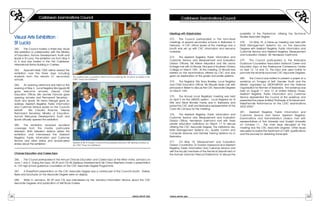
By Samuel Augustine
Marjorie Basden High School
Turks and Caicos Islands
Honey Bee Shopping Bag
By Jermaine Mclean
Mile Gully High School
Jamaica
Ackee
By Christina Hyatali
St Joseph’s Convent, Port of Spain
Trinidad and Tobago
Honey Bee Shopping Bag
By Stefani Dewar
Belair School
Jamaica
Coconuts
By Sabrina Jackson,
John Gray High School
Jamaica
Beach Vacation
By George Williams
Bridgeport High School
Jamaica
The Rum Shop
By Christopher Scott
Mannings School
Jamaica
The Rum Shop
By Garrett Campbell
Maud McLeod High Evening Institute
Jamaica
Textured Arrangement
By Clintray Hattiott
St George's College
Jamaica
Visual Arts Examaintions
Outstanding Pieces in the May/June 2005
17AANNNNUUAALL RREEPPOORRTT 22000055
Caribbean Examination Council
18 AANNNNUUAALL RREEPPOORRTT 22000055
Caribbean Examination CouncilCCaarriibbbbeeaann EExxaammiinnaattiioonnss CCoouunncciill CCaarriibbbbeeaann EExxaammiinnaattiioonnss CCoouunncciill
May/June Sitting
Caribbean Advanced Proficiency Examinations (CAPE)
ADMINISTRATION OF THE EXAMINATION
137. This year, the Council examined 43 Units in 27 subjects for the Caribbean Advanced Proficiency Examinations.
138. Candidate entries increased from 9 620 to 13 651 and subject Unit entries presented also increased from
30 829 to 43 983. The subjects with the largest entries were Caribbean Studies (4 481); Communication Studies
(5 055); Management of Business (Unit 1- 2 614, Unit 2 - 1 240); Pure Mathematics (Unit 1 - 2,325); and Sociology (Unit
1-2 065).
139. The performance in these subjects shows that over 80 percent of the candidates achieved Grades I to V.
PERFORMANCE OF CANDIDATES
140. Data on subject entries and candidates' performance are given in Appendix 3. A summary of the
candidates' performance in each Unit is given below.
Accounting Units 1 and 2
141. Seventy-eight percent of the candidates who sat the examination on Unit 1 in 2005 achieved Grades I to V,
a slight decline from the 80 percent achieving similar grades in 2004. Performance on Paper 01 was satisfactory,
while on Paper 02 candidates performed best in Module 2, where they were required to prepare financial statements
based on information given in the form of a 'mini-case'. In Unit 2, 77 percent of the candidates achieved Grades I
to V, candidates excelled in Module 1, Costing Principles.
142. Performance on the Internal Assessment components of both Units was of a high standard. The number of
private candidates writing the alternative paper was again very small.
Art and Design Units 1 and 2
143. There was significant improvement in the overall performance in Art and Design, with 100 percent of the
candidates achieving Grades I to III across both Units.
144. This year, candidates were better prepared for this examination. The highlight of the examination continued
to be the Creative Project. Candidates produced murals and sculpture gardens in schools. These have contributed
to a more aesthetically appealing learning and social environment.
Applied Mathematics
145. This was the first year of examination on the revised Applied Mathematics syllabus. Six candidates wrote Option
C: Discrete Mathematics, Probability and Distribution, and Particle Mechanics. All candidates achieved grades which
ranged from III to V in the 2005 examinations. Performance on the Internal Assessment was satisfactory.
Biology Units 1 and 2
146. Seventy-nine percent of the candidates who sat the 2005 Unit 1 Biology examination achieved Grades I -V
the same as in 2004. In Unit 2, 91 percent of the candidates achieved Grades I -V, compared with 87 percent in
2004. Candidates appeared not to have had adequate preparation for the questions assessing practical skills on
Paper 02. In the Internal Assessment, the application of theoretical knowledge to the analysis of original data
generated by experimentation was well demonstrated. Candidates’ drawing skills continue to be below the
expected standard. Also a clear understanding of the appropriate use and effectiveness of different types of
graphical representation was absent.
Caribbean Studies
147. Ninety-eight percent of the candidates achieved Grades I to V, the same level of achievement as in 2004.
Generally, candidates demonstrated satisfactory performance in all areas of the examination. Candidates
especially excelled on Module 3 (Investigating Human and Social Development in the Caribbean) which introduces
candidates to some of the major concepts and skills that should be mastered in conducting research. The main
areas of weakness among candidates were in geographical and geological concepts defining the Caribbean, the
impact of discrimination against women in the Caribbean, and how freedom of the press impacts on development
in the Caribbean.
Chemistry Units 1 and 2
148. In Unit 1, 66 percent of the candidates achieved Grades I to V in 2005, compared with 57 percent in 2004.
Candidates experienced difficulty in answering questions related to aromatic organic chemistry and demonstrated
an inadequate understanding of the terms 'empirical' and 'molecular formulae' and the principles of mass
spectrometry. However, they performed satisfactorily on questions assessing their understanding of the gas laws,
dynamic equilibrium and enthalpy.
149. In Unit 2, 79 percent of the candidates achieved Grades I to V in 2005, a slight increase over the 77 percent
achieving these grades in 2004. Candidates continued to experience difficulties with tasks that required the
application of knowledge. They performed poorly on questions assessing their understanding of behaviour of some
elements. Many, however, demonstrated mastery of the topics - Weak Acids and Solubility Product.
Communication Studies
150. The performance of candidates in the 2005 examination was generally good. Approximately 98 percent of
the candidates achieved Grades I to V. Although there was a significant improvement in Paper 01, the aural and
written comprehension presented difficulty for many candidates. Candidates' performance in the Paper 02 showed
a decline compared with the performance last year. However, the performance in Paper 03 (Internal Assessment),
showed some improvement. Performance by private candidates on the alternative to the Internal Assessment also
improved.
Computer Science Units 1 and 2
151. The number of candidates who achieved Grades I to V in Unit 1 increased to 98 percent in 2005 from 95
percent in 2004.
152. The percentage of candidates achieving Grades I to IV increased to 57 percent from 48 percent in 2004.
Candidates showed improved proficiency in answering questions on the Components of Computer Systems
module but failed to demonstrate mastery of some concepts in the Application of Computers module.
153. Eighty-three percent of the candidates who wrote the Unit 2 examination achieved Grades I to V, compared
with 79 percent in 2004. The majority of candidates showed improved proficiency in answering questions on the
Components of Computer Systems module.
154. The improvement in the Internal Assessment component which was noted last year was not sustained in
2005.
Economics Units 1 and 2
155. There was a significant improvement in the overall performance of candidates in Unit 1. Ninety-eight percent
of the candidates achieved Grades I to V compared with 91 percent in 2004. The significance of the improvement
was clearly seen in the performances on all the papers and modules. The only area on which candidates did not
perform well was on marginal principle and the relationship among different types of cost (Module 1).
19AANNNNUUAALL RREEPPOORRTT 22000055
Caribbean Examination CouncilCaribbean Examination Council
20 AANNNNUUAALL RREEPPOORRTT 22000055
CCaarriibbbbeeaann EExxaammiinnaattiioonnss CCoouunncciill CCaarriibbbbeeaann EExxaammiinnaattiioonnss CCoouunncciill
156. The overall performance of candidates in Unit 2 declined when compared with performance in 2004.
Ninety-one percent of the candidates achieved Grades I to V in 2005 compared with 96 percent in 2004. Weakest
performances occurred on Module 2 (Macroeconomic Policy Analysis) and Module 3 (Growth, Development and
International Economic Relations) on questions which required calculations.
157. For both Units, performance on the Internal Assessment component was satisfactory.
Electrical and Electronic Technology
158. The overall performance in this subject recorded a decline for the second consecutive year. Sixty-five
percent of the candidates who sat the examination achieved Grades I - V Compared with 68 percent in 2004. In
2005 no candidate achieved Grades I or II. Candidates performed well in circuit theory but they demonstrated
little competence in electronics and electrical energy systems.
Environmental Science Units 1 and 2
159. There was significant improvement in the level of performance in the examinations on both Units compared
with the performance in 2004.
160. In Unit 1, 98 percent of the candidates achieved Grades I to V, compared to 92 percent in 2004, with 11
percent achieving Grade I compared to two percent in 2004. Ninety-eight percent of the candidates also achieved
Grades I to V in Unit 2, compared with 76 percent in 2004, with 11 percent achieving Grade I compared with two
percent in 2004. Candidates performed well on tasks requiring knowledge of basic concepts and principles but
continued to demonstrate weaknesses in tasks requiring analysis and interpretation of data.
161. Generally, the performance in the Internal Assessment components of both Units was commendable.
Food and Nutrition Units 1 and 2
162. Candidate performance in Units 1 and 2 was satisfactory. There was significant improvement in the
performance of candidates in Unit 2 when compared with 2004, whereas performance in Unit 1 declined.
163. In Unit 1, 90 percent of candidates achieved Grades I to V, compared with 95 percent in 2004. In Unit 2, 99
percent of the candidates achieved Grades I to V, compared with 97 percent in 2004. In Unit 1, performance was
weakest on Module 3, Food Preparation and Service: Principles and Methods, and in Unit 2, performance was
weakest on Module 3, Food Preparation and Service: Large Quantity and Commercial.
164. Though candidates' performance was generally satisfactory, many responses on the essay paper merely
listed facts and principles and failed to demonstrate the required analytical skills.
165. Candidates generally performed well on the Internal Assessment component of the examination. Many of
the portfolios were well researched and well presented though weaknesses were apparent in the Product
Development component.
French Units 1 and 2
166. There was significant improvement in the performance of candidates across papers and modules in Unit 1.
Consequently, 92 percent of candidates achieved Grades I to V, compared with 71 percent in 2004. Improvements
were most significant on Paper 02 (Reading Comprehension) and Paper 03 (Literature).
167. In Unit 2, 90 percent achieved Grades I to V, down from the 100 percent who achieved similar grades in
2004. A below par performance on Paper 02 (Reading Comprehension) and Paper 03 (Literature) contributed most
to the decline in candidates' achievement levels.
168. There is still the need for candidates to be exposed to different aspects of the Francophone culture, an
exercise that will help them improve in their listening and speaking skills.
Geography Units 1 and 2
169. The number of candidates achieving Grades I to V in Unit 1 decreased by three percent (from 91 percent in
2004 to 88 percent in 2005). In both years, slightly less than one per cent of the candidates achieved Grade I.
170. There was some improvement in the overall performance in Unit 2. The number of candidates achieving
Grades I to V increased significantly, from 77 percent in 2004 to 91 percent in 2005. In both years, slightly less than
two percent of the candidates achieved Grade I.
171. In both Units, there was improvement in the level of competence demonstrated in map reading and tasks
requiring practical skills. Generally, the performance on the Internal Assessment components of both Units was
satisfactory.
Geometrical and Mechanical Engineering Drawing
172. The overall performance of candidates achieving Grades I to V in this examination (82 percent) compared
favourably with that of 2004 (80 percent). However, there were not as many candidates at the higher grade levels (I
to III) when compared with performance for 2004. In 2005, 20 percent of candidates achieved Grades I to III
compared with 27 percent in 2004. Performance on Paper 01 and Paper 03 declined, but there was an
improvement on Paper 02. There were slight improvements on Module 2 (Solid Geometry) and Module 3
(Mechanical Engineering Drawing) but a less than satisfactory performance on Module 1 (Plane Geometry).
History Units 1 and 2
173. The revised syllabus in CAPE History was offered for examination for the first time in 2005. Performance in Unit
1 and Unit 2 was satisfactory although there was a marginal decrease in the number of candidates achieving
acceptable grades in both Units.
174. In the Unit 1 examination, 86 percent of the candidates achieved Grades I to V, compared with 88 percent
in 2004. In Unit 2, 87 percent of the candidates achieved Grades I to V, compared with 90 percent in 2004.
175. Several candidates demonstrated poor analytical and essay-writing skills and the lack of coverage of some
topics was clearly evident. Candidates demonstrated some improvement in their research skills, and there were
several well-researched and well-written papers submitted for the Internal Assessment.
Information Technology
176. Ninety-two percent of candidates who sat the examination in 2005 achieved Grades I -V, compared to 86
percent in 2004. No candidate achieved Grade I in 2005. Candidates performed well in areas where they need to
apply Knowledge. Candidates' performances on areas where there was a need to apply the higher order skills such
as Application and Analysis, Synthesis and Evaluation, need improvement. Many candidates were unable to apply
facts, concepts, principles and procedures to familiar situations, make reasoned judgments and recommendations
or, to justify and apply appropriate techniques or tools to solve problems.
Law Units 1 and 2
177. Seventy-two percent of the candidates achieved Grades I to V in both Units 1 and 2, a substantial
improvement over the 63 and 58 percent achieving similar grades in Units 1 and 2 respectively in 2004. Candidates
performed fairly well in Paper 01 and Paper 03, but demonstrated weaknesses in writing extended essays required in
Paper 02. In spite of the general improvement, too many candidates failed to demonstrate accurate
understanding of fundamental legal principles.
21AANNNNUUAALL RREEPPOORRTT 22000055
Caribbean Examination CouncilCaribbean Examination Council
22 AANNNNUUAALL RREEPPOORRTT 22000055
CCaarriibbbbeeaann EExxaammiinnaattiioonnss CCoouunncciill CCaarriibbbbeeaann EExxaammiinnaattiioonnss CCoouunncciill
Literatures in English Units 1 and 2
178. In Unit 1, 92 percent of the candidates achieved Grades I to V. This was similar to the 2004 examination when
93 percent achieved similar grades. Candidates continued to perform best on Module 1 (Drama). While there was
a slight improvement in candidates' performance on Module 3 (Prose Fiction), this was not evident in Module 2
(Poetry), which showed a decline.
179. Ninety-five percent of candidates achieved Grades I to V in Unit 2, a slight decline from the 97 percent who
achieved these grades in 2004. However, a higher percentage of candidates (33 per cent) achieved Grades I to III
in 2005 than in 2004, when 27 percent achieved similar grades. A significant improvement in this year's performance
occurred in Module 1(Drama) but this was counterbalanced by slight decline in performance on Module 2 (Poetry)
and Module 3 (Prose Fiction).
Management of Business Units 1 and 2
180. The performance of candidates in Unit 1 was consistent with the performance in 2004. Eighty-three percent
of the candidates achieved Grades I to V, compared with 84 percent in 2004. There was a significant improvement
in the performance of candidates in Module 3, Business Finance and Accounting.
181. In Unit 2, 95 percent of the candidates achieved Grades l to V compared with 97 percent in 2004. There
was a significant decline in the performance in Paper 02, (the essay paper). This decline was evident in the overall
performance in Module 3, Small Business Management.
Physics Units 1 and Unit 2
182. The overall performance in Unit 1 in 2005 was similar to the performance in 2004. In 2005, 85 percent of the
candidates achieved Grades I to V, compared to 84 percent in 2004. However, the percentage of candidates
achieving Grades I to II increased to 65 percent from 40 percent in 2004.
183. Candidates demonstrated understanding of the concepts that were examined in Module 1 (Mechanics) but
demonstrated weaknesses in Module 3 (Thermal and Mechanical Properties of Matter).
184. Ninety-four percent of the candidates who wrote the Unit 2 examination achieved Grades I to V, compared
with 84 percent in 2004. Candidates demonstrated mastery of the concepts in Module 2 (Electronics), but their
performance was weaker in the application of concepts in Module 3 (Atomic and Nuclear Physics). As in 2004,
questions assessing practical skills continued to be challenging for many candidates.
185. For both Units performance on the Internal Assessment was satisfactory.
Pure Mathematics Units 1 and 2
186. The revised syllabus in Pure Mathematics (formerly Mathematics) was examined for the first time in 2005. In
Unit 1, there was some improvement in performance, with 67 percent of the candidates achieving Grades I to V,
compared to 62 percent in 2004. Sixteen percent of the candidates achieved Grade I compared to 12 percent in
2004.
187. In Unit 2, there was a decline in the level of performance, with 76 percent achieving Grades I to V, compared
to 87 percent in 2004. Sixteen percent of the candidates achieved Grade I compared to 20 percent in 2004.
Candidates demonstrated a satisfactory level of competence in the new areas such as Matrices. They continued to
demonstrate strengths in routine algorithmic processes, especially in differentiation and integration but exhibited
weaknesses in algebraic manipulation, and analytic or deductive competencies.
188. Generally, the performance on the Internal Assessments for both Units was of a high standard.
Sociology Units 1 and 2
189. Ninety-seven percent of the candidates achieved Grades I to V in Unit 1, a significant improvement over the
85 percent achieving similar grades in 2004. In Unit 2, 99 percent of the candidates achieved Grades I to V,
compared with 93 percent in 2004. Evidence of sound research skills being applied in the Internal Assessment
component of both Units was a feature of this year's performance.
Spanish Units 1 and 2
190. In Unit 1, there was an overall improvement in the candidates' performance in the 2005 examination
compared with that of 2004. Approximately 95 percent of the candidates achieved Grades I to V in the
examination this year. There was an improvement in the external examination components of the examination. In
particular, in Paper 1 where the aural skills were tested, candidates demonstrated a high level of comprehension of
authentic material. Candidates also performed well in the oral component of Paper 04 (Internal Assessment), where
their communicative ability was tested. However, there was still evidence of format and structural difficulties in the
written component of Paper 04.
191. In Unit 2, there was a similar performance in the 2005 examination, compared to the performance in 2004.
Approximately 97 percent of the candidates achieved Grades I to V in the examination this year. Candidates
performed equally well in Papers 02, 03 and 04 on both the externally and internally assessed components. However,
there was a decline in the performance in Paper 01.While many candidates experienced challenges relating to the
topics in this Unit, they performed well in the oral component of the Internal Assessment, Paper 04, where the
communicative skills were tested.
Statistical Analysis
192. There was a significant improvement in the overall performance in Statistical Analysis in 2005 over that of
2004. In 2005, 84 percent of the candidates achieved Grades I to V, compared with 67 percent in 2004.
193. Generally, candidates demonstrated satisfactory performance in all areas of the examination. However,
they excelled on Module 1 (Collecting and Describing Data) and Module 2 (Managing Uncertainty). The
performance on these modules was mainly responsible for the overall improvement.
194. As in 2004, questions assessing the topics, regression and hypothesis testing, in Module 3 (Analysing and
Interpreting Data) continued to be challenging for candidates.
195. Performance in the Internal Assessment was of a high standard.
23AANNNNUUAALL RREEPPOORRTT 22000055
Caribbean Examination CouncilCaribbean Examination Council
24 AANNNNUUAALL RREEPPOORRTT 22000055
CCaarriibbbbeeaann EExxaammiinnaattiioonnss CCoouunncciill CCaarriibbbbeeaann EExxaammiinnaattiioonnss CCoouunncciill
Syllabus Development Unit Activities
REVISED SYLLABUSES
Geography
196. A revised Geography syllabus was issued to schools in May 2005 for teaching from September 2005 and
first examination in May/June 2007.The syllabus was restructured into four Sections, namely, Map Work and
Field Study, Natural Systems, Man-Made Systems and Man-Environment Systems.
Religious Education
197. A revised Religious Education syllabus was issued to schools in May 2005 for teaching from September 2005
and first examination in May/June 2007. A section on "Caribbean Indigenous Religions" was included in the
Core of the syllabus and the School-Based Assessment component was revised to allow students to do their
research project on any religion in the syllabus. Work has started on the expansion of the syllabus to include
the options Hinduism, Islam and Judaism.
Modern Languages
198. A revised Modern Languages syllabus was issued to schools in May 2005 for teaching from September 2005
and first examination in May/June 2007. Paper 03, the oral component of the examination, was revised. For
Section 1, candidates are now required to respond orally to situations and instructions given in English; in
Section 2 candidates are required to read aloud; and in Section 3, candidates are required to respond to
four questions on four topics.
Agricultural Science
199. A Review Committee meeting held in September 2005 recommended that the current syllabuses for the
Single Award and Double Award be restructured into one syllabus comprising five Sections. The Committee
further recommended that candidates presented for the Single Award should complete the first three
Sections and candidates presented for the Double Award should complete all five Sections. The draft revised
syllabus will be circulated to teachers and subject specialists for comment. Subsequently, a Panel meeting
to complete the revision of the syllabus will be held in February 2006 and it is anticipated that the revised
syllabus will be issued to schools in May 2006, for teaching from September 2006 and examination from
May/June 2008.
Principles of Business and Principles of Accounts
200. A Review Committee meeting held in September 2005 recommended that the syllabuses should
emphasize the nurturing of students' entrepreneurial abilities to enable them to participate fully in the local,
regional and global economy. To this end, the SBA Guidelines for both syllabuses were revised to focus on
the requirements for establishing and preparing financial statements for a new business enterprise. The draft
revised syllabus will be circulated to teachers and subject specialists for comment. Subsequently a Panel
meeting to complete the revision of the syllabuses will be held in January 2006 and it is anticipated that the
revised syllabuses will be issued to schools in May 2006, for teaching from September 2006 and
examination from May/June 2008.
Teacher Training Workshops
201. Regional Orientation Workshops were
held in May, October and November 2005, for
teachers of (a) the newly-developed CSEC
Economics syllabus; (b) the revised CSEC Office
Administration syllabus that replaces the Office
Procedures syllabus; (c) the revised Geography
syllabus; (d) the revised Modern Languages
syllabus; and (e) the revised Religious Education
syllabus. The workshops were held in five
territories for teachers across the region. The Ministries of Education in the territories with the largest candidate
populations were invited to co-host the workshops by providing a suitable venue and meals for local participants. A
total of 747 participants from 16 Participating Territories attended the workshops in the five territories. Ministry of
Education officials who attended the workshops gave the assurance that follow-up workshops would be conducted
on an on-going basis using persons who were trained at these workshops.
CARIBBEAN ADVANCED PROFICIENCY EXAMINATION (CAPE)
Revised Syllabuses
Geometrical and Mechanical Engineering Drawing (GMED)
202. A revised Geometrical and Mechanical Engineering Drawing (GMED) syllabus was issued to schools in May
2005 for teaching from September 2005 and first examination in May/June 2006. A new Unit 2 was developed with
the main focus on the drawing and designing of engineering components. Unit 1 continues to focus on solving
problems pertaining to Plane and Solid Geometry.
Electrical and Electronic Technology
203. A revised Electrical and Electronic Technology syllabus was issued to schools in May 2005 for teaching from
September 2005 and first examination in May/June 2006. A new Unit 2, titled "Energy Converters and Logic Circuits"
was developed and has a heavy weighting on Electronic Technology. Unit 1 was titled "Electrical Theory and
Communications", and this Unit has a heavy weighting on Electrical Technology.
Literatures in English
204. A revised Literatures in English syllabus was issued to schools in May 2005 for teaching from September 2005
and first examination in May/June 2006. The revised syllabus reduces the demands of the Internal Assessment
component by replacing the requirement for a portfolio comprising three pieces of work, one from each of the
Modules, to an interpretation of some aspects of a prescribed play, poem or an extract from prose fiction. In
addition, the time allocated for Paper 01 was increased from one hour 15 minutes to one hour 30 minutes.
CARIBBEAN SECONDARY EDUCATION CERTIFICATE (CSEC)
Teachers involved in group work
during the Physical Education
and Sport orientation workshop
in Trinidad and Tobago
25AANNNNUUAALL RREEPPOORRTT 22000055
Caribbean Examination CouncilCaribbean Examination Council
26 AANNNNUUAALL RREEPPOORRTT 22000055
CCaarriibbbbeeaann EExxaammiinnaattiioonnss CCoouunncciill CCaarriibbbbeeaann EExxaammiinnaattiioonnss CCoouunncciill
210. In light of the continuing decline of candidates
for the Basic Proficiency examination and the
changing demands resulting from universal secondary
education, a Special Committee meeting was held on
April 12, 2005 to review the findings of several studies
and consultations and to make recommendations on
new programmes and certification that would meet a
variety of needs.
211. Two important outcomes of that meeting were
the recommendations for the discontinuation of the
Basic Proficiency level examinations and for CXC to
develop a secondary level programme with a new
curriculum and set of examinations. This new
programme would focus on the certification of the core
competencies that the majority of students at
secondary school would be expected to attain both for
the work force and for further education and training.
212. A decision was taken by Council to discontinue
the Basic Proficiency examinations in all subjects
except in English A, Mathematics and Social Studies
after 2006 and that the new examinations would be
available in 2007.
213. The Council requested that education officials
from across the region be consulted in order
to determine the best approach to be adopted
in implementing a proposed new education
programme. A meeting of Chief Education Officers
was, therefore, held on May 30, 2005 at which it was
decided that
a) a regional core should be developed;
b) territories would identify electives;
c) a schedule for syllabus development would be
prepared;
d) appropriate types of assessment would be
developed.
214. The meeting further agreed that the
examinations should comprise continuous assessment
and an extensive multiple choice examination set by
CXC.
215. Work has started on the development of
syllabuses in the five core subjects. Panel meetings were
held in September and sub-committees of the Panels
met in October to finalise the syllabuses which should be
in schools in September 2006 for first examinations in
2007.
216. SUBSEC at its meeting in October agreed that
the certification for this new programme will be based
on performance on the five core subjects and the
electives.
Discontinuation of Basic Proficiency and Implementation of a New Examination
CCaarriibbbbeeaann VVooccaattiioonnaall QQuuaalliiffiiccaattiioonnss ((CCVVQQ))
217. The Caribbean Examinations Council (CXC) has been participating in regional meetings dealing with Technical and
Vocational Education and Training (TVET). At these meetings the Caribbean Association of National Training Agencies (CANTA)
comprising representatives of National Training Agencies responsible for TVET, CXC and the CARICOM Secretariat discussed the
award of a Caribbean Vocational Qualification by CXC.
218. The award will be based on standards developed by CANTA and persons from industry. These standards approved by
the Council for Human and Social Development (COHSOD) formed the basis for the development of National Vocational
Qualification programmes at different levels. Many territories have been using programmes already developed by HEART Trust/NTA.
219. The NTAs agreed that added value would be gained through the award of a CVQ by CXC. In preparation for this, two
members of CXC staff went on an attachment for three days to the HEART Trust/NTA to learn how the NVQ programmes are
implemented and assessed in schools in Jamaica.
Mrs Paula Daniel, Chief Education Officer (Retired), Trinidad and Tobago
addressing the Basic Meeting. On her right is Mrs Adelle Browne CEO, Jamaica,
Mr Anderson Marshall (FC) (left) Dr Yolande Wright, SAR (MED), Mr Baldwin
Hercules SAR (EAD)
Teacher Training Workshops
205. Regional Orientation workshops were held in May 2005 for teachers of newly-revised syllabuses in French,
Spanish and Literatures in English. The workshops were held in five territories for teachers across the region. The
Ministries of Education in the territories with the largest candidate populations were invited to co-host the
workshops by providing a suitable venue and meals for local participants. A total of 175 participants attended the
workshops in the five territories. Ministry of Education officials who attended the workshop gave the assurance that
follow up workshops would be conducted on an on-going basis using persons who were trained at these workshops.
Resource Materials
206. A Reader for CAPE History was developed and is now available from CXC and partner bookstores throughout
the region.
AApppplliiccaattiioonn ooff TTeecchhnnoollooggyy ttoo tthhee EExxaammiinnaattiioonn PPrroocceessss
Electronic Registration
207. During 2005, the Electronic Registration application was implemented on-site in the four territories Guyana,
Jamaica, Grenada and Saba. The application and user manuals were made available to all territories via
download from the CXC web site. CDs and manuals were dispatched to territories without access to the
web. St. Maarten was expected to participate in the implementation, but requested deferral until 2006.
Examination Processing System
208. The new Examination Processing System (EPS) was implemented for the January 2005 and May/June CSEC
examinations. For the first time, the users in the Examination Administration Division and the Measurement
and Evaluation Division were able to run programs, queries and reports from their desktop computers using
the on-line facilities of the system. The January 2005 results were delivered on schedule.
209. Some challenges were encountered during the implementation of the EPS for the larger and more complex
June 2005 CSEC and CAPE examinations. Interruptions to the marking process and some technical
problems resulted in the delay in the delivery of some Grading reports and ultimately in the late delivery of
both the CAPE and CSEC results. An internal review of the new EPS has been completed to identify,
document and resolve user concerns. The EPS consultants met with the Registrar and Heads of Division on
October 10, 2005 to complete a plan for the resolution of the areas identified during the internal review
and to develop a plan for completion of modifications in time for the 2006 examinations.
(contd.)
27AANNNNUUAALL RREEPPOORRTT 22000055
Caribbean Examination CouncilCaribbean Examination Council
28 AANNNNUUAALL RREEPPOORRTT 22000055
CCaarriibbbbeeaann EExxaammiinnaattiioonnss CCoouunncciill CCaarriibbbbeeaann EExxaammiinnaattiioonnss CCoouunncciill
CXC Associate Degrees
227. The CXC Associate Degrees
were approved at the 35th Meeting of
Council in Antigua and Barbuda on
December 2. The Council is offering
Associate Degrees in nine
areas- Business Studies, Computer
Science, Environmental Science,
General Studies, Humanities,
Mathematics, Modern Languages,
Natural Sciences and Technical Studies. A minimum of seven CAPE Units including Caribbean Studies and Communication
Studies must be completed. Candidates must complete the Units within a five-year period and must achieve Grades I to V
in order to qualify for the Associate Degree.
228. The Associate Degree became effective from the 2005 CAPE examinations and the first degrees will be awarded
in 2006.
229. In preparation for the launch of the programme, several promotional materials were produced. These included a
poster, flyer, brochure and a handbook. The handbook was also posted on the Council's website.
230. Handbooks, brochures, posters and flyers were sent to Local Registrars. Additionally, handbooks were sent to Chief
Education Officers and principals of all institutions offering CAPE.
231. The CXC Associate Degrees Programme was launched in Barbados on Monday March 14 with a Press Conference
at the Savannah Hotel. The speakers at the launch were Professor, the Honourable Kenneth Hall, OJ, CXC Chairman; Mrs
Atheline Haynes, Permanent Secretary, Ministry of Education, Youth Affairs and Sport; Mrs Wendy Griffith-Watson, Chief
Education Officer, Barbados, Mrs Coreen Kennedy, Principal of Queen's College, Barbados and Dr Lucy Steward, CXC
Registrar.
232. Belize launched the Associate Degrees with an official ceremony on March 17th. The Honourable Francis Fonseca,
Minister of Education, Youth and Sports, Ms Maude Hyde, Chief Education Officer, Dr Lucy Steward, CXC Registrar and Mr.
Anthony Sabal, Dean of Stann Creek Junior College were among those who spoke at the ceremony.
233. The launch was preceded by meetings with various stakeholders including principals, of the colleges, the
lecturers from the university and Ministry of Education officials.
Launch of Associate Degree in St Kitts and Nevis :
L to R- Dr Hermia Morton-Anthony, Principal of
the Clarence Fitzroy Bryant College, Dr Lucy
Steward, CXC Registrar, Honourable Sam Condor,
Minister of Education and Deputy Prime Minister
and Mr Osmond Petty, Permanent Secretary
CCaarriibbbbeeaann VVooccaattiioonnaall QQuuaalliiffiiccaattiioonnss ((CCVVQQ))
220. Information on the Level 1 programmes was sent to all territories. One territory has initiated discussions for CXC to award
the CVQ. The TVET programmes in that territory were developed on standards already approved by COHSOD. The NTA and the
Ministry of Education will take responsibility for the orientation of teachers, training of assessors, preparation of assessment
procedures, work attachments for students, and assessment in schools and the work place. The Council's role will be mainly to
assure quality by reviewing various procedures, standards of practice, providing recommendations and verifying implementation
of agreed procedures by sampling, reviewing documents and attending review meetings with internal and external verifiers
appointed by the Ministry of Education and the NTA.
221. The Council looks forward to expanding its work in this area in 2006.
RReeggiissttrraattiioonn ooff CCXXCC TTrraaddeemmaarrkkss
222. In order to protect its name and those of its products and services, CXC registered several trademarks in 2004
and 2005 in Barbados, Jamaica, Trinidad and Tobago and the United Kingdom. By licensing the trademarks, CXC
asserts ownership over its name and any other mark, logo, seal, design, symbol, internet domain name or any
combination of these, which have come to be associated with CXC, specifically the following listed below:
(i) Caribbean Examinations Council
(ii) Caribbean Secondary Education Certificate
(iii) Caribbean Advanced Proficiency Examination
(iv) CXC
(v) CSEC
(vi) CAPE
(vii) The CXC ""loggo""
223. The purpose of trademark registration is threefold:
(i) to protect consumers from confusion regarding the source or origin of products and/or services;
(ii) to ensure that all products and services bearing CXC trademarks are of a specific type and quality;
(iii) to protect the commercial interests of the Council by ensuring that only authorised products and services
bear the Council's trademarks.
224. CXC has notified current and potential users of its trademarks of the official registration of these marks and
that unauthorised use is expressly forbidden. Those informed include publishers, other producers and distributors of
materials, educational service providers, and the public through the "Examiner" magazine and CXC Website.
225. It is proposed that CXC grant licenses to use CXC trademarks primarily on educational products and
services, specifically areas such as:
(i) Licensing of publications for use with the CSEC, CAPE and other curricula.
(ii) Licensing developmental initiatives designed to support and to enhance both teaching and learning
processes.
(iii) Licensing of electronic resources (CD-ROMS) or on-line services which support teaching and learning
processes.
(iv) Licensing of the delivery of services by private institutes and of specialised programmes designed to meet
the needs of specific target groups including mature, work-based and distance learners.
226. In order to maintain protection under trademark law, CXC is required to license and monitor all uses of its
trademarks.
29AANNNNUUAALL RREEPPOORRTT 22000055
Caribbean Examination CouncilCaribbean Examination Council
30 AANNNNUUAALL RREEPPOORRTT 22000055
CCaarriibbbbeeaann EExxaammiinnaattiioonnss CCoouunncciill CCaarriibbbbeeaann EExxaammiinnaattiioonnss CCoouunncciill
REGISTRAR'S VISITS AND MEETINGS
JANUARY
237. Trinidad and Tobago (January 5 to 8) - to discuss
CAPE and the CXC Associate Degree with the
Permanent Secretary, Ministry of Science, Technology
and Tertiary Education and officials at that Ministry.
238. Guyana (January 12) - meeting of the World
Summit on the Information Society (WSIS).
239. Paris, France (January 31 to February 3) -
Executive Committee meeting of the International
Association for Educational Assessment (IAEA).
FEBRUARY
240. Trinidad and Tobago (February 17 to 23) - to
meet with Ministry of Education officials to discuss CAPE
and attended the inauguration ceremony of the Vice
Chancellor at the University of the West Indies, St
Augustine Campus.
MARCH
241. Jamaica (March 9) - meeting of a Task Force to
consider the establishment of a Regional Accreditation
Agency.
242. Belize (March 15 to 20) - launch of CXC
Associate Degrees. While in Belize, the
Registrar met with Honourable Francis
Fonseca, Minister of Education, Culture,
Youth and Sports, Principals and Ministry
officials.
APRIL
243. Trinidad and Tobago (April 4 to 6)
- meeting with Curriculum Officers at the
Ministry of Education, to discuss CXC
Associate Degrees and CAPE.
244. St Vincent and the Grenadines - a Conference
on Education hosted by the Ministry of Education, Youth
Affairs and Sport in. The Registrar was one of the guest
speakers at the conference opening ceremony.
245. St Kitts and Nevis (April 17 to 20) - to participate
in the launch of the CXC Associate Degrees. She
participated in a Press Conference in St Kitts and in a
ceremony in Nevis to launch the Associate Degree on
the respective islands.
246. Jamaica (April 21 to 23) - a meeting hosted by
the Chairman and held at the Office of the Principal at
the University of the West Indies, Mona. The purpose of
the meeting was to discuss the introduction of National
Vocation Qualifications (NVQ) programmes in secondary
schools and the possible role for CXC in certifying the
NVQs. Representatives of HEART/NTA, Jamaica, National
Training Agency, Trinidad and Tobago, Principal of
Montserrat Community College and a representative
from the CARICOM Secretariat attended the meeting.
247. Trinidad and Tobago (April 27) - on the invitation
of the Minister of Education in Trinidad and Tobago, to
attend the launch of the Physical Education and Sport
Syllabus.
Dr Lucy Steward, CXC Registrar is flanked
by Nigerian Minister of Education, Mrs
Chinwe Nora Obaji (R) and Minister of
State for Education, Ms Halima Tayo
Alao(L)
234. St Kitts and Nevis launched the Associate Degrees with a Press Conference on April 20th. Honourable Sam Condor,
Minister of Education and Deputy Prime Minister, Mr Osmond Petty, Permanent Secretary and Deputy Chairman of CXC, Dr
Lucy Steward, CXC Registrar and Dr Hermia Morton-Anthony, Principal of the Clarence Fitzroy Bryant College spoke at the
press conference.
235. Jamaica launched the Associate Degrees on Friday May 27 with a ceremony at the Hilton Hotel in Kingston.
Honourable Maxine Henry-Wilson, Minister of Education, Professor the Honourable Kenneth Hall, OJ, CXC Chairman and Dr
Lucy Steward, CXC Registrar. Dr Ethley London, Chief Executive Officer of the University Council of Jamaica and Professor
Elsa Leo-Rhyne spoke on that occasion.
236. Along with schools, several private educational institutions have welcomed the Associate Degrees. The private
institutions have taken the opportunity to offer the Associate Degrees to out-of-school candidates in some
Participating Territories.
Professor The Honourable Kenneth Hall, OJ, Chairman of CXC presents a copy of the Associate Degree Handbook to
Mrs Atheline Haynes, Permanent Secretary, Ministry of Education, Barbados. Registrar, Dr Lucy Steward is at center.
31AANNNNUUAALL RREEPPOORRTT 22000055
Caribbean Examination CouncilCaribbean Examination Council
32 AANNNNUUAALL RREEPPOORRTT 22000055
CCaarriibbbbeeaann EExxaammiinnaattiioonnss CCoouunncciill CCaarriibbbbeeaann EExxaammiinnaattiioonnss CCoouunncciill
Public Relations and Outreach
Activities in 2005
Launch of Study Guides
264. The CXC Self-Studies Guides were launched in Trinidad and Tobago on February 11 to coincide with the
launch of the Caribbean Association of Distance and Open Learning (CARADOL).
265. An article on the Self-Study Guides was printed in the Trinidad and Tobago Ministry of Education special
newspaper supplement in the Trinidad Express newspaper on March 15.
Press Releases
266. A Press Release on the results of the January CSEC
examination was issued to the media on February 25th.
267. A Press Release was distributed to the regional
media on the occasion of the visit of the Head of COL, Sir
John Daniel.
268. The Council issued a press release on the visit of a
delegation from Botswana Ministry of Education in February.
269. A press release on the launch of the CXC Associate
Degree was issued in March.
270. A press release on the Visual Arts Exhibition hosted in
St Lucia was issued in May.
271. Press Releases were issued in August to announce
the release of the May/June CSEC and CAPE examinations.
Stemming from the CAPE press release, BBC Caribbean
published a story about CAPE replacing the British-based
advanced examinations on its website.
Mrs Blondell Franks(R), St Kitts and Nevis Local Registrar, Dr Desmond
Broomes, CXC Consultant, Ms Idamay Denny, Barbados Local Registrar and
Anthony Alleyne, AR Examinations Division CXC at the Local Registrars’
Meeting.
Sir John Daniel (L), Head of the Commonwealth of Learning listens
attentively as Dr Desmond Broomes(C), CXC Consultant makes a point.
AR MED Henderson Eastmond is at right.
Members of the delegation from the Ministry of Education in
Botswana pose for a photograph at CXC Headquarters.
MAY
248. Guyana (May 2 to 3) - with the Senior Manager
to attend the Retreat held for CARICOM Ministers of
Education. The Registrar presented a paper outlining the
status of the Associate Degree Programme and report-
ed on the meeting which was held to discuss Universal
Secondary Education.
249. Jamaica (May 23 to 27) - held meetings with
stakeholders about the CXC Associate Degrees,to
attend the launch of the Associate Degrees and also to
attend a function for Mrs Marguerite Bowie, former
Permanent Secretary and Deputy Chairman of the
Council.
JUNE
250. Guyana (June 9 to 10) - with MED Coordinator Dr
Harewood for meetings to discuss the Associate Degree
with Ministry of Education and University of Guyana
officials.
JULY
251. Guyana, Jamaica and Trinidad and Tobago - to
visit marking centres.
SEPTEMBER
252. Nigeria (September 4 to 9) - with the Pro Registrar
to attend the International Association for Educational
Assessment (IAEA) Conference.
253. Trinidad and Tobago (September 28 and 30) -
with the SAR (MED) and MED Officers Fitzroy Marcus and
Henderson Eastmond for meeting with officials of the
Ministry of Education to discuss CXC's assistance in
awarding a Caribbean Vocational Qualification.
254. The Registrar, SAR (EAD), SAR (MED) and MED
Officer Henderson Eastmond attended a review
meeting of the Secondary Entrance Assessment
Examination with officials and chaired by the Chief
Education Officer.
NOVEMBER
255. The Registrar attended the Association of
Caribbean Tertiary Institutions (ACTI) workshop and
General Meeting in Guyana on November 17 and 18.
256. St Kitts/Nevis (November 23 to 25) - attended the
17th OECS Ministers of Education meeting.
Media appearances
257. The Pro-Registrar was a guest on current
affairs programme Beyond the Headlines on RJR
in Jamaica in January to discuss candidates'
performance.
258. The Registrar and Sir John Daniel,
President of the Commonwealth of Learning
(COL) were guests on Mornin' Barbados on
February 8 to discuss the Self Study Guides and
the work of COL.
259. The Registrar was a guest on Beyond The
Headlines on RJR Jamaica on March 3 to discuss
CXC Associate Degrees.
260. The Registrar was a guest on Klass Radio
station's (Jamaica) First Edition on March 14 via
telephone link-up. The programme discussed
issues such as students' performance and the
launch of CXC Associate Degrees.
261. The Registrar and Ms Maude Hyde,
Belize's Chief Education Officer were guests on a
one-hour radio talk show in Belize on March 16th.
The topics discussed included the CXC Associate
Degrees and performance of candidates in CXC
examinations.
262. BWIA Caribbean Beat magazine
published an article on the Regional Top
Awardees in its April 2005 issue entitled CXC
Champs. The magazine also published the
winning short story.
263. The 2004 Annual Reports were distributed
to CXC stakeholders. For the first time, the Report
was posted on the Council's website.
Public Relations
and Outreach
Activities in 2005
33AANNNNUUAALL RREEPPOORRTT 22000055
Caribbean Examination CouncilCaribbean Examination Council
34 AANNNNUUAALL RREEPPOORRTT 22000055
CCaarriibbbbeeaann EExxaammiinnaattiioonnss CCoouunncciill CCaarriibbbbeeaann EExxaammiinnaattiioonnss CCoouunncciill
Visual Arts Exhibition -
St Lucia
282. The Council hosted a three-day Visual
Arts exhibition in collaboration with the Ministry
of Education, Human Development, Youth and
Sports in St Lucia. The exhibition ran from May 4
to 6 and was hosted in the First Caribbean
International Bank's Building in Castries.
283. Approximately 1000 visitors viewed the
exhibition over the three days including
students from the island's 21 secondary
schools.
284. An opening ceremony was held on the
evening of May 3. Local Registrar Mrs Agusta Ifill
gave welcome remarks, Deputy Chief
Education Officer, Mrs Leonise Francois gave
opening remarks and Permanent Secretary -
Youth and Sports, Mr Henry Mangal gave an
address. Assistant Registrar, Public Information
and Customer Service spoke on the Council's
behalf. Mrs Claudia Roache, Deputy
Permanent Secretary, Ministry of Education,
Human Resources Development, Youth and
Sports officially opened the exhibition.
285. The exhibition received excellent
coverage from the media, particularly
television. Both television stations visited the
exhibition and interviewed the Assistant
Registrar, Public Information and Customer
Service and other visitors and broadcasted
stories about the exhibition.
Choices Education and Career Expo
286. The Council participated in the Annual Choices Education and Career Expo at the Hilton Hotel, Jamaica on
June 1 and 2. During the Expo, AR (PI and CS) AR (Syllabus Development) Ms Cheryl Stephens made a presentation
to 120 high school guidance counsellors on the CXC Associate Degree Programme.
287. A PowerPoint presentation on the CXC Associate Degree was a central part of the Council's booth. Posters,
flyers and brochures on the Associate Degree were on display.
288. While in Jamaica, AR (PI and CS) was interviewed by the Jamaica Information Service about the CXC
Associate Degrees and publication of Self-Study Guides.
Students of the St Joseph's Convent St Lucia playing steel pan at the opening ceremony of
the CSEC Visual Arts Exhibition
Two students from a secondary school in St Lucia admiring the Art pieces on display at the
CSEC Visual Arts Exhibition
Meetings with Stakeholders
272. The Council participated in the form-level
meetings of several secondary schools in Barbados in
February. A CXC officer spoke at the meetings and a
booth was set up with CXC information and resource
materials.
273. The Assistant Registrar, Public Information and
Customer Service and Measurement and Evaluation
Division Officers, Ms Arlene Kirkpatrick and Mrs Leona
Emtage met with Dr Woods, Principal of Southern Ontario
College on March 10th. At the meeting, Dr Woods was
briefed on the examinations offered by CXC and was
given an explanation of the grade and profile systems.
274. The Registrar, Mrs Nora Bradley, Local Registrar
and Chief Education Officer, Ms Maude Hyde met with
principals in Belize to discuss the CXC Associate Degrees
on March 16th.
275. The Annual Local Registrars' meeting was held
on April 5 via the UWIDITE system. Local Registrar for St
Kitts and Nevis Blondel Franks was in Barbados and
joined the CXC staff and Barbados representative at the
Cave Hill Campus for the meeting.
276. The Assistant Registrar, Public Information and
Customer Service and Measurement and Evaluation
Division Officer, Henderson Eastmond met with three
private education institutions on March 17 to discuss
offering the CXC Associate Degree. The institutions are,
MJM Management Systems Inc, Quality Control and
Computer Services and Genesis Training Systems Inc.in
Barbados.
277. On May 18, Measurement and Evaluation
Division Coordinator, Dr Gordon Harewood and Assistant
Registrar, Public Information and Customer Service met
with the faculty members of the Electrical Department of
the Samuel Jackman Prescod Polytechnic to discuss the
possibility of the Polytechnic offering the Technical
Studies Associate Degree.
278. On May 18, a follow-up meeting was held with
MJM Management Systems Inc on the Associate
Degrees with Assistant Registrar, Public Information and
Customer Service and Assistant Registrar, Measurement
and Evaluation Division, Mr Henderson Eastmond.
279. The Council participated in the Barbados
Guidance Counsellors' Association National Career and
Education Expo at the Sherbourne Conference Centre
on April 13, 14 and 15. The Expo was used mainly to
promote the recently-launched CXC Associate Degrees.
280. The Council was invited to present a paper at a
workshop on "Images of Self: Gender, Youth and the
Media" organised by UNDP/UNIFEM and the National
Organisation for Women of Barbados. The workshop was
held on August 11 and 12 at United Nations House.
Assistant Registrar, Public Information and Customer
Service represented the Council at the workshop and
presented the paper entitled "Portrayals of Achievement:
Male/Female Performance on the CESC examinations
2002-2004."
281. Assistant Registrar, Public Information and
Customer Service and Senior Assistant Registrar,
Examinations and Administration Division met with
representatives of York University and Guelph University
on October 11. The main issue discussed at the
meeting was the CXC Associate Degrees. Other issues
discussed included the treatment of CAPE qualifications
and the process for obtaining transcripts.
35AANNNNUUAALL RREEPPOORRTT 22000055
Caribbean Examination CouncilCaribbean Examination Council
36 AANNNNUUAALL RREEPPOORRTT 22000055
CCaarriibbbbeeaann EExxaammiinnaattiioonnss CCoouunncciill CCaarriibbbbeeaann EExxaammiinnaattiioonnss CCoouunncciill
NNeeww AAppppooiinnttmmeennttss
HHeeaaddqquuaarrtteerrss
Name Post Effective Date
Mrs Anjanette Forde-Hinds Clerk/Typist (Personnel) March 14, 2005
Mrs Dennis O'Neale Clerk/Typist (Secretariat and Office Management) March 14, 2005
Mr Yohance Young Temporary Programmer (Information Systems) May 30, 2005
Mrs Megan Vitoria Business Analyst (Information Systems) June 01, 2005
Mr Fitzroy Marcus Assistant Registrar (Measurement and Evaluation) August 01, 2005
Mrs Maureen Grazette Assistant Registrar (Measurement and Evaluation) September 01, 2005
Western Zone Office
Ms Sharon Moncrieffe Administrative Assistant (Examinations) February 01, 2005
Employee Awards
297. The Council will honour the following staff members for their long service
Headquarters
30 years' service
• Mrs Marion Coppin, Administrative Assistant ( Personnel)
• Mrs Gloria Balram, Compositor (Production)
25 years' service
• Mr Frankey Worrell, Draughtsman/Printer (Production)
• Mrs Greta Forde, Compositor (Production)
• Mrs Rose Brathwaite, Senior Clerk (EAD)
• Mrs Sancia Bynoe, Maid/Cleaner (S&OM)
• Mrs Sandrene Doughlin, Stenotypist (Production)
20 years' service
• Mrs Arlene Kirkpatrick, Assistant Registrar (MED)
• Mrs Jennifer Cruickshank, Secure Records Keeper (Production)
• Mr Noel Stephens, Bindery Assistant (Production)
15 years' service
• Mr Earl Seale, Information Systems Manager (ISD)
• Mrs Emsy Walkes-Sealy, Senior Clerk (Finance)
• Mrs Geniose Bowen, Senior Clerk (Finance)
• Dr Gordon Harewood, Assistant Registrar (MED)
• Mrs Jackie Niles-Squires, Senior Secretary (Registrar's Office)
• Mrs Stephnian Marshall, Administrative Assistant (Finance)
10 years' service
• Mrs Andrea Callender, Senior
Clerk (EAD)
5 years' service
• Mrs Julia Grant-Medford,
Assistant Registrar (EAD)
• Mrs Mildred Daniel, Clerk (EAD)
Western Zone Office
5 years' service
• Mrs Tanya Cousins, Stenotypist
(Examinations)
Marketing of Resource Materials
289. In June, Days' Bookstore became the first bookstore in Barbados to sign on to the Marketing Distribution
arrangement. The bookstore now sells CXC syllabuses and resource materials.
290. NATO's Bookstore in St Lucia placed its first order for resource materials during the year under review.
291. CXC syllabuses, past papers and resource materials were sold at marking centres in Barbados and Jamaica.
The CXC/COL study guides and distance learning materials were well received by the markers.
292. The Council also took advantage of the form-level meetings of various secondary schools to market its
materials. Resource materials were also sold at college fairs.
293. The Council will continue its efforts to get bookstores in other territories to sell its resource materials, thus,
making them more easily available to teachers, parents, students and persons out of school who wish to do CXC
examinations
The Examiner Magazine
294. The Council's main publication, The Caribbean Examiner was published and distributed in July to CXC
stakeholders as well as at the marking centres in Barbados.
Video Documentary
295. A CXC television documentary was completed in September. The documentary looks at the Council's con-
tribution to education in the region and how it has impacted on the lives of Caribbean people.
STAFFING
296. The following persons left the employ of the Council in the year
2005:
HHeeaaddqquuaarrtteerrss
• Mr Robin Ramsingh, Assistant Registrar (MED), with effect from
March 31, 2005
• Mrs June Browne, Assistant Registrar (MED), with effect from
August 31, 2005
• Miss Lennise Baptiste, Assistant Registrar (MED), with effect from
August 31, 2005
WWeesstteerrnn ZZoonnee OOffffiiccee
• Dr Stafford Griffith, Pro-Registrar (WZO), with effect from
November 30, 2005
• Miss Marva Bucknor - Administrative Assistant, with effect from
October 21, 2005
• Miss Sharon Moncrieffe - Administrative Assistant, with effect
from November 14, 2005
Mr Richard Malcolm, Clerk at the Western Zone
Office pins a corsage onto Mrs Sharon Moncrieffe,
Administrative Assistant, WZO as part of Office
Professionals’ Day
Mrs Paula Hunte-Cox, an Etiquette Consultant making a
presentation to staff at Headquarters on Office
Professionals' Day
AANNNNUUAALL RREEPPOORRTT 22000055
Caribbean Examination Council
37
Caribbean Examination Council
38 AANNNNUUAALL RREEPPOORRTT 22000055
CCaarriibbbbeeaann EExxaammiinnaattiioonnss CCoouunncciill CCaarriibbbbeeaann EExxaammiinnaattiioonnss CCoouunncciill
APPENDIX 1
JANUARY CSEC ENTRY AND PERFORMANCE DATA
Table 1
TERRITORIAL CANDIDATE ENTRIES JANUARY 2004 - 2005
Territory
2004 2005 DIFF 2005-2004
No. % No. % No. %
Antigua and Barbuda 240 1.25 328 1.78 88 36.67
Anguilla 94 0.49 77 0.42 (17) -18.09
Barbados 1,520 7.91 1,465 7.94 (55) -3.62
Belize 12 0.06 11 0.06 (1) -8.33
BVI 3 0.02 3 0.02 - 0.00
Cayman Is 5 0.03 - 0.00 (5) -100.00
Dominica 62 0.32 28 0.15 (34) -54.84
Grenada 218 1.13 26 0.14 (192) -88.07
Guyana 511 2.66 528 2.86 17 3.33
Jamaica 6,583 34.24 6,122 33.18 (461) -7.00
Montserrat - 0.00 15 0.08 15 100.00
St Kitts and Nevis 15 0.08 6 0.03 (9) -60.00
Saint Lucia 107 0.56 190 1.03 83 77.57
St Vincent& the Grenadines 826 4.30 919 4.98 93 11.26
Trinidad and Tobago 159 0.83 210 1.14 51 32.08
Turks and Caicos 8,696 45.23 8,311 45.04 (385) -4.43
Saba 1 0.01 4 0.02 3 300.00
St Maarten 135 0.70 174 0.94 39 28.89
Suriname 41 0.21 35 0.19 (6) -14.63
TOTAL 19,228 18,452 (776)
Dr Stafford Griffith resigned as Pro-Registrar with
effect from 30th November, 2005.
Dr Griffith was appointed Pro-Registrar in January 1999
and was mainly responsible for the management of the
Western Zone Office and the syllabus development and
maintenance activities. He also managed the
CXC/COL Project for the preparation of self-study
materials for subjects for the Caribbean Secondary
Education Certificate (CSEC) and the Caribbean
Advanced Proficiency Examination (CAPE). Dr Griffith
holds degrees in education with specialized study in
research, measurement and evaluation, and
curriculum development. He also holds a LLB degree.
In addition, Dr Griffith has completed graduate studies
in Political Science and Development Studies.
Dr. Griffith has over 36 years of combined work
experience in teaching, curriculum development,
measurement and evaluation, and programme planning and management. He previously served as
Consultant/National Coordinator, World Bank/Ministry of Education Reform of Secondary Education Project, Jamaica;
Director, Canadian International Development Agency/University of the West Indies (UWI) Institutional Strengthening
Project; Senior Education Project Manager, United States Agency for International Development (USAID); Assistant
Registrar (Project Evaluation) and subsequently Project Coordinator, CXC/USAID Secondary Curriculum Development
Project.
Dr. Griffith has served as a resource person in a number of regional and national curriculum development, teacher
training and measurement and evaluation activities and as a consultant to a number of regional and international
institutions/organizations, including the Eugene Dupuch Law School (The Bahamas), Tecsult International Limited
(Montreal), United Nations Development Programme (New York) and Van Leer Foundation (Holland).
Dr. Griffith has published articles in curriculum development, measurement and evaluation, and training. He has also
co-authored two books.
Dr Griffith is leaving to take up an appointment as Professor, Measurement and Evaluation at the Mona Campus,
University of the West Indies.
The Chairman, members and staff of Council wish to thank Dr Griffith for his contribution to the work of the Council
and wish him the very best in his new assignment.
Dr Stafford Griffith - Pro-Registrar
Farewell to
Dr Stafford Griffith (L) CXC Pro-Registrar chats with Colin Robinson (C)
of Qualification Curriculum Authority, UK and Tom Christy (R) of Agakhan
University, Pakistan while at the IAEA Conference in Nigeria.
39AANNNNUUAALL RREEPPOORRTT 22000055
Caribbean Examination CouncilCaribbean Examination Council
40 AANNNNUUAALL RREEPPOORRTT 22000055
CCaarriibbbbeeaann EExxaammiinnaattiioonnss CCoouunncciill CCaarriibbbbeeaann EExxaammiinnaattiioonnss CCoouunncciill
Table 2
ANALYSIS OF PERFORMANCE OF REGIONAL CANDIDATE POPULATION IN
INDIVIDUAL SUBJECTS AS A WHOLE AND BY GENDER: JANUARY SITTING 2005
SUBJECT PROF SEX
Subject
Entry
Cands
Writing
Exam
GRADES
CUMULATIVE
GRADES
I II III IV V VI OTHER* I-II I-III
Biology G M 176 146 No. 1 25 69 42 9 0 30 26 95
% 0.7 17.1 47.3 28.8 6.2 0.0 17.81 65.07
G F 322 286 No. 11 31 114 113 17 0 36 42 156
% 3.8 10.8 39.9 39.5 5.9 0.0 14.69 54.55
G T 498 432 No. 12 56 183 155 26 0 66 68 251
% 2.8 13.0 42.4 35.9 6.0 0.0 15.74 58.10
Chemistry G M 166 151 No. 1 13 61 49 24 3 15 14 75
% 0.7 8.6 40.4 32.5 15.9 2.0 9.27 49.67
G F 247 218 No. 3 13 71 82 46 3 29 16 87
% 1.4 6.0 32.6 37.6 21.1 1.4 7.34 39.91
G T 413 369 No. 4 26 132 131 70 6 44 30 162
% 1.1 7.0 35.8 35.5 19.0 1.6 8.13 43.90
English (A) G M 3915 3634 No. 165 433 992 1439 589 16 281 598 1590
% 4.5 11.9 27.3 39.6 16.2 0.4 16.46 43.75
G F 6213 5810 No. 397 841 1722 2111 730 9 403 1238 2960
% 6.8 14.5 29.6 36.3 12.6 0.2 21.31 50.95
G T 10128 9444 No. 562 1274 2714 3550 1319 25 684 1836 4550
% 6.0 13.5 28.7 37.6 14.0 0.3 19.44 48.18
Information Technology T M 149 131 No. 1 36 48 29 14 3 18 37 85
% 0.8 27.5 36.6 22.1 10.7 2.3 28.24 64.89
T F 217 186 No. 3 26 78 56 21 2 31 29 107
% 1.6 14.0 41.9 30.1 11.3 1.1 15.59 57.53
T T 366 317 No. 4 62 126 85 35 5 49 66 192
% 1.3 19.6 39.7 26.8 11.0 1.6 20.82 60.57
Mathematics G M 3862 3403 No. 306 556 1019 923 563 36 459 862 1881
% 9.0 16.3 29.9 27.1 16.5 1.1 25.33 55.27
G F 7548 6776 No. 440 877 2063 2023 1288 85 772 1317 3380
% 6.5 12.9 30.4 29.9 19.0 1.3 19.44 49.88
G T 11410 10179 No. 746 1433 3082 2946 1851 121 1231 2179 5261
% 7.3 14.1 30.3 28.9 18.2 1.2 21.41 51.68
Office Procedures G M 193 154 No. 18 46 54 31 5 0 39 64 118
% 11.7 29.9 35.1 20.1 3.2 0.0 41.56 76.62
G F 723 631 No. 126 209 202 77 17 0 92 335 537
% 20.0 33.1 32.0 12.2 2.7 0.0 53.09 85.10
G T 916 785 No. 144 255 256 108 22 0 131 399 655
% 18.3 32.5 32.6 13.8 2.8 0.0 50.83 83.44
Physics G M 268 228 No. 18 43 84 71 12 0 40 61 145
% 7.9 18.9 36.8 31.1 5.3 0.0 26.75 63.60
G F 142 126 No. 11 24 48 34 9 0 16 35 83
% 8.7 19.0 38.1 27.0 7.1 0.0 27.78 65.87
G T 410 354 No. 29 67 132 105 21 0 56 96 228
% 8.2 18.9 37.3 29.7 5.9 0.0 27.12 64.41
41AANNNNUUAALL RREEPPOORRTT 22000055
Caribbean Examination CouncilCaribbean Examination Council
42 AANNNNUUAALL RREEPPOORRTT 22000055
CCaarriibbbbeeaann EExxaammiinnaattiioonnss CCoouunncciill CCaarriibbbbeeaann EExxaammiinnaattiioonnss CCoouunncciill
APPENDIX 2
CSEC Entry and Performance Data
SUBJECT PROF SEX
Subject
Entry
Cands
Writing
Exam
GRADES
CUMULATIVE
GRADES
I II III IV V VI OTHER* I-II I-III
Principles of Accounts G M 456 338 No. 23 36 106 86 81 6 118 59 165
% 6.8 10.7 31.4 25.4 24.0 1.8 17.46 48.82
G F 1132 941 No. 51 112 289 251 232 6 191 163 452
% 5.4 11.9 30.7 26.7 24.7 0.6 17.32 48.03
G T 1588 1279 No. 74 148 395 337 313 12 309 222 617
% 5.8 11.6 30.9 26.3 24.5 0.9 17.36 48.24
Principles of Business G M 531 450 No. 52 168 154 59 17 0 81 220 374
% 11.6 37.3 34.2 13.1 3.8 0.0 48.89 83.11
G F 1121 952 No. 111 334 312 137 56 2 169 445 757
% 11.7 35.1 32.8 14.4 5.9 0.2 46.74 79.52
G T 1652 1402 No. 163 502 466 196 73 2 250 665 1131
% 11.6 35.8 33.2 14.0 5.2 0.1 47.43 80.67
Social Studies G M 466 398 No. 21 127 180 54 16 0 68 148 328
% 5.3 31.9 45.2 13.6 4.0 0.0 37.19 82.41
G F 1016 901 No. 75 307 369 109 41 0 115 382 751
% 8.3 34.1 41.0 12.1 4.6 0.0 42.40 83.35
G T 1482 1299 No. 96 434 549 163 57 0 183 530 1079
% 7.4 33.4 42.3 12.5 4.4 0.0 40.80 83.06
Spanish G M 85 69 No. 5 20 22 14 8 0 16 25 47
% 7.2 29.0 31.9 20.3 11.6 0.0 36.23 68.12
G F 186 166 No. 25 49 51 28 13 0 20 74 125
% 15.1 29.5 30.7 16.9 7.8 0.0 44.58 75.30
G T 271 235 No. 30 69 73 42 21 0 36 99 172
% 12.8 29.4 31.1 17.9 8.9 0.0 42.13 73.19
TOTAL G M 10118 8971 No. 610 1467 2741 2768 1324 61 1147 2077 4818
% 6.80 16.35 30.55 30.85 14.76 0.68 23.15 53.71
G F 18650 16807 No. 1250 2797 5241 4965 2449 105 1843 4047 9288
% 7.44 16.64 31.18 29.54 14.57 0.62 24.08 55.26
G T 28768 25778 No. 1860 4264 7982 7733 3773 166 2990 6124 14106
% 7.22 16.54 30.96 30.00 14.64 0.64 23.76 54.72
T M 149 131 No. 1 36 48 29 14 3 18 37 85
% 0.76 27.48 36.64 22.14 10.69 2.29 28.24 64.89
T F 217 186 No. 3 26 78 56 21 2 31 29 107
% 1.61 13.98 41.94 30.11 11.29 1.08 15.59 57.53
T T 366 317 No. 4 62 126 85 35 5 49 66 192
% 1.26 19.56 39.75 26.81 11.04 1.58 20.82 60.57
M 10267 9102 No. 611 1503 2789 2797 1338 64 1165 2114 4903
% 6.71 16.51 30.64 30.73 14.70 0.70 23.23 53.87
F 18867 16993 No. 1253 2823 5319 5021 2470 107 1874 4076 9395
% 7.37 16.61 31.30 29.55 14.54 0.63 23.99 55.29
T 29134 26095 No. 1864 4326 8108 7818 3808 171 3039 6190 14298
% 7.14 16.58 31.07 29.96 14.59 0.66 23.72 54.79
43AANNNNUUAALL RREEPPOORRTT 22000055
Caribbean Examination CouncilCaribbean Examination Council
44 AANNNNUUAALL RREEPPOORRTT 22000055
CCaarriibbbbeeaann EExxaammiinnaattiioonnss CCoouunncciill CCaarriibbbbeeaann EExxaammiinnaattiioonnss CCoouunncciill
TABLE 3
Percentage of Candidates achieving Grades I-IV, by Subject in CSEC May-June 2005
General and Technical Proficiency Examinations
90% or more 80-89% 70-79% Less than 70%
(16 subjects) % (13 subjects) % (1 subject) % (6 subjects) %
Physical Education and Sports 99 French 89 Human and Social Biology 70 Mathematics 64
Home Econ. Management 99 Principles of Accounts 89
Building Technology:
Construction
97
Food & Nutrition 98 Physics 87
Electrical and Electronic
Technology
91
Office Procedures 97 Biology 86 Building Technology: Woods 91
Clothing & Textiles 97 Geography 86 Information Technology (T) 91
Religious Education 97 Agricultural Sc. SA - Crops & Soils 86 Mech. Eng Technology 88
Integrated Science SA 97 Typewriting 85
Agricultural Sc. DA 97 Technical Drawing 85
Electronic Document Preparation
and Management
96 English (A) 84
Social Studies 95 Caribbean History 83
Music 95 Chemistry 83
Theatre Arts 95 Spanish 83
Agricultural Sc. SA - Animal
Science
93 English (B) 82
Visual Arts 92
Information Technology (G) 91
Principles of Business 91
Table 2
Percentage of Candidates achieving Grades I-III, by Subject in CSEC May-June 2005 Basic
Proficiency Examinations
70% or more 50-69% Less than 50%
(1 subject) % (2 subjects) % (8 subjects) %
Principles of Accounts 73 French 66 Caribbean History 50
Caribbean History 50 Spanish 48
Principles of Business 46
Integrated Science SA 38
English (A) 32
Social Studies 30
Mathematics 18
Geography 14
TABLE 1
Percentage of Candidates achieving Grades I-III, by Subject in CSEC May-June 2005
General and Technical Proficiency Examinations
90% or more 80-89% 70-79% 60-69% Less than 60%
(3 subjects) % (8 subjects) % (5 subjects) % (8 subjects) % (12 subjects) %
Physical Education
and Sports
91 Food & Nutrition 86 Music 79 Principles of Accounts 68 English (A) 59
Home Econ. Management 90 Office Procedures 85 Info. Technology (G) 79 English (B) 65 Geography 58
Electronic Document
Preparation and
Management
90 Theatre Arts 85
Principles of
Business
72 Biology 65 Chemistry 58
Clothing & Textiles 84
Agricultural Sc.
SA - Animal Science
72 Visual Arts 64 Typewriting 58
Social Studies 83 French 71 Spanish 63 Technical Drawing 56
Agricultural Sc. DA 82 Physics 61 Mathematics 41
Religious Education 80 Caribbean History 60 Human and Social Biology 39
Integrated Science SA 80
Agricultural Sc.
SA - Crops & Soils
60
Building Technology:
Construction
80
Info. Technology (T) 67
Electrical and Electronic
Technology
57
Mech. Eng Technology 51
Building Technology:
Woods
37
45AANNNNUUAALL RREEPPOORRTT 22000055
Caribbean Examination CouncilCaribbean Examination Council
46 AANNNNUUAALL RREEPPOORRTT 22000055
CCaarriibbbbeeaann EExxaammiinnaattiioonnss CCoouunncciill CCaarriibbbbeeaann EExxaammiinnaattiioonnss CCoouunncciill
SUBJECT PROF YEAR
CANDI-
DATE
ENTRY
CANDS
WRITING
EXAM
GRADES CUMULATIVE GRADES
I II III IV V VI I-II I-III I-IV
Electronic
Document
Preparation and
Management
General 2005 1,991 1,733 No. 473 712 369 116 61 2 258 1,185 1,554 1,670
% 27.29 41.08 21.29 6.69 3.52 0.12 68.38 89.67 96.36
English (A)
General 2005 89,467 84,682 No. 13,085 14,984 21,549 21,840 11,820 1,404 4,785 28,069 49,618 71,458
% 15.45 17.69 25.45 25.79 13.96 1.66 33.15 58.59 84.38
2004 85,784 81,141 No. 9,239 11,385 19,619 23,545 14,816 2,537 4,643 20,624 40,243 63,788
% 11.39 14.03 24.18 29.02 18.26 3.13 25.42 49.60 78.61
Basic 2005 4,140 3,473 No. 234 420 470 997 920 432 667 654 1,124 2,121
% 6.74 12.09 13.53 28.71 26.49 12.44 18.83 32.36 61.07
2004 3,460 3,069 No. 61 192 332 1,180 1,009 295 391 253 585 1,765
% 1.99 6.26 10.82 38.45 32.88 9.61 8.24 19.06 57.51
English (B)
General 2005 19,970 19,285 No. 3,523 5,049 3,908 3,317 3,007 481 685 8,572 12,480 15,797
% 18.27 26.18 20.26 17.20 15.59 2.49 44.45 64.71 81.91
2004 17,724 17,170 No. 3,278 4,468 3,388 3,003 2,626 407 554 7,746 11,134 14,137
% 19.09 26.02 19.73 17.49 15.29 2.37 45.11 64.85 82.34
Food & Nutrition
General 2005 7,609 7,226 No. 465 2,900 2,845 871 145 0 383 3,365 6,210 7,081
% 6.44 40.13 39.37 12.05 2.01 0.00 46.57 85.94 97.99
2004 7,387 7,017 No. 250 2,435 3,391 813 128 0 370 2,685 6,076 6,889
% 3.56 34.70 48.33 11.59 1.82 0.00 38.26 86.59 98.18
French
General 2005 3,160 3,058 No. 342 865 979 541 324 7 102 1,207 2,186 2,727
% 11.18 28.29 32.01 17.69 10.60 0.23 39.47 71.48 89.18
2004 3,020 2,891 No. 365 718 1,002 500 305 1 129 1,083 2,085 2,585
% 12.63 24.84 34.66 17.30 10.55 0.03 37.46 72.12 89.42
Basic 2005 456 415 No. 10 90 172 100 43 0 41 100 272 372
% 2.41 21.69 41.45 24.10 10.36 0.00 24.10 65.54 89.64
2004 414 382 No. 9 52 158 88 75 0 32 61 219 307
% 2.36 13.61 41.36 23.04 19.63 0.00 15.97 57.33 80.37
Geography
General 2005 14,134 13,139 No. 433 2,440 4,788 3,678 1,787 13 995 2,873 7,661 11,339
% 3.30 18.57 36.44 27.99 13.60 0.10 21.87 58.31 86.30
2004 13,575 12,869 No. 647 2,642 4,545 3,233 1,738 64 706 3,289 7,834 11,067
% 5.03 20.53 35.32 25.12 13.51 0.50 25.56 60.87 86.00
Basic 2005 628 488 No. 1 6 61 146 263 11 140 7 68 214
% 0.20 1.23 12.50 29.92 53.89 2.25 1.43 13.93 43.85
2004 540 448 No. 2 10 88 157 177 14 92 12 100 257
% 0.45 2.23 19.64 35.04 39.51 3.13 2.68 22.32 57.37
SUBJECT PROF YEAR
CANDI-
DATE
ENTRY
CANDS
WRITING
EXAM
GRADES CUMULATIVE GRADES
I II III IV V VI I-II I-III I-IV
Agricultural Sc.
SA - Crops &
Soils
General 2005 3,006 2,829 No. 79 610 999 732 399 10 177 689 1,688 2,420
% 2.79 21.56 35.31 25.87 14.10 0.35 24.35 59.67 85.54
General 2004 2,524 2,358 No. 493 969 594 221 76 5 166 1,462 2,056 2,277
% 20.91 41.09 25.19 9.37 3.22 0.21 62.00 87.19 96.56
Agricultural Sc.
SA - Animal
Science
General 2005 2,217 2,107 No. 59 550 901 449 145 3 110 609 1,510 1,959
% 2.80 26.10 42.76 21.31 6.88 0.14 28.90 71.67 92.98
General 2004 2,066 1,912 No. 567 801 380 129 33 2 154 1,368 1,748 1,877
% 29.65 41.89 19.87 6.75 1.73 0.10 71.55 91.42 98.17
Agricultural Sc.
DA
General 2005 2,202 2,099 No. 157 525 1,029 317 70 1 103 682 1,711 2,028
% 7.48 25.01 49.02 15.10 3.33 0.05 32.49 81.52 96.62
General 2004 2,215 2,089 No. 78 473 1,175 297 65 1 126 551 1,726 2,023
% 3.73 22.64 56.25 14.22 3.11 0.05 26.38 82.62 96.84
Biology
General 2005 15,074 14,109 No. 1,661 2,826 4,635 3,076 1,899 12 965 4,487 9,122 12,198
% 11.77 20.03 32.85 21.80 13.46 0.09 31.80 64.65 86.46
General 2004 13,234 12,422 No. 1,105 2,393 4,249 2,722 1,935 18 812 3,498 7,747 10,469
% 8.90 19.26 34.21 21.91 15.58 0.14 28.16 62.37 84.28
Building
Technology:
Construction
Technical 2005 1,313 1,148 No. 338 464 112 203 30 1 165 802 914 1,117
% 29.44 40.42 9.76 17.68 2.61 0.09 69.86 79.62 97.30
2004 1,296 1,103 No. 139 387 333 184 59 1 193 526 859 1,043
% 12.60 35.09 30.19 16.68 5.35 0.09 47.69 77.88 94.56
Building
Technology:
Woods
Technical 2005 2,269 1,858 No. 39 451 196 1,004 167 1 411 490 686 1,690
% 2.10 24.27 10.55 54.04 8.99 0.05 26.37 36.92 90.96
2004 2,362 1,981 No. 65 649 891 274 94 8 381 714 1,605 1,879
% 3.28 32.76 44.98 13.83 4.75 0.40 36.04 81.02 94.85
Caribbean
History
General 2005 14,033 12,869 No. 478 2,500 4,713 3,028 2,128 22 1,164 2,978 7,691 10,719
% 3.71 19.43 36.62 23.53 16.54 0.17 23.14 59.76 83.29
2004 12,608 11,590 No. 603 2,720 4,443 2,320 1,480 24 1,018 3,323 7,766 10,086
% 5.20 23.47 38.33 20.02 12.77 0.21 28.67 67.01 87.02
Basic 2005 438 268 No. 7 44 84 75 57 1 170 51 135 210
% 2.61 16.42 31.34 27.99 21.27 0.37 19.03 50.37 78.36
2004 397 269 No. 4 59 102 59 43 2 128 63 165 224
% 1.49 21.93 37.92 21.93 15.99 0.74 23.42 61.34 83.27
Chemistry
General 2005 11,066 10,389 No. 455 1,673 3,908 2,565 1,769 19 677 2,128 6,036 8,601
% 4.38 16.10 37.62 24.69 17.03 0.18 20.48 58.10 82.79
2004 9,403 8,732 No. 619 1,422 2,587 2,037 2,019 48 671 2,041 4,628 6,665
% 7.09 16.28 29.63 23.33 23.12 0.55 23.37 53.00 76.33
Clothing &
Textiles
General 2005 2,215 2,043 No. 98 755 863 275 51 1 172 853 1,716 1,991
% 4.80 36.96 42.24 13.46 2.50 0.05 41.75 83.99 97.45
2004 2,264 2,115 No. 98 696 961 285 74 1 149 794 1,755 2,040
% 4.63 32.91 45.44 13.48 3.50 0.05 37.54 82.98 96.45
Electrical and
Electronic
Technology
Technical 2005 3,495 3,036 No. 259 912 545 1,054 247 19 459 1,171 1,716 2,770
% 8.53 30.04 17.95 34.72 8.14 0.63 38.57 56.52 91.24
2004 3,465 2,927 No. 282 1,043 1,146 354 88 14 538 1,325 2,471 2,825
% 9.63 35.63 39.15 12.09 3.01 0.48 45.27 84.42 96.52
TABLE 4
Comparison of CSEC May-June Grade Distributions - Region 2005 and 2004
47AANNNNUUAALL RREEPPOORRTT 22000055
Caribbean Examination CouncilCaribbean Examination Council
48 AANNNNUUAALL RREEPPOORRTT 22000055
CCaarriibbbbeeaann EExxaammiinnaattiioonnss CCoouunncciill CCaarriibbbbeeaann EExxaammiinnaattiioonnss CCoouunncciill
Office
Procedures
General 2005 17,955 15,570 No. 2,349 4,754 6,177 1,895 394 1 2,385 7,103 13,280 15,175
% 15.09 30.53 39.67 12.17 2.53 0.01 45.62 85.29 97.46
2004 17,607 15,229 No. 1,824 4,022 6,163 2,551 666 3 2,378 5,846 12,009 14,560
% 11.98 26.41 40.47 16.75 4.37 0.02 38.39 78.86 95.61
Basic 2005 0 0 No. 0 0 0 0 0 0 0 0 0 0
% 0.00 0.00 0.00 0.00 0.00 0.00 0.00 0.00 0.00
2004 0 0 No. 0 0 0 0 0 0 0 0 0 0
% 0.00 0.00 0.00 0.00 0.00 0.00 0.00 0.00 0.00
Physical
Education and
Sports
General 2005 552 413 No. 54 154 166 36 3 0 139 208 374 410
% 13.08 37.29 40.19 8.72 0.73 0.00 50.36 90.56 99.27
Physics
General 2005 9,965 9,209 No. 1,483 2,475 1,654 2,376 1,166 55 756 3,958 5,612 7,988
% 16.10 26.88 17.96 25.80 12.66 0.60 42.98 60.94 86.74
2004 8,696 8,042 No. 1,450 2,041 1,448 2,064 1,018 21 654 3,491 4,939 7,003
% 18.03 25.38 18.01 25.67 12.66 0.26 43.41 61.42 87.08
Principles of
Accounts
General 2005 31,053 26,463 No. 3,214 5,631 9,107 5,521 2,952 38 4,590 8,845 17,952 23,473
% 12.15 21.28 34.41 20.86 11.16 0.14 33.42 67.84 88.70
2004 29,867 25,292 No. 3,667 5,225 8,285 5,218 2,858 39 4,575 8,892 17,177 22,395
% 14.50 20.66 32.76 20.63 11.30 0.15 35.16 67.91 88.55
Basic 2005 688 402 No. 34 140 119 64 45 0 286 174 293 357
% 8.46 34.83 29.60 15.92 11.19 0.00 43.28 72.89 88.81
2004 622 454 No. 20 147 177 74 36 0 168 167 344 418
% 4.41 32.38 38.99 16.30 7.93 0.00 36.78 75.77 92.07
Principles of
Business
General 2005 38,861 34,698 No. 3,000 9,500 12,652 6,273 3,170 103 4,163 12,500 25,152 31,425
% 8.65 27.38 36.46 18.08 9.14 0.30 36.03 72.49 90.57
2004 37,087 32,946 No. 3,929 11,429 11,407 4,056 2,061 64 4,141 15,358 26,765 30,821
% 11.93 34.69 34.62 12.31 6.26 0.19 46.62 81.24 93.55
Basic 2005 801 384 No. 1 35 139 127 82 0 417 36 175 302
% 0.26 9.11 36.20 33.07 21.35 0.00 9.38 45.57 78.65
2004 497 304 No. 17 83 130 53 20 1 193 100 230 283
% 5.59 27.30 42.76 17.43 6.58 0.33 32.89 75.66 93.09
Religious
Education
General 2005 2,734 2,456 No. 300 929 747 416 64 0 278 1,229 1,976 2,392
% 12.21 37.83 30.42 16.94 2.61 0.00 50.04 80.46 97.39
2004 2,392 2,090 No. 202 854 662 301 71 0 302 1,056 1,718 2,019
% 9.67 40.86 31.67 14.40 3.40 0.00 50.53 82.20 96.60
Social Studies
General 2005 42,289 37,217 No. 5,667 12,006 13,171 4,672 1,687 14 5,072 17,673 30,844 35,516
% 15.23 32.26 35.39 12.55 4.53 0.04 47.49 82.88 95.43
2004 38,650 34,540 No. 2,737 9,867 14,100 5,428 2,388 20 4,110 12,604 26,704 32,132
% 7.92 28.57 40.82 15.72 6.91 0.06 36.49 77.31 93.03
Basic 2005 1,903 1,388 No. 53 163 201 553 376 42 515 216 417 970
% 3.82 11.74 14.48 39.84 27.09 3.03 15.56 30.04 69.88
2004 1,833 1,452 No. 43 155 323 496 392 43 381 198 521 1,017
% 2.96 10.67 22.25 34.16 27.00 2.96 13.64 35.88 70.04
SUBJECT PROF YEAR
CANDI-
DATE
ENTRY
CANDS
WRITING
EXAM
GRADES CUMULATIVE GRADES
I II III IV V VI I-II I-III I-IV
Home
Economics:
Management
General 2005 4,771 4,515 No. 274 2,091 1,700 393 57 0 256 2,365 4,065 4,458
% 6.07 46.31 37.65 8.70 1.26 0.00 52.38 90.03 98.74
2004 4,373 4,155 No. 1,132 2,150 733 116 24 0 218 3,282 4,015 4,131
% 27.24 51.74 17.64 2.79 0.58 0.00 78.99 96.63 99.42
Human and
Social Biology
General 2005 8,243 7,143 No. 170 809 1,820 2,227 2,017 100 1,100 979 2,799 5,026
% 2.38 11.33 25.48 31.18 28.24 1.40 13.71 39.19 70.36
Information
Technology
General 2005 762 640 No. 122 206 179 78 54 1 122 328 507 585
% 19.06 32.19 27.97 12.19 8.44 0.16 51.25 79.22 91.41
2004 633 473 No. 88 142 126 79 38 0 160 230 356 435
% 18.60 30.02 26.64 16.70 8.03 0.00 48.63 75.26 91.97
Technical 2005 20,511 17,272 No. 3,276 5,242 2,994 4,198 1,497 65 3,239 8,518 11,512 15,710
% 18.97 30.35 17.33 24.31 8.67 0.38 49.32 66.65 90.96
2004 18,010 14,849 No. 1,201 2,893 3,441 3,799 3,315 200 3,161 4,094 7,535 11,334
% 8.09 19.48 23.17 25.58 22.32 1.35 27.57 50.74 76.33
Integrated
Science SA
General 2005 19,763 17,797 No. 659 5,062 8,518 3,083 466 9 1,966 5,721 14,239 17,322
% 3.70 28.44 47.86 17.32 2.62 0.05 32.15 80.01 97.33
2004 17,521 15,929 No. 561 4,113 7,990 2,832 411 22 1,592 4,674 12,664 15,496
% 3.52 25.82 50.16 17.78 2.58 0.14 29.34 79.50 97.28
Basic 2005 727 398 No. 2 41 110 126 113 6 329 43 153 279
% 0.50 10.30 27.64 31.66 28.39 1.51 10.80 38.44 70.10
2004 466 340 No. 2 31 101 133 69 4 126 33 134 267
% 0.59 9.12 29.71 39.12 20.29 1.18 9.71 39.41 78.53
Mathematics
General 2005 86,566 78,624 No. 5,455 9,303 17,241 18,147 24,924 3,554 7,942 14,758 31,999 50,146
% 6.94 11.83 21.93 23.08 31.70 4.52 18.77 40.70 63.78
2004 84,787 76,873 No. 4,472 7,623 14,880 18,396 28,162 3,340 7,914 12,095 26,975 45,371
% 5.82 9.92 19.36 23.93 36.63 4.34 15.73 35.09 59.02
Basic 2005 8,103 6,932 No. 108 324 813 1,387 4,300 0 1,171 432 1,245 2,632
% 1.56 4.67 11.73 20.01 62.03 0.00 6.23 17.96 37.97
2004 7,862 6,972 No. 65 330 1,093 1,484 3,761 239 890 395 1,488 2,972
% 0.93 4.73 15.68 21.29 53.94 3.43 5.67 21.34 42.63
Mechanical
Engineering
Technology
Technical 2005 1,787 1,403 No. 174 299 246 517 151 16 384 473 719 1,236
% 12.40 21.31 17.53 36.85 10.76 1.14 33.71 51.25 88.10
2004 1,696 1,391 No. 132 285 611 266 87 10 305 417 1,028 1,294
% 9.49 20.49 43.93 19.12 6.25 0.72 29.98 73.90 93.03
Music
General 2005 431 306 No. 29 98 116 49 14 0 125 127 243 292
% 9.48 32.03 37.91 16.01 4.58 0.00 41.50 79.41 95.42
2004 342 239 No. 15 91 93 33 7 0 103 106 199 232
% 6.28 38.08 38.91 13.81 2.93 0.00 44.35 83.26 97.07
SUBJECT PROF YEAR
CANDI-
DATE
ENTRY
CANDS
WRITING
EXAM
GRADES CUMULATIVE GRADES
I II III IV V VI I-II I-III I-IV
49AANNNNUUAALL RREEPPOORRTT 22000055
Caribbean Examination CouncilCaribbean Examination Council
50 AANNNNUUAALL RREEPPOORRTT 22000055
CCaarriibbbbeeaann EExxaammiinnaattiioonnss CCoouunncciill CCaarriibbbbeeaann EExxaammiinnaattiioonnss CCoouunncciill
47
APPENDIX 3
CAPE Entry and Performance Data
TTaabbllee 11 CAPE Comparison of Subject Entries by Territory: 2001-22005
SUBJECT YEAR ANT ANG B'DOS BEL BVI GRE GUY J'CA MONT KITTS LUC ST V T&T T & C TOTAL
Accounting Unit 1
2001 2 12 5 251 37 307
2002 6 86 10 27 333 36 498
2003 88 4 70 11 0 0 24 679 0 42 0 0 0 0 918
2004 72 8 108 20 0 144 43 518 11 12 0 0 132 0 1068
2005 71 7 113 31 0 89 30 717 0 40 0 0 632 0 1730
Accounting Unit 2
2001 7 1 33 109 150
2002 2 7 3 346 6 36 400
2003 8 5 83 10 0 0 19 323 5 18 0 0 0 0 471
2004 50 2 98 13 0 0 38 655 1 59 0 0 0 0 916
2005 37 8 103 17 0 96 45 445 8 60 0 0 410 0 1229
Applied
Mathematics
Unit 1
2001 1 1
2002 12 12
2003 0 0 1 0 0 0 0 0 0 1 0 0 0 0 2
2004 0 0 0 0 0 0 0 0 0 0 0 0 0 0 0
2005 0 0 0 0 0 0 0 0 0 0 0 0 6 0 6
Art and Design
Unit 1
2002 24 3 15 6 48
2003 0 0 34 0 0 0 0 57 0 2 0 0 0 0 93
2004 0 3 24 0 0 0 2 40 0 5 0 0 0 0 74
2005 0 0 22 0 0 1 0 23 0 6 0 0 14 0 66
Art and Design
Unit 2
2003 0 2 15 0 0 0 1 9 0 5 0 0 0 0 32
2004 0 0 20 0 0 0 0 37 0 1 0 0 0 0 58
2005 0 1 23 0 0 0 0 32 0 2 0 0 0 0 58
Biology Unit 1
2001 2 29 21 51 93 16 212
2002 7 91 10 0 0 64 297 3 17 0 489
2003 22 10 89 4 0 0 15 414 1 28 0 0 0 0 583
2004 38 11 93 8 4 82 72 645 2 21 0 0 82 0 1058
2005 46 7 89 23 0 65 41 505 4 36 0 0 459 0 1275
Spanish
General 2005 13,043 11,979 No. 1,751 2,341 3,407 2,402 1,972 106 1,064 4,092 7,499 9,901
% 14.62 19.54 28.44 20.05 16.46 0.88 34.16 62.60 82.65
2004 11,205 10,248 No. 1,864 2,278 2,930 1,615 1,482 79 957 4,142 7,072 8,687
% 18.19 22.23 28.59 15.76 14.46 0.77 40.42 69.01 84.77
Basic 2005 1,703 1,223 No. 43 184 358 294 329 15 480 227 585 879
% 3.52 15.04 29.27 24.04 26.90 1.23 18.56 47.83 71.87
2004 1,145 879 No. 89 150 274 184 180 2 266 239 513 697
% 10.13 17.06 31.17 20.93 20.48 0.23 27.19 58.36 79.29
Technical
Drawing
General 2005 8,435 6,807 No. 555 1,543 1,740 1,952 1,002 15 1,628 2,098 3,838 5,790
% 8.15 22.67 25.56 28.68 14.72 0.22 30.82 56.38 85.06
2004 8,090 6,727 No. 657 1,522 1,845 2,051 649 3 1,363 2,179 4,024 6,075
% 9.77 22.63 27.43 30.49 9.65 0.04 32.39 59.82 90.31
Basic 2005 0 0 No. 0 0 0 0 0 0 0 0 0 0
% 0.00 0.00 0.00 0.00 0.00 0.00 0.00 0.00 0.00
2004 75 31 No. 1 5 7 11 7 0 44 6 13 24
% 3.23 16.13 22.58 35.48 22.58 0.00 19.35 41.94 77.42
Theatre Arts
General 2005 525 435 No. 42 170 157 46 20 0 90 212 369 415
% 2.67 37.33 42.00 16.00 2.00 0.00 48.74 84.83 95.40
2004 258 208 No. 6 72 72 38 20 0 50 78 150 188
% 2.88 34.62 34.62 18.27 9.62 0.00 37.50 72.12 90.38
Typewriting
General 2005 2,507 2,251 No. 175 588 534 623 151 180 256 763 1,297 1,920
% 7.77 26.12 23.72 27.68 6.71 8.00 33.90 57.62 85.30
2004 3,823 3,466 No. 141 637 914 1,184 289 301 357 778 1,692 2,876
% 4.07 18.38 26.37 34.16 8.34 8.68 22.45 48.82 82.98
Basic 2005 0 0 No. 0 0 0 0 0 0 0 0 0 0
% 0.00 0.00 0.00 0.00 0.00 0.00 0.00 0.00 0.00
2004 222 200 No. 38 20 27 45 28 42 22 58 85 130
% 19.00 10.00 13.50 22.50 14.00 21.00 29.00 42.50 65.00
Visual Arts
General 2005 5,603 4,302 No. 76 579 2,083 1,227 321 16 1,301 655 2,738 3,965
% 1.77 13.46 48.42 28.52 7.46 0.37 15.23 63.64 92.17
2004 5,155 4,216 No. 177 573 1,529 1,352 581 4 939 750 2,279 3,631
% 4.20 13.59 36.27 32.07 13.78 0.09 17.79 54.06 86.12
TOTAL
General 2005 480,202 436,393 No. 46,683 94,628 132,655 92,221 64,039 6,167 43,809 141,311 273,966 366,187
% 10.70 21.68 30.40 21.13 14.67 1.41 32.38 62.78 83.91
2004 442,290 402,979 No. 40,264 83,761 119,511 86,419 66,020 7,004 39,311 124,025 243,536 329,955
% 9.99 20.79 29.66 21.45 16.38 1.74 30.78 60.43 81.88
Technical 2005 29,375 24,717 No. 4,086 7,368 4,093 6,976 2,092 102 4,658 11,454 15,547 22,523
% 16.53 29.81 16.56 28.22 8.46 0.41 46.34 62.90 91.12
2004 26,829 22,251 No. 1,819 5,257 6,422 4,877 3,643 233 4,578 7,076 13,498 18,375
% 8.17 23.63 28.86 21.92 16.37 1.05 31.80 60.66 82.58
Basic 2005 19,587 15,371 No. 493 1,447 2,527 3,869 6,528 507 4,216 1,940 4,467 8,336
% 3.21 9.41 16.44 25.17 42.47 3.30 12.62 29.06 54.23
2004 17,533 14,800 No. 351 1,234 2,812 3,964 5,797 642 2,733 1,585 4,397 8,361
% 2.37 8.34 19.00 26.78 39.17 4.34 10.71 29.71 56.49
SUBJECT PROF YEAR
CANDI-
DATE
ENTRY
CANDS
WRITING
EXAM
GRADES CUMULATIVE GRADES
I II III IV V VI I-II I-III I-IV

CXC Annual Report 2005

  • 1.
    iAANNNNUUAALL RREEPPOORRTT 22000055 CaribbeanExamination Council ii AANNNNUUAALL RREEPPOORRTT 22000055 Caribbean Examination CouncilCCaarriibbbbeeaann EExxaammiinnaattiioonnss CCoouunncciill CCaarriibbbbeeaann EExxaammiinnaattiioonnss CCoouunncciill Copyright 2005 Caribbean Examinations Council All rights reserved Annual Report 2005 Published by the Caribbean Examinations Council Headquarters Western Zone Office Dr. Lucy Steward Mr. Wesley Barrett Registrar Pro-Registrar The Garrison Caenwood Centre St. Michael 20 37 Arnold Road Barbados Kingston, Jamaica E-Mail: cxcezo@cxc.org cxcwzo@cxc.org Website: www.cxc.org Phone No. 1 (246) 436-6261 1 (876) 922-6463 Fax No. 1(246) 429-5421 1(876) 967-4972 ISSN: 1562-0476 Designed & Printed in Jamaica by BCNS Printers Ltd. Cover Photo MODEL MUSICIAN By Meagan Christiani Holy Name Convent, Port of Spain Trinidad and Tobago CSEC Visual Arts Examinations 2005 Annual Report 2005 aribbean Examinations Council ®
  • 2.
    1AANNNNUUAALL RREEPPOORRTT 22000055 CaribbeanExamination Council 2 AANNNNUUAALL RREEPPOORRTT 22000055 Caribbean Examination CouncilCCaarriibbbbeeaann EExxaammiinnaattiioonnss CCoouunncciill CCaarriibbbbeeaann EExxaammiinnaattiioonnss CCoouunncciill Our Mission is to provide the Region with: Syllabuses of the highest quality; valid and reliable examinations and certificates of international repute for students of all ages, abilities and interests; Services to educational institutions in the development of syllabuses, examinations and examination administration, in the most cost-effective way. Mission Statement CONTENTS Table of Pages Chairman’s Statement.................................................................................................................. Introduction to Annual Report........................................................................................................ INTRODUCTION 1.......................................................................................................................... STRATEGIC GOALS AND OUTCOMES............................................................................................... CARIBBEAN SECONDARY EDUCATION CERTIFICATE (CSEC)…......................................................... January Sitting……………………………………...................................................................... May/June Sitting………………………………........................................................................... Performance of Candidates……………………………........................................................... Outstanding Visual Arts Pieces................................................................................................. CARIBBEAN ADVANCED PROFICIENCY EXAMINATION (CAPE).......................................................... Administration of Examinations……………………………….................................................... Performance of Candidates………………………………….................................................… SYLLABUS DEVELOPMENT ACTIVITIES……………………………......................................................... CSEC…………………………………………………………........................................................ CAPE…………………………………………………………......................................................... APPLICATION OF TECHNOLOGY TO THE EXAMINATION PROCESSES.................................................. (i) Electronic Registration………………………………………................................................ (ii) Examination Processing System…………………….……................................................... DISCONTINUATION OF BASIC……………………………………………............................................. CARIBBEAN VOCATIONAL QUALIFICATION..…………………………................................................. REGISTRATION OF TRADEMARKS……………………………………................................................... CXC ASSOCIATE DEGREES……………………………………………................................................. REGISTRAR'S VISITS AND MEETINGS ……………………………………............................................... PUBLIC RELATIONS/OUTREACH ACTIVITIES………………………….................................................... VISUAL ARTS EXHIBITION……………………………………………….................................................. STAFFING……………………………………………………………………........................................... Employee Awards…………………………………............................................………………... Farewell Dr Stafford Griffith - Pro-Registrar ………….................................................………….. APPENDICES Appendix 1 CSEC January Entry and Performance Data...…………............................................ Appendix 2 CSEC May/June Entry and Performance Data…………............................................ Appendix 3 CAPE Entry and Performance Data……………………............................................... Appendix 4 General Description of Council………………………................................................. Appendix 5 Membership of the Council……………………………............................................... Appendix 6 Membership of SEC…………..………………………................................................... Appendix 7 Membership of SUBSEC……………………………...................................................... Appendix 8 Membership of AFC………………………………….................................................... Appendix 9 Membership of FAC………………………………….................................................... Appendix 10 Local Registrars......................................................................................................... Appendix 11 Membership of CSEC Subject Panels.…….……….................................................. Appendix 12 Membership of CAPE Subject Panels………..………............................................... Appendix 13 Staff of the Council………………………….……….................................................. 3 3 4 5 9 9 11 11 16 17 17 17 23 23 24 25 25 25 26 26 27 28 30 31 34 35 36 37 38 42 50 62 64 67 69 69 70 70 71 75 78
  • 3.
    3AANNNNUUAALL RREEPPOORRTT 22000055 CaribbeanExamination Council 4 AANNNNUUAALL RREEPPOORRTT 22000055 Caribbean Examination CouncilCCaarriibbbbeeaann EExxaammiinnaattiioonnss CCoouunncciill CCaarriibbbbeeaann EExxaammiinnaattiioonnss CCoouunncciill This year we saw continued growth in the entries for examinations for the Caribbean Secondary Education Certificate (CSEC) and for the Caribbean Advanced Proficiency Examination (CAPE). Thirteen territories entered candidates for CAPE and the performance of candidates improved significantly. Council continued its efforts to respond to the changing educational needs in Participating Territories. Work was initiated on the development of a new secondary school programme to meet the needs of the majority of students at this level. The Council also continued discussions with partners in Technical and Vocational Education for the award of a Caribbean Vocational Qualification. During the year, several CXC Participating Territories suffered severe loss and damage due to hurricanes and floods. Council wishes to express its sympathy and to extend best wishes to the territories in the recovery efforts that are still underway. The achievements of the Council during the year were made possible because of the work and commitment of the staff and the many resource persons who assist in the operations of the Council. I wish to thank all of you. I look forward to your continued assistance and wish you the best for the New Year. Professor The Honourable Kenneth Hall, OJ Chairman I am pleased to present the 2005 Annual Report. In the following pages, detailed information is provided on the progress being made in implementing programmes and on new initiatives undertaken by the Council. In addition to our syllabus development and examination-related activities, we focused this year on the implementation and promotion of the CXC Associate Degree programme. Subject panels also started work on a new secondary school programme that is based on those competencies that every secondary school leaver should have. We are also pleased at the progress that was made in detailing strategies for strengthening the provision of technical and vocational education in schools through partnership arrangements. Our marking exercise this year was disrupted by hurricanes and adverse weather conditions. I wish to thank all the persons who worked with staff in a concerted effort during this time to get us back on schedule. My best wishes go to those territories that experienced serious damage. I wish to thank the staff and all those who have assisted us during the year and I look forward to your continued support in 2006. Best wishes for the New Year. Dr Lucy Steward Registrar INTRODUCTION 2. The major activities and achievements of the Council for 2005 are given below. (I) Caribbean Advanced Proficiency Examination (CAPE) • Syllabuses for three subjects were revised • Candidates entries and Unit entries increased • Thirteen Participating Territories offered candidates for the examinations • Additional Study Guides to support seven subjects were printed and distributed • A Reader in History was developed and printed • Qualifications were recognised by more regional and international institutions (II) Caribbean Secondary Education Certificate (CSEC) • Three new subjects were examined for the first time this year. • Syllabuses for three subjects were revised and two syllabuses were reviewed • Subject entries surpassed the half-million mark in the May/June CSEC examinations. • A successful Visual Arts Exhibition took place in St Lucia • Candidate entries declined for the January examinations • There was overall improvement in performance • Additional Self-Study Guides for four subjects were printed and distributed (III) New secondary level programme • Work was initiated on a new programme designed to meet the needs of the majority of students at secondary level. (IV) Launch of the CXC Associate Degree Programmes in Participating Territories. • The CXC Associate Degree programme was launched in five participating Territories, namely Antigua and Barbuda, Barbados, Belize, Jamaica and St Kitts and Nevis. Several private institutions are also offering the programmes to out-of -school candidates. (V) Registration of the Council's name, logo and names of examinations as Trademarks. • The Council has registered its name, logos and names of its products/services as trade marks in Barbados, Jamaica, Trinidad and Tobago and the United Kingdom. This report summarizes the major activities and accomplishments of the Caribbean Examinations Council (CXC) in 2005. It highlights new initiatives and outcomes in the administration and promotion of CXC examinations, provision of technical assistance to Participating Territories, and improvements in the Council's information systems and public relations activities. The report also provides information on staffing, candidates' performance in the Council's examinations and membership and responsibilities of the policy-making bodies of the Council. STATEMENT Chairman's Introduction to ANNUAL REPORT On behalf of the Caribbean Examinations Council (CXC) I wish to thank the many persons who have contributed to the successful implementation of the Council's programmes across the region. “ “ ” ”
  • 4.
    5AANNNNUUAALL RREEPPOORRTT 22000055 CaribbeanExamination Council 6 AANNNNUUAALL RREEPPOORRTT 22000055 Caribbean Examination CouncilCCaarriibbbbeeaann EExxaammiinnaattiioonnss CCoouunncciill CCaarriibbbbeeaann EExxaammiinnaattiioonnss CCoouunncciill STRATEGIC GOALS 3. The Council's Strategic Plan was succeeded by a Business Plan for the triennium 2005-2007. The Business Plan was approved at the Meeting of Council in Antigua and Barbuda on December 2, 2004. 4. The 13 goals outlined in the Business Plan for 2005-2007 and the major outcomes pertaining to the respective goals in 2005 are summarised below. Strategic Goal 1 5. Develop and administer relevant, high quality curriculum and assessment products and services to an increased percentage of persons in and out of institutions in a timely and cost-effective manner. Outcomes CSEC 6. The number of candidates writing the May/June CSEC examinations increased from 132 174 to 138 247 candidates. 7. The number of subject entries submitted reached the significant half-million mark with 528 289 subject entries received. 8. Three new subjects - Electronic Document Preparation and Management, Human and Social Biology and Physical Education and Sport, were examined for the first time in the May/June examinations. 9. The Council has taken a decision to discontinue offering examinations in Basic Proficiency after 2006. Three subjects - English A, Mathematics and Social Studies will continue to be examined for the time being. 10. A new examination that caters for a wide range of abilities and competencies will be offered in 2007 in five core subjects - English, Mathematics, Social Studies, Integrated Science, and Modern Languages CAPE 11. There was significant growth in both Unit and candidate entries. Unit entries increased by 30 percent over 2004, with 43 983 Units entries received compared with 30, 829 last year. Candidate entries increased from 9 620 in 2004 to 13 630 candidates this year, an increase of 29 percent. 12. Thirteen territories submitted candidates for CAPE. These are Anguilla, Antigua and Barbuda, Barbados, Belize, British Virgin Islands, Grenada, Guyana, Jamaica, Montserrat, St. Kitts and Nevis, St. Lucia, St Vincent and the Grenadines and Trinidad and Tobago. 13. The Council's decision to discontinue offering Functional French and Functional Spanish took effect this year. Strategic Goal 2 14. Develop and maintain syllabuses for the Caribbean Secondary Education Certificate (CSEC) and Caribbean Advanced Proficiency Examination (CAPE) which reflect the cultural and social identity of the region and take account of curriculum reform initiatives of Participating Territories. Outcomes CSEC 15. Revised syllabuses for Geography, Modern Languages and Religious Education were issued to schools in May 2005 for teaching from September for first examination in May/June 2007. Work continued to expand the Religious Education syllabus to include options on Hinduism, Islam and Judaism. 16. Review meetings were held to examine the restructuring of the Agricultural Science and Principles of Accounts and Principles of Business syllabuses. It is anticipated that the syllabuses will be issued to schools in the first quarter of 2006. CAPE 17. Revised syllabuses for Geometrical and Mechanical Engineering Drawing (GMED), Electrical and Electronic Technology and Literatures in English were issued to schools in May 2005 for teaching in September for the first examination in May/June 2006. Strategic Goal 3 18. Develop learning resources for Caribbean Secondary Education Certificate and Caribbean Advanced Proficiency Examination to complement syllabuses and enhance the learning process. 19. A Reader for CAPE History was developed and is now available to schools. 20. During the year under review, copies of the CXC/COL Self Study Guides were reprinted and distributed for sale. In addition, resource materials were developed and printed for Pure Mathematics and Applied Mathematics. Strategic Goal 4 21. Develop effective relationships with stakeholders in order to provide relevant products and services. Outcomes 22. A meeting of stakeholders including government representatives, University of the West Indies, employers and the teaching profession was held on April 12 to discuss the Basic Proficiency examination. The meeting recommended that the Basic examination be discontinued and an alternative examination be developed in its place. 23. The Council convened a follow- up meeting of Chief Education Officers on May 30 to detail a proposed examination for lower secondary school students. 24. Representatives of the Council met with owners of private educational institutions to discuss offering the CXC Associate Degrees. 25. The Council held discussions with principals and teachers on the CXC Associate Degree programme in some participating territories including Antigua and Barbuda, Belize, Jamaica and St Kitts and Nevis. 26. The Council has also held discussions on the Associate Degree with the Tertiary Level Institutions Unit of the University of the West Indies, Cave Hill Campus, the Barbados Community College, the Samuel Jackman Prescod Polytechnic, the University Council of Jamaica and the Association of Caribbean Tertiary Institutions. 27. In an effort to improve access to resource materials, the marketing distribution arrangement with book- stores in the region was expanded to include a bookshop in Barbados. 28. During the marking exercises in January and May/June, the Council had resource materials for sale at the marking centres in Barbados and Jamaica. Strategic Goal 5 29. Develop and implement a creative, dynamic and highly effective Public Relations and Customer Services programme that maintains and builds strong internal and external support for the work of the Caribbean Examinations Council. Outcomes 30. The Registrar and other staff visited several Participating Territories and met with government officials and representatives of various stakeholder groups during the year under review. 31. The CXC magazine The Caribbean Examiner was printed and distributed to stakeholders. Copies were also available at the marking centres in Barbados. 32. Three issues of Team CXC, the Council's internal newsletter was printed and distributed to staff. 33. An Art Exhibition was held in collaboration with the Ministry of Education in St Lucia, from May 3 to 6. The exhibition featured CSEC Visual Arts pieces, including Regional Top Award pieces as well as pieces from schools in St Lucia. Over 1000 visitors including students visited the exhibition. 34. Queries and requests for information from various stakeholders were given prompt and accurate responses. These included mailing syllabuses to universities in Canada and in the United States of America. CAPE and CSEC booklets, flyers and past papers were also available from Headquarters and the Western Zone Office. 35. Through the web mail, the Council provided prompt feedback to customers and stakeholders on various issues including procedures for queries, obtaining certifying statements, syllabuses and past papers. 36. A policy of responding to all web-mail queries within 24 hours was implemented by the Customer Service desk. 37. CAPE and CSEC examination timetables, 2004 Annual Report, press releases, list of self-study guides and prices and subject reports were posted on the CXC website. 38. A Public Relations campaign was designed and implemented for the CXC Associate Degree. 39. A press conference was held on March 14 in Barbados to launch the CXC Associate Degree. Press conferences and launching ceremonies were also held in other territories. 40. The Council participated in the college fair in Barbados. 41. The Council also participated in the Choices Education and Career Expo in Jamaica and the Barbados Association of Guidance Counsellors' National Expo.
  • 5.
    7AANNNNUUAALL RREEPPOORRTT 22000055 CaribbeanExamination Council 8 AANNNNUUAALL RREEPPOORRTT 22000055 Caribbean Examination CouncilCCaarriibbbbeeaann EExxaammiinnaattiioonnss CCoouunncciill CCaarriibbbbeeaann EExxaammiinnaattiioonnss CCoouunncciill Strateggic Goal 6 42. Exercise fiscal responsibility and prudent management in the conduct of the Council's business. 43. In order to ensure the financial viability of the organization, over the 2005 - 2007 period, steps are being taken to increase the revenue received for core operations, further diversify sources of revenue, and improve cost-effectiveness. The Council is also seeking to strengthen its business development focus through a number of initiatives. Strategic Goal 7 44. Identify and develop new business opportunities. Outcomes 45. Two major developments provide new business for the organisation. These are the development of the new secondary level programme and collaboration with National Training Agencies for the award of the Caribbean Vocational Qualification. 46. The Council is expanding the publication of resource materials, particularly Self-Study Guides. The initial publication of the Guides has created significant demands and one Participating Territory has placed a very large order for thousands of Guides. This is expected to lead to a significant growth in new revenue from CXC publications. 47. The Council has registered its logos and names of examinations as Trade Marks. The Council is working on a protocol for issuing licenses for using the marks. 48. The Council is also exploring possibilities for the publication and distribution of CAPE past papers. Strategic Goal 8 49. Evaluate manual and computerised processes to inform and ensure the optimal use of technological enhancements. Outcomes 50. During the year under review, Electronic Registration application was implemented on-site in Guyana, Jamaica, Grenada and Saba. The application and user manuals were made available to all territories via download from the CXC web site. CDs and manuals were dispatched to territories to be distributed to schools without access to the Internet. 51. The new Examination Processing System (EPS) was implemented for the January 2005 and May/ June CSEC examinations. Some challenges were encountered during the implementation of the EPS for the June 2005 CSEC and CAPE examinations. An internal review of the new EPS has been completed to identify, document and resolve user concerns. Strategic Goal 9 52. Improve efficiency by reviewing, modifying, developing and implementing procedures and best practices for managing organisational change. Outcomes 53. Ongoing activities to streamline the operations of the Council and to ensure cost-effectiveness took place. These included reviewing procedures in the Examination Administration Division in the syllabus review and maintenance procedures and through the development of procedures for modifying examinations and moderation procedures in some areas. 54. The enhanced Examination Processing System, which was used to deliver results for the 2005 examinations, now integrates several functions that existed on separate platforms and allows staff to now manipulate data and carry out examination processing functions on-line. This is expected to lead to improved data consistency, better version control, and reduced processing time. 55. These improvements should result in the reduction of supplemen- tary workers and seasonal staff as well as a reduction in the cost of computer maintenance. 56. Efforts will continue to improve efficiency and cost-effectiveness through the review of operational procedures and the enhancement of available technologies to improve processes. Already gains have been made in on-time delivery of materials and services, examination results and certificates; reduction in time and costs for paper-setting through development and more effective use of the Item Bank. Strategic Goal 10 57. Establish research and development mechanisms to facilitate the work of the Council. 58. Work was initiated in establishing systematic procedures for collaboration in research with other institutions, in particular, the education departments at the University of Guyana and at the University of the West Indies. A draft research agenda was prepared and will be finalised early in 2006 by a special committee. The collaborative research activities will be implemented in 2006. However, staff continue to collect data and relevant information to inform syllabus development and examination-related activities. Strategic Goal 11 59. Develop and maintain sound human resource management programmes. Outcomes 60. On-going meetings were held between management and staff representatives to discuss matters of relevance and address issues of concern to staff. 61. Staff Rules were revised and submitted to the Administrative and Finance Committee (AFC) for approval. 62. Activities were planned at both Headquarters and Western Zone Office to commemorate Office Professionals' Day and fun day and a day with a difference was held for staff at WZO and HQ respectively in October. 63. The Council provided training for staff during the year in several areas including Micro Pay, Business Law, Supervisory Management, Advance Visual Basics, MS PowerPoint, AutoCAD/CAD, Computer Graphics, Accounting and Finance for Management and Administrative Management. 64. The Council also facilitated staff participation in professional development conferences. Assistant Registrars, Dianne Medford (EAD) and Lennise Baptiste (MED), attended the American Educational Research Association (AERA) Annual Conference in Montreal, Canada from April 10-15. Dr Leyland Thompson attended the association for supervision and curriculum development [ASCD] conference from April 2-4 in Orlando, Florida. Strategic Goal 12 65. Develop and institute measures for a safe and healthy working environment. 66. Repairs and other measures such as air quality testing and servicing of air condition units were taken to provide safe and healthy environment. However, there are serious challenges because of the state of deterioration of the buildings at Headquarters. 67. The Health and Safety Committee has been meeting regularly to address issues relating to working conditions for staff. 68. The Disaster Management Committee has also been active this year. The Committee produced an updated version of the Disaster Preparedness and Business Resumption Plan which was distributed to staff. The Committee members were called in action during the marking exercise when Hurricane Emily threatened Barbados. Strategic Goal 13 69. Obtain and furnish buildings for CXC operations. 70. The Council continues to dialogue with the Ministries of Education in Barbados and Jamaica to identify permanent accommodation for its administrative and operational centres in these territories. A site was identified in Barbados and discussions are taking place in Jamaica for the relocation on the Western Zone Office.
  • 6.
    9AANNNNUUAALL RREEPPOORRTT 22000055 CaribbeanExamination Council 10 AANNNNUUAALL RREEPPOORRTT 22000055 Caribbean Examination CouncilCCaarriibbbbeeaann EExxaammiinnaattiioonnss CCoouunncciill CCaarriibbbbeeaann EExxaammiinnaattiioonnss CCoouunncciill January Sitting Caribbean Secondary Education Certificate (CSEC) Examinations Office Procedures 80. In January 2005, as in 2004, 80 percent of the candidates who wrote the examination achieved Grades I - III. Improvement in performance on Paper 01 - the multiple choice paper, and 03/2 - the alternative to school based assessment, outweighed a decline in Performance on Paper 02 - the short answer paper. Performance in the questions on Paper 02 that tested the compulsory units was satisfactory, but in some of the optional units, candidates produced responses that were below the required standard. Physics 81. Fifty-seven percent of the candidates achieved Grades I - III, compared with 61 percent in January 2004. Improved performances were noted on Paper 02 - the structured question paper, and Paper 04/2 - the alternative to school based assessment. On Paper 02, good performances were noted on the data analysis question, which tested dynamics, and on the questions testing sound and measurement. On Paper 04/2, good performances were recorded on the question testing planning and designing and on the practical component. Performance on Paper 03 - essay questions, declined marginally, while performance on Paper 01 - the multiple choice paper, was similar to that of 2004. Principles of Accounts 82. The percentage of candidates achieving Grades I - III declined slightly; from 51 in 2004 to 49 in 2005.While there was improvement in performance on Paper 01, the multiple choice paper, performance in both Paper 02 - the essay paper, and Paper 03/2 - the alternative to school based assessment, declined when compared with the performance in 2004. Candidates' major strengths were in the preparation of manufacturing and profit and loss accounts. Candidates continued to find the reconciliation of financial statements challenging. Principles of Business 83. Eighty-one percent of the candidates who sat the January 2005 examination achieved Grades I - III, compared with 84 percent in 2004. Candidates performed well on all components of the examination, but in particular on the SBA. They performed creditably on questions testing Organizational Principles and Production and Marketing; however, their performance on the questions testing Finance and Introduction to Economics was weak. Social Studies 84. Of 1481 candidates who wrote the January examinations, approximately 80 percent achieved Grades I - III, which was a slight improvement over the 78 percent in 2004. Candidates responded satisfactorily to most essay questions and showed competence in evaluating information, organizing ideas and making decisions related to social issues in the family and the community. 86. However, candidates did not display adequate knowledge of the critical components that are expected in reporting research in Social Studies topics. Spanish 85. Seventy-one percent of the candidates achieved Grades I-III in the 2005 examination compared with 73 percent in 2004. The performance in Paper 01 - the multiple choice paper, and Paper 03 - the oral paper, both of which tested the listening and speaking skills, continued to be reasonably good and on par with 2004. However, there was a small decline in performance in Paper 02 - the free response paper, particularly in the areas of essay and expanded paragraph writing, which required candidates to produce the language in a more detailed way. Candidates continued to show an acceptable standard of performance in the oral component of this examination. ADMINISTRATION OF EXAMINATIONS 71. The Council offered 11 subjects at the January 2005 sitting of the Caribbean Secondary Education Certificate (CSCEC), 10 subjects at General Proficiency and one at Technical Proficiency. 72. Both candidate and subject entries declined marginally. This year, 18 452 candidates registered for the exami- nations and 29 119 subject entries were received. This compared with 19 228 candidates and 30 069 subject entries in January 2004. PERFORMANCE OF CANDIDATES 73. Overall, 49 percent of the subject entries achieved grades I to III compared with 61.5 percent last year. 74. Data on the January entries and performance are given in Appendix 1. A summary of the performance in each subject is given below. Biology 75. Fifty-seven percent of the candidates achieved Grades I - III in 2005 compared with 67 percent at these grades in 2004. There was a marked decline in performance on Paper 04/2 - the alternative to school based assessment. Many candidates failed to demonstrate satisfactory competence in basic experimental skills. They experienced greatest difficulty in drawing diagrams accurately and clearly and in designing experiments. Performance of candidates in Paper 01 - the multiple choice paper, remained satisfactory and stable. Chemistry 76. Forty-three percent of the candidates who wrote the examination achieved Grades I - III, compared with 57 percent in 2004. Overall, candidates showed evidence of inadequate preparation for the 2005 examination. Many experienced difficulties in writing balanced chemical equations and in extracting data to perform calculations. They also demonstrated weakness in experimental skills, as indicated by their performance in the areas of quantitative analysis and planning and design. English A 77. Forty percent of the candidates who sat the January 2005 examination achieved Grades I - III, which represented a 14 percent decline in performance in comparison with January 2004. Performance in Paper 01 - the multiple choice paper, was better than in 2004. However, performance in the Paper 02 - the free response paper, was below that of 2004. The areas of weakness in Paper 02 were summary writing, expression of opinions and producing logical arguments. Information Technology 78. Sixty-two percent of the candidates achieved Grades I - III compared with 42 percent in 2004. This improvement was mainly due to an improved performance on Paper 02 - the practical paper. The performance on Paper 01 - the theory paper, and Paper 03 - the alternative to school based assessment, was satisfactory and similar to that of January 2004. However, the majority of candidates continued to demonstrate a lack of mastery of programming skills which were tested in Section 3 of Paper 01. Mathematics 79. Fifty-two percent of the candidates who sat the January 2005 examination achieved Grades I-III, compared with 58 percent in 2004. Performance on Paper 01 was satisfactory and consistent with that of 2004; however, performance on Paper 02 was significantly weaker than in 2004. Candidates showed improved performance on Geometry and Trigonometry, but continued to perform poorly on questions testing problem-solving.
  • 7.
    11AANNNNUUAALL RREEPPOORRTT 22000055 CaribbeanExamination Council 12 AANNNNUUAALL RREEPPOORRTT 22000055 Caribbean Examination CouncilCCaarriibbbbeeaann EExxaammiinnaattiioonnss CCoouunncciill CCaarriibbbbeeaann EExxaammiinnaattiioonnss CCoouunncciill May/June Sitting Caribbean Secondary Education Certificate (CSEC) Examinations 86. The Council offered 33 subjects in the Caribbean Secondary Education Certificate (CSEC) examinations this year; 20 at General Proficiency only, nine at Basic and General Proficiencies, three at Technical Proficiency only, and one subject at General and Technical Proficiencies. 87. Subject entries reached the half-million milestone this year with 528 289 subject entries received, compared with 469 119 subject entries last year. Candidate entries also increased reaching 138 247 compared with 132 174 candidates last year. 88. The traditionally large subjects, English Language and Mathematics had 88 397 and 86 476 entries respectively. Entries for some other subjects were Social Studies (42 279), Principles of Business (38 843), Principles of Accounts (31 036), Information Technology 20 507, English Literature (19 968) and Integrated Science (19 762). Performance of Candidates 89. Sixty-two percent of the subject entries presented for General and Technical Proficiencies achieved Grades I to III, compared with 61 percent last year. 90. Performance at Basic Proficiency improved significantly this year. Forty-one percent of the entries presented achieved Grades I to III, compared with 29 percent in 2004. 91. In 11 of the 33 subjects offered, more than 80 percent of the candidates achieved Grades I to III; in six of the subjects more than 70 percent of the candidates achieved Grades I to III and in three of the subjects, less than 50 percent of the candidates achieved Grades I to IIII in any subject. 92. Data on subject entries and performance are given in Appendix 2 and a summary of performance on each subject is given below. Agricultural Science (Double Award) 93. Eighty-two percent of the candidates achieved Grades I to III in 2005 compared with 83 percent in 2004. Candidates continued to experience difficulties in applying knowledge of agricultural principles and practices. They demonstrated an inadequate understanding of the topics in agricultural mechanisation, but performed satisfactorily on questions assessing knowledge of soil science and crop science. Agricultural Science (Single Award) 94. Candidates' performance declined in 2005 for both Options A and B. In Option A, Crops and Soils, 60 percent of candidates achieved Grades I to III, while in Option B, Animal Science, 72 percent of candidates achieved Grades I to III, compared with 91 percent in 2004. In both Options, candidates performed satisfactorily on questions assessing knowledge of livestock science. They continued to have difficulties in applying knowledge of agricultural principles and practices. In particular, candidates demonstrated an inadequate understanding of the science underlying topics such as soil fertility and physiology of the plant. Biology 95. Sixty-five percent of the candidates achieved Grades I to III in 2005, compared with 62 percent last year. The percentage of candidates achieving Grade I reached a record high of 12 percent this year. There was significant improvement in the performance of candidates in Paper 02, the structured paper, most notably in the data-based question. Performance of candidates in Paper 01, the multiple choice paper, remained satisfactory and stable; but performance declined in the Paper 03, the essay paper. Poor spelling and imprecision in the use of biological terminologies were the main areas of concern. Building Technology: Option 1: Woods 96. Eighty-three percent of the candidates achieved Grades I- III compared to 88 percent in 2004. There was a notable decline in performance on Paper 02 where candidates continue to exhibit weaknesses in the ability to express themselves in writing and sketching. Too many candidates did not respond to the compulsory question (Question 1) on Paper 02. Candidates responded well to the parts of the question testing knowledge and comprehension and showed better performance in the School Based Assessment. Building Technology: Option 2: Construction 97. Eighty percent of the candidates who sat the examination achieved Grades I - III, compared with 52 percent in 2004. Candidates' performance on Question 1 of Paper 02 was below the required standard. This question assessed detail/sectional drawings of building compartments. Many candidates did not submit the written component of the School Based Assessment and this is some cause for concern. Caribbean History 98. Approximately 60 percent of candidates who wrote the 2005 General Proficiency examination achieved Grades I to III, compared with 63 percent in 2004. In the Basic Proficiency examination, approximately 50 percent of the candidates achieved Grades I to III, compared with 57 percent in 2004. Many candidates failed to demonstrate the level of analytical skills required in their responses to the essay questions. It was also evident that coverage of several topics was inadequate. 99. The research projects and assignments for the School Based Assessment component of the examination were generally well done. However, performance on Paper 03/2, the Alternative to the School Based Assessment, which is offered to private candidates, declined when compared with performance in 2004. Chemistry 100. Fifty-eight percent of the candidates achieved Grades I to III in 2005, compared with 53 percent in 2004. Candidates demonstrated an inadequate under- standing of the principles underlying topics such as the mole concept and electrochemistry. They experienced difficulty in interpreting graphical data and drawing fully displayed structures of organic compounds. There was, however, some improvement in the writing of balanced equations and in the planning and design exercises. Clothing and Textiles 101. Candidates' performance improved marginally in 2005, with 84 percent of the candidates achieving Grades I to III compared with 83 percent in 2004. Some candidates continued to demonstrate weakness in applying their knowledge of the concepts, and many candidates provided responses without reference to the specifics of the questions asked. 102. The garments constructed for the School Based Assessment component of the examination generally showed excellent workmanship. Electronic Document Preparation and Management 103. The performance of candidates in this first sitting of the examination was satisfactory. Ninety percent of the candidates achieved Grades I to III. Best perform- ance was demonstrated in Paper 02, the production test, where candidates produced documents of high quality. Poorest performance was seen in Paper 01, where it was evident that certain concepts, such as copyright and copyright laws, were not mastered by the majority of candidates. Topics chosen for the School Based Assessment, and the standard of the manuscripts produced were satisfactory. English A 104. In English A, at the General Proficiency, candidates' performance in this year's examination improved when compared with that of 2004. Candidates' performance improved in both Paper 01 and 02. Overall, the percentage of candidates achieving Grades I to III increased from 49 in 2004 to 54 in 2005. Candidates' performance at the Basic Proficiency level also improved significantly. As was the case at the General Proficiency, candidates' performance in both Paper 01 and 02 improved. Overall, the number of candidates achieving Grades I to III showed a significant increase, from 19 per cent in 2004 to 29 percent in 2005. English B 105. There was an increase from the previous year, in the candidate population for English B in 2005. However, there was a decline in candidates' performance, with 60 percent achieving Grades I to III in 2005, compared with 65 percent in 2004. Candidates' performance in Paper 01 declined, while performance in Paper 02 improved. On Paper 02, candidates performed better in Question 1, the poem, than on Question 2, the prose extract; however, approximately two-thirds of the candidates chose Question 2. Food and Nutrition 106. There was an improvement in the performance of candidates in 2005 when compared with performance in 2004. Approximately 90 percent of the candidates who took the examination achieved Grades I to III, compared with 86 percent in 2004.
  • 8.
    13AANNNNUUAALL RREEPPOORRTT 22000055 CaribbeanExamination Council 14 AANNNNUUAALL RREEPPOORRTT 22000055 Caribbean Examination CouncilCCaarriibbbbeeaann EExxaammiinnaattiioonnss CCoouunncciill CCaarriibbbbeeaann EExxaammiinnaattiioonnss CCoouunncciill 107. Many candidates provided sketchy responses and ignored the command words in questions. The quality of responses suggested that some candidates continued to find the scientific component of nutrition challenging. 108. In the School Based Assessment component of the examination, candidates demonstrated proficiency in the food preparation and service skills. French 109. Seventy-three percent of the candidates at the General Proficiency achieved Grades I to III, compared with 72 percent in the 2004 examination. While candidates continued to do well on all papers, there is still room for improvement especially on Paper 01, which assesses the listening, and reading skills, and Paper 03, which assesses the listening and speaking skills. At the Basic Proficiency, 67 percent of candidates achieved Grades I to III. This was a much improved performance over that of the 2004 examination in which 58 percent of the candidates achieved Grades I to III. The main improvement occurred in Paper 02, which tested candidates' ability to write the language. While performance on Paper 01 remained constant, Paper 03 continued to pose challenges to candidates with respect to testing their ability to understand and speak the language. Geography 110. The overall performance in Geography at the General Proficiency was similar to that in 2004 but declined significantly at the Basic Proficiency. At the General Proficiency, 58 percent of candidates achieved Grades I to III, which was similar to performance in 2004. Many candidates failed to demonstrate the required competence in map work and in the practical skills required for fieldwork. Generally, there was some improvement in the quality of the performance in School Based Assessment. At the Basic Proficiency, 14 percent of candidates achieved Grades I to III, a decrease of approximately eight percent compared with 2004. Home Economics and Management 111. Candidate performance declined in 2005, with approximately 90 percent of the candidates achieving Grades I to III compared with 96 percent in 2004. 112. Candidates' continued to find difficulty in responding to command and key words in questions. While some candidates were able to provide comprehensive and informed responses to questions, many simply listed facts related to the topics without reference to the specific questions asked. 113. Candidates demonstrated much creativity in the School Based Assessment component of the examination. Human and Social Biology 114. Thirty-nine percent of the candidates achieved Grades I to III in 2005, the first sitting of this examination. Candidates showed evidence of inadequate preparation. They demonstrated a lack of understanding of the principles underlying topics such as osmosis, active transport, the menstrual cycle and genetics. They experienced difficulty in composing answers to the extended response questions. However, candidate performance on the multiple choice paper was satisfactory. Information Technology 115. There was an improvement in the percentage of candidates achieving Grades I to III at both the Technical and General Proficiency examinations in 2005. At the General Proficiency, 79 percent of the candidates achieved Grades I to III, compared with 76 percent in 2004. 116. At the Technical Proficiency, 67 percent of the candidates achieved Grades I to III, an increase of approximately 11 percent compared with 2004. There was some improvement in Paper 02, an integrated practical paper. However, candidates failed to demonstrate the required competence on the programming skills component of the examination tested in the Paper 01. Integrated Science 117. Performance in both the General and Basic Proficiency examinations remained stable in 2005 in comparison with 2004. Eighty percent of the candidates at the General Proficiency achieved Grades I to III, in both 2004 and 2005. At the Basic Proficiency, the percentage of candidates achieving Grades I to III was 41 in 2005 compared with 42 in 2004. At the General Proficiency, performance of candidates in Paper 01, the multiple choice paper, and Paper 02, the structured paper, was satisfactory and stable; but the quality of the candidates' laboratory work presented in the School Based Assessment at both Proficiencies was below the required standard. Mathematics 118. Thirty-nine percent of the candidates who sat the General Proficiency examination in 2005 achieved Grades I to III, compared with 35 percent in 2004, while 16 percent of the candidates who sat the Basic Proficiency examination achieved Grades I to III, compared with 20 percent in 2004. 119. Improved performance in Paper 02 at the General Proficiency level is directly related to the overall improvement in performance. 120. Extremely weak performance was noted in two main areas, namely, Relations, Functions and Graphs, and Geometry and Trigonometry. Mechanical Engineering Technology 121. The overall performance of candidates in this examination remained stable when compared with 2004. In 2005, 79 percent of the candidates achieved Grade I - III, the same as in 2004. Candidates' performance on Question 1 of Paper 02 was well below the expected standard. This question assesses candidates' knowledge and application of the work done in Module 8 of the syllabus. There was overall improvement on Paper 03 (School Based Assessment), but there is still need for improvement in the written component of the School Based Assessment. Music 122. Eighty-three percent of the candidates who wrote this examination in 2005 achieved Grades I to III, a percentage identical to that in 2004. There was a similar performance in Papers 01 and 03 compared with performance in 2004; however, there was a small decline in Paper 02. Candidates generally demonstrated a high level of ability in both the performing and composing skills. However, many need to improve their technical knowledge and originality, required for composing music. The performance in Paper 03, the School Based Assessment, was moderately good and similar to that of the previous year. Candidates' compositions continued to improve. There was evidence of better adherence to syllabus requirements as well as greater adherence to regulations, which further enhanced the performance of candidates. Office Procedures 123. Overall performance in this subject improved when compared to performance in 2004. Candidates' performance in Papers 01, 02 and 03/2 improved. There was a marginal decline in performance in Paper 03/1, School Based Assessment. The number of candidates achieving Grades I to III showed an increase, from 79 percent in 2004 to 82 percent in 2005. Physics 124. Overall performance improved when compared to that of 2004 as 61 percent of the candidates achieved Grade I to III compared to 55 percent in 2004. Satisfactory performance was again recorded for Paper 04(School Based Assessment). Physical Education and Sport 125. Ninety-one percent of the candidates achieved Grades I to III in 2005, the first sitting of this examination. Candidates experienced difficulty in answering theory questions. However, candidates' performance on the practical examination and on the School Based Assessment was satisfactory. Principles of Accounts 126. Sixty-seven percent of the candidates who sat the General Proficiency examination achieved Grades I to III, compared with 56 percent in 2004. Sixty-three percent who sat the Basic Proficiency examination achieved Grades I to III, compared with 72 per cent in 2004. 127. At the General Proficiency, performance on all components of the examination was consistent with performance in 2004. At the Basic Proficiency, there was a slight improvement in the performance of candidates on Papers 01 and 02. At both the General and Basic Proficiencies, the application of accounting principles continued to create a major challenge for candidates. Principles of Business 128. Performance declined at the General and Basic Proficiencies, in comparison with the 2004 examinations. Seventy-two percent of the candidates who sat the General Proficiency examination in 2005 achieved Grades I to III, compared with 80 percent in 2004. At the Basic Proficiency, 43 percent of the candidates achieved Grades I to III, compared with 77 percent in 2004.
  • 9.
    15AANNNNUUAALL RREEPPOORRTT 22000055 CaribbeanExamination Council 16 AANNNNUUAALL RREEPPOORRTT 22000055 Caribbean Examination CouncilCCaarriibbbbeeaann EExxaammiinnaattiioonnss CCoouunncciill CCaarriibbbbeeaann EExxaammiinnaattiioonnss CCoouunncciill Religious Education 129. Eighty-nine percent of the candidates sitting this examination in 2005 achieved Grades I to III, an improvement over the 82 percent who achieved similar grades in 2004. Performance indicated that the syllabus is appreciated and approached with a high degree of seriousness in a growing number of schools across the Caribbean. Areas in need of improvement included the degree of familiarity with biblical text, and the ability to apply what is known from the scriptures to real life situations. Social Studies 130. There was an overall improvement in performance at General Proficiency in 2005. Eighty- three percent of the candidates achieved Grades I - III, compared with 76 percent in 2004. At the Basic Proficiency, however, there was a decline. Thirty percent of the candidates achieved Grades I - III compared to 35 percent in 2004. The performance on those components assessing knowledge continues to be satisfactory while performance on those aspects of the examination, which assessed Application and Interpretation, were below the required standard. Spanish 131. Sixty-five per cent of the candidates achieved Grades I to III in the 2005 examination at the General Proficiency, compared with 69 percent in 2004. At both the General and Basic Proficiencies, the performance in Papers 01 and 03, where the listening and speaking skills were tested, continued to be reasonably good. However, there was a decline in performance in Paper 02 at both Proficiencies, particularly in the reading comprehension. There was also a decline in performance on the expanded paragraph in the General Proficiency, where candidates were tested on their ability to comprehend and write the language. The decline in performance in the Basic Proficiency Paper 02 was evident in the responses to situations and the gapped passage, where candidates were tested on their ability to write the language. At both Proficiencies, candidates continued to show an acceptable standard of performance in the oral communication component of this examination. Technical Drawing 132. In 2005, Technical Drawing was offered at the General Proficiency only. Fifty-six percent of the candidates achieved Grades I to III, which was very similar to the performance in 2004. 133. Candidates showed improvement in Plane and Solid Geometry, and in Mechanical Engineering Drawing. However, many candidates failed to demonstrate the required competence in Building Drawing (Paper 03/1) and the drawing skills assessed in Paper 01. There continued to be an increase in the number of candidates opting to use Computer Aided Design (CAD). Generally, there was some improvement in the quality of the School Based Assessment. Theatre Arts 134. This was the fourth year of examinations for Theatre Arts. The candidate population continued to show significant growth. The percentage of candidates achieving Grades I to III was 74 in 2005, slightly more than the 72 percent with the same grades in 2004. Typewriting 135. There was a marked improvement in the performance of candidates this year, when 58 percent of the candidates at the General Proficiency achieved Grades I to III, compared with 49 percent in 2004. There was significant improvement in the standard of performance of the candidates in Paper 02, the production test, particularly in the Speed profile. Marginal improvement was demonstrated in quality of presentation of manuscripts. Visual Arts 136. Overall performance in this subject increased when compared with 2004. Sixty-three percent of the candidates achieved Grades I - III compared to 60 percent in 2004. Drawing, Imaginative Composition, Graphic Design, Surface Decoration and Decorative Craft were the most popular options with 1000 - 2500 candidates choosing these options. Reasonable performance was recorded across all the options. Table Decoration By Samuel Augustine Marjorie Basden High School Turks and Caicos Islands Honey Bee Shopping Bag By Jermaine Mclean Mile Gully High School Jamaica Ackee By Christina Hyatali St Joseph’s Convent, Port of Spain Trinidad and Tobago Honey Bee Shopping Bag By Stefani Dewar Belair School Jamaica Coconuts By Sabrina Jackson, John Gray High School Jamaica Beach Vacation By George Williams Bridgeport High School Jamaica The Rum Shop By Christopher Scott Mannings School Jamaica The Rum Shop By Garrett Campbell Maud McLeod High Evening Institute Jamaica Textured Arrangement By Clintray Hattiott St George's College Jamaica Visual Arts Examaintions Outstanding Pieces in the May/June 2005
  • 10.
    17AANNNNUUAALL RREEPPOORRTT 22000055 CaribbeanExamination Council 18 AANNNNUUAALL RREEPPOORRTT 22000055 Caribbean Examination CouncilCCaarriibbbbeeaann EExxaammiinnaattiioonnss CCoouunncciill CCaarriibbbbeeaann EExxaammiinnaattiioonnss CCoouunncciill May/June Sitting Caribbean Advanced Proficiency Examinations (CAPE) ADMINISTRATION OF THE EXAMINATION 137. This year, the Council examined 43 Units in 27 subjects for the Caribbean Advanced Proficiency Examinations. 138. Candidate entries increased from 9 620 to 13 651 and subject Unit entries presented also increased from 30 829 to 43 983. The subjects with the largest entries were Caribbean Studies (4 481); Communication Studies (5 055); Management of Business (Unit 1- 2 614, Unit 2 - 1 240); Pure Mathematics (Unit 1 - 2,325); and Sociology (Unit 1-2 065). 139. The performance in these subjects shows that over 80 percent of the candidates achieved Grades I to V. PERFORMANCE OF CANDIDATES 140. Data on subject entries and candidates' performance are given in Appendix 3. A summary of the candidates' performance in each Unit is given below. Accounting Units 1 and 2 141. Seventy-eight percent of the candidates who sat the examination on Unit 1 in 2005 achieved Grades I to V, a slight decline from the 80 percent achieving similar grades in 2004. Performance on Paper 01 was satisfactory, while on Paper 02 candidates performed best in Module 2, where they were required to prepare financial statements based on information given in the form of a 'mini-case'. In Unit 2, 77 percent of the candidates achieved Grades I to V, candidates excelled in Module 1, Costing Principles. 142. Performance on the Internal Assessment components of both Units was of a high standard. The number of private candidates writing the alternative paper was again very small. Art and Design Units 1 and 2 143. There was significant improvement in the overall performance in Art and Design, with 100 percent of the candidates achieving Grades I to III across both Units. 144. This year, candidates were better prepared for this examination. The highlight of the examination continued to be the Creative Project. Candidates produced murals and sculpture gardens in schools. These have contributed to a more aesthetically appealing learning and social environment. Applied Mathematics 145. This was the first year of examination on the revised Applied Mathematics syllabus. Six candidates wrote Option C: Discrete Mathematics, Probability and Distribution, and Particle Mechanics. All candidates achieved grades which ranged from III to V in the 2005 examinations. Performance on the Internal Assessment was satisfactory. Biology Units 1 and 2 146. Seventy-nine percent of the candidates who sat the 2005 Unit 1 Biology examination achieved Grades I -V the same as in 2004. In Unit 2, 91 percent of the candidates achieved Grades I -V, compared with 87 percent in 2004. Candidates appeared not to have had adequate preparation for the questions assessing practical skills on Paper 02. In the Internal Assessment, the application of theoretical knowledge to the analysis of original data generated by experimentation was well demonstrated. Candidates’ drawing skills continue to be below the expected standard. Also a clear understanding of the appropriate use and effectiveness of different types of graphical representation was absent. Caribbean Studies 147. Ninety-eight percent of the candidates achieved Grades I to V, the same level of achievement as in 2004. Generally, candidates demonstrated satisfactory performance in all areas of the examination. Candidates especially excelled on Module 3 (Investigating Human and Social Development in the Caribbean) which introduces candidates to some of the major concepts and skills that should be mastered in conducting research. The main areas of weakness among candidates were in geographical and geological concepts defining the Caribbean, the impact of discrimination against women in the Caribbean, and how freedom of the press impacts on development in the Caribbean. Chemistry Units 1 and 2 148. In Unit 1, 66 percent of the candidates achieved Grades I to V in 2005, compared with 57 percent in 2004. Candidates experienced difficulty in answering questions related to aromatic organic chemistry and demonstrated an inadequate understanding of the terms 'empirical' and 'molecular formulae' and the principles of mass spectrometry. However, they performed satisfactorily on questions assessing their understanding of the gas laws, dynamic equilibrium and enthalpy. 149. In Unit 2, 79 percent of the candidates achieved Grades I to V in 2005, a slight increase over the 77 percent achieving these grades in 2004. Candidates continued to experience difficulties with tasks that required the application of knowledge. They performed poorly on questions assessing their understanding of behaviour of some elements. Many, however, demonstrated mastery of the topics - Weak Acids and Solubility Product. Communication Studies 150. The performance of candidates in the 2005 examination was generally good. Approximately 98 percent of the candidates achieved Grades I to V. Although there was a significant improvement in Paper 01, the aural and written comprehension presented difficulty for many candidates. Candidates' performance in the Paper 02 showed a decline compared with the performance last year. However, the performance in Paper 03 (Internal Assessment), showed some improvement. Performance by private candidates on the alternative to the Internal Assessment also improved. Computer Science Units 1 and 2 151. The number of candidates who achieved Grades I to V in Unit 1 increased to 98 percent in 2005 from 95 percent in 2004. 152. The percentage of candidates achieving Grades I to IV increased to 57 percent from 48 percent in 2004. Candidates showed improved proficiency in answering questions on the Components of Computer Systems module but failed to demonstrate mastery of some concepts in the Application of Computers module. 153. Eighty-three percent of the candidates who wrote the Unit 2 examination achieved Grades I to V, compared with 79 percent in 2004. The majority of candidates showed improved proficiency in answering questions on the Components of Computer Systems module. 154. The improvement in the Internal Assessment component which was noted last year was not sustained in 2005. Economics Units 1 and 2 155. There was a significant improvement in the overall performance of candidates in Unit 1. Ninety-eight percent of the candidates achieved Grades I to V compared with 91 percent in 2004. The significance of the improvement was clearly seen in the performances on all the papers and modules. The only area on which candidates did not perform well was on marginal principle and the relationship among different types of cost (Module 1).
  • 11.
    19AANNNNUUAALL RREEPPOORRTT 22000055 CaribbeanExamination CouncilCaribbean Examination Council 20 AANNNNUUAALL RREEPPOORRTT 22000055 CCaarriibbbbeeaann EExxaammiinnaattiioonnss CCoouunncciill CCaarriibbbbeeaann EExxaammiinnaattiioonnss CCoouunncciill 156. The overall performance of candidates in Unit 2 declined when compared with performance in 2004. Ninety-one percent of the candidates achieved Grades I to V in 2005 compared with 96 percent in 2004. Weakest performances occurred on Module 2 (Macroeconomic Policy Analysis) and Module 3 (Growth, Development and International Economic Relations) on questions which required calculations. 157. For both Units, performance on the Internal Assessment component was satisfactory. Electrical and Electronic Technology 158. The overall performance in this subject recorded a decline for the second consecutive year. Sixty-five percent of the candidates who sat the examination achieved Grades I - V Compared with 68 percent in 2004. In 2005 no candidate achieved Grades I or II. Candidates performed well in circuit theory but they demonstrated little competence in electronics and electrical energy systems. Environmental Science Units 1 and 2 159. There was significant improvement in the level of performance in the examinations on both Units compared with the performance in 2004. 160. In Unit 1, 98 percent of the candidates achieved Grades I to V, compared to 92 percent in 2004, with 11 percent achieving Grade I compared to two percent in 2004. Ninety-eight percent of the candidates also achieved Grades I to V in Unit 2, compared with 76 percent in 2004, with 11 percent achieving Grade I compared with two percent in 2004. Candidates performed well on tasks requiring knowledge of basic concepts and principles but continued to demonstrate weaknesses in tasks requiring analysis and interpretation of data. 161. Generally, the performance in the Internal Assessment components of both Units was commendable. Food and Nutrition Units 1 and 2 162. Candidate performance in Units 1 and 2 was satisfactory. There was significant improvement in the performance of candidates in Unit 2 when compared with 2004, whereas performance in Unit 1 declined. 163. In Unit 1, 90 percent of candidates achieved Grades I to V, compared with 95 percent in 2004. In Unit 2, 99 percent of the candidates achieved Grades I to V, compared with 97 percent in 2004. In Unit 1, performance was weakest on Module 3, Food Preparation and Service: Principles and Methods, and in Unit 2, performance was weakest on Module 3, Food Preparation and Service: Large Quantity and Commercial. 164. Though candidates' performance was generally satisfactory, many responses on the essay paper merely listed facts and principles and failed to demonstrate the required analytical skills. 165. Candidates generally performed well on the Internal Assessment component of the examination. Many of the portfolios were well researched and well presented though weaknesses were apparent in the Product Development component. French Units 1 and 2 166. There was significant improvement in the performance of candidates across papers and modules in Unit 1. Consequently, 92 percent of candidates achieved Grades I to V, compared with 71 percent in 2004. Improvements were most significant on Paper 02 (Reading Comprehension) and Paper 03 (Literature). 167. In Unit 2, 90 percent achieved Grades I to V, down from the 100 percent who achieved similar grades in 2004. A below par performance on Paper 02 (Reading Comprehension) and Paper 03 (Literature) contributed most to the decline in candidates' achievement levels. 168. There is still the need for candidates to be exposed to different aspects of the Francophone culture, an exercise that will help them improve in their listening and speaking skills. Geography Units 1 and 2 169. The number of candidates achieving Grades I to V in Unit 1 decreased by three percent (from 91 percent in 2004 to 88 percent in 2005). In both years, slightly less than one per cent of the candidates achieved Grade I. 170. There was some improvement in the overall performance in Unit 2. The number of candidates achieving Grades I to V increased significantly, from 77 percent in 2004 to 91 percent in 2005. In both years, slightly less than two percent of the candidates achieved Grade I. 171. In both Units, there was improvement in the level of competence demonstrated in map reading and tasks requiring practical skills. Generally, the performance on the Internal Assessment components of both Units was satisfactory. Geometrical and Mechanical Engineering Drawing 172. The overall performance of candidates achieving Grades I to V in this examination (82 percent) compared favourably with that of 2004 (80 percent). However, there were not as many candidates at the higher grade levels (I to III) when compared with performance for 2004. In 2005, 20 percent of candidates achieved Grades I to III compared with 27 percent in 2004. Performance on Paper 01 and Paper 03 declined, but there was an improvement on Paper 02. There were slight improvements on Module 2 (Solid Geometry) and Module 3 (Mechanical Engineering Drawing) but a less than satisfactory performance on Module 1 (Plane Geometry). History Units 1 and 2 173. The revised syllabus in CAPE History was offered for examination for the first time in 2005. Performance in Unit 1 and Unit 2 was satisfactory although there was a marginal decrease in the number of candidates achieving acceptable grades in both Units. 174. In the Unit 1 examination, 86 percent of the candidates achieved Grades I to V, compared with 88 percent in 2004. In Unit 2, 87 percent of the candidates achieved Grades I to V, compared with 90 percent in 2004. 175. Several candidates demonstrated poor analytical and essay-writing skills and the lack of coverage of some topics was clearly evident. Candidates demonstrated some improvement in their research skills, and there were several well-researched and well-written papers submitted for the Internal Assessment. Information Technology 176. Ninety-two percent of candidates who sat the examination in 2005 achieved Grades I -V, compared to 86 percent in 2004. No candidate achieved Grade I in 2005. Candidates performed well in areas where they need to apply Knowledge. Candidates' performances on areas where there was a need to apply the higher order skills such as Application and Analysis, Synthesis and Evaluation, need improvement. Many candidates were unable to apply facts, concepts, principles and procedures to familiar situations, make reasoned judgments and recommendations or, to justify and apply appropriate techniques or tools to solve problems. Law Units 1 and 2 177. Seventy-two percent of the candidates achieved Grades I to V in both Units 1 and 2, a substantial improvement over the 63 and 58 percent achieving similar grades in Units 1 and 2 respectively in 2004. Candidates performed fairly well in Paper 01 and Paper 03, but demonstrated weaknesses in writing extended essays required in Paper 02. In spite of the general improvement, too many candidates failed to demonstrate accurate understanding of fundamental legal principles.
  • 12.
    21AANNNNUUAALL RREEPPOORRTT 22000055 CaribbeanExamination CouncilCaribbean Examination Council 22 AANNNNUUAALL RREEPPOORRTT 22000055 CCaarriibbbbeeaann EExxaammiinnaattiioonnss CCoouunncciill CCaarriibbbbeeaann EExxaammiinnaattiioonnss CCoouunncciill Literatures in English Units 1 and 2 178. In Unit 1, 92 percent of the candidates achieved Grades I to V. This was similar to the 2004 examination when 93 percent achieved similar grades. Candidates continued to perform best on Module 1 (Drama). While there was a slight improvement in candidates' performance on Module 3 (Prose Fiction), this was not evident in Module 2 (Poetry), which showed a decline. 179. Ninety-five percent of candidates achieved Grades I to V in Unit 2, a slight decline from the 97 percent who achieved these grades in 2004. However, a higher percentage of candidates (33 per cent) achieved Grades I to III in 2005 than in 2004, when 27 percent achieved similar grades. A significant improvement in this year's performance occurred in Module 1(Drama) but this was counterbalanced by slight decline in performance on Module 2 (Poetry) and Module 3 (Prose Fiction). Management of Business Units 1 and 2 180. The performance of candidates in Unit 1 was consistent with the performance in 2004. Eighty-three percent of the candidates achieved Grades I to V, compared with 84 percent in 2004. There was a significant improvement in the performance of candidates in Module 3, Business Finance and Accounting. 181. In Unit 2, 95 percent of the candidates achieved Grades l to V compared with 97 percent in 2004. There was a significant decline in the performance in Paper 02, (the essay paper). This decline was evident in the overall performance in Module 3, Small Business Management. Physics Units 1 and Unit 2 182. The overall performance in Unit 1 in 2005 was similar to the performance in 2004. In 2005, 85 percent of the candidates achieved Grades I to V, compared to 84 percent in 2004. However, the percentage of candidates achieving Grades I to II increased to 65 percent from 40 percent in 2004. 183. Candidates demonstrated understanding of the concepts that were examined in Module 1 (Mechanics) but demonstrated weaknesses in Module 3 (Thermal and Mechanical Properties of Matter). 184. Ninety-four percent of the candidates who wrote the Unit 2 examination achieved Grades I to V, compared with 84 percent in 2004. Candidates demonstrated mastery of the concepts in Module 2 (Electronics), but their performance was weaker in the application of concepts in Module 3 (Atomic and Nuclear Physics). As in 2004, questions assessing practical skills continued to be challenging for many candidates. 185. For both Units performance on the Internal Assessment was satisfactory. Pure Mathematics Units 1 and 2 186. The revised syllabus in Pure Mathematics (formerly Mathematics) was examined for the first time in 2005. In Unit 1, there was some improvement in performance, with 67 percent of the candidates achieving Grades I to V, compared to 62 percent in 2004. Sixteen percent of the candidates achieved Grade I compared to 12 percent in 2004. 187. In Unit 2, there was a decline in the level of performance, with 76 percent achieving Grades I to V, compared to 87 percent in 2004. Sixteen percent of the candidates achieved Grade I compared to 20 percent in 2004. Candidates demonstrated a satisfactory level of competence in the new areas such as Matrices. They continued to demonstrate strengths in routine algorithmic processes, especially in differentiation and integration but exhibited weaknesses in algebraic manipulation, and analytic or deductive competencies. 188. Generally, the performance on the Internal Assessments for both Units was of a high standard. Sociology Units 1 and 2 189. Ninety-seven percent of the candidates achieved Grades I to V in Unit 1, a significant improvement over the 85 percent achieving similar grades in 2004. In Unit 2, 99 percent of the candidates achieved Grades I to V, compared with 93 percent in 2004. Evidence of sound research skills being applied in the Internal Assessment component of both Units was a feature of this year's performance. Spanish Units 1 and 2 190. In Unit 1, there was an overall improvement in the candidates' performance in the 2005 examination compared with that of 2004. Approximately 95 percent of the candidates achieved Grades I to V in the examination this year. There was an improvement in the external examination components of the examination. In particular, in Paper 1 where the aural skills were tested, candidates demonstrated a high level of comprehension of authentic material. Candidates also performed well in the oral component of Paper 04 (Internal Assessment), where their communicative ability was tested. However, there was still evidence of format and structural difficulties in the written component of Paper 04. 191. In Unit 2, there was a similar performance in the 2005 examination, compared to the performance in 2004. Approximately 97 percent of the candidates achieved Grades I to V in the examination this year. Candidates performed equally well in Papers 02, 03 and 04 on both the externally and internally assessed components. However, there was a decline in the performance in Paper 01.While many candidates experienced challenges relating to the topics in this Unit, they performed well in the oral component of the Internal Assessment, Paper 04, where the communicative skills were tested. Statistical Analysis 192. There was a significant improvement in the overall performance in Statistical Analysis in 2005 over that of 2004. In 2005, 84 percent of the candidates achieved Grades I to V, compared with 67 percent in 2004. 193. Generally, candidates demonstrated satisfactory performance in all areas of the examination. However, they excelled on Module 1 (Collecting and Describing Data) and Module 2 (Managing Uncertainty). The performance on these modules was mainly responsible for the overall improvement. 194. As in 2004, questions assessing the topics, regression and hypothesis testing, in Module 3 (Analysing and Interpreting Data) continued to be challenging for candidates. 195. Performance in the Internal Assessment was of a high standard.
  • 13.
    23AANNNNUUAALL RREEPPOORRTT 22000055 CaribbeanExamination CouncilCaribbean Examination Council 24 AANNNNUUAALL RREEPPOORRTT 22000055 CCaarriibbbbeeaann EExxaammiinnaattiioonnss CCoouunncciill CCaarriibbbbeeaann EExxaammiinnaattiioonnss CCoouunncciill Syllabus Development Unit Activities REVISED SYLLABUSES Geography 196. A revised Geography syllabus was issued to schools in May 2005 for teaching from September 2005 and first examination in May/June 2007.The syllabus was restructured into four Sections, namely, Map Work and Field Study, Natural Systems, Man-Made Systems and Man-Environment Systems. Religious Education 197. A revised Religious Education syllabus was issued to schools in May 2005 for teaching from September 2005 and first examination in May/June 2007. A section on "Caribbean Indigenous Religions" was included in the Core of the syllabus and the School-Based Assessment component was revised to allow students to do their research project on any religion in the syllabus. Work has started on the expansion of the syllabus to include the options Hinduism, Islam and Judaism. Modern Languages 198. A revised Modern Languages syllabus was issued to schools in May 2005 for teaching from September 2005 and first examination in May/June 2007. Paper 03, the oral component of the examination, was revised. For Section 1, candidates are now required to respond orally to situations and instructions given in English; in Section 2 candidates are required to read aloud; and in Section 3, candidates are required to respond to four questions on four topics. Agricultural Science 199. A Review Committee meeting held in September 2005 recommended that the current syllabuses for the Single Award and Double Award be restructured into one syllabus comprising five Sections. The Committee further recommended that candidates presented for the Single Award should complete the first three Sections and candidates presented for the Double Award should complete all five Sections. The draft revised syllabus will be circulated to teachers and subject specialists for comment. Subsequently, a Panel meeting to complete the revision of the syllabus will be held in February 2006 and it is anticipated that the revised syllabus will be issued to schools in May 2006, for teaching from September 2006 and examination from May/June 2008. Principles of Business and Principles of Accounts 200. A Review Committee meeting held in September 2005 recommended that the syllabuses should emphasize the nurturing of students' entrepreneurial abilities to enable them to participate fully in the local, regional and global economy. To this end, the SBA Guidelines for both syllabuses were revised to focus on the requirements for establishing and preparing financial statements for a new business enterprise. The draft revised syllabus will be circulated to teachers and subject specialists for comment. Subsequently a Panel meeting to complete the revision of the syllabuses will be held in January 2006 and it is anticipated that the revised syllabuses will be issued to schools in May 2006, for teaching from September 2006 and examination from May/June 2008. Teacher Training Workshops 201. Regional Orientation Workshops were held in May, October and November 2005, for teachers of (a) the newly-developed CSEC Economics syllabus; (b) the revised CSEC Office Administration syllabus that replaces the Office Procedures syllabus; (c) the revised Geography syllabus; (d) the revised Modern Languages syllabus; and (e) the revised Religious Education syllabus. The workshops were held in five territories for teachers across the region. The Ministries of Education in the territories with the largest candidate populations were invited to co-host the workshops by providing a suitable venue and meals for local participants. A total of 747 participants from 16 Participating Territories attended the workshops in the five territories. Ministry of Education officials who attended the workshops gave the assurance that follow-up workshops would be conducted on an on-going basis using persons who were trained at these workshops. CARIBBEAN ADVANCED PROFICIENCY EXAMINATION (CAPE) Revised Syllabuses Geometrical and Mechanical Engineering Drawing (GMED) 202. A revised Geometrical and Mechanical Engineering Drawing (GMED) syllabus was issued to schools in May 2005 for teaching from September 2005 and first examination in May/June 2006. A new Unit 2 was developed with the main focus on the drawing and designing of engineering components. Unit 1 continues to focus on solving problems pertaining to Plane and Solid Geometry. Electrical and Electronic Technology 203. A revised Electrical and Electronic Technology syllabus was issued to schools in May 2005 for teaching from September 2005 and first examination in May/June 2006. A new Unit 2, titled "Energy Converters and Logic Circuits" was developed and has a heavy weighting on Electronic Technology. Unit 1 was titled "Electrical Theory and Communications", and this Unit has a heavy weighting on Electrical Technology. Literatures in English 204. A revised Literatures in English syllabus was issued to schools in May 2005 for teaching from September 2005 and first examination in May/June 2006. The revised syllabus reduces the demands of the Internal Assessment component by replacing the requirement for a portfolio comprising three pieces of work, one from each of the Modules, to an interpretation of some aspects of a prescribed play, poem or an extract from prose fiction. In addition, the time allocated for Paper 01 was increased from one hour 15 minutes to one hour 30 minutes. CARIBBEAN SECONDARY EDUCATION CERTIFICATE (CSEC) Teachers involved in group work during the Physical Education and Sport orientation workshop in Trinidad and Tobago
  • 14.
    25AANNNNUUAALL RREEPPOORRTT 22000055 CaribbeanExamination CouncilCaribbean Examination Council 26 AANNNNUUAALL RREEPPOORRTT 22000055 CCaarriibbbbeeaann EExxaammiinnaattiioonnss CCoouunncciill CCaarriibbbbeeaann EExxaammiinnaattiioonnss CCoouunncciill 210. In light of the continuing decline of candidates for the Basic Proficiency examination and the changing demands resulting from universal secondary education, a Special Committee meeting was held on April 12, 2005 to review the findings of several studies and consultations and to make recommendations on new programmes and certification that would meet a variety of needs. 211. Two important outcomes of that meeting were the recommendations for the discontinuation of the Basic Proficiency level examinations and for CXC to develop a secondary level programme with a new curriculum and set of examinations. This new programme would focus on the certification of the core competencies that the majority of students at secondary school would be expected to attain both for the work force and for further education and training. 212. A decision was taken by Council to discontinue the Basic Proficiency examinations in all subjects except in English A, Mathematics and Social Studies after 2006 and that the new examinations would be available in 2007. 213. The Council requested that education officials from across the region be consulted in order to determine the best approach to be adopted in implementing a proposed new education programme. A meeting of Chief Education Officers was, therefore, held on May 30, 2005 at which it was decided that a) a regional core should be developed; b) territories would identify electives; c) a schedule for syllabus development would be prepared; d) appropriate types of assessment would be developed. 214. The meeting further agreed that the examinations should comprise continuous assessment and an extensive multiple choice examination set by CXC. 215. Work has started on the development of syllabuses in the five core subjects. Panel meetings were held in September and sub-committees of the Panels met in October to finalise the syllabuses which should be in schools in September 2006 for first examinations in 2007. 216. SUBSEC at its meeting in October agreed that the certification for this new programme will be based on performance on the five core subjects and the electives. Discontinuation of Basic Proficiency and Implementation of a New Examination CCaarriibbbbeeaann VVooccaattiioonnaall QQuuaalliiffiiccaattiioonnss ((CCVVQQ)) 217. The Caribbean Examinations Council (CXC) has been participating in regional meetings dealing with Technical and Vocational Education and Training (TVET). At these meetings the Caribbean Association of National Training Agencies (CANTA) comprising representatives of National Training Agencies responsible for TVET, CXC and the CARICOM Secretariat discussed the award of a Caribbean Vocational Qualification by CXC. 218. The award will be based on standards developed by CANTA and persons from industry. These standards approved by the Council for Human and Social Development (COHSOD) formed the basis for the development of National Vocational Qualification programmes at different levels. Many territories have been using programmes already developed by HEART Trust/NTA. 219. The NTAs agreed that added value would be gained through the award of a CVQ by CXC. In preparation for this, two members of CXC staff went on an attachment for three days to the HEART Trust/NTA to learn how the NVQ programmes are implemented and assessed in schools in Jamaica. Mrs Paula Daniel, Chief Education Officer (Retired), Trinidad and Tobago addressing the Basic Meeting. On her right is Mrs Adelle Browne CEO, Jamaica, Mr Anderson Marshall (FC) (left) Dr Yolande Wright, SAR (MED), Mr Baldwin Hercules SAR (EAD) Teacher Training Workshops 205. Regional Orientation workshops were held in May 2005 for teachers of newly-revised syllabuses in French, Spanish and Literatures in English. The workshops were held in five territories for teachers across the region. The Ministries of Education in the territories with the largest candidate populations were invited to co-host the workshops by providing a suitable venue and meals for local participants. A total of 175 participants attended the workshops in the five territories. Ministry of Education officials who attended the workshop gave the assurance that follow up workshops would be conducted on an on-going basis using persons who were trained at these workshops. Resource Materials 206. A Reader for CAPE History was developed and is now available from CXC and partner bookstores throughout the region. AApppplliiccaattiioonn ooff TTeecchhnnoollooggyy ttoo tthhee EExxaammiinnaattiioonn PPrroocceessss Electronic Registration 207. During 2005, the Electronic Registration application was implemented on-site in the four territories Guyana, Jamaica, Grenada and Saba. The application and user manuals were made available to all territories via download from the CXC web site. CDs and manuals were dispatched to territories without access to the web. St. Maarten was expected to participate in the implementation, but requested deferral until 2006. Examination Processing System 208. The new Examination Processing System (EPS) was implemented for the January 2005 and May/June CSEC examinations. For the first time, the users in the Examination Administration Division and the Measurement and Evaluation Division were able to run programs, queries and reports from their desktop computers using the on-line facilities of the system. The January 2005 results were delivered on schedule. 209. Some challenges were encountered during the implementation of the EPS for the larger and more complex June 2005 CSEC and CAPE examinations. Interruptions to the marking process and some technical problems resulted in the delay in the delivery of some Grading reports and ultimately in the late delivery of both the CAPE and CSEC results. An internal review of the new EPS has been completed to identify, document and resolve user concerns. The EPS consultants met with the Registrar and Heads of Division on October 10, 2005 to complete a plan for the resolution of the areas identified during the internal review and to develop a plan for completion of modifications in time for the 2006 examinations. (contd.)
  • 15.
    27AANNNNUUAALL RREEPPOORRTT 22000055 CaribbeanExamination CouncilCaribbean Examination Council 28 AANNNNUUAALL RREEPPOORRTT 22000055 CCaarriibbbbeeaann EExxaammiinnaattiioonnss CCoouunncciill CCaarriibbbbeeaann EExxaammiinnaattiioonnss CCoouunncciill CXC Associate Degrees 227. The CXC Associate Degrees were approved at the 35th Meeting of Council in Antigua and Barbuda on December 2. The Council is offering Associate Degrees in nine areas- Business Studies, Computer Science, Environmental Science, General Studies, Humanities, Mathematics, Modern Languages, Natural Sciences and Technical Studies. A minimum of seven CAPE Units including Caribbean Studies and Communication Studies must be completed. Candidates must complete the Units within a five-year period and must achieve Grades I to V in order to qualify for the Associate Degree. 228. The Associate Degree became effective from the 2005 CAPE examinations and the first degrees will be awarded in 2006. 229. In preparation for the launch of the programme, several promotional materials were produced. These included a poster, flyer, brochure and a handbook. The handbook was also posted on the Council's website. 230. Handbooks, brochures, posters and flyers were sent to Local Registrars. Additionally, handbooks were sent to Chief Education Officers and principals of all institutions offering CAPE. 231. The CXC Associate Degrees Programme was launched in Barbados on Monday March 14 with a Press Conference at the Savannah Hotel. The speakers at the launch were Professor, the Honourable Kenneth Hall, OJ, CXC Chairman; Mrs Atheline Haynes, Permanent Secretary, Ministry of Education, Youth Affairs and Sport; Mrs Wendy Griffith-Watson, Chief Education Officer, Barbados, Mrs Coreen Kennedy, Principal of Queen's College, Barbados and Dr Lucy Steward, CXC Registrar. 232. Belize launched the Associate Degrees with an official ceremony on March 17th. The Honourable Francis Fonseca, Minister of Education, Youth and Sports, Ms Maude Hyde, Chief Education Officer, Dr Lucy Steward, CXC Registrar and Mr. Anthony Sabal, Dean of Stann Creek Junior College were among those who spoke at the ceremony. 233. The launch was preceded by meetings with various stakeholders including principals, of the colleges, the lecturers from the university and Ministry of Education officials. Launch of Associate Degree in St Kitts and Nevis : L to R- Dr Hermia Morton-Anthony, Principal of the Clarence Fitzroy Bryant College, Dr Lucy Steward, CXC Registrar, Honourable Sam Condor, Minister of Education and Deputy Prime Minister and Mr Osmond Petty, Permanent Secretary CCaarriibbbbeeaann VVooccaattiioonnaall QQuuaalliiffiiccaattiioonnss ((CCVVQQ)) 220. Information on the Level 1 programmes was sent to all territories. One territory has initiated discussions for CXC to award the CVQ. The TVET programmes in that territory were developed on standards already approved by COHSOD. The NTA and the Ministry of Education will take responsibility for the orientation of teachers, training of assessors, preparation of assessment procedures, work attachments for students, and assessment in schools and the work place. The Council's role will be mainly to assure quality by reviewing various procedures, standards of practice, providing recommendations and verifying implementation of agreed procedures by sampling, reviewing documents and attending review meetings with internal and external verifiers appointed by the Ministry of Education and the NTA. 221. The Council looks forward to expanding its work in this area in 2006. RReeggiissttrraattiioonn ooff CCXXCC TTrraaddeemmaarrkkss 222. In order to protect its name and those of its products and services, CXC registered several trademarks in 2004 and 2005 in Barbados, Jamaica, Trinidad and Tobago and the United Kingdom. By licensing the trademarks, CXC asserts ownership over its name and any other mark, logo, seal, design, symbol, internet domain name or any combination of these, which have come to be associated with CXC, specifically the following listed below: (i) Caribbean Examinations Council (ii) Caribbean Secondary Education Certificate (iii) Caribbean Advanced Proficiency Examination (iv) CXC (v) CSEC (vi) CAPE (vii) The CXC ""loggo"" 223. The purpose of trademark registration is threefold: (i) to protect consumers from confusion regarding the source or origin of products and/or services; (ii) to ensure that all products and services bearing CXC trademarks are of a specific type and quality; (iii) to protect the commercial interests of the Council by ensuring that only authorised products and services bear the Council's trademarks. 224. CXC has notified current and potential users of its trademarks of the official registration of these marks and that unauthorised use is expressly forbidden. Those informed include publishers, other producers and distributors of materials, educational service providers, and the public through the "Examiner" magazine and CXC Website. 225. It is proposed that CXC grant licenses to use CXC trademarks primarily on educational products and services, specifically areas such as: (i) Licensing of publications for use with the CSEC, CAPE and other curricula. (ii) Licensing developmental initiatives designed to support and to enhance both teaching and learning processes. (iii) Licensing of electronic resources (CD-ROMS) or on-line services which support teaching and learning processes. (iv) Licensing of the delivery of services by private institutes and of specialised programmes designed to meet the needs of specific target groups including mature, work-based and distance learners. 226. In order to maintain protection under trademark law, CXC is required to license and monitor all uses of its trademarks.
  • 16.
    29AANNNNUUAALL RREEPPOORRTT 22000055 CaribbeanExamination CouncilCaribbean Examination Council 30 AANNNNUUAALL RREEPPOORRTT 22000055 CCaarriibbbbeeaann EExxaammiinnaattiioonnss CCoouunncciill CCaarriibbbbeeaann EExxaammiinnaattiioonnss CCoouunncciill REGISTRAR'S VISITS AND MEETINGS JANUARY 237. Trinidad and Tobago (January 5 to 8) - to discuss CAPE and the CXC Associate Degree with the Permanent Secretary, Ministry of Science, Technology and Tertiary Education and officials at that Ministry. 238. Guyana (January 12) - meeting of the World Summit on the Information Society (WSIS). 239. Paris, France (January 31 to February 3) - Executive Committee meeting of the International Association for Educational Assessment (IAEA). FEBRUARY 240. Trinidad and Tobago (February 17 to 23) - to meet with Ministry of Education officials to discuss CAPE and attended the inauguration ceremony of the Vice Chancellor at the University of the West Indies, St Augustine Campus. MARCH 241. Jamaica (March 9) - meeting of a Task Force to consider the establishment of a Regional Accreditation Agency. 242. Belize (March 15 to 20) - launch of CXC Associate Degrees. While in Belize, the Registrar met with Honourable Francis Fonseca, Minister of Education, Culture, Youth and Sports, Principals and Ministry officials. APRIL 243. Trinidad and Tobago (April 4 to 6) - meeting with Curriculum Officers at the Ministry of Education, to discuss CXC Associate Degrees and CAPE. 244. St Vincent and the Grenadines - a Conference on Education hosted by the Ministry of Education, Youth Affairs and Sport in. The Registrar was one of the guest speakers at the conference opening ceremony. 245. St Kitts and Nevis (April 17 to 20) - to participate in the launch of the CXC Associate Degrees. She participated in a Press Conference in St Kitts and in a ceremony in Nevis to launch the Associate Degree on the respective islands. 246. Jamaica (April 21 to 23) - a meeting hosted by the Chairman and held at the Office of the Principal at the University of the West Indies, Mona. The purpose of the meeting was to discuss the introduction of National Vocation Qualifications (NVQ) programmes in secondary schools and the possible role for CXC in certifying the NVQs. Representatives of HEART/NTA, Jamaica, National Training Agency, Trinidad and Tobago, Principal of Montserrat Community College and a representative from the CARICOM Secretariat attended the meeting. 247. Trinidad and Tobago (April 27) - on the invitation of the Minister of Education in Trinidad and Tobago, to attend the launch of the Physical Education and Sport Syllabus. Dr Lucy Steward, CXC Registrar is flanked by Nigerian Minister of Education, Mrs Chinwe Nora Obaji (R) and Minister of State for Education, Ms Halima Tayo Alao(L) 234. St Kitts and Nevis launched the Associate Degrees with a Press Conference on April 20th. Honourable Sam Condor, Minister of Education and Deputy Prime Minister, Mr Osmond Petty, Permanent Secretary and Deputy Chairman of CXC, Dr Lucy Steward, CXC Registrar and Dr Hermia Morton-Anthony, Principal of the Clarence Fitzroy Bryant College spoke at the press conference. 235. Jamaica launched the Associate Degrees on Friday May 27 with a ceremony at the Hilton Hotel in Kingston. Honourable Maxine Henry-Wilson, Minister of Education, Professor the Honourable Kenneth Hall, OJ, CXC Chairman and Dr Lucy Steward, CXC Registrar. Dr Ethley London, Chief Executive Officer of the University Council of Jamaica and Professor Elsa Leo-Rhyne spoke on that occasion. 236. Along with schools, several private educational institutions have welcomed the Associate Degrees. The private institutions have taken the opportunity to offer the Associate Degrees to out-of-school candidates in some Participating Territories. Professor The Honourable Kenneth Hall, OJ, Chairman of CXC presents a copy of the Associate Degree Handbook to Mrs Atheline Haynes, Permanent Secretary, Ministry of Education, Barbados. Registrar, Dr Lucy Steward is at center.
  • 17.
    31AANNNNUUAALL RREEPPOORRTT 22000055 CaribbeanExamination CouncilCaribbean Examination Council 32 AANNNNUUAALL RREEPPOORRTT 22000055 CCaarriibbbbeeaann EExxaammiinnaattiioonnss CCoouunncciill CCaarriibbbbeeaann EExxaammiinnaattiioonnss CCoouunncciill Public Relations and Outreach Activities in 2005 Launch of Study Guides 264. The CXC Self-Studies Guides were launched in Trinidad and Tobago on February 11 to coincide with the launch of the Caribbean Association of Distance and Open Learning (CARADOL). 265. An article on the Self-Study Guides was printed in the Trinidad and Tobago Ministry of Education special newspaper supplement in the Trinidad Express newspaper on March 15. Press Releases 266. A Press Release on the results of the January CSEC examination was issued to the media on February 25th. 267. A Press Release was distributed to the regional media on the occasion of the visit of the Head of COL, Sir John Daniel. 268. The Council issued a press release on the visit of a delegation from Botswana Ministry of Education in February. 269. A press release on the launch of the CXC Associate Degree was issued in March. 270. A press release on the Visual Arts Exhibition hosted in St Lucia was issued in May. 271. Press Releases were issued in August to announce the release of the May/June CSEC and CAPE examinations. Stemming from the CAPE press release, BBC Caribbean published a story about CAPE replacing the British-based advanced examinations on its website. Mrs Blondell Franks(R), St Kitts and Nevis Local Registrar, Dr Desmond Broomes, CXC Consultant, Ms Idamay Denny, Barbados Local Registrar and Anthony Alleyne, AR Examinations Division CXC at the Local Registrars’ Meeting. Sir John Daniel (L), Head of the Commonwealth of Learning listens attentively as Dr Desmond Broomes(C), CXC Consultant makes a point. AR MED Henderson Eastmond is at right. Members of the delegation from the Ministry of Education in Botswana pose for a photograph at CXC Headquarters. MAY 248. Guyana (May 2 to 3) - with the Senior Manager to attend the Retreat held for CARICOM Ministers of Education. The Registrar presented a paper outlining the status of the Associate Degree Programme and report- ed on the meeting which was held to discuss Universal Secondary Education. 249. Jamaica (May 23 to 27) - held meetings with stakeholders about the CXC Associate Degrees,to attend the launch of the Associate Degrees and also to attend a function for Mrs Marguerite Bowie, former Permanent Secretary and Deputy Chairman of the Council. JUNE 250. Guyana (June 9 to 10) - with MED Coordinator Dr Harewood for meetings to discuss the Associate Degree with Ministry of Education and University of Guyana officials. JULY 251. Guyana, Jamaica and Trinidad and Tobago - to visit marking centres. SEPTEMBER 252. Nigeria (September 4 to 9) - with the Pro Registrar to attend the International Association for Educational Assessment (IAEA) Conference. 253. Trinidad and Tobago (September 28 and 30) - with the SAR (MED) and MED Officers Fitzroy Marcus and Henderson Eastmond for meeting with officials of the Ministry of Education to discuss CXC's assistance in awarding a Caribbean Vocational Qualification. 254. The Registrar, SAR (EAD), SAR (MED) and MED Officer Henderson Eastmond attended a review meeting of the Secondary Entrance Assessment Examination with officials and chaired by the Chief Education Officer. NOVEMBER 255. The Registrar attended the Association of Caribbean Tertiary Institutions (ACTI) workshop and General Meeting in Guyana on November 17 and 18. 256. St Kitts/Nevis (November 23 to 25) - attended the 17th OECS Ministers of Education meeting. Media appearances 257. The Pro-Registrar was a guest on current affairs programme Beyond the Headlines on RJR in Jamaica in January to discuss candidates' performance. 258. The Registrar and Sir John Daniel, President of the Commonwealth of Learning (COL) were guests on Mornin' Barbados on February 8 to discuss the Self Study Guides and the work of COL. 259. The Registrar was a guest on Beyond The Headlines on RJR Jamaica on March 3 to discuss CXC Associate Degrees. 260. The Registrar was a guest on Klass Radio station's (Jamaica) First Edition on March 14 via telephone link-up. The programme discussed issues such as students' performance and the launch of CXC Associate Degrees. 261. The Registrar and Ms Maude Hyde, Belize's Chief Education Officer were guests on a one-hour radio talk show in Belize on March 16th. The topics discussed included the CXC Associate Degrees and performance of candidates in CXC examinations. 262. BWIA Caribbean Beat magazine published an article on the Regional Top Awardees in its April 2005 issue entitled CXC Champs. The magazine also published the winning short story. 263. The 2004 Annual Reports were distributed to CXC stakeholders. For the first time, the Report was posted on the Council's website. Public Relations and Outreach Activities in 2005
  • 18.
    33AANNNNUUAALL RREEPPOORRTT 22000055 CaribbeanExamination CouncilCaribbean Examination Council 34 AANNNNUUAALL RREEPPOORRTT 22000055 CCaarriibbbbeeaann EExxaammiinnaattiioonnss CCoouunncciill CCaarriibbbbeeaann EExxaammiinnaattiioonnss CCoouunncciill Visual Arts Exhibition - St Lucia 282. The Council hosted a three-day Visual Arts exhibition in collaboration with the Ministry of Education, Human Development, Youth and Sports in St Lucia. The exhibition ran from May 4 to 6 and was hosted in the First Caribbean International Bank's Building in Castries. 283. Approximately 1000 visitors viewed the exhibition over the three days including students from the island's 21 secondary schools. 284. An opening ceremony was held on the evening of May 3. Local Registrar Mrs Agusta Ifill gave welcome remarks, Deputy Chief Education Officer, Mrs Leonise Francois gave opening remarks and Permanent Secretary - Youth and Sports, Mr Henry Mangal gave an address. Assistant Registrar, Public Information and Customer Service spoke on the Council's behalf. Mrs Claudia Roache, Deputy Permanent Secretary, Ministry of Education, Human Resources Development, Youth and Sports officially opened the exhibition. 285. The exhibition received excellent coverage from the media, particularly television. Both television stations visited the exhibition and interviewed the Assistant Registrar, Public Information and Customer Service and other visitors and broadcasted stories about the exhibition. Choices Education and Career Expo 286. The Council participated in the Annual Choices Education and Career Expo at the Hilton Hotel, Jamaica on June 1 and 2. During the Expo, AR (PI and CS) AR (Syllabus Development) Ms Cheryl Stephens made a presentation to 120 high school guidance counsellors on the CXC Associate Degree Programme. 287. A PowerPoint presentation on the CXC Associate Degree was a central part of the Council's booth. Posters, flyers and brochures on the Associate Degree were on display. 288. While in Jamaica, AR (PI and CS) was interviewed by the Jamaica Information Service about the CXC Associate Degrees and publication of Self-Study Guides. Students of the St Joseph's Convent St Lucia playing steel pan at the opening ceremony of the CSEC Visual Arts Exhibition Two students from a secondary school in St Lucia admiring the Art pieces on display at the CSEC Visual Arts Exhibition Meetings with Stakeholders 272. The Council participated in the form-level meetings of several secondary schools in Barbados in February. A CXC officer spoke at the meetings and a booth was set up with CXC information and resource materials. 273. The Assistant Registrar, Public Information and Customer Service and Measurement and Evaluation Division Officers, Ms Arlene Kirkpatrick and Mrs Leona Emtage met with Dr Woods, Principal of Southern Ontario College on March 10th. At the meeting, Dr Woods was briefed on the examinations offered by CXC and was given an explanation of the grade and profile systems. 274. The Registrar, Mrs Nora Bradley, Local Registrar and Chief Education Officer, Ms Maude Hyde met with principals in Belize to discuss the CXC Associate Degrees on March 16th. 275. The Annual Local Registrars' meeting was held on April 5 via the UWIDITE system. Local Registrar for St Kitts and Nevis Blondel Franks was in Barbados and joined the CXC staff and Barbados representative at the Cave Hill Campus for the meeting. 276. The Assistant Registrar, Public Information and Customer Service and Measurement and Evaluation Division Officer, Henderson Eastmond met with three private education institutions on March 17 to discuss offering the CXC Associate Degree. The institutions are, MJM Management Systems Inc, Quality Control and Computer Services and Genesis Training Systems Inc.in Barbados. 277. On May 18, Measurement and Evaluation Division Coordinator, Dr Gordon Harewood and Assistant Registrar, Public Information and Customer Service met with the faculty members of the Electrical Department of the Samuel Jackman Prescod Polytechnic to discuss the possibility of the Polytechnic offering the Technical Studies Associate Degree. 278. On May 18, a follow-up meeting was held with MJM Management Systems Inc on the Associate Degrees with Assistant Registrar, Public Information and Customer Service and Assistant Registrar, Measurement and Evaluation Division, Mr Henderson Eastmond. 279. The Council participated in the Barbados Guidance Counsellors' Association National Career and Education Expo at the Sherbourne Conference Centre on April 13, 14 and 15. The Expo was used mainly to promote the recently-launched CXC Associate Degrees. 280. The Council was invited to present a paper at a workshop on "Images of Self: Gender, Youth and the Media" organised by UNDP/UNIFEM and the National Organisation for Women of Barbados. The workshop was held on August 11 and 12 at United Nations House. Assistant Registrar, Public Information and Customer Service represented the Council at the workshop and presented the paper entitled "Portrayals of Achievement: Male/Female Performance on the CESC examinations 2002-2004." 281. Assistant Registrar, Public Information and Customer Service and Senior Assistant Registrar, Examinations and Administration Division met with representatives of York University and Guelph University on October 11. The main issue discussed at the meeting was the CXC Associate Degrees. Other issues discussed included the treatment of CAPE qualifications and the process for obtaining transcripts.
  • 19.
    35AANNNNUUAALL RREEPPOORRTT 22000055 CaribbeanExamination CouncilCaribbean Examination Council 36 AANNNNUUAALL RREEPPOORRTT 22000055 CCaarriibbbbeeaann EExxaammiinnaattiioonnss CCoouunncciill CCaarriibbbbeeaann EExxaammiinnaattiioonnss CCoouunncciill NNeeww AAppppooiinnttmmeennttss HHeeaaddqquuaarrtteerrss Name Post Effective Date Mrs Anjanette Forde-Hinds Clerk/Typist (Personnel) March 14, 2005 Mrs Dennis O'Neale Clerk/Typist (Secretariat and Office Management) March 14, 2005 Mr Yohance Young Temporary Programmer (Information Systems) May 30, 2005 Mrs Megan Vitoria Business Analyst (Information Systems) June 01, 2005 Mr Fitzroy Marcus Assistant Registrar (Measurement and Evaluation) August 01, 2005 Mrs Maureen Grazette Assistant Registrar (Measurement and Evaluation) September 01, 2005 Western Zone Office Ms Sharon Moncrieffe Administrative Assistant (Examinations) February 01, 2005 Employee Awards 297. The Council will honour the following staff members for their long service Headquarters 30 years' service • Mrs Marion Coppin, Administrative Assistant ( Personnel) • Mrs Gloria Balram, Compositor (Production) 25 years' service • Mr Frankey Worrell, Draughtsman/Printer (Production) • Mrs Greta Forde, Compositor (Production) • Mrs Rose Brathwaite, Senior Clerk (EAD) • Mrs Sancia Bynoe, Maid/Cleaner (S&OM) • Mrs Sandrene Doughlin, Stenotypist (Production) 20 years' service • Mrs Arlene Kirkpatrick, Assistant Registrar (MED) • Mrs Jennifer Cruickshank, Secure Records Keeper (Production) • Mr Noel Stephens, Bindery Assistant (Production) 15 years' service • Mr Earl Seale, Information Systems Manager (ISD) • Mrs Emsy Walkes-Sealy, Senior Clerk (Finance) • Mrs Geniose Bowen, Senior Clerk (Finance) • Dr Gordon Harewood, Assistant Registrar (MED) • Mrs Jackie Niles-Squires, Senior Secretary (Registrar's Office) • Mrs Stephnian Marshall, Administrative Assistant (Finance) 10 years' service • Mrs Andrea Callender, Senior Clerk (EAD) 5 years' service • Mrs Julia Grant-Medford, Assistant Registrar (EAD) • Mrs Mildred Daniel, Clerk (EAD) Western Zone Office 5 years' service • Mrs Tanya Cousins, Stenotypist (Examinations) Marketing of Resource Materials 289. In June, Days' Bookstore became the first bookstore in Barbados to sign on to the Marketing Distribution arrangement. The bookstore now sells CXC syllabuses and resource materials. 290. NATO's Bookstore in St Lucia placed its first order for resource materials during the year under review. 291. CXC syllabuses, past papers and resource materials were sold at marking centres in Barbados and Jamaica. The CXC/COL study guides and distance learning materials were well received by the markers. 292. The Council also took advantage of the form-level meetings of various secondary schools to market its materials. Resource materials were also sold at college fairs. 293. The Council will continue its efforts to get bookstores in other territories to sell its resource materials, thus, making them more easily available to teachers, parents, students and persons out of school who wish to do CXC examinations The Examiner Magazine 294. The Council's main publication, The Caribbean Examiner was published and distributed in July to CXC stakeholders as well as at the marking centres in Barbados. Video Documentary 295. A CXC television documentary was completed in September. The documentary looks at the Council's con- tribution to education in the region and how it has impacted on the lives of Caribbean people. STAFFING 296. The following persons left the employ of the Council in the year 2005: HHeeaaddqquuaarrtteerrss • Mr Robin Ramsingh, Assistant Registrar (MED), with effect from March 31, 2005 • Mrs June Browne, Assistant Registrar (MED), with effect from August 31, 2005 • Miss Lennise Baptiste, Assistant Registrar (MED), with effect from August 31, 2005 WWeesstteerrnn ZZoonnee OOffffiiccee • Dr Stafford Griffith, Pro-Registrar (WZO), with effect from November 30, 2005 • Miss Marva Bucknor - Administrative Assistant, with effect from October 21, 2005 • Miss Sharon Moncrieffe - Administrative Assistant, with effect from November 14, 2005 Mr Richard Malcolm, Clerk at the Western Zone Office pins a corsage onto Mrs Sharon Moncrieffe, Administrative Assistant, WZO as part of Office Professionals’ Day Mrs Paula Hunte-Cox, an Etiquette Consultant making a presentation to staff at Headquarters on Office Professionals' Day
  • 20.
    AANNNNUUAALL RREEPPOORRTT 22000055 CaribbeanExamination Council 37 Caribbean Examination Council 38 AANNNNUUAALL RREEPPOORRTT 22000055 CCaarriibbbbeeaann EExxaammiinnaattiioonnss CCoouunncciill CCaarriibbbbeeaann EExxaammiinnaattiioonnss CCoouunncciill APPENDIX 1 JANUARY CSEC ENTRY AND PERFORMANCE DATA Table 1 TERRITORIAL CANDIDATE ENTRIES JANUARY 2004 - 2005 Territory 2004 2005 DIFF 2005-2004 No. % No. % No. % Antigua and Barbuda 240 1.25 328 1.78 88 36.67 Anguilla 94 0.49 77 0.42 (17) -18.09 Barbados 1,520 7.91 1,465 7.94 (55) -3.62 Belize 12 0.06 11 0.06 (1) -8.33 BVI 3 0.02 3 0.02 - 0.00 Cayman Is 5 0.03 - 0.00 (5) -100.00 Dominica 62 0.32 28 0.15 (34) -54.84 Grenada 218 1.13 26 0.14 (192) -88.07 Guyana 511 2.66 528 2.86 17 3.33 Jamaica 6,583 34.24 6,122 33.18 (461) -7.00 Montserrat - 0.00 15 0.08 15 100.00 St Kitts and Nevis 15 0.08 6 0.03 (9) -60.00 Saint Lucia 107 0.56 190 1.03 83 77.57 St Vincent& the Grenadines 826 4.30 919 4.98 93 11.26 Trinidad and Tobago 159 0.83 210 1.14 51 32.08 Turks and Caicos 8,696 45.23 8,311 45.04 (385) -4.43 Saba 1 0.01 4 0.02 3 300.00 St Maarten 135 0.70 174 0.94 39 28.89 Suriname 41 0.21 35 0.19 (6) -14.63 TOTAL 19,228 18,452 (776) Dr Stafford Griffith resigned as Pro-Registrar with effect from 30th November, 2005. Dr Griffith was appointed Pro-Registrar in January 1999 and was mainly responsible for the management of the Western Zone Office and the syllabus development and maintenance activities. He also managed the CXC/COL Project for the preparation of self-study materials for subjects for the Caribbean Secondary Education Certificate (CSEC) and the Caribbean Advanced Proficiency Examination (CAPE). Dr Griffith holds degrees in education with specialized study in research, measurement and evaluation, and curriculum development. He also holds a LLB degree. In addition, Dr Griffith has completed graduate studies in Political Science and Development Studies. Dr. Griffith has over 36 years of combined work experience in teaching, curriculum development, measurement and evaluation, and programme planning and management. He previously served as Consultant/National Coordinator, World Bank/Ministry of Education Reform of Secondary Education Project, Jamaica; Director, Canadian International Development Agency/University of the West Indies (UWI) Institutional Strengthening Project; Senior Education Project Manager, United States Agency for International Development (USAID); Assistant Registrar (Project Evaluation) and subsequently Project Coordinator, CXC/USAID Secondary Curriculum Development Project. Dr. Griffith has served as a resource person in a number of regional and national curriculum development, teacher training and measurement and evaluation activities and as a consultant to a number of regional and international institutions/organizations, including the Eugene Dupuch Law School (The Bahamas), Tecsult International Limited (Montreal), United Nations Development Programme (New York) and Van Leer Foundation (Holland). Dr. Griffith has published articles in curriculum development, measurement and evaluation, and training. He has also co-authored two books. Dr Griffith is leaving to take up an appointment as Professor, Measurement and Evaluation at the Mona Campus, University of the West Indies. The Chairman, members and staff of Council wish to thank Dr Griffith for his contribution to the work of the Council and wish him the very best in his new assignment. Dr Stafford Griffith - Pro-Registrar Farewell to Dr Stafford Griffith (L) CXC Pro-Registrar chats with Colin Robinson (C) of Qualification Curriculum Authority, UK and Tom Christy (R) of Agakhan University, Pakistan while at the IAEA Conference in Nigeria.
  • 21.
    39AANNNNUUAALL RREEPPOORRTT 22000055 CaribbeanExamination CouncilCaribbean Examination Council 40 AANNNNUUAALL RREEPPOORRTT 22000055 CCaarriibbbbeeaann EExxaammiinnaattiioonnss CCoouunncciill CCaarriibbbbeeaann EExxaammiinnaattiioonnss CCoouunncciill Table 2 ANALYSIS OF PERFORMANCE OF REGIONAL CANDIDATE POPULATION IN INDIVIDUAL SUBJECTS AS A WHOLE AND BY GENDER: JANUARY SITTING 2005 SUBJECT PROF SEX Subject Entry Cands Writing Exam GRADES CUMULATIVE GRADES I II III IV V VI OTHER* I-II I-III Biology G M 176 146 No. 1 25 69 42 9 0 30 26 95 % 0.7 17.1 47.3 28.8 6.2 0.0 17.81 65.07 G F 322 286 No. 11 31 114 113 17 0 36 42 156 % 3.8 10.8 39.9 39.5 5.9 0.0 14.69 54.55 G T 498 432 No. 12 56 183 155 26 0 66 68 251 % 2.8 13.0 42.4 35.9 6.0 0.0 15.74 58.10 Chemistry G M 166 151 No. 1 13 61 49 24 3 15 14 75 % 0.7 8.6 40.4 32.5 15.9 2.0 9.27 49.67 G F 247 218 No. 3 13 71 82 46 3 29 16 87 % 1.4 6.0 32.6 37.6 21.1 1.4 7.34 39.91 G T 413 369 No. 4 26 132 131 70 6 44 30 162 % 1.1 7.0 35.8 35.5 19.0 1.6 8.13 43.90 English (A) G M 3915 3634 No. 165 433 992 1439 589 16 281 598 1590 % 4.5 11.9 27.3 39.6 16.2 0.4 16.46 43.75 G F 6213 5810 No. 397 841 1722 2111 730 9 403 1238 2960 % 6.8 14.5 29.6 36.3 12.6 0.2 21.31 50.95 G T 10128 9444 No. 562 1274 2714 3550 1319 25 684 1836 4550 % 6.0 13.5 28.7 37.6 14.0 0.3 19.44 48.18 Information Technology T M 149 131 No. 1 36 48 29 14 3 18 37 85 % 0.8 27.5 36.6 22.1 10.7 2.3 28.24 64.89 T F 217 186 No. 3 26 78 56 21 2 31 29 107 % 1.6 14.0 41.9 30.1 11.3 1.1 15.59 57.53 T T 366 317 No. 4 62 126 85 35 5 49 66 192 % 1.3 19.6 39.7 26.8 11.0 1.6 20.82 60.57 Mathematics G M 3862 3403 No. 306 556 1019 923 563 36 459 862 1881 % 9.0 16.3 29.9 27.1 16.5 1.1 25.33 55.27 G F 7548 6776 No. 440 877 2063 2023 1288 85 772 1317 3380 % 6.5 12.9 30.4 29.9 19.0 1.3 19.44 49.88 G T 11410 10179 No. 746 1433 3082 2946 1851 121 1231 2179 5261 % 7.3 14.1 30.3 28.9 18.2 1.2 21.41 51.68 Office Procedures G M 193 154 No. 18 46 54 31 5 0 39 64 118 % 11.7 29.9 35.1 20.1 3.2 0.0 41.56 76.62 G F 723 631 No. 126 209 202 77 17 0 92 335 537 % 20.0 33.1 32.0 12.2 2.7 0.0 53.09 85.10 G T 916 785 No. 144 255 256 108 22 0 131 399 655 % 18.3 32.5 32.6 13.8 2.8 0.0 50.83 83.44 Physics G M 268 228 No. 18 43 84 71 12 0 40 61 145 % 7.9 18.9 36.8 31.1 5.3 0.0 26.75 63.60 G F 142 126 No. 11 24 48 34 9 0 16 35 83 % 8.7 19.0 38.1 27.0 7.1 0.0 27.78 65.87 G T 410 354 No. 29 67 132 105 21 0 56 96 228 % 8.2 18.9 37.3 29.7 5.9 0.0 27.12 64.41
  • 22.
    41AANNNNUUAALL RREEPPOORRTT 22000055 CaribbeanExamination CouncilCaribbean Examination Council 42 AANNNNUUAALL RREEPPOORRTT 22000055 CCaarriibbbbeeaann EExxaammiinnaattiioonnss CCoouunncciill CCaarriibbbbeeaann EExxaammiinnaattiioonnss CCoouunncciill APPENDIX 2 CSEC Entry and Performance Data SUBJECT PROF SEX Subject Entry Cands Writing Exam GRADES CUMULATIVE GRADES I II III IV V VI OTHER* I-II I-III Principles of Accounts G M 456 338 No. 23 36 106 86 81 6 118 59 165 % 6.8 10.7 31.4 25.4 24.0 1.8 17.46 48.82 G F 1132 941 No. 51 112 289 251 232 6 191 163 452 % 5.4 11.9 30.7 26.7 24.7 0.6 17.32 48.03 G T 1588 1279 No. 74 148 395 337 313 12 309 222 617 % 5.8 11.6 30.9 26.3 24.5 0.9 17.36 48.24 Principles of Business G M 531 450 No. 52 168 154 59 17 0 81 220 374 % 11.6 37.3 34.2 13.1 3.8 0.0 48.89 83.11 G F 1121 952 No. 111 334 312 137 56 2 169 445 757 % 11.7 35.1 32.8 14.4 5.9 0.2 46.74 79.52 G T 1652 1402 No. 163 502 466 196 73 2 250 665 1131 % 11.6 35.8 33.2 14.0 5.2 0.1 47.43 80.67 Social Studies G M 466 398 No. 21 127 180 54 16 0 68 148 328 % 5.3 31.9 45.2 13.6 4.0 0.0 37.19 82.41 G F 1016 901 No. 75 307 369 109 41 0 115 382 751 % 8.3 34.1 41.0 12.1 4.6 0.0 42.40 83.35 G T 1482 1299 No. 96 434 549 163 57 0 183 530 1079 % 7.4 33.4 42.3 12.5 4.4 0.0 40.80 83.06 Spanish G M 85 69 No. 5 20 22 14 8 0 16 25 47 % 7.2 29.0 31.9 20.3 11.6 0.0 36.23 68.12 G F 186 166 No. 25 49 51 28 13 0 20 74 125 % 15.1 29.5 30.7 16.9 7.8 0.0 44.58 75.30 G T 271 235 No. 30 69 73 42 21 0 36 99 172 % 12.8 29.4 31.1 17.9 8.9 0.0 42.13 73.19 TOTAL G M 10118 8971 No. 610 1467 2741 2768 1324 61 1147 2077 4818 % 6.80 16.35 30.55 30.85 14.76 0.68 23.15 53.71 G F 18650 16807 No. 1250 2797 5241 4965 2449 105 1843 4047 9288 % 7.44 16.64 31.18 29.54 14.57 0.62 24.08 55.26 G T 28768 25778 No. 1860 4264 7982 7733 3773 166 2990 6124 14106 % 7.22 16.54 30.96 30.00 14.64 0.64 23.76 54.72 T M 149 131 No. 1 36 48 29 14 3 18 37 85 % 0.76 27.48 36.64 22.14 10.69 2.29 28.24 64.89 T F 217 186 No. 3 26 78 56 21 2 31 29 107 % 1.61 13.98 41.94 30.11 11.29 1.08 15.59 57.53 T T 366 317 No. 4 62 126 85 35 5 49 66 192 % 1.26 19.56 39.75 26.81 11.04 1.58 20.82 60.57 M 10267 9102 No. 611 1503 2789 2797 1338 64 1165 2114 4903 % 6.71 16.51 30.64 30.73 14.70 0.70 23.23 53.87 F 18867 16993 No. 1253 2823 5319 5021 2470 107 1874 4076 9395 % 7.37 16.61 31.30 29.55 14.54 0.63 23.99 55.29 T 29134 26095 No. 1864 4326 8108 7818 3808 171 3039 6190 14298 % 7.14 16.58 31.07 29.96 14.59 0.66 23.72 54.79
  • 23.
    43AANNNNUUAALL RREEPPOORRTT 22000055 CaribbeanExamination CouncilCaribbean Examination Council 44 AANNNNUUAALL RREEPPOORRTT 22000055 CCaarriibbbbeeaann EExxaammiinnaattiioonnss CCoouunncciill CCaarriibbbbeeaann EExxaammiinnaattiioonnss CCoouunncciill TABLE 3 Percentage of Candidates achieving Grades I-IV, by Subject in CSEC May-June 2005 General and Technical Proficiency Examinations 90% or more 80-89% 70-79% Less than 70% (16 subjects) % (13 subjects) % (1 subject) % (6 subjects) % Physical Education and Sports 99 French 89 Human and Social Biology 70 Mathematics 64 Home Econ. Management 99 Principles of Accounts 89 Building Technology: Construction 97 Food & Nutrition 98 Physics 87 Electrical and Electronic Technology 91 Office Procedures 97 Biology 86 Building Technology: Woods 91 Clothing & Textiles 97 Geography 86 Information Technology (T) 91 Religious Education 97 Agricultural Sc. SA - Crops & Soils 86 Mech. Eng Technology 88 Integrated Science SA 97 Typewriting 85 Agricultural Sc. DA 97 Technical Drawing 85 Electronic Document Preparation and Management 96 English (A) 84 Social Studies 95 Caribbean History 83 Music 95 Chemistry 83 Theatre Arts 95 Spanish 83 Agricultural Sc. SA - Animal Science 93 English (B) 82 Visual Arts 92 Information Technology (G) 91 Principles of Business 91 Table 2 Percentage of Candidates achieving Grades I-III, by Subject in CSEC May-June 2005 Basic Proficiency Examinations 70% or more 50-69% Less than 50% (1 subject) % (2 subjects) % (8 subjects) % Principles of Accounts 73 French 66 Caribbean History 50 Caribbean History 50 Spanish 48 Principles of Business 46 Integrated Science SA 38 English (A) 32 Social Studies 30 Mathematics 18 Geography 14 TABLE 1 Percentage of Candidates achieving Grades I-III, by Subject in CSEC May-June 2005 General and Technical Proficiency Examinations 90% or more 80-89% 70-79% 60-69% Less than 60% (3 subjects) % (8 subjects) % (5 subjects) % (8 subjects) % (12 subjects) % Physical Education and Sports 91 Food & Nutrition 86 Music 79 Principles of Accounts 68 English (A) 59 Home Econ. Management 90 Office Procedures 85 Info. Technology (G) 79 English (B) 65 Geography 58 Electronic Document Preparation and Management 90 Theatre Arts 85 Principles of Business 72 Biology 65 Chemistry 58 Clothing & Textiles 84 Agricultural Sc. SA - Animal Science 72 Visual Arts 64 Typewriting 58 Social Studies 83 French 71 Spanish 63 Technical Drawing 56 Agricultural Sc. DA 82 Physics 61 Mathematics 41 Religious Education 80 Caribbean History 60 Human and Social Biology 39 Integrated Science SA 80 Agricultural Sc. SA - Crops & Soils 60 Building Technology: Construction 80 Info. Technology (T) 67 Electrical and Electronic Technology 57 Mech. Eng Technology 51 Building Technology: Woods 37
  • 24.
    45AANNNNUUAALL RREEPPOORRTT 22000055 CaribbeanExamination CouncilCaribbean Examination Council 46 AANNNNUUAALL RREEPPOORRTT 22000055 CCaarriibbbbeeaann EExxaammiinnaattiioonnss CCoouunncciill CCaarriibbbbeeaann EExxaammiinnaattiioonnss CCoouunncciill SUBJECT PROF YEAR CANDI- DATE ENTRY CANDS WRITING EXAM GRADES CUMULATIVE GRADES I II III IV V VI I-II I-III I-IV Electronic Document Preparation and Management General 2005 1,991 1,733 No. 473 712 369 116 61 2 258 1,185 1,554 1,670 % 27.29 41.08 21.29 6.69 3.52 0.12 68.38 89.67 96.36 English (A) General 2005 89,467 84,682 No. 13,085 14,984 21,549 21,840 11,820 1,404 4,785 28,069 49,618 71,458 % 15.45 17.69 25.45 25.79 13.96 1.66 33.15 58.59 84.38 2004 85,784 81,141 No. 9,239 11,385 19,619 23,545 14,816 2,537 4,643 20,624 40,243 63,788 % 11.39 14.03 24.18 29.02 18.26 3.13 25.42 49.60 78.61 Basic 2005 4,140 3,473 No. 234 420 470 997 920 432 667 654 1,124 2,121 % 6.74 12.09 13.53 28.71 26.49 12.44 18.83 32.36 61.07 2004 3,460 3,069 No. 61 192 332 1,180 1,009 295 391 253 585 1,765 % 1.99 6.26 10.82 38.45 32.88 9.61 8.24 19.06 57.51 English (B) General 2005 19,970 19,285 No. 3,523 5,049 3,908 3,317 3,007 481 685 8,572 12,480 15,797 % 18.27 26.18 20.26 17.20 15.59 2.49 44.45 64.71 81.91 2004 17,724 17,170 No. 3,278 4,468 3,388 3,003 2,626 407 554 7,746 11,134 14,137 % 19.09 26.02 19.73 17.49 15.29 2.37 45.11 64.85 82.34 Food & Nutrition General 2005 7,609 7,226 No. 465 2,900 2,845 871 145 0 383 3,365 6,210 7,081 % 6.44 40.13 39.37 12.05 2.01 0.00 46.57 85.94 97.99 2004 7,387 7,017 No. 250 2,435 3,391 813 128 0 370 2,685 6,076 6,889 % 3.56 34.70 48.33 11.59 1.82 0.00 38.26 86.59 98.18 French General 2005 3,160 3,058 No. 342 865 979 541 324 7 102 1,207 2,186 2,727 % 11.18 28.29 32.01 17.69 10.60 0.23 39.47 71.48 89.18 2004 3,020 2,891 No. 365 718 1,002 500 305 1 129 1,083 2,085 2,585 % 12.63 24.84 34.66 17.30 10.55 0.03 37.46 72.12 89.42 Basic 2005 456 415 No. 10 90 172 100 43 0 41 100 272 372 % 2.41 21.69 41.45 24.10 10.36 0.00 24.10 65.54 89.64 2004 414 382 No. 9 52 158 88 75 0 32 61 219 307 % 2.36 13.61 41.36 23.04 19.63 0.00 15.97 57.33 80.37 Geography General 2005 14,134 13,139 No. 433 2,440 4,788 3,678 1,787 13 995 2,873 7,661 11,339 % 3.30 18.57 36.44 27.99 13.60 0.10 21.87 58.31 86.30 2004 13,575 12,869 No. 647 2,642 4,545 3,233 1,738 64 706 3,289 7,834 11,067 % 5.03 20.53 35.32 25.12 13.51 0.50 25.56 60.87 86.00 Basic 2005 628 488 No. 1 6 61 146 263 11 140 7 68 214 % 0.20 1.23 12.50 29.92 53.89 2.25 1.43 13.93 43.85 2004 540 448 No. 2 10 88 157 177 14 92 12 100 257 % 0.45 2.23 19.64 35.04 39.51 3.13 2.68 22.32 57.37 SUBJECT PROF YEAR CANDI- DATE ENTRY CANDS WRITING EXAM GRADES CUMULATIVE GRADES I II III IV V VI I-II I-III I-IV Agricultural Sc. SA - Crops & Soils General 2005 3,006 2,829 No. 79 610 999 732 399 10 177 689 1,688 2,420 % 2.79 21.56 35.31 25.87 14.10 0.35 24.35 59.67 85.54 General 2004 2,524 2,358 No. 493 969 594 221 76 5 166 1,462 2,056 2,277 % 20.91 41.09 25.19 9.37 3.22 0.21 62.00 87.19 96.56 Agricultural Sc. SA - Animal Science General 2005 2,217 2,107 No. 59 550 901 449 145 3 110 609 1,510 1,959 % 2.80 26.10 42.76 21.31 6.88 0.14 28.90 71.67 92.98 General 2004 2,066 1,912 No. 567 801 380 129 33 2 154 1,368 1,748 1,877 % 29.65 41.89 19.87 6.75 1.73 0.10 71.55 91.42 98.17 Agricultural Sc. DA General 2005 2,202 2,099 No. 157 525 1,029 317 70 1 103 682 1,711 2,028 % 7.48 25.01 49.02 15.10 3.33 0.05 32.49 81.52 96.62 General 2004 2,215 2,089 No. 78 473 1,175 297 65 1 126 551 1,726 2,023 % 3.73 22.64 56.25 14.22 3.11 0.05 26.38 82.62 96.84 Biology General 2005 15,074 14,109 No. 1,661 2,826 4,635 3,076 1,899 12 965 4,487 9,122 12,198 % 11.77 20.03 32.85 21.80 13.46 0.09 31.80 64.65 86.46 General 2004 13,234 12,422 No. 1,105 2,393 4,249 2,722 1,935 18 812 3,498 7,747 10,469 % 8.90 19.26 34.21 21.91 15.58 0.14 28.16 62.37 84.28 Building Technology: Construction Technical 2005 1,313 1,148 No. 338 464 112 203 30 1 165 802 914 1,117 % 29.44 40.42 9.76 17.68 2.61 0.09 69.86 79.62 97.30 2004 1,296 1,103 No. 139 387 333 184 59 1 193 526 859 1,043 % 12.60 35.09 30.19 16.68 5.35 0.09 47.69 77.88 94.56 Building Technology: Woods Technical 2005 2,269 1,858 No. 39 451 196 1,004 167 1 411 490 686 1,690 % 2.10 24.27 10.55 54.04 8.99 0.05 26.37 36.92 90.96 2004 2,362 1,981 No. 65 649 891 274 94 8 381 714 1,605 1,879 % 3.28 32.76 44.98 13.83 4.75 0.40 36.04 81.02 94.85 Caribbean History General 2005 14,033 12,869 No. 478 2,500 4,713 3,028 2,128 22 1,164 2,978 7,691 10,719 % 3.71 19.43 36.62 23.53 16.54 0.17 23.14 59.76 83.29 2004 12,608 11,590 No. 603 2,720 4,443 2,320 1,480 24 1,018 3,323 7,766 10,086 % 5.20 23.47 38.33 20.02 12.77 0.21 28.67 67.01 87.02 Basic 2005 438 268 No. 7 44 84 75 57 1 170 51 135 210 % 2.61 16.42 31.34 27.99 21.27 0.37 19.03 50.37 78.36 2004 397 269 No. 4 59 102 59 43 2 128 63 165 224 % 1.49 21.93 37.92 21.93 15.99 0.74 23.42 61.34 83.27 Chemistry General 2005 11,066 10,389 No. 455 1,673 3,908 2,565 1,769 19 677 2,128 6,036 8,601 % 4.38 16.10 37.62 24.69 17.03 0.18 20.48 58.10 82.79 2004 9,403 8,732 No. 619 1,422 2,587 2,037 2,019 48 671 2,041 4,628 6,665 % 7.09 16.28 29.63 23.33 23.12 0.55 23.37 53.00 76.33 Clothing & Textiles General 2005 2,215 2,043 No. 98 755 863 275 51 1 172 853 1,716 1,991 % 4.80 36.96 42.24 13.46 2.50 0.05 41.75 83.99 97.45 2004 2,264 2,115 No. 98 696 961 285 74 1 149 794 1,755 2,040 % 4.63 32.91 45.44 13.48 3.50 0.05 37.54 82.98 96.45 Electrical and Electronic Technology Technical 2005 3,495 3,036 No. 259 912 545 1,054 247 19 459 1,171 1,716 2,770 % 8.53 30.04 17.95 34.72 8.14 0.63 38.57 56.52 91.24 2004 3,465 2,927 No. 282 1,043 1,146 354 88 14 538 1,325 2,471 2,825 % 9.63 35.63 39.15 12.09 3.01 0.48 45.27 84.42 96.52 TABLE 4 Comparison of CSEC May-June Grade Distributions - Region 2005 and 2004
  • 25.
    47AANNNNUUAALL RREEPPOORRTT 22000055 CaribbeanExamination CouncilCaribbean Examination Council 48 AANNNNUUAALL RREEPPOORRTT 22000055 CCaarriibbbbeeaann EExxaammiinnaattiioonnss CCoouunncciill CCaarriibbbbeeaann EExxaammiinnaattiioonnss CCoouunncciill Office Procedures General 2005 17,955 15,570 No. 2,349 4,754 6,177 1,895 394 1 2,385 7,103 13,280 15,175 % 15.09 30.53 39.67 12.17 2.53 0.01 45.62 85.29 97.46 2004 17,607 15,229 No. 1,824 4,022 6,163 2,551 666 3 2,378 5,846 12,009 14,560 % 11.98 26.41 40.47 16.75 4.37 0.02 38.39 78.86 95.61 Basic 2005 0 0 No. 0 0 0 0 0 0 0 0 0 0 % 0.00 0.00 0.00 0.00 0.00 0.00 0.00 0.00 0.00 2004 0 0 No. 0 0 0 0 0 0 0 0 0 0 % 0.00 0.00 0.00 0.00 0.00 0.00 0.00 0.00 0.00 Physical Education and Sports General 2005 552 413 No. 54 154 166 36 3 0 139 208 374 410 % 13.08 37.29 40.19 8.72 0.73 0.00 50.36 90.56 99.27 Physics General 2005 9,965 9,209 No. 1,483 2,475 1,654 2,376 1,166 55 756 3,958 5,612 7,988 % 16.10 26.88 17.96 25.80 12.66 0.60 42.98 60.94 86.74 2004 8,696 8,042 No. 1,450 2,041 1,448 2,064 1,018 21 654 3,491 4,939 7,003 % 18.03 25.38 18.01 25.67 12.66 0.26 43.41 61.42 87.08 Principles of Accounts General 2005 31,053 26,463 No. 3,214 5,631 9,107 5,521 2,952 38 4,590 8,845 17,952 23,473 % 12.15 21.28 34.41 20.86 11.16 0.14 33.42 67.84 88.70 2004 29,867 25,292 No. 3,667 5,225 8,285 5,218 2,858 39 4,575 8,892 17,177 22,395 % 14.50 20.66 32.76 20.63 11.30 0.15 35.16 67.91 88.55 Basic 2005 688 402 No. 34 140 119 64 45 0 286 174 293 357 % 8.46 34.83 29.60 15.92 11.19 0.00 43.28 72.89 88.81 2004 622 454 No. 20 147 177 74 36 0 168 167 344 418 % 4.41 32.38 38.99 16.30 7.93 0.00 36.78 75.77 92.07 Principles of Business General 2005 38,861 34,698 No. 3,000 9,500 12,652 6,273 3,170 103 4,163 12,500 25,152 31,425 % 8.65 27.38 36.46 18.08 9.14 0.30 36.03 72.49 90.57 2004 37,087 32,946 No. 3,929 11,429 11,407 4,056 2,061 64 4,141 15,358 26,765 30,821 % 11.93 34.69 34.62 12.31 6.26 0.19 46.62 81.24 93.55 Basic 2005 801 384 No. 1 35 139 127 82 0 417 36 175 302 % 0.26 9.11 36.20 33.07 21.35 0.00 9.38 45.57 78.65 2004 497 304 No. 17 83 130 53 20 1 193 100 230 283 % 5.59 27.30 42.76 17.43 6.58 0.33 32.89 75.66 93.09 Religious Education General 2005 2,734 2,456 No. 300 929 747 416 64 0 278 1,229 1,976 2,392 % 12.21 37.83 30.42 16.94 2.61 0.00 50.04 80.46 97.39 2004 2,392 2,090 No. 202 854 662 301 71 0 302 1,056 1,718 2,019 % 9.67 40.86 31.67 14.40 3.40 0.00 50.53 82.20 96.60 Social Studies General 2005 42,289 37,217 No. 5,667 12,006 13,171 4,672 1,687 14 5,072 17,673 30,844 35,516 % 15.23 32.26 35.39 12.55 4.53 0.04 47.49 82.88 95.43 2004 38,650 34,540 No. 2,737 9,867 14,100 5,428 2,388 20 4,110 12,604 26,704 32,132 % 7.92 28.57 40.82 15.72 6.91 0.06 36.49 77.31 93.03 Basic 2005 1,903 1,388 No. 53 163 201 553 376 42 515 216 417 970 % 3.82 11.74 14.48 39.84 27.09 3.03 15.56 30.04 69.88 2004 1,833 1,452 No. 43 155 323 496 392 43 381 198 521 1,017 % 2.96 10.67 22.25 34.16 27.00 2.96 13.64 35.88 70.04 SUBJECT PROF YEAR CANDI- DATE ENTRY CANDS WRITING EXAM GRADES CUMULATIVE GRADES I II III IV V VI I-II I-III I-IV Home Economics: Management General 2005 4,771 4,515 No. 274 2,091 1,700 393 57 0 256 2,365 4,065 4,458 % 6.07 46.31 37.65 8.70 1.26 0.00 52.38 90.03 98.74 2004 4,373 4,155 No. 1,132 2,150 733 116 24 0 218 3,282 4,015 4,131 % 27.24 51.74 17.64 2.79 0.58 0.00 78.99 96.63 99.42 Human and Social Biology General 2005 8,243 7,143 No. 170 809 1,820 2,227 2,017 100 1,100 979 2,799 5,026 % 2.38 11.33 25.48 31.18 28.24 1.40 13.71 39.19 70.36 Information Technology General 2005 762 640 No. 122 206 179 78 54 1 122 328 507 585 % 19.06 32.19 27.97 12.19 8.44 0.16 51.25 79.22 91.41 2004 633 473 No. 88 142 126 79 38 0 160 230 356 435 % 18.60 30.02 26.64 16.70 8.03 0.00 48.63 75.26 91.97 Technical 2005 20,511 17,272 No. 3,276 5,242 2,994 4,198 1,497 65 3,239 8,518 11,512 15,710 % 18.97 30.35 17.33 24.31 8.67 0.38 49.32 66.65 90.96 2004 18,010 14,849 No. 1,201 2,893 3,441 3,799 3,315 200 3,161 4,094 7,535 11,334 % 8.09 19.48 23.17 25.58 22.32 1.35 27.57 50.74 76.33 Integrated Science SA General 2005 19,763 17,797 No. 659 5,062 8,518 3,083 466 9 1,966 5,721 14,239 17,322 % 3.70 28.44 47.86 17.32 2.62 0.05 32.15 80.01 97.33 2004 17,521 15,929 No. 561 4,113 7,990 2,832 411 22 1,592 4,674 12,664 15,496 % 3.52 25.82 50.16 17.78 2.58 0.14 29.34 79.50 97.28 Basic 2005 727 398 No. 2 41 110 126 113 6 329 43 153 279 % 0.50 10.30 27.64 31.66 28.39 1.51 10.80 38.44 70.10 2004 466 340 No. 2 31 101 133 69 4 126 33 134 267 % 0.59 9.12 29.71 39.12 20.29 1.18 9.71 39.41 78.53 Mathematics General 2005 86,566 78,624 No. 5,455 9,303 17,241 18,147 24,924 3,554 7,942 14,758 31,999 50,146 % 6.94 11.83 21.93 23.08 31.70 4.52 18.77 40.70 63.78 2004 84,787 76,873 No. 4,472 7,623 14,880 18,396 28,162 3,340 7,914 12,095 26,975 45,371 % 5.82 9.92 19.36 23.93 36.63 4.34 15.73 35.09 59.02 Basic 2005 8,103 6,932 No. 108 324 813 1,387 4,300 0 1,171 432 1,245 2,632 % 1.56 4.67 11.73 20.01 62.03 0.00 6.23 17.96 37.97 2004 7,862 6,972 No. 65 330 1,093 1,484 3,761 239 890 395 1,488 2,972 % 0.93 4.73 15.68 21.29 53.94 3.43 5.67 21.34 42.63 Mechanical Engineering Technology Technical 2005 1,787 1,403 No. 174 299 246 517 151 16 384 473 719 1,236 % 12.40 21.31 17.53 36.85 10.76 1.14 33.71 51.25 88.10 2004 1,696 1,391 No. 132 285 611 266 87 10 305 417 1,028 1,294 % 9.49 20.49 43.93 19.12 6.25 0.72 29.98 73.90 93.03 Music General 2005 431 306 No. 29 98 116 49 14 0 125 127 243 292 % 9.48 32.03 37.91 16.01 4.58 0.00 41.50 79.41 95.42 2004 342 239 No. 15 91 93 33 7 0 103 106 199 232 % 6.28 38.08 38.91 13.81 2.93 0.00 44.35 83.26 97.07 SUBJECT PROF YEAR CANDI- DATE ENTRY CANDS WRITING EXAM GRADES CUMULATIVE GRADES I II III IV V VI I-II I-III I-IV
  • 26.
    49AANNNNUUAALL RREEPPOORRTT 22000055 CaribbeanExamination CouncilCaribbean Examination Council 50 AANNNNUUAALL RREEPPOORRTT 22000055 CCaarriibbbbeeaann EExxaammiinnaattiioonnss CCoouunncciill CCaarriibbbbeeaann EExxaammiinnaattiioonnss CCoouunncciill 47 APPENDIX 3 CAPE Entry and Performance Data TTaabbllee 11 CAPE Comparison of Subject Entries by Territory: 2001-22005 SUBJECT YEAR ANT ANG B'DOS BEL BVI GRE GUY J'CA MONT KITTS LUC ST V T&T T & C TOTAL Accounting Unit 1 2001 2 12 5 251 37 307 2002 6 86 10 27 333 36 498 2003 88 4 70 11 0 0 24 679 0 42 0 0 0 0 918 2004 72 8 108 20 0 144 43 518 11 12 0 0 132 0 1068 2005 71 7 113 31 0 89 30 717 0 40 0 0 632 0 1730 Accounting Unit 2 2001 7 1 33 109 150 2002 2 7 3 346 6 36 400 2003 8 5 83 10 0 0 19 323 5 18 0 0 0 0 471 2004 50 2 98 13 0 0 38 655 1 59 0 0 0 0 916 2005 37 8 103 17 0 96 45 445 8 60 0 0 410 0 1229 Applied Mathematics Unit 1 2001 1 1 2002 12 12 2003 0 0 1 0 0 0 0 0 0 1 0 0 0 0 2 2004 0 0 0 0 0 0 0 0 0 0 0 0 0 0 0 2005 0 0 0 0 0 0 0 0 0 0 0 0 6 0 6 Art and Design Unit 1 2002 24 3 15 6 48 2003 0 0 34 0 0 0 0 57 0 2 0 0 0 0 93 2004 0 3 24 0 0 0 2 40 0 5 0 0 0 0 74 2005 0 0 22 0 0 1 0 23 0 6 0 0 14 0 66 Art and Design Unit 2 2003 0 2 15 0 0 0 1 9 0 5 0 0 0 0 32 2004 0 0 20 0 0 0 0 37 0 1 0 0 0 0 58 2005 0 1 23 0 0 0 0 32 0 2 0 0 0 0 58 Biology Unit 1 2001 2 29 21 51 93 16 212 2002 7 91 10 0 0 64 297 3 17 0 489 2003 22 10 89 4 0 0 15 414 1 28 0 0 0 0 583 2004 38 11 93 8 4 82 72 645 2 21 0 0 82 0 1058 2005 46 7 89 23 0 65 41 505 4 36 0 0 459 0 1275 Spanish General 2005 13,043 11,979 No. 1,751 2,341 3,407 2,402 1,972 106 1,064 4,092 7,499 9,901 % 14.62 19.54 28.44 20.05 16.46 0.88 34.16 62.60 82.65 2004 11,205 10,248 No. 1,864 2,278 2,930 1,615 1,482 79 957 4,142 7,072 8,687 % 18.19 22.23 28.59 15.76 14.46 0.77 40.42 69.01 84.77 Basic 2005 1,703 1,223 No. 43 184 358 294 329 15 480 227 585 879 % 3.52 15.04 29.27 24.04 26.90 1.23 18.56 47.83 71.87 2004 1,145 879 No. 89 150 274 184 180 2 266 239 513 697 % 10.13 17.06 31.17 20.93 20.48 0.23 27.19 58.36 79.29 Technical Drawing General 2005 8,435 6,807 No. 555 1,543 1,740 1,952 1,002 15 1,628 2,098 3,838 5,790 % 8.15 22.67 25.56 28.68 14.72 0.22 30.82 56.38 85.06 2004 8,090 6,727 No. 657 1,522 1,845 2,051 649 3 1,363 2,179 4,024 6,075 % 9.77 22.63 27.43 30.49 9.65 0.04 32.39 59.82 90.31 Basic 2005 0 0 No. 0 0 0 0 0 0 0 0 0 0 % 0.00 0.00 0.00 0.00 0.00 0.00 0.00 0.00 0.00 2004 75 31 No. 1 5 7 11 7 0 44 6 13 24 % 3.23 16.13 22.58 35.48 22.58 0.00 19.35 41.94 77.42 Theatre Arts General 2005 525 435 No. 42 170 157 46 20 0 90 212 369 415 % 2.67 37.33 42.00 16.00 2.00 0.00 48.74 84.83 95.40 2004 258 208 No. 6 72 72 38 20 0 50 78 150 188 % 2.88 34.62 34.62 18.27 9.62 0.00 37.50 72.12 90.38 Typewriting General 2005 2,507 2,251 No. 175 588 534 623 151 180 256 763 1,297 1,920 % 7.77 26.12 23.72 27.68 6.71 8.00 33.90 57.62 85.30 2004 3,823 3,466 No. 141 637 914 1,184 289 301 357 778 1,692 2,876 % 4.07 18.38 26.37 34.16 8.34 8.68 22.45 48.82 82.98 Basic 2005 0 0 No. 0 0 0 0 0 0 0 0 0 0 % 0.00 0.00 0.00 0.00 0.00 0.00 0.00 0.00 0.00 2004 222 200 No. 38 20 27 45 28 42 22 58 85 130 % 19.00 10.00 13.50 22.50 14.00 21.00 29.00 42.50 65.00 Visual Arts General 2005 5,603 4,302 No. 76 579 2,083 1,227 321 16 1,301 655 2,738 3,965 % 1.77 13.46 48.42 28.52 7.46 0.37 15.23 63.64 92.17 2004 5,155 4,216 No. 177 573 1,529 1,352 581 4 939 750 2,279 3,631 % 4.20 13.59 36.27 32.07 13.78 0.09 17.79 54.06 86.12 TOTAL General 2005 480,202 436,393 No. 46,683 94,628 132,655 92,221 64,039 6,167 43,809 141,311 273,966 366,187 % 10.70 21.68 30.40 21.13 14.67 1.41 32.38 62.78 83.91 2004 442,290 402,979 No. 40,264 83,761 119,511 86,419 66,020 7,004 39,311 124,025 243,536 329,955 % 9.99 20.79 29.66 21.45 16.38 1.74 30.78 60.43 81.88 Technical 2005 29,375 24,717 No. 4,086 7,368 4,093 6,976 2,092 102 4,658 11,454 15,547 22,523 % 16.53 29.81 16.56 28.22 8.46 0.41 46.34 62.90 91.12 2004 26,829 22,251 No. 1,819 5,257 6,422 4,877 3,643 233 4,578 7,076 13,498 18,375 % 8.17 23.63 28.86 21.92 16.37 1.05 31.80 60.66 82.58 Basic 2005 19,587 15,371 No. 493 1,447 2,527 3,869 6,528 507 4,216 1,940 4,467 8,336 % 3.21 9.41 16.44 25.17 42.47 3.30 12.62 29.06 54.23 2004 17,533 14,800 No. 351 1,234 2,812 3,964 5,797 642 2,733 1,585 4,397 8,361 % 2.37 8.34 19.00 26.78 39.17 4.34 10.71 29.71 56.49 SUBJECT PROF YEAR CANDI- DATE ENTRY CANDS WRITING EXAM GRADES CUMULATIVE GRADES I II III IV V VI I-II I-III I-IV