CUTTING TOOLS
AND
CUTTING FLUIDS
CONTENT
• Cutting Tools
• Cutting Tool Properties
• Tool Materials
• Tool Life
• Lathe Cutting Tools
• Twist Drills
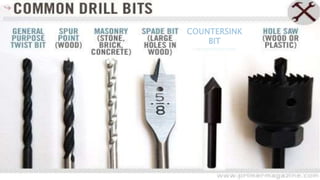
• Common Drill Bits
• Milling Cutters
• Cutting Fluids
• Essential Properties of Cutting Fluids
CUTTING TOOLS
• One of most important components in
machining process
• Performance will determine efficiency of
operation
• Two basic types (excluding abrasives)
• Single point and multiple point
• Must have rake and clearance angles
ground or formed on them
• Success in metal cutting depends on
selection of the proper cutting tool
(material and geometry) for a given work
material
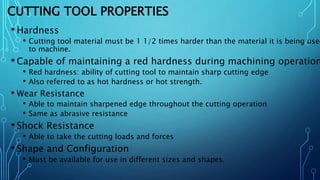
CUTTING TOOL PROPERTIES
• Hardness
• Cutting tool material must be 1 1/2 times harder than the material it is being used
to machine.
• Capable of maintaining a red hardness during machining operation
• Red hardness: ability of cutting tool to maintain sharp cutting edge
• Also referred to as hot hardness or hot strength.
• Wear Resistance
• Able to maintain sharpened edge throughout the cutting operation
• Same as abrasive resistance
• Shock Resistance
• Able to take the cutting loads and forces
• Shape and Configuration
• Must be available for use in different sizes and shapes.
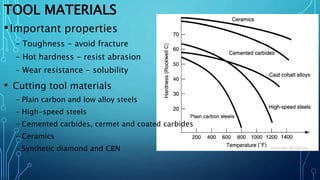
TOOL MATERIALS
•Important properties
– Toughness - avoid fracture
– Hot hardness - resist abrasion
– Wear resistance - solubility
• Cutting tool materials
– Plain carbon and low alloy steels
– High-speed steels
– Cemented carbides, cermet and coated carbides
– Ceramics
– Synthetic diamond and CBN
TOOL MATERIALS
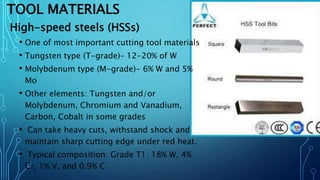
High-speed steels (HSSs)
• One of most important cutting tool materials
• Tungsten type (T-grade)– 12-20% of W
• Molybdenum type (M-grade)- 6% W and 5%
Mo
• Other elements: Tungsten and/or
Molybdenum, Chromium and Vanadium,
Carbon, Cobalt in some grades
• Can take heavy cuts, withstand shock and
maintain sharp cutting edge under red heat.
• Typical composition: Grade T1: 18% W, 4%
Cr, 1% V, and 0.9% C
CEMENTED CARBIDES
• Various types of cemented (sintered) carbides developed to suit different
materials and machining operations
• Operate at speeds ranging 150 to 1200 ft/min
• Can machine metals at speeds that cause cutting edge to become red hot
without loosing harness
• Advantages (Cemented Carbide, Cermet & Coated Carbides)
– High room and hot hardness
– Good wear resistance
– High thermal conductivity
– Lower in toughness that HSSs
• Grades
– Non steels grade – WC-Co
– Steel grades – add TiC and TaC due to the high solubility of WC into steels
resulting in extensive crater wear
• Plain Carbon and Low Alloy Steels
• Limited tool life. Therefore, not suited to mass production.
• Can be formed into complex shapes for small production runs.
• Suited to hand tools, and wood working.
• Carbon content about 0.9 to 1.35% with a hardness ABOUT 62
C Rockwell.
• Maximum cutting speeds about 26 ft/min.
• The hot hardness value is low. This is the major factor in tool
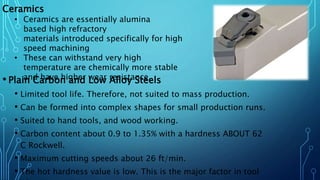
Ceramics
• Ceramics are essentially alumina
based high refractory
materials introduced specifically for high
speed machining
• These can withstand very high
temperature are chemically more stable
and have higher wear resistance.
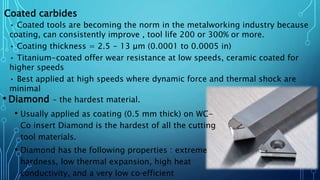
• Diamond – the hardest material.
• Usually applied as coating (0.5 mm thick) on WC-
Co insert Diamond is the hardest of all the cutting
tool materials.
• Diamond has the following properties : extreme
hardness, low thermal expansion, high heat
conductivity, and a very low co‐efficient
Coated carbides
• Coated tools are becoming the norm in the metalworking industry because
coating, can consistently improve , tool life 200 or 300% or more.
• Coating thickness = 2.5 - 13 μm (0.0001 to 0.0005 in)
• Titanium-coated offer wear resistance at low speeds, ceramic coated for
higher speeds
• Best applied at high speeds where dynamic force and thermal shock are
minimal
TOOL LIFE
• Three modes of failure
– Premature Failure
• Fracture failure - Cutting force becomes excessive and/or dynamic, leading to
brittle fracture
• Thermal failure - Cutting temperature is too high for the tool material
– Gradual Wear
• Gradual failure
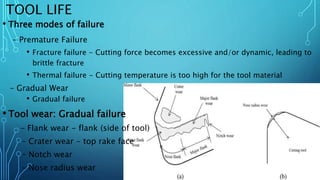
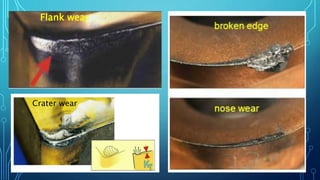
• Tool wear: Gradual failure
– Flank wear - flank (side of tool)
– Crater wear - top rake face
– Notch wear
– Nose radius wear
Flank wear
Crater wear
TOOL LIFE
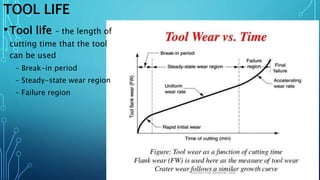
•Tool life – the length of
cutting time that the tool
can be used
– Break-in period
– Steady-state wear region
– Failure region
TOOL GEOMETRY
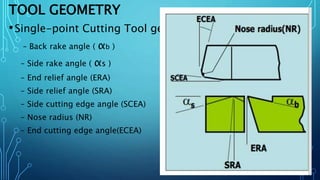
•Single-point Cutting Tool geometry
– Back rake angle ( αb )
– Side rake angle ( αs )
– End relief angle (ERA)
– Side relief angle (SRA)
– Side cutting edge angle (SCEA)
– Nose radius (NR)
– End cutting edge angle(ECEA)
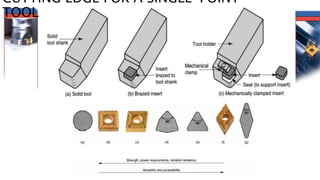
CUTTING EDGE FOR A SINGLE-POINT
TOOL
LATHE CUTTING TOOLS
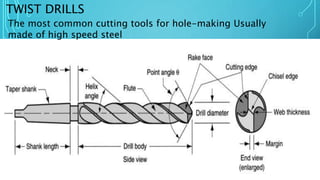
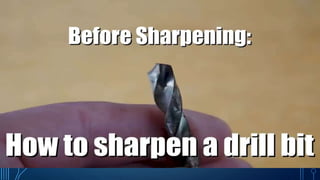
TWIST DRILLS
The most common cutting tools for hole-making Usually
made of high speed steel
COUNTERSINK
BIT
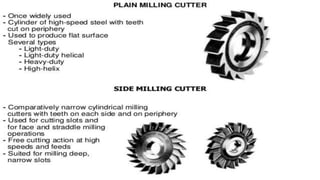
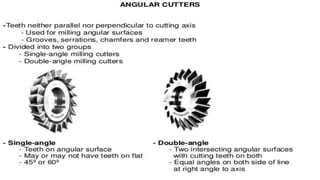
MILLING CUTTERS
• Useful for production of
small parts.
• Types of form cutter
- concave
- convex
- gear tooth
• Important application -
gear-making, in which the
form milling cutter is
shaped to cut the slots
between adjacent gear
teeth
Form cutter
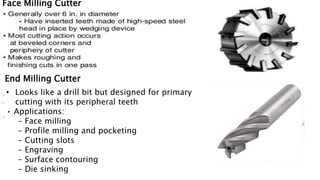
Face Milling Cutter
End Milling Cutter
• Looks like a drill bit but designed for primary
cutting with its peripheral teeth
• Applications:
– Face milling
– Profile milling and pocketing
– Cutting slots
– Engraving
– Surface contouring
– Die sinking
CUTTING FLUIDS
• Reduce friction and wear thus improving tool life and surface
finish of the workpiece.
• Cool the cutting zone, thus reducing workpiece temperature
and thermal distortion of the workpiece.
• Reduce forces and energy consumption.
• Flush away chips from the cutting zone, and thus chips rom
interfering with cutting process.
• Protect machined surface from environmental corrosion.
•Chemical formulation
– Cutting oils
– Emulsified oils
– Chemical fluids
• Application Methods
– Flooding
– Mist
– Manual
• Filtration
• Dry machining for Green Manufacturing
ESSENTIAL PROPERTIES OF CUTTING FLUIDS
• For cooling :
- High specific heat, thermal conductivity and film coefficient for heat transfer
- Spreading and wetting ability
• For lubrication :
- High lubricity without gumming and foaming
- Wetting and spreading
- High film boiling point
- Friction reduction at extreme pressure (EP) and temperature
• Other properties:
- Chemical stability, non-corrosive to the materials
- Less volatile and high flash point
- High resistance to bacterial growth
- Non toxic in both liquid and gaseous stage
- easily available and low cost
THANK
YOU

Cutting tool

  • 1.
  • 2.
    CONTENT • Cutting Tools •Cutting Tool Properties • Tool Materials • Tool Life • Lathe Cutting Tools • Twist Drills • Common Drill Bits • Milling Cutters • Cutting Fluids • Essential Properties of Cutting Fluids
  • 3.
    CUTTING TOOLS • Oneof most important components in machining process • Performance will determine efficiency of operation • Two basic types (excluding abrasives) • Single point and multiple point • Must have rake and clearance angles ground or formed on them • Success in metal cutting depends on selection of the proper cutting tool (material and geometry) for a given work material
  • 4.
    CUTTING TOOL PROPERTIES •Hardness • Cutting tool material must be 1 1/2 times harder than the material it is being used to machine. • Capable of maintaining a red hardness during machining operation • Red hardness: ability of cutting tool to maintain sharp cutting edge • Also referred to as hot hardness or hot strength. • Wear Resistance • Able to maintain sharpened edge throughout the cutting operation • Same as abrasive resistance • Shock Resistance • Able to take the cutting loads and forces • Shape and Configuration • Must be available for use in different sizes and shapes.
  • 5.
    TOOL MATERIALS •Important properties –Toughness - avoid fracture – Hot hardness - resist abrasion – Wear resistance - solubility • Cutting tool materials – Plain carbon and low alloy steels – High-speed steels – Cemented carbides, cermet and coated carbides – Ceramics – Synthetic diamond and CBN
  • 6.
    TOOL MATERIALS High-speed steels(HSSs) • One of most important cutting tool materials • Tungsten type (T-grade)– 12-20% of W • Molybdenum type (M-grade)- 6% W and 5% Mo • Other elements: Tungsten and/or Molybdenum, Chromium and Vanadium, Carbon, Cobalt in some grades • Can take heavy cuts, withstand shock and maintain sharp cutting edge under red heat. • Typical composition: Grade T1: 18% W, 4% Cr, 1% V, and 0.9% C
  • 7.
    CEMENTED CARBIDES • Varioustypes of cemented (sintered) carbides developed to suit different materials and machining operations • Operate at speeds ranging 150 to 1200 ft/min • Can machine metals at speeds that cause cutting edge to become red hot without loosing harness • Advantages (Cemented Carbide, Cermet & Coated Carbides) – High room and hot hardness – Good wear resistance – High thermal conductivity – Lower in toughness that HSSs • Grades – Non steels grade – WC-Co – Steel grades – add TiC and TaC due to the high solubility of WC into steels resulting in extensive crater wear
  • 8.
    • Plain Carbonand Low Alloy Steels • Limited tool life. Therefore, not suited to mass production. • Can be formed into complex shapes for small production runs. • Suited to hand tools, and wood working. • Carbon content about 0.9 to 1.35% with a hardness ABOUT 62 C Rockwell. • Maximum cutting speeds about 26 ft/min. • The hot hardness value is low. This is the major factor in tool Ceramics • Ceramics are essentially alumina based high refractory materials introduced specifically for high speed machining • These can withstand very high temperature are chemically more stable and have higher wear resistance.
  • 9.
    • Diamond –the hardest material. • Usually applied as coating (0.5 mm thick) on WC- Co insert Diamond is the hardest of all the cutting tool materials. • Diamond has the following properties : extreme hardness, low thermal expansion, high heat conductivity, and a very low co‐efficient Coated carbides • Coated tools are becoming the norm in the metalworking industry because coating, can consistently improve , tool life 200 or 300% or more. • Coating thickness = 2.5 - 13 μm (0.0001 to 0.0005 in) • Titanium-coated offer wear resistance at low speeds, ceramic coated for higher speeds • Best applied at high speeds where dynamic force and thermal shock are minimal
  • 10.
    TOOL LIFE • Threemodes of failure – Premature Failure • Fracture failure - Cutting force becomes excessive and/or dynamic, leading to brittle fracture • Thermal failure - Cutting temperature is too high for the tool material – Gradual Wear • Gradual failure • Tool wear: Gradual failure – Flank wear - flank (side of tool) – Crater wear - top rake face – Notch wear – Nose radius wear
  • 11.
  • 12.
    TOOL LIFE •Tool life– the length of cutting time that the tool can be used – Break-in period – Steady-state wear region – Failure region
  • 13.
    TOOL GEOMETRY •Single-point CuttingTool geometry – Back rake angle ( αb ) – Side rake angle ( αs ) – End relief angle (ERA) – Side relief angle (SRA) – Side cutting edge angle (SCEA) – Nose radius (NR) – End cutting edge angle(ECEA)
  • 15.
    CUTTING EDGE FORA SINGLE-POINT TOOL
  • 16.
  • 17.
    TWIST DRILLS The mostcommon cutting tools for hole-making Usually made of high speed steel
  • 18.
  • 20.
    MILLING CUTTERS • Usefulfor production of small parts. • Types of form cutter - concave - convex - gear tooth • Important application - gear-making, in which the form milling cutter is shaped to cut the slots between adjacent gear teeth Form cutter
  • 21.
    Face Milling Cutter EndMilling Cutter • Looks like a drill bit but designed for primary cutting with its peripheral teeth • Applications: – Face milling – Profile milling and pocketing – Cutting slots – Engraving – Surface contouring – Die sinking
  • 24.
    CUTTING FLUIDS • Reducefriction and wear thus improving tool life and surface finish of the workpiece. • Cool the cutting zone, thus reducing workpiece temperature and thermal distortion of the workpiece. • Reduce forces and energy consumption. • Flush away chips from the cutting zone, and thus chips rom interfering with cutting process. • Protect machined surface from environmental corrosion.
  • 25.
    •Chemical formulation – Cuttingoils – Emulsified oils – Chemical fluids • Application Methods – Flooding – Mist – Manual • Filtration • Dry machining for Green Manufacturing
  • 26.
    ESSENTIAL PROPERTIES OFCUTTING FLUIDS • For cooling : - High specific heat, thermal conductivity and film coefficient for heat transfer - Spreading and wetting ability • For lubrication : - High lubricity without gumming and foaming - Wetting and spreading - High film boiling point - Friction reduction at extreme pressure (EP) and temperature • Other properties: - Chemical stability, non-corrosive to the materials - Less volatile and high flash point - High resistance to bacterial growth - Non toxic in both liquid and gaseous stage - easily available and low cost
  • 27.