CURRICULUM PHILOSOPHY
REPORTER: MS. CATHERINE D. PUGOY
Philosophical foundation of curriculum
Philosophy is the driving force behind curriculum that motivates and
prepares both the teacher and students for success.
Philosophy provides educators, teachers and curriculum
makers with framework for planning, implementing and
evaluating curriculum in schools.
Philosophy is not only what is done in our classrooms, but more
specifically “how” it is done. Philosophy is also what educators
believe about themselves, either positively or negatively, and they
bring these beliefs into the classrooms. These beliefs also effect
students and their educational outcomes.
Educational Philosophies
Perennialism....
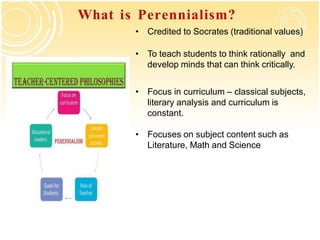
What is Perennialism?
• Credited to Socrates (traditional values)
• To teach students to think rationally and
develop minds that can think critically.
• Focus in curriculum – classical subjects,
literary analysis and curriculum is
constant.
• Focuses on subject content such as
Literature, Math and Science
Essentialism....
What is Essentialism?
• To teach students to think
rationally and develop minds
that can think critically.
•
• Supports individual growth
and maturity
• Promotes mastery of the basic core
subjects such as the three R’s
• Focus in essential subjects of
English, Science, History, Math
and Foreign Language.
• Teacher is the sole authority in his
or her subject area .
Progressivism....
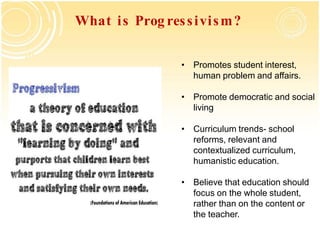
What is Prog ressivism?
• Promotes student interest,
human problem and affairs.
• Promote democratic and social
living
• Curriculum trends- school
reforms, relevant and
contextualized curriculum,
humanistic education.
• Believe that education should
focus on the whole student,
rather than on the content or
the teacher.
Reconstructionism....
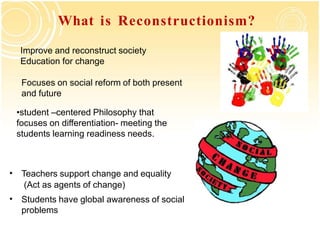
What is Reconstructionism?
•student –centered Philosophy that
focuses on differentiation- meeting the
students learning readiness needs.
Focuses on social reform of both present
and future
• Teachers support change and equality
(Act as agents of change)
• Students have global awareness of social
problems
Improve and reconstruct society
Education for change
Educational Philosophy lays the strong
foundation of any curriculum. A
curriculum planner, curriculum
implementor or the teacher, school
administrator or the curriculum evaluator
whether school-based or externally-
based anchors his/her decision-making
process on a sound philosophy.
Thank you!

curriculum philosophy.pptx

  • 1.
  • 2.
    Philosophical foundation ofcurriculum Philosophy is the driving force behind curriculum that motivates and prepares both the teacher and students for success. Philosophy provides educators, teachers and curriculum makers with framework for planning, implementing and evaluating curriculum in schools. Philosophy is not only what is done in our classrooms, but more specifically “how” it is done. Philosophy is also what educators believe about themselves, either positively or negatively, and they bring these beliefs into the classrooms. These beliefs also effect students and their educational outcomes.
  • 3.
  • 4.
  • 5.
    What is Perennialism? •Credited to Socrates (traditional values) • To teach students to think rationally and develop minds that can think critically. • Focus in curriculum – classical subjects, literary analysis and curriculum is constant. • Focuses on subject content such as Literature, Math and Science
  • 6.
  • 7.
    What is Essentialism? •To teach students to think rationally and develop minds that can think critically. • • Supports individual growth and maturity • Promotes mastery of the basic core subjects such as the three R’s • Focus in essential subjects of English, Science, History, Math and Foreign Language. • Teacher is the sole authority in his or her subject area .
  • 8.
  • 9.
    What is Progressivism? • Promotes student interest, human problem and affairs. • Promote democratic and social living • Curriculum trends- school reforms, relevant and contextualized curriculum, humanistic education. • Believe that education should focus on the whole student, rather than on the content or the teacher.
  • 10.
  • 11.
    What is Reconstructionism? •student–centered Philosophy that focuses on differentiation- meeting the students learning readiness needs. Focuses on social reform of both present and future • Teachers support change and equality (Act as agents of change) • Students have global awareness of social problems Improve and reconstruct society Education for change
  • 12.
    Educational Philosophy laysthe strong foundation of any curriculum. A curriculum planner, curriculum implementor or the teacher, school administrator or the curriculum evaluator whether school-based or externally- based anchors his/her decision-making process on a sound philosophy.
  • 13.