
Curling
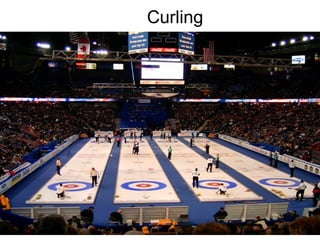
• Curling is a sport in which players slide stones across a sheet 
  of ice towards a target area. It is related to bowls, boule and 
  shuffleboard. Two teams, each of four players, take turns 
  sliding heavy, polished granite stones, also called "rocks", 
  across the ice curling sheet towards the house, a circular target 
  marked on the ice. Each team has eight stones. The purpose is 
  to accumulate the highest score for a game; points are scored 
  for the stones resting closest to the centre of the house at the 
  conclusion of each end, which is completed when both teams 
  have thrown all of their stones. A game may consist of ten or 
  eight ends.
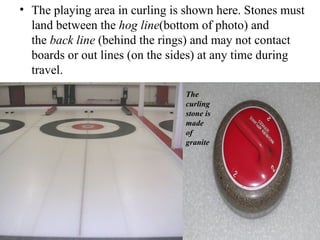
• The playing area in curling is shown here. Stones must 
  land between the hog line(bottom of photo) and 
  the back line (behind the rings) and may not contact 
  boards or out lines (on the sides) at any time during 
  travel. 
                                The
                                curling
                                stone is
                                made
                                of
                                granite
The curling stone
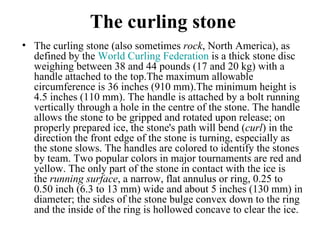
• The curling stone (also sometimes rock, North America), as 
  defined by the World Curling Federation is a thick stone disc 
  weighing between 38 and 44 pounds (17 and 20 kg) with a 
  handle attached to the top.The maximum allowable 
  circumference is 36 inches (910 mm).The minimum height is 
  4.5 inches (110 mm). The handle is attached by a bolt running 
  vertically through a hole in the centre of the stone. The handle 
  allows the stone to be gripped and rotated upon release; on 
  properly prepared ice, the stone's path will bend (curl) in the 
  direction the front edge of the stone is turning, especially as 
  the stone slows. The handles are colored to identify the stones 
  by team. Two popular colors in major tournaments are red and 
  yellow. The only part of the stone in contact with the ice is 
  the running surface, a narrow, flat annulus or ring, 0.25 to 
  0.50 inch (6.3 to 13 mm) wide and about 5 inches (130 mm) in 
  diameter; the sides of the stone bulge convex down to the ring 
  and the inside of the ring is hollowed concave to clear the ice. 
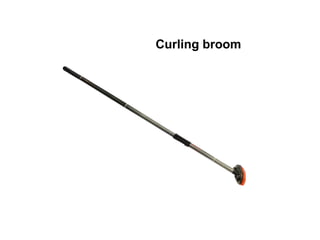
Curling broom
• The curling broom, or brush, is used to sweep the ice surface 
  in the path of the stone,and is also often used as a balancing 
  aid during delivery of the stone.
• In earlier days, brooms were made of corn strands and were 
  similar to household brooms. Brushes were used primarily by 
  elderly curlers as a substitute for corn brooms. Today, brushes 
  have replaced traditional corn brooms at every level of curling, 
  but are universally referred to as brooms. Curling brushes may 
  have fabric, hog hair, or horsehair heads. Modern curling 
  broomsticks are usually hollow tubes made of fiberglass or 
  carbon fiber instead of a solid length of wooden dowel. These 
  hollow tube handles are lighter and stronger than wooden 
  handles, allowing faster sweeping and also enabling more 
  downward force to be applied to the broom head with reduced 
  shaft flex.
Curling broom
Shoes
• Curling shoes are similar to ordinary athletic
  shoes except that they have dissimilar soles; the
  slider shoe is designed for the off foot (or sliding
  foot) and the non-sliding shoe for the hack foot:
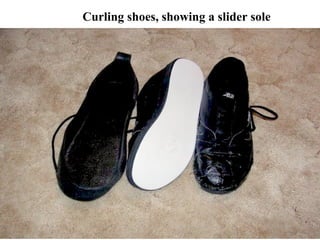
• The slider shoe is designed to slide and typically
  has a Teflon sole. It is worn by the thrower
  during delivery from the hack and by sweepers
  or the skip to glide down the ice when sweeping
  or otherwise traveling down the sheet quickly.
Curling shoes, showing a slider sole
Other equipment

• Other types of equipment include:
         – Curling pants, made to be stretchy to 
           accommodate the curling delivery.
         – A stopwatch to time the stones while 
           sweeping to get a feel of the speed of the 
           stone. Stopwatches can be attached either to 
           clothing or the broom itself.
         – Curling gloves and mittens, to keep the 
           hands warm and improve grip on the broom.
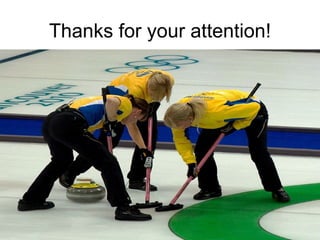
Thanks for your attention!

Curling

  • 1.
  • 2.
    • Curling is a sport in which players slide stones across a sheet  of ice towards a target area. It is related to bowls, boule and  shuffleboard. Two teams, each of four players, take turns  sliding heavy, polished granite stones, also called "rocks",  across the ice curling sheet towards the house, a circular target  marked on the ice. Each team has eight stones. The purpose is  to accumulate the highest score for a game; points are scored  for the stones resting closest to the centre of the house at the  conclusion of each end, which is completed when both teams  have thrown all of their stones. A game may consist of ten or  eight ends.
  • 3.
    • The playing area in curling is shown here. Stones must  land between the hog line(bottom of photo) and  the back line (behind the rings) and may not contact  boards or out lines (on the sides) at any time during  travel.  The curling stone is made of granite
  • 4.
    The curling stone •The curling stone (also sometimes rock, North America), as  defined by the World Curling Federation is a thick stone disc  weighing between 38 and 44 pounds (17 and 20 kg) with a  handle attached to the top.The maximum allowable  circumference is 36 inches (910 mm).The minimum height is  4.5 inches (110 mm). The handle is attached by a bolt running  vertically through a hole in the centre of the stone. The handle  allows the stone to be gripped and rotated upon release; on  properly prepared ice, the stone's path will bend (curl) in the  direction the front edge of the stone is turning, especially as  the stone slows. The handles are colored to identify the stones  by team. Two popular colors in major tournaments are red and  yellow. The only part of the stone in contact with the ice is  the running surface, a narrow, flat annulus or ring, 0.25 to  0.50 inch (6.3 to 13 mm) wide and about 5 inches (130 mm) in  diameter; the sides of the stone bulge convex down to the ring  and the inside of the ring is hollowed concave to clear the ice. 
  • 5.
    Curling broom • The curlingbroom, or brush, is used to sweep the ice surface  in the path of the stone,and is also often used as a balancing  aid during delivery of the stone. • In earlier days, brooms were made of corn strands and were  similar to household brooms. Brushes were used primarily by  elderly curlers as a substitute for corn brooms. Today, brushes  have replaced traditional corn brooms at every level of curling,  but are universally referred to as brooms. Curling brushes may  have fabric, hog hair, or horsehair heads. Modern curling  broomsticks are usually hollow tubes made of fiberglass or  carbon fiber instead of a solid length of wooden dowel. These  hollow tube handles are lighter and stronger than wooden  handles, allowing faster sweeping and also enabling more  downward force to be applied to the broom head with reduced  shaft flex.
  • 6.
  • 7.
    Shoes • Curling shoesare similar to ordinary athletic shoes except that they have dissimilar soles; the slider shoe is designed for the off foot (or sliding foot) and the non-sliding shoe for the hack foot: • The slider shoe is designed to slide and typically has a Teflon sole. It is worn by the thrower during delivery from the hack and by sweepers or the skip to glide down the ice when sweeping or otherwise traveling down the sheet quickly.
  • 8.
  • 9.
    Other equipment • Other types of equipment include: – Curling pants, made to be stretchy to  accommodate the curling delivery. – A stopwatch to time the stones while  sweeping to get a feel of the speed of the  stone. Stopwatches can be attached either to  clothing or the broom itself. – Curling gloves and mittens, to keep the  hands warm and improve grip on the broom.
  • 10.
    Thanks for yourattention!