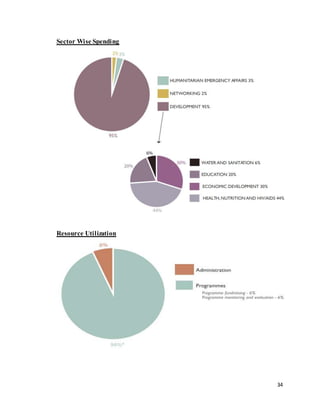
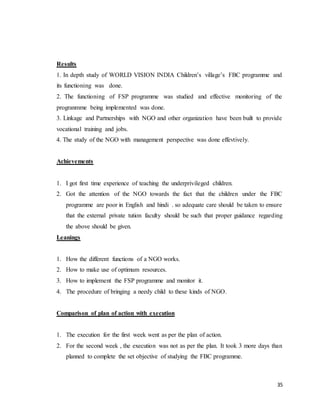
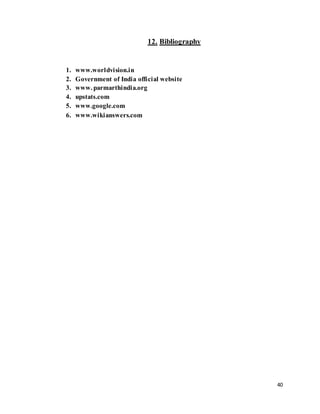
1
1 Introduction to the NGO
WORLD VISION INDIA Children's Villages is an independent, non-governmental, social
development organization that provides family-based care for children in 132 countries and
territories and that advocates the concerns, rights and needs of children. Approximately 73
with material, psychological and social support. Approximately 450,000 people benefit
from these family support services; some 489,000 people make use of the WORLD
VISIO,000 children and young people live in 491 WORLD VISION INDIA Children's
Villages and 396 WORLD VISION INDIA Youth Facilities around the world. More than
174,000 children and young people attend WORLD VISION INDIA Hermann Greener
Schools, WORLD VISION INDIA Kindergartens and WORLD VISION INDIA
Vocational Training Centers. Moreover, WORLD VISION INDIA Children's Villages
provides families N INDIA Medical Centers. In times of crisis and disaster, WORLD
VISION INDIA Children's Villages helps through emergency relief programs.
World Vision is one of the world’s leading child-focused humanitarian organizations.
Through development, relief and advocacy, we pursue fullness of life for every child by
serving the poor and oppressed regardless of religion, race, ethnicity or gender as a
demonstration of God’s unconditional love for all people.
With nearly 65 years of experience in India, World Vision India works in 185 districts
impacting 26 lakh children and their families in over 6200 communities spread across 25
states and the National Capital Region of India.
We work along with children, families and communities to address issues of health,
nutrition, water, sanitation & hygiene, education, child protection, climate change, gender,
disability and humanitarian emergencies in partnership with governments, civil society,
donors and corporates.
2
2 About The Organization
In adult life we reveal how we fared in childhood. The quality of childhood is critical – as
a help or hindrance in later life. What set the stage for our future development – loss and
hurt, or love and respect? Although we all know that childhood is decisive, children are
still ignored, manipulated, abused and abandoned.
At WORLD VISION INDIA Children’s Villages we are committed to the welfare of
children – often throughout the whole of their childhood – and to strengthening families
and communities as a preventive measure in the fight against abandonment and social
neglect.
It is a truly difficult – but also rewarding – task for an organization to seek to restore the
balance in life for abandoned, destitute, and spiritually and physically traumatized children,
to pick them up when crisis brings them down, to give them individual support, to take
them by the hand on the road from childhood to adulthood.
The influence of childhood on adults applies equally to us as an organization with its own
special history. The beginnings of WORLD VISION INDIA Children’s Villages are
decisive for our further development, but as we „grow up “the yardstick for our endeavor
and the future the challenge. It is this synthesis of the traditional and the modern, of
3
professionalism and compassion that guides WORLD VISION INDIA Children’s Villages
in meeting the responsibilities it has assumed for thousands of children and young adults.
The mission statement of WORLD VISION INDIA Children’s Villages defines the general
framework, our motivation and commitment to genuine social change that will benefit
children worldwide. That is our vision, which we are working to achieve step by step, to
help children enjoy their right to a childhood and to healthy development, through a family,
through security, through love and respect.
What (World Vision India) WVI Children's Villages stands for - A loving home for every
child
The first WORLD VISION INDIA Children‘s Village was founded by Hermann Gmeiner
in 1949 in Imst, Austria. He was committed to helping children in need – children who had
lost their homes, their security and their families as a result of the Second World War. With
the support of many donors and co-workers, our organization has grown to help children
all over the world. We take action for children as an independent nongovernmental social
development organization. We respect varying religions and cultures, and we work in
countries and communities where our mission can contribute to development. We work in
the spirit of the United Nations Convention on the Rights of the Child and we promote
these rights around the world.
“Mother is the name for God in the lips and hearts of little children.”
Gmeiner's concept was based on four main aspects: every child needs the care of a parent
who establishes a close relationship with each child. The children grow up in a family with
girls and boys of different ages as their siblings. The family is part of a community that
functions as a support system. Biological siblings are not separated if possible and if this
is in the children's best interests. The model of the "classic" WORLD VISION INDIA
Children's Village has been and will continue to be modified and adapted to local
conditions and requirements. There are now, for example, WORLD VISION INDIA
Children's Villages that have been integrated into housing estates, short and medium-term
care places and assisted living facilities for young people.
4
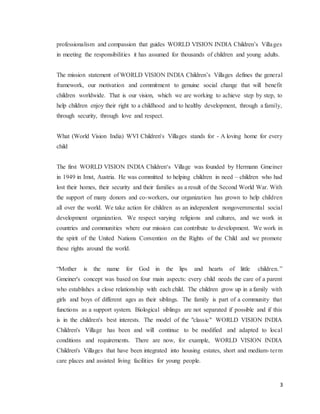
Even though the number of orphans is decreasing in many countries, the number of children
who, for various reasons, cannot live with their biological parents is increasing. This
concerns an estimated 150 million children worldwide. WORLD VISION INDIA
Children's Villages continuously works on developing child care methods and preventive
support for families to be able to respond to the continually-changing requirements.
In this development process, community-based programmers aimed at preventing the
marginalization of children in society play a key role. With its family strengthening
programs, WORLD VISION INDIA Children's Villages aims to help families to support
themselves in the long term, leading an independent life and raising children in a healthy
and protected environment. This is the only way we can assure that children are not
abandoned and can grow up with their family of origin.
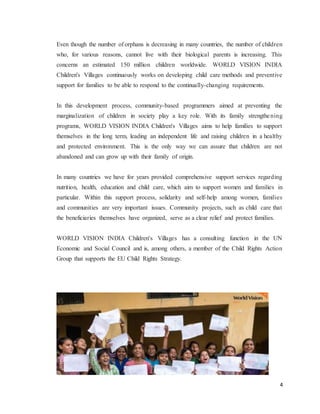
In many countries we have for years provided comprehensive support services regarding
nutrition, health, education and child care, which aim to support women and families in
particular. Within this support process, solidarity and self-help among women, families
and communities are very important issues. Community projects, such as child care that
the beneficiaries themselves have organized, serve as a clear relief and protect families.
WORLD VISION INDIA Children's Villages has a consulting function in the UN
Economic and Social Council and is, among others, a member of the Child Rights Action
Group that supports the EU Child Rights Strategy.
5
3.Objectives of NGO
With the WORLD VISION INDIA Children‘s Village concept, our organization pioneered
a family approach to the long-term care of orphaned and abandoned children. This concept
is based on four principles:
The Mother - Each child has a caring parent
The WORLD VISION INDIA mother builds a close relationship with every child entrusted
to her, and provides the security, love and stability that each child needs. As a child-care
professional, she lives together with the children, guides their development, and runs her
household independently. She recognizes and respects each child‘s family background,
cultural roots and religion.
Brothers and Sisters - Family ties grow naturally
Girls and boys of different ages live together as brothers and sisters, with natural brothers
and sisters always staying within the same WORLD VISION INDIA family. These
children and their WORLD VISION INDIA mother build emotional ties that last a lifetime.
The House - Each family creates its own home
The house is the family‘s home, with its own unique feeling, rhythm and routine. Under its
roof, children enjoy a real sense of security and belonging. Children grow and learn
together, sharing responsibilities and all the joys and sorrows of daily life.
The Village - The WORLD VISION INDIA family is a part of the community
WORLD VISION INDIA families live together, forming a supportive village environment
where children enjoy a happy childhood. The families share experiences and offer one
another a helping hand. They also live as integrated and contributing members of the local
community. Through his or her family, village and community.
6
4. Problem Statement
The Achievements and success of NGOs in various fields and the excellent work done by
them in specific areas is no doubt a tremendous task that has helped to meet the changing
needs of the social system. However, in spite of its achievements in various fields, NGOs
are facing different problems which differ from organization to organization, region to
region.
Some of the NGOs in India are facing the following major problems:
1 Lacks of funds – Most of the NGOs in India are suffering from paucity of funds.
Government does not give cent percent grants in aid or make delay in sanctions of grants
for numerous programs. NGOs have to make matching contributions which they are
sometimes unable to manage and are, therefore, unable to avail themselves of the grants.
2. Inadequate Trained Personnel – It is believed that the personnel working in NGOs may
be of personnel working in such organizations is a sense of dedication and commitment
and interest in the social services.
3. Misuse of Funds – It is a common experience that there have been serious charges of
misuse
And misappropriation of funds received as grant-in-aid form the government, foreign
donors and raised through their own resources by the most of the NGOs. These NGOs may
reflect its image to other NGOs who are working with dedication and commitment.
4. Inequality in rural areas – NGOs are more developed in urban areas as compared to
rural areas. The backwardness and ignorance of the rural people and lack of enthusiasm
among social workers to among them in the absence of availability of minimum comforts
are the two important reasons for the backwardness of the NGOs in rural areas.
7
5. Lack of Volunteerism/Social work among Youth – The basic characteristic of NGO is
volunteerism. In early days, youth are making their career in volunteerism but that
enthusiasm seems to have faded these days. The extent of volunteerism is declining day by
day and turning it into professionalization. Even the young graduates from social work are
interested in making their career in professionalism. This leads to lack of efficient
volunteers in NGOs.
The following are the suggested remedies to the problems of the NGOs in India.
1. The government of India should liberalize the rules and regulations of grants-in-aid
and to sanction more grants to NGOs. At the same time, the government should appoint
commissions of enquiry or committees to cross check the misuse of funds by NGOs. The
member of committee has to supervise and monitor the activities of NGOs periodically.
2. Young graduates from universities, colleges and schools should conduct the public
seminars, meetings etc., and use the local media to advertise the importance of
volunteerism, success stories of NGOs and encourage people to participate in voluntarism.
3. At the same time, universities, colleges and schools should collaborate with NGOs
and conduct a campus interviews for the young graduates who are interested in
voluntarism. NSS and NCC should encourage students to participate in voluntarism from
childhood days onwards.
4. In India, 65% of populations belong to rural areas. NGOs, therefore, need to operate
in rural areas on a bigger scale to enlist the cooperation of village people in making their
lives better. At the same time, these NGOs should encourage the educated young graduates
of rural areas to participate in voluntarism. The government should also give some special
provisions for NGOs who are working in rural areas in getting eligibility conditions for
grants.
5. NGOs being a welfare organization should maintain high standard of quality in
service. The government also should recognize those NGOs, by giving awards or rewards
with additional grants. This would motivate the other NGOs to work efficiently
8
6. The government should revise the pay-scales and allowances to the personnel of
NGOs. At the same time some special funds to be allotted for the NGOs to train the
personnel at the grass root level.
7. The NGOs should use of latest technologies like internet, websites etc., for raising of
their funds, to have mutual associations, to advertise their products and for the selection of
efficient personals.
NGOs are the ones who really intend to care the uncared sections and the people at the
bottom of the social stratum. Ours is a developing country which requires these type of
committed, devoted and dedicated organizations for the development of the country. So,
the government, the leaders, the donors, the politicians and the people should support these
organizations and help them to solve their problems at the grass-root level. Then only we
can do something for the poor, for the needy! I have done my bit, now it’s your turn.
Always remember
9
5. Function Wise Study
RESOURCE MANAGEMENT: NGOS are nonprofit making, non-government
organization. No fund is available from government. So there is a limited budget available
for expenditures. They use their resources in better manner. According to the requirement
they do manpower planning and pay scale is lower than other organizations. Most of the
appointments are on permanent basis so that money spend in training would not be waste.
So we learn how to do optimum utilization of resources.
ORGANIZATION STRUCTURE: WVI follows a particular hierarchy. Village Director is
the head of WVI village and all other coworkers work under Director. Their responsibilities
are well defined ie. Organization structure is transient enough. But all WVI workers are
interlinked with each other in their work as they all have same goal in mind to do the
betterment of children. This gives me the learning that how to coordinate with others while
working in an organization.
OPERATIONS: WVI Children's village is committed to long term care of less privileged
children of society. As their area of operations is for betterment of children. This
organization is expanding its services through community project for the benefit of children
of nearby community. Success of FSP (community program) proves how efficient this
organization is in operations
HR POLICIES: In WVI manpower planning is done by HR Head in Delhi. For each post
there is a defined training period which makes employee more efficient. Their recruitment
policies are clear, even in manual we can get the job profile and job description of each
post. Village Director send performance appraisal to the National Director. i.e. HR policies
should be well defined. Training plays an important role in developing organization as a
whole.
10
MARKETING EFFORTS: There is a PFR department for marketing of WVI. They form
their marketing strategy in such a way that they touch emotional cord of people. i.e. their
strategy is centered to fulfillment of aim ( to raise funds).
PPM
Planning
Planning is done mainly by the secretary and the director of the organization. For each
project the plan is prepared in attendance of the project coordinators and project workers.
Planning is very strong in the organization. Each plan is made by taking in account the
objective of the organization. Plan covers all area of operation and all members are
involved in the planning process
Organizing
After drawing out the plan the director delegates the responsibilities of a particular area to
a project coordinator who is responsible to answer about the progress of the plan. Project
coordinators are responsible to answer to director.
Leading
Leading is done all through the process. Coordinators lead the workers and the director
leads the coordinators. Coordinators take care of the problems faced by the workers and
communicate director about them who tries to solve the problems of workers.
Workers move through the area and discuss the problem with villagers. after discussing the
problems activists discuss the issues with the coordinators, if the problem needs a basic
level improvement or action the coordinator takes the decision himself otherwise he/she
approaches the director who has ultimately most of the power regarding operations and
takes major decisions, however he is responsible to answer to the secretary of the
organization who ultimately follows board of directors
11
Applicability of scientific management theory:
In case of an NGO scientific management theory plays a vital role. According to scientific
management theory the system must be transparent and that helps out the NGO workers in
a way that the director draws a master plan for the project and convokes a meeting of the
project workers along with project coordinator and communicates the basic
responsibilities, obligation process and rewards for achievements. This motivation helps
the employee to work effectively and efficiently. The system increases the pace of
operations because employee has a clear understanding what exactly they are supposed to
do and how.
Financial Management:
Financial policy is a tool as well as a measure for the standards of accountability of WVI.
Good financial policy enables the fulfillment of the vision of WVI. The nobler the vision,
the higher the standards of accountability will be. Transparency and high standards of
accountability can be infused only if there is a sound financial policy. Rather Financial
Policies are not disclosed by the organization but are mentioned.
Guiding principles of WVI financial policy:
A creative, honest and use of resources.
Optimum utilization of the above resources
Creative investments of the funds
High accountability standards.
A professional system of reporting, monitoring and evaluation.
Training of Finance Staff:
12
The Finance staff will be provided with orientation, refresher courses and workshops on a
continuing basis, since there is need for constant up gradation of skills in finances. This
measure improves the quality of the accounting standards and therefore will promote better
financial managements.
13
6. REVIEW OF LITRATURE
The following are the suggested remedies to the problems of the NGOs in India.
1. The government of India should liberalize the rules and regulations of grants-in-aid
and to sanction more grants to NGOs. At the same time, the government should appoint
commissions of enquiry or committees to cross check the misuse of funds by NGOs. The
member of committee has to supervise and monitor the activities of NGOs periodically.
2. Young graduates from universities, colleges and schools should conduct the public
seminars, meetings etc., and use the local media to advertise the importance of
volunteerism, success stories of NGOs and encourage people to participate in voluntarism.
3. At the same time, universities, colleges and schools should collaborate with NGOs
and conduct a campus interviews for the young graduates who are interested in
voluntarism. NSS and NCC should encourage students to participate in voluntarism from
childhood days onwards.
4. In India, 65% of populations belong to rural areas. NGOs, therefore, need to operate
in rural areas on a bigger scale to enlist the cooperation of village people in making their
lives better. At the same time, these NGOs should encourage the educated young graduates
of rural areas to participate in voluntarism. The government should also give some special
provisions for NGOs who are working in rural areas in getting eligibility conditions for
grants.
5. NGOs being a welfare organization should maintain high standard of quality in
service. The government also should recognize those NGOs, by giving awards or rewards
with additional grants. This would motivate the other NGOs to work efficiently
14
6. The government should revise the pay-scales and allowances to the personnel of
NGOs. At the same time some special funds to be allotted for the NGOs to train the
personnel at the grass root level.
7. The NGOs should use of latest technologies like internet, websites etc., for raising of
their funds, to have mutual associations, to advertise their products and for the selection of
efficient personals.
7. METHODOLOGY
Formation of Problem: “A Study CSR of World Vision(NGO) In India”
Methods of collection of data: Secondary Data
Research Instruments: Press release, magazines, journals
15
8. STRAGIC ALLIANCE
Strategic alliance has historically been an imperative means for NGOs in institutionalizing
change; in part because of exchanging information, sharing of knowledge, resources and
advocacy. It’s one of the influencing strategies that World Vision India has been using in
the recent years, which has enhanced the working relationship with the government and
other agencies. Recognizing the importance of strategic alliance, World Vision India, under
its country strategy (2008-2011), decided to leverage strategic alliance to enhance its
impact and influence primarily CWorld Vision India including NGOs, FBOs, CBOs and
other government agencies.
The focus has been to create a critical mass of community leaders committed to the well-
being of children and strengthen non-exploitative linkages with key development
stakeholders who strive hard towards the Millennium Development Goals (MDGs) – well-
being of every girl and boy, sustainable livelihood security, access to water, peace building
and reconciliation, prevent and mitigate HIV and AIDS and TB, organizational
effectiveness, expand engagement with all stakeholders, including donors for mutual
transformation.
World Vision India’s efforts under strategic alliances include leveraging resources,
maximizing the impact, monitoring quality, effectiveness and implementation of public
policies and legislation, influencing policies towards facilitating the rights of the most
vulnerable, especially children’s right to survival, development participation and
protection. In addition to the above, our journey with the Indian and multi-national
corporates has been an enriching experience. It started on a relationship model and at
present is thriving on a partnership model.
World Vision’s presence across more than 5000 communities, our network and reach has
given us a unique edge over other charities in taking CSR programs to multiple locations
with multiple models of engagement. In recent past, our partnership model matured with
corporates like Coke, BMW and Maersk in addition to our engagement with more than 10
Small and Medium Enterprises. For these enterprises, Corporate Social Responsibility is
16
new and they look forward to this journey in understanding and integrating social
responsibility into their business model.
World Vision engages with the local churches in the target areas to strengthen them to take
responsibility for the poor in their neighborhood by motivating and mobilizing them, to
speak out for the cause of the poor to the policy makers of the nation.
Grassroots Alliances & Networks
Highlights of alliances-
• Government Industrial Training Institutes opened way for unemployed youth to be
trained in various trades.
• Girls were trained in nursing and employed by hospitals and health centers.
• Integrated Child Development Services supported children and mothers in nutrition
development.
• Public Health Centers and District Health Department in immunization of children.
• District AIDS Control Societies in prevention and care of People Living with HIV and
AIDS.
• District Legal Services Authority in ensuring child protection.
The partnership at the grass root level has helped World Vision India move closer towards
its vision of bringing fullness of life to children and communities. At present, there are
more than 4,500 alliances/networks established at both the block and the district level,
primarily with government departments, CWorld Vision India, the private sector, CBOs
and FBOs. These alliances covered various aspects of program planning, implementation,
monitoring, technical support, capacity building and advocacy. It has brought about change
17
in more than 200,000 families in the last two years in the areas of quality education, health,
advocating for justice, and facilitating economic and social empowerment
Government Agencies More than half of the alliances that World Vision India is involved
in are with the government. These include the block and district administration, Agriculture
and Forest Department for implementation of the Agriculture program , District Rural
Development Agency (DRDA) for development programs, District Health Department for
health programs, National Insurance Company for livestock insurance, Centre for Water
and Soil Conservation and Research Institute for watershed programs, Human Resource
Development Centre for capacity building programs to CBOs, District Social Welfare
Department, banking institutions and self-help groups (SHGs) linkage. The government
schemes that World Vision India collaborated with include Mahatma Gandhi National
Rural Employment Guarantee Scheme (MNREGS) to address food insecurity, Indira
Awaas Yojana (IAY) for providing shelter to rural communities, Sarva Shiksha Abhiyan
(SSA) for improving school enrolments and the quality of education etc. Nutrition: World
Vision India works in close coordination with the Integrated Child Development Services
(ICDS) department to provide support in capacity building of anganwadi workers
(AWWs), infrastructure development and improving the quality of services. This has
helped World Vision India focus on issues pertaining to malnutrition, immunization, birth
spacing and other health services that affect the health of children. Joint meetings with
ICDS along with local governance agencies are held regularly. SHGs are trained in
monitoring the services of ICDS and the health department at the community level.
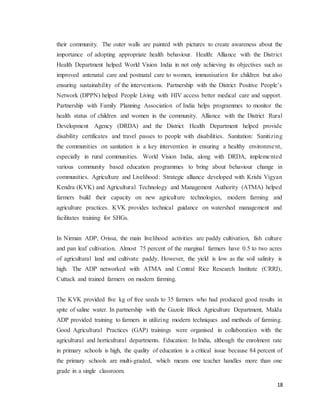
In Baran, Rajasthan, World Vision India remodelled the anganwadi centre (AWC) into a
child friendly and educative space, both inside and outside. Based on this model, the
Government of Rajasthan invited World Vision India to replicate it in neighbouring
villages. World Vision India helped in strengthening the capacity of AWWs, provided
technical support and helped in monitoring 60 ICDS centres in 40 villages of Baran district.
The model centre was colourfully painted with pictorial stories, Hindi and English letters
of the alphabet, numbers and other learning material. The centre is also equipped with
recreational material such as swings, sliders, searockers, etc. It is designed to sensitise the
community on health and nutrition for children and women. The growth monitoring chart
painted on the walls of the centre helps parents to track the nutritional status of children in
18
their community. The outer walls are painted with pictures to create awareness about the
importance of adopting appropriate health behaviour. Health: Alliance with the District
Health Department helped World Vision India in not only achieving its objectives such as
improved antenatal care and postnatal care to women, immunisation for children but also
ensuring sustainability of the interventions. Partnership with the District Positive People’s
Network (DPPN) helped People Living with HIV access better medical care and support.
Partnership with Family Planning Association of India helps programmes to monitor the
health status of children and women in the community. Alliance with the District Rural
Development Agency (DRDA) and the District Health Department helped provide
disability certificates and travel passes to people with disabilities. Sanitation: Sanitizing
the communities on sanitation is a key intervention in ensuring a healthy environment,
especially in rural communities. World Vision India, along with DRDA, implemented
various community based education programmes to bring about behaviour change in
communities. Agriculture and Livelihood: Strategic alliance developed with Krishi Vigyan
Kendra (KVK) and Agricultural Technology and Management Authority (ATMA) helped
farmers build their capacity on new agriculture technologies, modern farming and
agriculture practices. KVK provides technical guidance on watershed management and
facilitates training for SHGs.
In Nirman ADP, Orissa, the main livelihood activities are paddy cultivation, fish culture
and pan leaf cultivation. Almost 75 percent of the marginal farmers have 0.5 to two acres
of agricultural land and cultivate paddy. However, the yield is low as the soil salinity is
high. The ADP networked with ATMA and Central Rice Research Institute (CRRI),
Cuttack and trained farmers on modern farming.
The KVK provided five kg of free seeds to 35 farmers who had produced good results in
spite of saline water. In partnership with the Gazole Block Agriculture Department, Malda
ADP provided training to farmers in utilizing modern techniques and methods of farming.
Good Agricultural Practices (GAP) trainings were organised in collaboration with the
agricultural and horticultural departments. Education: In India, although the enrolment rate
in primary schools is high, the quality of education is a critical issue because 84 percent of
the primary schools are multi-graded, which means one teacher handles more than one
grade in a single classroom.
19
Unless there is a child friendly environment, it is difficult to impart quality education for
children to achieve learning outcomes such as learning to read, write and use numeracy
skills, social skills, manage emotions and communicate ideas. In the states of Madhya
Pradesh and Chattisgarh, World Vision India is working with the local Education
Department on the Multi Grade & Multi Level (MGML) model which is approved by
UNESCO.
Civil Society Organisations World Vision India works closely with the local CWorld
Vision India to maximize the impact of its interventions. In Melghat, Maharashtra, World
Vision India jointly organised initiatives such as the postcard campaign, advocating for
land rights and forest rights to help communities claim their rights from the duty bearers.
Training on Conflict Analysis programming was conducted across the country in Tripura,
Imphal, Guwahati, Mayurbhanj, Siliguri, Bhubaneswar, Hyderabad, Ratlam, Indore and
Dumka which helped the participants recognize that most people even in conflict zones are
engaged in normal peaceful activities and have indigenous capacities for resolving conflicts
and connecting people in constructive ways. World Vision India is an active partner of
Child Line India Foundation (CIF) since its inception in Chennai.
It works towards ensuring that all children in need of care and protection have access to
services that are child friendly and encourages them to participate in decisions that affect
them. It’s a 24-hours helpline that responds to the need of children in distress. The rescued
children are connected to their families and NGOs for further rehabilitation services. The
ANTI TRAFFICKING NETWORK (ATN) in Siliguri, West Bengal, initiated by World
Vision India brings together police, media, the local government, communities, NGOs to
address the issue of child trafficking.
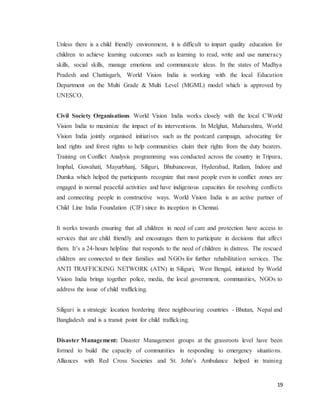
Siliguri is a strategic location bordering three neighbouring countries - Bhutan, Nepal and
Bangladesh and is a transit point for child trafficking.
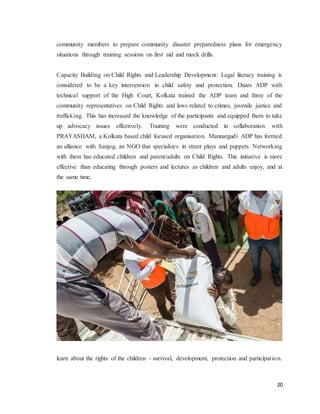
Disaster Management: Disaster Management groups at the grassroots level have been
formed to build the capacity of communities in responding to emergency situations.
Alliances with Red Cross Societies and St. John’s Ambulance helped in training
20
community members to prepare community disaster preparedness plans for emergency
situations through training sessions on first aid and mock drills.
Capacity Building on Child Rights and Leadership Development: Legal literacy training is
considered to be a key intervention in child safety and protection. Duars ADP with
technical support of the High Court, Kolkata trained the ADP team and three of the
community representatives on Child Rights and laws related to crimes, juvenile justice and
trafficking. This has increased the knowledge of the participants and equipped them to take
up advocacy issues effectively. Training were conducted in collaboration with
PRAYASHAM, a Kolkata based child focused organisation. Mannargudi ADP has formed
an alliance with Sanjog, an NGO that specializes in street plays and puppets. Networking
with them has educated children and parent/adults on Child Rights. This initiative is more
effective than educating through posters and lectures as children and adults enjoy, and at
the same time,
learn about the rights of the children - survival, development, protection and participation.
21
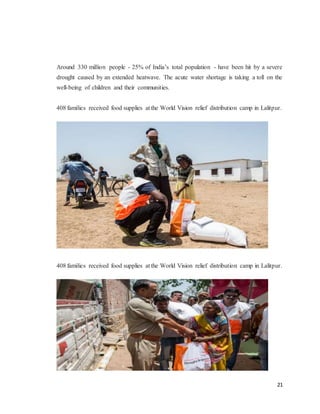
Around 330 million people - 25% of India’s total population - have been hit by a severe
drought caused by an extended heatwave. The acute water shortage is taking a toll on the
well-being of children and their communities.
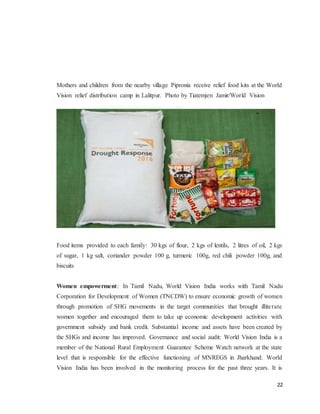
408 families received food supplies at the World Vision relief distribution camp in Lalitpur.
22
Mothers and children from the nearby village Pipronia receive relief food kits at the World
Vision relief distribution camp in Lalitpur. Photo by Tiatemjen Jamir/World Vision
Food items provided to each family: 30 kgs of flour, 2 kgs of lentils, 2 litres of oil, 2 kgs
of sugar, 1 kg salt, coriander powder 100 g, turmeric 100g, red chili powder 100g, and
biscuits
Women empowerment: In Tamil Nadu, World Vision India works with Tamil Nadu
Corporation for Development of Women (TNCDW) to ensure economic growth of women
through promotion of SHG movements in the target communities that brought illiterate
women together and encouraged them to take up economic development activities with
government subsidy and bank credit. Substantial income and assets have been created by
the SHGs and income has improved. Governance and social audit: World Vision India is a
member of the National Rural Employment Guarantee Scheme Watch network at the state
level that is responsible for the effective functioning of MNREGS in Jharkhand. World
Vision India has been involved in the monitoring process for the past three years. It is
23
recognized as an agency to impart capacity building on social audit and is involved in the
process of social audit at the district level in Godda.
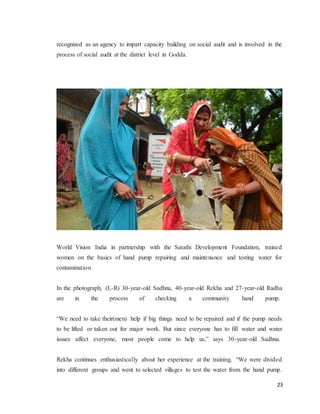
World Vision India in partnership with the Sarathi Development Foundation, trained
women on the basics of hand pump repairing and maintenance and testing water for
contamination.
In the photograph, (L-R) 30-year-old Sadhna, 40-year-old Rekha and 27-year-old Radha
are in the process of checking a community hand pump.
“We need to take their(men) help if big things need to be repaired and if the pump needs
to be lifted or taken out for major work. But since everyone has to fill water and water
issues affect everyone, most people come to help us,” says 30-year-old Sadhna.
Rekha continues enthusiastically about her experience at the training. “We were divided
into different groups and went to selected villages to test the water from the hand pump.
24
The information we got here was really good because we didn’t know how to test water.
In fact, we never even knew that water had to be tested. It was an eye-opening experience
when we saw water, changing colour. To us, water appeared pure and the possibility of it
being impure when it looked clear, never occurred to us. But through this we found out
which taps have good water and which sources are polluted.
The women initially thought it was a difficult task to repair a hand pump, but after the
practical sessions, they are more confident in repairing small problems.
“Earlier we depended upon our husband to call the ‘Mistry’ (a man who repairs pumps). It
would take a long time (sometimes months) to get a small job done. It would also be very
costly. The most important thing we learnt in this training was that sometimes the problem
in the hand pump was a very simple one and could be fixed easily. Especially during times
when there is water scarcity, if one hand pump is out of order it puts a lot of pressure on
the other ones. Now we just open it up and see what the problem is. If the chain has to be
changed we just change it. I have repaired my personal hand pump at home on several
occasions now and saved a lot of money in the process,” says Rekha (40).
Vocational training and Employment: Premamaya ADP, Hyderabad, in alliance with Dr.
Reddy’s Foundation, provided training for youth and helped them to find employment.
From the community, 70 youth aged 18 to 35 years, who were dropouts after their 10th
class, were selected and trained in three different trades such as CRS (Customer Relation
Services), MIT (Micro Irrigation Technician) and ITES (Information Technology Enabled
Services). After the training, 63 youth were placed in various companies and a follow up
was also provided by the foundation to help aspirants cope with the challenges of the
working environment until they stabilised in their new jobs. World Vision India, in
partnership with CEDMAP and IGNOU in Jabalpur, Madhya Pradesh has helped
unemployed youth and school dropouts find purpose in their lives through sessions for
them. CEDMAP is an autonomous, not-for profit agency that promotes entrepreneurship
in all spheres of society in Madhya Pradesh and Chhattisgarh states. In addition to this,
World Vision India is working with IL&FS (Infrastructure Leasing & Financial Services)
Cluster Development Initiative Ltd., which conducts a one month free residential training
25
programme on industrial sewing machines. The 75 youth who were employed through the
World Vision India-IL&FS joint venture, are pursuing a safe and secure future.
Livelihood Promotion: World Vision India partnered with Maple (Orgtech) to promote
organic farming, animal husbandry and pisciculture using Effective Microorganism (EM)
Technology. In partnership with Prasari in Kolkata, System of Rice Intensification (SRI)
method of paddy cultivation has been promoted in the communities.
National Alliance & Networks
World Vision India is currently part of 17 national level networks that play a vital role in
influencing policies, implementation process and governance accountable to child
wellbeing determining a sustainable approach. World Vision India is part of the steering
committee and governing board of some of the networks. 4.1 Protect and Promote Child
Rights World Vision India is one of the members of INDIA ALLIANCE FOR CHILD
RIGHTS (IACR), a countrywide alliance of networks and concerned individuals working
for the realization of the rights of children. World Vision India and IACR jointly organized
12 state level Child Rights Assemblies. The goal of the Child Rights Assembly is to
empower children to advocate for their rights. World Vision India is one of the board
members of the National Coalition for Education (NCE), a network that was effectively
involved in passing the Right to Education (RTE) act and lobbying to the government for
adequate budget to promote child education. Though the RTE Act was passed in 2009, the
budget allocated is inadequate and the NCE advocates for it. Apart from advocating with
the government, the network provides legal literacy training to communities on RTE.
World Vision India partnered with Lawyer’s Collective and connected it to its operational
areas spread across the country. The network educated communities on their rights through
legal literacy programs and also rendered support to communities by providing them with
legal aid and addressing the issues thereon.
World Vision India is advocating for a fair share in the nation’s Union Budget for
programs related to children. As the Government of India was gearing up to announce the
budget for the year 2011-12, World Vision India was trying to influence the process at
different levels through various media. The People’s Budget Initiative is a group of CWorld
26
Vision India that reviewed the budget and educated the various stakeholders at the national
and state level. The People’s Budget Initiative is coordinated by the Centre for Budget
Governance and Accountability (CBGA) and World Vision India played an active role in
this group. Child Health Now (CHN) campaign is World Vision India’s first global
campaign focused on a single issue; viz., reducing the preventable deaths of children under
five. In India, the campaign stressed on the need to work together to achieve two-third
reduction in child mortality rate by 2015, in line with MDG 4. The campaign has been
launched in seven states, Rajasthan, Madhya Pradesh, Chattisgarh, Jharkhand, Orissa,
Bihar, Uttar Pradesh. There are state level core groups set up in all these states comprising
of individuals and CWorld Vision India.
World Vision India is a member of Juvenile Justice National Desk (JJND) which advocates
for child rights. The initiative has been taken up to bring together the experiences of
implementation of the Juvenile Justice (JJ) Act across the nation. World Vision India, along
with three other networks Wada Na Todo Abhiyan (WNTA - Don’t break your Promises
campaign) People’s Action for Rural Awakening (PARA) and National Coalition for
Education, published a book called ‘Then Your Promise, Now Our Right’. The book
consolidates the work done by children in exercising their right to participation and
citizenship. It narrates how children have demanded governance accountability from the
state. It gives an overview of the infrastructure facilities of 3,677 schools and 3,810
anganwadis spread over 16 states in 57 parliamentary constituencies, 120 assembly
constituencies, over 1,000 villages. It is indeed the labour of around 20,000 children across
India who conducted a research study at primary schools and anganwadis in 16 states of
the country. This score card portrays a real picture of the government’s preparedness on
implementation of the RTE Act. It was also submitted to the Minister of Women and Child
Development, Government of India. This was brought out for all children, and in particular,
for children with disabilities who had lost out on education and health due to lack of access
and adequate infrastructural facilities in schools and anganwadi centres.
HIV and AIDS International Treatment Preparedness Coalition (ITPC) is a global
movement in which World Vision India is a member in India since 2009. It’s a collective
voice advocating for free access to treatment for People Living with HIV (PLHIV). The
urgency of this movement came to existence at a time when the treatment remained
27
unavailable for the vast majority of millions of people living with HIV in India. Recently,
the network addressed the issue of drug phase out and monitored the implementation
process across India. In six states, namely Tamil Nadu, Karnataka, Andhra Pradesh,
Maharashtra, Manipur and Assam, World Vision India, along with ten other stakeholders
including PLHAs, successfully urged the government to phase out Stavudine (d4T) drug
as per World Health Organization guidelines through media roundtable meets. The network
initiated a campaign addressing the issue to influence the government in taking necessary
steps. Nearly 3,000 people from all across India went on a rally in Delhi raising a voice
against patent rights for medicine, which is the basic right for victims of HIV and AIDS.
World Vision India contributed and made an effort to organise nearly 450 members to raise
their voice on this issue. In coalition with the Positive Women Network (PWN) and the
Indian Network for People Living with HIV and AIDS, World Vision India has brought
out a Charter of Demands for children and PLHIV. The charter was released in Chennai,
Tamil Nadu and presented during the media round table in the remaining five states. World
Vision India is also the member of the National Coalition for the HIV and AIDS Bill,
lobbying with the government to pass the HIV and AIDS Bill. The Act will serve as a legal
instrument for PLHA in seeking justice. The network sensitised different groups like
parliamentarians and the media to respond. Media roundtables were organised in nine
locations across the country on this issue. Different stakeholders and children from the
communities were provided the platform to interact with the media and addressed their
concerns as well as issues. Also, the alliance with Christian HIV and AIDS National
Alliance (CANA) has influenced churches and Christian organisations to address the issue
of HIV and AIDS. Most churches remain passive and are not comfortable talking about it.
Many times they have failed to accept the drug user and have viewed him as an anti-social
element. World Vision India conducted routine workshops and activities for pastors,
directors and deacon boards in stressing the need for taking initiative for HIV and AIDS
prevention programmes.
The ‘HIV friendly initiative’ workshop was organised to bring these institutions to a
realisation that they need to respond to the crisis and be a ‘HIV friendly institution’. Some
churches started talking about this issue openly to their congregation and visiting PLHIVs
at their homes, both within the church and outside.
28
Combat against Poverty World Vision India is a steering committee member of WNTA, a
network that holds the government accountable to its promise to end poverty, social
exclusion and discrimination. World Vision India is also a steering committee member of
Micah Challenge, a global coalition of Christian organisations aimed at supporting
churches and deepening Christian commitment to the poor. World Vision India supported
the initiative of Micah Challenge on 10th October, 2010 (10.10.10), bringing more than
10,000 supporters of Micah Challenge to Chennai for a one day programme on MDGs.
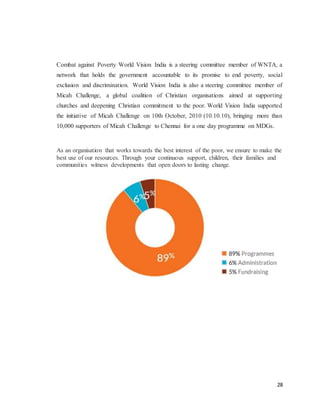
89%6
As an organisation that works towards the best interest of the poor, we ensure to make the
best use of our resources. Through your continuous support, children, their families and
communities witness developments that open doors to lasting change.
29
9. Corporate Social Responsibility by Coca-Cola.
Reiterating its commitment towards building sustainable communities, Coca-Cola,
together with its partners- Hand in Hand India and World Vision India successfully
implemented the Rehabilitation Project to restore communities in 39 flood-affected
villages in Chennai and Kanchipuram districts of Tamil Nadu.
The company had announced commencement of the program in May 2017, sanctioning a
grant amount of US$ 389,000 towards the initiative.
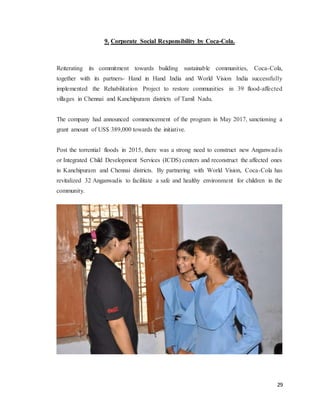
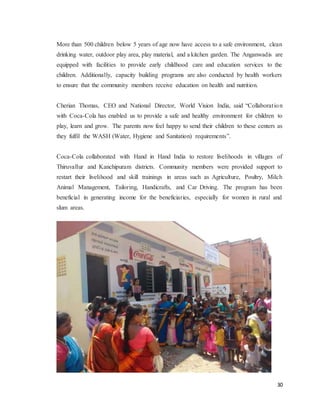
Post the torrential floods in 2015, there was a strong need to construct new Anganwadis
or Integrated Child Development Services (ICDS) centers and reconstruct the affected ones
in Kanchipuram and Chennai districts. By partnering with World Vision, Coca-Cola has
revitalized 32 Anganwadis to facilitate a safe and healthy environment for children in the
community.
30
More than 500 children below 5 years of age now have access to a safe environment, clean
drinking water, outdoor play area, play material, and a kitchen garden. The Anganwadis are
equipped with facilities to provide early childhood care and education services to the
children. Additionally, capacity building programs are also conducted by health workers
to ensure that the community members receive education on health and nutrition.
Cherian Thomas, CEO and National Director, World Vision India, said “Collaboration
with Coca-Cola has enabled us to provide a safe and healthy environment for children to
play, learn and grow. The parents now feel happy to send their children to these centers as
they fulfil the WASH (Water, Hygiene and Sanitation) requirements”.
Coca-Cola collaborated with Hand in Hand India to restore livelihoods in villages of
Thiruvallur and Kanchipuram districts. Community members were provided support to
restart their livelihood and skill trainings in areas such as Agriculture, Poultry, Milch
Animal Management, Tailoring, Handicrafts, and Car Driving. The program has been
beneficial in generating income for the beneficiaries, especially for women in rural and
slum areas.
31
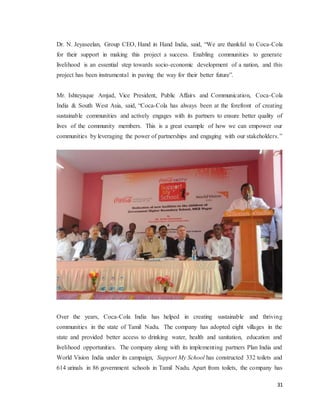
Dr. N. Jeyaseelan, Group CEO, Hand in Hand India, said, “We are thankful to Coca-Cola
for their support in making this project a success. Enabling communities to generate
livelihood is an essential step towards socio-economic development of a nation, and this
project has been instrumental in paving the way for their better future”.
Mr. Ishteyaque Amjad, Vice President, Public Affairs and Communication, Coca-Cola
India & South West Asia, said, “Coca-Cola has always been at the forefront of creating
sustainable communities and actively engages with its partners to ensure better quality of
lives of the community members. This is a great example of how we can empower our
communities by leveraging the power of partnerships and engaging with our stakeholders.”
Over the years, Coca-Cola India has helped in creating sustainable and thriving
communities in the state of Tamil Nadu. The company has adopted eight villages in the
state and provided better access to drinking water, health and sanitation, education and
livelihood opportunities. The company along with its implementing partners Plan India and
World Vision India under its campaign, Support My School has constructed 332 toilets and
614 urinals in 86 government schools in Tamil Nadu. Apart from toilets, the company has
32
developed 17 playgrounds, 74 drinking water stations, 32 filtration systems and installed
10 rainwater-harvesting systems across these schools benefitting almost 60,000 children.
Coca-Cola India is committed to improve livelihood of farmers in the country through its
project Unnati. The project aims to harness the higher productivity potential of mango and
orange farms, allowing owners of small-sized farms to increase crop yields by up to three
times. The project is engaging with farmers at a large scale by providing subsidized plants,
drip irrigation equipment and training on Ultra High Density Plantation, benefitting more
than 22,500 farmers. In Tamil Nadu alone, Project Unnati is targeting to impact about
5,000 farmers holding 10,000 acres land for enhancing Mango productivity.
Coca-Cola India in association with NGO partner World Vision India has flagged off the
second edition of the Support My School campaign.
Launched in January 2018, the campaign aims to create a happy and healthy environment
in schools for children across India by providing basic amenities such as water and proper
toilets for girls and boys, enabling them to study in a cleaner, healthier and a more holistic
environment, said a press release.
Season 1 of the campaign touched the lives of over 43,000 students across 10 States. For
Season 2, the Coca-Cola Foundation has committed $500,000, the release added. The
second edition was flagged off with the dedication of the Government Higher Secondary
School at MKB Nagar, Chennai.
The school has been revitalised with contributions made by campaign partner World Vision
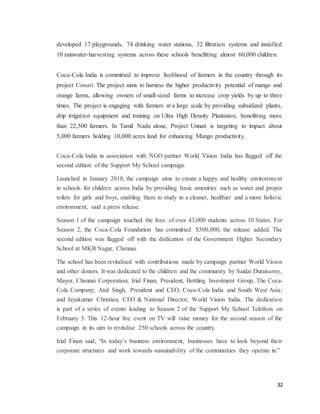
and other donors. It was dedicated to the children and the community by Saidai Duraisamy,
Mayor, Chennai Corporation; Irial Finan, President, Bottling Investment Group, The Coca-
Cola Company; Atul Singh, President and CEO, Coca-Cola India and South West Asia;
and Jayakumar Christian, CEO & National Director, World Vision India. The dedication
is part of a series of events leading to Season 2 of the Support My School Telethon on
February 3. This 12-hour live event on TV will raise money for the second season of the
campaign in its aim to revitalise 250 schools across the country.
Irial Finan said, “In today’s business environment, businesses have to look beyond their
corporate structures and work towards sustainability of the communities they operate in.”
33
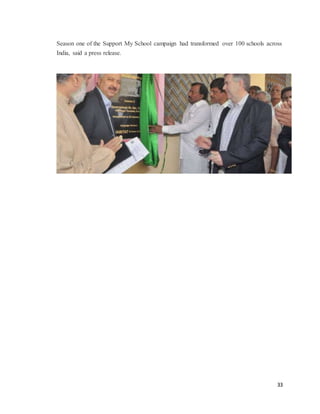
Season one of the Support My School campaign had transformed over 100 schools across
India, said a press release.
34
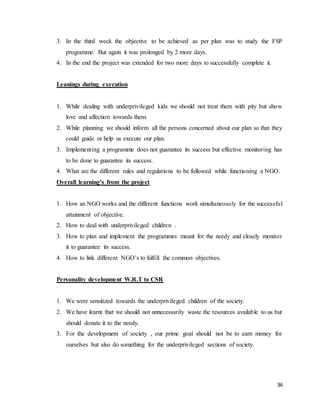
Sector Wise Spending
Resource Utilization
35
Results
1. In depth study of WORLD VISION INDIA Children’s village’s FBC programme and
its functioning was done.
2. The functioning of FSP programme was studied and effective monitoring of the
progranmme being implemented was done.
3. Linkage and Partnerships with NGO and other organization have been built to provide
vocational training and jobs.
4. The study of the NGO with management perspective was done effevtively.
Achievements
1. I got first time experience of teaching the underprivileged children.
2. Got the attention of the NGO towards the fact that the children under the FBC
programme are poor in English and hindi . so adequate care should be taken to ensure
that the external private tution faculty should be such that proper guidance regarding
the above should be given.
Leanings
1. How the different functions of a NGO works.
2. How to make use of optimum resources.
3. How to implement the FSP programme and monitor it.
4. The procedure of bringing a needy child to these kinds of NGO.
Comparison of plan of action with execution
1. The execution for the first week went as per the plan of action.
2. For the second week , the execution was not as per the plan. It took 3 more days than
planned to complete the set objective of studying the FBC programme.
36
3. In the third week the objective to be achieved as per plan was to study the FSP
programme. But again it was prolonged by 2 more days.
4. In the end the project was extended for two more days to successfully complete it.
Leanings during execution
1. While dealing with underprivileged kids we should not treat them with pity but show
love and affection towards them.
2. While planning we should inform all the persons concerned about our plan so that they
could guide or help us execute our plan.
3. Implementing a programme does not guarantee its success but effective monitoring has
to be done to guarantee its success.
4. What are the different rules and regulations to be followed while functioning a NGO.
Overall learning’s from the project
1. How an NGO works and the different functions work simultaneously for the successful
attainment of objective.
2. How to deal with underprivileged children .
3. How to plan and implement the programmes meant for the needy and closely monitor
it to guarantee its success.
4. How to link different NGO’s to fulfill the common objectives.
Personality development W.R.T to CSR
1. We were sensitized towards the underprivileged children of the society.
2. We have learnt that we should not unnecessarily waste the resources available to us but
should donate it to the needy.
3. For the development of society , our prime goal should not be to earn money for
ourselves but also do something for the underprivileged sections of society.
37
10. Recommendations
1. The children at the WORLD VISION INDIA children’s village are poor in English as
their teaching is done mainly in Hindi. So I have given the suggestion of improving
their selection of private tutors, so that the children could improve.
2. Every home at WORLD VISION INDIA children’s village purchases its monthly
ration on its own. as the purchase is done separately for each home, they are missing
the opportunity of availing cash discounts on bulk purchases. So a recommendation
was given to have a centralized ration shop at the NGO.the ration shop should purchase
the whole requirement of the village and can supply it to the individual houses as per
requirement. This will enable them to avail some discount.
3. There should be less no. of children in a WORLD VISION INDIA family. As one
WORLD VISION INDIA mother can't take care of 10 children. She is not able to give
proper attention. For proper development 5 to 6 children should live in a family.
Always there is a burden on elder children to do household work so they are not able
to perform well in studies.
4. In FSP community programme WORLD VISION INDIA provides help for 3 to 5
years. It is not necessary that a family can become self reliant within this time period.
So time period for help should be according to the requirement of families
Weak links in the functioning of the NGO
1. Staff strength and capacities need to be enhanced for FSP to be effective.
2. FSP programme is handled only by a Single person with 120 Families which makes
it difficult to manage.
3. Looking at the current scenario more marketing effort should be done at the
organizational level. As it is require to sustain in near future. More awareness
among people will lead to more funds.
4. There is no proper monitoring of the academic performance of the children
rersiding there.
38
Suggestedareas of Improvement
1. There is no proper system to encourage sports among the children which is required
for the proper mental and physical growth of the children.
2. Improve the teaching pedagogy so as improve the knowledge of children in English
and Hindi. So as to enable them to face the competition prevailing in the society.
39
11. Conclusion
World Vision is a Christian relief, development and advocacy organisation dedicated to
working with children, families and communities worldwide to reach their full potential
by tackling the causes of poverty and injustice. World Vision is dedicated to working with
the world’s most vulnerable people. World Vision serves all people regardless of religion,
race, ethnicity or gender. Child Health Now is World Vision’s five-year global campaign,
active in nearly 50 countries, aiming to accelerate action to end the preventable deaths of
children under five
40
12. Bibliography
1. www.worldvision.in
2. Government of India official website
3. www. parmarthindia.org
4. upstats.com
5. www.google.com
6. www.wikianswers.com

Csr bb

  • 1.
    1 1 Introduction tothe NGO WORLD VISION INDIA Children's Villages is an independent, non-governmental, social development organization that provides family-based care for children in 132 countries and territories and that advocates the concerns, rights and needs of children. Approximately 73 with material, psychological and social support. Approximately 450,000 people benefit from these family support services; some 489,000 people make use of the WORLD VISIO,000 children and young people live in 491 WORLD VISION INDIA Children's Villages and 396 WORLD VISION INDIA Youth Facilities around the world. More than 174,000 children and young people attend WORLD VISION INDIA Hermann Greener Schools, WORLD VISION INDIA Kindergartens and WORLD VISION INDIA Vocational Training Centers. Moreover, WORLD VISION INDIA Children's Villages provides families N INDIA Medical Centers. In times of crisis and disaster, WORLD VISION INDIA Children's Villages helps through emergency relief programs. World Vision is one of the world’s leading child-focused humanitarian organizations. Through development, relief and advocacy, we pursue fullness of life for every child by serving the poor and oppressed regardless of religion, race, ethnicity or gender as a demonstration of God’s unconditional love for all people. With nearly 65 years of experience in India, World Vision India works in 185 districts impacting 26 lakh children and their families in over 6200 communities spread across 25 states and the National Capital Region of India. We work along with children, families and communities to address issues of health, nutrition, water, sanitation & hygiene, education, child protection, climate change, gender, disability and humanitarian emergencies in partnership with governments, civil society, donors and corporates.
  • 2.
    2 2 About TheOrganization In adult life we reveal how we fared in childhood. The quality of childhood is critical – as a help or hindrance in later life. What set the stage for our future development – loss and hurt, or love and respect? Although we all know that childhood is decisive, children are still ignored, manipulated, abused and abandoned. At WORLD VISION INDIA Children’s Villages we are committed to the welfare of children – often throughout the whole of their childhood – and to strengthening families and communities as a preventive measure in the fight against abandonment and social neglect. It is a truly difficult – but also rewarding – task for an organization to seek to restore the balance in life for abandoned, destitute, and spiritually and physically traumatized children, to pick them up when crisis brings them down, to give them individual support, to take them by the hand on the road from childhood to adulthood. The influence of childhood on adults applies equally to us as an organization with its own special history. The beginnings of WORLD VISION INDIA Children’s Villages are decisive for our further development, but as we „grow up “the yardstick for our endeavor and the future the challenge. It is this synthesis of the traditional and the modern, of
  • 3.
    3 professionalism and compassionthat guides WORLD VISION INDIA Children’s Villages in meeting the responsibilities it has assumed for thousands of children and young adults. The mission statement of WORLD VISION INDIA Children’s Villages defines the general framework, our motivation and commitment to genuine social change that will benefit children worldwide. That is our vision, which we are working to achieve step by step, to help children enjoy their right to a childhood and to healthy development, through a family, through security, through love and respect. What (World Vision India) WVI Children's Villages stands for - A loving home for every child The first WORLD VISION INDIA Children‘s Village was founded by Hermann Gmeiner in 1949 in Imst, Austria. He was committed to helping children in need – children who had lost their homes, their security and their families as a result of the Second World War. With the support of many donors and co-workers, our organization has grown to help children all over the world. We take action for children as an independent nongovernmental social development organization. We respect varying religions and cultures, and we work in countries and communities where our mission can contribute to development. We work in the spirit of the United Nations Convention on the Rights of the Child and we promote these rights around the world. “Mother is the name for God in the lips and hearts of little children.” Gmeiner's concept was based on four main aspects: every child needs the care of a parent who establishes a close relationship with each child. The children grow up in a family with girls and boys of different ages as their siblings. The family is part of a community that functions as a support system. Biological siblings are not separated if possible and if this is in the children's best interests. The model of the "classic" WORLD VISION INDIA Children's Village has been and will continue to be modified and adapted to local conditions and requirements. There are now, for example, WORLD VISION INDIA Children's Villages that have been integrated into housing estates, short and medium-term care places and assisted living facilities for young people.
  • 4.
    4 Even though thenumber of orphans is decreasing in many countries, the number of children who, for various reasons, cannot live with their biological parents is increasing. This concerns an estimated 150 million children worldwide. WORLD VISION INDIA Children's Villages continuously works on developing child care methods and preventive support for families to be able to respond to the continually-changing requirements. In this development process, community-based programmers aimed at preventing the marginalization of children in society play a key role. With its family strengthening programs, WORLD VISION INDIA Children's Villages aims to help families to support themselves in the long term, leading an independent life and raising children in a healthy and protected environment. This is the only way we can assure that children are not abandoned and can grow up with their family of origin. In many countries we have for years provided comprehensive support services regarding nutrition, health, education and child care, which aim to support women and families in particular. Within this support process, solidarity and self-help among women, families and communities are very important issues. Community projects, such as child care that the beneficiaries themselves have organized, serve as a clear relief and protect families. WORLD VISION INDIA Children's Villages has a consulting function in the UN Economic and Social Council and is, among others, a member of the Child Rights Action Group that supports the EU Child Rights Strategy.
  • 5.
    5 3.Objectives of NGO Withthe WORLD VISION INDIA Children‘s Village concept, our organization pioneered a family approach to the long-term care of orphaned and abandoned children. This concept is based on four principles: The Mother - Each child has a caring parent The WORLD VISION INDIA mother builds a close relationship with every child entrusted to her, and provides the security, love and stability that each child needs. As a child-care professional, she lives together with the children, guides their development, and runs her household independently. She recognizes and respects each child‘s family background, cultural roots and religion. Brothers and Sisters - Family ties grow naturally Girls and boys of different ages live together as brothers and sisters, with natural brothers and sisters always staying within the same WORLD VISION INDIA family. These children and their WORLD VISION INDIA mother build emotional ties that last a lifetime. The House - Each family creates its own home The house is the family‘s home, with its own unique feeling, rhythm and routine. Under its roof, children enjoy a real sense of security and belonging. Children grow and learn together, sharing responsibilities and all the joys and sorrows of daily life. The Village - The WORLD VISION INDIA family is a part of the community WORLD VISION INDIA families live together, forming a supportive village environment where children enjoy a happy childhood. The families share experiences and offer one another a helping hand. They also live as integrated and contributing members of the local community. Through his or her family, village and community.
  • 6.
    6 4. Problem Statement TheAchievements and success of NGOs in various fields and the excellent work done by them in specific areas is no doubt a tremendous task that has helped to meet the changing needs of the social system. However, in spite of its achievements in various fields, NGOs are facing different problems which differ from organization to organization, region to region. Some of the NGOs in India are facing the following major problems: 1 Lacks of funds – Most of the NGOs in India are suffering from paucity of funds. Government does not give cent percent grants in aid or make delay in sanctions of grants for numerous programs. NGOs have to make matching contributions which they are sometimes unable to manage and are, therefore, unable to avail themselves of the grants. 2. Inadequate Trained Personnel – It is believed that the personnel working in NGOs may be of personnel working in such organizations is a sense of dedication and commitment and interest in the social services. 3. Misuse of Funds – It is a common experience that there have been serious charges of misuse And misappropriation of funds received as grant-in-aid form the government, foreign donors and raised through their own resources by the most of the NGOs. These NGOs may reflect its image to other NGOs who are working with dedication and commitment. 4. Inequality in rural areas – NGOs are more developed in urban areas as compared to rural areas. The backwardness and ignorance of the rural people and lack of enthusiasm among social workers to among them in the absence of availability of minimum comforts are the two important reasons for the backwardness of the NGOs in rural areas.
  • 7.
    7 5. Lack ofVolunteerism/Social work among Youth – The basic characteristic of NGO is volunteerism. In early days, youth are making their career in volunteerism but that enthusiasm seems to have faded these days. The extent of volunteerism is declining day by day and turning it into professionalization. Even the young graduates from social work are interested in making their career in professionalism. This leads to lack of efficient volunteers in NGOs. The following are the suggested remedies to the problems of the NGOs in India. 1. The government of India should liberalize the rules and regulations of grants-in-aid and to sanction more grants to NGOs. At the same time, the government should appoint commissions of enquiry or committees to cross check the misuse of funds by NGOs. The member of committee has to supervise and monitor the activities of NGOs periodically. 2. Young graduates from universities, colleges and schools should conduct the public seminars, meetings etc., and use the local media to advertise the importance of volunteerism, success stories of NGOs and encourage people to participate in voluntarism. 3. At the same time, universities, colleges and schools should collaborate with NGOs and conduct a campus interviews for the young graduates who are interested in voluntarism. NSS and NCC should encourage students to participate in voluntarism from childhood days onwards. 4. In India, 65% of populations belong to rural areas. NGOs, therefore, need to operate in rural areas on a bigger scale to enlist the cooperation of village people in making their lives better. At the same time, these NGOs should encourage the educated young graduates of rural areas to participate in voluntarism. The government should also give some special provisions for NGOs who are working in rural areas in getting eligibility conditions for grants. 5. NGOs being a welfare organization should maintain high standard of quality in service. The government also should recognize those NGOs, by giving awards or rewards with additional grants. This would motivate the other NGOs to work efficiently
  • 8.
    8 6. The governmentshould revise the pay-scales and allowances to the personnel of NGOs. At the same time some special funds to be allotted for the NGOs to train the personnel at the grass root level. 7. The NGOs should use of latest technologies like internet, websites etc., for raising of their funds, to have mutual associations, to advertise their products and for the selection of efficient personals. NGOs are the ones who really intend to care the uncared sections and the people at the bottom of the social stratum. Ours is a developing country which requires these type of committed, devoted and dedicated organizations for the development of the country. So, the government, the leaders, the donors, the politicians and the people should support these organizations and help them to solve their problems at the grass-root level. Then only we can do something for the poor, for the needy! I have done my bit, now it’s your turn. Always remember
  • 9.
    9 5. Function WiseStudy RESOURCE MANAGEMENT: NGOS are nonprofit making, non-government organization. No fund is available from government. So there is a limited budget available for expenditures. They use their resources in better manner. According to the requirement they do manpower planning and pay scale is lower than other organizations. Most of the appointments are on permanent basis so that money spend in training would not be waste. So we learn how to do optimum utilization of resources. ORGANIZATION STRUCTURE: WVI follows a particular hierarchy. Village Director is the head of WVI village and all other coworkers work under Director. Their responsibilities are well defined ie. Organization structure is transient enough. But all WVI workers are interlinked with each other in their work as they all have same goal in mind to do the betterment of children. This gives me the learning that how to coordinate with others while working in an organization. OPERATIONS: WVI Children's village is committed to long term care of less privileged children of society. As their area of operations is for betterment of children. This organization is expanding its services through community project for the benefit of children of nearby community. Success of FSP (community program) proves how efficient this organization is in operations HR POLICIES: In WVI manpower planning is done by HR Head in Delhi. For each post there is a defined training period which makes employee more efficient. Their recruitment policies are clear, even in manual we can get the job profile and job description of each post. Village Director send performance appraisal to the National Director. i.e. HR policies should be well defined. Training plays an important role in developing organization as a whole.
  • 10.
    10 MARKETING EFFORTS: Thereis a PFR department for marketing of WVI. They form their marketing strategy in such a way that they touch emotional cord of people. i.e. their strategy is centered to fulfillment of aim ( to raise funds). PPM Planning Planning is done mainly by the secretary and the director of the organization. For each project the plan is prepared in attendance of the project coordinators and project workers. Planning is very strong in the organization. Each plan is made by taking in account the objective of the organization. Plan covers all area of operation and all members are involved in the planning process Organizing After drawing out the plan the director delegates the responsibilities of a particular area to a project coordinator who is responsible to answer about the progress of the plan. Project coordinators are responsible to answer to director. Leading Leading is done all through the process. Coordinators lead the workers and the director leads the coordinators. Coordinators take care of the problems faced by the workers and communicate director about them who tries to solve the problems of workers. Workers move through the area and discuss the problem with villagers. after discussing the problems activists discuss the issues with the coordinators, if the problem needs a basic level improvement or action the coordinator takes the decision himself otherwise he/she approaches the director who has ultimately most of the power regarding operations and takes major decisions, however he is responsible to answer to the secretary of the organization who ultimately follows board of directors
  • 11.
    11 Applicability of scientificmanagement theory: In case of an NGO scientific management theory plays a vital role. According to scientific management theory the system must be transparent and that helps out the NGO workers in a way that the director draws a master plan for the project and convokes a meeting of the project workers along with project coordinator and communicates the basic responsibilities, obligation process and rewards for achievements. This motivation helps the employee to work effectively and efficiently. The system increases the pace of operations because employee has a clear understanding what exactly they are supposed to do and how. Financial Management: Financial policy is a tool as well as a measure for the standards of accountability of WVI. Good financial policy enables the fulfillment of the vision of WVI. The nobler the vision, the higher the standards of accountability will be. Transparency and high standards of accountability can be infused only if there is a sound financial policy. Rather Financial Policies are not disclosed by the organization but are mentioned. Guiding principles of WVI financial policy: A creative, honest and use of resources. Optimum utilization of the above resources Creative investments of the funds High accountability standards. A professional system of reporting, monitoring and evaluation. Training of Finance Staff:
  • 12.
    12 The Finance staffwill be provided with orientation, refresher courses and workshops on a continuing basis, since there is need for constant up gradation of skills in finances. This measure improves the quality of the accounting standards and therefore will promote better financial managements.
  • 13.
    13 6. REVIEW OFLITRATURE The following are the suggested remedies to the problems of the NGOs in India. 1. The government of India should liberalize the rules and regulations of grants-in-aid and to sanction more grants to NGOs. At the same time, the government should appoint commissions of enquiry or committees to cross check the misuse of funds by NGOs. The member of committee has to supervise and monitor the activities of NGOs periodically. 2. Young graduates from universities, colleges and schools should conduct the public seminars, meetings etc., and use the local media to advertise the importance of volunteerism, success stories of NGOs and encourage people to participate in voluntarism. 3. At the same time, universities, colleges and schools should collaborate with NGOs and conduct a campus interviews for the young graduates who are interested in voluntarism. NSS and NCC should encourage students to participate in voluntarism from childhood days onwards. 4. In India, 65% of populations belong to rural areas. NGOs, therefore, need to operate in rural areas on a bigger scale to enlist the cooperation of village people in making their lives better. At the same time, these NGOs should encourage the educated young graduates of rural areas to participate in voluntarism. The government should also give some special provisions for NGOs who are working in rural areas in getting eligibility conditions for grants. 5. NGOs being a welfare organization should maintain high standard of quality in service. The government also should recognize those NGOs, by giving awards or rewards with additional grants. This would motivate the other NGOs to work efficiently
  • 14.
    14 6. The governmentshould revise the pay-scales and allowances to the personnel of NGOs. At the same time some special funds to be allotted for the NGOs to train the personnel at the grass root level. 7. The NGOs should use of latest technologies like internet, websites etc., for raising of their funds, to have mutual associations, to advertise their products and for the selection of efficient personals. 7. METHODOLOGY Formation of Problem: “A Study CSR of World Vision(NGO) In India” Methods of collection of data: Secondary Data Research Instruments: Press release, magazines, journals
  • 15.
    15 8. STRAGIC ALLIANCE Strategicalliance has historically been an imperative means for NGOs in institutionalizing change; in part because of exchanging information, sharing of knowledge, resources and advocacy. It’s one of the influencing strategies that World Vision India has been using in the recent years, which has enhanced the working relationship with the government and other agencies. Recognizing the importance of strategic alliance, World Vision India, under its country strategy (2008-2011), decided to leverage strategic alliance to enhance its impact and influence primarily CWorld Vision India including NGOs, FBOs, CBOs and other government agencies. The focus has been to create a critical mass of community leaders committed to the well- being of children and strengthen non-exploitative linkages with key development stakeholders who strive hard towards the Millennium Development Goals (MDGs) – well- being of every girl and boy, sustainable livelihood security, access to water, peace building and reconciliation, prevent and mitigate HIV and AIDS and TB, organizational effectiveness, expand engagement with all stakeholders, including donors for mutual transformation. World Vision India’s efforts under strategic alliances include leveraging resources, maximizing the impact, monitoring quality, effectiveness and implementation of public policies and legislation, influencing policies towards facilitating the rights of the most vulnerable, especially children’s right to survival, development participation and protection. In addition to the above, our journey with the Indian and multi-national corporates has been an enriching experience. It started on a relationship model and at present is thriving on a partnership model. World Vision’s presence across more than 5000 communities, our network and reach has given us a unique edge over other charities in taking CSR programs to multiple locations with multiple models of engagement. In recent past, our partnership model matured with corporates like Coke, BMW and Maersk in addition to our engagement with more than 10 Small and Medium Enterprises. For these enterprises, Corporate Social Responsibility is
  • 16.
    16 new and theylook forward to this journey in understanding and integrating social responsibility into their business model. World Vision engages with the local churches in the target areas to strengthen them to take responsibility for the poor in their neighborhood by motivating and mobilizing them, to speak out for the cause of the poor to the policy makers of the nation. Grassroots Alliances & Networks Highlights of alliances- • Government Industrial Training Institutes opened way for unemployed youth to be trained in various trades. • Girls were trained in nursing and employed by hospitals and health centers. • Integrated Child Development Services supported children and mothers in nutrition development. • Public Health Centers and District Health Department in immunization of children. • District AIDS Control Societies in prevention and care of People Living with HIV and AIDS. • District Legal Services Authority in ensuring child protection. The partnership at the grass root level has helped World Vision India move closer towards its vision of bringing fullness of life to children and communities. At present, there are more than 4,500 alliances/networks established at both the block and the district level, primarily with government departments, CWorld Vision India, the private sector, CBOs and FBOs. These alliances covered various aspects of program planning, implementation, monitoring, technical support, capacity building and advocacy. It has brought about change
  • 17.
    17 in more than200,000 families in the last two years in the areas of quality education, health, advocating for justice, and facilitating economic and social empowerment Government Agencies More than half of the alliances that World Vision India is involved in are with the government. These include the block and district administration, Agriculture and Forest Department for implementation of the Agriculture program , District Rural Development Agency (DRDA) for development programs, District Health Department for health programs, National Insurance Company for livestock insurance, Centre for Water and Soil Conservation and Research Institute for watershed programs, Human Resource Development Centre for capacity building programs to CBOs, District Social Welfare Department, banking institutions and self-help groups (SHGs) linkage. The government schemes that World Vision India collaborated with include Mahatma Gandhi National Rural Employment Guarantee Scheme (MNREGS) to address food insecurity, Indira Awaas Yojana (IAY) for providing shelter to rural communities, Sarva Shiksha Abhiyan (SSA) for improving school enrolments and the quality of education etc. Nutrition: World Vision India works in close coordination with the Integrated Child Development Services (ICDS) department to provide support in capacity building of anganwadi workers (AWWs), infrastructure development and improving the quality of services. This has helped World Vision India focus on issues pertaining to malnutrition, immunization, birth spacing and other health services that affect the health of children. Joint meetings with ICDS along with local governance agencies are held regularly. SHGs are trained in monitoring the services of ICDS and the health department at the community level. In Baran, Rajasthan, World Vision India remodelled the anganwadi centre (AWC) into a child friendly and educative space, both inside and outside. Based on this model, the Government of Rajasthan invited World Vision India to replicate it in neighbouring villages. World Vision India helped in strengthening the capacity of AWWs, provided technical support and helped in monitoring 60 ICDS centres in 40 villages of Baran district. The model centre was colourfully painted with pictorial stories, Hindi and English letters of the alphabet, numbers and other learning material. The centre is also equipped with recreational material such as swings, sliders, searockers, etc. It is designed to sensitise the community on health and nutrition for children and women. The growth monitoring chart painted on the walls of the centre helps parents to track the nutritional status of children in
  • 18.
    18 their community. Theouter walls are painted with pictures to create awareness about the importance of adopting appropriate health behaviour. Health: Alliance with the District Health Department helped World Vision India in not only achieving its objectives such as improved antenatal care and postnatal care to women, immunisation for children but also ensuring sustainability of the interventions. Partnership with the District Positive People’s Network (DPPN) helped People Living with HIV access better medical care and support. Partnership with Family Planning Association of India helps programmes to monitor the health status of children and women in the community. Alliance with the District Rural Development Agency (DRDA) and the District Health Department helped provide disability certificates and travel passes to people with disabilities. Sanitation: Sanitizing the communities on sanitation is a key intervention in ensuring a healthy environment, especially in rural communities. World Vision India, along with DRDA, implemented various community based education programmes to bring about behaviour change in communities. Agriculture and Livelihood: Strategic alliance developed with Krishi Vigyan Kendra (KVK) and Agricultural Technology and Management Authority (ATMA) helped farmers build their capacity on new agriculture technologies, modern farming and agriculture practices. KVK provides technical guidance on watershed management and facilitates training for SHGs. In Nirman ADP, Orissa, the main livelihood activities are paddy cultivation, fish culture and pan leaf cultivation. Almost 75 percent of the marginal farmers have 0.5 to two acres of agricultural land and cultivate paddy. However, the yield is low as the soil salinity is high. The ADP networked with ATMA and Central Rice Research Institute (CRRI), Cuttack and trained farmers on modern farming. The KVK provided five kg of free seeds to 35 farmers who had produced good results in spite of saline water. In partnership with the Gazole Block Agriculture Department, Malda ADP provided training to farmers in utilizing modern techniques and methods of farming. Good Agricultural Practices (GAP) trainings were organised in collaboration with the agricultural and horticultural departments. Education: In India, although the enrolment rate in primary schools is high, the quality of education is a critical issue because 84 percent of the primary schools are multi-graded, which means one teacher handles more than one grade in a single classroom.
  • 19.
    19 Unless there isa child friendly environment, it is difficult to impart quality education for children to achieve learning outcomes such as learning to read, write and use numeracy skills, social skills, manage emotions and communicate ideas. In the states of Madhya Pradesh and Chattisgarh, World Vision India is working with the local Education Department on the Multi Grade & Multi Level (MGML) model which is approved by UNESCO. Civil Society Organisations World Vision India works closely with the local CWorld Vision India to maximize the impact of its interventions. In Melghat, Maharashtra, World Vision India jointly organised initiatives such as the postcard campaign, advocating for land rights and forest rights to help communities claim their rights from the duty bearers. Training on Conflict Analysis programming was conducted across the country in Tripura, Imphal, Guwahati, Mayurbhanj, Siliguri, Bhubaneswar, Hyderabad, Ratlam, Indore and Dumka which helped the participants recognize that most people even in conflict zones are engaged in normal peaceful activities and have indigenous capacities for resolving conflicts and connecting people in constructive ways. World Vision India is an active partner of Child Line India Foundation (CIF) since its inception in Chennai. It works towards ensuring that all children in need of care and protection have access to services that are child friendly and encourages them to participate in decisions that affect them. It’s a 24-hours helpline that responds to the need of children in distress. The rescued children are connected to their families and NGOs for further rehabilitation services. The ANTI TRAFFICKING NETWORK (ATN) in Siliguri, West Bengal, initiated by World Vision India brings together police, media, the local government, communities, NGOs to address the issue of child trafficking. Siliguri is a strategic location bordering three neighbouring countries - Bhutan, Nepal and Bangladesh and is a transit point for child trafficking. Disaster Management: Disaster Management groups at the grassroots level have been formed to build the capacity of communities in responding to emergency situations. Alliances with Red Cross Societies and St. John’s Ambulance helped in training
  • 20.
    20 community members toprepare community disaster preparedness plans for emergency situations through training sessions on first aid and mock drills. Capacity Building on Child Rights and Leadership Development: Legal literacy training is considered to be a key intervention in child safety and protection. Duars ADP with technical support of the High Court, Kolkata trained the ADP team and three of the community representatives on Child Rights and laws related to crimes, juvenile justice and trafficking. This has increased the knowledge of the participants and equipped them to take up advocacy issues effectively. Training were conducted in collaboration with PRAYASHAM, a Kolkata based child focused organisation. Mannargudi ADP has formed an alliance with Sanjog, an NGO that specializes in street plays and puppets. Networking with them has educated children and parent/adults on Child Rights. This initiative is more effective than educating through posters and lectures as children and adults enjoy, and at the same time, learn about the rights of the children - survival, development, protection and participation.
  • 21.
    21 Around 330 millionpeople - 25% of India’s total population - have been hit by a severe drought caused by an extended heatwave. The acute water shortage is taking a toll on the well-being of children and their communities. 408 families received food supplies at the World Vision relief distribution camp in Lalitpur. 408 families received food supplies at the World Vision relief distribution camp in Lalitpur.
  • 22.
    22 Mothers and childrenfrom the nearby village Pipronia receive relief food kits at the World Vision relief distribution camp in Lalitpur. Photo by Tiatemjen Jamir/World Vision Food items provided to each family: 30 kgs of flour, 2 kgs of lentils, 2 litres of oil, 2 kgs of sugar, 1 kg salt, coriander powder 100 g, turmeric 100g, red chili powder 100g, and biscuits Women empowerment: In Tamil Nadu, World Vision India works with Tamil Nadu Corporation for Development of Women (TNCDW) to ensure economic growth of women through promotion of SHG movements in the target communities that brought illiterate women together and encouraged them to take up economic development activities with government subsidy and bank credit. Substantial income and assets have been created by the SHGs and income has improved. Governance and social audit: World Vision India is a member of the National Rural Employment Guarantee Scheme Watch network at the state level that is responsible for the effective functioning of MNREGS in Jharkhand. World Vision India has been involved in the monitoring process for the past three years. It is
  • 23.
    23 recognized as anagency to impart capacity building on social audit and is involved in the process of social audit at the district level in Godda. World Vision India in partnership with the Sarathi Development Foundation, trained women on the basics of hand pump repairing and maintenance and testing water for contamination. In the photograph, (L-R) 30-year-old Sadhna, 40-year-old Rekha and 27-year-old Radha are in the process of checking a community hand pump. “We need to take their(men) help if big things need to be repaired and if the pump needs to be lifted or taken out for major work. But since everyone has to fill water and water issues affect everyone, most people come to help us,” says 30-year-old Sadhna. Rekha continues enthusiastically about her experience at the training. “We were divided into different groups and went to selected villages to test the water from the hand pump.
  • 24.
    24 The information wegot here was really good because we didn’t know how to test water. In fact, we never even knew that water had to be tested. It was an eye-opening experience when we saw water, changing colour. To us, water appeared pure and the possibility of it being impure when it looked clear, never occurred to us. But through this we found out which taps have good water and which sources are polluted. The women initially thought it was a difficult task to repair a hand pump, but after the practical sessions, they are more confident in repairing small problems. “Earlier we depended upon our husband to call the ‘Mistry’ (a man who repairs pumps). It would take a long time (sometimes months) to get a small job done. It would also be very costly. The most important thing we learnt in this training was that sometimes the problem in the hand pump was a very simple one and could be fixed easily. Especially during times when there is water scarcity, if one hand pump is out of order it puts a lot of pressure on the other ones. Now we just open it up and see what the problem is. If the chain has to be changed we just change it. I have repaired my personal hand pump at home on several occasions now and saved a lot of money in the process,” says Rekha (40). Vocational training and Employment: Premamaya ADP, Hyderabad, in alliance with Dr. Reddy’s Foundation, provided training for youth and helped them to find employment. From the community, 70 youth aged 18 to 35 years, who were dropouts after their 10th class, were selected and trained in three different trades such as CRS (Customer Relation Services), MIT (Micro Irrigation Technician) and ITES (Information Technology Enabled Services). After the training, 63 youth were placed in various companies and a follow up was also provided by the foundation to help aspirants cope with the challenges of the working environment until they stabilised in their new jobs. World Vision India, in partnership with CEDMAP and IGNOU in Jabalpur, Madhya Pradesh has helped unemployed youth and school dropouts find purpose in their lives through sessions for them. CEDMAP is an autonomous, not-for profit agency that promotes entrepreneurship in all spheres of society in Madhya Pradesh and Chhattisgarh states. In addition to this, World Vision India is working with IL&FS (Infrastructure Leasing & Financial Services) Cluster Development Initiative Ltd., which conducts a one month free residential training
  • 25.
    25 programme on industrialsewing machines. The 75 youth who were employed through the World Vision India-IL&FS joint venture, are pursuing a safe and secure future. Livelihood Promotion: World Vision India partnered with Maple (Orgtech) to promote organic farming, animal husbandry and pisciculture using Effective Microorganism (EM) Technology. In partnership with Prasari in Kolkata, System of Rice Intensification (SRI) method of paddy cultivation has been promoted in the communities. National Alliance & Networks World Vision India is currently part of 17 national level networks that play a vital role in influencing policies, implementation process and governance accountable to child wellbeing determining a sustainable approach. World Vision India is part of the steering committee and governing board of some of the networks. 4.1 Protect and Promote Child Rights World Vision India is one of the members of INDIA ALLIANCE FOR CHILD RIGHTS (IACR), a countrywide alliance of networks and concerned individuals working for the realization of the rights of children. World Vision India and IACR jointly organized 12 state level Child Rights Assemblies. The goal of the Child Rights Assembly is to empower children to advocate for their rights. World Vision India is one of the board members of the National Coalition for Education (NCE), a network that was effectively involved in passing the Right to Education (RTE) act and lobbying to the government for adequate budget to promote child education. Though the RTE Act was passed in 2009, the budget allocated is inadequate and the NCE advocates for it. Apart from advocating with the government, the network provides legal literacy training to communities on RTE. World Vision India partnered with Lawyer’s Collective and connected it to its operational areas spread across the country. The network educated communities on their rights through legal literacy programs and also rendered support to communities by providing them with legal aid and addressing the issues thereon. World Vision India is advocating for a fair share in the nation’s Union Budget for programs related to children. As the Government of India was gearing up to announce the budget for the year 2011-12, World Vision India was trying to influence the process at different levels through various media. The People’s Budget Initiative is a group of CWorld
  • 26.
    26 Vision India thatreviewed the budget and educated the various stakeholders at the national and state level. The People’s Budget Initiative is coordinated by the Centre for Budget Governance and Accountability (CBGA) and World Vision India played an active role in this group. Child Health Now (CHN) campaign is World Vision India’s first global campaign focused on a single issue; viz., reducing the preventable deaths of children under five. In India, the campaign stressed on the need to work together to achieve two-third reduction in child mortality rate by 2015, in line with MDG 4. The campaign has been launched in seven states, Rajasthan, Madhya Pradesh, Chattisgarh, Jharkhand, Orissa, Bihar, Uttar Pradesh. There are state level core groups set up in all these states comprising of individuals and CWorld Vision India. World Vision India is a member of Juvenile Justice National Desk (JJND) which advocates for child rights. The initiative has been taken up to bring together the experiences of implementation of the Juvenile Justice (JJ) Act across the nation. World Vision India, along with three other networks Wada Na Todo Abhiyan (WNTA - Don’t break your Promises campaign) People’s Action for Rural Awakening (PARA) and National Coalition for Education, published a book called ‘Then Your Promise, Now Our Right’. The book consolidates the work done by children in exercising their right to participation and citizenship. It narrates how children have demanded governance accountability from the state. It gives an overview of the infrastructure facilities of 3,677 schools and 3,810 anganwadis spread over 16 states in 57 parliamentary constituencies, 120 assembly constituencies, over 1,000 villages. It is indeed the labour of around 20,000 children across India who conducted a research study at primary schools and anganwadis in 16 states of the country. This score card portrays a real picture of the government’s preparedness on implementation of the RTE Act. It was also submitted to the Minister of Women and Child Development, Government of India. This was brought out for all children, and in particular, for children with disabilities who had lost out on education and health due to lack of access and adequate infrastructural facilities in schools and anganwadi centres. HIV and AIDS International Treatment Preparedness Coalition (ITPC) is a global movement in which World Vision India is a member in India since 2009. It’s a collective voice advocating for free access to treatment for People Living with HIV (PLHIV). The urgency of this movement came to existence at a time when the treatment remained
  • 27.
    27 unavailable for thevast majority of millions of people living with HIV in India. Recently, the network addressed the issue of drug phase out and monitored the implementation process across India. In six states, namely Tamil Nadu, Karnataka, Andhra Pradesh, Maharashtra, Manipur and Assam, World Vision India, along with ten other stakeholders including PLHAs, successfully urged the government to phase out Stavudine (d4T) drug as per World Health Organization guidelines through media roundtable meets. The network initiated a campaign addressing the issue to influence the government in taking necessary steps. Nearly 3,000 people from all across India went on a rally in Delhi raising a voice against patent rights for medicine, which is the basic right for victims of HIV and AIDS. World Vision India contributed and made an effort to organise nearly 450 members to raise their voice on this issue. In coalition with the Positive Women Network (PWN) and the Indian Network for People Living with HIV and AIDS, World Vision India has brought out a Charter of Demands for children and PLHIV. The charter was released in Chennai, Tamil Nadu and presented during the media round table in the remaining five states. World Vision India is also the member of the National Coalition for the HIV and AIDS Bill, lobbying with the government to pass the HIV and AIDS Bill. The Act will serve as a legal instrument for PLHA in seeking justice. The network sensitised different groups like parliamentarians and the media to respond. Media roundtables were organised in nine locations across the country on this issue. Different stakeholders and children from the communities were provided the platform to interact with the media and addressed their concerns as well as issues. Also, the alliance with Christian HIV and AIDS National Alliance (CANA) has influenced churches and Christian organisations to address the issue of HIV and AIDS. Most churches remain passive and are not comfortable talking about it. Many times they have failed to accept the drug user and have viewed him as an anti-social element. World Vision India conducted routine workshops and activities for pastors, directors and deacon boards in stressing the need for taking initiative for HIV and AIDS prevention programmes. The ‘HIV friendly initiative’ workshop was organised to bring these institutions to a realisation that they need to respond to the crisis and be a ‘HIV friendly institution’. Some churches started talking about this issue openly to their congregation and visiting PLHIVs at their homes, both within the church and outside.
  • 28.
    28 Combat against PovertyWorld Vision India is a steering committee member of WNTA, a network that holds the government accountable to its promise to end poverty, social exclusion and discrimination. World Vision India is also a steering committee member of Micah Challenge, a global coalition of Christian organisations aimed at supporting churches and deepening Christian commitment to the poor. World Vision India supported the initiative of Micah Challenge on 10th October, 2010 (10.10.10), bringing more than 10,000 supporters of Micah Challenge to Chennai for a one day programme on MDGs. 89%6 As an organisation that works towards the best interest of the poor, we ensure to make the best use of our resources. Through your continuous support, children, their families and communities witness developments that open doors to lasting change.
  • 29.
    29 9. Corporate SocialResponsibility by Coca-Cola. Reiterating its commitment towards building sustainable communities, Coca-Cola, together with its partners- Hand in Hand India and World Vision India successfully implemented the Rehabilitation Project to restore communities in 39 flood-affected villages in Chennai and Kanchipuram districts of Tamil Nadu. The company had announced commencement of the program in May 2017, sanctioning a grant amount of US$ 389,000 towards the initiative. Post the torrential floods in 2015, there was a strong need to construct new Anganwadis or Integrated Child Development Services (ICDS) centers and reconstruct the affected ones in Kanchipuram and Chennai districts. By partnering with World Vision, Coca-Cola has revitalized 32 Anganwadis to facilitate a safe and healthy environment for children in the community.
  • 30.
    30 More than 500children below 5 years of age now have access to a safe environment, clean drinking water, outdoor play area, play material, and a kitchen garden. The Anganwadis are equipped with facilities to provide early childhood care and education services to the children. Additionally, capacity building programs are also conducted by health workers to ensure that the community members receive education on health and nutrition. Cherian Thomas, CEO and National Director, World Vision India, said “Collaboration with Coca-Cola has enabled us to provide a safe and healthy environment for children to play, learn and grow. The parents now feel happy to send their children to these centers as they fulfil the WASH (Water, Hygiene and Sanitation) requirements”. Coca-Cola collaborated with Hand in Hand India to restore livelihoods in villages of Thiruvallur and Kanchipuram districts. Community members were provided support to restart their livelihood and skill trainings in areas such as Agriculture, Poultry, Milch Animal Management, Tailoring, Handicrafts, and Car Driving. The program has been beneficial in generating income for the beneficiaries, especially for women in rural and slum areas.
  • 31.
    31 Dr. N. Jeyaseelan,Group CEO, Hand in Hand India, said, “We are thankful to Coca-Cola for their support in making this project a success. Enabling communities to generate livelihood is an essential step towards socio-economic development of a nation, and this project has been instrumental in paving the way for their better future”. Mr. Ishteyaque Amjad, Vice President, Public Affairs and Communication, Coca-Cola India & South West Asia, said, “Coca-Cola has always been at the forefront of creating sustainable communities and actively engages with its partners to ensure better quality of lives of the community members. This is a great example of how we can empower our communities by leveraging the power of partnerships and engaging with our stakeholders.” Over the years, Coca-Cola India has helped in creating sustainable and thriving communities in the state of Tamil Nadu. The company has adopted eight villages in the state and provided better access to drinking water, health and sanitation, education and livelihood opportunities. The company along with its implementing partners Plan India and World Vision India under its campaign, Support My School has constructed 332 toilets and 614 urinals in 86 government schools in Tamil Nadu. Apart from toilets, the company has
  • 32.
    32 developed 17 playgrounds,74 drinking water stations, 32 filtration systems and installed 10 rainwater-harvesting systems across these schools benefitting almost 60,000 children. Coca-Cola India is committed to improve livelihood of farmers in the country through its project Unnati. The project aims to harness the higher productivity potential of mango and orange farms, allowing owners of small-sized farms to increase crop yields by up to three times. The project is engaging with farmers at a large scale by providing subsidized plants, drip irrigation equipment and training on Ultra High Density Plantation, benefitting more than 22,500 farmers. In Tamil Nadu alone, Project Unnati is targeting to impact about 5,000 farmers holding 10,000 acres land for enhancing Mango productivity. Coca-Cola India in association with NGO partner World Vision India has flagged off the second edition of the Support My School campaign. Launched in January 2018, the campaign aims to create a happy and healthy environment in schools for children across India by providing basic amenities such as water and proper toilets for girls and boys, enabling them to study in a cleaner, healthier and a more holistic environment, said a press release. Season 1 of the campaign touched the lives of over 43,000 students across 10 States. For Season 2, the Coca-Cola Foundation has committed $500,000, the release added. The second edition was flagged off with the dedication of the Government Higher Secondary School at MKB Nagar, Chennai. The school has been revitalised with contributions made by campaign partner World Vision and other donors. It was dedicated to the children and the community by Saidai Duraisamy, Mayor, Chennai Corporation; Irial Finan, President, Bottling Investment Group, The Coca- Cola Company; Atul Singh, President and CEO, Coca-Cola India and South West Asia; and Jayakumar Christian, CEO & National Director, World Vision India. The dedication is part of a series of events leading to Season 2 of the Support My School Telethon on February 3. This 12-hour live event on TV will raise money for the second season of the campaign in its aim to revitalise 250 schools across the country. Irial Finan said, “In today’s business environment, businesses have to look beyond their corporate structures and work towards sustainability of the communities they operate in.”
  • 33.
    33 Season one ofthe Support My School campaign had transformed over 100 schools across India, said a press release.
  • 34.
  • 35.
    35 Results 1. In depthstudy of WORLD VISION INDIA Children’s village’s FBC programme and its functioning was done. 2. The functioning of FSP programme was studied and effective monitoring of the progranmme being implemented was done. 3. Linkage and Partnerships with NGO and other organization have been built to provide vocational training and jobs. 4. The study of the NGO with management perspective was done effevtively. Achievements 1. I got first time experience of teaching the underprivileged children. 2. Got the attention of the NGO towards the fact that the children under the FBC programme are poor in English and hindi . so adequate care should be taken to ensure that the external private tution faculty should be such that proper guidance regarding the above should be given. Leanings 1. How the different functions of a NGO works. 2. How to make use of optimum resources. 3. How to implement the FSP programme and monitor it. 4. The procedure of bringing a needy child to these kinds of NGO. Comparison of plan of action with execution 1. The execution for the first week went as per the plan of action. 2. For the second week , the execution was not as per the plan. It took 3 more days than planned to complete the set objective of studying the FBC programme.
  • 36.
    36 3. In thethird week the objective to be achieved as per plan was to study the FSP programme. But again it was prolonged by 2 more days. 4. In the end the project was extended for two more days to successfully complete it. Leanings during execution 1. While dealing with underprivileged kids we should not treat them with pity but show love and affection towards them. 2. While planning we should inform all the persons concerned about our plan so that they could guide or help us execute our plan. 3. Implementing a programme does not guarantee its success but effective monitoring has to be done to guarantee its success. 4. What are the different rules and regulations to be followed while functioning a NGO. Overall learning’s from the project 1. How an NGO works and the different functions work simultaneously for the successful attainment of objective. 2. How to deal with underprivileged children . 3. How to plan and implement the programmes meant for the needy and closely monitor it to guarantee its success. 4. How to link different NGO’s to fulfill the common objectives. Personality development W.R.T to CSR 1. We were sensitized towards the underprivileged children of the society. 2. We have learnt that we should not unnecessarily waste the resources available to us but should donate it to the needy. 3. For the development of society , our prime goal should not be to earn money for ourselves but also do something for the underprivileged sections of society.
  • 37.
    37 10. Recommendations 1. Thechildren at the WORLD VISION INDIA children’s village are poor in English as their teaching is done mainly in Hindi. So I have given the suggestion of improving their selection of private tutors, so that the children could improve. 2. Every home at WORLD VISION INDIA children’s village purchases its monthly ration on its own. as the purchase is done separately for each home, they are missing the opportunity of availing cash discounts on bulk purchases. So a recommendation was given to have a centralized ration shop at the NGO.the ration shop should purchase the whole requirement of the village and can supply it to the individual houses as per requirement. This will enable them to avail some discount. 3. There should be less no. of children in a WORLD VISION INDIA family. As one WORLD VISION INDIA mother can't take care of 10 children. She is not able to give proper attention. For proper development 5 to 6 children should live in a family. Always there is a burden on elder children to do household work so they are not able to perform well in studies. 4. In FSP community programme WORLD VISION INDIA provides help for 3 to 5 years. It is not necessary that a family can become self reliant within this time period. So time period for help should be according to the requirement of families Weak links in the functioning of the NGO 1. Staff strength and capacities need to be enhanced for FSP to be effective. 2. FSP programme is handled only by a Single person with 120 Families which makes it difficult to manage. 3. Looking at the current scenario more marketing effort should be done at the organizational level. As it is require to sustain in near future. More awareness among people will lead to more funds. 4. There is no proper monitoring of the academic performance of the children rersiding there.
  • 38.
    38 Suggestedareas of Improvement 1.There is no proper system to encourage sports among the children which is required for the proper mental and physical growth of the children. 2. Improve the teaching pedagogy so as improve the knowledge of children in English and Hindi. So as to enable them to face the competition prevailing in the society.
  • 39.
    39 11. Conclusion World Visionis a Christian relief, development and advocacy organisation dedicated to working with children, families and communities worldwide to reach their full potential by tackling the causes of poverty and injustice. World Vision is dedicated to working with the world’s most vulnerable people. World Vision serves all people regardless of religion, race, ethnicity or gender. Child Health Now is World Vision’s five-year global campaign, active in nearly 50 countries, aiming to accelerate action to end the preventable deaths of children under five
  • 40.
    40 12. Bibliography 1. www.worldvision.in 2.Government of India official website 3. www. parmarthindia.org 4. upstats.com 5. www.google.com 6. www.wikianswers.com