1
CBSE Additional Practice Question Paper
Class: XII Session: 2023-24
Computer Science (083)
Marking Scheme
Q No. Answer Total
Marks
1 a. per%marks 1
2 b. list.append(element) 1
3 b. lcomme T 1
4 b. One block of except statement cannot handle multiple exceptions 1
5 c. Statement 3 1
6 d. dump 1
7 d. dict_student.update(dict_marks) 1
8 b. mean() 1
9 c. 13.5 1
10 PPP – Point to Point Protocol
VoIP - Voice Over Internet Protocol
1
11 b. LIKE operator 1
12 d. fetchone 1
13 b. r 1
14 a. file_object.seek(offset [, reference_point]) 1
15 d. Interlinking of collection of webpages is called Internet. 1
16 c. TelNet 1
17 a. Both A and R are true and R is the correct explanation for A 1
18 c. A is True but R is False 1
19 Advantages:
1) A dedicated communication channel increases the quality of
communication.
2) Suitable for long continuous communication.
Disadvantages:
1) Resources are not utilized fully.
2) The time required to establish the physical link between the two stations is
too long.
½ mark for each advantage and disadvantage
OR
Web browser
Purpose: Receives and displays web content.
2
2
Function: Initiates requests to web servers, and receives and displays content
for users.
Web server
Purpose: Delivers web content to clients.
Function: Listens to incoming requests, processes them, and sends requested
content to the client.
Name of Web browsers: Google Chrome, Mozilla Firefox
1 mark for any one correct difference and 1/2 mark for each two correct
examples
20 num1, num2 = 10, 45
while num1 % num2 == 0:
num1+= 20
num2+= 30
else:
print('hello')
½ mark for while
½ mark for :
½ mark for correct indentation (inside the block of while)
½ mark for else
2
21 def dispBook(BOOKS):
for key in BOOKS:
if BOOKS[key][0] not in "AEIOUaeiou":
print(BOOKS[key].upper())
BOOKS = {1:"Python",2:"Internet Fundamentals ",3:"Networking
",4:"Oracle sets",5:"Understanding HTML"}
dispBook(BOOKS)
½ mark for for loop
1 mark for if condition
½ mark for display in upper case
OR
def FindWord(STRING,SEARCH):
return (STRING . count (SEARCH) )
str = input('Enter String : ')
word = input('Enter word to search : ')
print('The word', word, 'occurs', FindWord(str,word), 'times')
½ mark for input
½ mark for print statement
1 mark for counting the word and returning the value
2
22 9$14$19$5$
½ mark for 9$
½ mark for 14$
½ mark for 19$
½ mark for 5$
2
23 i. del D['Mumbai']
1 mark for correct answer
2
3
ii. print(S.split())
1 mark for correct answer
OR
my_str = "Computer Science"
alternate_chars = my_str[::2]
print(alternate_chars)
1.5 mark for logic of alternate characters
½ mark for printing alternate characters
24 % (Percentage):
 Matches any sequence of characters (including empty sequence).
 Example: LIKE 'T%' matches all those strings starting with the letter 'T'.
The string with just 1 character 'T' will also be considered.
_ (Underscore):
 Matches a single character.
 Example: LIKE '_ _T' on the other hand will search for a three letter
string, whose 3rd letter is 'T'. At first two places any two character can
appear.
1 mark for one correct difference. 1/2 mark each for correct example of each.
OR
DROP is a DDL command in SQL and can be used to remove tables (or
database).
Example: 'DROP TABLE STUDENT;' will remove the table STUDENT from
the database.
DELETE is a DML command used to remove or delete rows/records from a
table.
Example: 'DELETE FROM STUDENT WHERE PER < 33;' will remove all
those records from the table STUDENT where the percentage is less than 33.
1 mark for one correct difference. 1/2 mark each for correct example of each.
2
25  COUNT(*) returns the count of all rows in the table, whereas COUNT()
is used with Column_Name passed as an argument and counts the number
of non-NULL values in a column that is given as an argument. Hence the
result may differ.
 The SQL command with COUNT(*) may have higher value as it count
all rows in the table.
1 mark for suitable reason
1 mark for mentioning correct command
2
26 (a)
CODE BNAME TYPE MNO MNAME ISSUEDATE
L102 Easy Python Programming M101 SNEH SINHA 2022-10-13
F102 Untold Story Fiction M103 SARTHAK 2021-02-23
C101 Juman Ji Thriller M102 SARA KHAN 2022-06-12
1 mark for correct answer
3
4
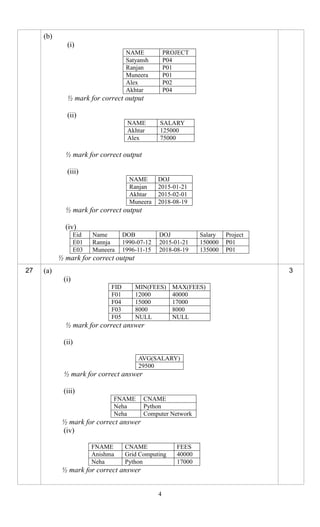
(b)
(i)
NAME PROJECT
Satyansh P04
Ranjan P01
Muneera P01
Alex P02
Akhtar P04
½ mark for correct output
(ii)
NAME SALARY
Akhtar 125000
Alex 75000
½ mark for correct output
(iii)
NAME DOJ
Ranjan 2015-01-21
Akhtar 2015-02-01
Muneera 2018-08-19
½ mark for correct output
(iv)
Eid Name DOB DOJ Salary Project
E01 Rannja 1990-07-12 2015-01-21 150000 P01
E03 Muneera 1996-11-15 2018-08-19 135000 P01
½ mark for correct output
27 (a)
(i)
FID MIN(FEES) MAX(FEES)
F01 12000 40000
F04 15000 17000
F03 8000 8000
F05 NULL NULL
½ mark for correct answer
(ii)
AVG(SALARY)
29500
½ mark for correct answer
(iii)
FNAME CNAME
Neha Python
Neha Computer Network
½ mark for correct answer
(iv)
FNAME CNAME FEES
Anishma Grid Computing 40000
Neha Python 17000
½ mark for correct answer
3
5
(b)
DESC or DESCRIBE command
1 mark for correct answer
28 def Count():
F=open('Gratitude.txt')
T=F.readlines()
X=1
for i in T:
print('Line',X,':',i.count('e'))
X=X+1
F.close()
Count()
½ mark for function header
½ mark for opening and closing the file
½ mark for reading lines
½ mark for loop
½ mark for count function/or any other alternate correct statement(s)
½ mark for counter
OR
def Start_with_I():
F=open('Gratitude.txt')
T=F.readlines()
for i in T:
if i[0] in 'Ii':
print(i,end='')
F.close()
Start_with_I()
½ mark for function header
½ mark for opening and closing the file
½ mark for reading lines
½ mark for loop
½ mark for if condition
½ mark for print statment
3
29 (i) Candidate Keys : ADMNO, ROLLNO
1 mark for correctly writing both names of candidate keys. OR ½ mark for
specifying any one candidate key correctly.
(ii) Degree-8, Cardinality=4
½ mark for degree and ½ mark for cardinality
(iii) Update result set SEM2=SEM2+.03*SEM2 where SEM2 between 70
and 100;
½ mark for writing Update result set part correctly
½ mark for writing SEM2=SEM2+.03*SEM2 where SEM2 between 70 and
100; correctly.
3
30 Stu_dict={5:(87,68,89), 10:(57,54,61), 12:(71,67,90),
14:(66,81,80), 18:(80,48,91)}
3
6
Stu_Stk=[]
def Push_elements(Stu_Stk, Stu_dict):
for Stu_ID, marks in Stu_dict.items():
if marks[2]>=80:
Stu_Stk.append(Stu_ID)
def Pop_elements(Stu_Stk):
while len(Stu_Stk)>0:
print(Stu_Stk.pop())
if not Stu_Stk:
print('Stack Empty')
Push_elements(Stu_Stk, Stu_dict)
Pop_elements(Stu_Stk)
1.5 marks for correct implementation of Push_elements()
1.5 marks for correct implementation of Pop_elements()
31 import csv
def maxsalary():
f=open('record.csv', 'r')
reader=csv.reader(f)
skip_header = True
max= 0
for row in reader:
if skip_header:
skip_header = False
else:
if(int(row[3])>max):
max=int(row[3])
rec=row
print('Row with the highest salary : ', rec)
f.close()
maxsalary()
½ mark for importing module
½ mark for function definition
½ mark for opening and closing file
½ for reader object
½ for skipping first row (i.e. header)
1 mark for calculating maximum salary
½ mark for displaying record having maximum salary
4
32 import pickle
def expensiveProducts():
with open('INVENTORY.DAT', 'rb') as file:
expensive_count = 0
while True:
try:
product_data = pickle.load(file)
product_id, product_name, quantity, price = product_data
if price > 1000:
print("Product ID:", product_id)
expensive_count += 1
except EOFError:
break
print("Total expensive products: ", expensive_count)
expensiveProducts()
½ mark for function definition
4
7
½ mark for opening and closing file
½ mark for correct try and except block
1.5 mark identifying and displaying details of expensive products
1 mark for displaying count of expensive products
33 i. The most appropriate location of the server inside the MUMBAI
campus is ADMIN building due to the maximum number of computers
in it.
½ mark for mentioning the branch and ½ mark for proper justification
ii. Cable Layout
Star Topology (Based on
server location)
Bus Topology (Based on
minimum distance between
branches)
1 mark for drawing any valid cable layout
iii. Switch or Hub
1mark for suggesting the correct device
iv. c. Video Conferencing
1 mark for correct answer
v.
(a) WAN
(b) LAN
½ mark for mentioning WAN and ½ mark for mentioning LAN
5
34 i.
seek() tell()
Purpose Repositions the file pointer to a
specific location within a file
Returns the current
position of the file
pointer
Syntax seek(offset [,reference point]) tell()
Parameters Requires specifying the offset
and an optional reference point
Requires no
parameters
2 marks for mentioning two correct differences.
OR
1 marks for mentioning only one correct differences.
ii.
import pickle
def COPY_REC():
In_file = open('FLIGHT.DAT','rb')
out_file = open('RECORD.DAT','wb')
try:
5
8
while True:
data = pickle.load(In_file)
if data[3] == 'DELHI' and data[4] == 'MUMBAI':
pickle.dump(data,out_file)
except:
In_file.close()
out_file.close()
COPY_REC()
½ mark for function definion
½ mark for correctly opening and closing file
½ mark for correct try and except block
1.5 marks for writing required data in RECORD.DAT
OR
i.
Binary CSV
1. pickle module to be used 1. csv module is used
2. Data is stored in binary
format(0s and 1s) and is not
in human readable form using
any plain text editor.
2. Data is stored in tabular
fashion and comma
separated by default. The
file can be read by any
spreadsheet software or text
editor.
3. File extension .dat/.pdf/.exe
etc.
3. File extension .csv
2 marks for mentioning two correct differences.
OR
1 marks for mentioning only one correct differences.
ii.
import pickle
def findBook(price):
with open('BOOK.DAT', 'rb') as file:
while True:
try:
book_record = pickle.load(file)
for item in book_record:
book_price = book_record[item][2]
if book_price >= price:
print(item, book_record[item])
except EOFError:
break
findBook(50)
½ mark for function definion
½ mark for correctly opening and closing file
½ mark for correct try and except block
1.5 marks for displying required records
35 (i) 5
9
SQL constraints are used to specify rules for the data in a table. Constraints
are used to limit the type of data that can go into a table.
Constraints –
NOT NULL - Ensures that a column cannot have a NULL value
UNIQUE - Ensures that all values in a column are different
PRIMARY KEY - A combination of a NOT NULL and UNIQUE. Uniquely
identifies each row in a table
½ mark for correct definition, ½ mark for correct example (anyone)
(ii)
a) password='tiger'
b) mycursor = con1.cursor()
c) query = 'delete from ITEM where Iname = "{}" '.format.(item_name)
d) con1.commit()
1 mark for each correct statement
OR
(i)
Candidate Key: A candidate key is a set of attributes in a relation that can
uniquely identify each tuple (row). A relation can have multiple candidate
keys, but only one of them is chosen as the primary key.
Alternate Key: An alternate key is a candidate key that is not selected as the
primary key.
1 mark for any one correct difference.
(ii)
a) import mysql.connector as mysql
b) mycursor = con1.cursor()
c) query = 'SELECT * FROM ITEM where Price > {}'.format(5000)
d) data = mycursor.fetchall()
1 mark for each correct statement

CS_PQMS.pdf

  • 1.
    1 CBSE Additional PracticeQuestion Paper Class: XII Session: 2023-24 Computer Science (083) Marking Scheme Q No. Answer Total Marks 1 a. per%marks 1 2 b. list.append(element) 1 3 b. lcomme T 1 4 b. One block of except statement cannot handle multiple exceptions 1 5 c. Statement 3 1 6 d. dump 1 7 d. dict_student.update(dict_marks) 1 8 b. mean() 1 9 c. 13.5 1 10 PPP – Point to Point Protocol VoIP - Voice Over Internet Protocol 1 11 b. LIKE operator 1 12 d. fetchone 1 13 b. r 1 14 a. file_object.seek(offset [, reference_point]) 1 15 d. Interlinking of collection of webpages is called Internet. 1 16 c. TelNet 1 17 a. Both A and R are true and R is the correct explanation for A 1 18 c. A is True but R is False 1 19 Advantages: 1) A dedicated communication channel increases the quality of communication. 2) Suitable for long continuous communication. Disadvantages: 1) Resources are not utilized fully. 2) The time required to establish the physical link between the two stations is too long. ½ mark for each advantage and disadvantage OR Web browser Purpose: Receives and displays web content. 2
  • 2.
    2 Function: Initiates requeststo web servers, and receives and displays content for users. Web server Purpose: Delivers web content to clients. Function: Listens to incoming requests, processes them, and sends requested content to the client. Name of Web browsers: Google Chrome, Mozilla Firefox 1 mark for any one correct difference and 1/2 mark for each two correct examples 20 num1, num2 = 10, 45 while num1 % num2 == 0: num1+= 20 num2+= 30 else: print('hello') ½ mark for while ½ mark for : ½ mark for correct indentation (inside the block of while) ½ mark for else 2 21 def dispBook(BOOKS): for key in BOOKS: if BOOKS[key][0] not in "AEIOUaeiou": print(BOOKS[key].upper()) BOOKS = {1:"Python",2:"Internet Fundamentals ",3:"Networking ",4:"Oracle sets",5:"Understanding HTML"} dispBook(BOOKS) ½ mark for for loop 1 mark for if condition ½ mark for display in upper case OR def FindWord(STRING,SEARCH): return (STRING . count (SEARCH) ) str = input('Enter String : ') word = input('Enter word to search : ') print('The word', word, 'occurs', FindWord(str,word), 'times') ½ mark for input ½ mark for print statement 1 mark for counting the word and returning the value 2 22 9$14$19$5$ ½ mark for 9$ ½ mark for 14$ ½ mark for 19$ ½ mark for 5$ 2 23 i. del D['Mumbai'] 1 mark for correct answer 2
  • 3.
    3 ii. print(S.split()) 1 markfor correct answer OR my_str = "Computer Science" alternate_chars = my_str[::2] print(alternate_chars) 1.5 mark for logic of alternate characters ½ mark for printing alternate characters 24 % (Percentage):  Matches any sequence of characters (including empty sequence).  Example: LIKE 'T%' matches all those strings starting with the letter 'T'. The string with just 1 character 'T' will also be considered. _ (Underscore):  Matches a single character.  Example: LIKE '_ _T' on the other hand will search for a three letter string, whose 3rd letter is 'T'. At first two places any two character can appear. 1 mark for one correct difference. 1/2 mark each for correct example of each. OR DROP is a DDL command in SQL and can be used to remove tables (or database). Example: 'DROP TABLE STUDENT;' will remove the table STUDENT from the database. DELETE is a DML command used to remove or delete rows/records from a table. Example: 'DELETE FROM STUDENT WHERE PER < 33;' will remove all those records from the table STUDENT where the percentage is less than 33. 1 mark for one correct difference. 1/2 mark each for correct example of each. 2 25  COUNT(*) returns the count of all rows in the table, whereas COUNT() is used with Column_Name passed as an argument and counts the number of non-NULL values in a column that is given as an argument. Hence the result may differ.  The SQL command with COUNT(*) may have higher value as it count all rows in the table. 1 mark for suitable reason 1 mark for mentioning correct command 2 26 (a) CODE BNAME TYPE MNO MNAME ISSUEDATE L102 Easy Python Programming M101 SNEH SINHA 2022-10-13 F102 Untold Story Fiction M103 SARTHAK 2021-02-23 C101 Juman Ji Thriller M102 SARA KHAN 2022-06-12 1 mark for correct answer 3
  • 4.
    4 (b) (i) NAME PROJECT Satyansh P04 RanjanP01 Muneera P01 Alex P02 Akhtar P04 ½ mark for correct output (ii) NAME SALARY Akhtar 125000 Alex 75000 ½ mark for correct output (iii) NAME DOJ Ranjan 2015-01-21 Akhtar 2015-02-01 Muneera 2018-08-19 ½ mark for correct output (iv) Eid Name DOB DOJ Salary Project E01 Rannja 1990-07-12 2015-01-21 150000 P01 E03 Muneera 1996-11-15 2018-08-19 135000 P01 ½ mark for correct output 27 (a) (i) FID MIN(FEES) MAX(FEES) F01 12000 40000 F04 15000 17000 F03 8000 8000 F05 NULL NULL ½ mark for correct answer (ii) AVG(SALARY) 29500 ½ mark for correct answer (iii) FNAME CNAME Neha Python Neha Computer Network ½ mark for correct answer (iv) FNAME CNAME FEES Anishma Grid Computing 40000 Neha Python 17000 ½ mark for correct answer 3
  • 5.
    5 (b) DESC or DESCRIBEcommand 1 mark for correct answer 28 def Count(): F=open('Gratitude.txt') T=F.readlines() X=1 for i in T: print('Line',X,':',i.count('e')) X=X+1 F.close() Count() ½ mark for function header ½ mark for opening and closing the file ½ mark for reading lines ½ mark for loop ½ mark for count function/or any other alternate correct statement(s) ½ mark for counter OR def Start_with_I(): F=open('Gratitude.txt') T=F.readlines() for i in T: if i[0] in 'Ii': print(i,end='') F.close() Start_with_I() ½ mark for function header ½ mark for opening and closing the file ½ mark for reading lines ½ mark for loop ½ mark for if condition ½ mark for print statment 3 29 (i) Candidate Keys : ADMNO, ROLLNO 1 mark for correctly writing both names of candidate keys. OR ½ mark for specifying any one candidate key correctly. (ii) Degree-8, Cardinality=4 ½ mark for degree and ½ mark for cardinality (iii) Update result set SEM2=SEM2+.03*SEM2 where SEM2 between 70 and 100; ½ mark for writing Update result set part correctly ½ mark for writing SEM2=SEM2+.03*SEM2 where SEM2 between 70 and 100; correctly. 3 30 Stu_dict={5:(87,68,89), 10:(57,54,61), 12:(71,67,90), 14:(66,81,80), 18:(80,48,91)} 3
  • 6.
    6 Stu_Stk=[] def Push_elements(Stu_Stk, Stu_dict): forStu_ID, marks in Stu_dict.items(): if marks[2]>=80: Stu_Stk.append(Stu_ID) def Pop_elements(Stu_Stk): while len(Stu_Stk)>0: print(Stu_Stk.pop()) if not Stu_Stk: print('Stack Empty') Push_elements(Stu_Stk, Stu_dict) Pop_elements(Stu_Stk) 1.5 marks for correct implementation of Push_elements() 1.5 marks for correct implementation of Pop_elements() 31 import csv def maxsalary(): f=open('record.csv', 'r') reader=csv.reader(f) skip_header = True max= 0 for row in reader: if skip_header: skip_header = False else: if(int(row[3])>max): max=int(row[3]) rec=row print('Row with the highest salary : ', rec) f.close() maxsalary() ½ mark for importing module ½ mark for function definition ½ mark for opening and closing file ½ for reader object ½ for skipping first row (i.e. header) 1 mark for calculating maximum salary ½ mark for displaying record having maximum salary 4 32 import pickle def expensiveProducts(): with open('INVENTORY.DAT', 'rb') as file: expensive_count = 0 while True: try: product_data = pickle.load(file) product_id, product_name, quantity, price = product_data if price > 1000: print("Product ID:", product_id) expensive_count += 1 except EOFError: break print("Total expensive products: ", expensive_count) expensiveProducts() ½ mark for function definition 4
  • 7.
    7 ½ mark foropening and closing file ½ mark for correct try and except block 1.5 mark identifying and displaying details of expensive products 1 mark for displaying count of expensive products 33 i. The most appropriate location of the server inside the MUMBAI campus is ADMIN building due to the maximum number of computers in it. ½ mark for mentioning the branch and ½ mark for proper justification ii. Cable Layout Star Topology (Based on server location) Bus Topology (Based on minimum distance between branches) 1 mark for drawing any valid cable layout iii. Switch or Hub 1mark for suggesting the correct device iv. c. Video Conferencing 1 mark for correct answer v. (a) WAN (b) LAN ½ mark for mentioning WAN and ½ mark for mentioning LAN 5 34 i. seek() tell() Purpose Repositions the file pointer to a specific location within a file Returns the current position of the file pointer Syntax seek(offset [,reference point]) tell() Parameters Requires specifying the offset and an optional reference point Requires no parameters 2 marks for mentioning two correct differences. OR 1 marks for mentioning only one correct differences. ii. import pickle def COPY_REC(): In_file = open('FLIGHT.DAT','rb') out_file = open('RECORD.DAT','wb') try: 5
  • 8.
    8 while True: data =pickle.load(In_file) if data[3] == 'DELHI' and data[4] == 'MUMBAI': pickle.dump(data,out_file) except: In_file.close() out_file.close() COPY_REC() ½ mark for function definion ½ mark for correctly opening and closing file ½ mark for correct try and except block 1.5 marks for writing required data in RECORD.DAT OR i. Binary CSV 1. pickle module to be used 1. csv module is used 2. Data is stored in binary format(0s and 1s) and is not in human readable form using any plain text editor. 2. Data is stored in tabular fashion and comma separated by default. The file can be read by any spreadsheet software or text editor. 3. File extension .dat/.pdf/.exe etc. 3. File extension .csv 2 marks for mentioning two correct differences. OR 1 marks for mentioning only one correct differences. ii. import pickle def findBook(price): with open('BOOK.DAT', 'rb') as file: while True: try: book_record = pickle.load(file) for item in book_record: book_price = book_record[item][2] if book_price >= price: print(item, book_record[item]) except EOFError: break findBook(50) ½ mark for function definion ½ mark for correctly opening and closing file ½ mark for correct try and except block 1.5 marks for displying required records 35 (i) 5
  • 9.
    9 SQL constraints areused to specify rules for the data in a table. Constraints are used to limit the type of data that can go into a table. Constraints – NOT NULL - Ensures that a column cannot have a NULL value UNIQUE - Ensures that all values in a column are different PRIMARY KEY - A combination of a NOT NULL and UNIQUE. Uniquely identifies each row in a table ½ mark for correct definition, ½ mark for correct example (anyone) (ii) a) password='tiger' b) mycursor = con1.cursor() c) query = 'delete from ITEM where Iname = "{}" '.format.(item_name) d) con1.commit() 1 mark for each correct statement OR (i) Candidate Key: A candidate key is a set of attributes in a relation that can uniquely identify each tuple (row). A relation can have multiple candidate keys, but only one of them is chosen as the primary key. Alternate Key: An alternate key is a candidate key that is not selected as the primary key. 1 mark for any one correct difference. (ii) a) import mysql.connector as mysql b) mycursor = con1.cursor() c) query = 'SELECT * FROM ITEM where Price > {}'.format(5000) d) data = mycursor.fetchall() 1 mark for each correct statement