A SEMINAR
ON
CRYPTOGRAPHY
By ;
Ashish Dhar
Roll No – 17
Semester – iv
Regd No. - 1625209002
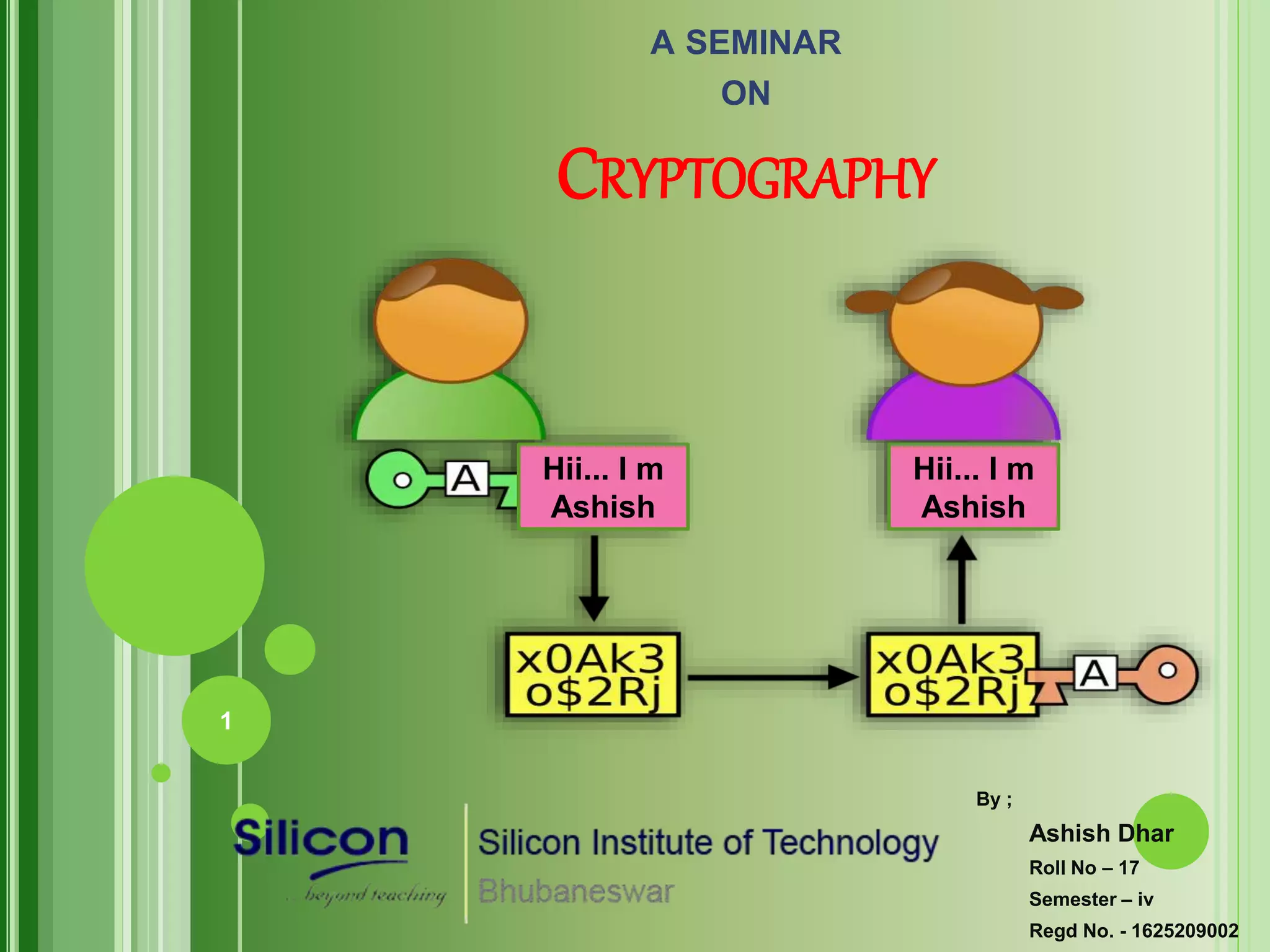
Hii... I m
Ashish
1
Hii... I m
Ashish
CONTENTS
ļ‚¢ What is Cryptography
ļ‚¢ Basic terms
ļ‚¢ Categories
ļ‚¢ Algorithms used
ļ‚¢ Applications
ļ‚¢ Conclusion
ļ‚¢ References
2
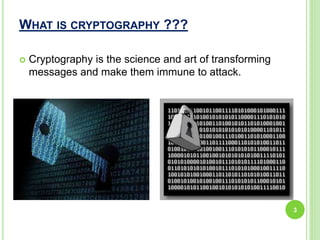
WHAT IS CRYPTOGRAPHY ???
ļ‚¢ Cryptography is the science and art of transforming
messages and make them immune to attack.
3
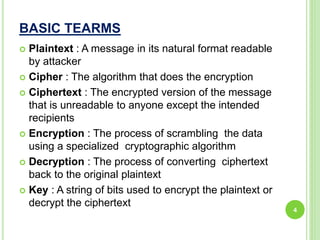
BASIC TEARMS
ļ‚¢ Plaintext : A message in its natural format readable
by attacker
ļ‚¢ Cipher : The algorithm that does the encryption
ļ‚¢ Ciphertext : The encrypted version of the message
that is unreadable to anyone except the intended
recipients
ļ‚¢ Encryption : The process of scrambling the data
using a specialized cryptographic algorithm
ļ‚¢ Decryption : The process of converting ciphertext
back to the original plaintext
ļ‚¢ Key : A string of bits used to encrypt the plaintext or
decrypt the ciphertext
4
ENCRIPTION BY CAESAR CIPHER
5
A B C D E F G H I J K L M N O P Q R S T U V W X Y Z
D E F G H I J K L M N O P Q R S T U V W X Y Z A B C
Plaintext : ASHISH
Ciphertext(Encrypted) : DVKLVK
DECRYPTION BY PIGPEN CIPHER
6
Answer: WELCOME
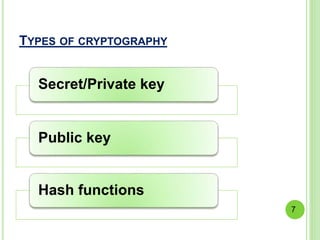
Secret/Private key
Public key
Hash functions
TYPES OF CRYPTOGRAPHY
7
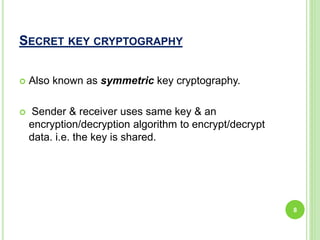
SECRET KEY CRYPTOGRAPHY
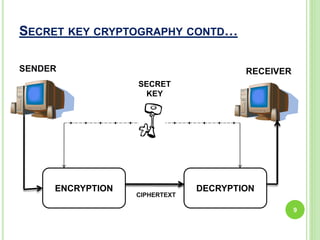
ļ‚¢ Also known as symmetric key cryptography.
ļ‚¢ Sender & receiver uses same key & an
encryption/decryption algorithm to encrypt/decrypt
data. i.e. the key is shared.
8
SECRET KEY CRYPTOGRAPHY CONTD…
9
ENCRYPTION DECRYPTION
CIPHERTEXT
SENDER RECEIVER
SECRET
KEY
PUBLIC KEY CRYPTOGRAPHY
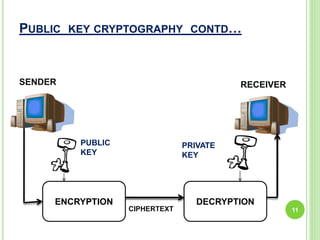
ļ‚¢ Also known as asymmetric key cryptography.
ļ‚¢ Sender & receiver uses different keys for
encryption & decryption namely PUBLIC &
PRIVATE respectively
10
PUBLIC KEY CRYPTOGRAPHY CONTD…
11
ENCRYPTION DECRYPTION
CIPHERTEXT
SENDER RECEIVER
PUBLIC
KEY
PRIVATE
KEY
HASH FUNCTION
12
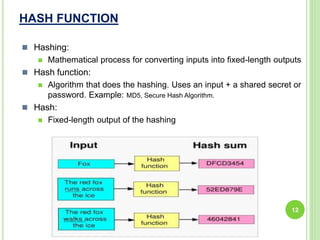
 Hashing:
 Mathematical process for converting inputs into fixed-length outputs
 Hash function:
 Algorithm that does the hashing. Uses an input + a shared secret or
password. Example: MD5, Secure Hash Algorithm.
 Hash:
 Fixed-length output of the hashing
ALGORITHMS USED
ļ‚¢ DES
ļ‚¢ Triple DES
ļ‚¢ AES
ļ‚¢ IDEA
ļ‚¢ ElGamal
ļ‚¢ Diffle-Hellman
ļ‚¢ RSA
ļ‚¢ SHA-1
ļ‚¢ SHA-2
13
14
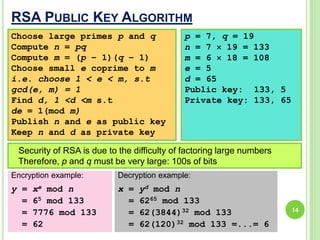
RSA PUBLIC KEY ALGORITHM
Security of RSA is due to the difficulty of factoring large numbers
Therefore, p and q must be very large: 100s of bits
Choose large primes p and q
Compute n = pq
Compute m = (p – 1)(q – 1)
Choose small e coprime to m
i.e. choose 1 < e < m, s.t
gcd(e, m) = 1
Find d, 1 <d <m s.t
de = 1(mod m)
Publish n and e as public key
Keep n and d as private key
Encryption example:
y = xe mod n
= 65 mod 133
= 7776 mod 133
= 62
p = 7, q = 19
n = 7 ļ‚“ 19 = 133
m = 6 ļ‚“ 18 = 108
e = 5
d = 65
Public key: 133, 5
Private key: 133, 65
Decryption example:
x = yd mod n
= 6265 mod 133
= 62(3844)32 mod 133
= 62(120)32 mod 133 =...= 6
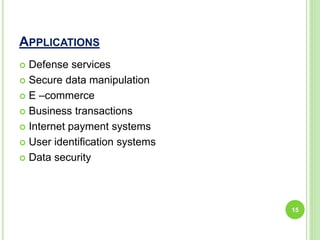
APPLICATIONS
ļ‚¢ Defense services
ļ‚¢ Secure data manipulation
ļ‚¢ E –commerce
ļ‚¢ Business transactions
ļ‚¢ Internet payment systems
ļ‚¢ User identification systems
ļ‚¢ Data security
15
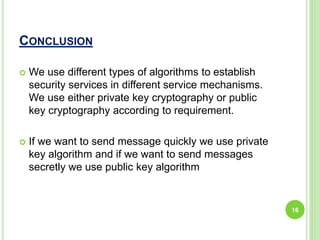
CONCLUSION
ļ‚¢ We use different types of algorithms to establish
security services in different service mechanisms.
We use either private key cryptography or public
key cryptography according to requirement.
ļ‚¢ If we want to send message quickly we use private
key algorithm and if we want to send messages
secretly we use public key algorithm
16
REFERENCES
ļ‚¢ ā€œCryptography and Network Securityā€ by William
Stallings
ļ‚¢ http://www.google.com
ļ‚¢ http://www.wikipedia.org
ļ‚¢ http://www.studymafia.org
ļ‚¢ http://www.youtube.com
17
GUIDANCE
ļ‚¢ Mr. Ajay Kumar Tripathy
ļ‚¢ Mr. Amarjeet Mohanty
18
19
20

Cryptography seminar 2017

  • 1.
    A SEMINAR ON CRYPTOGRAPHY By ; AshishDhar Roll No – 17 Semester – iv Regd No. - 1625209002 Hii... I m Ashish 1 Hii... I m Ashish
  • 2.
    CONTENTS ļ‚¢ What isCryptography ļ‚¢ Basic terms ļ‚¢ Categories ļ‚¢ Algorithms used ļ‚¢ Applications ļ‚¢ Conclusion ļ‚¢ References 2
  • 3.
    WHAT IS CRYPTOGRAPHY??? ļ‚¢ Cryptography is the science and art of transforming messages and make them immune to attack. 3
  • 4.
    BASIC TEARMS ļ‚¢ Plaintext: A message in its natural format readable by attacker ļ‚¢ Cipher : The algorithm that does the encryption ļ‚¢ Ciphertext : The encrypted version of the message that is unreadable to anyone except the intended recipients ļ‚¢ Encryption : The process of scrambling the data using a specialized cryptographic algorithm ļ‚¢ Decryption : The process of converting ciphertext back to the original plaintext ļ‚¢ Key : A string of bits used to encrypt the plaintext or decrypt the ciphertext 4
  • 5.
    ENCRIPTION BY CAESARCIPHER 5 A B C D E F G H I J K L M N O P Q R S T U V W X Y Z D E F G H I J K L M N O P Q R S T U V W X Y Z A B C Plaintext : ASHISH Ciphertext(Encrypted) : DVKLVK
  • 6.
    DECRYPTION BY PIGPENCIPHER 6 Answer: WELCOME
  • 7.
    Secret/Private key Public key Hashfunctions TYPES OF CRYPTOGRAPHY 7
  • 8.
    SECRET KEY CRYPTOGRAPHY ļ‚¢Also known as symmetric key cryptography. ļ‚¢ Sender & receiver uses same key & an encryption/decryption algorithm to encrypt/decrypt data. i.e. the key is shared. 8
  • 9.
    SECRET KEY CRYPTOGRAPHYCONTD… 9 ENCRYPTION DECRYPTION CIPHERTEXT SENDER RECEIVER SECRET KEY
  • 10.
    PUBLIC KEY CRYPTOGRAPHY ļ‚¢Also known as asymmetric key cryptography. ļ‚¢ Sender & receiver uses different keys for encryption & decryption namely PUBLIC & PRIVATE respectively 10
  • 11.
    PUBLIC KEY CRYPTOGRAPHYCONTD… 11 ENCRYPTION DECRYPTION CIPHERTEXT SENDER RECEIVER PUBLIC KEY PRIVATE KEY
  • 12.
    HASH FUNCTION 12  Hashing: Mathematical process for converting inputs into fixed-length outputs  Hash function:  Algorithm that does the hashing. Uses an input + a shared secret or password. Example: MD5, Secure Hash Algorithm.  Hash:  Fixed-length output of the hashing
  • 13.
    ALGORITHMS USED ļ‚¢ DES ļ‚¢Triple DES ļ‚¢ AES ļ‚¢ IDEA ļ‚¢ ElGamal ļ‚¢ Diffle-Hellman ļ‚¢ RSA ļ‚¢ SHA-1 ļ‚¢ SHA-2 13
  • 14.
    14 RSA PUBLIC KEYALGORITHM Security of RSA is due to the difficulty of factoring large numbers Therefore, p and q must be very large: 100s of bits Choose large primes p and q Compute n = pq Compute m = (p – 1)(q – 1) Choose small e coprime to m i.e. choose 1 < e < m, s.t gcd(e, m) = 1 Find d, 1 <d <m s.t de = 1(mod m) Publish n and e as public key Keep n and d as private key Encryption example: y = xe mod n = 65 mod 133 = 7776 mod 133 = 62 p = 7, q = 19 n = 7 ļ‚“ 19 = 133 m = 6 ļ‚“ 18 = 108 e = 5 d = 65 Public key: 133, 5 Private key: 133, 65 Decryption example: x = yd mod n = 6265 mod 133 = 62(3844)32 mod 133 = 62(120)32 mod 133 =...= 6
  • 15.
    APPLICATIONS ļ‚¢ Defense services ļ‚¢Secure data manipulation ļ‚¢ E –commerce ļ‚¢ Business transactions ļ‚¢ Internet payment systems ļ‚¢ User identification systems ļ‚¢ Data security 15
  • 16.
    CONCLUSION ļ‚¢ We usedifferent types of algorithms to establish security services in different service mechanisms. We use either private key cryptography or public key cryptography according to requirement. ļ‚¢ If we want to send message quickly we use private key algorithm and if we want to send messages secretly we use public key algorithm 16
  • 17.
    REFERENCES ļ‚¢ ā€œCryptography andNetwork Securityā€ by William Stallings ļ‚¢ http://www.google.com ļ‚¢ http://www.wikipedia.org ļ‚¢ http://www.studymafia.org ļ‚¢ http://www.youtube.com 17
  • 18.
    GUIDANCE ļ‚¢ Mr. AjayKumar Tripathy ļ‚¢ Mr. Amarjeet Mohanty 18
  • 19.
  • 20.