INTRODUCTION
 the practice and study of techniques for constructing
and analyzing protocols that overcome the influence
of adversaries and which are related to various aspects
in information such as data confidentiality data
integrity and authentication
 Applications of cryptography include ATM cards,
computer passwords, and electronic commerce
REQUIREMENTS OF A
SECURE NETWORKS
 Authentication: The process of proving one's
identity. (The primary forms of host-to-host
authentication on the Internet today are name-based
or address-based, both of which are notoriously weak.)
 Privacy/confidentiality: Ensuring that no one can
read the message except the intended receiver.
 Integrity: Assuring the receiver that the received
message has not been altered in any way from the
original.
 Non-repudiation: A mechanism to prove that the
sender really sent this message
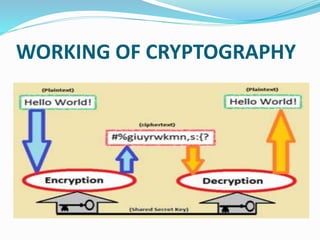
WORKING OF CRYPTOGRAPHY
OLDEST CRYPTOGRAPHY MACHINE
COMPUTER ERA
 The development of digital computers and electronics
after WWII made possible much more complex
ciphers. Furthermore, computers allowed for the
encryption of any kind of data
 Represent able in any binary format, unlike classical
ciphers which only encrypted written language texts;
this was new and significant. Computer use has thus
supplanted linguistic cryptography, both for cipher
design and cryptanalysis.
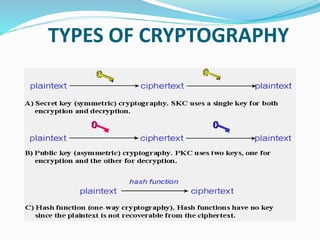
TYPES OF CRYPTOGRAPHY
SECRET KEY CRYPTOGRAPHY
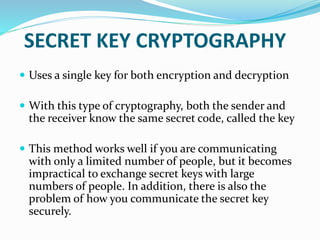
 Uses a single key for both encryption and decryption
 With this type of cryptography, both the sender and
the receiver know the same secret code, called the key
 This method works well if you are communicating
with only a limited number of people, but it becomes
impractical to exchange secret keys with large
numbers of people. In addition, there is also the
problem of how you communicate the secret key
securely.
PUBLIC KEY CRYPTOGRAPHY
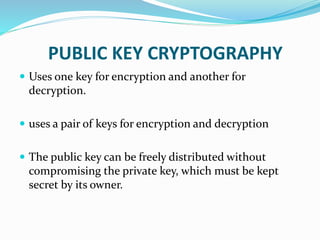
 Uses one key for encryption and another for
decryption.
 uses a pair of keys for encryption and decryption
 The public key can be freely distributed without
compromising the private key, which must be kept
secret by its owner.
HASH FUNCTION CRYPTOGRAPHY
 A hash function is any algorithm or subroutine that
maps large data cells, called keys, to smaller data sets.
For example, a single integer can serve as an index to
an array.
 Hash functions are mostly used to accelerate table
lookup or data comparison tasks such as finding items
in database, detecting duplicated or similar records in
a large file, finding similar stretches in DNA
sequences, and so on.
PURPOSE OF CRYPTOGRAPHY
 Cryptography is the science of writing in secret code
and is an ancient art; the first documented use of
cryptography in writing dates back to circa 1900 B.C.
 It provides more efficient way of security by encrypting
our data.
 It allows the sender and receiver to communicate more
securily
 It is used in armies from older ages to modern ages. It
allows the armies for exchanging information in the
efficient and secured way.
CONCLUSION
 Some experts argue that cryptography appeared
spontaneously sometime after writing was invented,
with applications ranging from diplomatic missives to
war-time battle plans. It is no surprise, then, that new
forms of cryptography came soon after the widespread
development of computer communications. In data
and telecommunications, cryptography is necessary
when communicating over any untrusted medium,
which includes just about any network, particularly
the Internet.

Cryptography

  • 2.
    INTRODUCTION  the practiceand study of techniques for constructing and analyzing protocols that overcome the influence of adversaries and which are related to various aspects in information such as data confidentiality data integrity and authentication  Applications of cryptography include ATM cards, computer passwords, and electronic commerce
  • 3.
    REQUIREMENTS OF A SECURENETWORKS  Authentication: The process of proving one's identity. (The primary forms of host-to-host authentication on the Internet today are name-based or address-based, both of which are notoriously weak.)  Privacy/confidentiality: Ensuring that no one can read the message except the intended receiver.  Integrity: Assuring the receiver that the received message has not been altered in any way from the original.  Non-repudiation: A mechanism to prove that the sender really sent this message
  • 4.
  • 5.
  • 6.
    COMPUTER ERA  Thedevelopment of digital computers and electronics after WWII made possible much more complex ciphers. Furthermore, computers allowed for the encryption of any kind of data  Represent able in any binary format, unlike classical ciphers which only encrypted written language texts; this was new and significant. Computer use has thus supplanted linguistic cryptography, both for cipher design and cryptanalysis.
  • 7.
  • 8.
    SECRET KEY CRYPTOGRAPHY Uses a single key for both encryption and decryption  With this type of cryptography, both the sender and the receiver know the same secret code, called the key  This method works well if you are communicating with only a limited number of people, but it becomes impractical to exchange secret keys with large numbers of people. In addition, there is also the problem of how you communicate the secret key securely.
  • 9.
    PUBLIC KEY CRYPTOGRAPHY Uses one key for encryption and another for decryption.  uses a pair of keys for encryption and decryption  The public key can be freely distributed without compromising the private key, which must be kept secret by its owner.
  • 10.
    HASH FUNCTION CRYPTOGRAPHY A hash function is any algorithm or subroutine that maps large data cells, called keys, to smaller data sets. For example, a single integer can serve as an index to an array.  Hash functions are mostly used to accelerate table lookup or data comparison tasks such as finding items in database, detecting duplicated or similar records in a large file, finding similar stretches in DNA sequences, and so on.
  • 11.
    PURPOSE OF CRYPTOGRAPHY Cryptography is the science of writing in secret code and is an ancient art; the first documented use of cryptography in writing dates back to circa 1900 B.C.  It provides more efficient way of security by encrypting our data.  It allows the sender and receiver to communicate more securily  It is used in armies from older ages to modern ages. It allows the armies for exchanging information in the efficient and secured way.
  • 12.
    CONCLUSION  Some expertsargue that cryptography appeared spontaneously sometime after writing was invented, with applications ranging from diplomatic missives to war-time battle plans. It is no surprise, then, that new forms of cryptography came soon after the widespread development of computer communications. In data and telecommunications, cryptography is necessary when communicating over any untrusted medium, which includes just about any network, particularly the Internet.