Cryptography and security
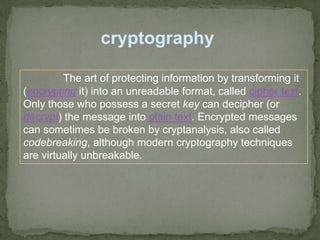
cryptographyThe art of protecting information by transforming it (encrypting it) into an unreadable format, called cipher text. Only those who possess a secret key can decipher (or decrypt) the message into plain text. Encrypted messages can sometimes be broken by cryptanalysis, also called codebreaking, although modern cryptography techniques are virtually unbreakable.
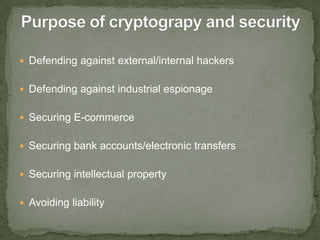
Defending against external/internal hackersDefending against industrial espionageSecuring E-commerceSecuring bank accounts/electronic transfersSecuring intellectual propertyAvoiding liabilityPurpose of cryptograpy and security
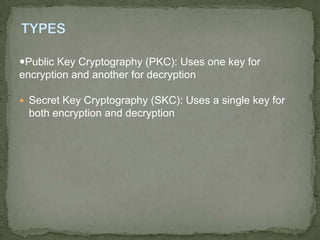
TYPESPublic Key Cryptography (PKC): Uses one key for encryption and another for decryption Secret Key Cryptography (SKC): Uses a single key for both encryption and decryption
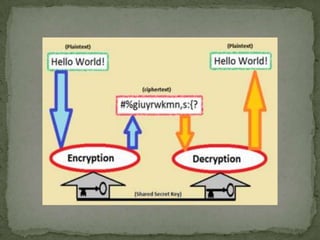
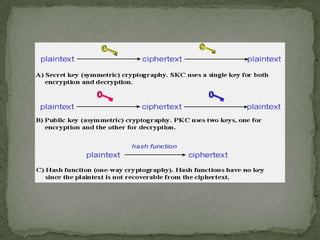
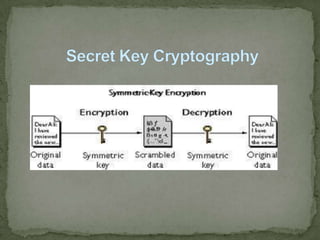
          With secret key cryptography, a single key is used for both encryption and decryption. As shown in Figure 1A, the sender uses the key (or some set of rules) to encrypt the plaintext and sends the ciphertext to the receiver. The receiver applies the same key (or ruleset) to decrypt the message and recover the plaintext. Because a single key is used for both functions, secret key cryptography is also called symmetric encryption.Secret Key Cryptography
Secret Key Cryptography
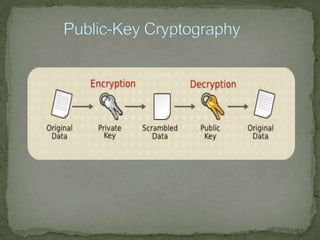
Public-Key CryptographyGeneric PKC employs two keys that are mathematically related although knowledge of one key does not allow someone to easily determine the other key. One key is used to encrypt the plaintext and the other key is used to decrypt the ciphertext. The important point here is that it does not matter which key is applied first, but that both keys are required for the process to work (Figure 1B). Because a pair of keys are required, this approach is also called asymmetric cryptography.
Public-Key Cryptography

Cryptography

  • 1.
  • 2.
    cryptographyThe art ofprotecting information by transforming it (encrypting it) into an unreadable format, called cipher text. Only those who possess a secret key can decipher (or decrypt) the message into plain text. Encrypted messages can sometimes be broken by cryptanalysis, also called codebreaking, although modern cryptography techniques are virtually unbreakable.
  • 3.
    Defending against external/internalhackersDefending against industrial espionageSecuring E-commerceSecuring bank accounts/electronic transfersSecuring intellectual propertyAvoiding liabilityPurpose of cryptograpy and security
  • 7.
    TYPESPublic Key Cryptography(PKC): Uses one key for encryption and another for decryption Secret Key Cryptography (SKC): Uses a single key for both encryption and decryption
  • 9.
    With secret key cryptography, a single key is used for both encryption and decryption. As shown in Figure 1A, the sender uses the key (or some set of rules) to encrypt the plaintext and sends the ciphertext to the receiver. The receiver applies the same key (or ruleset) to decrypt the message and recover the plaintext. Because a single key is used for both functions, secret key cryptography is also called symmetric encryption.Secret Key Cryptography
  • 10.
  • 11.
    Public-Key CryptographyGeneric PKCemploys two keys that are mathematically related although knowledge of one key does not allow someone to easily determine the other key. One key is used to encrypt the plaintext and the other key is used to decrypt the ciphertext. The important point here is that it does not matter which key is applied first, but that both keys are required for the process to work (Figure 1B). Because a pair of keys are required, this approach is also called asymmetric cryptography.
  • 12.