Cryopreservation Of
Sperm Antigens And
Embryo
By: Aachal D. J
Roll No. 07
Class: Msc. II
Paper: 4
Cryopreservation
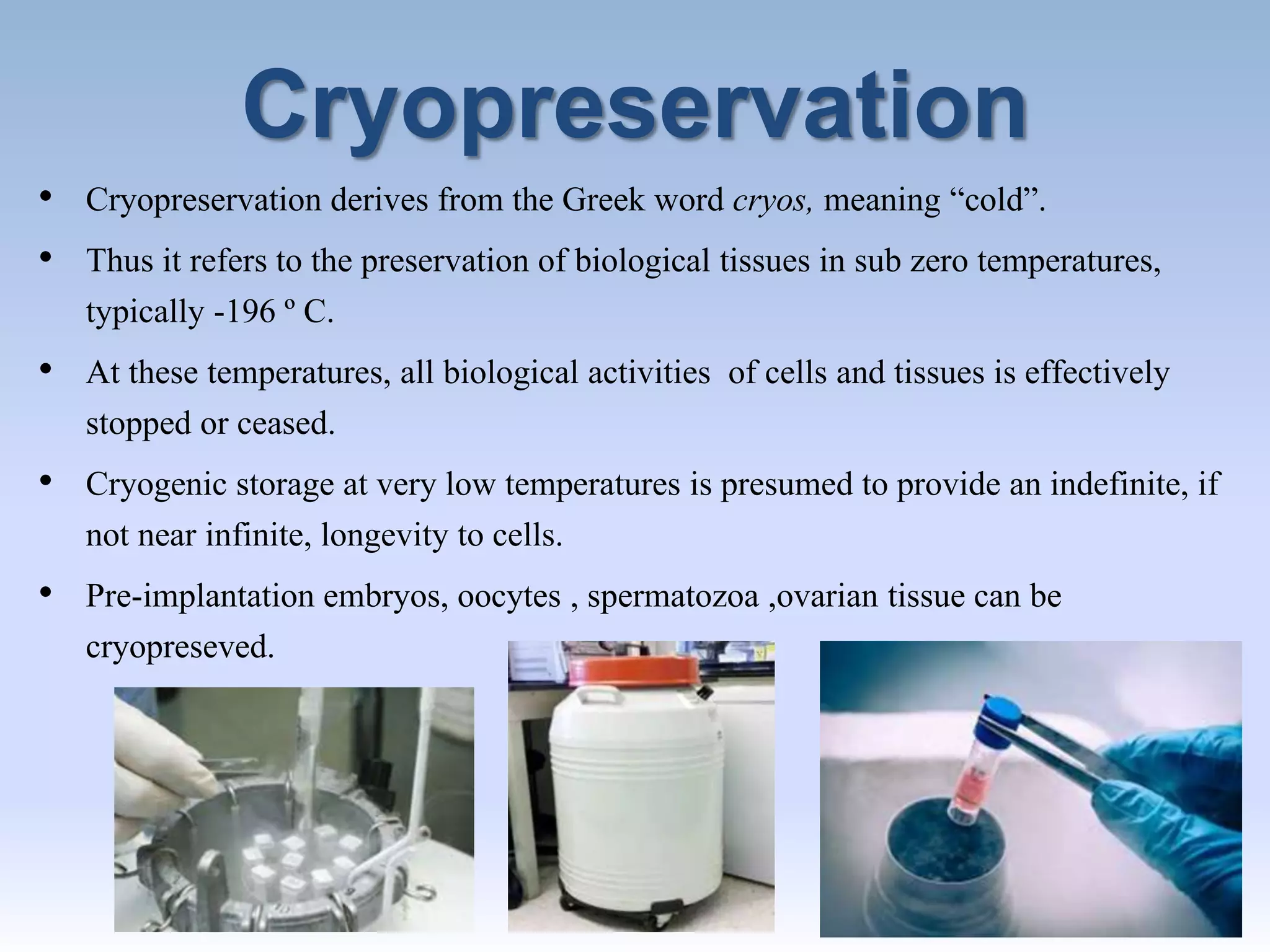
• Cryopreservation derives from the Greek word cryos, meaning “cold”.
• Thus it refers to the preservation of biological tissues in sub zero temperatures,
typically -196 º C.
• At these temperatures, all biological activities of cells and tissues is effectively
stopped or ceased.
• Cryogenic storage at very low temperatures is presumed to provide an indefinite, if
not near infinite, longevity to cells.
• Pre-implantation embryos, oocytes , spermatozoa ,ovarian tissue can be
cryopreseved.
Benefits of
Cryopreservation
• Effective means to conserve the germ plasms of endangered species.
• Fertility preservation.
• Methods to reduce multiple pregnancies
• Larger range of stocks available
• Easy disease-free exchange of stocks,
nationally and internationally
• Stocks remain viable indefinitely
• Safety from disease, genetic contamination and breeding failure
What You Need For
Cryopreservation?Liquid nitrogen ( liquid phase or vapor phase)
• Characteristics of liquid nitrogen:
– Chemically inert
– Relatively low cost
– Non toxic
– Non flammable
– Readily available
Cryofreezer
Cryoprotectant: organic or inorganic additive which will protect the cell from freezing
injuries during cryopreservation.
• Characteristics of cryoprotectants:
– Should easily penetrate into cell
– Non- electrolyte
– Easily misible with water
– E.g: Glycerol, DMSO, PVP, PEG etc.
Cryopreservation Of
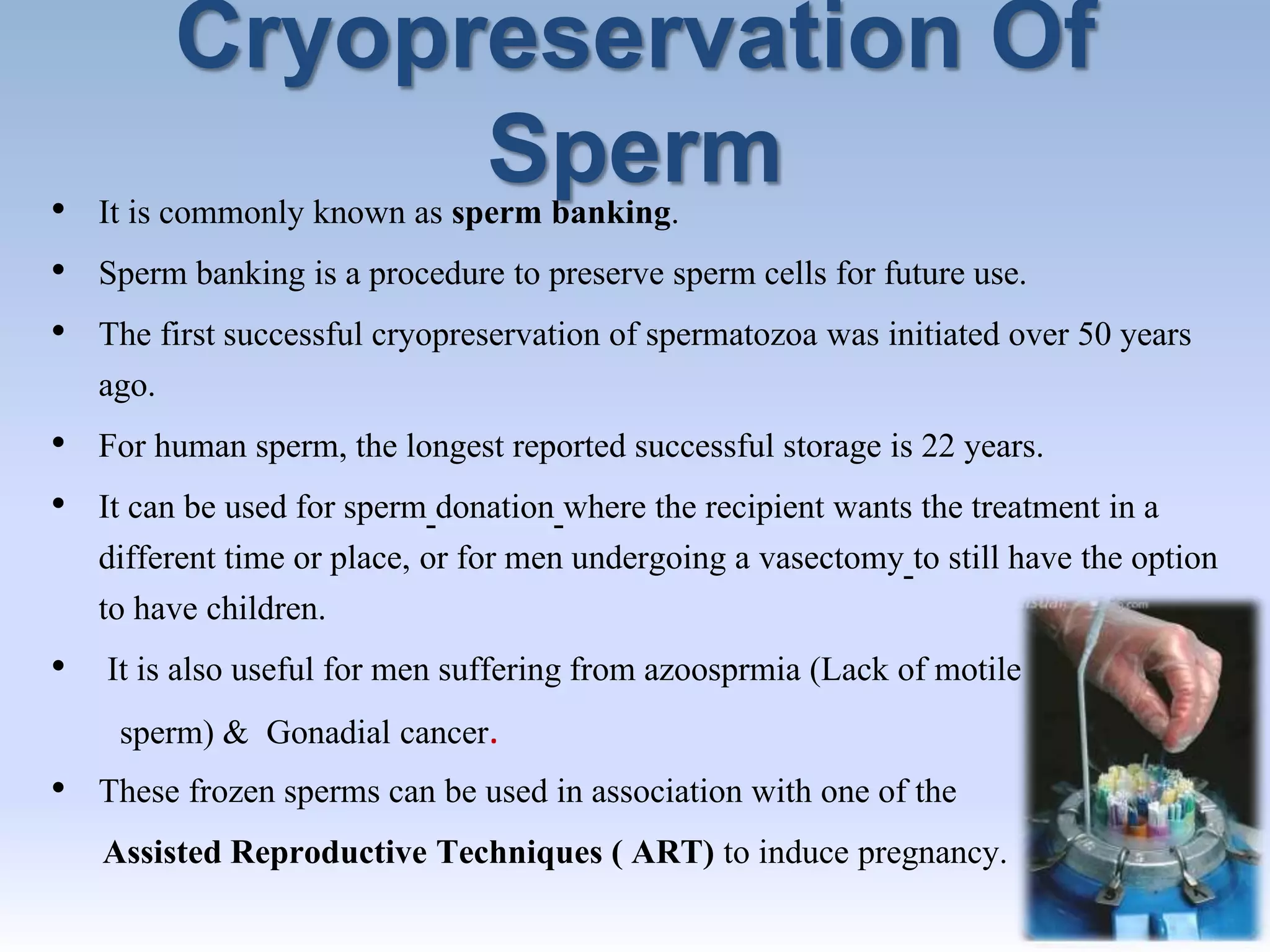
Sperm• It is commonly known as sperm banking.
• Sperm banking is a procedure to preserve sperm cells for future use.
• The first successful cryopreservation of spermatozoa was initiated over 50 years
ago.
• For human sperm, the longest reported successful storage is 22 years.
• It can be used for sperm donation where the recipient wants the treatment in a
different time or place, or for men undergoing a vasectomy to still have the option
to have children.
• It is also useful for men suffering from azoosprmia (Lack of motile
sperm) & Gonadial cancer.
• These frozen sperms can be used in association with one of the
Assisted Reproductive Techniques ( ART) to induce pregnancy.
Process of Sperm
Cryopreservation
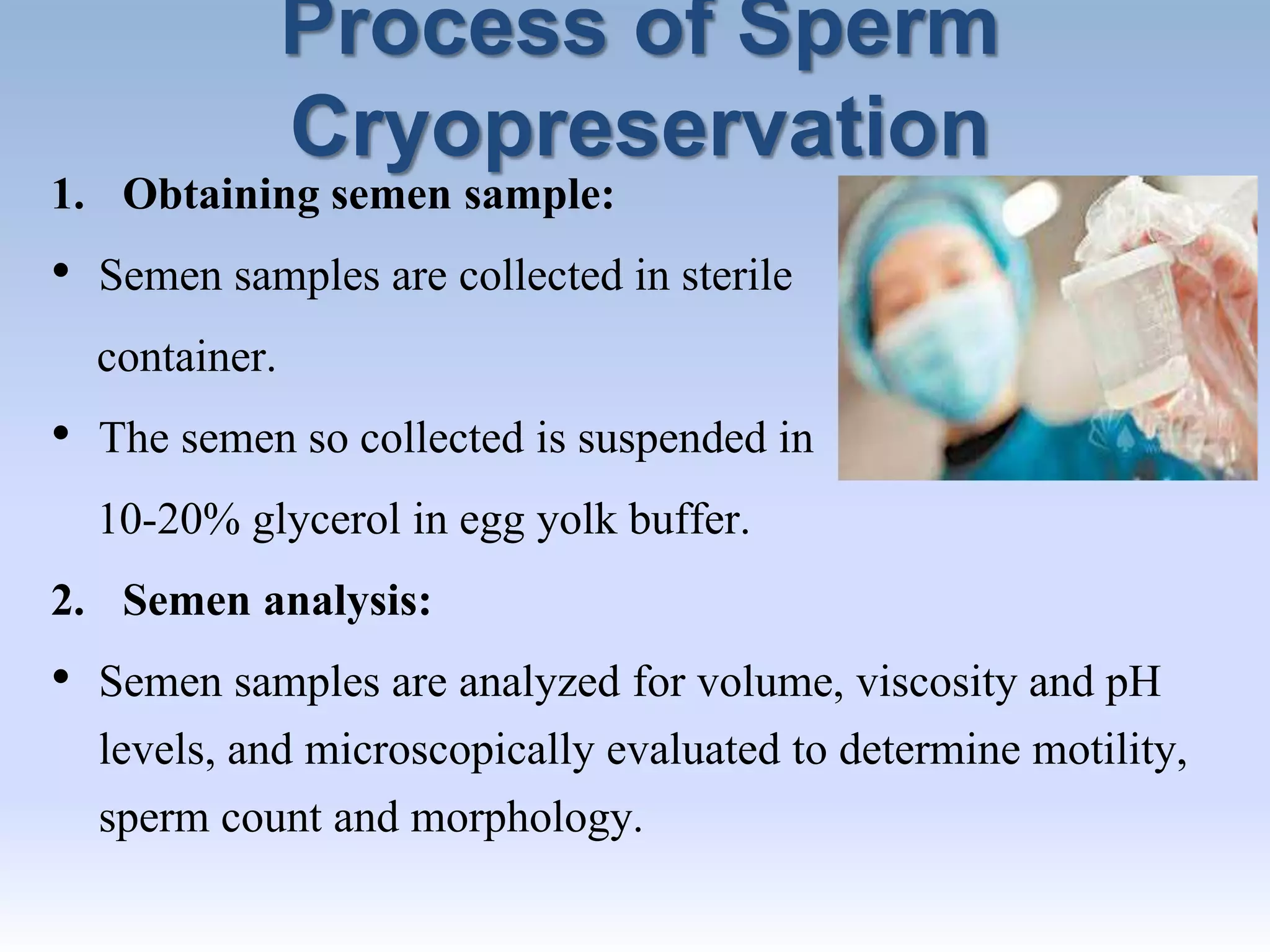
1. Obtaining semen sample:
• Semen samples are collected in sterile
container.
• The semen so collected is suspended in
10-20% glycerol in egg yolk buffer.
2. Semen analysis:
• Semen samples are analyzed for volume, viscosity and pH
levels, and microscopically evaluated to determine motility,
sperm count and morphology.
3. Freezing:
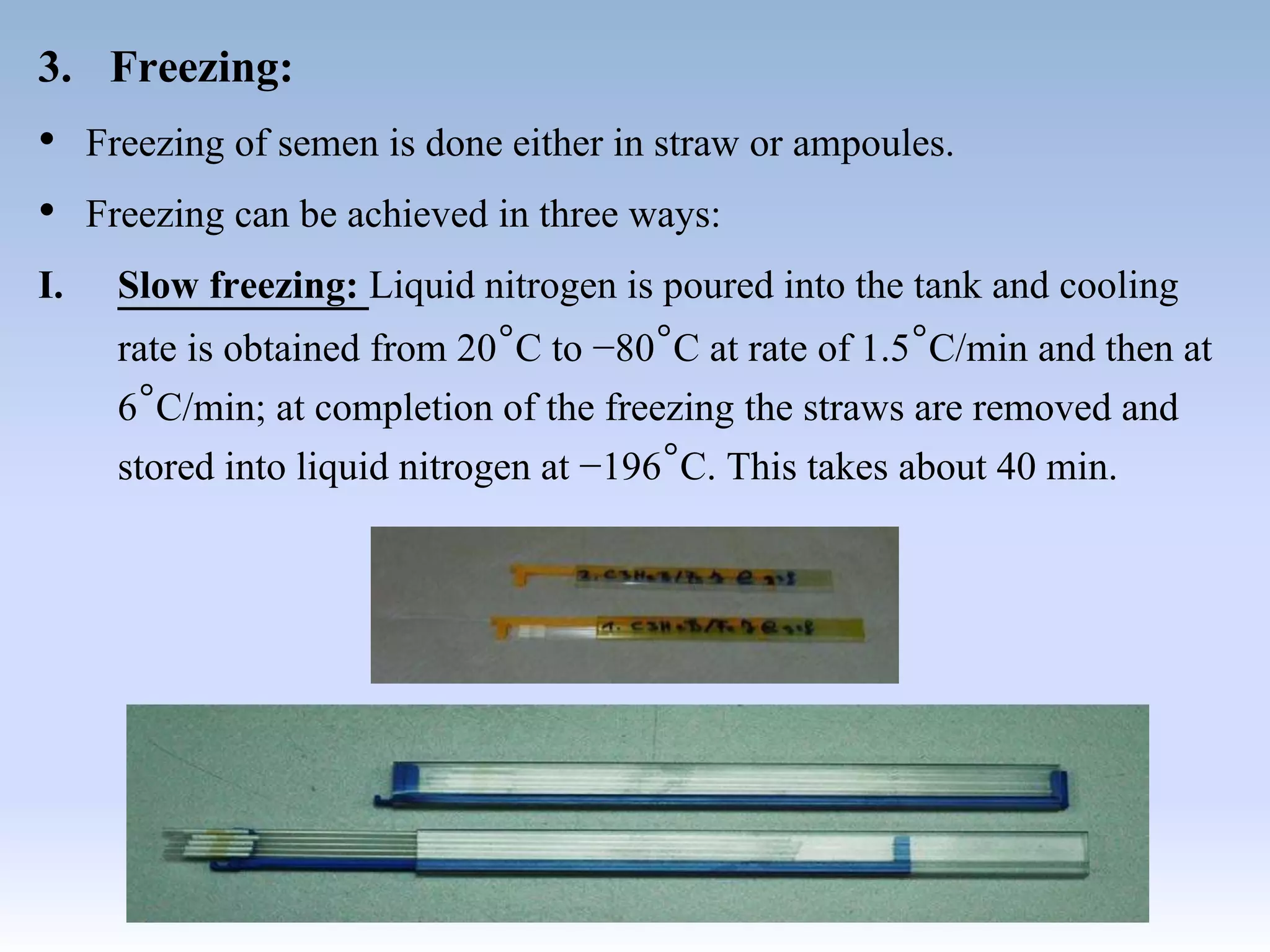
• Freezing of semen is done either in straw or ampoules.
• Freezing can be achieved in three ways:
I. Slow freezing: Liquid nitrogen is poured into the tank and cooling
rate is obtained from 20°C to −80°C at rate of 1.5°C/min and then at
6°C/min; at completion of the freezing the straws are removed and
stored into liquid nitrogen at −196°C. This takes about 40 min.
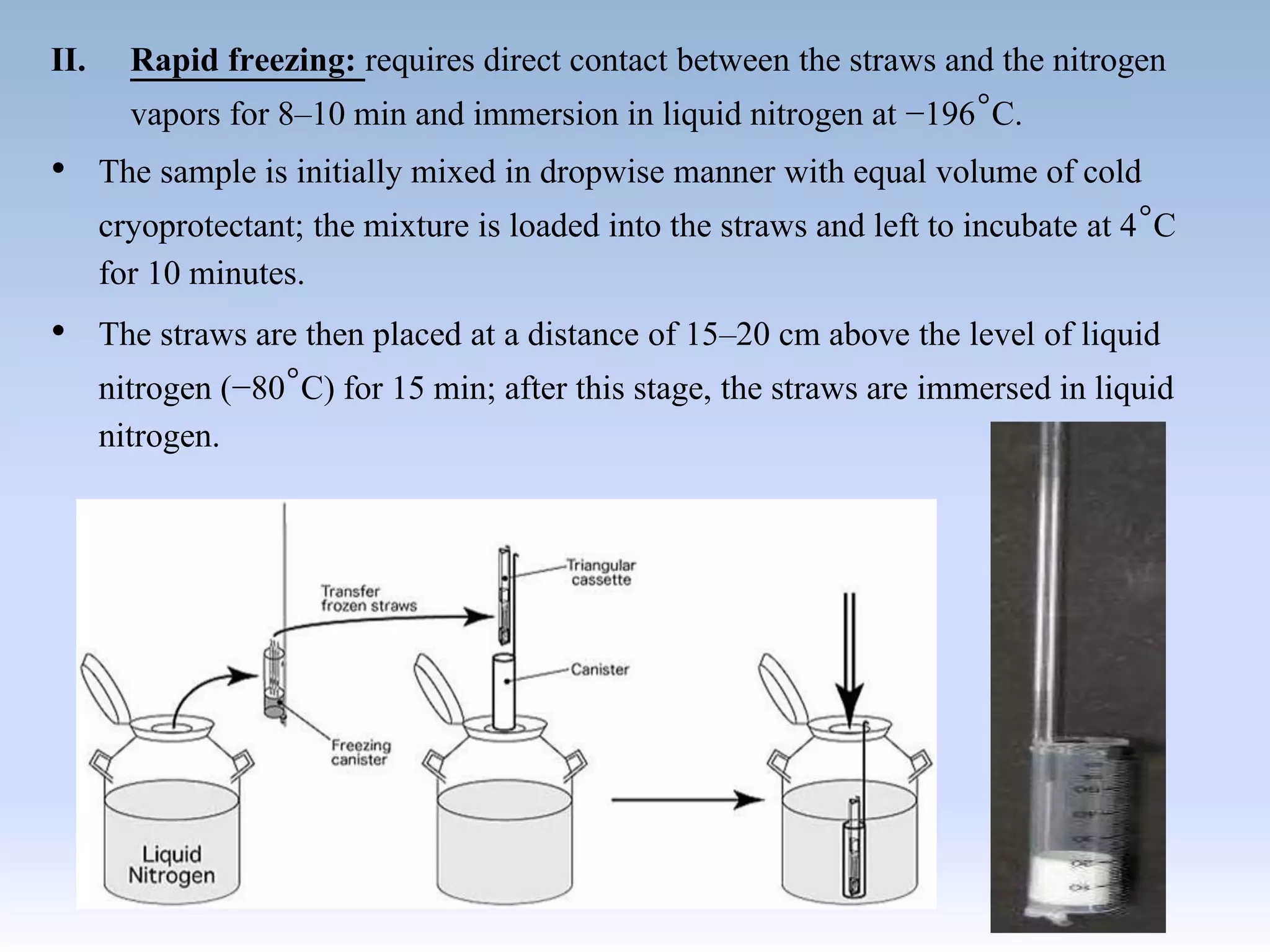
II. Rapid freezing: requires direct contact between the straws and the nitrogen
vapors for 8–10 min and immersion in liquid nitrogen at −196°C.
• The sample is initially mixed in dropwise manner with equal volume of cold
cryoprotectant; the mixture is loaded into the straws and left to incubate at 4°C
for 10 minutes.
• The straws are then placed at a distance of 15–20 cm above the level of liquid
nitrogen (−80°C) for 15 min; after this stage, the straws are immersed in liquid
nitrogen.
4. Thawing:
• It is done by putting ampoule containing the sample in a warm water
bath (35 to 40°c).
• Frozen tips of the sample in tubes or ampoules are plunged into the
warm water with a vigorous swirling action just to the point of ice
disappearance.
• Just a point of thawing quickly transfer the tubes to a water bath
maintained at room temperature and continue the swirling action for
15 sec to cool the warm walls of the tube.
Cryopreservation Of
Embryo• Embryo cryopreservation or embryo freezing is a method used to
preserve embryos, generally at embryogenesis stage by cooling and
storing them at low temperatures.
• Started in 1984.
• It is one of the most common and well
established fertility preservation treatments,
with proven successful pregnancy rates.
• In addition, the duration of storage had no
significant effect on clinical pregnancy,
miscarriage, implant, or live birth rate.
Process Of Embryo
Cryopreservation1. Embryo collection:
• Egg retrival is done under ultrasound guidance and
subsequent fertilization and embryo culture is carried out.
• If there is surplus of embryos, then embryos of sufficient
quality are collected for cryostorage.
2. Embryo selection:
• While the embryos can be frozen at any pre implantation
stage between one cell to the blastocyte stage, generally
embryos at blastocyte stage are chosen to cryopreserve.
• In cases where embryo needs to be frozen without a fresh
transfer, freeze all the embryos the day after egg collection at
one cell-stage.
3. Freezing:
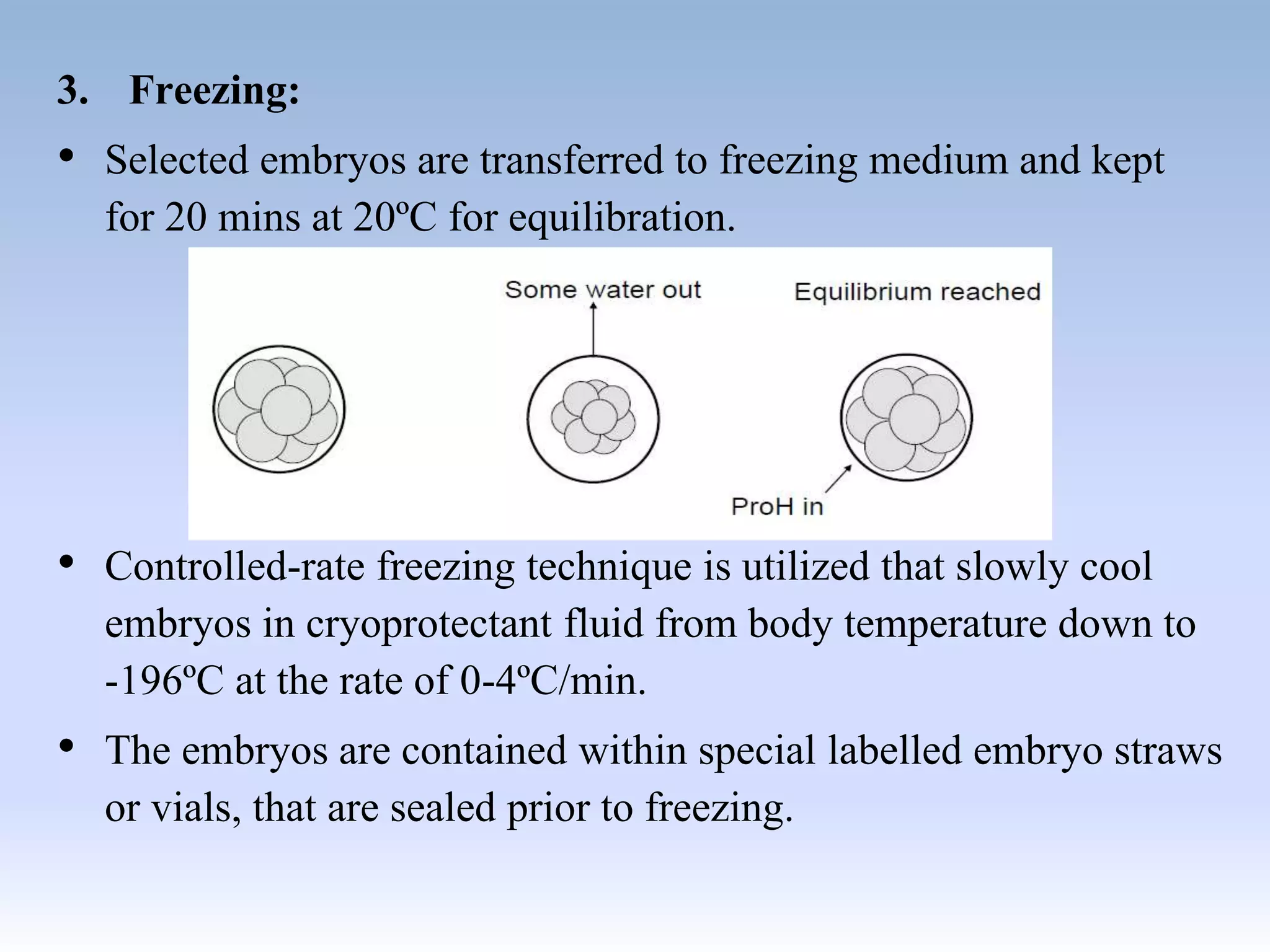
• Selected embryos are transferred to freezing medium and kept
for 20 mins at 20ºC for equilibration.
• Controlled-rate freezing technique is utilized that slowly cool
embryos in cryoprotectant fluid from body temperature down to
-196ºC at the rate of 0-4ºC/min.
• The embryos are contained within special labelled embryo straws
or vials, that are sealed prior to freezing.
• Once frozen, embryos are placed inside labelled tubes attached to
aluminium canes.
• After reaching -35ºC, the straw is removed from freezer and quickly
placed in LN2 container and stored in it.
4. Thawing:
• Embryo thawing is the reverse of the freezing process, and
involves warming the embryos.
• Embryo thawing takes approximately 2 hours.
• During the thawing process, embryo is placed in water bath.
• When embryos return to room temperature, the embryos are
passed through a series of solutions to remove the
cryoprotectant that is no longer needed.
• The thawed embryos are kept in the incubator until the
embryo transfer, during which time they should resume
development and undergo cell division.
Comparison Of
Cryopreservation Of Sperm
And Embryo
Cryopreservation

Cryopreservation

  • 1.
    Cryopreservation Of Sperm AntigensAnd Embryo By: Aachal D. J Roll No. 07 Class: Msc. II Paper: 4
  • 2.
    Cryopreservation • Cryopreservation derivesfrom the Greek word cryos, meaning “cold”. • Thus it refers to the preservation of biological tissues in sub zero temperatures, typically -196 º C. • At these temperatures, all biological activities of cells and tissues is effectively stopped or ceased. • Cryogenic storage at very low temperatures is presumed to provide an indefinite, if not near infinite, longevity to cells. • Pre-implantation embryos, oocytes , spermatozoa ,ovarian tissue can be cryopreseved.
  • 3.
    Benefits of Cryopreservation • Effectivemeans to conserve the germ plasms of endangered species. • Fertility preservation. • Methods to reduce multiple pregnancies • Larger range of stocks available • Easy disease-free exchange of stocks, nationally and internationally • Stocks remain viable indefinitely • Safety from disease, genetic contamination and breeding failure
  • 4.
    What You NeedFor Cryopreservation?Liquid nitrogen ( liquid phase or vapor phase) • Characteristics of liquid nitrogen: – Chemically inert – Relatively low cost – Non toxic – Non flammable – Readily available Cryofreezer Cryoprotectant: organic or inorganic additive which will protect the cell from freezing injuries during cryopreservation. • Characteristics of cryoprotectants: – Should easily penetrate into cell – Non- electrolyte – Easily misible with water – E.g: Glycerol, DMSO, PVP, PEG etc.
  • 5.
    Cryopreservation Of Sperm• Itis commonly known as sperm banking. • Sperm banking is a procedure to preserve sperm cells for future use. • The first successful cryopreservation of spermatozoa was initiated over 50 years ago. • For human sperm, the longest reported successful storage is 22 years. • It can be used for sperm donation where the recipient wants the treatment in a different time or place, or for men undergoing a vasectomy to still have the option to have children. • It is also useful for men suffering from azoosprmia (Lack of motile sperm) & Gonadial cancer. • These frozen sperms can be used in association with one of the Assisted Reproductive Techniques ( ART) to induce pregnancy.
  • 6.
    Process of Sperm Cryopreservation 1.Obtaining semen sample: • Semen samples are collected in sterile container. • The semen so collected is suspended in 10-20% glycerol in egg yolk buffer. 2. Semen analysis: • Semen samples are analyzed for volume, viscosity and pH levels, and microscopically evaluated to determine motility, sperm count and morphology.
  • 7.
    3. Freezing: • Freezingof semen is done either in straw or ampoules. • Freezing can be achieved in three ways: I. Slow freezing: Liquid nitrogen is poured into the tank and cooling rate is obtained from 20°C to −80°C at rate of 1.5°C/min and then at 6°C/min; at completion of the freezing the straws are removed and stored into liquid nitrogen at −196°C. This takes about 40 min.
  • 8.
    II. Rapid freezing:requires direct contact between the straws and the nitrogen vapors for 8–10 min and immersion in liquid nitrogen at −196°C. • The sample is initially mixed in dropwise manner with equal volume of cold cryoprotectant; the mixture is loaded into the straws and left to incubate at 4°C for 10 minutes. • The straws are then placed at a distance of 15–20 cm above the level of liquid nitrogen (−80°C) for 15 min; after this stage, the straws are immersed in liquid nitrogen.
  • 9.
    4. Thawing: • Itis done by putting ampoule containing the sample in a warm water bath (35 to 40°c). • Frozen tips of the sample in tubes or ampoules are plunged into the warm water with a vigorous swirling action just to the point of ice disappearance. • Just a point of thawing quickly transfer the tubes to a water bath maintained at room temperature and continue the swirling action for 15 sec to cool the warm walls of the tube.
  • 10.
    Cryopreservation Of Embryo• Embryocryopreservation or embryo freezing is a method used to preserve embryos, generally at embryogenesis stage by cooling and storing them at low temperatures. • Started in 1984. • It is one of the most common and well established fertility preservation treatments, with proven successful pregnancy rates. • In addition, the duration of storage had no significant effect on clinical pregnancy, miscarriage, implant, or live birth rate.
  • 11.
    Process Of Embryo Cryopreservation1.Embryo collection: • Egg retrival is done under ultrasound guidance and subsequent fertilization and embryo culture is carried out. • If there is surplus of embryos, then embryos of sufficient quality are collected for cryostorage. 2. Embryo selection: • While the embryos can be frozen at any pre implantation stage between one cell to the blastocyte stage, generally embryos at blastocyte stage are chosen to cryopreserve. • In cases where embryo needs to be frozen without a fresh transfer, freeze all the embryos the day after egg collection at one cell-stage.
  • 12.
    3. Freezing: • Selectedembryos are transferred to freezing medium and kept for 20 mins at 20ºC for equilibration. • Controlled-rate freezing technique is utilized that slowly cool embryos in cryoprotectant fluid from body temperature down to -196ºC at the rate of 0-4ºC/min. • The embryos are contained within special labelled embryo straws or vials, that are sealed prior to freezing.
  • 13.
    • Once frozen,embryos are placed inside labelled tubes attached to aluminium canes. • After reaching -35ºC, the straw is removed from freezer and quickly placed in LN2 container and stored in it.
  • 14.
    4. Thawing: • Embryothawing is the reverse of the freezing process, and involves warming the embryos. • Embryo thawing takes approximately 2 hours. • During the thawing process, embryo is placed in water bath. • When embryos return to room temperature, the embryos are passed through a series of solutions to remove the cryoprotectant that is no longer needed. • The thawed embryos are kept in the incubator until the embryo transfer, during which time they should resume development and undergo cell division.
  • 15.