Cross-Contamination Definition and  Prevention Techniques
In this lesson, you’ll learn about Cross-Contamination Definition Examples Results  Prevention
Cross-contamination Defined Cross Contamination occurs when bacteria is carried from one object to another object, person to person, or from one object to a person.
Examples of Object to Object  Cross-contamination Failing to use separate plates for cooked and RTE foods Example: using the same plate to take raw hamburger patties out to the grill and using the same plate to bring the cooked burgers in Failing to wash, rinse and sanitize cutting boards, knives and utensils in-between usage for raw and cooked food Example: cutting raw chicken on a cutting board and cutting a head of lettuce without washing, rinsing and sanitizing in-between these uses Improper Storage Example: RTE food, such as salad, is stored in the refrigerator below uncooked food, such as raw chicken. The raw chicken can drip into the salad.
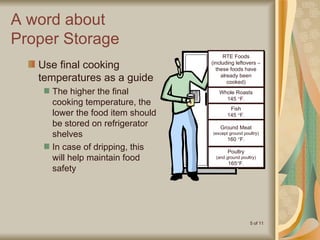
A word about  Proper Storage  Use final cooking temperatures as a guide The higher the final cooking temperature, the lower the food item should be stored on refrigerator shelves In case of dripping, this will help maintain food safety RTE Foods (including leftovers – these foods have already been cooked) Whole Roasts 145   F. Fish 145   F. Ground Meat (except ground poultry) 160   F. Poultry (and ground poultry) 165  F.
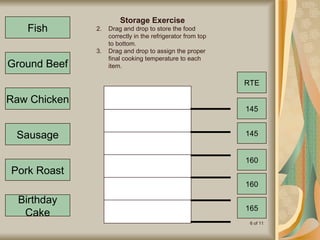
Simulated Storage Exercise Drag and drop to store the food correctly in the refrigerator from top to bottom. Drag and drop to the lines on the right to assign the proper final cooking temperature to each item. Fish Pork Roast Sausage Ground Beef Raw Chicken Birthday Cake 145 160 RTE 145 160 165
Examples of Person to Person Cross-contamination Via Food Example: Raw meat is handled by one person and, prior to hand washing, that person shakes hands with another (and another, and another…)  Via Hands Example: Failing to wash hands after restroom use, coughing, sneezing then shaking someone’s hand
Examples of Object to Person Cross-contamination Hands are not washed before handling food Hands are not washed after handling raw food and before handling Ready-To-Eat (RTE) foods Example: handling raw chicken and failing to wash hands before handling salad Failing to use separate plates for cooked and RTE foods Example: using the same plate to take raw hamburger patties out to the grill and using the same plate to bring the cooked burgers in Failing to wash, rinse and sanitize cutting boards, knives and utensils in-between usage for raw and cooked food Example: cutting raw chicken on a cutting board and cutting a head of lettuce without washing, rinsing and sanitizing in-between these uses
Results of Cross-contamination Foodborne Illness (FBI) Foodborne Illness Outbreaks  FBI outbreaks occur when two or more people contract a foodborne illness after eating the same food
Preventing Cross-contamination Always wash your hands before handling food AND in-between handling raw and RTE foods Always wash, rinse and sanitize cutting boards, knives and utensils in-between preparation of raw and RTE foods Always wash hands after: Using the restroom Coughing or sneezing Touching your hair or face Handling garbage or cleaning chemicals
For More Information… Visit the CDC’s web site to view a video on proper hand washing: http://www.cdc.gov/CDCTV/handstogether/ Visit the FDA’s website to learn more about symptoms and sources of specific foodborne illnesses: http://www.fda.gov/Food/ResourcesForYou/Consumers/ucm103263.htm

Cross-Contamination

  • 1.
    Cross-Contamination Definition and Prevention Techniques
  • 2.
    In this lesson,you’ll learn about Cross-Contamination Definition Examples Results Prevention
  • 3.
    Cross-contamination Defined CrossContamination occurs when bacteria is carried from one object to another object, person to person, or from one object to a person.
  • 4.
    Examples of Objectto Object Cross-contamination Failing to use separate plates for cooked and RTE foods Example: using the same plate to take raw hamburger patties out to the grill and using the same plate to bring the cooked burgers in Failing to wash, rinse and sanitize cutting boards, knives and utensils in-between usage for raw and cooked food Example: cutting raw chicken on a cutting board and cutting a head of lettuce without washing, rinsing and sanitizing in-between these uses Improper Storage Example: RTE food, such as salad, is stored in the refrigerator below uncooked food, such as raw chicken. The raw chicken can drip into the salad.
  • 5.
    A word about Proper Storage Use final cooking temperatures as a guide The higher the final cooking temperature, the lower the food item should be stored on refrigerator shelves In case of dripping, this will help maintain food safety RTE Foods (including leftovers – these foods have already been cooked) Whole Roasts 145  F. Fish 145  F. Ground Meat (except ground poultry) 160  F. Poultry (and ground poultry) 165  F.
  • 6.
    Simulated Storage ExerciseDrag and drop to store the food correctly in the refrigerator from top to bottom. Drag and drop to the lines on the right to assign the proper final cooking temperature to each item. Fish Pork Roast Sausage Ground Beef Raw Chicken Birthday Cake 145 160 RTE 145 160 165
  • 7.
    Examples of Personto Person Cross-contamination Via Food Example: Raw meat is handled by one person and, prior to hand washing, that person shakes hands with another (and another, and another…) Via Hands Example: Failing to wash hands after restroom use, coughing, sneezing then shaking someone’s hand
  • 8.
    Examples of Objectto Person Cross-contamination Hands are not washed before handling food Hands are not washed after handling raw food and before handling Ready-To-Eat (RTE) foods Example: handling raw chicken and failing to wash hands before handling salad Failing to use separate plates for cooked and RTE foods Example: using the same plate to take raw hamburger patties out to the grill and using the same plate to bring the cooked burgers in Failing to wash, rinse and sanitize cutting boards, knives and utensils in-between usage for raw and cooked food Example: cutting raw chicken on a cutting board and cutting a head of lettuce without washing, rinsing and sanitizing in-between these uses
  • 9.
    Results of Cross-contaminationFoodborne Illness (FBI) Foodborne Illness Outbreaks FBI outbreaks occur when two or more people contract a foodborne illness after eating the same food
  • 10.
    Preventing Cross-contamination Alwayswash your hands before handling food AND in-between handling raw and RTE foods Always wash, rinse and sanitize cutting boards, knives and utensils in-between preparation of raw and RTE foods Always wash hands after: Using the restroom Coughing or sneezing Touching your hair or face Handling garbage or cleaning chemicals
  • 11.
    For More Information…Visit the CDC’s web site to view a video on proper hand washing: http://www.cdc.gov/CDCTV/handstogether/ Visit the FDA’s website to learn more about symptoms and sources of specific foodborne illnesses: http://www.fda.gov/Food/ResourcesForYou/Consumers/ucm103263.htm