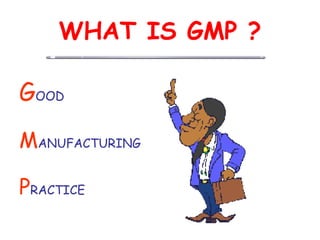
WHAT IS GMP ? G OOD M ANUFACTURING P RACTICE
WHY DO WE NEED GMP? BAKIT KAILANGAN ANG GMP?
TYPES OF CONTAMINATION PARTICULATES MICROORGANISMS CROSS-CONTAMINATION
TYPES OF CONTAMINANTS PARTICULATES  (Pira-pirasong bagay) dust, dirt, paper, metal, fibers, etc. MICROORGANISMS  (Mikrobyo) bacteria, yeasts, molds CROSS-CONTAMINATION  (Pag halo sa iba’t-ibang produkto) labels, cartons, foil, materials, etc.
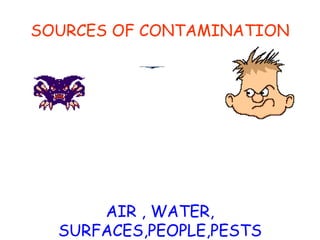
SOURCES OF CONTAMINATION AIR , WATER, SURFACES,PEOPLE,PESTS
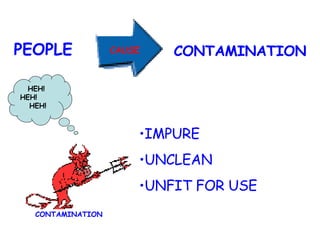
IMPURE UNCLEAN UNFIT FOR USE CONTAMINATION PEOPLE CONTAMINATION CAUSE HEH!  HEH! HEH!
CGMP REGULATION Report any injury or illness immediately to your supervisor.
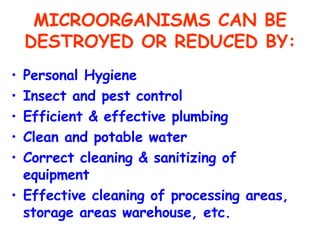
MICROORGANISMS CAN BE DESTROYED OR REDUCED BY: Personal Hygiene Insect and pest control Efficient & effective plumbing Clean and potable water Correct cleaning & sanitizing of equipment Effective cleaning of processing areas, storage areas warehouse, etc.
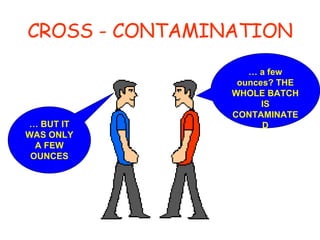
CROSS - CONTAMINATION …  BUT IT WAS ONLY A FEW OUNCES …  a few ounces? THE WHOLE BATCH IS CONTAMINATED
GMP………….… SHARED RESPONSIBILITY OF  ESTABLISHMENT AND EMPLOYEES
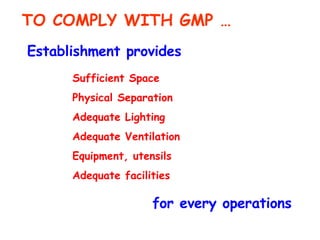
TO COMPLY WITH GMP … Establishment provides Sufficient Space Physical Separation Adequate Lighting Adequate Ventilation Equipment, utensils Adequate facilities for every operations


WORKERS AND EMPLOYEES Take necessary steps and follow procedures to assure sanitary and safe operation of the plant.
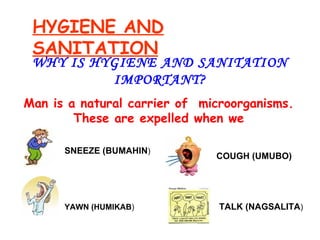
HYGIENE AND SANITATION WHY IS HYGIENE AND SANITATION IMPORTANT? Man is a natural carrier of  microorganisms. These are expelled when we SNEEZE (BUMAHIN ) COUGH (UMUBO) YAWN (HUMIKAB ) TALK (NAGSALITA )
MICROORGANISMS ARE IN MAN’S HAIR, SKIN, INTESTINES, URINE, UNDERNEATH FINGERNAILS. We collect more microorganisms as we travel from home to our destination due to dust, smoke generated by vehicles and contact with dirty items. It is therefore important that we observe good hygiene and sanitation to avoid contamination of products we handle.
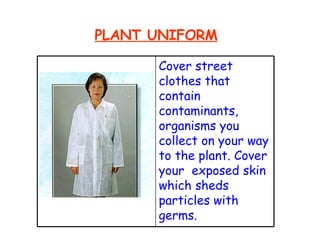
PLANT UNIFORM Cover street clothes that contain contaminants, organisms you collect on your way to the plant. Cover your  exposed skin which sheds particles with germs.
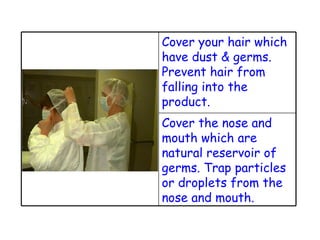
Cover the nose and mouth which are natural reservoir of germs. Trap particles or droplets from the nose and mouth. Cover your hair which have dust & germs. Prevent hair from falling into the product.
Cover finger nails and hands which have germs. Street shoes contain germs from the soil and dirt we stepped on, so it must not be worn inside the plant, plant shoes must be used instead.
WHY USE RUBBER GLOVES??? It prevents microorganism transfer from our hands to the product we handle. It prevents transfer of product dust to our hands.
It is porous and will not prevent transfer of microorganisms and perspiration to the product we handle. It permits transfer of product dust to our hands. WHY CAN’T WE USE COTTON GLOVES???
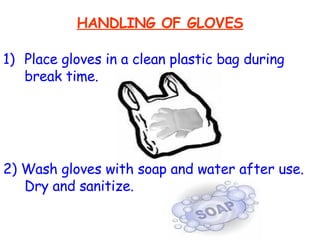
HANDLING OF GLOVES Place gloves in a clean plastic bag during break time. 2) Wash gloves with soap and water after use. Dry and sanitize.
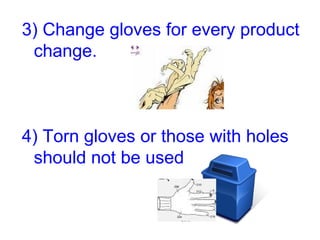
3) Change gloves for every product change. 4) Torn gloves or those with holes should not be used
HYGIENE AND SANITATION PRACTICES *Wash hands with soap and water After using the toilet Before starting to work After blowing your nose After handling dirty things After touching body surface After eating
-Don’t touch or scratch your nose, head, body parts while handling products. -Cover your nose, mouth when sneezing, coughing, yawning. -Avoid talking and use mask if necessary. -Observe good toilet practices by: - Flushing the toilet after use -Washing hands with soap and water
HOW TO WASH YOUR HANDS
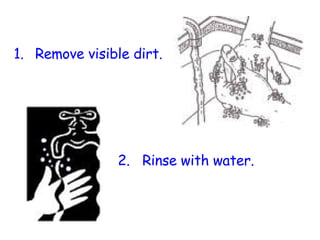
Remove visible dirt. 2.  Rinse with water.
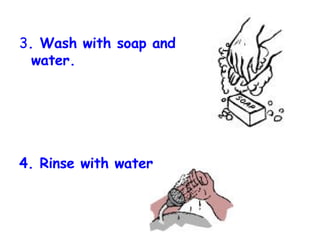
3 . Wash with soap and water. 4. Rinse with water
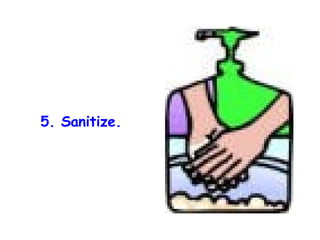
5. Sanitize.
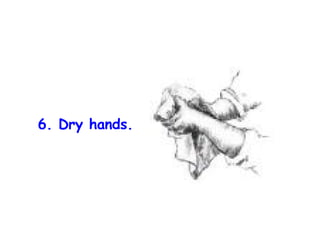
6. Dry hands.
GOOD HOUSE KEEPING PRACTICES - Keep dirt and dust away from work areas. Pick-up pieces of paper, foreign and unwanted objects that may be seen in the work area and throw them in the trash can. -Clean up debris as work continuous. -Do not place tools, materials, objects, etc. on product contact surfaces.
- When job is finished, clean up work area, surfaces and equipment. -Keep personal things in the place provided for them. -Place lunch wrappers, food left overs and other rabbish in the containers provided for them. -Place soft drinks bottles in the container provided for them. -Place chairs in orderly position before leaving the work area.
GMP IN THE WORK AREA Use the product container for the intended product only. Don’t use it for glue, oil, soap, etc. Be in your work assignment all the time. Don’t attempt to transfer to adjacent packing lines to help as you may not be properly trained to do the job.
3.  Clean up your debris as work continues. 4. Products falling on the floor or dirty surfaces must not be put back for packaging. 5. Cover product container and secure all materials pertaining to the product like labels, cartons, etc. before leaving the work area during break times. 6. Identify all containers used with product name, batch/lot number, expiry date. (Containers for rejects, unused labels, etc.)
7. Never handle products with bare hands. Use rubber gloves if you are assigned to handle products. 8. Clean and sanitize work area surface following instruction of supervisor when job is finished. 9. Don’t touch nose, head or any body parts while handling products. 10. Don’t get items from adjacent lines to be used in your line.
11) Cover your nose and mouth when sneezing or coughing. 12) Pay full attention to the assigned task and refrain from talking to your co-corkers. 13) Familiarize yourself with assigned operation taking note of distinct features to enable detection of mix-up or mistakes .
14) Follow strictly the instruction given by the supervisor. In case of doubt, seek the help of the supervisor. 15) Don’t eat or chew gums while in the work area. 16) Notify supervisor promptly if there is an accidental contamination of product contact surfaces.
BACTERIA Bacilli Bacterial Spores Molds Pneumococci Yeast
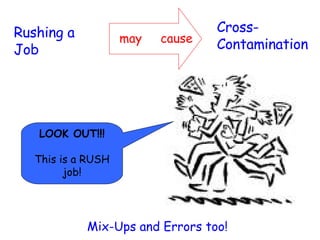
Mix-Ups and Errors too! Rushing a Job Cross-Contamination LOOK OUT!!! This is a RUSH job! may  cause
GOOD MANUFACTURING PRACTICE -Developed in the 1960’s -Part of the Food, Drug, and Cosmetic act -Has the force and effect of law THESE REGULATIONS HAVE THE FORCE AND EFFECT OF LAW  CGMP  Regulations
BFAD IS RESPONSIBLE FOR SEEING THAT OUR COMPANY COMPLIES WITH CGMP REGULATIONS.
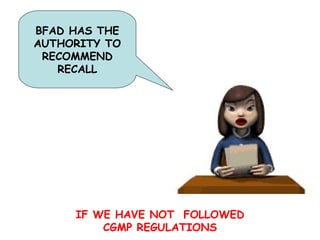
IF WE HAVE NOT  FOLLOWED CGMP REGULATIONS BFAD HAS THE AUTHORITY TO RECOMMEND RECALL
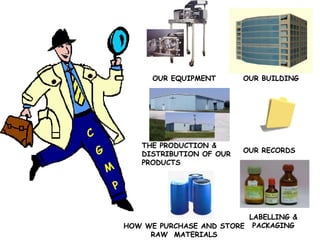
HOW WE PURCHASE AND STORE RAW  MATERIALS OUR BUILDING LABELLING & PACKAGING THE PRODUCTION & DISTRIBUTION OF OUR PRODUCTS OUR RECORDS OUR EQUIPMENT C G M P
PREMISES Premises/building must be designed and constructed to facilitate company productivity, employee safety and product quality. Plant site should be carefully selected considering the physical terrain and the ground surrounding it.
BUILDING PREMISES GMP REQUIREMENTS: 1. Separate area for specific operation. 2. Easy to clean. 3. Easy to maintain. 4. Easy to operate. 5. Adequate space 6. Eliminate unnecessary traffic Inadequate space and unnecessary traffic cause mix-up and errors.
GMP REGULATION:   Defined area for a. Receiving  of materials b. Storage of materials c. Quality control laboratory d. Manufacturing area e. In-process storage f. Packaging area g. Quarantine area
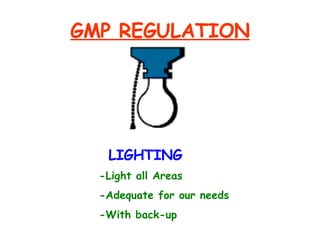
GMP REGULATION -Light all Areas -Adequate for our needs -With back-up LIGHTING
GMP REGULATION WATER SYSTEM STEADY PRESSURE FREE OF PROBLEMS NO DRAINAGE BACK-FLOW
GMP REGULATION Waste materials must be removed and disposed of in a safe and sanitary manner.
GMP REGULATION Building must be maintained and kept in good condition. There must be a regular housekeeping .
Building must be protected from infiltration of contaminants  and  from outside elements like dust, odors, filth, pests. Adequate space is necessary in designing a plant. Adequate space is critical to the plant productivity, personnel safety and the quality of the product.
Lack of space can cause confusion in the workflow and this can adversely affect productivity. Lack of space can also cause unnecessary traffic in the work area which can endanger employee safety. Lack of space can result in contamination, mix-ups and errors.
PERSONNEL People should know how to perform the job right the first time and every time. They must have the knowledge to perform their job and the skills required by the job. People must have personal responsibility to develop personal competence.
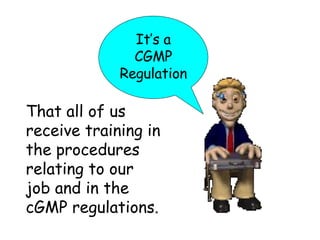
That all of us receive training in the procedures relating to our job and in the cGMP regulations. It’s a CGMP Regulation
Proper Training in relation to their assigned task or function SOLUTIONS IMPROVE  INSPECTION METHODS
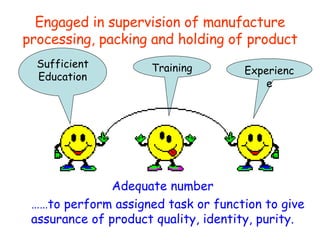
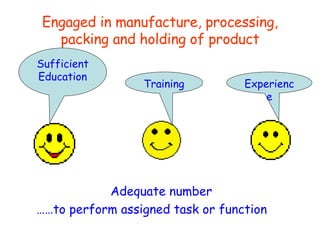
Engaged in supervision of manufacture processing, packing and holding of product Adequate number …… to perform assigned task or function to give assurance of product quality, identity, purity. Sufficient Education Training Experience
Engaged in manufacture, processing, packing and holding of product Adequate number …… to perform assigned task or function Sufficient Education Training Experience
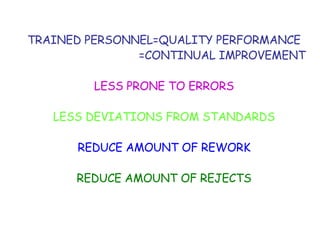
TRAINED PERSONNEL=QUALITY PERFORMANCE   =CONTINUAL IMPROVEMENT LESS PRONE TO ERRORS LESS DEVIATIONS FROM STANDARDS REDUCE AMOUNT OF REWORK REDUCE AMOUNT OF REJECTS
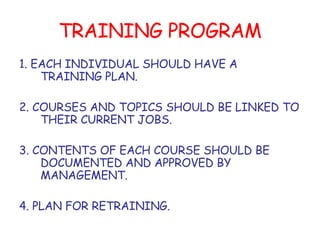
TRAINING PROGRAM 1. EACH INDIVIDUAL SHOULD HAVE A TRAINING PLAN. 2. COURSES AND TOPICS SHOULD BE LINKED TO THEIR CURRENT JOBS. 3. CONTENTS OF EACH COURSE SHOULD BE DOCUMENTED AND APPROVED BY MANAGEMENT. 4. PLAN FOR RETRAINING.
Confucius… I hear and I forget I see and I remember I do and I understand
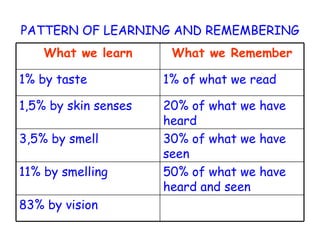
PATTERN OF LEARNING AND REMEMBERING 83% by vision 50% of what we have  heard and seen 11% by smelling 30% of what we have  seen 3,5% by smell 20% of what we have  heard 1,5% by skin senses 1% of what we read 1% by taste What we Remember What we learn
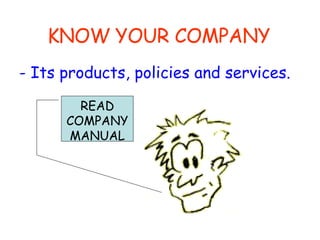
KNOW YOUR COMPANY - Its products, policies and services. READ COMPANY MANUAL
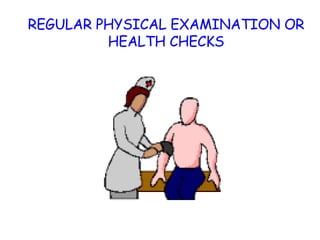
REGULAR PHYSICAL EXAMINATION OR HEALTH CHECKS
PRACTICE GOOD SANITATION AND HEALTH HABITS
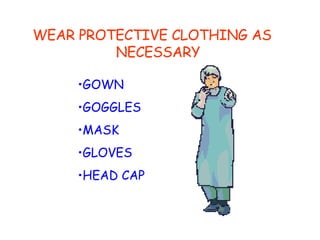
WEAR PROTECTIVE CLOTHING AS NECESSARY GOWN GOGGLES MASK GLOVES HEAD CAP
ADEQUATE PERSONAL RECORDS Name  Address Qualification Signature
UNDERSTAND THE REQUIREMENTS And demands of your job. Determine how you can do your job most efficiently.
FOLLOWING SOP’S IS VITAL …… .AND SO ARE THE RECORDS WE KEEP! SOP’s RECORDS
REASONS FOR WRITING PROCEDURES AVOID/MINIMIZE MIX-UPS AND ERRORS ENSURE CONSISTENT QUALITY ENSURE COMPLIANCE WITH GMP REGULATION
ACCURATE RECORD KEEPING IS VITAL ……. RECORDS MUST BE FILLED OUT AT THE TIME WE COMPLETE THE JOB!!! When did I do…. that?
TRAINING MUST BE REINFORCED BY THE SUPERVISOR….. BFAD INSPECTORS ASK TO SEE OUR TRAINING RECORDS…. FOLLOW S.O.P.‘s
cGMP TRAINING MUST BE REINFORCED BY ON THE JOB SUPERVISION AND WHERE REQUIRED, SUPPLEMENTED BY A REVIEW TRAINING COURSE. FOLLOW SOP’S!!!
DEVELOPING COMPETENCE EDUCATION AND TRAINING ON-THE-JOB EXPERIENCE
COMPETENCE IS DEMONSTRATED BY SUCCESSFUL JOB PERFORMANCE
DEFINITION OF COMPETENCE WEBSTER 1. Having ability or qualities 2. Legally qualified or able DR. LAWRENCE J. PETER (PETER PRINCIPLE) “ COMPETENCE  like truth, beauty and  contact lenses, is in the eye of the beholder.”
MEASURE OF COMPETENCE NUMBER OF SUCCESSES? NUMBER OF FAILURES? PROMPTNESS OF ACTION? LEADTIME? QUALITY OF ACTION?
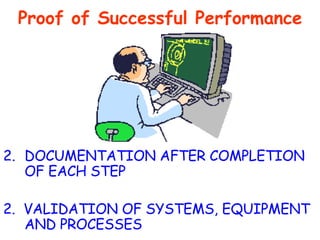
DOCUMENTATION AFTER COMPLETION OF EACH STEP 2.  VALIDATION OF SYSTEMS, EQUIPMENT AND PROCESSES Proof of Successful Performance
DEMONSTRATE COMPETENCE ON THE JOB EXPERIENCE
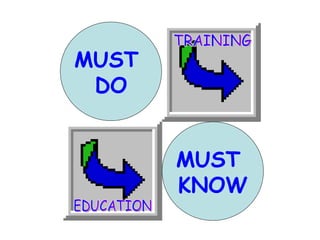
MUST  KNOW MUST  DO EDUCATION TRAINING
Y O U R  J O B MUST DO MUST KNOW KNOWLEDGE SKILLS
THREE P’s OF GMP P ERFORMANCE P RIDE P ROOF
EQUIPMENT Equipment design must be carefully examined. Dedicated equipment should be used for products which are difficult to remove, difficult to clean and for products with a high safety risk.
EQUIPMENT REQUIREMENTS: MUST BE MADE OF MATERIALS THAT WILL NOT REACT WITH OR ABSORB ANY COMPONENTS THEY CONTACT. MUST BE DESIGNED FOR THE PARTICULAR PURPOSE FOR WHICH IT IS INTENDED. MUST BE LOCATED FOR EASY MAINTENANCE. SUBSTANCES USED FOR OPERATION LIKE LUBRICANTS, COOLANTS SHOULD NOT COME IN CONTACT WITH THE PRODUCT.
  ALL MANUFACTURING EQUIPMENT NOT IN USE MUST BE STORED IN A MANNER TO KEEP IT CLEAN AND IN GOOD WORKING CONDITION. ALL EQUIPMENT MUST HAVE AN ACCURATE WELL DOCUMENTED LOG SHOWING WHAT WAS PRODUCED IN IT. ALL EQUIPMENT MUST HAVE A CLEANING LOG SHOWING WHEN, HOW AND BY WHOM EACH PIECE OF EQUIPMENT WAS CLEANED. ALL EQUIPMENT MUST HAVE AN IDENTIFICATION NUMBER WHICH SHOULD APPEAR ON THE BATCH RECORDS.
EQUIPMENT USED EXCLUSIVELY BY A PRODUCT, INDIVIDUAL LOG IS NOT REQUIRED. ALL EQUIPMENT MUST BE SANITIZED AFTER CLEANING. ALL EQUIPMENT MUST BE VALIDATED. EQUIPMENT MUST NOT BE USED AS STORAGE OF THINGS THAT DON’T BELONG TO THEM.
DETERGENTS USED FOR CLEANING MUST NOT BE SOURCE OF CONTAMINATION. MEASURING, WEIGHING, RECORDING AND CONTROL EQUIPMENT SHOULD BE CALIBRATED AND CHECKED AT DEFINED INTERVALS. MIXERS, PUMPS MUST HAVE CLEANABLE BEARINGS AND NON-LEAKING OIL SEALS. TANKS SHOULD HAVE COVED EDGES AND SLOPED BOTTOMS WITH THE OUTLET AT THE LOWEST POINT.
  TANKS MUST HAVE DOMED TOP TO ALLOW CONDENSATION TO DRAIN BACK TO THE TANK. TANK VENTS AND OVERFLOW LINES SHOULD HAVE SCREEN TO PREVENT ENTRY OF PESTS.   HOPPERS OF FILLING EQUIPMENT, RESERVOIRS MUST HAVE COVERS THAT ARE FIT AND EASY TO CLEAN.   FIXED PIPEWORK MUST BE CLEARLY LABELED TO INDICATE CONTENTS AND DIRECTION OF FLOW.
ALL PIPE WORK MUST BE SLOPED SO THAT THEY WILL DRAIN AND TO AVOID LOW SPOT AND DEAD LEGS. INTERNAL WELDS MUST BE SMOOTH, NOT PITTED TO AVOID FLUX-CONTAMINATION. DUST EXTRACTORS MUST NOT LODGE POWDER IN THE DUCTING WHICH MAY FALL BACK INTO THE PRODUCT. DEFECTIVE EQUIPMENT SHOULD BE REMOVED IN THE PRODUCTION AREA, QC, ETC. AND CLEARLY LABELED AS DEFECTIVE.
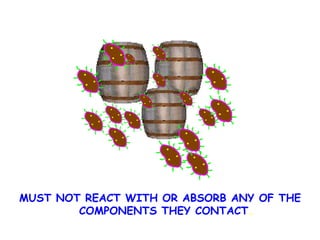
MUST NOT REACT WITH OR ABSORB ANY OF THE COMPONENTS THEY CONTACT .
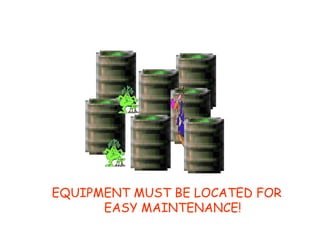
EQUIPMENT MUST BE LOCATED FOR EASY MAINTENANCE!
Equipment should be designed for the particular purpose for which it is intended. This is an important CGMP Regulation!
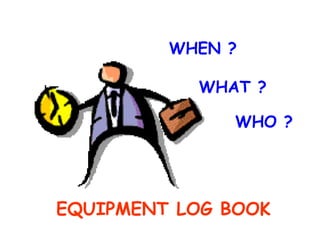
  WHEN ?   WHAT ?   WHO ? EQUIPMENT LOG BOOK
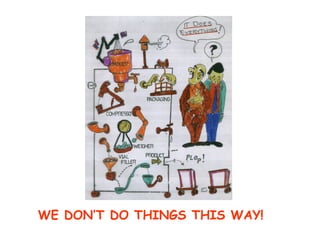
WE DON’T DO THINGS THIS WAY!
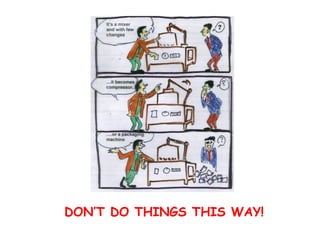
DON’T DO THINGS THIS WAY!
MAINTENANCE RETAIN EQUIPMENT IN ACCEPTABLE OPERATING CONDITION RESTORE EQUIPMENT TO AN ACCEPTABLE OPERATING CONDITION
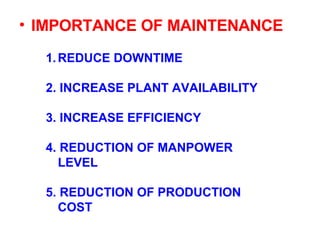
IMPORTANCE OF MAINTENANCE REDUCE DOWNTIME 2. INCREASE PLANT AVAILABILITY 3. INCREASE EFFICIENCY 4. REDUCTION OF MANPOWER  LEVEL 5. REDUCTION OF PRODUCTION COST
FOLLOW SOP’s ………………… …… . WHEN CLEANING EQUIPMENT GOOD JOB! THANK YOU!
BFAD CAN HOLD US RESPONSIBLE FOR ANY CGMP VIOLATION.
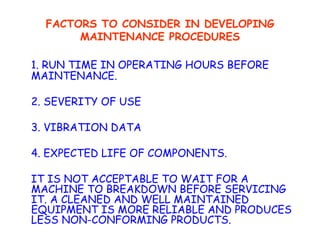
FACTORS TO CONSIDER IN DEVELOPING MAINTENANCE PROCEDURES 1. RUN TIME IN OPERATING HOURS BEFORE  MAINTENANCE. 2. SEVERITY OF USE 3. VIBRATION DATA 4. EXPECTED LIFE OF COMPONENTS. IT IS NOT ACCEPTABLE TO WAIT FOR A MACHINE TO BREAKDOWN BEFORE SERVICING IT. A CLEANED AND WELL MAINTAINED EQUIPMENT IS MORE RELIABLE AND PRODUCES LESS NON-CONFORMING PRODUCTS.
EQUIPMENT MAINTENANCE MECHANICAL AND PRECISION EQUIPMENT MUST BE CHECKED  REGULARLY . ALL AUTOMATIC AND ELECTRONIC EQUIPMENT LIKE COMPUTERS MUST ALSO BE TESTED AND INSPECTED .
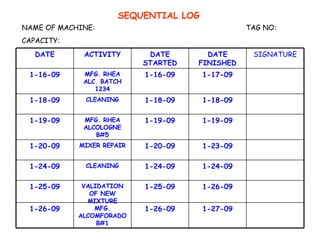
SEQUENTIAL LOG NAME OF MACHINE: TAG NO: CAPACITY: 1-27-09 1-26-09 MFG. ALCOMFORADO B#1 1-26-09 1-26-09 1-25-09 VALIDATION OF NEW MIXTURE 1-25-09 1-24-09 1-24-09 CLEANING 1-24-09 1-23-09 1-20-09 MIXER REPAIR 1-20-09 1-19-09 1-19-09 MFG. RHEA ALCOLOGNE B#5 1-19-09 1-18-09 1-18-09 CLEANING 1-18-09 1-17-09 1-16-09 MFG. RHEA ALC. BATCH 1234 1-16-09 SIGNATURE DATE FINISHED DATE STARTED ACTIVITY DATE
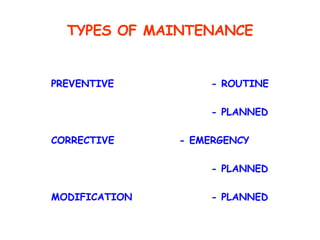
TYPES OF MAINTENANCE PREVENTIVE - ROUTINE - PLANNED CORRECTIVE - EMERGENCY - PLANNED MODIFICATION - PLANNED
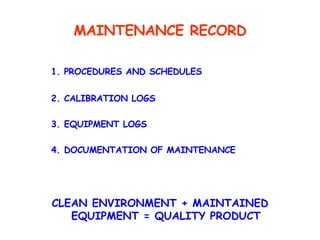
MAINTENANCE RECORD 1. PROCEDURES AND SCHEDULES 2. CALIBRATION LOGS 3. EQUIPMENT LOGS 4. DOCUMENTATION OF MAINTENANCE CLEAN ENVIRONMENT + MAINTAINED EQUIPMENT = QUALITY PRODUCT
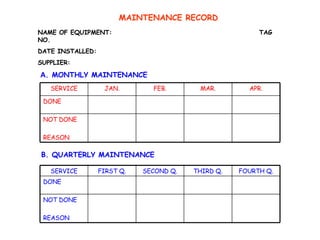
MAINTENANCE RECORD NAME OF EQUIPMENT:   TAG NO. DATE INSTALLED: SUPPLIER: A . MONTHLY MAINTENANCE B. QUARTERLY MAINTENANCE NOT DONE REASON DONE APR. MAR. FEB. JAN. SERVICE NOT DONE REASON DONE FOURTH Q. THIRD Q. SECOND Q. FIRST Q. SERVICE
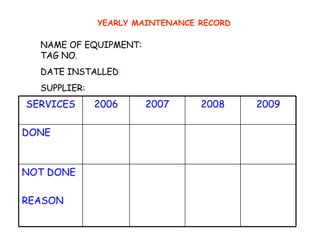
YEARLY MAINTENANCE RECORD NAME OF EQUIPMENT:   TAG NO. DATE INSTALLED : SUPPLIER: NOT DONE REASON DONE 2009 2008 2007 2006 SERVICES
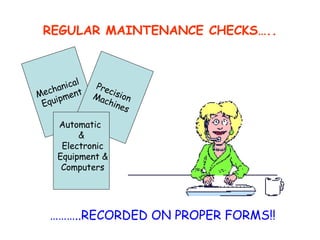
REGULAR MAINTENANCE CHECKS….. ……… ..RECORDED ON PROPER FORMS!! Mechanical  Equipment Precision  Machines Automatic  & Electronic Equipment & Computers
WE TEST OUR  PRODUCTS  FOR: A. PRESENCE OF  COMPONENTS       PRESUMED TO BE THERE B.  CONTAMINANTS  PRESUMED   MIGHT BE THERE
WE DO NOT LOOK FOR   CONTAMINANTS   INTRODUCED BY: INADEQUATE MANUFACTURING    CONTROLS 2. INADEQUATE ENVIRONMENTAL    CONTROLS 3. IMPROPER HANDLING
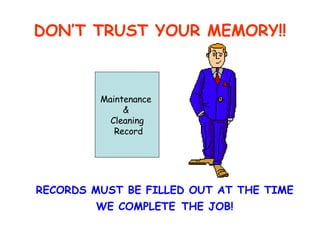
DON’T TRUST YOUR MEMORY!! RECORDS MUST BE FILLED OUT AT THE TIME WE COMPLETE   THE JOB! Maintenance  &  Cleaning Record
COMPONENTS CONTROL Building quality into the product starts with components control. Source, origin and suitability of components should be clearly defined. Components should come from qualified or approved manufacturers.
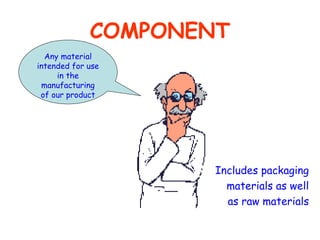
COMPONENT Includes packaging materials as well as raw materials Any material intended for use in the manufacturing of our product
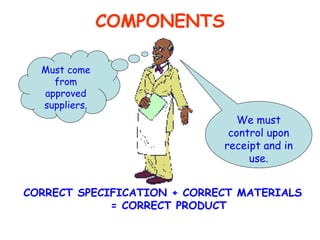
COMPONENTS CORRECT SPECIFICATION + CORRECT MATERIALS = CORRECT PRODUCT We must control upon receipt and in use. Must come from approved suppliers.
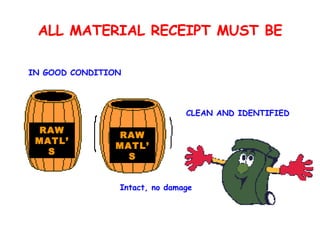
ALL MATERIAL RECEIPT MUST BE IN GOOD CONDITION       CLEAN AND IDENTIFIED Intact, no damage RAW MATL’S RAW MATL’S
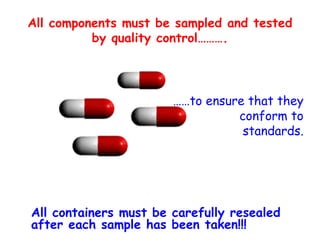
All components must be sampled and tested by quality control………. …… to ensure that they conform to standards. All containers must be carefully resealed after each sample has been taken!!!
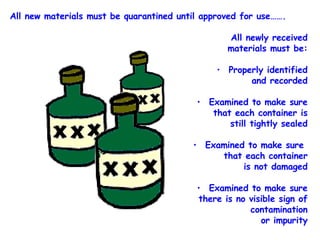
All new materials must be quarantined until approved for use……. All newly received materials must be: Properly identified and recorded Examined to make sure that each container is still tightly sealed Examined to make sure  that each container is not damaged Examined to make sure there is no visible sign of contamination or impurity
GMP REQUIRES THAT COMPLETE RECORDS ARE KEPT ON ALL NEWLY RECEIVED COMPONENTS. Proper identification When received and inspected? Who did the inspection? Who took samples ? When were they tested? Who did the test? ?????
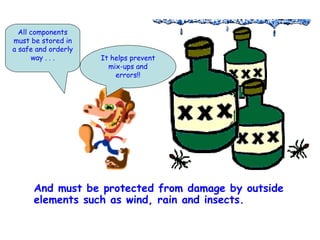
And must be protected from damage by outside elements such as wind, rain and insects. It helps prevent mix-ups and errors!! All components must be stored in a safe and orderly way . . .
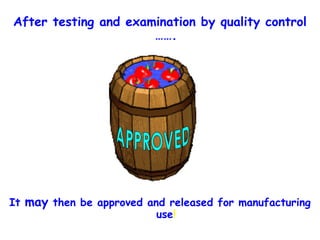
After testing and examination by quality control ……. It  may  then be approved and released for manufacturing use ! APPROVED
COMPONENTS MUST BE PROTECTED FROM HARMFUL BACTERIA
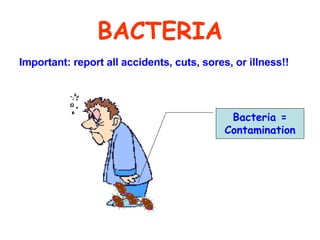
BACTERIA Important: report all accidents, cuts, sores, or illness!! Bacteria = Contamination
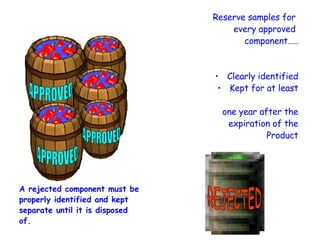
Reserve samples for  every approved  component….. Clearly identified Kept for at least one year after the expiration of the Product A rejected component must be properly identified and kept separate until it is disposed of. APPROVED APPROVED APPROVED REJECTED
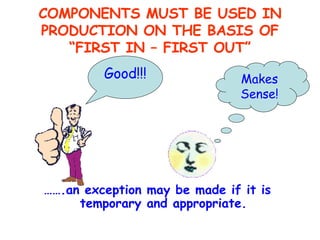
COMPONENTS MUST BE USED IN PRODUCTION ON THE BASIS OF “FIRST IN – FIRST OUT” …… .an exception may be made if it is temporary and appropriate. Good!!! Makes Sense!
RAW MATERIALS include both  active and inactive are the ingredients that go into our products
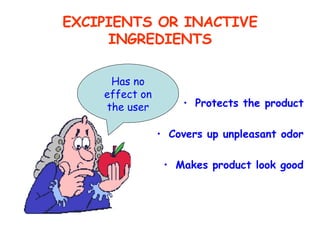
EXCIPIENTS OR INACTIVE INGREDIENTS Protects the product Covers up unpleasant odor Makes product look good Has no effect on the user
ACTIVE INGREDIENT With direct effect on the user Makes the product effective
CERTIFICATE OF ANALYSIS Maybe accepted if analytical competence has been established Typical analysis not accepted Full analysis is a must Equivalency of testing must be established for new supplier. Supplier must use same testing methods as the user.
BULK MATERIALS IT IS PERMISSIBLE TO MIX DELIVERIES OF A MATERIAL IN A SINGLE TANK PROVIDED: - THE TANK IS EMPTY AND CLEAN BEFORE THE    FIRST DELIVERIES - ALL DELIVERIES ARE WITHIN SPECIFICATION    BEFORE UNLOADING. - NONE OF THE MATERIAL IS USED UNTIL ALL    OF THE DELIVERIES ARE ANALYZED - A SINGLE CONTROL NUMBER IS ASSIGNED TO    THE ENTIRE TANK
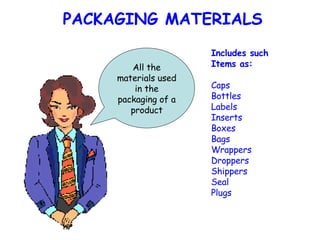
PACKAGING MATERIALS Includes such    Items as: Caps Bottles Labels Inserts Boxes Bags Wrappers Droppers Shippers Seal Plugs All the materials used in the packaging of a product
STORAGE SIMILAR PRINTED MATERIALS SPATIALLY SEGREGATED IN  ORDER TO PREVENT MIX-UP LABELS MUST BE STORED IN SEPARATE AREA TO  PREVENT LABELS OF DIFFERENT PRODUCT,  STRENGTH OR QUANTITIES BEING MIXED AND  CAUSE ERROR IN PRODUCTION RETURNS FROM PACKAGING MUST BE CHECKED  AND IDENTIFIED BEFORE RETURNING TO STOCK DAMAGED AND REJECTED MUST BE DESTROYED IN  WAY THAT WILL MAKE THE MATERIAL UNUSABLE
LABELS AND PRINTED MATERIALS SHOULD HAVE IDENTIFYING CODE NUMBER OR MARKS MUST BE CHECKED AGAINST A STANDARD OR ARTWORK UPON RECEIPT OBSOLETE MATERIALS MUST BE REMOVED FROM THE CONTROL SYSTEM AND INVENTORY SPECIMEN MUST BE SIGNED OFF BY QA TO INDICATE APPROVAL LIMITED ACCESS TO LABEL STORAGE LABELS AND PRINTED MATERIALS ISSUED ONLY WHEN AUTHORIZED KNOW NUMBER OF LABELS USED AND RECONCILE USAGE
COMPONENTS IN GOOD CONDITION, CLEAN AND IDENTIFIED INTACT, NO DAMAGE SAMPLED AND TESTED BY QC STORED IN A SAFE MANNER PROTECTED FROM WIND, RAIN, INSECTS WITH COMPLETE RECORDS COME FROM APPROVED SUPPLIERS FIRST IN-FIRST OUT OR FIRST EXPIRE-FIRST OUT RECONCILE USAGE
ANTI-MICROBIAL FILTERS REPLACE WHEN PRESSURE DIFFERENTIAL ACROSS THE FILTER REACH THE LEVEL SET BY THE SUPPLIER SUDDEN DROP INDICATES FAILURE OF THE FILTER AND MUST BE REPLACED NEW FILTER SHOULD BE INTEGRITY TESTED WATER SYSTEM MUST BE SANITIZED AT  LEAST TWICE A YEAR APPROPRIATE TESTING OF WATER CHEMICALLY-DAILY MICRO TESTING CONDUCTIVITY MEASUREMENTS
PROCESSED WATER CONSIDERED AS STARTING MATERIAL MUST BE SAMPLED, TESTED AND RESULTS DOCUMENTED SHOULD NOT BE STORED FOR MORE THAN 4 HOURS BECAUSE IT ALLOWS BACTERIA TO PROLIFERATE UV LAMPS MUST BE REPLACED  ANNUALLY OR IF RADIATION DROPS BELOW 90% OF THE OPTIMUM MUST BE CLEANED DAILY TO REMOVE BIOFILM
PRODUCTION DOCUMENTS PRODUCTION DOCUMENTS ARE THE BLUEPRINTS WE FOLLOW WHEN WE PRODUCE A PRODUCT. PRODUCTION DOCUMENTS SHOULD BE WRITTEN WITH DETAILED STEPS IN A CLEAR AND LOGICAL MANNER TO ACHIEVE SAFE AND EFFECTIVE PRODUCT. ASSURES PERFORMANCE OF THE SAME JOB THE SAME WAY EACH TIME.
MASTER PRODUCTION RECORDS MASTER FORMULA TO ASSURE UNIFORMITY FROM BATCH TO BATCH SHALL BE PREPARED BY ONE PERSON, DATED AND SIGNED(FULL SIGNATURE, HANDWRITTEN) AND INDEPENDENTLY CHECKED, DATED AND SIGNED BY A SECOND PERSON.
SHALL INCLUDE: NAME AND STRENGTH OF THE PRODUCT NAME AND WEIGHT OR MEASURE OF EACH ACTIVE INGREDIENT PER DOSAGE UNIT AND A STATEMENT OF THE TOTAL WEIGHT OR MEASURE OF ANY DOSAGE FORM. COMPLETE LIST OF COMPONENTS WITH CODES AN ACCURATE STATEMENT OF WEIGHT OR MEASURE OF EACH COMPONENT USING THE SAME WEIGHT SYSTEM STATEMENT ON CALCULATED EXCESS OF COMPONENT STATEMENT OF THEORETICAL WEIGHT OR MEASURE AT ANY STAGE OF PROCESING
MASTER MANUFACTURING PROCEDURE 1.STATE THE PROCESSING LOCATION AND THE  PRINCIPAL EQUIPMENT TO BE USED. 2.STATE THE METHODS OR REFERENCE TO THE  METHODS TO BE USED FOR PREPARING THE  EQUIPMENT 3.DETAILED STEPWISE PROCESSING   INSTRUCTIONS: CHECKS ON MATERIALS,  PRE-TREATMENT ,ASSEMBLING, SEQUENCE OF ADDING MATERIALS, MIXING TIME, SPEED, TEMPERATURE
INSTRUCTION FOR IN-PROCESS CONTROLS STATE STORAGE CONDITION, INCLUDING THE CONTAINER TO BE USED, LABELLING, ETC. PROVISION FOR SIGNATURES AND CHECKS FOR EACH STEP OF PROCESSING SPECIAL PRECAUTIONS STATE MINIMUM AND MAXIMUM PRECENTAGES OF THEORETICAL YIELD, BEYOND WHICH INVESTIGATION IS CARRIED OUT. IDENTIFICATION OF THE PERSONS PERFORMING DIRECTLY, SUPERVISING OR CHECKING EACH SIGNIFICANT STEP.
PACKAGING INSTRUCTIONS MUST BE PREPARED FOR EACH PRODUCT, PACK SIZE AND TYPE. SHALL INCLUDE: 1.NAME OF PRODUCT 2.STRENGTH AND DESCRIPTION OF THE PRODUCT 3.PACK SIZE EXPRESSED IN TERMS OF NUMBER OR  WEIGHT OR VOLUME OF THE FINAL PRODUCT IN THE  CONTAINER 4.COMPLETE LIST OF ALL PACKAGING MATERIALS  REQUIRED FOR A STANDARD BATCH SIZE,  INCLUDING QUANTITIES, SIZES, TYPES, WITH CODES  OR REFERENCE NUMBER RELATING TO THE  SPECIFICATION OF THE MATERIAL
5 .A STATEMENT WHERE TO INDICATE LOT  NUMBER AND EXPIRY DATE 6. SPECIAL PRECAUTIONS 7. DESCRIPTION OF THE PACKAGING OPERATION AND EQUIPMENT TO BE USED 8. DETAILS OF IN-PROCESS CONTROLS AND SAMPLING AND ACCEPTANCE LIMITS 9. DESCRIPTION OF THE PRODUCT CONTAINER AND CLOSURE 10. YIELD AND PERCENTAGE OF THEORETICAL YIELD
DISPENSING REQUIREMENTS: RAW MATERIALS MUST BE APPROVED BY Q.C. MUST BE THE LOT NUMBER SPECIFIED IN MO. MUST NOT SHOW EVIDENCE OF TAMPERING OR DETERIORATION. CONTAINERS NEW PLASTIC OR PE BAG. FOR LIQUIDS, STAINLESS STEEL CONTAINER WITH COVER. MUST BE CLEANED, SANITIZED AND DRIED.
C. BALANCE MUST BE CALIBRATED MUST BE CLEANED MUST BE SENSITIVE ENOUGH FOR THE AMOUNT BEING WEIGHED. D. WEIGHING TOOLS SCOOPS MUST BE STAINLESS STEEL. MUST BE CLEANED, SANITIZED AND DRIED BEFORE USE. ONE MATERIAL PER SCOOP; TO BE CLEANED BEFORE USE FOR OTHER MATERIAL. E. WEIGHING BRING IN ONE MATERIAL AT A TIME (CLEAN THE CONTAINER OUTSIDE ) ZERO THE BALANCE  TARE THE CONTAINER AND RECORD THE WEIGHT.
SCOOP THE REQUIRED AMOUNT OF THE MATERIAL TO THE TARED CONTAINER SLOWLY AND RECORD THE GROSS WEIGHT. CLOSE THE MATERIAL, INNER BAG AND DRUM. RETURN MATERIAL TO STORAGE. DISPENSED MATERIAL REMOVE ENTRAPPED AIR, TWIST THE OPEN END, FOLD AND TIE WITH TWISTER WIRE OR RUBBER BAND ATTACH WEIGHING LABEL. PLACE IN A CONTAINER LINED WITH CLEAN PE BAG TOGETHER WITH THE OTHER MATERIALS FOR ONE BATCH
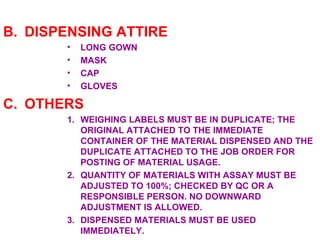
DISPENSING ATTIRE LONG GOWN MASK CAP GLOVES OTHERS WEIGHING LABELS MUST BE IN DUPLICATE; THE ORIGINAL ATTACHED TO THE IMMEDIATE CONTAINER OF THE MATERIAL DISPENSED AND THE DUPLICATE ATTACHED TO THE JOB ORDER FOR POSTING OF MATERIAL USAGE. QUANTITY OF MATERIALS WITH ASSAY MUST BE ADJUSTED TO 100%; CHECKED BY QC OR A RESPONSIBLE PERSON. NO DOWNWARD ADJUSTMENT IS ALLOWED. DISPENSED MATERIALS MUST BE USED IMMEDIATELY.
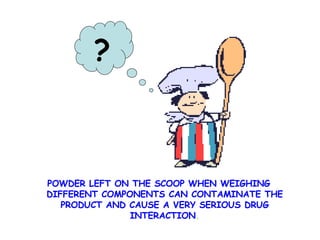
POWDER LEFT ON THE SCOOP WHEN WEIGHING DIFFERENT COMPONENTS CAN CONTAMINATE THE PRODUCT AND CAUSE A VERY SERIOUS DRUG INTERACTION . ?
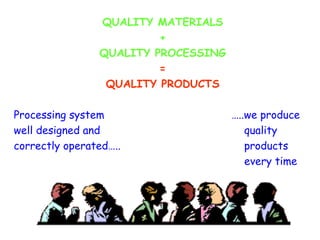
QUALITY MATERIALS + QUALITY PROCESSING = QUALITY PRODUCTS Processing system   …..we produce well designed and   quality correctly operated…..   products   every time
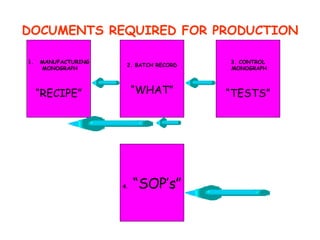
DOCUMENTS REQUIRED FOR PRODUCTION MANUFACTURING MONOGRAPH “ RECIPE” 2. BATCH RECORD “ WHAT” 3. CONTROL MONOGRAPH “ TESTS” 4.  “SOP’s”
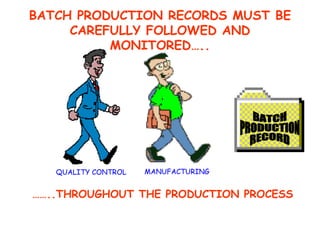
BATCH PRODUCTION RECORDS MUST BE CAREFULLY FOLLOWED AND MONITORED….. …… ..THROUGHOUT THE PRODUCTION PROCESS BATCH  PRODUCTION  RECORD QUALITY CONTROL MANUFACTURING
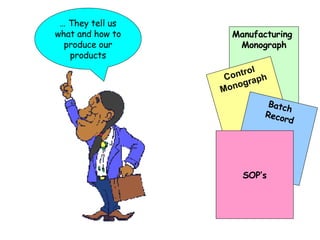
Manufacturing  Monograph Control  Monograph Batch  Record SOP’s …  They tell us what and how to produce our products
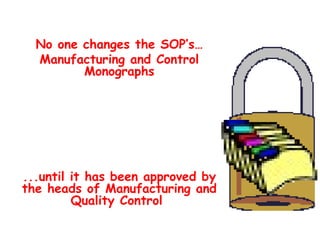
No one changes the SOP’s… Manufacturing and Control Monographs ...until it has been approved by the heads of Manufacturing and Quality Control
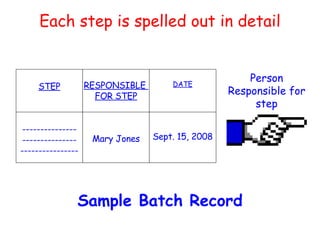
Each step is spelled out in detail Sample Batch Record Person Responsible for step STEP --------------- --------------- ---------------- RESPONSIBLE  FOR STEP Mary Jones DATE Sept. 15, 2008
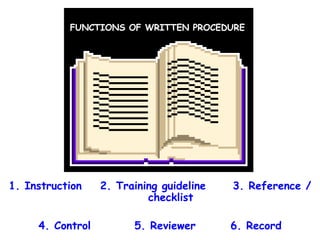
1. Instruction  2. Training guideline 3. Reference / checklist 4. Control 5. Reviewer 6. Record FUNCTIONS OF WRITTEN PROCEDURE
MANUFACTURING AND PACKAGING MANUFACTURING AND PACKAGING OPERATION IS THE FINAL STEP OF BUILDING QUALITY INTO THE PRODUCT. IN THESE OPERATION WE MUST PRECLUDE POTENTIAL MIX-UPS AND ERRORS AND CONTAMINATION. PROCEDURES MUST BE STRICTLY FOLLOWED AND EFFECTIVE CONTROLS SHOULD BE IN PLACE. IN-PROCESS CHECKS MUST BE CARRIED OUT AT SPECIFIC TIME INTERVALS TO MONITOR GMP COMPLIANCE
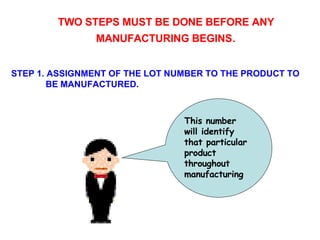
TWO STEPS MUST BE DONE BEFORE ANY MANUFACTURING BEGINS . STEP 1. ASSIGNMENT OF THE LOT NUMBER TO THE PRODUCT TO   BE MANUFACTURED. This number will identify that particular product throughout manufacturing
THIS LOT NUMBER IS THE KEY TO THE RECORDED HISTORY OF THE: MANUFACTURING PROCESSING PACKAGING HOLDING AND DISTRIBUTION OF THE  PRODUCT
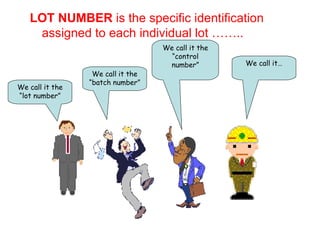
LOT NUMBER  is the specific identification assigned to each individual lot …….. We call it the “lot number” We call it the “batch number” We call it the “control number” We call it…
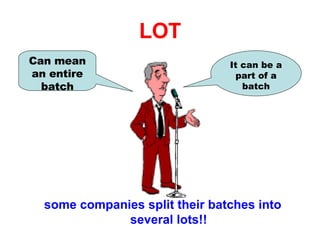
LOT some companies split their batches into several lots!! It can be a part of a batch Can mean an entire batch
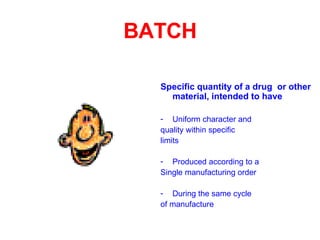
BATCH Specific quantity of a drug  or other material, intended to have Uniform character and  quality within specific  limits Produced according to a  Single manufacturing order During the same cycle of manufacture
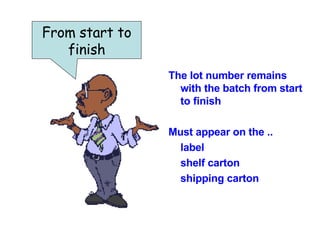
The lot number remains with the batch from start to finish Must appear on the ..  label  shelf carton  shipping carton From start to finish
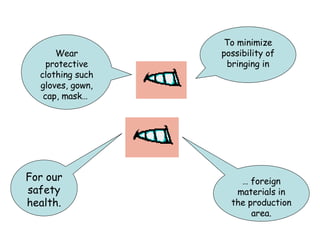
To minimize possibility of bringing in Wear protective clothing such gloves, gown, cap, mask…  …  foreign materials in the production area. For our safety health.
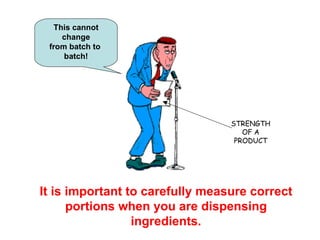
It is important to carefully measure correct portions when you are dispensing ingredients. This cannot change from batch to  batch! STRENGTH OF A PRODUCT
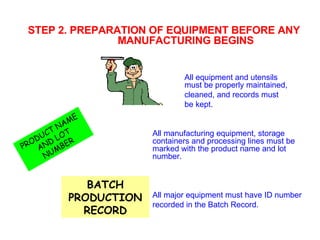
STEP 2. PREPARATION OF EQUIPMENT BEFORE ANY    MANUFACTURING BEGINS All equipment and utensils  must be properly maintained,  cleaned, and records must  be kept. All manufacturing equipment, storage  containers and processing lines must be  marked with the product name and lot  number. All major equipment must have ID number recorded in the Batch Record. PRODUCT NAME AND LOT NUMBER BATCH PRODUCTION RECORD
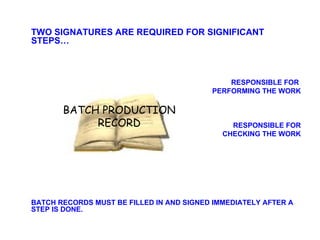
TWO SIGNATURES ARE REQUIRED FOR SIGNIFICANT STEPS… RESPONSIBLE FOR  PERFORMING THE WORK RESPONSIBLE FOR CHECKING THE WORK BATCH RECORDS MUST BE FILLED IN AND SIGNED IMMEDIATELY AFTER A STEP IS DONE. BATCH PRODUCTION RECORD
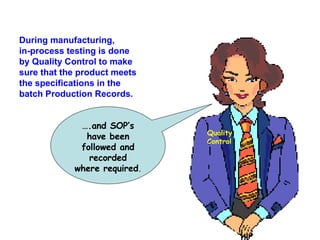
During manufacturing, in-process testing is done by Quality Control to make sure that the product meets the specifications in the batch Production Records. … .and SOP’s have been followed and recorded where required . Quality Control
At any point, adjustments to  bring the batch up to specifications may be made according to the SOP’s. … And we have to   approve it.
I’M NOT MEAN… IM JUST TOUGH! Samples to be tested Q U A L I T Y C O N T R O L
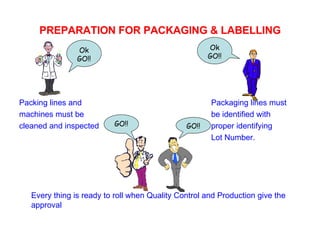
PREPARATION FOR PACKAGING & LABELLING Packing lines and Packaging lines must machines must be be identified with cleaned and inspected proper identifying Lot Number. Every thing is ready to roll when Quality Control and Production give the approval Ok GO!! Ok GO!! GO!! GO!!
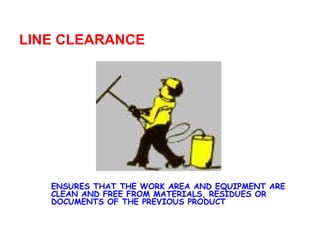
LINE CLEARANCE ENSURES THAT THE WORK AREA AND EQUIPMENT ARE CLEAN AND FREE FROM MATERIALS, RESIDUES OR DOCUMENTS OF THE PREVIOUS PRODUCT
The  packaging  department  follows the packaging directions for each individual lot. This includes affixing the lot number and expiration date. The packaging directions are very important part of the  Batch Production Record. It’s All here!!
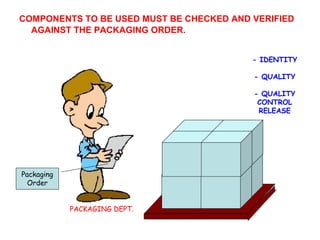
COMPONENTS TO BE USED MUST BE CHECKED AND VERIFIED AGAINST THE PACKAGING ORDER. PACKAGING DEPT. Packaging Order - IDENTITY - QUALITY - QUALITY CONTROL RELEASE
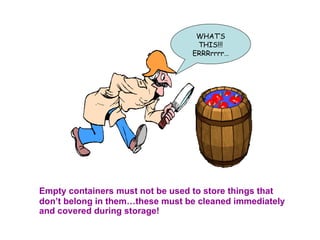
Empty containers must not be used to store things that don’t belong in them…these must be cleaned immediately and covered during storage! WHAT’S THIS!!! ERRRrrrr…
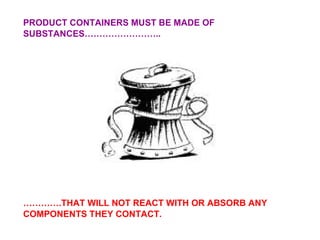
PRODUCT CONTAINERS MUST BE MADE OF SUBSTANCES…………………….. ………… .THAT WILL NOT REACT WITH OR ABSORB ANY COMPONENTS THEY CONTACT.
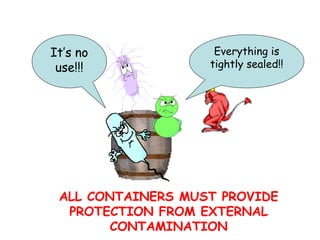
ALL CONTAINERS MUST PROVIDE PROTECTION FROM EXTERNAL CONTAMINATION It’s no use!!! Everything is tightly sealed!!
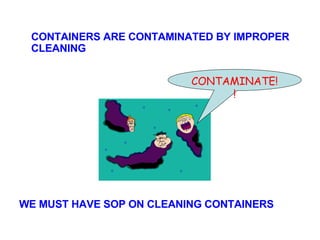
CONTAINERS ARE CONTAMINATED BY IMPROPER CLEANING WE MUST HAVE SOP ON CLEANING CONTAINERS CONTAMINATE!!
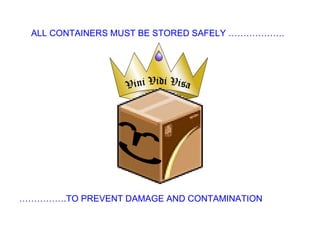
ALL CONTAINERS MUST BE STORED SAFELY ………………. …………… .TO PREVENT DAMAGE AND CONTAMINATION
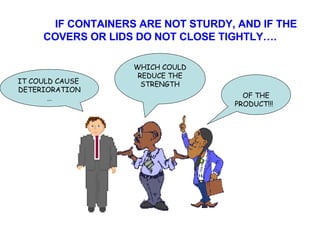
IF CONTAINERS ARE NOT STURDY, AND IF THE COVERS OR LIDS DO NOT CLOSE TIGHTLY…. IT COULD CAUSE DETERIORATION… WHICH COULD REDUCE THE STRENGTH OF THE PRODUCT!!!
  After packaging   and labeling are completed…   Name of Product  Control Number Quantity Hold   for Release CARTONS ARE TIGHTLY SEALED
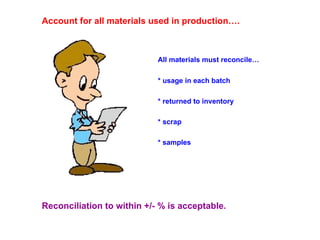
Account for all materials used in production…. All materials must reconcile… * usage in each batch * returned to inventory * scrap * samples Reconciliation to within +/- % is acceptable.
We must make sure…packages in batch are correctly labeled and packaged It’s gotta’ Be Correct!
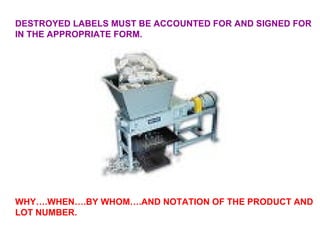
DESTROYED LABELS MUST BE ACCOUNTED FOR AND SIGNED FOR IN THE APPROPRIATE FORM. WHY….WHEN….BY WHOM….AND NOTATION OF THE PRODUCT AND LOT NUMBER.
PRODUCTS PRIOR TO RELEASE SHOULD MEET THE PHYSICAL AND CHEMICAL STANDARDS. SELF- INSPECTION AND SPOT CHECKS INCLUDING REVIEW OF BATCH RECORDS SHOULD DEMONSTRATE THAT PRODUUCTION AND TESTING HAVE COMPLIED WITH RELEVANT REQUIREMENTS .
COMPLAINTS ALL COMPLAINTS AND OTHER INFORMATION CONCERNING POTENTIALLY DEFECTIVE PRODUCT MUST BE CAREFULLY REVIEWED AND INVESTIGATED ACCORDING TO WRITTEN PROCEDURES.
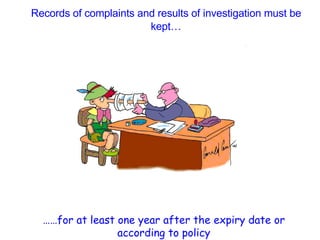
Records of complaints and results of investigation must be kept… …… for at least one year after the expiry date or according to policy
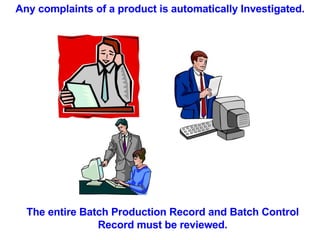
Any complaints of a product is automatically Investigated. The entire Batch Production Record and Batch Control Record must be reviewed.
THE SOURCE AND CONTENT OF DEFICIENCIES, REMEDIAL MEASURES TAKEN AND TESTS PERFORMED SHOULD BE DOCUMENTED IN WRITING AND ADDED TO THE BATCH RECORDS. CONSIDERATION SHOULD BE GIVEN TO CHECK IF OTHER BATCHES COULD BE AFFECTED AND TO CEASE SUPPLY UNTIL THE PROBLEM IS FULLY INVESTIGATED. PRODUCT RECALL SHOULD BE INITIATED IF DEFICIENCY IS POTENTIALLY HARMFUL TO HEALTH.
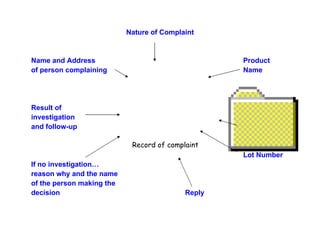
Nature of Complaint Name and Address Product of person complaining Name Result of  investigation and follow-up its strength Lot Number If no investigation… reason why and the name of the person making the decision   Reply Record of complaint
THE PROGRESS OF RECALL SHOULD BE RECORDED.  A FINAL REPORT SHOULD BE ISSUED, INCLUDING RECONCILIATION BETWEEN THE DELIVERED AND RECOVERED QUANTITIES OF THE QUESTIONABLE PRODUCT.
STABILITY PROGRAM THE STABILITY OF PRODUCTS SHOULD BE MONITORED ACCORDING TO A CONTINUOUS APPROPRIATE PROGRAM THAT WILL PERMIT DETECTION OF ANY INSTABILITY ASSOCIATED WITH THE FORMULATION IN THE MARKETED PACKAGE.
THE ON GOING OR REAL TIME STABILITY PROGRAM AIMS TO MONITOR THE PRODUCT OVER ITS SHELF LIFE AND TO DETERMINE IF THE PRODUCT REMAINS OR CAN BE EXPECTED TO REMAIN WITHIN SPECIFICATION UNDER THE LABELLED STORAGE CONDITIONS.

Back To Basic Gmp

  • 1.
    WHAT IS GMP? G OOD M ANUFACTURING P RACTICE
  • 2.
    WHY DO WENEED GMP? BAKIT KAILANGAN ANG GMP?
  • 3.
    TYPES OF CONTAMINATIONPARTICULATES MICROORGANISMS CROSS-CONTAMINATION
  • 4.
    TYPES OF CONTAMINANTSPARTICULATES (Pira-pirasong bagay) dust, dirt, paper, metal, fibers, etc. MICROORGANISMS (Mikrobyo) bacteria, yeasts, molds CROSS-CONTAMINATION (Pag halo sa iba’t-ibang produkto) labels, cartons, foil, materials, etc.
  • 5.
    SOURCES OF CONTAMINATIONAIR , WATER, SURFACES,PEOPLE,PESTS
  • 6.
    IMPURE UNCLEAN UNFITFOR USE CONTAMINATION PEOPLE CONTAMINATION CAUSE HEH! HEH! HEH!
  • 7.
    CGMP REGULATION Reportany injury or illness immediately to your supervisor.
  • 8.
    MICROORGANISMS CAN BEDESTROYED OR REDUCED BY: Personal Hygiene Insect and pest control Efficient & effective plumbing Clean and potable water Correct cleaning & sanitizing of equipment Effective cleaning of processing areas, storage areas warehouse, etc.
  • 9.
    CROSS - CONTAMINATION… BUT IT WAS ONLY A FEW OUNCES … a few ounces? THE WHOLE BATCH IS CONTAMINATED
  • 10.
    GMP………….… SHARED RESPONSIBILITYOF ESTABLISHMENT AND EMPLOYEES
  • 11.
    TO COMPLY WITHGMP … Establishment provides Sufficient Space Physical Separation Adequate Lighting Adequate Ventilation Equipment, utensils Adequate facilities for every operations
  • 12.
    WORKERS AND EMPLOYEESTake necessary steps and follow procedures to assure sanitary and safe operation of the plant.
  • 13.
    HYGIENE AND SANITATIONWHY IS HYGIENE AND SANITATION IMPORTANT? Man is a natural carrier of microorganisms. These are expelled when we SNEEZE (BUMAHIN ) COUGH (UMUBO) YAWN (HUMIKAB ) TALK (NAGSALITA )
  • 14.
    MICROORGANISMS ARE INMAN’S HAIR, SKIN, INTESTINES, URINE, UNDERNEATH FINGERNAILS. We collect more microorganisms as we travel from home to our destination due to dust, smoke generated by vehicles and contact with dirty items. It is therefore important that we observe good hygiene and sanitation to avoid contamination of products we handle.
  • 15.
    PLANT UNIFORM Coverstreet clothes that contain contaminants, organisms you collect on your way to the plant. Cover your exposed skin which sheds particles with germs.
  • 16.
    Cover the noseand mouth which are natural reservoir of germs. Trap particles or droplets from the nose and mouth. Cover your hair which have dust & germs. Prevent hair from falling into the product.
  • 17.
    Cover finger nailsand hands which have germs. Street shoes contain germs from the soil and dirt we stepped on, so it must not be worn inside the plant, plant shoes must be used instead.
  • 18.
    WHY USE RUBBERGLOVES??? It prevents microorganism transfer from our hands to the product we handle. It prevents transfer of product dust to our hands.
  • 19.
    It is porousand will not prevent transfer of microorganisms and perspiration to the product we handle. It permits transfer of product dust to our hands. WHY CAN’T WE USE COTTON GLOVES???
  • 20.
    HANDLING OF GLOVESPlace gloves in a clean plastic bag during break time. 2) Wash gloves with soap and water after use. Dry and sanitize.
  • 21.
    3) Change glovesfor every product change. 4) Torn gloves or those with holes should not be used
  • 22.
    HYGIENE AND SANITATIONPRACTICES *Wash hands with soap and water After using the toilet Before starting to work After blowing your nose After handling dirty things After touching body surface After eating
  • 23.
    -Don’t touch orscratch your nose, head, body parts while handling products. -Cover your nose, mouth when sneezing, coughing, yawning. -Avoid talking and use mask if necessary. -Observe good toilet practices by: - Flushing the toilet after use -Washing hands with soap and water
  • 24.
    HOW TO WASHYOUR HANDS
  • 25.
    Remove visible dirt.2. Rinse with water.
  • 26.
    3 . Washwith soap and water. 4. Rinse with water
  • 27.
  • 28.
  • 29.
    GOOD HOUSE KEEPINGPRACTICES - Keep dirt and dust away from work areas. Pick-up pieces of paper, foreign and unwanted objects that may be seen in the work area and throw them in the trash can. -Clean up debris as work continuous. -Do not place tools, materials, objects, etc. on product contact surfaces.
  • 30.
    - When jobis finished, clean up work area, surfaces and equipment. -Keep personal things in the place provided for them. -Place lunch wrappers, food left overs and other rabbish in the containers provided for them. -Place soft drinks bottles in the container provided for them. -Place chairs in orderly position before leaving the work area.
  • 31.
    GMP IN THEWORK AREA Use the product container for the intended product only. Don’t use it for glue, oil, soap, etc. Be in your work assignment all the time. Don’t attempt to transfer to adjacent packing lines to help as you may not be properly trained to do the job.
  • 32.
    3. Cleanup your debris as work continues. 4. Products falling on the floor or dirty surfaces must not be put back for packaging. 5. Cover product container and secure all materials pertaining to the product like labels, cartons, etc. before leaving the work area during break times. 6. Identify all containers used with product name, batch/lot number, expiry date. (Containers for rejects, unused labels, etc.)
  • 33.
    7. Never handleproducts with bare hands. Use rubber gloves if you are assigned to handle products. 8. Clean and sanitize work area surface following instruction of supervisor when job is finished. 9. Don’t touch nose, head or any body parts while handling products. 10. Don’t get items from adjacent lines to be used in your line.
  • 34.
    11) Cover yournose and mouth when sneezing or coughing. 12) Pay full attention to the assigned task and refrain from talking to your co-corkers. 13) Familiarize yourself with assigned operation taking note of distinct features to enable detection of mix-up or mistakes .
  • 35.
    14) Follow strictlythe instruction given by the supervisor. In case of doubt, seek the help of the supervisor. 15) Don’t eat or chew gums while in the work area. 16) Notify supervisor promptly if there is an accidental contamination of product contact surfaces.
  • 36.
    BACTERIA Bacilli BacterialSpores Molds Pneumococci Yeast
  • 37.
    Mix-Ups and Errorstoo! Rushing a Job Cross-Contamination LOOK OUT!!! This is a RUSH job! may cause
  • 38.
    GOOD MANUFACTURING PRACTICE-Developed in the 1960’s -Part of the Food, Drug, and Cosmetic act -Has the force and effect of law THESE REGULATIONS HAVE THE FORCE AND EFFECT OF LAW CGMP Regulations
  • 39.
    BFAD IS RESPONSIBLEFOR SEEING THAT OUR COMPANY COMPLIES WITH CGMP REGULATIONS.
  • 40.
    IF WE HAVENOT FOLLOWED CGMP REGULATIONS BFAD HAS THE AUTHORITY TO RECOMMEND RECALL
  • 41.
    HOW WE PURCHASEAND STORE RAW MATERIALS OUR BUILDING LABELLING & PACKAGING THE PRODUCTION & DISTRIBUTION OF OUR PRODUCTS OUR RECORDS OUR EQUIPMENT C G M P
  • 42.
    PREMISES Premises/building mustbe designed and constructed to facilitate company productivity, employee safety and product quality. Plant site should be carefully selected considering the physical terrain and the ground surrounding it.
  • 43.
    BUILDING PREMISES GMPREQUIREMENTS: 1. Separate area for specific operation. 2. Easy to clean. 3. Easy to maintain. 4. Easy to operate. 5. Adequate space 6. Eliminate unnecessary traffic Inadequate space and unnecessary traffic cause mix-up and errors.
  • 44.
    GMP REGULATION: Defined area for a. Receiving of materials b. Storage of materials c. Quality control laboratory d. Manufacturing area e. In-process storage f. Packaging area g. Quarantine area
  • 45.
    GMP REGULATION -Lightall Areas -Adequate for our needs -With back-up LIGHTING
  • 46.
    GMP REGULATION WATERSYSTEM STEADY PRESSURE FREE OF PROBLEMS NO DRAINAGE BACK-FLOW
  • 47.
    GMP REGULATION Wastematerials must be removed and disposed of in a safe and sanitary manner.
  • 48.
    GMP REGULATION Buildingmust be maintained and kept in good condition. There must be a regular housekeeping .
  • 49.
    Building must beprotected from infiltration of contaminants and from outside elements like dust, odors, filth, pests. Adequate space is necessary in designing a plant. Adequate space is critical to the plant productivity, personnel safety and the quality of the product.
  • 50.
    Lack of spacecan cause confusion in the workflow and this can adversely affect productivity. Lack of space can also cause unnecessary traffic in the work area which can endanger employee safety. Lack of space can result in contamination, mix-ups and errors.
  • 51.
    PERSONNEL People shouldknow how to perform the job right the first time and every time. They must have the knowledge to perform their job and the skills required by the job. People must have personal responsibility to develop personal competence.
  • 52.
    That all ofus receive training in the procedures relating to our job and in the cGMP regulations. It’s a CGMP Regulation
  • 53.
    Proper Training inrelation to their assigned task or function SOLUTIONS IMPROVE INSPECTION METHODS
  • 54.
    Engaged in supervisionof manufacture processing, packing and holding of product Adequate number …… to perform assigned task or function to give assurance of product quality, identity, purity. Sufficient Education Training Experience
  • 55.
    Engaged in manufacture,processing, packing and holding of product Adequate number …… to perform assigned task or function Sufficient Education Training Experience
  • 56.
    TRAINED PERSONNEL=QUALITY PERFORMANCE =CONTINUAL IMPROVEMENT LESS PRONE TO ERRORS LESS DEVIATIONS FROM STANDARDS REDUCE AMOUNT OF REWORK REDUCE AMOUNT OF REJECTS
  • 57.
    TRAINING PROGRAM 1.EACH INDIVIDUAL SHOULD HAVE A TRAINING PLAN. 2. COURSES AND TOPICS SHOULD BE LINKED TO THEIR CURRENT JOBS. 3. CONTENTS OF EACH COURSE SHOULD BE DOCUMENTED AND APPROVED BY MANAGEMENT. 4. PLAN FOR RETRAINING.
  • 58.
    Confucius… I hearand I forget I see and I remember I do and I understand
  • 59.
    PATTERN OF LEARNINGAND REMEMBERING 83% by vision 50% of what we have heard and seen 11% by smelling 30% of what we have seen 3,5% by smell 20% of what we have heard 1,5% by skin senses 1% of what we read 1% by taste What we Remember What we learn
  • 60.
    KNOW YOUR COMPANY- Its products, policies and services. READ COMPANY MANUAL
  • 61.
  • 62.
    PRACTICE GOOD SANITATIONAND HEALTH HABITS
  • 63.
    WEAR PROTECTIVE CLOTHINGAS NECESSARY GOWN GOGGLES MASK GLOVES HEAD CAP
  • 64.
    ADEQUATE PERSONAL RECORDSName Address Qualification Signature
  • 65.
    UNDERSTAND THE REQUIREMENTSAnd demands of your job. Determine how you can do your job most efficiently.
  • 66.
    FOLLOWING SOP’S ISVITAL …… .AND SO ARE THE RECORDS WE KEEP! SOP’s RECORDS
  • 67.
    REASONS FOR WRITINGPROCEDURES AVOID/MINIMIZE MIX-UPS AND ERRORS ENSURE CONSISTENT QUALITY ENSURE COMPLIANCE WITH GMP REGULATION
  • 68.
    ACCURATE RECORD KEEPINGIS VITAL ……. RECORDS MUST BE FILLED OUT AT THE TIME WE COMPLETE THE JOB!!! When did I do…. that?
  • 69.
    TRAINING MUST BEREINFORCED BY THE SUPERVISOR….. BFAD INSPECTORS ASK TO SEE OUR TRAINING RECORDS…. FOLLOW S.O.P.‘s
  • 70.
    cGMP TRAINING MUSTBE REINFORCED BY ON THE JOB SUPERVISION AND WHERE REQUIRED, SUPPLEMENTED BY A REVIEW TRAINING COURSE. FOLLOW SOP’S!!!
  • 71.
    DEVELOPING COMPETENCE EDUCATIONAND TRAINING ON-THE-JOB EXPERIENCE
  • 72.
    COMPETENCE IS DEMONSTRATEDBY SUCCESSFUL JOB PERFORMANCE
  • 73.
    DEFINITION OF COMPETENCEWEBSTER 1. Having ability or qualities 2. Legally qualified or able DR. LAWRENCE J. PETER (PETER PRINCIPLE) “ COMPETENCE like truth, beauty and contact lenses, is in the eye of the beholder.”
  • 74.
    MEASURE OF COMPETENCENUMBER OF SUCCESSES? NUMBER OF FAILURES? PROMPTNESS OF ACTION? LEADTIME? QUALITY OF ACTION?
  • 75.
    DOCUMENTATION AFTER COMPLETIONOF EACH STEP 2. VALIDATION OF SYSTEMS, EQUIPMENT AND PROCESSES Proof of Successful Performance
  • 76.
    DEMONSTRATE COMPETENCE ONTHE JOB EXPERIENCE
  • 77.
    MUST KNOWMUST DO EDUCATION TRAINING
  • 78.
    Y O UR J O B MUST DO MUST KNOW KNOWLEDGE SKILLS
  • 79.
    THREE P’s OFGMP P ERFORMANCE P RIDE P ROOF
  • 80.
    EQUIPMENT Equipment designmust be carefully examined. Dedicated equipment should be used for products which are difficult to remove, difficult to clean and for products with a high safety risk.
  • 81.
    EQUIPMENT REQUIREMENTS: MUSTBE MADE OF MATERIALS THAT WILL NOT REACT WITH OR ABSORB ANY COMPONENTS THEY CONTACT. MUST BE DESIGNED FOR THE PARTICULAR PURPOSE FOR WHICH IT IS INTENDED. MUST BE LOCATED FOR EASY MAINTENANCE. SUBSTANCES USED FOR OPERATION LIKE LUBRICANTS, COOLANTS SHOULD NOT COME IN CONTACT WITH THE PRODUCT.
  • 82.
    ALLMANUFACTURING EQUIPMENT NOT IN USE MUST BE STORED IN A MANNER TO KEEP IT CLEAN AND IN GOOD WORKING CONDITION. ALL EQUIPMENT MUST HAVE AN ACCURATE WELL DOCUMENTED LOG SHOWING WHAT WAS PRODUCED IN IT. ALL EQUIPMENT MUST HAVE A CLEANING LOG SHOWING WHEN, HOW AND BY WHOM EACH PIECE OF EQUIPMENT WAS CLEANED. ALL EQUIPMENT MUST HAVE AN IDENTIFICATION NUMBER WHICH SHOULD APPEAR ON THE BATCH RECORDS.
  • 83.
    EQUIPMENT USED EXCLUSIVELYBY A PRODUCT, INDIVIDUAL LOG IS NOT REQUIRED. ALL EQUIPMENT MUST BE SANITIZED AFTER CLEANING. ALL EQUIPMENT MUST BE VALIDATED. EQUIPMENT MUST NOT BE USED AS STORAGE OF THINGS THAT DON’T BELONG TO THEM.
  • 84.
    DETERGENTS USED FORCLEANING MUST NOT BE SOURCE OF CONTAMINATION. MEASURING, WEIGHING, RECORDING AND CONTROL EQUIPMENT SHOULD BE CALIBRATED AND CHECKED AT DEFINED INTERVALS. MIXERS, PUMPS MUST HAVE CLEANABLE BEARINGS AND NON-LEAKING OIL SEALS. TANKS SHOULD HAVE COVED EDGES AND SLOPED BOTTOMS WITH THE OUTLET AT THE LOWEST POINT.
  • 85.
    TANKSMUST HAVE DOMED TOP TO ALLOW CONDENSATION TO DRAIN BACK TO THE TANK. TANK VENTS AND OVERFLOW LINES SHOULD HAVE SCREEN TO PREVENT ENTRY OF PESTS. HOPPERS OF FILLING EQUIPMENT, RESERVOIRS MUST HAVE COVERS THAT ARE FIT AND EASY TO CLEAN. FIXED PIPEWORK MUST BE CLEARLY LABELED TO INDICATE CONTENTS AND DIRECTION OF FLOW.
  • 86.
    ALL PIPE WORKMUST BE SLOPED SO THAT THEY WILL DRAIN AND TO AVOID LOW SPOT AND DEAD LEGS. INTERNAL WELDS MUST BE SMOOTH, NOT PITTED TO AVOID FLUX-CONTAMINATION. DUST EXTRACTORS MUST NOT LODGE POWDER IN THE DUCTING WHICH MAY FALL BACK INTO THE PRODUCT. DEFECTIVE EQUIPMENT SHOULD BE REMOVED IN THE PRODUCTION AREA, QC, ETC. AND CLEARLY LABELED AS DEFECTIVE.
  • 87.
    MUST NOT REACTWITH OR ABSORB ANY OF THE COMPONENTS THEY CONTACT .
  • 88.
    EQUIPMENT MUST BELOCATED FOR EASY MAINTENANCE!
  • 89.
    Equipment should bedesigned for the particular purpose for which it is intended. This is an important CGMP Regulation!
  • 90.
    WHEN? WHAT ? WHO ? EQUIPMENT LOG BOOK
  • 91.
    WE DON’T DOTHINGS THIS WAY!
  • 92.
  • 93.
    MAINTENANCE RETAIN EQUIPMENTIN ACCEPTABLE OPERATING CONDITION RESTORE EQUIPMENT TO AN ACCEPTABLE OPERATING CONDITION
  • 94.
    IMPORTANCE OF MAINTENANCEREDUCE DOWNTIME 2. INCREASE PLANT AVAILABILITY 3. INCREASE EFFICIENCY 4. REDUCTION OF MANPOWER LEVEL 5. REDUCTION OF PRODUCTION COST
  • 95.
    FOLLOW SOP’s ……………………… . WHEN CLEANING EQUIPMENT GOOD JOB! THANK YOU!
  • 96.
    BFAD CAN HOLDUS RESPONSIBLE FOR ANY CGMP VIOLATION.
  • 97.
    FACTORS TO CONSIDERIN DEVELOPING MAINTENANCE PROCEDURES 1. RUN TIME IN OPERATING HOURS BEFORE MAINTENANCE. 2. SEVERITY OF USE 3. VIBRATION DATA 4. EXPECTED LIFE OF COMPONENTS. IT IS NOT ACCEPTABLE TO WAIT FOR A MACHINE TO BREAKDOWN BEFORE SERVICING IT. A CLEANED AND WELL MAINTAINED EQUIPMENT IS MORE RELIABLE AND PRODUCES LESS NON-CONFORMING PRODUCTS.
  • 98.
    EQUIPMENT MAINTENANCE MECHANICALAND PRECISION EQUIPMENT MUST BE CHECKED REGULARLY . ALL AUTOMATIC AND ELECTRONIC EQUIPMENT LIKE COMPUTERS MUST ALSO BE TESTED AND INSPECTED .
  • 99.
    SEQUENTIAL LOG NAMEOF MACHINE: TAG NO: CAPACITY: 1-27-09 1-26-09 MFG. ALCOMFORADO B#1 1-26-09 1-26-09 1-25-09 VALIDATION OF NEW MIXTURE 1-25-09 1-24-09 1-24-09 CLEANING 1-24-09 1-23-09 1-20-09 MIXER REPAIR 1-20-09 1-19-09 1-19-09 MFG. RHEA ALCOLOGNE B#5 1-19-09 1-18-09 1-18-09 CLEANING 1-18-09 1-17-09 1-16-09 MFG. RHEA ALC. BATCH 1234 1-16-09 SIGNATURE DATE FINISHED DATE STARTED ACTIVITY DATE
  • 100.
    TYPES OF MAINTENANCEPREVENTIVE - ROUTINE - PLANNED CORRECTIVE - EMERGENCY - PLANNED MODIFICATION - PLANNED
  • 101.
    MAINTENANCE RECORD 1.PROCEDURES AND SCHEDULES 2. CALIBRATION LOGS 3. EQUIPMENT LOGS 4. DOCUMENTATION OF MAINTENANCE CLEAN ENVIRONMENT + MAINTAINED EQUIPMENT = QUALITY PRODUCT
  • 102.
    MAINTENANCE RECORD NAMEOF EQUIPMENT: TAG NO. DATE INSTALLED: SUPPLIER: A . MONTHLY MAINTENANCE B. QUARTERLY MAINTENANCE NOT DONE REASON DONE APR. MAR. FEB. JAN. SERVICE NOT DONE REASON DONE FOURTH Q. THIRD Q. SECOND Q. FIRST Q. SERVICE
  • 103.
    YEARLY MAINTENANCE RECORDNAME OF EQUIPMENT: TAG NO. DATE INSTALLED : SUPPLIER: NOT DONE REASON DONE 2009 2008 2007 2006 SERVICES
  • 104.
    REGULAR MAINTENANCE CHECKS…..……… ..RECORDED ON PROPER FORMS!! Mechanical Equipment Precision Machines Automatic & Electronic Equipment & Computers
  • 105.
    WE TEST OUR PRODUCTS FOR: A. PRESENCE OF COMPONENTS PRESUMED TO BE THERE B. CONTAMINANTS PRESUMED MIGHT BE THERE
  • 106.
    WE DO NOTLOOK FOR CONTAMINANTS INTRODUCED BY: INADEQUATE MANUFACTURING CONTROLS 2. INADEQUATE ENVIRONMENTAL CONTROLS 3. IMPROPER HANDLING
  • 107.
    DON’T TRUST YOURMEMORY!! RECORDS MUST BE FILLED OUT AT THE TIME WE COMPLETE THE JOB! Maintenance & Cleaning Record
  • 108.
    COMPONENTS CONTROL Buildingquality into the product starts with components control. Source, origin and suitability of components should be clearly defined. Components should come from qualified or approved manufacturers.
  • 109.
    COMPONENT Includes packagingmaterials as well as raw materials Any material intended for use in the manufacturing of our product
  • 110.
    COMPONENTS CORRECT SPECIFICATION+ CORRECT MATERIALS = CORRECT PRODUCT We must control upon receipt and in use. Must come from approved suppliers.
  • 111.
    ALL MATERIAL RECEIPTMUST BE IN GOOD CONDITION CLEAN AND IDENTIFIED Intact, no damage RAW MATL’S RAW MATL’S
  • 112.
    All components mustbe sampled and tested by quality control………. …… to ensure that they conform to standards. All containers must be carefully resealed after each sample has been taken!!!
  • 113.
    All new materialsmust be quarantined until approved for use……. All newly received materials must be: Properly identified and recorded Examined to make sure that each container is still tightly sealed Examined to make sure that each container is not damaged Examined to make sure there is no visible sign of contamination or impurity
  • 114.
    GMP REQUIRES THATCOMPLETE RECORDS ARE KEPT ON ALL NEWLY RECEIVED COMPONENTS. Proper identification When received and inspected? Who did the inspection? Who took samples ? When were they tested? Who did the test? ?????
  • 115.
    And must beprotected from damage by outside elements such as wind, rain and insects. It helps prevent mix-ups and errors!! All components must be stored in a safe and orderly way . . .
  • 116.
    After testing andexamination by quality control ……. It may then be approved and released for manufacturing use ! APPROVED
  • 117.
    COMPONENTS MUST BEPROTECTED FROM HARMFUL BACTERIA
  • 118.
    BACTERIA Important: reportall accidents, cuts, sores, or illness!! Bacteria = Contamination
  • 119.
    Reserve samples for every approved component….. Clearly identified Kept for at least one year after the expiration of the Product A rejected component must be properly identified and kept separate until it is disposed of. APPROVED APPROVED APPROVED REJECTED
  • 120.
    COMPONENTS MUST BEUSED IN PRODUCTION ON THE BASIS OF “FIRST IN – FIRST OUT” …… .an exception may be made if it is temporary and appropriate. Good!!! Makes Sense!
  • 121.
    RAW MATERIALS includeboth active and inactive are the ingredients that go into our products
  • 122.
    EXCIPIENTS OR INACTIVEINGREDIENTS Protects the product Covers up unpleasant odor Makes product look good Has no effect on the user
  • 123.
    ACTIVE INGREDIENT Withdirect effect on the user Makes the product effective
  • 124.
    CERTIFICATE OF ANALYSISMaybe accepted if analytical competence has been established Typical analysis not accepted Full analysis is a must Equivalency of testing must be established for new supplier. Supplier must use same testing methods as the user.
  • 125.
    BULK MATERIALS ITIS PERMISSIBLE TO MIX DELIVERIES OF A MATERIAL IN A SINGLE TANK PROVIDED: - THE TANK IS EMPTY AND CLEAN BEFORE THE FIRST DELIVERIES - ALL DELIVERIES ARE WITHIN SPECIFICATION BEFORE UNLOADING. - NONE OF THE MATERIAL IS USED UNTIL ALL OF THE DELIVERIES ARE ANALYZED - A SINGLE CONTROL NUMBER IS ASSIGNED TO THE ENTIRE TANK
  • 126.
    PACKAGING MATERIALS Includessuch Items as: Caps Bottles Labels Inserts Boxes Bags Wrappers Droppers Shippers Seal Plugs All the materials used in the packaging of a product
  • 127.
    STORAGE SIMILAR PRINTEDMATERIALS SPATIALLY SEGREGATED IN ORDER TO PREVENT MIX-UP LABELS MUST BE STORED IN SEPARATE AREA TO PREVENT LABELS OF DIFFERENT PRODUCT, STRENGTH OR QUANTITIES BEING MIXED AND CAUSE ERROR IN PRODUCTION RETURNS FROM PACKAGING MUST BE CHECKED AND IDENTIFIED BEFORE RETURNING TO STOCK DAMAGED AND REJECTED MUST BE DESTROYED IN WAY THAT WILL MAKE THE MATERIAL UNUSABLE
  • 128.
    LABELS AND PRINTEDMATERIALS SHOULD HAVE IDENTIFYING CODE NUMBER OR MARKS MUST BE CHECKED AGAINST A STANDARD OR ARTWORK UPON RECEIPT OBSOLETE MATERIALS MUST BE REMOVED FROM THE CONTROL SYSTEM AND INVENTORY SPECIMEN MUST BE SIGNED OFF BY QA TO INDICATE APPROVAL LIMITED ACCESS TO LABEL STORAGE LABELS AND PRINTED MATERIALS ISSUED ONLY WHEN AUTHORIZED KNOW NUMBER OF LABELS USED AND RECONCILE USAGE
  • 129.
    COMPONENTS IN GOODCONDITION, CLEAN AND IDENTIFIED INTACT, NO DAMAGE SAMPLED AND TESTED BY QC STORED IN A SAFE MANNER PROTECTED FROM WIND, RAIN, INSECTS WITH COMPLETE RECORDS COME FROM APPROVED SUPPLIERS FIRST IN-FIRST OUT OR FIRST EXPIRE-FIRST OUT RECONCILE USAGE
  • 130.
    ANTI-MICROBIAL FILTERS REPLACEWHEN PRESSURE DIFFERENTIAL ACROSS THE FILTER REACH THE LEVEL SET BY THE SUPPLIER SUDDEN DROP INDICATES FAILURE OF THE FILTER AND MUST BE REPLACED NEW FILTER SHOULD BE INTEGRITY TESTED WATER SYSTEM MUST BE SANITIZED AT LEAST TWICE A YEAR APPROPRIATE TESTING OF WATER CHEMICALLY-DAILY MICRO TESTING CONDUCTIVITY MEASUREMENTS
  • 131.
    PROCESSED WATER CONSIDEREDAS STARTING MATERIAL MUST BE SAMPLED, TESTED AND RESULTS DOCUMENTED SHOULD NOT BE STORED FOR MORE THAN 4 HOURS BECAUSE IT ALLOWS BACTERIA TO PROLIFERATE UV LAMPS MUST BE REPLACED ANNUALLY OR IF RADIATION DROPS BELOW 90% OF THE OPTIMUM MUST BE CLEANED DAILY TO REMOVE BIOFILM
  • 132.
    PRODUCTION DOCUMENTS PRODUCTIONDOCUMENTS ARE THE BLUEPRINTS WE FOLLOW WHEN WE PRODUCE A PRODUCT. PRODUCTION DOCUMENTS SHOULD BE WRITTEN WITH DETAILED STEPS IN A CLEAR AND LOGICAL MANNER TO ACHIEVE SAFE AND EFFECTIVE PRODUCT. ASSURES PERFORMANCE OF THE SAME JOB THE SAME WAY EACH TIME.
  • 133.
    MASTER PRODUCTION RECORDSMASTER FORMULA TO ASSURE UNIFORMITY FROM BATCH TO BATCH SHALL BE PREPARED BY ONE PERSON, DATED AND SIGNED(FULL SIGNATURE, HANDWRITTEN) AND INDEPENDENTLY CHECKED, DATED AND SIGNED BY A SECOND PERSON.
  • 134.
    SHALL INCLUDE: NAMEAND STRENGTH OF THE PRODUCT NAME AND WEIGHT OR MEASURE OF EACH ACTIVE INGREDIENT PER DOSAGE UNIT AND A STATEMENT OF THE TOTAL WEIGHT OR MEASURE OF ANY DOSAGE FORM. COMPLETE LIST OF COMPONENTS WITH CODES AN ACCURATE STATEMENT OF WEIGHT OR MEASURE OF EACH COMPONENT USING THE SAME WEIGHT SYSTEM STATEMENT ON CALCULATED EXCESS OF COMPONENT STATEMENT OF THEORETICAL WEIGHT OR MEASURE AT ANY STAGE OF PROCESING
  • 135.
    MASTER MANUFACTURING PROCEDURE1.STATE THE PROCESSING LOCATION AND THE PRINCIPAL EQUIPMENT TO BE USED. 2.STATE THE METHODS OR REFERENCE TO THE METHODS TO BE USED FOR PREPARING THE EQUIPMENT 3.DETAILED STEPWISE PROCESSING INSTRUCTIONS: CHECKS ON MATERIALS, PRE-TREATMENT ,ASSEMBLING, SEQUENCE OF ADDING MATERIALS, MIXING TIME, SPEED, TEMPERATURE
  • 136.
    INSTRUCTION FOR IN-PROCESSCONTROLS STATE STORAGE CONDITION, INCLUDING THE CONTAINER TO BE USED, LABELLING, ETC. PROVISION FOR SIGNATURES AND CHECKS FOR EACH STEP OF PROCESSING SPECIAL PRECAUTIONS STATE MINIMUM AND MAXIMUM PRECENTAGES OF THEORETICAL YIELD, BEYOND WHICH INVESTIGATION IS CARRIED OUT. IDENTIFICATION OF THE PERSONS PERFORMING DIRECTLY, SUPERVISING OR CHECKING EACH SIGNIFICANT STEP.
  • 137.
    PACKAGING INSTRUCTIONS MUSTBE PREPARED FOR EACH PRODUCT, PACK SIZE AND TYPE. SHALL INCLUDE: 1.NAME OF PRODUCT 2.STRENGTH AND DESCRIPTION OF THE PRODUCT 3.PACK SIZE EXPRESSED IN TERMS OF NUMBER OR WEIGHT OR VOLUME OF THE FINAL PRODUCT IN THE CONTAINER 4.COMPLETE LIST OF ALL PACKAGING MATERIALS REQUIRED FOR A STANDARD BATCH SIZE, INCLUDING QUANTITIES, SIZES, TYPES, WITH CODES OR REFERENCE NUMBER RELATING TO THE SPECIFICATION OF THE MATERIAL
  • 138.
    5 .A STATEMENTWHERE TO INDICATE LOT NUMBER AND EXPIRY DATE 6. SPECIAL PRECAUTIONS 7. DESCRIPTION OF THE PACKAGING OPERATION AND EQUIPMENT TO BE USED 8. DETAILS OF IN-PROCESS CONTROLS AND SAMPLING AND ACCEPTANCE LIMITS 9. DESCRIPTION OF THE PRODUCT CONTAINER AND CLOSURE 10. YIELD AND PERCENTAGE OF THEORETICAL YIELD
  • 139.
    DISPENSING REQUIREMENTS: RAWMATERIALS MUST BE APPROVED BY Q.C. MUST BE THE LOT NUMBER SPECIFIED IN MO. MUST NOT SHOW EVIDENCE OF TAMPERING OR DETERIORATION. CONTAINERS NEW PLASTIC OR PE BAG. FOR LIQUIDS, STAINLESS STEEL CONTAINER WITH COVER. MUST BE CLEANED, SANITIZED AND DRIED.
  • 140.
    C. BALANCE MUSTBE CALIBRATED MUST BE CLEANED MUST BE SENSITIVE ENOUGH FOR THE AMOUNT BEING WEIGHED. D. WEIGHING TOOLS SCOOPS MUST BE STAINLESS STEEL. MUST BE CLEANED, SANITIZED AND DRIED BEFORE USE. ONE MATERIAL PER SCOOP; TO BE CLEANED BEFORE USE FOR OTHER MATERIAL. E. WEIGHING BRING IN ONE MATERIAL AT A TIME (CLEAN THE CONTAINER OUTSIDE ) ZERO THE BALANCE TARE THE CONTAINER AND RECORD THE WEIGHT.
  • 141.
    SCOOP THE REQUIREDAMOUNT OF THE MATERIAL TO THE TARED CONTAINER SLOWLY AND RECORD THE GROSS WEIGHT. CLOSE THE MATERIAL, INNER BAG AND DRUM. RETURN MATERIAL TO STORAGE. DISPENSED MATERIAL REMOVE ENTRAPPED AIR, TWIST THE OPEN END, FOLD AND TIE WITH TWISTER WIRE OR RUBBER BAND ATTACH WEIGHING LABEL. PLACE IN A CONTAINER LINED WITH CLEAN PE BAG TOGETHER WITH THE OTHER MATERIALS FOR ONE BATCH
  • 142.
    DISPENSING ATTIRE LONGGOWN MASK CAP GLOVES OTHERS WEIGHING LABELS MUST BE IN DUPLICATE; THE ORIGINAL ATTACHED TO THE IMMEDIATE CONTAINER OF THE MATERIAL DISPENSED AND THE DUPLICATE ATTACHED TO THE JOB ORDER FOR POSTING OF MATERIAL USAGE. QUANTITY OF MATERIALS WITH ASSAY MUST BE ADJUSTED TO 100%; CHECKED BY QC OR A RESPONSIBLE PERSON. NO DOWNWARD ADJUSTMENT IS ALLOWED. DISPENSED MATERIALS MUST BE USED IMMEDIATELY.
  • 143.
    POWDER LEFT ONTHE SCOOP WHEN WEIGHING DIFFERENT COMPONENTS CAN CONTAMINATE THE PRODUCT AND CAUSE A VERY SERIOUS DRUG INTERACTION . ?
  • 144.
    QUALITY MATERIALS +QUALITY PROCESSING = QUALITY PRODUCTS Processing system …..we produce well designed and quality correctly operated….. products every time
  • 145.
    DOCUMENTS REQUIRED FORPRODUCTION MANUFACTURING MONOGRAPH “ RECIPE” 2. BATCH RECORD “ WHAT” 3. CONTROL MONOGRAPH “ TESTS” 4. “SOP’s”
  • 146.
    BATCH PRODUCTION RECORDSMUST BE CAREFULLY FOLLOWED AND MONITORED….. …… ..THROUGHOUT THE PRODUCTION PROCESS BATCH PRODUCTION RECORD QUALITY CONTROL MANUFACTURING
  • 147.
    Manufacturing MonographControl Monograph Batch Record SOP’s … They tell us what and how to produce our products
  • 148.
    No one changesthe SOP’s… Manufacturing and Control Monographs ...until it has been approved by the heads of Manufacturing and Quality Control
  • 149.
    Each step isspelled out in detail Sample Batch Record Person Responsible for step STEP --------------- --------------- ---------------- RESPONSIBLE FOR STEP Mary Jones DATE Sept. 15, 2008
  • 150.
    1. Instruction 2. Training guideline 3. Reference / checklist 4. Control 5. Reviewer 6. Record FUNCTIONS OF WRITTEN PROCEDURE
  • 151.
    MANUFACTURING AND PACKAGINGMANUFACTURING AND PACKAGING OPERATION IS THE FINAL STEP OF BUILDING QUALITY INTO THE PRODUCT. IN THESE OPERATION WE MUST PRECLUDE POTENTIAL MIX-UPS AND ERRORS AND CONTAMINATION. PROCEDURES MUST BE STRICTLY FOLLOWED AND EFFECTIVE CONTROLS SHOULD BE IN PLACE. IN-PROCESS CHECKS MUST BE CARRIED OUT AT SPECIFIC TIME INTERVALS TO MONITOR GMP COMPLIANCE
  • 152.
    TWO STEPS MUSTBE DONE BEFORE ANY MANUFACTURING BEGINS . STEP 1. ASSIGNMENT OF THE LOT NUMBER TO THE PRODUCT TO BE MANUFACTURED. This number will identify that particular product throughout manufacturing
  • 153.
    THIS LOT NUMBERIS THE KEY TO THE RECORDED HISTORY OF THE: MANUFACTURING PROCESSING PACKAGING HOLDING AND DISTRIBUTION OF THE PRODUCT
  • 154.
    LOT NUMBER is the specific identification assigned to each individual lot …….. We call it the “lot number” We call it the “batch number” We call it the “control number” We call it…
  • 155.
    LOT some companiessplit their batches into several lots!! It can be a part of a batch Can mean an entire batch
  • 156.
    BATCH Specific quantityof a drug or other material, intended to have Uniform character and quality within specific limits Produced according to a Single manufacturing order During the same cycle of manufacture
  • 157.
    The lot numberremains with the batch from start to finish Must appear on the .. label shelf carton shipping carton From start to finish
  • 158.
    To minimize possibilityof bringing in Wear protective clothing such gloves, gown, cap, mask… … foreign materials in the production area. For our safety health.
  • 159.
    It is importantto carefully measure correct portions when you are dispensing ingredients. This cannot change from batch to batch! STRENGTH OF A PRODUCT
  • 160.
    STEP 2. PREPARATIONOF EQUIPMENT BEFORE ANY MANUFACTURING BEGINS All equipment and utensils must be properly maintained, cleaned, and records must be kept. All manufacturing equipment, storage containers and processing lines must be marked with the product name and lot number. All major equipment must have ID number recorded in the Batch Record. PRODUCT NAME AND LOT NUMBER BATCH PRODUCTION RECORD
  • 161.
    TWO SIGNATURES AREREQUIRED FOR SIGNIFICANT STEPS… RESPONSIBLE FOR PERFORMING THE WORK RESPONSIBLE FOR CHECKING THE WORK BATCH RECORDS MUST BE FILLED IN AND SIGNED IMMEDIATELY AFTER A STEP IS DONE. BATCH PRODUCTION RECORD
  • 162.
    During manufacturing, in-processtesting is done by Quality Control to make sure that the product meets the specifications in the batch Production Records. … .and SOP’s have been followed and recorded where required . Quality Control
  • 163.
    At any point,adjustments to bring the batch up to specifications may be made according to the SOP’s. … And we have to approve it.
  • 164.
    I’M NOT MEAN…IM JUST TOUGH! Samples to be tested Q U A L I T Y C O N T R O L
  • 165.
    PREPARATION FOR PACKAGING& LABELLING Packing lines and Packaging lines must machines must be be identified with cleaned and inspected proper identifying Lot Number. Every thing is ready to roll when Quality Control and Production give the approval Ok GO!! Ok GO!! GO!! GO!!
  • 166.
    LINE CLEARANCE ENSURESTHAT THE WORK AREA AND EQUIPMENT ARE CLEAN AND FREE FROM MATERIALS, RESIDUES OR DOCUMENTS OF THE PREVIOUS PRODUCT
  • 167.
    The packaging department follows the packaging directions for each individual lot. This includes affixing the lot number and expiration date. The packaging directions are very important part of the Batch Production Record. It’s All here!!
  • 168.
    COMPONENTS TO BEUSED MUST BE CHECKED AND VERIFIED AGAINST THE PACKAGING ORDER. PACKAGING DEPT. Packaging Order - IDENTITY - QUALITY - QUALITY CONTROL RELEASE
  • 169.
    Empty containers mustnot be used to store things that don’t belong in them…these must be cleaned immediately and covered during storage! WHAT’S THIS!!! ERRRrrrr…
  • 170.
    PRODUCT CONTAINERS MUSTBE MADE OF SUBSTANCES…………………….. ………… .THAT WILL NOT REACT WITH OR ABSORB ANY COMPONENTS THEY CONTACT.
  • 171.
    ALL CONTAINERS MUSTPROVIDE PROTECTION FROM EXTERNAL CONTAMINATION It’s no use!!! Everything is tightly sealed!!
  • 172.
    CONTAINERS ARE CONTAMINATEDBY IMPROPER CLEANING WE MUST HAVE SOP ON CLEANING CONTAINERS CONTAMINATE!!
  • 173.
    ALL CONTAINERS MUSTBE STORED SAFELY ………………. …………… .TO PREVENT DAMAGE AND CONTAMINATION
  • 174.
    IF CONTAINERS ARENOT STURDY, AND IF THE COVERS OR LIDS DO NOT CLOSE TIGHTLY…. IT COULD CAUSE DETERIORATION… WHICH COULD REDUCE THE STRENGTH OF THE PRODUCT!!!
  • 175.
    Afterpackaging and labeling are completed… Name of Product Control Number Quantity Hold for Release CARTONS ARE TIGHTLY SEALED
  • 176.
    Account for allmaterials used in production…. All materials must reconcile… * usage in each batch * returned to inventory * scrap * samples Reconciliation to within +/- % is acceptable.
  • 177.
    We must makesure…packages in batch are correctly labeled and packaged It’s gotta’ Be Correct!
  • 178.
    DESTROYED LABELS MUSTBE ACCOUNTED FOR AND SIGNED FOR IN THE APPROPRIATE FORM. WHY….WHEN….BY WHOM….AND NOTATION OF THE PRODUCT AND LOT NUMBER.
  • 179.
    PRODUCTS PRIOR TORELEASE SHOULD MEET THE PHYSICAL AND CHEMICAL STANDARDS. SELF- INSPECTION AND SPOT CHECKS INCLUDING REVIEW OF BATCH RECORDS SHOULD DEMONSTRATE THAT PRODUUCTION AND TESTING HAVE COMPLIED WITH RELEVANT REQUIREMENTS .
  • 180.
    COMPLAINTS ALL COMPLAINTSAND OTHER INFORMATION CONCERNING POTENTIALLY DEFECTIVE PRODUCT MUST BE CAREFULLY REVIEWED AND INVESTIGATED ACCORDING TO WRITTEN PROCEDURES.
  • 181.
    Records of complaintsand results of investigation must be kept… …… for at least one year after the expiry date or according to policy
  • 182.
    Any complaints ofa product is automatically Investigated. The entire Batch Production Record and Batch Control Record must be reviewed.
  • 183.
    THE SOURCE ANDCONTENT OF DEFICIENCIES, REMEDIAL MEASURES TAKEN AND TESTS PERFORMED SHOULD BE DOCUMENTED IN WRITING AND ADDED TO THE BATCH RECORDS. CONSIDERATION SHOULD BE GIVEN TO CHECK IF OTHER BATCHES COULD BE AFFECTED AND TO CEASE SUPPLY UNTIL THE PROBLEM IS FULLY INVESTIGATED. PRODUCT RECALL SHOULD BE INITIATED IF DEFICIENCY IS POTENTIALLY HARMFUL TO HEALTH.
  • 184.
    Nature of ComplaintName and Address Product of person complaining Name Result of investigation and follow-up its strength Lot Number If no investigation… reason why and the name of the person making the decision Reply Record of complaint
  • 185.
    THE PROGRESS OFRECALL SHOULD BE RECORDED. A FINAL REPORT SHOULD BE ISSUED, INCLUDING RECONCILIATION BETWEEN THE DELIVERED AND RECOVERED QUANTITIES OF THE QUESTIONABLE PRODUCT.
  • 186.
    STABILITY PROGRAM THESTABILITY OF PRODUCTS SHOULD BE MONITORED ACCORDING TO A CONTINUOUS APPROPRIATE PROGRAM THAT WILL PERMIT DETECTION OF ANY INSTABILITY ASSOCIATED WITH THE FORMULATION IN THE MARKETED PACKAGE.
  • 187.
    THE ON GOINGOR REAL TIME STABILITY PROGRAM AIMS TO MONITOR THE PRODUCT OVER ITS SHELF LIFE AND TO DETERMINE IF THE PRODUCT REMAINS OR CAN BE EXPECTED TO REMAIN WITHIN SPECIFICATION UNDER THE LABELLED STORAGE CONDITIONS.