Creative Problem Solving
MUHAMMAD HASRATH
What is Creative Problem Solving?
• The creative problem solving process involves
creativity. The problem solvers come up with
solutions that are innovative, rather than
obtaining help to learn the answers or
implementing standard procedures.
• The creative problem solving process is at work
anytime you identify solutions that have value or
that somehow improve a situation for someone.
• Problem Restatement Technique
• SWOT Methodology
• Pareto Principle
• Brainstorming
Creative Problem Solving Tools
• The aim of problem re-statement is to:
– Broaden our perspective of a problem, not to
solve it;
– Help us identify the central issues & alternative
solutions;
– Increase the chance that the outcome our
analysis produces will fully, not partially,
resolve the problem.
Problem Re-statement
SWOT Analysis is a simple but powerful
framework for analyzing your company's
Strengths and Weaknesses, and the
Opportunities and Threats you face. This
helps you to focus on your strengths,
minimize threats, and take the greatest
possible advantage of opportunities
available to you.
SWOT TECHNIQUE
This rule argues that typically
80% of unfocussed effort
generates only 20% of results.
The remaining 80% of results
are achieved with
only 20% of the effort.
80:20 Rule or Pareto Principle
• Brainstorming is a great way of generating radical ideas.
• During the brainstorming process there is no criticism of
ideas, as free rein is given to people's creativity (criticism
and judgment cramp creativity.)
• Individual Brainstorming:
– It is best for generating many ideas, but tends to be less
effective at developing them.
– Can be risky for individuals. Valuable but strange
suggestions may appear stupid at first sight.
Brainstorming – A Creative Technique
• Group Brainstorming:
– tends to develop fewer ideas, but takes each idea further
– needs formal rules for it to work smoothly
– group brainstorming sessions are usually enjoyable
experiences, which are great for creating cohesion in a
team
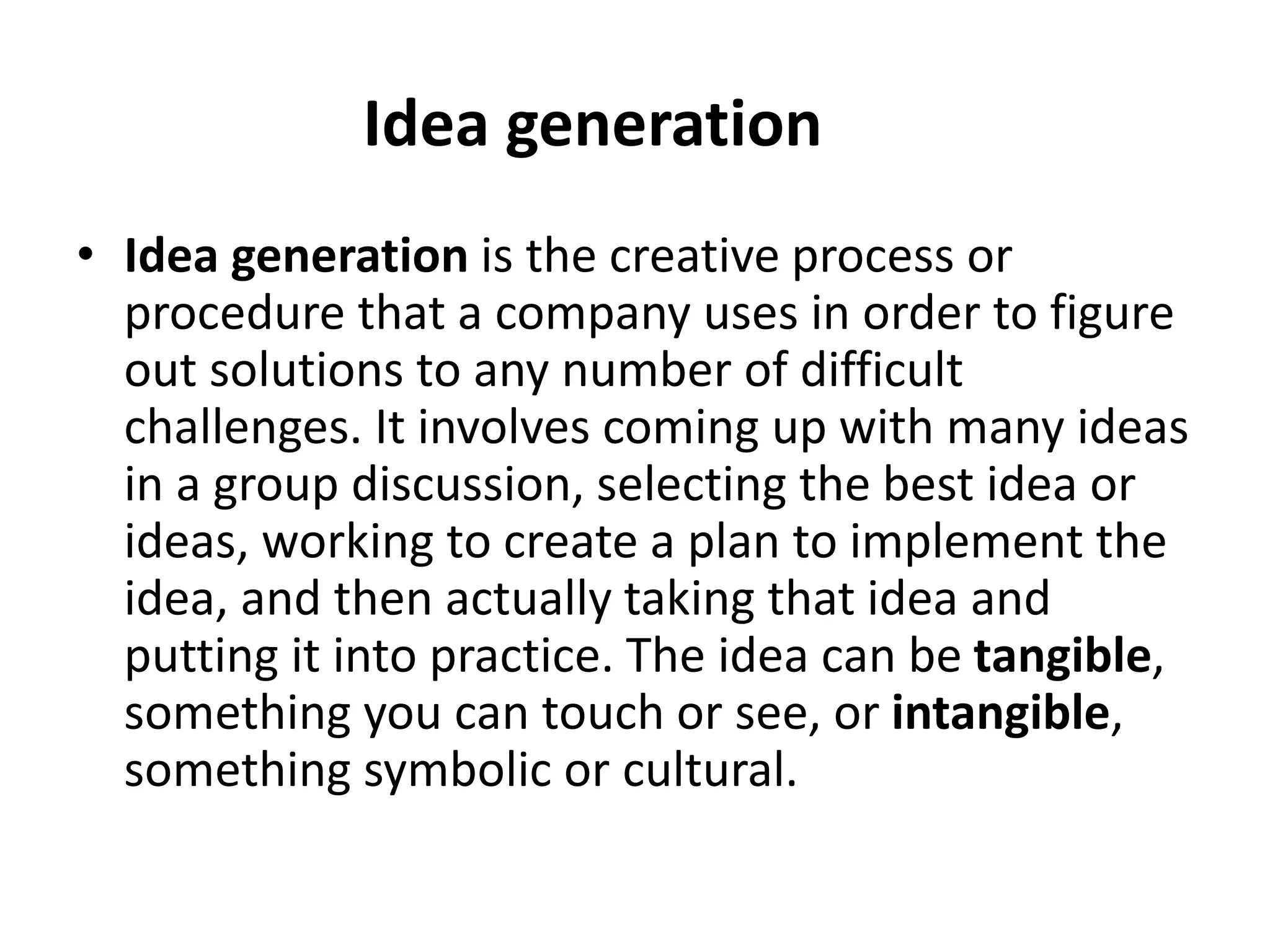
Idea generation
• Idea generation is the creative process or
procedure that a company uses in order to figure
out solutions to any number of difficult
challenges. It involves coming up with many ideas
in a group discussion, selecting the best idea or
ideas, working to create a plan to implement the
idea, and then actually taking that idea and
putting it into practice. The idea can be tangible,
something you can touch or see, or intangible,
something symbolic or cultural.
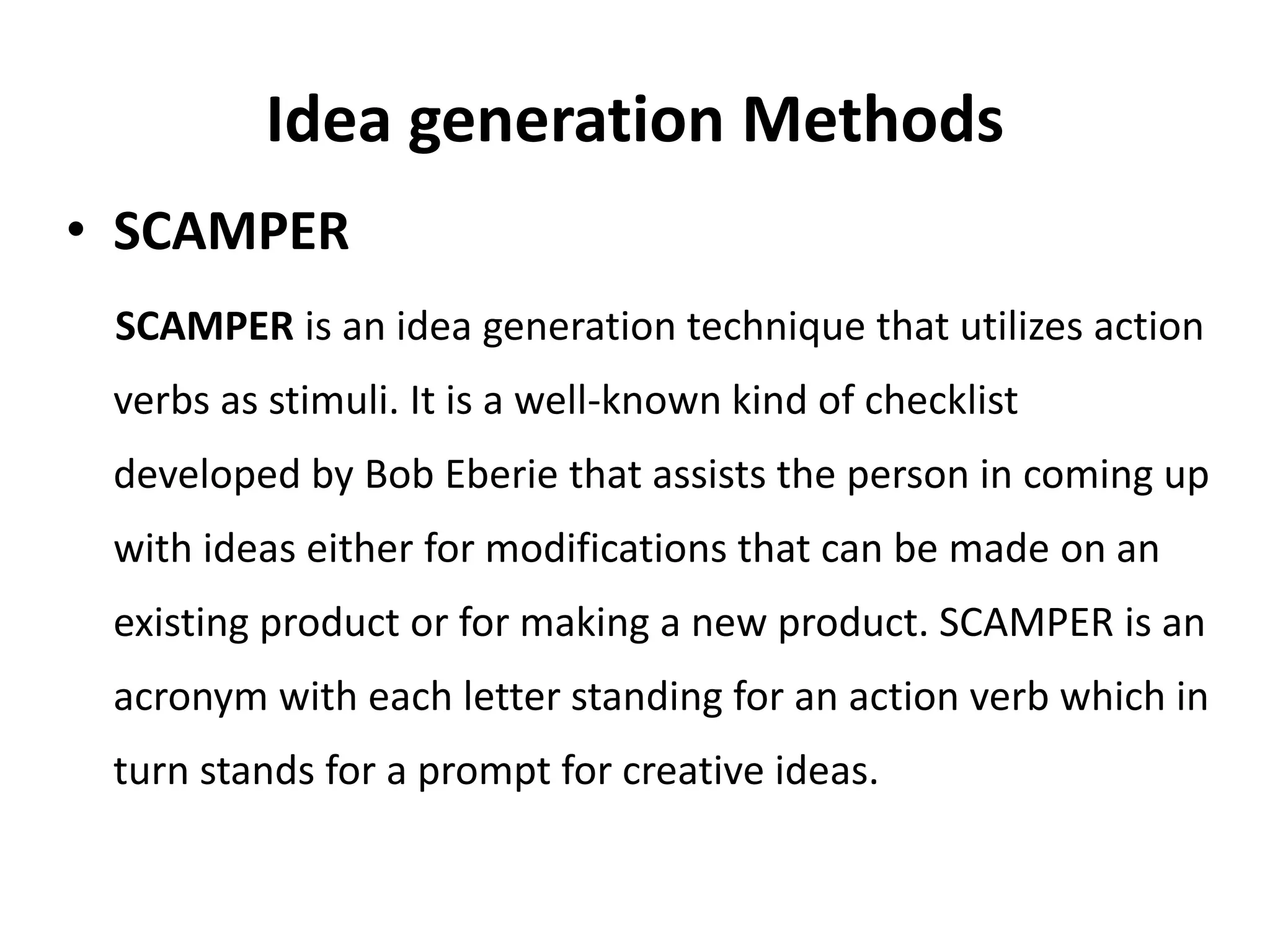
Idea generation Methods
• SCAMPER
SCAMPER is an idea generation technique that utilizes action
verbs as stimuli. It is a well-known kind of checklist
developed by Bob Eberie that assists the person in coming up
with ideas either for modifications that can be made on an
existing product or for making a new product. SCAMPER is an
acronym with each letter standing for an action verb which in
turn stands for a prompt for creative ideas.
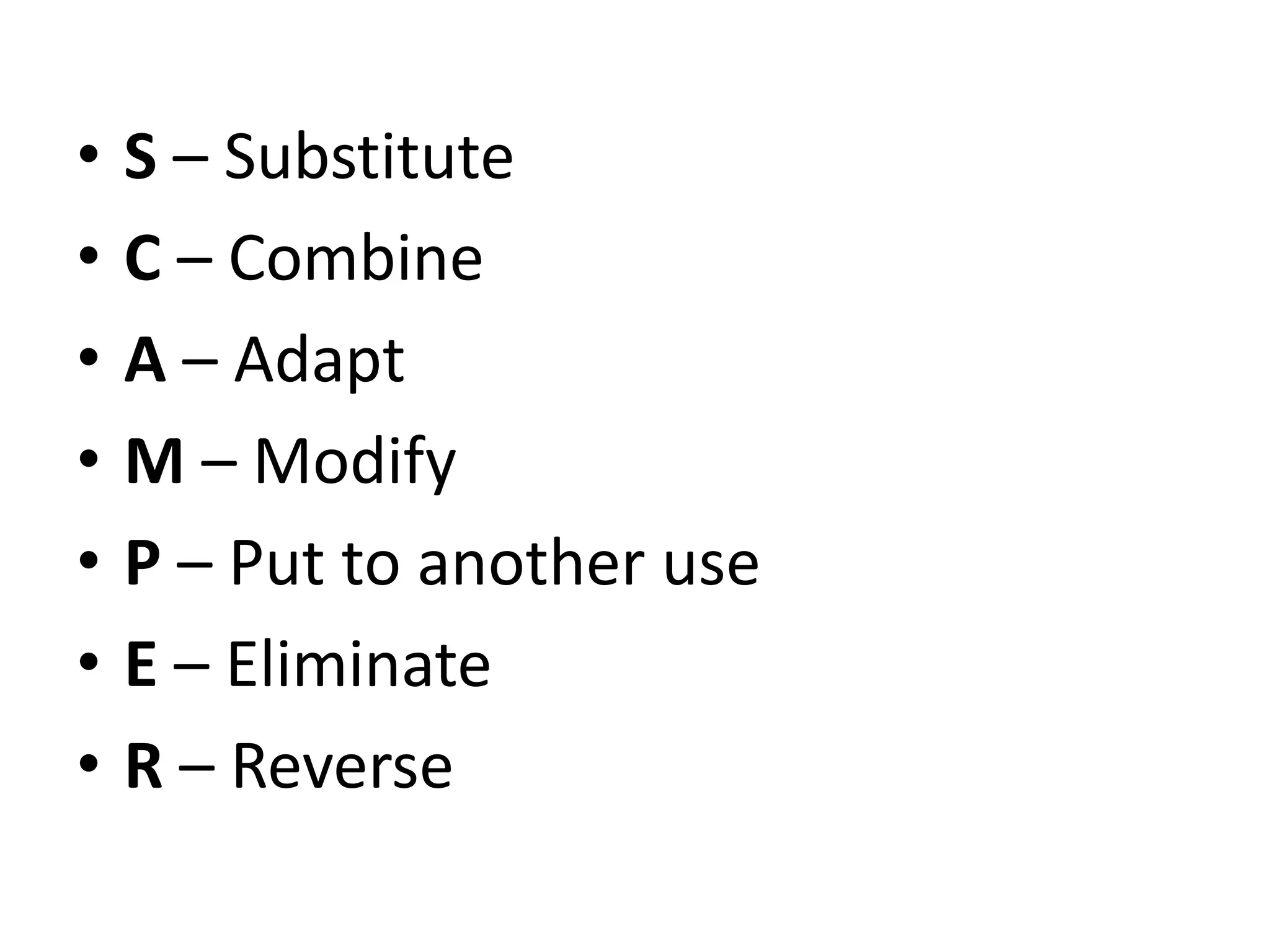
• S – Substitute
• C – Combine
• A – Adapt
• M – Modify
• P – Put to another use
• E – Eliminate
• R – Reverse
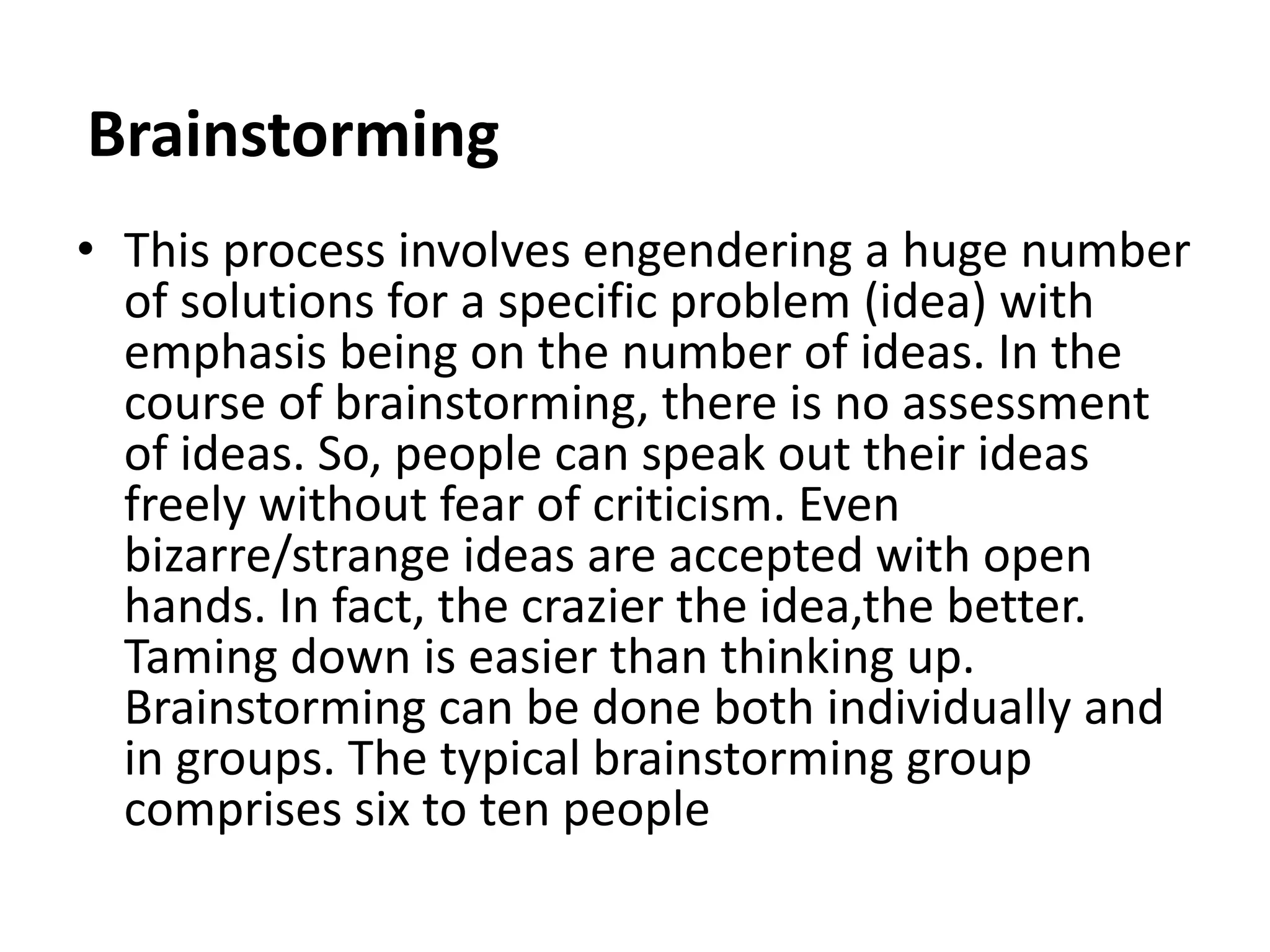
Brainstorming
• This process involves engendering a huge number
of solutions for a specific problem (idea) with
emphasis being on the number of ideas. In the
course of brainstorming, there is no assessment
of ideas. So, people can speak out their ideas
freely without fear of criticism. Even
bizarre/strange ideas are accepted with open
hands. In fact, the crazier the idea,the better.
Taming down is easier than thinking up.
Brainstorming can be done both individually and
in groups. The typical brainstorming group
comprises six to ten people
Mindmapping
• Mindmapping is a graphical technique for
imagining connections between various pieces of
information or ideas. Each fact or idea is written
down and then connected by curves or lines to its
minor or major (previous or following) fact or
idea, thus building a web of relationships. Mind
mapping is utilized in brainstorming, project
planning, problem solving and note taking. As is
the case with other mapping methods, the
intention behind brain mapping too is to capture
attention and to gain and frame information to
enable sharing of concepts and ideas.
Role playing
• In the role playing technique, each participant
can take on a personality or role different
from his own. As the technique is fun, it can
help people reduce their inhibitions and come
out with unexpected ideas.
Brainwriting
• Brainwriting is easy. Instead of asking the
participants to shout out ideas, they are told
to pen down their ideas pertaining to a
specific problem or question on sheets of
paper, for a small number of minutes. After
that, each participant can pass their ideas over
to someone else. This someone else reads the
ideas on the paper and adds some new ones.
Creative problem solving

Creative problem solving

  • 1.
  • 2.
    What is CreativeProblem Solving? • The creative problem solving process involves creativity. The problem solvers come up with solutions that are innovative, rather than obtaining help to learn the answers or implementing standard procedures. • The creative problem solving process is at work anytime you identify solutions that have value or that somehow improve a situation for someone.
  • 3.
    • Problem RestatementTechnique • SWOT Methodology • Pareto Principle • Brainstorming Creative Problem Solving Tools
  • 4.
    • The aimof problem re-statement is to: – Broaden our perspective of a problem, not to solve it; – Help us identify the central issues & alternative solutions; – Increase the chance that the outcome our analysis produces will fully, not partially, resolve the problem. Problem Re-statement
  • 5.
    SWOT Analysis isa simple but powerful framework for analyzing your company's Strengths and Weaknesses, and the Opportunities and Threats you face. This helps you to focus on your strengths, minimize threats, and take the greatest possible advantage of opportunities available to you. SWOT TECHNIQUE
  • 6.
    This rule arguesthat typically 80% of unfocussed effort generates only 20% of results. The remaining 80% of results are achieved with only 20% of the effort. 80:20 Rule or Pareto Principle
  • 7.
    • Brainstorming isa great way of generating radical ideas. • During the brainstorming process there is no criticism of ideas, as free rein is given to people's creativity (criticism and judgment cramp creativity.) • Individual Brainstorming: – It is best for generating many ideas, but tends to be less effective at developing them. – Can be risky for individuals. Valuable but strange suggestions may appear stupid at first sight. Brainstorming – A Creative Technique
  • 8.
    • Group Brainstorming: –tends to develop fewer ideas, but takes each idea further – needs formal rules for it to work smoothly – group brainstorming sessions are usually enjoyable experiences, which are great for creating cohesion in a team
  • 9.
    Idea generation • Ideageneration is the creative process or procedure that a company uses in order to figure out solutions to any number of difficult challenges. It involves coming up with many ideas in a group discussion, selecting the best idea or ideas, working to create a plan to implement the idea, and then actually taking that idea and putting it into practice. The idea can be tangible, something you can touch or see, or intangible, something symbolic or cultural.
  • 10.
    Idea generation Methods •SCAMPER SCAMPER is an idea generation technique that utilizes action verbs as stimuli. It is a well-known kind of checklist developed by Bob Eberie that assists the person in coming up with ideas either for modifications that can be made on an existing product or for making a new product. SCAMPER is an acronym with each letter standing for an action verb which in turn stands for a prompt for creative ideas.
  • 11.
    • S –Substitute • C – Combine • A – Adapt • M – Modify • P – Put to another use • E – Eliminate • R – Reverse
  • 12.
    Brainstorming • This processinvolves engendering a huge number of solutions for a specific problem (idea) with emphasis being on the number of ideas. In the course of brainstorming, there is no assessment of ideas. So, people can speak out their ideas freely without fear of criticism. Even bizarre/strange ideas are accepted with open hands. In fact, the crazier the idea,the better. Taming down is easier than thinking up. Brainstorming can be done both individually and in groups. The typical brainstorming group comprises six to ten people
  • 13.
    Mindmapping • Mindmapping isa graphical technique for imagining connections between various pieces of information or ideas. Each fact or idea is written down and then connected by curves or lines to its minor or major (previous or following) fact or idea, thus building a web of relationships. Mind mapping is utilized in brainstorming, project planning, problem solving and note taking. As is the case with other mapping methods, the intention behind brain mapping too is to capture attention and to gain and frame information to enable sharing of concepts and ideas.
  • 14.
    Role playing • Inthe role playing technique, each participant can take on a personality or role different from his own. As the technique is fun, it can help people reduce their inhibitions and come out with unexpected ideas.
  • 15.
    Brainwriting • Brainwriting iseasy. Instead of asking the participants to shout out ideas, they are told to pen down their ideas pertaining to a specific problem or question on sheets of paper, for a small number of minutes. After that, each participant can pass their ideas over to someone else. This someone else reads the ideas on the paper and adds some new ones.