Travel Writing
Yogyakarta, Indonesiahas been high on my bucket list
for ages so I was stoked to finally get to this cultural hub and
explore it’s street art lined alleys, eat all the vegan food, and
see ancient religious structures that are larger than life. As per
usual, I tried to make sure my trip was as responsible as
possible by collaborating with an eco-hotel, going on
community-based tours with Backstreet Academy, and hiring
local drivers for out-of-town adventures. There’s so much to
see and do in Yogyakarta, lovingly called Jogja by locals. I’d
recommend spending at least five days here and following this
Yogyakarta, Indonesia responsible travel guide.
4.
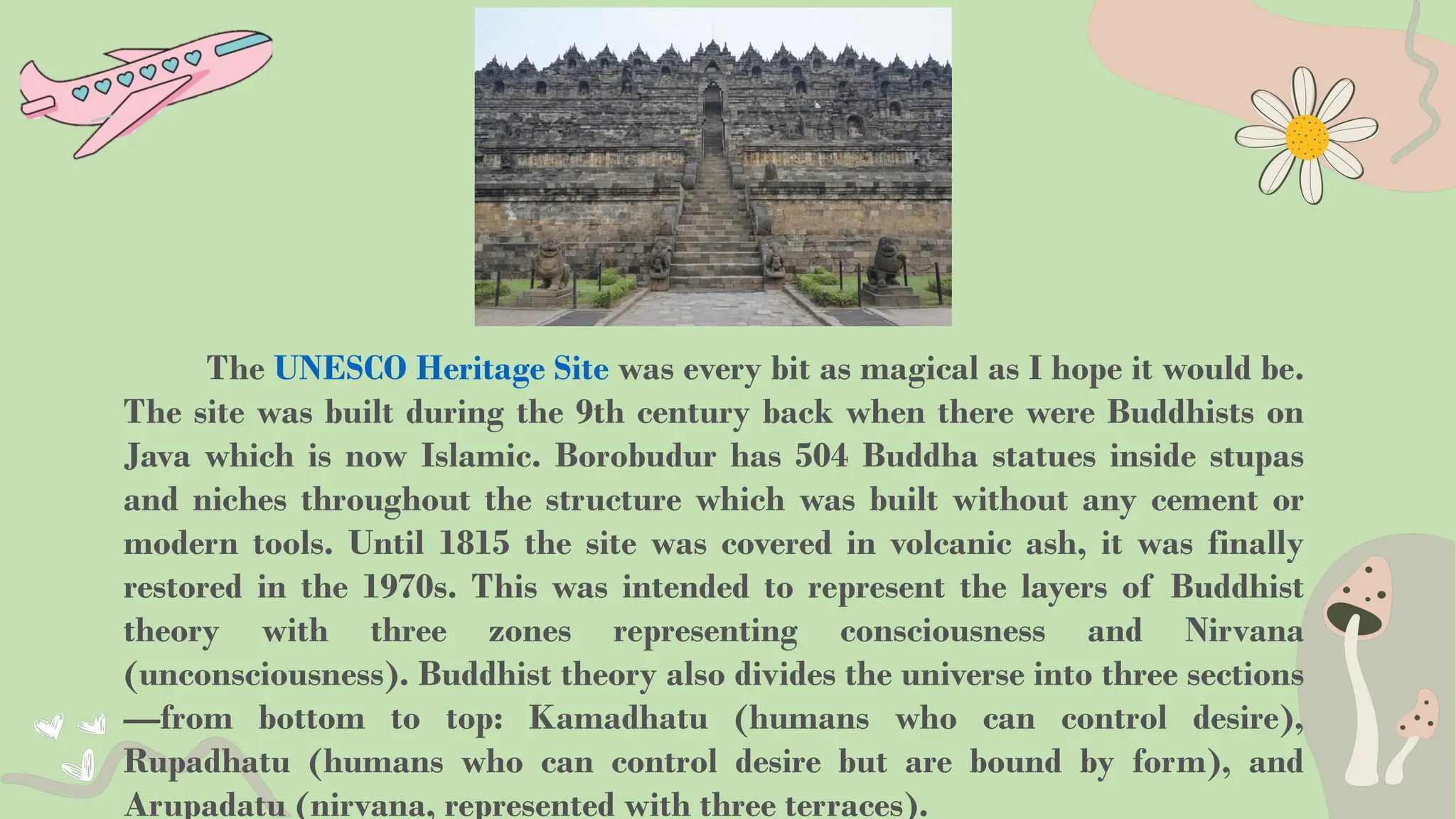
The UNESCO HeritageSite was every bit as magical as I hope it would be.
The site was built during the 9th century back when there were Buddhists on
Java which is now Islamic. Borobudur has 504 Buddha statues inside stupas
and niches throughout the structure which was built without any cement or
modern tools. Until 1815 the site was covered in volcanic ash, it was finally
restored in the 1970s. This was intended to represent the layers of Buddhist
theory with three zones representing consciousness and Nirvana
(unconsciousness). Buddhist theory also divides the universe into three sections
—from bottom to top: Kamadhatu (humans who can control desire),
Rupadhatu (humans who can control desire but are bound by form), and
Arupadatu (nirvana, represented with three terraces).
5.
Anagard’s art ispolitically powerful and
graces walls everywhere from Poland, Lithuania,
Sweden, Denmark to Thailand, and have had
their work exhibited in Germany and Australia.
They have a background in sculpture which they
studied in Sumatra in 2005. We met at their
house and they gave us a tour through their
stencils and explained their creative process to us.
They hand draw every stencil and many of the
characters are rooted in visual images of Hindu
mythology and incorporate both human and
animal body parts. They use a human model to
get the proportions correct. Anagard finds
inspiration from their surroundings and
community so it’s no surprise that much of their
work is rooted in policy.