Creating Shared Value
Mohammad Fahad ABBASI
MBA GGSB, France
Different approaches to Social
Responsibility
• Philanthropy or Voluntary act:
e.g. Donations to poor countries, distributing medicine/food to
needy people
• CSR(Corporate Social Responsibility): Complying to
regulation, Adhering to Standards like ISO
140001, SA8000, UN Global Impact etc.
• Sustainability: Reducing community impact of business.
e.g. Reducing Green house gas emission, reducing water
footprint etc.
Does it really work..
• Report from UN Millennium Assessment report 2012
highlights the degrading condition of our ecosystem:
• 15 out of 24(Nearly 60%) resources have degraded
• Exploitation in developing countries in order to find
cheap resources
E.g Building collapse in Bangladesh killed more
than 3000 people
Fair-trade money not reaching to poor farmers
• When a company has to make a choice between
money and social responsibility its always money
that wins
Why then invest..
•Brand recognition
•License to operate
•Marketing Strategy
•PR Stunt
Why doesn’t it work..
• Business and “Social responsibility look in
2 different directions.
• While one is about making money other is
about “spending” money.
• CSR always at the periphery of Business
• No Enforcement body
• It incurs cost
What is missing..
• Business is the only institution on the face of
earth that can make money.
• Social Responsibility approaches look at
societal issues and business as 2 separate
entities.
• What is missing in it is MONEY. Not spending
money but earning money.
What is the solution..
• A business Strategy that looks to create economic
value while simultaneously making
social/environmental impact.
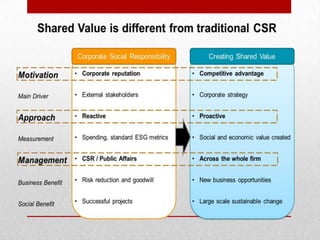
• The approach is called “Creating Shared
Value”(CSV).
• It is NOT about sharing the value that is created.
Shared Value Opportunities..
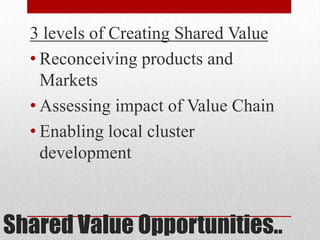
3 levels of Creating Shared Value
• Reconceiving products and
Markets
• Assessing impact of Value Chain
• Enabling local cluster
development
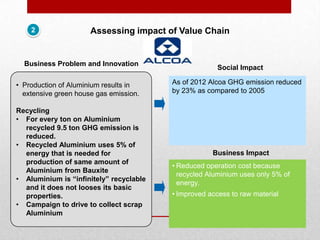
• Production of Aluminium results in
extensive green house gas emission.
Recycling
• For every ton on Aluminium
recycled 9.5 ton GHG emission is
reduced.
• Recycled Aluminium uses 5% of
energy that is needed for
production of same amount of
Aluminium from Bauxite
• Aluminium is “infinitely” recyclable
and it does not looses its basic
properties.
• Campaign to drive to collect scrap
Aluminium
Business Problem and Innovation
As of 2012 Alcoa GHG emission reduced
by 23% as compared to 2005
Social Impact
Business Impact
• Reduced operation cost because
recycled Aluminium uses only 5% of
energy.
• Improved access to raw material
Assessing impact of Value Chain2
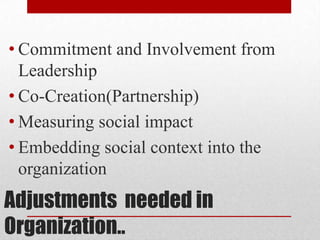
Adjustments needed in
Organization..
• Commitment and Involvement from
Leadership
• Co-Creation(Partnership)
• Measuring social impact
• Embedding social context into the
organization
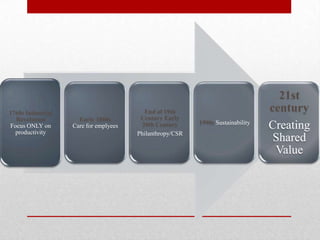
1760s Industrial
Revolution
Focus ONLY on
productivity
Early 1800s
Care for emplyees
End of 19th
Century Early
20th Century
Philanthropy/CSR
1990s Sustainability
21st
century
Creating
Shared
Value
THANK YOU…
• For any queries please contact me:
csv.im.course@gmail.com

Creating Shared Value

  • 1.
    Creating Shared Value MohammadFahad ABBASI MBA GGSB, France
  • 2.
    Different approaches toSocial Responsibility • Philanthropy or Voluntary act: e.g. Donations to poor countries, distributing medicine/food to needy people • CSR(Corporate Social Responsibility): Complying to regulation, Adhering to Standards like ISO 140001, SA8000, UN Global Impact etc. • Sustainability: Reducing community impact of business. e.g. Reducing Green house gas emission, reducing water footprint etc.
  • 3.
    Does it reallywork.. • Report from UN Millennium Assessment report 2012 highlights the degrading condition of our ecosystem: • 15 out of 24(Nearly 60%) resources have degraded • Exploitation in developing countries in order to find cheap resources E.g Building collapse in Bangladesh killed more than 3000 people Fair-trade money not reaching to poor farmers • When a company has to make a choice between money and social responsibility its always money that wins
  • 4.
    Why then invest.. •Brandrecognition •License to operate •Marketing Strategy •PR Stunt
  • 5.
    Why doesn’t itwork.. • Business and “Social responsibility look in 2 different directions. • While one is about making money other is about “spending” money. • CSR always at the periphery of Business • No Enforcement body • It incurs cost
  • 6.
    What is missing.. •Business is the only institution on the face of earth that can make money. • Social Responsibility approaches look at societal issues and business as 2 separate entities. • What is missing in it is MONEY. Not spending money but earning money.
  • 7.
    What is thesolution.. • A business Strategy that looks to create economic value while simultaneously making social/environmental impact. • The approach is called “Creating Shared Value”(CSV). • It is NOT about sharing the value that is created.
  • 9.
    Shared Value Opportunities.. 3levels of Creating Shared Value • Reconceiving products and Markets • Assessing impact of Value Chain • Enabling local cluster development
  • 11.
    • Production ofAluminium results in extensive green house gas emission. Recycling • For every ton on Aluminium recycled 9.5 ton GHG emission is reduced. • Recycled Aluminium uses 5% of energy that is needed for production of same amount of Aluminium from Bauxite • Aluminium is “infinitely” recyclable and it does not looses its basic properties. • Campaign to drive to collect scrap Aluminium Business Problem and Innovation As of 2012 Alcoa GHG emission reduced by 23% as compared to 2005 Social Impact Business Impact • Reduced operation cost because recycled Aluminium uses only 5% of energy. • Improved access to raw material Assessing impact of Value Chain2
  • 13.
    Adjustments needed in Organization.. •Commitment and Involvement from Leadership • Co-Creation(Partnership) • Measuring social impact • Embedding social context into the organization
  • 14.
    1760s Industrial Revolution Focus ONLYon productivity Early 1800s Care for emplyees End of 19th Century Early 20th Century Philanthropy/CSR 1990s Sustainability 21st century Creating Shared Value
  • 15.
    THANK YOU… • Forany queries please contact me: csv.im.course@gmail.com

Editor's Notes