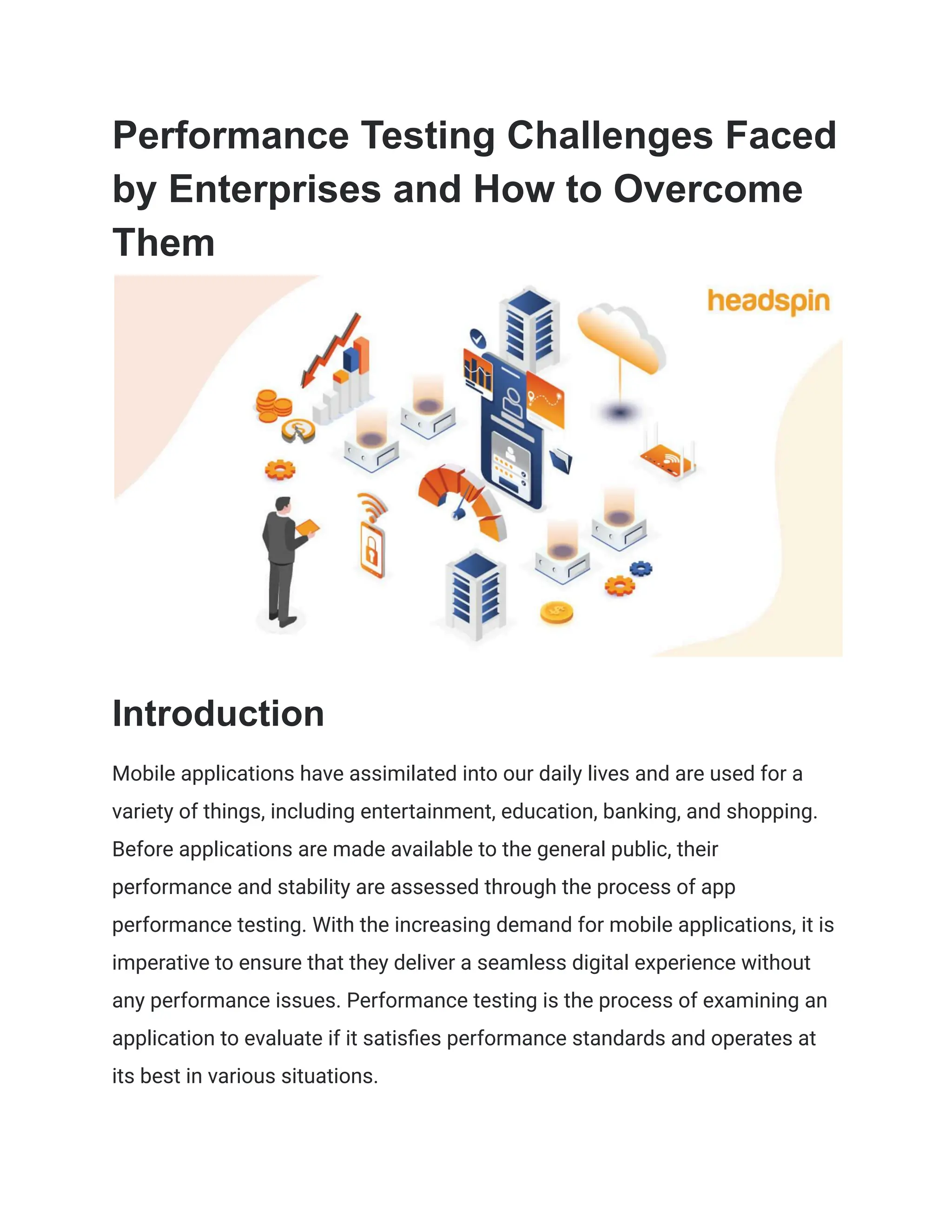
Performance Testing Challenges Faced
by Enterprises and How to Overcome
Them
Introduction
Mobile applications have assimilated into our daily lives and are used for a
variety of things, including entertainment, education, banking, and shopping.
Before applications are made available to the general public, their
performance and stability are assessed through the process of app
performance testing. With the increasing demand for mobile applications, it is
imperative to ensure that they deliver a seamless digital experience without
any performance issues. Performance testing is the process of examining an
application to evaluate if it satisfies performance standards and operates at
its best in various situations.
This blog highlights the importance of app performance testing during the
economic downturn and app performance testing challenges faced by
enterprises and how to overcome them.
Significance of Enhancing App
Performance Testing During the
Economic Recession
Businesses are under enormous pressure to maintain their market share and
consumer loyalty during an economic downturn. Their revenue, reputation, and
competitiveness may all be severely impacted by how well their applications
function in such a situation. Before their apps reach customers, businesses
can find and fix any flaws by performing app performance testing. This
guarantees that the apps function without hiccups, deliver a flawless user
experience, and live up to consumers' expectations. This raises customer
happiness and fosters brand loyalty, both of which help businesses maintain
their market share throughout the recession. Additionally, efficient
performance testing tools help companies reduce the cost of development,
minimize the risk of downtime, and improve the quality of the application,
thus, making it a valuable investment for companies during an economic
downturn.
App Performance Testing: Challenges
and Solutions
Challenge 1: Determining the scope of performance
testing
Determining the scope of performance testing is challenging for enterprises
for various reasons. Firstly, the scope of performance testing varies
depending on the nature of the application, system, or software being tested.
Different applications may have unique user requirements, functionality, and
performance demands, which makes it difficult to determine the scope of
testing. Secondly, enterprises need to consider the infrastructure, hardware,
and software resources required for testing, which can be a complex process.
Additionally, enterprises need to determine the right performance metrics, test
scenarios, and testing tools to be used in the testing process. The changing
requirements and the increasing complexity of applications make it
challenging for enterprises to determine the scope of performance testing,
which requires careful planning and execution.
Solution:
The first step that QA teams need to work on is identifying the key
performance indicators (KPIs) that matter most for their applications. Some
common KPIs used in app testing include response time, resource usage, and
scalability. Once QA teams have identified the required KPIs, they can create a
performance testing plan that outlines the scope of testing, testing objectives,
test cases, and testing environment.
Challenge 2: Automating customer user journeys
Automating customer user journeys during app performance testing is
difficult, as it requires capturing the diverse and often unpredictable ways that
real users interact with an application. Unlike scripted testing, where QA
experts follow a predetermined set of steps, realistic user behavior can vary
greatly depending on the individual user's preferences, device specifications,
network connectivity, and other environmental factors. Also, accurately
simulating realistic user behavior requires a large and diverse dataset of user
actions, which can be difficult to obtain and analyze. Thus, in order to
accurately simulate realistic user behavior, companies require a deep
understanding of human-computer interaction, as well as advanced technical
capabilities, making it a significant challenge for app performance testers.
Solution:
Automating customer user journeys is critical to ensure that applications
perform optimally under different conditions. Enterprises can use automated
performance testing tools to simulate user behavior and test the application's
performance under different loads. You can also use real user monitoring
(RUM) tools to gather data on user behavior and use this data to improve the
testing process.
Challenge 3: Test on real devices and network conditions
Owing to the availability of devices and network conditions that must be taken
into account, testing on real devices and networks can be difficult for
businesses. It is getting difficult for enterprises to stay up with the newest
trends as there are more devices available with different operating systems,
screen sizes, and resolutions. In addition, the location and type of network
being utilized can significantly impact network parameters, including
bandwidth, latency, and packet loss. To test and analyze apps, businesses
must spend money on a range of genuine devices, which can be expensive.
Ensuring that the app or software is compatible with all devices and network
conditions is time-consuming and requires thorough testing and analysis.
Enterprises need to have a well-defined testing strategy to ensure that the
software functions correctly across all devices and network conditions, which
can be challenging.
Solution:
To ensure that applications perform optimally across different devices and
network conditions, companies need to test them on a wide range of devices
and network configurations. The best way to perform such testing is to get the
support of a testing platform that has real devices deployed in various parts
of the world under different networks. This will help enterprises to gather data
on the performance of their applications in real-time.
Challenge 4: Integrating performance testing into the
development process
Integrating performance testing into the app development cycle is difficult for
companies for various reasons. Primarily, it requires a significant investment
of time and resources to properly test an app's performance, which can
deaccelerate the development process. Companies often depend on complex
and distributed systems that make it difficult to accurately identify
performance issues, as they can originate from multiple sources. Also, there
is often a lack of standardization in the development process, with different
teams and departments following their own workflows, making it tough to
implement a consistent approach to performance testing. Apart from all other
challenges, owing to the rapid pace of technological change, performance
testing tools and techniques are constantly evolving, thus requiring
businesses to update their testing practices to keep up continually.
Solution:
To ensure that a company's application performs optimally, they need to
integrate performance testing into the development process. This means that
companies need to instruct their teams to start testing early in the
development process and continue testing throughout the development cycle.
Companies can use continuous integration and continuous deployment
(CI/CD) tools to automate the testing process and ensure that their
application meets performance requirements.
How HeadSpin Helps Enterprises
Overcome Performance Testing
Challenges
With a focus on enhancing the performance of apps, HeadSpin uses its data
science capabilities to improve the development and QA processes for
applications and support product managers, SREs, developers, and QA
engineers in delivering high-quality apps. Here are the significant features of
the HeadSpin Platform that can help enterprises overcome all performance
testing challenges.
1. Performance-centric App Development and Testing
Development and testing teams can keep an eye on how their native digital
apps are performing thanks to the HeadSpin Platform. Teams may
incorporate input from testing teams to enhance the performance of their
apps, thanks to its rich insights and continuous testing strategy. This
improves the performance of the app as a whole and aids businesses in
achieving particular KPIs.
2. AI-generated Actionable Insights
Organizations can enhance the functionality of their native digital apps by
using the HeadSpin Platform, which offers ongoing monitoring and insights
into both the functional and non-functional aspects of the apps. Organizations
can collect useful information to improve the user experience of their apps by
using numerous digital testing methods, such as media testing, video testing,
and end-user experience testing. Teams can compare findings and
constantly enhance the performance of their apps with the help of the
Platform.
3. Synthetic Monitoring and Testing
Synthetic monitoring provided by the HeadSpin Platform enables businesses
to find problems and bugs before they spread widely. The Platform
continuously analyzes apps and automates user experiences to quickly
identify possible issues and take immediate corrective action.
4. Global Remote Testing
By providing remote end-to-end testing on real devices in over 90 locations,
HeadSpin enables businesses to grow without relocating personnel. This
functionality also aids in comprehending how apps behave in various settings.
Conclusion
Recessions in the economy can be very difficult for businesses that need to
undergo performance testing. The resources and knowledge needed for
efficient testing may be constrained by funding restrictions and labor
reductions. Organizations may, however, overcome these difficulties and
guarantee that their applications continue to run as efficiently as possible by
putting the ideas covered in this blog into practice. Companies may efficiently
and successfully manage their testing requirements even in difficult economic
times by prioritizing testing efforts, adopting automation, and utilizing
cloud-based resources. By doing this, they may strengthen their competitive
advantage and put themselves in a position for long-term success while also
maintaining the quality and dependability of their software programs.
This article was originally published on:
https://www.headspin.io/blog/performance-testing-challenges-and-solutions

Performance Testing Challenges Faced by Enterprises and How to Overcome Them.pdf

  • 1.
    Performance Testing ChallengesFaced by Enterprises and How to Overcome Them Introduction Mobile applications have assimilated into our daily lives and are used for a variety of things, including entertainment, education, banking, and shopping. Before applications are made available to the general public, their performance and stability are assessed through the process of app performance testing. With the increasing demand for mobile applications, it is imperative to ensure that they deliver a seamless digital experience without any performance issues. Performance testing is the process of examining an application to evaluate if it satisfies performance standards and operates at its best in various situations.
  • 2.
    This blog highlightsthe importance of app performance testing during the economic downturn and app performance testing challenges faced by enterprises and how to overcome them. Significance of Enhancing App Performance Testing During the Economic Recession Businesses are under enormous pressure to maintain their market share and consumer loyalty during an economic downturn. Their revenue, reputation, and competitiveness may all be severely impacted by how well their applications function in such a situation. Before their apps reach customers, businesses can find and fix any flaws by performing app performance testing. This guarantees that the apps function without hiccups, deliver a flawless user experience, and live up to consumers' expectations. This raises customer happiness and fosters brand loyalty, both of which help businesses maintain their market share throughout the recession. Additionally, efficient performance testing tools help companies reduce the cost of development, minimize the risk of downtime, and improve the quality of the application, thus, making it a valuable investment for companies during an economic downturn. App Performance Testing: Challenges and Solutions
  • 3.
    Challenge 1: Determiningthe scope of performance testing Determining the scope of performance testing is challenging for enterprises for various reasons. Firstly, the scope of performance testing varies depending on the nature of the application, system, or software being tested. Different applications may have unique user requirements, functionality, and performance demands, which makes it difficult to determine the scope of testing. Secondly, enterprises need to consider the infrastructure, hardware, and software resources required for testing, which can be a complex process. Additionally, enterprises need to determine the right performance metrics, test scenarios, and testing tools to be used in the testing process. The changing requirements and the increasing complexity of applications make it challenging for enterprises to determine the scope of performance testing, which requires careful planning and execution. Solution: The first step that QA teams need to work on is identifying the key performance indicators (KPIs) that matter most for their applications. Some common KPIs used in app testing include response time, resource usage, and scalability. Once QA teams have identified the required KPIs, they can create a performance testing plan that outlines the scope of testing, testing objectives, test cases, and testing environment. Challenge 2: Automating customer user journeys
  • 4.
    Automating customer userjourneys during app performance testing is difficult, as it requires capturing the diverse and often unpredictable ways that real users interact with an application. Unlike scripted testing, where QA experts follow a predetermined set of steps, realistic user behavior can vary greatly depending on the individual user's preferences, device specifications, network connectivity, and other environmental factors. Also, accurately simulating realistic user behavior requires a large and diverse dataset of user actions, which can be difficult to obtain and analyze. Thus, in order to accurately simulate realistic user behavior, companies require a deep understanding of human-computer interaction, as well as advanced technical capabilities, making it a significant challenge for app performance testers. Solution: Automating customer user journeys is critical to ensure that applications perform optimally under different conditions. Enterprises can use automated performance testing tools to simulate user behavior and test the application's performance under different loads. You can also use real user monitoring (RUM) tools to gather data on user behavior and use this data to improve the testing process. Challenge 3: Test on real devices and network conditions Owing to the availability of devices and network conditions that must be taken into account, testing on real devices and networks can be difficult for businesses. It is getting difficult for enterprises to stay up with the newest trends as there are more devices available with different operating systems, screen sizes, and resolutions. In addition, the location and type of network
  • 5.
    being utilized cansignificantly impact network parameters, including bandwidth, latency, and packet loss. To test and analyze apps, businesses must spend money on a range of genuine devices, which can be expensive. Ensuring that the app or software is compatible with all devices and network conditions is time-consuming and requires thorough testing and analysis. Enterprises need to have a well-defined testing strategy to ensure that the software functions correctly across all devices and network conditions, which can be challenging. Solution: To ensure that applications perform optimally across different devices and network conditions, companies need to test them on a wide range of devices and network configurations. The best way to perform such testing is to get the support of a testing platform that has real devices deployed in various parts of the world under different networks. This will help enterprises to gather data on the performance of their applications in real-time. Challenge 4: Integrating performance testing into the development process Integrating performance testing into the app development cycle is difficult for companies for various reasons. Primarily, it requires a significant investment of time and resources to properly test an app's performance, which can deaccelerate the development process. Companies often depend on complex and distributed systems that make it difficult to accurately identify performance issues, as they can originate from multiple sources. Also, there is often a lack of standardization in the development process, with different
  • 6.
    teams and departmentsfollowing their own workflows, making it tough to implement a consistent approach to performance testing. Apart from all other challenges, owing to the rapid pace of technological change, performance testing tools and techniques are constantly evolving, thus requiring businesses to update their testing practices to keep up continually. Solution: To ensure that a company's application performs optimally, they need to integrate performance testing into the development process. This means that companies need to instruct their teams to start testing early in the development process and continue testing throughout the development cycle. Companies can use continuous integration and continuous deployment (CI/CD) tools to automate the testing process and ensure that their application meets performance requirements. How HeadSpin Helps Enterprises Overcome Performance Testing Challenges With a focus on enhancing the performance of apps, HeadSpin uses its data science capabilities to improve the development and QA processes for applications and support product managers, SREs, developers, and QA engineers in delivering high-quality apps. Here are the significant features of the HeadSpin Platform that can help enterprises overcome all performance testing challenges.
  • 7.
    1. Performance-centric AppDevelopment and Testing Development and testing teams can keep an eye on how their native digital apps are performing thanks to the HeadSpin Platform. Teams may incorporate input from testing teams to enhance the performance of their apps, thanks to its rich insights and continuous testing strategy. This improves the performance of the app as a whole and aids businesses in achieving particular KPIs. 2. AI-generated Actionable Insights Organizations can enhance the functionality of their native digital apps by using the HeadSpin Platform, which offers ongoing monitoring and insights into both the functional and non-functional aspects of the apps. Organizations can collect useful information to improve the user experience of their apps by using numerous digital testing methods, such as media testing, video testing, and end-user experience testing. Teams can compare findings and constantly enhance the performance of their apps with the help of the Platform. 3. Synthetic Monitoring and Testing Synthetic monitoring provided by the HeadSpin Platform enables businesses to find problems and bugs before they spread widely. The Platform continuously analyzes apps and automates user experiences to quickly identify possible issues and take immediate corrective action. 4. Global Remote Testing
  • 8.
    By providing remoteend-to-end testing on real devices in over 90 locations, HeadSpin enables businesses to grow without relocating personnel. This functionality also aids in comprehending how apps behave in various settings. Conclusion Recessions in the economy can be very difficult for businesses that need to undergo performance testing. The resources and knowledge needed for efficient testing may be constrained by funding restrictions and labor reductions. Organizations may, however, overcome these difficulties and guarantee that their applications continue to run as efficiently as possible by putting the ideas covered in this blog into practice. Companies may efficiently and successfully manage their testing requirements even in difficult economic times by prioritizing testing efforts, adopting automation, and utilizing cloud-based resources. By doing this, they may strengthen their competitive advantage and put themselves in a position for long-term success while also maintaining the quality and dependability of their software programs. This article was originally published on: https://www.headspin.io/blog/performance-testing-challenges-and-solutions