Creating a 3D Animation Web Design Wonderland
In the dynamic world of web design, staying ahead of the curve is
essential to capture and retain the attention of today's increasingly
discerning online audience. One of the most exciting and innovative
trends in this realm is the integration of 3D animation into web design.
This captivating fusion of technology and artistry has opened up a world
of possibilities for designers, providing the means to engage users in a
whole new way. In this 6000-word exploration, we will delve into the
realm of 3D animation web designs, examining their evolution, benefits,
challenges, and providing insights into how to harness their potential to
create immersive and unforgettable online experiences.
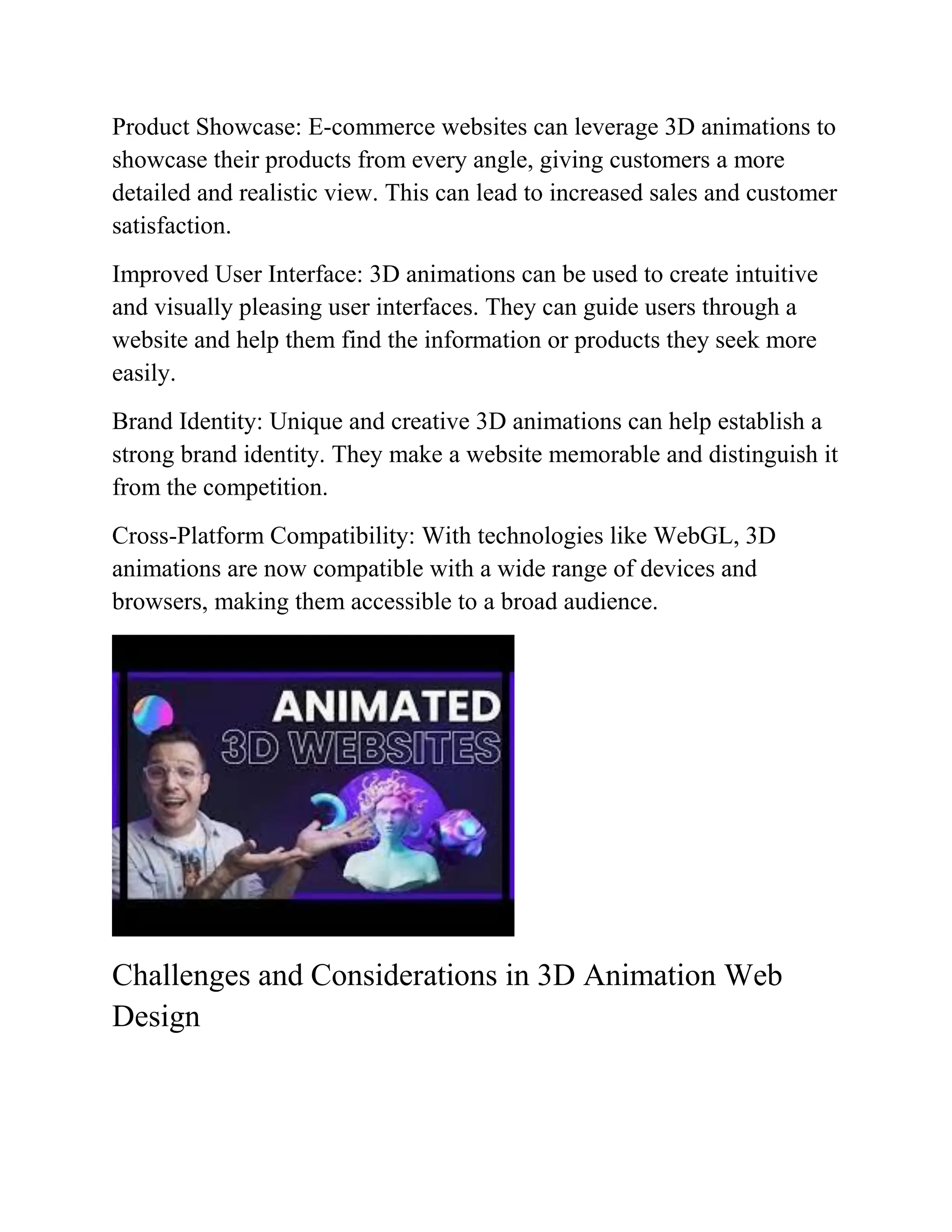
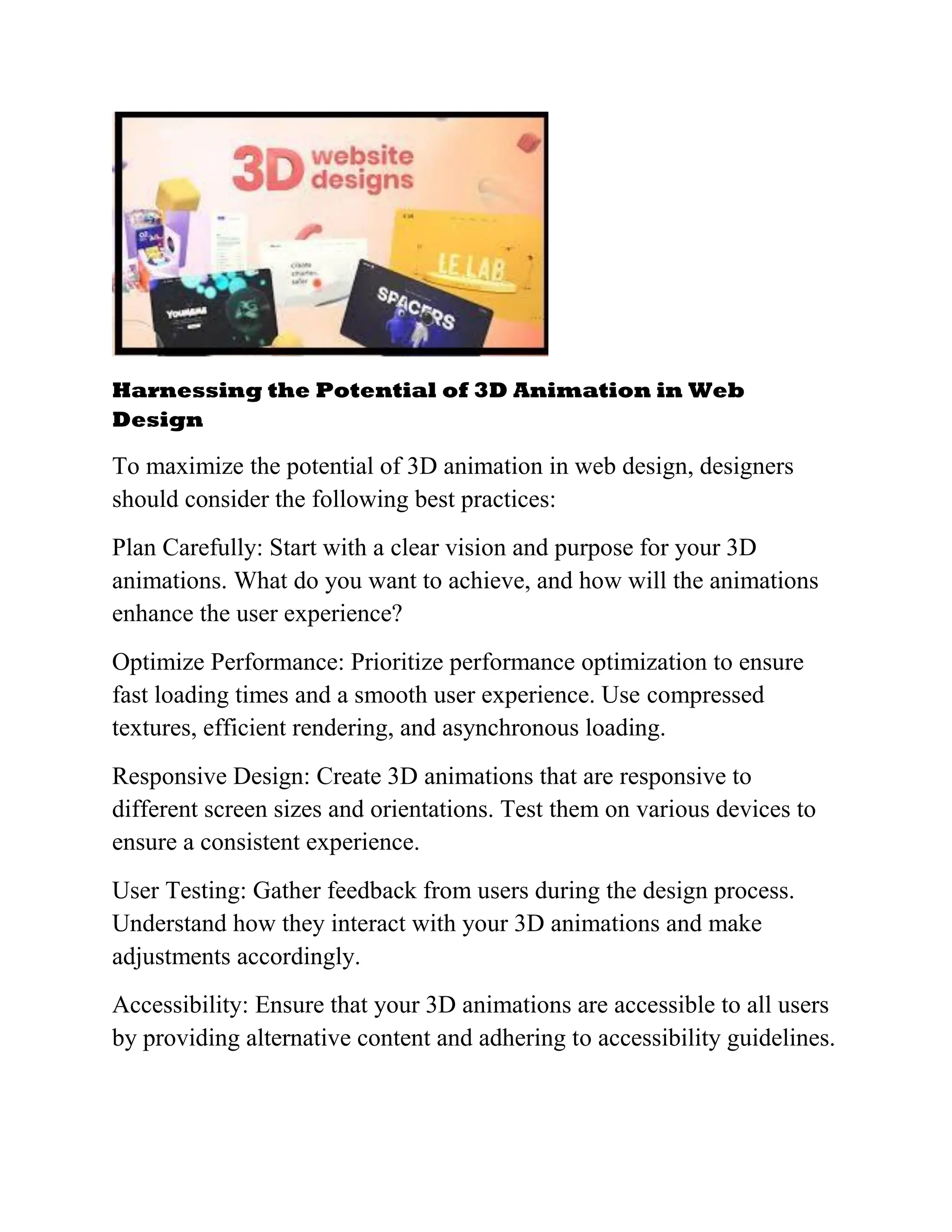
The Evolution of 3D Animation in Web Design
The journey of 3D animation in web design has been nothing short of
remarkable. It began as a novelty, with simple spinning logos and basic
animations, and has 3D Animation Web Designs evolved into a
sophisticated and integral part of modern web development. The
inception of technologies like WebGL and CSS3D has empowered
designers to seamlessly integrate 3D animations into web projects.
In the early days, 3D animations were primarily relegated to gaming
websites and other niche applications. However, as web technologies
advanced, designers found ways to incorporate 3D elements into various
types of websites, from e-commerce platforms to personal blogs. This
transformation has been driven by a confluence of factors, including the
growing availability of powerful hardware, better browser support, and
the creative drive of designers to explore new frontiers in user
engagement.
Benefits of 3D Animation in Web Design
The adoption of 3D animation in web design has brought forth a
plethora of advantages that are difficult to ignore. These benefits
encompass both the user experience and the effectiveness of websites in
achieving their goals:
Enhanced Engagement: 3D animations captivate users by providing a
more immersive and interactive experience. Users are more likely to stay
on a website that offers engaging 3D visuals, leading to increased user
retention and decreased bounce rates.
Visual Storytelling: 3D animations allow web designers to tell
compelling stories through visuals. Complex concepts and narratives can
be simplified and made more engaging, ensuring that users understand
and remember the content.
Product Showcase: E-commerce websites can leverage 3D animations to
showcase their products from every angle, giving customers a more
detailed and realistic view. This can lead to increased sales and customer
satisfaction.
Improved User Interface: 3D animations can be used to create intuitive
and visually pleasing user interfaces. They can guide users through a
website and help them find the information or products they seek more
easily.
Brand Identity: Unique and creative 3D animations can help establish a
strong brand identity. They make a website memorable and distinguish it
from the competition.
Cross-Platform Compatibility: With technologies like WebGL, 3D
animations are now compatible with a wide range of devices and
browsers, making them accessible to a broad audience.
Challenges and Considerations in 3D Animation Web
Design
While the potential benefits of 3D animation in web design are enticing,
there are challenges and considerations that designers must navigate to
harness this technology effectively:
Performance: High-quality 3D animations can be resource-intensive and
may slow down websites if not optimized properly. Striking the right
balance between performance and visual appeal is crucial.
Compatibility: Although 3D technologies have come a long way, not all
browsers and devices support them equally. Designers must consider
compatibility and provide fallback options for users on less capable
platforms.
Loading Times: 3D animations can increase loading times, which can
frustrate users. Optimizing assets and employing progressive loading
techniques can mitigate this issue.
User Experience: While 3D animations can enhance the user experience,
they must be used judiciously. Overly complex or distracting animations
can have the opposite effect and drive users away.
Accessibility: Accessibility is a critical consideration. Designers must
ensure that 3D animations do not exclude users with disabilities and
should provide alternative content or experiences.
Learning Curve: Implementing 3D animations requires a learning curve.
Designers and developers may need to acquire new skills to create and
integrate 3D elements effectively.
Harnessing the Potential of 3D Animation in Web
Design
To maximize the potential of 3D animation in web design, designers
should consider the following best practices:
Plan Carefully: Start with a clear vision and purpose for your 3D
animations. What do you want to achieve, and how will the animations
enhance the user experience?
Optimize Performance: Prioritize performance optimization to ensure
fast loading times and a smooth user experience. Use compressed
textures, efficient rendering, and asynchronous loading.
Responsive Design: Create 3D animations that are responsive to
different screen sizes and orientations. Test them on various devices to
ensure a consistent experience.
User Testing: Gather feedback from users during the design process.
Understand how they interact with your 3D animations and make
adjustments accordingly.
Accessibility: Ensure that your 3D animations are accessible to all users
by providing alternative content and adhering to accessibility guidelines.
Engage Users Meaningfully: Use 3D animations to enhance storytelling
and engagement, but avoid unnecessary complexity or distractions.
Stay Informed: Keep up with the latest developments in web
technologies and 3D animation tools. The field is continually evolving,
and staying informed is key to staying competitive.
In conclusion, 3D animation web designs have come a long way from
their inception, and they offer a wide range of benefits for web designers
and users alike. With careful planning, performance optimization, and a
commitment to user accessibility, designers can create captivating and
effective websites that leverage the full potential of 3D animations. As
technology continues to advance, the possibilities for 3D animation in
web design are limitless, making it an exciting and enduring trend in the
ever-evolving landscape of web development.
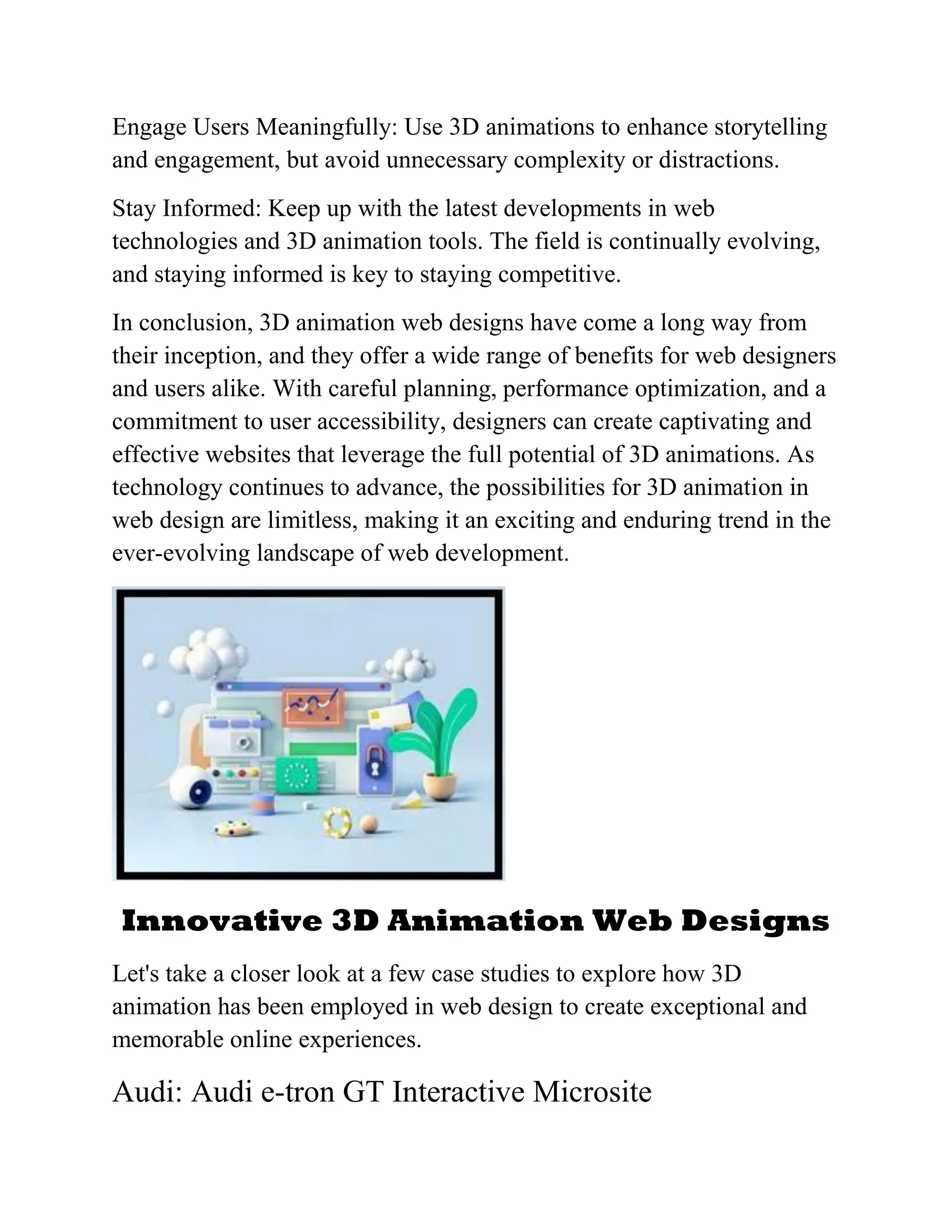
Innovative 3D Animation Web Designs
Let's take a closer look at a few case studies to explore how 3D
animation has been employed in web design to create exceptional and
memorable online experiences.
Audi: Audi e-tron GT Interactive Microsite
Audi, a renowned automobile manufacturer, utilized 3D animation in its
e-tron GT microsite to provide an immersive experience for potential
buyers. The microsite features a detailed 3D model of the e-tron GT,
allowing users to explore the car from different angles. Users can
interact with the vehicle's features, such as opening and closing doors
and adjusting the lighting. This interactive 3D model not only engages
users but also educates them about the car's design and features. It's a
prime example of how 3D animation can be used to showcase a product
in an engaging and informative way.
NASA: Experience Mars in 3D
NASA's "Experience Mars in 3D" website offers visitors a virtual tour of
the Martian landscape. By integrating 3D animations, users can explore
Mars as if they were there in person. They can navigate the Martian
terrain, visit famous landmarks, and learn about the various missions to
the Red Planet. This educational and visually stunning experience
demonstrates how 3D animation can be employed forscientific outreach,
making complex information accessible and engaging.
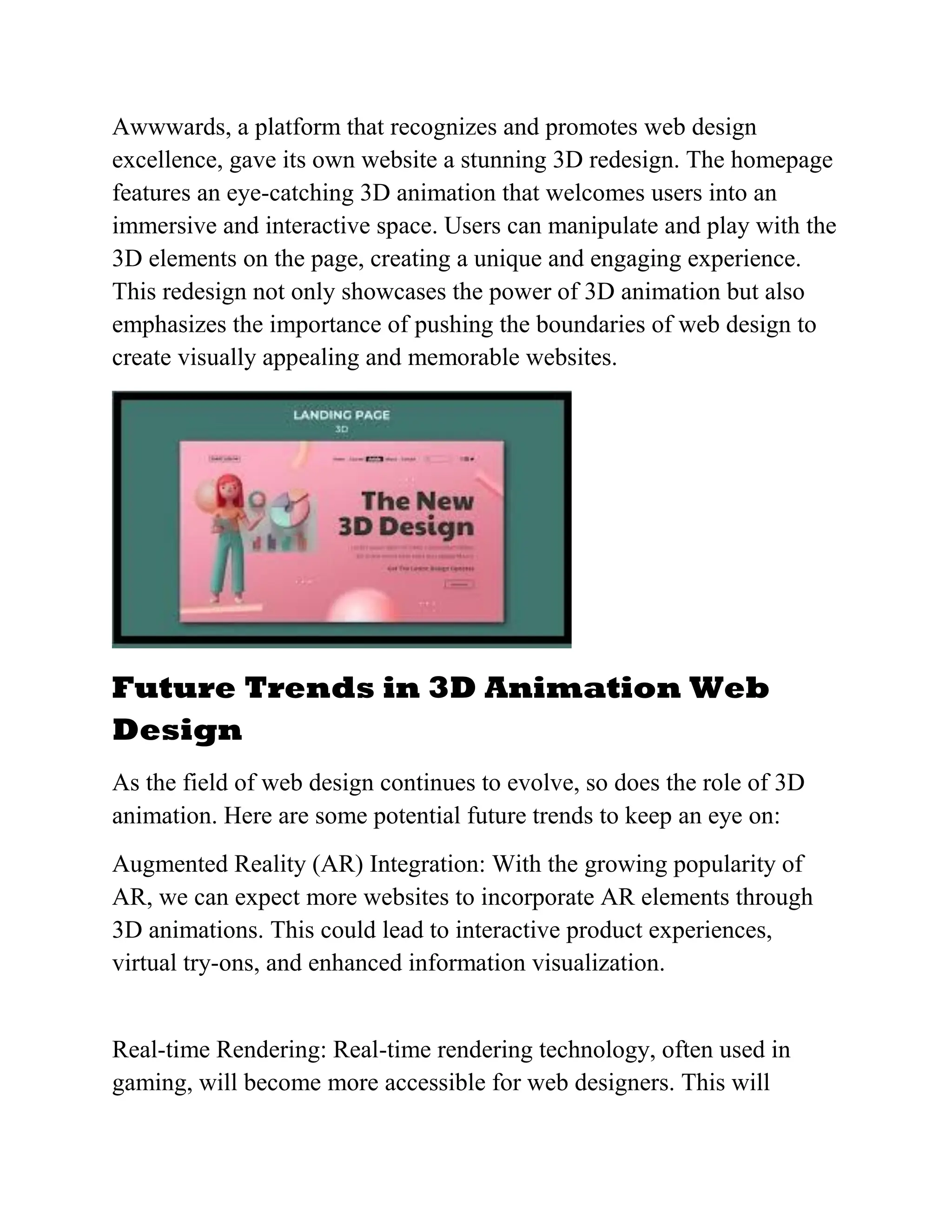
Awwwards: Awwwards 3D Website
Redesign
Awwwards, a platform that recognizes and promotes web design
excellence, gave its own website a stunning 3D redesign. The homepage
features an eye-catching 3D animation that welcomes users into an
immersive and interactive space. Users can manipulate and play with the
3D elements on the page, creating a unique and engaging experience.
This redesign not only showcases the power of 3D animation but also
emphasizes the importance of pushing the boundaries of web design to
create visually appealing and memorable websites.
Future Trends in 3D Animation Web
Design
As the field of web design continues to evolve, so does the role of 3D
animation. Here are some potential future trends to keep an eye on:
Augmented Reality (AR) Integration: With the growing popularity of
AR, we can expect more websites to incorporate AR elements through
3D animations. This could lead to interactive product experiences,
virtual try-ons, and enhanced information visualization.
Real-time Rendering: Real-time rendering technology, often used in
gaming, will become more accessible for web designers. This will
enable websites to deliver high-quality 3D animations without
sacrificing performance.
WebXR: The development of WebXR, an API for virtual and
augmented reality on the web, will open up new possibilities for
immersive 3D web experiences. Users will be able to explore websites
in a more immersive and interactive manner.
AI-Driven Animations: Artificial intelligence can enhance the
capabilities of 3D animations by generating dynamic and responsive
content based on user behavior and preferences. This will result in more
personalized and engaging web experiences.
Immersive E-commerce: E-commerce websites will leverage 3D
animations to create virtual showrooms, allowing customers to virtually
interact with products before making a purchase. This can enhance the
online shopping experience and reduce return rates.
Collaborative Design Environments: As 3D animation tools become
more collaborative, web design teams will be able to work together in
real-time to create intricate 3D elements for websites. This can
streamline the design process and lead to more innovative designs.
Conclusion
In the realm of web design, 3D animation has emerged as a
transformative force, offering designers the tools to captivate and engage
users in unprecedented ways. The journey of 3D animation in web
design has evolved from humble beginnings to a vast realm of creativity
and potential. By carefully considering the benefits, challenges, and best
practices, designers can harness the power of 3D animations to create
visually stunning, interactive, and memorable websites.
The future of 3D animation in web design is exciting, with the potential
for augmented reality, real-time rendering, AI-driven animations, and
immersive e-commerce experiences. As technology continues to
advance, web designers have an ever-expanding toolkit to create
websites that push the boundaries of creativity and user engagement. In
this dynamic landscape, 3D animation is a key player, promising a bright
future for the world of web design.
3D Animation in Web Design: Overcoming
Technical Challenges
While the utilization of 3D animations in web design has expanded, it's
essential to address the technical challenges that designers face in this
domain. The following are key hurdles and solutions:
Loading Speed Optimization: High-quality 3D animations, particularly
those involving complex models and textures, can increase loading
times. This challenge can be mitigated through efficient compression of
3D assets and textures. Implementing a progressive loading approach,
where essential elements load first and the rest follow, can ensure a
smoother user experience.
Performance Optimization: To maintain smooth interactions, designers
must prioritize performance optimization. This includes optimizing
rendering techniques and leveraging hardware acceleration through
WebGL. Techniques like culling, LOD (Level of Detail), and smart asset
management can significantly enhance the performance of 3D
animations.
Cross-Browser Compatibility: While 3D technologies like WebGL have
become widely supported, cross-browser compatibility remains a
challenge. Designers must be prepared to provide fallback options for
users accessing the website through browsers or devices that lack 3D
support. This can be achieved by offering 2D alternatives or simplified
representations.
Accessibility and Usability: Ensuring that 3D animations are accessible
to all users is crucial. This involves adhering to web accessibility
standards (e.g., WCAG) and providing alternative content for users with
disabilities. Designers should also be cautious not to overload the
website with excessive 3D elements, as this can overwhelm and confuse
users.
Mobile Responsiveness: As the majority of web traffic comes from
mobile devices, ensuring that 3D animations are responsive is
imperative. This means that animations should adapt to various screen
sizes and orientations. Testing across a range of devices and screen
resolutions is essential to ensure a consistent user experience.
Content Management and Updates: Maintaining a website with intricate
3D animations can be challenging, especially when updates or
modifications are required. Implementing content management systems
(CMS) tailored to 3D content or employing a modular approach to
animation assets can streamline the process.
Innovative Uses of 3D Animation in Web Design
Let's explore some innovative applications of 3D animation in web
design that have redefined user experiences:
Immersive Storytelling: Interactive storytelling experiences have
emerged, where users navigate through 3D-rendered worlds while
uncovering narratives. These experiences combine elements of gaming
and cinematic storytelling, creating a captivating and memorable user
journey.
Architectural Visualization: The architectural industry has embraced 3D
animation to present building designs and urban planning in a highly
immersive manner. Users can explore the interior and exterior of
buildings, experience different lighting conditions, and understand the
design's functionality.
Virtual Museums and Exhibits: Cultural institutions and museums have
adopted 3D animations to bring art and historical artifacts to life online.
Users can explore exhibitions and view artworks from various angles,
enhancing their engagement with the content.
Product Configurators: E-commerce websites are increasingly
incorporating 3D product configurators. These tools enable users to
customize products by changing colors, features, and accessories in real-
time, providing a more engaging and informative shopping experience.
Educational Simulations: In the field of education, 3D animations are
used to create interactive simulations. Students can engage with complex
scientific concepts, conduct virtual experiments, and explore historical
events, making learning more engaging and effective.
Challenges for the Future
As 3D animation in web design continues to evolve, new challenges and
considerations are bound to emerge. Here are some potential hurdles for
the future:
Data Privacy and Security: The collection of user data for personalized
3D experiences will raise concerns about data privacy and security.
Designers will need to navigate these issues while delivering
personalized and engaging experiences.
Bandwidth and Connectivity: The increasing complexity of 3D
animations may demand higher bandwidth and robust connectivity. As
web design trends toward more immersive experiences, ensuring access
for users with limited internet connections becomes a critical challenge.
Environmental Impact: Rendering complex 3D animations can be
resource-intensive and energy-consuming. As environmental concerns
grow, designers may need to consider the environmental impact of their
animations and explore more energy-efficient solutions.
Interactivity and User Control: Users will expect greater interactivity
and control over 3D elements. This may involve real-time interactions,
customization options, and more responsive user interfaces.
Standards and Guidelines: As the field expands, standards and
guidelines for 3D animations in web design will need to be refined and
adapted to ensure a consistent and accessible user experience.
In conclusion, the incorporation of 3D animations in web design is an
exciting journey marked by innovation, creativity, and technical
challenges. By addressing these challenges and staying attuned to
emerging trends and technologies, designers can continue to push the
boundaries of web design, creating engaging and memorable online
experiences that captivate and delight users. The future of 3D animation
in web design is promising, offering the potential for even more
immersive, interactive, and visually stunning digital experiences.
Summary
A website may stand out and fit more information into less space with
the help of 3D animations, which can also be fun and surprising. Here
are some incredible instances of 3D animation used in site design that
successfully grab users' attention while providing them with information
and entertainment.
FAQs
The condition of your business can be significantly improved by using
3D character and product models. Perhaps you are having trouble
growing your internet business because of improper product
presentations. Or, if you are a director or producer of a movie, you
should incorporate 3D effects and characters in your movie to grab the
audience's attention. Do you find yourself thinking a lot about 3D
modeling and having a lot of questions? If so, read the article and get
some ideas for an overview of 3D modeling services. We expect that
you will have a clear understanding of how you will communicate with
the 3D artists, the tools they use to create models, and the overall
working process.
Contact US
• Website: https://seoexpate.com
• Email: info@seoexpate.com
• WhatsApp: +8801758300772
• Address: Head Office Shajapur Kagji para, Majhira,
Shajahanpur 5801, Bogura, Banlgladesh

Creating a 3D Animation Web Design Wonderland

  • 1.
    Creating a 3DAnimation Web Design Wonderland In the dynamic world of web design, staying ahead of the curve is essential to capture and retain the attention of today's increasingly discerning online audience. One of the most exciting and innovative trends in this realm is the integration of 3D animation into web design. This captivating fusion of technology and artistry has opened up a world of possibilities for designers, providing the means to engage users in a whole new way. In this 6000-word exploration, we will delve into the realm of 3D animation web designs, examining their evolution, benefits, challenges, and providing insights into how to harness their potential to create immersive and unforgettable online experiences. The Evolution of 3D Animation in Web Design
  • 2.
    The journey of3D animation in web design has been nothing short of remarkable. It began as a novelty, with simple spinning logos and basic animations, and has 3D Animation Web Designs evolved into a sophisticated and integral part of modern web development. The inception of technologies like WebGL and CSS3D has empowered designers to seamlessly integrate 3D animations into web projects. In the early days, 3D animations were primarily relegated to gaming websites and other niche applications. However, as web technologies advanced, designers found ways to incorporate 3D elements into various types of websites, from e-commerce platforms to personal blogs. This transformation has been driven by a confluence of factors, including the growing availability of powerful hardware, better browser support, and the creative drive of designers to explore new frontiers in user engagement. Benefits of 3D Animation in Web Design The adoption of 3D animation in web design has brought forth a plethora of advantages that are difficult to ignore. These benefits encompass both the user experience and the effectiveness of websites in achieving their goals: Enhanced Engagement: 3D animations captivate users by providing a more immersive and interactive experience. Users are more likely to stay on a website that offers engaging 3D visuals, leading to increased user retention and decreased bounce rates. Visual Storytelling: 3D animations allow web designers to tell compelling stories through visuals. Complex concepts and narratives can be simplified and made more engaging, ensuring that users understand and remember the content.
  • 3.
    Product Showcase: E-commercewebsites can leverage 3D animations to showcase their products from every angle, giving customers a more detailed and realistic view. This can lead to increased sales and customer satisfaction. Improved User Interface: 3D animations can be used to create intuitive and visually pleasing user interfaces. They can guide users through a website and help them find the information or products they seek more easily. Brand Identity: Unique and creative 3D animations can help establish a strong brand identity. They make a website memorable and distinguish it from the competition. Cross-Platform Compatibility: With technologies like WebGL, 3D animations are now compatible with a wide range of devices and browsers, making them accessible to a broad audience. Challenges and Considerations in 3D Animation Web Design
  • 4.
    While the potentialbenefits of 3D animation in web design are enticing, there are challenges and considerations that designers must navigate to harness this technology effectively: Performance: High-quality 3D animations can be resource-intensive and may slow down websites if not optimized properly. Striking the right balance between performance and visual appeal is crucial. Compatibility: Although 3D technologies have come a long way, not all browsers and devices support them equally. Designers must consider compatibility and provide fallback options for users on less capable platforms. Loading Times: 3D animations can increase loading times, which can frustrate users. Optimizing assets and employing progressive loading techniques can mitigate this issue. User Experience: While 3D animations can enhance the user experience, they must be used judiciously. Overly complex or distracting animations can have the opposite effect and drive users away. Accessibility: Accessibility is a critical consideration. Designers must ensure that 3D animations do not exclude users with disabilities and should provide alternative content or experiences. Learning Curve: Implementing 3D animations requires a learning curve. Designers and developers may need to acquire new skills to create and integrate 3D elements effectively.
  • 5.
    Harnessing the Potentialof 3D Animation in Web Design To maximize the potential of 3D animation in web design, designers should consider the following best practices: Plan Carefully: Start with a clear vision and purpose for your 3D animations. What do you want to achieve, and how will the animations enhance the user experience? Optimize Performance: Prioritize performance optimization to ensure fast loading times and a smooth user experience. Use compressed textures, efficient rendering, and asynchronous loading. Responsive Design: Create 3D animations that are responsive to different screen sizes and orientations. Test them on various devices to ensure a consistent experience. User Testing: Gather feedback from users during the design process. Understand how they interact with your 3D animations and make adjustments accordingly. Accessibility: Ensure that your 3D animations are accessible to all users by providing alternative content and adhering to accessibility guidelines.
  • 6.
    Engage Users Meaningfully:Use 3D animations to enhance storytelling and engagement, but avoid unnecessary complexity or distractions. Stay Informed: Keep up with the latest developments in web technologies and 3D animation tools. The field is continually evolving, and staying informed is key to staying competitive. In conclusion, 3D animation web designs have come a long way from their inception, and they offer a wide range of benefits for web designers and users alike. With careful planning, performance optimization, and a commitment to user accessibility, designers can create captivating and effective websites that leverage the full potential of 3D animations. As technology continues to advance, the possibilities for 3D animation in web design are limitless, making it an exciting and enduring trend in the ever-evolving landscape of web development. Innovative 3D Animation Web Designs Let's take a closer look at a few case studies to explore how 3D animation has been employed in web design to create exceptional and memorable online experiences. Audi: Audi e-tron GT Interactive Microsite
  • 7.
    Audi, a renownedautomobile manufacturer, utilized 3D animation in its e-tron GT microsite to provide an immersive experience for potential buyers. The microsite features a detailed 3D model of the e-tron GT, allowing users to explore the car from different angles. Users can interact with the vehicle's features, such as opening and closing doors and adjusting the lighting. This interactive 3D model not only engages users but also educates them about the car's design and features. It's a prime example of how 3D animation can be used to showcase a product in an engaging and informative way. NASA: Experience Mars in 3D NASA's "Experience Mars in 3D" website offers visitors a virtual tour of the Martian landscape. By integrating 3D animations, users can explore Mars as if they were there in person. They can navigate the Martian terrain, visit famous landmarks, and learn about the various missions to the Red Planet. This educational and visually stunning experience demonstrates how 3D animation can be employed forscientific outreach, making complex information accessible and engaging. Awwwards: Awwwards 3D Website Redesign
  • 8.
    Awwwards, a platformthat recognizes and promotes web design excellence, gave its own website a stunning 3D redesign. The homepage features an eye-catching 3D animation that welcomes users into an immersive and interactive space. Users can manipulate and play with the 3D elements on the page, creating a unique and engaging experience. This redesign not only showcases the power of 3D animation but also emphasizes the importance of pushing the boundaries of web design to create visually appealing and memorable websites. Future Trends in 3D Animation Web Design As the field of web design continues to evolve, so does the role of 3D animation. Here are some potential future trends to keep an eye on: Augmented Reality (AR) Integration: With the growing popularity of AR, we can expect more websites to incorporate AR elements through 3D animations. This could lead to interactive product experiences, virtual try-ons, and enhanced information visualization. Real-time Rendering: Real-time rendering technology, often used in gaming, will become more accessible for web designers. This will
  • 9.
    enable websites todeliver high-quality 3D animations without sacrificing performance. WebXR: The development of WebXR, an API for virtual and augmented reality on the web, will open up new possibilities for immersive 3D web experiences. Users will be able to explore websites in a more immersive and interactive manner. AI-Driven Animations: Artificial intelligence can enhance the capabilities of 3D animations by generating dynamic and responsive content based on user behavior and preferences. This will result in more personalized and engaging web experiences. Immersive E-commerce: E-commerce websites will leverage 3D animations to create virtual showrooms, allowing customers to virtually interact with products before making a purchase. This can enhance the online shopping experience and reduce return rates. Collaborative Design Environments: As 3D animation tools become more collaborative, web design teams will be able to work together in real-time to create intricate 3D elements for websites. This can streamline the design process and lead to more innovative designs.
  • 10.
    Conclusion In the realmof web design, 3D animation has emerged as a transformative force, offering designers the tools to captivate and engage users in unprecedented ways. The journey of 3D animation in web design has evolved from humble beginnings to a vast realm of creativity and potential. By carefully considering the benefits, challenges, and best practices, designers can harness the power of 3D animations to create visually stunning, interactive, and memorable websites. The future of 3D animation in web design is exciting, with the potential for augmented reality, real-time rendering, AI-driven animations, and immersive e-commerce experiences. As technology continues to advance, web designers have an ever-expanding toolkit to create websites that push the boundaries of creativity and user engagement. In this dynamic landscape, 3D animation is a key player, promising a bright future for the world of web design. 3D Animation in Web Design: Overcoming Technical Challenges
  • 11.
    While the utilizationof 3D animations in web design has expanded, it's essential to address the technical challenges that designers face in this domain. The following are key hurdles and solutions: Loading Speed Optimization: High-quality 3D animations, particularly those involving complex models and textures, can increase loading times. This challenge can be mitigated through efficient compression of 3D assets and textures. Implementing a progressive loading approach, where essential elements load first and the rest follow, can ensure a smoother user experience. Performance Optimization: To maintain smooth interactions, designers must prioritize performance optimization. This includes optimizing rendering techniques and leveraging hardware acceleration through WebGL. Techniques like culling, LOD (Level of Detail), and smart asset management can significantly enhance the performance of 3D animations. Cross-Browser Compatibility: While 3D technologies like WebGL have become widely supported, cross-browser compatibility remains a challenge. Designers must be prepared to provide fallback options for users accessing the website through browsers or devices that lack 3D support. This can be achieved by offering 2D alternatives or simplified representations. Accessibility and Usability: Ensuring that 3D animations are accessible to all users is crucial. This involves adhering to web accessibility standards (e.g., WCAG) and providing alternative content for users with disabilities. Designers should also be cautious not to overload the website with excessive 3D elements, as this can overwhelm and confuse users.
  • 12.
    Mobile Responsiveness: Asthe majority of web traffic comes from mobile devices, ensuring that 3D animations are responsive is imperative. This means that animations should adapt to various screen sizes and orientations. Testing across a range of devices and screen resolutions is essential to ensure a consistent user experience. Content Management and Updates: Maintaining a website with intricate 3D animations can be challenging, especially when updates or modifications are required. Implementing content management systems (CMS) tailored to 3D content or employing a modular approach to animation assets can streamline the process. Innovative Uses of 3D Animation in Web Design Let's explore some innovative applications of 3D animation in web design that have redefined user experiences: Immersive Storytelling: Interactive storytelling experiences have emerged, where users navigate through 3D-rendered worlds while uncovering narratives. These experiences combine elements of gaming and cinematic storytelling, creating a captivating and memorable user journey.
  • 13.
    Architectural Visualization: Thearchitectural industry has embraced 3D animation to present building designs and urban planning in a highly immersive manner. Users can explore the interior and exterior of buildings, experience different lighting conditions, and understand the design's functionality. Virtual Museums and Exhibits: Cultural institutions and museums have adopted 3D animations to bring art and historical artifacts to life online. Users can explore exhibitions and view artworks from various angles, enhancing their engagement with the content. Product Configurators: E-commerce websites are increasingly incorporating 3D product configurators. These tools enable users to customize products by changing colors, features, and accessories in real- time, providing a more engaging and informative shopping experience. Educational Simulations: In the field of education, 3D animations are used to create interactive simulations. Students can engage with complex scientific concepts, conduct virtual experiments, and explore historical events, making learning more engaging and effective. Challenges for the Future
  • 14.
    As 3D animationin web design continues to evolve, new challenges and considerations are bound to emerge. Here are some potential hurdles for the future: Data Privacy and Security: The collection of user data for personalized 3D experiences will raise concerns about data privacy and security. Designers will need to navigate these issues while delivering personalized and engaging experiences. Bandwidth and Connectivity: The increasing complexity of 3D animations may demand higher bandwidth and robust connectivity. As web design trends toward more immersive experiences, ensuring access for users with limited internet connections becomes a critical challenge. Environmental Impact: Rendering complex 3D animations can be resource-intensive and energy-consuming. As environmental concerns grow, designers may need to consider the environmental impact of their animations and explore more energy-efficient solutions. Interactivity and User Control: Users will expect greater interactivity and control over 3D elements. This may involve real-time interactions, customization options, and more responsive user interfaces. Standards and Guidelines: As the field expands, standards and guidelines for 3D animations in web design will need to be refined and adapted to ensure a consistent and accessible user experience. In conclusion, the incorporation of 3D animations in web design is an exciting journey marked by innovation, creativity, and technical challenges. By addressing these challenges and staying attuned to emerging trends and technologies, designers can continue to push the boundaries of web design, creating engaging and memorable online experiences that captivate and delight users. The future of 3D animation
  • 15.
    in web designis promising, offering the potential for even more immersive, interactive, and visually stunning digital experiences. Summary A website may stand out and fit more information into less space with the help of 3D animations, which can also be fun and surprising. Here are some incredible instances of 3D animation used in site design that successfully grab users' attention while providing them with information and entertainment. FAQs The condition of your business can be significantly improved by using 3D character and product models. Perhaps you are having trouble growing your internet business because of improper product presentations. Or, if you are a director or producer of a movie, you should incorporate 3D effects and characters in your movie to grab the audience's attention. Do you find yourself thinking a lot about 3D modeling and having a lot of questions? If so, read the article and get some ideas for an overview of 3D modeling services. We expect that
  • 16.
    you will havea clear understanding of how you will communicate with the 3D artists, the tools they use to create models, and the overall working process. Contact US • Website: https://seoexpate.com • Email: info@seoexpate.com • WhatsApp: +8801758300772 • Address: Head Office Shajapur Kagji para, Majhira, Shajahanpur 5801, Bogura, Banlgladesh