Blue
Found frequently in nature, shades that aren’t overly dark have a calming
effect that enhances the ability to focus, stimulating intellectual abilities.
Green
A shade that’s not too intense also will be calming, and generate a
sense of well-being — conducive for boosting those who work long hours.
Red
Used sparingly, its intensity inspires passion and increases heart rate —
useful for when a job calls for physical activity.
Yellow
An artistic delight, it inspires
innovation and creativity while
raising levels of self-esteem
and optimism.
Color
Note: Use multiple colors, some on
accent walls, but note that too much
contrast can lead to eyestrain.
Modular workstation layout. Space is divided with partitions or furnishings
into work areas for individual employees. Provides a fully functioning area
for each employee, with a desk and storage, and many employees are more
productive operating with at least some privacy.
Open plan layout. The lack of
seclusion discourages slacking
off but also can make employees
uneasy. At the same time, this
layout promotes communication
and teamwork — but discussions
often could be superficial because
of concern over eavesdropping. A
noisier environment is a given as
a tradeoff.
Traditional closed office layout.
The presence of private and
perhaps plush offices gives
employees a status to which
they can aspire. Also defines
the organizational hierarchy and
structure, albeit at the potential
cost of not fostering easy
communication.
Dim, artificial lighting and
fluorescent lighting can lead to
eyestrain, resulting in headaches,
while also promoting drowsiness.
There’s literally a window of
opportunity here: Studies show
that renovations incorporating
natural lighting result in
productivity increases. Natural light
allows us to see better and is a
mood enhancer, creating happier
workers and less absenteeism.
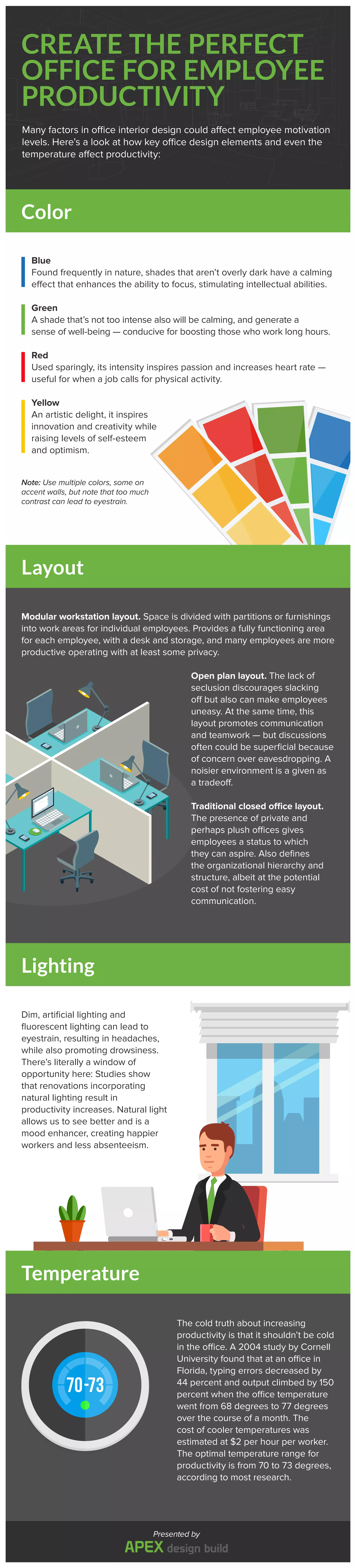
Many factors in office interior design could affect employee motivation
levels. Here’s a look at how key office design elements and even the
temperature affect productivity:
CREATE THE PERFECT
OFFICE FOR EMPLOYEE
PRODUCTIVITY
Lighting
Temperature
The cold truth about increasing
productivity is that it shouldn’t be cold
in the office. A 2004 study by Cornell
University found that at an office in
Florida, typing errors decreased by
44 percent and output climbed by 150
percent when the office temperature
went from 68 degrees to 77 degrees
over the course of a month. The
cost of cooler temperatures was
estimated at $2 per hour per worker.
The optimal temperature range for
productivity is from 70 to 73 degrees,
according to most research.
Layout
Presented by
70-73

Create The Perfect Office For Employee Productivity

  • 1.
    Blue Found frequently innature, shades that aren’t overly dark have a calming effect that enhances the ability to focus, stimulating intellectual abilities. Green A shade that’s not too intense also will be calming, and generate a sense of well-being — conducive for boosting those who work long hours. Red Used sparingly, its intensity inspires passion and increases heart rate — useful for when a job calls for physical activity. Yellow An artistic delight, it inspires innovation and creativity while raising levels of self-esteem and optimism. Color Note: Use multiple colors, some on accent walls, but note that too much contrast can lead to eyestrain. Modular workstation layout. Space is divided with partitions or furnishings into work areas for individual employees. Provides a fully functioning area for each employee, with a desk and storage, and many employees are more productive operating with at least some privacy. Open plan layout. The lack of seclusion discourages slacking off but also can make employees uneasy. At the same time, this layout promotes communication and teamwork — but discussions often could be superficial because of concern over eavesdropping. A noisier environment is a given as a tradeoff. Traditional closed office layout. The presence of private and perhaps plush offices gives employees a status to which they can aspire. Also defines the organizational hierarchy and structure, albeit at the potential cost of not fostering easy communication. Dim, artificial lighting and fluorescent lighting can lead to eyestrain, resulting in headaches, while also promoting drowsiness. There’s literally a window of opportunity here: Studies show that renovations incorporating natural lighting result in productivity increases. Natural light allows us to see better and is a mood enhancer, creating happier workers and less absenteeism. Many factors in office interior design could affect employee motivation levels. Here’s a look at how key office design elements and even the temperature affect productivity: CREATE THE PERFECT OFFICE FOR EMPLOYEE PRODUCTIVITY Lighting Temperature The cold truth about increasing productivity is that it shouldn’t be cold in the office. A 2004 study by Cornell University found that at an office in Florida, typing errors decreased by 44 percent and output climbed by 150 percent when the office temperature went from 68 degrees to 77 degrees over the course of a month. The cost of cooler temperatures was estimated at $2 per hour per worker. The optimal temperature range for productivity is from 70 to 73 degrees, according to most research. Layout Presented by 70-73