1/11
Create Custom LLMs for Your Enterprise: Step-by-Step
solulab.com/how-to-create-custom-llms-for-your-enterprise
Over the past few years, generative AI has drawn the public’s interest and imagination.
Given a natural language cue, these generative models may produce human-quality
outputs, such as well-written children’s stories or visuals of product prototypes.
Central to this transformation are large language models (LLMs). LLMs are general-
purpose language comprehenders that encode human knowledge and are easily
applicable to a wide range of natural and programming language comprehension
applications. These consist of summarizing, translating, responding to inquiries, and
annotating and finishing code. Currently, as per the latest report, approximately 67% of
organizations have integrated LLMs into their workflows, yet only 23% have deployed
commercial models in production, indicating a significant opportunity for growth in
enterprise-specific applications.
Creating a unique Large Language Model (LLM) may appear to be a challenge for
experts with large funds and extensive computational resources. However, with the
democratization of AI technology and the wide range of open-source tools and platforms,
businesses and even individual developers can now engage in this journey. According to
a recent poll, nearly half of organizations anticipate growing their AI spending by more
than 25% this year, with 88% already investing in generative AI. This blog post will walk
you through the processes necessary to develop your own bespoke LLM, with a focus on
practical guidance and real-world examples.
What are Large Language Models (LLMs)?
2/11
Large Language Models (LLMs) are advanced AI systems trained on extensive datasets
of text to understand, generate, and process human language with remarkable accuracy.
These models, often based on architectures like GPT (Generative Pre-trained
Transformer) or BERT (Bidirectional Encoder Representations from Transformers), excel
in tasks such as text generation, sentiment analysis, summarization, translation, and
conversational AI.
For enterprises, the potential of LLMs goes beyond general-purpose applications.
Enterprise LLMs are tailored to address specific business needs, utilizing domain-specific
data to provide highly accurate, context-aware solutions. This customization enables
organizations to optimize customer service, enhance operational efficiency, and unlock
new avenues for innovation.
LLMs in enterprise environments are transforming industries by automating routine tasks,
generating actionable insights from unstructured data, and enabling advanced
personalization in marketing and customer interactions. From financial services and
healthcare to retail and logistics, large language models enterprise solutions are
becoming a cornerstone of digital transformation strategies.
Incorporating enterprise LLMs allows businesses to maintain a competitive edge by
utilizing AI that is not only powerful but also adaptable to their unique challenges and
objectives. These models are paving the way for smarter decision-making, reduced
operational costs, and enriched customer experiences, making them a vital tool for
modern enterprises.
General-Purpose LLMs vs. Custom Enterprise LLMs
When considering Enterprise AI solutions, businesses often face a choice between
utilizing general-purpose Large Language Models (LLMs) or investing in custom
Enterprise LLMs. Both options have their advantages, but their suitability depends on the
specific needs and goals of the enterprise.
General-Purpose LLMs
General-purpose LLMs, like GPT-4 or BERT, are pre-trained on vast datasets and
designed for a wide range of tasks, including text summarization, content generation, and
sentiment analysis. These models are versatile, easy to deploy, and well-suited for basic
language processing tasks across industries. However, they have limitations when
applied to specific enterprise scenarios. Their generalized training data can lead to
inaccuracies or irrelevant outputs in niche domains where domain-specific knowledge is
critical.
Custom Enterprise LLMs
In contrast, implementing LLMs in enterprise settings often requires customization to
achieve maximum value. Custom Enterprise LLMs are fine-tuned using domain-specific
data, enabling them to understand the unique language, terminology, and nuances of a
3/11
particular industry or business function. These models deliver higher accuracy, relevance,
and performance in tasks such as customer service, document analysis, or personalized
recommendations.
For example, a custom Enterprise LLM trained in healthcare records can provide precise
insights into patient data, while one tailored for the legal industry can process and
analyze contracts with unparalleled accuracy. This specificity is not achievable with
general-purpose models, making custom LLMs a game-changer for enterprises with
specialized needs.
Key Differences Between General-Purpose vs. Custom Enterprise
LLMs
When businesses explore LLM integration in business workflows, understanding the
distinctions between general-purpose models like ChatGPT and custom Enterprise LLMs
is crucial. Each has unique attributes suited to different use cases, from general language
understanding to specialized domain expertise. Below, we break down the key differences
to help businesses choose the right solution for their needs.
1. Generalization vs. Specialization
General-Purpose Models: General-purpose LLMs, like ChatGPT, are designed to
handle a wide variety of topics with reasonable accuracy. This makes them versatile
and capable of addressing generic tasks across industries.
Custom Enterprise LLMs: Custom models excel in specialization, trained to
master specific fields or tasks. Their focus allows for highly accurate and relevant
responses, outperforming general models in niche areas.
2. Training and Data
General-Purpose Models: These are pre-trained on extensive datasets from
diverse internet sources, giving them broad knowledge and language
understanding.
Custom Enterprise LLMs: Training custom models requires domain-specific
datasets, and the quality of this data is critical for achieving high performance in
targeted applications.
3. Implementation and Costs
General-Purpose Models: Readily available via APIs, general models like
ChatGPT are cost-effective and easy to integrate without significant infrastructure or
expertise.
Custom Enterprise LLMs: Implementing custom models involves higher initial
costs for data collection, training, and updates. This process requires skilled AI
talent and infrastructure investment.
4. Privacy and Security
4/11
General-Purpose Models: These models often operate on external servers, which
can raise concerns about data privacy and security for sensitive applications.
Custom Enterprise LLMs: Businesses can deploy custom models on private
servers or secure cloud environments, offering enhanced control over data and
compliance with industry regulations.
5. Customization and Flexibility
General-Purpose Models: Customization is limited, primarily achieved through
prompt engineering. The model’s architecture and training remain unchanged.
Custom Enterprise LLMs: These models provide unmatched flexibility, allowing
businesses to tailor the architecture, training, and datasets to meet precise
requirements, ensuring alignment with business objectives.
By understanding these key differences, businesses can strategically decide whether to
adopt a general-purpose model for quick, broad-based applications or invest in a custom
Enterprise LLM for specialized, high-impact solutions. The choice depends on the
complexity of tasks, budget considerations, and the need for privacy, accuracy, and
adaptability in specific domains.
Choosing the Right Solution
The choice between general-purpose and custom LLMs depends on the complexity of the
task and the degree of domain specificity required. General-purpose models are ideal for
quick, generic implementations, while custom Enterprise AI solutions provide long-term
value for businesses aiming to leverage AI as a strategic differentiator. By implementing
LLMs in enterprise workflows through customization, organizations can unlock their full
potential, drive innovation, and achieve unparalleled efficiency in their operations.
Use Cases of Custom LLMs
Custom Large Language Models (LLMs) are transforming industries by enabling
businesses to address specific challenges and unlock new opportunities. Unlike generic
models, custom LLM use cases are for particular sectors or tasks, offering unparalleled
accuracy and relevance. Here are some key business applications of LLMs in enterprise
environments:
1. Customer Support Automation
Custom LLMs can enhance customer service by understanding industry-specific
terminology and providing accurate responses. For example, in e-commerce, they can
handle complex queries about products or returns, while in healthcare, they can assist
patients with appointment scheduling or medical inquiries.
2. Document Analysis and Summarization
5/11
Enterprises dealing with large volumes of documents, such as contracts, reports, or legal
briefs, can use LLMs to extract critical information, summarize content, or generate
concise reports. Custom LLMs trained on domain-specific data ensure accurate and
relevant outputs, saving time and resources.
3. Personalized Marketing Campaigns
Large language models enterprise solutions are pivotal in crafting personalized marketing
messages. By analyzing customer preferences and behavior, custom LLMs can generate
targeted email campaigns, social media posts, and product recommendations that drive
engagement and conversions.
4. Risk Management and Compliance
In finance and insurance, custom LLMs can identify risks by analyzing transaction
patterns or scanning regulatory documents. They help ensure compliance by flagging
potential issues and assisting in audits with greater accuracy than manual reviews.
5. Knowledge Management
Custom LLMs streamline internal processes by organizing and retrieving enterprise
knowledge. Employees can quickly access precise information from company manuals,
policies, or technical documentation, improving productivity and decision-making.
6. Product Development and Research
Custom LLMs are invaluable for research-intensive industries like pharmaceuticals or
technology. By analyzing scientific papers, patents, or market trends, these models can
assist in identifying opportunities, improving innovation cycles, and speeding up product
development.
7. Fraud Detection
Custom LLMs can be trained to identify patterns and anomalies in data, making them
highly effective for detecting fraud in transactions, insurance claims, or cybersecurity
threats.
By utilizing business applications of LLMs, enterprises can achieve tailored, high-
performance solutions that address their unique challenges. From automating repetitive
tasks to enhancing customer interactions and decision-making, large language models
enterprise implementations are a critical step in driving innovation and operational
efficiency.
6/11
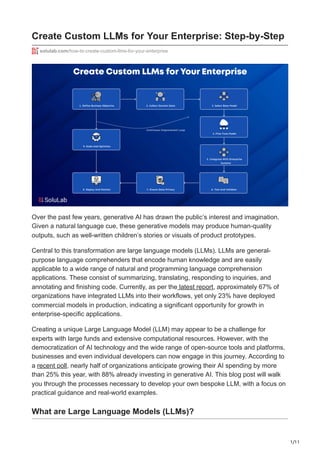
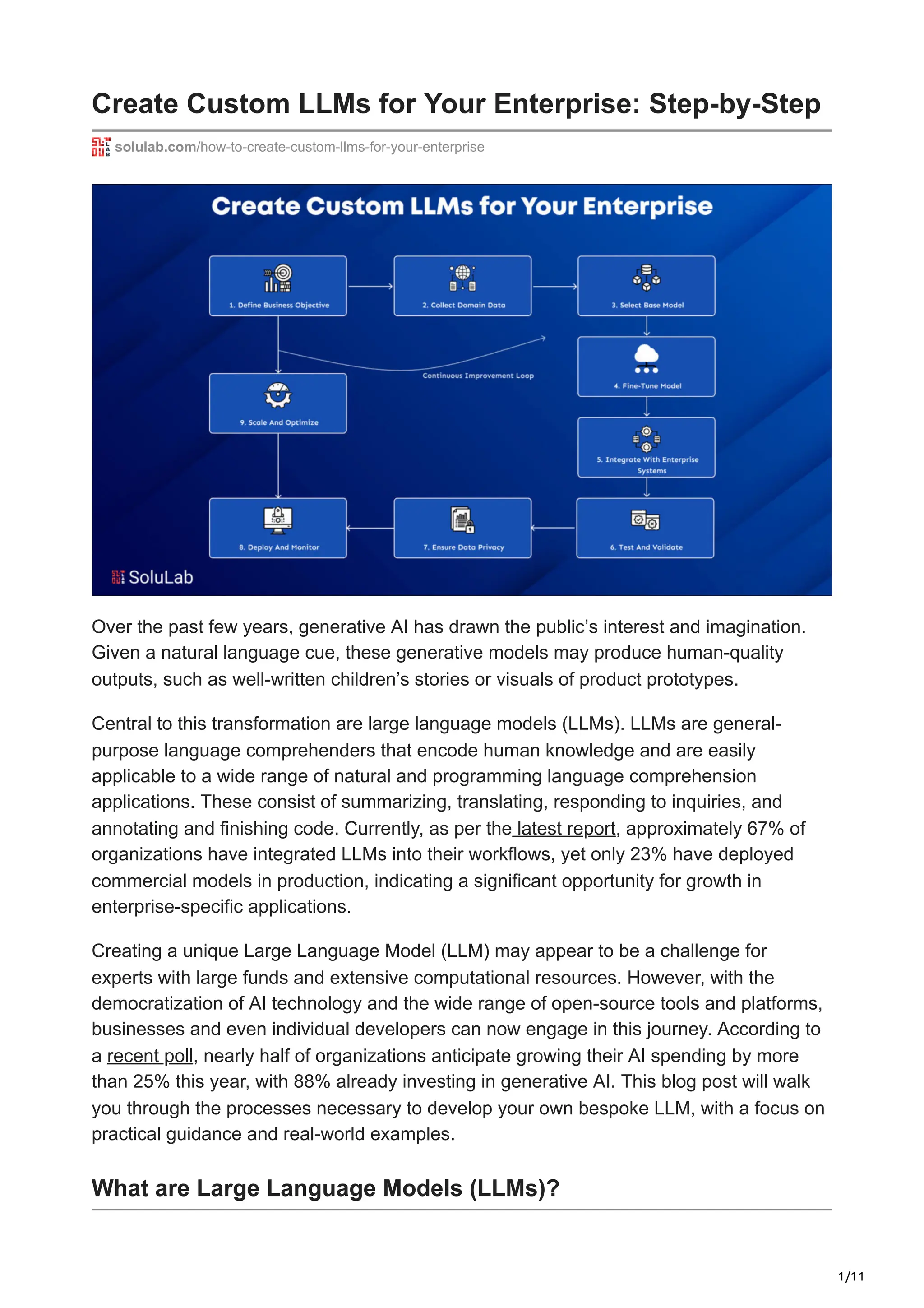
Steps for Creating a Custom Enterprise LLM
Creating a custom Large Language Model (LLM) customized to your business needs
involves a structured approach to ensure the model delivers maximum value. Custom
LLMs are pivotal in using generative AI enterprise solutions to address domain-specific
challenges, enhance operations, and provide precise insights. Below are the essential
steps to build private LLMs and implementing LLMs in enterprise workflows:
1. Define the Business Objective
Start by identifying the specific problem your enterprise needs to solve. Whether it’s
automating customer support, improving document processing, or personalizing
marketing campaigns, clear objectives will guide the development process.
2. Collect Domain-Specific Data
The effectiveness of a custom LLM depends on the quality and relevance of the training
data. Gather data specific to your industry or enterprise operations, such as technical
documents, customer interactions, or regulatory guidelines. Clean and preprocess this
data to ensure it’s ready for training.
3. Select the Base Model
Choose a pre-trained LLM as the foundation for your custom model. Popular options
include GPT, BERT, or other open-source models. These serve as a starting point,
reducing the need for extensive training from scratch.
4. Fine-Tune the Model
Fine-tuning involves training the base model on your enterprise-specific data. This step
ensures the model understands your domain’s terminology and nuances, improving its
accuracy and relevance. Techniques like Parameter-Efficient Fine-Tuning (PEFT) can
optimize this process.
5. Integrate with Enterprise Systems
After fine-tuning, integrate the custom LLM into your enterprise applications. Use APIs or
middleware to connect the model with existing systems such as CRM platforms,
knowledge bases, or chatbots, enabling seamless generative AI enterprise functionality.
6. Test and Validate
7/11
Thoroughly test the custom LLM to ensure it meets business requirements. Evaluate its
performance across use cases, measure accuracy, and gather feedback from end-users.
This step helps refine the model and address potential gaps.
7. Ensure Data Privacy and Security
For large language models enterprise deployments, compliance with data privacy
regulations is critical. Implement robust security measures, such as encrypted data
storage and secure API access, to protect sensitive enterprise information.
8. Deploy and Monitor
Once validated, deploy the model within your enterprise environment. Continuous
monitoring is essential to track performance, address issues, and adapt the model to
evolving business needs. Regular updates with fresh data ensure the model remains
relevant.
9. Scale and Optimize
As the model proves successful, explore opportunities to scale its implementation across
different departments or geographies. Optimize its performance with advanced
techniques like reinforcement learning to further improve its outputs.
By following these steps, enterprises can successfully harness the power of generative AI
enterprise solutions. Custom LLMs provide a significant competitive advantage, enabling
businesses to innovate, streamline operations, and deliver exceptional customer
experiences through tailored AI capabilities.
Real-World Applications of Custom LLMs
Custom large language models (LLMs) are impacting industries by offering customized
solutions that address unique business challenges. The versatility and adaptability of
LLMOPs make them invaluable for various applications across sectors. Here are some
key real-world applications of custom LLMs:
1. Customer Support and Virtual Assistants
Custom LLMs power chatbots and virtual assistants that provide context-aware, precise
responses to customer queries. For instance:
E-commerce: Assisting customers with product recommendations, order tracking,
and returns.
Healthcare: Scheduling appointments, answering medical inquiries, and guiding
patients through treatment options.
2. Legal Document Analysis
8/11
In the legal industry, custom LLMs analyze contracts, identify risks, and ensure
compliance. They can process large volumes of legal documents with speed and
accuracy, reducing the manual workload for legal professionals.
3. Financial Risk Assessment
Custom LLMs assist in identifying potential risks by analyzing financial reports,
transaction histories, and market data. They are widely used in fraud detection, credit risk
evaluation, and compliance monitoring in banking and insurance.
4. Personalized Marketing and Customer Engagement
In marketing, custom LLMs enable hyper-personalization by analyzing customer behavior
and preferences. They help create targeted ad campaigns, dynamic content, and
personalized offers, driving higher engagement and conversions.
5. Education and Training
Custom LLMs are used to develop intelligent tutoring systems that provide personalized
learning experiences. For example:
EdTech Platforms: Delivering tailored content and answering student questions in
real-time.
Corporate Training: Enhancing employee onboarding and skill development with
AI-driven content.
6. Scientific Research and Development
Custom LLMs expedite research by analyzing academic papers, generating summaries,
and identifying trends in data. They are widely used in pharmaceuticals, biotechnology,
and engineering to accelerate innovation.
7. Supply Chain Optimization
Custom LLMs analyze logistics data, forecast demand, and recommend strategies to
streamline supply chains. This is particularly useful in retail and manufacturing industries,
where efficiency and precision are critical.
8. Human Resources and Recruitment
Custom LLMs help HR teams by automating resume screening, drafting job descriptions,
and even conducting initial candidate interactions. They ensure faster and more accurate
hiring processes.
9. Real Estate and Property Management
9/11
In real estate, custom LLMs assist with generating property descriptions, analyzing
market trends, and streamlining tenant management. They also facilitate transactions by
automating document generation and verification.
10. Content Creation and Localization
Custom LLMs generate high-quality, localized content for global audiences. They can
create marketing materials, blogs, and product descriptions while maintaining linguistic
and cultural relevance.
By integrating custom LLMs into these real-world scenarios, businesses can drive
efficiency, improve decision-making, and deliver exceptional customer experiences.
These models exemplify how customized AI solutions are becoming indispensable tools
for innovation and growth across industries.
Challenges and Considerations of Custom Enterprise LLMs
While LLMs in enterprise environments offer transformative potential, their
implementation comes with challenges that businesses must address to fully realize their
value. From data complexities to operational hurdles, understanding these considerations
is critical when developing enterprise AI solutions.
1. Data Requirements
Custom LLMs rely heavily on high-quality, domain-specific data for training. Collecting,
cleaning, and curating such data can be resource-intensive, especially for industries with
limited structured datasets. Ensuring data diversity and accuracy is essential to avoid
biased or incomplete outputs.
2. Cost of Development and Maintenance
Building a custom LLM involves significant upfront investment in infrastructure, model
training, and expert talent. Additionally, maintaining and updating the model to keep it
relevant in dynamic industries requires ongoing expenses. These costs may pose
challenges for small or medium-sized enterprises.
3. Integration Complexity
Seamless integration of custom LLMs into existing enterprise workflows and systems can
be challenging. Compatibility with legacy systems, APIs, and platforms must be carefully
addressed to ensure smooth deployment and avoid disruptions.
4. Data Privacy and Security
For many businesses, especially those handling sensitive information, data privacy and
security are top concerns. Deploying LLMs in enterprise applications may involve risks
related to unauthorized access or breaches. Ensuring compliance with industry standards
and regulations, such as GDPR or HIPAA, is crucial.
10/11
5. Scalability
Custom LLMs require significant computational resources, particularly for large-scale
operations. As the enterprise grows, scaling these models to handle increased data and
user demands can strain infrastructure and budgets.
6. Ethical and Bias Concerns
Training data can inadvertently introduce biases into the model, leading to skewed or
unfair outputs. Enterprises must rigorously test and monitor their models to ensure ethical
use and mitigate potential risks of discriminatory outcomes.
7. Performance Monitoring and Optimization
Custom LLMs need continuous monitoring to ensure they deliver accurate and relevant
results. Fine-tuning and retraining are often required to adapt to evolving business needs,
but this demands technical expertise and careful resource allocation.
8. User Adoption and Training
Introducing enterprise AI solutions like custom LLMs may face resistance from employees
unfamiliar with AI technologies. Proper training and change management strategies are
essential to encourage adoption and maximize the benefits of these solutions.
9. Regulatory and Industry-Specific Challenges
Certain industries, such as finance and healthcare, have stringent regulatory
requirements. Ensuring that custom LLMs comply with these standards while delivering
value can be a complex and time-consuming process.
Final Words
Custom Large Language Models (LLMs) are changing how enterprises address problem-
solving, customer engagement, and operational efficiency. By creating LLMs designed to
meet specific business needs, organizations can achieve improved accuracy, automation,
and innovation. However, the journey from concept to deployment requires strategic
planning, domain-specific expertise, and continuous optimization to ensure success.
At SoluLab, as an LLM development company, we specialize in building enterprise AI
solutions that enable businesses to implement custom LLMs effectively. A prime example
of our expertise is our collaboration with Digital Quest, a travel business that partnered
11/11
with us to develop an AI-powered ChatGPT for seamless travel recommendations. This
innovative chatbot enhances user engagement and delivers specific travel insights,
showcasing how custom LLMs can address industry-specific requirements. Our team of
experts ensures that each project is designed to align with our client’s unique goals and
needs.
Ready to explore custom LLMs for your enterprise? Contact SoluLab today to learn how
our team can help you build AI-driven solutions that drive growth, efficiency, and customer
satisfaction.
FAQs
1. How are LLMs created?
LLMs (Large Language Models) are developed by training neural networks on extensive
datasets using transformer architectures. The process begins with pre-training the model
on large-scale text data to understand general language patterns, followed by fine-tuning
on domain-specific data to adapt it to specialized tasks or industries.
2. How to personalize LLMs?
Personalizing an LLM involves adapting it to specific business needs through fine-tuning
or prompt optimization. By using domain-specific datasets and aligning the model with
organizational goals, businesses can enhance accuracy, relevance, and overall
performance for their unique use cases.
3. What are the techniques used in LLM customization?
Customizing LLMs requires advanced techniques like fine-tuning specialized datasets,
optimizing with reinforcement learning, or refining responses using prompt engineering.
These approaches enable businesses to tailor the model to their unique operational
needs while ensuring precision and efficiency.
4. Can you build your own LLM?
Yes, businesses can build their own LLM, either from scratch or by adapting existing
open-source models. While resource-intensive, this approach provides complete control
over the model’s training and performance, ensuring alignment with specific business
requirements and use cases.
5. What is the advantage of a company using its own data with a custom LLM?
Using its own data, a company can enhance security, maintain privacy, and ensure
compliance with industry regulations. A custom LLM trained on internal data delivers
highly relevant results while minimizing risks associated with exposing sensitive
information to third-party platforms.

Create Custom LLMs for Your Enterprise Step-by-Step.pdf

  • 1.
    1/11 Create Custom LLMsfor Your Enterprise: Step-by-Step solulab.com/how-to-create-custom-llms-for-your-enterprise Over the past few years, generative AI has drawn the public’s interest and imagination. Given a natural language cue, these generative models may produce human-quality outputs, such as well-written children’s stories or visuals of product prototypes. Central to this transformation are large language models (LLMs). LLMs are general- purpose language comprehenders that encode human knowledge and are easily applicable to a wide range of natural and programming language comprehension applications. These consist of summarizing, translating, responding to inquiries, and annotating and finishing code. Currently, as per the latest report, approximately 67% of organizations have integrated LLMs into their workflows, yet only 23% have deployed commercial models in production, indicating a significant opportunity for growth in enterprise-specific applications. Creating a unique Large Language Model (LLM) may appear to be a challenge for experts with large funds and extensive computational resources. However, with the democratization of AI technology and the wide range of open-source tools and platforms, businesses and even individual developers can now engage in this journey. According to a recent poll, nearly half of organizations anticipate growing their AI spending by more than 25% this year, with 88% already investing in generative AI. This blog post will walk you through the processes necessary to develop your own bespoke LLM, with a focus on practical guidance and real-world examples. What are Large Language Models (LLMs)?
  • 2.
    2/11 Large Language Models(LLMs) are advanced AI systems trained on extensive datasets of text to understand, generate, and process human language with remarkable accuracy. These models, often based on architectures like GPT (Generative Pre-trained Transformer) or BERT (Bidirectional Encoder Representations from Transformers), excel in tasks such as text generation, sentiment analysis, summarization, translation, and conversational AI. For enterprises, the potential of LLMs goes beyond general-purpose applications. Enterprise LLMs are tailored to address specific business needs, utilizing domain-specific data to provide highly accurate, context-aware solutions. This customization enables organizations to optimize customer service, enhance operational efficiency, and unlock new avenues for innovation. LLMs in enterprise environments are transforming industries by automating routine tasks, generating actionable insights from unstructured data, and enabling advanced personalization in marketing and customer interactions. From financial services and healthcare to retail and logistics, large language models enterprise solutions are becoming a cornerstone of digital transformation strategies. Incorporating enterprise LLMs allows businesses to maintain a competitive edge by utilizing AI that is not only powerful but also adaptable to their unique challenges and objectives. These models are paving the way for smarter decision-making, reduced operational costs, and enriched customer experiences, making them a vital tool for modern enterprises. General-Purpose LLMs vs. Custom Enterprise LLMs When considering Enterprise AI solutions, businesses often face a choice between utilizing general-purpose Large Language Models (LLMs) or investing in custom Enterprise LLMs. Both options have their advantages, but their suitability depends on the specific needs and goals of the enterprise. General-Purpose LLMs General-purpose LLMs, like GPT-4 or BERT, are pre-trained on vast datasets and designed for a wide range of tasks, including text summarization, content generation, and sentiment analysis. These models are versatile, easy to deploy, and well-suited for basic language processing tasks across industries. However, they have limitations when applied to specific enterprise scenarios. Their generalized training data can lead to inaccuracies or irrelevant outputs in niche domains where domain-specific knowledge is critical. Custom Enterprise LLMs In contrast, implementing LLMs in enterprise settings often requires customization to achieve maximum value. Custom Enterprise LLMs are fine-tuned using domain-specific data, enabling them to understand the unique language, terminology, and nuances of a
  • 3.
    3/11 particular industry orbusiness function. These models deliver higher accuracy, relevance, and performance in tasks such as customer service, document analysis, or personalized recommendations. For example, a custom Enterprise LLM trained in healthcare records can provide precise insights into patient data, while one tailored for the legal industry can process and analyze contracts with unparalleled accuracy. This specificity is not achievable with general-purpose models, making custom LLMs a game-changer for enterprises with specialized needs. Key Differences Between General-Purpose vs. Custom Enterprise LLMs When businesses explore LLM integration in business workflows, understanding the distinctions between general-purpose models like ChatGPT and custom Enterprise LLMs is crucial. Each has unique attributes suited to different use cases, from general language understanding to specialized domain expertise. Below, we break down the key differences to help businesses choose the right solution for their needs. 1. Generalization vs. Specialization General-Purpose Models: General-purpose LLMs, like ChatGPT, are designed to handle a wide variety of topics with reasonable accuracy. This makes them versatile and capable of addressing generic tasks across industries. Custom Enterprise LLMs: Custom models excel in specialization, trained to master specific fields or tasks. Their focus allows for highly accurate and relevant responses, outperforming general models in niche areas. 2. Training and Data General-Purpose Models: These are pre-trained on extensive datasets from diverse internet sources, giving them broad knowledge and language understanding. Custom Enterprise LLMs: Training custom models requires domain-specific datasets, and the quality of this data is critical for achieving high performance in targeted applications. 3. Implementation and Costs General-Purpose Models: Readily available via APIs, general models like ChatGPT are cost-effective and easy to integrate without significant infrastructure or expertise. Custom Enterprise LLMs: Implementing custom models involves higher initial costs for data collection, training, and updates. This process requires skilled AI talent and infrastructure investment. 4. Privacy and Security
  • 4.
    4/11 General-Purpose Models: Thesemodels often operate on external servers, which can raise concerns about data privacy and security for sensitive applications. Custom Enterprise LLMs: Businesses can deploy custom models on private servers or secure cloud environments, offering enhanced control over data and compliance with industry regulations. 5. Customization and Flexibility General-Purpose Models: Customization is limited, primarily achieved through prompt engineering. The model’s architecture and training remain unchanged. Custom Enterprise LLMs: These models provide unmatched flexibility, allowing businesses to tailor the architecture, training, and datasets to meet precise requirements, ensuring alignment with business objectives. By understanding these key differences, businesses can strategically decide whether to adopt a general-purpose model for quick, broad-based applications or invest in a custom Enterprise LLM for specialized, high-impact solutions. The choice depends on the complexity of tasks, budget considerations, and the need for privacy, accuracy, and adaptability in specific domains. Choosing the Right Solution The choice between general-purpose and custom LLMs depends on the complexity of the task and the degree of domain specificity required. General-purpose models are ideal for quick, generic implementations, while custom Enterprise AI solutions provide long-term value for businesses aiming to leverage AI as a strategic differentiator. By implementing LLMs in enterprise workflows through customization, organizations can unlock their full potential, drive innovation, and achieve unparalleled efficiency in their operations. Use Cases of Custom LLMs Custom Large Language Models (LLMs) are transforming industries by enabling businesses to address specific challenges and unlock new opportunities. Unlike generic models, custom LLM use cases are for particular sectors or tasks, offering unparalleled accuracy and relevance. Here are some key business applications of LLMs in enterprise environments: 1. Customer Support Automation Custom LLMs can enhance customer service by understanding industry-specific terminology and providing accurate responses. For example, in e-commerce, they can handle complex queries about products or returns, while in healthcare, they can assist patients with appointment scheduling or medical inquiries. 2. Document Analysis and Summarization
  • 5.
    5/11 Enterprises dealing withlarge volumes of documents, such as contracts, reports, or legal briefs, can use LLMs to extract critical information, summarize content, or generate concise reports. Custom LLMs trained on domain-specific data ensure accurate and relevant outputs, saving time and resources. 3. Personalized Marketing Campaigns Large language models enterprise solutions are pivotal in crafting personalized marketing messages. By analyzing customer preferences and behavior, custom LLMs can generate targeted email campaigns, social media posts, and product recommendations that drive engagement and conversions. 4. Risk Management and Compliance In finance and insurance, custom LLMs can identify risks by analyzing transaction patterns or scanning regulatory documents. They help ensure compliance by flagging potential issues and assisting in audits with greater accuracy than manual reviews. 5. Knowledge Management Custom LLMs streamline internal processes by organizing and retrieving enterprise knowledge. Employees can quickly access precise information from company manuals, policies, or technical documentation, improving productivity and decision-making. 6. Product Development and Research Custom LLMs are invaluable for research-intensive industries like pharmaceuticals or technology. By analyzing scientific papers, patents, or market trends, these models can assist in identifying opportunities, improving innovation cycles, and speeding up product development. 7. Fraud Detection Custom LLMs can be trained to identify patterns and anomalies in data, making them highly effective for detecting fraud in transactions, insurance claims, or cybersecurity threats. By utilizing business applications of LLMs, enterprises can achieve tailored, high- performance solutions that address their unique challenges. From automating repetitive tasks to enhancing customer interactions and decision-making, large language models enterprise implementations are a critical step in driving innovation and operational efficiency.
  • 6.
    6/11 Steps for Creatinga Custom Enterprise LLM Creating a custom Large Language Model (LLM) customized to your business needs involves a structured approach to ensure the model delivers maximum value. Custom LLMs are pivotal in using generative AI enterprise solutions to address domain-specific challenges, enhance operations, and provide precise insights. Below are the essential steps to build private LLMs and implementing LLMs in enterprise workflows: 1. Define the Business Objective Start by identifying the specific problem your enterprise needs to solve. Whether it’s automating customer support, improving document processing, or personalizing marketing campaigns, clear objectives will guide the development process. 2. Collect Domain-Specific Data The effectiveness of a custom LLM depends on the quality and relevance of the training data. Gather data specific to your industry or enterprise operations, such as technical documents, customer interactions, or regulatory guidelines. Clean and preprocess this data to ensure it’s ready for training. 3. Select the Base Model Choose a pre-trained LLM as the foundation for your custom model. Popular options include GPT, BERT, or other open-source models. These serve as a starting point, reducing the need for extensive training from scratch. 4. Fine-Tune the Model Fine-tuning involves training the base model on your enterprise-specific data. This step ensures the model understands your domain’s terminology and nuances, improving its accuracy and relevance. Techniques like Parameter-Efficient Fine-Tuning (PEFT) can optimize this process. 5. Integrate with Enterprise Systems After fine-tuning, integrate the custom LLM into your enterprise applications. Use APIs or middleware to connect the model with existing systems such as CRM platforms, knowledge bases, or chatbots, enabling seamless generative AI enterprise functionality. 6. Test and Validate
  • 7.
    7/11 Thoroughly test thecustom LLM to ensure it meets business requirements. Evaluate its performance across use cases, measure accuracy, and gather feedback from end-users. This step helps refine the model and address potential gaps. 7. Ensure Data Privacy and Security For large language models enterprise deployments, compliance with data privacy regulations is critical. Implement robust security measures, such as encrypted data storage and secure API access, to protect sensitive enterprise information. 8. Deploy and Monitor Once validated, deploy the model within your enterprise environment. Continuous monitoring is essential to track performance, address issues, and adapt the model to evolving business needs. Regular updates with fresh data ensure the model remains relevant. 9. Scale and Optimize As the model proves successful, explore opportunities to scale its implementation across different departments or geographies. Optimize its performance with advanced techniques like reinforcement learning to further improve its outputs. By following these steps, enterprises can successfully harness the power of generative AI enterprise solutions. Custom LLMs provide a significant competitive advantage, enabling businesses to innovate, streamline operations, and deliver exceptional customer experiences through tailored AI capabilities. Real-World Applications of Custom LLMs Custom large language models (LLMs) are impacting industries by offering customized solutions that address unique business challenges. The versatility and adaptability of LLMOPs make them invaluable for various applications across sectors. Here are some key real-world applications of custom LLMs: 1. Customer Support and Virtual Assistants Custom LLMs power chatbots and virtual assistants that provide context-aware, precise responses to customer queries. For instance: E-commerce: Assisting customers with product recommendations, order tracking, and returns. Healthcare: Scheduling appointments, answering medical inquiries, and guiding patients through treatment options. 2. Legal Document Analysis
  • 8.
    8/11 In the legalindustry, custom LLMs analyze contracts, identify risks, and ensure compliance. They can process large volumes of legal documents with speed and accuracy, reducing the manual workload for legal professionals. 3. Financial Risk Assessment Custom LLMs assist in identifying potential risks by analyzing financial reports, transaction histories, and market data. They are widely used in fraud detection, credit risk evaluation, and compliance monitoring in banking and insurance. 4. Personalized Marketing and Customer Engagement In marketing, custom LLMs enable hyper-personalization by analyzing customer behavior and preferences. They help create targeted ad campaigns, dynamic content, and personalized offers, driving higher engagement and conversions. 5. Education and Training Custom LLMs are used to develop intelligent tutoring systems that provide personalized learning experiences. For example: EdTech Platforms: Delivering tailored content and answering student questions in real-time. Corporate Training: Enhancing employee onboarding and skill development with AI-driven content. 6. Scientific Research and Development Custom LLMs expedite research by analyzing academic papers, generating summaries, and identifying trends in data. They are widely used in pharmaceuticals, biotechnology, and engineering to accelerate innovation. 7. Supply Chain Optimization Custom LLMs analyze logistics data, forecast demand, and recommend strategies to streamline supply chains. This is particularly useful in retail and manufacturing industries, where efficiency and precision are critical. 8. Human Resources and Recruitment Custom LLMs help HR teams by automating resume screening, drafting job descriptions, and even conducting initial candidate interactions. They ensure faster and more accurate hiring processes. 9. Real Estate and Property Management
  • 9.
    9/11 In real estate,custom LLMs assist with generating property descriptions, analyzing market trends, and streamlining tenant management. They also facilitate transactions by automating document generation and verification. 10. Content Creation and Localization Custom LLMs generate high-quality, localized content for global audiences. They can create marketing materials, blogs, and product descriptions while maintaining linguistic and cultural relevance. By integrating custom LLMs into these real-world scenarios, businesses can drive efficiency, improve decision-making, and deliver exceptional customer experiences. These models exemplify how customized AI solutions are becoming indispensable tools for innovation and growth across industries. Challenges and Considerations of Custom Enterprise LLMs While LLMs in enterprise environments offer transformative potential, their implementation comes with challenges that businesses must address to fully realize their value. From data complexities to operational hurdles, understanding these considerations is critical when developing enterprise AI solutions. 1. Data Requirements Custom LLMs rely heavily on high-quality, domain-specific data for training. Collecting, cleaning, and curating such data can be resource-intensive, especially for industries with limited structured datasets. Ensuring data diversity and accuracy is essential to avoid biased or incomplete outputs. 2. Cost of Development and Maintenance Building a custom LLM involves significant upfront investment in infrastructure, model training, and expert talent. Additionally, maintaining and updating the model to keep it relevant in dynamic industries requires ongoing expenses. These costs may pose challenges for small or medium-sized enterprises. 3. Integration Complexity Seamless integration of custom LLMs into existing enterprise workflows and systems can be challenging. Compatibility with legacy systems, APIs, and platforms must be carefully addressed to ensure smooth deployment and avoid disruptions. 4. Data Privacy and Security For many businesses, especially those handling sensitive information, data privacy and security are top concerns. Deploying LLMs in enterprise applications may involve risks related to unauthorized access or breaches. Ensuring compliance with industry standards and regulations, such as GDPR or HIPAA, is crucial.
  • 10.
    10/11 5. Scalability Custom LLMsrequire significant computational resources, particularly for large-scale operations. As the enterprise grows, scaling these models to handle increased data and user demands can strain infrastructure and budgets. 6. Ethical and Bias Concerns Training data can inadvertently introduce biases into the model, leading to skewed or unfair outputs. Enterprises must rigorously test and monitor their models to ensure ethical use and mitigate potential risks of discriminatory outcomes. 7. Performance Monitoring and Optimization Custom LLMs need continuous monitoring to ensure they deliver accurate and relevant results. Fine-tuning and retraining are often required to adapt to evolving business needs, but this demands technical expertise and careful resource allocation. 8. User Adoption and Training Introducing enterprise AI solutions like custom LLMs may face resistance from employees unfamiliar with AI technologies. Proper training and change management strategies are essential to encourage adoption and maximize the benefits of these solutions. 9. Regulatory and Industry-Specific Challenges Certain industries, such as finance and healthcare, have stringent regulatory requirements. Ensuring that custom LLMs comply with these standards while delivering value can be a complex and time-consuming process. Final Words Custom Large Language Models (LLMs) are changing how enterprises address problem- solving, customer engagement, and operational efficiency. By creating LLMs designed to meet specific business needs, organizations can achieve improved accuracy, automation, and innovation. However, the journey from concept to deployment requires strategic planning, domain-specific expertise, and continuous optimization to ensure success. At SoluLab, as an LLM development company, we specialize in building enterprise AI solutions that enable businesses to implement custom LLMs effectively. A prime example of our expertise is our collaboration with Digital Quest, a travel business that partnered
  • 11.
    11/11 with us todevelop an AI-powered ChatGPT for seamless travel recommendations. This innovative chatbot enhances user engagement and delivers specific travel insights, showcasing how custom LLMs can address industry-specific requirements. Our team of experts ensures that each project is designed to align with our client’s unique goals and needs. Ready to explore custom LLMs for your enterprise? Contact SoluLab today to learn how our team can help you build AI-driven solutions that drive growth, efficiency, and customer satisfaction. FAQs 1. How are LLMs created? LLMs (Large Language Models) are developed by training neural networks on extensive datasets using transformer architectures. The process begins with pre-training the model on large-scale text data to understand general language patterns, followed by fine-tuning on domain-specific data to adapt it to specialized tasks or industries. 2. How to personalize LLMs? Personalizing an LLM involves adapting it to specific business needs through fine-tuning or prompt optimization. By using domain-specific datasets and aligning the model with organizational goals, businesses can enhance accuracy, relevance, and overall performance for their unique use cases. 3. What are the techniques used in LLM customization? Customizing LLMs requires advanced techniques like fine-tuning specialized datasets, optimizing with reinforcement learning, or refining responses using prompt engineering. These approaches enable businesses to tailor the model to their unique operational needs while ensuring precision and efficiency. 4. Can you build your own LLM? Yes, businesses can build their own LLM, either from scratch or by adapting existing open-source models. While resource-intensive, this approach provides complete control over the model’s training and performance, ensuring alignment with specific business requirements and use cases. 5. What is the advantage of a company using its own data with a custom LLM? Using its own data, a company can enhance security, maintain privacy, and ensure compliance with industry regulations. A custom LLM trained on internal data delivers highly relevant results while minimizing risks associated with exposing sensitive information to third-party platforms.