Ganesh S G
Hari Kiran
Cracking OCA/OCP Java 8
Exams
Ganesh S G | Hari Kiran
Why Get Certified?
• The key to get a job, hike or promotion is to show you
deserve it
• Certification is a means to show that you’ve relevant
knowledge and skills
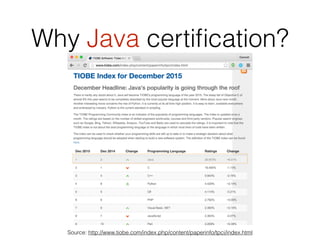
Why Java certification?
Source: http://www.tiobe.com/index.php/content/paperinfo/tpci/index.html
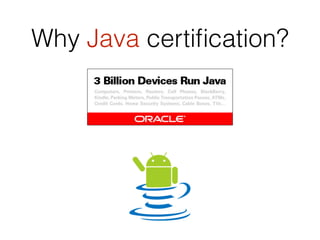
Why Java certification?
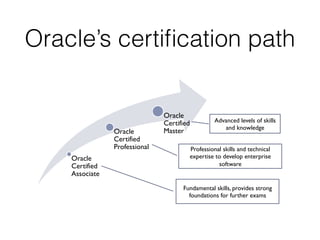
Oracle’s certification path
Oracle
Certified
Associate
Oracle
Certified
Professional
Oracle
Certified
Master
Advanced levels of skills
and knowledge
Professional skills and technical
expertise to develop enterprise
software
Fundamental skills, provides strong
foundations for further exams
How to register?
• You can register and pay at the Pearson VUE
website
• This is our recommended option
• You can buy exam voucher from Oracle and then
register yourself in Pearson VUE website
• You can register and pay in the Oracle Testing
Center (OTC)
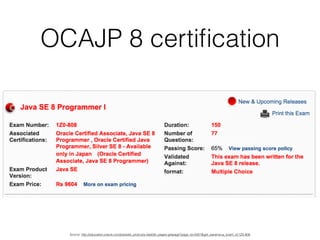
OCAJP 8 certification
Source: http://education.oracle.com/pls/web_prod-plq-dad/db_pages.getpage?page_id=5001&get_params=p_exam_id:1Z0-808
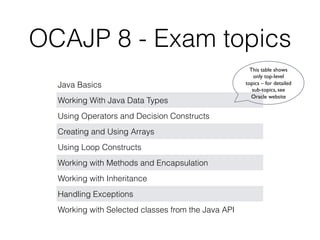
OCAJP 8 - Exam topics
Java Basics
Working With Java Data Types
Using Operators and Decision Constructs
Creating and Using Arrays
Using Loop Constructs
Working with Methods and Encapsulation
Working with Inheritance
Handling Exceptions
Working with Selected classes from the Java API
This table shows
only top-level
topics – for detailed
sub-topics, see
Oracle website
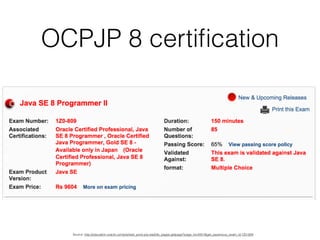
OCPJP 8 certification
Source: http://education.oracle.com/pls/web_prod-plq-dad/db_pages.getpage?page_id=5001&get_params=p_exam_id:1Z0-809
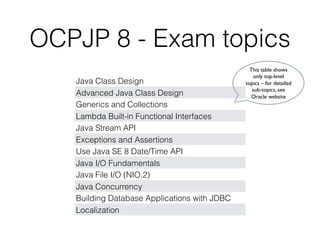
OCPJP 8 - Exam topics
Java Class Design
Advanced Java Class Design
Generics and Collections
Lambda Built-in Functional Interfaces
Java Stream API
Exceptions and Assertions
Use Java SE 8 Date/Time API
Java I/O Fundamentals
Java File I/O (NIO.2)
Java Concurrency
Building Database Applications with JDBC
Localization
This table shows
only top-level
topics – for detailed
sub-topics, see
Oracle website
Exam questions - Format
• It’s a multiple-choice questions exam
• The number of options would be based on the
questions
• Can be from 4 to 7 options (typically four options)
• Many questions will have more than one answer to be
selected!
• The question will clearly tell you how many options you
need to select
What do the questions test?
• Questions intend to test your ability to solve real-world
problems
• Most questions would be programming questions
• Given a program or code segment, predict the behavior
• Also few conceptual questions; These questions will test your
knowledge and will not have any programs in it. Examples:
• What are different kinds of drivers in JDBC
• What are different kinds of liveness problems with threads
What do the questions test?
• Questions will test your knowledge of language features
and their usage
• Will test if you understand language features and can
apply them in practical situations
• Most questions will be on nitty-gritty details or corner
cases, or unusual aspects of the language
• You don’t just need to understand the generics feature
in Java but also need to understand problems due to
type-erasure, mixing legacy containers with generic
containers, etc.
What do the questions test?
• Questions will test your knowledge of library features and their
usage
• Will test if your familiarity with Java APIs and know how to use
them in practical situations
• Most questions will be on nitty-gritty details or corner cases, or
unusual aspects of the library; examples:
• What does the remove() method of Deque do? (Answer: It
removes the first element from the underlying deque instance).
• What will happen if sleep() method is interrupted? (Answer:
You'll get an InterrputedException)
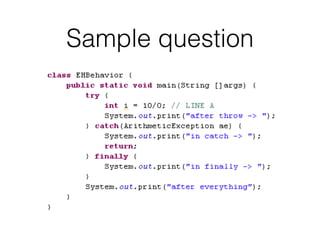
Sample question
Sample question
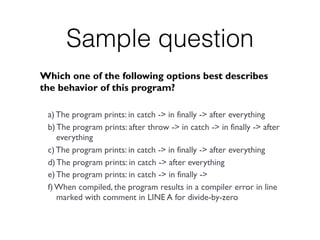
Which one of the following options best describes
the behavior of this program?
a) The program prints: in catch -> in finally -> after everything
b) The program prints: after throw -> in catch -> in finally -> after
everything
c) The program prints: in catch -> in finally -> after everything
d) The program prints: in catch -> after everything
e) The program prints: in catch -> in finally ->
f) When compiled, the program results in a compiler error in line
marked with comment in LINE A for divide-by-zero
Sample question: Answer
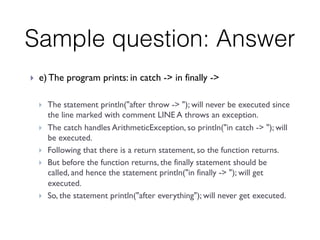
}  e) The program prints: in catch -> in finally ->
 
}  The statement println("after throw -> "); will never be executed since
the line marked with comment LINE A throws an exception.
}  The catch handles ArithmeticException, so println("in catch -> "); will
be executed.
}  Following that there is a return statement, so the function returns.
}  But before the function returns, the finally statement should be
called, and hence the statement println("in finally -> "); will get
executed.
}  So, the statement println("after everything"); will never get executed.
Sample question
Which one of the following relationship describes the
OO design concept of "composition"?
a) is-a
b) is-a-kind-of
c) has-a
d) is-implemented-in-terms-of
e) composed-as
Answer: c) has-a
Composition is a design concept that refers to has-a relationship.
Sample question
Sample question
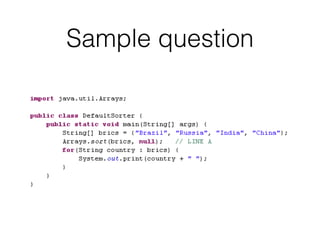
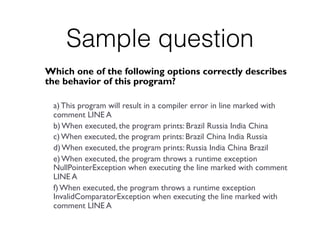
Which one of the following options correctly describes
the behavior of this program?
a) This program will result in a compiler error in line marked with
comment LINE A
b) When executed, the program prints: Brazil Russia India China
c) When executed, the program prints: Brazil China India Russia
d) When executed, the program prints: Russia India China Brazil
e) When executed, the program throws a runtime exception
NullPointerException when executing the line marked with comment
LINE A
f) When executed, the program throws a runtime exception
InvalidComparatorException when executing the line marked with
comment LINE A
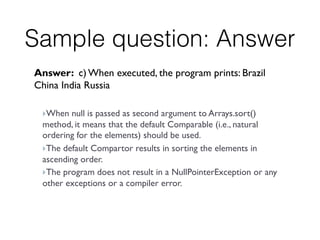
Sample question: Answer
Answer: c) When executed, the program prints: Brazil
China India Russia
 
} When null is passed as second argument to Arrays.sort()
method, it means that the default Comparable (i.e., natural
ordering for the elements) should be used.
} The default Compartor results in sorting the elements in
ascending order.
} The program does not result in a NullPointerException or any
other exceptions or a compiler error.
How to prepare?
• Code, code, code!
• The best way to prepare for the exam is to write lots
and lots of small programs and learn from your
mistakes!
• If possible, do some small toy projects in the topics
you’re new or not familiar with.
How to prepare?
• Read, read, read!
• By reading more, you’ll learn more about the
language features and the library. Lots of
resources in the internet.
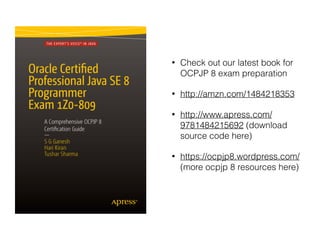
• Check out our latest book for
OCPJP 8 exam preparation
• http://amzn.com/1484218353
• www.apress.com/
9781484218358 (download
source code here)
• https://ocpjava.wordpress.com/
(more ocpjp 8 resources here)

Cracking OCA and OCP Java 8 Exams

  • 1.
    Ganesh S G HariKiran Cracking OCA/OCP Java 8 Exams Ganesh S G | Hari Kiran
  • 2.
    Why Get Certified? •The key to get a job, hike or promotion is to show you deserve it • Certification is a means to show that you’ve relevant knowledge and skills
  • 3.
    Why Java certification? Source:http://www.tiobe.com/index.php/content/paperinfo/tpci/index.html
  • 4.
  • 5.
    Oracle’s certification path Oracle Certified Associate Oracle Certified Professional Oracle Certified Master Advancedlevels of skills and knowledge Professional skills and technical expertise to develop enterprise software Fundamental skills, provides strong foundations for further exams
  • 6.
    How to register? •You can register and pay at the Pearson VUE website • This is our recommended option • You can buy exam voucher from Oracle and then register yourself in Pearson VUE website • You can register and pay in the Oracle Testing Center (OTC)
  • 7.
    OCAJP 8 certification Source:http://education.oracle.com/pls/web_prod-plq-dad/db_pages.getpage?page_id=5001&get_params=p_exam_id:1Z0-808
  • 8.
    OCAJP 8 -Exam topics Java Basics Working With Java Data Types Using Operators and Decision Constructs Creating and Using Arrays Using Loop Constructs Working with Methods and Encapsulation Working with Inheritance Handling Exceptions Working with Selected classes from the Java API This table shows only top-level topics – for detailed sub-topics, see Oracle website
  • 9.
    OCPJP 8 certification Source:http://education.oracle.com/pls/web_prod-plq-dad/db_pages.getpage?page_id=5001&get_params=p_exam_id:1Z0-809
  • 10.
    OCPJP 8 -Exam topics Java Class Design Advanced Java Class Design Generics and Collections Lambda Built-in Functional Interfaces Java Stream API Exceptions and Assertions Use Java SE 8 Date/Time API Java I/O Fundamentals Java File I/O (NIO.2) Java Concurrency Building Database Applications with JDBC Localization This table shows only top-level topics – for detailed sub-topics, see Oracle website
  • 11.
    Exam questions -Format • It’s a multiple-choice questions exam • The number of options would be based on the questions • Can be from 4 to 7 options (typically four options) • Many questions will have more than one answer to be selected! • The question will clearly tell you how many options you need to select
  • 12.
    What do thequestions test? • Questions intend to test your ability to solve real-world problems • Most questions would be programming questions • Given a program or code segment, predict the behavior • Also few conceptual questions; These questions will test your knowledge and will not have any programs in it. Examples: • What are different kinds of drivers in JDBC • What are different kinds of liveness problems with threads
  • 13.
    What do thequestions test? • Questions will test your knowledge of language features and their usage • Will test if you understand language features and can apply them in practical situations • Most questions will be on nitty-gritty details or corner cases, or unusual aspects of the language • You don’t just need to understand the generics feature in Java but also need to understand problems due to type-erasure, mixing legacy containers with generic containers, etc.
  • 14.
    What do thequestions test? • Questions will test your knowledge of library features and their usage • Will test if your familiarity with Java APIs and know how to use them in practical situations • Most questions will be on nitty-gritty details or corner cases, or unusual aspects of the library; examples: • What does the remove() method of Deque do? (Answer: It removes the first element from the underlying deque instance). • What will happen if sleep() method is interrupted? (Answer: You'll get an InterrputedException)
  • 15.
  • 16.
    Sample question Which oneof the following options best describes the behavior of this program? a) The program prints: in catch -> in finally -> after everything b) The program prints: after throw -> in catch -> in finally -> after everything c) The program prints: in catch -> in finally -> after everything d) The program prints: in catch -> after everything e) The program prints: in catch -> in finally -> f) When compiled, the program results in a compiler error in line marked with comment in LINE A for divide-by-zero
  • 17.
    Sample question: Answer } e) The program prints: in catch -> in finally ->   }  The statement println("after throw -> "); will never be executed since the line marked with comment LINE A throws an exception. }  The catch handles ArithmeticException, so println("in catch -> "); will be executed. }  Following that there is a return statement, so the function returns. }  But before the function returns, the finally statement should be called, and hence the statement println("in finally -> "); will get executed. }  So, the statement println("after everything"); will never get executed.
  • 18.
    Sample question Which oneof the following relationship describes the OO design concept of "composition"? a) is-a b) is-a-kind-of c) has-a d) is-implemented-in-terms-of e) composed-as Answer: c) has-a Composition is a design concept that refers to has-a relationship.
  • 19.
  • 20.
    Sample question Which oneof the following options correctly describes the behavior of this program? a) This program will result in a compiler error in line marked with comment LINE A b) When executed, the program prints: Brazil Russia India China c) When executed, the program prints: Brazil China India Russia d) When executed, the program prints: Russia India China Brazil e) When executed, the program throws a runtime exception NullPointerException when executing the line marked with comment LINE A f) When executed, the program throws a runtime exception InvalidComparatorException when executing the line marked with comment LINE A
  • 21.
    Sample question: Answer Answer:c) When executed, the program prints: Brazil China India Russia   } When null is passed as second argument to Arrays.sort() method, it means that the default Comparable (i.e., natural ordering for the elements) should be used. } The default Compartor results in sorting the elements in ascending order. } The program does not result in a NullPointerException or any other exceptions or a compiler error.
  • 22.
    How to prepare? •Code, code, code! • The best way to prepare for the exam is to write lots and lots of small programs and learn from your mistakes! • If possible, do some small toy projects in the topics you’re new or not familiar with.
  • 23.
    How to prepare? •Read, read, read! • By reading more, you’ll learn more about the language features and the library. Lots of resources in the internet.
  • 24.
    • Check outour latest book for OCPJP 8 exam preparation • http://amzn.com/1484218353 • www.apress.com/ 9781484218358 (download source code here) • https://ocpjava.wordpress.com/ (more ocpjp 8 resources here)