
COMPUTERIZEDPROVIDER ORDER ENTRY
Presented By,
JYOTIRMOY ROY
B.Phrm.6th sem
BCDA COLLEGE OF PHARMACY AND TECHNOLOGY
OBJECTIVES
1. Describe Computer-Based Provider Order Entry (CPOE)
2. Problems with Manual System
3. Why CPOE ?
4. Available hardware and software for CPOE
5. How CPOE work ?
6. Example of CPOE screen Provider
7. CPOE NETWORK
8. Advantages and disadvantages of CPOE
9. Conclusion
10. References
Computerize provider Oder entry
(CPOE)
 Known as Computerized physician order entry (CPOE)
 A system that allows providers to place specific order electronically through
the computer.
 It's the process of a medical professional entering meditation order or other
physician instructions electronically instead on paper charts .
 CPOE system are often used in tandem with e-prescribing system ,which alert
physicians and clinicians to a particular patient's drug allergies and current
medication.
The problem with Manual system
 Deciphering hieroglyphics (provider‘s handwriting)
 Incomplete or Inappropriate Oder
 Order on the wrong patient
 Drug/Drug , Drug/Formulary ,Drug-Allergy issues
 Delays-workflow
For These Problems
 Estimated that between 44,000 to 98,000 hospital deaths/year Due to
medical errors
 Two resent Harvard Studies found that physician ordering errors accounted for
56%-78% of all preventable adverse Drug Events.
Why CPOE
 Order Communication
 Clarity of orders
 Ease of Identifying the Ordering Physician
 Standardization of care
 Clinically validated order sets for
 Clinical diagnoses
 Procedures
 Situations (post-op order sets )
 Alerts and Reminders (Real Time Decision Support)
 Drug safety Database (Conflict checking)
 Clinically validated Rules
CPOE Hardware And Software
 Desktop computer
 Laptop
 Computer on wheels
 PDA (Personal Digital Assistant)
 PALM Pilot
Provider Order System
 Multiple manufacturers
 Cerner
 McKesson
 Eclipsys
 Siemens
 Quadra med
 HMS
 Meditech
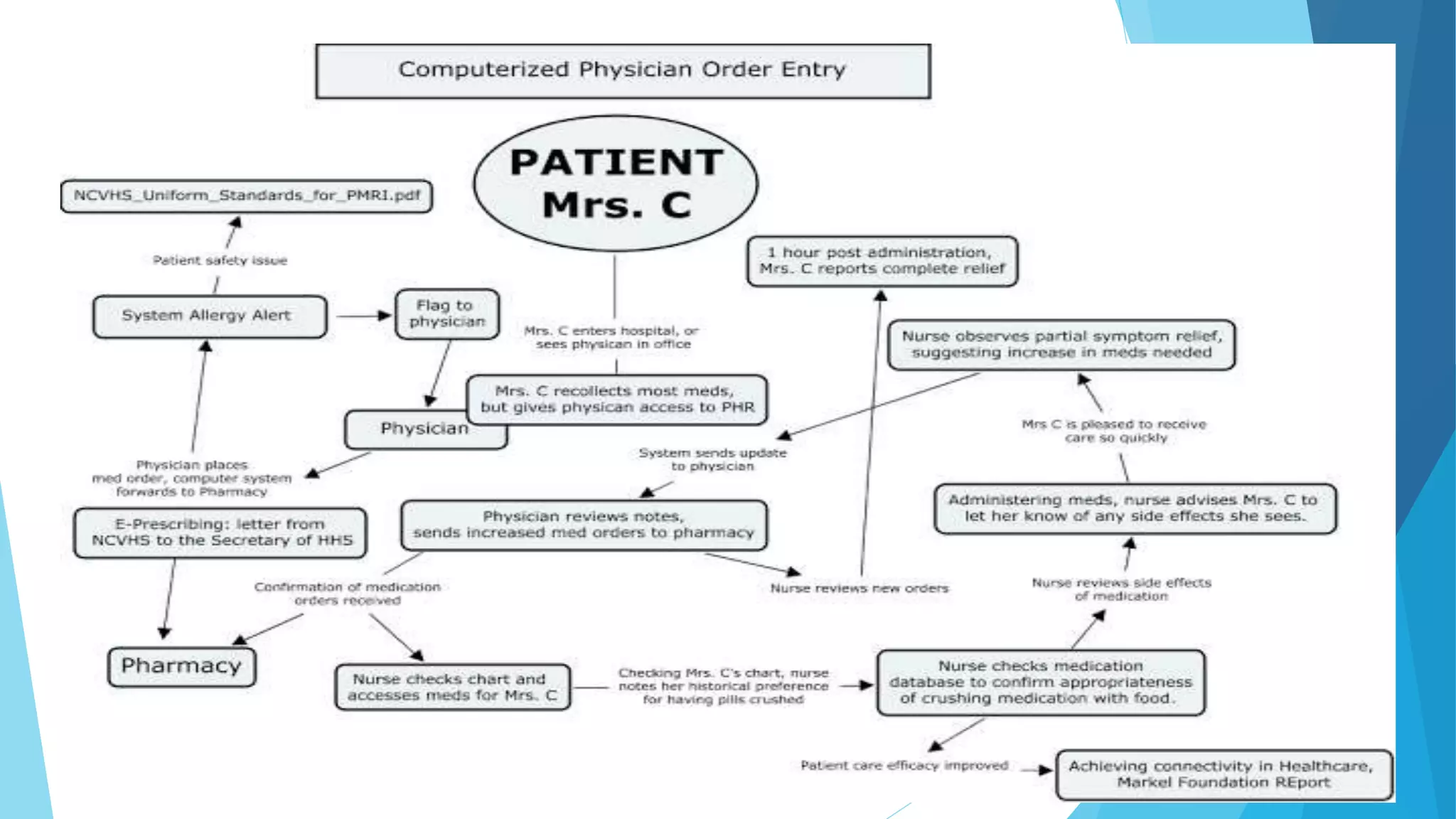
Working of CPOE
Example 1 of CPOE screen Provider
Example 2 of CPOE screen Provider
CPOE NETWORK
Advantages of CPOE
 Ensures that orders are legible
 Prevents medication errors which can save money and lives
 The Institute of Medicine estimates that the United States spends about $37.6 billion each year for
medical errors,$17 billion of those costs are preventable (McGonigle & Mastrian,2012,P.219)
 In 20000 about 98,000 people died as a result of medical errors in the United States (Hoey,Nichol
& Silverman,2009)
 Can keeps costs down if the software is used correctly
 Improves quality of care
 Can save time verify orders
 Alerts
 Medication expiring ,duplicate order ,contraindications
 Will prevent illegal handwritten orders/prescriptions
 Provides decision support
Disadvantages
 Can cause negative workflow for unit clerks as they may not be able to verify
orders in a timely manner before the order is carried out (Dixon &Zafar,2009)
 Needs training which is costly and time consuming (Dixon &Zafar,2009)
 Software can be expensive to start and maintain (Hoey,Nichol &
Silverman,2009)
 Can change workflow and result in less communication between healthcare
professionals as a result of electronically processed orders ( Hoey, Nichol &
Silverman ,2009)
 Unavailable with computer downtime
CONCLUSION
 CPOE systems with clinical decision support systems can improve medication
safety and quality of care as well as compliance with guidelines and the
efficiency of hospital workflow; they can also reduce the cost of care.
 The unintended consequences of CPOE are widespread and important to those
knowledgeable about CPOE in hospitals. They can be positive, negative, or
both, depending on one’s perspective, and they continue to exist over the
duration of use. Aggressive detection and management of adverse unintended
consequences is vital for CPOE success.
References
1.agency for Healthcare Research and Quality
(2009). http://healthit.ahrq.gov/images/jan09cpoereport/cpoe_issue_paper.htm
2. Institute of Medicine (1999). "To Err Is Human: Building a Safer Health System (1999)". The
National Academies Press.
3. Institute of Medicine (2001). "Crossing the Quality Chasm: A New Health System for the 21st
Century". The National Academies Press..
4.The Institute of Medicine (2006). "Preventing Medication Errors". The National Academies
Press.
5.Oren, E.; Shaffer, E. & Guglielmo, B. (2003). "Impact of emerging technologies on medication
errors and adverse drug events.". American Journal of Health-System Pharmacy. 60: 1447–
1458.
6 David W. Bates, MD; et al. (1998). "Effect of Computerized Physician Order Entry and a Team
Intervention on Prevention of Serious Medication Errors" (abstract). JAMA. 280
7. http://www.eurekalert.org/pub_releases/2010-05/sumc-ssf042710.php.
10.Lohr, Steve (2005-03-09). "Doctors' Journal Says Computing Is No Panacea". The New York
Times. Retrieved 2006-07-15.
THANK YOU

CPOE overviews

  • 1.
    COMPUTERIZEDPROVIDER ORDER ENTRY PresentedBy, JYOTIRMOY ROY B.Phrm.6th sem BCDA COLLEGE OF PHARMACY AND TECHNOLOGY
  • 2.
    OBJECTIVES 1. Describe Computer-BasedProvider Order Entry (CPOE) 2. Problems with Manual System 3. Why CPOE ? 4. Available hardware and software for CPOE 5. How CPOE work ? 6. Example of CPOE screen Provider 7. CPOE NETWORK 8. Advantages and disadvantages of CPOE 9. Conclusion 10. References
  • 3.
    Computerize provider Oderentry (CPOE)  Known as Computerized physician order entry (CPOE)  A system that allows providers to place specific order electronically through the computer.  It's the process of a medical professional entering meditation order or other physician instructions electronically instead on paper charts .  CPOE system are often used in tandem with e-prescribing system ,which alert physicians and clinicians to a particular patient's drug allergies and current medication.
  • 4.
    The problem withManual system  Deciphering hieroglyphics (provider‘s handwriting)  Incomplete or Inappropriate Oder  Order on the wrong patient  Drug/Drug , Drug/Formulary ,Drug-Allergy issues  Delays-workflow For These Problems  Estimated that between 44,000 to 98,000 hospital deaths/year Due to medical errors  Two resent Harvard Studies found that physician ordering errors accounted for 56%-78% of all preventable adverse Drug Events.
  • 5.
    Why CPOE  OrderCommunication  Clarity of orders  Ease of Identifying the Ordering Physician  Standardization of care  Clinically validated order sets for  Clinical diagnoses  Procedures  Situations (post-op order sets )  Alerts and Reminders (Real Time Decision Support)  Drug safety Database (Conflict checking)  Clinically validated Rules
  • 6.
    CPOE Hardware AndSoftware  Desktop computer  Laptop  Computer on wheels  PDA (Personal Digital Assistant)  PALM Pilot Provider Order System  Multiple manufacturers  Cerner  McKesson  Eclipsys  Siemens  Quadra med  HMS  Meditech
  • 7.
  • 8.
    Example 1 ofCPOE screen Provider
  • 9.
    Example 2 ofCPOE screen Provider
  • 10.
  • 11.
    Advantages of CPOE Ensures that orders are legible  Prevents medication errors which can save money and lives  The Institute of Medicine estimates that the United States spends about $37.6 billion each year for medical errors,$17 billion of those costs are preventable (McGonigle & Mastrian,2012,P.219)  In 20000 about 98,000 people died as a result of medical errors in the United States (Hoey,Nichol & Silverman,2009)  Can keeps costs down if the software is used correctly  Improves quality of care  Can save time verify orders  Alerts  Medication expiring ,duplicate order ,contraindications  Will prevent illegal handwritten orders/prescriptions  Provides decision support
  • 12.
    Disadvantages  Can causenegative workflow for unit clerks as they may not be able to verify orders in a timely manner before the order is carried out (Dixon &Zafar,2009)  Needs training which is costly and time consuming (Dixon &Zafar,2009)  Software can be expensive to start and maintain (Hoey,Nichol & Silverman,2009)  Can change workflow and result in less communication between healthcare professionals as a result of electronically processed orders ( Hoey, Nichol & Silverman ,2009)  Unavailable with computer downtime
  • 13.
    CONCLUSION  CPOE systemswith clinical decision support systems can improve medication safety and quality of care as well as compliance with guidelines and the efficiency of hospital workflow; they can also reduce the cost of care.  The unintended consequences of CPOE are widespread and important to those knowledgeable about CPOE in hospitals. They can be positive, negative, or both, depending on one’s perspective, and they continue to exist over the duration of use. Aggressive detection and management of adverse unintended consequences is vital for CPOE success.
  • 14.
    References 1.agency for HealthcareResearch and Quality (2009). http://healthit.ahrq.gov/images/jan09cpoereport/cpoe_issue_paper.htm 2. Institute of Medicine (1999). "To Err Is Human: Building a Safer Health System (1999)". The National Academies Press. 3. Institute of Medicine (2001). "Crossing the Quality Chasm: A New Health System for the 21st Century". The National Academies Press.. 4.The Institute of Medicine (2006). "Preventing Medication Errors". The National Academies Press. 5.Oren, E.; Shaffer, E. & Guglielmo, B. (2003). "Impact of emerging technologies on medication errors and adverse drug events.". American Journal of Health-System Pharmacy. 60: 1447– 1458. 6 David W. Bates, MD; et al. (1998). "Effect of Computerized Physician Order Entry and a Team Intervention on Prevention of Serious Medication Errors" (abstract). JAMA. 280 7. http://www.eurekalert.org/pub_releases/2010-05/sumc-ssf042710.php. 10.Lohr, Steve (2005-03-09). "Doctors' Journal Says Computing Is No Panacea". The New York Times. Retrieved 2006-07-15.
  • 15.