Making the Move to
               Digital Textbooks
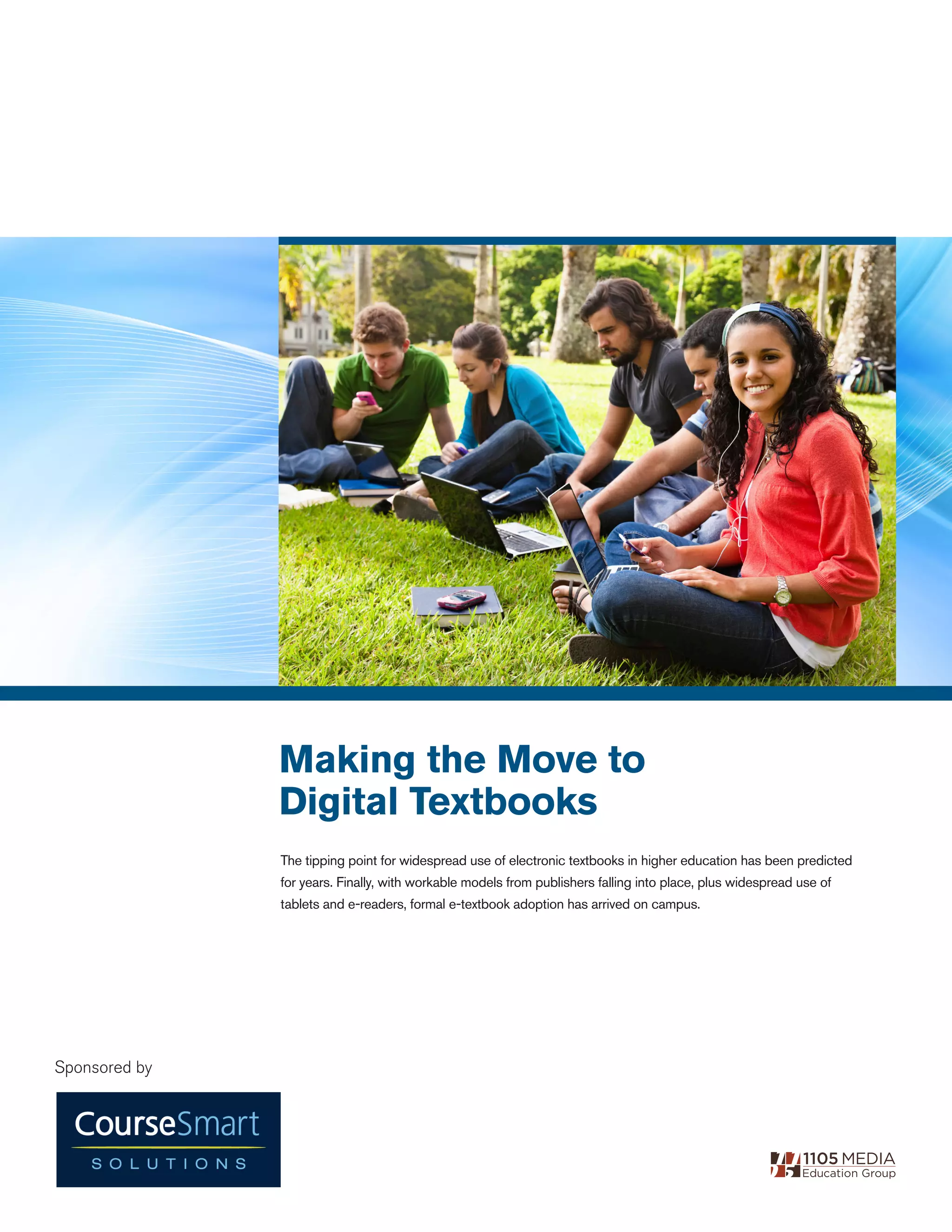
               The tipping point for widespread use of electronic textbooks in higher education has been predicted
               for years. Finally, with workable models from publishers falling into place, plus widespread use of
               tablets and e-readers, formal e-textbook adoption has arrived on campus.


Sponsored by
Table of Contents                          Introduction
                                           Digital textbooks are not new. Academic publishers began offering digital versions of their
                                           textbooks a decade ago, but only for a limited number of subjects and courses. Now,
Introduction                           2   however, with the rapid growth in tablets and e-reader use, publishers are releasing nearly
Drivers Behind an E-textbook Program   3   all their textbooks in digital format.
Navigating Change                      3   And campuses are jumping on board. Price tends to be the biggest driver for most
Faculty Response                       4   institutions, as they look for ways to cut costs for their students. Other benefits follow,
                                           including integration of e-texts with other course material and with software such as the
Managing Student Reactions             4
                                           learning management system, as well as ease of access to new textbooks for faculty
Conclusion: The Future for             5   consideration.
E-textbook Programs
                                           Not surprisingly, students welcome the adoption of e-textbooks. In a 2011 ECAR student
About Us                               7
                                           technology study, 57 percent of respondents indicated that they use e-books or e-textbooks
References                             8   to some extent. Roughly one-third (31 percent) wish more of their instructors would use
                                           e-textbooks. These students report that “e-books are cheaper than regular hardbound
                                           textbooks, easier to carry around, and more accessible all the time,” according to the study.
                                           Despite these benefits, challenges remain with introducing electronic coursework
                                           programs. These include student access to a wider range of e-textbooks, integration of
                                           more supplemental materials into those e-books, and better use of the electronic medium
                                           to offer capabilities paper textbooks can’t. In addition, faculty and students both must see
                                           e-textbooks as workable, useful tools for teaching, learning, and studying. In fact, that is
                                           something that frequently happens after adoption rather than before.
                                           In this paper, we look at three institutions that are piloting electronic textbook programs from
                                           CourseSmart®, a San Mateo, CA-based provider of digital course materials. The focus of
                                           the pilots range from online courses, to traditional classrooms, to a hybrid approach. The
                                           extent of each pilot also varies -- from a single section, to faculty only, to the entire school.
                                           Here is a quick overview of the three profiled institutions.
                                                                         Chattanooga State Community College is a two-year
                                                                         community college and member of the Tennessee Board
                                                                         of Regents, which comprises 18 community colleges, five
                                                                         universities, and 28 technology centers. Chattanooga State
                                                                         is one of the largest community colleges within the system,
                                           with more than 10,000 students, about 3,500 of whom are taking online courses. We
                                           spoke with Judy Lowe, assistant VP for distributed education and multimedia.
                                           The e-textbook program at Chattanooga has been implemented in a portion of the online
                                           courses. According to Lowe, the CourseSmart program so far includes 40 courses, 83
                                           individual sections, and some 2,000 students, rolled out in the fall 2011 semester. “We’re
                                           continuing with the spring semester and then we’re going to evaluate how to further
                                           implement it in the future,” Lowe says. The college is conducting surveys and focus groups
                                           to evaluate the program as it continues.
                                                                          California State University at Fullerton is part of the
                                                                          23-campus CSU system, which serves more than 400,000
                                                                          students. CSU-Fullerton is currently the largest school by
                                           headcount in the system, at 36,000-plus students. Its e-textbook deployment has been
                                           campuswide, but focused on faculty only for course material discovery and evaluation. We
                                           spoke with Chris Manriquez, who is associate VP for IT, as well as CTO and academic
                                           technology officer.
                                           “We went with an enterprise approach to the project with CourseSmart,” explains
                                           Manriquez. CSU-Fullerton distributed iPads to their faculty. Beginning with the fall 2011
                                           semester, faculty can access CourseSmart’s solution through a single sign-on capability
Jumping off the                                        at the university’s portal using the iPads. “Our ultimate long-range goal is to make
                                                       [CourseSmart resources] available to the students as well,” Manriquez says.
page: the benefits                                                                       Harrison College is a career-focused institution with 12
of e-textbooks                                                                           campuses in Indiana, Ohio, and North Carolina. The college
                                                                                         serves more than 6,000 students throughout the US and
                                                       internationally. Harrison has a large online division, and courses are offered in several
Digital textbooks offer unique capabilities that can   formats, from online to traditional face-to-face settings, as well as blended and hybrid
enhance learning. With e-textbooks, students can:      offerings. We spoke with Dennis A. Trinkle, who is provost and chief academic officer.
• Print pages or sections as they read                 Harrison’s pilot, which also began in fall 2011, involves 50 online and hybrid courses, and
• Take notes and highlight text                        several hundred students. Trinkle points out that “about 85 percent of our students are adult
• Share information with other students                learners, so this is a big online adult learner pilot.”
• Access online, interactive e-resources
• Read materials on mobile devices
                                                       Drivers Behind an E-textbook Program
                                                       Moving to a formal e-textbook program is often precipitated by the rapidly escalating cost of
                                                       student textbooks. At Chattanooga State, for example, which has a large percentage of
                                                       financial aid students, the CourseSmart initiative was predicated on reducing book costs.
                                                       “Even though we had e-textbooks in many courses, and they’re the same books we’re now
                                                       using through CourseSmart,” Lowe explains, e-materials “are coming in at an even lower
                                                       price because we’re doing it on a larger scale” through CourseSmart.
                                                       CSU Fullerton’s move to a formal program was also largely driven by cost. But as
                                                       Manriquez explains, the shift was part of a larger strategy at the university to integrate digital
                                                       and mobile technologies. With more and more students carrying mobile devices, he says,
                                                       going with digital texts made sense from both an administrative and instructional point of
                                                       view. Manriquez sees the move as running in parallel with CSU’s statewide focus on driving
                                                       down costs and making a CSU education more affordable.
                                                       Harrison College began its CourseSmart pilot in September, motivated partly by the rising
                                                       cost of tuition and textbooks, according to Trinkle.
                                                       But the principal driver, he says, was the need for a flexible solution. After listening to the
                                                       institution’s adult learners, who often study at different times of day and in different places,
                                                       the institution sought out a platform that would deliver flexibility, ease of access, and
                                                       portability for study materials. “It’s not easy [for students] to carry all of their textbooks with
                                                       them everywhere, so we’ve eased that problem for them,” Trinkle says.
                                                       Other students, he adds, are increasingly asking for textbook delivery on iPads, Kindles,
                                                       and the like. “Working from those challenges -- from the cost perspective, from the flexibility
                                                       standpoint, and from where our students are across all age groups with technology -- we
                                                       wanted to see if the CourseSmart platform might have an answer,” he says.

                                                       Navigating Change
                                                       Bringing in a formal e-textbook program inevitably introduces new layers of system
                                                       complexity even as it does away with others. Changes range from how to charge students,
                                                       to faculty access and training, to backend integrations like incorporating the digital
                                                       textbooks into the learning management system.
                                                       At CSU Fullerton, one change entailed giving faculty simple, quick access to CourseSmart
                                                       resources through a portal and single sign-on technology. (CourseSmart makes available
                                                       a series of tools for this purpose; there is also an app for iPads, which Fullerton is using.)
                                                       Manriquez explains that CSU Fullerton deployed Shibboleth, a web-based technology for
About CourseSmart                                       user authentication, along with InCommon, a framework that allows educational
                                                        institutions to safely and securely share online resources, to enable single sign-on
                                                        capabilities for faculty.
                                                        Harrison College is planning to integrate CourseSmart into its learning management
CourseSmart     Solutions    is   a   comprehensive
                                                        system, Blackboard’s ANGEL Learning, to give students consistency and convenience in
selection of services and technologies developed
exclusively   for   higher   education   institutions
                                                        accessing course materials.
to provide fulfillment and access to a catalog          In addition, Trinkle says, a key change was preparing faculty to utilize all the features in
of digital course materials from within your            e-texts. “One of the things we want to do with the pilot,” he explains, “is to really encourage
campus ecosystem.
                                                        our instructors to be innovative in the use of the platform.” To that end, Harrison College
For more information, visit www.coursesmart.com
                                                        is approaching training carefully “to make sure that faculty are well-prepared to support
                                                        students with e-books, and to take advantage of the technologies there.” The bottom line,
                                                        as with any technology, he says: Added value for students.
                                                        Changes at Chattanooga State have involved incorporating a method for charging
                                                        students for e-content material. As Lowe explains, courses using CourseSmart e-books
                                                        have a cost attached as part of the tuition. “When [students] register for that course, they
                                                        see an e-book rate and know they’re going to be charged that.” That cost had to be coded
                                                        into each course through Banner, the college’s student information system.
                                                        The college uses Desire2Learn as its LMS, loading course materials into the LMS master
                                                        site directly from CourseSmart. That gives registered students immediate access to course
                                                        materials through Desire2Learn. At Chattanooga, faculty also access e-resources through
                                                        the LMS, rather than the portal method used at CSU Fullerton.

                                                        Faculty Response
                                                        One challenge with new technology is introducing it to faculty and transitioning them to a
                                                        new program.
                                                        At Chattanooga State, Lowe says that faculty were split in their reaction to the
                                                        CourseSmart program. “Half of them were excited, and loved the new tools and all of the
                                                        things that they couldn’t do otherwise,” she says. The other half -- who tended to teach
                                                        either professional courses or prerequisite courses for professional degrees, such as the
                                                        college’s health program -- saw drawbacks. Students in those courses, for example, often
                                                        need a hard copy of a book throughout a professional program, not just for one course, and
                                                        instructors in those courses tend to use open-book assessments and assignments. Still
                                                        early in the program, Chattanooga is working on methods for addressing those concerns.
                                                        Faculty response has been favorable at CSU Fullerton, where instructors are taking
                                                        advantage of a faster, easier way to review new books before using them in a course.
                                                        Rather than having publishers mail print copies of potential books, faculty are using
                                                        CourseSmart’s Faculty Instant Access function to search for a specific text. If it’s available, it
                                                        can be reviewed entirely online.

                                                        Managing Student Response
                                                        Handling student reaction to introducing a formal e-book program means being patient and
                                                        communicating well during the early deployment period. After some Harrison College
                                                        students expressed concerns during the initial phase, Trinkle says, “we have seen lots of
                                                        enthusiasm.” Positive reaction from students includes appreciation of the flexibility of the
                                                        e-texts, and the additional tools that come with them.
                                                        Even so, notes Trinkle, Harrison has realized that some students will still want and need
                                                        a hard copy textbook. To address that, Harrison students can buy a course textbook at a
                                                        significantly reduced cost. (All students are required to buy the electronic resources for
Waiting out the                                           the course.) Offering “students for whom it is functionally and psychologically important [to
                                                          have a paper text] the ability to buy one,” Trinkle says, has helped ensure an overall positive
Reaction to Change                                        reaction from students.
                                                          Judging student response at CSU Fullerton is premature, since the program has only
                                                          focused on faculty to this point. The model the university is considering, however, will
How can higher ed institutions help faculty and
                                                          allow students to purchase a course textbook either digitally or print initially, while program
students adapt to the changes that a formal
                                                          adoption is weighed. But CSU Fullerton students aren’t waiting. While the new program
e-textbook program brings? Harrison College
                                                          has yet to be implemented campuswide, school officials report that students are already
Provost and Chief Academic Officer Dennis Trinkle
offers these suggestions for a smooth transition.
                                                          taking advantage of CourseSmart’s offerings. “We’ve seen a growing number of students
                                                          making [e-textbook] purchases already,” Manriquez says.
1) Keep in mind that change tends to prompt
immediate adverse reactions no matter what.               The university also addressed student concerns about eliminating traditional textbooks.
“There will always be a group of faculty, students,       Some courses within a student’s major, Manriquez points out, may need to be part of a
and support staff who are uncomfortable,” he says.        student’s permanent book collection -- an organic chemistry text for a science major, for
He advises “doing everything you can to ease the          example. The university understands this need and plans to include this option when the
impact and lighten the transition effects,” then          program rolls out campuswide. “We’re not planning to completely replace [print] textbooks,”
waiting out the initial storm.                            he says.
2) Communicate often to your stakeholders. “We
                                                          At Chattanooga State, Lowe reports that student response has, for the most part, been
have a lot of adult learners who are balancing a
                                                          positive, based on surveys and focus groups. Once initial vocal resistance calmed, she
great many things,” Trinkle says, “so our faculty
                                                          says, students began to use the materials. “When they realized the tools that were there
members are very sensitive to the fragility of those
students.” It’s important to focus on consistently
                                                          and how much better they were, they became quite excited about it,” she says. “And that’s
communicating changes to students.                        been quite a surprise to me. I wasn’t expecting it.”

3) Listen to your students and faculty. In the first      The model at Chattanooga is to require CourseSmart materials; students can purchase
couple of weeks that Harrison’s CourseSmart               hardcopies on their own if that’s what they choose to do. (Students for whom internet
program was introduced, some students raised              access is a challenge are using campus labs more to access needed materials.) Lowe
concerns. “There was an expected emotional                cites discussions with publishers to produce “a stripped-down, no-frills print text at a very
response,” Trinkle says. “Now that we’re about            reduced cost.” Keeping in mind the needs of low-income students, she is also looking for
two months out, though, folks have calmed down            solutions to the challenge Manriquez mentions at CSU Fullerton -- addressing students
… I talked with a student last night at our Board
                                                          who need to keep their textbooks long after a course concludes.
of Trustees meeting who is… in the pilot. And he
said he’d been freaked out at first, but now he was
loving it; he’d come to enjoy and recognize the           Conclusion: The Future for E-textbook Programs
value of the technology and it was opening up lots        With each of the three institutions profiled here just starting out with a formal CourseSmart
of possibilities for him.” By Trinkle’s estimation, the   program, long-term goals depend to some extent on how the programs are received by
reality of how well a program such as CourseSmart         students, faculty, and staff. Managing student and faculty reaction as well as the clear
is going to work won’t be apparent until two or three     need for some courses to include paper texts are challenges that each school is gradually
months into the rollout.                                  weighing and addressing as the pilot programs continue.
                                                          At Chattanooga State, Lowe looks forward to extending the pilot program from the
                                                          college’s online-only courses to the face-to-face ones as well. That will enable faculty and
                                                          students in “on-ground” courses to make use of features in the e-textbooks that are offered
                                                          through the college’s learning management system.
                                                          At CSU Fullerton, Manriquez points out that a simple move from paper textbooks to digital
                                                          material doesn’t add enough value to justify the change. Instead, digital texts must bring
                                                          additional value -- lower costs for students, portability, ease of sharing material in class,
                                                          additional materials such as quizzes and questions, and an easier way for faculty to review
                                                          and order new textbooks.
                                                          At Harrison College, Trinkle envisions tools and content continuing to evolve until the
                                                          differentiation between an online course and its content fade away. That sort of solution, he
says, “is rich and interactive. It supports the learning process while at the same time helping
students to avoid some of the costs of print. It also brings added functionality and ease of
access.”
All three institutions agree that they share that vision of rich course content at reduced
cost, whether the material is for courses delivered online, in the classroom, or in some
combination. With the promise of dramatic cost reductions, integrated online materials
that can be accessed anywhere and on any device, and additional electronic material that
enhances the learning experience, e-textbooks are here and delivering on their potential.
About Us
                                       About Campus Technology
                                       Campus Technology is the only monthly publication focusing exclusively on the use of
                                       technology across all areas of higher education. Campus Technology provides in depth
                                       coverage of specific technologies and their implementations, including wireless networks
                                       and mobile devices; enterprise resource planning; eLearning and course management
                                       systems; “smart classroom” technologies; telecom; Web; and security solutions--all the
                                       important issues and trends for campus IT decision makers.
                                       Launched in October, 2004, Campus Technology replaced the highly respected Syllabus
                                       magazine, a recognized leader in the coverage of technology on campus since 1988.
                                       Campus Technology continues to uphold Syllabus’ mission of serving as a complete
                                       resource for academic and administrative IT leaders in higher education, and provides in
                                       depth coverage of specific technologies, their uses, and implementations on campus.
                                       Campus Technology consists of the monthly Campus Technology print magazine; the daily
                                       CampusTechnology.com Web site; weekly, biweekly, and monthly electronic newsletters
                                       (Campus Cloud Computing, Mobile Technology in Higher Education, Campus Technology
                                       Insider, News Update, IT Trends, SmartClassroom, C-Level View, Campus Security);
                                       conferences; and targeted list rental opportunities.
                                       About CourseSmart
                                       CourseSmart is a venture supported by publishers in North America including Pearson,
                                       Cengage Learning, McGraw-Hill, MacMillan Higher Education, and John Wiley & Sons.
                                       CourseSmart Solutions is a comprehensive selection of services and technologies
                                       developed exclusively for institutions to provide fulfillment and access to a catalog of digital
                                       course materials with over 20,000 titles representing 90 percent of the core textbooks
                                       in use in North American higher education. Prices are on average 60 percent less than
                                       the cost of a new print textbook. CourseSmart works with individual institutions to create
                                       custom solutions within the campus ecosystem that distribute content directly into a
                                       student or instructor’s workflow. Content can be integrated with campus portals, learning
                                       management systems, and student information systems and can be accessed by any web-
                                       enabled computer, tablet, or smartphone.
                                       More information is at www.coursesmart.com/institutions.


9201 Oakdale Ave.
Suite 101
Chatsworth, CA 91311
(818) 814-5277


CourseSmart
901 Mariners Island Blvd., Suite 545
San Mateo, CA 94404
References

The ECAR National Study of Undergraduate Students and Information Technology, 2011
http://net.educause.edu/ir/library/pdf/ERS1103/ERS1103pdf.pdf
Retrieved 11/17/2011

CourseSmart Campus Technology Whitepaper: Making The Move to Digital Textbooks

  • 1.
    Making the Moveto Digital Textbooks The tipping point for widespread use of electronic textbooks in higher education has been predicted for years. Finally, with workable models from publishers falling into place, plus widespread use of tablets and e-readers, formal e-textbook adoption has arrived on campus. Sponsored by
  • 2.
    Table of Contents Introduction Digital textbooks are not new. Academic publishers began offering digital versions of their textbooks a decade ago, but only for a limited number of subjects and courses. Now, Introduction 2 however, with the rapid growth in tablets and e-reader use, publishers are releasing nearly Drivers Behind an E-textbook Program 3 all their textbooks in digital format. Navigating Change 3 And campuses are jumping on board. Price tends to be the biggest driver for most Faculty Response 4 institutions, as they look for ways to cut costs for their students. Other benefits follow, including integration of e-texts with other course material and with software such as the Managing Student Reactions 4 learning management system, as well as ease of access to new textbooks for faculty Conclusion: The Future for 5 consideration. E-textbook Programs Not surprisingly, students welcome the adoption of e-textbooks. In a 2011 ECAR student About Us 7 technology study, 57 percent of respondents indicated that they use e-books or e-textbooks References 8 to some extent. Roughly one-third (31 percent) wish more of their instructors would use e-textbooks. These students report that “e-books are cheaper than regular hardbound textbooks, easier to carry around, and more accessible all the time,” according to the study. Despite these benefits, challenges remain with introducing electronic coursework programs. These include student access to a wider range of e-textbooks, integration of more supplemental materials into those e-books, and better use of the electronic medium to offer capabilities paper textbooks can’t. In addition, faculty and students both must see e-textbooks as workable, useful tools for teaching, learning, and studying. In fact, that is something that frequently happens after adoption rather than before. In this paper, we look at three institutions that are piloting electronic textbook programs from CourseSmart®, a San Mateo, CA-based provider of digital course materials. The focus of the pilots range from online courses, to traditional classrooms, to a hybrid approach. The extent of each pilot also varies -- from a single section, to faculty only, to the entire school. Here is a quick overview of the three profiled institutions. Chattanooga State Community College is a two-year community college and member of the Tennessee Board of Regents, which comprises 18 community colleges, five universities, and 28 technology centers. Chattanooga State is one of the largest community colleges within the system, with more than 10,000 students, about 3,500 of whom are taking online courses. We spoke with Judy Lowe, assistant VP for distributed education and multimedia. The e-textbook program at Chattanooga has been implemented in a portion of the online courses. According to Lowe, the CourseSmart program so far includes 40 courses, 83 individual sections, and some 2,000 students, rolled out in the fall 2011 semester. “We’re continuing with the spring semester and then we’re going to evaluate how to further implement it in the future,” Lowe says. The college is conducting surveys and focus groups to evaluate the program as it continues. California State University at Fullerton is part of the 23-campus CSU system, which serves more than 400,000 students. CSU-Fullerton is currently the largest school by headcount in the system, at 36,000-plus students. Its e-textbook deployment has been campuswide, but focused on faculty only for course material discovery and evaluation. We spoke with Chris Manriquez, who is associate VP for IT, as well as CTO and academic technology officer. “We went with an enterprise approach to the project with CourseSmart,” explains Manriquez. CSU-Fullerton distributed iPads to their faculty. Beginning with the fall 2011 semester, faculty can access CourseSmart’s solution through a single sign-on capability
  • 3.
    Jumping off the at the university’s portal using the iPads. “Our ultimate long-range goal is to make [CourseSmart resources] available to the students as well,” Manriquez says. page: the benefits Harrison College is a career-focused institution with 12 of e-textbooks campuses in Indiana, Ohio, and North Carolina. The college serves more than 6,000 students throughout the US and internationally. Harrison has a large online division, and courses are offered in several Digital textbooks offer unique capabilities that can formats, from online to traditional face-to-face settings, as well as blended and hybrid enhance learning. With e-textbooks, students can: offerings. We spoke with Dennis A. Trinkle, who is provost and chief academic officer. • Print pages or sections as they read Harrison’s pilot, which also began in fall 2011, involves 50 online and hybrid courses, and • Take notes and highlight text several hundred students. Trinkle points out that “about 85 percent of our students are adult • Share information with other students learners, so this is a big online adult learner pilot.” • Access online, interactive e-resources • Read materials on mobile devices Drivers Behind an E-textbook Program Moving to a formal e-textbook program is often precipitated by the rapidly escalating cost of student textbooks. At Chattanooga State, for example, which has a large percentage of financial aid students, the CourseSmart initiative was predicated on reducing book costs. “Even though we had e-textbooks in many courses, and they’re the same books we’re now using through CourseSmart,” Lowe explains, e-materials “are coming in at an even lower price because we’re doing it on a larger scale” through CourseSmart. CSU Fullerton’s move to a formal program was also largely driven by cost. But as Manriquez explains, the shift was part of a larger strategy at the university to integrate digital and mobile technologies. With more and more students carrying mobile devices, he says, going with digital texts made sense from both an administrative and instructional point of view. Manriquez sees the move as running in parallel with CSU’s statewide focus on driving down costs and making a CSU education more affordable. Harrison College began its CourseSmart pilot in September, motivated partly by the rising cost of tuition and textbooks, according to Trinkle. But the principal driver, he says, was the need for a flexible solution. After listening to the institution’s adult learners, who often study at different times of day and in different places, the institution sought out a platform that would deliver flexibility, ease of access, and portability for study materials. “It’s not easy [for students] to carry all of their textbooks with them everywhere, so we’ve eased that problem for them,” Trinkle says. Other students, he adds, are increasingly asking for textbook delivery on iPads, Kindles, and the like. “Working from those challenges -- from the cost perspective, from the flexibility standpoint, and from where our students are across all age groups with technology -- we wanted to see if the CourseSmart platform might have an answer,” he says. Navigating Change Bringing in a formal e-textbook program inevitably introduces new layers of system complexity even as it does away with others. Changes range from how to charge students, to faculty access and training, to backend integrations like incorporating the digital textbooks into the learning management system. At CSU Fullerton, one change entailed giving faculty simple, quick access to CourseSmart resources through a portal and single sign-on technology. (CourseSmart makes available a series of tools for this purpose; there is also an app for iPads, which Fullerton is using.) Manriquez explains that CSU Fullerton deployed Shibboleth, a web-based technology for
  • 4.
    About CourseSmart user authentication, along with InCommon, a framework that allows educational institutions to safely and securely share online resources, to enable single sign-on capabilities for faculty. Harrison College is planning to integrate CourseSmart into its learning management CourseSmart Solutions is a comprehensive system, Blackboard’s ANGEL Learning, to give students consistency and convenience in selection of services and technologies developed exclusively for higher education institutions accessing course materials. to provide fulfillment and access to a catalog In addition, Trinkle says, a key change was preparing faculty to utilize all the features in of digital course materials from within your e-texts. “One of the things we want to do with the pilot,” he explains, “is to really encourage campus ecosystem. our instructors to be innovative in the use of the platform.” To that end, Harrison College For more information, visit www.coursesmart.com is approaching training carefully “to make sure that faculty are well-prepared to support students with e-books, and to take advantage of the technologies there.” The bottom line, as with any technology, he says: Added value for students. Changes at Chattanooga State have involved incorporating a method for charging students for e-content material. As Lowe explains, courses using CourseSmart e-books have a cost attached as part of the tuition. “When [students] register for that course, they see an e-book rate and know they’re going to be charged that.” That cost had to be coded into each course through Banner, the college’s student information system. The college uses Desire2Learn as its LMS, loading course materials into the LMS master site directly from CourseSmart. That gives registered students immediate access to course materials through Desire2Learn. At Chattanooga, faculty also access e-resources through the LMS, rather than the portal method used at CSU Fullerton. Faculty Response One challenge with new technology is introducing it to faculty and transitioning them to a new program. At Chattanooga State, Lowe says that faculty were split in their reaction to the CourseSmart program. “Half of them were excited, and loved the new tools and all of the things that they couldn’t do otherwise,” she says. The other half -- who tended to teach either professional courses or prerequisite courses for professional degrees, such as the college’s health program -- saw drawbacks. Students in those courses, for example, often need a hard copy of a book throughout a professional program, not just for one course, and instructors in those courses tend to use open-book assessments and assignments. Still early in the program, Chattanooga is working on methods for addressing those concerns. Faculty response has been favorable at CSU Fullerton, where instructors are taking advantage of a faster, easier way to review new books before using them in a course. Rather than having publishers mail print copies of potential books, faculty are using CourseSmart’s Faculty Instant Access function to search for a specific text. If it’s available, it can be reviewed entirely online. Managing Student Response Handling student reaction to introducing a formal e-book program means being patient and communicating well during the early deployment period. After some Harrison College students expressed concerns during the initial phase, Trinkle says, “we have seen lots of enthusiasm.” Positive reaction from students includes appreciation of the flexibility of the e-texts, and the additional tools that come with them. Even so, notes Trinkle, Harrison has realized that some students will still want and need a hard copy textbook. To address that, Harrison students can buy a course textbook at a significantly reduced cost. (All students are required to buy the electronic resources for
  • 5.
    Waiting out the the course.) Offering “students for whom it is functionally and psychologically important [to have a paper text] the ability to buy one,” Trinkle says, has helped ensure an overall positive Reaction to Change reaction from students. Judging student response at CSU Fullerton is premature, since the program has only focused on faculty to this point. The model the university is considering, however, will How can higher ed institutions help faculty and allow students to purchase a course textbook either digitally or print initially, while program students adapt to the changes that a formal adoption is weighed. But CSU Fullerton students aren’t waiting. While the new program e-textbook program brings? Harrison College has yet to be implemented campuswide, school officials report that students are already Provost and Chief Academic Officer Dennis Trinkle offers these suggestions for a smooth transition. taking advantage of CourseSmart’s offerings. “We’ve seen a growing number of students making [e-textbook] purchases already,” Manriquez says. 1) Keep in mind that change tends to prompt immediate adverse reactions no matter what. The university also addressed student concerns about eliminating traditional textbooks. “There will always be a group of faculty, students, Some courses within a student’s major, Manriquez points out, may need to be part of a and support staff who are uncomfortable,” he says. student’s permanent book collection -- an organic chemistry text for a science major, for He advises “doing everything you can to ease the example. The university understands this need and plans to include this option when the impact and lighten the transition effects,” then program rolls out campuswide. “We’re not planning to completely replace [print] textbooks,” waiting out the initial storm. he says. 2) Communicate often to your stakeholders. “We At Chattanooga State, Lowe reports that student response has, for the most part, been have a lot of adult learners who are balancing a positive, based on surveys and focus groups. Once initial vocal resistance calmed, she great many things,” Trinkle says, “so our faculty says, students began to use the materials. “When they realized the tools that were there members are very sensitive to the fragility of those students.” It’s important to focus on consistently and how much better they were, they became quite excited about it,” she says. “And that’s communicating changes to students. been quite a surprise to me. I wasn’t expecting it.” 3) Listen to your students and faculty. In the first The model at Chattanooga is to require CourseSmart materials; students can purchase couple of weeks that Harrison’s CourseSmart hardcopies on their own if that’s what they choose to do. (Students for whom internet program was introduced, some students raised access is a challenge are using campus labs more to access needed materials.) Lowe concerns. “There was an expected emotional cites discussions with publishers to produce “a stripped-down, no-frills print text at a very response,” Trinkle says. “Now that we’re about reduced cost.” Keeping in mind the needs of low-income students, she is also looking for two months out, though, folks have calmed down solutions to the challenge Manriquez mentions at CSU Fullerton -- addressing students … I talked with a student last night at our Board who need to keep their textbooks long after a course concludes. of Trustees meeting who is… in the pilot. And he said he’d been freaked out at first, but now he was loving it; he’d come to enjoy and recognize the Conclusion: The Future for E-textbook Programs value of the technology and it was opening up lots With each of the three institutions profiled here just starting out with a formal CourseSmart of possibilities for him.” By Trinkle’s estimation, the program, long-term goals depend to some extent on how the programs are received by reality of how well a program such as CourseSmart students, faculty, and staff. Managing student and faculty reaction as well as the clear is going to work won’t be apparent until two or three need for some courses to include paper texts are challenges that each school is gradually months into the rollout. weighing and addressing as the pilot programs continue. At Chattanooga State, Lowe looks forward to extending the pilot program from the college’s online-only courses to the face-to-face ones as well. That will enable faculty and students in “on-ground” courses to make use of features in the e-textbooks that are offered through the college’s learning management system. At CSU Fullerton, Manriquez points out that a simple move from paper textbooks to digital material doesn’t add enough value to justify the change. Instead, digital texts must bring additional value -- lower costs for students, portability, ease of sharing material in class, additional materials such as quizzes and questions, and an easier way for faculty to review and order new textbooks. At Harrison College, Trinkle envisions tools and content continuing to evolve until the differentiation between an online course and its content fade away. That sort of solution, he
  • 6.
    says, “is richand interactive. It supports the learning process while at the same time helping students to avoid some of the costs of print. It also brings added functionality and ease of access.” All three institutions agree that they share that vision of rich course content at reduced cost, whether the material is for courses delivered online, in the classroom, or in some combination. With the promise of dramatic cost reductions, integrated online materials that can be accessed anywhere and on any device, and additional electronic material that enhances the learning experience, e-textbooks are here and delivering on their potential.
  • 7.
    About Us About Campus Technology Campus Technology is the only monthly publication focusing exclusively on the use of technology across all areas of higher education. Campus Technology provides in depth coverage of specific technologies and their implementations, including wireless networks and mobile devices; enterprise resource planning; eLearning and course management systems; “smart classroom” technologies; telecom; Web; and security solutions--all the important issues and trends for campus IT decision makers. Launched in October, 2004, Campus Technology replaced the highly respected Syllabus magazine, a recognized leader in the coverage of technology on campus since 1988. Campus Technology continues to uphold Syllabus’ mission of serving as a complete resource for academic and administrative IT leaders in higher education, and provides in depth coverage of specific technologies, their uses, and implementations on campus. Campus Technology consists of the monthly Campus Technology print magazine; the daily CampusTechnology.com Web site; weekly, biweekly, and monthly electronic newsletters (Campus Cloud Computing, Mobile Technology in Higher Education, Campus Technology Insider, News Update, IT Trends, SmartClassroom, C-Level View, Campus Security); conferences; and targeted list rental opportunities. About CourseSmart CourseSmart is a venture supported by publishers in North America including Pearson, Cengage Learning, McGraw-Hill, MacMillan Higher Education, and John Wiley & Sons. CourseSmart Solutions is a comprehensive selection of services and technologies developed exclusively for institutions to provide fulfillment and access to a catalog of digital course materials with over 20,000 titles representing 90 percent of the core textbooks in use in North American higher education. Prices are on average 60 percent less than the cost of a new print textbook. CourseSmart works with individual institutions to create custom solutions within the campus ecosystem that distribute content directly into a student or instructor’s workflow. Content can be integrated with campus portals, learning management systems, and student information systems and can be accessed by any web- enabled computer, tablet, or smartphone. More information is at www.coursesmart.com/institutions. 9201 Oakdale Ave. Suite 101 Chatsworth, CA 91311 (818) 814-5277 CourseSmart 901 Mariners Island Blvd., Suite 545 San Mateo, CA 94404
  • 8.
    References The ECAR NationalStudy of Undergraduate Students and Information Technology, 2011 http://net.educause.edu/ir/library/pdf/ERS1103/ERS1103pdf.pdf Retrieved 11/17/2011