ABOUT ME
CONTACT INFO
Tel: (+92) 322 7967172
E-Mail: abubakarmehmood786@yahoo.com
SKILLS & LANGUAGE
ORIGIN LAB, VIRTUAL LAB, ENDNOTE
SOFTWARE, EMATHHELP SOFTWARE ,
MICROSOFT OFFICE, ADBOBE
(PHOTOSHOP & ILUUSTRATOR),
ARDUINO SOFTWARE, AMAZON VITUAL
ASSISTAN, VIDEO EDITTING, SOCIAL
MEDIA ACCOUNT MANAGEMENT
URDU, PUNJABI, ENGLISH, ARABIC
FOUNDER
UCQxAo-GBHUI2l9_LBYicsRw
THE CREATOR ACADEMY
thecreatorsacademyofficial
The Creators Academy
ABU BAKAR
NATIONALITY : PAKISTAN
CITY : SIALKOT, PUNJAB
MARITAL STATUS : SINGLE
PERSONAL PROFILE
BS(HONS) PHYSICS
UNIVERSITY OF SIALKOT
EDUCATION
SOCIAL MEDIA
Abubakar Bhutta
@_abubakar786
ABU BAKAR
@abubakar786786
ABUBAKAR692909
1 2 3 4 6
5 7 8 9 0
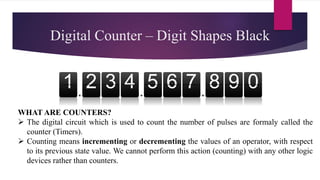
Digital Counter – Digit Shapes Black
WHAT ARE COUNTERS?
 The digital circuit which is used to count the number of pulses are formaly called the
counter (Timers).
 Counting means incrementing or decrementing the values of an operator, with respect
to its previous state value. We cannot perform this action (counting) with any other logic
devices rather than counters.
 Asynchronous counter
 Synchronous counter
 Up and down counter
 Decade counter
 Ring counter
Types of Counter
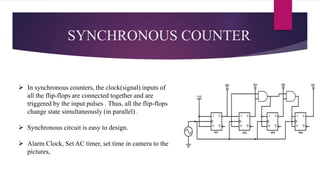
SYNCHRONOUS COUNTER
 In synchronous counters, the clock(signal) inputs of
all the flip-flops are connected together and are
triggered by the input pulses . Thus, all the flip-flops
change state simultaneously (in parallel) .
 Synchronous circuit is easy to design.
 Alarm Clock, Set AC timer, set time in camera to the
pictures,
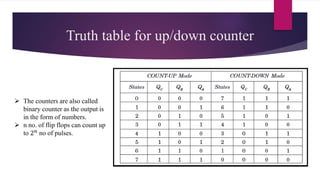
Truth table for up/down counter
 The counters are also called
binary counter as the output is
in the form of numbers.
 n no. of flip flops can count up
to 2𝑛
no of pulses.
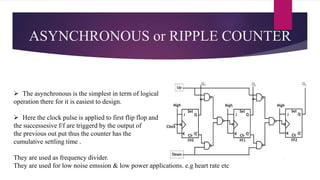
ASYNCHRONOUS or RIPPLE COUNTER
 The asynchronous is the simplest in term of logical
operation there for it is easiest to design.
 Here the clock pulse is applied to first flip flop and
the successesive f/f are triggerd by the output of
the previous out put thus the counter has the
cumulative settling time .
They are used as frequency divider.
They are used for low noise emssion & low power applications. e.g heart rate etc
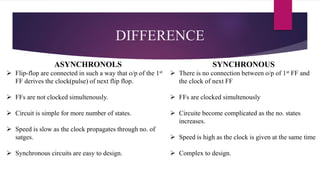
DIFFERENCE
ASYNCHRONOLS
 Flip-flop are connected in such a way that o/p of the 1st
FF derives the clock(pulse) of next flip flop.
 FFs are not clocked simultenously.
 Circuit is simple for more number of states.
 Speed is slow as the clock propagates through no. of
satges.
 Synchronous circuits are easy to design.
SYNCHRONOUS
 There is no connection between o/p of 1st FF and
the clock of next FF
 FFs are clocked simultenously
 Circuite become complicated as the no. states
increases.
 Speed is high as the clock is given at the same time
 Complex to design.
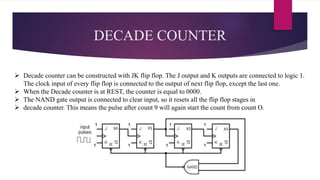
DECADE COUNTER
 Decade counter can be constructed with JK flip flop. The J output and K outputs are connected to logic 1.
The clock input of every flip flop is connected to the output of next flip flop, except the last one.
 When the Decade counter is at REST, the counter is equal to 0000.
 The NAND gate output is connected to clear input, so it resets all the flip flop stages in
 decade counter. This means the pulse after count 9 will again start the count from count O.
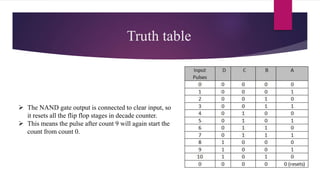
Truth table
 The NAND gate output is connected to clear input, so
it resets all the flip flop stages in decade counter.
 This means the pulse after count 9 will again start the
count from count 0.
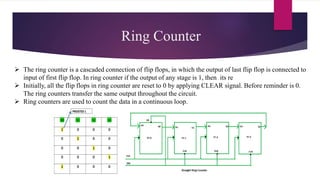
Ring Counter
 The ring counter is a cascaded connection of flip flops, in which the output of last flip flop is connected to
input of first flip flop. In ring counter if the output of any stage is 1, then its re
 Initially, all the flip flops in ring counter are reset to 0 by applying CLEAR signal. Before reminder is 0.
The ring counters transfer the same output throughout the circuit.
 Ring counters are used to count the data in a continuous loop.
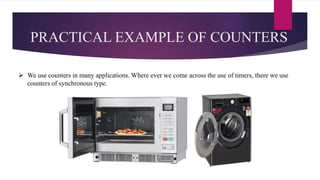
PRACTICAL EXAMPLE OF COUNTERS
 We use counters in many applications. Where ever we come across the use of timers, there we use
counters of synchronous type.
PROGRAMMABLE LOGIC CONTROLLER (PLC)
Programmable controller is a digital computer used for automation of typically industrial electromechanical processes.
APPLICATION
 Frequency counters
 Digital clocks
 Analog to digital convertors.
 With some changes in their design, counters can be used as frequency divider circuits. The frequency
divider circuit is that which divide s the input frequency exactly by '2'.
 In time measurement. That means calculating time in timers such as electronic devices like ovens and
washing machines.
 We can design digital triangular wave generator by using counters.

COUNTERS.pptx

  • 2.
    ABOUT ME CONTACT INFO Tel:(+92) 322 7967172 E-Mail: abubakarmehmood786@yahoo.com SKILLS & LANGUAGE ORIGIN LAB, VIRTUAL LAB, ENDNOTE SOFTWARE, EMATHHELP SOFTWARE , MICROSOFT OFFICE, ADBOBE (PHOTOSHOP & ILUUSTRATOR), ARDUINO SOFTWARE, AMAZON VITUAL ASSISTAN, VIDEO EDITTING, SOCIAL MEDIA ACCOUNT MANAGEMENT URDU, PUNJABI, ENGLISH, ARABIC FOUNDER UCQxAo-GBHUI2l9_LBYicsRw THE CREATOR ACADEMY thecreatorsacademyofficial thecreatorsacademyofficial The Creators Academy ABU BAKAR NATIONALITY : PAKISTAN CITY : SIALKOT, PUNJAB MARITAL STATUS : SINGLE PERSONAL PROFILE BS(HONS) PHYSICS UNIVERSITY OF SIALKOT EDUCATION SOCIAL MEDIA Abubakar Bhutta @_abubakar786 ABU BAKAR @abubakar786786 ABUBAKAR692909
  • 4.
    1 2 34 6 5 7 8 9 0 Digital Counter – Digit Shapes Black WHAT ARE COUNTERS?  The digital circuit which is used to count the number of pulses are formaly called the counter (Timers).  Counting means incrementing or decrementing the values of an operator, with respect to its previous state value. We cannot perform this action (counting) with any other logic devices rather than counters.
  • 5.
     Asynchronous counter Synchronous counter  Up and down counter  Decade counter  Ring counter Types of Counter
  • 6.
    SYNCHRONOUS COUNTER  Insynchronous counters, the clock(signal) inputs of all the flip-flops are connected together and are triggered by the input pulses . Thus, all the flip-flops change state simultaneously (in parallel) .  Synchronous circuit is easy to design.  Alarm Clock, Set AC timer, set time in camera to the pictures,
  • 7.
    Truth table forup/down counter  The counters are also called binary counter as the output is in the form of numbers.  n no. of flip flops can count up to 2𝑛 no of pulses.
  • 8.
    ASYNCHRONOUS or RIPPLECOUNTER  The asynchronous is the simplest in term of logical operation there for it is easiest to design.  Here the clock pulse is applied to first flip flop and the successesive f/f are triggerd by the output of the previous out put thus the counter has the cumulative settling time . They are used as frequency divider. They are used for low noise emssion & low power applications. e.g heart rate etc
  • 9.
    DIFFERENCE ASYNCHRONOLS  Flip-flop areconnected in such a way that o/p of the 1st FF derives the clock(pulse) of next flip flop.  FFs are not clocked simultenously.  Circuit is simple for more number of states.  Speed is slow as the clock propagates through no. of satges.  Synchronous circuits are easy to design. SYNCHRONOUS  There is no connection between o/p of 1st FF and the clock of next FF  FFs are clocked simultenously  Circuite become complicated as the no. states increases.  Speed is high as the clock is given at the same time  Complex to design.
  • 10.
    DECADE COUNTER  Decadecounter can be constructed with JK flip flop. The J output and K outputs are connected to logic 1. The clock input of every flip flop is connected to the output of next flip flop, except the last one.  When the Decade counter is at REST, the counter is equal to 0000.  The NAND gate output is connected to clear input, so it resets all the flip flop stages in  decade counter. This means the pulse after count 9 will again start the count from count O.
  • 11.
    Truth table  TheNAND gate output is connected to clear input, so it resets all the flip flop stages in decade counter.  This means the pulse after count 9 will again start the count from count 0.
  • 12.
    Ring Counter  Thering counter is a cascaded connection of flip flops, in which the output of last flip flop is connected to input of first flip flop. In ring counter if the output of any stage is 1, then its re  Initially, all the flip flops in ring counter are reset to 0 by applying CLEAR signal. Before reminder is 0. The ring counters transfer the same output throughout the circuit.  Ring counters are used to count the data in a continuous loop.
  • 13.
    PRACTICAL EXAMPLE OFCOUNTERS  We use counters in many applications. Where ever we come across the use of timers, there we use counters of synchronous type.
  • 14.
    PROGRAMMABLE LOGIC CONTROLLER(PLC) Programmable controller is a digital computer used for automation of typically industrial electromechanical processes. APPLICATION  Frequency counters  Digital clocks  Analog to digital convertors.  With some changes in their design, counters can be used as frequency divider circuits. The frequency divider circuit is that which divide s the input frequency exactly by '2'.  In time measurement. That means calculating time in timers such as electronic devices like ovens and washing machines.  We can design digital triangular wave generator by using counters.