Presentation on
Presented by:
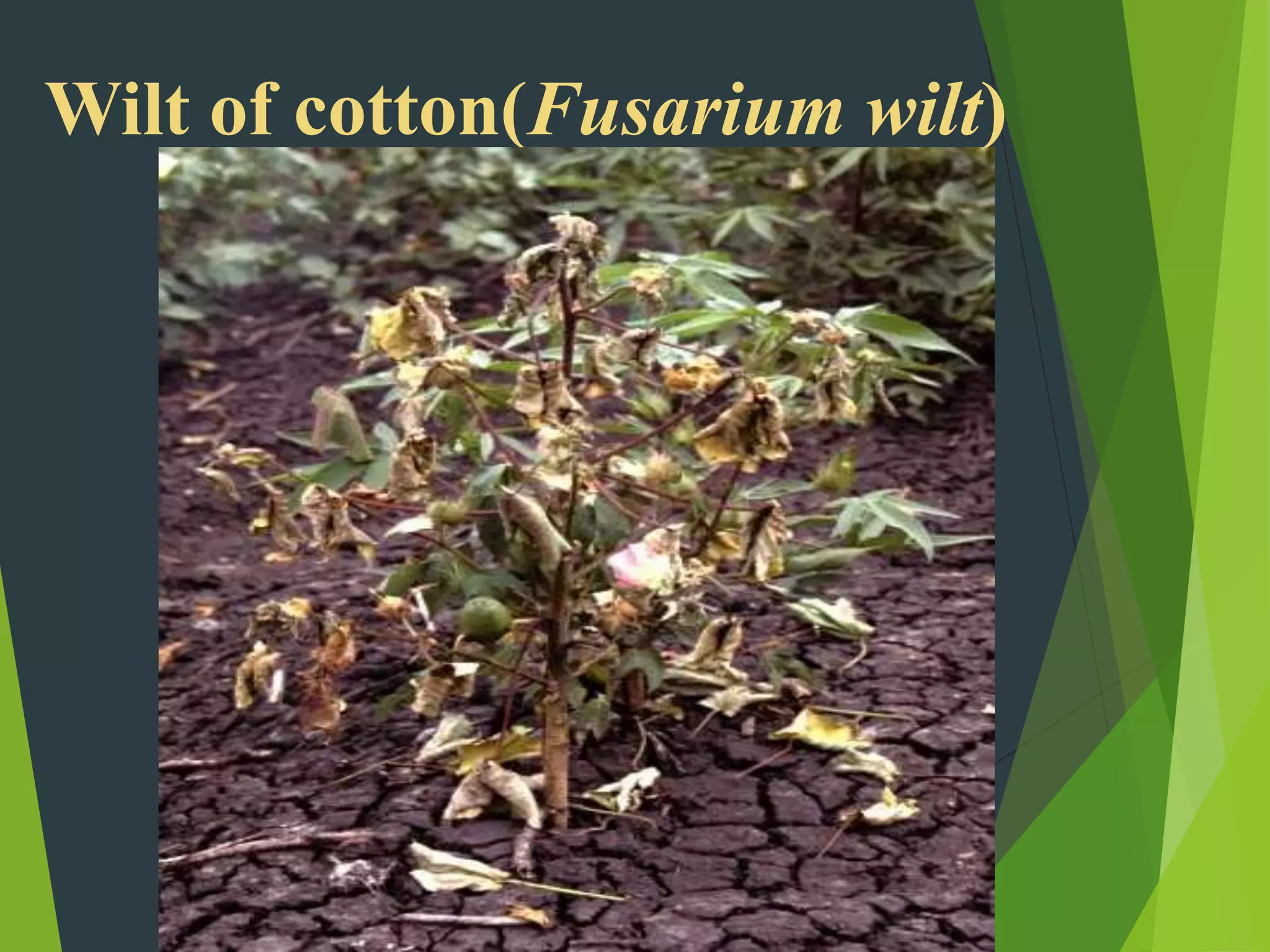
Wilt of cotton(Fusarium wilt)
Favourable Condition
Disease incidence in seedlings can be
high in cold soil.
Mean temperature of about 23oC favour
the disease.
More prevalent in black cotton
soils(heavy clay) with an alkaline
reaction.
Fusarium wilt is a stress-related
pathogen.
ETIOLOGY AND SYMPTOMS
Fusarium oxysporum f.sp. Vasinfectum
 The earliest symptoms appear on the seedlings
in the cotyledons(1-3 weeks old).
 The leaves start to turn yellow
 Discoloration starting from margin followed
by epinasty and defoliation leaving the stem
bare.
Symptoms contd.
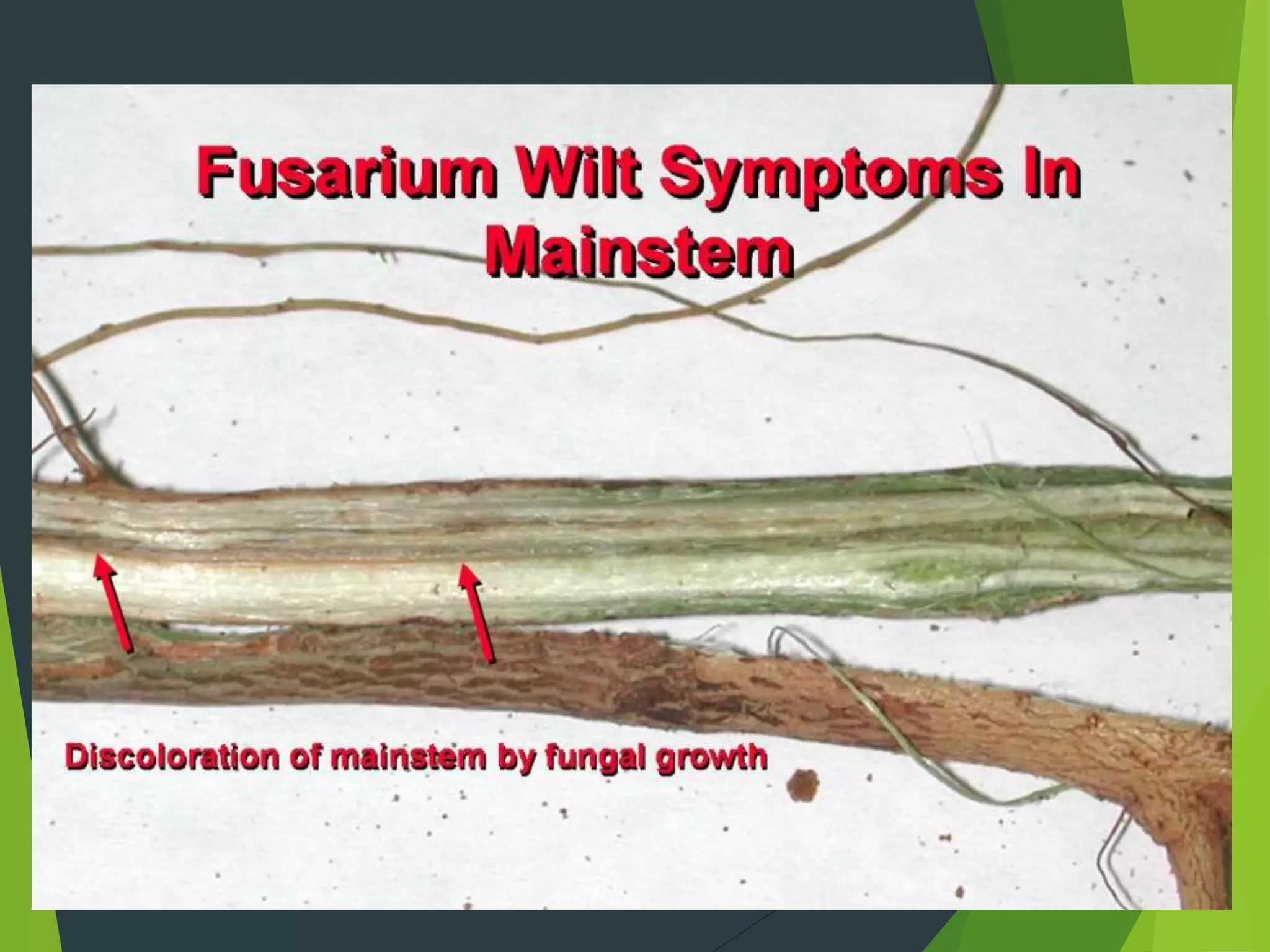
 Owning or blackening of vascular tissues is
the other important symptom, black streaks
or stripes(Vessels plunging) may be seen
extending upwards to the branches and
downwards to lateral roots.
 In severe cases, discolouration may extend
throughout the plant.
 In transverse section, discoloured ring is
seen in the woody tissues of stem.
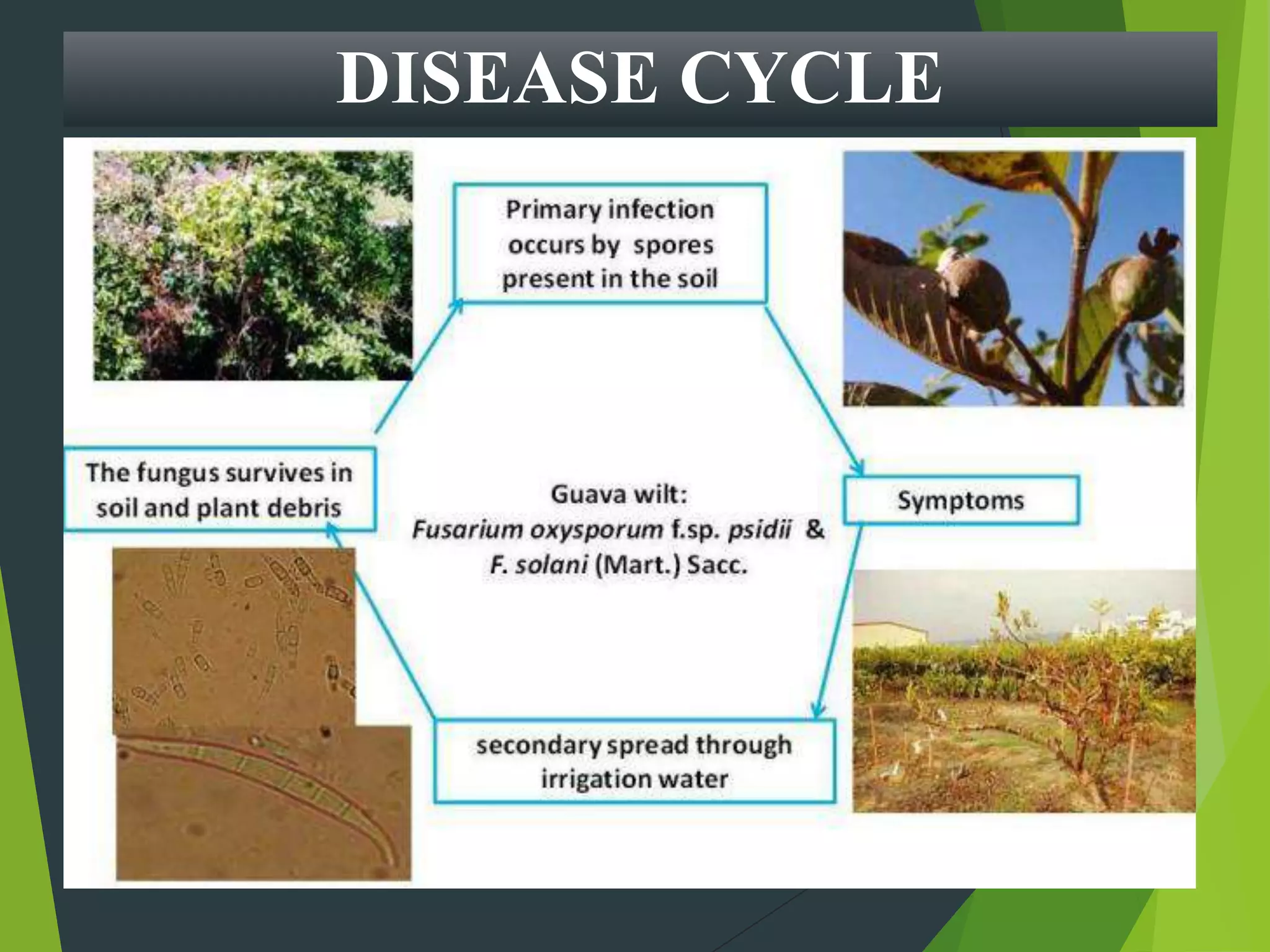
DISEASE CYCLE
 The fungus can produce 3 types of spores:
Micro conidia, Macro conidia and Chlamydiospores
 The fungus can survive in soil as saprophyte for
many years and chlamydospores act as resting spores.
 The pathogen is both externally and internally seed-
borne.
 The primary infection is mainly from dormant hyphae
and chlamydospores in the soil.
 The secondary spread is through conidia and
chlamydospores which are disseminated by irrigation
water.
EPIDEMIOLOGY
 Soil temperature of 20-30 0C, hot and dry
periods followed by rains.
 Heavy black soils with an alkaline reaction,
increased doses of nitrogen and phosphatic
fertilizers, soil amendment with manganese
and wounds caused by nematode
(Meloidogyne incognita) and grubs of
Ashweevil (Myllocerus pustulatus).
MANAGEMENT
 Treat the acid-delinted seeds with Carboxin or
Chlorothalonil at 4 g/kg or
Carbendazim@2g/kg seed.
 Remove and burn the infected plant debris in
the soil after deep summer ploughing.
 Apply increased doses of potash with a
balanced dose of nitrogenous and phosphatic
fertilizers.
Management contd.
 Apply heavy doses of farm yard manure or other
organic manures at 10 t/ha.
 Follow mixed cropping with non-host plants.
 Grow disease resistant varieties of G. hirsutum and
G. barbadense like Varalakshmi, Vijaya,
Pratap,Jayadhar, Jarila, Jyothi, G 22 and Verum, HD
324, HD 432.
OCCURENCE AND IMPORTANCE
 Wilt is a pernicious disease of guava in India.
 In India the disease was first recorded near
Allahabad in 1935 . The infection was reported 15
-30 %.
 The disease is a serious threat to guava cultivation
in U.P. In West Bengal it reduces the yield in
affected orchard by 80% .
 The disease is also prevalent in Haryana
Rajasthan , A.P , Punjab and M.P.
 It has forced uprooting of about 150 acre of guava
orchard in Panjab and 300 acres in Haryana during
1971-81.
ETIOLOGY
 The exact cause of the disease is still not fully
understood but the pathogens viz. Fusarium oxysporum
f. sp. psidii (Prasad, Mehta & Lal), Rhizoctonia
bataticola Marcrophomina phaseoli and various
pathogens are reported by different workers may be the
incitant of the disease.
Survival and spread:
 Through movement of plants containing sick soil in
virgin areas.
 Short distance spread is by water.
 Root injury predisposes wilt disease.
Favourable conditions
 High rainfall during August/ September.
 Stagnation of water in guava field for long duration.
 Maximum and minimum temperature ranges 23-32 °C
with 76% RH are conducive.
 Lack of timely application of suitable control measures.
 There is severe incidence of wilt in alkaline soils at pH
ranging from 7.5 to 9.0 or in lateritic soils at pH 6.5 .
 Guava seedlings are more susceptible to F. solani as well
as F. oxysporum f.sp. psidii than older plants of 3 years
age.
 On the other hand researchers reported that F. solani could
infect guava plants from 1-month-old to more than 4 years
old.
SYMPTOMS
The leaves shed of
premature , fruit size remain
smaller, bare twig fail to
develop new leaves and
flower dry up.
 Browning and wilting of
leaves from tip.
Discolouration of stem
and death of branches and
then the whole tree dry up.
 The inner part of stem
and root upto cambium and
vascular tissues show a
distinct discolouration.
DISEASE CYCLE
MANAGEMENT
 Proper sanitation.
 Soil solarization.
 Uprooted and burnt wilted plants.
 Severe pruning followed by a drench with .2 %
Benlate or Bavistine 4 times in a year.
 Injection guava plant with 0.1 % water soluble 8-
quinolinol sulphate may provide protection against
wilt for at least 1 year.
 Use of resistant and tolerant varieties like ,
Allahabad Safeda , Dholka , Sindh etc.
Thank you…
Presented to:
Mr. Rajan Poudel
 Mrs. Anju Pandey
Asst. Professors
Department of
Pathology, IAAS,
Paklihawa, TU

Cotton and guava wilt

  • 1.
  • 2.
  • 3.
    Favourable Condition Disease incidencein seedlings can be high in cold soil. Mean temperature of about 23oC favour the disease. More prevalent in black cotton soils(heavy clay) with an alkaline reaction. Fusarium wilt is a stress-related pathogen.
  • 4.
    ETIOLOGY AND SYMPTOMS Fusariumoxysporum f.sp. Vasinfectum  The earliest symptoms appear on the seedlings in the cotyledons(1-3 weeks old).  The leaves start to turn yellow  Discoloration starting from margin followed by epinasty and defoliation leaving the stem bare.
  • 6.
    Symptoms contd.  Owningor blackening of vascular tissues is the other important symptom, black streaks or stripes(Vessels plunging) may be seen extending upwards to the branches and downwards to lateral roots.  In severe cases, discolouration may extend throughout the plant.  In transverse section, discoloured ring is seen in the woody tissues of stem.
  • 8.
    DISEASE CYCLE  Thefungus can produce 3 types of spores: Micro conidia, Macro conidia and Chlamydiospores  The fungus can survive in soil as saprophyte for many years and chlamydospores act as resting spores.  The pathogen is both externally and internally seed- borne.  The primary infection is mainly from dormant hyphae and chlamydospores in the soil.  The secondary spread is through conidia and chlamydospores which are disseminated by irrigation water.
  • 10.
    EPIDEMIOLOGY  Soil temperatureof 20-30 0C, hot and dry periods followed by rains.  Heavy black soils with an alkaline reaction, increased doses of nitrogen and phosphatic fertilizers, soil amendment with manganese and wounds caused by nematode (Meloidogyne incognita) and grubs of Ashweevil (Myllocerus pustulatus).
  • 11.
    MANAGEMENT  Treat theacid-delinted seeds with Carboxin or Chlorothalonil at 4 g/kg or Carbendazim@2g/kg seed.  Remove and burn the infected plant debris in the soil after deep summer ploughing.  Apply increased doses of potash with a balanced dose of nitrogenous and phosphatic fertilizers.
  • 12.
    Management contd.  Applyheavy doses of farm yard manure or other organic manures at 10 t/ha.  Follow mixed cropping with non-host plants.  Grow disease resistant varieties of G. hirsutum and G. barbadense like Varalakshmi, Vijaya, Pratap,Jayadhar, Jarila, Jyothi, G 22 and Verum, HD 324, HD 432.
  • 14.
    OCCURENCE AND IMPORTANCE Wilt is a pernicious disease of guava in India.  In India the disease was first recorded near Allahabad in 1935 . The infection was reported 15 -30 %.  The disease is a serious threat to guava cultivation in U.P. In West Bengal it reduces the yield in affected orchard by 80% .  The disease is also prevalent in Haryana Rajasthan , A.P , Punjab and M.P.  It has forced uprooting of about 150 acre of guava orchard in Panjab and 300 acres in Haryana during 1971-81.
  • 15.
    ETIOLOGY  The exactcause of the disease is still not fully understood but the pathogens viz. Fusarium oxysporum f. sp. psidii (Prasad, Mehta & Lal), Rhizoctonia bataticola Marcrophomina phaseoli and various pathogens are reported by different workers may be the incitant of the disease. Survival and spread:  Through movement of plants containing sick soil in virgin areas.  Short distance spread is by water.  Root injury predisposes wilt disease.
  • 16.
    Favourable conditions  Highrainfall during August/ September.  Stagnation of water in guava field for long duration.  Maximum and minimum temperature ranges 23-32 °C with 76% RH are conducive.  Lack of timely application of suitable control measures.  There is severe incidence of wilt in alkaline soils at pH ranging from 7.5 to 9.0 or in lateritic soils at pH 6.5 .  Guava seedlings are more susceptible to F. solani as well as F. oxysporum f.sp. psidii than older plants of 3 years age.  On the other hand researchers reported that F. solani could infect guava plants from 1-month-old to more than 4 years old.
  • 17.
    SYMPTOMS The leaves shedof premature , fruit size remain smaller, bare twig fail to develop new leaves and flower dry up.  Browning and wilting of leaves from tip. Discolouration of stem and death of branches and then the whole tree dry up.  The inner part of stem and root upto cambium and vascular tissues show a distinct discolouration.
  • 18.
  • 19.
    MANAGEMENT  Proper sanitation. Soil solarization.  Uprooted and burnt wilted plants.  Severe pruning followed by a drench with .2 % Benlate or Bavistine 4 times in a year.  Injection guava plant with 0.1 % water soluble 8- quinolinol sulphate may provide protection against wilt for at least 1 year.  Use of resistant and tolerant varieties like , Allahabad Safeda , Dholka , Sindh etc.
  • 20.
    Thank you… Presented to: Mr.Rajan Poudel  Mrs. Anju Pandey Asst. Professors Department of Pathology, IAAS, Paklihawa, TU