Core Values and Code of Ethics
Followed By Every Social Worker
Dr. Suresh Borole
Introduction
● Social workers should "support the well-being of everybody without
discrimination" as they are "committed to service for the welfare of
mankind."
● The six basic values upon which the code of ethics is based are
outlined, along with the general ethical standards that go along with
them that social workers should use as a reference in their work.
What are Social Work Ethics?
● Ethics are a set of moral principles or a moral philosophy that directs
one's behavior and activities.
● It is also described as a collection of rules or a code of ethics established
by a business or a profession.
● Social workers must comply with social work ethics when functioning in
their position as professionals.
● Ethics distinguish between right and wrong and define what is
appropriate or inappropriate behavior.
Who Develops Social Work Ethics?
● Social workers' ethical standards are developed by the National Association
of Social Workers (NASW).
● The largest membership organization for social workers in the world is
NASW.
● The standards, values, and guiding principles for the profession are
established by the NASW.
Six Core Values of the Social Work Profession
● Service
● Social justice
● Dignity and worth of the person
● Importance of human relationships
● Integrity
● Competence
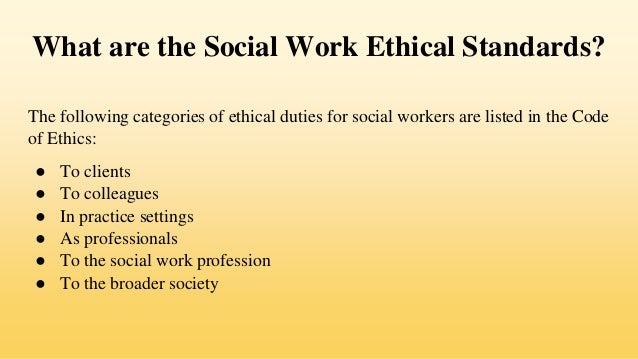
What are the Social Work Ethical Standards?
The following categories of ethical duties for social workers are listed in the Code
of Ethics:
● To clients
● To colleagues
● In practice settings
● As professionals
● To the social work profession
● To the broader society
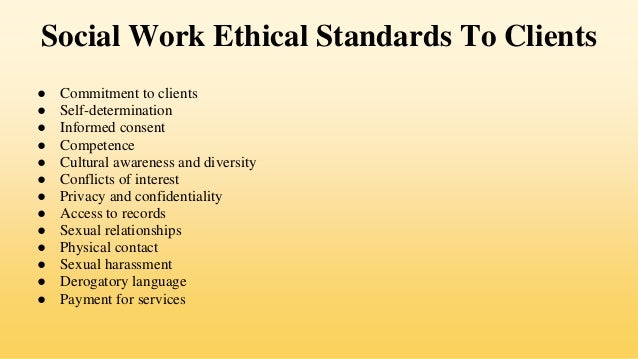
Social Work Ethical Standards To Clients
● Commitment to clients
● Self-determination
● Informed consent
● Competence
● Cultural awareness and diversity
● Conflicts of interest
● Privacy and confidentiality
● Access to records
● Sexual relationships
● Physical contact
● Sexual harassment
● Derogatory language
● Payment for services
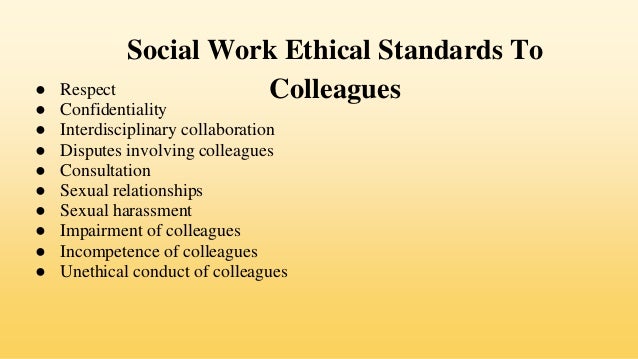
Social Work Ethical Standards To
Colleagues
● Respect
● Confidentiality
● Interdisciplinary collaboration
● Disputes involving colleagues
● Consultation
● Sexual relationships
● Sexual harassment
● Impairment of colleagues
● Incompetence of colleagues
● Unethical conduct of colleagues
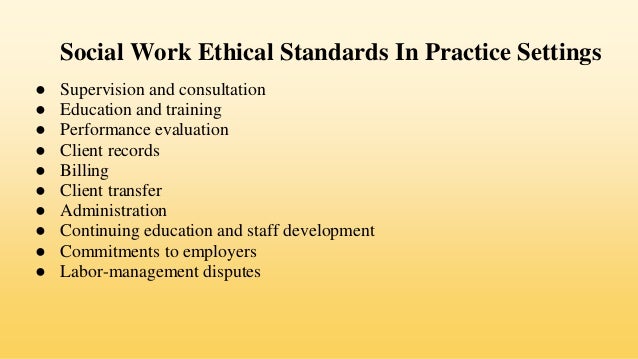
Social Work Ethical Standards In Practice Settings
● Supervision and consultation
● Education and training
● Performance evaluation
● Client records
● Billing
● Client transfer
● Administration
● Continuing education and staff development
● Commitments to employers
● Labor-management disputes
Social Work Ethical Standards As Professionals
● Competence
● Discrimination
● Private conduct
● Dishonesty, fraud, and deception
● Impairment
● Misrepresentation
● Solicitations
● Acknowledging credit
Social Work Ethical Standards To the Social
Work Profession
● The integrity of the profession
● Evaluation and research
Social Work Ethical Standards To The
Broader Society
● Social welfare
● Public participation
● Public emergencies
● Social and Political action
Thank You

Core Values and Code of Ethics Followed By Every Social Worker.pptx

  • 1.
    Core Values andCode of Ethics Followed By Every Social Worker Dr. Suresh Borole
  • 2.
    Introduction ● Social workersshould "support the well-being of everybody without discrimination" as they are "committed to service for the welfare of mankind." ● The six basic values upon which the code of ethics is based are outlined, along with the general ethical standards that go along with them that social workers should use as a reference in their work.
  • 3.
    What are SocialWork Ethics? ● Ethics are a set of moral principles or a moral philosophy that directs one's behavior and activities. ● It is also described as a collection of rules or a code of ethics established by a business or a profession. ● Social workers must comply with social work ethics when functioning in their position as professionals. ● Ethics distinguish between right and wrong and define what is appropriate or inappropriate behavior.
  • 4.
    Who Develops SocialWork Ethics? ● Social workers' ethical standards are developed by the National Association of Social Workers (NASW). ● The largest membership organization for social workers in the world is NASW. ● The standards, values, and guiding principles for the profession are established by the NASW.
  • 5.
    Six Core Valuesof the Social Work Profession ● Service ● Social justice ● Dignity and worth of the person ● Importance of human relationships ● Integrity ● Competence
  • 6.
    What are theSocial Work Ethical Standards? The following categories of ethical duties for social workers are listed in the Code of Ethics: ● To clients ● To colleagues ● In practice settings ● As professionals ● To the social work profession ● To the broader society
  • 7.
    Social Work EthicalStandards To Clients ● Commitment to clients ● Self-determination ● Informed consent ● Competence ● Cultural awareness and diversity ● Conflicts of interest ● Privacy and confidentiality ● Access to records ● Sexual relationships ● Physical contact ● Sexual harassment ● Derogatory language ● Payment for services
  • 8.
    Social Work EthicalStandards To Colleagues ● Respect ● Confidentiality ● Interdisciplinary collaboration ● Disputes involving colleagues ● Consultation ● Sexual relationships ● Sexual harassment ● Impairment of colleagues ● Incompetence of colleagues ● Unethical conduct of colleagues
  • 9.
    Social Work EthicalStandards In Practice Settings ● Supervision and consultation ● Education and training ● Performance evaluation ● Client records ● Billing ● Client transfer ● Administration ● Continuing education and staff development ● Commitments to employers ● Labor-management disputes
  • 10.
    Social Work EthicalStandards As Professionals ● Competence ● Discrimination ● Private conduct ● Dishonesty, fraud, and deception ● Impairment ● Misrepresentation ● Solicitations ● Acknowledging credit
  • 11.
    Social Work EthicalStandards To the Social Work Profession ● The integrity of the profession ● Evaluation and research
  • 12.
    Social Work EthicalStandards To The Broader Society ● Social welfare ● Public participation ● Public emergencies ● Social and Political action
  • 13.