Download the full version and explore a variety of test banks
or solution manuals at https://testbankdeal.com
Core Concepts Of Accounting Information Systems
12th Edition Simkin Solutions Manual

_____ Tap the link below to start your download _____
https://testbankdeal.com/product/core-concepts-of-
accounting-information-systems-12th-edition-simkin-
solutions-manual/
Find test banks or solution manuals at testbankdeal.com today!
We believe these products will be a great fit for you. Click
the link to download now, or visit testbankdeal.com
to discover even more!
Core Concepts Of Accounting Information Systems 12th
Edition Simkin Test Bank
https://testbankdeal.com/product/core-concepts-of-accounting-
information-systems-12th-edition-simkin-test-bank/
Core Concepts of Accounting Information Systems 13th
Edition Simkin Solutions Manual
https://testbankdeal.com/product/core-concepts-of-accounting-
information-systems-13th-edition-simkin-solutions-manual/
Core Concepts of Accounting Information Systems 14th
Edition Simkin Solutions Manual
https://testbankdeal.com/product/core-concepts-of-accounting-
information-systems-14th-edition-simkin-solutions-manual/
Economics Canada in the Global Environment Canadian 8th
Edition Parkin Test Bank
https://testbankdeal.com/product/economics-canada-in-the-global-
environment-canadian-8th-edition-parkin-test-bank/
Small Business An Entrepreneurs Plan Enhanced Canadian 7th
Edition Knowles Solutions Manual
https://testbankdeal.com/product/small-business-an-entrepreneurs-plan-
enhanced-canadian-7th-edition-knowles-solutions-manual/
Mathematics Its Power and Utility 10th Edition Smith
Solutions Manual
https://testbankdeal.com/product/mathematics-its-power-and-
utility-10th-edition-smith-solutions-manual/
Statistics Data Analysis and Decision Modeling 5th Edition
Evans Test Bank
https://testbankdeal.com/product/statistics-data-analysis-and-
decision-modeling-5th-edition-evans-test-bank/
Intermediate Accounting Vol 1 Canadian 3rd Edition Lo Test
Bank
https://testbankdeal.com/product/intermediate-accounting-
vol-1-canadian-3rd-edition-lo-test-bank/
Cornerstones of Managerial Accounting Canadian 2nd Edition
Mowen Test Bank
https://testbankdeal.com/product/cornerstones-of-managerial-
accounting-canadian-2nd-edition-mowen-test-bank/
Small Animal Care and Management 4th Edition Warren
Solutions Manual
https://testbankdeal.com/product/small-animal-care-and-management-4th-
edition-warren-solutions-manual/
SM 8.1
Chapter 8
Accounting Information Systems and Business Processes:
Part II
Discussion Questions
8-1. Four data items that both payroll and personnel functions would use are: employee
number (or SSN), employee name, department, and title. Personnel data would also include data
such as date hired, date of birth, and contact and family data. Payroll data would include pay rate,
job code, and information about deductions.
8-2. Accounting transactions for payroll processing involve essentially the same steps for
each employee. Gross pay, deductions, and net pay must all be calculated. These calculations
involve a lot of basic math (e.g., footing and cross-footing). Outside service bureaus may be less
expensive for payroll processing. They may also offer some advantages in terms of confidentiality.
8-3. Data items likely to be added when inputting a new raw materials inventory item
include: merchandise number, description, quantity measure (e.g., yard, pound, pair, etc.), vendor,
and cost. When a worker records time spent on a production line, data to be input include: worker
identification number, time started and stopped, department to be charged, and rate. In both these
examples, there are other data items that an AIS may capture, depending on the nature of the
reports to be output.
8-4. Nonfinancial information that an AIS might capture about a manufacturing firm’s
production process would primarily consist of information that would help in evaluating productivity
and performance. For example, information needed for control would be the amount of wasted
materials and machine downtime. Productivity information would relate to the amount of time
needed to produce a product or each product component. AISs tend to focus on dollar
measurements, but in many cases, measurements of quantities are equally important to a
business organization.
8-5. The basic concepts are a commitment to eliminate waste, simplify procedures and
speed up production. There are five areas that drive lean manufacturing, and they are cost, quality,
delivery, safety, and morale. Non-value added activities (waste) are eliminated through continuous
improvement efforts (http://www.1000ventures.com/business_guide/lean_production_main.html).
The concepts that are at the heart of lean production/manufacturing are total quality management
and continuous improvement.
8-6. AIM Industries, a metal stamping company, located in Grand Haven, MI has been in
business for over 40 years. Jeanne Duthler had 10 employees when she bought the plant in 1984.
Now there are 37, and last year’s sales were $5 million. The company is doing the same numbers
dollar wise as they did last year, but showing more profit as a result of lean manufacturing. For
2007, the company expected to increase profitability by 10%.
Lean practices at AIM include:
• Consolidating production steps
• Having raw materials set up at hand to save time and increase productivity
• Moving presses to make production flow smoother
• Finishing a product in one space rather than walking to another room for finishing
SM 8.2
For more examples, see Karen Kroll, “The Lowdown on Lean Accounting,” The Journal of
Accountancy (July 2004), pp. 69-76.
8-7. For examples, see Karen Kroll, “The Lowdown on Lean Accounting,” The Journal of
Accountancy (July 2004), pp. 69-76.
8-8. Both homebuilders and cement companies have information needs related to their
manufacturing processes. The primary difference between these two companies concerns the
need to maintain a job order versus a process costing system. The homebuilder is likely to track
many costs for each individual house built. The cement company will use an AIS that uses input
and output data to calculate costs for specific quantities. This distinction is likely to impact the type
of accounting software a company chooses. Some software packages are specially designed for
either job order or process costing manufacturing environments.
8-9. This chapter discussed AISs for the professional services, health care, and not-for-profit
industries. Some students feel that “the absence of merchandise inventory” is the unique
characteristic of service organizations that causes the greatest problem in their AISs (i.e., budget
forecasting of “returns-on-assets employed” can be difficult). However, the greatest problem may
be the difficulty in measuring the quantity and quality of output, which gives rise to difficulties in
budgetary planning activities, as well as developing preestablished operational quality goals for its
intangible products. These difficulties can cause various negligence suits against service
organizations.
Other vertical market industries include insurance, banking, construction, manufacturing, retail,
hospitality, and government organizations. Each is somewhat unique in its AIS needs. Insurance
has many special issues including co-insurance. The insurance industry is quite diverse and
various kinds of insurers need a variety of accounting information. An important issue for the
insurance industry is fraud. The banking industry must deal with check clearing, credit ratings and
credit histories, as well as information about financial markets. The construction industry is
concerned with projects and has a need for job cost accounting systems and bidding capabilities.
Retailers use POS (point-of-sale) systems to collect a variety of data helpful in analyzing sales.
Manufacturing systems need inventory control systems that allow them to efficiently manage a
variety of inventories. These systems may be quite sophisticated and can include MRP II and/or
ERP capabilities (input technologies might also be used, such as RFIDs and bar codes). The
hospitality industry includes restaurants and hotels and so its information systems vary.
Restaurants are concerned with monitoring costs and perishable inventories. Hotels need
sophisticated reservation systems that can handle various billing rates. AISs for government
entities are built around fund accounting and must comply with governmental accounting
standards. These are just a few of the issues you might discuss relative to these industries.
8-10. To ensure that a business reengineering effort is successful, managers will want to
“champion” the effort. This means obtaining a buy in from employees and showing unwavering
commitment and enthusiasm for the project. Honesty is important because many workers equate
reengineering with downsizing. Managers should be realistic about jobs that may be lost and
should prepare to retrain workers or provide career counseling to affected employees.
Management should be conservative in estimating the benefits to accrue from reengineering
efforts, as well as the costs that may be incurred. The cost of reengineering can be high. Several
good reference articles on this topic are:
“Change Champions,” J. Berk, The Internal Auditor, April 2006, pp.64-68.
SM 8.3
“Get Ready: The Rules are Changing,” K. Melymuka, Computerworld, June 13, 2005, p. 38.
“Are Companies Really Ready for Stretch Targets?” C. Chen and K. Jones, Management
Accounting Quarterly, Summer 2005, pp.10-18.
Problems
8-11. This question requires students to do some outside research. It is useful for students
since it helps them to understand how industries vary in their accounting information needs.
Students might be randomly assigned to investigate health care, insurance, banking, construction,
manufacturing, retail, professional service, hospitality, not-for-profit, or government organizations.
Each of these organizations has very specialized AIS needs. Students may find that accounting
systems for these organizations consist of generic accounting software, supplemented by
spreadsheets and databases. They may also learn that many of the organizations use very
specific programs. For instance, a student who looks at catering firms might learn about catering
software and its special complexities. Students can be sent to doctor's offices, retail stores,
restaurants, and so on to interview employees about the accounting software used. There are
many sources of information about vertical market software programs, including personal
interviews and accounting magazines/journals.
Students might also use an Internet search engine, such as Yahoo or Google, to find sites for
many accounting software programs. Using the terms “construction software,” “health software,”
and “retail software,” students will find many specialized software vendors. You may want to ask
students to print web pages for specific vendors, or to do some analysis of the special features
associated with software for each industry. For example, the following web sites offer information
on software for dentists to manage their practice:
http://www.dentrix.com
http://gbsystems.com/os96i.htm
http://www.dentalexec.com/dental-exec
8-12. As you might imagine there are a wide variety of choices that students might identify for
this problem. The important point to make with the students is that the solution should match the
company size, needs, and other factors that the supervisor “should” identify before the search is
conducted. However, the following are a representative sampling of the choices available:
• ADP Payroll Software for Microsoft Office Small Business Accounting
(http://www.microsoft.com/smallbusiness/products/office/accounting/payroll-software.mspx)
• ZPay Payroll Systems offers technical support, tutorials, and a free 30-day trial
(http://www.zpay.com/)
• PenSoft Payroll Solutions is designed for small to mid-sized businesses, and can process
virtually any payroll and related tax requirements. (http://www.pensoft.com/aboutus.asp)
8-13. Again, there are a wide variety of choices that students might identify to help CEOs and
CFOs deal with the compliance requirements of the Sarbanes-Oxley Act, specifically the Section
302 and Section 404 reviews. Many business process management solutions are already
available to managers. The following web sites offer information on this type of BPM software:
http://www.longview.com
http://www.approva.net/products
SM 8.4
8-14. An automated time and billing system could help this firm in several ways. First, by
investing in an in-house time and billing software, it may be possible to significantly reduce the
expense associated with the outside accountant. Since this type of software may be integrated with
a complete AIS, the outside accountant would not need to compile financial statements. The
system would do this automatically.
Another way the automated time and billing system would help is by capturing more detail. A
manual system cannot keep track of so many items without becoming unwieldy. The automated
system can keep track of specific charges by customer and therefore reduce overhead to be
allocated. With an automated system, many indirect costs may become direct costs. For
instance, secretarial work, phone expenses, and copying may all be directly related to a
particular client.
An automated system will be able to analyze data in many different ways. Each lawyer's
billable hours can be computed and compared for various periods, for example. Productivity
reports and reports highlighting budget overruns can be produced easily with an automated
system. What an automated system cannot do is to force lawyers to record their activities on a
timely basis. This is frequently a problem in professional service firms. Some organizations
resolve the problem by holding up paychecks until time sheets are filled out completely and
accurately. Other solutions lie in technology that makes it easier for professionals to record
their time or automatically records the time for individuals.
Lawyers who use computers may record time spent on a client's work in the following way. Every
time the lawyer logs into a particular file, software can keep track of the time the file is in use.
Alternatively, a professional might keep track of time in an on-line organizer. As the individual
begins work on a particular client's file, he or she might enter the time in the organizer and then
enter the time when finished. Online time sheets work the same way.
By assigning a special code to a customer that is used when copying, the amount spent for
copying can be captured directly. Special codes entered into the telephone can help record
phone charges, particularly long distance charges. Use of customer codes when special mail
services are necessary, such as Federal Express, also allows for tracking expenses directly.
Software: A number of companies offer this type of software, such as QuickBooks
(http://quickbooks.intuit.com) and Imagine Time (http://www.imaginetime.com).
Features include: Time & billing (tracks billable time; some programs create reports for individual
billing; stopwatch feature accurately times tasks; billable time can be recorded on an hourly,
contingent, transactional, or user defined fee rate individually or firm-wide); due date monitor;
calendar/contacts; integrated scheduling; client relations manager; credit card processing; and
others.
SM 8.5
Case Analyses
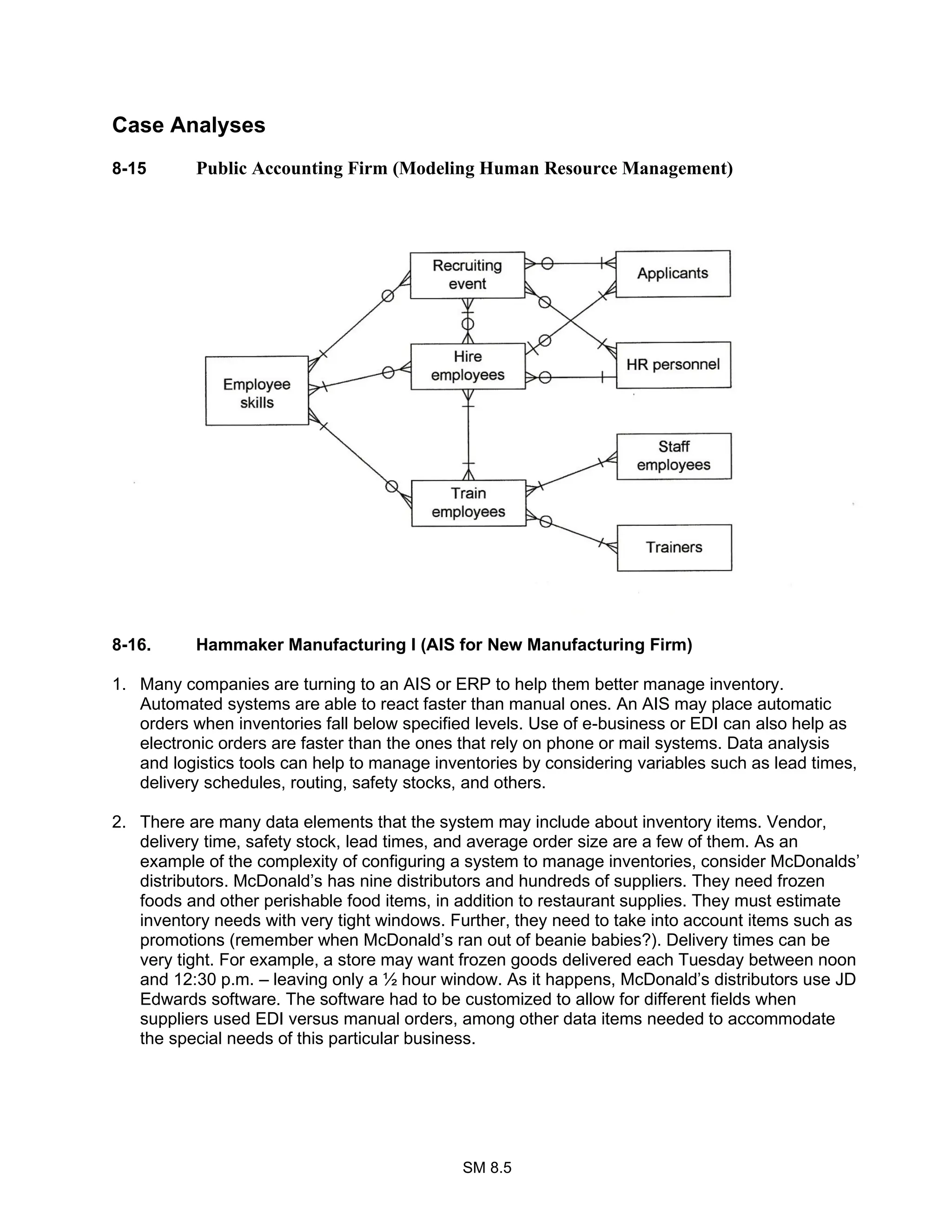
8-15 Public Accounting Firm (Modeling Human Resource Management)
8-16. Hammaker Manufacturing I (AIS for New Manufacturing Firm)
1. Many companies are turning to an AIS or ERP to help them better manage inventory.
Automated systems are able to react faster than manual ones. An AIS may place automatic
orders when inventories fall below specified levels. Use of e-business or EDI can also help as
electronic orders are faster than the ones that rely on phone or mail systems. Data analysis
and logistics tools can help to manage inventories by considering variables such as lead times,
delivery schedules, routing, safety stocks, and others.
2. There are many data elements that the system may include about inventory items. Vendor,
delivery time, safety stock, lead times, and average order size are a few of them. As an
example of the complexity of configuring a system to manage inventories, consider McDonalds’
distributors. McDonald’s has nine distributors and hundreds of suppliers. They need frozen
foods and other perishable food items, in addition to restaurant supplies. They must estimate
inventory needs with very tight windows. Further, they need to take into account items such as
promotions (remember when McDonald’s ran out of beanie babies?). Delivery times can be
very tight. For example, a store may want frozen goods delivered each Tuesday between noon
and 12:30 p.m. – leaving only a ½ hour window. As it happens, McDonald’s distributors use JD
Edwards software. The software had to be customized to allow for different fields when
suppliers used EDI versus manual orders, among other data items needed to accommodate
the special needs of this particular business.
SM 8.6
8-17. Hammaker Manufacturing II (Business Process Reengineering or Outsource)
1. Students might select any of the documentation tools identified in Chapter 3 (flowcharts,
process maps, or one of the graphical tools such as CASE tools). Most likely, HMC would work
on the manufacturing processes – or they might limit their efforts to the inventory process first.
By restructuring the manufacturing process or by looking into just-in-time inventory purchasing,
the company might be able to save money and jobs.
2. Students might locate a variety of sources that list reasons for outsourcing. The Introduction
section of Part Two of the textbook, identifies several reasons: global pressures to cut costs, to
reduce capital expenditures, and to become as efficient as possible at core competencies.
Additional reasons that different companies might use are:
• access resources that are not available within the company (people, capacity, technology)
a. To access innovative ideas, solutions, expertise of individuals
b. To provide flexibility to meet changing volume requirements – to increase or decrease
capacity as needed
c. To access plant and equipment without the time and cost of building
d. To gain quick access to new process, production, or information systems technology
(perhaps too costly or unproven so company is not ready to buy it yet – if at all)
• To improve speed-to-market of products
• To accelerate reengineering benefits
• To share risks
• To take advantage of offshore capabilities (human capital, lower cost)
• To better manage difficult or non-core processes and functions
• To enjoy economies of scale (vendor can accomplish process on much larger scale)
Some believe that investors want companies to expense context work (anything that is not
considered a core process of the firm) rather than invest in it. That is, investors would rather
see it on the income statement than the balance sheet, which in effect would free up resources
(employees) to focus on the processes that generate revenue, and increase share value. For
example, if we outsource the accounting function, then we might be able to better use the
talents of the staff accountants in analyzing other business opportunities, analyzing and
improving business processes, etc. So we could use our human capital in endeavors more
directly related to our core processes.
Hammaker might consider a number of these reasons to decide to outsource. Of course, the
first question is: What process (or processes) might Dick want to outsource? Denise does
not know the answer to this question, so the company should study the various processes
discussed in Chapters 4 and 5 to make this determination. Since frequently outsourced
processes are human resources, finance and accounting, customer services, learning services
and training, janitorial services, and information technology, these should probably be
examined first. Once one or several of these processes have been identified as possible
candidates for outsourcing, we would then ask: Which of these processes are core to our
business?
Of course, in the effort to examine each of these processes, Dick might want his employees to
determine where efficiencies may be realized through Business Process Reengineering.
3. We would probably all agree that producing automotive parts is a core business process for
Hammaker. It’s the primary thing the company does. It’s what the company does to generate
SM 8.7
revenue. It’s also whatever you do to differentiate your company’s products from your
competitors’ products.
4. The answer is yes, businesses do sometimes outsource what we would call core processes. A
number of examples may be cited here. Probably the best known example is Nike. This
sneaker company doesn’t manufacture any sneakers. The entire production process has been
outsourced. Insurance companies are another example. Several of their core business
processes are risk management, information services, underwriting, claims administration, and
customer service. Both customer service and underwriting are processes that are now
outsourced by some insurance companies.
Why would companies outsource a core process? There is no one answer for every situation,
but most likely firms would do this for the same reasons cited above in the answer to
requirement #2. Sometimes this becomes a strategic alliance with another company (or
companies) so that the company that does the outsourcing can focus on other products or on
other services to generate revenue.
5. Most likely any business decision that displaces employees will have social and legal
implications. Socially responsible organizations are typically admired by the community and
the marketplace, so developing options for the displaced workers is always an important
consideration. If the employee’s job is deleted, what other jobs might the person do for
Hammaker? Is training required? What if there are no employment choices? Should
Hammaker offer transition-assistance packages to those employees to help them find jobs at
other firms? At what cost? These are all important questions that should be asked.
Regarding legal implications, we need to know if the company employees are represented by a
union. We might have restrictions that are in contracts with the union that would limit what
options we can and cannot exercise. In this case, we know that Hammaker Manufacturing is
not limited by any union contracts. The company might have other contractual obligations that
it needs to honor. For example, is there a mortgage on the manufacturing complex or is there
a long-term lease? The lease contract might have certain penalties for breaking the contract if
the facilities are no longer needed.
6. This is certainly a case that has many facets and interesting possibilities. Unfortunately, we
don’t really have enough information at this point to make an informed recommendation, but
many intriguing clues may be found in the case to suggest that some sort of outsourcing would
be advantageous to Hammaker.
8-18. Hammaker Manufacturing III (Lean Production/Lean Accounting)
1. To adopt lean production, HMC would probably want to focus on the five principles of lean
thinking that are identified in an article in Strategic Finance, May 2007 (How do your
measurements stack up to lean? By Kennedy et al.). These include:
• Customer Value: Lean enterprises continually redefine value from a customer’s standpoint.
This means that HMC would need to get feedback from their customers.
• Value Stream: The lean enterprise is organized in value streams. This means that HMC
would need to rethink how they collect data for decision making.
• Flow and Pull: In a lean enterprise the customer order triggers or pulls production. This
might represent the biggest change in philosophy for HMC – which would be a change from
stockpiling inventory to more of a JIT philosophy.
• Empowerment: Lean enterprises’ employees are empowered with the authority to interpret
SM 8.8
information and to take necessary actions.
• Perfection: Lean enterprises seek perfection, defined as 100% quality flowing in an
unbroken flow at the pull of the customer. HMC is already committed to quality products so
this does not represent a change from current thinking.
2. Firms that implement lean production concepts typically benefit in the following ways:
• Waste reduction
• Production cost reduction
• Labor reduction
• Inventory reduction
• Production capacity increase
• Employee involvement and empowerment (multi-skilled workforce)
• Higher quality products
• More information: http://www.1000ventures.com/presentations/production_systems.html
3. Denise and her financial analysts might gain the following benefits from attending a Lean
Accounting Summit:
• Perhaps the most important benefit is the ability to network with professionals at other
organizations who have already implemented lean production concepts to gain insights
from their efforts – i.e., lessons learned from those who have already worked with these
concepts
• Learn cutting-edge thoughts and ideas
• Discover helpful software packages and accounting methods that support lean production
• Identify some best practices from companies currently using lean production concepts
• Identify companies to benchmark these concepts
Other documents randomly have
different content
Miss O'Byrne did not appear to have heard, but she had. It was the
first time he had called her by her Christian name, and it sounded
strangely to her from his lips. Katie could not help colouring, and
was angry with herself for doing so, and still more angry when she
saw by a little quiet smile on Sarah's face that she noticed it. When
she thought the matter over, she determined, on the first
opportunity to tell Mr. Maynard she considered it to be a great
liberty. But then she felt certain Frank would only laugh and say that
he called her cousin “Sarah,” but that if Miss O'Byrne objected, he
would apologise, and not repeat the offence. After all, too, there was
no particular reason why she should object any more than Sarah. As
to that talk about the sea, it was absurd.
“No one would care for a storm unless he loved the sea,” Katie said,
thoughtfully; “and of course he meant me to suppose that he would
not have cared about making me mad if he didn't—well, like me.
What humbugs men are,” she exclaimed, indignantly; “I do think
they imagine we girls are fools enough to believe any stuff they like
to tell us.”
Frank Maynard did not repeat the offence of calling her by her
Christian name until he said good-bye to her upon leaving.
“What impudence!” Katie said to herself, as she looked after the dog-
cart; “what impudence, to venture to squeeze my hand, as he
certainly did, just as if he would persuade me that all his rudeness is
to go for nothing. Well, men are humbugs! I wonder whether he will
ever come back again.”
CHAPTER II.
THE “LIVELY STUNNERS.”
After the first greeting between Frank Maynard and his friend
Prescott, upon the former's return from Staffordshire, and when they
had fairly sat down in Frank's room for a talk, Prescott said,—
“Now, Frank, let me hear all about what you have been doing. Your
letters were not long, and you seemed enjoying yourself down there,
Frank. I suppose Teddy is just about the same as he used to be.”
“Just the same,” Frank laughed; “he pretends to assist his father in
the business, but I fancy the material advantage, derived by Painter
and Co. from Teddy's services, is slight indeed. He went round the
manufactory with me, and I find that his knowledge upon the
subject of china is absolutely nil. I question if he would know the
difference between Dresden and Sèvres, or between Limoges and
Etruscan; and I should imagine his ideas on the subject of accounts,
are, if possible, even more vague. No, he is just what he used to be
—a careless, warm-hearted Irishman, and the best fellow in the
world.”
“But Mr. Drake is not Irish, Frank?”
“Not the least in the world. A particularly practical, long-headed,
sensible Englishman. His Celtic blood all comes from his mother. She
is as Irish in her way as he is in his, and so is his sister.”
“Is Miss Drake pretty, Frank?”
“Yes,” Frank said, “very pretty; an awfully jolly girl, Prescott, not the
least bit of nonsense about her—downright and straightforward, you
know.”
Prescott glanced up. But he saw that Frank was too outspoken in his
praise to be the least in love.
“Tall or short, Frank?”
“Tall,” Frank said; “a good deal like Teddy; fancy Teddy a pretty girl,
and you've got Sarah.”
“And there was a cousin with an Irish name, Frank, wasn't there?
You mentioned her in your first letter, but you did not allude to her
afterwards. What was she like?”
Frank was longer in giving his answer this time.
“Well,” he said, slowly, “Miss O'Byrne would hardly be considered
very pretty, at least I don't think most people would call her so. No, I
should say not. She was rather short; and, yes, I should say, and
plump.”
Prescott glanced across again at Frank, and a little amused smile
came across his face at the cautious way in which he had spoken.
But Frank was looking thoughtfully into the fire, and did not notice
it.
“There were other young ladies staying in the house you said, Frank.
Was there anything special about any of them?”
“No,” Frank said, carelessly; “they were a very jolly lot of girls; I had
great fun down there.”
“Lots of dancing, and music, and so on, I suppose, Frank?”
“No end,” Frank said.
“Any of the girls sing well?”
“Katie sang splendidly; one of the finest voices I ever heard in my
life,” Frank said, enthusiastically.
“Katie?” Prescott repeated questioningly.
“Miss OByrne,” Frank explained.
“Ah,” Prescott said, with a smile, “the stout little cousin.”
“Good heavens, Prescott,” Frank said, turning round with great
indignation, “what are you talking about?—stout little—by Jove, what
put such a ridiculous idea in your head?”
“Why, my dear Frank, you said she was rather short and plump.”
“Pooh, nonsense,” Frank said; “she is rather short, perhaps, but has
a charming little figure; just a little plump; but—” and muttering the
obnoxious word over to himself, he smoked away in short angry
puffs.
Prescott could hardly help laughing aloud at the success which
attended his ruse.
“So Miss O'Byrne is not to be talked of lightly, eh, Frank?”
“Oh, nonsense,” Frank said. “Of course one doesn't like to hear a girl
like Katie talked of as a stout little—but there, of course you couldn't
tell.”
“And do you ever mean to repeat your visit, Frank?”
“Well, yes, Prescott, I expect I shall go down there again; at least I
hope so.”
“And may I ask, Frank, if you have any intention of bringing Miss
O'Byrne back with you?”
Frank put his pipe down, and looked at Prescott, who was evidently
greatly amused; then, after a moment's pause, he said,—
“You have guessed it, Prescott, sure enough. If Katie will come, I will
bring her up.”
“Really, Frank?”
“Really, old man. I should have told you sooner or later. I am quite in
earnest. I will marry Katie O'Byrne if she will have me.”
“I am very glad, Frank, very glad indeed;” and Prescott shook his
friend warmly by the hand. “I always hoped you would do it sooner
or later, Frank. You are only leading an idle useless life, and a wife
will be the making of you. Of course she is very nice, Frank.”
“My dear fellow,” Frank said, quite inclined to be communicative now
that the ice was pan> broken, “she is the most loveable girl in the
world.”
Prescott laughed.
“But not pretty, eh, Frank?”
“Well, Prescott, I suppose most men wouldn't call her pretty at first;
I don't think I did; but I think her so now. Not pretty, perhaps, but
loveable; that's the only word that expresses it, Prescott; just
loveable, with the most trusting eyes you ever saw. She is full of fun,
Katie, and has got a very decided will of her own. Not a bit of a
muff, you know, Prescott.”
“No, I don't think you would be likely to fall in love with a muff,
Frank. Well, and what does the young lady think of you, Frank? Was
it a very strong flirtation?”
Frank laughed.
“No, Prescott, not a bit of it. It was perpetual war. I am afraid I was
very hard on her, but I did like teazing her, and making her
indignant. Katie has rather a will of her own, you see, and can hit
very hard when she likes; and she was immensely angry at being
made fun of. I do think, sometimes, she almost hated me. I don't
think she has the least idea I care for her; but I don't know,
Prescott, I hope that in the end I shall win her.”
Prescott smiled at Frank's description of his love-making.
“Well, Frank, and what do you propose doing with yourself this
evening?”
“I hardly know, Prescott. I feel too restless to sit still, and a theatre
would be just as bad. What with drives, and dinners, and parties,
and a constant state of light skirmishing when I was with Katie, and
an extreme amount of thought and restlessness when I was alone, I
have been kept in a state of constant excitement for the last three
weeks. I was always wondering whether anything would come of it;
whether it was a mere case of strong flirtation, such as I have been
engaged in fifty times before, or whether I was seriously in earnest.
And then at last I arrived at the fixed and settled determination that
of all the women I ever met, Katie was the one most certain to make
me perfectly happy. Altogether I have been regularly worked up, and
it would be quite impossible for me to sit still. I want something to
let off the steam. A row would suit me admirably. It would be an
immense satisfaction to hit out from the shoulder. Suppose we go to
the ‘Stunners.’ There is sure to be some sparring going on; and if
there's no one else, I can put on the gloves with Perkins. What do
you say, Prescott?”
“Anything you like, Frank, so that I am not called upon to bail you
out.”
So after dinner they went up to the “Lively Stunners.” The
“Stunners” was a public-house, situated in one of the small streets
lying above the top of the Haymarket. Not an aristocratic
neighbourhood, indeed the reverse; but the “Stunners” did a good
business, as even Perkins was ready to allow. Perkins was behind
the bar in his shirt-sleeves, and was very busy indeed when the
young men entered.
“Ah, Mr. Maynard, I am glad to see you, sir.”
“How are you, Perkins? Anything going on upstairs?”
“Not much, sir. It's not the night for sparring. We've got harmony to-
night, sir.”
“I want a set-to with the gloves, Perkins. What do you say?”
“Well, sir, I should be willing enough, but I am going out for a spree.
Just the thing to suit you if you are in the humour.”
“What is it, Perkins?”
“Well, sir, you must keep it dark, or it wouldn't do me any good in
my business; but the Slogger and I are going,”—and here he bent
over the bar with an air of great mystery,—“we're going to a Chartist
meeting to-night. The Slogger knows a fellow who is hot about it,
and he's put him up to the pass-word. So we're going, and if you
and Mr. Prescott are game, you can go with us. We can easily get up
a row if we like, and it's hard if us four can't fight our way out of it.”
“The very thing, Perkins; as you say, it's hard if we can't get up a
row somehow. What do you say, Prescott?”
“Anything you like, Frank. A black eye will not look strictly
professional, but as I have no case on in court it won't much matter.
I have not used my fists since that last town and gown row we were
in together at Cambridge; and I have no objection to a row for once
in a way.”
“Well, Mr. Maynard, we are not to start till half-past nine, it's no use
getting there too early, so if you don't mind going upstairs for an
hour, I will tell you when it is time to be off.”
“If there's no sparring going on, Perkins, I think we'll go out for a
stroll, and come back at the time you name. I can't stand the bad
tobacco smoke, and the bad singing.”
“Now, gentlemen, if you're ready,” Perkins said, when they returned,
“I'm with you.”
They went into the bar-parlour, where the Slogger, a powerful man,
with the unmistakeable look of a prize fighter, was awaiting them.
“You are not thinking of going like that?” he asked. “Lor', they'd
never let you in, not if you'd twenty pass-words, and if they did,
they'd pitch into us directly we were in the light. No; if you mean to
go, you must go like working men.”
“Have you any clothes you could lend us, Perkins?”
“Well, sir, I've an old greatcoat which would cover you well enough,
and I dare say I can rummage out something for Mr. Prescott. As for
hats, your best way is to send out and buy a couple of cheap
billycocks. You can pull them down over your eyes. I think that with
that, and if you take off your collars, and put a black handkerchief or
a bird's eye round your necks, you will pass well enough.”
The transformation was soon effected, and the two young men could
not help laughing at each other's altered appearance.
“You'll pass very well for a bricklayer out of employ, Frank.”
“Well, Prescott,” Frank retorted, “I could swear to you as a
disreputable-looking tailor anywhere.”
A cab was at the door, and the party were soon off.
“Now,” Perkins said, “if there is a shindy, we must all keep together,
and then we shall be as right as ninepence, whatever comes of it. I'd
back the Slogger and you and I, Mr. Maynard, to clear the roughs
out of any room in London in about five minutes. Mr. Prescott's very
handy with the gloves, but he hasn't weight, and in a close fight
weight tells.”
“Where is the place, Perkins?”
“In the New Cut, sir. It's a penny gaff at ordinary times.”
Arrived at the New Cut, they discharged the cab, and went on foot
through the busy crowd with which that locality is always filled of a
Saturday evening. Hundreds of men were standing about, their
week's work finished, smoking and talking together. The women
were busy shopping, and were engaged in examining the various
goods before purchasing, and in chaffering with the shopmen and
costermongers. The pleasure of shopping is by no means a
monopoly of the rich, the poor enjoy it to at least an equal extent;
and no lady can more carefully examine the texture of the silk dress
which the shopman temptingly holds out before her, or turn over one
article after another before making her selection, than does her
poorer sister scrutinise the markings and colour of a piece of bacon,
or turn over the heaps of cauliflowers and cabbages upon a
costermonger's cart. Great is the noise. The touts at the second-
hand furniture and Jew clothing shops, the butchers, and the
itinerant vendors, vie with each other in their efforts to obtain
customers. Half-price has just begun at the Victoria Theatre, which
stands large and black at the corner of the New Cut, and numbers
are flocking in to see the tragedy of “The Hangman's Stepdaughter;
or the Murdered Mother of the Blind Alley.” Views of this drama, of
thrilling interest and in bright colours, are placed beside the doors,
and, illuminated by the bright gaslight, exhibit scenes of bloodshed
and murder, highly enticing to the frequenters of the threepenny
gallery. A few policemen are scattered among the crowd, but their
services are seldom required, except when some drunken man
insists upon fighting everyone, and, refusing all persuasion to return
home, has to be taken to the station-house, in spite of his struggles
and shouts, by two policemen. In the discharge of this duty,
although undertaken solely for the protection of the public, the
police are greeted with much jeering and hooting on the part of that
ungrateful body. And then all goes on quietly for a time. The
gaslights shine brightly out from the gin-palaces, and great business
is in course of being there carried on. Numbers go in and out, and
the glass-doors are ever on the swing. Through these doors
glimpses can be caught of crowds of men and women standing at
the bar drinking, and waiting to be served; while through the open
windows of the room above sounds of singing and of violent
thumping of pewter pots and glasses upon the table come out.
Through all this the four companions slowly made their way, and
presently stopped at the door of one of those establishments
popularly known as a penny gaff,—theatres at which a suicide, three
murders, four combats, two comic songs, and a ballet, are
condensed into the space of a quarter of an hour, and are to be
heard for the charge of a penny; dens in which a perspiring
audience inhale a pestilential atmosphere and vicious ideas together,
and which the strong arm of the legislature should either reform or
sweep away altogether.
At present the establishment was apparently closed. The appalling
pictures no longer stood before the doors. The illumination which
usually blazed upon it was extinguished. No sound of music or
laughter came through into the street. The doors were closed, and
the whole place seemed deserted. Now and then, however, a man
went up, knocked, and after a short parley was admitted, and then
all was quiet again. At this door the party knocked. It was partially
opened, and a voice said,—
“What do you want?”
“Universal suffrage,” the Slogger answered.
The door opened a little wider, and they all entered. They found
themselves in perfect darkness, but the man who had let them in
turned on the light of a bull's-eye lantern.
“You are late, mates,” he said, leading the way along the passage.
Opening a door, he admitted them into the main apartment, a sort of
covered room or theatre. At one end was a raised stage, with the
usual front and drop scene. The latter was now raised, however, and
four or five chairs and a table were on the stage, and some ten or a
dozen men were standing or sitting there. The aspect of the place
was tawdry and dirty beyond description. The walls, originally white
and decorated with flower wreaths, were now black with smoke and
filth. What the ornamentation of the ceiling had once been, it was
impossible to say. The place was lighted by two gas chandeliers,
without glasses, and by a row of footlights in front of the stage. The
room was full of men, who were mostly smoking short pipes, and
the fog of tobacco smoke made it seem dingier and darker than it
really was, while the close, noxious atmosphere, and the entire
absence of any ventilation whatever, rendered it difficult for any one
unaccustomed to such noxious atmosphere to breathe at all.
The new comers took their stand close to the door where they
entered, and the seats having been removed and everyone standing,
their coming was altogether unnoticed by anyone.
“I say, Prescott, the air here is poisonous; it makes me feel quite
faint.”
“So it does me, Frank. We'd better light our pipes; we shan't feel it
so much.”
They accordingly followed the example of all around them, and
began to smoke, but even then they found the atmosphere almost
overpowering.
“We can't stand this long, Prescott. We'll just listen to a speech or
two, and then we will have some fun.”
The meeting, they soon found, was principally held for the object of
informing the people of the arrangements which had been made for
the great meeting to take place in a few days. All in the hall were
evidently in their way leaders, and the speakers urged them to bring
up their forces to the appointed place, to keep them well in hand,
and to be prepared in case of resistance, for barricade fighting. Each
was requested to notice particularly the addresses of the gunsmiths'
shops, and even of second-hand dealers where a few firearms might
be exhibited in the windows, and to tell off men upon whom they
could rely to seize the arms. General instructions, too, were given as
to forming barricades; and the noble example of the French was
cited to them again and again.
“This is rather a serious business, Frank.”
“It's all talk, my dear fellow; an English mob has no idea of street
fighting; a few hundred policemen would drive ten thousand of
them.”
The speaker now finished amid a low murmur of applause. The man
who followed him was of a less practical turn, and simply strove to
excite his hearers by a speech calling upon them to strike for liberty,
and to cut off the chains in which they were bound by a pampered
aristocracy.
“Look out, Perkins, I'm going to begin,” Frank said; and then, at the
top of his voice, he shouted out, “That's a lie!”
An immense confusion at once took place in the hall. There were
shouts of “A spy!”—“Turn him out!”—“Hang him!”—“Lock the doors!”
But those nearest who turned to carry these threats into execution,
hesitated a moment at the sight of the three powerful men who
guarded the door, which Prescott, as previously agreed, had opened,
to prevent the man in the passage locking it on the other side. The
hesitation was momentary, and then a tremendous rush was made
by the exasperated crowd. Those in front, however, as speedily
recoiled, or were beaten back by the tremendous blows of Frank
Maynard and the two prizefighters. The assault of the Slogger,
however, was not in the first place directed against those who
attacked him, but against a man who was standing in front of him,
and who had evinced no intention of taking part in the fray. He was
a tall man, dressed as a bricklayer, with large whiskers and black
hair. Soon after he had entered, the Slogger had noticed with
surprise that these whiskers were false, for the upper part of one of
them, owing probably to the heat of the room, had become
detached from his face. The Slogger would not have thought much
of this, as he supposed at first it was some one who had disguised
himself, and come merely from curiosity, as he had himself, but
something in the man's figure, and in his peculiar way of holding his
head, reminded him of a man against whom he had a particular
grudge, for having, only the week before, been the means of
transporting the Slogger's brother. He determined immediately the
fray began to find out if his suspicions were correct. Accordingly, the
instant the rush was made, he commenced the assault, by striking
the unsuspecting man in front of him a violent blow on the ear,
which would have sent him to the ground had not he been kept on
his feet by the crowd around him. His false whiskers, however, fell
off, and the smoothly shaven cheeks were visible.
“Ha! Mr. Barton,” the Slogger shouted, as he dealt tremendous blows
right and left at the assailants who rushed at him, “it's my turn now.
You shan't go out from here with a whole skin. A spy!—a spy!” he
shouted; but the tumult was too great for his voice to be heard. For
some little time the three men had easily beaten off their assailants,
but matters were momentarily becoming more serious. The men on
the platform were breaking up the chairs and tables, while others
tore down portions of the woodwork to form weapons. These now
pressed forward through the crowd as they fell back in dismay from
their formidable opponents.
“I think it's about time to make a bolt, sir.”
“All right, Perkins,—come along.”
In the meantime, Prescott had had a quiet encounter of his own
with the door-keeper—who had been signally worsted, and had run
out into the street—and was now holding the door ready to close it
as the others retreated. After a rush upon the assailants, in order to
drive them back, and gain time for the manœuvre, the three men
made a hasty retreat through the door, which Prescott instantly
closed and locked behind them, and in another instant they were out
in the New Cut.
“Come the other way, sir,” Perkins said, “there's a cab-stand under
the railway-arch, and if them fellows get out and find us, they'd be
as likely to knife us as not.”
In another minute they were in the cab.
“That was a sharp fight, Perkins.”
“And no mistake, sir. As good a turn-up as I've had for a long time.
There'll be some smartish black eyes in the morning.”
“Do you think there is really going to be a row with these Chartists,
Perkins?”
“I don't think so, sir. They don't mind the bobbies, but they'll never
stand against the red coats. I'm going to-morrow to get sworn in as
a special. I ain't going to have them coming in to the ‘Stunners’ to
help themselves without pay. I don't know, and I don't care, a rap
about the charter, and I don't believe one in fifty of them knows
theirselves. What they want isn't the charter so much as their
neighbour's goods. Well, they won't get my beer till some of 'em
have gone down. They'll find that they have to pay for it one way or
the other. Here we are, sir, and I ain't sorry, for I don't know that I
was ever so dry in my life.”
“So am I, Perkins; the heat and stench in that place was
tremendous. The fighting, too, was warm while it lasted. I don't
think any of us got hit.”
“Hit!” said Perkins, contemptuously; “no, nor we shouldn't have been
if we had stopped there all night. Not as long as we could have kept
them at arm's length. The worst of that sort of row is, that the
fellows who are behind always want to get close, and they push the
chaps in front on so that at last one gets jammed up into a heap,
and can't use one's arms. No, I think we just stopped long enough.
The leg of a table is a nasty sort of thing to come down on your
guard. Now then, sir, what's your liquor?”
CHAPTER III.
A SLAP IN THE FACE.
Frank Maynard's departure for the country had been a relief both to
Captain Bradshaw and Alice, and when he returned they were able
to start anew upon something like their old footing. He was not at
the house, however, as much as he had before been, for the London
season was now beginning in earnest, and he was out nearly every
night. Captain Bradshaw and Alice too were a good deal out, for
although the old man would have greatly preferred to remain quietly
at home, yet for Alice's sake he went into society, and when there
enjoyed it perhaps more than she did. He would have a quiet rubber
for a while, and would then go into the dancing room and look on
with pleasure at the admiration which Alice attracted. And, indeed,
Alice had many admirers, for she was a strikingly elegant girl, and an
heiress, and not a few of the government clerks, who form so large
a proportion of the dancing men of London, would have willingly
enough exchanged their arduous duties of copying and endorsing
letters, for the charge of Alice Heathcote and her fortune. But Alice
gave but slight encouragement to any of them. She was one of
those girls with whom a partner very soon gets upon pleasant terms.
She was perfectly natural, straightforward, and unaffected; sensible
herself, and expecting some amount of sense from others, the sort
of girl with whom a flirtation is next to impossible. Nor upon those
evenings, when they had no engagements, were Captain Bradshaw
and Alice often alone; for in proportion as the visits of Frank had
decreased in frequency during the last three months, those of Fred
Bingham had increased. Very pleasant did he make himself upon
these evenings; full of amusing anecdotes, and rattling on with a
constant stream of fun and nonsense, he aroused Alice, and kept
Captain Bradshaw in a state of good temper. Indeed Alice felt really
grateful to Fred Bingham, for she rather dreaded these evenings
alone with her uncle. He amused and interested her too with his
talk, for Fred was undoubtedly clever; and yet, she could hardly
explain to herself why, she did not like him. It was partly an old
standing feeling. From the day when he had first come to the house,
a lad of sixteen, she, a child of twelve, had felt a sort of jealousy of
him for her playfellow Frank's sake, which Frank had never felt for
his own. Either from some passing remark she had heard from a
servant, or from some other reason, she had come to entertain the
feeling that he had interfered with Frank's position. Children are
keenly jealous. She had always looked upon Frank as her guardian's
son and heir, and she considered this new comer to be a rival of
Frank's. All along she had cherished this impression, all along had
thought that Fred was trying to supplant his cousin in Captain
Bradshaw's affection. She could scarcely have given a reason for her
belief. It was not what he actually said or did, it was his way. True
Fred Bingham never spoke ill of his cousin in any way; on the
contrary, he frequently praised him; but in Alice's jealous ears there
was a current of implied blame in the very praise; she would rather
that he had abused Frank openly to his uncle than praise him as he
did. Then too, he was always fond of drawing Frank into an
argument when his uncle was present, and Frank never showed to
advantage in these wordy conflicts. He was greatly deficient in quiet
suavity; he could not hear views which he considered vicious
expressed, and either hold his peace or dissent quietly. Frank gave
his opinion with energy and heartiness, even with vehemence. He
plunged into an argument as if he were personally aggrieved by the
opinions stated upon the other side. He denounced and scouted
them as heresies dangerous to mankind. A strong conservative, he
hated radicalism with a personal hatred. He would willingly have
buckled on armour and have settled the matter by a combat to the
death between himself and the champion of the other party. In
these conflicts then, which Fred was constantly provoking, Fred with
his quiet sneering manner would greatly gain the advantage. His
straight thrusts would be too fine and delicate for his cousin's
slashing two-handed blows, and they not unfrequently ended by
Frank's losing his temper.
During Frank's absence abroad Fred had been a great deal at
Lowndes Square, and had, at least so Alice thought, tried hard to
gain the place of first favourite with Captain Bradshaw. In this he
had not succeeded. At present, however, while his uncle was still
smarting under the overthrow of his pet plans, Alice had fears that
Fred Bingham's attention and adroit flatteries were attaining their
effect. Indeed, for the time being, he became prime favourite with
his uncle, and in his absence Captain Bradshaw would sound his
praises loudly to his ward, generally coupling them with disparaging
remarks of the disgraced Frank. At first Alice had listened in silence,
but finding that it was becoming a favourite theme with her uncle,
she spoke out warmly in Franks defence, declaring roundly that
there was more truth and honesty in his little finger than in his
cousin's whole composition. Her uncle, as was his wont, although
nowise convinced, was yet fain to let the matter drop for the
present. In addition to her championship of Frank, Alice had another
reason for speaking out so decidedly. She had for some time felt that
Fred was endeavouring to make himself specially agreeable to her,
and she now thought that her uncle was inclined to favour his
efforts. Now Alice had, as has been said, a positive dislike to Fred
Bingham, and although she could not help being amused by his talk,
she yet believed that all this jesting and fun was a mere cloak which
concealed a scheming and crafty disposition. After all these years of
careful watching, she was convinced he was playing a deep game for
his uncle's fortune, and she now saw at once that in the same way
he was wishing to add her fortune to his pile. That he cared in the
slightest degree for herself she did not for a moment believe.
Now of all these thoughts, suspicions, and opinions on the part of
Alice Heathcote, Fred Bingham had not the remotest conception.
Shrewd as he was, keenly alive to everything which concerned his
own interests, he was yet completely in the dark as to Alice
Heathcote's sentiments regarding him. Women in general he knew
but little of, and understood even less: beside this he was intensely
vain. He had been made a little god of at home, his mother and
sisters looked up to him as the best of human beings, and were
never tired of doing him homage. Over and over again his mother
had said in his hearing that Freddy ought to marry well, for that any
girl must feel flattered by his attentions, and Fred's own experience
when he did go into society was that girls were amused by his fun
and caustic humour. He was profoundly ignorant of the fact that girls
very seldom do fall in love with men who amuse them.
Fred Bingham then had long looked upon his success with Alice
Heathcote as a certainty, only awaiting his making up his mind.
Before Frank had left England, indeed, Fred had rather doubted
whether Alice Heathcote did not prefer his cousin to himself, but he
believed that his long absence had quite put him beyond the pale as
a rival; and when, upon Frank's return, he had observed that there
was a sort of reserve on Alice's part towards him, and that this
reserve apparently increased rather than lessened with time, he
considered his own success as secured. Then, too, with great
pleasure he had seen that Frank was somehow in disgrace, and took
the opportunity of his absence to make the greatest progress
possible. What was the cause of Frank's disgrace, Fred was ignorant,
as Captain Bradshaw had upon no occasion even hinted the cause of
his displeasure. Had he done so, Fred would have done all in his
power to keep them apart: as it was, he was obliged to let matters
take their course. The sole reason why Fred Bingham had not long
before proposed to Alice Heathcote, was because he was doubtful
about himself. Not doubtful as to whether he loved her, for upon that
point he had no question at all; indeed, he had no belief whatever in
love, and looked upon it as an absurdity quite out of place in
business. If two people liked each other, and could get on well
together, and the match was mutually advantageous, what more
could be desired? The question in his mind was, should he get on
well with Alice Heathcote? He liked her well enough, yes, he really
liked her very much, and the match would be an advantageous one,
but he was not quite so easy in his mind as to whether he should
get on well with her. Now Fred's idea of a wife who would get on
well with him was a woman who would do just as she was told, who
would never set up her opinion against his, who would in fact be a
species of bond slave to his will. Now he had great doubts whether
Alice Heathcote would do all this. He was in fact a little afraid of her.
There was a quiet decision and firmness about her which made him
feel uncomfortably that the combat between them would be a hard
fought one; then too she was tall, and Fred did not like tall women.
He fancied sometimes that if he got into a passion with her—and he
allowed himself that he had a hasty temper—she would look down
coldly contemptuous at him. There was another difficulty which
presented itself, and which had for some time kept Fred Bingham in
a state of uncertainty. Alice Heathcote's fortune was he knew about
£50,000, and also that it was her own absolutely, and Fred felt
certain that Captain Bradshaw would see that the greater part, if not
the whole of it, were settled upon herself at her marriage. Now Fred
Bingham was very much pressed for ready money; he was
embarking with his father in several extensive affairs in which capital
was all-essential. More than once his thoughts had turned to a
young lady he had met near Manchester, who had lost her father,
whose mother was old and weak, and who had a fortune of about
half the amount of that of Alice Heathcote at her own disposal. Miss
Farrer was pretty, but with a weak prettiness which would not stand
time. Her appearance did not belie her character; she was an
affectionate and amiable, but weak girl. Fred had been very
attentive to her, and had completely won her mother's heart by
playing many games of cribbage with her, and losing almost
invariably. So that altogether he felt sure of his ground there. It was
not that he had actually any idea of marrying Miss Farrer, he felt too
sure of success with Alice to think seriously of the other; but he was
a cautious man, and liked to have a second string to his bow in case
of accidents.
It was one morning after breakfast, about three weeks after Frank's
return from the country, that Fred Bingham made up his mind to
propose formally to Alice. He had been chatting with his father as to
a contract, concerning which they were in treaty.
“The margin of profit is not as large as we could wish, Fred. If we
were working with our own capital it would be different, but all this
discount and advance work makes a large hole in the margin of
profit.”
“I should think it did,” Fred said, shortly, “it is not to-day that we
have found that out.”
“I think, Fred, that if I were you I should bring your affair with Miss
Heathcote to a head. You have been going there now for a very long
time; you tell me that you think you are pretty safe, and even if you
do not touch any of her fortune, you would be able to borrow upon
better terms as the husband of a rich woman; and, however things
went, you would fall upon your feet. Besides, as the husband of Miss
Heathcote, you would stand better with Captain Bradshaw.”
“Yes, that's all true enough,” Fred said, “and I've thought it all over a
thousand times. I suppose it ought to be done, but I would rather
remain as I am. However, needs must, I won't put it off any longer. I
will settle it this afternoon. There, don't talk about it, it's bad enough
to have to do it.”
Half an hour afterwards Fred Bingham went out. First down to New
Street, where he bought some cigars, as usual, and stayed for some
time in the shop smoking and talking with Carry. Then he went out
and turned towards Knightsbridge. “She is an awfully nice child,” he
thought to himself. “I wish to goodness she was in Alice's place, and
Alice in hers. I shouldn't mind even if she had that girl Farrer's
money, I would marry her to-morrow. I wish I had never seen her, it
would have been better for both of us. Well, it's no use thinking of
that now, I must go through with this other business. The old man
will have gone up to his club by this time. The sooner it is over the
better.” And so he went on to the house in Lowndes Square, where,
as he expected, he found Alice Heathcote alone.
“Good morning, Alice, I have not gone up to town to-day, so I
thought I would come in for a chat. You are not looking very well
this morning. I miss the usual roses—I do not mean that lilies are
less becoming—I only notice the change of flowers.”
“My uncle is out,” Alice said, ignoring the compliment. “He started
for the club rather earlier than usual.”
“I rather hoped he would be gone, Alice, for I was anxious to see
you alone.”
Alice saw what was coming, but her mind being fully made up upon
the subject, she felt no nervousness, as she would have felt had she
had the slightest belief that he really cared for her.
“The fact is, Alice, I want to ask you to marry me. I don't know how
it's usually done, but that's what it comes to whichever way it's put.
I have liked you very much for years now, I am sure we should suit
each other very well, and I don't think the old gentleman would
make any objection. What do you say, Alice?”
Fred Bingham had spoken in his usual off-hand way, but there was a
little nervousness in his tone which showed that he felt distrust as to
the result of his question.
“You put it in a very straightforward way, Fred,” Alice said quietly,
but with a little tinge of sarcasm; “and I am glad that you do so, as
it makes it easier for me to say that I differ from you entirely as to
our mutual suitability; and, therefore, must decline the honour you
propose doing me.”
“But I am quite in earnest, Alice; it is only my way, you know.”
“I suppose you are in earnest, Fred, and I can assure you that I am
at least equally so.”
Fred Bingham paused for a moment, and then said, much more
earnestly than he had spoken before,—
“I am afraid, Alice, that I am not going the right way about this. I
love you very much, and have done so for years. You must have
seen it. I know that usually men put all this in a sentimental sort of
way, but that is quite out of my line. But I am not the less in
earnest. I do love you very much, Alice. I always thought you knew
it.”
“I will be as frank with you, Fred, as you are with me. I have had an
idea for some time past that you intended some day or other to
make me an offer. Had you made love to me in the usual sort of way
I should assuredly at once have shown you by my manner that the
thing was out of the question. But you have never done so. You
have been very often here. You have been very chatty and amusing.
I could not show you that I did not wish you to come so often. I was
obliged to wait. Had I believed, or did I now believe that you loved
me, I should feel very great pain in refusing you; but, although I did,
and do believe that you wish to marry me, I do not believe that you
have the slightest love for me in the real meaning of the word any
more than I have for you.”
Fred coloured up deeply now, and looked mortified and angry.
“But I tell you I do love you, Alice, and I suppose I know my own
heart.”
A little scornful smile crossed Alice's face.
“You may think you do, Fred. If it is so I am sorry; but I do not think
that your heart has taken any share whatever in the proceeding.
Neither of our hearts are in the slightest degree affected in the
question, and there is, therefore, no occasion for me to feel sorrow,
or for you to feel pain. It is a simple matter of opinion. You are of
opinion that we should suit each other well, and that a marriage
between us would be for our mutual benefit and gratification. I differ
from you entirely upon both these points.”
Alice was so perfectly cool and composed that Fred felt that any
further urging would be useless. His rage and mortification were
excessive, and he was far more angry at having been so completely
read and seen through by Alice, when he had believed himself so
safe, than at the overthrow of his plans.
“May I ask,” he said, bitterly, “if you have any other reasons beyond
those you have given?”
“You certainly may not,” Alice said, with spirit. “I have already given
you for answer that I do not love you, and I conceive that to be
quite sufficient answer for any gentleman.”
Fred Bingham stood irresolute for a moment, and then turned to go;
but his temper got the better of him, and he said, with a sneer,—
“I was a fool to have asked for the reason, Alice, when I know it as
well as you do yourself. If it had been Frank——”
He did not continue, for Alice Heathcote leaped from her seat as if
she had been struck with a blow, her cheeks flushed with a sudden
flame of colour and her eyes flashing, but before she could speak
Fred Bingham was gone. His last hit had been almost a random one,
for he had never really suspected Alice of caring for Frank. He had
been too well satisfied with his own chance to imagine that he had a
serious rival in Frank. Even now he was not sure. Alice's indignant
look might be explained by her natural anger at his own taunt. “I
was a fool to let my beastly temper get the better of me,” he said to
himself; “the matter was bad enough as it stood without making an
enemy of her. Not that she'll do me any harm. She can't well go and
tell my uncle what I said. However, it was a foolish thing to do. It's
been a nice morning's work altogether. To think she should have
been all this time laughing at me. Evidently I don't understand
women. I believe she cares for Frank. That's another notch to your
score, Master Frank. If I ever get a chance to wipe them out, look
out, that's all.”
It was with bitter mortification and anger that Fred Bingham
returned to Hans Place, and briefly told his father that Alice
Heathcote had refused him. He gave no details, nor did Mr. Bingham
ask for any, for he saw that Fred was in one of those moods when
he was better left alone.
CHAPTER IV.
A LIGHT IN THE GLOOM.
The great bubble had burst at last. Those who blew it had worked so
hard, and had blown up such a bulky affair that they had really
forgotten that it was all wind and suds, a mere baseless fabric which
would burst and leave nothing behind it at the first resistance of a
solid substance. But so it was. The great Chartist conspiracy had
swelled and swelled, unmolested by Government, until, relying upon
its bulk, it sought to assert itself. Government stood firm, and the
bubble collapsed. The affair, however, had been of too serious
dimensions to be altogether passed over, and a few of the most
conspicuous among the Chartist leaders were taken, tried, and
condemned to transportation. At their trial they found, as
conspirators have almost always done, that there had been a traitor
in their midst, that the whole details of their intended movements
were as well known to the Government as to themselves. Who the
traitor was they did not discover. The evidence was ample without
calling him personally, but many and deep were the vows of
vengeance sworn against him should he ever be discovered. Among
the condemned was William Holl, who was sentenced to seven
years' transportation.
Evan Holl learnt the news one afternoon when he had asked leave to
go down to Knightsbridge. He came back before the hour at which
he usually returned from his father's. Frank himself let him in.
“You are early, Evan.”
“Yes, sir.”
Frank noticed that the boy did not speak in his usual cheery tone.
“Anything the matter, lad?”
“Yes, sir; there is a terrible upset at home. Mother's crying, and Aunt
Bessy's crying fit to break her heart, and everything is upside down.”
“That sounds bad, Evan; come into my room and tell me what is the
matter.”
Prescott was there, as was his custom in the evening, when Frank
was at home.
“Now, Evan, tell us all about it.”
“If you please, sir, Uncle Will has got transported.”
“Got transported, Evan! Why, what has your Uncle Will been doing?”
“Please, sir, he's been going and being a Chartist.”
“Oh, is the Holl who was tried to-day your uncle, Evan?”
“Yes, sir.”
“Whew,” whistled Frank, “that is a bad business; how the deuce
could the man have made such a fool of himself?”
“Please, sir, I don't know,” Evan answered, taking Frank's ejaculation
as a direct question addressed to himself.
“No, I don't suppose you do, Evan, and I don't suppose he does
himself, which is more to the point. The question is, what is to be
done?”
There was silence for a moment, and then Evan said, hesitatingly,—
“You don't think you could get him off, sir, do you? It will break Aunt
Bessy's heart.”
“No, Evan, that is quite out of the question; your uncle is a fool, and
must pay for his folly. I could do nothing for him if I wished it ever
so much, and I am not sure that I do wish it at all. I have neither
patience with nor pity for these men. It is the wife I am thinking of,
as he ought to have been, before he ran his head against a wall.
Something might be done for her, though I don't plainly see what.
There, Evan, go off to bed, I will talk it over with Mr. Prescott.”
The result of the talk was that the friends drove down the following
morning to Knightsbridge. Mrs. Holl—her honest face swollen and
red from crying—was, as usual, washing. Her sister-in-law sat by the
fire in an apathy of sorrow. She could cry no more, and, worn out by
her grief, looked the image of despondency. When the young men
entered she did not even look up or appear to notice their presence.
“Evan has been telling us, Mrs. Holl,” Frank began, “about this bad
affair of your husband's brother. Of course nothing can be done in
his case, but we came to ask what his wife intends to do.”
“Bless the poor creature,” Mrs. Holl said, “she ain't even thought
about it. She is grieving too much over that husband of hers. There,
I have no patience with him, though he be my John's brother. To
think what a tidy chap he were, and what a steady good workman,
before he took up with these Chartist goings-on.”
“Yes,” Bessy Holl said, speaking suddenly, and almost startling her
listeners, for she had appeared lost in her own thoughts, as indeed
she was, having probably but a vague idea of what was being said;
“yes, Bill was that; there was not his equal, I've heard say, at
planing and grooving, and moulding and tongueing. But there,” and
here she broke into a sort of hysterical laughter, “it's the tongueing
that's done it, and I knew it would all along. God forgive me!” she
again broke out after a pause, “I don't know what I am talking
about,” and then she began to cry quietly again, rocking herself to
and fro.
“I will tell you what I thought, Mrs. Holl. You see, when a convict
first goes out he is put to work upon the roads. After he has been at
that for some time, in proportion to the length of his sentence, he is
hired out to one of the farmers, and a year or two afterwards, if his
conduct continues good, he gets a ticket-of-leave, and does as he
pleases. Now, in the present case, as the sentence is only for seven
years, it is probable that your brother will not be kept more than a
year upon public work, and will then be hired to a farmer. No
disgrace will attach to him afterwards for having been a convict for
his political opinions, and he may yet live to make an honest name
and a fair position in Australia. Now, my idea is that his wife should
sail a year after him and join him there; it is probable that she would
find no difficulty in getting employment about the house or dairy
wherever he may be. Women are scarce there. The passage money
out is about twenty-five pounds, and say another ten pounds for
expenses out there until she is settled—thirty-five pounds. Now, Mrs.
Holl, I have plenty of money and I don't see that I can do better
with it than to lend this money to your sister-in-law. I am a very
unsettled man and do not know where I may be at the end of some
months, so I have handed over the money to Mr. Prescott here, and
at the end of a year, if Mrs. Holl is ready to start to join her husband,
he will give it to her.”
As he finished, Bessy Holl rose from her chair and tottered three
steps forward, and then fell upon her knees. Then she tried to
speak, but tears and sobs choked her, and she could only gasp out,
“God bless you! God bless you! to think, only a year—my William,
my William!” and she went off in violent hysterics.
The young men assisted Mrs. Holl to raise her, and to carry her into
the next room and lay her upon a bed, and then Frank said, “We had
better leave her to you, Mrs. Holl; she will soon be better.”
Mrs. Holl turned to him and took his hand, “Young gentleman,” she
said, solemnly, “the thought of that poor child's joyful cry will ring in
your ears and gladden your heart may be for many a year to come.
You will have your reward, as the good book says. I am a rough
woman, sir, and can no more thank you than that poor creature
there, but my prayers can do you no harm, and you will have them,
sir. May God in heaven bless you, sir, and make you a very happy
man, as you deserve to be!”
It was two days later that Sarah and Bessy Holl were shown into the
waiting-room of the prison where William Holl was confined. He was
to be taken to Portland, whence he was in a short time to be
shipped for Australia. It was a small room, and after they were
ushered into it they sat for nearly five minutes in silence before the
door was opened. Bessy was calm and composed now; her face was
sad but no longer hopeless; perhaps, indeed, if she could have read
her own heart she would have found that she was really happier
than she had been for months past. Her life, indeed, had lately been
one long anxiety and care. She had seen ruin gradually coming upon
them; her husband, from being one of the best of workmen and the
most cheerful of husbands, had become an idle, moody man; her
home had been broken up, and she herself had suffered the actual
pangs of hunger. And never for a moment had Bessy believed in her
husband's schemes and aspirations, but had all along had a prison,
or perhaps a gallows, before her eyes as the end which must sooner
or later befall him. Now all this weary strain of thought and care was
over. Her husband would, indeed, be separated from her for a year—
but what was a year? At the end of that time there was a future
before them, a fresh home in a new country, honest labour and
contentment and happiness, and William would yet again be the
William she had loved and married.
Thoughts something like these were running in her mind, when the
door opened and her husband entered. He was already in convict
attire, and all Bessy's glad thoughts faded, and she gave a little cry
as she looked at his pale, haggard face. She tottered forward and
fell half fainting on his neck.
“My poor girl,” he said, softly, “my poor girl, and I have brought you
to this; this is the end of all my hopes and plans.”
Sarah Holl went to the barred window and looked out into the
narrow court. She so pitied Bessy, and was so out of all patience, as
she said herself, with her husband that she could not bring herself to
speak kindly to him. Yet, for Bessy's sake, she would not embitter
their last meeting. So she looked steadily out of the window, and
stood there alternating between anger and pity, now longing to turn
round and upbraid William Holl for his madness and folly, now crying
quietly to herself in relenting sorrow.
William Holl placed his wife in a chair and then knelt down beside
her.
“Oh Bessy, Bessy! what can I say, how can I ask you to forgive me?
I have destroyed your life, Bessy, and yet I would have given mine
to make you happy. When I think, Bessy, how happy we were, how
bright and gay you were only a year ago and see what I have
brought you to, I could die, Bessy—oh! how gladly—if I could recall
the past and have never seen you. I see now how right you were,
and how mad I have been—how miserably mad—to think that all the
idle hands who were willing to spend their time in talking and
drinking, and making speeches, were patriots ready to die for the
cause of freedom. I have been a fool, Bessy, but, oh, that I could
have my punishment alone! Why must I drag you down to misery
too? Even had things been as I thought them, what right had I to
devote myself, as I thought, to my country, and to sacrifice my wife?
Oh, Bessy! you may forgive me, but I never can forgive myself.”
Bessy, up to this time, had not spoken a word. Sometimes she had
tried to stop her husband, but her own sobs had prevented her.
“I do forgive you with all my heart, William. You did what you
thought was right; you never meant to make me unhappy, you never
thought——” and here she broke down again.
“No, Bessy,” he said, sadly, “I never did think, but I ought to have
thought. I was a dreamer, and I wilfully blinded myself. I have not
even the satisfaction of knowing that I was ignorant. I knew you
suffered, I knew you wanted bread, but I went on. Oh Bessy, Bessy!
I have gone all wrong, but it is hard upon you. I was born to be a
blight and a curse to you.”
“No, no, William!” the wife broke out; “no, no, not that.”
“Yes, Bessy, it is so. I know my brother and his wife are good
people. They will take care of you, dear. I shall never see you again.
Hear me out, darling. I only hope that it will not be for long. I am
not strong, and I do not think I shall last many months. I hope not, I
pray to God not. It is all I can do for you now, Bessy; to die and set
you free. But you will think of me kindly, dear: think of me as I used
to be before I went mad, as the William who courted you long ago.
Will you promise me this, Bessy?”
Bessy was crying too much to speak.
“Oh! William,” she sobbed out at last; “you must not talk so, you will
kill me. We are going to be happy yet. Yes, yes,” she said, as he
shook his head in sad denial; “you don't know, you have not heard
what I have to tell you. I am coming out to you, dear. In a little time,
they tell me, they will let you out of prison to work with a farmer,
and in a year I am to start to you; only a year, William, think of that.
Mr. Maynard, God bless him, has given me the money, and in a year
after you get out I shall be by your side. Think of it, William. And he
said, too, there was no disgrace in being sent out for politics, and
that some day you would get on and be well thought of again. Yes,
it is all true, William, I am only come to say good-bye for a year.”
William Holl had listened at first with incredulity, then with a flash of
joyful hope, and then with the deep silent thankfulness of conviction.
Then he got up and held his wife to his heart.
“Yes, yes, I feel it is true,” he said; “my own Bessy, once again my
own, we shall be happy yet.” Then again releasing her, he said
solemnly: “Let us kneel down, Bessy, and thank God together, and
let us pray Him to bless the man who has thus, in the time of our
misery, given us new life and hope.” Bessy knelt in silence beside her
husband, and in a voice broken by deep emotion he went on: “Thou
merciful God, I thank thee that in our hour of misery Thou has had
mercy upon us. Grant us a re-union in the land to which I go; and
enable me, by a life of earnest toil, to atone for my error here, and
to console my wife for the grief I have caused her. And, O God,
bless, I pray thee, our benefactor, and shower blessings and mercies
upon him, as he has blessed and been merciful to us, Amen.”
And the sobbing women repeated “Amen” after him.
The remaining quarter of an hour of the time allotted for the visit
was spent in discussing arrangements, and in drawing happy
pictures of the future, and when the turnkey opened the door and
said that time was up, they parted with tears indeed, but with hearts
full of anticipation of re-union and a happy future.
Welcome to our website – the perfect destination for book lovers and
knowledge seekers. We believe that every book holds a new world,
offering opportunities for learning, discovery, and personal growth.
That’s why we are dedicated to bringing you a diverse collection of
books, ranging from classic literature and specialized publications to
self-development guides and children's books.
More than just a book-buying platform, we strive to be a bridge
connecting you with timeless cultural and intellectual values. With an
elegant, user-friendly interface and a smart search system, you can
quickly find the books that best suit your interests. Additionally,
our special promotions and home delivery services help you save time
and fully enjoy the joy of reading.
Join us on a journey of knowledge exploration, passion nurturing, and
personal growth every day!
testbankdeal.com

Core Concepts Of Accounting Information Systems 12th Edition Simkin Solutions Manual

  • 1.
    Download the fullversion and explore a variety of test banks or solution manuals at https://testbankdeal.com Core Concepts Of Accounting Information Systems 12th Edition Simkin Solutions Manual _____ Tap the link below to start your download _____ https://testbankdeal.com/product/core-concepts-of- accounting-information-systems-12th-edition-simkin- solutions-manual/ Find test banks or solution manuals at testbankdeal.com today!

  • 2.
    We believe theseproducts will be a great fit for you. Click the link to download now, or visit testbankdeal.com to discover even more! Core Concepts Of Accounting Information Systems 12th Edition Simkin Test Bank https://testbankdeal.com/product/core-concepts-of-accounting- information-systems-12th-edition-simkin-test-bank/ Core Concepts of Accounting Information Systems 13th Edition Simkin Solutions Manual https://testbankdeal.com/product/core-concepts-of-accounting- information-systems-13th-edition-simkin-solutions-manual/ Core Concepts of Accounting Information Systems 14th Edition Simkin Solutions Manual https://testbankdeal.com/product/core-concepts-of-accounting- information-systems-14th-edition-simkin-solutions-manual/ Economics Canada in the Global Environment Canadian 8th Edition Parkin Test Bank https://testbankdeal.com/product/economics-canada-in-the-global- environment-canadian-8th-edition-parkin-test-bank/
  • 3.
    Small Business AnEntrepreneurs Plan Enhanced Canadian 7th Edition Knowles Solutions Manual https://testbankdeal.com/product/small-business-an-entrepreneurs-plan- enhanced-canadian-7th-edition-knowles-solutions-manual/ Mathematics Its Power and Utility 10th Edition Smith Solutions Manual https://testbankdeal.com/product/mathematics-its-power-and- utility-10th-edition-smith-solutions-manual/ Statistics Data Analysis and Decision Modeling 5th Edition Evans Test Bank https://testbankdeal.com/product/statistics-data-analysis-and- decision-modeling-5th-edition-evans-test-bank/ Intermediate Accounting Vol 1 Canadian 3rd Edition Lo Test Bank https://testbankdeal.com/product/intermediate-accounting- vol-1-canadian-3rd-edition-lo-test-bank/ Cornerstones of Managerial Accounting Canadian 2nd Edition Mowen Test Bank https://testbankdeal.com/product/cornerstones-of-managerial- accounting-canadian-2nd-edition-mowen-test-bank/
  • 4.
    Small Animal Careand Management 4th Edition Warren Solutions Manual https://testbankdeal.com/product/small-animal-care-and-management-4th- edition-warren-solutions-manual/
  • 5.
    SM 8.1 Chapter 8 AccountingInformation Systems and Business Processes: Part II Discussion Questions 8-1. Four data items that both payroll and personnel functions would use are: employee number (or SSN), employee name, department, and title. Personnel data would also include data such as date hired, date of birth, and contact and family data. Payroll data would include pay rate, job code, and information about deductions. 8-2. Accounting transactions for payroll processing involve essentially the same steps for each employee. Gross pay, deductions, and net pay must all be calculated. These calculations involve a lot of basic math (e.g., footing and cross-footing). Outside service bureaus may be less expensive for payroll processing. They may also offer some advantages in terms of confidentiality. 8-3. Data items likely to be added when inputting a new raw materials inventory item include: merchandise number, description, quantity measure (e.g., yard, pound, pair, etc.), vendor, and cost. When a worker records time spent on a production line, data to be input include: worker identification number, time started and stopped, department to be charged, and rate. In both these examples, there are other data items that an AIS may capture, depending on the nature of the reports to be output. 8-4. Nonfinancial information that an AIS might capture about a manufacturing firm’s production process would primarily consist of information that would help in evaluating productivity and performance. For example, information needed for control would be the amount of wasted materials and machine downtime. Productivity information would relate to the amount of time needed to produce a product or each product component. AISs tend to focus on dollar measurements, but in many cases, measurements of quantities are equally important to a business organization. 8-5. The basic concepts are a commitment to eliminate waste, simplify procedures and speed up production. There are five areas that drive lean manufacturing, and they are cost, quality, delivery, safety, and morale. Non-value added activities (waste) are eliminated through continuous improvement efforts (http://www.1000ventures.com/business_guide/lean_production_main.html). The concepts that are at the heart of lean production/manufacturing are total quality management and continuous improvement. 8-6. AIM Industries, a metal stamping company, located in Grand Haven, MI has been in business for over 40 years. Jeanne Duthler had 10 employees when she bought the plant in 1984. Now there are 37, and last year’s sales were $5 million. The company is doing the same numbers dollar wise as they did last year, but showing more profit as a result of lean manufacturing. For 2007, the company expected to increase profitability by 10%. Lean practices at AIM include: • Consolidating production steps • Having raw materials set up at hand to save time and increase productivity • Moving presses to make production flow smoother • Finishing a product in one space rather than walking to another room for finishing
  • 6.
    SM 8.2 For moreexamples, see Karen Kroll, “The Lowdown on Lean Accounting,” The Journal of Accountancy (July 2004), pp. 69-76. 8-7. For examples, see Karen Kroll, “The Lowdown on Lean Accounting,” The Journal of Accountancy (July 2004), pp. 69-76. 8-8. Both homebuilders and cement companies have information needs related to their manufacturing processes. The primary difference between these two companies concerns the need to maintain a job order versus a process costing system. The homebuilder is likely to track many costs for each individual house built. The cement company will use an AIS that uses input and output data to calculate costs for specific quantities. This distinction is likely to impact the type of accounting software a company chooses. Some software packages are specially designed for either job order or process costing manufacturing environments. 8-9. This chapter discussed AISs for the professional services, health care, and not-for-profit industries. Some students feel that “the absence of merchandise inventory” is the unique characteristic of service organizations that causes the greatest problem in their AISs (i.e., budget forecasting of “returns-on-assets employed” can be difficult). However, the greatest problem may be the difficulty in measuring the quantity and quality of output, which gives rise to difficulties in budgetary planning activities, as well as developing preestablished operational quality goals for its intangible products. These difficulties can cause various negligence suits against service organizations. Other vertical market industries include insurance, banking, construction, manufacturing, retail, hospitality, and government organizations. Each is somewhat unique in its AIS needs. Insurance has many special issues including co-insurance. The insurance industry is quite diverse and various kinds of insurers need a variety of accounting information. An important issue for the insurance industry is fraud. The banking industry must deal with check clearing, credit ratings and credit histories, as well as information about financial markets. The construction industry is concerned with projects and has a need for job cost accounting systems and bidding capabilities. Retailers use POS (point-of-sale) systems to collect a variety of data helpful in analyzing sales. Manufacturing systems need inventory control systems that allow them to efficiently manage a variety of inventories. These systems may be quite sophisticated and can include MRP II and/or ERP capabilities (input technologies might also be used, such as RFIDs and bar codes). The hospitality industry includes restaurants and hotels and so its information systems vary. Restaurants are concerned with monitoring costs and perishable inventories. Hotels need sophisticated reservation systems that can handle various billing rates. AISs for government entities are built around fund accounting and must comply with governmental accounting standards. These are just a few of the issues you might discuss relative to these industries. 8-10. To ensure that a business reengineering effort is successful, managers will want to “champion” the effort. This means obtaining a buy in from employees and showing unwavering commitment and enthusiasm for the project. Honesty is important because many workers equate reengineering with downsizing. Managers should be realistic about jobs that may be lost and should prepare to retrain workers or provide career counseling to affected employees. Management should be conservative in estimating the benefits to accrue from reengineering efforts, as well as the costs that may be incurred. The cost of reengineering can be high. Several good reference articles on this topic are: “Change Champions,” J. Berk, The Internal Auditor, April 2006, pp.64-68.
  • 7.
    SM 8.3 “Get Ready:The Rules are Changing,” K. Melymuka, Computerworld, June 13, 2005, p. 38. “Are Companies Really Ready for Stretch Targets?” C. Chen and K. Jones, Management Accounting Quarterly, Summer 2005, pp.10-18. Problems 8-11. This question requires students to do some outside research. It is useful for students since it helps them to understand how industries vary in their accounting information needs. Students might be randomly assigned to investigate health care, insurance, banking, construction, manufacturing, retail, professional service, hospitality, not-for-profit, or government organizations. Each of these organizations has very specialized AIS needs. Students may find that accounting systems for these organizations consist of generic accounting software, supplemented by spreadsheets and databases. They may also learn that many of the organizations use very specific programs. For instance, a student who looks at catering firms might learn about catering software and its special complexities. Students can be sent to doctor's offices, retail stores, restaurants, and so on to interview employees about the accounting software used. There are many sources of information about vertical market software programs, including personal interviews and accounting magazines/journals. Students might also use an Internet search engine, such as Yahoo or Google, to find sites for many accounting software programs. Using the terms “construction software,” “health software,” and “retail software,” students will find many specialized software vendors. You may want to ask students to print web pages for specific vendors, or to do some analysis of the special features associated with software for each industry. For example, the following web sites offer information on software for dentists to manage their practice: http://www.dentrix.com http://gbsystems.com/os96i.htm http://www.dentalexec.com/dental-exec 8-12. As you might imagine there are a wide variety of choices that students might identify for this problem. The important point to make with the students is that the solution should match the company size, needs, and other factors that the supervisor “should” identify before the search is conducted. However, the following are a representative sampling of the choices available: • ADP Payroll Software for Microsoft Office Small Business Accounting (http://www.microsoft.com/smallbusiness/products/office/accounting/payroll-software.mspx) • ZPay Payroll Systems offers technical support, tutorials, and a free 30-day trial (http://www.zpay.com/) • PenSoft Payroll Solutions is designed for small to mid-sized businesses, and can process virtually any payroll and related tax requirements. (http://www.pensoft.com/aboutus.asp) 8-13. Again, there are a wide variety of choices that students might identify to help CEOs and CFOs deal with the compliance requirements of the Sarbanes-Oxley Act, specifically the Section 302 and Section 404 reviews. Many business process management solutions are already available to managers. The following web sites offer information on this type of BPM software: http://www.longview.com http://www.approva.net/products
  • 8.
    SM 8.4 8-14. Anautomated time and billing system could help this firm in several ways. First, by investing in an in-house time and billing software, it may be possible to significantly reduce the expense associated with the outside accountant. Since this type of software may be integrated with a complete AIS, the outside accountant would not need to compile financial statements. The system would do this automatically. Another way the automated time and billing system would help is by capturing more detail. A manual system cannot keep track of so many items without becoming unwieldy. The automated system can keep track of specific charges by customer and therefore reduce overhead to be allocated. With an automated system, many indirect costs may become direct costs. For instance, secretarial work, phone expenses, and copying may all be directly related to a particular client. An automated system will be able to analyze data in many different ways. Each lawyer's billable hours can be computed and compared for various periods, for example. Productivity reports and reports highlighting budget overruns can be produced easily with an automated system. What an automated system cannot do is to force lawyers to record their activities on a timely basis. This is frequently a problem in professional service firms. Some organizations resolve the problem by holding up paychecks until time sheets are filled out completely and accurately. Other solutions lie in technology that makes it easier for professionals to record their time or automatically records the time for individuals. Lawyers who use computers may record time spent on a client's work in the following way. Every time the lawyer logs into a particular file, software can keep track of the time the file is in use. Alternatively, a professional might keep track of time in an on-line organizer. As the individual begins work on a particular client's file, he or she might enter the time in the organizer and then enter the time when finished. Online time sheets work the same way. By assigning a special code to a customer that is used when copying, the amount spent for copying can be captured directly. Special codes entered into the telephone can help record phone charges, particularly long distance charges. Use of customer codes when special mail services are necessary, such as Federal Express, also allows for tracking expenses directly. Software: A number of companies offer this type of software, such as QuickBooks (http://quickbooks.intuit.com) and Imagine Time (http://www.imaginetime.com). Features include: Time & billing (tracks billable time; some programs create reports for individual billing; stopwatch feature accurately times tasks; billable time can be recorded on an hourly, contingent, transactional, or user defined fee rate individually or firm-wide); due date monitor; calendar/contacts; integrated scheduling; client relations manager; credit card processing; and others.
  • 9.
    SM 8.5 Case Analyses 8-15Public Accounting Firm (Modeling Human Resource Management) 8-16. Hammaker Manufacturing I (AIS for New Manufacturing Firm) 1. Many companies are turning to an AIS or ERP to help them better manage inventory. Automated systems are able to react faster than manual ones. An AIS may place automatic orders when inventories fall below specified levels. Use of e-business or EDI can also help as electronic orders are faster than the ones that rely on phone or mail systems. Data analysis and logistics tools can help to manage inventories by considering variables such as lead times, delivery schedules, routing, safety stocks, and others. 2. There are many data elements that the system may include about inventory items. Vendor, delivery time, safety stock, lead times, and average order size are a few of them. As an example of the complexity of configuring a system to manage inventories, consider McDonalds’ distributors. McDonald’s has nine distributors and hundreds of suppliers. They need frozen foods and other perishable food items, in addition to restaurant supplies. They must estimate inventory needs with very tight windows. Further, they need to take into account items such as promotions (remember when McDonald’s ran out of beanie babies?). Delivery times can be very tight. For example, a store may want frozen goods delivered each Tuesday between noon and 12:30 p.m. – leaving only a ½ hour window. As it happens, McDonald’s distributors use JD Edwards software. The software had to be customized to allow for different fields when suppliers used EDI versus manual orders, among other data items needed to accommodate the special needs of this particular business.
  • 10.
    SM 8.6 8-17. HammakerManufacturing II (Business Process Reengineering or Outsource) 1. Students might select any of the documentation tools identified in Chapter 3 (flowcharts, process maps, or one of the graphical tools such as CASE tools). Most likely, HMC would work on the manufacturing processes – or they might limit their efforts to the inventory process first. By restructuring the manufacturing process or by looking into just-in-time inventory purchasing, the company might be able to save money and jobs. 2. Students might locate a variety of sources that list reasons for outsourcing. The Introduction section of Part Two of the textbook, identifies several reasons: global pressures to cut costs, to reduce capital expenditures, and to become as efficient as possible at core competencies. Additional reasons that different companies might use are: • access resources that are not available within the company (people, capacity, technology) a. To access innovative ideas, solutions, expertise of individuals b. To provide flexibility to meet changing volume requirements – to increase or decrease capacity as needed c. To access plant and equipment without the time and cost of building d. To gain quick access to new process, production, or information systems technology (perhaps too costly or unproven so company is not ready to buy it yet – if at all) • To improve speed-to-market of products • To accelerate reengineering benefits • To share risks • To take advantage of offshore capabilities (human capital, lower cost) • To better manage difficult or non-core processes and functions • To enjoy economies of scale (vendor can accomplish process on much larger scale) Some believe that investors want companies to expense context work (anything that is not considered a core process of the firm) rather than invest in it. That is, investors would rather see it on the income statement than the balance sheet, which in effect would free up resources (employees) to focus on the processes that generate revenue, and increase share value. For example, if we outsource the accounting function, then we might be able to better use the talents of the staff accountants in analyzing other business opportunities, analyzing and improving business processes, etc. So we could use our human capital in endeavors more directly related to our core processes. Hammaker might consider a number of these reasons to decide to outsource. Of course, the first question is: What process (or processes) might Dick want to outsource? Denise does not know the answer to this question, so the company should study the various processes discussed in Chapters 4 and 5 to make this determination. Since frequently outsourced processes are human resources, finance and accounting, customer services, learning services and training, janitorial services, and information technology, these should probably be examined first. Once one or several of these processes have been identified as possible candidates for outsourcing, we would then ask: Which of these processes are core to our business? Of course, in the effort to examine each of these processes, Dick might want his employees to determine where efficiencies may be realized through Business Process Reengineering. 3. We would probably all agree that producing automotive parts is a core business process for Hammaker. It’s the primary thing the company does. It’s what the company does to generate

  • 11.
    SM 8.7 revenue. It’salso whatever you do to differentiate your company’s products from your competitors’ products. 4. The answer is yes, businesses do sometimes outsource what we would call core processes. A number of examples may be cited here. Probably the best known example is Nike. This sneaker company doesn’t manufacture any sneakers. The entire production process has been outsourced. Insurance companies are another example. Several of their core business processes are risk management, information services, underwriting, claims administration, and customer service. Both customer service and underwriting are processes that are now outsourced by some insurance companies. Why would companies outsource a core process? There is no one answer for every situation, but most likely firms would do this for the same reasons cited above in the answer to requirement #2. Sometimes this becomes a strategic alliance with another company (or companies) so that the company that does the outsourcing can focus on other products or on other services to generate revenue. 5. Most likely any business decision that displaces employees will have social and legal implications. Socially responsible organizations are typically admired by the community and the marketplace, so developing options for the displaced workers is always an important consideration. If the employee’s job is deleted, what other jobs might the person do for Hammaker? Is training required? What if there are no employment choices? Should Hammaker offer transition-assistance packages to those employees to help them find jobs at other firms? At what cost? These are all important questions that should be asked. Regarding legal implications, we need to know if the company employees are represented by a union. We might have restrictions that are in contracts with the union that would limit what options we can and cannot exercise. In this case, we know that Hammaker Manufacturing is not limited by any union contracts. The company might have other contractual obligations that it needs to honor. For example, is there a mortgage on the manufacturing complex or is there a long-term lease? The lease contract might have certain penalties for breaking the contract if the facilities are no longer needed. 6. This is certainly a case that has many facets and interesting possibilities. Unfortunately, we don’t really have enough information at this point to make an informed recommendation, but many intriguing clues may be found in the case to suggest that some sort of outsourcing would be advantageous to Hammaker. 8-18. Hammaker Manufacturing III (Lean Production/Lean Accounting) 1. To adopt lean production, HMC would probably want to focus on the five principles of lean thinking that are identified in an article in Strategic Finance, May 2007 (How do your measurements stack up to lean? By Kennedy et al.). These include: • Customer Value: Lean enterprises continually redefine value from a customer’s standpoint. This means that HMC would need to get feedback from their customers. • Value Stream: The lean enterprise is organized in value streams. This means that HMC would need to rethink how they collect data for decision making. • Flow and Pull: In a lean enterprise the customer order triggers or pulls production. This might represent the biggest change in philosophy for HMC – which would be a change from stockpiling inventory to more of a JIT philosophy. • Empowerment: Lean enterprises’ employees are empowered with the authority to interpret
  • 12.
    SM 8.8 information andto take necessary actions. • Perfection: Lean enterprises seek perfection, defined as 100% quality flowing in an unbroken flow at the pull of the customer. HMC is already committed to quality products so this does not represent a change from current thinking. 2. Firms that implement lean production concepts typically benefit in the following ways: • Waste reduction • Production cost reduction • Labor reduction • Inventory reduction • Production capacity increase • Employee involvement and empowerment (multi-skilled workforce) • Higher quality products • More information: http://www.1000ventures.com/presentations/production_systems.html 3. Denise and her financial analysts might gain the following benefits from attending a Lean Accounting Summit: • Perhaps the most important benefit is the ability to network with professionals at other organizations who have already implemented lean production concepts to gain insights from their efforts – i.e., lessons learned from those who have already worked with these concepts • Learn cutting-edge thoughts and ideas • Discover helpful software packages and accounting methods that support lean production • Identify some best practices from companies currently using lean production concepts • Identify companies to benchmark these concepts
  • 13.
    Other documents randomlyhave different content
  • 14.
    Miss O'Byrne didnot appear to have heard, but she had. It was the first time he had called her by her Christian name, and it sounded strangely to her from his lips. Katie could not help colouring, and was angry with herself for doing so, and still more angry when she saw by a little quiet smile on Sarah's face that she noticed it. When she thought the matter over, she determined, on the first opportunity to tell Mr. Maynard she considered it to be a great liberty. But then she felt certain Frank would only laugh and say that he called her cousin “Sarah,” but that if Miss O'Byrne objected, he would apologise, and not repeat the offence. After all, too, there was no particular reason why she should object any more than Sarah. As to that talk about the sea, it was absurd. “No one would care for a storm unless he loved the sea,” Katie said, thoughtfully; “and of course he meant me to suppose that he would not have cared about making me mad if he didn't—well, like me. What humbugs men are,” she exclaimed, indignantly; “I do think they imagine we girls are fools enough to believe any stuff they like to tell us.” Frank Maynard did not repeat the offence of calling her by her Christian name until he said good-bye to her upon leaving. “What impudence!” Katie said to herself, as she looked after the dog- cart; “what impudence, to venture to squeeze my hand, as he certainly did, just as if he would persuade me that all his rudeness is to go for nothing. Well, men are humbugs! I wonder whether he will ever come back again.”
  • 16.
    CHAPTER II. THE “LIVELYSTUNNERS.” After the first greeting between Frank Maynard and his friend Prescott, upon the former's return from Staffordshire, and when they had fairly sat down in Frank's room for a talk, Prescott said,— “Now, Frank, let me hear all about what you have been doing. Your letters were not long, and you seemed enjoying yourself down there, Frank. I suppose Teddy is just about the same as he used to be.” “Just the same,” Frank laughed; “he pretends to assist his father in the business, but I fancy the material advantage, derived by Painter and Co. from Teddy's services, is slight indeed. He went round the manufactory with me, and I find that his knowledge upon the subject of china is absolutely nil. I question if he would know the difference between Dresden and Sèvres, or between Limoges and Etruscan; and I should imagine his ideas on the subject of accounts, are, if possible, even more vague. No, he is just what he used to be —a careless, warm-hearted Irishman, and the best fellow in the world.” “But Mr. Drake is not Irish, Frank?” “Not the least in the world. A particularly practical, long-headed, sensible Englishman. His Celtic blood all comes from his mother. She is as Irish in her way as he is in his, and so is his sister.” “Is Miss Drake pretty, Frank?” “Yes,” Frank said, “very pretty; an awfully jolly girl, Prescott, not the least bit of nonsense about her—downright and straightforward, you know.” Prescott glanced up. But he saw that Frank was too outspoken in his praise to be the least in love.
  • 17.
    “Tall or short,Frank?” “Tall,” Frank said; “a good deal like Teddy; fancy Teddy a pretty girl, and you've got Sarah.” “And there was a cousin with an Irish name, Frank, wasn't there? You mentioned her in your first letter, but you did not allude to her afterwards. What was she like?” Frank was longer in giving his answer this time. “Well,” he said, slowly, “Miss O'Byrne would hardly be considered very pretty, at least I don't think most people would call her so. No, I should say not. She was rather short; and, yes, I should say, and plump.” Prescott glanced across again at Frank, and a little amused smile came across his face at the cautious way in which he had spoken. But Frank was looking thoughtfully into the fire, and did not notice it. “There were other young ladies staying in the house you said, Frank. Was there anything special about any of them?” “No,” Frank said, carelessly; “they were a very jolly lot of girls; I had great fun down there.” “Lots of dancing, and music, and so on, I suppose, Frank?” “No end,” Frank said. “Any of the girls sing well?” “Katie sang splendidly; one of the finest voices I ever heard in my life,” Frank said, enthusiastically. “Katie?” Prescott repeated questioningly. “Miss OByrne,” Frank explained. “Ah,” Prescott said, with a smile, “the stout little cousin.” “Good heavens, Prescott,” Frank said, turning round with great indignation, “what are you talking about?—stout little—by Jove, what
  • 18.
    put such aridiculous idea in your head?” “Why, my dear Frank, you said she was rather short and plump.” “Pooh, nonsense,” Frank said; “she is rather short, perhaps, but has a charming little figure; just a little plump; but—” and muttering the obnoxious word over to himself, he smoked away in short angry puffs. Prescott could hardly help laughing aloud at the success which attended his ruse. “So Miss O'Byrne is not to be talked of lightly, eh, Frank?” “Oh, nonsense,” Frank said. “Of course one doesn't like to hear a girl like Katie talked of as a stout little—but there, of course you couldn't tell.” “And do you ever mean to repeat your visit, Frank?” “Well, yes, Prescott, I expect I shall go down there again; at least I hope so.” “And may I ask, Frank, if you have any intention of bringing Miss O'Byrne back with you?” Frank put his pipe down, and looked at Prescott, who was evidently greatly amused; then, after a moment's pause, he said,— “You have guessed it, Prescott, sure enough. If Katie will come, I will bring her up.” “Really, Frank?” “Really, old man. I should have told you sooner or later. I am quite in earnest. I will marry Katie O'Byrne if she will have me.” “I am very glad, Frank, very glad indeed;” and Prescott shook his friend warmly by the hand. “I always hoped you would do it sooner or later, Frank. You are only leading an idle useless life, and a wife will be the making of you. Of course she is very nice, Frank.” “My dear fellow,” Frank said, quite inclined to be communicative now that the ice was pan> broken, “she is the most loveable girl in the
  • 19.
    world.” Prescott laughed. “But notpretty, eh, Frank?” “Well, Prescott, I suppose most men wouldn't call her pretty at first; I don't think I did; but I think her so now. Not pretty, perhaps, but loveable; that's the only word that expresses it, Prescott; just loveable, with the most trusting eyes you ever saw. She is full of fun, Katie, and has got a very decided will of her own. Not a bit of a muff, you know, Prescott.” “No, I don't think you would be likely to fall in love with a muff, Frank. Well, and what does the young lady think of you, Frank? Was it a very strong flirtation?” Frank laughed. “No, Prescott, not a bit of it. It was perpetual war. I am afraid I was very hard on her, but I did like teazing her, and making her indignant. Katie has rather a will of her own, you see, and can hit very hard when she likes; and she was immensely angry at being made fun of. I do think, sometimes, she almost hated me. I don't think she has the least idea I care for her; but I don't know, Prescott, I hope that in the end I shall win her.” Prescott smiled at Frank's description of his love-making. “Well, Frank, and what do you propose doing with yourself this evening?” “I hardly know, Prescott. I feel too restless to sit still, and a theatre would be just as bad. What with drives, and dinners, and parties, and a constant state of light skirmishing when I was with Katie, and an extreme amount of thought and restlessness when I was alone, I have been kept in a state of constant excitement for the last three weeks. I was always wondering whether anything would come of it; whether it was a mere case of strong flirtation, such as I have been engaged in fifty times before, or whether I was seriously in earnest. And then at last I arrived at the fixed and settled determination that
  • 20.
    of all thewomen I ever met, Katie was the one most certain to make me perfectly happy. Altogether I have been regularly worked up, and it would be quite impossible for me to sit still. I want something to let off the steam. A row would suit me admirably. It would be an immense satisfaction to hit out from the shoulder. Suppose we go to the ‘Stunners.’ There is sure to be some sparring going on; and if there's no one else, I can put on the gloves with Perkins. What do you say, Prescott?” “Anything you like, Frank, so that I am not called upon to bail you out.” So after dinner they went up to the “Lively Stunners.” The “Stunners” was a public-house, situated in one of the small streets lying above the top of the Haymarket. Not an aristocratic neighbourhood, indeed the reverse; but the “Stunners” did a good business, as even Perkins was ready to allow. Perkins was behind the bar in his shirt-sleeves, and was very busy indeed when the young men entered. “Ah, Mr. Maynard, I am glad to see you, sir.” “How are you, Perkins? Anything going on upstairs?” “Not much, sir. It's not the night for sparring. We've got harmony to- night, sir.” “I want a set-to with the gloves, Perkins. What do you say?” “Well, sir, I should be willing enough, but I am going out for a spree. Just the thing to suit you if you are in the humour.” “What is it, Perkins?” “Well, sir, you must keep it dark, or it wouldn't do me any good in my business; but the Slogger and I are going,”—and here he bent over the bar with an air of great mystery,—“we're going to a Chartist meeting to-night. The Slogger knows a fellow who is hot about it, and he's put him up to the pass-word. So we're going, and if you and Mr. Prescott are game, you can go with us. We can easily get up a row if we like, and it's hard if us four can't fight our way out of it.”
  • 21.
    “The very thing,Perkins; as you say, it's hard if we can't get up a row somehow. What do you say, Prescott?” “Anything you like, Frank. A black eye will not look strictly professional, but as I have no case on in court it won't much matter. I have not used my fists since that last town and gown row we were in together at Cambridge; and I have no objection to a row for once in a way.” “Well, Mr. Maynard, we are not to start till half-past nine, it's no use getting there too early, so if you don't mind going upstairs for an hour, I will tell you when it is time to be off.” “If there's no sparring going on, Perkins, I think we'll go out for a stroll, and come back at the time you name. I can't stand the bad tobacco smoke, and the bad singing.” “Now, gentlemen, if you're ready,” Perkins said, when they returned, “I'm with you.” They went into the bar-parlour, where the Slogger, a powerful man, with the unmistakeable look of a prize fighter, was awaiting them. “You are not thinking of going like that?” he asked. “Lor', they'd never let you in, not if you'd twenty pass-words, and if they did, they'd pitch into us directly we were in the light. No; if you mean to go, you must go like working men.” “Have you any clothes you could lend us, Perkins?” “Well, sir, I've an old greatcoat which would cover you well enough, and I dare say I can rummage out something for Mr. Prescott. As for hats, your best way is to send out and buy a couple of cheap billycocks. You can pull them down over your eyes. I think that with that, and if you take off your collars, and put a black handkerchief or a bird's eye round your necks, you will pass well enough.” The transformation was soon effected, and the two young men could not help laughing at each other's altered appearance. “You'll pass very well for a bricklayer out of employ, Frank.”
  • 22.
    “Well, Prescott,” Frankretorted, “I could swear to you as a disreputable-looking tailor anywhere.” A cab was at the door, and the party were soon off. “Now,” Perkins said, “if there is a shindy, we must all keep together, and then we shall be as right as ninepence, whatever comes of it. I'd back the Slogger and you and I, Mr. Maynard, to clear the roughs out of any room in London in about five minutes. Mr. Prescott's very handy with the gloves, but he hasn't weight, and in a close fight weight tells.” “Where is the place, Perkins?” “In the New Cut, sir. It's a penny gaff at ordinary times.” Arrived at the New Cut, they discharged the cab, and went on foot through the busy crowd with which that locality is always filled of a Saturday evening. Hundreds of men were standing about, their week's work finished, smoking and talking together. The women were busy shopping, and were engaged in examining the various goods before purchasing, and in chaffering with the shopmen and costermongers. The pleasure of shopping is by no means a monopoly of the rich, the poor enjoy it to at least an equal extent; and no lady can more carefully examine the texture of the silk dress which the shopman temptingly holds out before her, or turn over one article after another before making her selection, than does her poorer sister scrutinise the markings and colour of a piece of bacon, or turn over the heaps of cauliflowers and cabbages upon a costermonger's cart. Great is the noise. The touts at the second- hand furniture and Jew clothing shops, the butchers, and the itinerant vendors, vie with each other in their efforts to obtain customers. Half-price has just begun at the Victoria Theatre, which stands large and black at the corner of the New Cut, and numbers are flocking in to see the tragedy of “The Hangman's Stepdaughter; or the Murdered Mother of the Blind Alley.” Views of this drama, of thrilling interest and in bright colours, are placed beside the doors, and, illuminated by the bright gaslight, exhibit scenes of bloodshed
  • 23.
    and murder, highlyenticing to the frequenters of the threepenny gallery. A few policemen are scattered among the crowd, but their services are seldom required, except when some drunken man insists upon fighting everyone, and, refusing all persuasion to return home, has to be taken to the station-house, in spite of his struggles and shouts, by two policemen. In the discharge of this duty, although undertaken solely for the protection of the public, the police are greeted with much jeering and hooting on the part of that ungrateful body. And then all goes on quietly for a time. The gaslights shine brightly out from the gin-palaces, and great business is in course of being there carried on. Numbers go in and out, and the glass-doors are ever on the swing. Through these doors glimpses can be caught of crowds of men and women standing at the bar drinking, and waiting to be served; while through the open windows of the room above sounds of singing and of violent thumping of pewter pots and glasses upon the table come out. Through all this the four companions slowly made their way, and presently stopped at the door of one of those establishments popularly known as a penny gaff,—theatres at which a suicide, three murders, four combats, two comic songs, and a ballet, are condensed into the space of a quarter of an hour, and are to be heard for the charge of a penny; dens in which a perspiring audience inhale a pestilential atmosphere and vicious ideas together, and which the strong arm of the legislature should either reform or sweep away altogether. At present the establishment was apparently closed. The appalling pictures no longer stood before the doors. The illumination which usually blazed upon it was extinguished. No sound of music or laughter came through into the street. The doors were closed, and the whole place seemed deserted. Now and then, however, a man went up, knocked, and after a short parley was admitted, and then all was quiet again. At this door the party knocked. It was partially opened, and a voice said,— “What do you want?”
  • 24.
    “Universal suffrage,” theSlogger answered. The door opened a little wider, and they all entered. They found themselves in perfect darkness, but the man who had let them in turned on the light of a bull's-eye lantern. “You are late, mates,” he said, leading the way along the passage. Opening a door, he admitted them into the main apartment, a sort of covered room or theatre. At one end was a raised stage, with the usual front and drop scene. The latter was now raised, however, and four or five chairs and a table were on the stage, and some ten or a dozen men were standing or sitting there. The aspect of the place was tawdry and dirty beyond description. The walls, originally white and decorated with flower wreaths, were now black with smoke and filth. What the ornamentation of the ceiling had once been, it was impossible to say. The place was lighted by two gas chandeliers, without glasses, and by a row of footlights in front of the stage. The room was full of men, who were mostly smoking short pipes, and the fog of tobacco smoke made it seem dingier and darker than it really was, while the close, noxious atmosphere, and the entire absence of any ventilation whatever, rendered it difficult for any one unaccustomed to such noxious atmosphere to breathe at all. The new comers took their stand close to the door where they entered, and the seats having been removed and everyone standing, their coming was altogether unnoticed by anyone. “I say, Prescott, the air here is poisonous; it makes me feel quite faint.” “So it does me, Frank. We'd better light our pipes; we shan't feel it so much.” They accordingly followed the example of all around them, and began to smoke, but even then they found the atmosphere almost overpowering. “We can't stand this long, Prescott. We'll just listen to a speech or two, and then we will have some fun.”
  • 25.
    The meeting, theysoon found, was principally held for the object of informing the people of the arrangements which had been made for the great meeting to take place in a few days. All in the hall were evidently in their way leaders, and the speakers urged them to bring up their forces to the appointed place, to keep them well in hand, and to be prepared in case of resistance, for barricade fighting. Each was requested to notice particularly the addresses of the gunsmiths' shops, and even of second-hand dealers where a few firearms might be exhibited in the windows, and to tell off men upon whom they could rely to seize the arms. General instructions, too, were given as to forming barricades; and the noble example of the French was cited to them again and again. “This is rather a serious business, Frank.” “It's all talk, my dear fellow; an English mob has no idea of street fighting; a few hundred policemen would drive ten thousand of them.” The speaker now finished amid a low murmur of applause. The man who followed him was of a less practical turn, and simply strove to excite his hearers by a speech calling upon them to strike for liberty, and to cut off the chains in which they were bound by a pampered aristocracy. “Look out, Perkins, I'm going to begin,” Frank said; and then, at the top of his voice, he shouted out, “That's a lie!” An immense confusion at once took place in the hall. There were shouts of “A spy!”—“Turn him out!”—“Hang him!”—“Lock the doors!” But those nearest who turned to carry these threats into execution, hesitated a moment at the sight of the three powerful men who guarded the door, which Prescott, as previously agreed, had opened, to prevent the man in the passage locking it on the other side. The hesitation was momentary, and then a tremendous rush was made by the exasperated crowd. Those in front, however, as speedily recoiled, or were beaten back by the tremendous blows of Frank Maynard and the two prizefighters. The assault of the Slogger,
  • 26.
    however, was notin the first place directed against those who attacked him, but against a man who was standing in front of him, and who had evinced no intention of taking part in the fray. He was a tall man, dressed as a bricklayer, with large whiskers and black hair. Soon after he had entered, the Slogger had noticed with surprise that these whiskers were false, for the upper part of one of them, owing probably to the heat of the room, had become detached from his face. The Slogger would not have thought much of this, as he supposed at first it was some one who had disguised himself, and come merely from curiosity, as he had himself, but something in the man's figure, and in his peculiar way of holding his head, reminded him of a man against whom he had a particular grudge, for having, only the week before, been the means of transporting the Slogger's brother. He determined immediately the fray began to find out if his suspicions were correct. Accordingly, the instant the rush was made, he commenced the assault, by striking the unsuspecting man in front of him a violent blow on the ear, which would have sent him to the ground had not he been kept on his feet by the crowd around him. His false whiskers, however, fell off, and the smoothly shaven cheeks were visible. “Ha! Mr. Barton,” the Slogger shouted, as he dealt tremendous blows right and left at the assailants who rushed at him, “it's my turn now. You shan't go out from here with a whole skin. A spy!—a spy!” he shouted; but the tumult was too great for his voice to be heard. For some little time the three men had easily beaten off their assailants, but matters were momentarily becoming more serious. The men on the platform were breaking up the chairs and tables, while others tore down portions of the woodwork to form weapons. These now pressed forward through the crowd as they fell back in dismay from their formidable opponents. “I think it's about time to make a bolt, sir.” “All right, Perkins,—come along.” In the meantime, Prescott had had a quiet encounter of his own with the door-keeper—who had been signally worsted, and had run
  • 27.
    out into thestreet—and was now holding the door ready to close it as the others retreated. After a rush upon the assailants, in order to drive them back, and gain time for the manœuvre, the three men made a hasty retreat through the door, which Prescott instantly closed and locked behind them, and in another instant they were out in the New Cut. “Come the other way, sir,” Perkins said, “there's a cab-stand under the railway-arch, and if them fellows get out and find us, they'd be as likely to knife us as not.” In another minute they were in the cab. “That was a sharp fight, Perkins.” “And no mistake, sir. As good a turn-up as I've had for a long time. There'll be some smartish black eyes in the morning.” “Do you think there is really going to be a row with these Chartists, Perkins?” “I don't think so, sir. They don't mind the bobbies, but they'll never stand against the red coats. I'm going to-morrow to get sworn in as a special. I ain't going to have them coming in to the ‘Stunners’ to help themselves without pay. I don't know, and I don't care, a rap about the charter, and I don't believe one in fifty of them knows theirselves. What they want isn't the charter so much as their neighbour's goods. Well, they won't get my beer till some of 'em have gone down. They'll find that they have to pay for it one way or the other. Here we are, sir, and I ain't sorry, for I don't know that I was ever so dry in my life.” “So am I, Perkins; the heat and stench in that place was tremendous. The fighting, too, was warm while it lasted. I don't think any of us got hit.” “Hit!” said Perkins, contemptuously; “no, nor we shouldn't have been if we had stopped there all night. Not as long as we could have kept them at arm's length. The worst of that sort of row is, that the fellows who are behind always want to get close, and they push the
  • 28.
    chaps in fronton so that at last one gets jammed up into a heap, and can't use one's arms. No, I think we just stopped long enough. The leg of a table is a nasty sort of thing to come down on your guard. Now then, sir, what's your liquor?”
  • 30.
    CHAPTER III. A SLAPIN THE FACE. Frank Maynard's departure for the country had been a relief both to Captain Bradshaw and Alice, and when he returned they were able to start anew upon something like their old footing. He was not at the house, however, as much as he had before been, for the London season was now beginning in earnest, and he was out nearly every night. Captain Bradshaw and Alice too were a good deal out, for although the old man would have greatly preferred to remain quietly at home, yet for Alice's sake he went into society, and when there enjoyed it perhaps more than she did. He would have a quiet rubber for a while, and would then go into the dancing room and look on with pleasure at the admiration which Alice attracted. And, indeed, Alice had many admirers, for she was a strikingly elegant girl, and an heiress, and not a few of the government clerks, who form so large a proportion of the dancing men of London, would have willingly enough exchanged their arduous duties of copying and endorsing letters, for the charge of Alice Heathcote and her fortune. But Alice gave but slight encouragement to any of them. She was one of those girls with whom a partner very soon gets upon pleasant terms. She was perfectly natural, straightforward, and unaffected; sensible herself, and expecting some amount of sense from others, the sort of girl with whom a flirtation is next to impossible. Nor upon those evenings, when they had no engagements, were Captain Bradshaw and Alice often alone; for in proportion as the visits of Frank had decreased in frequency during the last three months, those of Fred Bingham had increased. Very pleasant did he make himself upon these evenings; full of amusing anecdotes, and rattling on with a constant stream of fun and nonsense, he aroused Alice, and kept Captain Bradshaw in a state of good temper. Indeed Alice felt really
  • 31.
    grateful to FredBingham, for she rather dreaded these evenings alone with her uncle. He amused and interested her too with his talk, for Fred was undoubtedly clever; and yet, she could hardly explain to herself why, she did not like him. It was partly an old standing feeling. From the day when he had first come to the house, a lad of sixteen, she, a child of twelve, had felt a sort of jealousy of him for her playfellow Frank's sake, which Frank had never felt for his own. Either from some passing remark she had heard from a servant, or from some other reason, she had come to entertain the feeling that he had interfered with Frank's position. Children are keenly jealous. She had always looked upon Frank as her guardian's son and heir, and she considered this new comer to be a rival of Frank's. All along she had cherished this impression, all along had thought that Fred was trying to supplant his cousin in Captain Bradshaw's affection. She could scarcely have given a reason for her belief. It was not what he actually said or did, it was his way. True Fred Bingham never spoke ill of his cousin in any way; on the contrary, he frequently praised him; but in Alice's jealous ears there was a current of implied blame in the very praise; she would rather that he had abused Frank openly to his uncle than praise him as he did. Then too, he was always fond of drawing Frank into an argument when his uncle was present, and Frank never showed to advantage in these wordy conflicts. He was greatly deficient in quiet suavity; he could not hear views which he considered vicious expressed, and either hold his peace or dissent quietly. Frank gave his opinion with energy and heartiness, even with vehemence. He plunged into an argument as if he were personally aggrieved by the opinions stated upon the other side. He denounced and scouted them as heresies dangerous to mankind. A strong conservative, he hated radicalism with a personal hatred. He would willingly have buckled on armour and have settled the matter by a combat to the death between himself and the champion of the other party. In these conflicts then, which Fred was constantly provoking, Fred with his quiet sneering manner would greatly gain the advantage. His straight thrusts would be too fine and delicate for his cousin's
  • 32.
    slashing two-handed blows,and they not unfrequently ended by Frank's losing his temper. During Frank's absence abroad Fred had been a great deal at Lowndes Square, and had, at least so Alice thought, tried hard to gain the place of first favourite with Captain Bradshaw. In this he had not succeeded. At present, however, while his uncle was still smarting under the overthrow of his pet plans, Alice had fears that Fred Bingham's attention and adroit flatteries were attaining their effect. Indeed, for the time being, he became prime favourite with his uncle, and in his absence Captain Bradshaw would sound his praises loudly to his ward, generally coupling them with disparaging remarks of the disgraced Frank. At first Alice had listened in silence, but finding that it was becoming a favourite theme with her uncle, she spoke out warmly in Franks defence, declaring roundly that there was more truth and honesty in his little finger than in his cousin's whole composition. Her uncle, as was his wont, although nowise convinced, was yet fain to let the matter drop for the present. In addition to her championship of Frank, Alice had another reason for speaking out so decidedly. She had for some time felt that Fred was endeavouring to make himself specially agreeable to her, and she now thought that her uncle was inclined to favour his efforts. Now Alice had, as has been said, a positive dislike to Fred Bingham, and although she could not help being amused by his talk, she yet believed that all this jesting and fun was a mere cloak which concealed a scheming and crafty disposition. After all these years of careful watching, she was convinced he was playing a deep game for his uncle's fortune, and she now saw at once that in the same way he was wishing to add her fortune to his pile. That he cared in the slightest degree for herself she did not for a moment believe. Now of all these thoughts, suspicions, and opinions on the part of Alice Heathcote, Fred Bingham had not the remotest conception. Shrewd as he was, keenly alive to everything which concerned his own interests, he was yet completely in the dark as to Alice Heathcote's sentiments regarding him. Women in general he knew but little of, and understood even less: beside this he was intensely
  • 33.
    vain. He hadbeen made a little god of at home, his mother and sisters looked up to him as the best of human beings, and were never tired of doing him homage. Over and over again his mother had said in his hearing that Freddy ought to marry well, for that any girl must feel flattered by his attentions, and Fred's own experience when he did go into society was that girls were amused by his fun and caustic humour. He was profoundly ignorant of the fact that girls very seldom do fall in love with men who amuse them. Fred Bingham then had long looked upon his success with Alice Heathcote as a certainty, only awaiting his making up his mind. Before Frank had left England, indeed, Fred had rather doubted whether Alice Heathcote did not prefer his cousin to himself, but he believed that his long absence had quite put him beyond the pale as a rival; and when, upon Frank's return, he had observed that there was a sort of reserve on Alice's part towards him, and that this reserve apparently increased rather than lessened with time, he considered his own success as secured. Then, too, with great pleasure he had seen that Frank was somehow in disgrace, and took the opportunity of his absence to make the greatest progress possible. What was the cause of Frank's disgrace, Fred was ignorant, as Captain Bradshaw had upon no occasion even hinted the cause of his displeasure. Had he done so, Fred would have done all in his power to keep them apart: as it was, he was obliged to let matters take their course. The sole reason why Fred Bingham had not long before proposed to Alice Heathcote, was because he was doubtful about himself. Not doubtful as to whether he loved her, for upon that point he had no question at all; indeed, he had no belief whatever in love, and looked upon it as an absurdity quite out of place in business. If two people liked each other, and could get on well together, and the match was mutually advantageous, what more could be desired? The question in his mind was, should he get on well with Alice Heathcote? He liked her well enough, yes, he really liked her very much, and the match would be an advantageous one, but he was not quite so easy in his mind as to whether he should get on well with her. Now Fred's idea of a wife who would get on
  • 34.
    well with himwas a woman who would do just as she was told, who would never set up her opinion against his, who would in fact be a species of bond slave to his will. Now he had great doubts whether Alice Heathcote would do all this. He was in fact a little afraid of her. There was a quiet decision and firmness about her which made him feel uncomfortably that the combat between them would be a hard fought one; then too she was tall, and Fred did not like tall women. He fancied sometimes that if he got into a passion with her—and he allowed himself that he had a hasty temper—she would look down coldly contemptuous at him. There was another difficulty which presented itself, and which had for some time kept Fred Bingham in a state of uncertainty. Alice Heathcote's fortune was he knew about £50,000, and also that it was her own absolutely, and Fred felt certain that Captain Bradshaw would see that the greater part, if not the whole of it, were settled upon herself at her marriage. Now Fred Bingham was very much pressed for ready money; he was embarking with his father in several extensive affairs in which capital was all-essential. More than once his thoughts had turned to a young lady he had met near Manchester, who had lost her father, whose mother was old and weak, and who had a fortune of about half the amount of that of Alice Heathcote at her own disposal. Miss Farrer was pretty, but with a weak prettiness which would not stand time. Her appearance did not belie her character; she was an affectionate and amiable, but weak girl. Fred had been very attentive to her, and had completely won her mother's heart by playing many games of cribbage with her, and losing almost invariably. So that altogether he felt sure of his ground there. It was not that he had actually any idea of marrying Miss Farrer, he felt too sure of success with Alice to think seriously of the other; but he was a cautious man, and liked to have a second string to his bow in case of accidents. It was one morning after breakfast, about three weeks after Frank's return from the country, that Fred Bingham made up his mind to propose formally to Alice. He had been chatting with his father as to a contract, concerning which they were in treaty.
  • 35.
    “The margin ofprofit is not as large as we could wish, Fred. If we were working with our own capital it would be different, but all this discount and advance work makes a large hole in the margin of profit.” “I should think it did,” Fred said, shortly, “it is not to-day that we have found that out.” “I think, Fred, that if I were you I should bring your affair with Miss Heathcote to a head. You have been going there now for a very long time; you tell me that you think you are pretty safe, and even if you do not touch any of her fortune, you would be able to borrow upon better terms as the husband of a rich woman; and, however things went, you would fall upon your feet. Besides, as the husband of Miss Heathcote, you would stand better with Captain Bradshaw.” “Yes, that's all true enough,” Fred said, “and I've thought it all over a thousand times. I suppose it ought to be done, but I would rather remain as I am. However, needs must, I won't put it off any longer. I will settle it this afternoon. There, don't talk about it, it's bad enough to have to do it.” Half an hour afterwards Fred Bingham went out. First down to New Street, where he bought some cigars, as usual, and stayed for some time in the shop smoking and talking with Carry. Then he went out and turned towards Knightsbridge. “She is an awfully nice child,” he thought to himself. “I wish to goodness she was in Alice's place, and Alice in hers. I shouldn't mind even if she had that girl Farrer's money, I would marry her to-morrow. I wish I had never seen her, it would have been better for both of us. Well, it's no use thinking of that now, I must go through with this other business. The old man will have gone up to his club by this time. The sooner it is over the better.” And so he went on to the house in Lowndes Square, where, as he expected, he found Alice Heathcote alone. “Good morning, Alice, I have not gone up to town to-day, so I thought I would come in for a chat. You are not looking very well
  • 36.
    this morning. Imiss the usual roses—I do not mean that lilies are less becoming—I only notice the change of flowers.” “My uncle is out,” Alice said, ignoring the compliment. “He started for the club rather earlier than usual.” “I rather hoped he would be gone, Alice, for I was anxious to see you alone.” Alice saw what was coming, but her mind being fully made up upon the subject, she felt no nervousness, as she would have felt had she had the slightest belief that he really cared for her. “The fact is, Alice, I want to ask you to marry me. I don't know how it's usually done, but that's what it comes to whichever way it's put. I have liked you very much for years now, I am sure we should suit each other very well, and I don't think the old gentleman would make any objection. What do you say, Alice?” Fred Bingham had spoken in his usual off-hand way, but there was a little nervousness in his tone which showed that he felt distrust as to the result of his question. “You put it in a very straightforward way, Fred,” Alice said quietly, but with a little tinge of sarcasm; “and I am glad that you do so, as it makes it easier for me to say that I differ from you entirely as to our mutual suitability; and, therefore, must decline the honour you propose doing me.” “But I am quite in earnest, Alice; it is only my way, you know.” “I suppose you are in earnest, Fred, and I can assure you that I am at least equally so.” Fred Bingham paused for a moment, and then said, much more earnestly than he had spoken before,— “I am afraid, Alice, that I am not going the right way about this. I love you very much, and have done so for years. You must have seen it. I know that usually men put all this in a sentimental sort of way, but that is quite out of my line. But I am not the less in
  • 37.
    earnest. I dolove you very much, Alice. I always thought you knew it.” “I will be as frank with you, Fred, as you are with me. I have had an idea for some time past that you intended some day or other to make me an offer. Had you made love to me in the usual sort of way I should assuredly at once have shown you by my manner that the thing was out of the question. But you have never done so. You have been very often here. You have been very chatty and amusing. I could not show you that I did not wish you to come so often. I was obliged to wait. Had I believed, or did I now believe that you loved me, I should feel very great pain in refusing you; but, although I did, and do believe that you wish to marry me, I do not believe that you have the slightest love for me in the real meaning of the word any more than I have for you.” Fred coloured up deeply now, and looked mortified and angry. “But I tell you I do love you, Alice, and I suppose I know my own heart.” A little scornful smile crossed Alice's face. “You may think you do, Fred. If it is so I am sorry; but I do not think that your heart has taken any share whatever in the proceeding. Neither of our hearts are in the slightest degree affected in the question, and there is, therefore, no occasion for me to feel sorrow, or for you to feel pain. It is a simple matter of opinion. You are of opinion that we should suit each other well, and that a marriage between us would be for our mutual benefit and gratification. I differ from you entirely upon both these points.” Alice was so perfectly cool and composed that Fred felt that any further urging would be useless. His rage and mortification were excessive, and he was far more angry at having been so completely read and seen through by Alice, when he had believed himself so safe, than at the overthrow of his plans. “May I ask,” he said, bitterly, “if you have any other reasons beyond those you have given?”
  • 38.
    “You certainly maynot,” Alice said, with spirit. “I have already given you for answer that I do not love you, and I conceive that to be quite sufficient answer for any gentleman.” Fred Bingham stood irresolute for a moment, and then turned to go; but his temper got the better of him, and he said, with a sneer,— “I was a fool to have asked for the reason, Alice, when I know it as well as you do yourself. If it had been Frank——” He did not continue, for Alice Heathcote leaped from her seat as if she had been struck with a blow, her cheeks flushed with a sudden flame of colour and her eyes flashing, but before she could speak Fred Bingham was gone. His last hit had been almost a random one, for he had never really suspected Alice of caring for Frank. He had been too well satisfied with his own chance to imagine that he had a serious rival in Frank. Even now he was not sure. Alice's indignant look might be explained by her natural anger at his own taunt. “I was a fool to let my beastly temper get the better of me,” he said to himself; “the matter was bad enough as it stood without making an enemy of her. Not that she'll do me any harm. She can't well go and tell my uncle what I said. However, it was a foolish thing to do. It's been a nice morning's work altogether. To think she should have been all this time laughing at me. Evidently I don't understand women. I believe she cares for Frank. That's another notch to your score, Master Frank. If I ever get a chance to wipe them out, look out, that's all.” It was with bitter mortification and anger that Fred Bingham returned to Hans Place, and briefly told his father that Alice Heathcote had refused him. He gave no details, nor did Mr. Bingham ask for any, for he saw that Fred was in one of those moods when he was better left alone.
  • 40.
    CHAPTER IV. A LIGHTIN THE GLOOM. The great bubble had burst at last. Those who blew it had worked so hard, and had blown up such a bulky affair that they had really forgotten that it was all wind and suds, a mere baseless fabric which would burst and leave nothing behind it at the first resistance of a solid substance. But so it was. The great Chartist conspiracy had swelled and swelled, unmolested by Government, until, relying upon its bulk, it sought to assert itself. Government stood firm, and the bubble collapsed. The affair, however, had been of too serious dimensions to be altogether passed over, and a few of the most conspicuous among the Chartist leaders were taken, tried, and condemned to transportation. At their trial they found, as conspirators have almost always done, that there had been a traitor in their midst, that the whole details of their intended movements were as well known to the Government as to themselves. Who the traitor was they did not discover. The evidence was ample without calling him personally, but many and deep were the vows of vengeance sworn against him should he ever be discovered. Among the condemned was William Holl, who was sentenced to seven years' transportation. Evan Holl learnt the news one afternoon when he had asked leave to go down to Knightsbridge. He came back before the hour at which he usually returned from his father's. Frank himself let him in. “You are early, Evan.” “Yes, sir.” Frank noticed that the boy did not speak in his usual cheery tone. “Anything the matter, lad?”
  • 41.
    “Yes, sir; thereis a terrible upset at home. Mother's crying, and Aunt Bessy's crying fit to break her heart, and everything is upside down.” “That sounds bad, Evan; come into my room and tell me what is the matter.” Prescott was there, as was his custom in the evening, when Frank was at home. “Now, Evan, tell us all about it.” “If you please, sir, Uncle Will has got transported.” “Got transported, Evan! Why, what has your Uncle Will been doing?” “Please, sir, he's been going and being a Chartist.” “Oh, is the Holl who was tried to-day your uncle, Evan?” “Yes, sir.” “Whew,” whistled Frank, “that is a bad business; how the deuce could the man have made such a fool of himself?” “Please, sir, I don't know,” Evan answered, taking Frank's ejaculation as a direct question addressed to himself. “No, I don't suppose you do, Evan, and I don't suppose he does himself, which is more to the point. The question is, what is to be done?” There was silence for a moment, and then Evan said, hesitatingly,— “You don't think you could get him off, sir, do you? It will break Aunt Bessy's heart.” “No, Evan, that is quite out of the question; your uncle is a fool, and must pay for his folly. I could do nothing for him if I wished it ever so much, and I am not sure that I do wish it at all. I have neither patience with nor pity for these men. It is the wife I am thinking of, as he ought to have been, before he ran his head against a wall. Something might be done for her, though I don't plainly see what. There, Evan, go off to bed, I will talk it over with Mr. Prescott.”
  • 42.
    The result ofthe talk was that the friends drove down the following morning to Knightsbridge. Mrs. Holl—her honest face swollen and red from crying—was, as usual, washing. Her sister-in-law sat by the fire in an apathy of sorrow. She could cry no more, and, worn out by her grief, looked the image of despondency. When the young men entered she did not even look up or appear to notice their presence. “Evan has been telling us, Mrs. Holl,” Frank began, “about this bad affair of your husband's brother. Of course nothing can be done in his case, but we came to ask what his wife intends to do.” “Bless the poor creature,” Mrs. Holl said, “she ain't even thought about it. She is grieving too much over that husband of hers. There, I have no patience with him, though he be my John's brother. To think what a tidy chap he were, and what a steady good workman, before he took up with these Chartist goings-on.” “Yes,” Bessy Holl said, speaking suddenly, and almost startling her listeners, for she had appeared lost in her own thoughts, as indeed she was, having probably but a vague idea of what was being said; “yes, Bill was that; there was not his equal, I've heard say, at planing and grooving, and moulding and tongueing. But there,” and here she broke into a sort of hysterical laughter, “it's the tongueing that's done it, and I knew it would all along. God forgive me!” she again broke out after a pause, “I don't know what I am talking about,” and then she began to cry quietly again, rocking herself to and fro. “I will tell you what I thought, Mrs. Holl. You see, when a convict first goes out he is put to work upon the roads. After he has been at that for some time, in proportion to the length of his sentence, he is hired out to one of the farmers, and a year or two afterwards, if his conduct continues good, he gets a ticket-of-leave, and does as he pleases. Now, in the present case, as the sentence is only for seven years, it is probable that your brother will not be kept more than a year upon public work, and will then be hired to a farmer. No disgrace will attach to him afterwards for having been a convict for his political opinions, and he may yet live to make an honest name
  • 43.
    and a fairposition in Australia. Now, my idea is that his wife should sail a year after him and join him there; it is probable that she would find no difficulty in getting employment about the house or dairy wherever he may be. Women are scarce there. The passage money out is about twenty-five pounds, and say another ten pounds for expenses out there until she is settled—thirty-five pounds. Now, Mrs. Holl, I have plenty of money and I don't see that I can do better with it than to lend this money to your sister-in-law. I am a very unsettled man and do not know where I may be at the end of some months, so I have handed over the money to Mr. Prescott here, and at the end of a year, if Mrs. Holl is ready to start to join her husband, he will give it to her.” As he finished, Bessy Holl rose from her chair and tottered three steps forward, and then fell upon her knees. Then she tried to speak, but tears and sobs choked her, and she could only gasp out, “God bless you! God bless you! to think, only a year—my William, my William!” and she went off in violent hysterics. The young men assisted Mrs. Holl to raise her, and to carry her into the next room and lay her upon a bed, and then Frank said, “We had better leave her to you, Mrs. Holl; she will soon be better.” Mrs. Holl turned to him and took his hand, “Young gentleman,” she said, solemnly, “the thought of that poor child's joyful cry will ring in your ears and gladden your heart may be for many a year to come. You will have your reward, as the good book says. I am a rough woman, sir, and can no more thank you than that poor creature there, but my prayers can do you no harm, and you will have them, sir. May God in heaven bless you, sir, and make you a very happy man, as you deserve to be!” It was two days later that Sarah and Bessy Holl were shown into the waiting-room of the prison where William Holl was confined. He was to be taken to Portland, whence he was in a short time to be shipped for Australia. It was a small room, and after they were ushered into it they sat for nearly five minutes in silence before the door was opened. Bessy was calm and composed now; her face was
  • 44.
    sad but nolonger hopeless; perhaps, indeed, if she could have read her own heart she would have found that she was really happier than she had been for months past. Her life, indeed, had lately been one long anxiety and care. She had seen ruin gradually coming upon them; her husband, from being one of the best of workmen and the most cheerful of husbands, had become an idle, moody man; her home had been broken up, and she herself had suffered the actual pangs of hunger. And never for a moment had Bessy believed in her husband's schemes and aspirations, but had all along had a prison, or perhaps a gallows, before her eyes as the end which must sooner or later befall him. Now all this weary strain of thought and care was over. Her husband would, indeed, be separated from her for a year— but what was a year? At the end of that time there was a future before them, a fresh home in a new country, honest labour and contentment and happiness, and William would yet again be the William she had loved and married. Thoughts something like these were running in her mind, when the door opened and her husband entered. He was already in convict attire, and all Bessy's glad thoughts faded, and she gave a little cry as she looked at his pale, haggard face. She tottered forward and fell half fainting on his neck. “My poor girl,” he said, softly, “my poor girl, and I have brought you to this; this is the end of all my hopes and plans.” Sarah Holl went to the barred window and looked out into the narrow court. She so pitied Bessy, and was so out of all patience, as she said herself, with her husband that she could not bring herself to speak kindly to him. Yet, for Bessy's sake, she would not embitter their last meeting. So she looked steadily out of the window, and stood there alternating between anger and pity, now longing to turn round and upbraid William Holl for his madness and folly, now crying quietly to herself in relenting sorrow. William Holl placed his wife in a chair and then knelt down beside her.
  • 45.
    “Oh Bessy, Bessy!what can I say, how can I ask you to forgive me? I have destroyed your life, Bessy, and yet I would have given mine to make you happy. When I think, Bessy, how happy we were, how bright and gay you were only a year ago and see what I have brought you to, I could die, Bessy—oh! how gladly—if I could recall the past and have never seen you. I see now how right you were, and how mad I have been—how miserably mad—to think that all the idle hands who were willing to spend their time in talking and drinking, and making speeches, were patriots ready to die for the cause of freedom. I have been a fool, Bessy, but, oh, that I could have my punishment alone! Why must I drag you down to misery too? Even had things been as I thought them, what right had I to devote myself, as I thought, to my country, and to sacrifice my wife? Oh, Bessy! you may forgive me, but I never can forgive myself.” Bessy, up to this time, had not spoken a word. Sometimes she had tried to stop her husband, but her own sobs had prevented her. “I do forgive you with all my heart, William. You did what you thought was right; you never meant to make me unhappy, you never thought——” and here she broke down again. “No, Bessy,” he said, sadly, “I never did think, but I ought to have thought. I was a dreamer, and I wilfully blinded myself. I have not even the satisfaction of knowing that I was ignorant. I knew you suffered, I knew you wanted bread, but I went on. Oh Bessy, Bessy! I have gone all wrong, but it is hard upon you. I was born to be a blight and a curse to you.” “No, no, William!” the wife broke out; “no, no, not that.” “Yes, Bessy, it is so. I know my brother and his wife are good people. They will take care of you, dear. I shall never see you again. Hear me out, darling. I only hope that it will not be for long. I am not strong, and I do not think I shall last many months. I hope not, I pray to God not. It is all I can do for you now, Bessy; to die and set you free. But you will think of me kindly, dear: think of me as I used
  • 46.
    to be beforeI went mad, as the William who courted you long ago. Will you promise me this, Bessy?” Bessy was crying too much to speak. “Oh! William,” she sobbed out at last; “you must not talk so, you will kill me. We are going to be happy yet. Yes, yes,” she said, as he shook his head in sad denial; “you don't know, you have not heard what I have to tell you. I am coming out to you, dear. In a little time, they tell me, they will let you out of prison to work with a farmer, and in a year I am to start to you; only a year, William, think of that. Mr. Maynard, God bless him, has given me the money, and in a year after you get out I shall be by your side. Think of it, William. And he said, too, there was no disgrace in being sent out for politics, and that some day you would get on and be well thought of again. Yes, it is all true, William, I am only come to say good-bye for a year.” William Holl had listened at first with incredulity, then with a flash of joyful hope, and then with the deep silent thankfulness of conviction. Then he got up and held his wife to his heart. “Yes, yes, I feel it is true,” he said; “my own Bessy, once again my own, we shall be happy yet.” Then again releasing her, he said solemnly: “Let us kneel down, Bessy, and thank God together, and let us pray Him to bless the man who has thus, in the time of our misery, given us new life and hope.” Bessy knelt in silence beside her husband, and in a voice broken by deep emotion he went on: “Thou merciful God, I thank thee that in our hour of misery Thou has had mercy upon us. Grant us a re-union in the land to which I go; and enable me, by a life of earnest toil, to atone for my error here, and to console my wife for the grief I have caused her. And, O God, bless, I pray thee, our benefactor, and shower blessings and mercies upon him, as he has blessed and been merciful to us, Amen.” And the sobbing women repeated “Amen” after him. The remaining quarter of an hour of the time allotted for the visit was spent in discussing arrangements, and in drawing happy pictures of the future, and when the turnkey opened the door and
  • 47.
    said that timewas up, they parted with tears indeed, but with hearts full of anticipation of re-union and a happy future.
  • 49.
    Welcome to ourwebsite – the perfect destination for book lovers and knowledge seekers. We believe that every book holds a new world, offering opportunities for learning, discovery, and personal growth. That’s why we are dedicated to bringing you a diverse collection of books, ranging from classic literature and specialized publications to self-development guides and children's books. More than just a book-buying platform, we strive to be a bridge connecting you with timeless cultural and intellectual values. With an elegant, user-friendly interface and a smart search system, you can quickly find the books that best suit your interests. Additionally, our special promotions and home delivery services help you save time and fully enjoy the joy of reading. Join us on a journey of knowledge exploration, passion nurturing, and personal growth every day! testbankdeal.com