

Dr Julian Edge
University of Manchester
www.cooperative-development.com
In-Service Foreign Language Teachers’
Professional Development: Theories,
Approaches and Methods Innovation
Philosophy and values
Training, education and development
Outlining a way forward
Some key notes
PRAGMATISM
Aware, committed, purposeful action
If something is not useful in practice, it
cannot be good in theory.
Theorising is a process built up through
reflection on experience.
Innovation is something that is done.
Diversity
Inquiry
Cooperation
Respect
You can train me and you can educate me,
but you cannot develop me. I develop.
If you wish to facilitate development for
someone else, you cannot try to determine
the outcome.
Some version of on-going reflective
practice / action research
Here, the key question is not,
‘Did it work?’, or even,
‘Is that true?’, but
‘What have I learned from this?’
Extending communicative repertoire.
Not as a way to teach, but as a way of
supporting teacher learning.
Although there are effects on teaching.
Learning through:
Intellect
Experience
Articulation / Expression
A non-defensive Speaker pursuing
Exploration
Discovery
Action
A non-judgmental Understander, offering
 Respect
 Empathy
 Sincerity
With eyes and face and body and gesture
and heart and mind and spirit: to make the
Speaker feel well-listened-to.
‘Let me see if I’ve got this right.
What you are saying is …
and I get the impression that you feel …’
‘You’ve talked about xxxx and yyyy and
zzzz. Is there anything in what you’ve said
so far that you think you’d like to go into in
more depth?’
‘I hear you saying xxxx now, and earlier you
said yyyy. Is that right?
Are those ideas connected at all?’
‘I hear you saying xxxxx at this point. I’m
not sure how that fits with what I understood
before, when you were saying yyyyy. Have I
got those two points right?’
‘So, coming out of what you’ve said so far,
can you see a clear goal that you’d like to
set yourself?’
U: So, the feeling you have is that you want to be
able to take on a piece of work, get it done and
move on to the next thing.
S: Yes.
U: You know your work experience isn’t like that,
because people come and give you things you
can’t ignore …
S: That’s right.
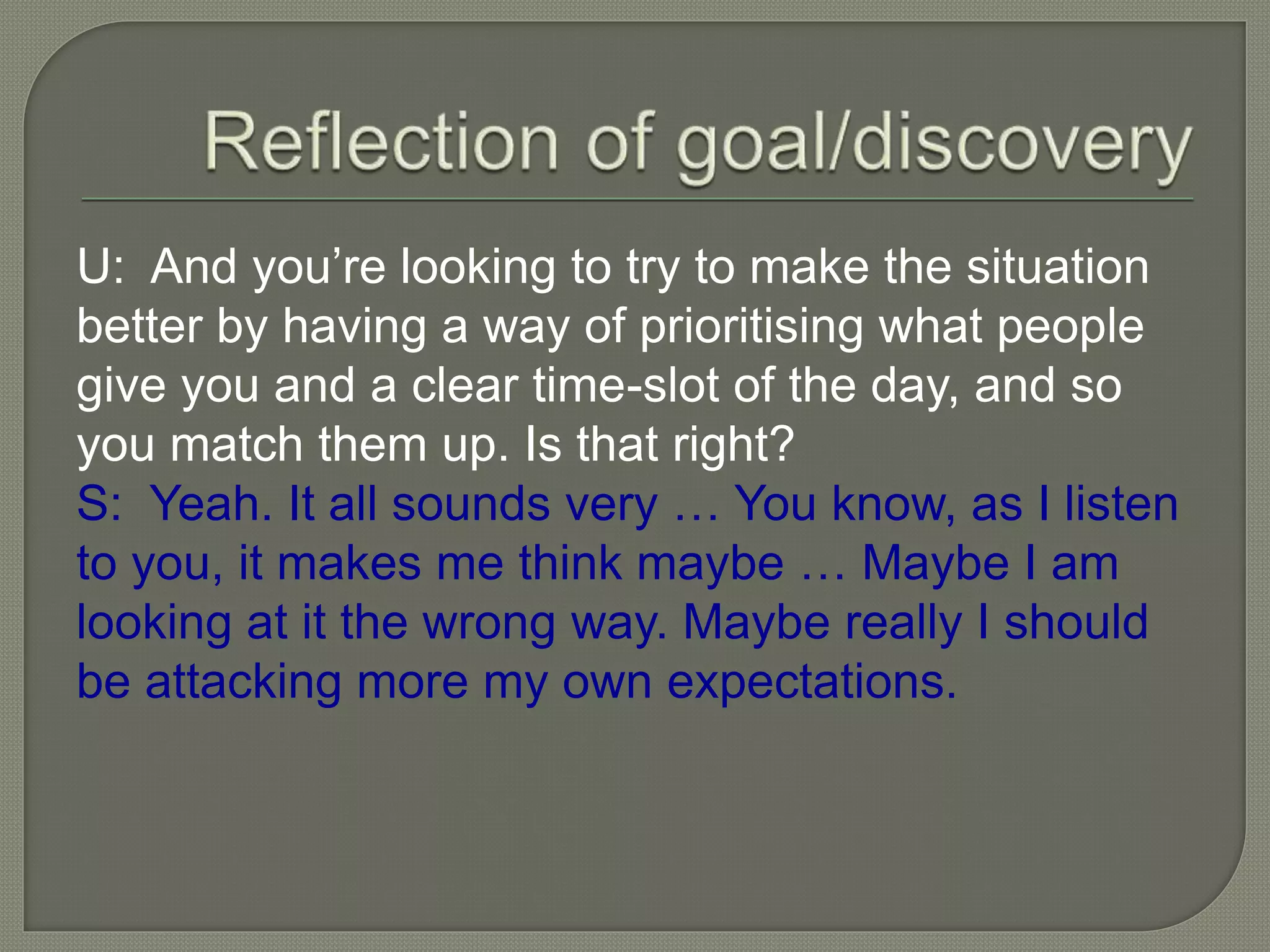
U: And you’re looking to try to make the situation
better by having a way of prioritising what people
give you and a clear time-slot of the day, and so
you match them up. Is that right?
S: Yeah. It all sounds very … You know, as I listen
to you, it makes me think maybe … Maybe I am
looking at it the wrong way. Maybe really I should
be attacking more my own expectations.
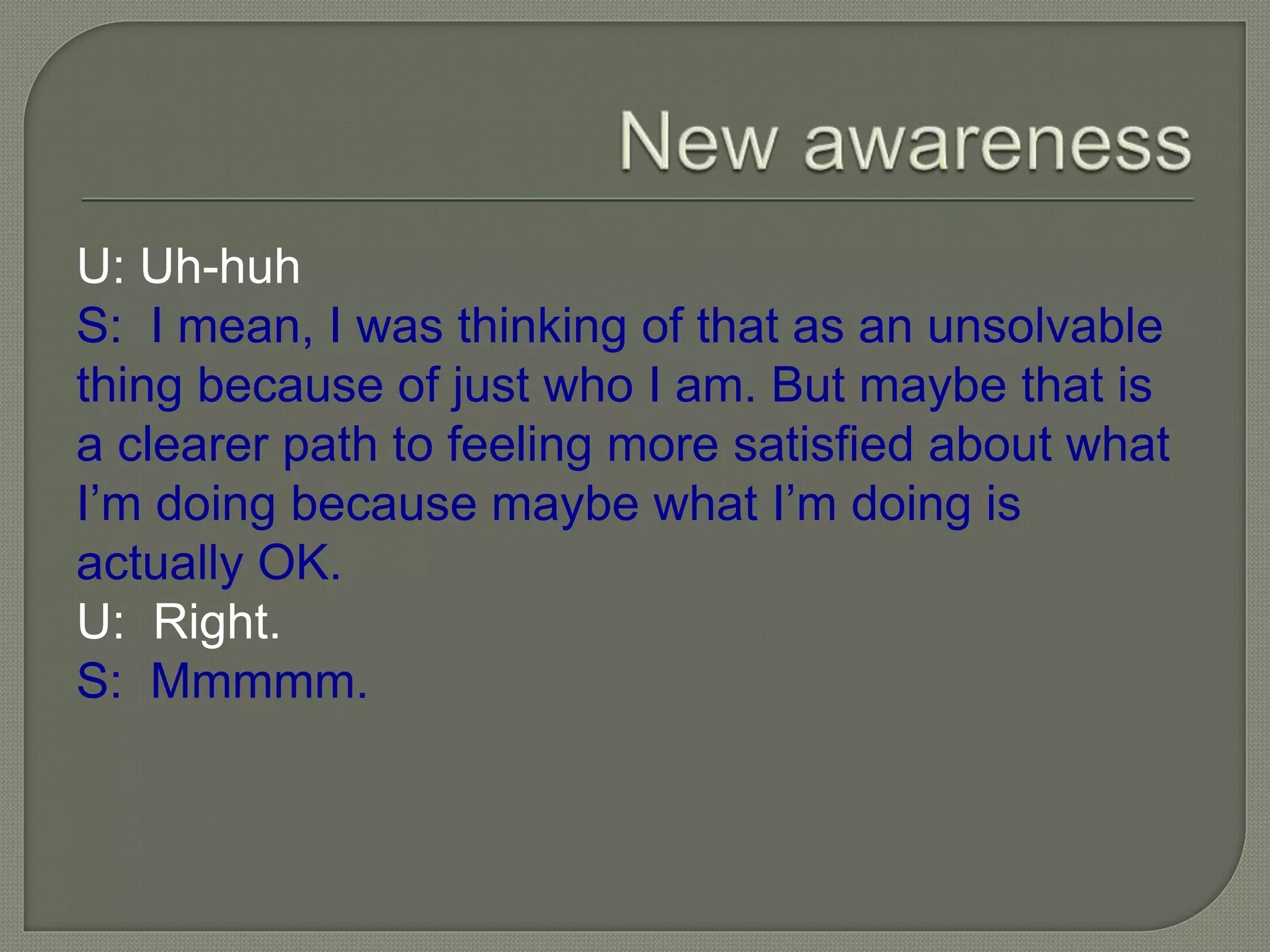
U: Uh-huh
S: I mean, I was thinking of that as an unsolvable
thing because of just who I am. But maybe that is
a clearer path to feeling more satisfied about what
I’m doing because maybe what I’m doing is
actually OK.
U: Right.
S: Mmmmm.
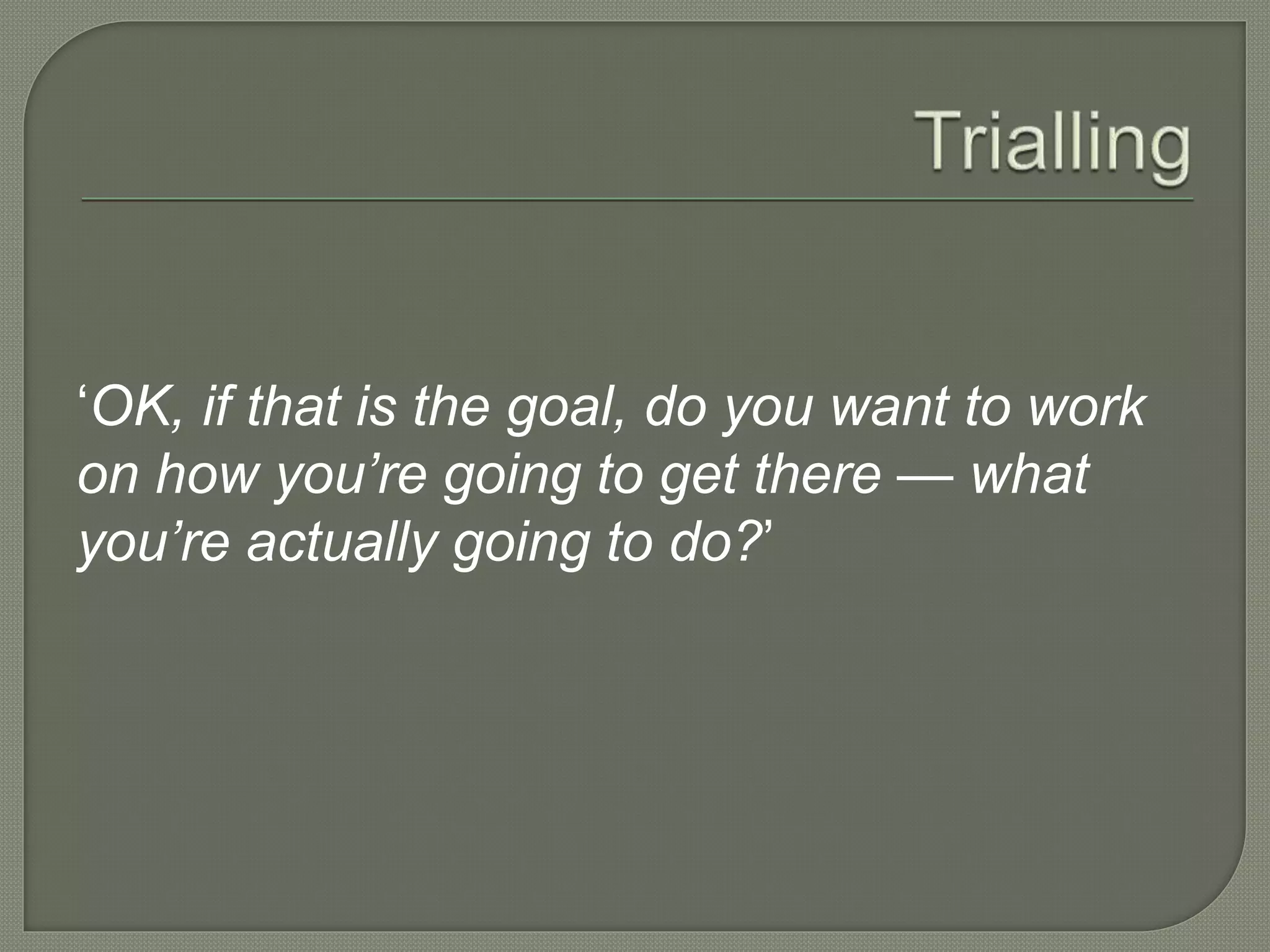
‘OK, if that is the goal, do you want to work
on how you’re going to get there — what
you’re actually going to do?’
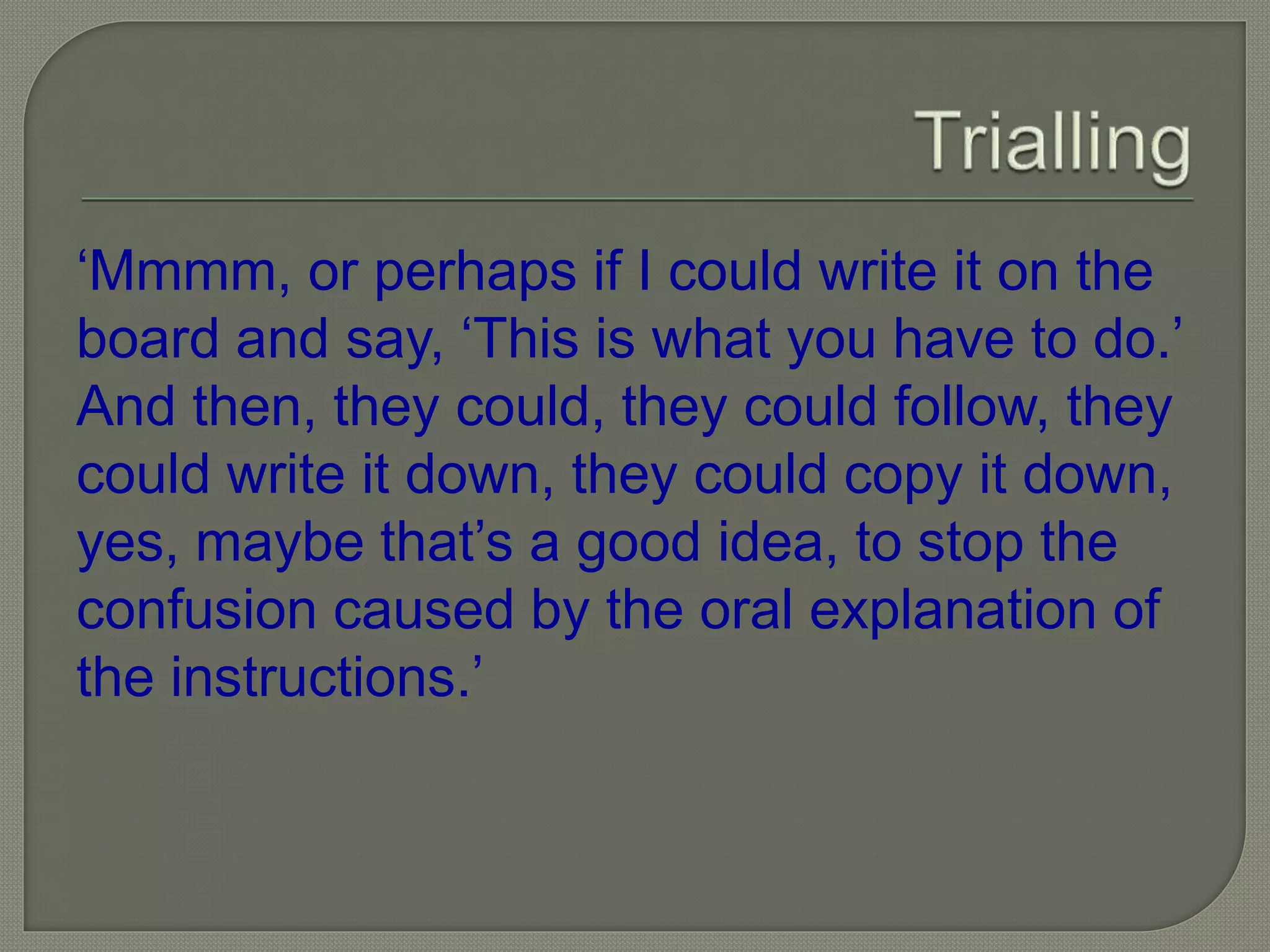
‘Mmmm, or perhaps if I could write it on the
board and say, ‘This is what you have to do.’
And then, they could, they could follow, they
could write it down, they could copy it down,
yes, maybe that’s a good idea, to stop the
confusion caused by the oral explanation of
the instructions.’
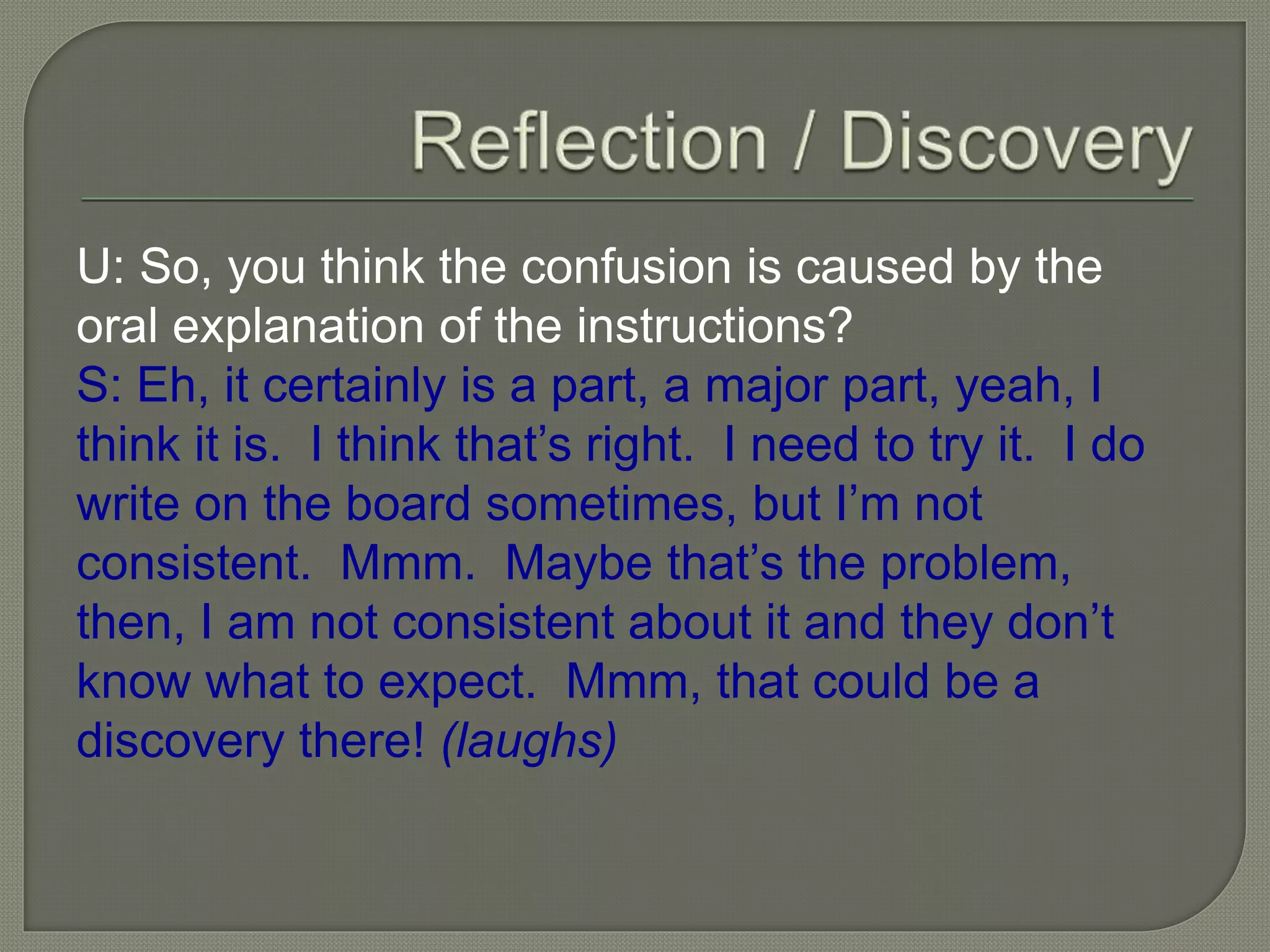
U: So, you think the confusion is caused by the
oral explanation of the instructions?
S: Eh, it certainly is a part, a major part, yeah, I
think it is. I think that’s right. I need to try it. I do
write on the board sometimes, but I’m not
consistent. Mmm. Maybe that’s the problem,
then, I am not consistent about it and they don’t
know what to expect. Mmm, that could be a
discovery there! (laughs)
‘Shall we fix a time and place for the next
meeting?’
Edge, J. 2011. The Reflexive Teacher
Educator in TESOL: Roots and Wings.
Routledge.
Edge,J. 2002. Continuing Cooperative
Development. University of Michigan
Press.
Rogers, C. 1980. A Way of Being.
Houghton Mifflin.
Rogers, C. 1961. On Becoming a Person.
Houghton Mifflin.
www.cooperative-development.com
In-Service Foreign Language Teachers’
Professional Development: Theories,
Approaches and Methods Innovation
As much a question of:
personal capacity as of a list of
competencies;
the kind of person you want to be as of the
skills you can learn;
internal growth as of external models.
Teachers do not need to be given new
methods in order to improve their
development so much as they need
support for their development in order to
improve their methods.
In-service development is less about
applying theory than it is about theorising
practice:
What did I try to do?
What did I learn from it?
How can I share and develop this?
So, what comes next?
www.cooperative-development.com

Cooperative Development: A way of being?

  • 1.
    Dr Julian Edge Universityof Manchester www.cooperative-development.com
  • 2.
    In-Service Foreign LanguageTeachers’ Professional Development: Theories, Approaches and Methods Innovation
  • 3.
    Philosophy and values Training,education and development Outlining a way forward Some key notes
  • 4.
    PRAGMATISM Aware, committed, purposefulaction If something is not useful in practice, it cannot be good in theory. Theorising is a process built up through reflection on experience. Innovation is something that is done.
  • 5.
  • 6.
    You can trainme and you can educate me, but you cannot develop me. I develop. If you wish to facilitate development for someone else, you cannot try to determine the outcome.
  • 7.
    Some version ofon-going reflective practice / action research Here, the key question is not, ‘Did it work?’, or even, ‘Is that true?’, but ‘What have I learned from this?’
  • 8.
    Extending communicative repertoire. Notas a way to teach, but as a way of supporting teacher learning. Although there are effects on teaching.
  • 9.
  • 10.
    A non-defensive Speakerpursuing Exploration Discovery Action
  • 12.
    A non-judgmental Understander,offering  Respect  Empathy  Sincerity
  • 13.
    With eyes andface and body and gesture and heart and mind and spirit: to make the Speaker feel well-listened-to.
  • 14.
    ‘Let me seeif I’ve got this right. What you are saying is … and I get the impression that you feel …’
  • 16.
    ‘You’ve talked aboutxxxx and yyyy and zzzz. Is there anything in what you’ve said so far that you think you’d like to go into in more depth?’
  • 17.
    ‘I hear yousaying xxxx now, and earlier you said yyyy. Is that right? Are those ideas connected at all?’
  • 18.
    ‘I hear yousaying xxxxx at this point. I’m not sure how that fits with what I understood before, when you were saying yyyyy. Have I got those two points right?’
  • 19.
    ‘So, coming outof what you’ve said so far, can you see a clear goal that you’d like to set yourself?’
  • 20.
    U: So, thefeeling you have is that you want to be able to take on a piece of work, get it done and move on to the next thing. S: Yes. U: You know your work experience isn’t like that, because people come and give you things you can’t ignore … S: That’s right.
  • 21.
    U: And you’relooking to try to make the situation better by having a way of prioritising what people give you and a clear time-slot of the day, and so you match them up. Is that right? S: Yeah. It all sounds very … You know, as I listen to you, it makes me think maybe … Maybe I am looking at it the wrong way. Maybe really I should be attacking more my own expectations.
  • 22.
    U: Uh-huh S: Imean, I was thinking of that as an unsolvable thing because of just who I am. But maybe that is a clearer path to feeling more satisfied about what I’m doing because maybe what I’m doing is actually OK. U: Right. S: Mmmmm.
  • 23.
    ‘OK, if thatis the goal, do you want to work on how you’re going to get there — what you’re actually going to do?’
  • 24.
    ‘Mmmm, or perhapsif I could write it on the board and say, ‘This is what you have to do.’ And then, they could, they could follow, they could write it down, they could copy it down, yes, maybe that’s a good idea, to stop the confusion caused by the oral explanation of the instructions.’
  • 25.
    U: So, youthink the confusion is caused by the oral explanation of the instructions? S: Eh, it certainly is a part, a major part, yeah, I think it is. I think that’s right. I need to try it. I do write on the board sometimes, but I’m not consistent. Mmm. Maybe that’s the problem, then, I am not consistent about it and they don’t know what to expect. Mmm, that could be a discovery there! (laughs)
  • 28.
    ‘Shall we fixa time and place for the next meeting?’
  • 29.
    Edge, J. 2011.The Reflexive Teacher Educator in TESOL: Roots and Wings. Routledge. Edge,J. 2002. Continuing Cooperative Development. University of Michigan Press. Rogers, C. 1980. A Way of Being. Houghton Mifflin. Rogers, C. 1961. On Becoming a Person. Houghton Mifflin.
  • 30.
  • 31.
    In-Service Foreign LanguageTeachers’ Professional Development: Theories, Approaches and Methods Innovation
  • 32.
    As much aquestion of: personal capacity as of a list of competencies; the kind of person you want to be as of the skills you can learn; internal growth as of external models.
  • 33.
    Teachers do notneed to be given new methods in order to improve their development so much as they need support for their development in order to improve their methods.
  • 34.
    In-service development isless about applying theory than it is about theorising practice: What did I try to do? What did I learn from it? How can I share and develop this? So, what comes next?
  • 35.

Editor's Notes

  • #2 Thanks to all involved in inviting me, to those taking such good care of me, personally, professionally and technologically, and to you all for coming. It is a very great honour to be invited to give a keynote talk at any gathering of fellow professionals. It is particularly so to be invited at such distance and to such a prestigious event as this. It bears thinking about. I have decided to interpret this invitation as being based on my work, and I want to tell you about that strand of my work that has been, and remains most important to me. It also becomes a responsibility of mine not only to address the symposium’s theme, but also to attempt to sound some key notes that might resonate usefully over the next couple of days. So, let us begin by reminding ourselves of the title of our symposium.
  • #3 These are profound concepts and frequently differentially understood. It makes sense to me, therefore, to try to establish some common ground before I get on to the work proper. And if I fail to establish common ground with you, that will also count as a success so long as you get clear view of where I stand and what I mean by what I say. Here is an overview of how I have organised my talk.
  • #4 First, I will briefly explore some philosophical concepts and values that, for me, underpin action in this area. I will then define what I mean by the terms, training, education and development in the context of in-service teachers. In the main part of the talk, I will introduce Cooperative Development as one possible way forward in this area. Finally, I will reformulate some ideas arising from the talk and offer them as key notes for your further consideration. If I had to align myself with any one school of philosophy, it would be pragmatism.
  • #5 Distinguish this from being ‘practical’ as distinct from ‘theoretical’ and talk through the points.
  • #6 Emphasize that this is not an argument that these are THE CORE values that everyone should subscribe to. HOWEVER, they are my best shot thus far at identifying mine. The challenge is to work on identifying one’s own, because the actions that follow need to be in line with one’s underlying values, and so much attempted innovation falls at this hurdle. To understand the work that I want to report on, you need to keep these values in mind. NOT accept them, necessarily, but keep them in mind as what I am trying to express.
  • #7 Identify development as my focus, but point out that to make such development possible will frequently require training and education. My work is centered in a larger context of overall approach: reflective practice/action research.
  • #8 Stress pedagogic capacity being built by the teacher as explorer, investigator, experimenter, researcher, theoriser.
  • #9 Stress communicative repertoire among colleagues. I will now explain what I mean by non-judgmental discourse and why I find it so useful. I do so under the heading of Cooperative Development — a mode of work that has motivated and sustained me since the late 1980s and which some others have found useful.
  • #10 Individual development as a social process that also supports collegiality. Or communal development that releases the potential creativity and creative potential of the individual.
  • #11 Explanation of terms. Let’s see one example of this happening.
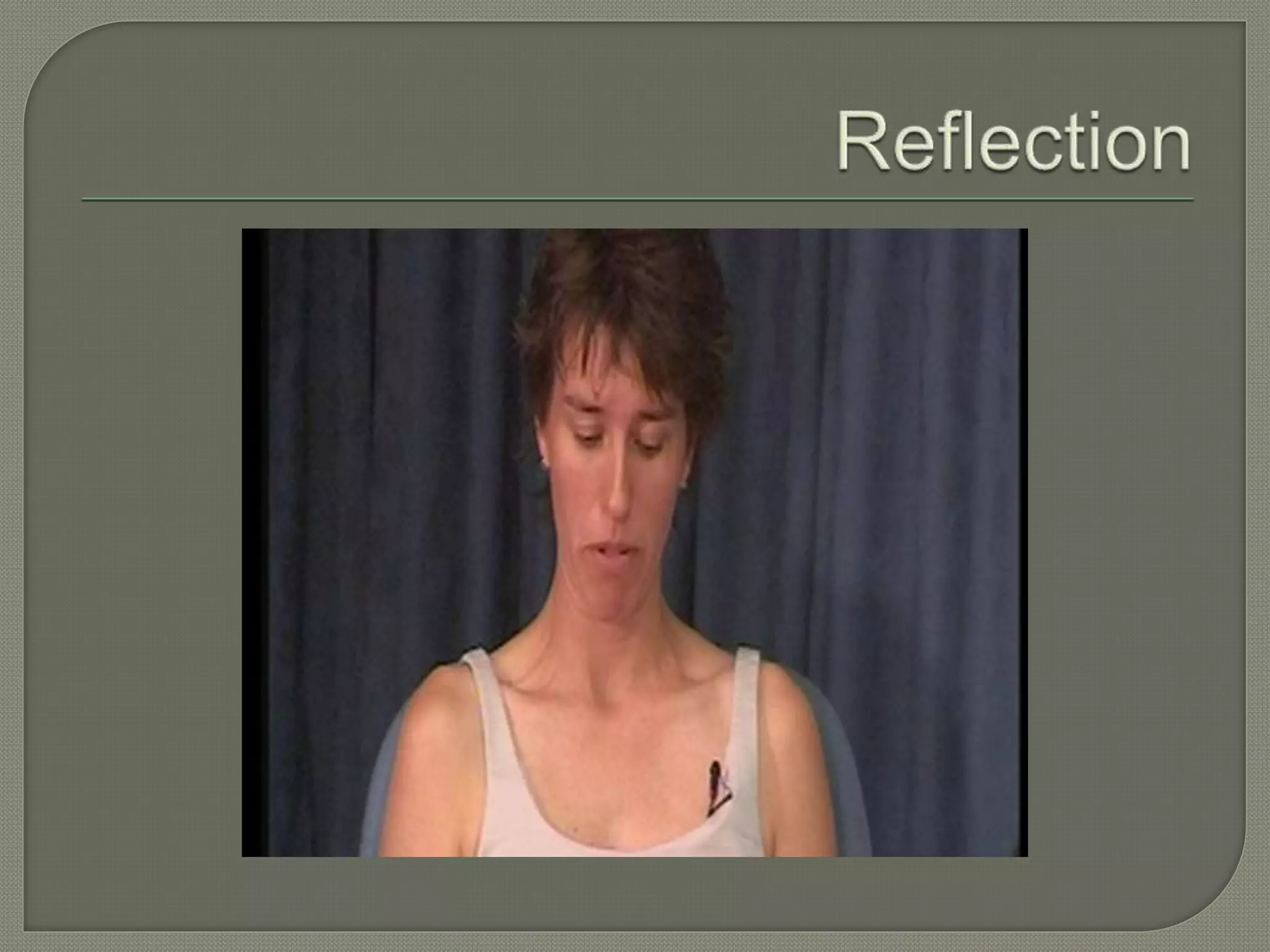
  • #12 Sue was a teacher of English at an Italian College of Agriculture at the time of the 2003 invasion of Iraq. Her duties involved helping students become more critical in their reading. She felt that engaging the students’ sociopolitical awareness could be an important part of this process. Rather than the specific content of what she says, what I would like you to notice is the process in which she is engaged: she explores herself to a discovery and we can hear that moment marked in her words, with “Actually, come to think of it.” What she discovers there will prove significant as she later works her way towards action.
  • #13 Three underling principles. The Understander (usually one person, although I just showed you a group version of CD) puts aside his or her opinions and experience n order to Understand. So, we have two people working together, one as Speaker, one as Understander, both committed to supporting the development of the Speaker. A number of different skills are required of the Understander. I have to tell you about them one after the other, but that does not mean that they are to seen as existing in a fixed sequence.
  • #14 Attending, for example, is required at all times.
  • #15 Three effects of Reflecting: correct+, incorrect+, correct-++; Here’s a brief example of the first
  • #16 In a previous session, Sue had worked on her work/life balance. She had recently taken on some new responsibilities and wanted to make clear that she did not want to return to her previous topic in this session. The Reflection makes clear that she has been Understood and encourages her to move forward.
  • #17 Explain.
  • #18 Explain.
  • #19 Explain.
  • #20 Let’s look at how an accurate reflection helps a teacher make a new Discovery in terms of Goal
  • #21 Explain context: Newly promoted supervisor finds that she can’t get on with her work because of having to deal with constant interruptions by teachers with problems.
  • #22 Notice ‘As I listen to you’ (Reflect accurately what I said) as the moment of discovery.
  • #23 The breakthrough here is not the more usual progression towards action, but a discovery in terms of awareness. In other words, the Speaker realises that she does not need to change what she does, but to recognise what she does and value it differently. The challenge is not to change the world but to change one’s attitude towards it. In other circumstances, clarification of the Speaker’s goal will lead on towards changes in action. The Understander can help by inviting what we call Trialling.
  • #24 An example: A teacher of elementary children had been working on the difficulty he had getting his pupils to take proper note of the homework he set:
  • #25 At this point, the Understander Reflected back what the Speaker had said:
  • #26 So, the teacher not only came up with a practical response to his immediate problem, he made a deeper discovery about himself as a teacher that he could work on further. Look at example away from immediate action and how correcting Reflections helps the Speaker clarify more precisely what she wants to say.
  • #27 As well as leading to action, the approach can also be useful in terms of clarifying conceptual thinking. A longer clip taken from a workshop. Excuse the camera angle. Olga is talking about the importance to her research of understanding different perspectives. Notice how she corrects my Reflections, moving always closer to exactly what she wants to say, until I get to “exactly what I had in my mind”. She begins with, “In my own personal experience, when I was back in Bylorussia, …’
  • #28 The key outcome for Olga was that she had felt that she was going round in circles, but that she had now identified the concept of “acceptance” as being fundamental to her research into intercultural communication. The energy of thought had been soiidified into the matter of language, allowing her to see it, hear it, grasp it, and this will feed the energy of future thought.
  • #29 Regular meetings, later possible occasional use.
  • #30 I hope that you have seen and heard enough to want to know more. You can’t meaningfully evaluate this approach without experiencing it, which is not to say that it will suit everyone. There is no one way. There are ways. The website is one way forward.
  • #31 Created, administered and taken forward by my colleague, Mariam Attia, where you will find more information, introductory materials, examples of CD exchanges and, most importantly, potential colleagues keen to work as Speakers and Understanders. Returning to the here and now …
  • #32 I promised some suggested key notes . . .
  • #33 Not the displacive argument of ‘More than’, but an augmentative suggestion of as/as. As pressures grow, our response needs to draw on our unique capacities as humans to know ourselves, to know ourselves as a reflexive part of a context, not only in one.
  • #34 Comment.
  • #35 I look forward to further interaction here and wish you all an enjoyable, stimulating and motivating symposium. Here is the website again.
  • #36 Thank you.