1
Contingency
Approaches
2
Ex. 3.1 Comparing the Universalistic and
Contingency Approaches to Leadership
Universalistic
Approach
Contingency
Approach
Followers
Leader
Situation
Leadership
Traits/behaviors
Style
Traits
Behavior
Position
Needs
Maturity
Training
Cohesion
Task
Structure
Systems
Env.
Outcomes
(Performance, satisfaction,
etc.)
Outcomes
(Performance, satisfaction,
etc.)
3
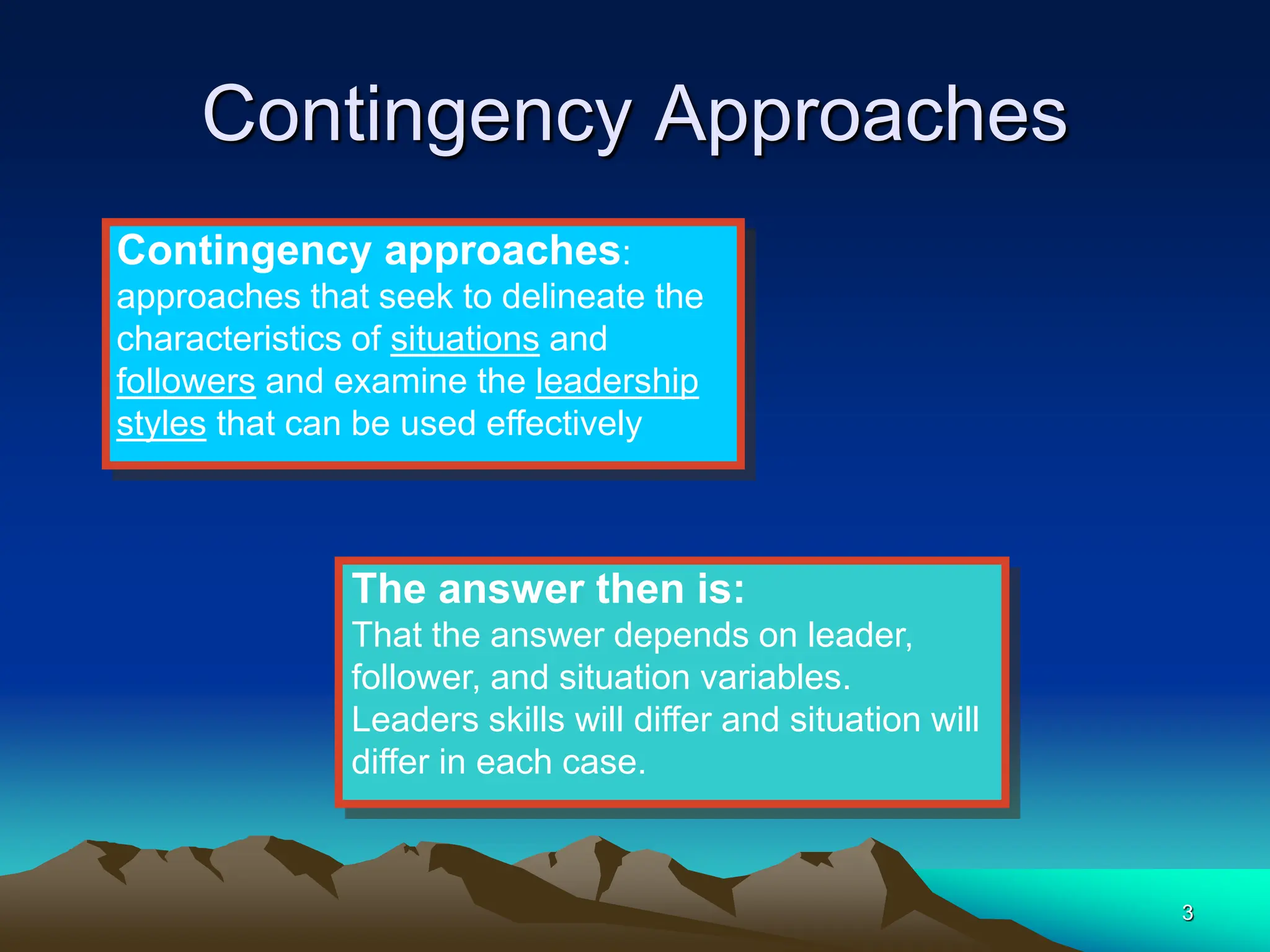
Contingency Approaches
Contingency approaches:
approaches that seek to delineate the
characteristics of situations and
followers and examine the leadership
styles that can be used effectively
The answer then is:
That the answer depends on leader,
follower, and situation variables.
Leaders skills will differ and situation will
differ in each case.
4
Contingency Approaches
Contingency approaches:
Ultimately, the leader, the followers,
and the situation must match for true
leadership to take place!
5
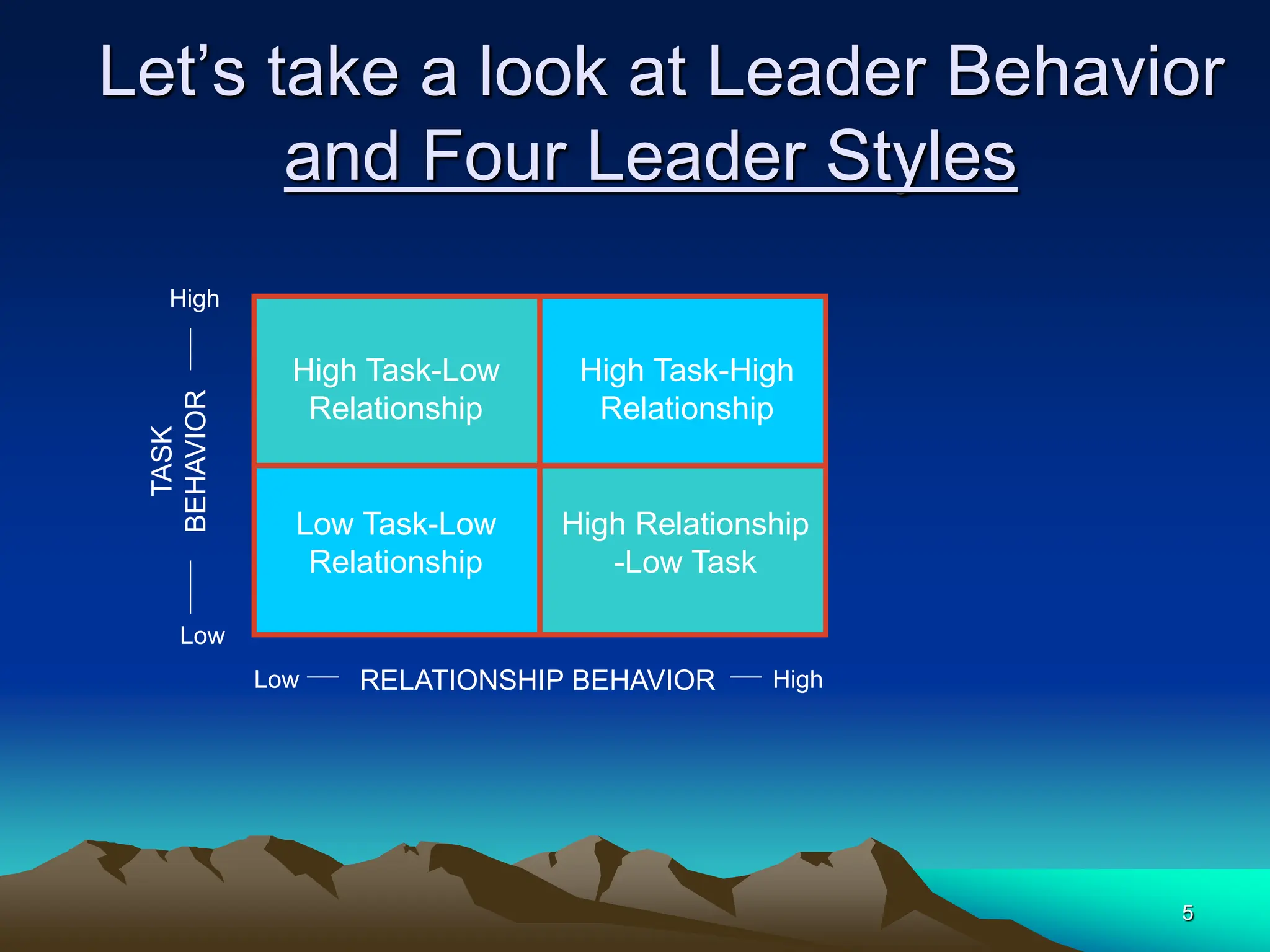
Let’s take a look at Leader Behavior
and Four Leader Styles
High Task-Low
Relationship
High Task-High
Relationship
Low Task-Low
Relationship
High Relationship
-Low Task
Low
High
Low High
RELATIONSHIP BEHAVIOR
TASK
BEHAVIOR
Qualities that influence a Leader
• Vision
Qualities that influence a Leader
• Vision
• Ability
Qualities that influence a Leader
• Vision
• Ability
• Enthusiasm/Vitality
Qualities that influence a Leader
• Vision
• Ability
• Enthusiasm/Vitality
• Stability
Qualities that influence a Leader
• Vision
• Ability
• Enthusiasm/Vitality
• Stability
• Concern for others
Qualities that influence a Leader
• Vision
• Ability
• Enthusiasm/Vitality
• Stability
• Concern for others
• Self Confidence
Qualities that influence a Leader
• Vision
• Ability
• Enthusiasm/Vitality
• Stability
• Concern for others
• Self Confidence
• Integrity
Qualities that influence a Leader
• Vision
• Ability
• Enthusiasm/Vitality
• Stability
• Concern for others
• Self Confidence
• Integrity
• Charisma
14
Situational Theory
Let’s look at Situational approaches
Hersey and Blanchard’s extension
of the Leadership Grid focusing on
the characteristics of followers as
the important element of the
situation, and consequently, of
determining effective leader
behavior
Situational Theory
15
• Chart:
16
Ex. 3.4 Hersey and Blanchard’s
Situational Theory of Leadership
Follower Characteristics Appropriate Leader Style
Low readiness level
Moderate readiness level
High readiness level
Very high readiness level
Telling (high task-low relationship)
Selling (high task-high relationship)
Participating (low task-high rel.)
Delegating (low task-low relationship)
17
Path-Goal Theory
A contingency approach to
leadership in which the leader’s
responsibility is to increase
subordinates’ motivation by
clarifying the behaviors necessary
for task accomplishment and
rewards
18
Ex. 3.5 Leader Roles in the Path-Goal
Model
Path Clarification Increase Rewards
Leader defines what follower
must do to attain work
outcomes
Leader clarifies follower’s
work role
Follower has increased
knowledge & confidence to
accomplish outcomes
Leader learns follower’s
needs
Leader matches follower’s
needs to rewards if work
outcomes are accomplished
Leader increases value of
work outcomes for follower
Follower displays increased effort and
motivation
Organizational work outcomes are
accomplished
19
Ex. 3.6 Path-Goal Situations and
Preferred Leader Behaviors
Situation Leader Behavior Impact on Follower Outcome
Supportive
Leadership
Directive
Leadership
Achievement-
Oriented
Leadership
Participative
Leadership
Followers lack
self-confidence
Ambiguous job
Lack of job
challenge
Incorrect
reward
Increases confidence
to achieve work
outcomes
Clarifies path to
reward
Set and strive for
high goals
Clarifies followers’
needs to change
rewards
Increased
effort;
improved
satisfaction
and
performance
20
Ex. 3.7 Five Leader Decision Styles
Area of Influence by Leader
Area of Freedom for Group
Decide Consult
Individually
Consult
Group
Facilitate Delegate
21
Substitute and Neutralizer
Substitute: a situational
variable that makes
leadership unnecessary
or redundant
Neutralizer: a situational
characteristic that
counteracts the leadership
style and prevents the
leader from displaying
certain behaviors
22
Ex. 3.10 Substitutes and Neutralizers
for Leadership
Variable Task-Oriented
Leadership
People-
Oriented
Leadership
Organizational
variables
Group cohesiveness
Formalization
Inflexibility
Low positional power
Physical separation
Substitutes for
Substitutes for
Neutralizes
Neutralizes
Neutralizes
Substitutes for
No effect on
No effect on
Neutralizes
Neutralizes
Task
characteristics
Highly struct. task
Automatic feedback
Intrinsic satisfaction
Substitutes for
Substitutes for
No effect on
No effect on
No effect on
Substitutes for
Follower
characteristics
Professionalism
Training/experience
Low value of rewards
Substitutes for
Substitutes for
Neutralizes
Substitutes for
No effect on
Neutralizes
Filling the “GAPS”
• JACK WELCH
• “Before you are a leader,
success is all about growing
yourself. When you become a
leader, success is all about
growing others and filling the
Gaps.”
Through Individualized
Leadership
• Vertical Dyad Linkage
• Leader Member Exchange (LMX)
• Partnership Building
• Systems and Networks
Through Communication
• Build Relationships
• Create the sense of Community
• Remember to ask questions
• Maintain Open Channels of
Communication
Through Leadership
• Remember that everything filters down
• Allow for opportunities
• Seek to Engage
• Don’t Delegate. Motivate!
Through Empowerment
• Empowerment is the delegation of power
or authority to subordinates in the
organization
• Are they a “4” or are they a “5”?
• Share the Power.
Through Tools
• Personal Evaluations
• One on One meetings
• Building rapport with your team
• Going to meetings
• Having outings
• Team Building Exercise
• Though Conferences

Contengency Approaches in management..ppt

  • 1.
  • 2.
    2 Ex. 3.1 Comparingthe Universalistic and Contingency Approaches to Leadership Universalistic Approach Contingency Approach Followers Leader Situation Leadership Traits/behaviors Style Traits Behavior Position Needs Maturity Training Cohesion Task Structure Systems Env. Outcomes (Performance, satisfaction, etc.) Outcomes (Performance, satisfaction, etc.)
  • 3.
    3 Contingency Approaches Contingency approaches: approachesthat seek to delineate the characteristics of situations and followers and examine the leadership styles that can be used effectively The answer then is: That the answer depends on leader, follower, and situation variables. Leaders skills will differ and situation will differ in each case.
  • 4.
    4 Contingency Approaches Contingency approaches: Ultimately,the leader, the followers, and the situation must match for true leadership to take place!
  • 5.
    5 Let’s take alook at Leader Behavior and Four Leader Styles High Task-Low Relationship High Task-High Relationship Low Task-Low Relationship High Relationship -Low Task Low High Low High RELATIONSHIP BEHAVIOR TASK BEHAVIOR
  • 6.
    Qualities that influencea Leader • Vision
  • 7.
    Qualities that influencea Leader • Vision • Ability
  • 8.
    Qualities that influencea Leader • Vision • Ability • Enthusiasm/Vitality
  • 9.
    Qualities that influencea Leader • Vision • Ability • Enthusiasm/Vitality • Stability
  • 10.
    Qualities that influencea Leader • Vision • Ability • Enthusiasm/Vitality • Stability • Concern for others
  • 11.
    Qualities that influencea Leader • Vision • Ability • Enthusiasm/Vitality • Stability • Concern for others • Self Confidence
  • 12.
    Qualities that influencea Leader • Vision • Ability • Enthusiasm/Vitality • Stability • Concern for others • Self Confidence • Integrity
  • 13.
    Qualities that influencea Leader • Vision • Ability • Enthusiasm/Vitality • Stability • Concern for others • Self Confidence • Integrity • Charisma
  • 14.
    14 Situational Theory Let’s lookat Situational approaches Hersey and Blanchard’s extension of the Leadership Grid focusing on the characteristics of followers as the important element of the situation, and consequently, of determining effective leader behavior
  • 15.
  • 16.
    16 Ex. 3.4 Herseyand Blanchard’s Situational Theory of Leadership Follower Characteristics Appropriate Leader Style Low readiness level Moderate readiness level High readiness level Very high readiness level Telling (high task-low relationship) Selling (high task-high relationship) Participating (low task-high rel.) Delegating (low task-low relationship)
  • 17.
    17 Path-Goal Theory A contingencyapproach to leadership in which the leader’s responsibility is to increase subordinates’ motivation by clarifying the behaviors necessary for task accomplishment and rewards
  • 18.
    18 Ex. 3.5 LeaderRoles in the Path-Goal Model Path Clarification Increase Rewards Leader defines what follower must do to attain work outcomes Leader clarifies follower’s work role Follower has increased knowledge & confidence to accomplish outcomes Leader learns follower’s needs Leader matches follower’s needs to rewards if work outcomes are accomplished Leader increases value of work outcomes for follower Follower displays increased effort and motivation Organizational work outcomes are accomplished
  • 19.
    19 Ex. 3.6 Path-GoalSituations and Preferred Leader Behaviors Situation Leader Behavior Impact on Follower Outcome Supportive Leadership Directive Leadership Achievement- Oriented Leadership Participative Leadership Followers lack self-confidence Ambiguous job Lack of job challenge Incorrect reward Increases confidence to achieve work outcomes Clarifies path to reward Set and strive for high goals Clarifies followers’ needs to change rewards Increased effort; improved satisfaction and performance
  • 20.
    20 Ex. 3.7 FiveLeader Decision Styles Area of Influence by Leader Area of Freedom for Group Decide Consult Individually Consult Group Facilitate Delegate
  • 21.
    21 Substitute and Neutralizer Substitute:a situational variable that makes leadership unnecessary or redundant Neutralizer: a situational characteristic that counteracts the leadership style and prevents the leader from displaying certain behaviors
  • 22.
    22 Ex. 3.10 Substitutesand Neutralizers for Leadership Variable Task-Oriented Leadership People- Oriented Leadership Organizational variables Group cohesiveness Formalization Inflexibility Low positional power Physical separation Substitutes for Substitutes for Neutralizes Neutralizes Neutralizes Substitutes for No effect on No effect on Neutralizes Neutralizes Task characteristics Highly struct. task Automatic feedback Intrinsic satisfaction Substitutes for Substitutes for No effect on No effect on No effect on Substitutes for Follower characteristics Professionalism Training/experience Low value of rewards Substitutes for Substitutes for Neutralizes Substitutes for No effect on Neutralizes
  • 23.
    Filling the “GAPS” •JACK WELCH • “Before you are a leader, success is all about growing yourself. When you become a leader, success is all about growing others and filling the Gaps.”
  • 24.
    Through Individualized Leadership • VerticalDyad Linkage • Leader Member Exchange (LMX) • Partnership Building • Systems and Networks
  • 25.
    Through Communication • BuildRelationships • Create the sense of Community • Remember to ask questions • Maintain Open Channels of Communication
  • 26.
    Through Leadership • Rememberthat everything filters down • Allow for opportunities • Seek to Engage • Don’t Delegate. Motivate!
  • 27.
    Through Empowerment • Empowermentis the delegation of power or authority to subordinates in the organization • Are they a “4” or are they a “5”? • Share the Power.
  • 28.
    Through Tools • PersonalEvaluations • One on One meetings • Building rapport with your team • Going to meetings • Having outings • Team Building Exercise • Though Conferences