



Constructing a Strategic Plan:
Essential Processes & Components
Presented by
Rebecca Jones, MLS
Managing Partner, Dysart & Jones Associates
&
Kimberly Silk, MLS
Principal Consultant, Brightsail Research
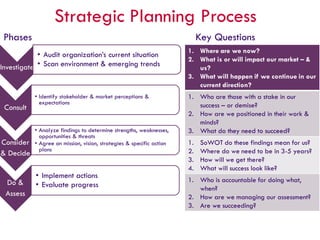
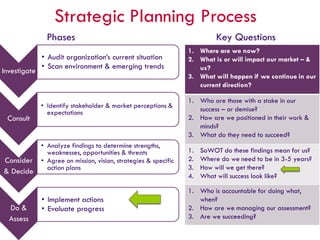
Strategic Planning Process
Investigate
• Audit organization’s current situation
• Scan environment & emerging trends
Consult
• Identify stakeholder & market perceptions &
expectations
Consider
& Decide
• Analyze findings to determine strengths, weaknesses,
opportunities & threats
• Agree on mission, vision, strategies & specific action
plans
Do &
Assess
• Implement actions
• Evaluate progress
Phases Key Questions
1. Where are we now?
2. What is or will impact our market – &
us?
3. What will happen if we continue in our
current direction?
1. Who are those with a stake in our
success – or demise?
2. How are we positioned in their work &
minds?
3. What do they need to succeed?
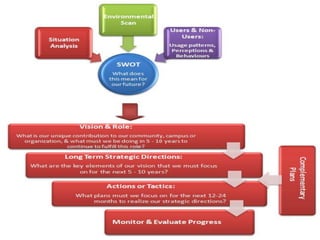
1. SoWOT do these findings mean for us?
2. Where do we need to be in 3-5 years?
3. How will we get there?
4. What will success look like?
1. Who is accountable for doing what,
when?
2. How are we managing our assessment?
3. Are we succeeding?
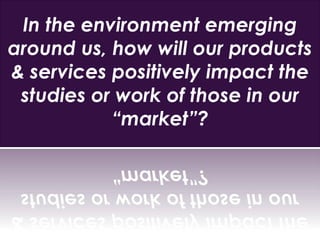
In the environment emerging
around us, how will our products
& services positively impact the
studies or work of those in our
“market”?
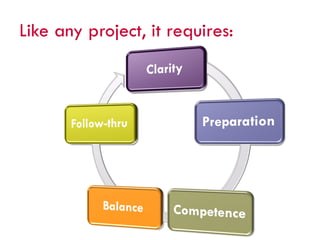
Like any project, it requires:
Planning is
a good
thing
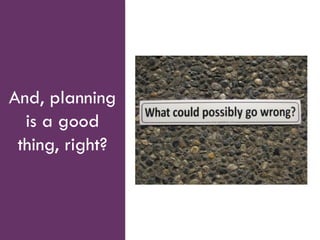
And, planning
is a good
thing, right?
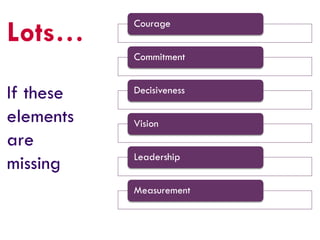
Lots…
If these
elements
are
missing
Courage
Commitment
Decisiveness
Vision
Leadership
Measurement
Courage
Takes courage to question assumptions:
• The SWOT is a powerful analytical tool if used
properly
• Focus on the future – ensure “O” and “T” are
grounded in research on the future of
communities, society and the industry you are in
• Frame the SWOT as “SoWOT” – seriously
consider what this means for your library
Takes Courage to Research &
Forecast Future Trends
• Future forecasts are based on analysis; there is
limited trends analysis
• Few information professionals are trained
forecasters; little understanding of the field or the
techniques
• We are generally too preoccupied with today to
think seriously about the future
Takes Courage to Use the SWOT
Properly
• Isolate elements of the SWOT that indicate the need
for change – all else is irrelevant and distracts you
from the primary purpose of the strategic plan
• In most cases – the critical considerations can be
counted on one hand – in most strategic plans 80%
of the strengths and weaknesses are of no
significance
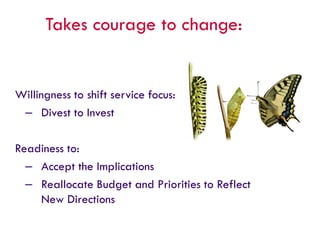
Takes courage to change:
Willingness to shift service focus:
– Divest to Invest
Readiness to:
– Accept the Implications
– Reallocate Budget and Priorities to Reflect
New Directions
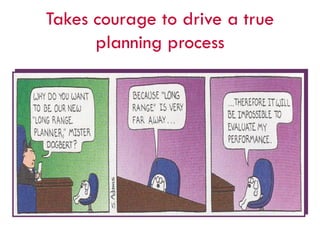
Takes courage to drive a true
planning process
Commitment
https://goo.gl/RYm48J
Commit the Time and Energy
• Strategic Planning is hard
work
• Advance preparation is
essential
• Senior staff must commit a
significant amount of time and
staff investment
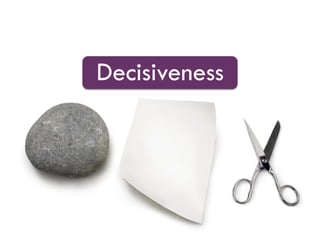
Decisiveness
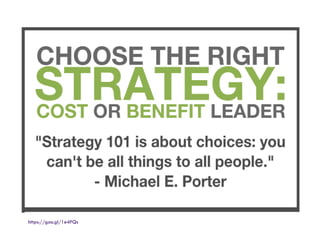
https://goo.gl/1e4PQs
18
Determining your mission, your vision, and
your strategies is fundamentally a decision-
making process to go in this direction as
opposed to that direction.
Vision
“Vision statements … are also the
most overused, abused, and
poorly written part of strategic
planning you will ever see.”
Peter Wright
http://www.planningbootcamp.com
An Effective Vision
• Addresses the SW and the OT in the SWOT
• Communicates a clear picture of a preferred
future
• Focuses on the need for major changes
• Drives the strategic directions and ultimately
the goals and tactics
Leadership
“The only way a leader is going to translate
a vision into reality – an ability that is the
essence of leadership – is to anchor,
implement and execute that vision through a
variety of policies, practices, procedures and
systems that will bring in people and
empower them to implement the vision”.
Warren Bennis
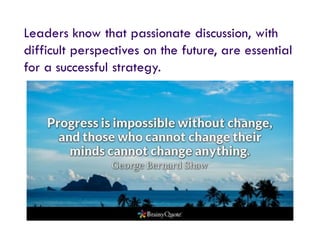
Leaders know that passionate discussion, with
difficult perspectives on the future, are essential
for a successful strategy.
Demonstrating Leadership
• Identify necessary changes – regardless of the
discomfort
• Challenge public opinion and perceptions – be
prepared to take your services in a different direction
• Actively engage segments of your market that no
longer view your services as a important part of their
life or a vital contributor to their interests
– “Non users?” nah…..”potential customers”
• Make your case for change – reasoned, defensible
and practical – and then do it
Decisions are Critical Throughout
the Process
1. Is it a Strategic Plan, a Service Plan or an Operational Plan?
2. Will the vision describe an organization that addresses major
social, economic, and sector changes?
3. Does the plan consider, and likely change, key outcomes and
priorities?
4. Does the plan lead rather than follow popular opinion?
5. Does it reallocate resources?
6. Is there commitment to establish success measures and to
monitor and manage the measures?
Measurement
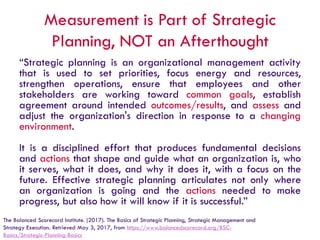
Measurement is Part of Strategic
Planning, NOT an Afterthought
“Strategic planning is an organizational management activity
that is used to set priorities, focus energy and resources,
strengthen operations, ensure that employees and other
stakeholders are working toward common goals, establish
agreement around intended outcomes/results, and assess and
adjust the organization's direction in response to a changing
environment.
It is a disciplined effort that produces fundamental decisions
and actions that shape and guide what an organization is, who
it serves, what it does, and why it does it, with a focus on the
future. Effective strategic planning articulates not only where
an organization is going and the actions needed to make
progress, but also how it will know if it is successful.”
The Balanced Scorecard Institute. (2017). The Basics of Strategic Planning, Strategic Management and
Strategy Execution. Retrieved May 3, 2017, from https://www.balancedscorecard.org/BSC-
Basics/Strategic-Planning-Basics
Strategic Planning Process
Investigate
• Audit organization’s current situation
• Scan environment & emerging trends
Consult
• Identify stakeholder & market perceptions &
expectations
Consider
& Decide
• Analyze findings to determine strengths,
weaknesses, opportunities & threats
• Agree on mission, vision, strategies & specific
action plans
Do &
Assess
• Implement actions
• Evaluate progress
Phases Key Questions
1. Where are we now?
2. What is or will impact our market – &
us?
3. What will happen if we continue in our
current direction?
1. Who are those with a stake in our
success – or demise?
2. How are we positioned in their work &
minds?
3. What do they need to succeed?
1. SoWOT do these findings mean for us?
2. Where do we need to be in 3-5 years?
3. How will we get there?
4. What will success look like?
1. Who is accountable for doing what,
when?
2. How are we managing our assessment?
3. Are we succeeding?
How Do We Know if
We Are Achieving
Success?
Measure and Evaluate.
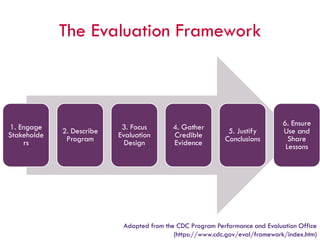
The Evaluation Framework
1. Engage
Stakeholde
rs
2. Describe
Program
3. Focus
Evaluation
Design
4. Gather
Credible
Evidence
5. Justify
Conclusions
6. Ensure
Use and
Share
Lessons
Adapted from the CDC Program Performance and Evaluation Office
(https://www.cdc.gov/eval/framework/index.htm)
1. Engage Stakeholders
• Who is involved in program
operations?
• Who is served or affected by the
program?
• Who are the primary users of the
evaluation?
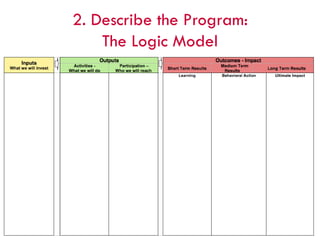
2. Describe the Program:
The Logic Model
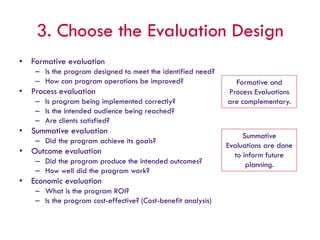
3. Choose the Evaluation Design
• Formative evaluation
– Is the program designed to meet the identified need?
– How can program operations be improved?
• Process evaluation
– Is program being implemented correctly?
– Is the intended audience being reached?
– Are clients satisfied?
• Summative evaluation
– Did the program achieve its goals?
• Outcome evaluation
– Did the program produce the intended outcomes?
– How well did the program work?
• Economic evaluation
– What is the program ROI?
– Is the program cost-effective? (Cost-benefit analysis)
Formative and
Process Evaluations
are complementary.
Summative
Evaluations are done
to inform future
planning.
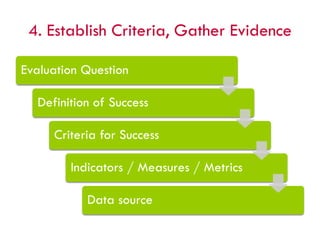
4. Establish Criteria, Gather Evidence
Evaluation Question
Definition of Success
Criteria for Success
Indicators / Measures / Metrics
Data source
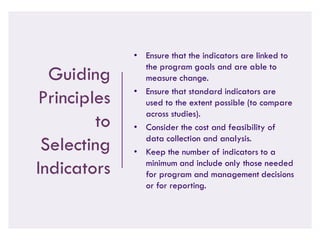
Guiding
Principles
to
Selecting
Indicators
• Ensure that the indicators are linked to
the program goals and are able to
measure change.
• Ensure that standard indicators are
used to the extent possible (to compare
across studies).
• Consider the cost and feasibility of
data collection and analysis.
• Keep the number of indicators to a
minimum and include only those needed
for program and management decisions
or for reporting.
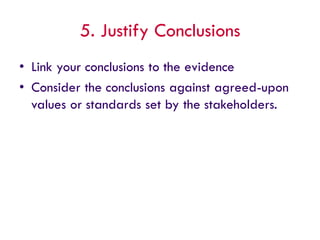
5. Justify Conclusions
• Link your conclusions to the evidence
• Consider the conclusions against agreed-upon
values or standards set by the stakeholders.
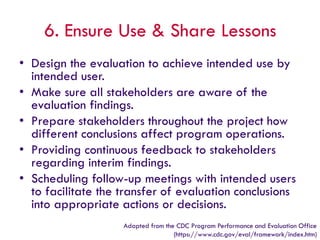
6. Ensure Use & Share Lessons
• Design the evaluation to achieve intended use by
intended user.
• Make sure all stakeholders are aware of the
evaluation findings.
• Prepare stakeholders throughout the project how
different conclusions affect program operations.
• Providing continuous feedback to stakeholders
regarding interim findings.
• Scheduling follow-up meetings with intended users
to facilitate the transfer of evaluation conclusions
into appropriate actions or decisions.
Adapted from the CDC Program Performance and Evaluation Office
(https://www.cdc.gov/eval/framework/index.htm)
Q & A
Thank You
Rebecca Jones – Rebecca@dysartjones.com
Kimberly Silk – Kim@brightsail.com

Constructing a Strategic Plan: Essential Processes and Components

  • 1.
    Constructing a StrategicPlan: Essential Processes & Components Presented by Rebecca Jones, MLS Managing Partner, Dysart & Jones Associates & Kimberly Silk, MLS Principal Consultant, Brightsail Research
  • 2.
    Strategic Planning Process Investigate •Audit organization’s current situation • Scan environment & emerging trends Consult • Identify stakeholder & market perceptions & expectations Consider & Decide • Analyze findings to determine strengths, weaknesses, opportunities & threats • Agree on mission, vision, strategies & specific action plans Do & Assess • Implement actions • Evaluate progress Phases Key Questions 1. Where are we now? 2. What is or will impact our market – & us? 3. What will happen if we continue in our current direction? 1. Who are those with a stake in our success – or demise? 2. How are we positioned in their work & minds? 3. What do they need to succeed? 1. SoWOT do these findings mean for us? 2. Where do we need to be in 3-5 years? 3. How will we get there? 4. What will success look like? 1. Who is accountable for doing what, when? 2. How are we managing our assessment? 3. Are we succeeding?
  • 4.
    In the environmentemerging around us, how will our products & services positively impact the studies or work of those in our “market”?
  • 5.
    Like any project,it requires:
  • 6.
    Planning is a good thing And,planning is a good thing, right?
  • 7.
  • 8.
  • 9.
    Takes courage toquestion assumptions: • The SWOT is a powerful analytical tool if used properly • Focus on the future – ensure “O” and “T” are grounded in research on the future of communities, society and the industry you are in • Frame the SWOT as “SoWOT” – seriously consider what this means for your library
  • 10.
    Takes Courage toResearch & Forecast Future Trends • Future forecasts are based on analysis; there is limited trends analysis • Few information professionals are trained forecasters; little understanding of the field or the techniques • We are generally too preoccupied with today to think seriously about the future
  • 11.
    Takes Courage toUse the SWOT Properly • Isolate elements of the SWOT that indicate the need for change – all else is irrelevant and distracts you from the primary purpose of the strategic plan • In most cases – the critical considerations can be counted on one hand – in most strategic plans 80% of the strengths and weaknesses are of no significance
  • 12.
    Takes courage tochange: Willingness to shift service focus: – Divest to Invest Readiness to: – Accept the Implications – Reallocate Budget and Priorities to Reflect New Directions
  • 13.
    Takes courage todrive a true planning process
  • 14.
  • 15.
    Commit the Timeand Energy • Strategic Planning is hard work • Advance preparation is essential • Senior staff must commit a significant amount of time and staff investment
  • 16.
  • 17.
  • 18.
    18 Determining your mission,your vision, and your strategies is fundamentally a decision- making process to go in this direction as opposed to that direction.
  • 19.
  • 20.
    “Vision statements …are also the most overused, abused, and poorly written part of strategic planning you will ever see.” Peter Wright http://www.planningbootcamp.com
  • 21.
    An Effective Vision •Addresses the SW and the OT in the SWOT • Communicates a clear picture of a preferred future • Focuses on the need for major changes • Drives the strategic directions and ultimately the goals and tactics
  • 22.
  • 23.
    “The only waya leader is going to translate a vision into reality – an ability that is the essence of leadership – is to anchor, implement and execute that vision through a variety of policies, practices, procedures and systems that will bring in people and empower them to implement the vision”. Warren Bennis
  • 24.
    Leaders know thatpassionate discussion, with difficult perspectives on the future, are essential for a successful strategy.
  • 25.
    Demonstrating Leadership • Identifynecessary changes – regardless of the discomfort • Challenge public opinion and perceptions – be prepared to take your services in a different direction • Actively engage segments of your market that no longer view your services as a important part of their life or a vital contributor to their interests – “Non users?” nah…..”potential customers” • Make your case for change – reasoned, defensible and practical – and then do it
  • 26.
    Decisions are CriticalThroughout the Process 1. Is it a Strategic Plan, a Service Plan or an Operational Plan? 2. Will the vision describe an organization that addresses major social, economic, and sector changes? 3. Does the plan consider, and likely change, key outcomes and priorities? 4. Does the plan lead rather than follow popular opinion? 5. Does it reallocate resources? 6. Is there commitment to establish success measures and to monitor and manage the measures?
  • 27.
  • 28.
    Measurement is Partof Strategic Planning, NOT an Afterthought “Strategic planning is an organizational management activity that is used to set priorities, focus energy and resources, strengthen operations, ensure that employees and other stakeholders are working toward common goals, establish agreement around intended outcomes/results, and assess and adjust the organization's direction in response to a changing environment. It is a disciplined effort that produces fundamental decisions and actions that shape and guide what an organization is, who it serves, what it does, and why it does it, with a focus on the future. Effective strategic planning articulates not only where an organization is going and the actions needed to make progress, but also how it will know if it is successful.” The Balanced Scorecard Institute. (2017). The Basics of Strategic Planning, Strategic Management and Strategy Execution. Retrieved May 3, 2017, from https://www.balancedscorecard.org/BSC- Basics/Strategic-Planning-Basics
  • 29.
    Strategic Planning Process Investigate •Audit organization’s current situation • Scan environment & emerging trends Consult • Identify stakeholder & market perceptions & expectations Consider & Decide • Analyze findings to determine strengths, weaknesses, opportunities & threats • Agree on mission, vision, strategies & specific action plans Do & Assess • Implement actions • Evaluate progress Phases Key Questions 1. Where are we now? 2. What is or will impact our market – & us? 3. What will happen if we continue in our current direction? 1. Who are those with a stake in our success – or demise? 2. How are we positioned in their work & minds? 3. What do they need to succeed? 1. SoWOT do these findings mean for us? 2. Where do we need to be in 3-5 years? 3. How will we get there? 4. What will success look like? 1. Who is accountable for doing what, when? 2. How are we managing our assessment? 3. Are we succeeding?
  • 30.
    How Do WeKnow if We Are Achieving Success? Measure and Evaluate.
  • 31.
    The Evaluation Framework 1.Engage Stakeholde rs 2. Describe Program 3. Focus Evaluation Design 4. Gather Credible Evidence 5. Justify Conclusions 6. Ensure Use and Share Lessons Adapted from the CDC Program Performance and Evaluation Office (https://www.cdc.gov/eval/framework/index.htm)
  • 32.
    1. Engage Stakeholders •Who is involved in program operations? • Who is served or affected by the program? • Who are the primary users of the evaluation?
  • 33.
    2. Describe theProgram: The Logic Model
  • 34.
    3. Choose theEvaluation Design • Formative evaluation – Is the program designed to meet the identified need? – How can program operations be improved? • Process evaluation – Is program being implemented correctly? – Is the intended audience being reached? – Are clients satisfied? • Summative evaluation – Did the program achieve its goals? • Outcome evaluation – Did the program produce the intended outcomes? – How well did the program work? • Economic evaluation – What is the program ROI? – Is the program cost-effective? (Cost-benefit analysis) Formative and Process Evaluations are complementary. Summative Evaluations are done to inform future planning.
  • 35.
    4. Establish Criteria,Gather Evidence Evaluation Question Definition of Success Criteria for Success Indicators / Measures / Metrics Data source
  • 36.
    Guiding Principles to Selecting Indicators • Ensure thatthe indicators are linked to the program goals and are able to measure change. • Ensure that standard indicators are used to the extent possible (to compare across studies). • Consider the cost and feasibility of data collection and analysis. • Keep the number of indicators to a minimum and include only those needed for program and management decisions or for reporting.
  • 37.
    5. Justify Conclusions •Link your conclusions to the evidence • Consider the conclusions against agreed-upon values or standards set by the stakeholders.
  • 38.
    6. Ensure Use& Share Lessons • Design the evaluation to achieve intended use by intended user. • Make sure all stakeholders are aware of the evaluation findings. • Prepare stakeholders throughout the project how different conclusions affect program operations. • Providing continuous feedback to stakeholders regarding interim findings. • Scheduling follow-up meetings with intended users to facilitate the transfer of evaluation conclusions into appropriate actions or decisions. Adapted from the CDC Program Performance and Evaluation Office (https://www.cdc.gov/eval/framework/index.htm)
  • 39.
  • 40.
    Thank You Rebecca Jones– Rebecca@dysartjones.com Kimberly Silk – Kim@brightsail.com