 
Michelle Palaro
CJUS 2360
Fall 2015
Chapter 8
Conducting
Constitutional
Seizures
 The elements of the seizure are:
o Intending to seize an object (includes a person)
o Exercising authority to do so
o Physically controlling the object, and
o The understanding of what is happening such that a
reasonable person would not feel free to leave
 Facts: Brower was killed when the stolen car that he had been driving
at high speeds for approximately 20 miles in an effort to elude pursuing
police crashed into a police roadblock
 Issues: Whether police used “brutal, excessive, unreasonable and
unnecessary physical force” in establishing the roadblock, and thus
effected an unreasonable seizure of Brower, in violation of the Fourth
Amendment
 Holding: No
 Rationale: Under the Fourth Amendment, a person is seized when his
freedom of movement is intentionally terminated. The court ruled that the
defendant was not seized by the police setting the roadblock and he only
became seized under the meaning of the Fourth Amendment when he
actually crashed into the tractor trailer
 http://caselaw.lp.findlaw.com/scripts/getcase.pl?court=US&vol=489&invo
l=593
 Law enforcement involves decisions and
discretion
 What begins as a simple stop may turn into an
arrest and a full body search
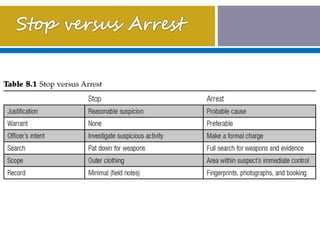
 A stop is considered different than an arrest
o Terry v. Ohio established that the authority to stop is
independent of the power to arrest
o A stop is not an arrest, but it is a seizure within the
meaning of the 4th Amendment and requires
reasonableness
 If an officer suspects a person is presently armed and
dangerous, a frisk may conducted without a warrant
 A frisk is authorized by the circumstances of an
investigative stop, only a limited pat-down of the
detainee’s outer clothing for the officer’s safety is
authorized
 Factors contributing to the decision to frisk include:
 Suspect that flees
 A bulge in the clothing
 Suspect’s hand concealed in a pocket
 Being in a known high crime area and suspect crime
would likely involve a weapon
 Officers may stop motorists:
o For violations of the law such as
equipment violations, erratic driving,
and invalid vehicle registration
o And when an occupant inside the
vehicle is suspected of having
committed a crime
 Facts: Police stopped a car without probable cause to
check the driver’s license and auto registration
 Issues: Did the officer's search of Prouse's automobile
constitute an unreasonable search and seizure under
the Fourth Amendment?
 Holding: Yes
 Rationale: The Court held that the privacy interests of
travelers outweighed the state interests in discretionary
spot checks of automobiles
 Facts: After stopping a driver suspected of DUI, the
officer asked McCarty to get out of the car and he could
not stand up. The officer decided he would be charged
with DUI and asked if McCarty had been drinking. He
said he had and was arrested
 Issues: Was Miranda required?
 Holding: No
 Rationale: A person temporarily detained pursuant to a
traffic stop is not in custody for purposes of Miranda and
the brief detention occurs in public
 http://en.wikipedia.org/wiki/Berkemer_v._McCarty
 Facts: Pavelski was convicted of armed robbery after a police
officer stopped his car for a sharp right turn and out of state
plates
 Issues: Was there sufficient reasonable suspicion to justify the
stop?
 Holding: No
 Rationale: In the totality of circumstances test, the standard of
proof is less than reasonable belief or probable cause.
However, it must be more than a mere hunch or even general
suspicion and cannot be a “fishing expedition” based on a whim
or a “gut feeling things were really wrong”
 http://www.leagle.com/decision/19861274789F2d485_11198.x
ml/UNITED%20STATES%20v.%20PAVELSKI
 United States v. Sharpe (1985)
o How long a stop may last depends on factors
that indicate the suspect was not detained an
unreasonably long time
• The purpose of the stop
• The reasonableness of the time used for the
investigation that the officers wish to conduct
• The reasonableness of the means of investigation
used by the officer
• http://www.casebriefs.com/blog/law/criminal-procedure/criminal-
procedure-keyed-to-weinreb/the-fourth-amendment-arrest-and-
search-and-seizure/united-states-v-sharpe/
 The detention of an individual
 The taking of a person into custody, in a manner
authorized by law, for the purpose of presenting that
person before a magistrate to answer for the
commission of a crime
 The general guideline is that a person is under arrest if
a reasonable person would believe that under the
existing circumstances and when viewed objectively,
there was a restraint on movement that one associates
with formal arrest and that the person was, in fact, been
detained by the police and not free to go
 The elements of an arrest are:
1. Intending to take a person into custody
2. Exercising authority to do so
3. Detaining or restraining the person to be
arrested, and
4. The arrestee understanding what is
happening
 Generally, lawful arrests can be made in
one of three ways
 Officers can usually make a lawful arrest
o For any crime committed in their presence
o For any felony if they have probable cause
o With an arrest warrant
 They can be made in public places without a
warrant if probable cause exists
 Even if a person retreats to a private place, the
warrantless arrest based on probable cause is
valid
 Payton v. New York (1980)
o Police may not enter a private home to make a
routine felony arrest unless exigent circumstances
exists, as in hot pursuit
o http://en.wikipedia.org/wiki/Payton_v._New_York
 When government agents search a person
incident to arrest, they may use as much force
as reasonably necessary to
 Protect themselves,
 To prevent escape,
 Or the destruction or concealment of evidence
 The reasonableness of the police action
determines the lawfulness of it
 Legitimate use of force in arrests includes:
o Self-defense (a right common to all persons)
o Defense of others (a duty assigned to police personnel)
o Effectuate an arrest (a vested authority granted by law)
o Prevent an escape (a vested authority granted by law)
o Overcome resistance (a vested authority granted by law)
 Generally, the police have the authority to use force if
necessary to make an arrest, keep the peace, or
maintain order
o The amount of force must be reasonable
 The use of a TASER might be considered
unreasonable excessive force if the subject is
neither a flight risk, a dangerous felon nor an
immediate threat
 The Court will apply an objective
reasonableness standard to the officer’s
conduct
 The only justification for use of deadly
force is self-defense or protecting the
lives of others
 The use of deadly force to prevent the
escape of all felony suspects, whatever
the circumstances, is constitutionally
unreasonable
 Facts: A 15-year-old boy was shot in the back of the
head and killed as he began climbing over a fence after
being told to stop by police responding to a prowler call
 Issues: Can deadly force be used to apprehend a
fleeing, nonviolent felon?
 Holding: No
 Rationale: Deadly force is not justified when the
fleeing felon presents no immediate danger to the
officer or to others. A police officer may not seize an
unarmed, non-dangerous felony suspect through the
use of deadly force
 Certain classifications of people have immunity from
arrest because of federal or state statutes
 Foreign diplomats, including ambassadors, ministers,
their assistants and attachés have complete immunity
from arrest
 Many states have granted their legislatures immunity
from civil lawsuits
 Officers who use reasonable force in a lawful manner
are also immune from arrest because their actions do
not violate the law. However, officers who use excessive
force can be subject to criminal or civil sanctions

Constitutional Issues - Chapter 8

  • 1.
      Michelle Palaro CJUS2360 Fall 2015 Chapter 8 Conducting Constitutional Seizures
  • 2.
     The elementsof the seizure are: o Intending to seize an object (includes a person) o Exercising authority to do so o Physically controlling the object, and o The understanding of what is happening such that a reasonable person would not feel free to leave
  • 3.
     Facts: Browerwas killed when the stolen car that he had been driving at high speeds for approximately 20 miles in an effort to elude pursuing police crashed into a police roadblock  Issues: Whether police used “brutal, excessive, unreasonable and unnecessary physical force” in establishing the roadblock, and thus effected an unreasonable seizure of Brower, in violation of the Fourth Amendment  Holding: No  Rationale: Under the Fourth Amendment, a person is seized when his freedom of movement is intentionally terminated. The court ruled that the defendant was not seized by the police setting the roadblock and he only became seized under the meaning of the Fourth Amendment when he actually crashed into the tractor trailer  http://caselaw.lp.findlaw.com/scripts/getcase.pl?court=US&vol=489&invo l=593
  • 4.
     Law enforcementinvolves decisions and discretion  What begins as a simple stop may turn into an arrest and a full body search  A stop is considered different than an arrest o Terry v. Ohio established that the authority to stop is independent of the power to arrest o A stop is not an arrest, but it is a seizure within the meaning of the 4th Amendment and requires reasonableness
  • 6.
     If anofficer suspects a person is presently armed and dangerous, a frisk may conducted without a warrant  A frisk is authorized by the circumstances of an investigative stop, only a limited pat-down of the detainee’s outer clothing for the officer’s safety is authorized  Factors contributing to the decision to frisk include:  Suspect that flees  A bulge in the clothing  Suspect’s hand concealed in a pocket  Being in a known high crime area and suspect crime would likely involve a weapon
  • 7.
     Officers maystop motorists: o For violations of the law such as equipment violations, erratic driving, and invalid vehicle registration o And when an occupant inside the vehicle is suspected of having committed a crime
  • 9.
     Facts: Policestopped a car without probable cause to check the driver’s license and auto registration  Issues: Did the officer's search of Prouse's automobile constitute an unreasonable search and seizure under the Fourth Amendment?  Holding: Yes  Rationale: The Court held that the privacy interests of travelers outweighed the state interests in discretionary spot checks of automobiles
  • 10.
     Facts: Afterstopping a driver suspected of DUI, the officer asked McCarty to get out of the car and he could not stand up. The officer decided he would be charged with DUI and asked if McCarty had been drinking. He said he had and was arrested  Issues: Was Miranda required?  Holding: No  Rationale: A person temporarily detained pursuant to a traffic stop is not in custody for purposes of Miranda and the brief detention occurs in public  http://en.wikipedia.org/wiki/Berkemer_v._McCarty
  • 11.
     Facts: Pavelskiwas convicted of armed robbery after a police officer stopped his car for a sharp right turn and out of state plates  Issues: Was there sufficient reasonable suspicion to justify the stop?  Holding: No  Rationale: In the totality of circumstances test, the standard of proof is less than reasonable belief or probable cause. However, it must be more than a mere hunch or even general suspicion and cannot be a “fishing expedition” based on a whim or a “gut feeling things were really wrong”  http://www.leagle.com/decision/19861274789F2d485_11198.x ml/UNITED%20STATES%20v.%20PAVELSKI
  • 12.
     United Statesv. Sharpe (1985) o How long a stop may last depends on factors that indicate the suspect was not detained an unreasonably long time • The purpose of the stop • The reasonableness of the time used for the investigation that the officers wish to conduct • The reasonableness of the means of investigation used by the officer • http://www.casebriefs.com/blog/law/criminal-procedure/criminal- procedure-keyed-to-weinreb/the-fourth-amendment-arrest-and- search-and-seizure/united-states-v-sharpe/
  • 13.
     The detentionof an individual  The taking of a person into custody, in a manner authorized by law, for the purpose of presenting that person before a magistrate to answer for the commission of a crime  The general guideline is that a person is under arrest if a reasonable person would believe that under the existing circumstances and when viewed objectively, there was a restraint on movement that one associates with formal arrest and that the person was, in fact, been detained by the police and not free to go
  • 14.
     The elementsof an arrest are: 1. Intending to take a person into custody 2. Exercising authority to do so 3. Detaining or restraining the person to be arrested, and 4. The arrestee understanding what is happening
  • 15.
     Generally, lawfularrests can be made in one of three ways  Officers can usually make a lawful arrest o For any crime committed in their presence o For any felony if they have probable cause o With an arrest warrant
  • 16.
     They canbe made in public places without a warrant if probable cause exists  Even if a person retreats to a private place, the warrantless arrest based on probable cause is valid  Payton v. New York (1980) o Police may not enter a private home to make a routine felony arrest unless exigent circumstances exists, as in hot pursuit o http://en.wikipedia.org/wiki/Payton_v._New_York
  • 17.
     When governmentagents search a person incident to arrest, they may use as much force as reasonably necessary to  Protect themselves,  To prevent escape,  Or the destruction or concealment of evidence  The reasonableness of the police action determines the lawfulness of it
  • 18.
     Legitimate useof force in arrests includes: o Self-defense (a right common to all persons) o Defense of others (a duty assigned to police personnel) o Effectuate an arrest (a vested authority granted by law) o Prevent an escape (a vested authority granted by law) o Overcome resistance (a vested authority granted by law)  Generally, the police have the authority to use force if necessary to make an arrest, keep the peace, or maintain order o The amount of force must be reasonable
  • 19.
     The useof a TASER might be considered unreasonable excessive force if the subject is neither a flight risk, a dangerous felon nor an immediate threat  The Court will apply an objective reasonableness standard to the officer’s conduct
  • 20.
     The onlyjustification for use of deadly force is self-defense or protecting the lives of others  The use of deadly force to prevent the escape of all felony suspects, whatever the circumstances, is constitutionally unreasonable
  • 22.
     Facts: A15-year-old boy was shot in the back of the head and killed as he began climbing over a fence after being told to stop by police responding to a prowler call  Issues: Can deadly force be used to apprehend a fleeing, nonviolent felon?  Holding: No  Rationale: Deadly force is not justified when the fleeing felon presents no immediate danger to the officer or to others. A police officer may not seize an unarmed, non-dangerous felony suspect through the use of deadly force
  • 23.
     Certain classificationsof people have immunity from arrest because of federal or state statutes  Foreign diplomats, including ambassadors, ministers, their assistants and attachés have complete immunity from arrest  Many states have granted their legislatures immunity from civil lawsuits  Officers who use reasonable force in a lawful manner are also immune from arrest because their actions do not violate the law. However, officers who use excessive force can be subject to criminal or civil sanctions

Editor's Notes

  • #4 Opinion at http://supreme.justia.com/cases/federal/us/489/593/
  • #10 Opinion at http://supreme.justia.com/cases/federal/us/440/648/case.html
  • #11 Opinion at http://supreme.justia.com/cases/federal/us/468/420/case.html
  • #12 Opinion at http://openjurist.org/789/f2d/485/united-states-v-pavelski
  • #23 Opinion at http://supreme.justia.com/cases/federal/us/471/1/case.html