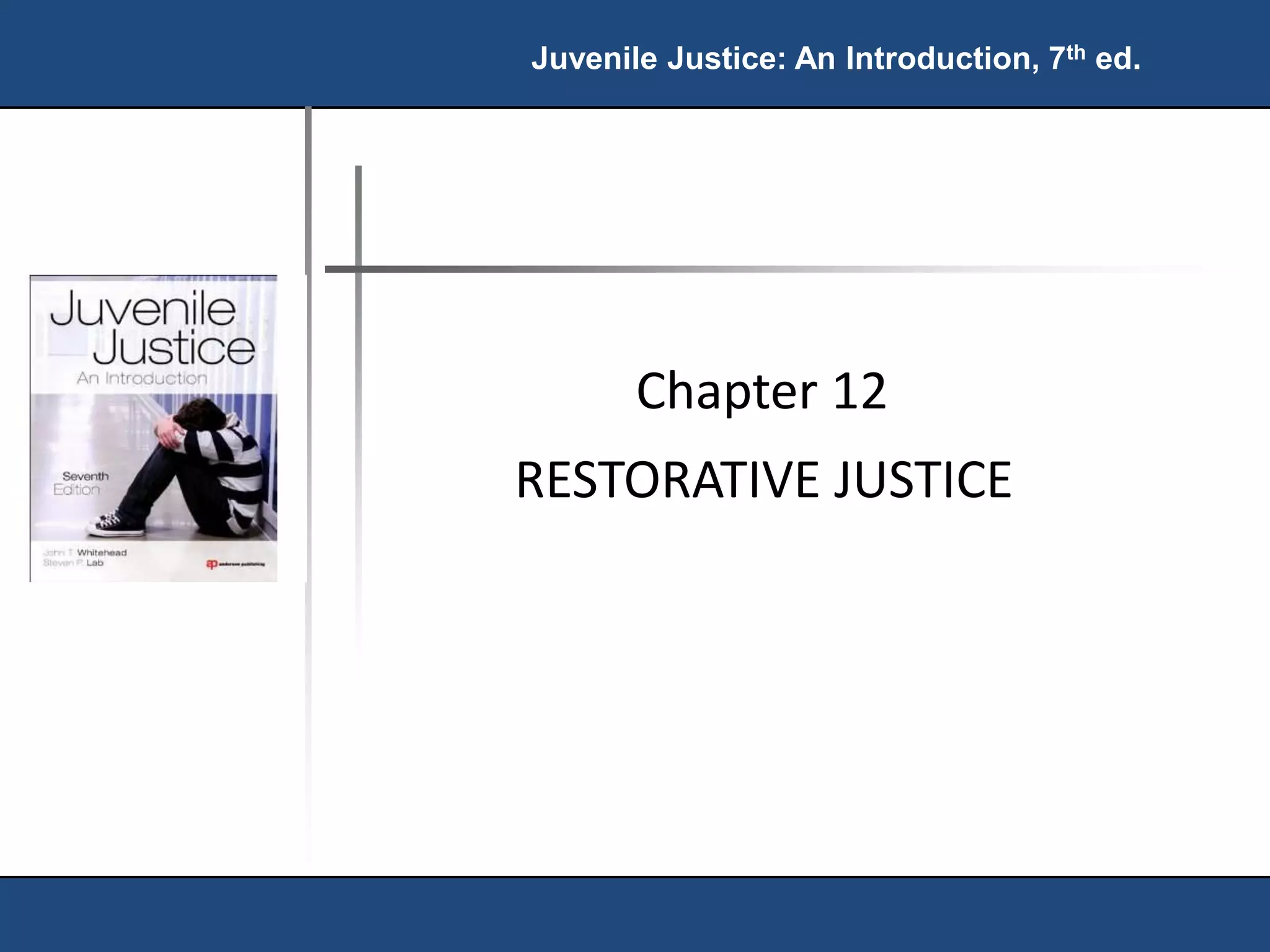
Juvenile Justice: An Introduction, 7th ed. 
Chapter 12 
RESTORATIVE JUSTICE
Chapter 12 
What You Need to Know 
• Restorative justice seeks to repair the harm done to both the 
victim and the community, while simultaneously changing the 
behavior of the offender. 
• A primary argument used to explain restorative justice is the idea 
of reintegrative shaming, which argues that shame can be used in a 
positive fashion to bring offenders back into society. 
• Restorative justice takes four primary forms: victim-offender 
mediation, family group counseling, neighborhood reparative 
boards, and sentencing/peacemaking circles. 
• Victim-offender mediation, also called victim-offender 
reconciliation programs, involves bringing the victim and offender 
together with a mediator to try and arrive at an understanding of 
all positions and find a solution agreeable to both parties.
Chapter 12 
What You Need to Know (cont.) 
• Family group conferencing includes family members, friends, 
and support groups with the victim and offender in trying to 
find a solution to the issues. 
• Neighborhood reparative boards do not require victim 
participation and require the offender to make amends, 
restore the victim and community to the pre-offense state, 
and help the offender understand what he or she did. 
• Sentencing circles are open to anyone in the community and 
are often a part of the court. The sentences can include 
virtually anything, including jail time. 
• Evaluations of restorative justice reveal a great deal of 
satisfaction among participants and some reduced recidivism, 
although a great deal of additional research is needed.
Chapter 12 
Introduction 
• Restorative justice - Concerned with repairing the damage 
or harm done to victims and the community through a 
process of negotiation, mediation, victim empowerment, 
and reparation. 
• Restorative justice - About relationships — how 
relationships are harmed by crime and how they can be 
rebuilt to promote recovery and healing for people affected 
by crime. 
• This chapter examines the idea of restorative justice as a 
means of addressing the needs of youthful offenders, 
victims, and the community. 
• Restorative justice - A major shift from existing practices. 
Consequently, it is important to define and discuss the 
philosophical and practical differences between restorative 
justice and most juvenile justice system activity.
Chapter 12 
Background of Restorative Justice 
• Over the past 30 years, there has been an increasing 
call for programs that pay more attention to the 
combined needs of victims, offenders, and the 
community. 
• The concept of restorative or reparative justice seeks 
to use interventions that return the victim and 
offender to their pre-offense states. 
– For offenders, it means assuring that the action will not be 
repeated. 
– For victims, this means repairing the harm done. For the 
community, it means returning things to their state prior to 
the offensive behavior.
Chapter 12 
Background of Restorative Justice (cont.) 
Retributive Justice 
• Generally focuses on the 
lawbreaker and the 
imposition of sanctions for 
the purposes of deterrence, 
vengeance, and/or 
punishment. 
• A criminal act is viewed as an 
offense against society or the 
state, and the victim is 
nothing more than a witness 
for the state. 
Restorative Justice 
• Seeks to repair the harm that 
was done to both the victim 
and the community, while 
simultaneously changing the 
behavior of the offender. 
• Sees crime as an act against 
the victim and community, 
and the focus shifts from 
what is best for the state to 
repairing the harm that has 
been committed against the 
victim and community.
Chapter 12 
Precursors to Restorative Justice 
• Restorative justice has been the dominant model of criminal 
justice throughout most of human history for all the world’s 
peoples. 
• The earliest codified laws, such as the Law of Moses, the 
Code of Hammurabi, and Roman laws, all outlined the 
responsibility of individuals to deal with criminal acts 
committed against them. 
• The very bases for the development of a juvenile court and 
juvenile justice system are found in restorative justice 
principles. 
– The parens patriae philosophy of the juvenile court focuses not on 
the offense but the offender and the actions needed to help the 
youth. Therefore the emphasis was not on punishment.
Chapter 12 
Precursors to Restorative Justice (cont.) 
• Dispute resolution - One can trace modern dispute resolution 
back to the early 1970s. During this time, a number of 
jurisdictions started programs to divert minor disputes out of 
the formal court system. 
• Dispute resolution- A mechanism for achieving a number of 
goals simultaneously: 
– First, the parties involved in the situation work together to resolve the 
problem rather than having some outside authority impose a solution. 
– Second, any dispute that reaches a settlement is one less case with 
which the formal justice system must contend. This alternative 
alleviates some congestion in the court system. 
– Third, this informal approach empowers victims by giving them a 
direct voice in their own matters. Victims retain complete veto power 
over the final outcome. 
– Finally, dispute resolution provides the victim with a face-to-face 
encounter with the offender.
Chapter 12 
Precursors to Restorative Justice (cont.) 
• Dispute resolution - Programs can vary in terms 
of the cases they handle or the procedures they 
use. They typically share five traits in common; 
1. A third-party mediator is involved. 
2. Disputants usually know each other. 
3. Participation must be voluntary. 
4. Processes are informal. 
5. Disputants are usually referred to the process by 
someone in the criminal justice system.
Chapter 12 
Precursors to Restorative Justice (cont.) 
• Conflict resolution programs - Utilized to teach youths 
alternative methods for resolving conflicts before they occur. 
• Peer mediation programs- Bring together disputing parties 
with a peer mediator to discuss the situation and attempt to 
resolve the dispute to the satisfaction of both parties. 
– In many cases, there is no clear victim and offender. Instead, the two 
parties are involved in an argument or disagreement that, left 
unchecked, could escalate into a physical confrontation. 
– The goal of the mediation is to defuse the situation before it reaches 
that stage and to keep it from occurring again in the future.
Chapter 12 
The Theoretical Basis of Restorative 
Practices 
• The basic argument underlying restorative justice is 
that reactions to crime and harmful behavior 
should seek to repair the harm done to the 
individual victim and society while simultaneously 
reintegrating and addressing the needs of the 
offender. 
– Repairing harm (to victim and community) 
– Engendering stakeholder involvement (victims, 
offenders, families, and community) 
– Transforming the role of community and government
Chapter 12 
The Theoretical Basis of Restorative 
Practices (cont.) 
• Exchange theory - Proceeds from the assumption 
that equal reciprocity is a cornerstone of social 
interaction. 
– The offender is expected to make amends for the harm 
caused, in exchange for reintegration back into society
Chapter 12 
The Theoretical Basis of Restorative 
Practices (cont.) 
• Reintegrative shaming - Rests on the assumption 
that typical processing of offenders through the 
criminal justice system serves to isolate the 
offender and stigmatize him or her. 
– Shame can be used in a positive fashion to bring the 
offender back into society. 
– Under reintegrative shaming, the system needs to 
express its disapproval of the criminal activity while 
simultaneously forgiving the offender for the action if the 
offender is willing to learn from the event and make 
reparations to the victim and society.
Chapter 12 
The Theoretical Basis of Restorative 
Practices (cont.) 
• Collective efficacy - Transform communities into 
active participants in controlling problem youths 
and socialize them into proper societal roles. 
Community members need to feel empowered to 
do something about problems. 
• Social disorganization - Can mitigate the ability of 
residents to effect change and control in the area. 
– Restorative justice offers a mechanism to build the social 
capital necessary to address youthful offenders and the 
causes of misbehavior.
Chapter 12 
Types of Restorative Justice 
• Four primary aims to restorative justice: 
1. Empowerment - Reflects the need for all interested 
parties to be involved in the process. This provides a 
sense of legitimacy for both the victim and the offender. 
2. Restoration - Refers to repairing the harm done to all 
participants. At the same time, retribution is disavowed 
as a legitimate response to the behavior. 
3. Reintegration- of both the offender and the victim into 
the community, without the stigma of being an 
offender or being different from the other 
community members. 
4. Emotional harm- of both the victim and the 
community, must be addressed.
Chapter 12 
Types of Restorative Justice (cont.) 
• Achieving those primary aims requires that the 
restorative approach be grounded on two additional 
factors: 
1. Procedural fairness - Refers to the fact that the process 
must respect all the parties involved. The rights (both 
legal and human) and wishes of all participants must be 
recognized as legitimate by the participants. 
2. Satisfactory outcome - Means that all parties agree with 
the proposed resolution and are willing to follow through 
with the plan of action. The failure to achieve procedural 
fairness and a satisfactory outcome from the process 
itself will make it impossible to fully realize the major 
aims of restorative justice.
Chapter 12 
Types of Restorative Justice (cont.) 
• Victim–offender mediation (VOM) - Also referred to as victim– 
offender reconciliation programs (VORPs), is a direct outgrowth of 
the dispute resolution/dispute mediation programs of the early 
1970s, and is considered the oldest form of restorative justice. 
• The basic premise of VOM is that the criminal/victimization incident 
and its consequences are complex and beyond the ability of the 
criminal code to address on its own. 
• Where the formal criminal justice response to crime is to simply 
impose the sanction outlined in the statutes, VOM seeks to deal 
with the needs of both the victim and the offender. 
– Perhaps the most important concern addressed in VOM meetings is to 
identify for the offender the types and level of harm suffered by the victim 
as a result of the crime. 
– The victim is given the opportunity to express his or her concerns about 
the crime and his or her loss.
Chapter 12 
Types of Restorative Justice (cont.) 
• Neighborhood reparative boards (NRBs) – also called 
neighborhood accountability boards – have existed since the 
mid-1990s and typically deal with nonviolent youthful 
offenders. 
– Not unlike other restorative practices, NRBs seek to restore the 
victims and community to pre-offense states, require the offender to 
make amends, and aid the offender in understanding the impact of 
his or her actions on the victim and community. 
• Family group conferencing (FGC) - The greatest difference 
between FGC and VOM is the inclusion of family members, 
close friends, and other support groups of the victim and 
offender in the conferences. 
– There is also the possibility of including criminal justice system 
personnel, including social workers, police officers, and an offender’s 
attorney.
Chapter 12 
Types of Restorative Justice (cont.) 
• Peacemaking circles - Based on Canadian First Nation practices and 
began formal operation in the early 1990s. Circles invite members 
from across the community to participate in determining the 
appropriate sanctions for offenders. 
– Participants in circles typically include all of the parties found in FGCs, as 
well as general community members who wish to be included. 
• Sentencing circles - May function as either a part of the court or 
separate from the court. The intended outcome of the circle is 
consensus on a plan of action that may include a wide array of 
activities. 
– Plans of action may include further meetings between the victim and 
offender, apologies by the offender, restitution, community service, 
treatment/rehabilitation programs, and/or explicit sentencing 
recommendations to the trial judge
Chapter 12 
The Impact of Restorative Justice 
• Restorative justice programs are intended to have a 
number of different possible outcomes, including 
rehabilitating the offender and repairing the harm 
done to the victim. 
• Satisfaction, fairness, and compliance - Assessments 
of the impact of restorative justice have most often 
relied on outcomes such as victim satisfaction, 
feelings of fairness by victims, and compliance with 
the agreements.
Chapter 12 
The Impact of Restorative Justice 
– Current results contrast greatly with those found in 
analyses of formal criminal justice system processing, in 
which victims and offenders report lower satisfaction 
and feelings of fairness. 
– Participants in fully restorative programs report higher 
levels of satisfaction and perceived fairness, followed by 
those in mostly restorative programs. Individuals from 
programs rated as not restorative report the lowest 
levels of satisfaction and fairness.
Chapter 12 
The Impact of Restorative Justice (cont.) 
• Satisfaction, fairness, and compliance - The success of 
restorative justice programs is also measured in terms of the 
ability of the meetings to achieve consensus on a solution and 
whether the parties carry through with the agreement. 
• Recidivism - Reducing reoffending is an important restorative 
goal, particularly in a discussion of juvenile justice. 
– It appears that earlier studies of recidivism did not show consistent 
reductions in recidivism but that more recent studies have shown 
recidivism reductions. 
– In fact, a recent meta-analysis of 35 restorative justice programs found 
that two-thirds of the effect sizes showed such reduction in recidivism. 
– The restorative justice programs also resulted in higher victim 
satisfaction and that offenders were more likely to comply with 
restitution orders.
Chapter 12 
Problems and Issues with Restorative 
Justice 
1. Restorative justice programs may be too ambitious in their 
attempt to solve very complex societal problems. 
2. Related to the first problem is that restorative justice has been 
used primarily with less serious and property crimes. There is 
a great deal of debate over whether this approach can be 
used successfully with serious violent offenses. 
3. There exists a concern that, while voluntary, there is an 
underlying level of coercion in most programs. What makes 
this truly problematic is that many programs do not allow the 
presence of defense attorneys, thus raising the issue of 
violation of an accused individual’s constitutional rights and 
procedural safeguards.
Chapter 12 
Problems and Issues with Restorative 
Justice (cont.) 
4. There is concern over how the “community” is defined and 
who is allowed to represent the community. This can be a 
very important concern because the participants help mold 
the outcome and the expectations for the solution. 
5. There is a distinct imbalance of power in most restorative 
justice programs. This is especially problematic when 
juvenile offenders must face not only the victim but also the 
victim’s support groups, members of the criminal justice 
system, and strangers from the general community.
Chapter 12 
Problems and Issues with Restorative 
Justice (cont.) 
6. The issue of net-widening: Net-widening refers to the 
situation in which the introduction of a new program or 
intervention serves to bring more people under the 
umbrella of social control. This is especially problematic 
when the new programs are intended to take people 
currently being served in the formal justice system in order 
to divert them to the new program.

81-260-1 Chapter 12

  • 1.
    Juvenile Justice: AnIntroduction, 7th ed. Chapter 12 RESTORATIVE JUSTICE
  • 2.
    Chapter 12 WhatYou Need to Know • Restorative justice seeks to repair the harm done to both the victim and the community, while simultaneously changing the behavior of the offender. • A primary argument used to explain restorative justice is the idea of reintegrative shaming, which argues that shame can be used in a positive fashion to bring offenders back into society. • Restorative justice takes four primary forms: victim-offender mediation, family group counseling, neighborhood reparative boards, and sentencing/peacemaking circles. • Victim-offender mediation, also called victim-offender reconciliation programs, involves bringing the victim and offender together with a mediator to try and arrive at an understanding of all positions and find a solution agreeable to both parties.
  • 3.
    Chapter 12 WhatYou Need to Know (cont.) • Family group conferencing includes family members, friends, and support groups with the victim and offender in trying to find a solution to the issues. • Neighborhood reparative boards do not require victim participation and require the offender to make amends, restore the victim and community to the pre-offense state, and help the offender understand what he or she did. • Sentencing circles are open to anyone in the community and are often a part of the court. The sentences can include virtually anything, including jail time. • Evaluations of restorative justice reveal a great deal of satisfaction among participants and some reduced recidivism, although a great deal of additional research is needed.
  • 4.
    Chapter 12 Introduction • Restorative justice - Concerned with repairing the damage or harm done to victims and the community through a process of negotiation, mediation, victim empowerment, and reparation. • Restorative justice - About relationships — how relationships are harmed by crime and how they can be rebuilt to promote recovery and healing for people affected by crime. • This chapter examines the idea of restorative justice as a means of addressing the needs of youthful offenders, victims, and the community. • Restorative justice - A major shift from existing practices. Consequently, it is important to define and discuss the philosophical and practical differences between restorative justice and most juvenile justice system activity.
  • 5.
    Chapter 12 Backgroundof Restorative Justice • Over the past 30 years, there has been an increasing call for programs that pay more attention to the combined needs of victims, offenders, and the community. • The concept of restorative or reparative justice seeks to use interventions that return the victim and offender to their pre-offense states. – For offenders, it means assuring that the action will not be repeated. – For victims, this means repairing the harm done. For the community, it means returning things to their state prior to the offensive behavior.
  • 6.
    Chapter 12 Backgroundof Restorative Justice (cont.) Retributive Justice • Generally focuses on the lawbreaker and the imposition of sanctions for the purposes of deterrence, vengeance, and/or punishment. • A criminal act is viewed as an offense against society or the state, and the victim is nothing more than a witness for the state. Restorative Justice • Seeks to repair the harm that was done to both the victim and the community, while simultaneously changing the behavior of the offender. • Sees crime as an act against the victim and community, and the focus shifts from what is best for the state to repairing the harm that has been committed against the victim and community.
  • 7.
    Chapter 12 Precursorsto Restorative Justice • Restorative justice has been the dominant model of criminal justice throughout most of human history for all the world’s peoples. • The earliest codified laws, such as the Law of Moses, the Code of Hammurabi, and Roman laws, all outlined the responsibility of individuals to deal with criminal acts committed against them. • The very bases for the development of a juvenile court and juvenile justice system are found in restorative justice principles. – The parens patriae philosophy of the juvenile court focuses not on the offense but the offender and the actions needed to help the youth. Therefore the emphasis was not on punishment.
  • 8.
    Chapter 12 Precursorsto Restorative Justice (cont.) • Dispute resolution - One can trace modern dispute resolution back to the early 1970s. During this time, a number of jurisdictions started programs to divert minor disputes out of the formal court system. • Dispute resolution- A mechanism for achieving a number of goals simultaneously: – First, the parties involved in the situation work together to resolve the problem rather than having some outside authority impose a solution. – Second, any dispute that reaches a settlement is one less case with which the formal justice system must contend. This alternative alleviates some congestion in the court system. – Third, this informal approach empowers victims by giving them a direct voice in their own matters. Victims retain complete veto power over the final outcome. – Finally, dispute resolution provides the victim with a face-to-face encounter with the offender.
  • 9.
    Chapter 12 Precursorsto Restorative Justice (cont.) • Dispute resolution - Programs can vary in terms of the cases they handle or the procedures they use. They typically share five traits in common; 1. A third-party mediator is involved. 2. Disputants usually know each other. 3. Participation must be voluntary. 4. Processes are informal. 5. Disputants are usually referred to the process by someone in the criminal justice system.
  • 10.
    Chapter 12 Precursorsto Restorative Justice (cont.) • Conflict resolution programs - Utilized to teach youths alternative methods for resolving conflicts before they occur. • Peer mediation programs- Bring together disputing parties with a peer mediator to discuss the situation and attempt to resolve the dispute to the satisfaction of both parties. – In many cases, there is no clear victim and offender. Instead, the two parties are involved in an argument or disagreement that, left unchecked, could escalate into a physical confrontation. – The goal of the mediation is to defuse the situation before it reaches that stage and to keep it from occurring again in the future.
  • 11.
    Chapter 12 TheTheoretical Basis of Restorative Practices • The basic argument underlying restorative justice is that reactions to crime and harmful behavior should seek to repair the harm done to the individual victim and society while simultaneously reintegrating and addressing the needs of the offender. – Repairing harm (to victim and community) – Engendering stakeholder involvement (victims, offenders, families, and community) – Transforming the role of community and government
  • 12.
    Chapter 12 TheTheoretical Basis of Restorative Practices (cont.) • Exchange theory - Proceeds from the assumption that equal reciprocity is a cornerstone of social interaction. – The offender is expected to make amends for the harm caused, in exchange for reintegration back into society
  • 13.
    Chapter 12 TheTheoretical Basis of Restorative Practices (cont.) • Reintegrative shaming - Rests on the assumption that typical processing of offenders through the criminal justice system serves to isolate the offender and stigmatize him or her. – Shame can be used in a positive fashion to bring the offender back into society. – Under reintegrative shaming, the system needs to express its disapproval of the criminal activity while simultaneously forgiving the offender for the action if the offender is willing to learn from the event and make reparations to the victim and society.
  • 14.
    Chapter 12 TheTheoretical Basis of Restorative Practices (cont.) • Collective efficacy - Transform communities into active participants in controlling problem youths and socialize them into proper societal roles. Community members need to feel empowered to do something about problems. • Social disorganization - Can mitigate the ability of residents to effect change and control in the area. – Restorative justice offers a mechanism to build the social capital necessary to address youthful offenders and the causes of misbehavior.
  • 15.
    Chapter 12 Typesof Restorative Justice • Four primary aims to restorative justice: 1. Empowerment - Reflects the need for all interested parties to be involved in the process. This provides a sense of legitimacy for both the victim and the offender. 2. Restoration - Refers to repairing the harm done to all participants. At the same time, retribution is disavowed as a legitimate response to the behavior. 3. Reintegration- of both the offender and the victim into the community, without the stigma of being an offender or being different from the other community members. 4. Emotional harm- of both the victim and the community, must be addressed.
  • 16.
    Chapter 12 Typesof Restorative Justice (cont.) • Achieving those primary aims requires that the restorative approach be grounded on two additional factors: 1. Procedural fairness - Refers to the fact that the process must respect all the parties involved. The rights (both legal and human) and wishes of all participants must be recognized as legitimate by the participants. 2. Satisfactory outcome - Means that all parties agree with the proposed resolution and are willing to follow through with the plan of action. The failure to achieve procedural fairness and a satisfactory outcome from the process itself will make it impossible to fully realize the major aims of restorative justice.
  • 17.
    Chapter 12 Typesof Restorative Justice (cont.) • Victim–offender mediation (VOM) - Also referred to as victim– offender reconciliation programs (VORPs), is a direct outgrowth of the dispute resolution/dispute mediation programs of the early 1970s, and is considered the oldest form of restorative justice. • The basic premise of VOM is that the criminal/victimization incident and its consequences are complex and beyond the ability of the criminal code to address on its own. • Where the formal criminal justice response to crime is to simply impose the sanction outlined in the statutes, VOM seeks to deal with the needs of both the victim and the offender. – Perhaps the most important concern addressed in VOM meetings is to identify for the offender the types and level of harm suffered by the victim as a result of the crime. – The victim is given the opportunity to express his or her concerns about the crime and his or her loss.
  • 18.
    Chapter 12 Typesof Restorative Justice (cont.) • Neighborhood reparative boards (NRBs) – also called neighborhood accountability boards – have existed since the mid-1990s and typically deal with nonviolent youthful offenders. – Not unlike other restorative practices, NRBs seek to restore the victims and community to pre-offense states, require the offender to make amends, and aid the offender in understanding the impact of his or her actions on the victim and community. • Family group conferencing (FGC) - The greatest difference between FGC and VOM is the inclusion of family members, close friends, and other support groups of the victim and offender in the conferences. – There is also the possibility of including criminal justice system personnel, including social workers, police officers, and an offender’s attorney.
  • 19.
    Chapter 12 Typesof Restorative Justice (cont.) • Peacemaking circles - Based on Canadian First Nation practices and began formal operation in the early 1990s. Circles invite members from across the community to participate in determining the appropriate sanctions for offenders. – Participants in circles typically include all of the parties found in FGCs, as well as general community members who wish to be included. • Sentencing circles - May function as either a part of the court or separate from the court. The intended outcome of the circle is consensus on a plan of action that may include a wide array of activities. – Plans of action may include further meetings between the victim and offender, apologies by the offender, restitution, community service, treatment/rehabilitation programs, and/or explicit sentencing recommendations to the trial judge
  • 20.
    Chapter 12 TheImpact of Restorative Justice • Restorative justice programs are intended to have a number of different possible outcomes, including rehabilitating the offender and repairing the harm done to the victim. • Satisfaction, fairness, and compliance - Assessments of the impact of restorative justice have most often relied on outcomes such as victim satisfaction, feelings of fairness by victims, and compliance with the agreements.
  • 21.
    Chapter 12 TheImpact of Restorative Justice – Current results contrast greatly with those found in analyses of formal criminal justice system processing, in which victims and offenders report lower satisfaction and feelings of fairness. – Participants in fully restorative programs report higher levels of satisfaction and perceived fairness, followed by those in mostly restorative programs. Individuals from programs rated as not restorative report the lowest levels of satisfaction and fairness.
  • 22.
    Chapter 12 TheImpact of Restorative Justice (cont.) • Satisfaction, fairness, and compliance - The success of restorative justice programs is also measured in terms of the ability of the meetings to achieve consensus on a solution and whether the parties carry through with the agreement. • Recidivism - Reducing reoffending is an important restorative goal, particularly in a discussion of juvenile justice. – It appears that earlier studies of recidivism did not show consistent reductions in recidivism but that more recent studies have shown recidivism reductions. – In fact, a recent meta-analysis of 35 restorative justice programs found that two-thirds of the effect sizes showed such reduction in recidivism. – The restorative justice programs also resulted in higher victim satisfaction and that offenders were more likely to comply with restitution orders.
  • 23.
    Chapter 12 Problemsand Issues with Restorative Justice 1. Restorative justice programs may be too ambitious in their attempt to solve very complex societal problems. 2. Related to the first problem is that restorative justice has been used primarily with less serious and property crimes. There is a great deal of debate over whether this approach can be used successfully with serious violent offenses. 3. There exists a concern that, while voluntary, there is an underlying level of coercion in most programs. What makes this truly problematic is that many programs do not allow the presence of defense attorneys, thus raising the issue of violation of an accused individual’s constitutional rights and procedural safeguards.
  • 24.
    Chapter 12 Problemsand Issues with Restorative Justice (cont.) 4. There is concern over how the “community” is defined and who is allowed to represent the community. This can be a very important concern because the participants help mold the outcome and the expectations for the solution. 5. There is a distinct imbalance of power in most restorative justice programs. This is especially problematic when juvenile offenders must face not only the victim but also the victim’s support groups, members of the criminal justice system, and strangers from the general community.
  • 25.
    Chapter 12 Problemsand Issues with Restorative Justice (cont.) 6. The issue of net-widening: Net-widening refers to the situation in which the introduction of a new program or intervention serves to bring more people under the umbrella of social control. This is especially problematic when the new programs are intended to take people currently being served in the formal justice system in order to divert them to the new program.