FUNCTIONAL AND ORGANIC
CONSTIPATION
by
Dr Wael Ahmed Yousry
Prof .of Gastroenetrology and
Hepatology
Definition of constipation
Constipation is generally defined as infrequent and/or
unsatisfactory defecation fewer than 3 times per
week. Patients may define constipation as passing
hard stools or straining, incomplete or painful
defecation
Risk factors for constipation
The following factors can increase a person’s
likelihood of becoming constipated; however, these
do not need to be present for constipation to occur:
Female gender
Over 65 years of age
Low caloric intake (eating less food)
Greater number of medications used
Sedentary lifestyle (lack of exercise)
Ignoring the urge to defecate
•Medications
•Analgesics (opiates, tramadol, NSAIDs)
•Tricyclic antidepressants
•Anticholinergic agents
•Calcium channel blockers
•Anti-parkinsonian drugs (dopaminergic
agents)
•Antipsychotics (phenothiazine
derivatives)
•Antacids (calcium and aluminum)
•Calcium supplements
•Bile acid resins
•Iron supplements
•Antihistamines
•Diuretics (furosemide,
hydrochlorothiazide)
•Anticonvulsants
Common causes of constipation
•Endocrine and metabolic diseases
•Diabetes mellitus
•Hypothyroidism
•Hyperparathyroidism
•Chronic renal disease
•Neurologic disordersCerebrovascular disease and stroke
•Parkinson’s disease
•Multiple sclerosis
•Autonomic neuropathy
•Spinal cord lesions
•Dementia
•Myopathic disorders
•Amyloidosis
•Scleroderma
•OthersDepression
•General disability
•Poor mobility
•Colonic obstructing mass or stricture,…
what is functional constipation???
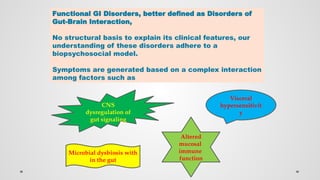
Functional GI Disorders, better defined as Disorders of
Gut-Brain Interaction,
No structural basis to explain its clinical features, our
understanding of these disorders adhere to a
biopsychosocial model.
Symptoms are generated based on a complex interaction
among factors such as
Microbial dysbiosis with
in the gut
Visceral
hypersensitivit
y
Altered
mucosal
immune
function
CNS
dysregulation of
gut signaling
Functional constipation is also
known as chronic idiopathic
constipation (CIC). It is
constipation that does not
have a physical (anatomical)
or physiological (hormonal or
other body chemistry) cause.
It may have a neurological,
psychological or
psychosomatic cause. A
Rome IV criteria define Functional Constipation as
including two or more of the following symptoms:
•(1) straining during >25% of defecations;
•(2) lumpy or hard stools in >25% of defecations;
•(3) sensation of incomplete evacuation in >25% of
defecations;
•(4) sensation of anorectal obstruction/blockage in
>25% of defecations;
•(5) manual maneuvers (e.g. digital evacuation,
support of the pelvic floor) in >25% of evacuations;
and
•(6) fewer than three spontaneous bowel
movements per week.
Furthermore, these criteria should be
fulfilled for the last 3 months and
symptom onset should have been at least 6
months prior to diagnosis.
-In addition, loose stools should be rarely
present in the absence of the use of
laxatives
- Abdominal pain and/or bloating may be
present, but these should not be
predominant symptoms
(i.e. Rome IV criteria for irritable bowel
syndrome (IBS) should not be met)
Diagnostic criteria for irritable bowel
syndrome (Rome IV)
-Recurrent abdominal pain(essential),
on average, at least 1 day per week in the last 3
months, associated with 2 or more of the
following criteria:
– Related to defecation
– Associated with a change in frequency of stool
– Associated with a change in form (appearance)
of stool
word discomfort
has been
removed
3days /month changed
Phrase Improved with
defecation removed
: Patient reports that abnormal bowel
movements are usually constipation (like
type 1 or 2 in the picture of Bristol Stool
Form Scale [BSFS]
So,,What similarities and differences
are there between irritable bowel
syndrome with constipation and
functional constipation?
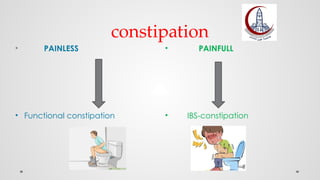
The key difference between both lies
in the presence or absence of pain
constipation
• PAINFULL
• IBS-constipation
• PAINLESS
• Functional constipation
Causes of functional
constipation
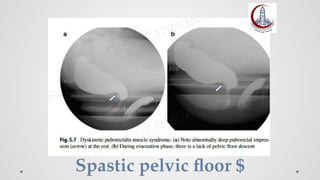
-Anismus (spastic pelvic floor)
-Descending perineum syndrome
-inability or unwillingness to control the
external anal sphincter, which normally
is under voluntary control
-A poor diet
-An unwillingness to defecate
-Nervous reactions, including prolonged
and/or chronic stress and anxiety, that
close the internal anal sphincter, a
muscle that is not under voluntary
control
-Deeper psychosomatic disorders which
sometimes affect digestion and the
How many pathophysiological
types of functional constipation
(with or without irritable bowel
syndrome) are there?
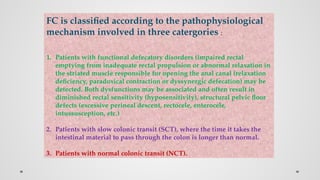
FC is classified according to the pathophysiological
mechanism involved in three catergories :
1. Patients with functional defecatory disorders (impaired rectal
emptying from inadequate rectal propulsion or abnormal relaxation in
the striated muscle responsible for opening the anal canal (relaxation
deficiency, paradoxical contraction or dyssynergic defecation) may be
detected. Both dysfunctions may be associated and often result in
diminished rectal sensitivity (hyposensitivity), structural pelvic floor
defects (excessive perineal descent, rectocele, enterocele,
intussusception, etc.)
2. Patients with slow colonic transit (SCT), where the time it takes the
intestinal material to pass through the colon is longer than normal.
3. Patients with normal colonic transit (NCT).
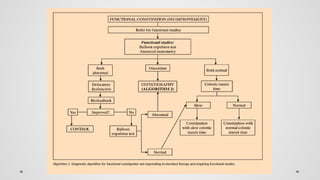
What diagnostic tests are needed
for the diagnosis of constipation-
predominant irritable bowel
syndrome and of functional
constipation?
Alarm criteria that should prompt diagnostic
testing to rule out organicity
Personal or family history of colorectal cancer, intestinal
polyposis, inflammatory bowel disease.
Symptom onset from 50 years of age on.
Recent changes in bowel movement habit.
-Presence of signs and symptoms that may suggest
organicity:
-Nocturnal symptoms
-Fever
-Anemia
-Unintended weight loss that cannot be explained by
other causes -Fecal blood
-Severe abdominal pain
-Physical exam with palpable abdominal mass,
visceromegalies, or abnormal digital rectal examination
1- Anorectal manometry
2-high resolution manometry
3-high definition manometry
4- Balloon expulsion test
5-Defecography and MR proctography
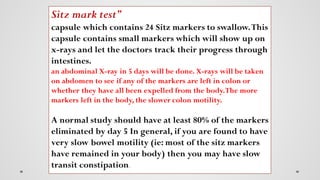
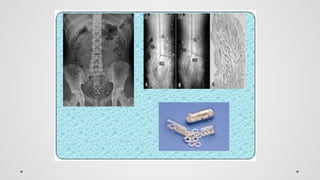
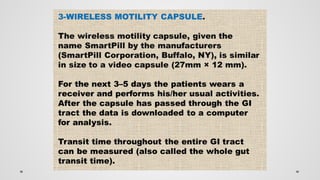
6-colonic transit assessment
How to assess colon
transit time
Balloon expulsion test
Anorectal manometry
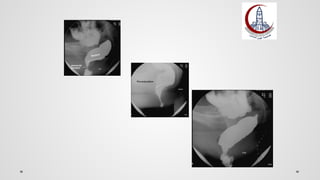
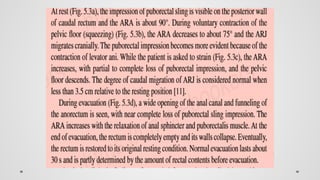
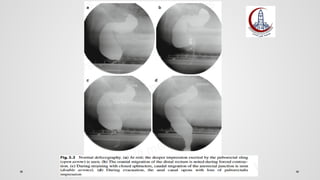
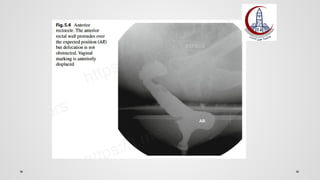
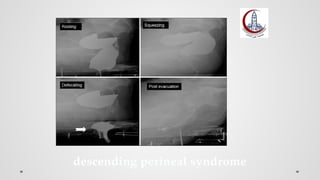
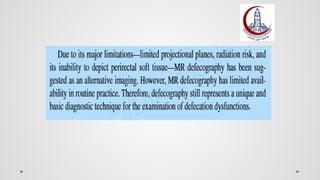
DEFECOGRAPHY
Spastic pelvic floor $
descending perineal syndrome
Treatment:
The treatment of a patient with
dyssynergic defecation consists of:
1-Standard treatment for constipation
2-Specific treatment i.e. neuromuscular
training or biofeedback therapy
3-Other measures include botulinum
toxin injection, myomectomy or
ileostomy
Plecanatide(brandname Trulance),
is a drug approved in January 2017
by the FDA for the treatment of
chronic idiopathic constipation
(CIC). Plecanatide is an agonist of
guanylate cyclase-C. Plecanatide
decreases intestinal transit time and
increase fluid through a buildup of
cGMP
Dose: 3 mg taken orally once daily
Biofeedback therapy
1-Timed toilet training: consists of
educating the patient to attempt a
bowel movement at least twice a day,
usually 30 minutes after meals and to
strain for no more than 5 minutes.
During attempted defecation, they
must be instructed to push at a level
of 5 to 7, assuming level 10 as their
maximum effort of straining
They should be encouraged to stress on intrinsic
physiologic mechanisms that stimulate the colon,
such as after waking and after a meal ,
It is important to emphasize that stool impaction
should be prevented at all costs.
Patients should be advised to refrain from manual
maneuvers such as digital disimpaction of stools.
Enemas should be generally discouraged although
during the initial stages of training or if
biofeedback therapy is pending this may be
permitted along with use of glycerin or bisacodyl
suppositories
2-Diaphragmatic breathing
excercises
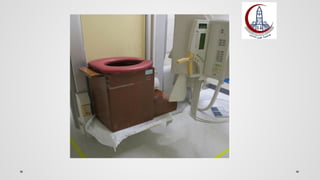
To facilitate the training, ideally the subject should be seated
on a commode with the manometry probe in situ. After
correcting the patient’s posture (for example, keeping the legs
apart as opposed to keeping them together) and the sitting
angle at which he/she will attempt the defecation maneuver,
i.e. leaning forward, the subject is asked to take a good
diaphragmatic breath and to push and bear down as if to
defecate .
The subject is encouraged to watch the
monitor while performing this maneuver.
The subject’s posture and breathing techniques are
continuously monitored and corrected.
The visual display of the pressure changes in the rectum
and anal canal on the monitor provides instant feedback
to the subject regarding their performance and helps
them to understand and learn quickly. At least 10-15
maneuvers are performed.
Thank
you

CONSTIPATION .pptx

  • 1.
    FUNCTIONAL AND ORGANIC CONSTIPATION by DrWael Ahmed Yousry Prof .of Gastroenetrology and Hepatology
  • 2.
    Definition of constipation Constipationis generally defined as infrequent and/or unsatisfactory defecation fewer than 3 times per week. Patients may define constipation as passing hard stools or straining, incomplete or painful defecation Risk factors for constipation The following factors can increase a person’s likelihood of becoming constipated; however, these do not need to be present for constipation to occur: Female gender Over 65 years of age Low caloric intake (eating less food) Greater number of medications used Sedentary lifestyle (lack of exercise) Ignoring the urge to defecate
  • 3.
    •Medications •Analgesics (opiates, tramadol,NSAIDs) •Tricyclic antidepressants •Anticholinergic agents •Calcium channel blockers •Anti-parkinsonian drugs (dopaminergic agents) •Antipsychotics (phenothiazine derivatives) •Antacids (calcium and aluminum) •Calcium supplements •Bile acid resins •Iron supplements •Antihistamines •Diuretics (furosemide, hydrochlorothiazide) •Anticonvulsants Common causes of constipation
  • 4.
    •Endocrine and metabolicdiseases •Diabetes mellitus •Hypothyroidism •Hyperparathyroidism •Chronic renal disease •Neurologic disordersCerebrovascular disease and stroke •Parkinson’s disease •Multiple sclerosis •Autonomic neuropathy •Spinal cord lesions •Dementia •Myopathic disorders •Amyloidosis •Scleroderma •OthersDepression •General disability •Poor mobility •Colonic obstructing mass or stricture,…
  • 5.
    what is functionalconstipation???
  • 6.
    Functional GI Disorders,better defined as Disorders of Gut-Brain Interaction, No structural basis to explain its clinical features, our understanding of these disorders adhere to a biopsychosocial model. Symptoms are generated based on a complex interaction among factors such as Microbial dysbiosis with in the gut Visceral hypersensitivit y Altered mucosal immune function CNS dysregulation of gut signaling
  • 7.
    Functional constipation isalso known as chronic idiopathic constipation (CIC). It is constipation that does not have a physical (anatomical) or physiological (hormonal or other body chemistry) cause. It may have a neurological, psychological or psychosomatic cause. A
  • 8.
    Rome IV criteriadefine Functional Constipation as including two or more of the following symptoms: •(1) straining during >25% of defecations; •(2) lumpy or hard stools in >25% of defecations; •(3) sensation of incomplete evacuation in >25% of defecations; •(4) sensation of anorectal obstruction/blockage in >25% of defecations; •(5) manual maneuvers (e.g. digital evacuation, support of the pelvic floor) in >25% of evacuations; and •(6) fewer than three spontaneous bowel movements per week.
  • 9.
    Furthermore, these criteriashould be fulfilled for the last 3 months and symptom onset should have been at least 6 months prior to diagnosis. -In addition, loose stools should be rarely present in the absence of the use of laxatives - Abdominal pain and/or bloating may be present, but these should not be predominant symptoms (i.e. Rome IV criteria for irritable bowel syndrome (IBS) should not be met)
  • 10.
    Diagnostic criteria forirritable bowel syndrome (Rome IV) -Recurrent abdominal pain(essential), on average, at least 1 day per week in the last 3 months, associated with 2 or more of the following criteria: – Related to defecation – Associated with a change in frequency of stool – Associated with a change in form (appearance) of stool word discomfort has been removed 3days /month changed Phrase Improved with defecation removed
  • 11.
    : Patient reportsthat abnormal bowel movements are usually constipation (like type 1 or 2 in the picture of Bristol Stool Form Scale [BSFS]
  • 12.
    So,,What similarities anddifferences are there between irritable bowel syndrome with constipation and functional constipation? The key difference between both lies in the presence or absence of pain
  • 13.
    constipation • PAINFULL • IBS-constipation •PAINLESS • Functional constipation
  • 14.
  • 15.
    -Anismus (spastic pelvicfloor) -Descending perineum syndrome -inability or unwillingness to control the external anal sphincter, which normally is under voluntary control -A poor diet -An unwillingness to defecate -Nervous reactions, including prolonged and/or chronic stress and anxiety, that close the internal anal sphincter, a muscle that is not under voluntary control -Deeper psychosomatic disorders which sometimes affect digestion and the
  • 16.
    How many pathophysiological typesof functional constipation (with or without irritable bowel syndrome) are there?
  • 17.
    FC is classifiedaccording to the pathophysiological mechanism involved in three catergories : 1. Patients with functional defecatory disorders (impaired rectal emptying from inadequate rectal propulsion or abnormal relaxation in the striated muscle responsible for opening the anal canal (relaxation deficiency, paradoxical contraction or dyssynergic defecation) may be detected. Both dysfunctions may be associated and often result in diminished rectal sensitivity (hyposensitivity), structural pelvic floor defects (excessive perineal descent, rectocele, enterocele, intussusception, etc.) 2. Patients with slow colonic transit (SCT), where the time it takes the intestinal material to pass through the colon is longer than normal. 3. Patients with normal colonic transit (NCT).
  • 18.
    What diagnostic testsare needed for the diagnosis of constipation- predominant irritable bowel syndrome and of functional constipation?
  • 19.
    Alarm criteria thatshould prompt diagnostic testing to rule out organicity Personal or family history of colorectal cancer, intestinal polyposis, inflammatory bowel disease. Symptom onset from 50 years of age on. Recent changes in bowel movement habit. -Presence of signs and symptoms that may suggest organicity: -Nocturnal symptoms -Fever -Anemia -Unintended weight loss that cannot be explained by other causes -Fecal blood -Severe abdominal pain -Physical exam with palpable abdominal mass, visceromegalies, or abnormal digital rectal examination
  • 20.
    1- Anorectal manometry 2-highresolution manometry 3-high definition manometry 4- Balloon expulsion test 5-Defecography and MR proctography 6-colonic transit assessment
  • 23.
    How to assesscolon transit time
  • 30.
  • 31.
  • 33.
  • 42.
  • 43.
  • 45.
    Treatment: The treatment ofa patient with dyssynergic defecation consists of: 1-Standard treatment for constipation 2-Specific treatment i.e. neuromuscular training or biofeedback therapy 3-Other measures include botulinum toxin injection, myomectomy or ileostomy
  • 50.
    Plecanatide(brandname Trulance), is adrug approved in January 2017 by the FDA for the treatment of chronic idiopathic constipation (CIC). Plecanatide is an agonist of guanylate cyclase-C. Plecanatide decreases intestinal transit time and increase fluid through a buildup of cGMP Dose: 3 mg taken orally once daily
  • 51.
    Biofeedback therapy 1-Timed toilettraining: consists of educating the patient to attempt a bowel movement at least twice a day, usually 30 minutes after meals and to strain for no more than 5 minutes. During attempted defecation, they must be instructed to push at a level of 5 to 7, assuming level 10 as their maximum effort of straining
  • 52.
    They should beencouraged to stress on intrinsic physiologic mechanisms that stimulate the colon, such as after waking and after a meal , It is important to emphasize that stool impaction should be prevented at all costs. Patients should be advised to refrain from manual maneuvers such as digital disimpaction of stools. Enemas should be generally discouraged although during the initial stages of training or if biofeedback therapy is pending this may be permitted along with use of glycerin or bisacodyl suppositories
  • 53.
  • 54.
    To facilitate thetraining, ideally the subject should be seated on a commode with the manometry probe in situ. After correcting the patient’s posture (for example, keeping the legs apart as opposed to keeping them together) and the sitting angle at which he/she will attempt the defecation maneuver, i.e. leaning forward, the subject is asked to take a good diaphragmatic breath and to push and bear down as if to defecate . The subject is encouraged to watch the monitor while performing this maneuver. The subject’s posture and breathing techniques are continuously monitored and corrected. The visual display of the pressure changes in the rectum and anal canal on the monitor provides instant feedback to the subject regarding their performance and helps them to understand and learn quickly. At least 10-15 maneuvers are performed.
  • 55.