CONNECTIVITY
DEVICES
By: PRINCE KUMAR
CONTENTS…
 COMPUTER NETWORK
 IDENTIFICATION OF A NODE IN THE
NETWORK
 MEDIA & CONNECTORS
 CONNECTIVITY DEVICES
 TRANSCEIVER
 REPEATER
 HUB
 SWITCH
 BRIDGE
 ROUTER
 GATEWAY
COMPUTER NETWORK
 A computer network is collection of interlinked
nodes.
 The goals for which a computer network is
established_
 Communication
 Resource sharing
 Reliable environment
 To achieve goals a network involves_
 Message : Data content.
 Sender and Receiver: Nodes
 Media : Any thing though which the message is
transferred from sender to receiver.
 Protocols : Certain algorithms to control
communication.
IDENTIFICATION OF A NODE IN
THE NETWORK
 Each Node has an address
through which it is identified in
the network.
 NIC [Network Interface Card]:
An special device connected
on the motherboard of the
computer having a 6 digit
hexadecimal address [MAC
Address] by which it is
identified by matching the
logical address[IP Address] at
network support layers .
MEDIA & CONNECTORS
 Any thing though which the message is
transferred from sender to receiver is called as
Medium.
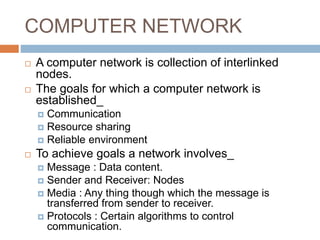
 It may be_
 Unguided: Air or Vaccum space.
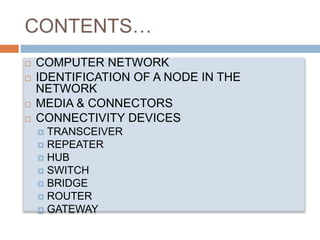
 Guided: A physical way or link between nodes.
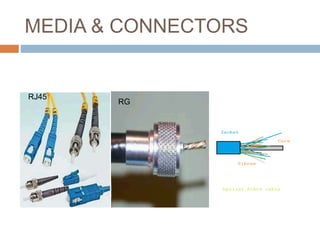
 E .g; Twisted pair cable (STP, UTP with RJ
connectors), Coaxial cable (with RG connectors) and
Fibre Optics.
MEDIA & CONNECTORS
RJ45
RG
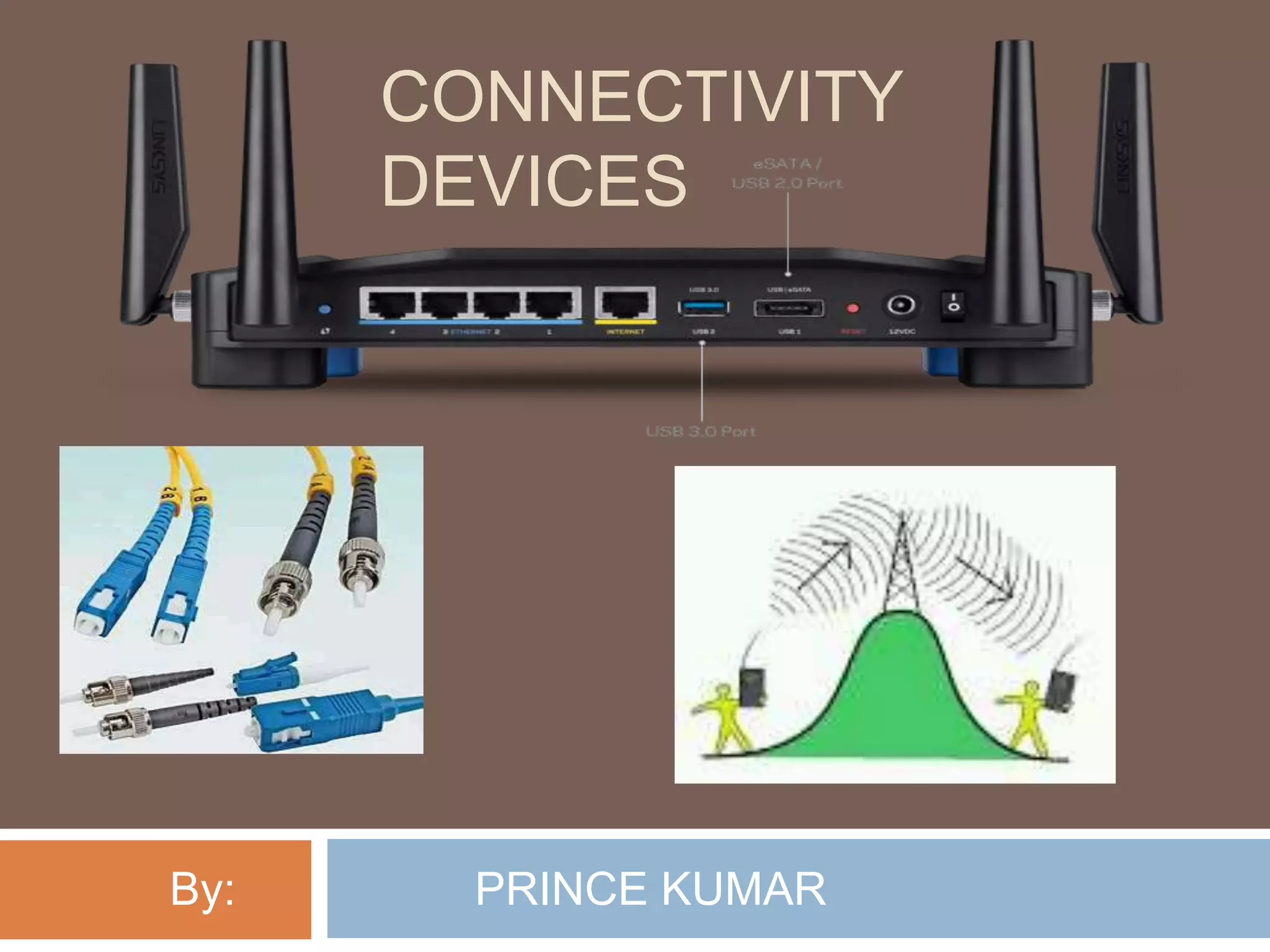
CONNECTIVITY DEVICES
 The devices used to establish a network are
known as CONNECTIVITY DEVICES.
 They may be categories as_
 Networking Devices
 Within a network; HUB, SWITCH etc.
 Internetworking Devices.
 Between two or more networks; BRIDGE, ROUTER
etc
TRANSCEIVER
 A device that is able to receive as well as
transmit signals is known as TRANSCEIVER.
REPEATER
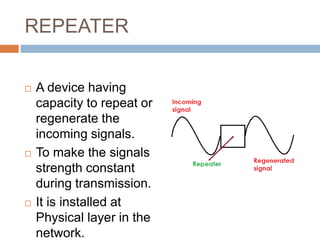
 A device having
capacity to repeat or
regenerate the
incoming signals.
 To make the signals
strength constant
during transmission.
 It is installed at
Physical layer in the
network.
HUB
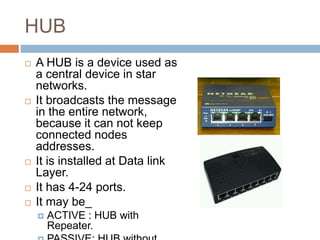
 A HUB is a device used as
a central device in star
networks.
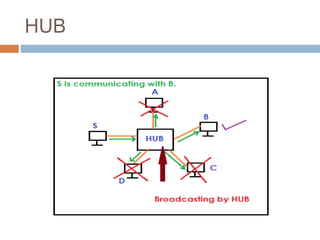
 It broadcasts the message
in the entire network,
because it can not keep
connected nodes
addresses.
 It is installed at Data link
Layer.
 It has 4-24 ports.
 It may be_
 ACTIVE : HUB with
Repeater.
HUB
SWITCH
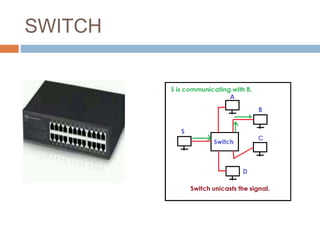
 Like a HUB Switch is also a central device
used in star networks.
 By default it unicast the message because it
keeps the address information of all the
connected devices but when broadcasting is
allowed it also broadcasts.
 It has 4-32 ports normally but also available in
128-256 ports.
 Modern Switches have inbuilt Repeaters.
 Installed at Layer2 or Layer 3 as required and
reads MAC addresses.
SWITCH
BRIDGE
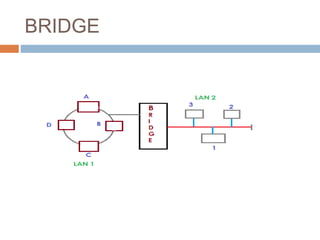
 A device to connect two or more LANs.
 It may be_
 Transparent : connects homogeneous LANs.
 Translational : connects heterogeneous LANs.
 It keeps the information about configurations of
all the networks connected via Bridge; such as
topologies and access techniques.
 Installed at Data link layer.
BRIDGE
ROUTER
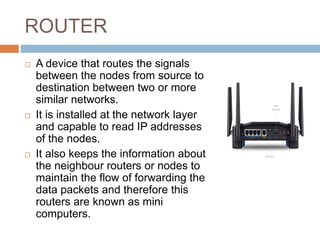
 A device that routes the signals
between the nodes from source to
destination between two or more
similar networks.
 It is installed at the network layer
and capable to read IP addresses
of the nodes.
 It also keeps the information about
the neighbour routers or nodes to
maintain the flow of forwarding the
data packets and therefore this
routers are known as mini
computers.
ROUTER
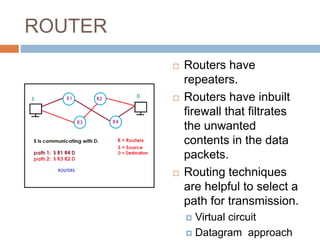
 Routers have
repeaters.
 Routers have inbuilt
firewall that filtrates
the unwanted
contents in the data
packets.
 Routing techniques
are helpful to select a
path for transmission.
 Virtual circuit
 Datagram approach
ROUTER
 Some devices are used as Bridge as well as
Routers called BROUTERS.
 At a time it works either as a Bridge or as a
Router.
GATEWAYS
 Gateway is a internetworking device.
 It is used to interconnect two dissimilar networks.
 It is installed at application layer in the network.
 Also known as protocol converter.
THE END

Connectivity devices

  • 1.
  • 2.
    CONTENTS…  COMPUTER NETWORK IDENTIFICATION OF A NODE IN THE NETWORK  MEDIA & CONNECTORS  CONNECTIVITY DEVICES  TRANSCEIVER  REPEATER  HUB  SWITCH  BRIDGE  ROUTER  GATEWAY
  • 3.
    COMPUTER NETWORK  Acomputer network is collection of interlinked nodes.  The goals for which a computer network is established_  Communication  Resource sharing  Reliable environment  To achieve goals a network involves_  Message : Data content.  Sender and Receiver: Nodes  Media : Any thing though which the message is transferred from sender to receiver.  Protocols : Certain algorithms to control communication.
  • 4.
    IDENTIFICATION OF ANODE IN THE NETWORK  Each Node has an address through which it is identified in the network.  NIC [Network Interface Card]: An special device connected on the motherboard of the computer having a 6 digit hexadecimal address [MAC Address] by which it is identified by matching the logical address[IP Address] at network support layers .
  • 5.
    MEDIA & CONNECTORS Any thing though which the message is transferred from sender to receiver is called as Medium.  It may be_  Unguided: Air or Vaccum space.  Guided: A physical way or link between nodes.  E .g; Twisted pair cable (STP, UTP with RJ connectors), Coaxial cable (with RG connectors) and Fibre Optics.
  • 6.
  • 7.
    CONNECTIVITY DEVICES  Thedevices used to establish a network are known as CONNECTIVITY DEVICES.  They may be categories as_  Networking Devices  Within a network; HUB, SWITCH etc.  Internetworking Devices.  Between two or more networks; BRIDGE, ROUTER etc
  • 8.
    TRANSCEIVER  A devicethat is able to receive as well as transmit signals is known as TRANSCEIVER.
  • 9.
    REPEATER  A devicehaving capacity to repeat or regenerate the incoming signals.  To make the signals strength constant during transmission.  It is installed at Physical layer in the network.
  • 10.
    HUB  A HUBis a device used as a central device in star networks.  It broadcasts the message in the entire network, because it can not keep connected nodes addresses.  It is installed at Data link Layer.  It has 4-24 ports.  It may be_  ACTIVE : HUB with Repeater.
  • 11.
  • 12.
    SWITCH  Like aHUB Switch is also a central device used in star networks.  By default it unicast the message because it keeps the address information of all the connected devices but when broadcasting is allowed it also broadcasts.  It has 4-32 ports normally but also available in 128-256 ports.  Modern Switches have inbuilt Repeaters.  Installed at Layer2 or Layer 3 as required and reads MAC addresses.
  • 13.
  • 14.
    BRIDGE  A deviceto connect two or more LANs.  It may be_  Transparent : connects homogeneous LANs.  Translational : connects heterogeneous LANs.  It keeps the information about configurations of all the networks connected via Bridge; such as topologies and access techniques.  Installed at Data link layer.
  • 15.
  • 16.
    ROUTER  A devicethat routes the signals between the nodes from source to destination between two or more similar networks.  It is installed at the network layer and capable to read IP addresses of the nodes.  It also keeps the information about the neighbour routers or nodes to maintain the flow of forwarding the data packets and therefore this routers are known as mini computers.
  • 17.
    ROUTER  Routers have repeaters. Routers have inbuilt firewall that filtrates the unwanted contents in the data packets.  Routing techniques are helpful to select a path for transmission.  Virtual circuit  Datagram approach
  • 18.
    ROUTER  Some devicesare used as Bridge as well as Routers called BROUTERS.  At a time it works either as a Bridge or as a Router.
  • 19.
    GATEWAYS  Gateway isa internetworking device.  It is used to interconnect two dissimilar networks.  It is installed at application layer in the network.  Also known as protocol converter.
  • 20.