Connective Tissues
Connective TissuesResponsible for providing and maintaining form in the body
HistogenesisMesodermal in origin
General CharacteristicsAre made up of fewer cells that are set far apartThey are supported by abundant intercellular  substanceThey also contain connective tissue fibersThe different contents of intercellular substance, CT cells and fibers account for the difference in appearance of the various connective tissues
General FunctionsProvide a matrix that serves to connect and bind the cells and organsGive mechanical support to the bodyStorage of fat and certain minerals like calcium in the bonesExchange of metabolites between blood and tissuesSignificant role in the repair and healing of woundsFor protection against infection
ClassificationI.    Connective Tissue Proper          Loose connective Tissue          Dense connective tissue – regular & irregularII.   Connective Tissue with special properties	Adipose CT	Elastic CT	Hematopoietic  CT(lymphatic and myeloid)	Mucous CTIII.  Suporting Connective Tissue          Cartilage           Bone
Composition of Connective TissuesConnective tissue cellsConnective tissue fibersIntercellular or Ground substanceBlood vessels – except in Mucous CT and in cartilage
Connective Tissue cellsFixed or permanentWandering cellsAre immigrant cells usually from blood or bone marrow.  Some retain their original characteristics and may take up permanent residence there:	1.  mast cells	2.  plasma cells	3.  pigment cells	4.  blood leukocytesAre native to the tissue in which they are found:	1.  undifferentiated             mesenchymal cells	2.  fibroblasts	3.  macrophages	4.  fat cells
Fixed Connective Tissue Cells
Undifferentiated Mesenchymal cellsPrecursor of most cells indigenous to CT including fibroblasts and adipose cellsAdventitial cells remain undiifferentiated in adult CT and constitute a reserve population of stem cellsPerivascular cells, often located along the walls of blood vesselsAre difficult to distinguish from active fibroblasts – recognition come not with the microscope but from numerous observations of their responses to certain stimuliPluripotential cells, capable of differentiation either into the usual cell types or into other cell types such as smooth muscle cells
FibroblastsPredominant CT cellsConsidered to be responsible for the formation of the fibers and are also thought to elaborate most, if not all, of the amourpous ground substanceAre large, flat branching cells which appear fusiform or spindle shaped in profileClassified as: lamellar or pyriform-shaped (youngest)Spindle or fusiform  (intermediate in age)Stellate or star-shaped (mature)
Fibroblasts
MacrophagesAs numerous as fibroblasts in loose CTOften termed histiocytes,  are most abundant in richly vascularized areasMay either be:Fixed or resting (attached to the fibers of the matrix)Free, wandering (derived from the immigration of monocytes from the blood) Capable of ameboid movement – very irregular in outline with pseudopodia extending in numerous directions
MacrophagesAct as scavengers, (motility and phagocytic activity) engulfing extravasated blood cells, dead cells, bacteria and foreign bodies
Fat cellsFully differentiated cells and are incapable of mitotic divisionSignet-ring appearance – cytoplasm is so thinned that it appears as a narrow rim around the edge of a single large lipid droplet with the nucleus fused to one side of the cell membraneTypes:Yellow or white – found in most of the bulk of the human bodyBrown fat cells – concerned with heat production, particularly important in newborn and young animals
Fat cells
Wandering Connective Tissue Cells
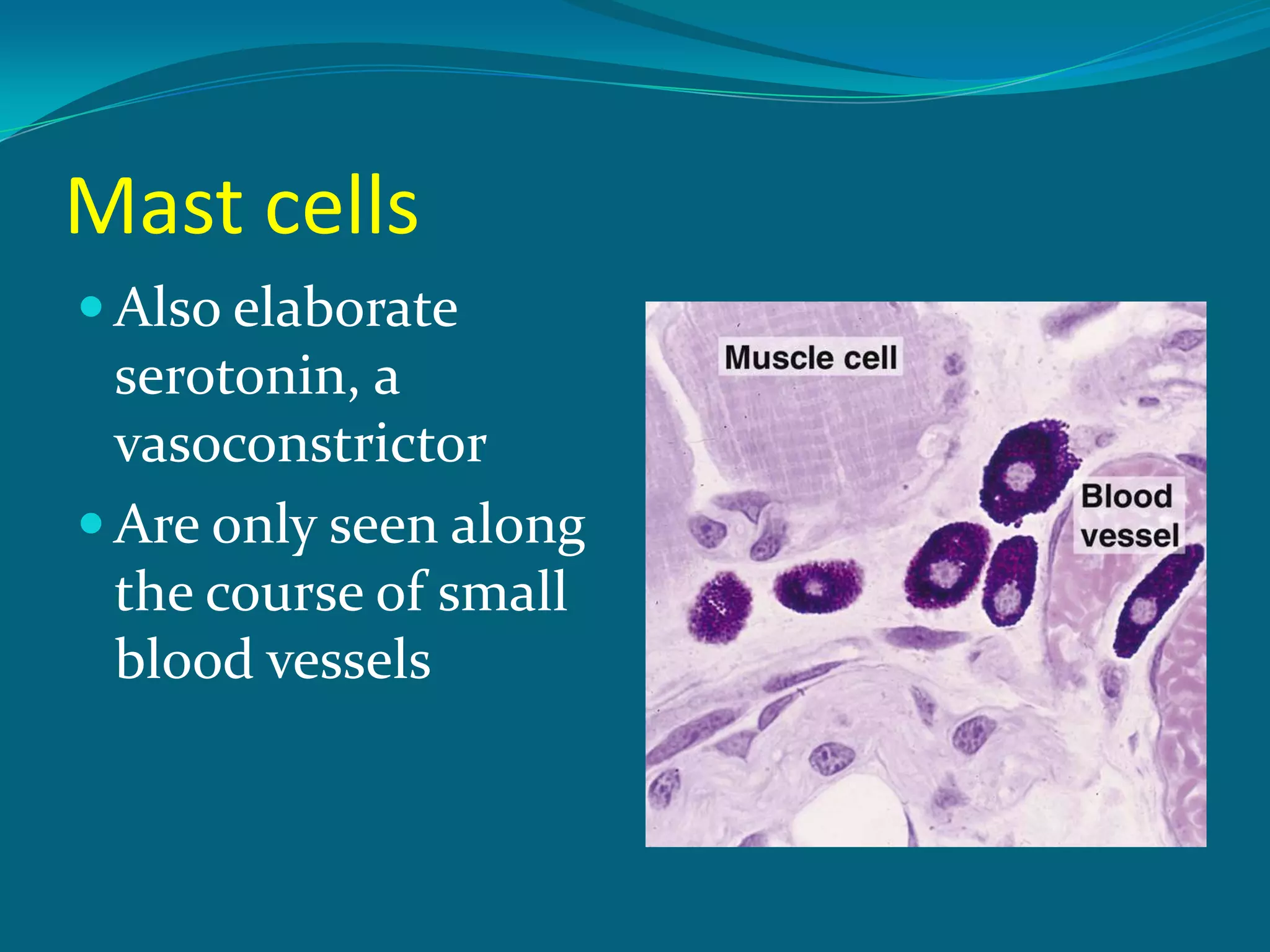
Mast cellsRound to oval CT cells whose cytoplasm is filled with basophilic granulesThe rather small and spherical nucleus is centrally situated and is frequently obscured by the cytoplasmic granulesProduce an anticoagulant similar if not identical to heparinProduce histamine in allergic response to some foreign proteins
Mast cellsAlso elaborate serotonin, a vasoconstrictorAre only seen along the course of small blood vessels
Plasma cellsSpherical cells with rounded or irregular nuclei generally eccentrically located , whose chromatin materials exhibit a characteristic “checker-board”, “clock-faced”, “cart-wheel” appearance Has an important function in resistance to disease and known as the:  principal producer of antibodies
Plasma Cells
Pigment cellsResemble the fibroblast but whose cytoplasm contains pigment granules that never invade the nucleusTypes:Dermal chromatophore– found in the dermis of the skin, retina, choroid and iris of eyeballEpidermal melanocytes, found in common mole and are responsible for the manufacture of melanin granules
Blood Leukocytes
LymphocytesSmallest, with rounded nucleus which occupies most of the cytoplasmConcerned with antibody production
EosinophilsHave bilobed nucleus with spherical, darkly staining acidophilic granulesFound abundant in lactating breasts, respiratory and alimentary tracts, and in certain allergic reactions
NeutrophilsFirst line of defense, seen in regions of acute inflammationHave a segmented nucleus (3-5 lobes) having fine granules which are purple or violet in color
MonocytesLargest, they have a kidney-shaped nucleus and are considered as the phagocytes of the blood
Connective tissue cells
Ground Substance
Ground substanceColorless, transparent and homogenousFills the space between cells and fibers of the CTIt is viscous and acts as lubricant and also as a barrier to the penetration of the tissues by foreign particlesFormed mainly by two classes of components:GlycosaminoglycansStructural glycoproteins
Connective Tissue FibersCollagen          formed by the protein collagen,            Reticular         most abundant protein of the bodyElastic – composed mainly of the protein elastin
Collagen fibersMost numerous fiber in CTFibers are colorless stands, but when present in great numbers, they cause the tissue in which it lie to be whiteAre inelastic and have a tensile strength greater than steelImparts a unique combination of flexibility and strength to the tissues in which it lies
Collagen fibersConsists of closely packed thick fibrils with an average diameter of 75 nmIn many parts of the body, are organized in parallel array forming collagen bundlesIn H & E sections, large or small bundles of fibrils or individual fibrils exhibit acidophilic staining properties
Types of Collages fibersCollagen type IMost abundant and has a widespread distribution (90% of the collagen in the body)Found in the dermis of the skin, tendons, bone, teeth and virtually all CT Collagen type IIPresent mainly in hyaline  and elastic cartilageOnly very thin fibrils are formed
Types of collagen fibersCollagen type IIIOften found in association with type I and is probably the major collagenous components of reticular fibersCan copolymerize with other types of collagenCollagen type IVIs the major collagen type in basal laminaDoes not form fibrils or fibersCollagen type VPresent in fetal membranes and blood vessels and in small amounts in other tissues
Reticular fibersAre extremely thin, with a diameter between 0.5 and 2 μmNot visible in hematoxylin and eosin stains but can be easily stained black by impregnation with silver saltsArgyrophilic fibers – affinity to silver saltsDuring embryogenesis, inflammatory processes, and wound healing, most connective tissues have an abundance of reticular fibers, but these are subsequently replaced by regular collagen fibers
Reticular fibersParticularly abundant in smooth muscles, endoneurium, and the framework of hematopoietic organs (e.g. spleen, lymph nodes, red bone marrow) and constitute a network around the cells of parenchymal organs (e.g. liver, kidney, endocrine glands)
Elastic fibersConsists of an albuminoid protein called elastinRange in diameter from 0.1 to 10 µmHistologically contains few charged amino acids so it stains poorly with standard ionic dyesSpecial stains such as Verhoeff’s stain and Weigert’sResorcin-fushsin stain are used in light microscopeAre extremely pliable and elastic Can be stretched to 150% of their length without breaking and then return to their original length
Elastic fibersFound where their mechanical properties are necessary to allow tissues to stretch or expand and then return to their original shape, e.g. in arterial walls, interalveolar septa, bronchi and brionchioles of the lungs, vocal ligaments and ligamentaflava of the vertebral column

Connective tissues

  • 1.
  • 2.
    Connective TissuesResponsible forproviding and maintaining form in the body
  • 3.
  • 4.
    General CharacteristicsAre madeup of fewer cells that are set far apartThey are supported by abundant intercellular substanceThey also contain connective tissue fibersThe different contents of intercellular substance, CT cells and fibers account for the difference in appearance of the various connective tissues
  • 5.
    General FunctionsProvide amatrix that serves to connect and bind the cells and organsGive mechanical support to the bodyStorage of fat and certain minerals like calcium in the bonesExchange of metabolites between blood and tissuesSignificant role in the repair and healing of woundsFor protection against infection
  • 6.
    ClassificationI. Connective Tissue Proper Loose connective Tissue Dense connective tissue – regular & irregularII. Connective Tissue with special properties Adipose CT Elastic CT Hematopoietic CT(lymphatic and myeloid) Mucous CTIII. Suporting Connective Tissue Cartilage Bone
  • 7.
    Composition of ConnectiveTissuesConnective tissue cellsConnective tissue fibersIntercellular or Ground substanceBlood vessels – except in Mucous CT and in cartilage
  • 8.
    Connective Tissue cellsFixedor permanentWandering cellsAre immigrant cells usually from blood or bone marrow. Some retain their original characteristics and may take up permanent residence there: 1. mast cells 2. plasma cells 3. pigment cells 4. blood leukocytesAre native to the tissue in which they are found: 1. undifferentiated mesenchymal cells 2. fibroblasts 3. macrophages 4. fat cells
  • 9.
  • 10.
    Undifferentiated Mesenchymal cellsPrecursorof most cells indigenous to CT including fibroblasts and adipose cellsAdventitial cells remain undiifferentiated in adult CT and constitute a reserve population of stem cellsPerivascular cells, often located along the walls of blood vesselsAre difficult to distinguish from active fibroblasts – recognition come not with the microscope but from numerous observations of their responses to certain stimuliPluripotential cells, capable of differentiation either into the usual cell types or into other cell types such as smooth muscle cells
  • 11.
    FibroblastsPredominant CT cellsConsideredto be responsible for the formation of the fibers and are also thought to elaborate most, if not all, of the amourpous ground substanceAre large, flat branching cells which appear fusiform or spindle shaped in profileClassified as: lamellar or pyriform-shaped (youngest)Spindle or fusiform (intermediate in age)Stellate or star-shaped (mature)
  • 12.
  • 13.
    MacrophagesAs numerous asfibroblasts in loose CTOften termed histiocytes, are most abundant in richly vascularized areasMay either be:Fixed or resting (attached to the fibers of the matrix)Free, wandering (derived from the immigration of monocytes from the blood) Capable of ameboid movement – very irregular in outline with pseudopodia extending in numerous directions
  • 14.
    MacrophagesAct as scavengers,(motility and phagocytic activity) engulfing extravasated blood cells, dead cells, bacteria and foreign bodies
  • 15.
    Fat cellsFully differentiatedcells and are incapable of mitotic divisionSignet-ring appearance – cytoplasm is so thinned that it appears as a narrow rim around the edge of a single large lipid droplet with the nucleus fused to one side of the cell membraneTypes:Yellow or white – found in most of the bulk of the human bodyBrown fat cells – concerned with heat production, particularly important in newborn and young animals
  • 16.
  • 18.
  • 19.
    Mast cellsRound tooval CT cells whose cytoplasm is filled with basophilic granulesThe rather small and spherical nucleus is centrally situated and is frequently obscured by the cytoplasmic granulesProduce an anticoagulant similar if not identical to heparinProduce histamine in allergic response to some foreign proteins
  • 20.
    Mast cellsAlso elaborateserotonin, a vasoconstrictorAre only seen along the course of small blood vessels
  • 21.
    Plasma cellsSpherical cellswith rounded or irregular nuclei generally eccentrically located , whose chromatin materials exhibit a characteristic “checker-board”, “clock-faced”, “cart-wheel” appearance Has an important function in resistance to disease and known as the: principal producer of antibodies
  • 22.
  • 23.
    Pigment cellsResemble thefibroblast but whose cytoplasm contains pigment granules that never invade the nucleusTypes:Dermal chromatophore– found in the dermis of the skin, retina, choroid and iris of eyeballEpidermal melanocytes, found in common mole and are responsible for the manufacture of melanin granules
  • 24.
  • 25.
    LymphocytesSmallest, with roundednucleus which occupies most of the cytoplasmConcerned with antibody production
  • 26.
    EosinophilsHave bilobed nucleuswith spherical, darkly staining acidophilic granulesFound abundant in lactating breasts, respiratory and alimentary tracts, and in certain allergic reactions
  • 27.
    NeutrophilsFirst line ofdefense, seen in regions of acute inflammationHave a segmented nucleus (3-5 lobes) having fine granules which are purple or violet in color
  • 28.
    MonocytesLargest, they havea kidney-shaped nucleus and are considered as the phagocytes of the blood
  • 29.
  • 30.
  • 31.
    Ground substanceColorless, transparentand homogenousFills the space between cells and fibers of the CTIt is viscous and acts as lubricant and also as a barrier to the penetration of the tissues by foreign particlesFormed mainly by two classes of components:GlycosaminoglycansStructural glycoproteins
  • 32.
    Connective Tissue FibersCollagen formed by the protein collagen, Reticular most abundant protein of the bodyElastic – composed mainly of the protein elastin
  • 33.
    Collagen fibersMost numerousfiber in CTFibers are colorless stands, but when present in great numbers, they cause the tissue in which it lie to be whiteAre inelastic and have a tensile strength greater than steelImparts a unique combination of flexibility and strength to the tissues in which it lies
  • 34.
    Collagen fibersConsists ofclosely packed thick fibrils with an average diameter of 75 nmIn many parts of the body, are organized in parallel array forming collagen bundlesIn H & E sections, large or small bundles of fibrils or individual fibrils exhibit acidophilic staining properties
  • 35.
    Types of CollagesfibersCollagen type IMost abundant and has a widespread distribution (90% of the collagen in the body)Found in the dermis of the skin, tendons, bone, teeth and virtually all CT Collagen type IIPresent mainly in hyaline and elastic cartilageOnly very thin fibrils are formed
  • 36.
    Types of collagenfibersCollagen type IIIOften found in association with type I and is probably the major collagenous components of reticular fibersCan copolymerize with other types of collagenCollagen type IVIs the major collagen type in basal laminaDoes not form fibrils or fibersCollagen type VPresent in fetal membranes and blood vessels and in small amounts in other tissues
  • 37.
    Reticular fibersAre extremelythin, with a diameter between 0.5 and 2 μmNot visible in hematoxylin and eosin stains but can be easily stained black by impregnation with silver saltsArgyrophilic fibers – affinity to silver saltsDuring embryogenesis, inflammatory processes, and wound healing, most connective tissues have an abundance of reticular fibers, but these are subsequently replaced by regular collagen fibers
  • 38.
    Reticular fibersParticularly abundantin smooth muscles, endoneurium, and the framework of hematopoietic organs (e.g. spleen, lymph nodes, red bone marrow) and constitute a network around the cells of parenchymal organs (e.g. liver, kidney, endocrine glands)
  • 39.
    Elastic fibersConsists ofan albuminoid protein called elastinRange in diameter from 0.1 to 10 µmHistologically contains few charged amino acids so it stains poorly with standard ionic dyesSpecial stains such as Verhoeff’s stain and Weigert’sResorcin-fushsin stain are used in light microscopeAre extremely pliable and elastic Can be stretched to 150% of their length without breaking and then return to their original length
  • 40.
    Elastic fibersFound wheretheir mechanical properties are necessary to allow tissues to stretch or expand and then return to their original shape, e.g. in arterial walls, interalveolar septa, bronchi and brionchioles of the lungs, vocal ligaments and ligamentaflava of the vertebral column