This content has been downloaded from IOPscience. Please scroll down to see the full text.
Download details:
IP Address: 51.175.145.26
This content was downloaded on 04/04/2016 at 18:49
Please note that terms and conditions apply.
2 °C and SDGs: united they stand, divided they fall?
View the table of contents for this issue, or go to the journal homepage for more
2016 Environ. Res. Lett. 11 034022
(http://iopscience.iop.org/1748-9326/11/3/034022)
Home Search Collections Journals About Contact us My IOPscience
Environ. Res. Lett. 11 (2016) 034022 doi:10.1088/1748-9326/11/3/034022
LETTER
2°C and SDGs: united they stand, divided they fall?
Christoph von Stechow1,2,3
, Jan C Minx1,2,4
, Keywan Riahi5,6
, Jessica Jewell5
, David L McCollum5
,
Max W Callaghan4
, Christoph Bertram2
, Gunnar Luderer2
and Giovanni Baiocchi7
1
Mercator Research Institute on Global Commons and Climate Change, 10 829 Berlin, Germany
2
Potsdam Institute for Climate Impact Research, 14 412 Potsdam, Germany
3
Department of Economics of Climate Change, Technical University Berlin, 10 623 Berlin, Germany
4
Hertie School of Governance, 10 117 Berlin, Germany
5
International Institute for Applied Systems Analysis, A-2361 Laxenburg, Austria
6
Institute of Thermal Engineering, Graz University of Technology, A-8010 Graz, Austria
7
Department of Geographical Sciences, University of Maryland, College Park, MD 20 742, USA
E-mail: stechow@mcc-berlin.net
Keywords: climate change mitigation, climate policy, co-benefits, risk management, energy efficiency, sustainable development, mitigation
risks
Supplementary material for this article is available online
Abstract
The adoption of the Sustainable Development Goals (SDGs) and the new international climate treaty
could put 2015 into the history books as a defining year for setting human development on a more
sustainable pathway. The global climate policy and SDG agendas are highly interconnected: the way
that the climate problem is addressed strongly affects the prospects of meeting numerous other SDGs
and vice versa. Drawing on existing scenario results from a recent energy-economy-climate model
inter-comparison project, this letter analyses these synergies and (risk) trade-offs of alternative 2 °C
pathways across indicators relevant for energy-related SDGs and sustainable energy objectives. We
find that limiting the availability of key mitigation technologies yields some co-benefits and decreases
risks specific to these technologies but greatly increases many others. Fewer synergies and substantial
trade-offs across SDGs are locked into the system for weak short-term climate policies that are broadly
in line with current Intended Nationally Determined Contributions (INDCs), particularly when
combined with constraints on technologies. Lowering energy demand growth is key to managing
these trade-offs and creating synergies across multiple energy-related SD dimensions. We argue that
SD considerations are central for choosing socially acceptable 2 °C pathways: the prospects of meeting
other SDGs need not dwindle and can even be enhanced for some goals if appropriate climate policy
choices are made. Progress on the climate policy and SDG agendas should therefore be tracked within
a unified framework.
1. Introduction
There is hope that 2015 will be remembered as a
defining year for setting human development on a
more sustainable pathway. Two important milestones
were reached. On 25 September, a new development
agenda was adopted in New York aimed at eradicating
poverty and facilitating inclusive development within
ever tighter planetary boundaries. Economic, social
and environmental progress will be tracked across a set
of agreed sustainable development goals (SDGs). The
SDG framework is intended to manage trade-offs and
maximize synergies across the 17 different goals and
associated 169 targets (Griggs et al 2013).
On 12 December, countries agreed upon a new
international climate treaty, the Paris Agreement, at
the United Nations Framework Convention on Cli-
mate Change (UNFCCC) Conference of Parties
(COP21) in Paris. It ‘aims to strengthen the global
response to the threat of climate change, in the context
of sustainable development and efforts to eradicate
poverty, including by holding the increase in the global
average temperature to well below 2 °C above pre-
industrial levels’ (UNFCCC 2015a).
OPEN ACCESS
RECEIVED
28 September 2015
REVISED
5 February 2016
ACCEPTED FOR PUBLICATION
10 February 2016
PUBLISHED
16 March 2016
Original content from this
work may be used under
the terms of the Creative
Commons Attribution 3.0
licence.
Any further distribution of
this work must maintain
attribution to the
author(s) and the title of
the work, journal citation
and DOI.
© 2016 IOP Publishing Ltd
Both processes are highly interrelated: SD is an
explicit part of the Paris Agreement, while avoiding
dangerous climate change features as one of the SDGs
(#13). In fact, failure in one process would undermine
the success of the other. Stringent and sustained miti-
gation is a necessary condition for SD, because una-
bated climate change will exacerbate many of today’s
development issues and negate future improvements
(see Fleurbaey et al 2014). However, it is an insufficient
condition for SD, because some 2 °C pathways could,
if not designed properly, undermine SD in non-cli-
mate dimensions. For example, pathways with a lim-
ited short-term ambition like the current INDCs may
have higher SD risks than more ambitious ones. Such
broader SD implications could delegitimize some 2 °C
pathways or even the 2 °C target itself (Edenhofer and
Kowarsch 2015). SD further hinges on the successful
implementation of non-climate policies that comple-
ment or support climate policies in other dimensions.
Thus, identifying socially acceptable 2 °C pathways
requires framing climate policy in a broader SD
context.
Assessments of alternative mitigation pathways so
far have mainly focused on characterizing the under-
lying technological and economic challenges (Clarke
et al 2014), but less is known about the wider social,
economic and environmental implications. For exam-
ple, many 2 °C pathways project large amounts of
bioenergy demand in the second half of this century. It
is highly debated in the literature whether these can be
provided sustainably: food security, place-specific
livelihoods, water availability and biodiversity are
amongst the critical issues being discussed (Creutzig
et al 2012, Smith et al 2014). At the same time, many
2 °C pathways project potential health gains and co-
benefits for other sustainability objectives. The bal-
ance of these co-effects is poorly understood, particu-
larly on the supply side, because risks of alternative
2 °C pathways for non-climate sustainability objec-
tives have not yet been systematically analyzed (von
Stechow et al 2015).
In this letter, we analyze the implications of alter-
native 2 °C pathways for SD risk dimensions by draw-
ing on existing, publicly available inter-model
comparison results from integrated energy-economy-
climate models—henceforth referred to as integrated
models (see SI section 1, available at stacks.iop.org/
ERL/11/034022/mmedia). We demonstrate how
broadening the analytical framework can allow both
for a more informed public debate about alternative
2 °C pathways and how achieving the climate SDG
may affect the prospects of meeting other energy-rela-
ted SDGs. This is important both for critically discuss-
ing the relationship between the international climate
policy and SDG agendas as well as for identifying strin-
gent mitigation pathways that are socially acceptable.
2. Methods
Choosing appropriate climate policies is an exercise in
risk management for which it is key to understand and
evaluate relevant uncertainties (Kunreuther
et al 2013). We focus on uncertainties related to
different model structures and assumptions, i.e.
‘model uncertainty’ (Drouet et al 2015) and draw on
results from a structured inter-comparison exercise of
integrated energy-economy-climate models,
AMPERE (Kriegler et al 2015, Riahi et al 2015). To
complement existing literature, this data is used to
assess relevant SD implications of alternative clusters
of mitigation pathways that are consistent with the
2 °C target (see table S2) to initiate a public debate on
their wider sustainability implications.
2.1. Choice of indicators for SD risks
The analysis builds on recent literature that explores a
growing number of mitigation challenges with impli-
cations for non-climate sustainability objectives.
Comprehensive discussions can be found in Clarke
et al (2014, section 6.6) and von Stechow et al (2015,
section 4). Table 1 summarizes the indicators that can
be calculated from integrated model variables. Our
choice of indicators is further constrained by the
model structures, scenario runs, and reported vari-
ables as aggregated in the publicly available AMPERE
database (https://secure.iiasa.ac.at/web-apps/ene/
AMPEREDB). For example, the coarse regional dis-
aggregation of reported data in AMPERE impedes the
analysis of indicators that are most relevant for
inequality and poverty outcomes, such as energy
supply per capita to satiate basic human needs (see
Steckel et al 2013, Lamb and Rao 2015 and SI section 2
for a discussion of further model limitations). By
systematically linking the chosen set of indicators to
global SD risks, we can present a first, rough approx-
imation of how alternative clusters of 2 °C pathways
perform with respect to energy-related SDGs and
other multilaterally agreed sustainable energy objec-
tives (see table 2 and SI section 3 for a discussion on the
indicator choice).
Due tothelimiteddataavailability,theanalysiscan-
not address all relevant SDGs explicitly. But it enables
us to provide an early contribution to public and scien-
tific debates on the relationship between the interna-
tional climate policy and SDG agendas and contribute
to important early learning processes. To simplify the
complex relationship between indicators, energy-rela-
ted SDGs and other sustainable energy objectives (see
figure S2), table 2 focuses on the strongest links
between them. However, many indicators are also rele-
vant for some cross-cutting SDGs, such as poverty and
inequality, which are not addressed in the analysis (see
SI section 3.1). The resulting set of indicators is relevant
for judging both co-benefits of mitigation (air quality,
oil security) and mitigation risks (upscaling of
2
Environ. Res. Lett. 11 (2016) 034022
bioenergy and low-carbon electricity technologies) and
has been shown to havesubstantial sustainability impli-
cations in many integrated models (Jewell et al 2013,
McCollum et al 2013a, von Stechow et al 2015). It also
includes an indicator for ocean acidification (Joos
et al 2011, Zickfeld et al 2012) as well as three indicators
that relate to transitional socioeconomic mitigation
risks (growth in mitigation costs and energy prices as
wellasearlyretirement ofcoalcapacity).
Our analysis presents SD risk profiles for alter-
native clusters of 2 °C pathways (see figures 2–4). The
figures plot percentage changes over baseline projec-
tions in each dimension rather than comparing differ-
ent metrics to each other and/or identifying critical
thresholds because of the difficulty of incommensur-
ability across different SD dimensions (von Stechow
et al 2015). Care needs to be taken in the interpreta-
tion, because the different risks analyzed cannot be
Table 1. Integrated model literature on mitigation challenges with implications for non-climate sustainability objectives, with a focus on
indicators that can be calculated from model variables. The different categories largely follow table 4.1 in Fleurbaey et al (2014). Due to
strengths and weaknesses of the models, some mitigation challenges were only analyzed by individual models while others were covered by
multiple models—mostly in the context of model inter-comparison projects. A comprehensive review on co-benefits and risks of mitigation
is provided in von Stechow et al (2015).
Mitigation challenges Indicators used Selected literature
Economic/affordability challenges
Aggregate economic costs of
mitigation
Aggregated and discounted GDP/
consumption losses
Kriegler et al 2013, Paltsev and Capros 2013, Clarke
et al 2014, Kriegler et al 2014, Rogelj et al 2015
Transitional economic costs of
mitigation
Consumption growth reduction Kriegler et al 2013, Luderer et al 2013a, 2013b, Bertram
et al 2015b
Carbon price growth Carbon price jump over a decade Rogelj et al 2013a, 2015
Global energy price index Luderer et al 2013b, Bertram et al 2015b
Energy price growth Electricity price growth rate Kriegler et al 2013, Rogelj et al 2015
Stranded fossil investment Idle power plant capacity per year Luderer et al 2013a, Rogelj et al 2013a, Bertram et al 2015a,
Johnson et al 2015
Energy dependence Trade flows between regions Cherp et al 2013, Jewell et al 2013, 2014, Riahi et al 2012
Resilience of energy systems Diversity of energy carriers in indivi-
dual sectors (SWDI, HHI)
Cherp et al 2013, Jewell et al 2013, 2014
Depletion of oil reserves Cumulative oil extraction Sathaye et al 2011, Jewell et al 2013
Technological/innovation challenges
Integration challenges of low-
carbon technologies
Technological upscaling (rates) Wilson et al 2013, Kim et al 2014, Eom et al 2015, Riahi
et al 2015, van Sluisveld et al 2015, Bertram et al 2015a
Carbon intensity improvement Carbon intensity reduction rates Luderer et al 2013a, Edenhofer et al 2014a, Kriegler
et al 2014, Riahi et al 2015
Social/institutional challenges
Food price increase World and regional market prices von Braun et al 2008, PBL 2012, Lotze-Campen et al 2014,
Wise et al 2014, van Vuuren et al 2015
Energy supply per capita/
energy access
Final energy supply per year/access to
modern fuels
van Ruijven et al 2012, Daioglou et al 2012, Krey et al 2012,
Steckel et al 2013, Riahi et al 2012, Pachauri et al 2013,
Lamb and Rao 2015, van Vuuren et al 2015
Nuclear proliferation Enrichment/reprocessing facilities Lehtveer and Hedenus 2015
Carbon market value Value of cumulative emissions Luderer et al 2013b, Bertram et al 2015b
Environmental challenges
Resource extraction/use Cumulative coal/uranium extraction Rogner et al 2012, Bauer et al 2013, McCollum et al 2014
Bioenergy expansion Biomass supply for energy Creutzig et al 2012, Smith et al 2014
Air pollutant concentration SO2, BC, OC and NOx emissions/
concentrations
Riahi et al 2012, McCollum et al 2013a, Rogelj et al 2014,
Rose et al 2014, Strefler et al 2014, van Vuuren et al 2015
Environmental risks of CO2
capture and storage
CO2 (fossil/biomass) captured and
stored underground
Kriegler et al 2013, Eom et al 2015, Rogelj et al 2015, Smith
et al 2016
Land use change Global area changes for cropland,
pasture, biomass, unmanaged land
Wise et al 2009, Reilly et al 2012, Lotze-Campen et al 2014,
Popp et al 2014, Calvin et al 2014
Water shortage Water use (mainly for bioenergy
supply)
De Fraiture et al 2008, Arnell et al 2011, PBL 2012, Hejazi
et al 2013, Bonsch et al 2016
Biodiversity loss Mean species abundance (MSA) PBL 2012, van Vuuren et al 2015
Peak atmospheric CO2
concentration
Cumulative CO2 emissions until
mid-century
Joos et al 2011, Zickfeld et al 2012
Exceedance likelihood/
overshoot risk
Likelihood of exceeding specific
temperature/concentration target
Kriegler et al 2013, Luderer et al 2013b, Rogelj
et al 2013a, 2013b
3
Environ. Res. Lett. 11 (2016) 034022
directly compared to each other, i.e. a larger increase
in one risk is not necessarily more important than a
smaller increase in another risk. Any interpretation of
these risk profiles and any trade-off across risk dimen-
sions requires evaluation and weighting—and this
depends on the locally specific policy contexts and dif-
fer depending on individual priorities and risk percep-
tions (Slovic 1987, Jakob and Edenhofer 2014,
Kunreuther et al 2014). The provided risk profiles
therefore allow readers to make their own judgement
about the relevance of changes in risk levels across SD
dimensions. In this sense our analysis provides a start-
ing point for a more informed public debate about the
interaction between the mitigation and other energy-
related SDGs that will put the normative aspects of
such evaluation centre stage (see Edenhofer et al
2014b).
2.2. Choice of scenario data
Using model inter-comparison results from AMPERE
allows us to take advantage of an internally consistent
set of scenario specifications and harmonized input
assumptions (Kriegler et al 2015, Riahi et al 2015).
AMPERE work package 2 was chosen because (i) the
data is publicly available, (ii) it consistently defines
alternative short-term climate policy pathways across
models until 2030, which is particularly relevant from
an SDG perspective with a focus on short/medium-
term developments, and (iii) it is the only model inter-
comparison project that combines different types of
constraints with respect to the stringency of short-
term climate policies and the availability of mitigation
technologies or energy demand growth assumptions
(see table 3 and SI section S4). This is a key
requirement for comprehensively exploring the SD
risk dimensions of alternative 2 °C pathways. Yet the
reported data does not shed light on all relevant
dimensions. One shortcoming is the simplifying
assumption of regionally homogeneous carbon prices
without consideration of burden sharing regimes. This
impedes an analysis of regional mitigation cost dis-
tributions (see den Elzen et al 2008, Luderer et al 2012,
Tavoni et al 2013, Aboumahboub et al 2014, Tavoni
et al 2015) and related SD implications.
The analysis draws on more than 20 scenario spe-
cifications from seven models: DNE21+, GCAM,
IMAGE, MESSAGE, POLES, REMIND, and WITCH
(for further information, see Riahi et al (2015) and SI
section 4). To avoid comparisons of scenario results
from different sets of models, most figures only draw
on a subset of models as (i) not all models ran or found
a solution for all mitigation scenario specifications,
and (ii) not all models report results for all indicators
due to model type, assumptions on parameters and
constraints, or respective system boundaries (see table
S1). The results are presented similarly to the scenario
ranges in the Working Group III contribution to the
IPCC Fifth Assessment Report (WGIII AR5) because
this shows variability across models. However, given
that the sample size is small and no systematic varia-
tion of all relevant model input assumptions was per-
formed this variability does not represent full model
uncertainty.
3. Results
The analysis is divided into two parts: we assess co-
benefits of alternative 2 °C pathways before turning to
their mitigation risk profiles. In each part, we system-
atically analyze different clusters of 2 °C pathways to
understand the implications for SD outcomes of
variations in (i) short-term climate policy stringency,
(ii) availability of mitigation technologies or (iii) a
combination of the two. Analyzing these clusters is
highly relevant, because the current and projected
INDC emission trajectories are not consistent with
Table 2. The link between relevant and available indicators calculated from integrated model variables, SD risk dimensions, and SDGs and
other sustainable energy objectives. See figure S2 and SI section 3 for more details.
Indicators calculated from integrated model variables
SD risk dimensions affected by
mitigation
SDGs and other sustainable energy
objectives
Biomass supply for energy per year Bioenergy expansion Food security (SDG 2)
Cumulative BC and SO2 emissions Air pollutant concentration Health via air quality (SDG 3.9)
Maximum decadal energy price growth Energy price growth Energy access (SDG 7)
Maximum decadal growth reduction Consumption growth reduction Economic growth (SDG 8.1)
Idle coal capacity per year Stranded fossil investment Full employment (SDG 8.3)
Maximum decadal PV and Wind upscaling Wind & PV grid integration Resilient infrastructure (SDG 9)
Cumulative global oil trade, cumulative oil extraction,
fuel diversity of transport sector
Oil insecurity, transport sector
reliance on oil
Ensure energy securitya
Nuclear capacity expansion in Newcomersb
Nuclear proliferation Peaceful use of nuclear power
Cumulative CO2 emissions until mid-century Peak atmospheric CO2 concentration Minimize ocean acidification
(SDG 14.3)
CO2 captured and stored per year Environmental risks of CCS Sustainable production (SDG 12.4)
a
Due to the focus on global risks, the analysis is limited to oil security—the fuel with the highest scarcity concerns and high import
dependence in most countries, lacking substitutes in transport (see SI section 3.1.7).
b
We designed a new indicator that can draw on existing model variables (see SI section 3.2).
4
Environ. Res. Lett. 11 (2016) 034022
optimal 2 °C pathways (UNFCCC 2015b) and the
standard assumption of full technological flexibility is
inhibited as significant upscaling of low-carbon tech-
nologies faces many different hurdles in practice8
. Our
analysis here focuses on the first half of the 21st
century in which the interaction of short-term climate
policies and the long-term climate target is strongest
(Kriegler et al 2013, Luderer et al 2013a, 2013b, Riahi
et al 2015, Eom et al 2015, Bertram et al 2015a).
3.1. Synergies across mitigation and sustainable
energy objectives
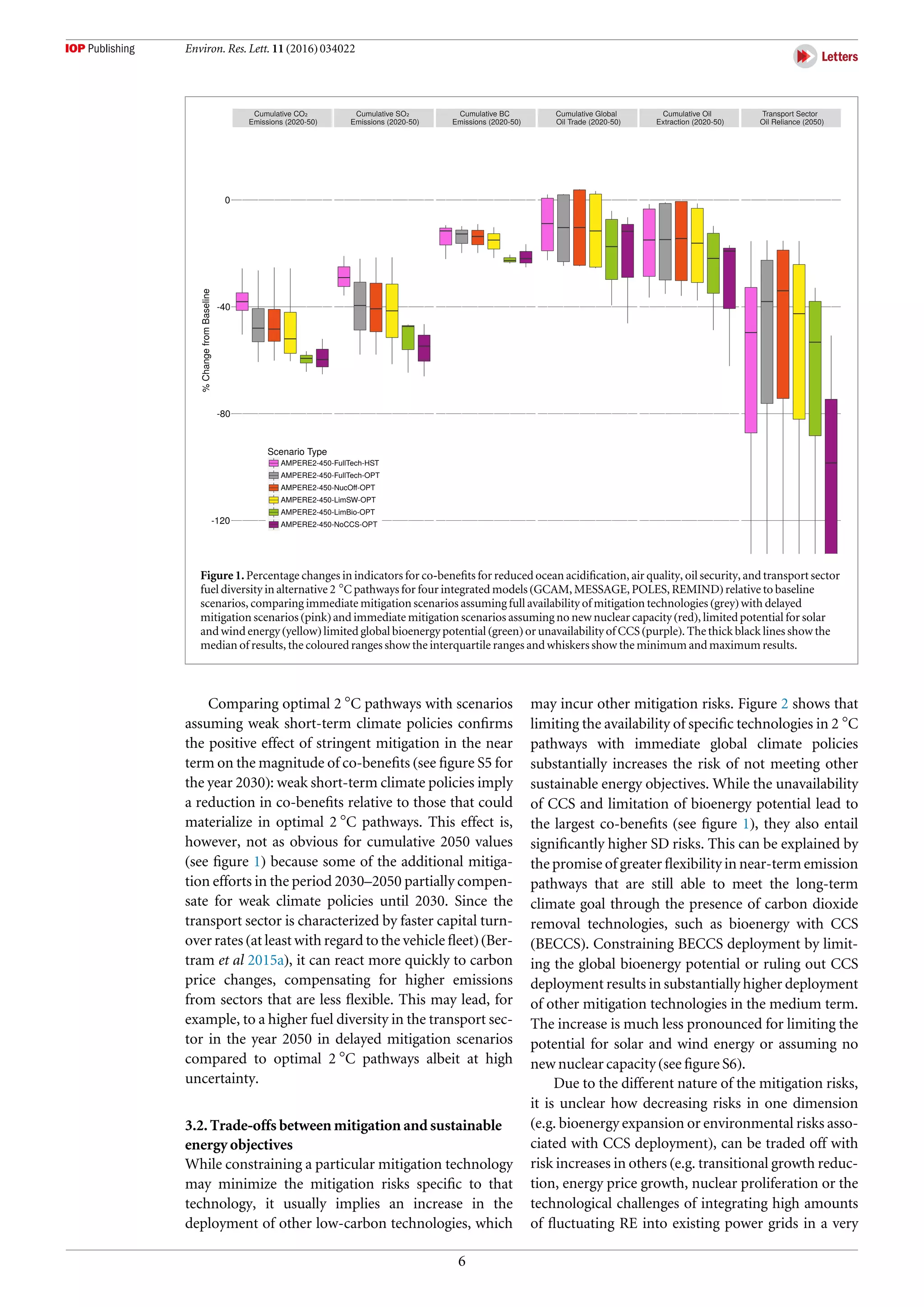
Figure 1 uses cumulative indicators for (i) CO2
emissions (Zickfeld et al 2012), (ii) the co-emitted air
pollutants black carbon (BC) and sulphur dioxide
(SO2) and (iii) global oil extraction and trade as well as
transport sector reliance on oil to present reduced SD
risks, i.e. co-benefits of mitigation scenarios compared
to baseline developments. Figure 1 shows that co-
benefits in terms of lower ocean acidification, health
and oil security increase relative to optimal 2 °C
pathways by limiting the availability of key mitigation
technologies, though considerable differences exist for
different technologies and different sustainable energy
objectives. This is for three main reasons:
(i) The unavailability of low-carbon technologies
limits long-term mitigation potential, resulting
in greater near-term emissions reduction
requirements to meet a particular long-term
climate goal. This leads to a decrease in fossil fuel
use in the medium term (with lower cumulative
global oil trade, oil extraction as well as transport
sector reliance on oil) and the associated CO2
emissions and co-emitted air pollutants. Limiting
technologies that play a smaller role in reaching
the long-term goal results in less dramatic trans-
ition requirements and fewer additional co-
benefits.
(ii) When relying less on bioenergy and/or CO2
capture and storage (CCS) technologies, the
models are forced to switch more rapidly from
fossil fuels to solar, wind and nuclear energy,
which have higher co-benefits for air quality and
oil security (Bruckner et al 2014, Hertwich
et al 2015).
(iii) Limiting the deployment of bioenergy or CCS
technologies that are associated with co-emitted
air pollutants themselves (see SI section 3.1.9)
additionally reduces air pollutant emission levels
—which is not the case for limiting the avail-
ability of non-combustible RE or new nuclear
capacity.
Admittedly, these results only cover a small subset
of potential co-benefits from mitigation. However, the
literature suggests that this finding may apply more
broadly (see von Stechow et al 2015 for a review and
synthesis): climate policy that leads to less fossil fuel
use and energy demand growth in the near term drives
a broad range of co-benefits beyond air quality and oil
security, such as reduced water use and pollution,
reduced ecosystem impacts, reduced health impacts
(also due to more physical activity under changed
mobility patterns and less fuel poverty in insulated
housing) as well as more local employment
opportunities.
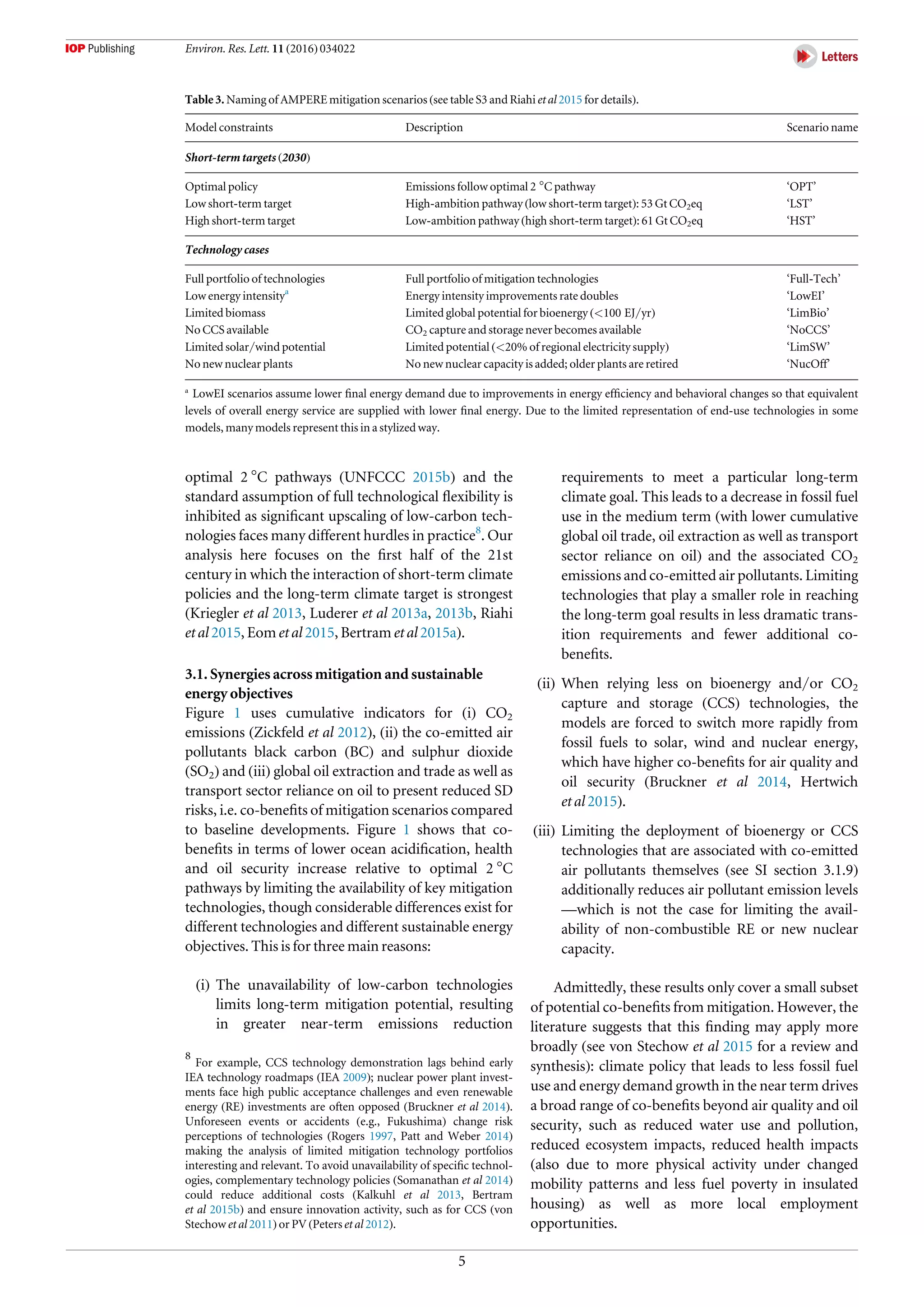
Table 3. Naming of AMPERE mitigation scenarios (see table S3 and Riahi et al 2015 for details).
Model constraints Description Scenario name
Short-term targets (2030)
Optimal policy Emissions follow optimal 2 °C pathway ‘OPT’
Low short-term target High-ambition pathway (low short-term target): 53 Gt CO2eq ‘LST’
High short-term target Low-ambition pathway (high short-term target): 61 Gt CO2eq ‘HST’
Technology cases
Full portfolio of technologies Full portfolio of mitigation technologies ‘Full-Tech’
Low energy intensitya
Energy intensity improvements rate doubles ‘LowEI’
Limited biomass Limited global potential for bioenergy (<100 EJ/yr) ‘LimBio’
No CCS available CO2 capture and storage never becomes available ‘NoCCS’
Limited solar/wind potential Limited potential (<20% of regional electricity supply) ‘LimSW’
No new nuclear plants No new nuclear capacity is added; older plants are retired ‘NucOff’
a
LowEI scenarios assume lower final energy demand due to improvements in energy efficiency and behavioral changes so that equivalent
levels of overall energy service are supplied with lower final energy. Due to the limited representation of end-use technologies in some
models, many models represent this in a stylized way.
8
For example, CCS technology demonstration lags behind early
IEA technology roadmaps (IEA 2009); nuclear power plant invest-
ments face high public acceptance challenges and even renewable
energy (RE) investments are often opposed (Bruckner et al 2014).
Unforeseen events or accidents (e.g., Fukushima) change risk
perceptions of technologies (Rogers 1997, Patt and Weber 2014)
making the analysis of limited mitigation technology portfolios
interesting and relevant. To avoid unavailability of specific technol-
ogies, complementary technology policies (Somanathan et al 2014)
could reduce additional costs (Kalkuhl et al 2013, Bertram
et al 2015b) and ensure innovation activity, such as for CCS (von
Stechow et al 2011) or PV (Peters et al 2012).
5
Environ. Res. Lett. 11 (2016) 034022
Comparing optimal 2 °C pathways with scenarios
assuming weak short-term climate policies confirms
the positive effect of stringent mitigation in the near
term on the magnitude of co-benefits (see figure S5 for
the year 2030): weak short-term climate policies imply
a reduction in co-benefits relative to those that could
materialize in optimal 2 °C pathways. This effect is,
however, not as obvious for cumulative 2050 values
(see figure 1) because some of the additional mitiga-
tion efforts in the period 2030–2050 partially compen-
sate for weak climate policies until 2030. Since the
transport sector is characterized by faster capital turn-
over rates (at least with regard to the vehicle fleet) (Ber-
tram et al 2015a), it can react more quickly to carbon
price changes, compensating for higher emissions
from sectors that are less flexible. This may lead, for
example, to a higher fuel diversity in the transport sec-
tor in the year 2050 in delayed mitigation scenarios
compared to optimal 2 °C pathways albeit at high
uncertainty.
3.2. Trade-offs between mitigation and sustainable
energy objectives
While constraining a particular mitigation technology
may minimize the mitigation risks specific to that
technology, it usually implies an increase in the
deployment of other low-carbon technologies, which
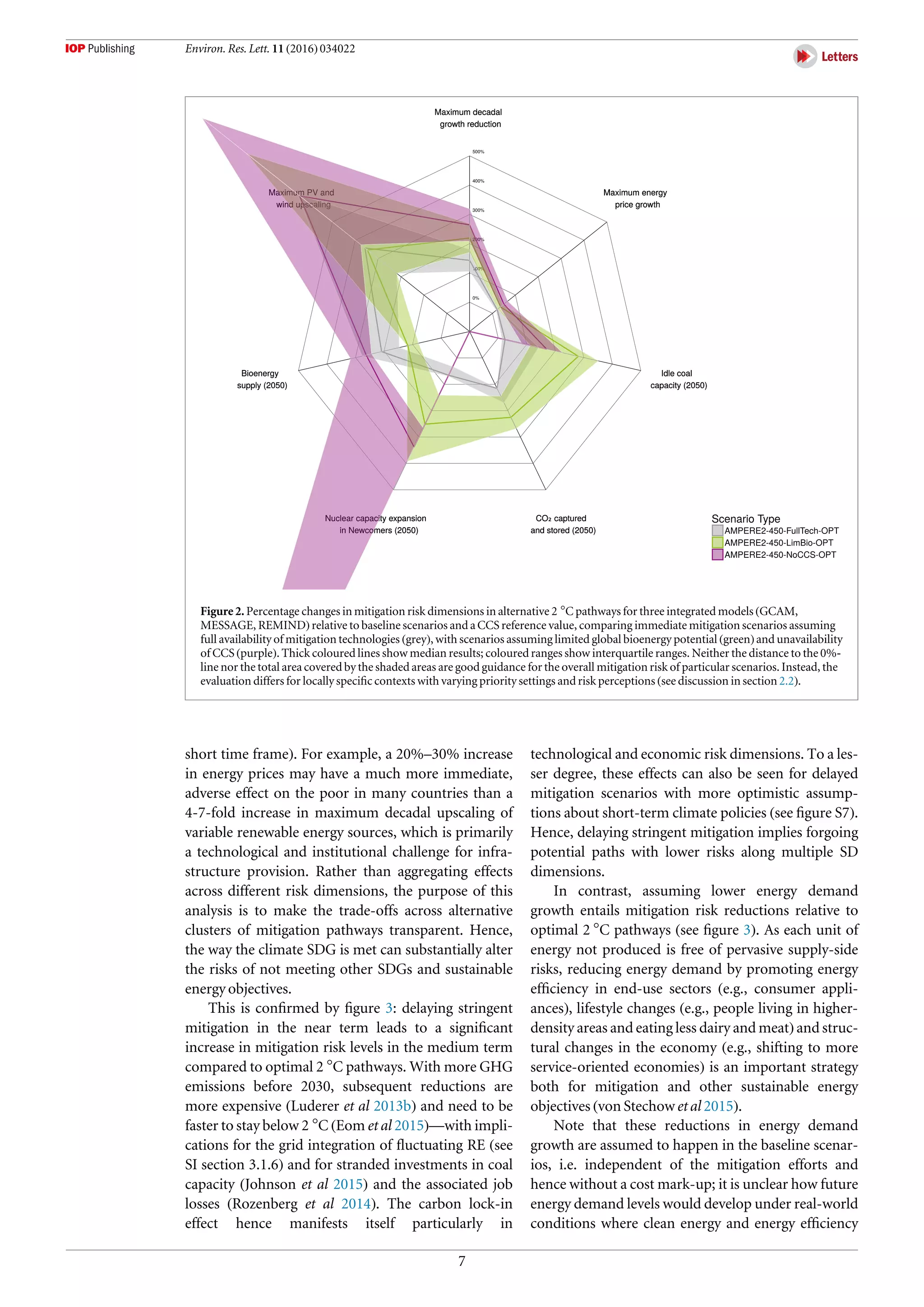
may incur other mitigation risks. Figure 2 shows that
limiting the availability of specific technologies in 2 °C
pathways with immediate global climate policies
substantially increases the risk of not meeting other
sustainable energy objectives. While the unavailability
of CCS and limitation of bioenergy potential lead to
the largest co-benefits (see figure 1), they also entail
significantly higher SD risks. This can be explained by
the promise of greater flexibility in near-term emission
pathways that are still able to meet the long-term
climate goal through the presence of carbon dioxide
removal technologies, such as bioenergy with CCS
(BECCS). Constraining BECCS deployment by limit-
ing the global bioenergy potential or ruling out CCS
deployment results in substantially higher deployment
of other mitigation technologies in the medium term.
The increase is much less pronounced for limiting the
potential for solar and wind energy or assuming no
new nuclear capacity (see figure S6).
Due to the different nature of the mitigation risks,
it is unclear how decreasing risks in one dimension
(e.g. bioenergy expansion or environmental risks asso-
ciated with CCS deployment), can be traded off with
risk increases in others (e.g. transitional growth reduc-
tion, energy price growth, nuclear proliferation or the
technological challenges of integrating high amounts
of fluctuating RE into existing power grids in a very
Figure 1. Percentage changes in indicators for co-benefits for reduced ocean acidification, air quality, oil security, and transport sector
fuel diversity in alternative 2 °C pathways for four integrated models (GCAM, MESSAGE, POLES, REMIND) relative to baseline
scenarios, comparing immediate mitigation scenarios assuming full availability of mitigation technologies (grey) with delayed
mitigation scenarios (pink) and immediate mitigation scenarios assuming no new nuclear capacity (red), limited potential for solar
and wind energy (yellow) limited global bioenergy potential (green) or unavailability of CCS (purple). The thick black lines show the
median of results, the coloured ranges show the interquartile ranges and whiskers show the minimum and maximum results.
6
Environ. Res. Lett. 11 (2016) 034022
short time frame). For example, a 20%–30% increase
in energy prices may have a much more immediate,
adverse effect on the poor in many countries than a
4-7-fold increase in maximum decadal upscaling of
variable renewable energy sources, which is primarily
a technological and institutional challenge for infra-
structure provision. Rather than aggregating effects
across different risk dimensions, the purpose of this
analysis is to make the trade-offs across alternative
clusters of mitigation pathways transparent. Hence,
the way the climate SDG is met can substantially alter
the risks of not meeting other SDGs and sustainable
energy objectives.
This is confirmed by figure 3: delaying stringent
mitigation in the near term leads to a significant
increase in mitigation risk levels in the medium term
compared to optimal 2 °C pathways. With more GHG
emissions before 2030, subsequent reductions are
more expensive (Luderer et al 2013b) and need to be
faster to stay below 2 °C (Eom et al 2015)—with impli-
cations for the grid integration of fluctuating RE (see
SI section 3.1.6) and for stranded investments in coal
capacity (Johnson et al 2015) and the associated job
losses (Rozenberg et al 2014). The carbon lock-in
effect hence manifests itself particularly in
technological and economic risk dimensions. To a les-
ser degree, these effects can also be seen for delayed
mitigation scenarios with more optimistic assump-
tions about short-term climate policies (see figure S7).
Hence, delaying stringent mitigation implies forgoing
potential paths with lower risks along multiple SD
dimensions.
In contrast, assuming lower energy demand
growth entails mitigation risk reductions relative to
optimal 2 °C pathways (see figure 3). As each unit of
energy not produced is free of pervasive supply-side
risks, reducing energy demand by promoting energy
efficiency in end-use sectors (e.g., consumer appli-
ances), lifestyle changes (e.g., people living in higher-
density areas and eating less dairy and meat) and struc-
tural changes in the economy (e.g., shifting to more
service-oriented economies) is an important strategy
both for mitigation and other sustainable energy
objectives (von Stechow et al 2015).
Note that these reductions in energy demand
growth are assumed to happen in the baseline scenar-
ios, i.e. independent of the mitigation efforts and
hence without a cost mark-up; it is unclear how future
energy demand levels would develop under real-world
conditions where clean energy and energy efficiency
Figure 2. Percentage changes in mitigation risk dimensions in alternative 2 °C pathways for three integrated models (GCAM,
MESSAGE, REMIND) relative to baseline scenarios and a CCS reference value, comparing immediate mitigation scenarios assuming
full availability of mitigation technologies (grey), with scenarios assuming limited global bioenergy potential (green) and unavailability
of CCS (purple). Thick coloured lines show median results; coloured ranges show interquartile ranges. Neither the distance to the 0%-
line nor the total area covered by the shaded areas are good guidance for the overall mitigation risk of particular scenarios. Instead, the
evaluation differs for locally specific contexts with varying priority settings and risk perceptions (see discussion in section 2.2).
7
Environ. Res. Lett. 11 (2016) 034022
projects may compete for limited funds (McCollum
et al 2013b). Furthermore, the models do not simply
prescribe lower energy supply at the expense of energy
service supply, but alter assumptions on the average
energy intensity improvement rates and, e.g., on the
viability of more compact, public transit-friendly
urban areas (Riahi et al 2015). This does not imply,
however, that all integrated models project final
energy supplies in mitigation scenarios that are con-
sistent with minimum thresholds of energy consump-
tion to satiate basic needs related to cooking, heating,
health and other infrastructure (Steckel et al 2013,
Lamb and Rao 2015). Hence, projections of energy
demand from individual models need to be inter-
preted with care (see discussion in SI section 2).
3.3. Trade-offs between mitigation and sustainable
energy objectives for combined model constraints
As current GHG emission trends keep tracking along
business-as-usual (Edenhofer et al 2014a) and societal
concerns grow with regard to upscaling of many low-
carbon technologies (see footnote 8), 2 °C pathways
with multiple constraints seem to mirror most
closely developments observed in the real world. In
fact, delaying stringent mitigation in combination
with technological constraints risks no longer meeting
the climate goal (Riahi et al 2015), substantially
increases mitigation risks (see figure 4) and increas-
ingly jeopardizes our ability to manage risk trade-offs.
For CCS and bioenergy whose unavailability/limita-
tions already show substantial risk trade-offs in
immediate mitigation scenarios, most models can no
longer find a solution (for CCS unavailability only
DNE21+ and GCAM; for limited global bioenergy
potential only GCAM, POLES, and REMIND) imply-
ing a high risk of not meeting the 2 °C target.
Figure 4 draws on AMPERE scenarios with multi-
ple constraints but shows results for more optimistic
—albeit not optimal — short-term climate policies9
,
with and without limited global bioenergy potential.
As models work close to their feasibility frontier, the
additional constraint results in large mitigation risk
increases. Even for non-biomass RE and nuclear
energy, whose limitation/phase-out has rather small
effects in immediate 2 °C pathways, risk trade-offs
Figure 3. Percentage changes in mitigation risk dimensions in alternative 2 °C pathways for six integrated models (DNE21+, GCAM,
MESSAGE, POLES, REMIND, WITCH) relative to baseline scenarios and a CCS reference value, comparing immediate (grey) with
delayed mitigation scenarios (pink) and immediate mitigation scenarios with lower energy demand growth (blue). Neither the
distance to the 0%-line nor the total area covered by the shaded areas are good guidance for the overall mitigation risk of particular
scenarios. Instead, the evaluation differs for locally specific contexts with varying priority settings and risk perceptions (see discussion
in section 2.2).
9
Figure 4 shows ‘LST’ scenarios (i.e. with more optimistic
assumptions about near-term climate policies relative to ‘HST’
scenarios but still less stringent than optimal, see table 1) because
only three models (GCAM, POLES, and REMIND) were able to find
a solution for the ‘HST-LimBio’ scenarios.
8
Environ. Res. Lett. 11 (2016) 034022
increase strongly for delayed mitigation scenarios in
some dimensions (see figures S7 and S8).
4. Discussion
This letter presents a first attempt to shed light on the
question of how alternative 2 °C pathways perform in
non-climate SD dimensions and to draw conclusions
about important interactions between stringent miti-
gationandothersustainableenergyobjectives.Figure5
shows an overview of the different clusters of con-
strained 2 °C pathways relative to (each model’s)
optimal pathways (i.e., those with immediate mitiga-
tion, full technology portfolios, and conventional
energy demand growth). We use ‘optimal’ scenarios as
benchmarks because they show comparatively
balanced risk profiles relative to baseline develop-
ments (see figures 2–4) and because they are com-
monly used as reference point for policy analysis, e.g.
inthe WGIIIAR5 (Edenhofer et al 2014a). This enables
the comparison of the various SD implications of one
cluster of 2 °C pathways to those of all others and
therefore facilitates an informed public debate on
socially acceptable SD risks and thus the interaction
between the international climate policy and the
broader SDG agendas.
Note that ‘optimal’ pathways are not necessarily
the most socially desirable because they may already
involve unacceptable risks. Scientific analysis alone
cannot judge whether a particular 2 °C pathway poses
acceptable or unacceptable risks to society (Edenhofer
and Minx 2014). Science can, however, explore alter-
native mitigation pathways and inform an enlightened
public debate across SD risk dimensions in an iterative
learning process (Edenhofer and Kowarsch 2015). For
example, annual bioenergy supply is projected to
reach up to 168 EJ (median: 158 EJ) in 2050 in optimal
scenarios. These levels of biomass extraction may
already be associated with fundamental challenges
with respect to food security, place-specific liveli-
hoods, water availability and biodiversity (Creutzig
et al 2012, Smith et al 2014). These numbers further
increase substantially over the second half of the cen-
tury, reaching up to 862 EJ (median: 268 EJ) with
growing requirements for removing CO2 from the
atmosphere via bioenergy with CCS (BECCS) technol-
ogies in many available scenarios (Clarke et al 2014).
Many ‘optimal’ 2 °C pathways have therefore been
Figure 4. Percentage changes in mitigation risk dimensions in alternative 2 °C pathways for four integrated models (GCAM,
MESSAGE, POLES, REMIND) relative to baseline scenarios and a CCS reference value, comparing delayed mitigation scenarios
assuming full availability of mitigation technologies and weak short-term climate policies (purple) with delayed mitigation scenarios
assuming limited global availability of bioenergy (green). Neither the distance to the 0%-line nor the total area covered by the shaded
areas are good guidance for the overall mitigation risk of particular scenarios. Instead, the evaluation differs for locally specific contexts
with varying priority settings and risk perceptions (see discussion in section 2.2).
9
Environ. Res. Lett. 11 (2016) 034022
challenged on these grounds (Fuss et al 2014, Smith
et al 2016).
In a world which is increasingly unlikely to
develop along ‘optimal’ scenario trajectories, an
informed public debate about synergies and risk trade-
offs implied by alternative clusters of constrained 2 °C
pathways is key for identifying those which are socially
acceptable. For example, current INDCs at best add up
to emission trajectories similar to those 2 °C pathways
with low short-term ambition (‘LST’ scenarios, see
table 3)10
. According to figure 5, these pathways (pre-
sented as circles) not only lead to fewer co-benefits
compared to optimal 2 °C pathways (except for cumu-
lative BC emissions and transport sector oil reliance)
but also to significantly higher mitigation risk levels,
particularly in socioeconomic dimensions—with
higher risks of not meeting those SDGs related to eco-
nomic growth, energy access, job preservation, food
security and resilient grid infrastructure (see also
figure S7).
When a technology constraint is added, only the
risks specific to that technology can be lowered (e.g.
reduced nuclear proliferation risks for scenarios with
no new nuclear capacity or fewer grid integration chal-
lenges for scenarios with limited potential for solar
and wind energy, see also figures S8 and S9). The other
risk levels are exacerbated, particularly for those SDGs
Figure 5. Percentage changes in SD risk dimensions that can be linked to a set of SDGs and other sustainable energy objectives in
constrained 2 °C pathways relative to optimal pathways (assuming immediate mitigation with full availability of mitigation
technologies and conventional energy demand growth). The different shapes denote different short-term climate policy stringencies
while the different colours denote different technology cases (see table 3). As the figure aims at showing trends in synergies and risk
trade-offs of alternative clusters of 2 °C pathways rather than an exact quantitative analysis, results are plotted in logarithmic scale (see
table S4 for the underlying data).
10
See http://infographics.pbl.nl/indc and http://climateaction
tracker.org/global.
10
Environ. Res. Lett. 11 (2016) 034022
that relate to economic growth, job preservation, resi-
lient infrastructure, and ocean acidification. This is
particularly obvious for scenarios with limited global
potential of bioenergy in which the risks related to
bioenergy expansion are lower (including environ-
mental effects related to BECCS deployment) but the
risks of not meeting socioeconomic SDGs are sig-
nificantly higher (see green circles in figure 5). Limit-
ing the global use of bioenergy to 100 EJ per year by
2050—widely believed to be more sustainable (Creut-
zig et al 2014)—hence introduces a trade-off with
socioeconomic objectives for weak short-term climate
policies (see green circles in figure 5).
While there are uncertainties around acceptable
levels of bioenergy deployment, the development and
deployment of CCS technology is lagging behind
expectations (IEA 2009), despite its important role in
keeping mitigation costs at relatively low levels (Eden-
hofer et al 2014a). Our results highlight two things:
first, those models that are flexible enough to compen-
sate for the unavailability of CCS can only do so with
increased upscaling requirements for other low-car-
bon technologies and related SD risks (see pink circles
in figure 5). This also implies high near-term mitiga-
tion requirements with associated co-benefits. Sec-
ond, the absence of CCS seriously questions the
achievability of the 2 °C target in a world with delayed
climate action and therefore threatens the climate
SDG itself—only two models can report results for the
combination with weak short-term climate policies.
In contrast, 2 °C pathways with lower energy
demand growth generally entail a substantial reduc-
tion in SD risk levels (blue shapes in figure 5). This
confirms results from a bottom-up assessment of the
wider SD implications of technology-specific studies
from a cross-sectoral perspective (von Stechow
et al 2015). While these scenarios typically do not fea-
ture many additional co-benefits due to lower supply-
side transition requirements, achieving lower energy
demand growth has considerable synergies with the
SDG agenda related to economic growth, food secur-
ity, resilient grid infrastructure as well as with the
peaceful use of nuclear energy. Delaying mitigation in
scenarios with low energy demand growth only entails
moderate risk increases—although some co-benefits
are reduced and more coal capacity is likely to be
retired early. Pursuing aggressive energy efficiency
improvements across all sectors and rethinking high-
energy lifestyles therefore seems essential to increase
synergies and keep the trade-offs across SDGs man-
ageable in a world that is characterized by multiple
constraints. Unfortunately, model inter-comparison
projects have not yet analyzed the combination of
technology constraints and low energy demand
growth pathways, which is a promising research area
to better understand synergies between SDGs. Future
research should also ensure that mitigation scenarios
are consistent with minimum thresholds of energy
demand necessary to satiate basic human needs (see
discussion in SI section 2).
This letter has analyzed the changes in SD risks
across alternative 2 °C pathways. These effects depend
to a great extent on the development context, i.e.,
assumptions about baseline developments (Moss
et al 2010, O’Neill et al 2014). To circumvent this
potential caveat, the analysis used AMPERE data that
stands out in its comprehensive effort to harmonize
future socio-economic drivers of SD across models in
the baseline scenarios: e.g., regional-level gross
domestic product (GDP), population, and energy
demand growth. This makes the results more compar-
able across models but begs the question of how the
results would have changed for alternative assump-
tions beyond changes in energy demand growth.
Research can and should build on alternative baseline
developments as expressed by the ‘shared socio-
economic pathways’ (O’Neill et al 2014) that will soon
be published even though important, non-trivial dis-
cussions remain on how SDGs can be adequately built
into these baselines (O’Neill et al 2015).
Indicators that were used to track the changes in
SD risks are only rough and sometimes very rough
approximations of individual SDGs. There is no doubt
that individual models—particularly those coupled to
a detailed agro-economic and land-use model—could
already provide better indicators, such as for water
availability and ecosystem impacts which are impor-
tant concerns in stringent mitigation pathways (see SI
section 3.1.1). However, these have not yet been ana-
lyzed in a multi-model study (von Stechow et al 2015).
We believe that such inter-model comparison results
are crucial for a meaningful public debate about SD
risks.
Another important caveat of the analysis is that we
focus on 2050 and the preceding decades when look-
ing at the implications of alternative 2 °C pathways for
SD risk dimensions. The risks of some 2 °C pathways,
however, only unfold later in that century when some
particularly risky negative emissions technologies,
such as BECCS, are being deployed at large scale to
compensate for lower mitigation efforts in the first
decades and residual GHG emissions in other sectors
(Fuss et al 2014, Smith et al 2016). For illustrative pur-
poses, figures S10 and S11 show how mitigation risks
change from 2050 to 2080 for scenarios with sub-
stantially different amounts of negative emission
requirements. Since the AMPERE scenario specifica-
tions do not allow for a meaningful comparison across
scenarios with low or high amounts of negative emis-
sions, we use the amount of radiative forcing over-
shoot to cluster scenarios with respect to their
dependence on negative emissions (also used in the
WGIII AR5 scenario database, see Krey et al 2014). It
shows that the magnitude of the mitigation risk levels
can change substantially over time for those dimen-
sions that are related to negative emission technologies
such as CCS and bioenergy deployment.
11
Environ. Res. Lett. 11 (2016) 034022
Our analysis points to important future chal-
lenges: first, the chosen indicators do not represent all
SDGs as some touch on socio-cultural and institu-
tional aspects which are challenging—if not impos-
sible—to represent in an economic model framework
(see SI section 2). Second, the changes in the indicators
across scenarios are merely indicative for the change in
risks to meet the related SDGs and sustainable energy
objectives because there are many more relevant dri-
vers that cannot be analyzed based on the available sce-
nario data. Third, many relevant issues play out at
lower geographic and time scales which are difficult to
represent adequately in global-scale integrated mod-
els. For example, food security is driven by many
socioeconomic drivers both on global and local scales
and bioenergy expansion represents but one of those
(Tscharntke et al 2012). And according to Creutzig
et al (2012), the models are not (yet) suitable for oper-
ationalizing important global SD dimensions of bioe-
nergy supply such as the socioeconomic convergence
across different countries. Nevertheless, we argue that
the indicators used in this letter are relevant for evalu-
ating additional pressure on the energy-economy-cli-
mate system from additional constraints as
represented in the models. As such, they supply
important information from internally consistent
model frameworks taking into account inter-sectoral
and inter-regional interactions (von Stechow
et al 2015 and SI section 1).
We provide this early contribution to a public
debate on the relationship between the international
climate policy and the SDG agendas based on existing
multi-model scenario data that was not specifically
developed for this particular purpose. This stimulus
seems important because results from model inter-
comparisons that are tailored towards the SDG-cli-
mate nexus will not be published for some years. Only
by working with the available data can we start discuss-
ing relevant (risk) trade-offs and synergies. Based on
our analysis, we argue that SD considerations are cen-
tral for determining socially acceptable climate poli-
cies and that the prospects of meeting other SDGs
need not dwindle and can even be enhanced for some
goals if appropriate climate policy choices are made.
Moreover, experiences and caveats of this analysis can
help guide future research efforts at a relevant moment
in time when new model comparison exercises are
being designed. For example, to remain policy-rele-
vant, SDG-focused multi-model comparisons will
need to address inequality, poverty, and basic human
needs as major drivers of the policy process much
more adequately. This requires a serious discussion,
e.g., on how to deal with the coarse regional dis-
aggregation in the integrated modelling frameworks.
Equally, successful efforts to address SDG-relevant
issues in one model, e.g., for the analysis of water avail-
ability or ecosystem impacts (see SI section 2), will
need to be lifted into a multi-model context.
5. Conclusion
Until now, no multi-model study has been used to
systematically analyze the changes in SD risks implied
by stringent mitigation scenarios and evaluate them
across a set of SDGs. This letter addresses this research
gap by analyzing a comprehensive set of alternative
clusters of 2 °C pathways consistently formulated
across many integrated models from the AMPERE
model inter-comparison study, drawing on publicly
available scenario results to calculate indicators for
global SD risks. We shed light on the implications of
alternative clusters of 2 °C pathways for meeting a set
of energy-related SDGs and other sustainable energy
objectives and to inform the public debate about the
synergies and trade-offs across the international cli-
mate policy and the SDG agendas.
Our analysis shows that the near-term choice of
2 °C pathways has implications for the extent of syner-
gies and trade-offs across energy-related SDGs in the
medium term. Given current trends in emissions and
technology deployment, we argue that mitigation
pathways are likely to be characterized by multiple
constraints. But adding limits on the availability of
specific mitigation technologies on top of weak short-
term climate policies decreases synergies and locks in
substantial trade-offs across environmental and socio-
economic objectives. From an SDG perspective, the
challenges of meeting other sustainable energy objec-
tives substantially change with the way the climate
SDG will be met. In some cases, meeting the 2 °C tar-
get is even threatened itself. Achieving low-energy
demand growth, e.g., through aggressive energy effi-
ciency improvements, helps to manage these trade-
offs and attain multiple energy-related SDGs together.
We find the greater the constraints on flexibility in
meeting the 2 °C target, the higher the risks of not
meeting other SDGs and the flexibility to manage
these risks. Governments at all levels need to be
informed about such implications of their collective
decision for the attainability of global SDGs. This
could avoid additional pressures on the sustainability
of each region’s development pathway.
After COP21, decision makers need to rethink
their commitment to the SDG agenda, given that the
short-term ambition for mitigation action falls short
of the mitigation efforts consistent with staying below
2 °C in a cost-effective way. According to our results,
this is likely to decrease co-benefits and increase the
risks for attaining energy-related SDGs and other sus-
tainable energy objectives. Since many of these SD
risks are best dealt with at the global level, however,
they might be good entry points into additional incen-
tives for international cooperation. We suggest that
the review of INDCs should provide for an assessment
of policies at all scales to monitor global risks for non-
climate sustainability objectives that arise from spe-
cific global mitigation pathways. Monitoring these
risks could avoid unintended consequences (which
12
Environ. Res. Lett. 11 (2016) 034022
might even delegitimize the 2 °C target), finding new
entry points for global cooperation and providing
rationales for ramping up mitigation ambition in the
short to medium term.
Future research should extend the current system
boundaries and, based on a comprehensive review of
model literature on the climate-SDG nexus, establish
indicators that help evaluate integrated policies
addressing multiple SDGs in a unified framework.
This would be a prerequisite for model inter-compar-
ison projects with a focus on the interactions across
multiple SDGs that could result in meaningful and
robust results for better decision making. Climate pol-
icy will not be successful unless it seriously considers
other policy objectives and therefore wider SD impli-
cations. Dividing the huge effort of achieving more
sustainable development pathways into isolated policy
problems will fall short of reaping synergies and suc-
cessfully managing trade-offs across the many SDGs.
Acknowledgments
We are grateful to Ad-Willem Dashorst, Michael
Jakob, Jan C Steckel, Nils Johnson, and Felix Creutzig
for helpful comments on earlier versions of this
manuscript. We acknowledge the work by integrated
model teams that contributed to the AMPERE sce-
nario database and thank IIASA for hosting the
AMPERE scenario database. The AMPERE scenario
work received funding from the European Union’s
Seventh Framework Programme (FP7/2007–2014)
under grant agreement No. 265 139 (AMPERE). The
research leading to this publication was supported by
the German Federal Environment Agency (UBA)
under UFOPLAN FKZ 3714 411 670 as well as the
European Union’s Horizon 2020 research and innova-
tion programme under grant agreement No. 642 147
(CD-LINKS).
References
Aboumahboub T, Luderer G, Kriegler E, Leimbach M, Bauer N,
Pehl M and Baumstark L 2014 On the regional distribution of
climate mitigation costs: the impact of delayed cooperative
action Clim. Change Econ. 05 1440002
Arnell N W, van Vuuren D P and Isaac M 2011 The implications of
climate policy for the impacts of climate change on global
water resources Global Environmental Change 21 592–603
Bauer N, Mouratiadou I, Luderer G, Baumstark L, Brecha R J,
Edenhofer O and Kriegler E 2013 Global fossil energy markets
and climate change mitigation—an analysis with REMIND
Clim. Change 1–14
Bertram C, Johnson N, Luderer G, Riahi K, Isaac M and Eom J 2015a
Carbon lock-in through capital stock inertia associated with
weak near-term climate policies Technol. Forecast. Soc.
Change A 90 62–72
Bertram C, Luderer G, Pietzcker R C, Schmid E, Kriegler E and
Edenhofer O 2015b Complementing carbon prices with
technology policies to keep climate targets within reach Nat.
Clim. Change 5 235–9
Bonsch M et al 2016 Trade-offs between land and water
requirements for large-scale bioenergy production Glob.
Change Biol. Bioenergy 8 11–24
von Braun J et al 2008 High Food Prices: The What, Who, and How of
Proposed Policy Actions (Washington, DC: International Food
Policy Research Institute)
Bruckner T et al 2014 Energy systems Climate Change 2014:
Mitigation of Climate Change. Contribution of Working Group
III to the Fifth Assessment Report of the Intergovernmental
Panel on Climate Change ed O R Edenhofer et al (Cambridge:
Cambridge University Press) pp 511–97
Calvin K, Wise M, Kyle P, Patel P, Clarke L and Edmonds J 2014
Trade-offs of different land and bioenergy policies on the
path to achieving climate targets Clim. Change 123 691–704
Cherp A, Jewell J, Vinichenko V, Bauer N and Cian E D 2013 Global
energy security under different climate policies, GDP growth
rates and fossil resource availabilities Clim. Change 1–12
Clarke L et al 2014 Assessing transformation pathways Climate
Change 2014: Mitigation of Climate Change. Contribution of
Working Group III to the Fifth Assessment Report of the
Intergovernmental Panel on Climate Change ed O R Edenhofer
et al (Cambridge: Cambridge University Press) pp 413–506
Creutzig F et al 2014 Bioenergy and climate change mitigation: an
assessment GCB Bioenergy 7 916–44
Creutzig F, von Stechow C, Klein D, Hunsberger C, Bauer N,
Popp A and Edenhofer O 2012 Can bioenergy assessments
deliver? Economics of Energy & Environmental Policy 1 65–82
Daioglou V, van Ruijven B J and van Vuuren D P 2012 Model
projections for household energy use in developing countries
Energy 37 601–15
De Fraiture C, Giordano M and Liao Y 2008 Biofuels and
implications for agricultural water use: blue impacts of green
energy Water Policy 10 67–81
den Elzen M G J, Lucas P L and van Vuuren D P 2008 Regional
abatement action and costs under allocation schemes for
emission allowances for achieving low CO2-equivalent
concentrations Clim. Change 90 243–68
Drouet L, Bosetti V and Tavoni M 2015 Selection of climate policies
under the uncertainties in the fifth assessment report of the
IPCC Nat. Clim. Change 5 937–40
Edenhofer O and Kowarsch M 2015 Cartography of pathways: a new
model for environmental policy assessments Environ. Sci.
Policy 51 56–64
Edenhofer O and Minx J 2014 Mapmakers and navigators, facts and
values Science 345 37–8
Edenhofer O et al 2014a Technical summary Climate Change 2014:
Mitigation of Climate Change. Contribution of Working Group
III to the Fifth Assessment Report of the Intergovernmental
Panel on Climate Change ed O R Edenhofer et al (Cambridge:
Cambridge University Press) pp 31–107
Edenhofer O, Kadner S, von Stechow C, Schwerhoff G and
Luderer G 2014b Linking climate change mitigation research
to sustainable development Handbook of Sustainable
Development 2nd edn ed G Atkinson, S Dietz,
E Neumayer and M Agarwala (Cheltenham, UK: Edward
Elgar) pp 476–99
Eom J, Edmonds J, Krey V, Johnson N, Longden T, Luderer G,
Riahi K and Van Vuuren D P 2015 The impact of near-term
climate policy choices on technology and emission transition
pathways Technological Forecasting and Social Change 90
73–88
Fleurbaey M et al 2014 Sustainable development and equity Climate
Change 2014: Mitigation of Climate Change. Contribution of
Working Group III to the Fifth Assessment Report of the
Intergovernmental Panel on Climate Change ed O R Edenhofer
et al (Cambridge: Cambridge University Press) pp 283–350
Fuss S et al 2014 Betting on negative emissions Nature Clim. Change
4 850–3
Griggs D, Stafford-Smith M, Gaffney O, Rockström J, Öhman M C,
Shyamsundar P, Steffen W, Glaser G, Kanie N and Noble I
13
Environ. Res. Lett. 11 (2016) 034022
2013 Policy: sustainable development goals for people and
planet Nature 495 305–7
Hejazi M I, Edmonds J, Clarke L, Kyle P, Davies E, Chaturvedi V,
Eom J, Wise M, Patel P and Calvin K 2013 Integrated
assessment of global water scarcity over the 21st century: 2.
Climate change mitigation policies Hydrology and Earth
System Sciences Discussions 10 3383–425
Hertwich E G, Gibon T, Bouman E A, Arvesen A, Suh S, Heath G A,
Bergesen J D, Ramirez A, Vega M I and Shi L 2015 Integrated
life-cycle assessment of electricity-supply scenarios confirms
global environmental benefit of low-carbon technologies
Proc. Natl Acad. Sci. USA 112 6260–4
IEA 2009 Technology Roadmap: Carbon Capture and Storage (Paris,
France: Organisation for Economic Co-operation and
Development/International Energy Agency (IEA)) (https://
iea.org/publications/freepublications/publication/
technology-roadmap-carbon-capture-and-storage-
2009.html)
Jakob M and Edenhofer O 2014 Green growth, degrowth, and the
commons Oxford Review of Economic Policy 30 447–68
Jewell J, Cherp A and Riahi K 2014 Energy security under de-
carbonization scenarios: an assessment framework and
evaluation under different technology and policy choices
Energy Policy 65 743–60
Jewell J, Cherp A, Vinichenko V, Bauer N, Kober T, McCollum D L,
van Vuuren D P and van der Zwaan B 2013 Energy security of
China, India, the EU and the US under long-term scenarios:
results from six IAMs Clim. Change Econ. 4 1340011
Johnson N, Krey V, McCollum D L, Rao S, Riahi K and Rogelj J 2015
Stranded on a low-carbon planet: implications of climate
policy for the phase-out of coal-based power plants Technol.
Forecast. Soc. Change A 90 89–102
Joos F, Fröhlicher T L, Steinacher M and Plattner G-K 2011 Impact
of climate change mitigation on ocean acidification
projections Ocean Acidification ed J-P Gattuso and L Hansson
(Oxford: Oxford University Press) pp 272–90
Kalkuhl M, Edenhofer O and Lessmann K 2013 Renewable energy
subsidies: Second-best policy or fatal aberration for
mitigation? Resour. Energy Econ. 35 217–34
Kim S H, Wada K, Kurosawa A and Roberts M 2014 Nuclear energy
response in the EMF27 study Clim. Change 123 443–60
Krey V et al 2014 Annex II: metrics & methodology Climate Change
2014: Mitigation of Climate Change. Contribution of Working
Group III to the Fifth Assessment Report of the
Intergovernmental Panel on Climate Change ed O R Edenhofer
et al (Cambridge: Cambridge University Press) pp
1281–328
Krey V, O’Neill B C, van Ruijven B, Chaturvedi V, Daioglou V,
Eom J, Jiang L, Nagai Y, Pachauri S and Ren X 2012 Urban
and rural energy use and carbon dioxide emissions in Asia
Energy Economics 34 S272–83
Kriegler E et al 2015 Making or breaking climate targets: the
AMPERE study on staged accession scenarios for climate
policy Technol. Forecast. Soc. Change A 90 24–44
Kriegler E et al 2013 What does the 2 °C target imply for a global
climate agreement in 2020? The limits study on Durban
Platform scenarios Clim. Change Econ. 04 1340008
Kriegler E et al 2014 The role of technology for achieving climate
policy objectives: overview of the EMF 27 study on global
technology and climate policy strategies Clim. Change 123
353–67
Kunreuther H et al 2014 Integrated risk and uncertainty assessment
of climate change response policies Climate Change 2014:
Mitigation of Climate Change. Contribution of Working Group
III to the Fifth Assessment Report of the Intergovernmental
Panel on Climate Change ed O R Edenhofer et al (Cambridge:
Cambridge University Press) pp 151–205
Kunreuther H, Heal G, Allen M, Edenhofer O, Field C B and Yohe G
2013 Risk management and climate change Nature Clim.
Change 3 447–50
Lamb W F and Rao N D 2015 Human development in a climate-
constrained world: what the past says about the future Glob.
Environ. Change 33 14–22
Lehtveer M and Hedenus F 2015 Nuclear power as a climate
mitigation strategy—technology and proliferation risk J. Risk
Res. 18 273–90
Lotze-Campen H et al 2014 Impacts of increased bioenergy demand
on global food markets: an AgMIP economic model
intercomparison Agricultural Economics 45 103–16
Luderer G, Bertram C, Calvin K, Cian E D and Kriegler E 2013a
Implications of weak near-term climate policies on long-term
mitigation pathways Clim. Change 1–14
LudererG,De CianE,Hourcade J-C,Leimbach M,Waisman H and
EdenhoferO 2012Onthe regionaldistributionofmitigation
costs inaglobalcap-and-trade regimeClim.Change 114 59–78
Luderer G, Pietzcker R C, Bertram C, Kriegler E,
Meinshausen M and Edenhofer O 2013b Economic
mitigation challenges: How further delay closes the door for
achieving climate targets Environ. Res. Lett. 8 034033
McCollum D, Bauer N, Calvin K, Kitous A and Riahi K 2014 Fossil
resource and energy security dynamics in conventional and
carbon-constrained worlds Clim. Change 123 413–26
McCollum D L, Krey V, Riahi K, Kolp P, Grubler A,
Makowski M and Nakicenovic N 2013a Climate policies can
help resolve energy security and air pollution challenges Clim.
Change 119 479–94
McCollum D, Nagai Y, Riahi K, Marangoni G, Calvin K, Pietzcker R,
van Vliet J and van der Zwaan B 2013b Energy investments
under climate policy: a comparison of global models Clim.
Change Econ. 04 1340010
Moss R H et al 2010 The next generation of scenarios for climate
change research and assessment Nature 463 747–56
O’Neill B C, Kriegler E, Riahi K, Ebi K L, Hallegatte S, Carter T R,
Mathur R and van Vuuren D P 2014 A new scenario
framework for climate change research: the concept of shared
socioeconomic pathways Clim. Change 122 387–400
O’Neill B C et al 2015 The roads ahead: narratives for shared
socioeconomic pathways describing world futures in the 21st
century Glob. Environ. Change (doi:10.1016/j.
gloenvcha.2015.01.004)
Pachauri S, Ruijven B J van, Nagai Y, Riahi K, Vuuren D P van,
Brew-Hammond A and Nakicenovic N 2013 Pathways to
achieve universal household access to modern energy by 2030
Environ. Res. Lett. 8 024015
Paltsev S and Capros P 2013 Cost concepts for climate change
mitigation Clim. Change Econ. 04 1340003
Patt A G and Weber E U 2014 Perceptions and communication
strategies for the many uncertainties relevant for climate
policy WIREs Clim Change 5 219–32
PBL 2012 Roads from Rio+20 Pathways to achieve global
sustainability goals by 2050 (The Hague, The Netherlands:
Netherlands 3 Environmental Assessment Agency (PBL))
(http://pbl.nl/en/publications/2012/roads-from-rio20)
Peters M, Schneider M, Griesshaber T and Hoffmann V H 2012 The
impact of technology-push and demand-pull policies on
technical change—does the locus of policies matter? Research
Policy 41 1296–308
Popp A et al 2014 Land-use transition for bioenergy and climate
stabilization: model comparison of drivers, impacts and
interactions with other land use based mitigation options
Clim. Change 123 495–509
Reilly J, Melillo J, Cai Y, Kicklighter D, Gurgel A, Paltsev S,
Cronin T, Sokolov A and Schlosser A 2012 Using land to
mitigate climate change: hitting the target, recognizing the
trade-offs Environ. Sci. Technol. 46 5672–9
Riahi K et al 2015 Locked into Copenhagen pledges—implications
of short-term emission targets for the cost and feasibility of
long-term climate goals Technol. Forecast. Soc. Change A 90
8–23
Riahi K et al 2012 Energy pathways for sustainable development
Global Energy Assessment—Toward a Sustainable Future
(Cambridge: Cambridge University Press, and Laxenburg,
Austria: International Institute for Applied Systems Analysis)
ch 17, pp 1203–306 (www.globalenergyassessment.org)
Rogelj J, Luderer G, Pietzcker R C, Kriegler E, Schaeffer M,
Krey V and Riahi K 2015 Energy system transformations for
14
Environ. Res. Lett. 11 (2016) 034022
limiting end-of-century warming to below 1.5 °C Nature
Clim. Change 5 519–27
Rogelj J, McCollum D L, O’Neill B C and Riahi K 2013a 2020
emissions levels required to limit warming to below 2 °C
Nature Clim. Change 3 405–12
Rogelj J, McCollum D L, Reisinger A, Meinshausen M and Riahi K
2013b Probabilistic cost estimates for climate change
mitigation Nature 493 79–83
Rogelj J, Schaeffer M, Meinshausen M, Shindell D T, Hare W,
Klimont Z, Velders G J M, Amann M and Schellnhuber H J
2014 Disentangling the effects of CO2 and short-lived climate
forcer mitigation Proc. Natl Acad. Sci. USA 111 16325–30
Rogers G O 1997 The dynamics of risk perception: how does
perceived risk respond to risk events? Risk Anal. 17 745–57
Rogner H-H et al 2012 Energy Resources and Potentials Global Energy
Assessment—Toward a Sustainable Future (Cambridge:
Cambridge University Press, and Laxenburg, Austria:
International Institute for Applied Systems) ch 7, pp 423–512
(www.globalenergyassessment.org)
Rose S K, Richels R, Smith S, Riahi K, Strefler J and van Vuuren D P
2014 Non-Kyoto radiative forcing in long-run greenhouse
gas emissions and climate change scenarios Clim. Change 123
511–25
Rozenberg J, Vogt-Schilb A and Hallegatte S 2014 Transition to
clean capital, irreversible investment and stranded assets
World Bank Policy Research Working Paper 6859 (http://
papers.ssrn.com/abstract=2 433 812)
van Ruijven B J, Schers J and van Vuuren D P 2012 Model-based
scenarios for rural electrification in developing countries
Energy 38 386–97
Sathaye J et al 2011 Renewable energy in the context of sustainable
development IPCC Special Report on Renewable Energy
Sources and Climate Change Mitigation ed O R Edenhofer et al
(Cambridge: Cambridge University Press) pp 707–89
Slovic P 1987 Perception of risk Science 236 280–5
van Sluisveld M A E, Harmsen J H M, Bauer N, McCollum D L,
Riahi K, Tavoni M, Vuuren D P, van, Wilson C and
Zwaan B van der 2015 Comparing future patterns of energy
system change in 2 °C scenarios with historically observed
rates of change Global Environmental Change 35 436–49
Smith P et al 2014 Agriculture, forestry and other land use (AFOLU)
Climate Change 2014: Mitigation of Climate Change.
Contribution of Working Group III to the Fifth Assessment
Report of the Intergovernmental Panel on Climate Change ed
O R Edenhofer et al (Cambridge: Cambridge University
Press) pp 811–922
Smith P et al 2016 Biophysical and economic limits to negative CO2
emissions Nature Clim. Change 6 42–50
Somanathan E et al 2014 National and sub-national policies and
institutions Climate Change 2014: Mitigation of Climate
Change. Contribution of Working Group III to the Fifth
Assessment Report of the Intergovernmental Panel on Climate
Change ed O R Edenhofer et al (Cambridge: Cambridge
University Press) pp 1141–205
von Stechow C et al 2015 Integrating global climate change
mitigation goals with other sustainability objectives: a
synthesis Ann. Rev. Environ. Res. 40 363–94
von Stechow C, Watson J and Praetorius B 2011 Policy incentives
for carbon capture and storage technologies in Europe: a
qualitative multi-criteria analysis Glob. Environ. Change 21
346–57
Steckel J C, Brecha R J, Jakob M, Strefler J and Luderer G 2013
Development without energy? Assessing future scenarios of
energy consumption in developing countries Ecological
Economics 90 53–67
Strefler J, Luderer G, Kriegler E and Meinshausen M 2014 Can air
pollutant controls change global warming? Environ. Sci.
Policy 41 33–43
Tavoni M et al 2013 The distribution of the major economies’ effort
in the Durban Platform scenarios Clim. Change Econ. 04
1340009
Tavoni M et al 2015 Post-2020 climate agreements in the major
economies assessed in the light of global models Nature Clim.
Change 5 119–26
Tscharntke T, Clough Y, Wanger T C, Jackson L, Motzke I,
Perfecto I, Vandermeer J and Whitbread A 2012 Global food
security, biodiversity conservation and the future of
agricultural intensification Biological Conservation 151 53–9
UNFCCC 2015a Adoption of the Paris Agreement Proposal by the
President (Paris: United Nations Framework Convention on
Climate Change (UNFCCC)) (http://unfccc.int/
documentation/documents/advanced_search/items/6911.
php?priref=600008831)
UNFCCC 2015b Synthesis report on the aggregate effect of the
intended nationally determined contributions. Note by the
secretariat. Report of the Ad Hoc Working Group on the
Durban Platform for Enhanced Action (Paris: United Nations
Framework Convention on Climate Change (UNFCCC))
(http://unfccc.int/resource/docs/2015/cop21/eng/
07.pdf)
van Vuuren D P et al 2015 Pathways to achieve a set of ambitious
global sustainability objectives by 2050: explorations using
the IMAGE integrated assessment model Technol. Forecast.
Soc. Change 98 303–23
Wilson C, Grubler A, Bauer N, Krey V and Riahi K 2013
Future capacity growth of energy technologies: are
scenarios consistent with historical evidence? Clim. Change
118 381–95
Wise M, Calvin K, Thomson A, Clarke L, Bond-Lamberty B,
Sands R, Smith S J, Janetos A and Edmonds J 2009
Implications of limiting CO2 concentrations for land use and
energy Science 324 1183–6
Wise M, Dooley J, Luckow P, Calvin K and Kyle P 2014
Agriculture, land use, energy and carbon emission impacts of
global biofuel mandates to mid-century Appl. Energy 114
763–73
Zickfeld K, Arora V K and Gillett N P 2012 Is the climate response to
CO2 emissions path dependent? Geophys. Res. Lett. 39 L05703
15
Environ. Res. Lett. 11 (2016) 034022

Connecting Energy, UN SDGs with Climate Change actions (INDC's)

  • 1.
    This content hasbeen downloaded from IOPscience. Please scroll down to see the full text. Download details: IP Address: 51.175.145.26 This content was downloaded on 04/04/2016 at 18:49 Please note that terms and conditions apply. 2 °C and SDGs: united they stand, divided they fall? View the table of contents for this issue, or go to the journal homepage for more 2016 Environ. Res. Lett. 11 034022 (http://iopscience.iop.org/1748-9326/11/3/034022) Home Search Collections Journals About Contact us My IOPscience
  • 2.
    Environ. Res. Lett.11 (2016) 034022 doi:10.1088/1748-9326/11/3/034022 LETTER 2°C and SDGs: united they stand, divided they fall? Christoph von Stechow1,2,3 , Jan C Minx1,2,4 , Keywan Riahi5,6 , Jessica Jewell5 , David L McCollum5 , Max W Callaghan4 , Christoph Bertram2 , Gunnar Luderer2 and Giovanni Baiocchi7 1 Mercator Research Institute on Global Commons and Climate Change, 10 829 Berlin, Germany 2 Potsdam Institute for Climate Impact Research, 14 412 Potsdam, Germany 3 Department of Economics of Climate Change, Technical University Berlin, 10 623 Berlin, Germany 4 Hertie School of Governance, 10 117 Berlin, Germany 5 International Institute for Applied Systems Analysis, A-2361 Laxenburg, Austria 6 Institute of Thermal Engineering, Graz University of Technology, A-8010 Graz, Austria 7 Department of Geographical Sciences, University of Maryland, College Park, MD 20 742, USA E-mail: stechow@mcc-berlin.net Keywords: climate change mitigation, climate policy, co-benefits, risk management, energy efficiency, sustainable development, mitigation risks Supplementary material for this article is available online Abstract The adoption of the Sustainable Development Goals (SDGs) and the new international climate treaty could put 2015 into the history books as a defining year for setting human development on a more sustainable pathway. The global climate policy and SDG agendas are highly interconnected: the way that the climate problem is addressed strongly affects the prospects of meeting numerous other SDGs and vice versa. Drawing on existing scenario results from a recent energy-economy-climate model inter-comparison project, this letter analyses these synergies and (risk) trade-offs of alternative 2 °C pathways across indicators relevant for energy-related SDGs and sustainable energy objectives. We find that limiting the availability of key mitigation technologies yields some co-benefits and decreases risks specific to these technologies but greatly increases many others. Fewer synergies and substantial trade-offs across SDGs are locked into the system for weak short-term climate policies that are broadly in line with current Intended Nationally Determined Contributions (INDCs), particularly when combined with constraints on technologies. Lowering energy demand growth is key to managing these trade-offs and creating synergies across multiple energy-related SD dimensions. We argue that SD considerations are central for choosing socially acceptable 2 °C pathways: the prospects of meeting other SDGs need not dwindle and can even be enhanced for some goals if appropriate climate policy choices are made. Progress on the climate policy and SDG agendas should therefore be tracked within a unified framework. 1. Introduction There is hope that 2015 will be remembered as a defining year for setting human development on a more sustainable pathway. Two important milestones were reached. On 25 September, a new development agenda was adopted in New York aimed at eradicating poverty and facilitating inclusive development within ever tighter planetary boundaries. Economic, social and environmental progress will be tracked across a set of agreed sustainable development goals (SDGs). The SDG framework is intended to manage trade-offs and maximize synergies across the 17 different goals and associated 169 targets (Griggs et al 2013). On 12 December, countries agreed upon a new international climate treaty, the Paris Agreement, at the United Nations Framework Convention on Cli- mate Change (UNFCCC) Conference of Parties (COP21) in Paris. It ‘aims to strengthen the global response to the threat of climate change, in the context of sustainable development and efforts to eradicate poverty, including by holding the increase in the global average temperature to well below 2 °C above pre- industrial levels’ (UNFCCC 2015a). OPEN ACCESS RECEIVED 28 September 2015 REVISED 5 February 2016 ACCEPTED FOR PUBLICATION 10 February 2016 PUBLISHED 16 March 2016 Original content from this work may be used under the terms of the Creative Commons Attribution 3.0 licence. Any further distribution of this work must maintain attribution to the author(s) and the title of the work, journal citation and DOI. © 2016 IOP Publishing Ltd
  • 3.
    Both processes arehighly interrelated: SD is an explicit part of the Paris Agreement, while avoiding dangerous climate change features as one of the SDGs (#13). In fact, failure in one process would undermine the success of the other. Stringent and sustained miti- gation is a necessary condition for SD, because una- bated climate change will exacerbate many of today’s development issues and negate future improvements (see Fleurbaey et al 2014). However, it is an insufficient condition for SD, because some 2 °C pathways could, if not designed properly, undermine SD in non-cli- mate dimensions. For example, pathways with a lim- ited short-term ambition like the current INDCs may have higher SD risks than more ambitious ones. Such broader SD implications could delegitimize some 2 °C pathways or even the 2 °C target itself (Edenhofer and Kowarsch 2015). SD further hinges on the successful implementation of non-climate policies that comple- ment or support climate policies in other dimensions. Thus, identifying socially acceptable 2 °C pathways requires framing climate policy in a broader SD context. Assessments of alternative mitigation pathways so far have mainly focused on characterizing the under- lying technological and economic challenges (Clarke et al 2014), but less is known about the wider social, economic and environmental implications. For exam- ple, many 2 °C pathways project large amounts of bioenergy demand in the second half of this century. It is highly debated in the literature whether these can be provided sustainably: food security, place-specific livelihoods, water availability and biodiversity are amongst the critical issues being discussed (Creutzig et al 2012, Smith et al 2014). At the same time, many 2 °C pathways project potential health gains and co- benefits for other sustainability objectives. The bal- ance of these co-effects is poorly understood, particu- larly on the supply side, because risks of alternative 2 °C pathways for non-climate sustainability objec- tives have not yet been systematically analyzed (von Stechow et al 2015). In this letter, we analyze the implications of alter- native 2 °C pathways for SD risk dimensions by draw- ing on existing, publicly available inter-model comparison results from integrated energy-economy- climate models—henceforth referred to as integrated models (see SI section 1, available at stacks.iop.org/ ERL/11/034022/mmedia). We demonstrate how broadening the analytical framework can allow both for a more informed public debate about alternative 2 °C pathways and how achieving the climate SDG may affect the prospects of meeting other energy-rela- ted SDGs. This is important both for critically discuss- ing the relationship between the international climate policy and SDG agendas as well as for identifying strin- gent mitigation pathways that are socially acceptable. 2. Methods Choosing appropriate climate policies is an exercise in risk management for which it is key to understand and evaluate relevant uncertainties (Kunreuther et al 2013). We focus on uncertainties related to different model structures and assumptions, i.e. ‘model uncertainty’ (Drouet et al 2015) and draw on results from a structured inter-comparison exercise of integrated energy-economy-climate models, AMPERE (Kriegler et al 2015, Riahi et al 2015). To complement existing literature, this data is used to assess relevant SD implications of alternative clusters of mitigation pathways that are consistent with the 2 °C target (see table S2) to initiate a public debate on their wider sustainability implications. 2.1. Choice of indicators for SD risks The analysis builds on recent literature that explores a growing number of mitigation challenges with impli- cations for non-climate sustainability objectives. Comprehensive discussions can be found in Clarke et al (2014, section 6.6) and von Stechow et al (2015, section 4). Table 1 summarizes the indicators that can be calculated from integrated model variables. Our choice of indicators is further constrained by the model structures, scenario runs, and reported vari- ables as aggregated in the publicly available AMPERE database (https://secure.iiasa.ac.at/web-apps/ene/ AMPEREDB). For example, the coarse regional dis- aggregation of reported data in AMPERE impedes the analysis of indicators that are most relevant for inequality and poverty outcomes, such as energy supply per capita to satiate basic human needs (see Steckel et al 2013, Lamb and Rao 2015 and SI section 2 for a discussion of further model limitations). By systematically linking the chosen set of indicators to global SD risks, we can present a first, rough approx- imation of how alternative clusters of 2 °C pathways perform with respect to energy-related SDGs and other multilaterally agreed sustainable energy objec- tives (see table 2 and SI section 3 for a discussion on the indicator choice). Due tothelimiteddataavailability,theanalysiscan- not address all relevant SDGs explicitly. But it enables us to provide an early contribution to public and scien- tific debates on the relationship between the interna- tional climate policy and SDG agendas and contribute to important early learning processes. To simplify the complex relationship between indicators, energy-rela- ted SDGs and other sustainable energy objectives (see figure S2), table 2 focuses on the strongest links between them. However, many indicators are also rele- vant for some cross-cutting SDGs, such as poverty and inequality, which are not addressed in the analysis (see SI section 3.1). The resulting set of indicators is relevant for judging both co-benefits of mitigation (air quality, oil security) and mitigation risks (upscaling of 2 Environ. Res. Lett. 11 (2016) 034022
  • 4.
    bioenergy and low-carbonelectricity technologies) and has been shown to havesubstantial sustainability impli- cations in many integrated models (Jewell et al 2013, McCollum et al 2013a, von Stechow et al 2015). It also includes an indicator for ocean acidification (Joos et al 2011, Zickfeld et al 2012) as well as three indicators that relate to transitional socioeconomic mitigation risks (growth in mitigation costs and energy prices as wellasearlyretirement ofcoalcapacity). Our analysis presents SD risk profiles for alter- native clusters of 2 °C pathways (see figures 2–4). The figures plot percentage changes over baseline projec- tions in each dimension rather than comparing differ- ent metrics to each other and/or identifying critical thresholds because of the difficulty of incommensur- ability across different SD dimensions (von Stechow et al 2015). Care needs to be taken in the interpreta- tion, because the different risks analyzed cannot be Table 1. Integrated model literature on mitigation challenges with implications for non-climate sustainability objectives, with a focus on indicators that can be calculated from model variables. The different categories largely follow table 4.1 in Fleurbaey et al (2014). Due to strengths and weaknesses of the models, some mitigation challenges were only analyzed by individual models while others were covered by multiple models—mostly in the context of model inter-comparison projects. A comprehensive review on co-benefits and risks of mitigation is provided in von Stechow et al (2015). Mitigation challenges Indicators used Selected literature Economic/affordability challenges Aggregate economic costs of mitigation Aggregated and discounted GDP/ consumption losses Kriegler et al 2013, Paltsev and Capros 2013, Clarke et al 2014, Kriegler et al 2014, Rogelj et al 2015 Transitional economic costs of mitigation Consumption growth reduction Kriegler et al 2013, Luderer et al 2013a, 2013b, Bertram et al 2015b Carbon price growth Carbon price jump over a decade Rogelj et al 2013a, 2015 Global energy price index Luderer et al 2013b, Bertram et al 2015b Energy price growth Electricity price growth rate Kriegler et al 2013, Rogelj et al 2015 Stranded fossil investment Idle power plant capacity per year Luderer et al 2013a, Rogelj et al 2013a, Bertram et al 2015a, Johnson et al 2015 Energy dependence Trade flows between regions Cherp et al 2013, Jewell et al 2013, 2014, Riahi et al 2012 Resilience of energy systems Diversity of energy carriers in indivi- dual sectors (SWDI, HHI) Cherp et al 2013, Jewell et al 2013, 2014 Depletion of oil reserves Cumulative oil extraction Sathaye et al 2011, Jewell et al 2013 Technological/innovation challenges Integration challenges of low- carbon technologies Technological upscaling (rates) Wilson et al 2013, Kim et al 2014, Eom et al 2015, Riahi et al 2015, van Sluisveld et al 2015, Bertram et al 2015a Carbon intensity improvement Carbon intensity reduction rates Luderer et al 2013a, Edenhofer et al 2014a, Kriegler et al 2014, Riahi et al 2015 Social/institutional challenges Food price increase World and regional market prices von Braun et al 2008, PBL 2012, Lotze-Campen et al 2014, Wise et al 2014, van Vuuren et al 2015 Energy supply per capita/ energy access Final energy supply per year/access to modern fuels van Ruijven et al 2012, Daioglou et al 2012, Krey et al 2012, Steckel et al 2013, Riahi et al 2012, Pachauri et al 2013, Lamb and Rao 2015, van Vuuren et al 2015 Nuclear proliferation Enrichment/reprocessing facilities Lehtveer and Hedenus 2015 Carbon market value Value of cumulative emissions Luderer et al 2013b, Bertram et al 2015b Environmental challenges Resource extraction/use Cumulative coal/uranium extraction Rogner et al 2012, Bauer et al 2013, McCollum et al 2014 Bioenergy expansion Biomass supply for energy Creutzig et al 2012, Smith et al 2014 Air pollutant concentration SO2, BC, OC and NOx emissions/ concentrations Riahi et al 2012, McCollum et al 2013a, Rogelj et al 2014, Rose et al 2014, Strefler et al 2014, van Vuuren et al 2015 Environmental risks of CO2 capture and storage CO2 (fossil/biomass) captured and stored underground Kriegler et al 2013, Eom et al 2015, Rogelj et al 2015, Smith et al 2016 Land use change Global area changes for cropland, pasture, biomass, unmanaged land Wise et al 2009, Reilly et al 2012, Lotze-Campen et al 2014, Popp et al 2014, Calvin et al 2014 Water shortage Water use (mainly for bioenergy supply) De Fraiture et al 2008, Arnell et al 2011, PBL 2012, Hejazi et al 2013, Bonsch et al 2016 Biodiversity loss Mean species abundance (MSA) PBL 2012, van Vuuren et al 2015 Peak atmospheric CO2 concentration Cumulative CO2 emissions until mid-century Joos et al 2011, Zickfeld et al 2012 Exceedance likelihood/ overshoot risk Likelihood of exceeding specific temperature/concentration target Kriegler et al 2013, Luderer et al 2013b, Rogelj et al 2013a, 2013b 3 Environ. Res. Lett. 11 (2016) 034022
  • 5.
    directly compared toeach other, i.e. a larger increase in one risk is not necessarily more important than a smaller increase in another risk. Any interpretation of these risk profiles and any trade-off across risk dimen- sions requires evaluation and weighting—and this depends on the locally specific policy contexts and dif- fer depending on individual priorities and risk percep- tions (Slovic 1987, Jakob and Edenhofer 2014, Kunreuther et al 2014). The provided risk profiles therefore allow readers to make their own judgement about the relevance of changes in risk levels across SD dimensions. In this sense our analysis provides a start- ing point for a more informed public debate about the interaction between the mitigation and other energy- related SDGs that will put the normative aspects of such evaluation centre stage (see Edenhofer et al 2014b). 2.2. Choice of scenario data Using model inter-comparison results from AMPERE allows us to take advantage of an internally consistent set of scenario specifications and harmonized input assumptions (Kriegler et al 2015, Riahi et al 2015). AMPERE work package 2 was chosen because (i) the data is publicly available, (ii) it consistently defines alternative short-term climate policy pathways across models until 2030, which is particularly relevant from an SDG perspective with a focus on short/medium- term developments, and (iii) it is the only model inter- comparison project that combines different types of constraints with respect to the stringency of short- term climate policies and the availability of mitigation technologies or energy demand growth assumptions (see table 3 and SI section S4). This is a key requirement for comprehensively exploring the SD risk dimensions of alternative 2 °C pathways. Yet the reported data does not shed light on all relevant dimensions. One shortcoming is the simplifying assumption of regionally homogeneous carbon prices without consideration of burden sharing regimes. This impedes an analysis of regional mitigation cost dis- tributions (see den Elzen et al 2008, Luderer et al 2012, Tavoni et al 2013, Aboumahboub et al 2014, Tavoni et al 2015) and related SD implications. The analysis draws on more than 20 scenario spe- cifications from seven models: DNE21+, GCAM, IMAGE, MESSAGE, POLES, REMIND, and WITCH (for further information, see Riahi et al (2015) and SI section 4). To avoid comparisons of scenario results from different sets of models, most figures only draw on a subset of models as (i) not all models ran or found a solution for all mitigation scenario specifications, and (ii) not all models report results for all indicators due to model type, assumptions on parameters and constraints, or respective system boundaries (see table S1). The results are presented similarly to the scenario ranges in the Working Group III contribution to the IPCC Fifth Assessment Report (WGIII AR5) because this shows variability across models. However, given that the sample size is small and no systematic varia- tion of all relevant model input assumptions was per- formed this variability does not represent full model uncertainty. 3. Results The analysis is divided into two parts: we assess co- benefits of alternative 2 °C pathways before turning to their mitigation risk profiles. In each part, we system- atically analyze different clusters of 2 °C pathways to understand the implications for SD outcomes of variations in (i) short-term climate policy stringency, (ii) availability of mitigation technologies or (iii) a combination of the two. Analyzing these clusters is highly relevant, because the current and projected INDC emission trajectories are not consistent with Table 2. The link between relevant and available indicators calculated from integrated model variables, SD risk dimensions, and SDGs and other sustainable energy objectives. See figure S2 and SI section 3 for more details. Indicators calculated from integrated model variables SD risk dimensions affected by mitigation SDGs and other sustainable energy objectives Biomass supply for energy per year Bioenergy expansion Food security (SDG 2) Cumulative BC and SO2 emissions Air pollutant concentration Health via air quality (SDG 3.9) Maximum decadal energy price growth Energy price growth Energy access (SDG 7) Maximum decadal growth reduction Consumption growth reduction Economic growth (SDG 8.1) Idle coal capacity per year Stranded fossil investment Full employment (SDG 8.3) Maximum decadal PV and Wind upscaling Wind & PV grid integration Resilient infrastructure (SDG 9) Cumulative global oil trade, cumulative oil extraction, fuel diversity of transport sector Oil insecurity, transport sector reliance on oil Ensure energy securitya Nuclear capacity expansion in Newcomersb Nuclear proliferation Peaceful use of nuclear power Cumulative CO2 emissions until mid-century Peak atmospheric CO2 concentration Minimize ocean acidification (SDG 14.3) CO2 captured and stored per year Environmental risks of CCS Sustainable production (SDG 12.4) a Due to the focus on global risks, the analysis is limited to oil security—the fuel with the highest scarcity concerns and high import dependence in most countries, lacking substitutes in transport (see SI section 3.1.7). b We designed a new indicator that can draw on existing model variables (see SI section 3.2). 4 Environ. Res. Lett. 11 (2016) 034022
  • 6.
    optimal 2 °Cpathways (UNFCCC 2015b) and the standard assumption of full technological flexibility is inhibited as significant upscaling of low-carbon tech- nologies faces many different hurdles in practice8 . Our analysis here focuses on the first half of the 21st century in which the interaction of short-term climate policies and the long-term climate target is strongest (Kriegler et al 2013, Luderer et al 2013a, 2013b, Riahi et al 2015, Eom et al 2015, Bertram et al 2015a). 3.1. Synergies across mitigation and sustainable energy objectives Figure 1 uses cumulative indicators for (i) CO2 emissions (Zickfeld et al 2012), (ii) the co-emitted air pollutants black carbon (BC) and sulphur dioxide (SO2) and (iii) global oil extraction and trade as well as transport sector reliance on oil to present reduced SD risks, i.e. co-benefits of mitigation scenarios compared to baseline developments. Figure 1 shows that co- benefits in terms of lower ocean acidification, health and oil security increase relative to optimal 2 °C pathways by limiting the availability of key mitigation technologies, though considerable differences exist for different technologies and different sustainable energy objectives. This is for three main reasons: (i) The unavailability of low-carbon technologies limits long-term mitigation potential, resulting in greater near-term emissions reduction requirements to meet a particular long-term climate goal. This leads to a decrease in fossil fuel use in the medium term (with lower cumulative global oil trade, oil extraction as well as transport sector reliance on oil) and the associated CO2 emissions and co-emitted air pollutants. Limiting technologies that play a smaller role in reaching the long-term goal results in less dramatic trans- ition requirements and fewer additional co- benefits. (ii) When relying less on bioenergy and/or CO2 capture and storage (CCS) technologies, the models are forced to switch more rapidly from fossil fuels to solar, wind and nuclear energy, which have higher co-benefits for air quality and oil security (Bruckner et al 2014, Hertwich et al 2015). (iii) Limiting the deployment of bioenergy or CCS technologies that are associated with co-emitted air pollutants themselves (see SI section 3.1.9) additionally reduces air pollutant emission levels —which is not the case for limiting the avail- ability of non-combustible RE or new nuclear capacity. Admittedly, these results only cover a small subset of potential co-benefits from mitigation. However, the literature suggests that this finding may apply more broadly (see von Stechow et al 2015 for a review and synthesis): climate policy that leads to less fossil fuel use and energy demand growth in the near term drives a broad range of co-benefits beyond air quality and oil security, such as reduced water use and pollution, reduced ecosystem impacts, reduced health impacts (also due to more physical activity under changed mobility patterns and less fuel poverty in insulated housing) as well as more local employment opportunities. Table 3. Naming of AMPERE mitigation scenarios (see table S3 and Riahi et al 2015 for details). Model constraints Description Scenario name Short-term targets (2030) Optimal policy Emissions follow optimal 2 °C pathway ‘OPT’ Low short-term target High-ambition pathway (low short-term target): 53 Gt CO2eq ‘LST’ High short-term target Low-ambition pathway (high short-term target): 61 Gt CO2eq ‘HST’ Technology cases Full portfolio of technologies Full portfolio of mitigation technologies ‘Full-Tech’ Low energy intensitya Energy intensity improvements rate doubles ‘LowEI’ Limited biomass Limited global potential for bioenergy (<100 EJ/yr) ‘LimBio’ No CCS available CO2 capture and storage never becomes available ‘NoCCS’ Limited solar/wind potential Limited potential (<20% of regional electricity supply) ‘LimSW’ No new nuclear plants No new nuclear capacity is added; older plants are retired ‘NucOff’ a LowEI scenarios assume lower final energy demand due to improvements in energy efficiency and behavioral changes so that equivalent levels of overall energy service are supplied with lower final energy. Due to the limited representation of end-use technologies in some models, many models represent this in a stylized way. 8 For example, CCS technology demonstration lags behind early IEA technology roadmaps (IEA 2009); nuclear power plant invest- ments face high public acceptance challenges and even renewable energy (RE) investments are often opposed (Bruckner et al 2014). Unforeseen events or accidents (e.g., Fukushima) change risk perceptions of technologies (Rogers 1997, Patt and Weber 2014) making the analysis of limited mitigation technology portfolios interesting and relevant. To avoid unavailability of specific technol- ogies, complementary technology policies (Somanathan et al 2014) could reduce additional costs (Kalkuhl et al 2013, Bertram et al 2015b) and ensure innovation activity, such as for CCS (von Stechow et al 2011) or PV (Peters et al 2012). 5 Environ. Res. Lett. 11 (2016) 034022
  • 7.
    Comparing optimal 2°C pathways with scenarios assuming weak short-term climate policies confirms the positive effect of stringent mitigation in the near term on the magnitude of co-benefits (see figure S5 for the year 2030): weak short-term climate policies imply a reduction in co-benefits relative to those that could materialize in optimal 2 °C pathways. This effect is, however, not as obvious for cumulative 2050 values (see figure 1) because some of the additional mitiga- tion efforts in the period 2030–2050 partially compen- sate for weak climate policies until 2030. Since the transport sector is characterized by faster capital turn- over rates (at least with regard to the vehicle fleet) (Ber- tram et al 2015a), it can react more quickly to carbon price changes, compensating for higher emissions from sectors that are less flexible. This may lead, for example, to a higher fuel diversity in the transport sec- tor in the year 2050 in delayed mitigation scenarios compared to optimal 2 °C pathways albeit at high uncertainty. 3.2. Trade-offs between mitigation and sustainable energy objectives While constraining a particular mitigation technology may minimize the mitigation risks specific to that technology, it usually implies an increase in the deployment of other low-carbon technologies, which may incur other mitigation risks. Figure 2 shows that limiting the availability of specific technologies in 2 °C pathways with immediate global climate policies substantially increases the risk of not meeting other sustainable energy objectives. While the unavailability of CCS and limitation of bioenergy potential lead to the largest co-benefits (see figure 1), they also entail significantly higher SD risks. This can be explained by the promise of greater flexibility in near-term emission pathways that are still able to meet the long-term climate goal through the presence of carbon dioxide removal technologies, such as bioenergy with CCS (BECCS). Constraining BECCS deployment by limit- ing the global bioenergy potential or ruling out CCS deployment results in substantially higher deployment of other mitigation technologies in the medium term. The increase is much less pronounced for limiting the potential for solar and wind energy or assuming no new nuclear capacity (see figure S6). Due to the different nature of the mitigation risks, it is unclear how decreasing risks in one dimension (e.g. bioenergy expansion or environmental risks asso- ciated with CCS deployment), can be traded off with risk increases in others (e.g. transitional growth reduc- tion, energy price growth, nuclear proliferation or the technological challenges of integrating high amounts of fluctuating RE into existing power grids in a very Figure 1. Percentage changes in indicators for co-benefits for reduced ocean acidification, air quality, oil security, and transport sector fuel diversity in alternative 2 °C pathways for four integrated models (GCAM, MESSAGE, POLES, REMIND) relative to baseline scenarios, comparing immediate mitigation scenarios assuming full availability of mitigation technologies (grey) with delayed mitigation scenarios (pink) and immediate mitigation scenarios assuming no new nuclear capacity (red), limited potential for solar and wind energy (yellow) limited global bioenergy potential (green) or unavailability of CCS (purple). The thick black lines show the median of results, the coloured ranges show the interquartile ranges and whiskers show the minimum and maximum results. 6 Environ. Res. Lett. 11 (2016) 034022
  • 8.
    short time frame).For example, a 20%–30% increase in energy prices may have a much more immediate, adverse effect on the poor in many countries than a 4-7-fold increase in maximum decadal upscaling of variable renewable energy sources, which is primarily a technological and institutional challenge for infra- structure provision. Rather than aggregating effects across different risk dimensions, the purpose of this analysis is to make the trade-offs across alternative clusters of mitigation pathways transparent. Hence, the way the climate SDG is met can substantially alter the risks of not meeting other SDGs and sustainable energy objectives. This is confirmed by figure 3: delaying stringent mitigation in the near term leads to a significant increase in mitigation risk levels in the medium term compared to optimal 2 °C pathways. With more GHG emissions before 2030, subsequent reductions are more expensive (Luderer et al 2013b) and need to be faster to stay below 2 °C (Eom et al 2015)—with impli- cations for the grid integration of fluctuating RE (see SI section 3.1.6) and for stranded investments in coal capacity (Johnson et al 2015) and the associated job losses (Rozenberg et al 2014). The carbon lock-in effect hence manifests itself particularly in technological and economic risk dimensions. To a les- ser degree, these effects can also be seen for delayed mitigation scenarios with more optimistic assump- tions about short-term climate policies (see figure S7). Hence, delaying stringent mitigation implies forgoing potential paths with lower risks along multiple SD dimensions. In contrast, assuming lower energy demand growth entails mitigation risk reductions relative to optimal 2 °C pathways (see figure 3). As each unit of energy not produced is free of pervasive supply-side risks, reducing energy demand by promoting energy efficiency in end-use sectors (e.g., consumer appli- ances), lifestyle changes (e.g., people living in higher- density areas and eating less dairy and meat) and struc- tural changes in the economy (e.g., shifting to more service-oriented economies) is an important strategy both for mitigation and other sustainable energy objectives (von Stechow et al 2015). Note that these reductions in energy demand growth are assumed to happen in the baseline scenar- ios, i.e. independent of the mitigation efforts and hence without a cost mark-up; it is unclear how future energy demand levels would develop under real-world conditions where clean energy and energy efficiency Figure 2. Percentage changes in mitigation risk dimensions in alternative 2 °C pathways for three integrated models (GCAM, MESSAGE, REMIND) relative to baseline scenarios and a CCS reference value, comparing immediate mitigation scenarios assuming full availability of mitigation technologies (grey), with scenarios assuming limited global bioenergy potential (green) and unavailability of CCS (purple). Thick coloured lines show median results; coloured ranges show interquartile ranges. Neither the distance to the 0%- line nor the total area covered by the shaded areas are good guidance for the overall mitigation risk of particular scenarios. Instead, the evaluation differs for locally specific contexts with varying priority settings and risk perceptions (see discussion in section 2.2). 7 Environ. Res. Lett. 11 (2016) 034022
  • 9.
    projects may competefor limited funds (McCollum et al 2013b). Furthermore, the models do not simply prescribe lower energy supply at the expense of energy service supply, but alter assumptions on the average energy intensity improvement rates and, e.g., on the viability of more compact, public transit-friendly urban areas (Riahi et al 2015). This does not imply, however, that all integrated models project final energy supplies in mitigation scenarios that are con- sistent with minimum thresholds of energy consump- tion to satiate basic needs related to cooking, heating, health and other infrastructure (Steckel et al 2013, Lamb and Rao 2015). Hence, projections of energy demand from individual models need to be inter- preted with care (see discussion in SI section 2). 3.3. Trade-offs between mitigation and sustainable energy objectives for combined model constraints As current GHG emission trends keep tracking along business-as-usual (Edenhofer et al 2014a) and societal concerns grow with regard to upscaling of many low- carbon technologies (see footnote 8), 2 °C pathways with multiple constraints seem to mirror most closely developments observed in the real world. In fact, delaying stringent mitigation in combination with technological constraints risks no longer meeting the climate goal (Riahi et al 2015), substantially increases mitigation risks (see figure 4) and increas- ingly jeopardizes our ability to manage risk trade-offs. For CCS and bioenergy whose unavailability/limita- tions already show substantial risk trade-offs in immediate mitigation scenarios, most models can no longer find a solution (for CCS unavailability only DNE21+ and GCAM; for limited global bioenergy potential only GCAM, POLES, and REMIND) imply- ing a high risk of not meeting the 2 °C target. Figure 4 draws on AMPERE scenarios with multi- ple constraints but shows results for more optimistic —albeit not optimal — short-term climate policies9 , with and without limited global bioenergy potential. As models work close to their feasibility frontier, the additional constraint results in large mitigation risk increases. Even for non-biomass RE and nuclear energy, whose limitation/phase-out has rather small effects in immediate 2 °C pathways, risk trade-offs Figure 3. Percentage changes in mitigation risk dimensions in alternative 2 °C pathways for six integrated models (DNE21+, GCAM, MESSAGE, POLES, REMIND, WITCH) relative to baseline scenarios and a CCS reference value, comparing immediate (grey) with delayed mitigation scenarios (pink) and immediate mitigation scenarios with lower energy demand growth (blue). Neither the distance to the 0%-line nor the total area covered by the shaded areas are good guidance for the overall mitigation risk of particular scenarios. Instead, the evaluation differs for locally specific contexts with varying priority settings and risk perceptions (see discussion in section 2.2). 9 Figure 4 shows ‘LST’ scenarios (i.e. with more optimistic assumptions about near-term climate policies relative to ‘HST’ scenarios but still less stringent than optimal, see table 1) because only three models (GCAM, POLES, and REMIND) were able to find a solution for the ‘HST-LimBio’ scenarios. 8 Environ. Res. Lett. 11 (2016) 034022
  • 10.
    increase strongly fordelayed mitigation scenarios in some dimensions (see figures S7 and S8). 4. Discussion This letter presents a first attempt to shed light on the question of how alternative 2 °C pathways perform in non-climate SD dimensions and to draw conclusions about important interactions between stringent miti- gationandothersustainableenergyobjectives.Figure5 shows an overview of the different clusters of con- strained 2 °C pathways relative to (each model’s) optimal pathways (i.e., those with immediate mitiga- tion, full technology portfolios, and conventional energy demand growth). We use ‘optimal’ scenarios as benchmarks because they show comparatively balanced risk profiles relative to baseline develop- ments (see figures 2–4) and because they are com- monly used as reference point for policy analysis, e.g. inthe WGIIIAR5 (Edenhofer et al 2014a). This enables the comparison of the various SD implications of one cluster of 2 °C pathways to those of all others and therefore facilitates an informed public debate on socially acceptable SD risks and thus the interaction between the international climate policy and the broader SDG agendas. Note that ‘optimal’ pathways are not necessarily the most socially desirable because they may already involve unacceptable risks. Scientific analysis alone cannot judge whether a particular 2 °C pathway poses acceptable or unacceptable risks to society (Edenhofer and Minx 2014). Science can, however, explore alter- native mitigation pathways and inform an enlightened public debate across SD risk dimensions in an iterative learning process (Edenhofer and Kowarsch 2015). For example, annual bioenergy supply is projected to reach up to 168 EJ (median: 158 EJ) in 2050 in optimal scenarios. These levels of biomass extraction may already be associated with fundamental challenges with respect to food security, place-specific liveli- hoods, water availability and biodiversity (Creutzig et al 2012, Smith et al 2014). These numbers further increase substantially over the second half of the cen- tury, reaching up to 862 EJ (median: 268 EJ) with growing requirements for removing CO2 from the atmosphere via bioenergy with CCS (BECCS) technol- ogies in many available scenarios (Clarke et al 2014). Many ‘optimal’ 2 °C pathways have therefore been Figure 4. Percentage changes in mitigation risk dimensions in alternative 2 °C pathways for four integrated models (GCAM, MESSAGE, POLES, REMIND) relative to baseline scenarios and a CCS reference value, comparing delayed mitigation scenarios assuming full availability of mitigation technologies and weak short-term climate policies (purple) with delayed mitigation scenarios assuming limited global availability of bioenergy (green). Neither the distance to the 0%-line nor the total area covered by the shaded areas are good guidance for the overall mitigation risk of particular scenarios. Instead, the evaluation differs for locally specific contexts with varying priority settings and risk perceptions (see discussion in section 2.2). 9 Environ. Res. Lett. 11 (2016) 034022
  • 11.
    challenged on thesegrounds (Fuss et al 2014, Smith et al 2016). In a world which is increasingly unlikely to develop along ‘optimal’ scenario trajectories, an informed public debate about synergies and risk trade- offs implied by alternative clusters of constrained 2 °C pathways is key for identifying those which are socially acceptable. For example, current INDCs at best add up to emission trajectories similar to those 2 °C pathways with low short-term ambition (‘LST’ scenarios, see table 3)10 . According to figure 5, these pathways (pre- sented as circles) not only lead to fewer co-benefits compared to optimal 2 °C pathways (except for cumu- lative BC emissions and transport sector oil reliance) but also to significantly higher mitigation risk levels, particularly in socioeconomic dimensions—with higher risks of not meeting those SDGs related to eco- nomic growth, energy access, job preservation, food security and resilient grid infrastructure (see also figure S7). When a technology constraint is added, only the risks specific to that technology can be lowered (e.g. reduced nuclear proliferation risks for scenarios with no new nuclear capacity or fewer grid integration chal- lenges for scenarios with limited potential for solar and wind energy, see also figures S8 and S9). The other risk levels are exacerbated, particularly for those SDGs Figure 5. Percentage changes in SD risk dimensions that can be linked to a set of SDGs and other sustainable energy objectives in constrained 2 °C pathways relative to optimal pathways (assuming immediate mitigation with full availability of mitigation technologies and conventional energy demand growth). The different shapes denote different short-term climate policy stringencies while the different colours denote different technology cases (see table 3). As the figure aims at showing trends in synergies and risk trade-offs of alternative clusters of 2 °C pathways rather than an exact quantitative analysis, results are plotted in logarithmic scale (see table S4 for the underlying data). 10 See http://infographics.pbl.nl/indc and http://climateaction tracker.org/global. 10 Environ. Res. Lett. 11 (2016) 034022
  • 12.
    that relate toeconomic growth, job preservation, resi- lient infrastructure, and ocean acidification. This is particularly obvious for scenarios with limited global potential of bioenergy in which the risks related to bioenergy expansion are lower (including environ- mental effects related to BECCS deployment) but the risks of not meeting socioeconomic SDGs are sig- nificantly higher (see green circles in figure 5). Limit- ing the global use of bioenergy to 100 EJ per year by 2050—widely believed to be more sustainable (Creut- zig et al 2014)—hence introduces a trade-off with socioeconomic objectives for weak short-term climate policies (see green circles in figure 5). While there are uncertainties around acceptable levels of bioenergy deployment, the development and deployment of CCS technology is lagging behind expectations (IEA 2009), despite its important role in keeping mitigation costs at relatively low levels (Eden- hofer et al 2014a). Our results highlight two things: first, those models that are flexible enough to compen- sate for the unavailability of CCS can only do so with increased upscaling requirements for other low-car- bon technologies and related SD risks (see pink circles in figure 5). This also implies high near-term mitiga- tion requirements with associated co-benefits. Sec- ond, the absence of CCS seriously questions the achievability of the 2 °C target in a world with delayed climate action and therefore threatens the climate SDG itself—only two models can report results for the combination with weak short-term climate policies. In contrast, 2 °C pathways with lower energy demand growth generally entail a substantial reduc- tion in SD risk levels (blue shapes in figure 5). This confirms results from a bottom-up assessment of the wider SD implications of technology-specific studies from a cross-sectoral perspective (von Stechow et al 2015). While these scenarios typically do not fea- ture many additional co-benefits due to lower supply- side transition requirements, achieving lower energy demand growth has considerable synergies with the SDG agenda related to economic growth, food secur- ity, resilient grid infrastructure as well as with the peaceful use of nuclear energy. Delaying mitigation in scenarios with low energy demand growth only entails moderate risk increases—although some co-benefits are reduced and more coal capacity is likely to be retired early. Pursuing aggressive energy efficiency improvements across all sectors and rethinking high- energy lifestyles therefore seems essential to increase synergies and keep the trade-offs across SDGs man- ageable in a world that is characterized by multiple constraints. Unfortunately, model inter-comparison projects have not yet analyzed the combination of technology constraints and low energy demand growth pathways, which is a promising research area to better understand synergies between SDGs. Future research should also ensure that mitigation scenarios are consistent with minimum thresholds of energy demand necessary to satiate basic human needs (see discussion in SI section 2). This letter has analyzed the changes in SD risks across alternative 2 °C pathways. These effects depend to a great extent on the development context, i.e., assumptions about baseline developments (Moss et al 2010, O’Neill et al 2014). To circumvent this potential caveat, the analysis used AMPERE data that stands out in its comprehensive effort to harmonize future socio-economic drivers of SD across models in the baseline scenarios: e.g., regional-level gross domestic product (GDP), population, and energy demand growth. This makes the results more compar- able across models but begs the question of how the results would have changed for alternative assump- tions beyond changes in energy demand growth. Research can and should build on alternative baseline developments as expressed by the ‘shared socio- economic pathways’ (O’Neill et al 2014) that will soon be published even though important, non-trivial dis- cussions remain on how SDGs can be adequately built into these baselines (O’Neill et al 2015). Indicators that were used to track the changes in SD risks are only rough and sometimes very rough approximations of individual SDGs. There is no doubt that individual models—particularly those coupled to a detailed agro-economic and land-use model—could already provide better indicators, such as for water availability and ecosystem impacts which are impor- tant concerns in stringent mitigation pathways (see SI section 3.1.1). However, these have not yet been ana- lyzed in a multi-model study (von Stechow et al 2015). We believe that such inter-model comparison results are crucial for a meaningful public debate about SD risks. Another important caveat of the analysis is that we focus on 2050 and the preceding decades when look- ing at the implications of alternative 2 °C pathways for SD risk dimensions. The risks of some 2 °C pathways, however, only unfold later in that century when some particularly risky negative emissions technologies, such as BECCS, are being deployed at large scale to compensate for lower mitigation efforts in the first decades and residual GHG emissions in other sectors (Fuss et al 2014, Smith et al 2016). For illustrative pur- poses, figures S10 and S11 show how mitigation risks change from 2050 to 2080 for scenarios with sub- stantially different amounts of negative emission requirements. Since the AMPERE scenario specifica- tions do not allow for a meaningful comparison across scenarios with low or high amounts of negative emis- sions, we use the amount of radiative forcing over- shoot to cluster scenarios with respect to their dependence on negative emissions (also used in the WGIII AR5 scenario database, see Krey et al 2014). It shows that the magnitude of the mitigation risk levels can change substantially over time for those dimen- sions that are related to negative emission technologies such as CCS and bioenergy deployment. 11 Environ. Res. Lett. 11 (2016) 034022
  • 13.
    Our analysis pointsto important future chal- lenges: first, the chosen indicators do not represent all SDGs as some touch on socio-cultural and institu- tional aspects which are challenging—if not impos- sible—to represent in an economic model framework (see SI section 2). Second, the changes in the indicators across scenarios are merely indicative for the change in risks to meet the related SDGs and sustainable energy objectives because there are many more relevant dri- vers that cannot be analyzed based on the available sce- nario data. Third, many relevant issues play out at lower geographic and time scales which are difficult to represent adequately in global-scale integrated mod- els. For example, food security is driven by many socioeconomic drivers both on global and local scales and bioenergy expansion represents but one of those (Tscharntke et al 2012). And according to Creutzig et al (2012), the models are not (yet) suitable for oper- ationalizing important global SD dimensions of bioe- nergy supply such as the socioeconomic convergence across different countries. Nevertheless, we argue that the indicators used in this letter are relevant for evalu- ating additional pressure on the energy-economy-cli- mate system from additional constraints as represented in the models. As such, they supply important information from internally consistent model frameworks taking into account inter-sectoral and inter-regional interactions (von Stechow et al 2015 and SI section 1). We provide this early contribution to a public debate on the relationship between the international climate policy and the SDG agendas based on existing multi-model scenario data that was not specifically developed for this particular purpose. This stimulus seems important because results from model inter- comparisons that are tailored towards the SDG-cli- mate nexus will not be published for some years. Only by working with the available data can we start discuss- ing relevant (risk) trade-offs and synergies. Based on our analysis, we argue that SD considerations are cen- tral for determining socially acceptable climate poli- cies and that the prospects of meeting other SDGs need not dwindle and can even be enhanced for some goals if appropriate climate policy choices are made. Moreover, experiences and caveats of this analysis can help guide future research efforts at a relevant moment in time when new model comparison exercises are being designed. For example, to remain policy-rele- vant, SDG-focused multi-model comparisons will need to address inequality, poverty, and basic human needs as major drivers of the policy process much more adequately. This requires a serious discussion, e.g., on how to deal with the coarse regional dis- aggregation in the integrated modelling frameworks. Equally, successful efforts to address SDG-relevant issues in one model, e.g., for the analysis of water avail- ability or ecosystem impacts (see SI section 2), will need to be lifted into a multi-model context. 5. Conclusion Until now, no multi-model study has been used to systematically analyze the changes in SD risks implied by stringent mitigation scenarios and evaluate them across a set of SDGs. This letter addresses this research gap by analyzing a comprehensive set of alternative clusters of 2 °C pathways consistently formulated across many integrated models from the AMPERE model inter-comparison study, drawing on publicly available scenario results to calculate indicators for global SD risks. We shed light on the implications of alternative clusters of 2 °C pathways for meeting a set of energy-related SDGs and other sustainable energy objectives and to inform the public debate about the synergies and trade-offs across the international cli- mate policy and the SDG agendas. Our analysis shows that the near-term choice of 2 °C pathways has implications for the extent of syner- gies and trade-offs across energy-related SDGs in the medium term. Given current trends in emissions and technology deployment, we argue that mitigation pathways are likely to be characterized by multiple constraints. But adding limits on the availability of specific mitigation technologies on top of weak short- term climate policies decreases synergies and locks in substantial trade-offs across environmental and socio- economic objectives. From an SDG perspective, the challenges of meeting other sustainable energy objec- tives substantially change with the way the climate SDG will be met. In some cases, meeting the 2 °C tar- get is even threatened itself. Achieving low-energy demand growth, e.g., through aggressive energy effi- ciency improvements, helps to manage these trade- offs and attain multiple energy-related SDGs together. We find the greater the constraints on flexibility in meeting the 2 °C target, the higher the risks of not meeting other SDGs and the flexibility to manage these risks. Governments at all levels need to be informed about such implications of their collective decision for the attainability of global SDGs. This could avoid additional pressures on the sustainability of each region’s development pathway. After COP21, decision makers need to rethink their commitment to the SDG agenda, given that the short-term ambition for mitigation action falls short of the mitigation efforts consistent with staying below 2 °C in a cost-effective way. According to our results, this is likely to decrease co-benefits and increase the risks for attaining energy-related SDGs and other sus- tainable energy objectives. Since many of these SD risks are best dealt with at the global level, however, they might be good entry points into additional incen- tives for international cooperation. We suggest that the review of INDCs should provide for an assessment of policies at all scales to monitor global risks for non- climate sustainability objectives that arise from spe- cific global mitigation pathways. Monitoring these risks could avoid unintended consequences (which 12 Environ. Res. Lett. 11 (2016) 034022
  • 14.
    might even delegitimizethe 2 °C target), finding new entry points for global cooperation and providing rationales for ramping up mitigation ambition in the short to medium term. Future research should extend the current system boundaries and, based on a comprehensive review of model literature on the climate-SDG nexus, establish indicators that help evaluate integrated policies addressing multiple SDGs in a unified framework. This would be a prerequisite for model inter-compar- ison projects with a focus on the interactions across multiple SDGs that could result in meaningful and robust results for better decision making. Climate pol- icy will not be successful unless it seriously considers other policy objectives and therefore wider SD impli- cations. Dividing the huge effort of achieving more sustainable development pathways into isolated policy problems will fall short of reaping synergies and suc- cessfully managing trade-offs across the many SDGs. Acknowledgments We are grateful to Ad-Willem Dashorst, Michael Jakob, Jan C Steckel, Nils Johnson, and Felix Creutzig for helpful comments on earlier versions of this manuscript. We acknowledge the work by integrated model teams that contributed to the AMPERE sce- nario database and thank IIASA for hosting the AMPERE scenario database. The AMPERE scenario work received funding from the European Union’s Seventh Framework Programme (FP7/2007–2014) under grant agreement No. 265 139 (AMPERE). The research leading to this publication was supported by the German Federal Environment Agency (UBA) under UFOPLAN FKZ 3714 411 670 as well as the European Union’s Horizon 2020 research and innova- tion programme under grant agreement No. 642 147 (CD-LINKS). References Aboumahboub T, Luderer G, Kriegler E, Leimbach M, Bauer N, Pehl M and Baumstark L 2014 On the regional distribution of climate mitigation costs: the impact of delayed cooperative action Clim. Change Econ. 05 1440002 Arnell N W, van Vuuren D P and Isaac M 2011 The implications of climate policy for the impacts of climate change on global water resources Global Environmental Change 21 592–603 Bauer N, Mouratiadou I, Luderer G, Baumstark L, Brecha R J, Edenhofer O and Kriegler E 2013 Global fossil energy markets and climate change mitigation—an analysis with REMIND Clim. Change 1–14 Bertram C, Johnson N, Luderer G, Riahi K, Isaac M and Eom J 2015a Carbon lock-in through capital stock inertia associated with weak near-term climate policies Technol. Forecast. Soc. Change A 90 62–72 Bertram C, Luderer G, Pietzcker R C, Schmid E, Kriegler E and Edenhofer O 2015b Complementing carbon prices with technology policies to keep climate targets within reach Nat. Clim. Change 5 235–9 Bonsch M et al 2016 Trade-offs between land and water requirements for large-scale bioenergy production Glob. Change Biol. Bioenergy 8 11–24 von Braun J et al 2008 High Food Prices: The What, Who, and How of Proposed Policy Actions (Washington, DC: International Food Policy Research Institute) Bruckner T et al 2014 Energy systems Climate Change 2014: Mitigation of Climate Change. Contribution of Working Group III to the Fifth Assessment Report of the Intergovernmental Panel on Climate Change ed O R Edenhofer et al (Cambridge: Cambridge University Press) pp 511–97 Calvin K, Wise M, Kyle P, Patel P, Clarke L and Edmonds J 2014 Trade-offs of different land and bioenergy policies on the path to achieving climate targets Clim. Change 123 691–704 Cherp A, Jewell J, Vinichenko V, Bauer N and Cian E D 2013 Global energy security under different climate policies, GDP growth rates and fossil resource availabilities Clim. Change 1–12 Clarke L et al 2014 Assessing transformation pathways Climate Change 2014: Mitigation of Climate Change. Contribution of Working Group III to the Fifth Assessment Report of the Intergovernmental Panel on Climate Change ed O R Edenhofer et al (Cambridge: Cambridge University Press) pp 413–506 Creutzig F et al 2014 Bioenergy and climate change mitigation: an assessment GCB Bioenergy 7 916–44 Creutzig F, von Stechow C, Klein D, Hunsberger C, Bauer N, Popp A and Edenhofer O 2012 Can bioenergy assessments deliver? Economics of Energy & Environmental Policy 1 65–82 Daioglou V, van Ruijven B J and van Vuuren D P 2012 Model projections for household energy use in developing countries Energy 37 601–15 De Fraiture C, Giordano M and Liao Y 2008 Biofuels and implications for agricultural water use: blue impacts of green energy Water Policy 10 67–81 den Elzen M G J, Lucas P L and van Vuuren D P 2008 Regional abatement action and costs under allocation schemes for emission allowances for achieving low CO2-equivalent concentrations Clim. Change 90 243–68 Drouet L, Bosetti V and Tavoni M 2015 Selection of climate policies under the uncertainties in the fifth assessment report of the IPCC Nat. Clim. Change 5 937–40 Edenhofer O and Kowarsch M 2015 Cartography of pathways: a new model for environmental policy assessments Environ. Sci. Policy 51 56–64 Edenhofer O and Minx J 2014 Mapmakers and navigators, facts and values Science 345 37–8 Edenhofer O et al 2014a Technical summary Climate Change 2014: Mitigation of Climate Change. Contribution of Working Group III to the Fifth Assessment Report of the Intergovernmental Panel on Climate Change ed O R Edenhofer et al (Cambridge: Cambridge University Press) pp 31–107 Edenhofer O, Kadner S, von Stechow C, Schwerhoff G and Luderer G 2014b Linking climate change mitigation research to sustainable development Handbook of Sustainable Development 2nd edn ed G Atkinson, S Dietz, E Neumayer and M Agarwala (Cheltenham, UK: Edward Elgar) pp 476–99 Eom J, Edmonds J, Krey V, Johnson N, Longden T, Luderer G, Riahi K and Van Vuuren D P 2015 The impact of near-term climate policy choices on technology and emission transition pathways Technological Forecasting and Social Change 90 73–88 Fleurbaey M et al 2014 Sustainable development and equity Climate Change 2014: Mitigation of Climate Change. Contribution of Working Group III to the Fifth Assessment Report of the Intergovernmental Panel on Climate Change ed O R Edenhofer et al (Cambridge: Cambridge University Press) pp 283–350 Fuss S et al 2014 Betting on negative emissions Nature Clim. Change 4 850–3 Griggs D, Stafford-Smith M, Gaffney O, Rockström J, Öhman M C, Shyamsundar P, Steffen W, Glaser G, Kanie N and Noble I 13 Environ. Res. Lett. 11 (2016) 034022
  • 15.
    2013 Policy: sustainabledevelopment goals for people and planet Nature 495 305–7 Hejazi M I, Edmonds J, Clarke L, Kyle P, Davies E, Chaturvedi V, Eom J, Wise M, Patel P and Calvin K 2013 Integrated assessment of global water scarcity over the 21st century: 2. Climate change mitigation policies Hydrology and Earth System Sciences Discussions 10 3383–425 Hertwich E G, Gibon T, Bouman E A, Arvesen A, Suh S, Heath G A, Bergesen J D, Ramirez A, Vega M I and Shi L 2015 Integrated life-cycle assessment of electricity-supply scenarios confirms global environmental benefit of low-carbon technologies Proc. Natl Acad. Sci. USA 112 6260–4 IEA 2009 Technology Roadmap: Carbon Capture and Storage (Paris, France: Organisation for Economic Co-operation and Development/International Energy Agency (IEA)) (https:// iea.org/publications/freepublications/publication/ technology-roadmap-carbon-capture-and-storage- 2009.html) Jakob M and Edenhofer O 2014 Green growth, degrowth, and the commons Oxford Review of Economic Policy 30 447–68 Jewell J, Cherp A and Riahi K 2014 Energy security under de- carbonization scenarios: an assessment framework and evaluation under different technology and policy choices Energy Policy 65 743–60 Jewell J, Cherp A, Vinichenko V, Bauer N, Kober T, McCollum D L, van Vuuren D P and van der Zwaan B 2013 Energy security of China, India, the EU and the US under long-term scenarios: results from six IAMs Clim. Change Econ. 4 1340011 Johnson N, Krey V, McCollum D L, Rao S, Riahi K and Rogelj J 2015 Stranded on a low-carbon planet: implications of climate policy for the phase-out of coal-based power plants Technol. Forecast. Soc. Change A 90 89–102 Joos F, Fröhlicher T L, Steinacher M and Plattner G-K 2011 Impact of climate change mitigation on ocean acidification projections Ocean Acidification ed J-P Gattuso and L Hansson (Oxford: Oxford University Press) pp 272–90 Kalkuhl M, Edenhofer O and Lessmann K 2013 Renewable energy subsidies: Second-best policy or fatal aberration for mitigation? Resour. Energy Econ. 35 217–34 Kim S H, Wada K, Kurosawa A and Roberts M 2014 Nuclear energy response in the EMF27 study Clim. Change 123 443–60 Krey V et al 2014 Annex II: metrics & methodology Climate Change 2014: Mitigation of Climate Change. Contribution of Working Group III to the Fifth Assessment Report of the Intergovernmental Panel on Climate Change ed O R Edenhofer et al (Cambridge: Cambridge University Press) pp 1281–328 Krey V, O’Neill B C, van Ruijven B, Chaturvedi V, Daioglou V, Eom J, Jiang L, Nagai Y, Pachauri S and Ren X 2012 Urban and rural energy use and carbon dioxide emissions in Asia Energy Economics 34 S272–83 Kriegler E et al 2015 Making or breaking climate targets: the AMPERE study on staged accession scenarios for climate policy Technol. Forecast. Soc. Change A 90 24–44 Kriegler E et al 2013 What does the 2 °C target imply for a global climate agreement in 2020? The limits study on Durban Platform scenarios Clim. Change Econ. 04 1340008 Kriegler E et al 2014 The role of technology for achieving climate policy objectives: overview of the EMF 27 study on global technology and climate policy strategies Clim. Change 123 353–67 Kunreuther H et al 2014 Integrated risk and uncertainty assessment of climate change response policies Climate Change 2014: Mitigation of Climate Change. Contribution of Working Group III to the Fifth Assessment Report of the Intergovernmental Panel on Climate Change ed O R Edenhofer et al (Cambridge: Cambridge University Press) pp 151–205 Kunreuther H, Heal G, Allen M, Edenhofer O, Field C B and Yohe G 2013 Risk management and climate change Nature Clim. Change 3 447–50 Lamb W F and Rao N D 2015 Human development in a climate- constrained world: what the past says about the future Glob. Environ. Change 33 14–22 Lehtveer M and Hedenus F 2015 Nuclear power as a climate mitigation strategy—technology and proliferation risk J. Risk Res. 18 273–90 Lotze-Campen H et al 2014 Impacts of increased bioenergy demand on global food markets: an AgMIP economic model intercomparison Agricultural Economics 45 103–16 Luderer G, Bertram C, Calvin K, Cian E D and Kriegler E 2013a Implications of weak near-term climate policies on long-term mitigation pathways Clim. Change 1–14 LudererG,De CianE,Hourcade J-C,Leimbach M,Waisman H and EdenhoferO 2012Onthe regionaldistributionofmitigation costs inaglobalcap-and-trade regimeClim.Change 114 59–78 Luderer G, Pietzcker R C, Bertram C, Kriegler E, Meinshausen M and Edenhofer O 2013b Economic mitigation challenges: How further delay closes the door for achieving climate targets Environ. Res. Lett. 8 034033 McCollum D, Bauer N, Calvin K, Kitous A and Riahi K 2014 Fossil resource and energy security dynamics in conventional and carbon-constrained worlds Clim. Change 123 413–26 McCollum D L, Krey V, Riahi K, Kolp P, Grubler A, Makowski M and Nakicenovic N 2013a Climate policies can help resolve energy security and air pollution challenges Clim. Change 119 479–94 McCollum D, Nagai Y, Riahi K, Marangoni G, Calvin K, Pietzcker R, van Vliet J and van der Zwaan B 2013b Energy investments under climate policy: a comparison of global models Clim. Change Econ. 04 1340010 Moss R H et al 2010 The next generation of scenarios for climate change research and assessment Nature 463 747–56 O’Neill B C, Kriegler E, Riahi K, Ebi K L, Hallegatte S, Carter T R, Mathur R and van Vuuren D P 2014 A new scenario framework for climate change research: the concept of shared socioeconomic pathways Clim. Change 122 387–400 O’Neill B C et al 2015 The roads ahead: narratives for shared socioeconomic pathways describing world futures in the 21st century Glob. Environ. Change (doi:10.1016/j. gloenvcha.2015.01.004) Pachauri S, Ruijven B J van, Nagai Y, Riahi K, Vuuren D P van, Brew-Hammond A and Nakicenovic N 2013 Pathways to achieve universal household access to modern energy by 2030 Environ. Res. Lett. 8 024015 Paltsev S and Capros P 2013 Cost concepts for climate change mitigation Clim. Change Econ. 04 1340003 Patt A G and Weber E U 2014 Perceptions and communication strategies for the many uncertainties relevant for climate policy WIREs Clim Change 5 219–32 PBL 2012 Roads from Rio+20 Pathways to achieve global sustainability goals by 2050 (The Hague, The Netherlands: Netherlands 3 Environmental Assessment Agency (PBL)) (http://pbl.nl/en/publications/2012/roads-from-rio20) Peters M, Schneider M, Griesshaber T and Hoffmann V H 2012 The impact of technology-push and demand-pull policies on technical change—does the locus of policies matter? Research Policy 41 1296–308 Popp A et al 2014 Land-use transition for bioenergy and climate stabilization: model comparison of drivers, impacts and interactions with other land use based mitigation options Clim. Change 123 495–509 Reilly J, Melillo J, Cai Y, Kicklighter D, Gurgel A, Paltsev S, Cronin T, Sokolov A and Schlosser A 2012 Using land to mitigate climate change: hitting the target, recognizing the trade-offs Environ. Sci. Technol. 46 5672–9 Riahi K et al 2015 Locked into Copenhagen pledges—implications of short-term emission targets for the cost and feasibility of long-term climate goals Technol. Forecast. Soc. Change A 90 8–23 Riahi K et al 2012 Energy pathways for sustainable development Global Energy Assessment—Toward a Sustainable Future (Cambridge: Cambridge University Press, and Laxenburg, Austria: International Institute for Applied Systems Analysis) ch 17, pp 1203–306 (www.globalenergyassessment.org) Rogelj J, Luderer G, Pietzcker R C, Kriegler E, Schaeffer M, Krey V and Riahi K 2015 Energy system transformations for 14 Environ. Res. Lett. 11 (2016) 034022
  • 16.
    limiting end-of-century warmingto below 1.5 °C Nature Clim. Change 5 519–27 Rogelj J, McCollum D L, O’Neill B C and Riahi K 2013a 2020 emissions levels required to limit warming to below 2 °C Nature Clim. Change 3 405–12 Rogelj J, McCollum D L, Reisinger A, Meinshausen M and Riahi K 2013b Probabilistic cost estimates for climate change mitigation Nature 493 79–83 Rogelj J, Schaeffer M, Meinshausen M, Shindell D T, Hare W, Klimont Z, Velders G J M, Amann M and Schellnhuber H J 2014 Disentangling the effects of CO2 and short-lived climate forcer mitigation Proc. Natl Acad. Sci. USA 111 16325–30 Rogers G O 1997 The dynamics of risk perception: how does perceived risk respond to risk events? Risk Anal. 17 745–57 Rogner H-H et al 2012 Energy Resources and Potentials Global Energy Assessment—Toward a Sustainable Future (Cambridge: Cambridge University Press, and Laxenburg, Austria: International Institute for Applied Systems) ch 7, pp 423–512 (www.globalenergyassessment.org) Rose S K, Richels R, Smith S, Riahi K, Strefler J and van Vuuren D P 2014 Non-Kyoto radiative forcing in long-run greenhouse gas emissions and climate change scenarios Clim. Change 123 511–25 Rozenberg J, Vogt-Schilb A and Hallegatte S 2014 Transition to clean capital, irreversible investment and stranded assets World Bank Policy Research Working Paper 6859 (http:// papers.ssrn.com/abstract=2 433 812) van Ruijven B J, Schers J and van Vuuren D P 2012 Model-based scenarios for rural electrification in developing countries Energy 38 386–97 Sathaye J et al 2011 Renewable energy in the context of sustainable development IPCC Special Report on Renewable Energy Sources and Climate Change Mitigation ed O R Edenhofer et al (Cambridge: Cambridge University Press) pp 707–89 Slovic P 1987 Perception of risk Science 236 280–5 van Sluisveld M A E, Harmsen J H M, Bauer N, McCollum D L, Riahi K, Tavoni M, Vuuren D P, van, Wilson C and Zwaan B van der 2015 Comparing future patterns of energy system change in 2 °C scenarios with historically observed rates of change Global Environmental Change 35 436–49 Smith P et al 2014 Agriculture, forestry and other land use (AFOLU) Climate Change 2014: Mitigation of Climate Change. Contribution of Working Group III to the Fifth Assessment Report of the Intergovernmental Panel on Climate Change ed O R Edenhofer et al (Cambridge: Cambridge University Press) pp 811–922 Smith P et al 2016 Biophysical and economic limits to negative CO2 emissions Nature Clim. Change 6 42–50 Somanathan E et al 2014 National and sub-national policies and institutions Climate Change 2014: Mitigation of Climate Change. Contribution of Working Group III to the Fifth Assessment Report of the Intergovernmental Panel on Climate Change ed O R Edenhofer et al (Cambridge: Cambridge University Press) pp 1141–205 von Stechow C et al 2015 Integrating global climate change mitigation goals with other sustainability objectives: a synthesis Ann. Rev. Environ. Res. 40 363–94 von Stechow C, Watson J and Praetorius B 2011 Policy incentives for carbon capture and storage technologies in Europe: a qualitative multi-criteria analysis Glob. Environ. Change 21 346–57 Steckel J C, Brecha R J, Jakob M, Strefler J and Luderer G 2013 Development without energy? Assessing future scenarios of energy consumption in developing countries Ecological Economics 90 53–67 Strefler J, Luderer G, Kriegler E and Meinshausen M 2014 Can air pollutant controls change global warming? Environ. Sci. Policy 41 33–43 Tavoni M et al 2013 The distribution of the major economies’ effort in the Durban Platform scenarios Clim. Change Econ. 04 1340009 Tavoni M et al 2015 Post-2020 climate agreements in the major economies assessed in the light of global models Nature Clim. Change 5 119–26 Tscharntke T, Clough Y, Wanger T C, Jackson L, Motzke I, Perfecto I, Vandermeer J and Whitbread A 2012 Global food security, biodiversity conservation and the future of agricultural intensification Biological Conservation 151 53–9 UNFCCC 2015a Adoption of the Paris Agreement Proposal by the President (Paris: United Nations Framework Convention on Climate Change (UNFCCC)) (http://unfccc.int/ documentation/documents/advanced_search/items/6911. php?priref=600008831) UNFCCC 2015b Synthesis report on the aggregate effect of the intended nationally determined contributions. Note by the secretariat. Report of the Ad Hoc Working Group on the Durban Platform for Enhanced Action (Paris: United Nations Framework Convention on Climate Change (UNFCCC)) (http://unfccc.int/resource/docs/2015/cop21/eng/ 07.pdf) van Vuuren D P et al 2015 Pathways to achieve a set of ambitious global sustainability objectives by 2050: explorations using the IMAGE integrated assessment model Technol. Forecast. Soc. Change 98 303–23 Wilson C, Grubler A, Bauer N, Krey V and Riahi K 2013 Future capacity growth of energy technologies: are scenarios consistent with historical evidence? Clim. Change 118 381–95 Wise M, Calvin K, Thomson A, Clarke L, Bond-Lamberty B, Sands R, Smith S J, Janetos A and Edmonds J 2009 Implications of limiting CO2 concentrations for land use and energy Science 324 1183–6 Wise M, Dooley J, Luckow P, Calvin K and Kyle P 2014 Agriculture, land use, energy and carbon emission impacts of global biofuel mandates to mid-century Appl. Energy 114 763–73 Zickfeld K, Arora V K and Gillett N P 2012 Is the climate response to CO2 emissions path dependent? Geophys. Res. Lett. 39 L05703 15 Environ. Res. Lett. 11 (2016) 034022