Download to read offline
![Conditional Execution: A Pattern for the Implementation of
Fine-Grained Variabilities in Software Product Lines
Jadson Santos1,2, Gleydson Lima1,2, Uirá Kulesza1
Demóstenes Sena1, Felipe Pinto1, Jalerson Lima1
Alexandre Vianna1, David Pereira2, Victor Fernandes2
1
Department of Informatics and Applied Mathematics (DIMAP) – Federal University of
Rio Grande do Norte (UFRN) – Natal – RN – Brazil
2
Informatic Superintendence (SINFO) – Federal University of Rio Grande do Norte
(UFRN) – Natal – RN – Brazil
jadson@info.ufrn.br, gleydson@info.ufrn.br, uira@dimap.ufrn.br,
demostenes.sena@ifrn.edu.br, felipe.pinto@ifrn.edu.br,
jalerson.lima@ifrn.edu.br, strapacao@gmail.com, david@info.ufrn.br,
victorhcf@gmail.com
Abstract. This paper presents the Conditional Execution design pattern that
aims to help the implementation of fine-grained variabilities in the context of
software product lines of information systems. The pattern has been used
successfully in three product lines of web information systems developed by
Informatic Superintendence (SINFO) at Federal University of Rio Grande do
Norte.
1. Intention
The Conditional Execution design pattern contributes to the implementation of
fine-grained variabilities in the context of software product lines (SPL) [Clements and
Northrop 2001] [Czarnecki and Eisenecker 2000] [Weiss 1999] of information systems.
It provides support to the modularization of a certain variability located in one or more
modules to values assigned to configurations parameters, allowing its activation (or
deactivation) dynamically in the system.
2. Example
In order to illustrate the need for the usage of the pattern, we present examples
from a Library Management module of a software product line of an academic
information system. We use the punishment functionality for users who return late
borrowed books. This functionality defines a variability that determines the kinds of
punishment, which can be: (i) a payment in cash or (ii) a suspension for a period of time
without to make new loans.
During the execution of the system, which represents a product (instance) of the
SPL, the decision for execution of such punishment variability can happen several
times, for example, during the execution of a new loan, returning a book or printing a
bill for payment. The variability code is also spread among the system layers, from the
calculation of the amounts of punishment in the business layer to the user visualization
of loan functionalities in GUI layer. In some cases, the system manager can provide a](https://image.slidesharecdn.com/conditionalexecution-ww-sugar-2012final-130125080540-phpapp01/85/Conditional-Execution-A-Pattern-for-the-Implementation-of-Fine-Grained-Variabilities-in-Software-Product-Lines-1-320.jpg)
![Conditional Execution: A Pattern for the Implementation of
Fine-Grained Variabilities in Software Product Lines
Jadson Santos1,2, Gleydson Lima1,2, Uirá Kulesza1
Demóstenes Sena1, Felipe Pinto1, Jalerson Lima1
Alexandre Vianna1, David Pereira2, Victor Fernandes2
1
Department of Informatics and Applied Mathematics (DIMAP) – Federal University of
Rio Grande do Norte (UFRN) – Natal – RN – Brazil
2
Informatic Superintendence (SINFO) – Federal University of Rio Grande do Norte
(UFRN) – Natal – RN – Brazil
jadson@info.ufrn.br, gleydson@info.ufrn.br, uira@dimap.ufrn.br,
demostenes.sena@ifrn.edu.br, felipe.pinto@ifrn.edu.br,
jalerson.lima@ifrn.edu.br, strapacao@gmail.com, david@info.ufrn.br,
victorhcf@gmail.com
Abstract. This paper presents the Conditional Execution design pattern that
aims to help the implementation of fine-grained variabilities in the context of
software product lines of information systems. The pattern has been used
successfully in three product lines of web information systems developed by
Informatic Superintendence (SINFO) at Federal University of Rio Grande do
Norte.
1. Intention
The Conditional Execution design pattern contributes to the implementation of
fine-grained variabilities in the context of software product lines (SPL) [Clements and
Northrop 2001] [Czarnecki and Eisenecker 2000] [Weiss 1999] of information systems.
It provides support to the modularization of a certain variability located in one or more
modules to values assigned to configurations parameters, allowing its activation (or
deactivation) dynamically in the system.
2. Example
In order to illustrate the need for the usage of the pattern, we present examples
from a Library Management module of a software product line of an academic
information system. We use the punishment functionality for users who return late
borrowed books. This functionality defines a variability that determines the kinds of
punishment, which can be: (i) a payment in cash or (ii) a suspension for a period of time
without to make new loans.
During the execution of the system, which represents a product (instance) of the
SPL, the decision for execution of such punishment variability can happen several
times, for example, during the execution of a new loan, returning a book or printing a
bill for payment. The variability code is also spread among the system layers, from the
calculation of the amounts of punishment in the business layer to the user visualization
of loan functionalities in GUI layer. In some cases, the system manager can provide a](https://image.slidesharecdn.com/conditionalexecution-ww-sugar-2012final-130125080540-phpapp01/75/Conditional-Execution-A-Pattern-for-the-Implementation-of-Fine-Grained-Variabilities-in-Software-Product-Lines-1-2048.jpg)
![“period of forgiving” during which the users do not receive punishment, even if they
return the material overdue. All variabilities related to the punishment feature must be
deactivated from the system and then being re-activated immediately after the system
manager request.
Listing 1 shows the code of the ReturnLoanProcessor class from business
layer containing the functionality “return of a book loan” without the punishment
variability. We want to create a variation point inside the core conditional statement that
verifies if the return of the book is delayed. It is noticed that the code that creates a
suspension is intertwined with business code that verifies the permission of the operator
(library employee who performs the loan), updating the data to commit the loan and
sending e-mail information to the user about the book return.
Listing 1: Example of fine-grained variability in business layer
Software product lines of medium and large scale with a large number of
features, tend to have fine-grained variabilities [Kästner, Apel and Kuhlemann 2008]
that are intertwined with the implementations of other common and variable features.
It is necessary to implement the variability of execution the punishment feature
in the example in Listing 1 in a way that, depending on the type of punishment that is
currently active, the code that implements such variability is executed, creating the
correct punishment for the user, instead always create a suspension.
The decision for the execution of the variability need be codified to allow its
dynamic change, reflecting if the punishment variability is currently active or not. In
addition, it is also need the introduction of the variability implementation inside of
classes of the business layer. In Listing 1, for example, the punishment variability must
be implemented using another conditional statement (“if”) that determines its execution.](https://image.slidesharecdn.com/conditionalexecution-ww-sugar-2012final-130125080540-phpapp01/85/Conditional-Execution-A-Pattern-for-the-Implementation-of-Fine-Grained-Variabilities-in-Software-Product-Lines-2-320.jpg)
![Finally, another requirement is that the proposed solution to implement the
punishment variability can be used in other modules of the system, eventually
implemented using other technologies. Listing 2 shows, for example, a Java Server
Faces (JSF) web page from the same system, which implements a menu with the user
options related to the functionalities of the book loan. The item "Print Bill for Pay
Library Fines" should be visible to users only if the variability of fine is enabled.
Listing 2: Example of fine-grained variability in view layer.
Object-oriented (OO) solutions such as design patterns [Gamma et al 1995] can
contribute to the modularization of SPL variabilities in information systems by
providing flexible structures to implement optional and alternatives features, which may
be activated depending on the desired behavior in the product. For example, the State or
Strategy [Gamma et al 1995] design patterns can be used to implement alternative
variabilities, such as the example shown in Listing 1, which involves choosing one
among a set of algorithms or possible states.
Although the adoption of traditional design patterns can help the modularization
of SPL variabilities in information systems, the decision to instantiate or execute such
variability may depend on many other parameters configured from the SPL domain.
These parameters can be available during the process of derivation of the product
(configuration parameters of the product) or only during its execution.
There are other modularization techniques that can be used in the
implementation of fine-grained variability of information systems, such as aspect-
oriented programming and conditional compilation. Each one of them faces difficulties
when used in this context. Aspect-oriented programming (AOP) enables the
modularization of such variabilities. However, the implementation of fine-grained
variabilities is usually strongly coupled with the business code where it is located.
Because of that, the use of aspects requires to expose all parameters used by the
variability, which demands the codification of complex pointcuts [Kästner, Apel and
Kuhlemann 2008]. Furthermore, in the context of the development of information](https://image.slidesharecdn.com/conditionalexecution-ww-sugar-2012final-130125080540-phpapp01/85/Conditional-Execution-A-Pattern-for-the-Implementation-of-Fine-Grained-Variabilities-in-Software-Product-Lines-3-320.jpg)
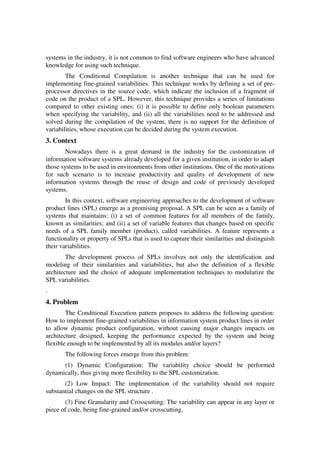
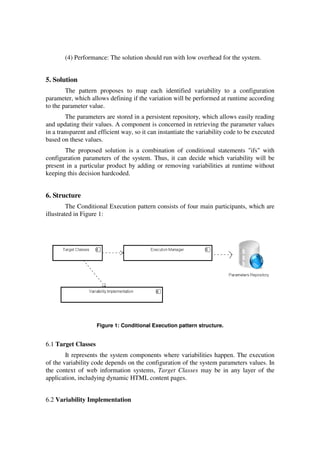

![Figure 2: Dynamic of the Conditional Execution pattern.
8. Consequences
The Conditional Execution pattern brings the following benefits:
• Simplicity. It simplifies the implementation and customization of fine-grained
variabilities by allowing the extraction or introduction of SPL variabilities in
existing legacy information systems.
• Load-time or runtime customization. Variabilities can be configured at load or
execution time. Changes in the system business rules, for example, that demands
the addition or removal of variabilities may be performed by the software
engineers without the need to recompile the system, such as using techniques
like Conditional Compilation.
• Preventing compilations issues. All variabilities code are present in the SPL
products, the pattern eliminates the possibility of generating compilation errors
during the product derivation process compared to the Conditional Compilation
technique [Kästner and Apel 2009].
• Reducing code complexity. It avoids the implementation of aspects with complex
pointcuts that need exposing several parameters. It allows introducing variability
code based on parameter values that can be easily implementing in any
mainstream programming languages.
On the other hand, Conditional Execution pattern has the following drawbacks:](https://image.slidesharecdn.com/conditionalexecution-ww-sugar-2012final-130125080540-phpapp01/85/Conditional-Execution-A-Pattern-for-the-Implementation-of-Fine-Grained-Variabilities-in-Software-Product-Lines-7-320.jpg)
![• Poor variability modularization. When compared to other techniques such as
aspect-oriented programming, the Conditional Execution pattern does not
provide an adequate modularization, because it does not promote the separated
and localized implementation of fine-grained variability. However, the usage and
adaptation of virtual separation of concerns (VSoC) tools [Kästner, Apel and
Kuhlemann 2008] can help to overcome this deficiency.
• Late detection of variability correct configuration. Because the Conditional
Execution pattern is an implementation technique that enables the runtime
decision for the execution of SPL variabilities, the effective test to verify the
correct configuration of the system with their respective variabilities can be done
just at load time and/or during the system execution.
• Exposure of full product line code. The code of all variabilities is always present
in every SPL product, requiring only changes in parameters values for activating
each of these variabilities. This may not be suitable for some business models, in
which the product price depends on the amount and kind of variabilities enabled.
9. Known Uses
In recent years, the Conditional Execution design pattern has been used to
implement different types of fine-grained variabilities in the information systems of the
Informatics Superintendence (SINFO) at the Federal University of Rio Grande do Norte
(UFRN) [SINFO / UFRN 2012 ] [GIS / SINFO 2012], such as:
• SIPAC - Sistema Integrado de Patrimônio, Gestão e Contratos: It provides
fundamental operations for the management of the units responsible for
finance, property and UFRN contracts, therefore, acting through activities
“middle” of this institution. The SIPAC fully integrates administrative area
since the request (material, service, supply of funds, daily tickets, lodging,
informational material, maintenance of infrastructure) until internal
distributed budget controls.
Among the several features of SIPAC using this pattern, we can cite:
o Lock Materials Purchase: It indicates whether the system will block
the request of materials if the available balance is exceeded.
o Editing the Contract Occurrences: If the system possesses the
operation to change/delete occurrences of contracts.
o Indication Request Period for Scholarships: The period in which the
operation of request for financial aid for students is enabled.
• SIGRH - Sistema Integrado de Gestão e Recursos Humanos: It automates the
human resources procedures, such as marking / changing vacation, retire
calculations, functional assessment, sizing workforce, frequency control,
trainings, online services and applications and functional registers, personal
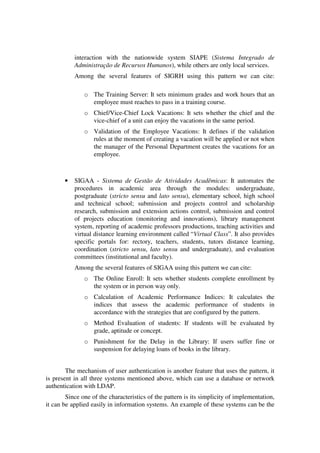
department reports, among others. Most operations have some level of](https://image.slidesharecdn.com/conditionalexecution-ww-sugar-2012final-130125080540-phpapp01/85/Conditional-Execution-A-Pattern-for-the-Implementation-of-Fine-Grained-Variabilities-in-Software-Product-Lines-8-320.jpg)
![ERPs systems (software integrated enterprise resource planning). These softwares have
features for presenting a large amount of variability because they are designed to be
deployed in as many customers as possible and each of these customers have a business
processes whose variability must be answered.
10. Implementation
This section presents an example of how the Conditional Execution pattern can
be implemented. This example is the same shown in Section 2 about the punishment
variability for the overdue materials (books, journals, proceedings, among others) from
Library Management module. During the discussion of the example is highlighted how
the forces involved with the pattern were implemented.
1º Step: Identifying the Target Classes
Inside the SPL SIGAA, there are two variabilities related to the user punishment
functionality: (a) cash fines for each day of delay in return of the material, and (b)
suspend the user for a certain amount of days, during which the user cannot do new
loans.
The using of the punishments functionality is related mainly with two scenarios
of implementation in Library Management module: (i) the execution of a new loan when
the system must not allow punished users get a new loans and (ii) at the moment of
material return when the system must verify if it has been returned late and then it
generates a punishment for the user. These two actions are performed in SPL SIGAA
respectively by business classes LoanProcessor and ReturnLoanProcessor, which are
characterized as Target Classes of the patterns. Both classes are part of the business
layer of the SPL SIGAA which is organized following the tier architectural pattern
[Buschmann et al 1996].
Inside the functionality user punishment, there is another action that involves
print bill for pay library fines. This action should be only enabled if the variability "fine"
is properly configured. Inside the SPL SIGAA, the places where this variability happens,
which are characterized as Targets Classes are: (i) the Managed Bean
PrintBillPayLibraryFinesMBean, and (ii) the following JSP pages: student_menu.jsp,
professor_menu.jsp and server_menu.jsp.
2º Step: Mapping each identified variability to configurations parameters
After identification of Targets Classes, you need to create the parameters
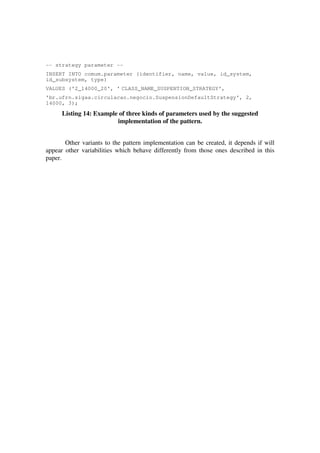
corresponding to punishment variability. For this case, there are two punishment
variabilities. Thus, two parameters were defined:
• SYSTEM_WORKS_WITH_SUSPENSION
• SYSTEM_WORKS_WITH_FINE](https://image.slidesharecdn.com/conditionalexecution-ww-sugar-2012final-130125080540-phpapp01/85/Conditional-Execution-A-Pattern-for-the-Implementation-of-Fine-Grained-Variabilities-in-Software-Product-Lines-10-320.jpg)
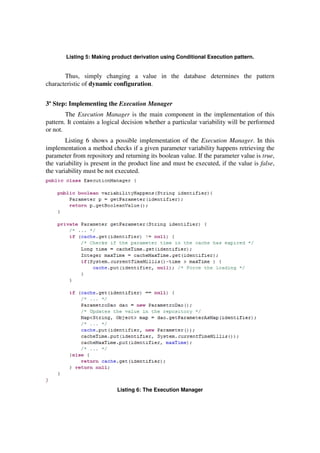
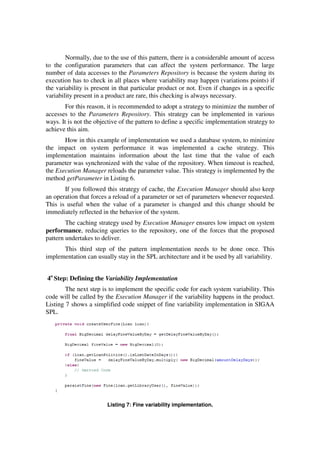
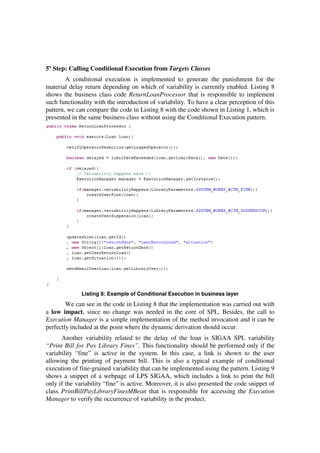
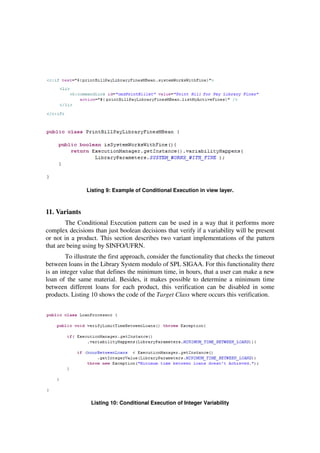
![performance in a Target Class, but it instantiates and returns to the Target Class the
Variability Implementation to be executed.
The solution adopted for this second approach makes use of the Strategy design
pattern [Gamma et al 1995]. Some strategies are defined. The names of the classes that
implement these strategies are mapping for parameters. If the variability is presented in
the product, the Execution Manager instantiates the concrete strategies contained in
those parameters.
For this approach was created a new type of parameter called “Strategy
Parameter”. This kind of parameter doesn’t contain a boolean or integer value, but a
class name that implements the strategy. The variabilities that use this kind of parameter
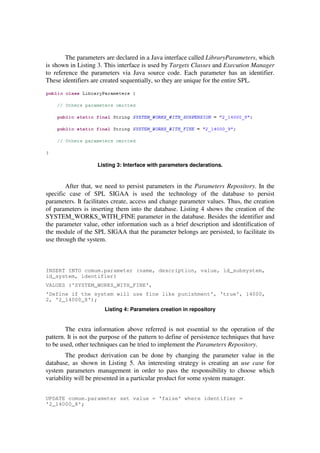
we call of “Strategy Variabilities”. Figure 3 outlines the structure for this second
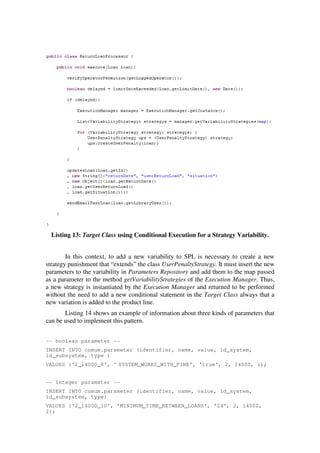
approach. The functionality used is the same of Listings 1 and 8, the punishment of
users for Library Management module of SPL SIGAA.
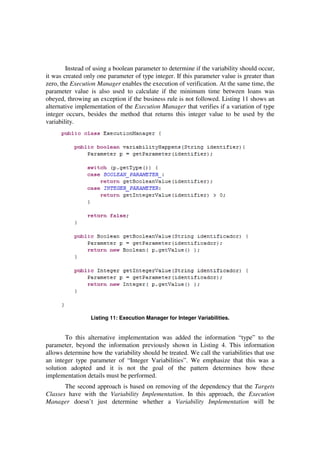
Figure 3: Example of Strategy Variability implementation using Conditional
Execution pattern.
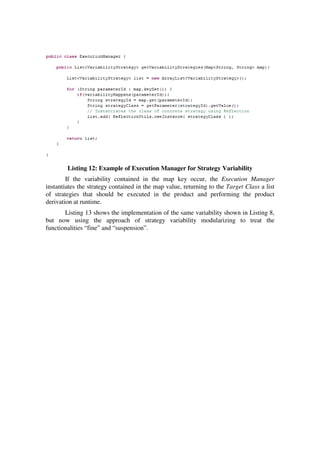
In this approach the method getVariabilityStrategies of Execution Manager
receives a map of parameters. The map keys are boolean parameters which determine
whether the variabilities happen and the map values are strategy parameters containing
concrete strategies to be instantiated. Listing 12 contains the code for a possible
implementation of the method getVariabilityStrategies.](https://image.slidesharecdn.com/conditionalexecution-ww-sugar-2012final-130125080540-phpapp01/85/Conditional-Execution-A-Pattern-for-the-Implementation-of-Fine-Grained-Variabilities-in-Software-Product-Lines-17-320.jpg)

This paper presents the Conditional Execution pattern for implementing fine-grained variabilities in software product lines. The pattern allows variabilities to be activated or deactivated dynamically based on configuration parameters. It was used successfully in three web-based product lines. The pattern addresses how to implement fine-grained variabilities to allow dynamic product configuration without major architecture changes while maintaining performance and flexibility across modules.


