Chapter 14 – Security EngineeringLecture 1Chapter 14 Security Engineering1
Topics coveredSecurity engineering and security managementSecurity engineering concerned with applications; security management with infrastructure.Security risk assessmentDesigning a system based on the assessment of security risks.Design for securityHow system architectures have to be designed for security.Chapter 14 Security Engineering2
Security engineeringTools, techniques and methods to support the development and maintenance of systems that can resist malicious attacks that are intended to damage a computer-based system or its data.A sub-field of the broader field of computer security.Assumes background knowledge of dependability and security concepts (Chapter 10) and security requirements specification (Chapter 12)Chapter 14 Security Engineering3
Application/infrastructure securityApplication security is a software engineering problem where the system is designed to resist attacks.Infrastructure security is a systems management problem where the infrastructure is configured to resist attacks.The focus of this chapter is application security.Chapter 14 Security Engineering4
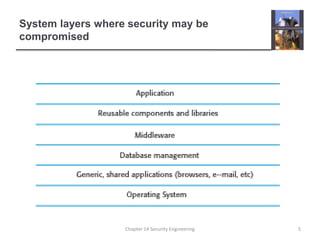
System layers where security may be compromisedChapter 14 Security Engineering5
System security managementUser and permission managementAdding and removing users from the system and setting up appropriate permissions for usersSoftware deployment and maintenanceInstalling application software and middleware and configuring these systems so that vulnerabilities are avoided.Attack monitoring, detection and recoveryMonitoring the system for unauthorized access, design strategies for resisting attacks and develop backup and recovery strategies.Chapter 14 Security Engineering6
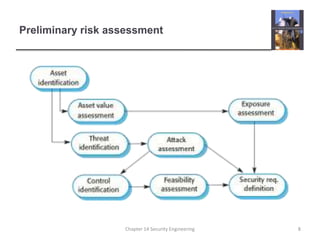
Security risk managementRisk management is concerned with assessing the possible losses that might ensue from attacks on the system and balancing these losses against the costs of security procedures that may reduce these losses.Risk management should be driven by an organisational security policy.Risk management involvesPreliminary risk assessmentLife cycle risk assessmentOperational risk assessmentChapter 14 Security Engineering7
Preliminary risk assessmentChapter 14 Security Engineering8
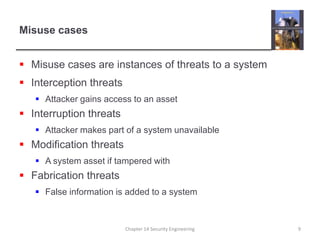
Misuse casesMisuse cases are instances of threats to a systemInterception threatsAttacker gains access to an assetInterruption threatsAttacker makes part of a system unavailableModification threatsA system asset if tampered withFabrication threatsFalse information is added to a systemChapter 14 Security Engineering9
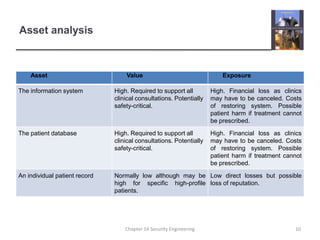
Asset analysisChapter 14 Security Engineering10
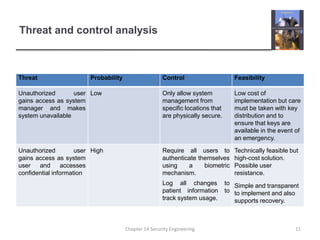
Threat and control analysisChapter 14 Security Engineering11
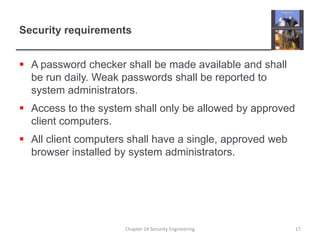
Security requirementsPatient information must be downloaded at the start of a clinic session to a secure area on the system client that is used by clinical staff.Patient information must not be maintained on system clients after a clinic session has finished.A log on a separate computer from the database server must be maintained of all changes made to the system database.Chapter 14 Security Engineering12
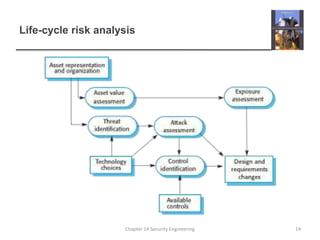
Life cycle risk assessmentRisk assessment while the system is being developed and after it has been deployedMore information is available - system platform, middleware and the system architecture and data organisation.Vulnerabilities that arise from design choices may therefore be identified.Chapter 14 Security Engineering13
Life-cycle risk analysisChapter 14 Security Engineering14
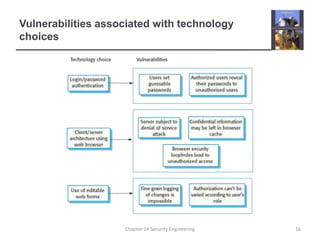
Design decisions from use of COTSSystem users authenticated using a name/password combination.The system architecture is client-server with clients accessing the system through a standard web browser.Information is presented as an editable web form.Chapter 14 Security Engineering15
Vulnerabilities associated with technology choicesChapter 14 Security Engineering16
Security requirementsA password checker shall be made available and shall be run daily. Weak passwords shall be reported to system administrators.Access to the system shall only be allowed by approved client computers.All client computers shall have a single, approved web browser installed by system administrators.Chapter 14 Security Engineering17
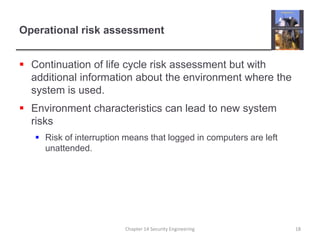
Operational risk assessmentContinuation of life cycle risk assessment but with additional information about the environment where the system is used.Environment characteristics can lead to new system risks Risk of interruption means that logged in computers are left unattended.Chapter 14 Security Engineering18
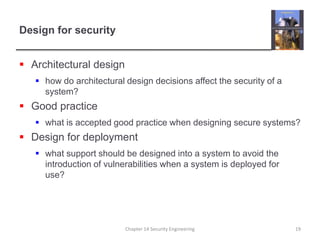
Design for securityArchitectural designhow do architectural design decisions affect the security of a system?Good practicewhat is accepted good practice when designing secure systems?Design for deploymentwhat support should be designed into a system to avoid the introduction of vulnerabilities when a system is deployed for use?Chapter 14 Security Engineering19
Architectural designTwo fundamental issues have to be considered when designing an architecture for security.ProtectionHow should the system be organised so that critical assets can be protected against external attack?DistributionHow should system assets be distributed so that the effects of a successful attack are minimized?These are potentially conflictingIf assets are distributed, then they are more expensive to protect. If assets are protected, then usability and performance requirements may be compromised.Chapter 14 Security Engineering20
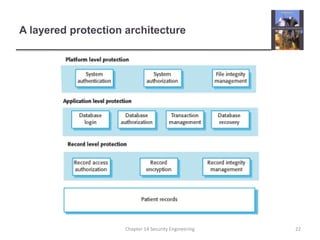
ProtectionPlatform-level protectionTop-level controls on the platform on which a system runs.Application-level protectionSpecific protection mechanisms built into the application itself e.g. additional password protection.Record-level protectionProtection that is invoked when access to specific information is requestedThese lead to a layered protection architectureChapter 14 Security Engineering21
A layered protection architecture Chapter 14 Security Engineering22
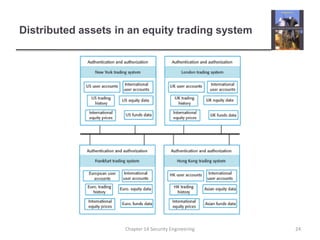
DistributionDistributing assets means that attacks on one system do not necessarily lead to complete loss of system serviceEach platform has separate protection features and may be different from other platforms so that they do not share a common vulnerabilityDistribution is particularly important if the risk of denial of service attacks is highChapter 14 Security Engineering23
Distributed assets in an equity trading systemChapter 14 Security Engineering24
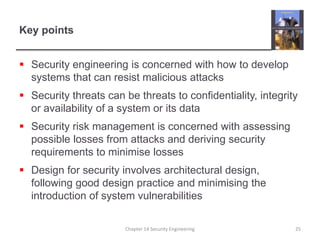
Key pointsSecurity engineering is concerned with how to develop systems that can resist malicious attacksSecurity threats can be threats to confidentiality, integrity or availability of a system or its dataSecurity risk management is concerned with assessing possible losses from attacks and deriving security requirements to minimise lossesDesign for security involves architectural design, following good design practice and minimising the introduction of system vulnerabilitiesChapter 14 Security Engineering25
Chapter 14 – Security EngineeringLecture 2Chapter 14 Security Engineering26
Topics coveredDesign guidelines for securityGuidelines that help you design a secure systemDesign for deploymentDesign so that deployment problems that may introduce vulnerabilities are minimizedSystem survivabilityAllow the system to deliver essential services when under attackChapter 14 Security Engineering27
Design guidelines for security engineeringDesign guidelines encapsulate good practice in secure systems designDesign guidelines serve two purposes:They raise awareness of security issues in a software engineering team. Security is considered when design decisions are made.They can be used as the basis of a review checklist that is applied during the system validation process. Design guidelines here are applicable during software specification and designChapter 14 Security Engineering28
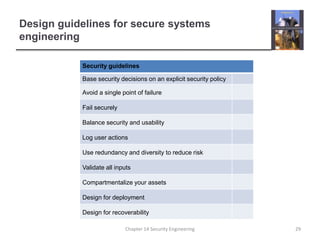
Design guidelines for secure systems engineeringChapter 14 Security Engineering29
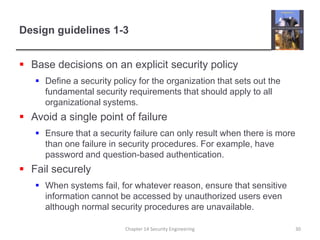
Design guidelines 1-3Base decisions on an explicit security policyDefine a security policy for the organization that sets out the fundamental security requirements that should apply to all organizational systems.Avoid a single point of failureEnsure that a security failure can only result when there is more than one failure in security procedures. For example, have password and question-based authentication.Fail securelyWhen systems fail, for whatever reason, ensure that sensitive information cannot be accessed by unauthorized users even although normal security procedures are unavailable.Chapter 14 Security Engineering30
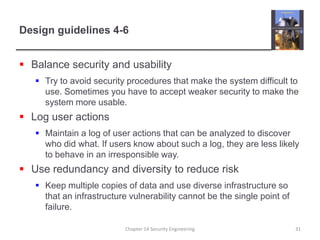
Design guidelines 4-6Balance security and usabilityTry to avoid security procedures that make the system difficult to use. Sometimes you have to accept weaker security to make the system more usable.Log user actionsMaintain a log of user actions that can be analyzed to discover who did what. If users know about such a log, they are less likely to behave in an irresponsible way.Use redundancy and diversity to reduce riskKeep multiple copies of data and use diverse infrastructure so that an infrastructure vulnerability cannot be the single point of failure.Chapter 14 Security Engineering31
Design guidelines 7-10Validate all inputsCheck that all inputs are within range so that unexpected inputs cannot cause problems.Compartmentalize your assetsOrganize the system so that assets are in separate areas and users only have access to the information that they need rather than all system information.Design for deploymentDesign the system to avoid deployment problemsDesign for recoverabilityDesign the system to simplify recoverability after a successful attack.Chapter 14 Security Engineering32
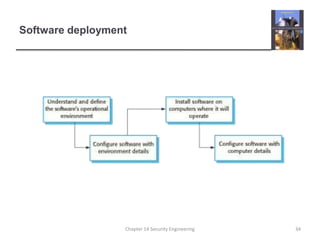
Design for deploymentDeployment involves configuring software to operate in its working environment, installing the system and configuring it for the operational platform.Vulnerabilities may be introduced at this stage as a result of configuration mistakes.Designing deployment support into the system can reduce the probability that vulnerabilities will be introduced.Chapter 14 Security Engineering33
Software deploymentChapter 14 Security Engineering34
Configuration vulnerabilitiesVulnerable default settingsAttackers can find out the default settings for software. If these are weak (often to increase usability) then they can be exploited by users when attacking a system. Development rather than deploymentSome configuration settings in systems are designed to support development and debugging. If these are not turned off, they can be a vulnerability that can be exploited by attackers.Chapter 14 Security Engineering35
Deployment support 1Include support for viewing and analyzing configurationsMake sure that the system administrator responsible for deployment can easily view the entire configuration. This makes it easier to spot omissions and errors that have been made.Minimize default privileges and thus limit the damage that might be causedDesign the system so that the default privileges for an administrator are minimized. This means that if someone gains admin access, they do not have immediate access to the features of the system.Chapter 14 Security Engineering36
Deployment support 2Localize configuration settingsWhen setting up a system, all information that is relevant to the same part or component of a system should be localized so that it is all set up at once. Otherwise, it is easy to forget to set up related security features.Provide easy ways to fix security vulnerabilitiesWhen problems are detected, provide easy ways, such as auto-updating, to repair security vulnerabilities in the deployed systems.Chapter 14 Security Engineering37
System survivabilitySurvivability is an emergent system property that reflects the systems ability to deliver essential services whilst it is under attack or after part of the system has been damagedSurvivability analysis and design should be part of the security engineering processChapter 14 Security Engineering38
Importance of survivabilityOur economic and social lives are dependent on computer systemsCritical infrastructure – electricity, gas, telecommunications, transport  HealthcareGovernmentLoss of business systems for even a short time can have very severe economic effectsAirline reservation systemsE-commerce systemsPayment systemsChapter 14 Security Engineering39
Service availabilityWhich system services are the most critical for a business?How might these services be compromised?What is the minimal quality of service that must be maintained?How can these services be protected?If a service becomes unavailable, how quickly can it be recovered?Chapter 14 Security Engineering40
Survivability strategiesResistance Avoiding problems by building capabilities into the system to resist attacksRecognitionDetecting problems by building capabilities into the system to detect attacks and failures and assess the resultant damageRecoveryTolerating problems by building capabilities into the system to deliver services whilst under attackChapter 14 Security Engineering41
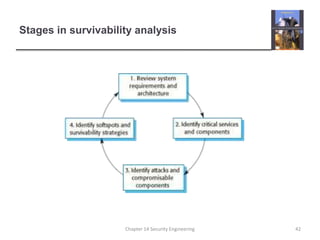
Stages in survivability analysisChapter 14 Security Engineering42
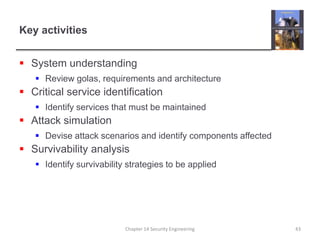
Key activitiesSystem understandingReview golas, requirements and architectureCritical service identificationIdentify services that must be maintainedAttack simulationDevise attack scenarios and identify components affectedSurvivability analysisIdentify survivability strategies to be appliedChapter 14 Security Engineering43
Trading system survivabilityUser accounts and equity prices replicated across servers so some provision for survivability madeKey capability to be maintained is the ability to place orders for stockOrders must be accurate and reflect the actual sales/purchases made by a traderChapter 14 Security Engineering44
Survivable ordering serviceThe critical service that must survive is the ability for authorized users to place orders for stockThis requires 3 components of the system to be available and operating reliability:User authentication, allowing authorized users to log on to the systemPrice quotation, allowing buying and selling prices to be quotedOrder placement, allowing buy and sell orders to be madeChapter 14 Security Engineering45
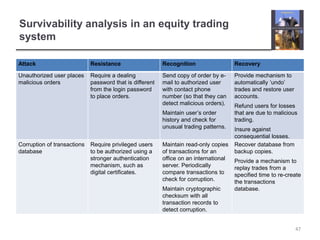
Possible attacksMalicious user masquerades as a legitimate user and places malicious orders for stock, with the aim of causing problems for the legitimate userAn unauthorized user corrupts the database of transactions thus making reconciliation of sales and purchases impossibleChapter 14 Security Engineering46
Survivability analysis in an equity trading system47
Key pointsGeneral security guidelines sensitize designers to security issues and serve as review checklistsConfiguration visualization, setting localization, and minimization of default privileges help reduce deployment errorsSystem survivability reflects the ability of a system to deliver services whilst under attack or after part of the system has been damaged.Chapter 14 Security Engineering48

Ch14-Software Engineering 9

  • 1.
    Chapter 14 –Security EngineeringLecture 1Chapter 14 Security Engineering1
  • 2.
    Topics coveredSecurity engineeringand security managementSecurity engineering concerned with applications; security management with infrastructure.Security risk assessmentDesigning a system based on the assessment of security risks.Design for securityHow system architectures have to be designed for security.Chapter 14 Security Engineering2
  • 3.
    Security engineeringTools, techniquesand methods to support the development and maintenance of systems that can resist malicious attacks that are intended to damage a computer-based system or its data.A sub-field of the broader field of computer security.Assumes background knowledge of dependability and security concepts (Chapter 10) and security requirements specification (Chapter 12)Chapter 14 Security Engineering3
  • 4.
    Application/infrastructure securityApplication securityis a software engineering problem where the system is designed to resist attacks.Infrastructure security is a systems management problem where the infrastructure is configured to resist attacks.The focus of this chapter is application security.Chapter 14 Security Engineering4
  • 5.
    System layers wheresecurity may be compromisedChapter 14 Security Engineering5
  • 6.
    System security managementUserand permission managementAdding and removing users from the system and setting up appropriate permissions for usersSoftware deployment and maintenanceInstalling application software and middleware and configuring these systems so that vulnerabilities are avoided.Attack monitoring, detection and recoveryMonitoring the system for unauthorized access, design strategies for resisting attacks and develop backup and recovery strategies.Chapter 14 Security Engineering6
  • 7.
    Security risk managementRiskmanagement is concerned with assessing the possible losses that might ensue from attacks on the system and balancing these losses against the costs of security procedures that may reduce these losses.Risk management should be driven by an organisational security policy.Risk management involvesPreliminary risk assessmentLife cycle risk assessmentOperational risk assessmentChapter 14 Security Engineering7
  • 8.
    Preliminary risk assessmentChapter14 Security Engineering8
  • 9.
    Misuse casesMisuse casesare instances of threats to a systemInterception threatsAttacker gains access to an assetInterruption threatsAttacker makes part of a system unavailableModification threatsA system asset if tampered withFabrication threatsFalse information is added to a systemChapter 14 Security Engineering9
  • 10.
    Asset analysisChapter 14Security Engineering10
  • 11.
    Threat and controlanalysisChapter 14 Security Engineering11
  • 12.
    Security requirementsPatient informationmust be downloaded at the start of a clinic session to a secure area on the system client that is used by clinical staff.Patient information must not be maintained on system clients after a clinic session has finished.A log on a separate computer from the database server must be maintained of all changes made to the system database.Chapter 14 Security Engineering12
  • 13.
    Life cycle riskassessmentRisk assessment while the system is being developed and after it has been deployedMore information is available - system platform, middleware and the system architecture and data organisation.Vulnerabilities that arise from design choices may therefore be identified.Chapter 14 Security Engineering13
  • 14.
    Life-cycle risk analysisChapter14 Security Engineering14
  • 15.
    Design decisions fromuse of COTSSystem users authenticated using a name/password combination.The system architecture is client-server with clients accessing the system through a standard web browser.Information is presented as an editable web form.Chapter 14 Security Engineering15
  • 16.
    Vulnerabilities associated withtechnology choicesChapter 14 Security Engineering16
  • 17.
    Security requirementsA passwordchecker shall be made available and shall be run daily. Weak passwords shall be reported to system administrators.Access to the system shall only be allowed by approved client computers.All client computers shall have a single, approved web browser installed by system administrators.Chapter 14 Security Engineering17
  • 18.
    Operational risk assessmentContinuationof life cycle risk assessment but with additional information about the environment where the system is used.Environment characteristics can lead to new system risks Risk of interruption means that logged in computers are left unattended.Chapter 14 Security Engineering18
  • 19.
    Design for securityArchitecturaldesignhow do architectural design decisions affect the security of a system?Good practicewhat is accepted good practice when designing secure systems?Design for deploymentwhat support should be designed into a system to avoid the introduction of vulnerabilities when a system is deployed for use?Chapter 14 Security Engineering19
  • 20.
    Architectural designTwo fundamentalissues have to be considered when designing an architecture for security.ProtectionHow should the system be organised so that critical assets can be protected against external attack?DistributionHow should system assets be distributed so that the effects of a successful attack are minimized?These are potentially conflictingIf assets are distributed, then they are more expensive to protect. If assets are protected, then usability and performance requirements may be compromised.Chapter 14 Security Engineering20
  • 21.
    ProtectionPlatform-level protectionTop-level controlson the platform on which a system runs.Application-level protectionSpecific protection mechanisms built into the application itself e.g. additional password protection.Record-level protectionProtection that is invoked when access to specific information is requestedThese lead to a layered protection architectureChapter 14 Security Engineering21
  • 22.
    A layered protectionarchitecture Chapter 14 Security Engineering22
  • 23.
    DistributionDistributing assets meansthat attacks on one system do not necessarily lead to complete loss of system serviceEach platform has separate protection features and may be different from other platforms so that they do not share a common vulnerabilityDistribution is particularly important if the risk of denial of service attacks is highChapter 14 Security Engineering23
  • 24.
    Distributed assets inan equity trading systemChapter 14 Security Engineering24
  • 25.
    Key pointsSecurity engineeringis concerned with how to develop systems that can resist malicious attacksSecurity threats can be threats to confidentiality, integrity or availability of a system or its dataSecurity risk management is concerned with assessing possible losses from attacks and deriving security requirements to minimise lossesDesign for security involves architectural design, following good design practice and minimising the introduction of system vulnerabilitiesChapter 14 Security Engineering25
  • 26.
    Chapter 14 –Security EngineeringLecture 2Chapter 14 Security Engineering26
  • 27.
    Topics coveredDesign guidelinesfor securityGuidelines that help you design a secure systemDesign for deploymentDesign so that deployment problems that may introduce vulnerabilities are minimizedSystem survivabilityAllow the system to deliver essential services when under attackChapter 14 Security Engineering27
  • 28.
    Design guidelines forsecurity engineeringDesign guidelines encapsulate good practice in secure systems designDesign guidelines serve two purposes:They raise awareness of security issues in a software engineering team. Security is considered when design decisions are made.They can be used as the basis of a review checklist that is applied during the system validation process. Design guidelines here are applicable during software specification and designChapter 14 Security Engineering28
  • 29.
    Design guidelines forsecure systems engineeringChapter 14 Security Engineering29
  • 30.
    Design guidelines 1-3Basedecisions on an explicit security policyDefine a security policy for the organization that sets out the fundamental security requirements that should apply to all organizational systems.Avoid a single point of failureEnsure that a security failure can only result when there is more than one failure in security procedures. For example, have password and question-based authentication.Fail securelyWhen systems fail, for whatever reason, ensure that sensitive information cannot be accessed by unauthorized users even although normal security procedures are unavailable.Chapter 14 Security Engineering30
  • 31.
    Design guidelines 4-6Balancesecurity and usabilityTry to avoid security procedures that make the system difficult to use. Sometimes you have to accept weaker security to make the system more usable.Log user actionsMaintain a log of user actions that can be analyzed to discover who did what. If users know about such a log, they are less likely to behave in an irresponsible way.Use redundancy and diversity to reduce riskKeep multiple copies of data and use diverse infrastructure so that an infrastructure vulnerability cannot be the single point of failure.Chapter 14 Security Engineering31
  • 32.
    Design guidelines 7-10Validateall inputsCheck that all inputs are within range so that unexpected inputs cannot cause problems.Compartmentalize your assetsOrganize the system so that assets are in separate areas and users only have access to the information that they need rather than all system information.Design for deploymentDesign the system to avoid deployment problemsDesign for recoverabilityDesign the system to simplify recoverability after a successful attack.Chapter 14 Security Engineering32
  • 33.
    Design for deploymentDeploymentinvolves configuring software to operate in its working environment, installing the system and configuring it for the operational platform.Vulnerabilities may be introduced at this stage as a result of configuration mistakes.Designing deployment support into the system can reduce the probability that vulnerabilities will be introduced.Chapter 14 Security Engineering33
  • 34.
    Software deploymentChapter 14Security Engineering34
  • 35.
    Configuration vulnerabilitiesVulnerable defaultsettingsAttackers can find out the default settings for software. If these are weak (often to increase usability) then they can be exploited by users when attacking a system. Development rather than deploymentSome configuration settings in systems are designed to support development and debugging. If these are not turned off, they can be a vulnerability that can be exploited by attackers.Chapter 14 Security Engineering35
  • 36.
    Deployment support 1Includesupport for viewing and analyzing configurationsMake sure that the system administrator responsible for deployment can easily view the entire configuration. This makes it easier to spot omissions and errors that have been made.Minimize default privileges and thus limit the damage that might be causedDesign the system so that the default privileges for an administrator are minimized. This means that if someone gains admin access, they do not have immediate access to the features of the system.Chapter 14 Security Engineering36
  • 37.
    Deployment support 2Localizeconfiguration settingsWhen setting up a system, all information that is relevant to the same part or component of a system should be localized so that it is all set up at once. Otherwise, it is easy to forget to set up related security features.Provide easy ways to fix security vulnerabilitiesWhen problems are detected, provide easy ways, such as auto-updating, to repair security vulnerabilities in the deployed systems.Chapter 14 Security Engineering37
  • 38.
    System survivabilitySurvivability isan emergent system property that reflects the systems ability to deliver essential services whilst it is under attack or after part of the system has been damagedSurvivability analysis and design should be part of the security engineering processChapter 14 Security Engineering38
  • 39.
    Importance of survivabilityOureconomic and social lives are dependent on computer systemsCritical infrastructure – electricity, gas, telecommunications, transport HealthcareGovernmentLoss of business systems for even a short time can have very severe economic effectsAirline reservation systemsE-commerce systemsPayment systemsChapter 14 Security Engineering39
  • 40.
    Service availabilityWhich systemservices are the most critical for a business?How might these services be compromised?What is the minimal quality of service that must be maintained?How can these services be protected?If a service becomes unavailable, how quickly can it be recovered?Chapter 14 Security Engineering40
  • 41.
    Survivability strategiesResistance Avoidingproblems by building capabilities into the system to resist attacksRecognitionDetecting problems by building capabilities into the system to detect attacks and failures and assess the resultant damageRecoveryTolerating problems by building capabilities into the system to deliver services whilst under attackChapter 14 Security Engineering41
  • 42.
    Stages in survivabilityanalysisChapter 14 Security Engineering42
  • 43.
    Key activitiesSystem understandingReviewgolas, requirements and architectureCritical service identificationIdentify services that must be maintainedAttack simulationDevise attack scenarios and identify components affectedSurvivability analysisIdentify survivability strategies to be appliedChapter 14 Security Engineering43
  • 44.
    Trading system survivabilityUseraccounts and equity prices replicated across servers so some provision for survivability madeKey capability to be maintained is the ability to place orders for stockOrders must be accurate and reflect the actual sales/purchases made by a traderChapter 14 Security Engineering44
  • 45.
    Survivable ordering serviceThecritical service that must survive is the ability for authorized users to place orders for stockThis requires 3 components of the system to be available and operating reliability:User authentication, allowing authorized users to log on to the systemPrice quotation, allowing buying and selling prices to be quotedOrder placement, allowing buy and sell orders to be madeChapter 14 Security Engineering45
  • 46.
    Possible attacksMalicious usermasquerades as a legitimate user and places malicious orders for stock, with the aim of causing problems for the legitimate userAn unauthorized user corrupts the database of transactions thus making reconciliation of sales and purchases impossibleChapter 14 Security Engineering46
  • 47.
    Survivability analysis inan equity trading system47
  • 48.
    Key pointsGeneral securityguidelines sensitize designers to security issues and serve as review checklistsConfiguration visualization, setting localization, and minimization of default privileges help reduce deployment errorsSystem survivability reflects the ability of a system to deliver services whilst under attack or after part of the system has been damaged.Chapter 14 Security Engineering48