Concise Introduction to Logic 13th Edition
Hurley Solutions Manual download
https://testbankdeal.com/product/concise-introduction-to-
logic-13th-edition-hurley-solutions-manual/
Explore and download more test bank or solution manual
at testbankdeal.com
Here are some recommended products for you. Click the link to
download, or explore more at testbankdeal.com
Concise Introduction to Logic 13th Edition Hurley Test
Bank
https://testbankdeal.com/product/concise-introduction-to-logic-13th-
edition-hurley-test-bank/
Concise Introduction to Logic 11th Edition Hurley
Solutions Manual
https://testbankdeal.com/product/concise-introduction-to-logic-11th-
edition-hurley-solutions-manual/
Logic The Essentials 1st Edition Hurley Solutions Manual
https://testbankdeal.com/product/logic-the-essentials-1st-edition-
hurley-solutions-manual/
Nutrition Through the Life Cycle 6th Edition Brown Test
Bank
https://testbankdeal.com/product/nutrition-through-the-life-cycle-6th-
edition-brown-test-bank/
Contemporary Business Law 8th Edition Cheeseman Solutions
Manual
https://testbankdeal.com/product/contemporary-business-law-8th-
edition-cheeseman-solutions-manual/
Intermediate Algebra Functions and Authentic Applications
5th Edition Jay Lehmann Test Bank
https://testbankdeal.com/product/intermediate-algebra-functions-and-
authentic-applications-5th-edition-jay-lehmann-test-bank/
Netters Essential Histology with Student Consult Access
2nd Edition Ovalle Test Bank
https://testbankdeal.com/product/netters-essential-histology-with-
student-consult-access-2nd-edition-ovalle-test-bank/
Issues and Ethics in the Helping Professions 10th Edition
Corey Solutions Manual
https://testbankdeal.com/product/issues-and-ethics-in-the-helping-
professions-10th-edition-corey-solutions-manual/
Political Science Research Methods 8th Edition Johnson
Test Bank
https://testbankdeal.com/product/political-science-research-
methods-8th-edition-johnson-test-bank/
Business Analytics 3rd Edition Evans Solutions Manual
https://testbankdeal.com/product/business-analytics-3rd-edition-evans-
solutions-manual/
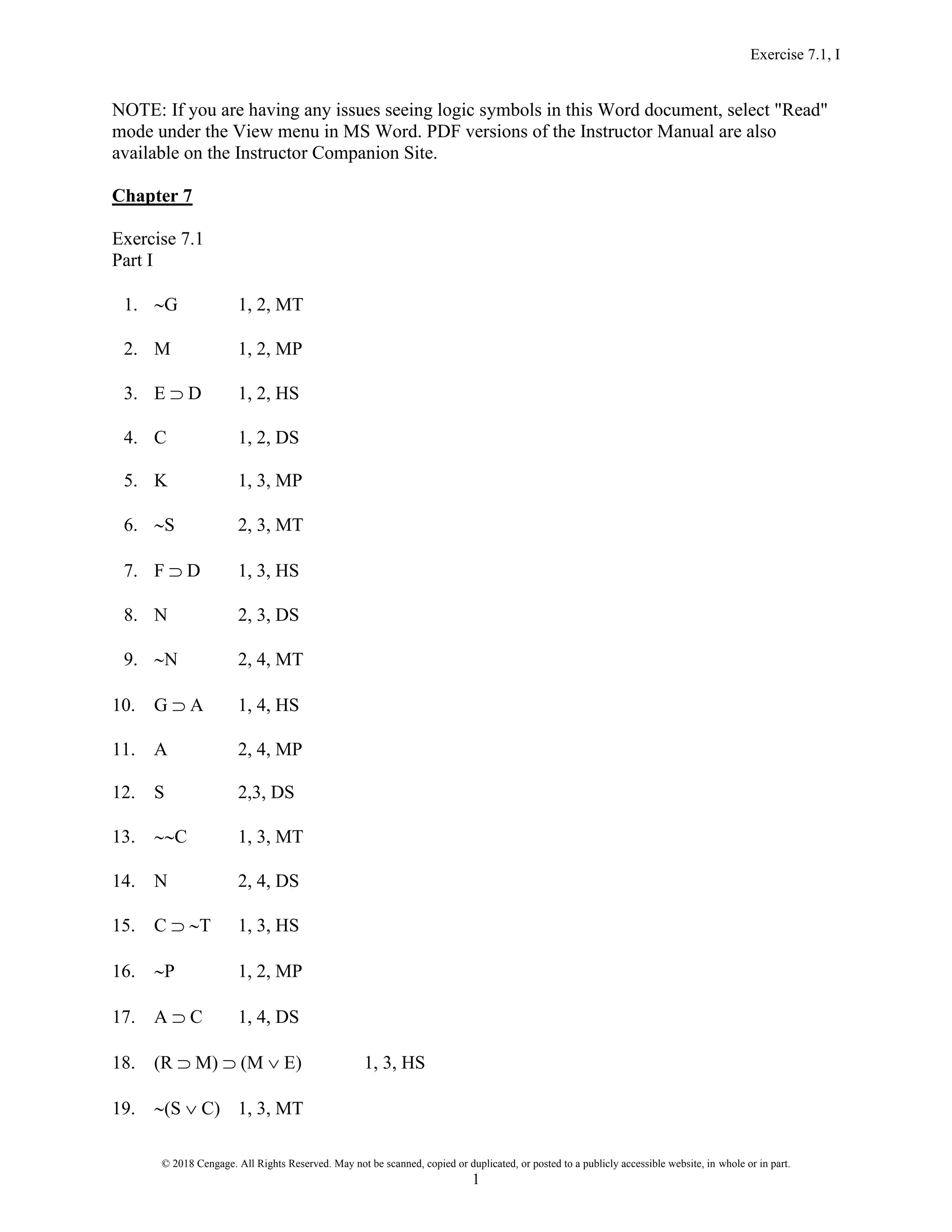
Exercise 7.1, I
© 2018 Cengage. All Rights Reserved. May not be scanned, copied or duplicated, or posted to a publicly accessible website, in whole or in part.
1
NOTE: If you are having any issues seeing logic symbols in this Word document, select "Read"
mode under the View menu in MS Word. PDF versions of the Instructor Manual are also
available on the Instructor Companion Site.
Chapter 7
Exercise 7.1
Part I
1. G 1, 2, MT
2. M 1, 2, MP
3. E  D 1, 2, HS
4. C 1, 2, DS
5. K 1, 3, MP
6. S 2, 3, MT
7. F  D 1, 3, HS
8. N 2, 3, DS
9. N 2, 4, MT
10. G  A 1, 4, HS
11. A 2, 4, MP
12. S 2,3, DS
13. C 1, 3, MT
14. N 2, 4, DS
15. C  T 1, 3, HS
16. P 1, 2, MP
17. A  C 1, 4, DS
18. (R  M)  (M  E) 1, 3, HS
19. (S  C) 1, 3, MT
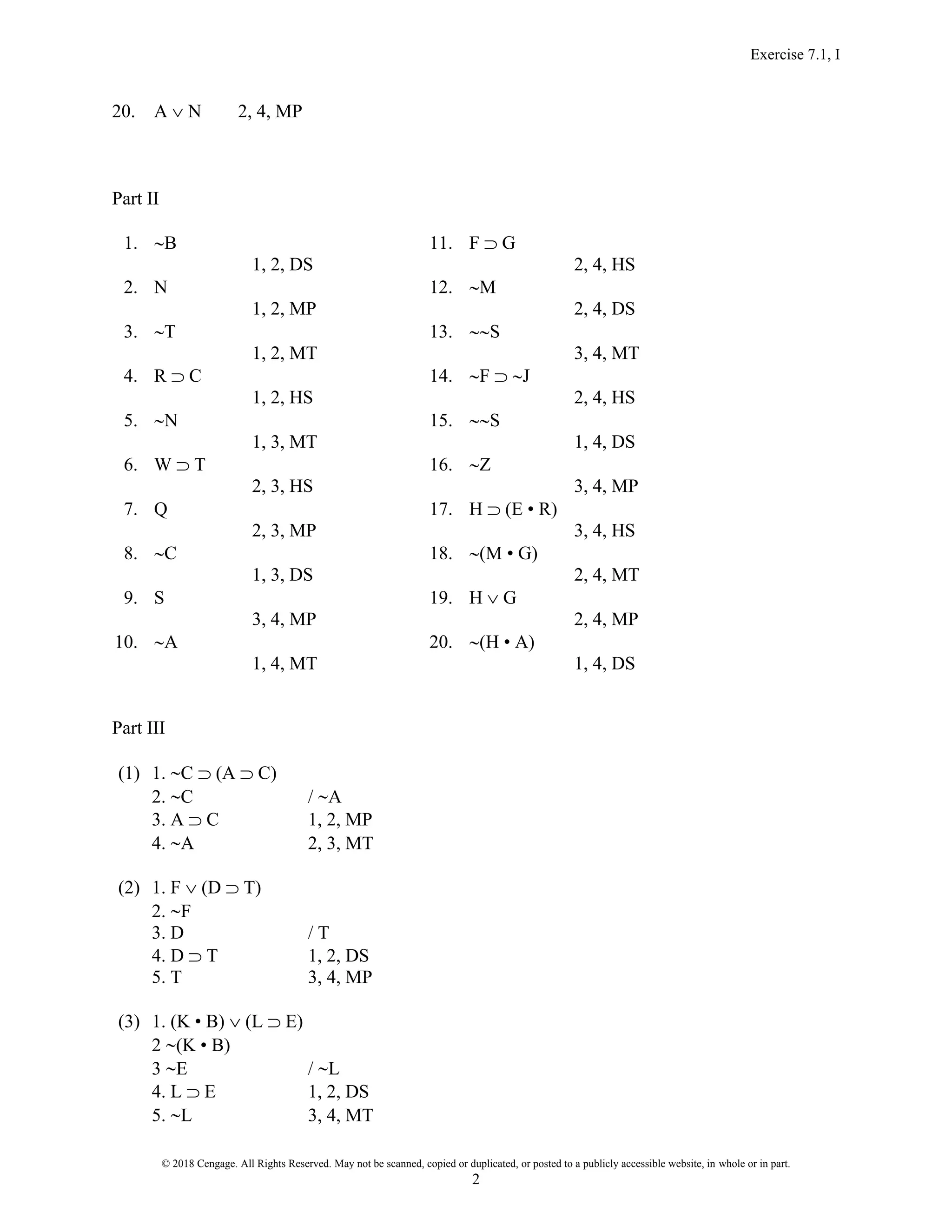
Exercise 7.1, I
© 2018 Cengage. All Rights Reserved. May not be scanned, copied or duplicated, or posted to a publicly accessible website, in whole or in part.
2
20. A  N 2, 4, MP
Part II
1. B 11. F  G
1, 2, DS 2, 4, HS
2. N 12. M
1, 2, MP 2, 4, DS
3. T 13. S
1, 2, MT 3, 4, MT
4. R  C 14. F  J
1, 2, HS 2, 4, HS
5. N 15. S
1, 3, MT 1, 4, DS
6. W  T 16. Z
2, 3, HS 3, 4, MP
7. Q 17. H  (E • R)
2, 3, MP 3, 4, HS
8. C 18. (M • G)
1, 3, DS 2, 4, MT
9. S 19. H  G
3, 4, MP 2, 4, MP
10. A 20. (H • A)
1, 4, MT 1, 4, DS
Part III
(1) 1. C  (A  C)
2. C / A
3. A  C 1, 2, MP
4. A 2, 3, MT
(2) 1. F  (D  T)
2. F
3. D / T
4. D  T 1, 2, DS
5. T 3, 4, MP
(3) 1. (K • B)  (L  E)
2 (K • B)
3 E / L
4. L  E 1, 2, DS
5. L 3, 4, MT
Exercise 7.1, III
© 2018 Cengage. All Rights Reserved. May not be scanned, copied or duplicated, or posted to a publicly accessible website, in whole or in part.
3
(4) 1. P  (G  T)
2. Q  (T  E)
3. P
4. Q / G  E
5. G  T 1, 3, MP
6. T  E 2, 4, MP
7. G  E 5, 6, HS
(5) 1. W  [W  (X  W)]
2. W / X
3. W  (X  W) 1, 2, MP
4. X  W 2, 3, MP
5. X 2, 4, MT
(6) 1. J  (K  L)
2. L  J
3. L / K
4. J 2, 3, DS
5. K  L 1, 4, MP
6. K 3, 5, MT
(7) 1. S  D
2. S  (D  K)
3. D / K
4. S 1, 3, MT
5. D  K 2, 4, DS
6. K 3, 5, MP
(8) 1. A  (E  F)
2. H  (F  M)
3. A
4. H / E  M
5. E  F 1, 3, MP
6. F  M 2, 4, DS
7. E  M 5, 6, HS
(9) 1. G  (G  A)
2. A  (C  A)
3. G / C
4. G  A 1, 3, MP
5. A 3, 4, DS
6. C  A 2, 5, MP
7. C 5, 6, MT
(10) 1. N  (J  P)
Exercise 7.1, III
© 2018 Cengage. All Rights Reserved. May not be scanned, copied or duplicated, or posted to a publicly accessible website, in whole or in part.
4
2. (J  P)  (N  J)
3. N / P
4. J  P 1, 3, MP
5. N  J 2, 4, MP
6. N  P 4, 5, HS
7. P 3, 6, MP
(11) 1. G  [O  (G  D)]
2. O  G
3. O / D
4. G 2, 3, DS
5. O  (G  D) 1, 4, MP
6. G  D 3, 5, MP
7. D 4, 6, MP
(12) 1. M  (B  T)
2. B  W
3. M
4. W / T
5. B  T 1, 3, DS
6. B 2, 4, MT
7. T 5, 6, DS
(13) 1. R  (G  A)
2. (G  A)  S
3. G  S
4. R / A
5. G  A 1, 4, MP
6. S 2, 5, MP
7. G 3, 6, MT
8. A 5, 7, DS
(14) 1. (L  N)  C
2. (L  N)  (P  E)
3. E  C
4. C / P
5. (L  N) 1, 4, MT
6. P  E 2, 5, DS
7. E 3, 4, MT
8. P 6, 7, MT
(15) 1. J  [A  (D  A)]
2. J  A
3. J / D
4. A  (D  A) 1, 3, MP
Exercise 7.1, III
© 2018 Cengage. All Rights Reserved. May not be scanned, copied or duplicated, or posted to a publicly accessible website, in whole or in part.
5
5. A 2, 3, DS
6. D  A 4, 5, MP
7. D 5, 6, MT
(16) 1. (B  M)  (T  S)
2. B  K
3. K  M
4. S  N / T  N
5. B  M 2, 3, HS
6. T  S 1, 5, MP
7. T  N 4, 6, HS
(17) 1. H  (Q  F)
2. R  (Q  R)
3. R  H
4. R / F
5. H 3, 4, DS
6. Q  F 1, 5, DS
7. Q  R 2, 4, DS
8. Q 4, 7, MT
9. F 6, 8, DS
(18) 1. A  (B  C)
2. D  (C  A)
3. D  A
4. D /B
5. A 3, 4, DS
6. B  C 1, 5, MP
7. C  A 2, 4, MP
8. B  A 6, 7, HS
9. B 5, 8, MT
(19) 1. G  [G  (S  G)]
2. (S  L)  G
3. S  L / L
4. G 2, 3, MP
5. G  (S  G) 1, 4, MP
6. S  G 4, 5, DS
7. S 4, 6, MT
8. L 3, 7, DS
(20) 1. H  [E  (C  D)]
2. D  E
3. E  H
Exercise 7.1, III
© 2018 Cengage. All Rights Reserved. May not be scanned, copied or duplicated, or posted to a publicly accessible website, in whole or in part.
6
4. E / C
5. H 3, 4, DS
6. E  (C  D) 1, 5, MP
7. C  D 4, 6, MP
8. C  E 2, 7, HS
9. C 4, 8, MT
(21) 1. B  [(A  K)  (B  K)]
2. J  K
3. A  J
4. B / A
5. (A  K)  (B  K) 1, 4, MP
6. A  K 2, 3, HS
7. B  K 5, 6, MP
8. K 4, 7, DS
9. A 6, 8, MT
(22) 1. (C  M)  (N  P)
2. (C  N)  (N  M)
3. (C  P)  M
4. C  N / C
5. N  M 2, 4, MP
6. C  M 4, 5, HS
7. N  P 1, 6, MP
8. C  P 4, 7, HS
9. M 3, 8, MP
10. C 6, 9, MT
(23) 1. (R  F)  [(R  G)  (S  Q)]
2. (Q  F)  (R  Q)
3. G  F
4. Q  G / S  F
5. Q  F 3, 4, HS
6. R  Q 2, 5, MP
7. R  F 5, 6, HS
8. (R  G)  (S  Q) 1, 7, MP
9. R  G 4, 6, HS
10. S  Q 8, 9, MP
11. S  F 5, 10, HS
(24) 1. A  [A  (T  R)]
2. R  [R  (A  R)]
3. (T  D)  R
4. T  D / D
5. R 3, 4, MP
Exercise 7.1, III
© 2018 Cengage. All Rights Reserved. May not be scanned, copied or duplicated, or posted to a publicly accessible website, in whole or in part.
7
6. R  (A  R) 2, 5, MP
7. A  R 5, 6, DS
8. A 5, 7, MT
9. A  (T  R) 1, 8, MP
10. T  R 8, 9, DS
11. T 5, 10, MT
12. D 4, 11, DS
(25) 1. N  [(B  D)  (N  E)]
2. (B  E )  N
3. B  D
4. D  E / D
5. B  E 3, 4, HS
6. N 2, 5, MP
7. (B  D)  (N  E) 1, 6, MP
8. N  E 3, 7, MP
9. E 6, 8, DS
10. D 4, 9, MT
Part IV
(1) 1. O  (P  T)
2. P
3. O / T
4. P  T 1, 3, MP
5. T 2, 4, DS
(2) 1. P  L
2. S  L
3. S / P
4. L 2, 3, DS
5. P 1, 4, MT
(3) 1. (Q  J)  (M  D)
2. Q  M
3. M  J / Q  D
4. Q  J 2, 3, HS
5. M  D 1, 4, MP
6. Q  D 2, 5, HS
(4) 1. (R  L)  (L  F)
2. F  (R  L)
3. F / R
4. R  L 2, 3, DS
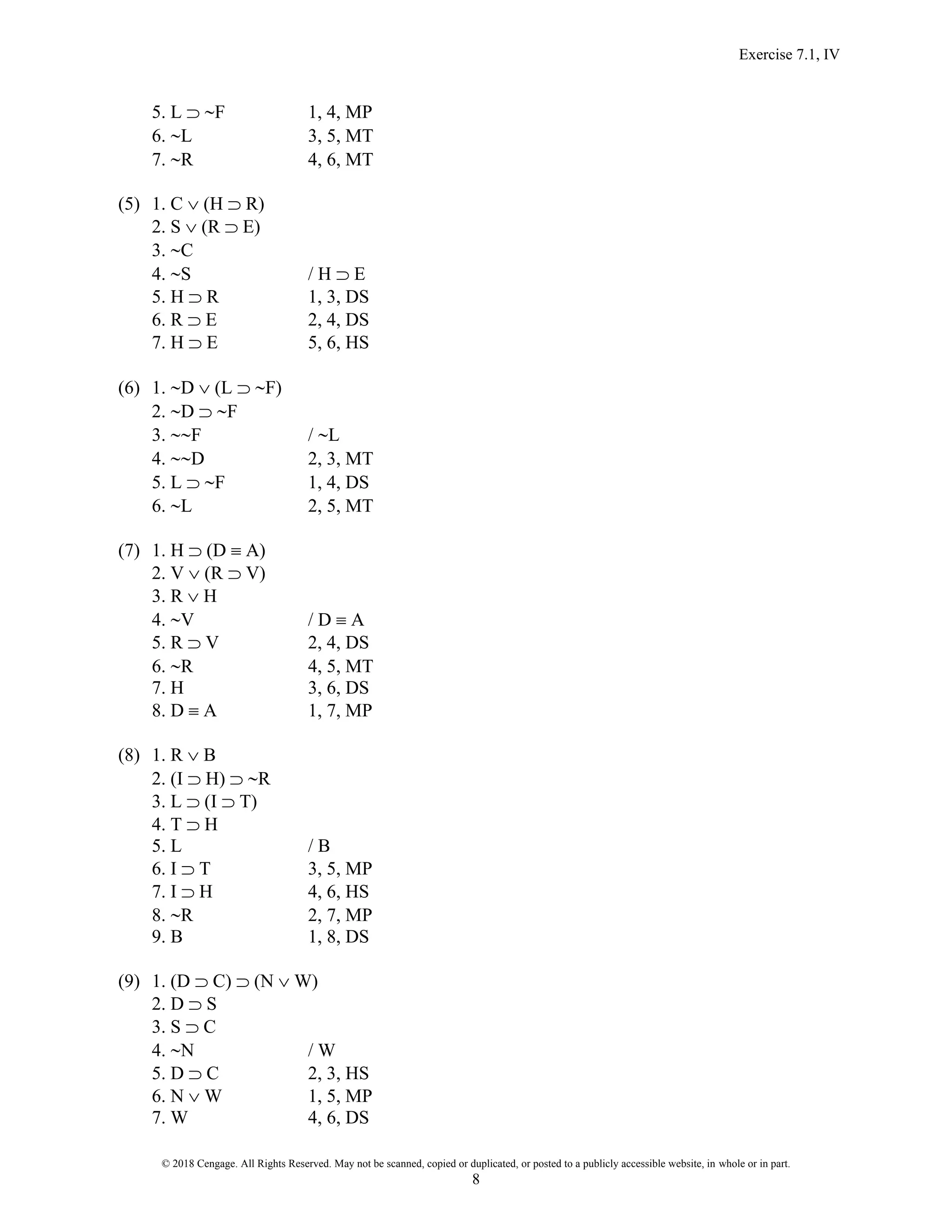
Exercise 7.1, IV
© 2018 Cengage. All Rights Reserved. May not be scanned, copied or duplicated, or posted to a publicly accessible website, in whole or in part.
8
5. L  F 1, 4, MP
6. L 3, 5, MT
7. R 4, 6, MT
(5) 1. C  (H  R)
2. S  (R  E)
3. C
4. S / H  E
5. H  R 1, 3, DS
6. R  E 2, 4, DS
7. H  E 5, 6, HS
(6) 1. D  (L  F)
2. D  F
3. F / L
4. D 2, 3, MT
5. L  F 1, 4, DS
6. L 2, 5, MT
(7) 1. H  (D  A)
2. V  (R  V)
3. R  H
4. V / D  A
5. R  V 2, 4, DS
6. R 4, 5, MT
7. H 3, 6, DS
8. D  A 1, 7, MP
(8) 1. R  B
2. (I  H)  R
3. L  (I  T)
4. T  H
5. L / B
6. I  T 3, 5, MP
7. I  H 4, 6, HS
8. R 2, 7, MP
9. B 1, 8, DS
(9) 1. (D  C)  (N  W)
2. D  S
3. S  C
4. N / W
5. D  C 2, 3, HS
6. N  W 1, 5, MP
7. W 4, 6, DS
Exercise 7.1, IV
© 2018 Cengage. All Rights Reserved. May not be scanned, copied or duplicated, or posted to a publicly accessible website, in whole or in part.
9
(10) 1. C  [C  (J  D)]
2. C  (C • U)
3. (C • U)
4. D / J
5. C 2, 3, MT
6. C  (J  D) 1, 5, MP
7. J  D 5, 6, DS
8. J 4, 7, MT
Exercise 7.2
Part I
1. B 2 6. A  N 1, 3
2. T  Q 1, 3 7. Q  K 1
3. D • W 1, 2 8. (E • G)  T 1
4. H  F 1 9. B • (F  N) 1, 2
5. R 1 10. L  M 1, 2
Part II
1. G 2, Simp 6. N  F 1, Add
3, Add 3, 4, CD
2. E 1, 2, DS 7. F 2, 3, MT
1, 3, Conj 1, 4, Conj
3. (B  N) • (K  R) 1, 3, Conj 8. E  B 1, Simp
2, 4, CD 3, 4, HS
4. T  U 1, Add 9. H • R 2, 3, MP
3, 4, MP Simp
5. S • P 2, 3, DS 10. M • E 1, 3, Conj
4, Simp 2, 4, MP
Part III
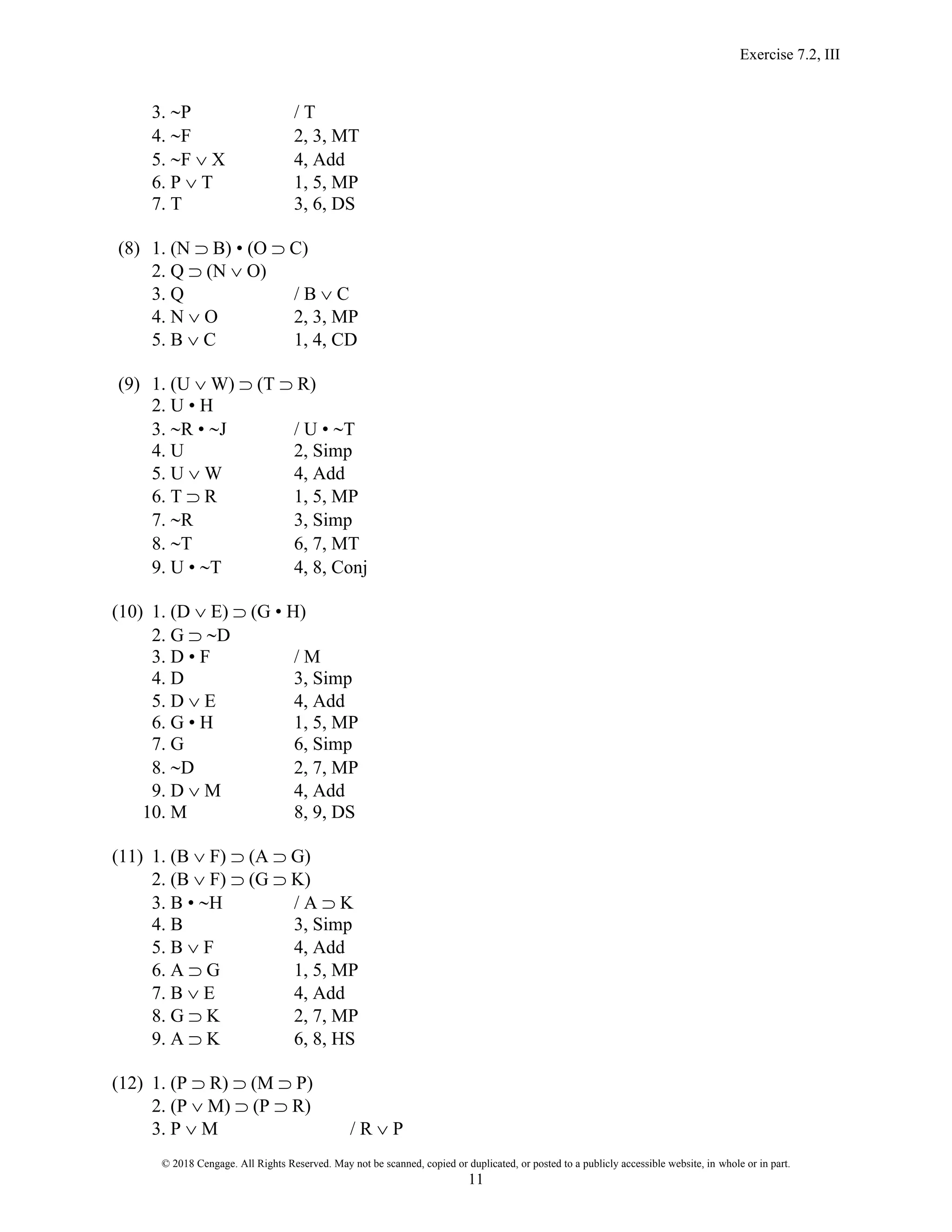
(1) 1. M  Q
2. R  T
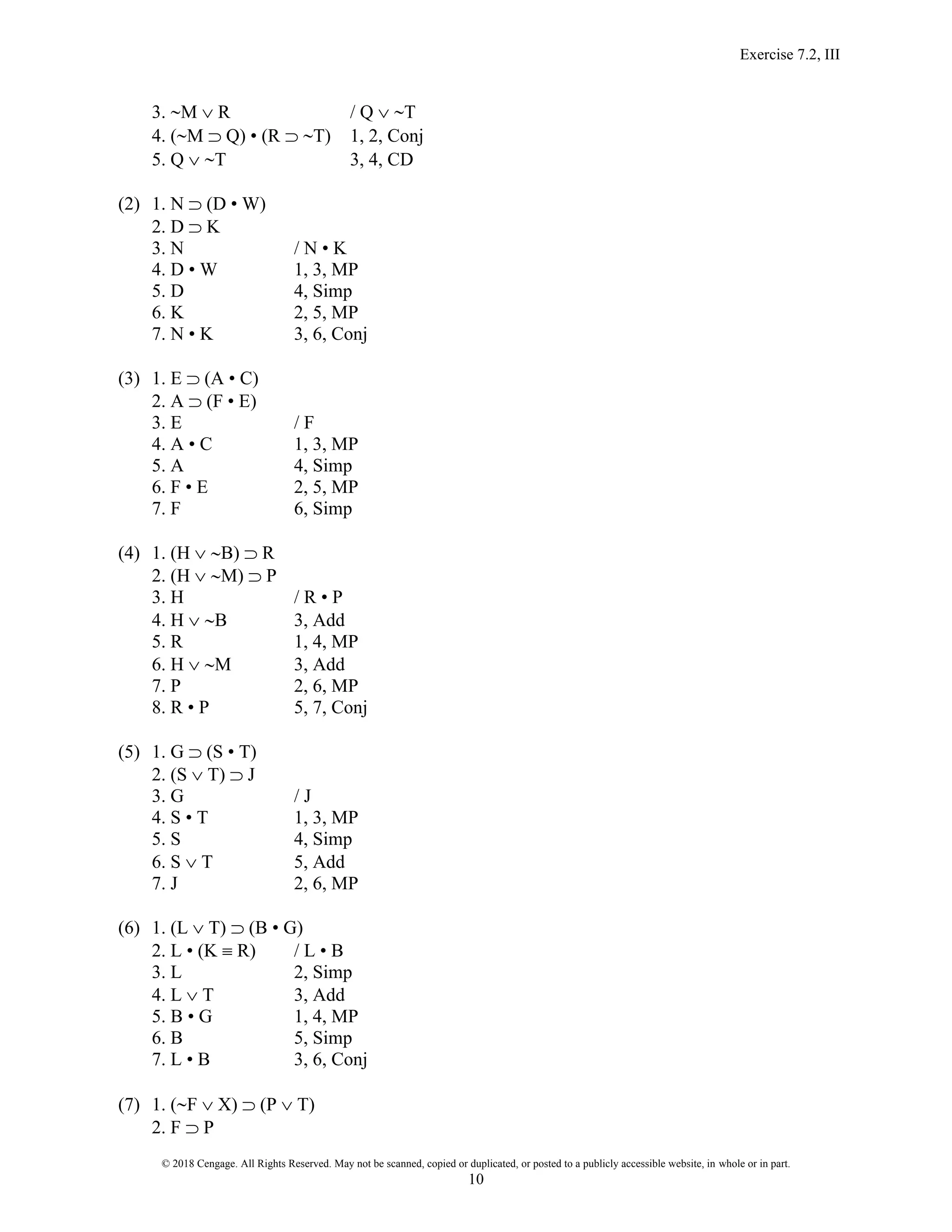
Exercise 7.2, III
© 2018 Cengage. All Rights Reserved. May not be scanned, copied or duplicated, or posted to a publicly accessible website, in whole or in part.
10
3. M  R / Q  T
4. (M  Q) • (R  T) 1, 2, Conj
5. Q  T 3, 4, CD
(2) 1. N  (D • W)
2. D  K
3. N / N • K
4. D • W 1, 3, MP
5. D 4, Simp
6. K 2, 5, MP
7. N • K 3, 6, Conj
(3) 1. E  (A • C)
2. A  (F • E)
3. E / F
4. A • C 1, 3, MP
5. A 4, Simp
6. F • E 2, 5, MP
7. F 6, Simp
(4) 1. (H  B)  R
2. (H  M)  P
3. H / R • P
4. H  B 3, Add
5. R 1, 4, MP
6. H  M 3, Add
7. P 2, 6, MP
8. R • P 5, 7, Conj
(5) 1. G  (S • T)
2. (S  T)  J
3. G / J
4. S • T 1, 3, MP
5. S 4, Simp
6. S  T 5, Add
7. J 2, 6, MP
(6) 1. (L  T)  (B • G)
2. L • (K  R) / L • B
3. L 2, Simp
4. L  T 3, Add
5. B • G 1, 4, MP
6. B 5, Simp
7. L • B 3, 6, Conj
(7) 1. (F  X)  (P  T)
2. F  P
Visit https://testbankdead.com
now to explore a rich
collection of testbank,
solution manual and enjoy
exciting offers!
Exercise 7.2, III
© 2018 Cengage. All Rights Reserved. May not be scanned, copied or duplicated, or posted to a publicly accessible website, in whole or in part.
11
3. P / T
4. F 2, 3, MT
5. F  X 4, Add
6. P  T 1, 5, MP
7. T 3, 6, DS
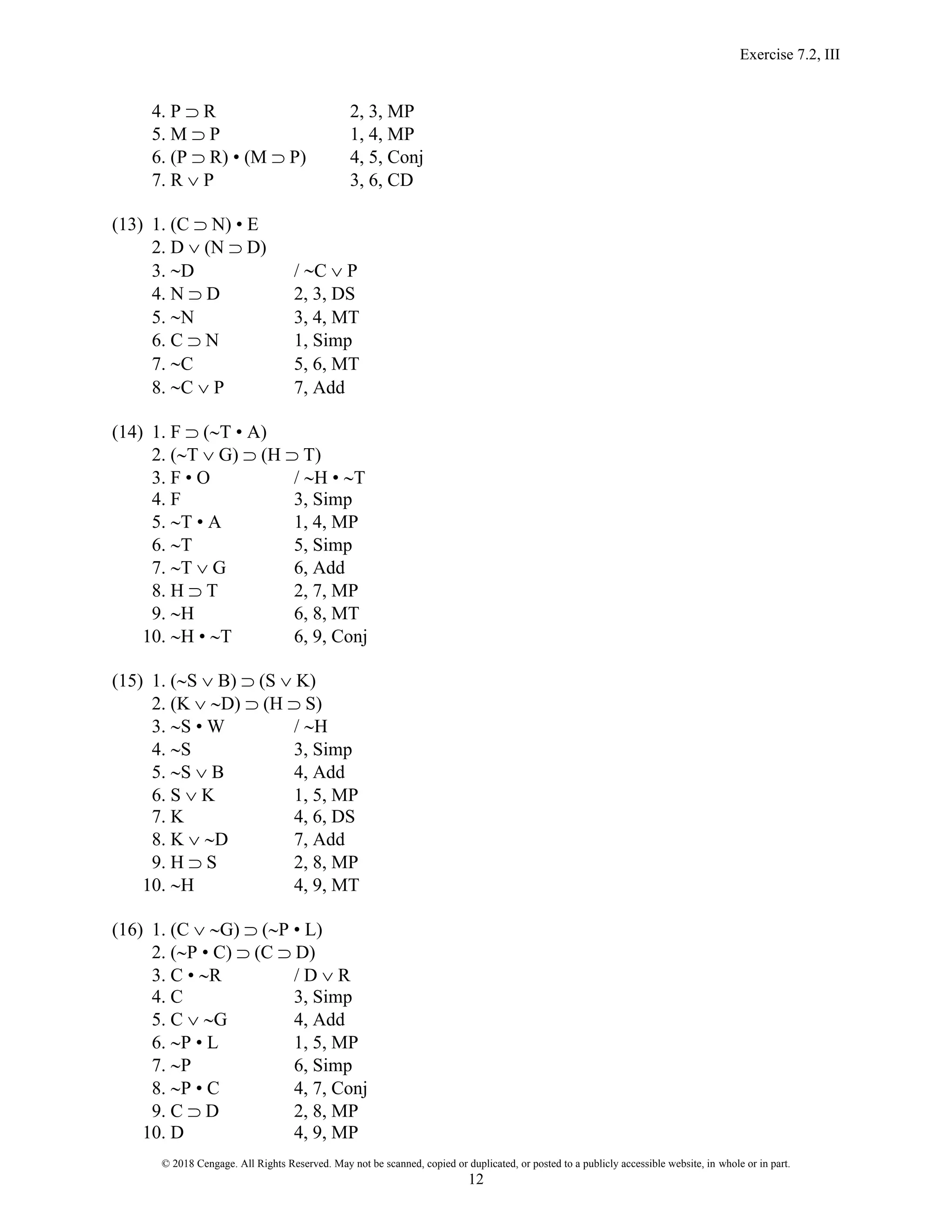
(8) 1. (N  B) • (O  C)
2. Q  (N  O)
3. Q / B  C
4. N  O 2, 3, MP
5. B  C 1, 4, CD
(9) 1. (U  W)  (T  R)
2. U • H
3. R • J / U • T
4. U 2, Simp
5. U  W 4, Add
6. T  R 1, 5, MP
7. R 3, Simp
8. T 6, 7, MT
9. U • T 4, 8, Conj
(10) 1. (D  E)  (G • H)
2. G  D
3. D • F / M
4. D 3, Simp
5. D  E 4, Add
6. G • H 1, 5, MP
7. G 6, Simp
8. D 2, 7, MP
9. D  M 4, Add
10. M 8, 9, DS
(11) 1. (B  F)  (A  G)
2. (B  F)  (G  K)
3. B • H / A  K
4. B 3, Simp
5. B  F 4, Add
6. A  G 1, 5, MP
7. B  E 4, Add
8. G  K 2, 7, MP
9. A  K 6, 8, HS
(12) 1. (P  R)  (M  P)
2. (P  M)  (P  R)
3. P  M / R  P
Exercise 7.2, III
© 2018 Cengage. All Rights Reserved. May not be scanned, copied or duplicated, or posted to a publicly accessible website, in whole or in part.
12
4. P  R 2, 3, MP
5. M  P 1, 4, MP
6. (P  R) • (M  P) 4, 5, Conj
7. R  P 3, 6, CD
(13) 1. (C  N) • E
2. D  (N  D)
3. D / C  P
4. N  D 2, 3, DS
5. N 3, 4, MT
6. C  N 1, Simp
7. C 5, 6, MT
8. C  P 7, Add
(14) 1. F  (T • A)
2. (T  G)  (H  T)
3. F • O / H • T
4. F 3, Simp
5. T • A 1, 4, MP
6. T 5, Simp
7. T  G 6, Add
8. H  T 2, 7, MP
9. H 6, 8, MT
10. H • T 6, 9, Conj
(15) 1. (S  B)  (S  K)
2. (K  D)  (H  S)
3. S • W / H
4. S 3, Simp
5. S  B 4, Add
6. S  K 1, 5, MP
7. K 4, 6, DS
8. K  D 7, Add
9. H  S 2, 8, MP
10. H 4, 9, MT
(16) 1. (C  G)  (P • L)
2. (P • C)  (C  D)
3. C • R / D  R
4. C 3, Simp
5. C  G 4, Add
6. P • L 1, 5, MP
7. P 6, Simp
8. P • C 4, 7, Conj
9. C  D 2, 8, MP
10. D 4, 9, MP
Exercise 7.2, III
© 2018 Cengage. All Rights Reserved. May not be scanned, copied or duplicated, or posted to a publicly accessible website, in whole or in part.
13
11. D  R 10, Add
(17) 1. [A  (K • J)]  (E • F)
2. M  [A • (P  R)]
3. M • U / E • A
4. M 3, Simp
5. A • (P  R) 2, 4, MP
6. A 5, Simp
7. A  (K • J) 6, Add
8. E • F 1, 7, MP
9. E 8, Simp
10. E • A 6, 9, Conj
(18) 1. H  (T  R)
2. H  (E  F)
3. T  E
4. H • D / R  F
5. H 4, Simp
6. T  R 1, 5, MP
7. E  F 2, 5, DS
8. (T  R) • (E  F) 6, 7, Conj
9. R  F 3, 8, CD
(19) 1. (U • P)  Q
2. O  U
3. P  O
4. O • T / Q
5. O 4, Simp
6. U 2, 5, MP
7. P 3, 5, MT
8. U • P 6, 7, Conj
9. Q 1, 8, MP
(20) 1. (M  N)  (F  G)
2. D  C
3. C  B
4. M • H
5. D  F / B  G
6. D  B 2, 3, HS
7. M 4, Simp
8. M  N 7, Add
9. F  G 1, 8, MP
10. (D  B) • (F  G) 6, 9, Conj
Exercise 7.2, III
© 2018 Cengage. All Rights Reserved. May not be scanned, copied or duplicated, or posted to a publicly accessible website, in whole or in part.
14
11. B  G 5, 10, CD
(21) 1. (F • M)  (S  T)
2. (S  A)  F
3. (S  B)  M
4. S • G / T
5. S 4, Simp
6. S  A 5, Add
7. F 2, 6, MP
8. S  B 5, Add
9. M 3, 8, MP
10. F • M 7, 9, Conj
11. S  T 1, 10, MP
12. T 5, 11, DS
(22) 1. (K • N)  [(P  K) • (R  G)]
2. K  N
3. N • B
4. P  R / G
5. N 3, Simp
6. K 2, 5, MT
7. K • N 5, 6, Conj
8. (P  K) • (R  G) 1, 7, MP
9. K  G 4, 8, CD
10. G 6, 9, DS
(23) 1. (A  D)  (B  F)
2. (B  C)  (A  E)
3. A  B
4. A / E  F
5. A  D 4, Add
6. B  F 1, 5, MP
7. B 3, 4, DS
8. B  C 7, Add
9. A  E 2, 8, MP
10. (A  E) • (B  F) 8, 9, Conj
11. E  F 3, 10, CD
(24) 1. (J  K) • (O  P)
2. (L  J) • (M  O)
3. K  (L  M)
4. K • G / P
5. K 4, Simp
Exercise 7.2, III
© 2018 Cengage. All Rights Reserved. May not be scanned, copied or duplicated, or posted to a publicly accessible website, in whole or in part.
15
6. L  M 3, 5, MP
7. J  O 2, 6, CD
8. K  P 1, 7, CD
9. P 5, 8, DS
(25) 1. (M • N)  [(M  H)  (K • L)]
2. M • (C  D)
3. N • (F  G) / K • N
4. M 2, Simp
5. N 3, Simp
6. M • N 4, 5, Conj
7. (M  H)  (K • L) 1, 6, MP
8. M  H 4, Add
9. K • L 7, 8, MP
10. K 9, Simp
11. K • N 5, 10, Conj
(26) . (P  S)  (E  F)
2. (P  T)  (G  H)
3. (P  U)  (E  G)
4. P / F  H
5. P  S 4, Add
6. E  F 1, 5, MP
7. P  T 4, Add
8. G  H 2, 7, MP
9. P  U 4, Add
10. E  G 3, 9, MP
11. (E  F) • (G  H) 6, 8, Conj
12. F  H 10, 11, CD
(27) 1. (S  Q) • (Q  S)
2. S  Q
3. Q / P • R
4. Q  S 1, 2, CD
5. S 3, 4, DS
6. Q 2, 5, DS
7. Q  (P • R) 6, Add
8. P • R 3, 7, DS
(28) 1. (D  B) • (C  D)
2. (B  D) • (E  C)
3. B  E / D  B
4. D  C 2, 3, CD
5. B  D 1, 4, CD
6. B  D 2, Simp
Other documents randomly have
different content
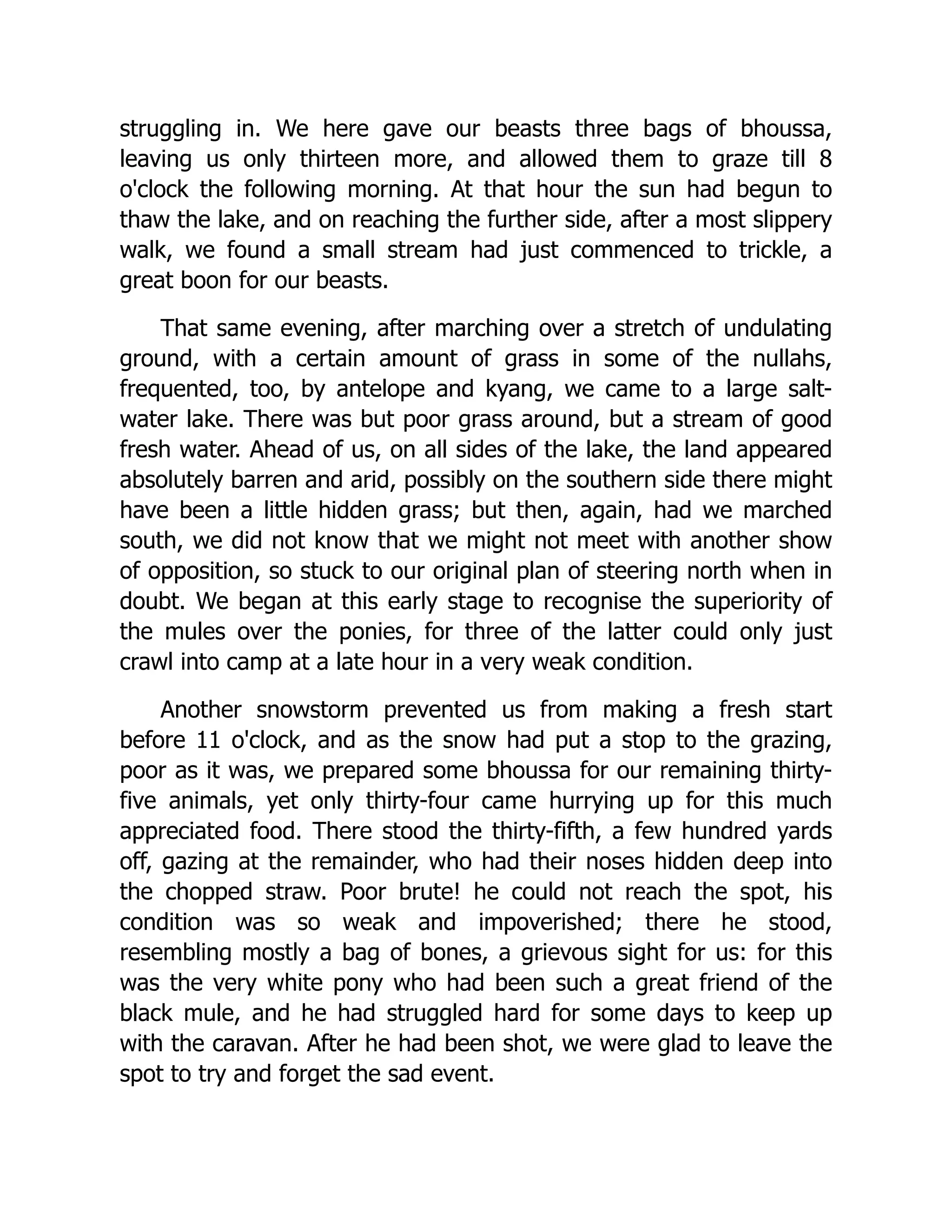
struggling in. We here gave our beasts three bags of bhoussa,
leaving us only thirteen more, and allowed them to graze till 8
o'clock the following morning. At that hour the sun had begun to
thaw the lake, and on reaching the further side, after a most slippery
walk, we found a small stream had just commenced to trickle, a
great boon for our beasts.
That same evening, after marching over a stretch of undulating
ground, with a certain amount of grass in some of the nullahs,
frequented, too, by antelope and kyang, we came to a large salt-
water lake. There was but poor grass around, but a stream of good
fresh water. Ahead of us, on all sides of the lake, the land appeared
absolutely barren and arid, possibly on the southern side there might
have been a little hidden grass; but then, again, had we marched
south, we did not know that we might not meet with another show
of opposition, so stuck to our original plan of steering north when in
doubt. We began at this early stage to recognise the superiority of
the mules over the ponies, for three of the latter could only just
crawl into camp at a late hour in a very weak condition.
Another snowstorm prevented us from making a fresh start
before 11 o'clock, and as the snow had put a stop to the grazing,
poor as it was, we prepared some bhoussa for our remaining thirty-
five animals, yet only thirty-four came hurrying up for this much
appreciated food. There stood the thirty-fifth, a few hundred yards
off, gazing at the remainder, who had their noses hidden deep into
the chopped straw. Poor brute! he could not reach the spot, his
condition was so weak and impoverished; there he stood,
resembling mostly a bag of bones, a grievous sight for us: for this
was the very white pony who had been such a great friend of the
black mule, and he had struggled hard for some days to keep up
with the caravan. After he had been shot, we were glad to leave the
spot to try and forget the sad event.
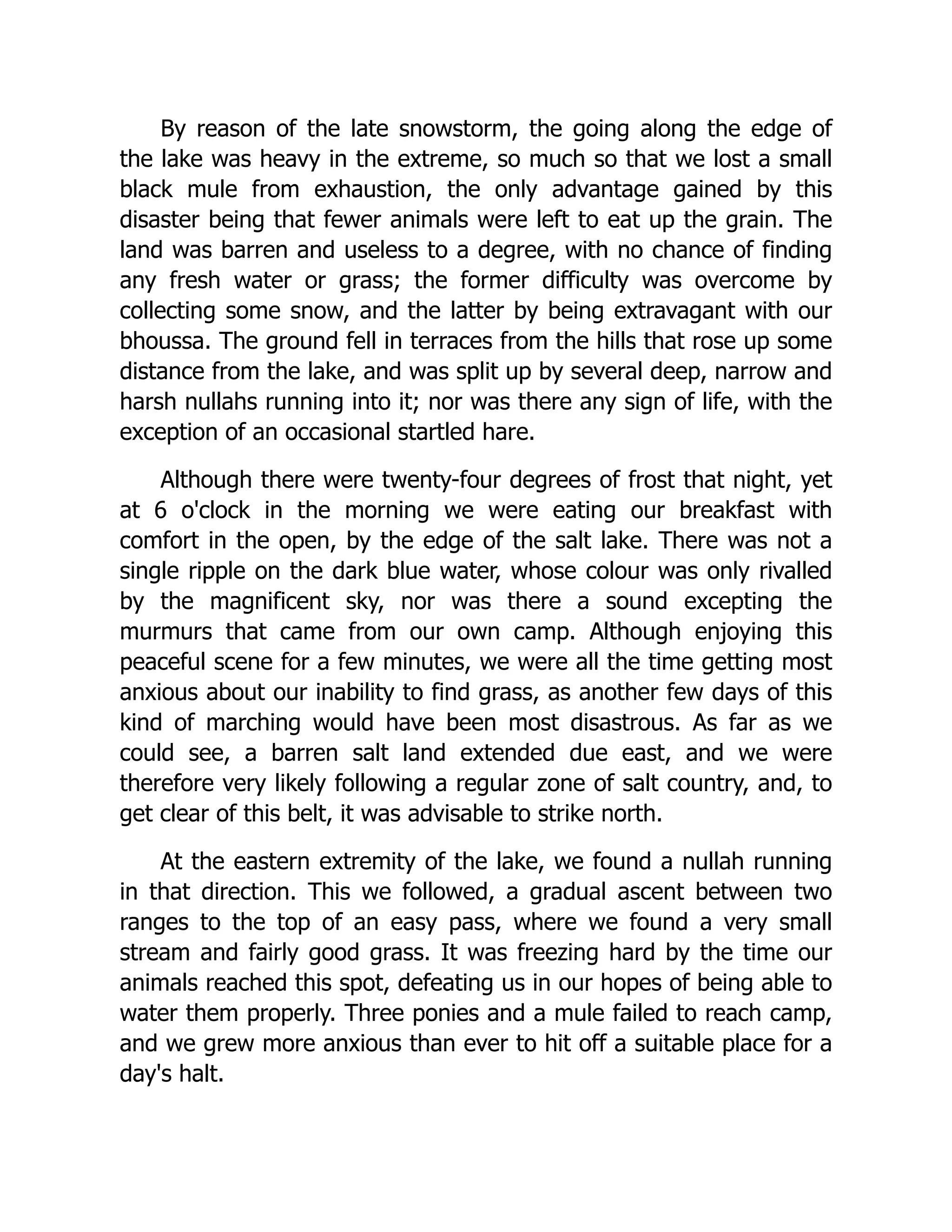
By reason of the late snowstorm, the going along the edge of
the lake was heavy in the extreme, so much so that we lost a small
black mule from exhaustion, the only advantage gained by this
disaster being that fewer animals were left to eat up the grain. The
land was barren and useless to a degree, with no chance of finding
any fresh water or grass; the former difficulty was overcome by
collecting some snow, and the latter by being extravagant with our
bhoussa. The ground fell in terraces from the hills that rose up some
distance from the lake, and was split up by several deep, narrow and
harsh nullahs running into it; nor was there any sign of life, with the
exception of an occasional startled hare.
Although there were twenty-four degrees of frost that night, yet
at 6 o'clock in the morning we were eating our breakfast with
comfort in the open, by the edge of the salt lake. There was not a
single ripple on the dark blue water, whose colour was only rivalled
by the magnificent sky, nor was there a sound excepting the
murmurs that came from our own camp. Although enjoying this
peaceful scene for a few minutes, we were all the time getting most
anxious about our inability to find grass, as another few days of this
kind of marching would have been most disastrous. As far as we
could see, a barren salt land extended due east, and we were
therefore very likely following a regular zone of salt country, and, to
get clear of this belt, it was advisable to strike north.
At the eastern extremity of the lake, we found a nullah running
in that direction. This we followed, a gradual ascent between two
ranges to the top of an easy pass, where we found a very small
stream and fairly good grass. It was freezing hard by the time our
animals reached this spot, defeating us in our hopes of being able to
water them properly. Three ponies and a mule failed to reach camp,
and we grew more anxious than ever to hit off a suitable place for a
day's halt.
It was a grand, hot morning as we commenced the descent of
this pass, so much so that we were somewhat puzzled to know
really what amount of clothes we ought to put on to suit the
extraordinary variety in the temperature. As soon as we had come
down a few hundred feet, we came to a more hospitable-looking
country. Grass grew in some of the valleys, and water, too, was to be
had, while a herd of antelope close by gave us an easy chance of
knocking some of them over. Early in the afternoon we came to a
stretch of fairly good grazing, and in the sandy nullah close at hand,
a foot or so beneath the surface, flowed unlimited water. Antelope
were plentiful and tame around this spot, and having fallen into such
clover, we agreed to remain there over the following day.
During this necessary halt our time was by no means wasted.
Men and animals had to be doctored up, the shoeing had to be seen
to; there was mending, repairing, washing, sketching, mapping, and
writing to be done; above all things, we began to overhaul our
impedimenta to see if there were not a few articles we might
dispense with. As it was, we had only been making some nine or ten
miles a day, and even with this care we feared to think of or to count
our losses. At this spot we left a yakdan, with some horse-shoes and
a book or two inside. Whoever may happen to come this way will
find something worth having. One of our muleteers, too, named
Tokhta, was so ill that he could do no work; he had swollen to an
abnormal size, more resembling a balloon than a human being.
Looking ahead of us, it seemed as though a range of mountains
barred our road, and our only chance was to follow the sandy nullah
from whence we had obtained the water. It was now covered with
snow and ice owing to another storm during the night. On our left
hand were some very heavy craggy-looking rocks, and through them
was a very narrow gorge, only a few yards across, sorely tempting
us to follow it through and see what would be disclosed on the
further side. It almost invited one to enter and explore, but we
feared marching too far north, and followed instead the nullah we
were in, which eventually led to the summit of a pass. The way was
steep and rocky, and the sun so powerful that we slung our coats
across our arms and loitered on the top for the breeze and the
caravan. Snow lay there in heaps, a welcome quencher to our thirst.
This was a stiff climb for our caravan, the height of the pass being
nearly 17,000 feet. Having waited till they were nearly at the top, we
began to descend again the other side.
Quite suddenly we seemed to be transplanted into a new zone,
for a cutting snowstorm blew straight in our faces. We were almost
frozen, and any portion of the head we exposed suffered severely.
We looked for some overhanging rock that would serve for a shelter,
but there the cold became so intense that we preferred to fight the
elements and keep in motion. As soon as we had completed the
descent we found a broad valley stretching east and west,
apparently to eternity. We walked along this, for our ponies had
become too weak for us ever to think of riding them again, and
sought grass and water for making a halt by. Having found a fairly
suitable spot, and waited for a considerable length of time, we were
perplexed to hear no sign of the caravan. They would have to come
thus far, for until they did they would find no fit place to camp in.
Darkness and cold came upon us, and we kept up an
intermittent fusillade till eight o'clock, when a distant shout in reply
revealed to us that they were at length coming. But alas! although
some of the mules walked in fit and strong, others came in
wretchedly weak, and, worst of all, six animals and three complete
loads had been abandoned altogether.
This was a crushing bit of news, coming as it did just after our
day's halt, when we had expected to make such good headway. The
men, too, declared that these six animals had all died; but we
suspected, from their demeanour and the way they spoke and
behaved, that very likely some of them had been left behind in good
condition for a reason, namely, that should any of the men take it
into their heads to turn back, they would have the assistance of one
or two stout animals to carry what they wanted. We knew they had
been taking but little care of the transport, even in the proper
adjustment of their loads.
In order to satisfy our suspicions, we arranged that Malcolm
should remain in camp, or, better still, shift the camp a mile or so
further on to a better spot, while I should take a man and go back in
search of the mules and ponies that had been left behind. After a
five-mile tramp, we came to a dead black pony, and another mile
further on found a single mule grazing, to whom we gave some of
the grain we had brought with us. In another nullah close by was a
second dead pony and another mule, which must have very shortly
died had we not hastened on his end with a revolver. The fifth, a
grey mule, we found grazing, apparently enjoying himself. The sixth,
a dun-coloured pony, we could discover nowhere. He was a useful
pony, and had probably wandered a long way in search of good
grass. We returned triumphant to camp with the grey and black
mules, the latter especially doing good work afterwards for some
weeks to come. Had one of us not gone back we must have lost the
services of two strong mules, which would have been due solely to
the men's laziness, and we could not help thinking that they, the dun
pony, and the three loads of food, had been temporarily abandoned
with the intention of helping some of the men on a return journey to
Ladakh. My satisfaction was, however, marred on return to camp by
the news that my own riding pony had succumbed in the night.
CHAPTER VIII.
LAKE LIGHTEN—INTENSE HEAT—AN OLD FIREPLACE—SERIOUS ACCIDENT
THROUGH OVER-HASTE OF MULES TO DRINK—A COUP D'ŒIL—THE FIRST
FLOWER—OUR PET SHEEP—ANOTHER FRESH-WATER LAKE—A PLEASANT BATH
—DEATH OF ANIMALS AND DEARTH OF GRAIN.
We were now reduced to twenty-eight animals, and we knew
our muleteers to be so careless and untrustworthy a lot, that we
resolved that henceforth one of us should always remain with them
and the mules—never, in fact, let them out of our sight. This would
ensure the animals being properly cared for, and would be a
prevention against the muleteers forming any scheme for desertion.
We decided, too, to make very easy marches. We continued to see
snow mountains in all directions, and somehow or other managed to
steer our way amongst them, either east or north-east, over valleys
and plains or stony nullahs, but we were most unfortunate as to
finding good grass. It must have been too early in the year, for in
many places it was just beginning to sprout.
Owing to the heavy loss to our transport we could only march
some four or five miles the next day, which brought us to a big
fresh-water lake, completely frozen over, resembling a large white
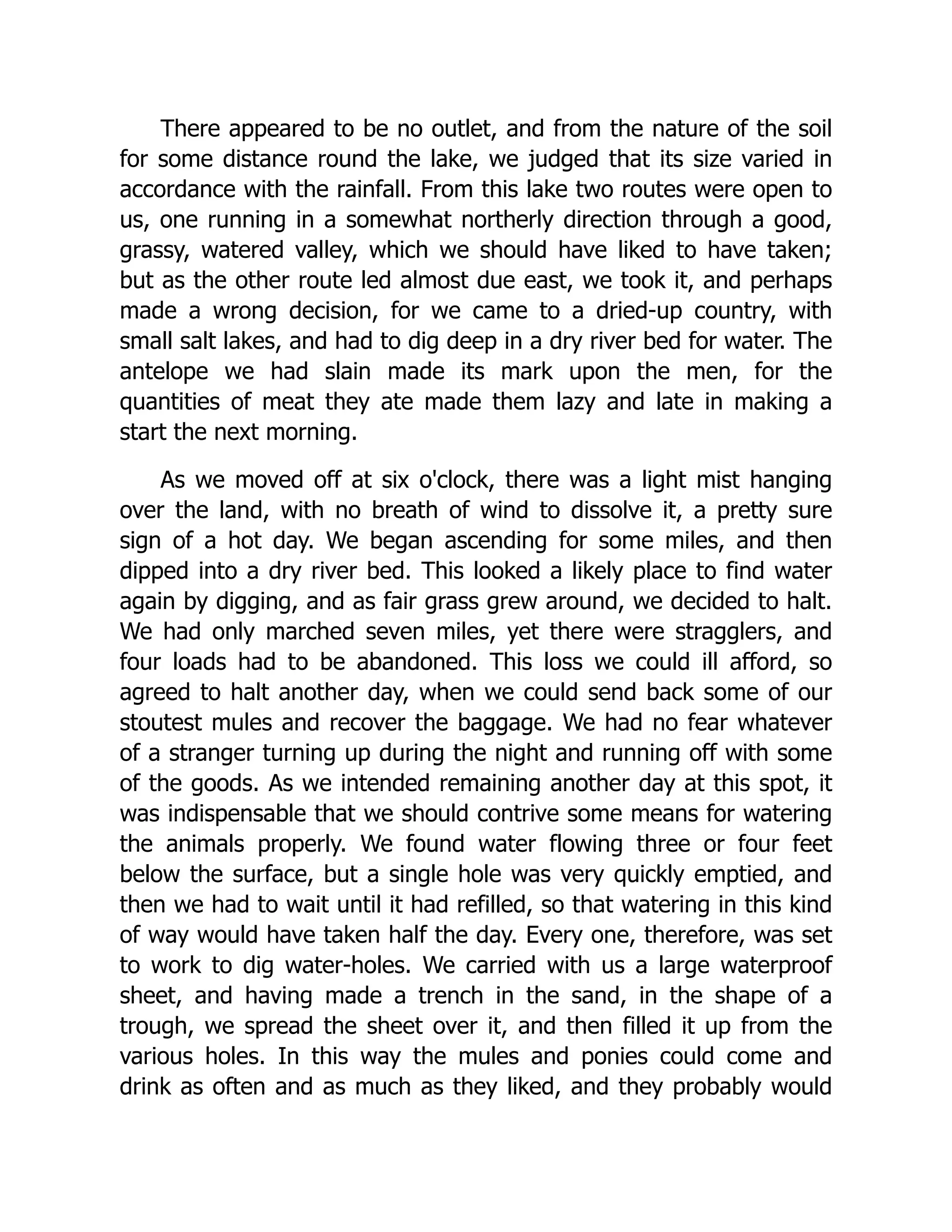
sheet. Here we resolved to lighten our loads, and left on the ground
a number of cartridges, horse shoes, cooking utensils, clothes,
candles, etc., besides giving the mules and ponies a feast of forty
pounds of flour made into bread. Some old pistols, rather heavy
ones, which we had brought with us as presents for natives, we
allowed the men to carry themselves, on the condition that should
we require them as presents we would buy them back from them,
otherwise they might retain them for ever. Every one, too, carried a
certain number of cartridges, the men doing so under the proviso
that we would lend them a rifle when game was close to camp.
LAKE "LIGHTEN" (WE LIGHTENED OUR LOADS HERE).
To celebrate the occasion we christened this lake "Lake Lighten."
The size of this frozen water was deceptive. Our direction took us
over a portion of it which we reckoned to be about a mile across, but
in reality this turned out to be six miles. On the other side we found
good grass, and in a snug corner a very tiny fresh-water lake, or
what we should call at home a duck-pond. Here were geese,
antelope, and kyang, so we were able to make a substantial addition
to our larder, which at that time was in the same state as Mother
Hubbard's cupboard. This spot, too, became famous in its way for
two events. First, it was here discovered that one of our carbines
had been left behind the day before, and the men were so unwilling
that none would go back to fetch it. To do more than they were
obliged to do was quite against their grain. Secondly, another mule
had to be shot, for he was too weak to rise and march. The next day
another pony met the same fate, and we began to think our
ammunition was more useful for this purpose than for killing game,
which, as a rule, was scarce. Our march took us another six miles
over the ice, and on the way we narrowly escaped losing one of the
best mules, who dropped his hind legs in a crack; luckily, he was
extricated unhurt, but he might easily have broken a leg.
On the 13th of June we camped by another salt lake. From the
top of a pass we had been rewarded with a very fine view of it, for
the water under a cloudless sky was of a wonderfully bright blue,
backed as it was by massive snow mountains, but detestable when
near for its uselessness. As we marched along its banks, the heat
was intense, the maximum thermometer registering 105° in the sun,
and although there was no fresh water to be seen, we found some
by digging, though not enough to satisfy our mules, and on making
our tea, its constituency was, to say the least of it, thick; perhaps
Esau's description of it was nearer the mark, for he said it was like
jam. On warm days like this we were always glad to discard our
heavy boots, and coats, while our little terrier Ruby could only lie
and pant for breath. Such heat in the Chang at a height of between
fifteen and sixteen thousand feet may seem to some people
incredible. Its effect upon our animals was most disastrous, sapping
their strength in no small degree, and on this account we decided in
future to make an earlier march.
In this little nullah we found three stones which from the way
they were placed showed that they had been used for a fireplace,
but not at any very recent date, more likely two or three years ago.
This was the first sign of mankind since leaving Lanak La, and had
probably been made by some nomads who had wandered in this
direction. We here consumed two more of our remaining three bags
of bhoussa, thereby still more lightening our loads.
According to our intention, camp was astir at 3.30 a.m., and we
were well off before 5 o'clock, and even at that hour it was so warm
that our gloves were not even wanted. It was a grand morning, and
as we faced the glorious rising sun, we were blinded by its brilliancy
and found it most difficult at first to see precisely where we were
going. After passing into a fairly grassy valley, the home of the
kyang, we descended to a fresh-water lake. At the time when the
caravan was approaching this water, we were both some distance
off, shooting and taking observations, and blamed ourselves
afterwards at having left the muleteers. These men knew the
animals had been short of water lately, yet took no step to prevent
the calamity which naturally occurred at the sight of a clean fresh-
water lake. They, poor brutes, forgetful of the loads on their backs,
with one accord made a simultaneous rush to satisfy their thirst. The
water, although only two or three feet deep, concealed a treacherous
bottom of several feet of soft mud and as they plunged in further
and deeper, a general collapse ensued, and the mules and ponies lay
in a heap unable to extricate themselves, with a good chance too of
being drowned. Nor did any of our baggage benefit by the soaking it
received. Each animal as he lay had to be unloaded separately, no
easy undertaking, and then pulled out of the mud on his side by
head and tail, by four or five men. Furthermore the weight of each
load was considerably increased by this disaster, and as the going
along the edge of the water was not of the best, there were more
stragglers than ever into our new camp, two of them not even
getting in at all. Around the lake were several antelope, while geese
and Brahmini ducks were fairly plentiful.
There appeared to be no outlet, and from the nature of the soil
for some distance round the lake, we judged that its size varied in
accordance with the rainfall. From this lake two routes were open to
us, one running in a somewhat northerly direction through a good,
grassy, watered valley, which we should have liked to have taken;
but as the other route led almost due east, we took it, and perhaps
made a wrong decision, for we came to a dried-up country, with
small salt lakes, and had to dig deep in a dry river bed for water. The
antelope we had slain made its mark upon the men, for the
quantities of meat they ate made them lazy and late in making a
start the next morning.
As we moved off at six o'clock, there was a light mist hanging
over the land, with no breath of wind to dissolve it, a pretty sure
sign of a hot day. We began ascending for some miles, and then
dipped into a dry river bed. This looked a likely place to find water
again by digging, and as fair grass grew around, we decided to halt.
We had only marched seven miles, yet there were stragglers, and
four loads had to be abandoned. This loss we could ill afford, so
agreed to halt another day, when we could send back some of our
stoutest mules and recover the baggage. We had no fear whatever
of a stranger turning up during the night and running off with some
of the goods. As we intended remaining another day at this spot, it
was indispensable that we should contrive some means for watering
the animals properly. We found water flowing three or four feet
below the surface, but a single hole was very quickly emptied, and
then we had to wait until it had refilled, so that watering in this kind
of way would have taken half the day. Every one, therefore, was set
to work to dig water-holes. We carried with us a large waterproof
sheet, and having made a trench in the sand, in the shape of a
trough, we spread the sheet over it, and then filled it up from the
various holes. In this way the mules and ponies could come and
drink as often and as much as they liked, and they probably would
have drunk more than they did, had not the water been somewhat
saltish, with certain purging qualities. We also set about lessening
the loads again, and many of the articles which we had imagined
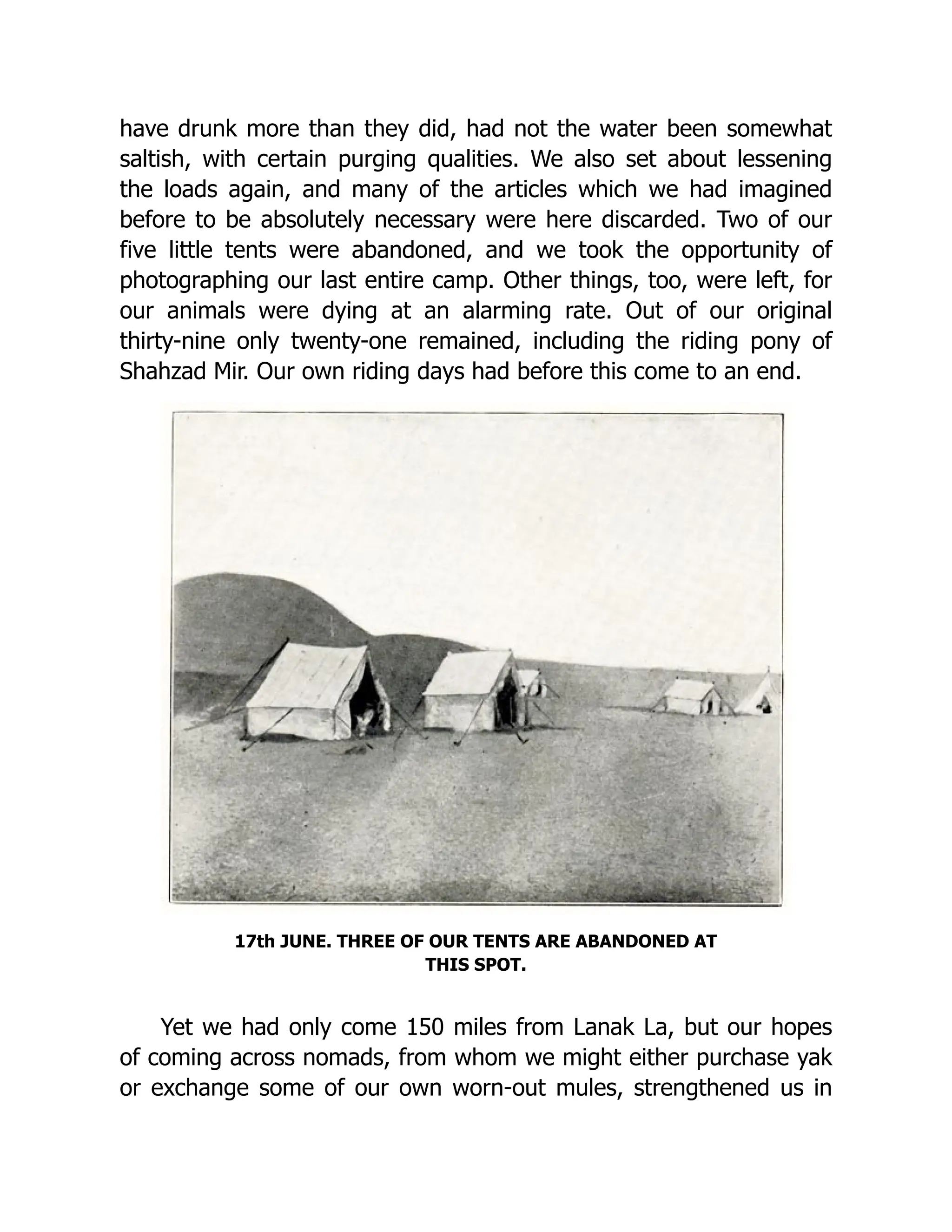
before to be absolutely necessary were here discarded. Two of our
five little tents were abandoned, and we took the opportunity of
photographing our last entire camp. Other things, too, were left, for
our animals were dying at an alarming rate. Out of our original
thirty-nine only twenty-one remained, including the riding pony of
Shahzad Mir. Our own riding days had before this come to an end.
17th JUNE. THREE OF OUR TENTS ARE ABANDONED AT
THIS SPOT.
Yet we had only come 150 miles from Lanak La, but our hopes
of coming across nomads, from whom we might either purchase yak
or exchange some of our own worn-out mules, strengthened us in
our determination not to entertain for a moment the idea of turning
back. The men, too, were so confident that we should ere long fall in
with nomads that they became lavish with their rations. Instead of
continuing the practice of doling their allowance out to them every
three or four days, they had latterly been permitted to have the full
run of it, after being made well aware how long the rations should
last if they never exceeded the amount agreed upon. This plan was
instituted because in spite of all our endeavours to regulate the
consumption of food, yet in the dead of night they would undo and
take out whatever extra they fancied, even when the foolhardiness
of such a procedure was carefully explained to them. Nevertheless,
we reaped one advantage from their avarice, namely, that the loads
grew lighter in a shorter time than they otherwise would have done.
One man, Mahomed Rahim, annoyed at being upbraided for his
laziness and sulky temperament, threatened to turn back. This we
gave him full permission to do, much to his astonishment, and on
second thoughts he withdrew his threat, and even our own
persuasion would not induce him to go.
During our halt we were able to overhaul all the luggage. Some
of it had suffered from the immersion in the lake, notably the
contents of our dispatch box, for all our papers inside it had had a
thorough soaking, and each one had to be put under a stone to be
dried again, and to save it from being blown away by the strong
wind.
About half a mile from our camp was a solitary hill rising up
between eight and nine hundred feet above the level of the camp. I
climbed over the rocks to the summit of this to spy out the land, and
see which would be the most favourable route to take. South-east of
us lay a fine range of snow mountains, and I reckoned that if we
could manage to steer just north of these, there would be no more
difficulty about water to annoy us. All the ranges, large and small,
seemed to run east and west, and it struck me how much more
difficult, for this reason, it would be to traverse Tibet from north to
south. Directly south of us, some sixty or eighty miles off, was
another magnificent snow range with enormous white peaks. Some
six or eight miles south-east was a dark blue salt lake, with two
other smaller ones nestling close to it, and in the nullah immediately
south of us grew grass which, for this country, was rich. Far away to
the north again loomed another mighty snow range. Our own way
eastwards, as far as I could make out, would take us past a small
lake, and then, skirting round some low hills, turned up a nullah half
left, where there seemed, through my glasses, to be good grass.
On account of the heat we delayed our march till early in the
afternoon. During a part of the morning we tested the skill of our
muleteers in rifle shooting. We thought that, should we come across
nomads who showed any signs of hostility, our men would have
more confidence in their arms, and perhaps would not show the
white feather. None of them could hit an empty bottle at forty yards,
so the confidence in their aim received rather a demoralising shock.
Two days after leaving this camp, we crossed over an easy pass
of some 17,000 feet high, and about the top of this found a small
white butterfly and a yellow flower, the first we had seen, and it was
satisfactory to think that our flower press had not been carried along
all this way for nothing, for it nearly shared the same fate as other
things thrown away. A few miles further on, we camped in a grassy
nullah, close by some heavy, craggy rocks.
Finding the morning again too hot for the mules to march, we
shouldered our rifles and set forth in search of game, and to try and
find out the lay of the country ahead. We had completely run out of
meat and had no wish to slay our single sheep, which for many days
had marched along with us, the sole survivor of our flock. He had
now become inured to hardships, was never fatigued, and was
looked upon as our very last reserve in case of starvation. Although
we actually found no game, yet we saw tracks of antelope, kyang,
and one or two entire skeletons of yak.
WE CAMP IN A GRASSY NULLAH.
We were rewarded for our tramp in another way, when, from
some high ground, we saw below us a fresh-water lake with rich
grass growing around it, and we wondered why nomads did not go
and live there if they knew of the spot. We hurried back to camp
with the good news, so as to march to such a paradise as soon as
possible, and halt there another day, to give our animals the
opportunity of thoroughly enjoying the luxurious spot. Poor brutes,
strive as hard as they might, there had been more casualties
amongst them and we were reduced to nineteen, less than half our
original number.
On arrival at this lake, we found the centre portion of it was
frozen over. By the edge of the water were a number of geese; but
they might as well have been living in another country altogether, for
they would give us no chance of shooting them, and we began to
meditate the slaughter of our pet sheep, when, coming over the
crest of a grassy rise, we spotted a herd of antelope. They were
certainly timid, but, with a lucky longish shot, Malcolm knocked one
over, saving us from hunger and our dear old sheep from an
unmerited death. How often we looked at our living mutton with
hungry feelings, it is hard to say, and how often an antelope just
saved him from the slaughter-house would be equally hard to relate.
We admired him, too, for his pluck and endurance, for he had long
outstayed every other member of the flock. Our affection for him
was great, and we even meditated his triumphal entry into China,
and he would undoubtedly have accomplished it, had not an
unforeseen mishap later on demanded his flesh and blood. Poor
beast, if he had only known how we admired him, he would willingly
have given us a dinner long ago.
It was a great treat for all to get good water clear and fresh, for
latterly the water we had been digging up had been mostly muddy
and saltish. We were blessed with a perfect day for repose, the
mules and ponies grazed along the edge of the lake, sometimes
standing up to their fetlocks in the still water, a day of thorough
enjoyment to them. All their swellings and sores too were doctored
up and the shoeing looked to. Considering what they had
undergone, their backs were in a very satisfactory state. Tents and
clothes were mended and a general clear-up was organised, so
much so that about midday, we and Ruby were bathing in the lake
itself, and although the lake was partly frozen over with ice, and we
were living at a height of nearly 16,000 feet, the water was quite
enjoyable, and we could remain splashing about in it for half an
hour, and afterwards bask naked in the sun. So much pleasure did
we derive from this bath that we ordered all the men down for
tubbing. They went, certainly, but the amount of washing they
executed would not have been sufficient for some people.
A DAY'S HALT BY A FRESH-WATER LAKE.
A climate like this at such a height struck us as truly marvellous.
After seventeen degrees of frost by night, we found ourselves
basking in the open in a temperature of 106 degrees, showing a
variation of ninety degrees in the twenty-four hours. At 7 p.m. again,
the thermometer registered as much as forty-eight degrees Fahr. Our
route, as far as we could make out, lay over a large open plain with
but scanty grass, and far off we could see a hill standing out alone
conspicuously, a useful landmark for us to march on to. Without a
distinct feature to make for, the caravan would very often zigzag
down a broad valley and perhaps cover a mile or two more of
ground than was necessary.
We were off before 5 o'clock, with a keen morning air in our
faces, but after a couple of hours the heat became so unbearable
that we would fain have halted. We had, however, to march ten
miles before we could find a spot at all suitable, where, too, we had
to resort to digging for water. Around here we shot sand-grouse,
excellent food. Owing to the impossibility of marching with the sun
so powerful, we decided to make two short marches each day, one
of three hours in the very early morning, and the second during the
afternoon. The drawbacks to this method were the uncertainty of
finding grass and water twice in one day, and the fatigue involved in
doubling the work of collecting the animals and loading and
unloading them. But to march ten miles straight away in one
morning as we had just done would have been suicidal. We
reckoned that by making these two short marches, we should cover
rather more ground each day, about twelve miles.
Whilst resting the animals, that they might recover from the
results of the hot morning's march, we sent Esau on in front to spy
out the land, who brought back the favourable news that lakes and
grass were ahead of us, and no mountains to climb. It was bitterly
cold as we moved off at 4.30, but no doubt a bracing morning for
our animals, but as soon as the sun rose, the heat again made itself
unpleasant, and we were glad to find a suitable camp before 8
o'clock. One of the mules, a big black one, could only carry his load
a few yards, and had to be shot. Although at the end of the first
march we had found a good halting place in a clean gravel-bedded
nullah, with running water from the snow mountains, and fair grass,
yet the second march ended by moonlight with no grass at all, and
two of the ponies were left behind. Our second attempt at a double
march failed.
During the early morning we hit off a rivulet, which, as we
continued to follow it, increased in volume, but on issuing from the
nullah into a large open plain, this rivulet became a river, some ten
yards across, and two feet deep, and wound away northwards. As
our course took us due east, we reluctantly had to leave it, with the
hope of meeting it again further on, and of finding its size still larger,
so that we might be able to map out its course for a considerable
distance. For some time afterwards we could see a silver streak in
the distance, and beyond it an enormous range of snow mountains.
As soon as we left the river and marched east, our route lay
across a sandy gravel plain, and our chances of ever finding water
and grass again seemed very small, when, fortunately, from one of
the hills I climbed, I noticed a hidden dip in the ground, with grass,
and here, as usual, water was found by digging. The number of our
animals was still decreasing, and the strength of the survivors was
growing weaker and weaker. We had to economise every cupful of
grain, for that was the way we always doled it out. There were six
bags remaining, in all about 480 pounds, and we reckoned that each
bag would last out for eight marching days if we gave to each
animal two cupfuls of grain per diem. There were only sixteen
survivors. One of the mules showed an obstinate and mutinous
frame of mind, for when loaded with his fair due, he absolutely
refused to march; as soon as we gave him a light load, he trotted
along gaily and felt no effects from the march. He was about the
fattest and strongest mule we had, thereby convincing us that his
inability to carry his proper amount of baggage was a mere sham,
and in order that he should not get the better of us, we gave his
grain to others who did his work, until he saw the folly of his
obstinacy.
On viewing the country from a neighbouring hill, I found that if
we marched due east we should meet with obstacles in the shape of
innumerable steep nullahs of red, sandy soil, but that by marching
north-east we should travel over undulating grassy ground skirting
round a small range of hills. This latter route we decided upon, with
the hopes of marching due east again before very long. We also
made up our minds to try and find a good camp where we could halt
for two days, so that during that time we could send off men north
and south, with food to last them, in order to search for signs of
people. Even if the men were not successful in their object, still we
reflected that the animals would be gaining strength and a complete
rest all the while.
At 3.45 a.m., 23rd June, Camp 36, we were drinking our cocoa
with chupatty in the open, without feeling any discomfort from the
cold, preparatory to marching. We required neither gloves nor coats,
and we almost imagined we were about to start for an early morning
shoot in the Indian plains. For the next two days we made successful
double marches, inasmuch as there were no transport disasters. As
usual, we dug for water, and found it brackish for our labours.
Towards the end of the second day, we came to a small nullah
with beautifully green grass, and two tiny pools of water almost
fresh. Imprinted on the moist sandy soil were marks of kyang,
antelope, and yak. Evidently we had hit upon a favourite drinking
resort of game, and accordingly pitched our tents just out of sight
but close to the pools, expecting to get as much food as we wanted,
for it was no easy matter to keep ourselves supplied in meat.
Although we stopped here a day, the only game that came for his
drink was a cock sand-grouse, who suffered the penalty of death for
his intrusion, while just above the camp was an old hen, who sat
undisturbed upon her nest. We should have had to be a good deal
hungrier than we were before we could have found it in our hearts
to kill her.
CHAPTER IX.
TERRIBLE GUN ACCIDENT—WE SEND OUT SCOUTS.
We were still favoured with wonderfully fine weather. About this
time the wind would blow from the east in the morning, and
afterwards from the west, if there were any wind at all.
During our halt, we sent out men to the north and to the south,
to try and find some signs of nomads, while we ourselves sallied
forth in search of game. The total result of all our exertions was nil.
The men who went south spoke only of a hilly country with grass
and no water, and the northerners reported that after crossing a
broad grassy valley they came to a range of hills, and that on the
other side flowed our lost river, then consisting of a small stream
running south-east in the centre of a very large sandy nullah; that
still further off was another range of hills but no grass. We could not
put much faith in the assertion of having found our lost river, which
must have been still further north.
There is a place marked as a town in our map, called Barkhalu,
which we intended to try and steer for by keeping as nearly as
possible on the line of its exact latitude. From our present camp we
reckoned that it was about a week's journey off. With such
expectations, we endeavoured to keep up our men's spirits, and to
induce them to double their exertions. It was always a difficult task
to get them up of a morning in time to load the animals for an early
start, and upon their doing this our success greatly depended. In
order to make a start at 4.30 a.m., the camp would have to wake up
very soon after three, and unless Malcolm or I awoke, the camp
would go slumbering on till sunrise. But when we knew it depended
upon ourselves, one of us generally managed to wake up in time. As
the men had returned unsuccessful from their search for people
after one day, there was no need to stop two, especially as all were
eager to get on to Barkhalu. At our first halt for grass and digging
operations, the sand-grouse came over in fair numbers and did well
for our breakfast. Ahead of us a range of hills obscured an extensive
view, although they did not appear of a very formidable nature,
differing from those ranges to our north and south. The very feeling
of not being able to see our onward course made us all the more
eager to surmount the obstacle, peep over the other side, and see
what lay in store for us.
On the 27th of June, Camp 39, we marched up the hills that hid
our view and camped near the summit, where the water was
brackish and purging. We inspected our men's rations, and found
there was only sufficient to last them twenty-five days more, and as
to ourselves, our consumption would have to be curtailed to one
pound a day between the two of us, so as to last out for the same
length of time. We all hoped to reach Barkhalu and there lay in fresh
supplies, and we felt that if we could not find the place, our
difficulties would be hard to overcome. From this summit we made a
very early start at 4 a.m. I went on ahead, as it was my turn, finding
it fairly plain sailing, considering it was not yet light. It was my
intention to reach some point of vantage, whence I could get a good
view as soon as there was sufficient light. Below me was an expanse
of uneven, barren, sandy country, and the haze prevented me from
seeing at all far.
As I was finding a way over these low mounds, I looked back, as
was my wont, to see how far the caravan had come, when I noticed
that Esau, a long way off, was coming towards me all alone, but,
thinking little of it, I went on again to another bit of rising ground.
There was Esau still alone, and on using my glasses I saw that he
was first walking, then running; no doubt he wanted me. I waved
my handkerchief and waited. On he came faster than before, so that
when he reached me, he was so breathless from his exertion and
feverish agitation, that it was some minutes before he could come
out with even a single word. His first utterance was, "Shot—gun." It
struck me that something terrible might have happened; all sorts of
things entered my head, and the worst thought of all—had Malcolm
met with an accident? I made Esau sit down, and as soon as he had
grown calmer, he told me that our cook, Lassoo, had been carrying a
shot gun, and that Mahomed Rahim had tried to take it from him.
Whilst they were struggling for the loaded weapon, off went the
trigger, and the contents of the cartridge had blown away the lower
half of the face of one of the muleteers, by name Sulloo, who was
marching only a couple of yards off at the time.
I hurried back as fast as possible, only hoping that Esau, like
many other people, had been carried away by his own imagination,
and greatly exaggerated the truth. I thought it quite possible that
the man might have been wounded, and at first sight that Esau had
on the spur of the moment concluded that half the man's face had
been blown away. I soon met the caravan, still coming along with
most of the men, but their long faces and downcast looks told me
too clearly that there had been some sad mishap. They told me that
Malcolm had remained with Sulloo to doctor him up and give him
brandy, and had sent on the caravan, with orders to halt at the very
first spot where water could be got. It seemed to me that at the
place where we met water could be obtained by digging, so the
animals were at once unloaded and set free.
On my way further back to the scene of the disaster I met
Malcolm coming towards me. He explained to me how the poor man
had completely lost the lower half of his face, and how he had done
his best for him in the way of bandaging and doctoring. It was
impossible for him to walk or ride, so the men took back one of our
bamboo beds, whereon to bring him into camp. Whilst they were
away on this errand, Malcolm and I set to work to dig for water, the
toughest dig we had had, and as the water could be only taken out
by cupfuls it was a very tedious business before the animals had had
sufficient to drink. The water, too, was very brackish, and almost
undrinkable.
In the meantime Sulloo had been brought in, and we found the
most effective solution in the way of soothing his pain was cyona
and water. The poor fellow was most plucky over it, and implored to
be merely left where he was to die. His only thought was that
somebody owed him twenty rupees, and he wanted this money to
go to his brother, and not to the woman he had married the day
before he had set out from Leh! And there was no one else he cared
about. We had certainly fallen into a most distressing fix. We could
not help wishing that it might be so willed that the unfortunate man
should die quietly that same morning. We could then have buried
him, and marched away from the sad calamity to fresh scenes. As
one of our men, Shukr Ali, philosophically remarked, it would only be
his "kismet." Should, on the other hand, the man live, for all that, it
was not in our power to remain where we were, for in that case the
small store of rations would have soon been eaten up, and when
they were gone there was nothing to follow, as far as we could see,
but starvation. "We must shove on and find people" had been our
daily axiom for some time, and to halt more than was absolutely
necessary for the strength of the mules would be entirely fatal. Yet it
was our duty, it we possibly could, to keep the man alive, and we
knew it, too. We were in a most unpleasant situation; whichever
course we adopted was equally hateful to us.
After seriously considering the pros and cons, we decided to
remain where we were, Camp 40, for the day, and on the morrow to
strap the man to a pony, with a muleteer walking on either side to
support him. The idea of carrying him on a stretcher certainly
entered our heads, but its execution was an impossibility.
It was indeed a very gloomy day, most of the time being spent
in trying to get enough water from the holes we had dug. The
unhappy Sulloo was fed through a small opening, by holding back
his head and pouring down brandy and water or mutton broth.
One sad event seldom comes without a second. As we had no
meat with us, and it was imperative that Sulloo should have
something in the shape of beef-tea, for solid food could never be his
fare again, we had to slay our dear old sheep and make the soup
from his bones and what flesh there was. We wondered all the time
what possible good we could be doing the man. He would never be
able to eat again, nor even speak, or, as Shukr Ali put it, "What's the
use of troubling about him? Admi kabhi nahin banjaega! He'll never
make a man any more."
Our caravan was very depressed as it moved off the next
morning at 4.30, marching for five miles over a most barren, sandy,
and desolate country, when there was some improvement, and we
were able to call a halt, again managing to get brackish water by
digging. Poor Sulloo was brought into camp later on, and seemed to
be doing well, for the bleeding ceased when he was placed on the
ground and rested from the motion of the pony. He would lie
huddled up in a heap on the pony's back, and if the pony happened
to take an uneven pace or make a sudden jolt over an unlevel piece
of ground, the jar to the man must have been almost unbearable.
The second march was accomplished, too, without any casualty to
man or beast.
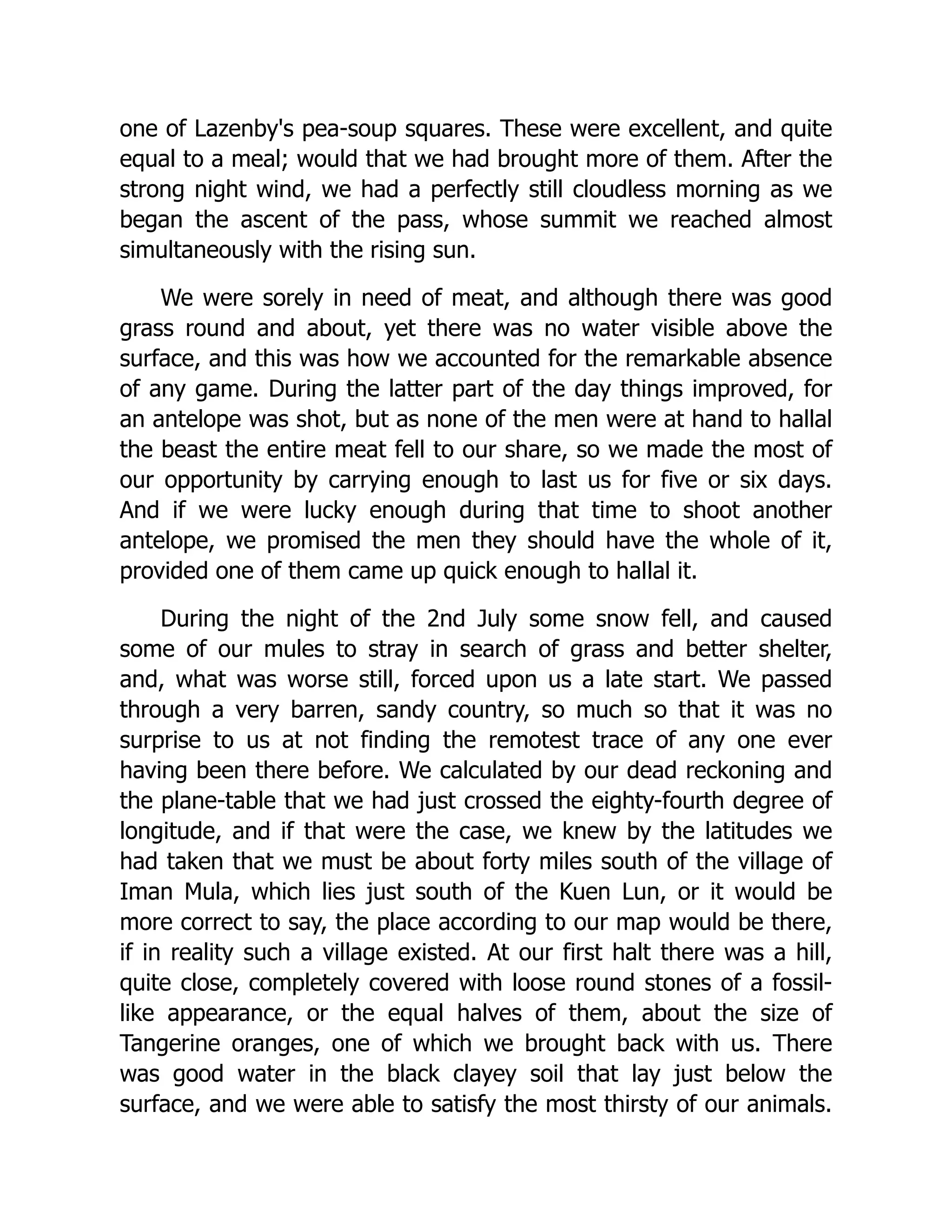
OUR MULES BEING WATERED.
The following day we had two stragglers, and Sulloo came in
late, for even the two miles an hour was too fast for him. The land
we marched over was remarkable for its various coloured stones;
there were different shades of blue, red, green, yellow, black, and
white, all perhaps indicating the presence of a multitude of minerals.
The fine range of mountains to the north was still kept in sight, and
we conjectured they must be a part of the Kuen Lun. Towards
evening we came to a sandy nullah at the foot of an easy pass, and
as water was good and plentiful a foot below the surface, and the
animals had had none that day, we halted and made our drinking
trough with the waterproof sheet. The wind blew hard and bitterly
cold that evening from the north, and as we had no meat we tried
one of Lazenby's pea-soup squares. These were excellent, and quite
equal to a meal; would that we had brought more of them. After the
strong night wind, we had a perfectly still cloudless morning as we
began the ascent of the pass, whose summit we reached almost
simultaneously with the rising sun.
We were sorely in need of meat, and although there was good
grass round and about, yet there was no water visible above the
surface, and this was how we accounted for the remarkable absence
of any game. During the latter part of the day things improved, for
an antelope was shot, but as none of the men were at hand to hallal
the beast the entire meat fell to our share, so we made the most of
our opportunity by carrying enough to last us for five or six days.
And if we were lucky enough during that time to shoot another
antelope, we promised the men they should have the whole of it,
provided one of them came up quick enough to hallal it.
During the night of the 2nd July some snow fell, and caused
some of our mules to stray in search of grass and better shelter,
and, what was worse still, forced upon us a late start. We passed
through a very barren, sandy country, so much so that it was no
surprise to us at not finding the remotest trace of any one ever
having been there before. We calculated by our dead reckoning and
the plane-table that we had just crossed the eighty-fourth degree of
longitude, and if that were the case, we knew by the latitudes we
had taken that we must be about forty miles south of the village of
Iman Mula, which lies just south of the Kuen Lun, or it would be
more correct to say, the place according to our map would be there,
if in reality such a village existed. At our first halt there was a hill,
quite close, completely covered with loose round stones of a fossil-
like appearance, or the equal halves of them, about the size of
Tangerine oranges, one of which we brought back with us. There
was good water in the black clayey soil that lay just below the
surface, and we were able to satisfy the most thirsty of our animals.
During the day there was thunder and a shower of snow. It seemed
as though there was about to be a breaking up of the grand
weather.
The men wanted us to give Sulloo some medicine which would
make him insensible, so that they might then sew up a portion of his
face. This we did not feel inclined to do, as we did not know the
proper amount of laudanum to dose him with, and an attempt at
sewing up his face on the top of this would probably have done for
the man. He had, undoubtedly, gained some strength, for he was
able to keep up with the caravan on his pony.
Another snowstorm coming from the north, that blew through
the night, made the ground in heavy condition, so that we had to
make a late march. We passed through a sandy, stony country, with
low ranges of hills on either hand, and further off another large
range running as usual almost east and west. Our difficulties
throughout the day were increased by the scarcity of water.
On the 4th of July we found ourselves marching down a fine
grassy nullah, with several others running into it from the north and
south, and we could not help thinking that we had struck a nullah of
some importance, that perhaps it would eventually lead to the
source of some river. About a foot below the surface we could
always get as much water as we wanted and of a very fair quality. It
was a happy event to have some means of raising hopes of finding
people in the men's minds again. They were becoming lazier and
inclined to be insolent, and any kindness or consideration we
showed them was looked upon as so much weakness on our part.
Our only way of getting any real work out of them was by behaving
towards them with sternness and severity, and showing a pretty
sharp temper, much as we disliked doing it. Towards evening the
aspect of the country underwent a change. Although there were still
grassy valleys, several of them and the intervening country were
adorned by curiously-shaped hills of sandstone.
Far away, some thirty or forty miles, in an east-north-east
direction, we saw a fine snow mountain range and peaks, and
decided to steer for the south side of them. On climbing a hill it was
obvious that the nullah we were in ran straight away towards these
mountains. This was certainly encouraging. There would be no more
trouble in having to find a way, and there would be no anxiety about
our water and grass supply. The chances, too, were that we should
pick up a better supply of wild game droppings for our fires, instead
of having to dig up so much boortsa each day, and on some
occasions we had hardly been able to collect enough to make a fire
at all. We argued, with regard to the range we should come to, that
if there were grass, streams from the snow, and shelter from the
hills, why should not there be wandering inhabitants of the place?
Some time back a muleteer, Ghulam Russul, had taken the post
of headman in place of Tokhta, degraded for incapacity. Ghulam
Russul had been on a previous trip with the Littledales, and knew
the likely sort of country where nomads love to dwell in. We had
been warned against this man by the Wazir of Leh, but then we
considered him the most suitable, out of a poor lot of men, for the
post of head muleteer. The sight of this range added to Ghulam
Russul's opinion that people might be living there, and the
knowledge that we must be somewhere near Barkhalu, if there were
such a place, induced us to make the following plan. We arranged to
send Esau and Mahomed Rahim south, and Ghulam Russul with
Shukr Ali north, each man with enough rations to last for two days;
this we were able to do, for fortunately an antelope had just lately
been shot. We furnished them with the simple instructions to find
people, get assistance in the shape of some baggage animals, and
return again into camp a little lower down, but in the same nullah
we were in. We agreed that we might just as well not lose an
opportunity of making a few more miles, by marching the first day
without these four men. Before, therefore, these two exploring
parties sallied forth, they helped to load up. We thought we could
manage to drive them by ourselves for one day, seeing that the way
was clear, although our numbers would be very small. Of a truth,
when these four men went off, there only remained, besides
Malcolm and myself, Lassoo and another man, called Usman, to look
after the caravan. This is really not enough, for one man must lead
the way in front; whenever, too, a load during the march falls over to
one side, the mule must at once be reloaded, to prevent any chafing
from a badly-balanced burden. While this is occupying the attention
of two or three men, the rest of the mules will stray in any direction,
unless there are some more men present to keep them together.
Sulloo, as usual, would come along behind, with one Juma to look
after him, whose special employment was as cook for the rest of the
men. Shahzad Mir, of course, would have to attend to his plane-table
work. Usman was a tall, black, powerful fellow, but not fond of work;
when Shahzad Mir's pony died he was generally told off to carry the
plane-table. This duty suited him admirably, for he could put in many
a snooze throughout the day on the top of various hills. He used to
say he had travelled before, with a Russian through Turkistan. As for
Tokhta, who had swollen to a tremendous size, resembling a large,
over-ripe gooseberry, or rotten apple, he had been sent out in the
very early morning to look after the ponies, for he was equal to no
other greater exertion, but when it came to the hour of starting
there was no Tokhta present, nor could we discover what on earth
had become of him. In the end, we moved off without him, knowing
that when he awoke, for he was probably slumbering peacefully in a
sheltered nook, he would find it no hard job to track us down the
nullah we were going along; besides, we intended halting all that
afternoon and the whole of the following day. Tokhta was a regular
drain upon us, for, although he had made up his mind that he was
unfit to do any more work, still he had to have his share of the
rations, much to the disgust of his brother muleteers, who under
such circumstances soon lost all affection for one another, and had
no scruples about letting a man starve as long as it suited their own
ends. Having loaded the animals, we all started off together, the
men who had been selected to the north and south, and we
ourselves down the nullah.
About 9 o'clock we decided to halt, as already one of the mules
had collapsed half a mile back. After unloading, we first of all dug a
number of water holes, so as to have an abundant supply for all. We
next found out that some of the animals required re-shoeing. We
had leisure to see to all things. Our little camp table had come to
ruin, or rather its legs had, but their place was taken by a couple of
yakdans, which served us equally well. Our two camp chairs were
still holding out; the most durable one that can be had in India is
from the Government workshops at Roorkee. Most other chairs
generally last for two or three weeks, when they require nailing and
binding up, only to give way again shortly afterwards. Even at this
early stage of our journey, when we were buoyed up with the empty
hopes of our men finding signs of people and of Barkhalu, and of
bringing in yak, ponies, and provisions, we began to anticipate the
pleasures of our voyage across a portion of China, down the Yellow
River from Lancheo to Pao T'eo. With so many men, we argued that
this would be quite the best way of getting through China, as well as
an inexpensive way, for we could pack the whole of them on one
boat, and ourselves on another; or, better still, perhaps one boat
would hold both the men and ourselves. Leisure and a clear night
enabled us to take latitudes again from north and south stars,
showing us to be about 35 degrees, 20 minutes.
During the afternoon of the following day Ghulam Russul and
Shukr Ali turned up, without any news whatever of people. They told
us how, after climbing a range of hills, they had been able to see an
immense distance, but that there was nothing more than a
continuation of grassy plains without any water; this, too, with the
help of field-glasses we had provided them with. As Esau and
Mahomed Rahim had not turned up by sunset, we began to
entertain hopes that they had really found people, and that their
delay was caused by bargaining and persuading them to come to us.
Tokhta, too, had not turned up, and must have been having a
splendid sleep. It was blowing hard with sleet the next morning, and
this, combined with Esau's absence, kept us imprisoned in our tent.
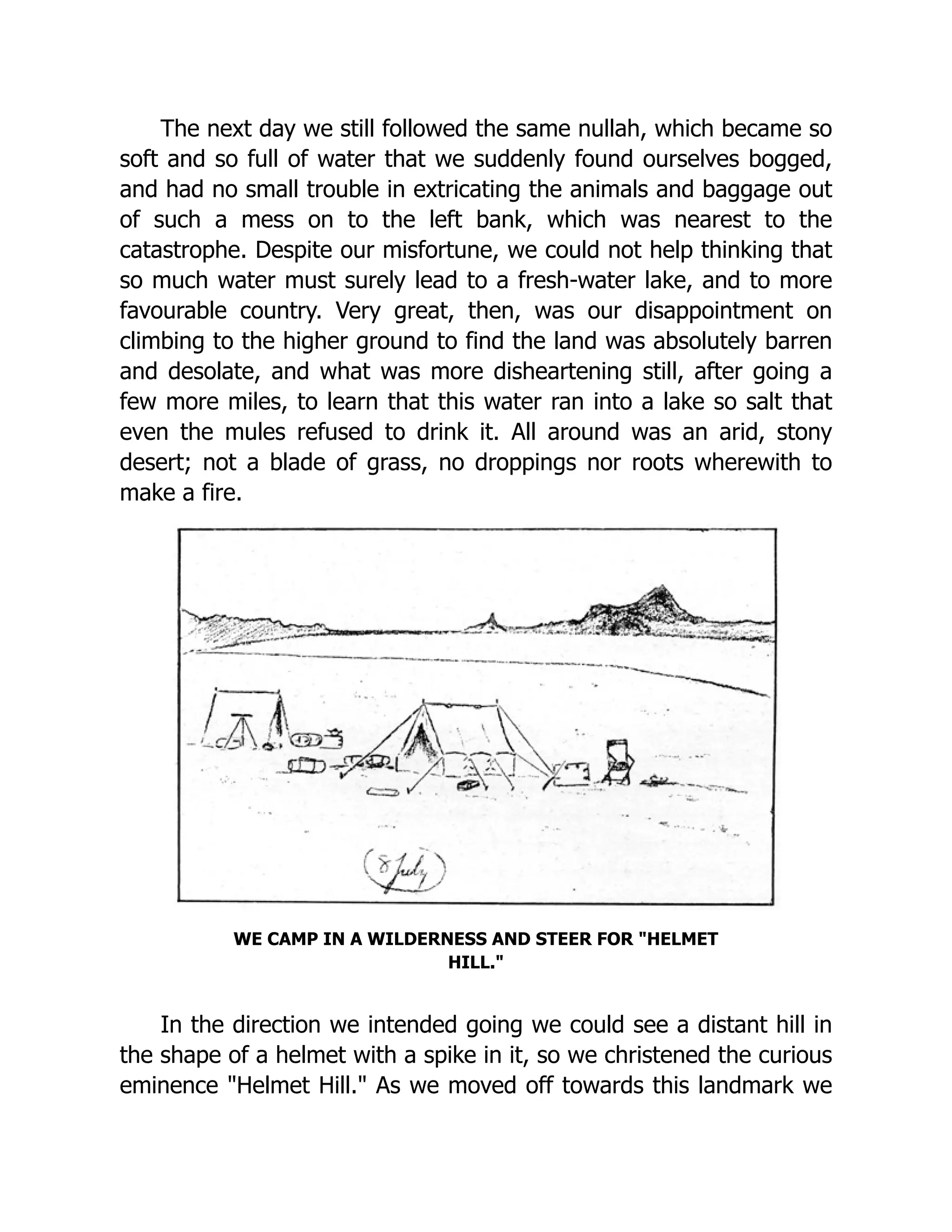
CHAPTER X.
I SHOOT A YAK—DEATH OF ANOTHER MULE—"HELMET HILL"— WE LEAVE
TOKHTA AND SULLOO BEHIND—REDUCED TO TWELVE ANIMALS—A MULE'S
ADVENTURE.
About 8 o'clock all these excuses for repose came to an end, for
the sun began to shine, and with it Esau returned, bringing Tokhta,
whom, as we had rightly surmised, he had found snoozing peacefully
in a nullah. We could not help feeling somewhat disappointed at the
sleeper's return, for the chief reason that the food he ate was like
having so much wasted. Nevertheless, had he not come in, we had
arranged to send back a search party for him. Esau had been equally
unsuccessful in his wanderings, and the only excuse for his absence
he could offer, was that he could not get back sooner!
We all moved off, once more reunited, down the nullah, soon
after 9 o'clock, and as I went ahead to feel the way, I came to a
spot where the nullah bifurcated. Here was actual running water,
and at the point of separation was a hill on which grew fine green
grass, and running half-way up it were two long lines of white
stones, piled up in small heaps of three, showing me that at some
time or other people must have been there.
Whilst reconnoitring the surrounding country from the top of the
hill, I spotted in a valley about two miles away a single yak grazing.
Seeing by the lay of the land that the caravan would have no
difficulty in finding their way, on arrival at this spot I went off on a
little stalk, taking Ruby with me. I had to cross a broad expanse of
sand, where some antelopes had come to drink, before reaching the
grass land where the yak was feeding. After cautiously crawling up
to a crest from where I had calculated I should be quite near
enough to the yak to shoot him, to my dismay there was no sign of
the animal, but as I had not seen him make off, I concluded he must
have moved on over some other crest, which now hid him from my
view, during the time of my stalk when he was out of my sight. This
proved to be the case, but it was only after crossing several crests
that I at length found him fast asleep in a dip of the ground.
Creeping up silently on tiptoe to within 100 yards, I woke him up
rather harshly by placing a ·303 Jeffery bullet into a fatal part, and
as he rose to learn the cause, I knocked him over with a second
bullet, much to little Ruby's unbounded delight, who was soon
scampering, snapping, and barking around the dying body, worrying
as only terriers can. To cut the flesh off a dead yak is no slight
undertaking, so I retraced my steps to get assistance from some of
the men, but, on reaching the hill, there was no sign of them. I
climbed to the top again, and found they had marched down the left
branch of the nullah, so soon made tracks for them. After about a
mile tramp, I came upon Mahomed Rahim and Shukr Ali asleep, and
by their side a little black mule on the point of dying. Seeing they
were doing no good, for the mule was too far gone, I sent them on
to catch up the other men and bring back another mule, so that they
could go to the dead yak and fetch in some meat for Malcolm and
myself, and for themselves too, if they cared to eat it, in spite of it
not having been hallaled. The death of another mule had now
reduced us to fifteen.
The next day we still followed the same nullah, which became so
soft and so full of water that we suddenly found ourselves bogged,
and had no small trouble in extricating the animals and baggage out
of such a mess on to the left bank, which was nearest to the
catastrophe. Despite our misfortune, we could not help thinking that
so much water must surely lead to a fresh-water lake, and to more
favourable country. Very great, then, was our disappointment on
climbing to the higher ground to find the land was absolutely barren
and desolate, and what was more disheartening still, after going a
few more miles, to learn that this water ran into a lake so salt that
even the mules refused to drink it. All around was an arid, stony
desert; not a blade of grass, no droppings nor roots wherewith to
make a fire.
WE CAMP IN A WILDERNESS AND STEER FOR "HELMET
HILL."
In the direction we intended going we could see a distant hill in
the shape of a helmet with a spike in it, so we christened the curious
eminence "Helmet Hill." As we moved off towards this landmark we
agreed that few things are more detestable than having to march
along the borders of a salt lake, where the surroundings are
absolutely barren and lifeless; such land as this always seems to
have a depressing effect on men and beasts, and one wonders why
there are such places. At night we most luckily found some fresh
water below the surface, in a sandy nullah, and in a small valley
close by grew some boortsa. This food the animals generally
preferred to grass, and there is no doubt that in this coarse kind of
short heather there is a deal of moisture and sustaining power. As
long as the mules could get plenty of boortsa, they wanted but little
water.
Such adverse and inauspicious times as these made their mark
on our men, who lost heart and became lazier. We consequently
made a later start from the sandy nullah than we should have done,
and on coming to the end of the lake, the sun being hot, we called a
halt where we fancied we should get water by digging. In this
expectation we were unfortunate, much to the annoyance of our
muleteers, and to make them feel that the misfortune was brought
about by themselves, we explained to them that had they only risen
and marched earlier we should by this time have been some miles
further on, and reached a place where water could be obtained.
At this waterless camp we had to shoot a big, grey mule, who
could not possibly have done another march. He had carried a load
for many days, and we felt his loss severely. This death reduced us
to fourteen animals, including the one that was kept spare for
carrying Shahzad Mir's plane-table.
We felt we must come to a standstill unless people came across
our path before long. As the country was so barren and desolate, we
wanted to cover as much ground as possible that same afternoon. I
went on ahead, and so bare was the aspect that it looked as though
we should never see any water or green again; everywhere the
Welcome to our website – the perfect destination for book lovers and
knowledge seekers. We believe that every book holds a new world,
offering opportunities for learning, discovery, and personal growth.
That’s why we are dedicated to bringing you a diverse collection of
books, ranging from classic literature and specialized publications to
self-development guides and children's books.
More than just a book-buying platform, we strive to be a bridge
connecting you with timeless cultural and intellectual values. With an
elegant, user-friendly interface and a smart search system, you can
quickly find the books that best suit your interests. Additionally,
our special promotions and home delivery services help you save time
and fully enjoy the joy of reading.
Join us on a journey of knowledge exploration, passion nurturing, and
personal growth every day!
testbankdeal.com

Concise Introduction to Logic 13th Edition Hurley Solutions Manual

  • 1.
    Concise Introduction toLogic 13th Edition Hurley Solutions Manual download https://testbankdeal.com/product/concise-introduction-to- logic-13th-edition-hurley-solutions-manual/ Explore and download more test bank or solution manual at testbankdeal.com
  • 2.
    Here are somerecommended products for you. Click the link to download, or explore more at testbankdeal.com Concise Introduction to Logic 13th Edition Hurley Test Bank https://testbankdeal.com/product/concise-introduction-to-logic-13th- edition-hurley-test-bank/ Concise Introduction to Logic 11th Edition Hurley Solutions Manual https://testbankdeal.com/product/concise-introduction-to-logic-11th- edition-hurley-solutions-manual/ Logic The Essentials 1st Edition Hurley Solutions Manual https://testbankdeal.com/product/logic-the-essentials-1st-edition- hurley-solutions-manual/ Nutrition Through the Life Cycle 6th Edition Brown Test Bank https://testbankdeal.com/product/nutrition-through-the-life-cycle-6th- edition-brown-test-bank/
  • 3.
    Contemporary Business Law8th Edition Cheeseman Solutions Manual https://testbankdeal.com/product/contemporary-business-law-8th- edition-cheeseman-solutions-manual/ Intermediate Algebra Functions and Authentic Applications 5th Edition Jay Lehmann Test Bank https://testbankdeal.com/product/intermediate-algebra-functions-and- authentic-applications-5th-edition-jay-lehmann-test-bank/ Netters Essential Histology with Student Consult Access 2nd Edition Ovalle Test Bank https://testbankdeal.com/product/netters-essential-histology-with- student-consult-access-2nd-edition-ovalle-test-bank/ Issues and Ethics in the Helping Professions 10th Edition Corey Solutions Manual https://testbankdeal.com/product/issues-and-ethics-in-the-helping- professions-10th-edition-corey-solutions-manual/ Political Science Research Methods 8th Edition Johnson Test Bank https://testbankdeal.com/product/political-science-research- methods-8th-edition-johnson-test-bank/
  • 4.
    Business Analytics 3rdEdition Evans Solutions Manual https://testbankdeal.com/product/business-analytics-3rd-edition-evans- solutions-manual/
  • 5.
    Exercise 7.1, I ©2018 Cengage. All Rights Reserved. May not be scanned, copied or duplicated, or posted to a publicly accessible website, in whole or in part. 1 NOTE: If you are having any issues seeing logic symbols in this Word document, select "Read" mode under the View menu in MS Word. PDF versions of the Instructor Manual are also available on the Instructor Companion Site. Chapter 7 Exercise 7.1 Part I 1. G 1, 2, MT 2. M 1, 2, MP 3. E  D 1, 2, HS 4. C 1, 2, DS 5. K 1, 3, MP 6. S 2, 3, MT 7. F  D 1, 3, HS 8. N 2, 3, DS 9. N 2, 4, MT 10. G  A 1, 4, HS 11. A 2, 4, MP 12. S 2,3, DS 13. C 1, 3, MT 14. N 2, 4, DS 15. C  T 1, 3, HS 16. P 1, 2, MP 17. A  C 1, 4, DS 18. (R  M)  (M  E) 1, 3, HS 19. (S  C) 1, 3, MT
  • 6.
    Exercise 7.1, I ©2018 Cengage. All Rights Reserved. May not be scanned, copied or duplicated, or posted to a publicly accessible website, in whole or in part. 2 20. A  N 2, 4, MP Part II 1. B 11. F  G 1, 2, DS 2, 4, HS 2. N 12. M 1, 2, MP 2, 4, DS 3. T 13. S 1, 2, MT 3, 4, MT 4. R  C 14. F  J 1, 2, HS 2, 4, HS 5. N 15. S 1, 3, MT 1, 4, DS 6. W  T 16. Z 2, 3, HS 3, 4, MP 7. Q 17. H  (E • R) 2, 3, MP 3, 4, HS 8. C 18. (M • G) 1, 3, DS 2, 4, MT 9. S 19. H  G 3, 4, MP 2, 4, MP 10. A 20. (H • A) 1, 4, MT 1, 4, DS Part III (1) 1. C  (A  C) 2. C / A 3. A  C 1, 2, MP 4. A 2, 3, MT (2) 1. F  (D  T) 2. F 3. D / T 4. D  T 1, 2, DS 5. T 3, 4, MP (3) 1. (K • B)  (L  E) 2 (K • B) 3 E / L 4. L  E 1, 2, DS 5. L 3, 4, MT
  • 7.
    Exercise 7.1, III ©2018 Cengage. All Rights Reserved. May not be scanned, copied or duplicated, or posted to a publicly accessible website, in whole or in part. 3 (4) 1. P  (G  T) 2. Q  (T  E) 3. P 4. Q / G  E 5. G  T 1, 3, MP 6. T  E 2, 4, MP 7. G  E 5, 6, HS (5) 1. W  [W  (X  W)] 2. W / X 3. W  (X  W) 1, 2, MP 4. X  W 2, 3, MP 5. X 2, 4, MT (6) 1. J  (K  L) 2. L  J 3. L / K 4. J 2, 3, DS 5. K  L 1, 4, MP 6. K 3, 5, MT (7) 1. S  D 2. S  (D  K) 3. D / K 4. S 1, 3, MT 5. D  K 2, 4, DS 6. K 3, 5, MP (8) 1. A  (E  F) 2. H  (F  M) 3. A 4. H / E  M 5. E  F 1, 3, MP 6. F  M 2, 4, DS 7. E  M 5, 6, HS (9) 1. G  (G  A) 2. A  (C  A) 3. G / C 4. G  A 1, 3, MP 5. A 3, 4, DS 6. C  A 2, 5, MP 7. C 5, 6, MT (10) 1. N  (J  P)
  • 8.
    Exercise 7.1, III ©2018 Cengage. All Rights Reserved. May not be scanned, copied or duplicated, or posted to a publicly accessible website, in whole or in part. 4 2. (J  P)  (N  J) 3. N / P 4. J  P 1, 3, MP 5. N  J 2, 4, MP 6. N  P 4, 5, HS 7. P 3, 6, MP (11) 1. G  [O  (G  D)] 2. O  G 3. O / D 4. G 2, 3, DS 5. O  (G  D) 1, 4, MP 6. G  D 3, 5, MP 7. D 4, 6, MP (12) 1. M  (B  T) 2. B  W 3. M 4. W / T 5. B  T 1, 3, DS 6. B 2, 4, MT 7. T 5, 6, DS (13) 1. R  (G  A) 2. (G  A)  S 3. G  S 4. R / A 5. G  A 1, 4, MP 6. S 2, 5, MP 7. G 3, 6, MT 8. A 5, 7, DS (14) 1. (L  N)  C 2. (L  N)  (P  E) 3. E  C 4. C / P 5. (L  N) 1, 4, MT 6. P  E 2, 5, DS 7. E 3, 4, MT 8. P 6, 7, MT (15) 1. J  [A  (D  A)] 2. J  A 3. J / D 4. A  (D  A) 1, 3, MP
  • 9.
    Exercise 7.1, III ©2018 Cengage. All Rights Reserved. May not be scanned, copied or duplicated, or posted to a publicly accessible website, in whole or in part. 5 5. A 2, 3, DS 6. D  A 4, 5, MP 7. D 5, 6, MT (16) 1. (B  M)  (T  S) 2. B  K 3. K  M 4. S  N / T  N 5. B  M 2, 3, HS 6. T  S 1, 5, MP 7. T  N 4, 6, HS (17) 1. H  (Q  F) 2. R  (Q  R) 3. R  H 4. R / F 5. H 3, 4, DS 6. Q  F 1, 5, DS 7. Q  R 2, 4, DS 8. Q 4, 7, MT 9. F 6, 8, DS (18) 1. A  (B  C) 2. D  (C  A) 3. D  A 4. D /B 5. A 3, 4, DS 6. B  C 1, 5, MP 7. C  A 2, 4, MP 8. B  A 6, 7, HS 9. B 5, 8, MT (19) 1. G  [G  (S  G)] 2. (S  L)  G 3. S  L / L 4. G 2, 3, MP 5. G  (S  G) 1, 4, MP 6. S  G 4, 5, DS 7. S 4, 6, MT 8. L 3, 7, DS (20) 1. H  [E  (C  D)] 2. D  E 3. E  H
  • 10.
    Exercise 7.1, III ©2018 Cengage. All Rights Reserved. May not be scanned, copied or duplicated, or posted to a publicly accessible website, in whole or in part. 6 4. E / C 5. H 3, 4, DS 6. E  (C  D) 1, 5, MP 7. C  D 4, 6, MP 8. C  E 2, 7, HS 9. C 4, 8, MT (21) 1. B  [(A  K)  (B  K)] 2. J  K 3. A  J 4. B / A 5. (A  K)  (B  K) 1, 4, MP 6. A  K 2, 3, HS 7. B  K 5, 6, MP 8. K 4, 7, DS 9. A 6, 8, MT (22) 1. (C  M)  (N  P) 2. (C  N)  (N  M) 3. (C  P)  M 4. C  N / C 5. N  M 2, 4, MP 6. C  M 4, 5, HS 7. N  P 1, 6, MP 8. C  P 4, 7, HS 9. M 3, 8, MP 10. C 6, 9, MT (23) 1. (R  F)  [(R  G)  (S  Q)] 2. (Q  F)  (R  Q) 3. G  F 4. Q  G / S  F 5. Q  F 3, 4, HS 6. R  Q 2, 5, MP 7. R  F 5, 6, HS 8. (R  G)  (S  Q) 1, 7, MP 9. R  G 4, 6, HS 10. S  Q 8, 9, MP 11. S  F 5, 10, HS (24) 1. A  [A  (T  R)] 2. R  [R  (A  R)] 3. (T  D)  R 4. T  D / D 5. R 3, 4, MP
  • 11.
    Exercise 7.1, III ©2018 Cengage. All Rights Reserved. May not be scanned, copied or duplicated, or posted to a publicly accessible website, in whole or in part. 7 6. R  (A  R) 2, 5, MP 7. A  R 5, 6, DS 8. A 5, 7, MT 9. A  (T  R) 1, 8, MP 10. T  R 8, 9, DS 11. T 5, 10, MT 12. D 4, 11, DS (25) 1. N  [(B  D)  (N  E)] 2. (B  E )  N 3. B  D 4. D  E / D 5. B  E 3, 4, HS 6. N 2, 5, MP 7. (B  D)  (N  E) 1, 6, MP 8. N  E 3, 7, MP 9. E 6, 8, DS 10. D 4, 9, MT Part IV (1) 1. O  (P  T) 2. P 3. O / T 4. P  T 1, 3, MP 5. T 2, 4, DS (2) 1. P  L 2. S  L 3. S / P 4. L 2, 3, DS 5. P 1, 4, MT (3) 1. (Q  J)  (M  D) 2. Q  M 3. M  J / Q  D 4. Q  J 2, 3, HS 5. M  D 1, 4, MP 6. Q  D 2, 5, HS (4) 1. (R  L)  (L  F) 2. F  (R  L) 3. F / R 4. R  L 2, 3, DS
  • 12.
    Exercise 7.1, IV ©2018 Cengage. All Rights Reserved. May not be scanned, copied or duplicated, or posted to a publicly accessible website, in whole or in part. 8 5. L  F 1, 4, MP 6. L 3, 5, MT 7. R 4, 6, MT (5) 1. C  (H  R) 2. S  (R  E) 3. C 4. S / H  E 5. H  R 1, 3, DS 6. R  E 2, 4, DS 7. H  E 5, 6, HS (6) 1. D  (L  F) 2. D  F 3. F / L 4. D 2, 3, MT 5. L  F 1, 4, DS 6. L 2, 5, MT (7) 1. H  (D  A) 2. V  (R  V) 3. R  H 4. V / D  A 5. R  V 2, 4, DS 6. R 4, 5, MT 7. H 3, 6, DS 8. D  A 1, 7, MP (8) 1. R  B 2. (I  H)  R 3. L  (I  T) 4. T  H 5. L / B 6. I  T 3, 5, MP 7. I  H 4, 6, HS 8. R 2, 7, MP 9. B 1, 8, DS (9) 1. (D  C)  (N  W) 2. D  S 3. S  C 4. N / W 5. D  C 2, 3, HS 6. N  W 1, 5, MP 7. W 4, 6, DS
  • 13.
    Exercise 7.1, IV ©2018 Cengage. All Rights Reserved. May not be scanned, copied or duplicated, or posted to a publicly accessible website, in whole or in part. 9 (10) 1. C  [C  (J  D)] 2. C  (C • U) 3. (C • U) 4. D / J 5. C 2, 3, MT 6. C  (J  D) 1, 5, MP 7. J  D 5, 6, DS 8. J 4, 7, MT Exercise 7.2 Part I 1. B 2 6. A  N 1, 3 2. T  Q 1, 3 7. Q  K 1 3. D • W 1, 2 8. (E • G)  T 1 4. H  F 1 9. B • (F  N) 1, 2 5. R 1 10. L  M 1, 2 Part II 1. G 2, Simp 6. N  F 1, Add 3, Add 3, 4, CD 2. E 1, 2, DS 7. F 2, 3, MT 1, 3, Conj 1, 4, Conj 3. (B  N) • (K  R) 1, 3, Conj 8. E  B 1, Simp 2, 4, CD 3, 4, HS 4. T  U 1, Add 9. H • R 2, 3, MP 3, 4, MP Simp 5. S • P 2, 3, DS 10. M • E 1, 3, Conj 4, Simp 2, 4, MP Part III (1) 1. M  Q 2. R  T
  • 14.
    Exercise 7.2, III ©2018 Cengage. All Rights Reserved. May not be scanned, copied or duplicated, or posted to a publicly accessible website, in whole or in part. 10 3. M  R / Q  T 4. (M  Q) • (R  T) 1, 2, Conj 5. Q  T 3, 4, CD (2) 1. N  (D • W) 2. D  K 3. N / N • K 4. D • W 1, 3, MP 5. D 4, Simp 6. K 2, 5, MP 7. N • K 3, 6, Conj (3) 1. E  (A • C) 2. A  (F • E) 3. E / F 4. A • C 1, 3, MP 5. A 4, Simp 6. F • E 2, 5, MP 7. F 6, Simp (4) 1. (H  B)  R 2. (H  M)  P 3. H / R • P 4. H  B 3, Add 5. R 1, 4, MP 6. H  M 3, Add 7. P 2, 6, MP 8. R • P 5, 7, Conj (5) 1. G  (S • T) 2. (S  T)  J 3. G / J 4. S • T 1, 3, MP 5. S 4, Simp 6. S  T 5, Add 7. J 2, 6, MP (6) 1. (L  T)  (B • G) 2. L • (K  R) / L • B 3. L 2, Simp 4. L  T 3, Add 5. B • G 1, 4, MP 6. B 5, Simp 7. L • B 3, 6, Conj (7) 1. (F  X)  (P  T) 2. F  P
  • 15.
    Visit https://testbankdead.com now toexplore a rich collection of testbank, solution manual and enjoy exciting offers!
  • 16.
    Exercise 7.2, III ©2018 Cengage. All Rights Reserved. May not be scanned, copied or duplicated, or posted to a publicly accessible website, in whole or in part. 11 3. P / T 4. F 2, 3, MT 5. F  X 4, Add 6. P  T 1, 5, MP 7. T 3, 6, DS (8) 1. (N  B) • (O  C) 2. Q  (N  O) 3. Q / B  C 4. N  O 2, 3, MP 5. B  C 1, 4, CD (9) 1. (U  W)  (T  R) 2. U • H 3. R • J / U • T 4. U 2, Simp 5. U  W 4, Add 6. T  R 1, 5, MP 7. R 3, Simp 8. T 6, 7, MT 9. U • T 4, 8, Conj (10) 1. (D  E)  (G • H) 2. G  D 3. D • F / M 4. D 3, Simp 5. D  E 4, Add 6. G • H 1, 5, MP 7. G 6, Simp 8. D 2, 7, MP 9. D  M 4, Add 10. M 8, 9, DS (11) 1. (B  F)  (A  G) 2. (B  F)  (G  K) 3. B • H / A  K 4. B 3, Simp 5. B  F 4, Add 6. A  G 1, 5, MP 7. B  E 4, Add 8. G  K 2, 7, MP 9. A  K 6, 8, HS (12) 1. (P  R)  (M  P) 2. (P  M)  (P  R) 3. P  M / R  P
  • 17.
    Exercise 7.2, III ©2018 Cengage. All Rights Reserved. May not be scanned, copied or duplicated, or posted to a publicly accessible website, in whole or in part. 12 4. P  R 2, 3, MP 5. M  P 1, 4, MP 6. (P  R) • (M  P) 4, 5, Conj 7. R  P 3, 6, CD (13) 1. (C  N) • E 2. D  (N  D) 3. D / C  P 4. N  D 2, 3, DS 5. N 3, 4, MT 6. C  N 1, Simp 7. C 5, 6, MT 8. C  P 7, Add (14) 1. F  (T • A) 2. (T  G)  (H  T) 3. F • O / H • T 4. F 3, Simp 5. T • A 1, 4, MP 6. T 5, Simp 7. T  G 6, Add 8. H  T 2, 7, MP 9. H 6, 8, MT 10. H • T 6, 9, Conj (15) 1. (S  B)  (S  K) 2. (K  D)  (H  S) 3. S • W / H 4. S 3, Simp 5. S  B 4, Add 6. S  K 1, 5, MP 7. K 4, 6, DS 8. K  D 7, Add 9. H  S 2, 8, MP 10. H 4, 9, MT (16) 1. (C  G)  (P • L) 2. (P • C)  (C  D) 3. C • R / D  R 4. C 3, Simp 5. C  G 4, Add 6. P • L 1, 5, MP 7. P 6, Simp 8. P • C 4, 7, Conj 9. C  D 2, 8, MP 10. D 4, 9, MP
  • 18.
    Exercise 7.2, III ©2018 Cengage. All Rights Reserved. May not be scanned, copied or duplicated, or posted to a publicly accessible website, in whole or in part. 13 11. D  R 10, Add (17) 1. [A  (K • J)]  (E • F) 2. M  [A • (P  R)] 3. M • U / E • A 4. M 3, Simp 5. A • (P  R) 2, 4, MP 6. A 5, Simp 7. A  (K • J) 6, Add 8. E • F 1, 7, MP 9. E 8, Simp 10. E • A 6, 9, Conj (18) 1. H  (T  R) 2. H  (E  F) 3. T  E 4. H • D / R  F 5. H 4, Simp 6. T  R 1, 5, MP 7. E  F 2, 5, DS 8. (T  R) • (E  F) 6, 7, Conj 9. R  F 3, 8, CD (19) 1. (U • P)  Q 2. O  U 3. P  O 4. O • T / Q 5. O 4, Simp 6. U 2, 5, MP 7. P 3, 5, MT 8. U • P 6, 7, Conj 9. Q 1, 8, MP (20) 1. (M  N)  (F  G) 2. D  C 3. C  B 4. M • H 5. D  F / B  G 6. D  B 2, 3, HS 7. M 4, Simp 8. M  N 7, Add 9. F  G 1, 8, MP 10. (D  B) • (F  G) 6, 9, Conj
  • 19.
    Exercise 7.2, III ©2018 Cengage. All Rights Reserved. May not be scanned, copied or duplicated, or posted to a publicly accessible website, in whole or in part. 14 11. B  G 5, 10, CD (21) 1. (F • M)  (S  T) 2. (S  A)  F 3. (S  B)  M 4. S • G / T 5. S 4, Simp 6. S  A 5, Add 7. F 2, 6, MP 8. S  B 5, Add 9. M 3, 8, MP 10. F • M 7, 9, Conj 11. S  T 1, 10, MP 12. T 5, 11, DS (22) 1. (K • N)  [(P  K) • (R  G)] 2. K  N 3. N • B 4. P  R / G 5. N 3, Simp 6. K 2, 5, MT 7. K • N 5, 6, Conj 8. (P  K) • (R  G) 1, 7, MP 9. K  G 4, 8, CD 10. G 6, 9, DS (23) 1. (A  D)  (B  F) 2. (B  C)  (A  E) 3. A  B 4. A / E  F 5. A  D 4, Add 6. B  F 1, 5, MP 7. B 3, 4, DS 8. B  C 7, Add 9. A  E 2, 8, MP 10. (A  E) • (B  F) 8, 9, Conj 11. E  F 3, 10, CD (24) 1. (J  K) • (O  P) 2. (L  J) • (M  O) 3. K  (L  M) 4. K • G / P 5. K 4, Simp
  • 20.
    Exercise 7.2, III ©2018 Cengage. All Rights Reserved. May not be scanned, copied or duplicated, or posted to a publicly accessible website, in whole or in part. 15 6. L  M 3, 5, MP 7. J  O 2, 6, CD 8. K  P 1, 7, CD 9. P 5, 8, DS (25) 1. (M • N)  [(M  H)  (K • L)] 2. M • (C  D) 3. N • (F  G) / K • N 4. M 2, Simp 5. N 3, Simp 6. M • N 4, 5, Conj 7. (M  H)  (K • L) 1, 6, MP 8. M  H 4, Add 9. K • L 7, 8, MP 10. K 9, Simp 11. K • N 5, 10, Conj (26) . (P  S)  (E  F) 2. (P  T)  (G  H) 3. (P  U)  (E  G) 4. P / F  H 5. P  S 4, Add 6. E  F 1, 5, MP 7. P  T 4, Add 8. G  H 2, 7, MP 9. P  U 4, Add 10. E  G 3, 9, MP 11. (E  F) • (G  H) 6, 8, Conj 12. F  H 10, 11, CD (27) 1. (S  Q) • (Q  S) 2. S  Q 3. Q / P • R 4. Q  S 1, 2, CD 5. S 3, 4, DS 6. Q 2, 5, DS 7. Q  (P • R) 6, Add 8. P • R 3, 7, DS (28) 1. (D  B) • (C  D) 2. (B  D) • (E  C) 3. B  E / D  B 4. D  C 2, 3, CD 5. B  D 1, 4, CD 6. B  D 2, Simp
  • 21.
    Other documents randomlyhave different content
  • 22.
    struggling in. Wehere gave our beasts three bags of bhoussa, leaving us only thirteen more, and allowed them to graze till 8 o'clock the following morning. At that hour the sun had begun to thaw the lake, and on reaching the further side, after a most slippery walk, we found a small stream had just commenced to trickle, a great boon for our beasts. That same evening, after marching over a stretch of undulating ground, with a certain amount of grass in some of the nullahs, frequented, too, by antelope and kyang, we came to a large salt- water lake. There was but poor grass around, but a stream of good fresh water. Ahead of us, on all sides of the lake, the land appeared absolutely barren and arid, possibly on the southern side there might have been a little hidden grass; but then, again, had we marched south, we did not know that we might not meet with another show of opposition, so stuck to our original plan of steering north when in doubt. We began at this early stage to recognise the superiority of the mules over the ponies, for three of the latter could only just crawl into camp at a late hour in a very weak condition. Another snowstorm prevented us from making a fresh start before 11 o'clock, and as the snow had put a stop to the grazing, poor as it was, we prepared some bhoussa for our remaining thirty- five animals, yet only thirty-four came hurrying up for this much appreciated food. There stood the thirty-fifth, a few hundred yards off, gazing at the remainder, who had their noses hidden deep into the chopped straw. Poor brute! he could not reach the spot, his condition was so weak and impoverished; there he stood, resembling mostly a bag of bones, a grievous sight for us: for this was the very white pony who had been such a great friend of the black mule, and he had struggled hard for some days to keep up with the caravan. After he had been shot, we were glad to leave the spot to try and forget the sad event.
  • 23.
    By reason ofthe late snowstorm, the going along the edge of the lake was heavy in the extreme, so much so that we lost a small black mule from exhaustion, the only advantage gained by this disaster being that fewer animals were left to eat up the grain. The land was barren and useless to a degree, with no chance of finding any fresh water or grass; the former difficulty was overcome by collecting some snow, and the latter by being extravagant with our bhoussa. The ground fell in terraces from the hills that rose up some distance from the lake, and was split up by several deep, narrow and harsh nullahs running into it; nor was there any sign of life, with the exception of an occasional startled hare. Although there were twenty-four degrees of frost that night, yet at 6 o'clock in the morning we were eating our breakfast with comfort in the open, by the edge of the salt lake. There was not a single ripple on the dark blue water, whose colour was only rivalled by the magnificent sky, nor was there a sound excepting the murmurs that came from our own camp. Although enjoying this peaceful scene for a few minutes, we were all the time getting most anxious about our inability to find grass, as another few days of this kind of marching would have been most disastrous. As far as we could see, a barren salt land extended due east, and we were therefore very likely following a regular zone of salt country, and, to get clear of this belt, it was advisable to strike north. At the eastern extremity of the lake, we found a nullah running in that direction. This we followed, a gradual ascent between two ranges to the top of an easy pass, where we found a very small stream and fairly good grass. It was freezing hard by the time our animals reached this spot, defeating us in our hopes of being able to water them properly. Three ponies and a mule failed to reach camp, and we grew more anxious than ever to hit off a suitable place for a day's halt.
  • 24.
    It was agrand, hot morning as we commenced the descent of this pass, so much so that we were somewhat puzzled to know really what amount of clothes we ought to put on to suit the extraordinary variety in the temperature. As soon as we had come down a few hundred feet, we came to a more hospitable-looking country. Grass grew in some of the valleys, and water, too, was to be had, while a herd of antelope close by gave us an easy chance of knocking some of them over. Early in the afternoon we came to a stretch of fairly good grazing, and in the sandy nullah close at hand, a foot or so beneath the surface, flowed unlimited water. Antelope were plentiful and tame around this spot, and having fallen into such clover, we agreed to remain there over the following day. During this necessary halt our time was by no means wasted. Men and animals had to be doctored up, the shoeing had to be seen to; there was mending, repairing, washing, sketching, mapping, and writing to be done; above all things, we began to overhaul our impedimenta to see if there were not a few articles we might dispense with. As it was, we had only been making some nine or ten miles a day, and even with this care we feared to think of or to count our losses. At this spot we left a yakdan, with some horse-shoes and a book or two inside. Whoever may happen to come this way will find something worth having. One of our muleteers, too, named Tokhta, was so ill that he could do no work; he had swollen to an abnormal size, more resembling a balloon than a human being. Looking ahead of us, it seemed as though a range of mountains barred our road, and our only chance was to follow the sandy nullah from whence we had obtained the water. It was now covered with snow and ice owing to another storm during the night. On our left hand were some very heavy craggy-looking rocks, and through them was a very narrow gorge, only a few yards across, sorely tempting us to follow it through and see what would be disclosed on the further side. It almost invited one to enter and explore, but we
  • 25.
    feared marching toofar north, and followed instead the nullah we were in, which eventually led to the summit of a pass. The way was steep and rocky, and the sun so powerful that we slung our coats across our arms and loitered on the top for the breeze and the caravan. Snow lay there in heaps, a welcome quencher to our thirst. This was a stiff climb for our caravan, the height of the pass being nearly 17,000 feet. Having waited till they were nearly at the top, we began to descend again the other side. Quite suddenly we seemed to be transplanted into a new zone, for a cutting snowstorm blew straight in our faces. We were almost frozen, and any portion of the head we exposed suffered severely. We looked for some overhanging rock that would serve for a shelter, but there the cold became so intense that we preferred to fight the elements and keep in motion. As soon as we had completed the descent we found a broad valley stretching east and west, apparently to eternity. We walked along this, for our ponies had become too weak for us ever to think of riding them again, and sought grass and water for making a halt by. Having found a fairly suitable spot, and waited for a considerable length of time, we were perplexed to hear no sign of the caravan. They would have to come thus far, for until they did they would find no fit place to camp in. Darkness and cold came upon us, and we kept up an intermittent fusillade till eight o'clock, when a distant shout in reply revealed to us that they were at length coming. But alas! although some of the mules walked in fit and strong, others came in wretchedly weak, and, worst of all, six animals and three complete loads had been abandoned altogether. This was a crushing bit of news, coming as it did just after our day's halt, when we had expected to make such good headway. The men, too, declared that these six animals had all died; but we suspected, from their demeanour and the way they spoke and
  • 26.
    behaved, that verylikely some of them had been left behind in good condition for a reason, namely, that should any of the men take it into their heads to turn back, they would have the assistance of one or two stout animals to carry what they wanted. We knew they had been taking but little care of the transport, even in the proper adjustment of their loads. In order to satisfy our suspicions, we arranged that Malcolm should remain in camp, or, better still, shift the camp a mile or so further on to a better spot, while I should take a man and go back in search of the mules and ponies that had been left behind. After a five-mile tramp, we came to a dead black pony, and another mile further on found a single mule grazing, to whom we gave some of the grain we had brought with us. In another nullah close by was a second dead pony and another mule, which must have very shortly died had we not hastened on his end with a revolver. The fifth, a grey mule, we found grazing, apparently enjoying himself. The sixth, a dun-coloured pony, we could discover nowhere. He was a useful pony, and had probably wandered a long way in search of good grass. We returned triumphant to camp with the grey and black mules, the latter especially doing good work afterwards for some weeks to come. Had one of us not gone back we must have lost the services of two strong mules, which would have been due solely to the men's laziness, and we could not help thinking that they, the dun pony, and the three loads of food, had been temporarily abandoned with the intention of helping some of the men on a return journey to Ladakh. My satisfaction was, however, marred on return to camp by the news that my own riding pony had succumbed in the night.
  • 27.
    CHAPTER VIII. LAKE LIGHTEN—INTENSEHEAT—AN OLD FIREPLACE—SERIOUS ACCIDENT THROUGH OVER-HASTE OF MULES TO DRINK—A COUP D'ŒIL—THE FIRST FLOWER—OUR PET SHEEP—ANOTHER FRESH-WATER LAKE—A PLEASANT BATH —DEATH OF ANIMALS AND DEARTH OF GRAIN. We were now reduced to twenty-eight animals, and we knew our muleteers to be so careless and untrustworthy a lot, that we resolved that henceforth one of us should always remain with them and the mules—never, in fact, let them out of our sight. This would ensure the animals being properly cared for, and would be a prevention against the muleteers forming any scheme for desertion. We decided, too, to make very easy marches. We continued to see snow mountains in all directions, and somehow or other managed to steer our way amongst them, either east or north-east, over valleys and plains or stony nullahs, but we were most unfortunate as to finding good grass. It must have been too early in the year, for in many places it was just beginning to sprout. Owing to the heavy loss to our transport we could only march some four or five miles the next day, which brought us to a big fresh-water lake, completely frozen over, resembling a large white sheet. Here we resolved to lighten our loads, and left on the ground
  • 28.
    a number ofcartridges, horse shoes, cooking utensils, clothes, candles, etc., besides giving the mules and ponies a feast of forty pounds of flour made into bread. Some old pistols, rather heavy ones, which we had brought with us as presents for natives, we allowed the men to carry themselves, on the condition that should we require them as presents we would buy them back from them, otherwise they might retain them for ever. Every one, too, carried a certain number of cartridges, the men doing so under the proviso that we would lend them a rifle when game was close to camp. LAKE "LIGHTEN" (WE LIGHTENED OUR LOADS HERE). To celebrate the occasion we christened this lake "Lake Lighten." The size of this frozen water was deceptive. Our direction took us over a portion of it which we reckoned to be about a mile across, but in reality this turned out to be six miles. On the other side we found good grass, and in a snug corner a very tiny fresh-water lake, or what we should call at home a duck-pond. Here were geese, antelope, and kyang, so we were able to make a substantial addition to our larder, which at that time was in the same state as Mother
  • 29.
    Hubbard's cupboard. Thisspot, too, became famous in its way for two events. First, it was here discovered that one of our carbines had been left behind the day before, and the men were so unwilling that none would go back to fetch it. To do more than they were obliged to do was quite against their grain. Secondly, another mule had to be shot, for he was too weak to rise and march. The next day another pony met the same fate, and we began to think our ammunition was more useful for this purpose than for killing game, which, as a rule, was scarce. Our march took us another six miles over the ice, and on the way we narrowly escaped losing one of the best mules, who dropped his hind legs in a crack; luckily, he was extricated unhurt, but he might easily have broken a leg. On the 13th of June we camped by another salt lake. From the top of a pass we had been rewarded with a very fine view of it, for the water under a cloudless sky was of a wonderfully bright blue, backed as it was by massive snow mountains, but detestable when near for its uselessness. As we marched along its banks, the heat was intense, the maximum thermometer registering 105° in the sun, and although there was no fresh water to be seen, we found some by digging, though not enough to satisfy our mules, and on making our tea, its constituency was, to say the least of it, thick; perhaps Esau's description of it was nearer the mark, for he said it was like jam. On warm days like this we were always glad to discard our heavy boots, and coats, while our little terrier Ruby could only lie and pant for breath. Such heat in the Chang at a height of between fifteen and sixteen thousand feet may seem to some people incredible. Its effect upon our animals was most disastrous, sapping their strength in no small degree, and on this account we decided in future to make an earlier march. In this little nullah we found three stones which from the way they were placed showed that they had been used for a fireplace, but not at any very recent date, more likely two or three years ago.
  • 30.
    This was thefirst sign of mankind since leaving Lanak La, and had probably been made by some nomads who had wandered in this direction. We here consumed two more of our remaining three bags of bhoussa, thereby still more lightening our loads. According to our intention, camp was astir at 3.30 a.m., and we were well off before 5 o'clock, and even at that hour it was so warm that our gloves were not even wanted. It was a grand morning, and as we faced the glorious rising sun, we were blinded by its brilliancy and found it most difficult at first to see precisely where we were going. After passing into a fairly grassy valley, the home of the kyang, we descended to a fresh-water lake. At the time when the caravan was approaching this water, we were both some distance off, shooting and taking observations, and blamed ourselves afterwards at having left the muleteers. These men knew the animals had been short of water lately, yet took no step to prevent the calamity which naturally occurred at the sight of a clean fresh- water lake. They, poor brutes, forgetful of the loads on their backs, with one accord made a simultaneous rush to satisfy their thirst. The water, although only two or three feet deep, concealed a treacherous bottom of several feet of soft mud and as they plunged in further and deeper, a general collapse ensued, and the mules and ponies lay in a heap unable to extricate themselves, with a good chance too of being drowned. Nor did any of our baggage benefit by the soaking it received. Each animal as he lay had to be unloaded separately, no easy undertaking, and then pulled out of the mud on his side by head and tail, by four or five men. Furthermore the weight of each load was considerably increased by this disaster, and as the going along the edge of the water was not of the best, there were more stragglers than ever into our new camp, two of them not even getting in at all. Around the lake were several antelope, while geese and Brahmini ducks were fairly plentiful.
  • 31.
    There appeared tobe no outlet, and from the nature of the soil for some distance round the lake, we judged that its size varied in accordance with the rainfall. From this lake two routes were open to us, one running in a somewhat northerly direction through a good, grassy, watered valley, which we should have liked to have taken; but as the other route led almost due east, we took it, and perhaps made a wrong decision, for we came to a dried-up country, with small salt lakes, and had to dig deep in a dry river bed for water. The antelope we had slain made its mark upon the men, for the quantities of meat they ate made them lazy and late in making a start the next morning. As we moved off at six o'clock, there was a light mist hanging over the land, with no breath of wind to dissolve it, a pretty sure sign of a hot day. We began ascending for some miles, and then dipped into a dry river bed. This looked a likely place to find water again by digging, and as fair grass grew around, we decided to halt. We had only marched seven miles, yet there were stragglers, and four loads had to be abandoned. This loss we could ill afford, so agreed to halt another day, when we could send back some of our stoutest mules and recover the baggage. We had no fear whatever of a stranger turning up during the night and running off with some of the goods. As we intended remaining another day at this spot, it was indispensable that we should contrive some means for watering the animals properly. We found water flowing three or four feet below the surface, but a single hole was very quickly emptied, and then we had to wait until it had refilled, so that watering in this kind of way would have taken half the day. Every one, therefore, was set to work to dig water-holes. We carried with us a large waterproof sheet, and having made a trench in the sand, in the shape of a trough, we spread the sheet over it, and then filled it up from the various holes. In this way the mules and ponies could come and drink as often and as much as they liked, and they probably would
  • 32.
    have drunk morethan they did, had not the water been somewhat saltish, with certain purging qualities. We also set about lessening the loads again, and many of the articles which we had imagined before to be absolutely necessary were here discarded. Two of our five little tents were abandoned, and we took the opportunity of photographing our last entire camp. Other things, too, were left, for our animals were dying at an alarming rate. Out of our original thirty-nine only twenty-one remained, including the riding pony of Shahzad Mir. Our own riding days had before this come to an end. 17th JUNE. THREE OF OUR TENTS ARE ABANDONED AT THIS SPOT. Yet we had only come 150 miles from Lanak La, but our hopes of coming across nomads, from whom we might either purchase yak or exchange some of our own worn-out mules, strengthened us in
  • 33.
    our determination notto entertain for a moment the idea of turning back. The men, too, were so confident that we should ere long fall in with nomads that they became lavish with their rations. Instead of continuing the practice of doling their allowance out to them every three or four days, they had latterly been permitted to have the full run of it, after being made well aware how long the rations should last if they never exceeded the amount agreed upon. This plan was instituted because in spite of all our endeavours to regulate the consumption of food, yet in the dead of night they would undo and take out whatever extra they fancied, even when the foolhardiness of such a procedure was carefully explained to them. Nevertheless, we reaped one advantage from their avarice, namely, that the loads grew lighter in a shorter time than they otherwise would have done. One man, Mahomed Rahim, annoyed at being upbraided for his laziness and sulky temperament, threatened to turn back. This we gave him full permission to do, much to his astonishment, and on second thoughts he withdrew his threat, and even our own persuasion would not induce him to go. During our halt we were able to overhaul all the luggage. Some of it had suffered from the immersion in the lake, notably the contents of our dispatch box, for all our papers inside it had had a thorough soaking, and each one had to be put under a stone to be dried again, and to save it from being blown away by the strong wind. About half a mile from our camp was a solitary hill rising up between eight and nine hundred feet above the level of the camp. I climbed over the rocks to the summit of this to spy out the land, and see which would be the most favourable route to take. South-east of us lay a fine range of snow mountains, and I reckoned that if we could manage to steer just north of these, there would be no more difficulty about water to annoy us. All the ranges, large and small, seemed to run east and west, and it struck me how much more
  • 34.
    difficult, for thisreason, it would be to traverse Tibet from north to south. Directly south of us, some sixty or eighty miles off, was another magnificent snow range with enormous white peaks. Some six or eight miles south-east was a dark blue salt lake, with two other smaller ones nestling close to it, and in the nullah immediately south of us grew grass which, for this country, was rich. Far away to the north again loomed another mighty snow range. Our own way eastwards, as far as I could make out, would take us past a small lake, and then, skirting round some low hills, turned up a nullah half left, where there seemed, through my glasses, to be good grass. On account of the heat we delayed our march till early in the afternoon. During a part of the morning we tested the skill of our muleteers in rifle shooting. We thought that, should we come across nomads who showed any signs of hostility, our men would have more confidence in their arms, and perhaps would not show the white feather. None of them could hit an empty bottle at forty yards, so the confidence in their aim received rather a demoralising shock. Two days after leaving this camp, we crossed over an easy pass of some 17,000 feet high, and about the top of this found a small white butterfly and a yellow flower, the first we had seen, and it was satisfactory to think that our flower press had not been carried along all this way for nothing, for it nearly shared the same fate as other things thrown away. A few miles further on, we camped in a grassy nullah, close by some heavy, craggy rocks. Finding the morning again too hot for the mules to march, we shouldered our rifles and set forth in search of game, and to try and find out the lay of the country ahead. We had completely run out of meat and had no wish to slay our single sheep, which for many days had marched along with us, the sole survivor of our flock. He had now become inured to hardships, was never fatigued, and was looked upon as our very last reserve in case of starvation. Although
  • 35.
    we actually foundno game, yet we saw tracks of antelope, kyang, and one or two entire skeletons of yak. WE CAMP IN A GRASSY NULLAH. We were rewarded for our tramp in another way, when, from some high ground, we saw below us a fresh-water lake with rich grass growing around it, and we wondered why nomads did not go and live there if they knew of the spot. We hurried back to camp with the good news, so as to march to such a paradise as soon as possible, and halt there another day, to give our animals the opportunity of thoroughly enjoying the luxurious spot. Poor brutes, strive as hard as they might, there had been more casualties amongst them and we were reduced to nineteen, less than half our original number. On arrival at this lake, we found the centre portion of it was frozen over. By the edge of the water were a number of geese; but they might as well have been living in another country altogether, for they would give us no chance of shooting them, and we began to
  • 36.
    meditate the slaughterof our pet sheep, when, coming over the crest of a grassy rise, we spotted a herd of antelope. They were certainly timid, but, with a lucky longish shot, Malcolm knocked one over, saving us from hunger and our dear old sheep from an unmerited death. How often we looked at our living mutton with hungry feelings, it is hard to say, and how often an antelope just saved him from the slaughter-house would be equally hard to relate. We admired him, too, for his pluck and endurance, for he had long outstayed every other member of the flock. Our affection for him was great, and we even meditated his triumphal entry into China, and he would undoubtedly have accomplished it, had not an unforeseen mishap later on demanded his flesh and blood. Poor beast, if he had only known how we admired him, he would willingly have given us a dinner long ago. It was a great treat for all to get good water clear and fresh, for latterly the water we had been digging up had been mostly muddy and saltish. We were blessed with a perfect day for repose, the mules and ponies grazed along the edge of the lake, sometimes standing up to their fetlocks in the still water, a day of thorough enjoyment to them. All their swellings and sores too were doctored up and the shoeing looked to. Considering what they had undergone, their backs were in a very satisfactory state. Tents and clothes were mended and a general clear-up was organised, so much so that about midday, we and Ruby were bathing in the lake itself, and although the lake was partly frozen over with ice, and we were living at a height of nearly 16,000 feet, the water was quite enjoyable, and we could remain splashing about in it for half an hour, and afterwards bask naked in the sun. So much pleasure did we derive from this bath that we ordered all the men down for tubbing. They went, certainly, but the amount of washing they executed would not have been sufficient for some people.
  • 37.
    A DAY'S HALTBY A FRESH-WATER LAKE. A climate like this at such a height struck us as truly marvellous. After seventeen degrees of frost by night, we found ourselves basking in the open in a temperature of 106 degrees, showing a variation of ninety degrees in the twenty-four hours. At 7 p.m. again, the thermometer registered as much as forty-eight degrees Fahr. Our route, as far as we could make out, lay over a large open plain with but scanty grass, and far off we could see a hill standing out alone conspicuously, a useful landmark for us to march on to. Without a distinct feature to make for, the caravan would very often zigzag down a broad valley and perhaps cover a mile or two more of ground than was necessary. We were off before 5 o'clock, with a keen morning air in our faces, but after a couple of hours the heat became so unbearable that we would fain have halted. We had, however, to march ten miles before we could find a spot at all suitable, where, too, we had to resort to digging for water. Around here we shot sand-grouse, excellent food. Owing to the impossibility of marching with the sun
  • 38.
    so powerful, wedecided to make two short marches each day, one of three hours in the very early morning, and the second during the afternoon. The drawbacks to this method were the uncertainty of finding grass and water twice in one day, and the fatigue involved in doubling the work of collecting the animals and loading and unloading them. But to march ten miles straight away in one morning as we had just done would have been suicidal. We reckoned that by making these two short marches, we should cover rather more ground each day, about twelve miles. Whilst resting the animals, that they might recover from the results of the hot morning's march, we sent Esau on in front to spy out the land, who brought back the favourable news that lakes and grass were ahead of us, and no mountains to climb. It was bitterly cold as we moved off at 4.30, but no doubt a bracing morning for our animals, but as soon as the sun rose, the heat again made itself unpleasant, and we were glad to find a suitable camp before 8 o'clock. One of the mules, a big black one, could only carry his load a few yards, and had to be shot. Although at the end of the first march we had found a good halting place in a clean gravel-bedded nullah, with running water from the snow mountains, and fair grass, yet the second march ended by moonlight with no grass at all, and two of the ponies were left behind. Our second attempt at a double march failed. During the early morning we hit off a rivulet, which, as we continued to follow it, increased in volume, but on issuing from the nullah into a large open plain, this rivulet became a river, some ten yards across, and two feet deep, and wound away northwards. As our course took us due east, we reluctantly had to leave it, with the hope of meeting it again further on, and of finding its size still larger, so that we might be able to map out its course for a considerable distance. For some time afterwards we could see a silver streak in the distance, and beyond it an enormous range of snow mountains.
  • 39.
    As soon aswe left the river and marched east, our route lay across a sandy gravel plain, and our chances of ever finding water and grass again seemed very small, when, fortunately, from one of the hills I climbed, I noticed a hidden dip in the ground, with grass, and here, as usual, water was found by digging. The number of our animals was still decreasing, and the strength of the survivors was growing weaker and weaker. We had to economise every cupful of grain, for that was the way we always doled it out. There were six bags remaining, in all about 480 pounds, and we reckoned that each bag would last out for eight marching days if we gave to each animal two cupfuls of grain per diem. There were only sixteen survivors. One of the mules showed an obstinate and mutinous frame of mind, for when loaded with his fair due, he absolutely refused to march; as soon as we gave him a light load, he trotted along gaily and felt no effects from the march. He was about the fattest and strongest mule we had, thereby convincing us that his inability to carry his proper amount of baggage was a mere sham, and in order that he should not get the better of us, we gave his grain to others who did his work, until he saw the folly of his obstinacy. On viewing the country from a neighbouring hill, I found that if we marched due east we should meet with obstacles in the shape of innumerable steep nullahs of red, sandy soil, but that by marching north-east we should travel over undulating grassy ground skirting round a small range of hills. This latter route we decided upon, with the hopes of marching due east again before very long. We also made up our minds to try and find a good camp where we could halt for two days, so that during that time we could send off men north and south, with food to last them, in order to search for signs of people. Even if the men were not successful in their object, still we reflected that the animals would be gaining strength and a complete rest all the while.
  • 40.
    At 3.45 a.m.,23rd June, Camp 36, we were drinking our cocoa with chupatty in the open, without feeling any discomfort from the cold, preparatory to marching. We required neither gloves nor coats, and we almost imagined we were about to start for an early morning shoot in the Indian plains. For the next two days we made successful double marches, inasmuch as there were no transport disasters. As usual, we dug for water, and found it brackish for our labours. Towards the end of the second day, we came to a small nullah with beautifully green grass, and two tiny pools of water almost fresh. Imprinted on the moist sandy soil were marks of kyang, antelope, and yak. Evidently we had hit upon a favourite drinking resort of game, and accordingly pitched our tents just out of sight but close to the pools, expecting to get as much food as we wanted, for it was no easy matter to keep ourselves supplied in meat. Although we stopped here a day, the only game that came for his drink was a cock sand-grouse, who suffered the penalty of death for his intrusion, while just above the camp was an old hen, who sat undisturbed upon her nest. We should have had to be a good deal hungrier than we were before we could have found it in our hearts to kill her.
  • 41.
    CHAPTER IX. TERRIBLE GUNACCIDENT—WE SEND OUT SCOUTS. We were still favoured with wonderfully fine weather. About this time the wind would blow from the east in the morning, and afterwards from the west, if there were any wind at all. During our halt, we sent out men to the north and to the south, to try and find some signs of nomads, while we ourselves sallied forth in search of game. The total result of all our exertions was nil. The men who went south spoke only of a hilly country with grass and no water, and the northerners reported that after crossing a broad grassy valley they came to a range of hills, and that on the other side flowed our lost river, then consisting of a small stream running south-east in the centre of a very large sandy nullah; that still further off was another range of hills but no grass. We could not put much faith in the assertion of having found our lost river, which must have been still further north. There is a place marked as a town in our map, called Barkhalu, which we intended to try and steer for by keeping as nearly as possible on the line of its exact latitude. From our present camp we reckoned that it was about a week's journey off. With such
  • 42.
    expectations, we endeavouredto keep up our men's spirits, and to induce them to double their exertions. It was always a difficult task to get them up of a morning in time to load the animals for an early start, and upon their doing this our success greatly depended. In order to make a start at 4.30 a.m., the camp would have to wake up very soon after three, and unless Malcolm or I awoke, the camp would go slumbering on till sunrise. But when we knew it depended upon ourselves, one of us generally managed to wake up in time. As the men had returned unsuccessful from their search for people after one day, there was no need to stop two, especially as all were eager to get on to Barkhalu. At our first halt for grass and digging operations, the sand-grouse came over in fair numbers and did well for our breakfast. Ahead of us a range of hills obscured an extensive view, although they did not appear of a very formidable nature, differing from those ranges to our north and south. The very feeling of not being able to see our onward course made us all the more eager to surmount the obstacle, peep over the other side, and see what lay in store for us. On the 27th of June, Camp 39, we marched up the hills that hid our view and camped near the summit, where the water was brackish and purging. We inspected our men's rations, and found there was only sufficient to last them twenty-five days more, and as to ourselves, our consumption would have to be curtailed to one pound a day between the two of us, so as to last out for the same length of time. We all hoped to reach Barkhalu and there lay in fresh supplies, and we felt that if we could not find the place, our difficulties would be hard to overcome. From this summit we made a very early start at 4 a.m. I went on ahead, as it was my turn, finding it fairly plain sailing, considering it was not yet light. It was my intention to reach some point of vantage, whence I could get a good view as soon as there was sufficient light. Below me was an expanse
  • 43.
    of uneven, barren,sandy country, and the haze prevented me from seeing at all far. As I was finding a way over these low mounds, I looked back, as was my wont, to see how far the caravan had come, when I noticed that Esau, a long way off, was coming towards me all alone, but, thinking little of it, I went on again to another bit of rising ground. There was Esau still alone, and on using my glasses I saw that he was first walking, then running; no doubt he wanted me. I waved my handkerchief and waited. On he came faster than before, so that when he reached me, he was so breathless from his exertion and feverish agitation, that it was some minutes before he could come out with even a single word. His first utterance was, "Shot—gun." It struck me that something terrible might have happened; all sorts of things entered my head, and the worst thought of all—had Malcolm met with an accident? I made Esau sit down, and as soon as he had grown calmer, he told me that our cook, Lassoo, had been carrying a shot gun, and that Mahomed Rahim had tried to take it from him. Whilst they were struggling for the loaded weapon, off went the trigger, and the contents of the cartridge had blown away the lower half of the face of one of the muleteers, by name Sulloo, who was marching only a couple of yards off at the time. I hurried back as fast as possible, only hoping that Esau, like many other people, had been carried away by his own imagination, and greatly exaggerated the truth. I thought it quite possible that the man might have been wounded, and at first sight that Esau had on the spur of the moment concluded that half the man's face had been blown away. I soon met the caravan, still coming along with most of the men, but their long faces and downcast looks told me too clearly that there had been some sad mishap. They told me that Malcolm had remained with Sulloo to doctor him up and give him brandy, and had sent on the caravan, with orders to halt at the very first spot where water could be got. It seemed to me that at the
  • 44.
    place where wemet water could be obtained by digging, so the animals were at once unloaded and set free. On my way further back to the scene of the disaster I met Malcolm coming towards me. He explained to me how the poor man had completely lost the lower half of his face, and how he had done his best for him in the way of bandaging and doctoring. It was impossible for him to walk or ride, so the men took back one of our bamboo beds, whereon to bring him into camp. Whilst they were away on this errand, Malcolm and I set to work to dig for water, the toughest dig we had had, and as the water could be only taken out by cupfuls it was a very tedious business before the animals had had sufficient to drink. The water, too, was very brackish, and almost undrinkable. In the meantime Sulloo had been brought in, and we found the most effective solution in the way of soothing his pain was cyona and water. The poor fellow was most plucky over it, and implored to be merely left where he was to die. His only thought was that somebody owed him twenty rupees, and he wanted this money to go to his brother, and not to the woman he had married the day before he had set out from Leh! And there was no one else he cared about. We had certainly fallen into a most distressing fix. We could not help wishing that it might be so willed that the unfortunate man should die quietly that same morning. We could then have buried him, and marched away from the sad calamity to fresh scenes. As one of our men, Shukr Ali, philosophically remarked, it would only be his "kismet." Should, on the other hand, the man live, for all that, it was not in our power to remain where we were, for in that case the small store of rations would have soon been eaten up, and when they were gone there was nothing to follow, as far as we could see, but starvation. "We must shove on and find people" had been our daily axiom for some time, and to halt more than was absolutely necessary for the strength of the mules would be entirely fatal. Yet it
  • 45.
    was our duty,it we possibly could, to keep the man alive, and we knew it, too. We were in a most unpleasant situation; whichever course we adopted was equally hateful to us. After seriously considering the pros and cons, we decided to remain where we were, Camp 40, for the day, and on the morrow to strap the man to a pony, with a muleteer walking on either side to support him. The idea of carrying him on a stretcher certainly entered our heads, but its execution was an impossibility. It was indeed a very gloomy day, most of the time being spent in trying to get enough water from the holes we had dug. The unhappy Sulloo was fed through a small opening, by holding back his head and pouring down brandy and water or mutton broth. One sad event seldom comes without a second. As we had no meat with us, and it was imperative that Sulloo should have something in the shape of beef-tea, for solid food could never be his fare again, we had to slay our dear old sheep and make the soup from his bones and what flesh there was. We wondered all the time what possible good we could be doing the man. He would never be able to eat again, nor even speak, or, as Shukr Ali put it, "What's the use of troubling about him? Admi kabhi nahin banjaega! He'll never make a man any more." Our caravan was very depressed as it moved off the next morning at 4.30, marching for five miles over a most barren, sandy, and desolate country, when there was some improvement, and we were able to call a halt, again managing to get brackish water by digging. Poor Sulloo was brought into camp later on, and seemed to be doing well, for the bleeding ceased when he was placed on the ground and rested from the motion of the pony. He would lie huddled up in a heap on the pony's back, and if the pony happened to take an uneven pace or make a sudden jolt over an unlevel piece
  • 46.
    of ground, thejar to the man must have been almost unbearable. The second march was accomplished, too, without any casualty to man or beast. OUR MULES BEING WATERED. The following day we had two stragglers, and Sulloo came in late, for even the two miles an hour was too fast for him. The land we marched over was remarkable for its various coloured stones; there were different shades of blue, red, green, yellow, black, and white, all perhaps indicating the presence of a multitude of minerals. The fine range of mountains to the north was still kept in sight, and we conjectured they must be a part of the Kuen Lun. Towards evening we came to a sandy nullah at the foot of an easy pass, and as water was good and plentiful a foot below the surface, and the animals had had none that day, we halted and made our drinking trough with the waterproof sheet. The wind blew hard and bitterly cold that evening from the north, and as we had no meat we tried
  • 47.
    one of Lazenby'spea-soup squares. These were excellent, and quite equal to a meal; would that we had brought more of them. After the strong night wind, we had a perfectly still cloudless morning as we began the ascent of the pass, whose summit we reached almost simultaneously with the rising sun. We were sorely in need of meat, and although there was good grass round and about, yet there was no water visible above the surface, and this was how we accounted for the remarkable absence of any game. During the latter part of the day things improved, for an antelope was shot, but as none of the men were at hand to hallal the beast the entire meat fell to our share, so we made the most of our opportunity by carrying enough to last us for five or six days. And if we were lucky enough during that time to shoot another antelope, we promised the men they should have the whole of it, provided one of them came up quick enough to hallal it. During the night of the 2nd July some snow fell, and caused some of our mules to stray in search of grass and better shelter, and, what was worse still, forced upon us a late start. We passed through a very barren, sandy country, so much so that it was no surprise to us at not finding the remotest trace of any one ever having been there before. We calculated by our dead reckoning and the plane-table that we had just crossed the eighty-fourth degree of longitude, and if that were the case, we knew by the latitudes we had taken that we must be about forty miles south of the village of Iman Mula, which lies just south of the Kuen Lun, or it would be more correct to say, the place according to our map would be there, if in reality such a village existed. At our first halt there was a hill, quite close, completely covered with loose round stones of a fossil- like appearance, or the equal halves of them, about the size of Tangerine oranges, one of which we brought back with us. There was good water in the black clayey soil that lay just below the surface, and we were able to satisfy the most thirsty of our animals.
  • 48.
    During the daythere was thunder and a shower of snow. It seemed as though there was about to be a breaking up of the grand weather. The men wanted us to give Sulloo some medicine which would make him insensible, so that they might then sew up a portion of his face. This we did not feel inclined to do, as we did not know the proper amount of laudanum to dose him with, and an attempt at sewing up his face on the top of this would probably have done for the man. He had, undoubtedly, gained some strength, for he was able to keep up with the caravan on his pony. Another snowstorm coming from the north, that blew through the night, made the ground in heavy condition, so that we had to make a late march. We passed through a sandy, stony country, with low ranges of hills on either hand, and further off another large range running as usual almost east and west. Our difficulties throughout the day were increased by the scarcity of water. On the 4th of July we found ourselves marching down a fine grassy nullah, with several others running into it from the north and south, and we could not help thinking that we had struck a nullah of some importance, that perhaps it would eventually lead to the source of some river. About a foot below the surface we could always get as much water as we wanted and of a very fair quality. It was a happy event to have some means of raising hopes of finding people in the men's minds again. They were becoming lazier and inclined to be insolent, and any kindness or consideration we showed them was looked upon as so much weakness on our part. Our only way of getting any real work out of them was by behaving towards them with sternness and severity, and showing a pretty sharp temper, much as we disliked doing it. Towards evening the aspect of the country underwent a change. Although there were still
  • 49.
    grassy valleys, severalof them and the intervening country were adorned by curiously-shaped hills of sandstone. Far away, some thirty or forty miles, in an east-north-east direction, we saw a fine snow mountain range and peaks, and decided to steer for the south side of them. On climbing a hill it was obvious that the nullah we were in ran straight away towards these mountains. This was certainly encouraging. There would be no more trouble in having to find a way, and there would be no anxiety about our water and grass supply. The chances, too, were that we should pick up a better supply of wild game droppings for our fires, instead of having to dig up so much boortsa each day, and on some occasions we had hardly been able to collect enough to make a fire at all. We argued, with regard to the range we should come to, that if there were grass, streams from the snow, and shelter from the hills, why should not there be wandering inhabitants of the place? Some time back a muleteer, Ghulam Russul, had taken the post of headman in place of Tokhta, degraded for incapacity. Ghulam Russul had been on a previous trip with the Littledales, and knew the likely sort of country where nomads love to dwell in. We had been warned against this man by the Wazir of Leh, but then we considered him the most suitable, out of a poor lot of men, for the post of head muleteer. The sight of this range added to Ghulam Russul's opinion that people might be living there, and the knowledge that we must be somewhere near Barkhalu, if there were such a place, induced us to make the following plan. We arranged to send Esau and Mahomed Rahim south, and Ghulam Russul with Shukr Ali north, each man with enough rations to last for two days; this we were able to do, for fortunately an antelope had just lately been shot. We furnished them with the simple instructions to find people, get assistance in the shape of some baggage animals, and return again into camp a little lower down, but in the same nullah we were in. We agreed that we might just as well not lose an
  • 50.
    opportunity of makinga few more miles, by marching the first day without these four men. Before, therefore, these two exploring parties sallied forth, they helped to load up. We thought we could manage to drive them by ourselves for one day, seeing that the way was clear, although our numbers would be very small. Of a truth, when these four men went off, there only remained, besides Malcolm and myself, Lassoo and another man, called Usman, to look after the caravan. This is really not enough, for one man must lead the way in front; whenever, too, a load during the march falls over to one side, the mule must at once be reloaded, to prevent any chafing from a badly-balanced burden. While this is occupying the attention of two or three men, the rest of the mules will stray in any direction, unless there are some more men present to keep them together. Sulloo, as usual, would come along behind, with one Juma to look after him, whose special employment was as cook for the rest of the men. Shahzad Mir, of course, would have to attend to his plane-table work. Usman was a tall, black, powerful fellow, but not fond of work; when Shahzad Mir's pony died he was generally told off to carry the plane-table. This duty suited him admirably, for he could put in many a snooze throughout the day on the top of various hills. He used to say he had travelled before, with a Russian through Turkistan. As for Tokhta, who had swollen to a tremendous size, resembling a large, over-ripe gooseberry, or rotten apple, he had been sent out in the very early morning to look after the ponies, for he was equal to no other greater exertion, but when it came to the hour of starting there was no Tokhta present, nor could we discover what on earth had become of him. In the end, we moved off without him, knowing that when he awoke, for he was probably slumbering peacefully in a sheltered nook, he would find it no hard job to track us down the nullah we were going along; besides, we intended halting all that afternoon and the whole of the following day. Tokhta was a regular drain upon us, for, although he had made up his mind that he was unfit to do any more work, still he had to have his share of the
  • 51.
    rations, much tothe disgust of his brother muleteers, who under such circumstances soon lost all affection for one another, and had no scruples about letting a man starve as long as it suited their own ends. Having loaded the animals, we all started off together, the men who had been selected to the north and south, and we ourselves down the nullah. About 9 o'clock we decided to halt, as already one of the mules had collapsed half a mile back. After unloading, we first of all dug a number of water holes, so as to have an abundant supply for all. We next found out that some of the animals required re-shoeing. We had leisure to see to all things. Our little camp table had come to ruin, or rather its legs had, but their place was taken by a couple of yakdans, which served us equally well. Our two camp chairs were still holding out; the most durable one that can be had in India is from the Government workshops at Roorkee. Most other chairs generally last for two or three weeks, when they require nailing and binding up, only to give way again shortly afterwards. Even at this early stage of our journey, when we were buoyed up with the empty hopes of our men finding signs of people and of Barkhalu, and of bringing in yak, ponies, and provisions, we began to anticipate the pleasures of our voyage across a portion of China, down the Yellow River from Lancheo to Pao T'eo. With so many men, we argued that this would be quite the best way of getting through China, as well as an inexpensive way, for we could pack the whole of them on one boat, and ourselves on another; or, better still, perhaps one boat would hold both the men and ourselves. Leisure and a clear night enabled us to take latitudes again from north and south stars, showing us to be about 35 degrees, 20 minutes. During the afternoon of the following day Ghulam Russul and Shukr Ali turned up, without any news whatever of people. They told us how, after climbing a range of hills, they had been able to see an immense distance, but that there was nothing more than a
  • 52.
    continuation of grassyplains without any water; this, too, with the help of field-glasses we had provided them with. As Esau and Mahomed Rahim had not turned up by sunset, we began to entertain hopes that they had really found people, and that their delay was caused by bargaining and persuading them to come to us. Tokhta, too, had not turned up, and must have been having a splendid sleep. It was blowing hard with sleet the next morning, and this, combined with Esau's absence, kept us imprisoned in our tent.
  • 53.
    CHAPTER X. I SHOOTA YAK—DEATH OF ANOTHER MULE—"HELMET HILL"— WE LEAVE TOKHTA AND SULLOO BEHIND—REDUCED TO TWELVE ANIMALS—A MULE'S ADVENTURE. About 8 o'clock all these excuses for repose came to an end, for the sun began to shine, and with it Esau returned, bringing Tokhta, whom, as we had rightly surmised, he had found snoozing peacefully in a nullah. We could not help feeling somewhat disappointed at the sleeper's return, for the chief reason that the food he ate was like having so much wasted. Nevertheless, had he not come in, we had arranged to send back a search party for him. Esau had been equally unsuccessful in his wanderings, and the only excuse for his absence he could offer, was that he could not get back sooner! We all moved off, once more reunited, down the nullah, soon after 9 o'clock, and as I went ahead to feel the way, I came to a spot where the nullah bifurcated. Here was actual running water, and at the point of separation was a hill on which grew fine green grass, and running half-way up it were two long lines of white stones, piled up in small heaps of three, showing me that at some time or other people must have been there.
  • 54.
    Whilst reconnoitring thesurrounding country from the top of the hill, I spotted in a valley about two miles away a single yak grazing. Seeing by the lay of the land that the caravan would have no difficulty in finding their way, on arrival at this spot I went off on a little stalk, taking Ruby with me. I had to cross a broad expanse of sand, where some antelopes had come to drink, before reaching the grass land where the yak was feeding. After cautiously crawling up to a crest from where I had calculated I should be quite near enough to the yak to shoot him, to my dismay there was no sign of the animal, but as I had not seen him make off, I concluded he must have moved on over some other crest, which now hid him from my view, during the time of my stalk when he was out of my sight. This proved to be the case, but it was only after crossing several crests that I at length found him fast asleep in a dip of the ground. Creeping up silently on tiptoe to within 100 yards, I woke him up rather harshly by placing a ·303 Jeffery bullet into a fatal part, and as he rose to learn the cause, I knocked him over with a second bullet, much to little Ruby's unbounded delight, who was soon scampering, snapping, and barking around the dying body, worrying as only terriers can. To cut the flesh off a dead yak is no slight undertaking, so I retraced my steps to get assistance from some of the men, but, on reaching the hill, there was no sign of them. I climbed to the top again, and found they had marched down the left branch of the nullah, so soon made tracks for them. After about a mile tramp, I came upon Mahomed Rahim and Shukr Ali asleep, and by their side a little black mule on the point of dying. Seeing they were doing no good, for the mule was too far gone, I sent them on to catch up the other men and bring back another mule, so that they could go to the dead yak and fetch in some meat for Malcolm and myself, and for themselves too, if they cared to eat it, in spite of it not having been hallaled. The death of another mule had now reduced us to fifteen.
  • 55.
    The next daywe still followed the same nullah, which became so soft and so full of water that we suddenly found ourselves bogged, and had no small trouble in extricating the animals and baggage out of such a mess on to the left bank, which was nearest to the catastrophe. Despite our misfortune, we could not help thinking that so much water must surely lead to a fresh-water lake, and to more favourable country. Very great, then, was our disappointment on climbing to the higher ground to find the land was absolutely barren and desolate, and what was more disheartening still, after going a few more miles, to learn that this water ran into a lake so salt that even the mules refused to drink it. All around was an arid, stony desert; not a blade of grass, no droppings nor roots wherewith to make a fire. WE CAMP IN A WILDERNESS AND STEER FOR "HELMET HILL." In the direction we intended going we could see a distant hill in the shape of a helmet with a spike in it, so we christened the curious eminence "Helmet Hill." As we moved off towards this landmark we
  • 56.
    agreed that fewthings are more detestable than having to march along the borders of a salt lake, where the surroundings are absolutely barren and lifeless; such land as this always seems to have a depressing effect on men and beasts, and one wonders why there are such places. At night we most luckily found some fresh water below the surface, in a sandy nullah, and in a small valley close by grew some boortsa. This food the animals generally preferred to grass, and there is no doubt that in this coarse kind of short heather there is a deal of moisture and sustaining power. As long as the mules could get plenty of boortsa, they wanted but little water. Such adverse and inauspicious times as these made their mark on our men, who lost heart and became lazier. We consequently made a later start from the sandy nullah than we should have done, and on coming to the end of the lake, the sun being hot, we called a halt where we fancied we should get water by digging. In this expectation we were unfortunate, much to the annoyance of our muleteers, and to make them feel that the misfortune was brought about by themselves, we explained to them that had they only risen and marched earlier we should by this time have been some miles further on, and reached a place where water could be obtained. At this waterless camp we had to shoot a big, grey mule, who could not possibly have done another march. He had carried a load for many days, and we felt his loss severely. This death reduced us to fourteen animals, including the one that was kept spare for carrying Shahzad Mir's plane-table. We felt we must come to a standstill unless people came across our path before long. As the country was so barren and desolate, we wanted to cover as much ground as possible that same afternoon. I went on ahead, and so bare was the aspect that it looked as though we should never see any water or green again; everywhere the
  • 57.
    Welcome to ourwebsite – the perfect destination for book lovers and knowledge seekers. We believe that every book holds a new world, offering opportunities for learning, discovery, and personal growth. That’s why we are dedicated to bringing you a diverse collection of books, ranging from classic literature and specialized publications to self-development guides and children's books. More than just a book-buying platform, we strive to be a bridge connecting you with timeless cultural and intellectual values. With an elegant, user-friendly interface and a smart search system, you can quickly find the books that best suit your interests. Additionally, our special promotions and home delivery services help you save time and fully enjoy the joy of reading. Join us on a journey of knowledge exploration, passion nurturing, and personal growth every day! testbankdeal.com