MATHS
PRESENTATION
PRESENTED BY:-
GAURAV DEV
PIYUSH PAREWA
VAIBHAV
HARSH
LAVKUSH JATAV
DEPARTMENT OF ELECTRICAL ENGINEERING
IN THE GUIDANCE OF :-
Dr. PRIYANKA ASHOK HARJULE
[Ass.proffessor (mathematics)]
CONENT :-
1] Introduction
2] Problem specification
3] Solution of the problem
4] Source code
5] Advantages and disadvantages of
genetic algorithm
6] Conclusion
PROJECT DESCRIPTION
Computer program for solving a unconstrained
Nonlinear Programming problem through any of
the metaheuristic algorithm.
GENETIC ALGORITHM
• Genetic Algorithms are intelligent
search techniques maintaining a
population of candidate solutions
for a given problem and search the
solution space by applying
variation operators.
What is Genetic Algorithm?
•The genetic algorithm is a method for solving both
constrained and unconstrained optimization problems that
is based on natural selection, the process that drives
biological evolution. The genetic algorithm repeatedly
modifies a population of individual solutions. At each step,
the genetic algorithm selects individuals from the current
population to be parents and uses them to produce the
children for the next generation. Over successive
generations, the population "evolves" toward an optimal
solution.
•
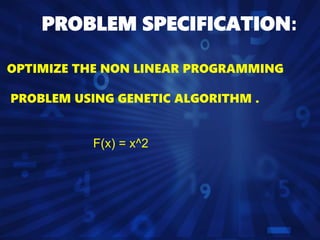
PROBLEM SPECIFICATION:
OPTIMIZE THE NON LINEAR PROGRAMMING
PROBLEM USING GENETIC ALGORITHM .
F(x) = x^2
HOW GENETIC ALGORITHM WORKS ?
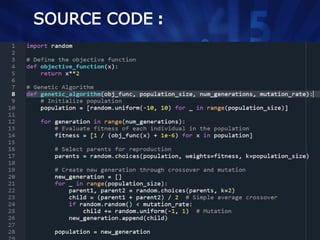
SOURCE CODE :
• .
OUTPUT :-
ADVANTAGES OF GENETIC ALGORITHM
• 1. EXPLORATION OF SEARCH SPACE
• 2. FLEXIBILITY
• 3. ADAPTABILITY
• 4.PARALLEL PROCESSING
• 5.GLOBAL OPTIMISATION
DISADVANTAGES OF GENETIC ALGORITHM
• 1. COMPUTATIONAL COMPLEXITY
• 2. DIFFICULTY IN TUNING PARAMETERS
• 3. DEPENDENCE ON RANDOMNESS
• 4. RISK OF PREMATURE CONVERGENCE
• 5. LIMITED UNDERSTANDING OF RESULTS
CONCLUSION :-
GENETIC ALGORITHMS ARE A VERSATILE
OPTIMIZATION TECHNIQUE THAT CAN FIND
SOLUTIONS TO A WIDE RANGE OF COMPLEX
PROBLEMS . THEY ARE PARTICULARLY USEFUL
WHEN OTHER OPTIMIZATION METHODS MAY
NOT BE SUITABLE OR WHEN AN ANALYTICAL
SOLUTION IS NOT READILY AVAILABLE.
THANK YOU

computer programing to solve unconstrained non linear program

  • 1.
    MATHS PRESENTATION PRESENTED BY:- GAURAV DEV PIYUSHPAREWA VAIBHAV HARSH LAVKUSH JATAV DEPARTMENT OF ELECTRICAL ENGINEERING IN THE GUIDANCE OF :- Dr. PRIYANKA ASHOK HARJULE [Ass.proffessor (mathematics)]
  • 2.
    CONENT :- 1] Introduction 2]Problem specification 3] Solution of the problem 4] Source code 5] Advantages and disadvantages of genetic algorithm 6] Conclusion
  • 3.
    PROJECT DESCRIPTION Computer programfor solving a unconstrained Nonlinear Programming problem through any of the metaheuristic algorithm.
  • 4.
    GENETIC ALGORITHM • GeneticAlgorithms are intelligent search techniques maintaining a population of candidate solutions for a given problem and search the solution space by applying variation operators.
  • 5.
    What is GeneticAlgorithm? •The genetic algorithm is a method for solving both constrained and unconstrained optimization problems that is based on natural selection, the process that drives biological evolution. The genetic algorithm repeatedly modifies a population of individual solutions. At each step, the genetic algorithm selects individuals from the current population to be parents and uses them to produce the children for the next generation. Over successive generations, the population "evolves" toward an optimal solution. •
  • 6.
    PROBLEM SPECIFICATION: OPTIMIZE THENON LINEAR PROGRAMMING PROBLEM USING GENETIC ALGORITHM . F(x) = x^2
  • 7.
  • 8.
  • 9.
  • 10.
  • 11.
    ADVANTAGES OF GENETICALGORITHM • 1. EXPLORATION OF SEARCH SPACE • 2. FLEXIBILITY • 3. ADAPTABILITY • 4.PARALLEL PROCESSING • 5.GLOBAL OPTIMISATION
  • 12.
    DISADVANTAGES OF GENETICALGORITHM • 1. COMPUTATIONAL COMPLEXITY • 2. DIFFICULTY IN TUNING PARAMETERS • 3. DEPENDENCE ON RANDOMNESS • 4. RISK OF PREMATURE CONVERGENCE • 5. LIMITED UNDERSTANDING OF RESULTS
  • 13.
    CONCLUSION :- GENETIC ALGORITHMSARE A VERSATILE OPTIMIZATION TECHNIQUE THAT CAN FIND SOLUTIONS TO A WIDE RANGE OF COMPLEX PROBLEMS . THEY ARE PARTICULARLY USEFUL WHEN OTHER OPTIMIZATION METHODS MAY NOT BE SUITABLE OR WHEN AN ANALYTICAL SOLUTION IS NOT READILY AVAILABLE.
  • 14.