COMPUTER LANGUAGES
TRANSLATERS
and
LANGUAGE
Human Language Commonly Used to Express Feelings and understand
other person expression and emotions. It can be oral or gestural kind of
Communication
WHAT IS COMPUTER LANGUAGE
• A Computer language is a formal language that specifies a set of instructions that can
be used to produce various kinds of output. Programming languages generally consist of
instructions for a computer. Computer languages can be used to create programs that
implement specific algorithms.
TYPES OF COMPUTER LANGUAGE
1. LOW-LEVEL LANGUAGE
2. HIGH-LEVEL LANGUAGE
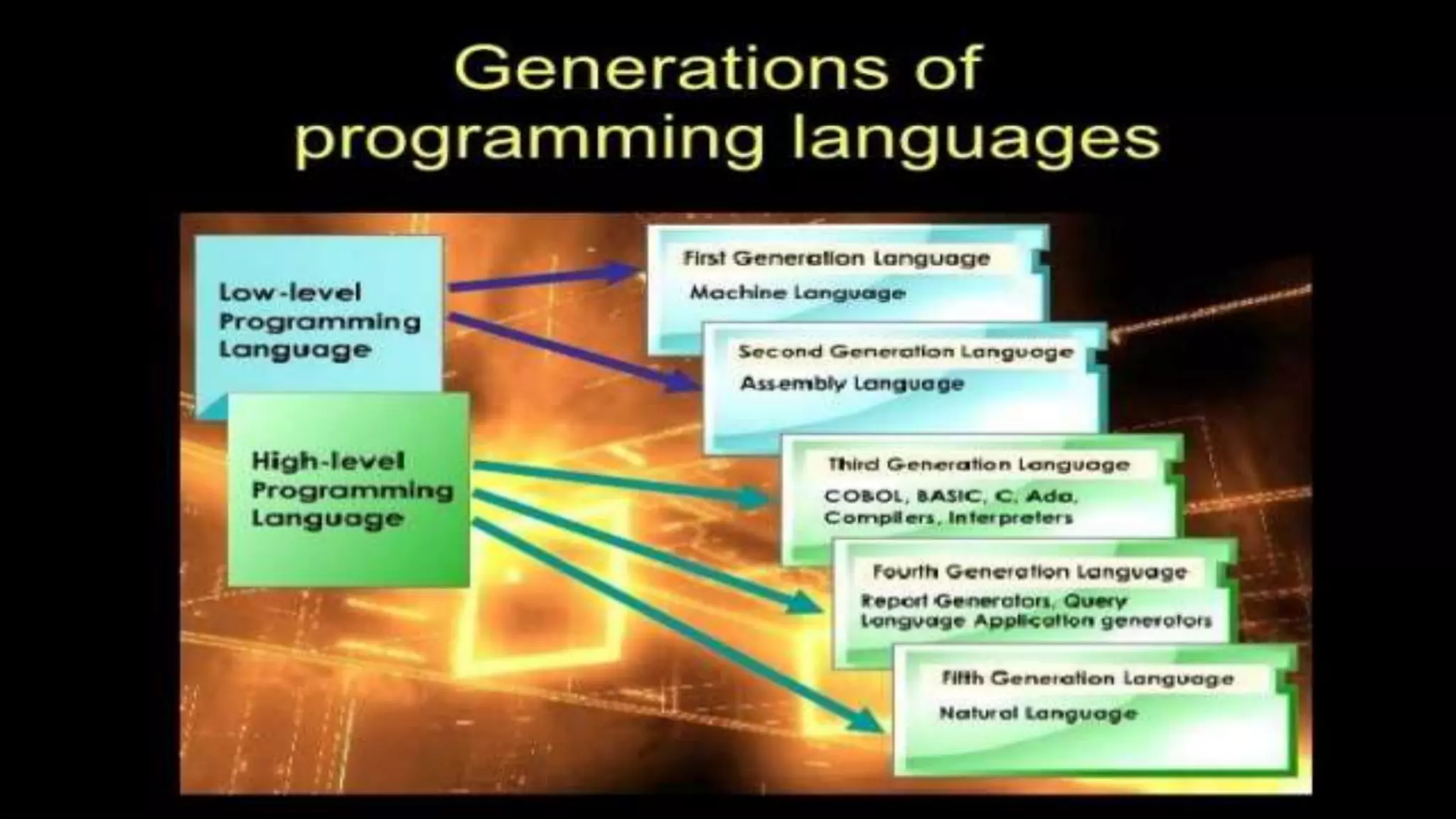
There are two types of computer language:
LOW-LEVEL LANGUAGE
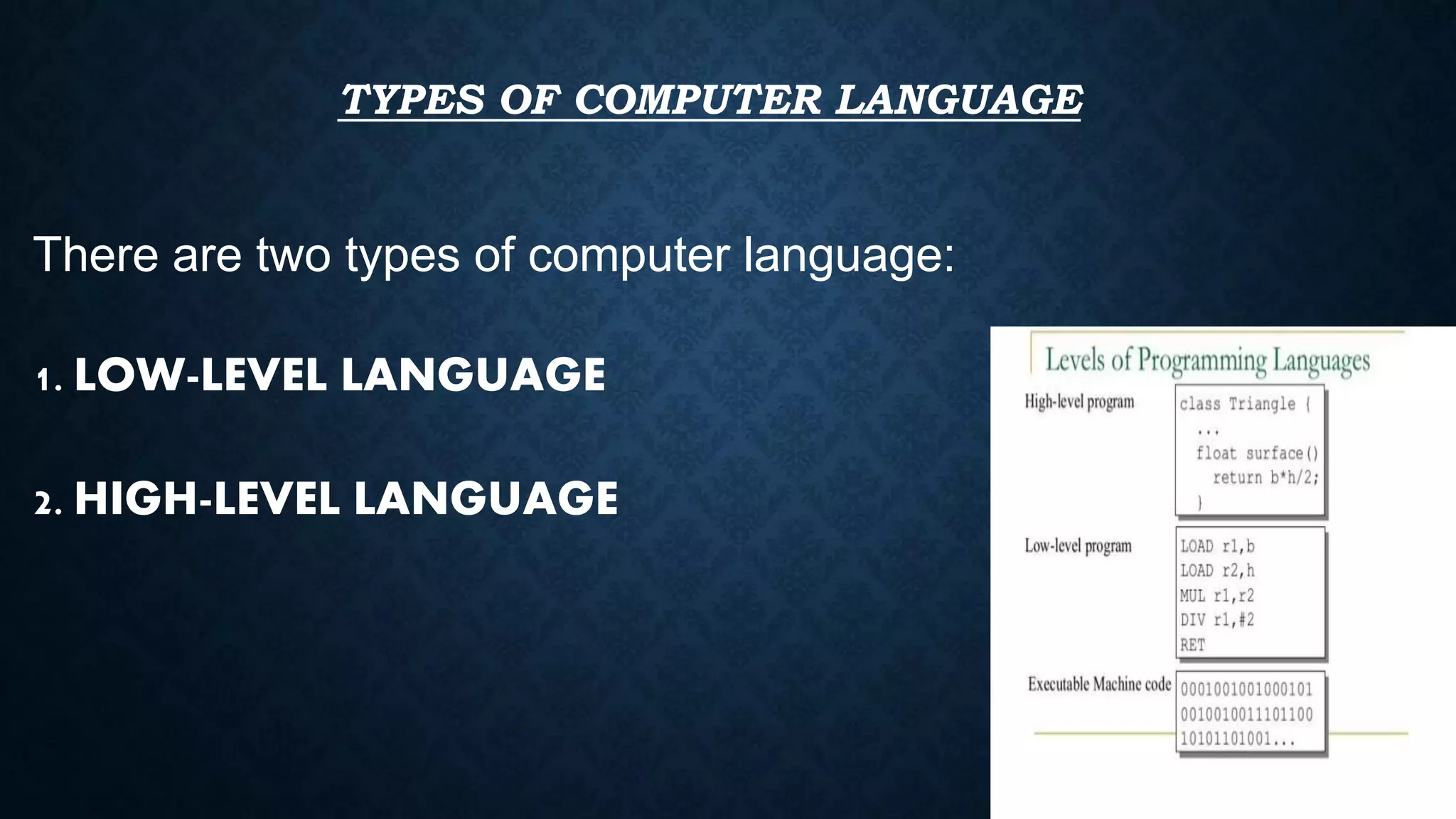
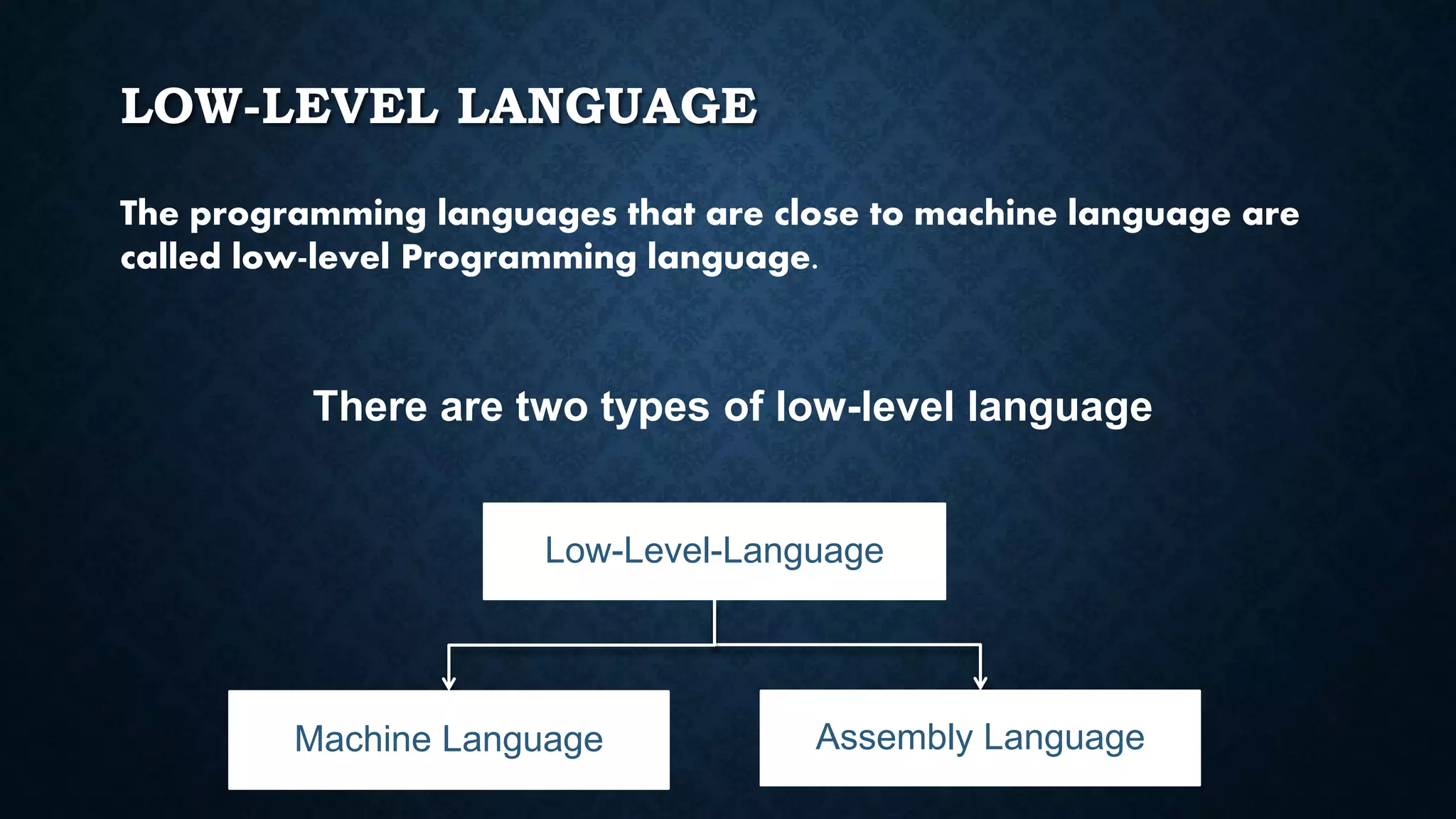
The programming languages that are close to machine language are
called low-level Programming language.
There are two types of low-level language
Low-Level-Language
Machine Language Assembly Language
MACHINE LANGUAGE
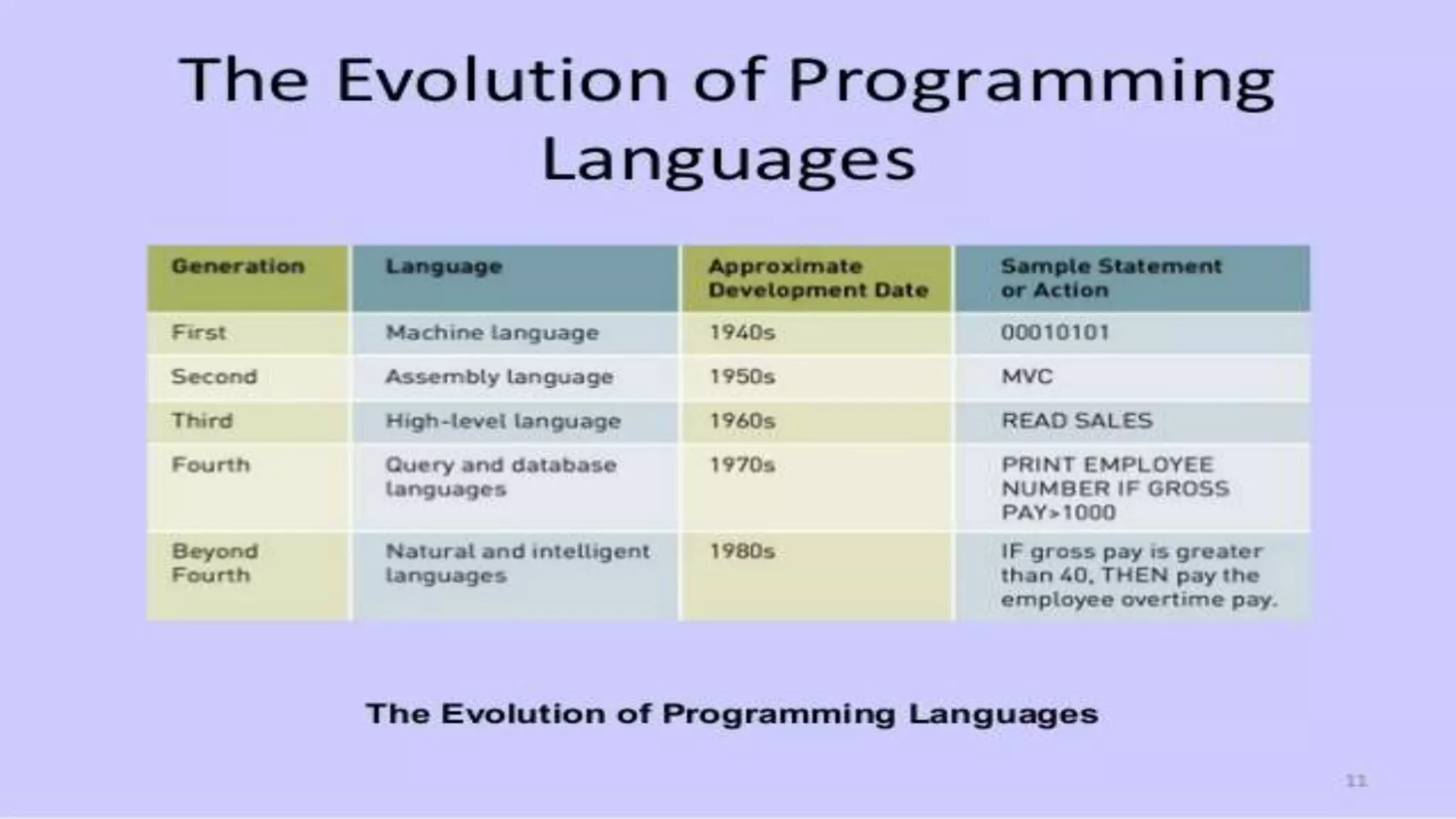
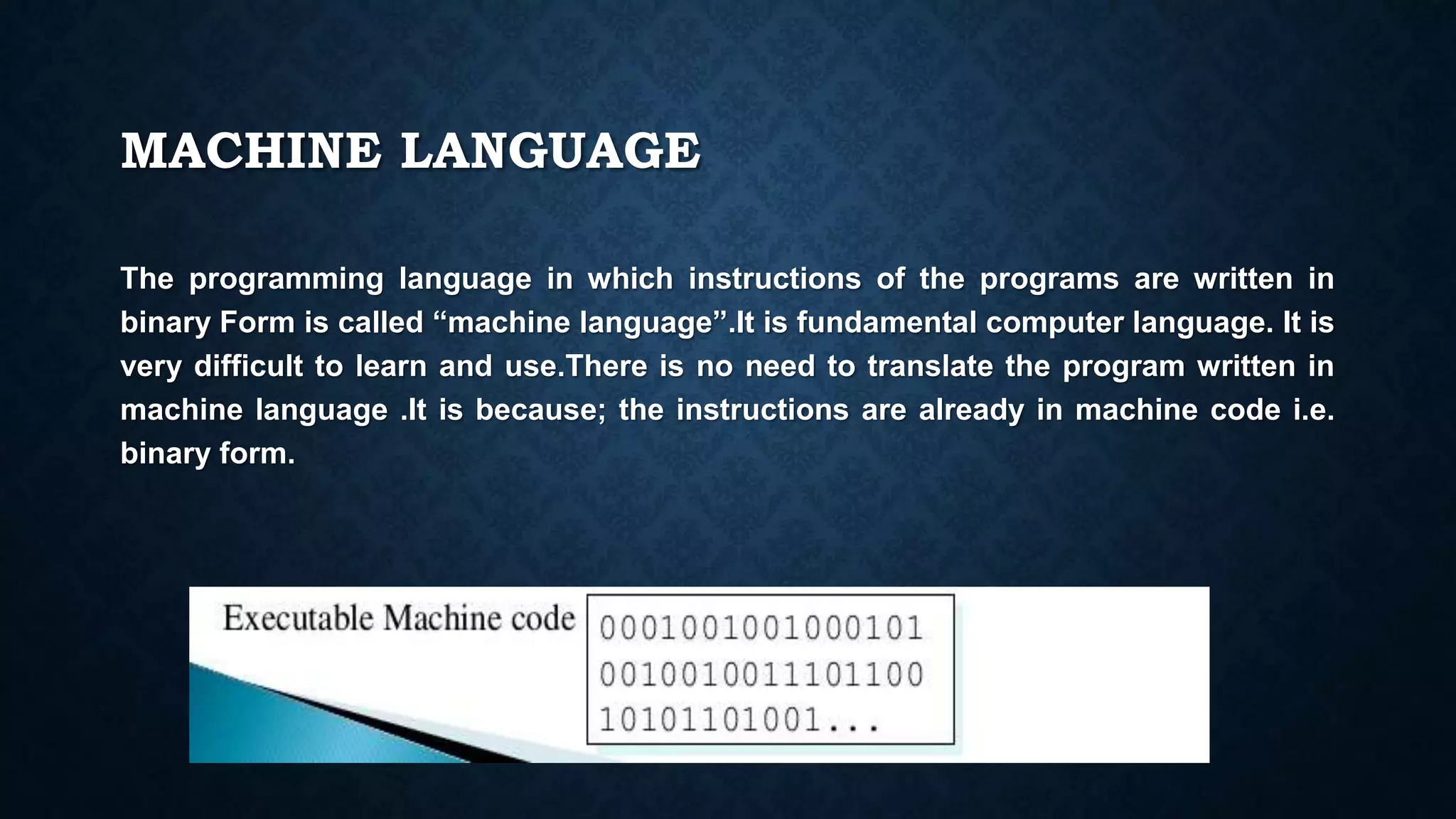
The programming language in which instructions of the programs are written in
binary Form is called “machine language”.It is fundamental computer language. It is
very difficult to learn and use.There is no need to translate the program written in
machine language .It is because; the instructions are already in machine code i.e.
binary form.
ASSEMBLY LANGUAGE
The programming language in which instructions of the programs are written in
Symbols or English like words, is called “assembly language". Assembly language
was developed to make the programming task easier.it is very easy to learn than
“machine language". This language is usually used for writing system software and
firmware. In assembly language, symbols(or English like words) are used to write
program instruction, these symbols are known as “mnemonics”. For example , the
add instruction is written as “ADD SUB MUL AND” .
ADVANTAGES OF LOW-LEVEL LANGUAGE
• Programs developed using low level languages are fast and memory efficient.
• Programmers can utilize processor and memory in better way using a low level
language.
• There is no need of any compiler or interpreters to translate the source to machine code.
Thus, cuts the compilation and interpretation time.
• Low level languages provide direct manipulation of computer registers and storage.
• It can directly communicate with hardware devices.
DISADVANTAGES OF LOW-LEVEL LANGUAGE
• Programs developed using low level languages are machine dependent and are not
portable.
• It is difficult to develop, debug and maintain.
• Low level programs are more error prone.
• Low level programming usually results in poor programming productivity.
• Programmer must have additional knowledge of the computer architecture of particular
machine, for programming in low level language.
HIGH-LEVEL LANGUAGE
The programming languages that are close to human languages are called “high-
level language”. The program instructions written in these programming Languages
are similar to English language. These languages are easy to learn.
Some commonly used high-level language are as following:
 C/C++
 FORTRAN
 COBOL
 JAVA
 PASCAL
 BASIC
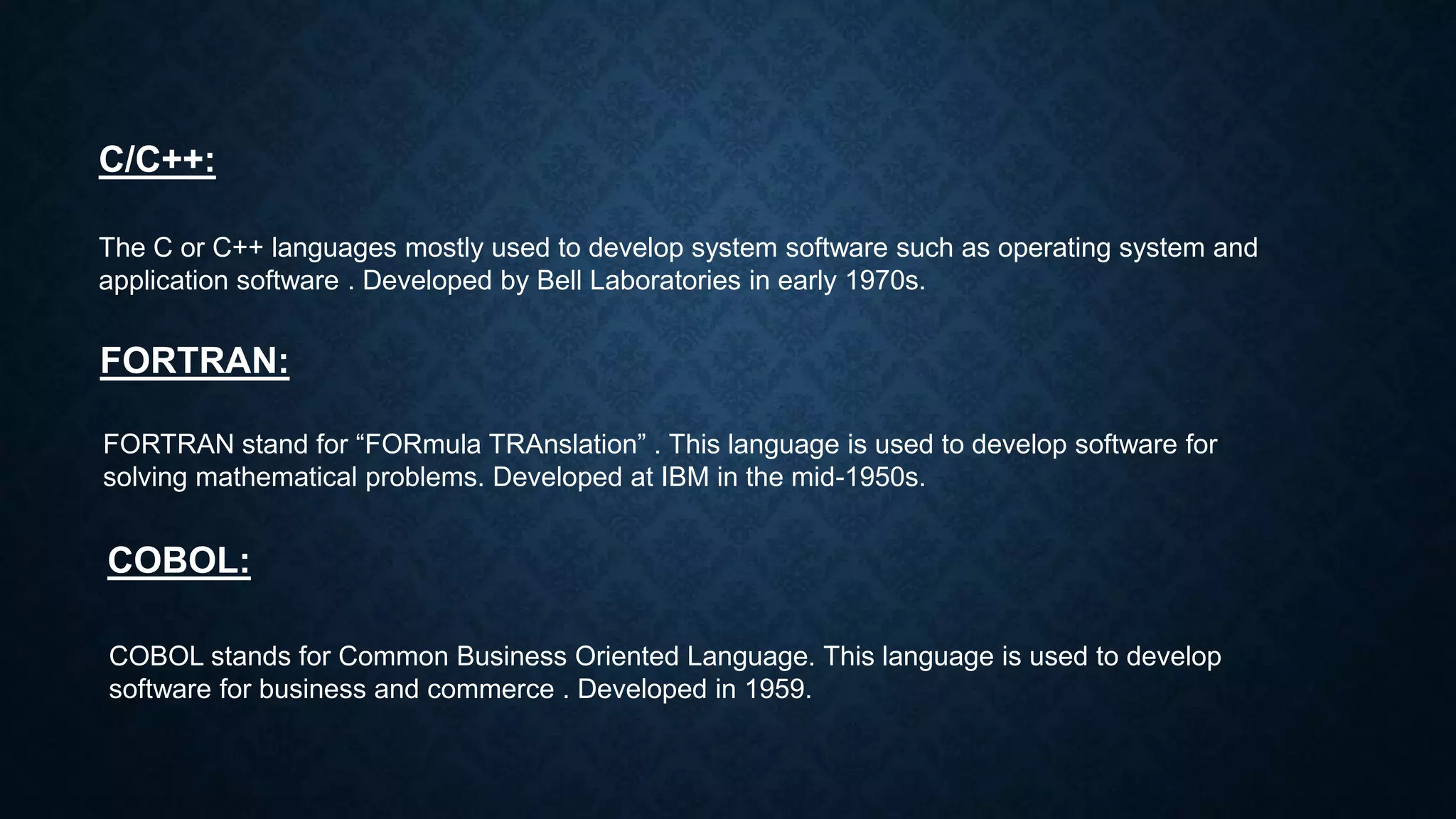
C/C++:
The C or C++ languages mostly used to develop system software such as operating system and
application software . Developed by Bell Laboratories in early 1970s.
FORTRAN:
FORTRAN stand for “FORmula TRAnslation” . This language is used to develop software for
solving mathematical problems. Developed at IBM in the mid-1950s.
COBOL:
COBOL stands for Common Business Oriented Language. This language is used to develop
software for business and commerce . Developed in 1959.
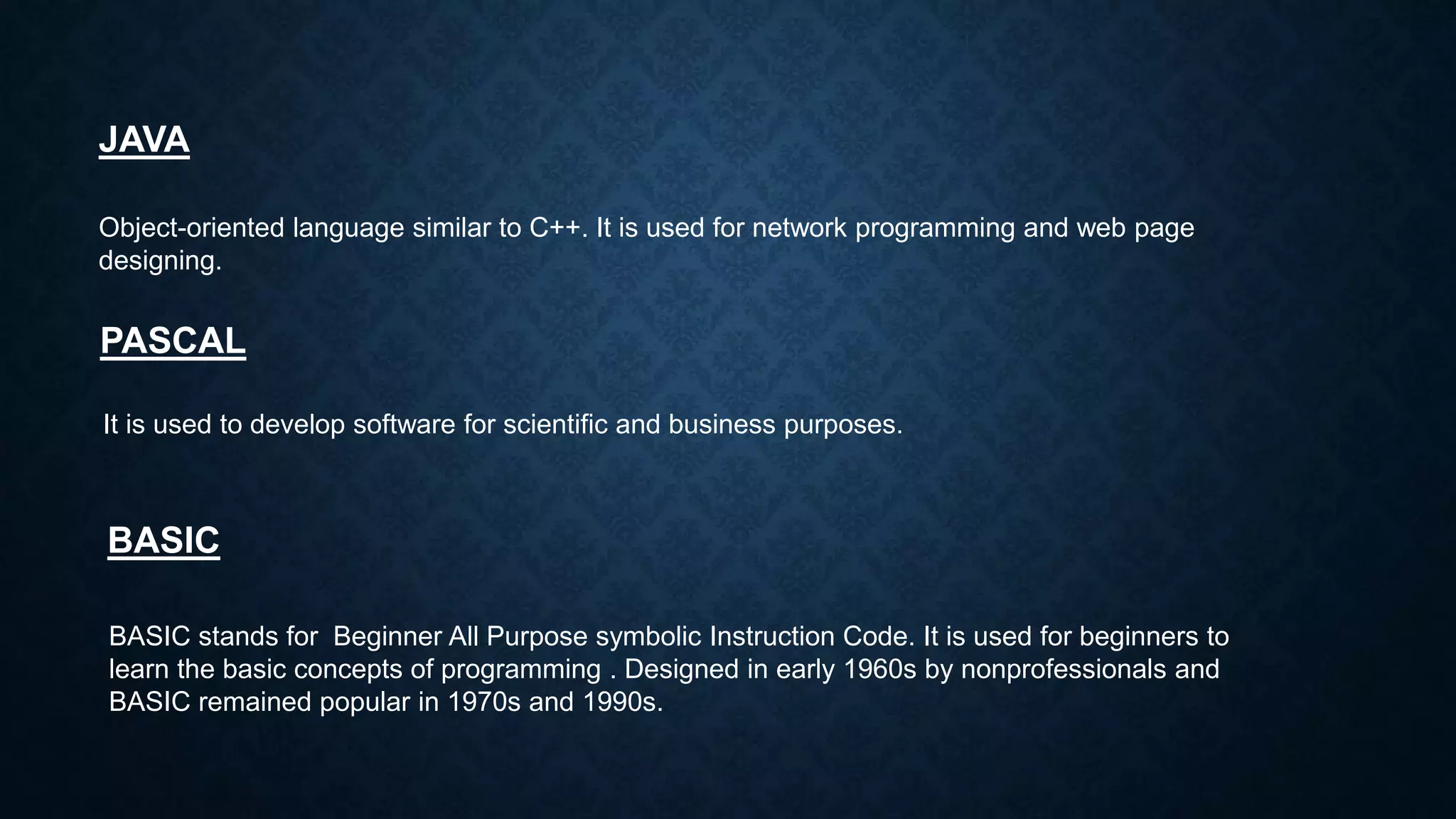
JAVA
Object-oriented language similar to C++. It is used for network programming and web page
designing.
PASCAL
It is used to develop software for scientific and business purposes.
BASIC
BASIC stands for Beginner All Purpose symbolic Instruction Code. It is used for beginners to
learn the basic concepts of programming . Designed in early 1960s by nonprofessionals and
BASIC remained popular in 1970s and 1990s.
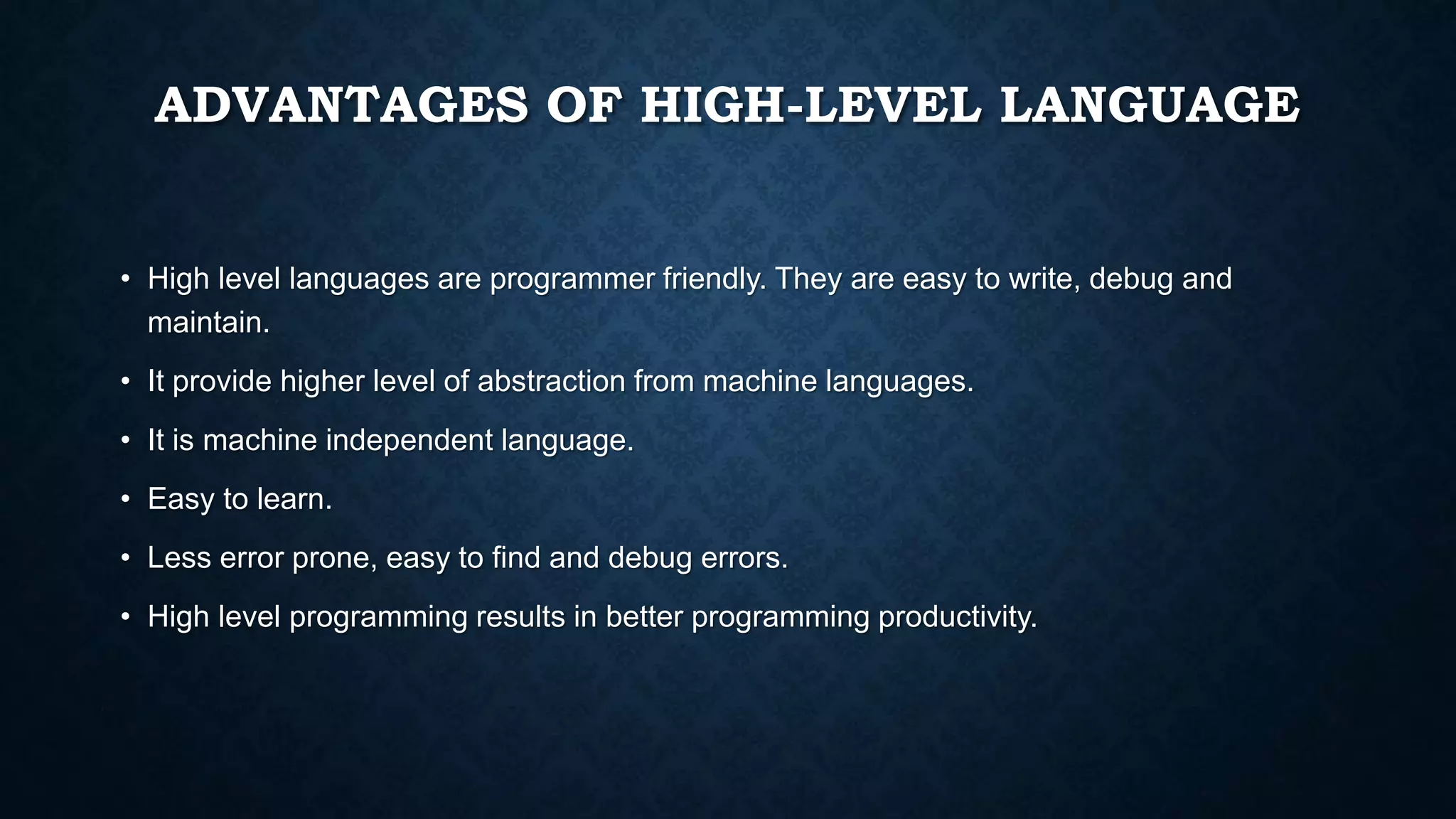
ADVANTAGES OF HIGH-LEVEL LANGUAGE
• High level languages are programmer friendly. They are easy to write, debug and
maintain.
• It provide higher level of abstraction from machine languages.
• It is machine independent language.
• Easy to learn.
• Less error prone, easy to find and debug errors.
• High level programming results in better programming productivity.
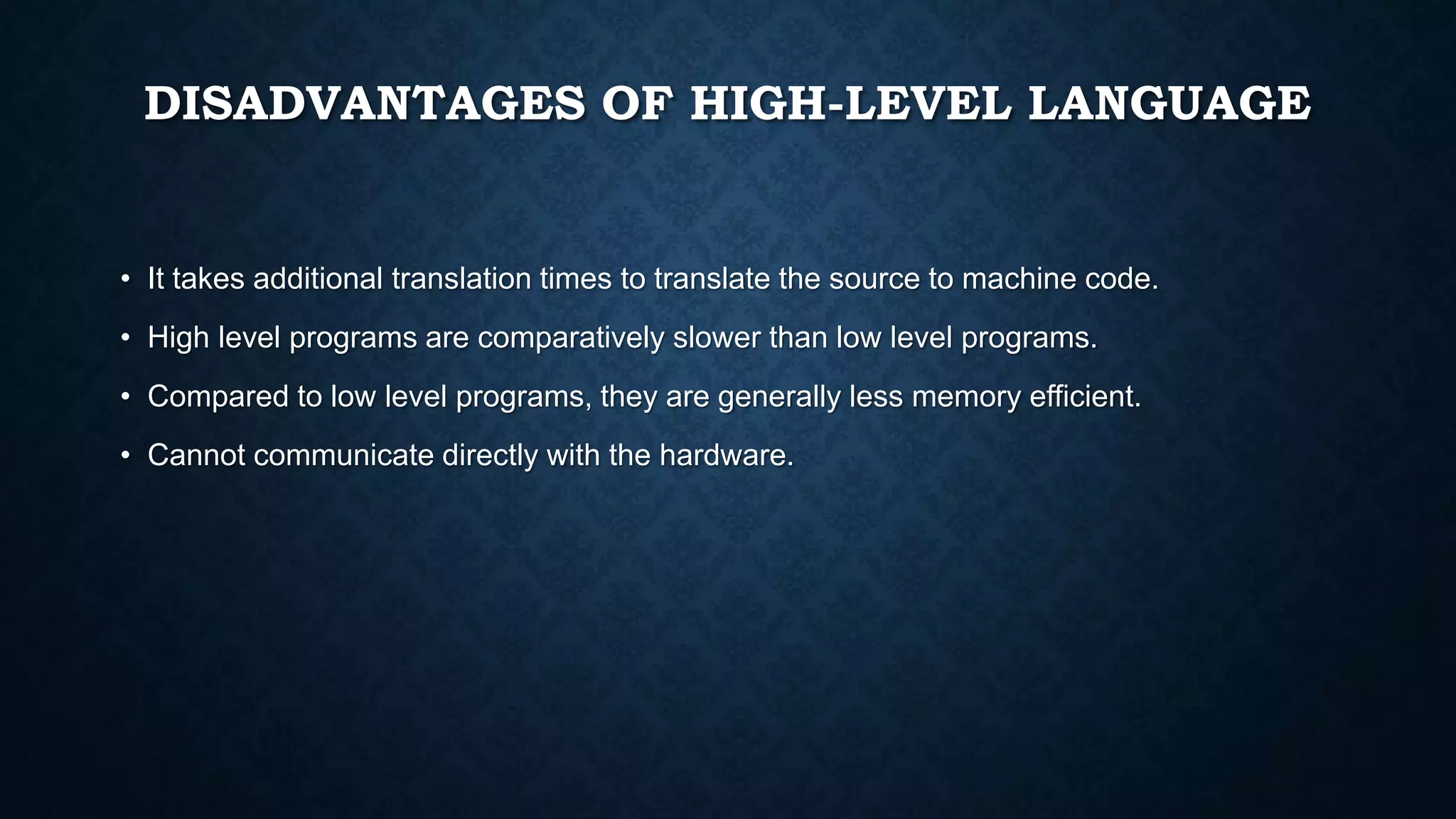
DISADVANTAGES OF HIGH-LEVEL LANGUAGE
• It takes additional translation times to translate the source to machine code.
• High level programs are comparatively slower than low level programs.
• Compared to low level programs, they are generally less memory efficient.
• Cannot communicate directly with the hardware.
LANGUAGE TRANSLATORS
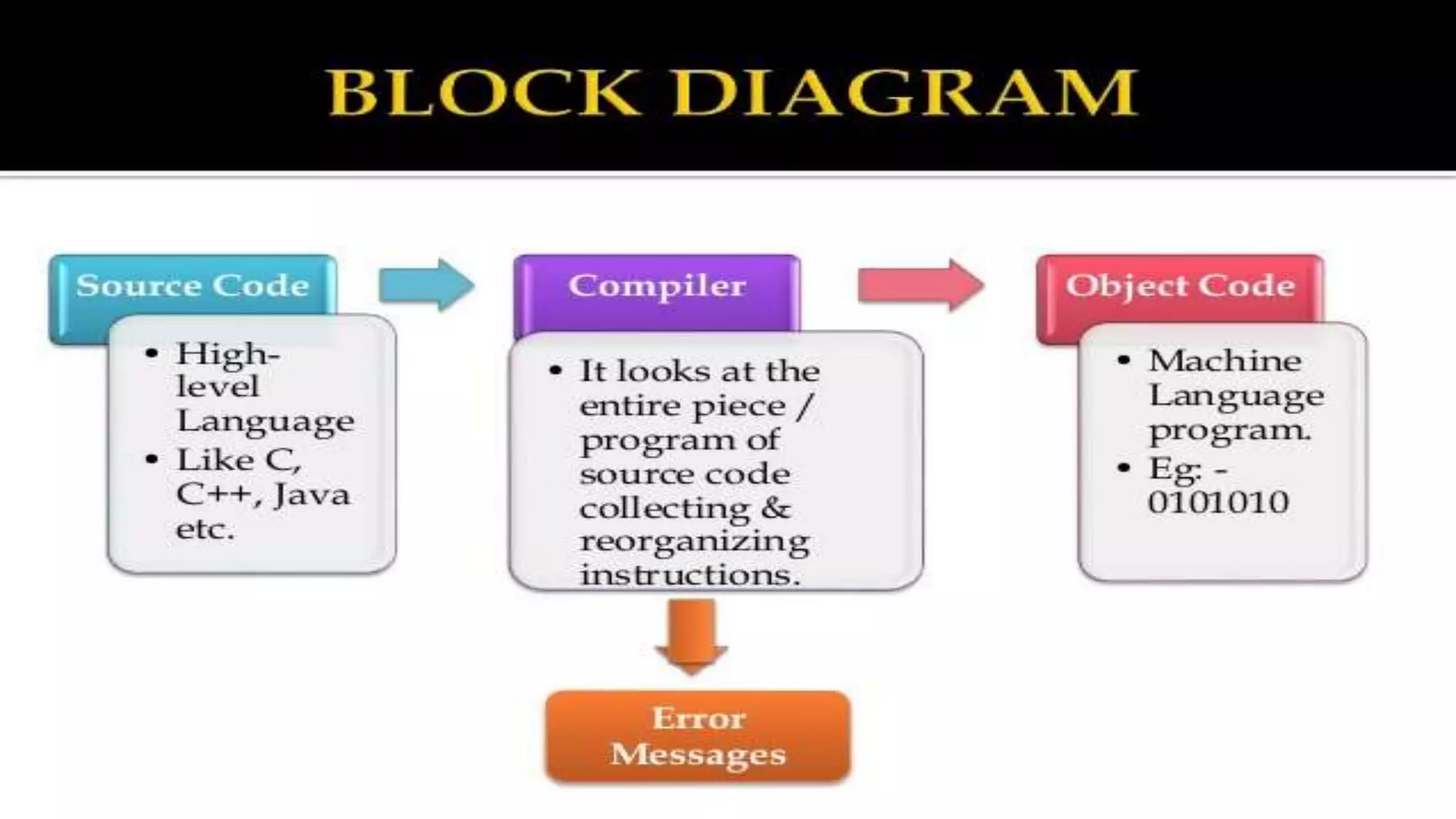
SOURCE CODE:
The program instruction written by following rules of any high-
level language. The source code is like English statement.
OBJECT CODE:
The translated program into machine code the source code
must be translated into machine code. Because the computer
only understand instructions in machine code.
WHY WE USE TRANSLATORS
Computer can only understand binary form and that is 0,1 ,so we have to
convert HLL into machine language. Therefore we use translators.
WHAT IS LANGUAGE TRANSLATORS:
A type of system software that is used to translate the program written in high-level
language (or assembly language) into machine code is called “language translator". Its
also known as language processor. Every language has its own language translator
program. it is difficult to write computer program directly in machine code. So we use
language translators.
Types of language Translators:
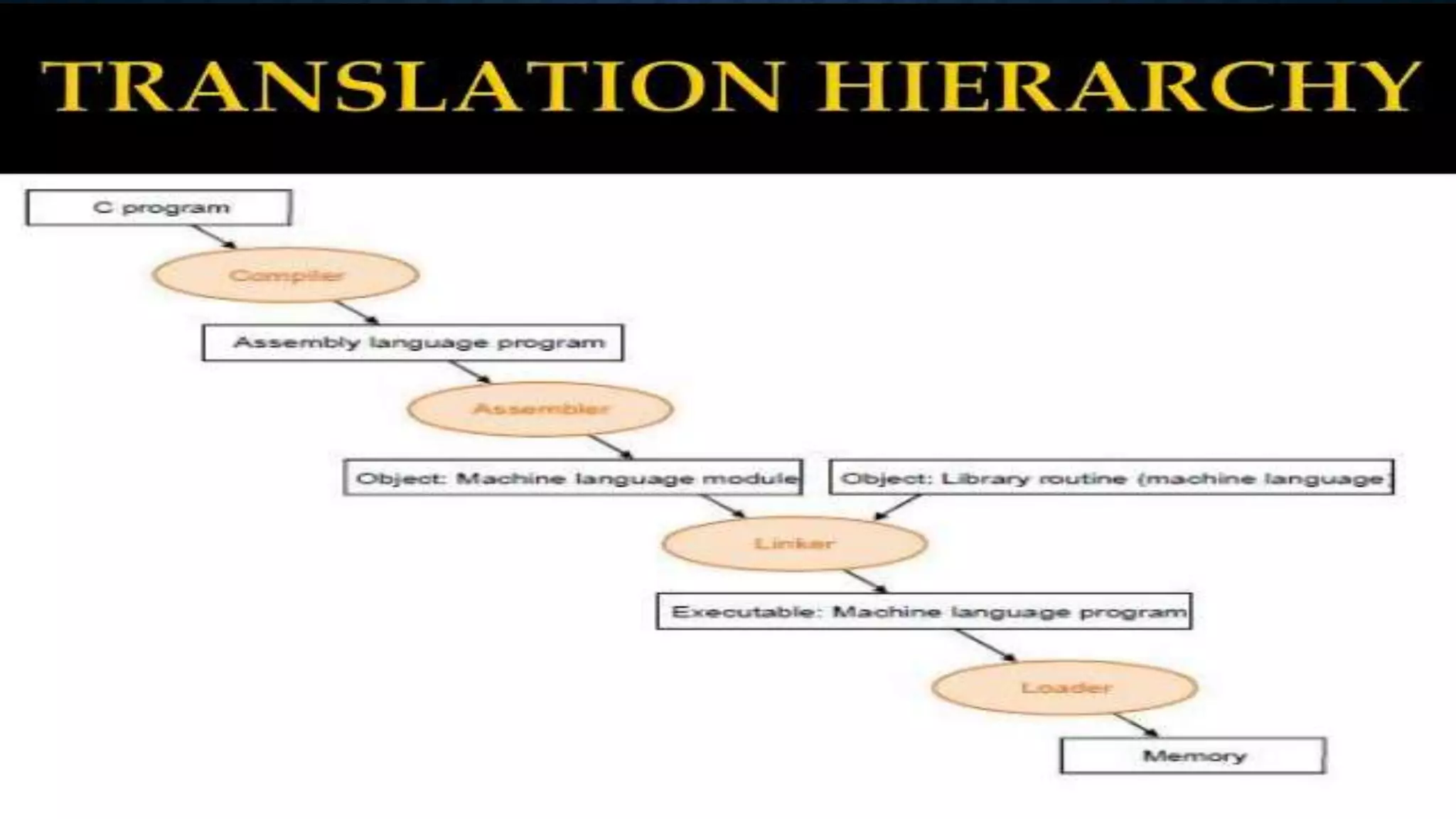
• Compiler
• Interpreter
• Assembler
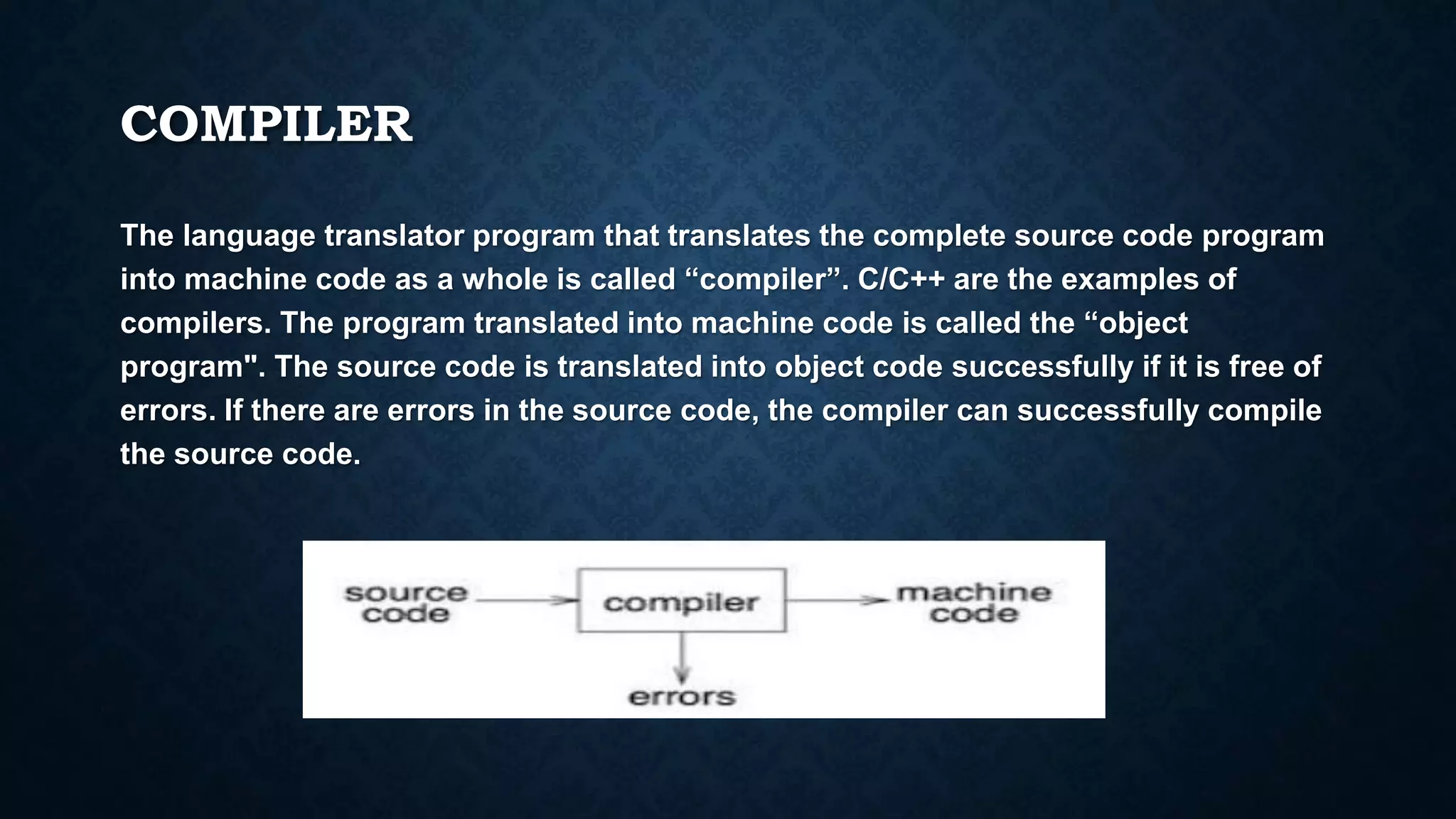
COMPILER
The language translator program that translates the complete source code program
into machine code as a whole is called “compiler”. C/C++ are the examples of
compilers. The program translated into machine code is called the “object
program". The source code is translated into object code successfully if it is free of
errors. If there are errors in the source code, the compiler can successfully compile
the source code.
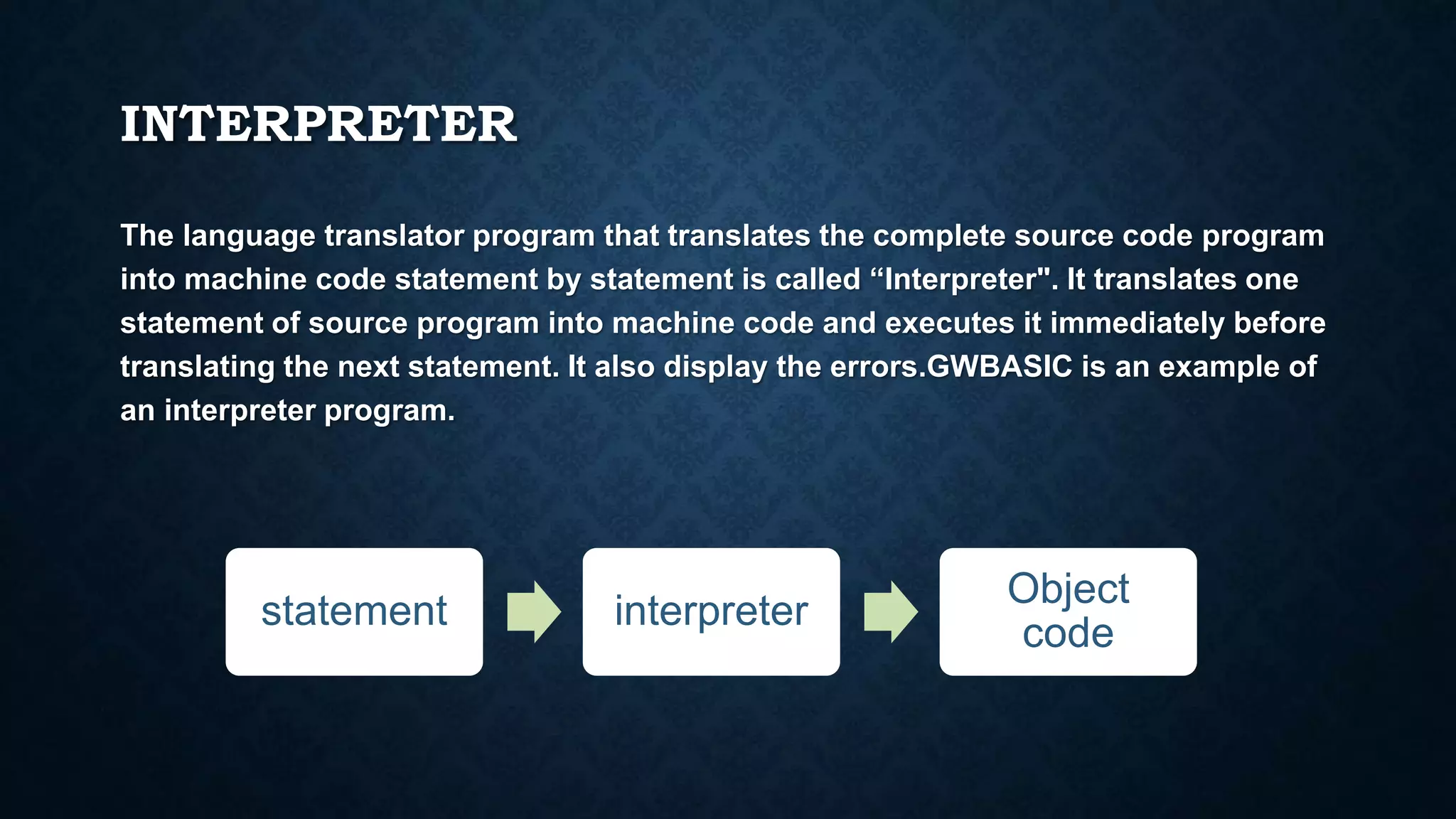
INTERPRETER
The language translator program that translates the complete source code program
into machine code statement by statement is called “Interpreter". It translates one
statement of source program into machine code and executes it immediately before
translating the next statement. It also display the errors.GWBASIC is an example of
an interpreter program.
statement interpreter
Object
code
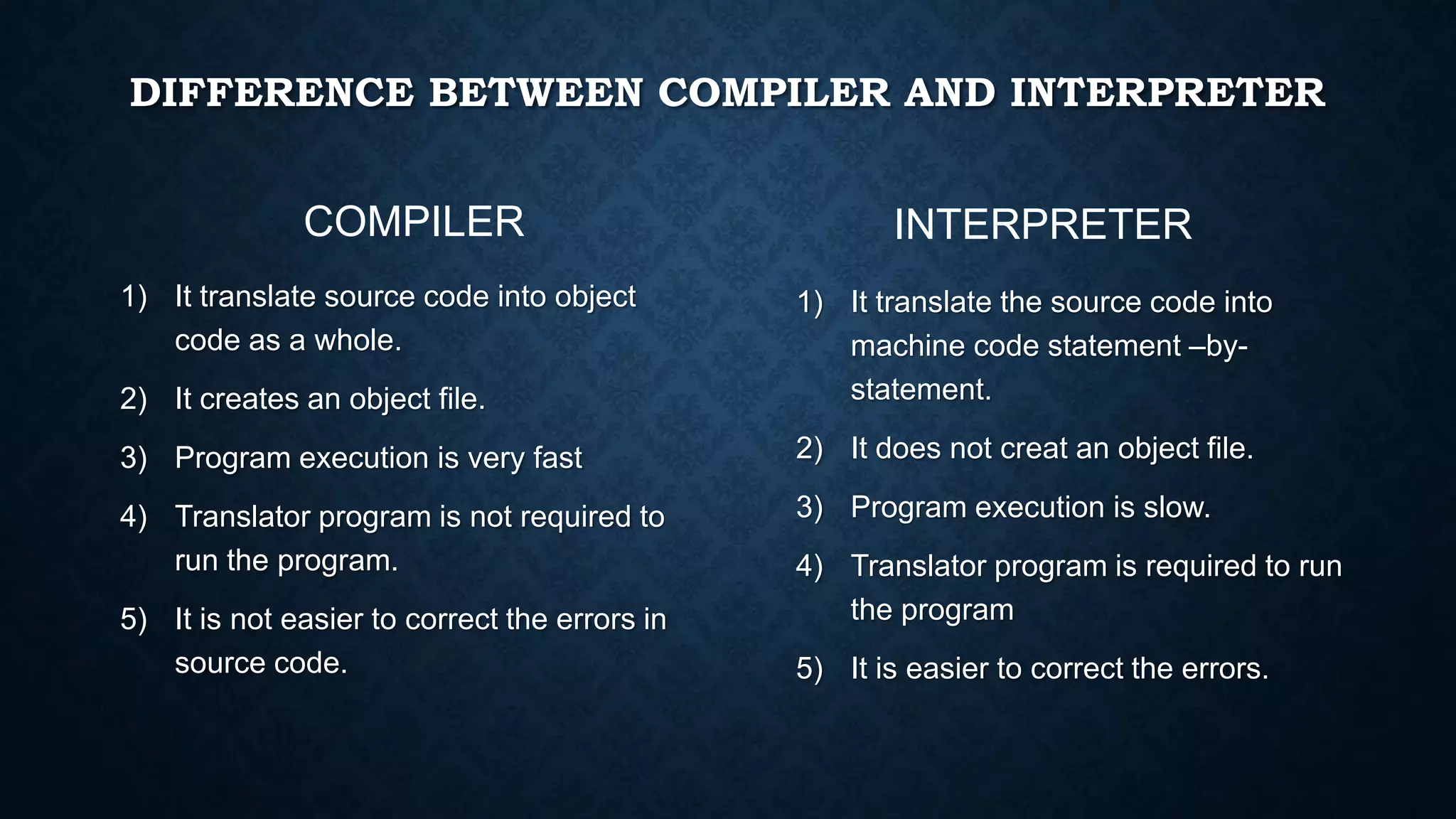
DIFFERENCE BETWEEN COMPILER AND INTERPRETER
1) It translate source code into object
code as a whole.
2) It creates an object file.
3) Program execution is very fast
4) Translator program is not required to
run the program.
5) It is not easier to correct the errors in
source code.
1) It translate the source code into
machine code statement –by-
statement.
2) It does not creat an object file.
3) Program execution is slow.
4) Translator program is required to run
the program
5) It is easier to correct the errors.
COMPILER INTERPRETER
ASSEMBLER
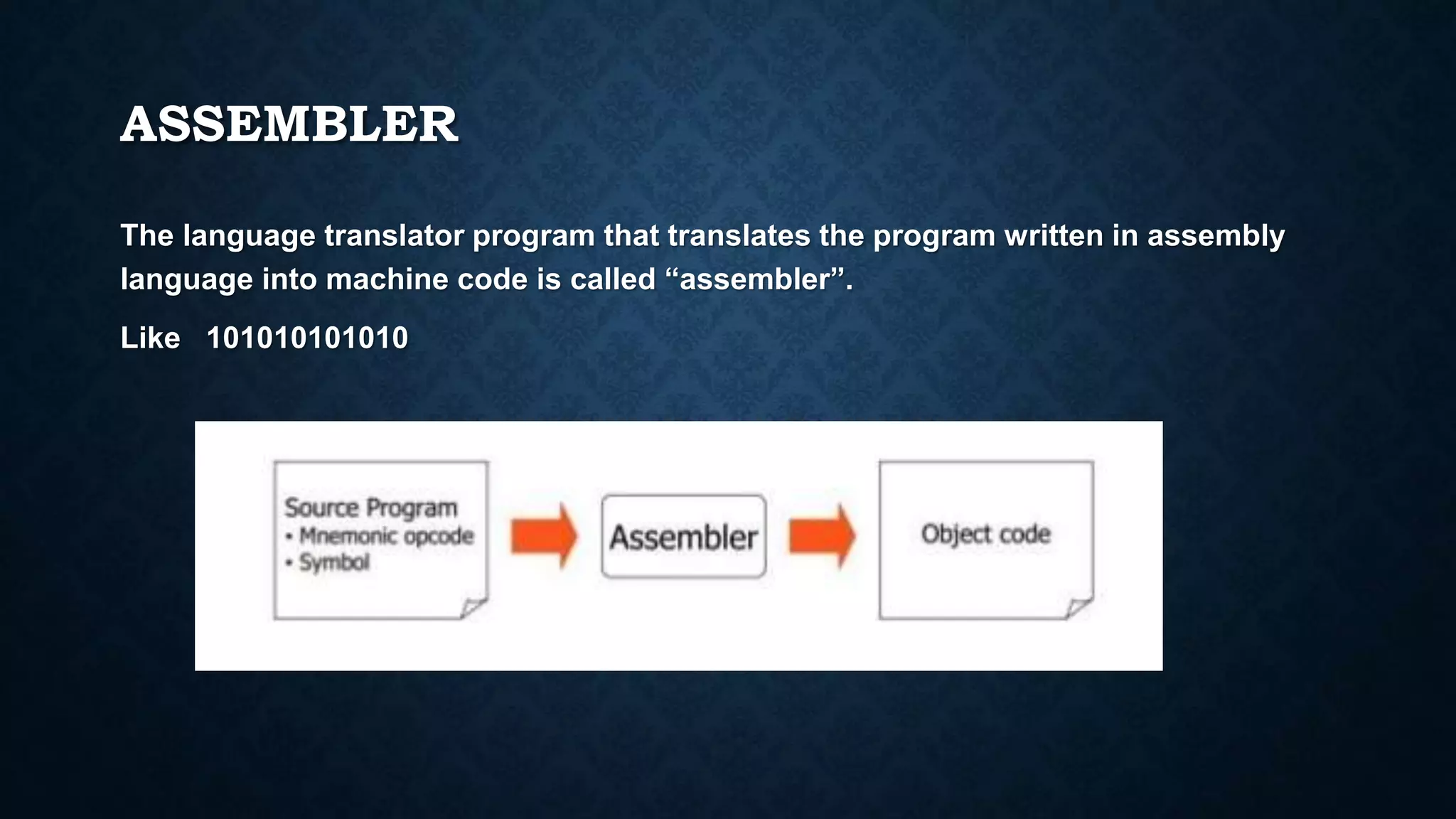
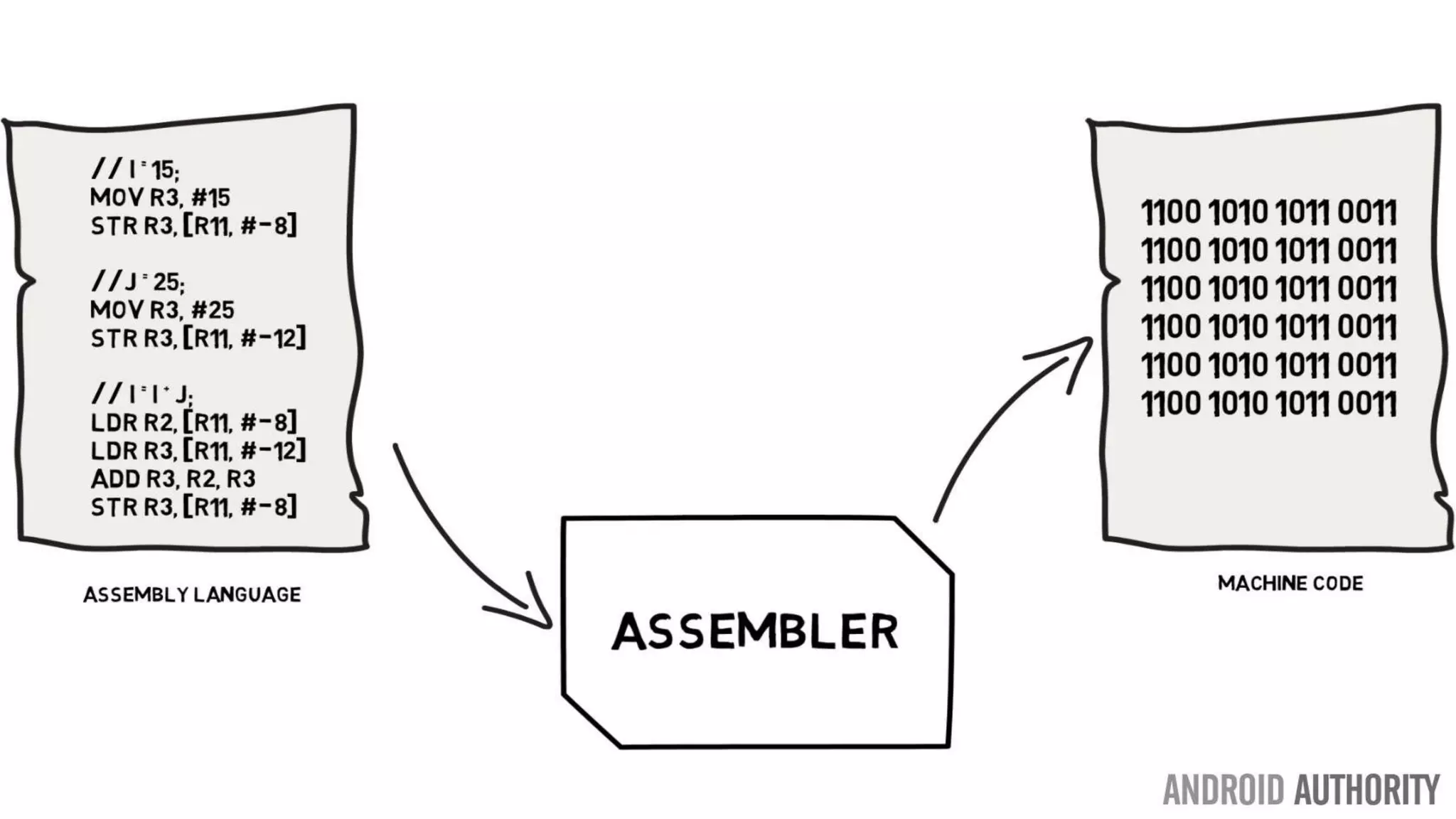
The language translator program that translates the program written in assembly
language into machine code is called “assembler”.
Like 101010101010
WORKING OF ASSEMBLER
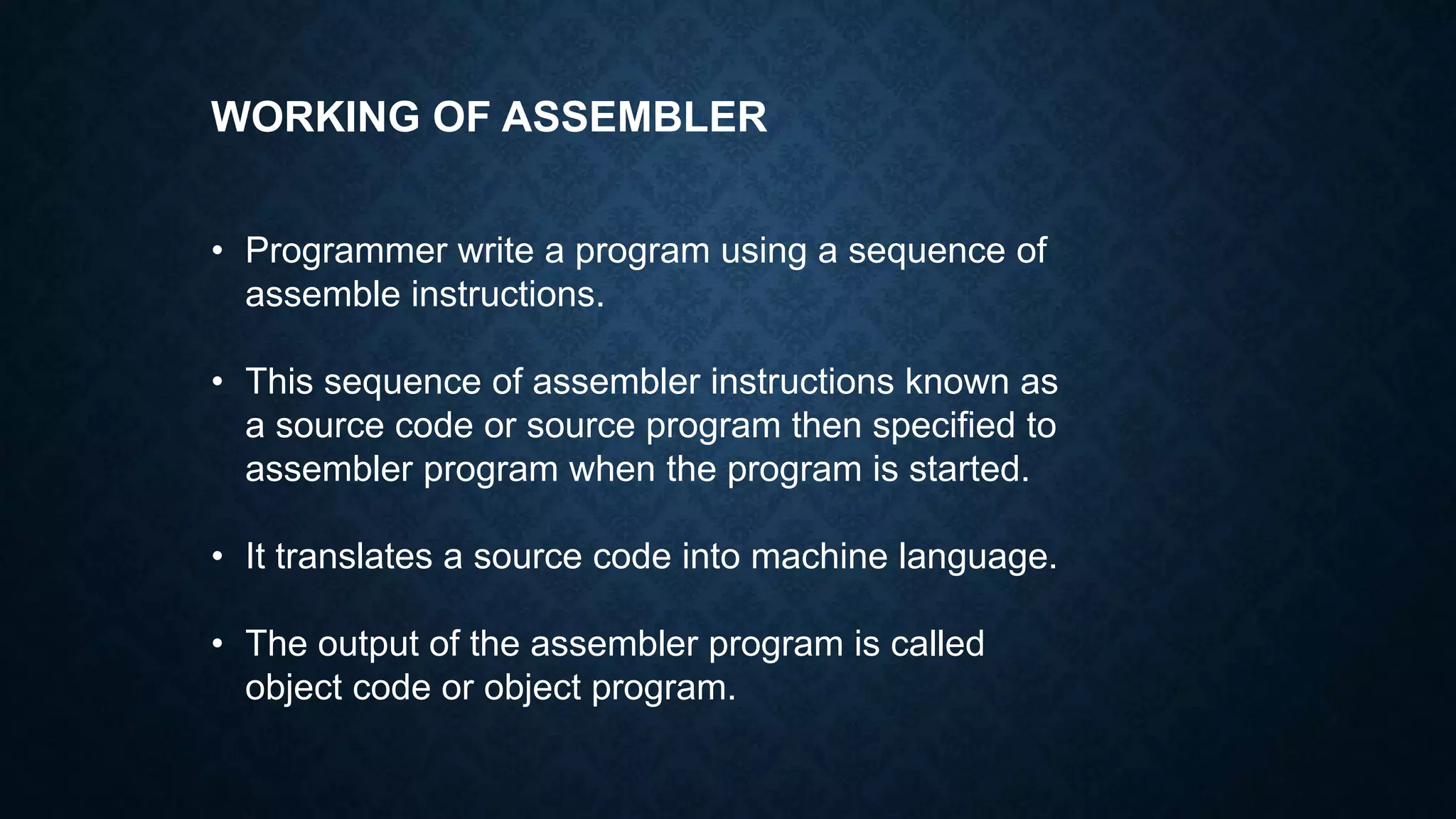
• Programmer write a program using a sequence of
assemble instructions.
• This sequence of assembler instructions known as
a source code or source program then specified to
assembler program when the program is started.
• It translates a source code into machine language.
• The output of the assembler program is called
object code or object program.
TYPES OF ASSEMBLER:
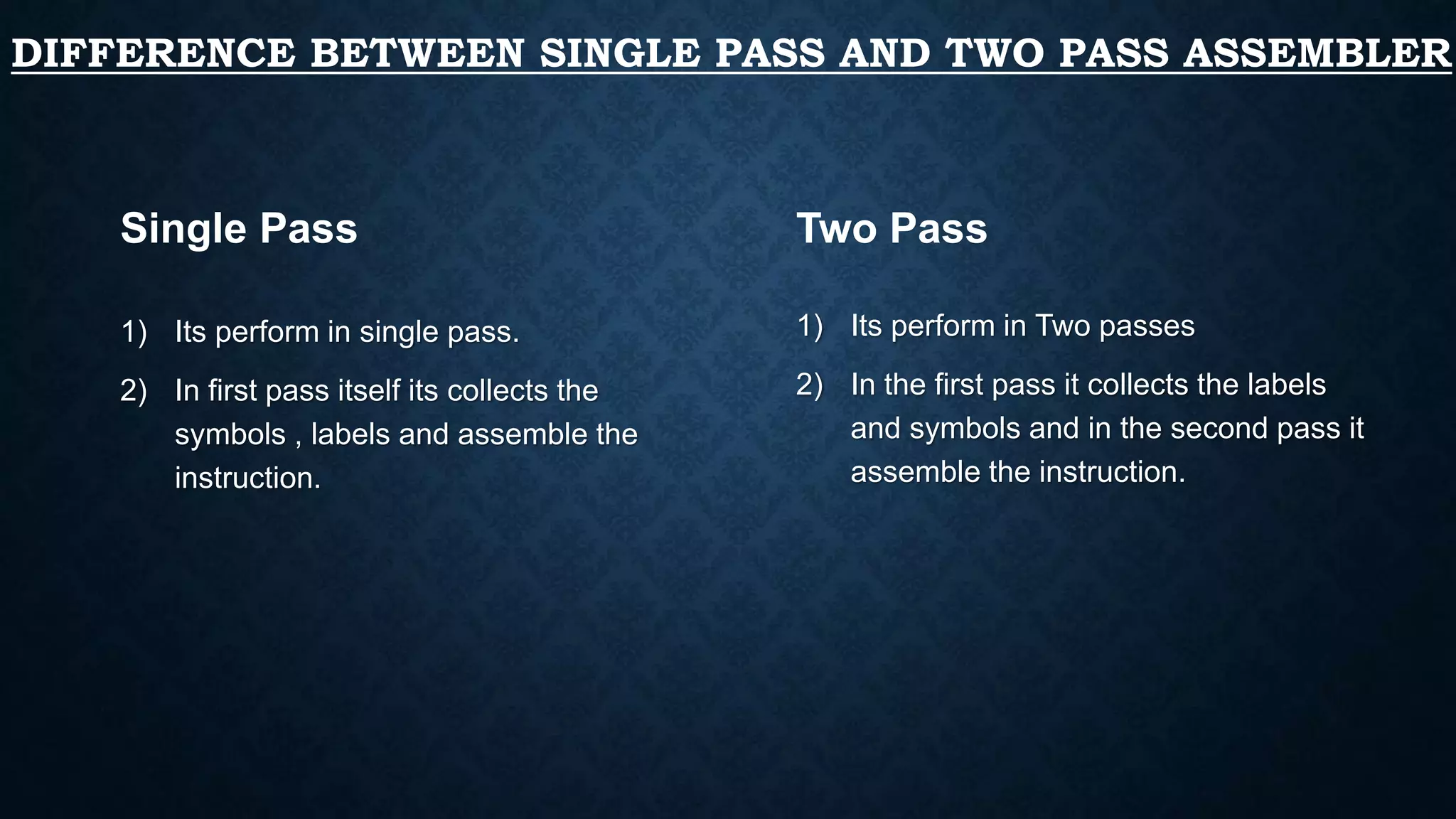
 Single pass assembler
 Two pass assembler
DIFFERENCE BETWEEN SINGLE PASS AND TWO PASS ASSEMBLER
1) Its perform in single pass.
2) In first pass itself its collects the
symbols , labels and assemble the
instruction.
1) Its perform in Two passes
2) In the first pass it collects the labels
and symbols and in the second pass it
assemble the instruction.
Single Pass Two Pass
If you have any kind of questions
…so you can ask us right now.
Computer language

Computer language

  • 2.
  • 3.
    LANGUAGE Human Language CommonlyUsed to Express Feelings and understand other person expression and emotions. It can be oral or gestural kind of Communication
  • 4.
    WHAT IS COMPUTERLANGUAGE • A Computer language is a formal language that specifies a set of instructions that can be used to produce various kinds of output. Programming languages generally consist of instructions for a computer. Computer languages can be used to create programs that implement specific algorithms.
  • 5.
    TYPES OF COMPUTERLANGUAGE 1. LOW-LEVEL LANGUAGE 2. HIGH-LEVEL LANGUAGE There are two types of computer language:
  • 8.
    LOW-LEVEL LANGUAGE The programminglanguages that are close to machine language are called low-level Programming language. There are two types of low-level language Low-Level-Language Machine Language Assembly Language
  • 9.
    MACHINE LANGUAGE The programminglanguage in which instructions of the programs are written in binary Form is called “machine language”.It is fundamental computer language. It is very difficult to learn and use.There is no need to translate the program written in machine language .It is because; the instructions are already in machine code i.e. binary form.
  • 10.
    ASSEMBLY LANGUAGE The programminglanguage in which instructions of the programs are written in Symbols or English like words, is called “assembly language". Assembly language was developed to make the programming task easier.it is very easy to learn than “machine language". This language is usually used for writing system software and firmware. In assembly language, symbols(or English like words) are used to write program instruction, these symbols are known as “mnemonics”. For example , the add instruction is written as “ADD SUB MUL AND” .
  • 11.
    ADVANTAGES OF LOW-LEVELLANGUAGE • Programs developed using low level languages are fast and memory efficient. • Programmers can utilize processor and memory in better way using a low level language. • There is no need of any compiler or interpreters to translate the source to machine code. Thus, cuts the compilation and interpretation time. • Low level languages provide direct manipulation of computer registers and storage. • It can directly communicate with hardware devices.
  • 12.
    DISADVANTAGES OF LOW-LEVELLANGUAGE • Programs developed using low level languages are machine dependent and are not portable. • It is difficult to develop, debug and maintain. • Low level programs are more error prone. • Low level programming usually results in poor programming productivity. • Programmer must have additional knowledge of the computer architecture of particular machine, for programming in low level language.
  • 13.
    HIGH-LEVEL LANGUAGE The programminglanguages that are close to human languages are called “high- level language”. The program instructions written in these programming Languages are similar to English language. These languages are easy to learn. Some commonly used high-level language are as following:  C/C++  FORTRAN  COBOL  JAVA  PASCAL  BASIC
  • 14.
    C/C++: The C orC++ languages mostly used to develop system software such as operating system and application software . Developed by Bell Laboratories in early 1970s. FORTRAN: FORTRAN stand for “FORmula TRAnslation” . This language is used to develop software for solving mathematical problems. Developed at IBM in the mid-1950s. COBOL: COBOL stands for Common Business Oriented Language. This language is used to develop software for business and commerce . Developed in 1959.
  • 15.
    JAVA Object-oriented language similarto C++. It is used for network programming and web page designing. PASCAL It is used to develop software for scientific and business purposes. BASIC BASIC stands for Beginner All Purpose symbolic Instruction Code. It is used for beginners to learn the basic concepts of programming . Designed in early 1960s by nonprofessionals and BASIC remained popular in 1970s and 1990s.
  • 16.
    ADVANTAGES OF HIGH-LEVELLANGUAGE • High level languages are programmer friendly. They are easy to write, debug and maintain. • It provide higher level of abstraction from machine languages. • It is machine independent language. • Easy to learn. • Less error prone, easy to find and debug errors. • High level programming results in better programming productivity.
  • 17.
    DISADVANTAGES OF HIGH-LEVELLANGUAGE • It takes additional translation times to translate the source to machine code. • High level programs are comparatively slower than low level programs. • Compared to low level programs, they are generally less memory efficient. • Cannot communicate directly with the hardware.
  • 18.
  • 19.
    SOURCE CODE: The programinstruction written by following rules of any high- level language. The source code is like English statement. OBJECT CODE: The translated program into machine code the source code must be translated into machine code. Because the computer only understand instructions in machine code.
  • 20.
    WHY WE USETRANSLATORS Computer can only understand binary form and that is 0,1 ,so we have to convert HLL into machine language. Therefore we use translators.
  • 21.
    WHAT IS LANGUAGETRANSLATORS: A type of system software that is used to translate the program written in high-level language (or assembly language) into machine code is called “language translator". Its also known as language processor. Every language has its own language translator program. it is difficult to write computer program directly in machine code. So we use language translators.
  • 23.
    Types of languageTranslators: • Compiler • Interpreter • Assembler
  • 24.
    COMPILER The language translatorprogram that translates the complete source code program into machine code as a whole is called “compiler”. C/C++ are the examples of compilers. The program translated into machine code is called the “object program". The source code is translated into object code successfully if it is free of errors. If there are errors in the source code, the compiler can successfully compile the source code.

  • 26.
    INTERPRETER The language translatorprogram that translates the complete source code program into machine code statement by statement is called “Interpreter". It translates one statement of source program into machine code and executes it immediately before translating the next statement. It also display the errors.GWBASIC is an example of an interpreter program. statement interpreter Object code
  • 27.
    DIFFERENCE BETWEEN COMPILERAND INTERPRETER 1) It translate source code into object code as a whole. 2) It creates an object file. 3) Program execution is very fast 4) Translator program is not required to run the program. 5) It is not easier to correct the errors in source code. 1) It translate the source code into machine code statement –by- statement. 2) It does not creat an object file. 3) Program execution is slow. 4) Translator program is required to run the program 5) It is easier to correct the errors. COMPILER INTERPRETER

  • 28.
    ASSEMBLER The language translatorprogram that translates the program written in assembly language into machine code is called “assembler”. Like 101010101010
  • 29.
    WORKING OF ASSEMBLER •Programmer write a program using a sequence of assemble instructions. • This sequence of assembler instructions known as a source code or source program then specified to assembler program when the program is started. • It translates a source code into machine language. • The output of the assembler program is called object code or object program.
  • 31.
    TYPES OF ASSEMBLER: Single pass assembler  Two pass assembler
  • 32.
    DIFFERENCE BETWEEN SINGLEPASS AND TWO PASS ASSEMBLER 1) Its perform in single pass. 2) In first pass itself its collects the symbols , labels and assemble the instruction. 1) Its perform in Two passes 2) In the first pass it collects the labels and symbols and in the second pass it assemble the instruction. Single Pass Two Pass
  • 33.
    If you haveany kind of questions …so you can ask us right now.