© AIR LAW ACADEMY & RESEARCH CENTRE,
NAGPUR
1
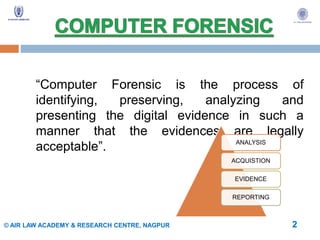
“Computer Forensic is the process of
identifying, preserving, analyzing and
presenting the digital evidence in such a
manner that the evidences are legally
acceptable”. ANALYSIS
ACQUISTION
EVIDENCE
REPORTING
© AIR LAW ACADEMY & RESEARCH CENTRE, NAGPUR 2
 To find out the criminal which is directly or
indirectly related to cyber world.
 To find out the digital evidence.
 Presenting evidences in a manner that legal
action of the criminal.
© AIR LAW ACADEMY & RESEARCH CENTRE, NAGPUR 3
 Employee internet abuse
 Unauthorized disclosure of corporate information.
 Industrial espionage
 Damage assessment
 Criminal fraud and deception cases
© AIR LAW ACADEMY & RESEARCH CENTRE, NAGPUR 4
 Criminal Prosecutors: Rely on evidence
obtained from a computer to prosecute suspects
and use as evidence.
 Civil Litigations: Personal and business data
discovered on a computer can be used in fraud,
harassment, or discrimination cases.
© AIR LAW ACADEMY & RESEARCH CENTRE, NAGPUR 5
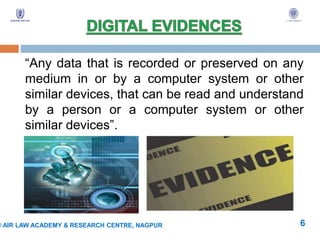
“Any data that is recorded or preserved on any
medium in or by a computer system or other
similar devices, that can be read and understand
by a person or a computer system or other
similar devices”.
© AIR LAW ACADEMY & RESEARCH CENTRE, NAGPUR 6
 Persistent Data: Data that remains unaffected
when the computer is turned off.
Example: Hard Drive and storage media.
 Volatile Data: Data that would be lost if the
computer is turned off.
Example: Deleted files, computer history, the
computer’s registry, temporary files and web
browsing history.
© AIR LAW ACADEMY & RESEARCH CENTRE, NAGPUR 7
 Admissible- Must be able to be used in court or
elsewhere.
 Authentic- Evidence must be relevant to the
case.
 Complete- Must not lack any information.
 Reliable- No question about authenticity.
 Believable- Clear, easy to understand and
believable by a court.
IR LAW ACADEMY & RESEARCH CENTRE, NAGPUR
8
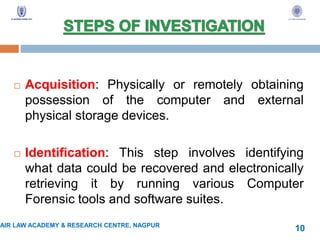
 Find the evidence, where it is stored.
 Find relevant data- recovery.
 Create order of volatility.
 Collect evidence- use tools.
 Good documentation of all the actions
AIR LAW ACADEMY & RESEARCH CENTRE, NAGPUR
9
 Acquisition: Physically or remotely obtaining
possession of the computer and external
physical storage devices.
 Identification: This step involves identifying
what data could be recovered and electronically
retrieving it by running various Computer
Forensic tools and software suites.
AIR LAW ACADEMY & RESEARCH CENTRE, NAGPUR
10
 Evaluation: Evaluating the data recovered to
determine if and how it could be used again the
suspect for prosecution in court.
 Presentation: Presentation of evidence
discovered in a manner which is understood by
lawyers, no technically staff/management, and
suitable as evidence as determined by laws.
AIR LAW ACADEMY & RESEARCH CENTRE, NAGPUR 11
 Disk imaging software
 Hashing tools
 File recovery programme
 Encryption decoding software
 Password cracking software
AIR LAW ACADEMY & RESEARCH CENTRE, NAGPUR 12
 Proper knowledge of computer.
 Strong computer science fundamentals.
 Strong system administrative skills.
 Knowledge of the latest forensic tools.
© AIR LAW ACADEMY & RESEARCH CENTRE, NAGPUR
13
Digital forensics help to protect from and solve
cases involving:
Theft of intellectual property: This is related to
any act that allow access to customer data and
any confidential information.
Financial Fraud: This is related to anything that
uses fraudulent purchase of victims information
to conduct fraudulent transactions.
AIR LAW ACADEMY & RESEARCH CENTRE, NAGPUR 14
 Digital evidence accepted into court must prove
that there is no tampering.
 Costs- Producing electronic records and
preserving them is extremely costly.
 Legal practitioners must have extensive
computer knowledge.
IR LAW ACADEMY & RESEARCH CENTRE, NAGPUR
15
© AIR LAW ACADEMY & RESEARCH CENTRE, NAGPUR 16
THANK YOU

Computer forensic ppt

  • 1.
    © AIR LAWACADEMY & RESEARCH CENTRE, NAGPUR 1
  • 2.
    “Computer Forensic isthe process of identifying, preserving, analyzing and presenting the digital evidence in such a manner that the evidences are legally acceptable”. ANALYSIS ACQUISTION EVIDENCE REPORTING © AIR LAW ACADEMY & RESEARCH CENTRE, NAGPUR 2
  • 3.
     To findout the criminal which is directly or indirectly related to cyber world.  To find out the digital evidence.  Presenting evidences in a manner that legal action of the criminal. © AIR LAW ACADEMY & RESEARCH CENTRE, NAGPUR 3
  • 4.
     Employee internetabuse  Unauthorized disclosure of corporate information.  Industrial espionage  Damage assessment  Criminal fraud and deception cases © AIR LAW ACADEMY & RESEARCH CENTRE, NAGPUR 4
  • 5.
     Criminal Prosecutors:Rely on evidence obtained from a computer to prosecute suspects and use as evidence.  Civil Litigations: Personal and business data discovered on a computer can be used in fraud, harassment, or discrimination cases. © AIR LAW ACADEMY & RESEARCH CENTRE, NAGPUR 5
  • 6.
    “Any data thatis recorded or preserved on any medium in or by a computer system or other similar devices, that can be read and understand by a person or a computer system or other similar devices”. © AIR LAW ACADEMY & RESEARCH CENTRE, NAGPUR 6
  • 7.
     Persistent Data:Data that remains unaffected when the computer is turned off. Example: Hard Drive and storage media.  Volatile Data: Data that would be lost if the computer is turned off. Example: Deleted files, computer history, the computer’s registry, temporary files and web browsing history. © AIR LAW ACADEMY & RESEARCH CENTRE, NAGPUR 7
  • 8.
     Admissible- Mustbe able to be used in court or elsewhere.  Authentic- Evidence must be relevant to the case.  Complete- Must not lack any information.  Reliable- No question about authenticity.  Believable- Clear, easy to understand and believable by a court. IR LAW ACADEMY & RESEARCH CENTRE, NAGPUR 8
  • 9.
     Find theevidence, where it is stored.  Find relevant data- recovery.  Create order of volatility.  Collect evidence- use tools.  Good documentation of all the actions AIR LAW ACADEMY & RESEARCH CENTRE, NAGPUR 9
  • 10.
     Acquisition: Physicallyor remotely obtaining possession of the computer and external physical storage devices.  Identification: This step involves identifying what data could be recovered and electronically retrieving it by running various Computer Forensic tools and software suites. AIR LAW ACADEMY & RESEARCH CENTRE, NAGPUR 10
  • 11.
     Evaluation: Evaluatingthe data recovered to determine if and how it could be used again the suspect for prosecution in court.  Presentation: Presentation of evidence discovered in a manner which is understood by lawyers, no technically staff/management, and suitable as evidence as determined by laws. AIR LAW ACADEMY & RESEARCH CENTRE, NAGPUR 11
  • 12.
     Disk imagingsoftware  Hashing tools  File recovery programme  Encryption decoding software  Password cracking software AIR LAW ACADEMY & RESEARCH CENTRE, NAGPUR 12
  • 13.
     Proper knowledgeof computer.  Strong computer science fundamentals.  Strong system administrative skills.  Knowledge of the latest forensic tools. © AIR LAW ACADEMY & RESEARCH CENTRE, NAGPUR 13
  • 14.
    Digital forensics helpto protect from and solve cases involving: Theft of intellectual property: This is related to any act that allow access to customer data and any confidential information. Financial Fraud: This is related to anything that uses fraudulent purchase of victims information to conduct fraudulent transactions. AIR LAW ACADEMY & RESEARCH CENTRE, NAGPUR 14
  • 15.
     Digital evidenceaccepted into court must prove that there is no tampering.  Costs- Producing electronic records and preserving them is extremely costly.  Legal practitioners must have extensive computer knowledge. IR LAW ACADEMY & RESEARCH CENTRE, NAGPUR 15
  • 16.
    © AIR LAWACADEMY & RESEARCH CENTRE, NAGPUR 16 THANK YOU